
 321-236-2899

B2B Manufacturing Marketing: The Funnel That Wins RFQs
Most mid-market manufacturers do not have a marketing problem. They have a funnel problem: plenty of activity at the top, almost nothing engineered to turn a curious engineer into a signed RFQ.
Over the years, working alongside industrial brands selling six-figure capital equipment and long-run contract parts, one pattern repeats. The companies that grow are not the ones with the flashiest website. They are the ones whose marketing mirrors how a technical buying committee actually moves from “we have a problem” to “send us a quote.”
For years, manufacturing marketing meant a trade show booth, a catalog, and a relationship with a handful of distributors. That world still exists, but it no longer controls who gets shortlisted.
Today the first impression happens on a screen, during a search an engineer runs at 11pm while diagnosing a problem. The funnel below is how you show up at that moment and stay present until the quote request arrives.
This guide lays out that funnel stage by stage, with the content, channels, and metrics that belong at each one. By the end, you will know exactly where your pipeline leaks and the specific play that plugs it.
Key Takeaways
- B2B manufacturing marketing is a funnel, not a campaign. Awareness, consideration, and the RFQ each need their own content, channel, and metric.
- The buying committee is large and technical. Gartner finds 6 to 10 decision-makers on a typical complex purchase, so one persona and one message will never be enough.
- Buyers self-educate before they ever call you. They spend only about 17% of the journey with suppliers, which means your website and content do most of the selling.
- The bottom of the funnel is where manufacturers lose the most money. A clunky quote process quietly kills deals that marketing worked months to create.
- Measure pipeline, not traffic. With a six-month sales cycle, vanity metrics mislead and attribution has to connect first touch to closed revenue.
What B2B Manufacturing Marketing Actually Is (And Why It Is Different)
B2B manufacturing marketing is the system of attracting, educating, and converting the technical buying committees that specify and purchase industrial products. It covers everything from a plant engineer’s first Google search to the quote request that lands in your inbox.
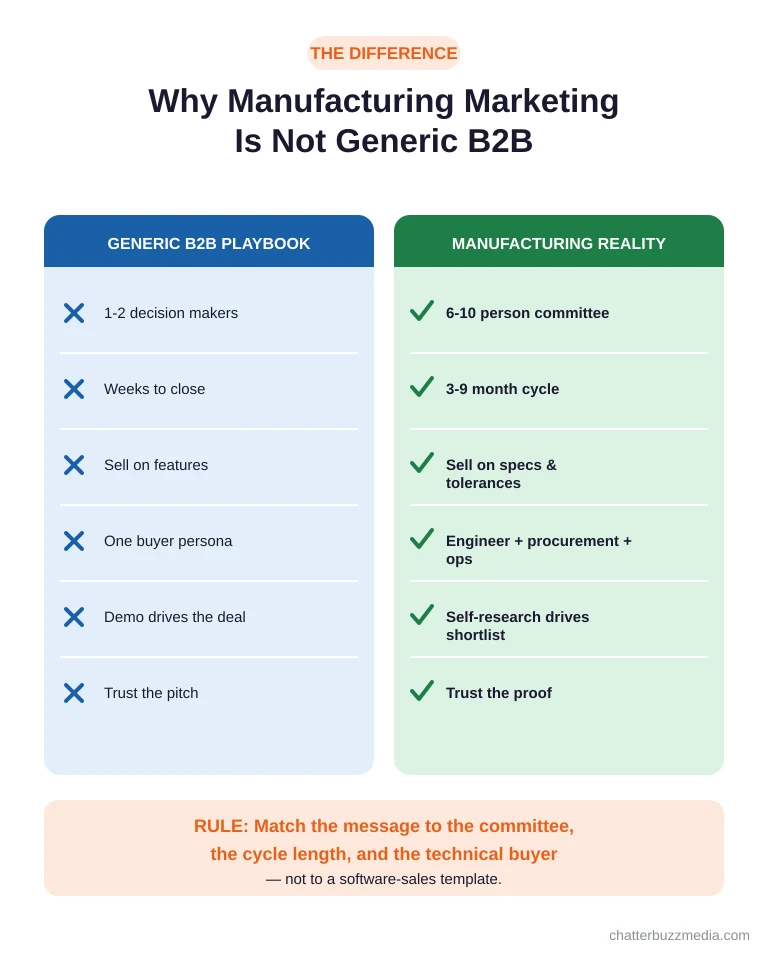
It matters because the way manufacturers are bought has changed faster than the way most of them sell. Buyers now research independently, compare on specification and lead time, and shortlist vendors long before a salesperson is involved.
The difference from ordinary B2B marketing comes down to three things: the complexity of the product, the size of the committee, and the length of the cycle. Miss any one of them and your marketing speaks to the wrong person at the wrong moment.
The buying committee is large, technical, and skeptical
A single industrial purchase rarely has a single buyer. Gartner reports that 6 to 10 decision-makers are involved in a complex B2B purchase, each arriving with their own research.
That committee usually blends an engineer who cares about tolerances, a procurement lead who cares about price and terms, and an operations owner who cares about uptime. Your content has to answer all three without diluting any of them.
These buyers are also deeply skeptical of marketing language. They trust spec sheets, drawings, tolerances, and evidence far more than adjectives, so content built for manufacturers has to lead with substance.
The cycle is long, so timing beats volume
Capital equipment and contract manufacturing deals often run three to nine months from first touch to purchase order. A lead that is not ready today may be your best deal two quarters from now.
Because the cycle is long, buyers spend only about 17% of the journey meeting with suppliers. The rest is self-directed research, which is exactly the stretch your funnel has to influence.
That is why a generic B2B playbook, tuned for fast software sales, breaks in a plant environment. The manufacturing funnel has to nurture patiently and surface proof at the precise moment a specification is being written.
Why manufacturers historically underinvested, and why that is now a risk
Many manufacturers grew for decades on referrals, distributor relationships, and a strong reputation in a niche. Marketing felt optional, so it stayed a line item rather than a system.
The risk today is that buyers who cannot find you simply never consider you. When a competitor ranks for the problem, publishes the comparison, and answers the question an AI assistant repeats, your reputation never enters the room.
Map the Funnel to How Manufacturers Actually Buy
The manufacturing funnel has five stages: problem-aware, solution-aware, vendor-aware, evaluation, and RFQ. Each stage asks a different question, and your job is to answer it before a competitor does.
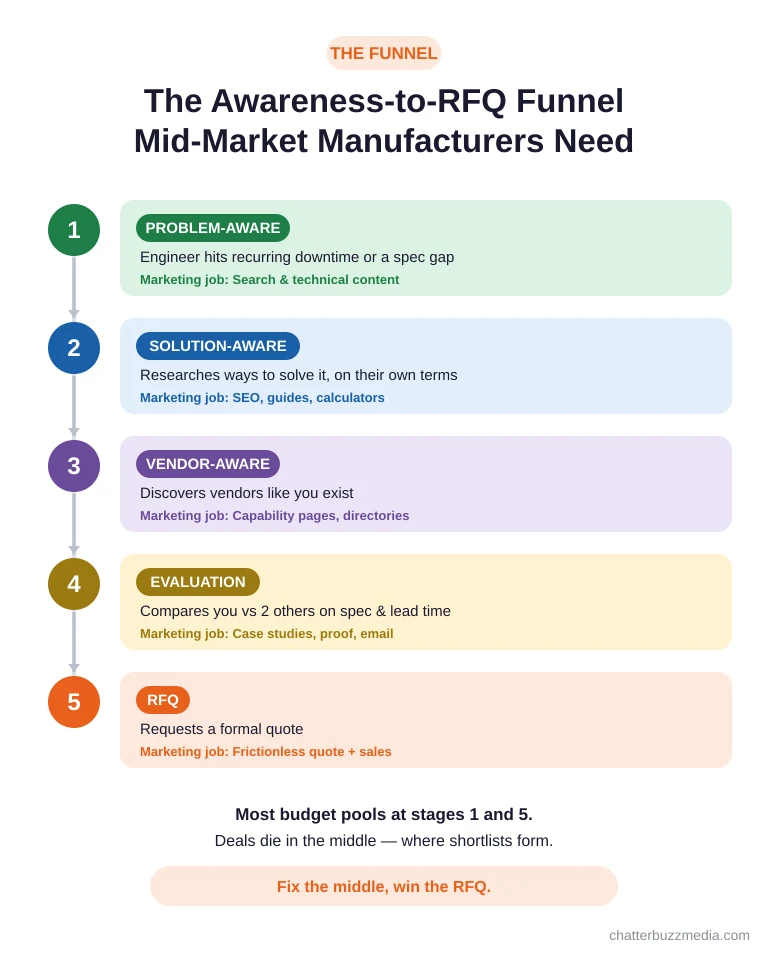
Why this matters: most manufacturers pour budget into the top and bottom while the middle, where shortlists are formed, goes dark. Buyers quietly disqualify vendors there, and you never see the deal you lost.
Here is what each stage looks like in practice. A maintenance engineer notices recurring downtime (problem-aware), searches for ways to fix it (solution-aware), discovers that vendors like you exist (vendor-aware), compares you against two others on spec and lead time (evaluation), then requests a formal quote (RFQ).
The handoff between stages is where pipeline is won or lost. A buyer who cannot find a case study at the evaluation stage, or hits a broken quote form at the RFQ stage, simply moves on to the competitor who made it easy.
The journey is also rarely a straight line. McKinsey finds that B2B buyers now use ten or more channels to interact with suppliers, hopping between search, your site, LinkedIn, email, and peer forums before deciding.
That complexity is felt by the buyer, too. Gartner reports that 77% of B2B buyers describe their latest purchase as complex or difficult, which means the vendor who reduces that difficulty earns a real advantage.
What changes hands at each stage
At the top, you are trading education for attention: a buyer gives you a few minutes in exchange for a genuinely useful answer. In the middle, you are trading proof for trust, and at the bottom you are trading a frictionless quote for a commitment.
Mapping your existing assets against these five stages usually reveals the gap in minutes. If you want a framework for aligning content to the journey, our breakdown of mapping content to the customer journey walks through it step by step.
The funnel only works on top of a sharp ICP
Before you build content for any stage, define who the funnel is for. A precise ideal customer profile, by industry, part type, volume, and the roles on the committee, keeps you from marketing to everyone and converting no one.
The sharper the profile, the easier every later decision becomes. A clear B2B buyer persona tells you which keywords to target, which proof points to lead with, and which accounts deserve a dedicated play.
Top of Funnel: Getting Found by Engineers and Buyers
At the top of the funnel, the goal is to be found during self-directed research, not to pitch. Engineers and buyers are searching for answers to a problem, and the manufacturer who answers best earns the first mention.
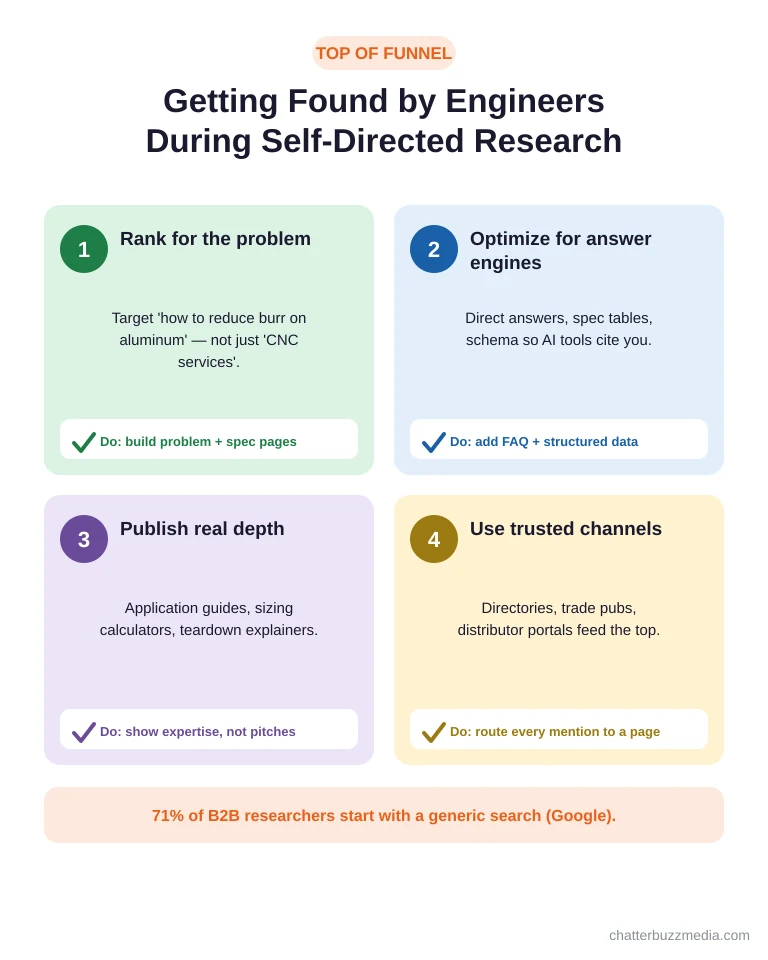
This stage matters because buyers start on their own terms. Google found that 71% of B2B researchers begin with a generic search rather than a brand name, so visibility for problem-level terms is the whole game.
Technical SEO and the terms engineers actually type
Rank for the problem, not just the product. A buyer rarely searches “CNC machining services” first; they search “how to reduce burr on aluminum parts” or “tolerance for stamped brackets.”
Build content around those problem-level and specification-level queries, then connect it to your capability pages. Our guide to manufacturing SEO covers the technical structure that helps these pages rank and get indexed.
Answer engine optimization for manufacturers
Buyers increasingly ask AI assistants to shortlist vendors and explain tradeoffs. Being cited in those answers now depends on clear, structured, well-sourced content that machines can parse.
That means direct answers near the top of each page, specification tables, and schema markup. It is the same discipline as traditional SEO, extended so that answer engines can quote you confidently.
Content formats that earn technical attention
Technical buyers reward depth. The formats that consistently pull them in are application guides, selection and sizing calculators, comparison articles, and teardown-style explainers that show real expertise.
Avoid thin, salesy blog posts that any competitor could publish. The point of a manufacturing marketing strategy at this stage is to prove you understand the buyer’s problem better than anyone else.
Do not abandon the channels engineers already trust
Digital does not replace industry directories, trade publications, and distributor portals; it compounds them. A listing in the right directory still feeds qualified buyers into the top of your funnel.
The difference is that every one of those touchpoints should lead back to a page built to convert. Treat a trade publication mention or a directory profile as the start of the journey, not the end of it.
Middle of Funnel: Turning Interest Into a Shortlist
In the middle of the funnel, the goal is to earn a spot on the shortlist by replacing doubt with proof. The buyer now knows vendors like you exist and is quietly deciding who is worth a conversation.
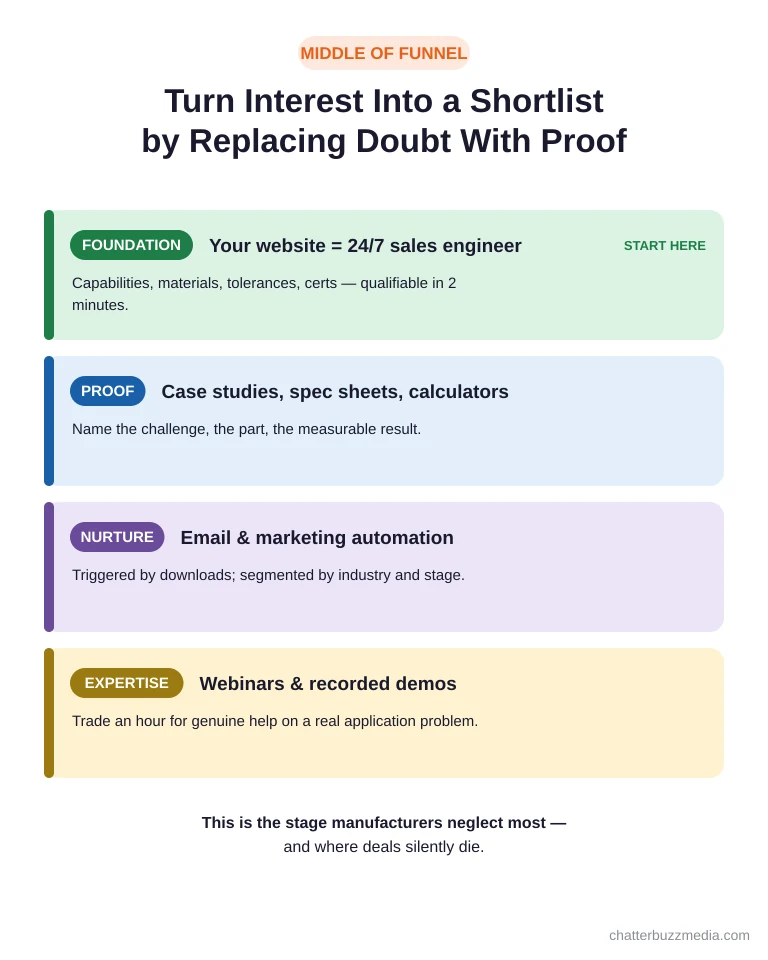
This is the stage manufacturers neglect most, and it is where deals silently die. A buyer comparing three vendors will drop the one whose website cannot answer basic questions about capability, capacity, and quality certification.
Your website is the 24/7 sales engineer
When buyers spend most of the journey researching alone, your website does the selling. It has to state capabilities, materials, tolerances, industries served, and certifications clearly enough that an engineer can qualify you in two minutes.
Speed, mobile usability, and obvious next steps matter as much as the copy. A strong manufacturing website design treats every capability page as a conversion page, not a brochure.
Proof content: case studies, spec sheets, and calculators
Proof is the currency of the middle funnel. Case studies that name the challenge, the part, and the measurable result do more to advance a deal than any amount of brand messaging.
Pair those with downloadable spec sheets, capability matrices, and sizing tools the buyer can use on their own terms. If you are building these for the first time, our primer on writing a case study shows the structure that persuades technical readers.
Email and marketing automation for long cycles
A buyer who is not ready today still needs to remember you in four months. Automated nurture, triggered by the content someone downloads, keeps you present without pestering.
Segment by industry and by funnel stage so the message fits the moment. Done well, marketing automation turns a long cycle from a liability into a relationship you compound over time.
Webinars and demos that respect an engineer’s time
Technical buyers will trade an hour for genuine expertise, not a sales pitch. A focused webinar on a real application problem, or a recorded line walkthrough, advances the deal because it demonstrates competence rather than claiming it.
Keep these practical and specific. The best middle-funnel assets answer a question the buyer is actively wrestling with, then make it easy to take the next step when they are ready.
Bottom of Funnel: Winning the RFQ
At the bottom of the funnel, the goal is to make requesting a quote effortless and to arm sales to win it. This is the most valuable stage and, for many manufacturers, the most broken.
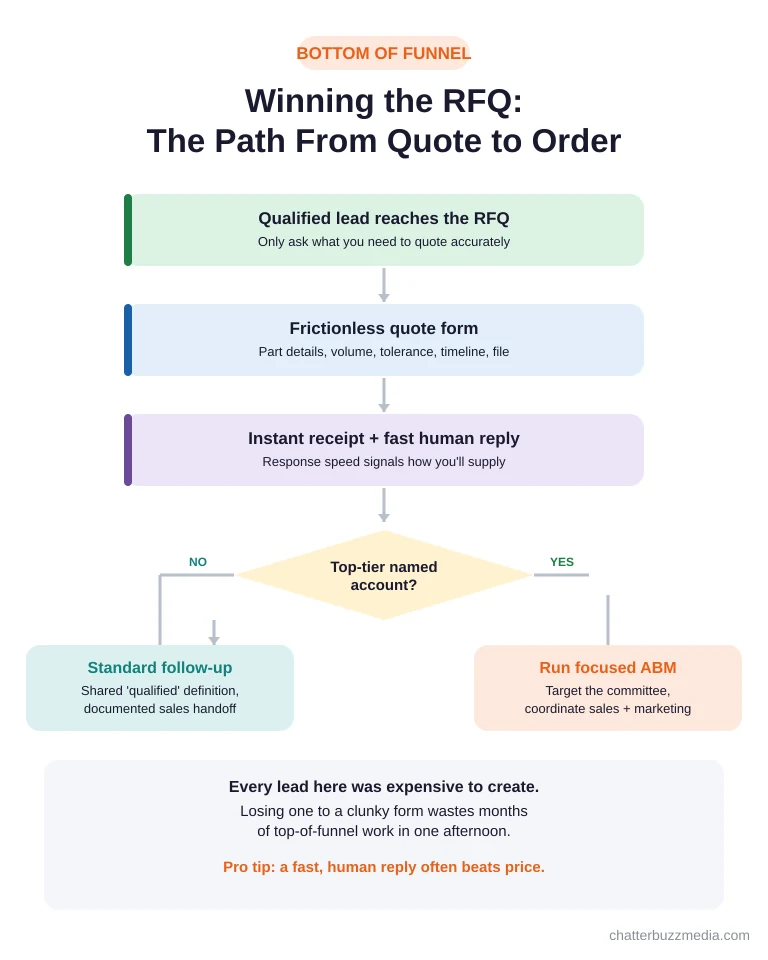
It matters because every lead here was expensive to create. Losing one to a confusing form or a slow response wastes months of top-of-funnel work in a single afternoon.
Make the RFQ frictionless
Ask only for what you need to quote accurately: part details, volumes, tolerances, timeline, and a file upload. Every extra field is a reason to abandon.
Confirm receipt instantly and set a clear expectation for response time. A fast, human follow-up at this moment often matters more than price, because it signals how you will behave as a supplier.
Account-based marketing for your top accounts
Not every RFQ is equal. For the named accounts that could become your largest customers, a focused account-based marketing motion concentrates marketing and sales on the specific people inside those plants.
That means tailored content, targeted ads to the buying committee, and sales outreach coordinated around one account. The signals that predict account readiness tell you when to lean in.
Sales and marketing alignment at the handoff
The RFQ is where marketing hands the baton to sales, and a dropped baton is a lost deal. Both teams need a shared definition of a qualified lead and a documented handoff.
When marketing passes context, not just a name, sales closes faster. Our take on aligning marketing and sales covers the service-level agreement that makes this reliable.
Account for distributors, reps, and channel partners
Many manufacturers sell through reps and distributors, which means the RFQ may not come straight to you. Your marketing still has to create the demand that your channel then fulfills.
Make it easy for partners to use your content, and track which leads you route to them. A deal closed through a distributor is still a deal your funnel created, and it belongs in your attribution.
Channels and Budget: Where Mid-Market Manufacturers Should Spend
Mid-market manufacturers get the best return from a concentrated mix of SEO, paid search, LinkedIn, and email, not a little of everything. Spreading budget thin is the fastest way to prove that marketing “does not work.”
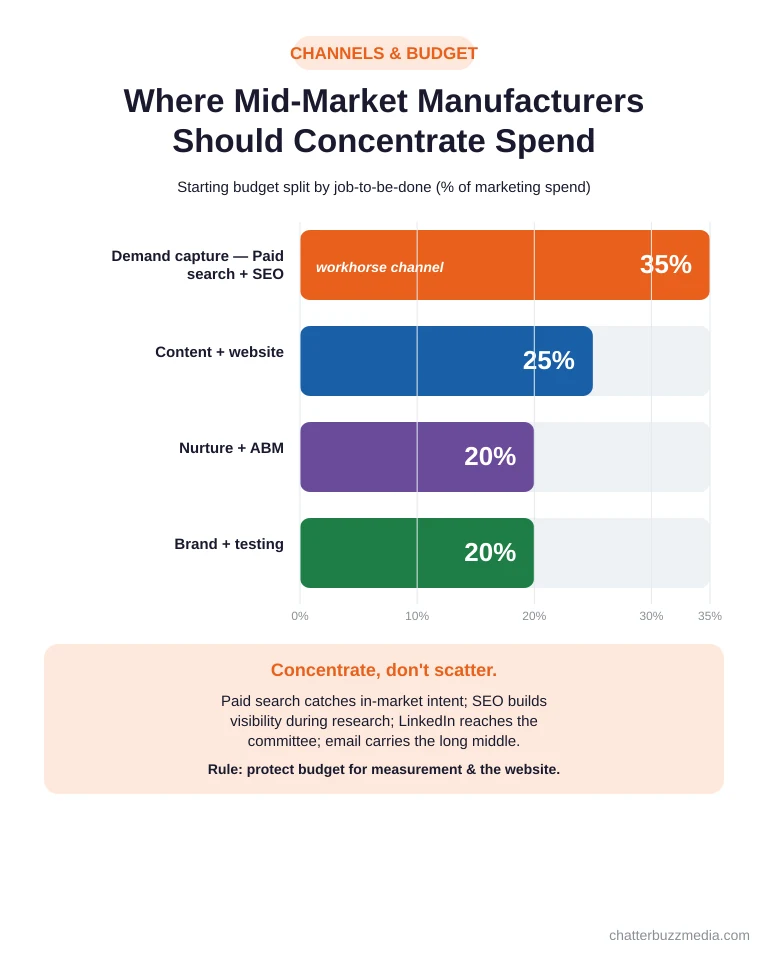
The right mix follows the funnel. SEO and content feed the top, paid search captures in-market demand, LinkedIn and ABM reach the committee, and email nurtures the long middle.
The channel mix that works
Paid search is the workhorse because it catches buyers at the moment of intent. Pairing it with strong landing pages is why Google Ads for manufacturers can turn industrial search into qualified quote requests.
LinkedIn earns its place for reaching engineers and plant leadership by title and industry. A deliberate LinkedIn advertising strategy keeps you in front of the committee between searches.
How to split a mid-market manufacturing budget
A durable starting split is roughly 35% to demand capture (paid search and SEO), 25% to content and website, 20% to nurture and ABM, and 20% to brand and testing. Adjust as data comes in.
Whatever the split, protect the budget for measurement and the website itself. A broader cross-channel paid media strategy only compounds when every channel points at a page built to convert.
Where trade shows still fit
Trade shows remain valuable for manufacturers, but they work best as an accelerant, not a standalone plan. The relationships you start on the floor convert faster when a buyer can research you thoroughly afterward.
Plan the digital follow-up before the event, not after. A booth that drives traffic to a strong landing page and a tracked follow-up sequence turns a few days of conversations into months of nurtured pipeline.
Measure What Matters: Attribution Across a Six-Month Cycle
The metric that matters is pipeline influenced and revenue closed, not traffic or clicks. With a cycle this long, anything you can measure in a week will mislead you.
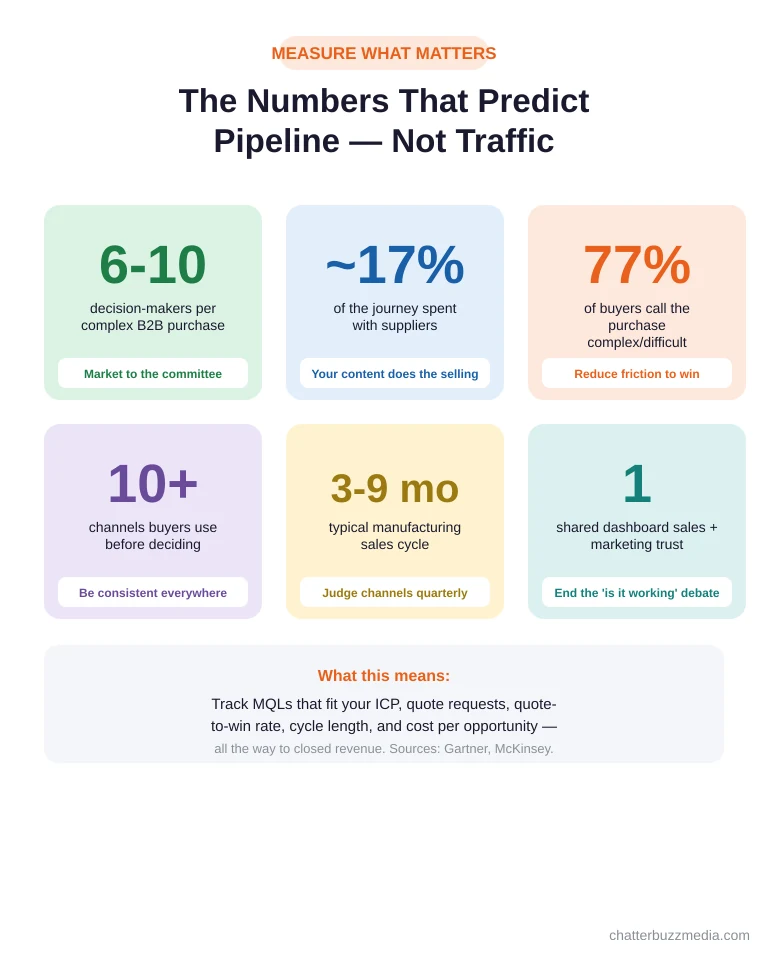
Measurement is hard here precisely because of the lag. A piece of content that sparked a deal in January may not show its value until the purchase order lands in July.
The metrics that actually predict pipeline
Track marketing-qualified leads that match your ideal customer profile, quote requests, quote-to-win rate, sales cycle length, and cost per qualified opportunity. These connect marketing to money.
Leave vanity metrics like raw sessions in the background. Defining the right scorecard starts with a sharp B2B buyer persona so you can tell a real opportunity from noise.
Solving attribution when the cycle is long
You need a CRM that stamps first touch and tracks every interaction through to the closed deal. Without it, you are guessing which channels actually create revenue.
Feed offline conversions, such as a closed RFQ, back into your ad platforms so they optimize for revenue instead of form fills. A regular marketing audit keeps the tracking honest as the funnel evolves.
Report on a cadence that matches the cycle
A six-month cycle rewards a patient reporting rhythm. Review leading indicators like qualified leads and quote requests monthly, but judge channel performance on a rolling quarterly basis so a slow month does not trigger a bad decision.
Build one dashboard the whole team trusts. When marketing and sales look at the same pipeline numbers, the argument shifts from “is marketing working” to “where do we invest next.”
When to Build In-House vs. Hire an Industrial Marketing Agency
Build in-house when marketing is steady-state and specialized knowledge already lives on your team; hire an industrial marketing agency when you need range and speed you cannot staff. Most mid-market manufacturers run a hybrid of the two.
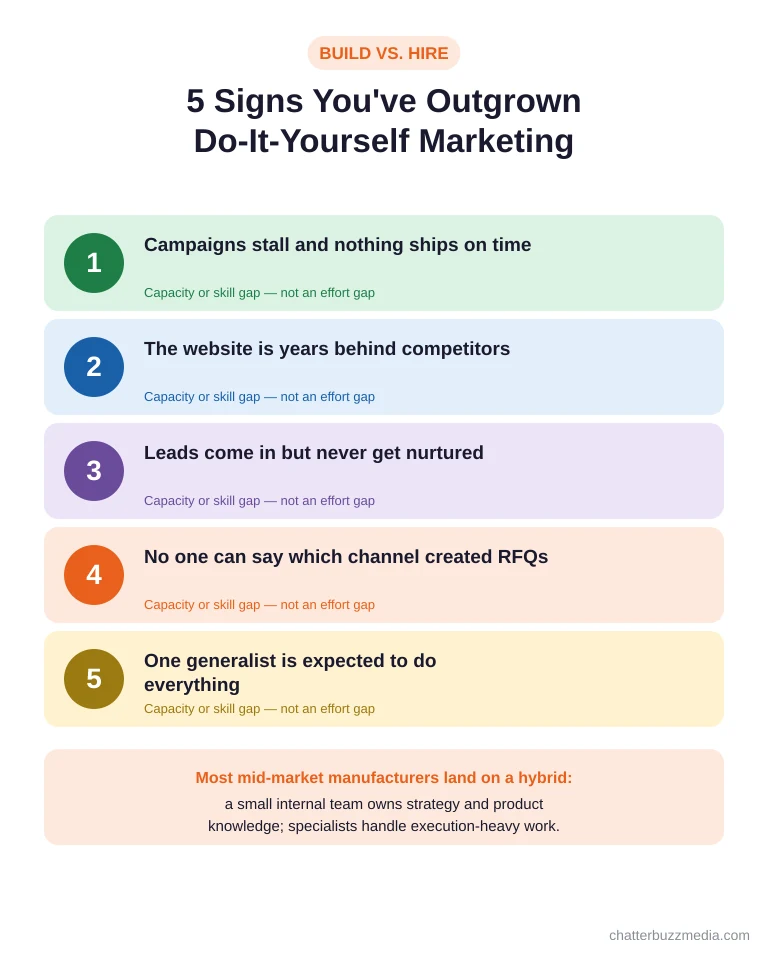
The honest test is whether the work is getting done well and on time. A single in-house generalist cannot be strong at SEO, paid media, web development, content, and analytics all at once.
Signs you have outgrown do-it-yourself
You have outgrown DIY when campaigns stall, the website is years behind, or leads come in but never get nurtured. Those are capacity and skill gaps, not effort gaps.
Another clear signal is an inability to measure results. If no one can say which channel produced last quarter’s RFQs, you need either a system or a partner who brings one.
What to look for in an industrial marketing agency
Look for genuine manufacturing experience, proof in the form of industrial case studies, and fluency in the full funnel rather than a single channel. Ask how they would measure a six-month cycle.
A good partner should strengthen your team, not replace its judgment. If you are weighing the decision, our guide to choosing an industrial marketing agency lays out the questions that separate specialists from generalists.
The hybrid model most mid-market manufacturers land on
The common endpoint is a small internal team that owns strategy, product knowledge, and relationships, paired with outside specialists for execution-heavy work. This keeps institutional knowledge in-house while buying range on demand.
Think of the decision as a spectrum, not a switch. As volume and ambition grow, you shift work across that line deliberately, keeping whatever your team does genuinely well and partnering for the rest.
Frequently Asked Questions
1. 🔍 What is B2B manufacturing marketing?
B2B manufacturing marketing is the practice of attracting and converting the technical buying committees that specify and purchase industrial products. It spans SEO, content, paid media, email, and account-based marketing, all organized around a long, research-heavy buying cycle that ends in a request for a quote.
2. 📊 How long is a typical manufacturing sales cycle?
Most mid-market manufacturing deals run three to nine months from first touch to purchase order, and capital equipment can run longer. That length is why nurture, proof content, and accurate attribution matter more than short-term click metrics.
3. ⚡ Which marketing channels work best for manufacturers?
A concentrated mix of SEO, paid search, LinkedIn, and email delivers the strongest return for most mid-market manufacturers. Paid search captures in-market demand, SEO and content build visibility during research, and LinkedIn reaches the buying committee by title and industry.
4. 🏦 How much should a mid-market manufacturer budget for marketing?
Many mid-market manufacturers invest a meaningful share of revenue, then split it roughly across demand capture, content and website, nurture and ABM, and brand and testing. The exact figure matters less than concentrating spend on a few channels that connect directly to quote requests.
5. 🤝 What is the difference between manufacturing marketing and lead generation?
Lead generation is one outcome of marketing, not the whole of it. Manufacturing marketing covers the full funnel from awareness through the RFQ, including the brand, content, and nurture that make lead generation efficient in the first place.
6. 💰 How do you measure ROI with such a long sales cycle?
Track pipeline influenced and revenue closed rather than traffic, using a CRM that records first touch and every interaction through to the won deal. Feeding closed RFQs back into your ad platforms lets them optimize for revenue instead of form fills.
7. 🚀 Do manufacturers really need content marketing?
Yes, because technical buyers self-educate long before they contact a vendor. Application guides, spec sheets, case studies, and comparison content are how you get found during that research and how you earn a place on the shortlist.
8. 📈 Should we build a marketing team or hire an agency?
Build in-house when the work is steady and the expertise already exists on your team, and hire an industrial marketing agency when you need broader skills or faster execution than you can staff. Most mid-market manufacturers run a hybrid, keeping strategy close while outsourcing specialized execution.
Turning the Funnel Into Pipeline
B2B manufacturing marketing works when it stops being a scatter of tactics and becomes a funnel that mirrors how your buyers actually buy. Get found during research, prove yourself in the middle, make the RFQ effortless, and measure all the way to revenue.
The manufacturers who win are not the loudest. They are the ones who removed friction at every stage a buyer passes through.
Here is a simple way to start:
- Map your current assets to the five funnel stages and circle the gaps, usually in the middle.
- Fix the RFQ path first, since it protects the deals you are already creating.
- Concentrate your budget on the two or three channels that connect to quote requests.
- Stand up revenue-based measurement so you can prove what works and reinvest with confidence.
When you are ready to pressure-test your own funnel against this framework, our manufacturing lead generation guide is the natural next step for turning these stages into a working pipeline.

Victoria Wallace
Victoria Wallace is a senior content strategist and marketing writer with 30+ years of experience helping more than 200 brands translate complex business goals into clear, conversion-focused content. Her background spans paid media, marketing strategy, go-to-market planning, brand positioning, and full-funnel campaign development, giving her a deep understanding of how SEO content connects to real business growth.