
 321-236-2899
Paid Media Strategy: How to Build a Cross-Channel Ad Plan That Converts
Most companies do not fail at paid media because they picked the wrong channel. They fail because they run Google, Meta, and LinkedIn as three separate campaigns that never share data, budget, or a story.
A real paid media strategy connects those channels into one system where each ad makes the next one smarter. Done well, this approach is how brands managing hundreds of millions in ad spend turn scattered clicks into predictable pipeline.
This guide walks you through the exact five-step process to build a cross-channel paid media plan from scratch: how to set goals, map channels to your funnel, structure audiences, split budget, and measure what actually drives revenue. Let’s start with what a paid media strategy really is.
Key Takeaways
- Cross-channel beats multi-channel. Being on many platforms is not a strategy; making those platforms feed each other data is.
- Every channel gets one job. Map each platform to a single funnel stage instead of asking all of them to drive conversions.
- Split budget into three pools: demand capture (40–60%), demand creation (25–40%), and remarketing (10–20%).
- Build one story, not twelve ads. Translate a single message into native formats so creative compounds across touchpoints.
- Kill last-click reporting. Use data-driven attribution and incrementality tests to see the channels that build intent, not just the ones that catch it.
What Is a Paid Media Strategy?
A paid media strategy is a coordinated plan for how you spend advertising budget across paid channels to move a defined audience through every stage of the buying journey. It answers three questions: which channels you use, what job each one does, and how you measure the whole system rather than each platform alone.
Paid media is one of three media types every brand works with. Owned media is what you control, like your website and email list. Earned media is coverage others give you, and paid media is any placement you buy, from search ads to sponsored posts.
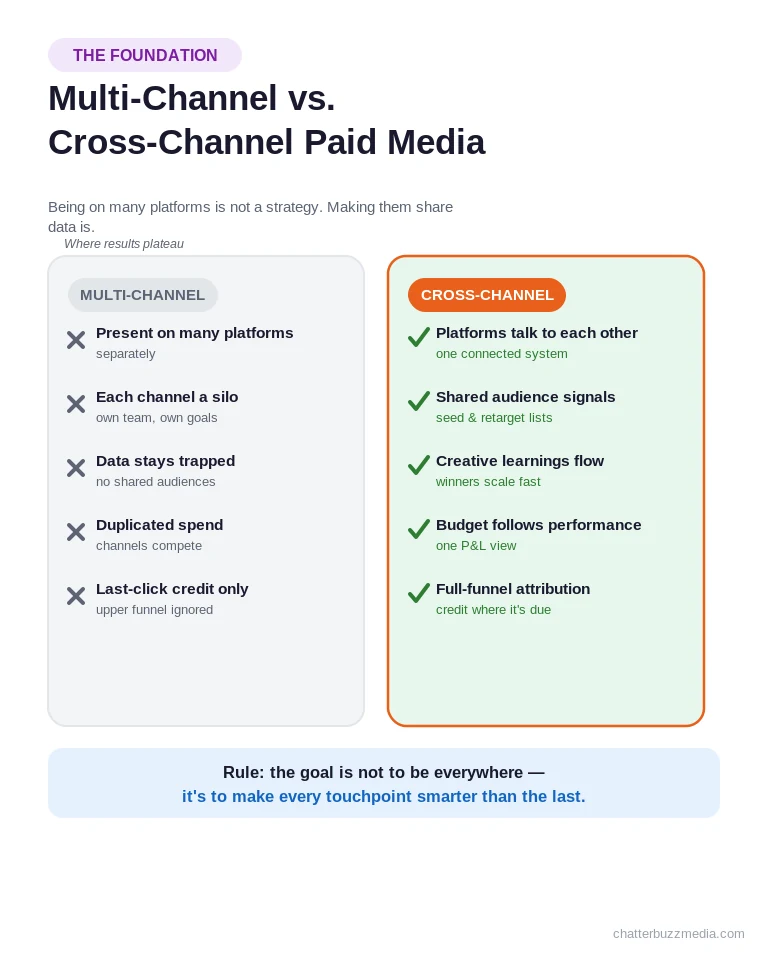
The distinction that matters most today is multi-channel versus cross-channel. Multi-channel simply means you are present on several platforms at once. Cross-channel means those platforms talk to each other, sharing audience signals and creative learnings so every campaign strengthens the rest.
That difference is where performance lives. When a prospect sees your video on YouTube, gets retargeted on Meta, and finally converts on branded search, a cross-channel system captures and learns from that path. A siloed setup only credits the last click and quietly wastes the spend that created the demand.
Modern buying journeys are rarely linear. Google’s research on the messy middle of the purchase journey shows people loop between exploring options and evaluating them across many touchpoints before they buy. A strategy that surrounds them at each loop, rather than shouting from one channel, is what earns the sale. Understanding this is the foundation for the five steps that follow.
Step 1: Set Goals and Map Each Channel to the Funnel
Start by assigning every channel a single job tied to one funnel stage, then set a specific KPI for that job. This prevents the two most expensive mistakes in paid media: asking awareness channels to close sales and forcing conversion channels to create demand they were never built to generate.
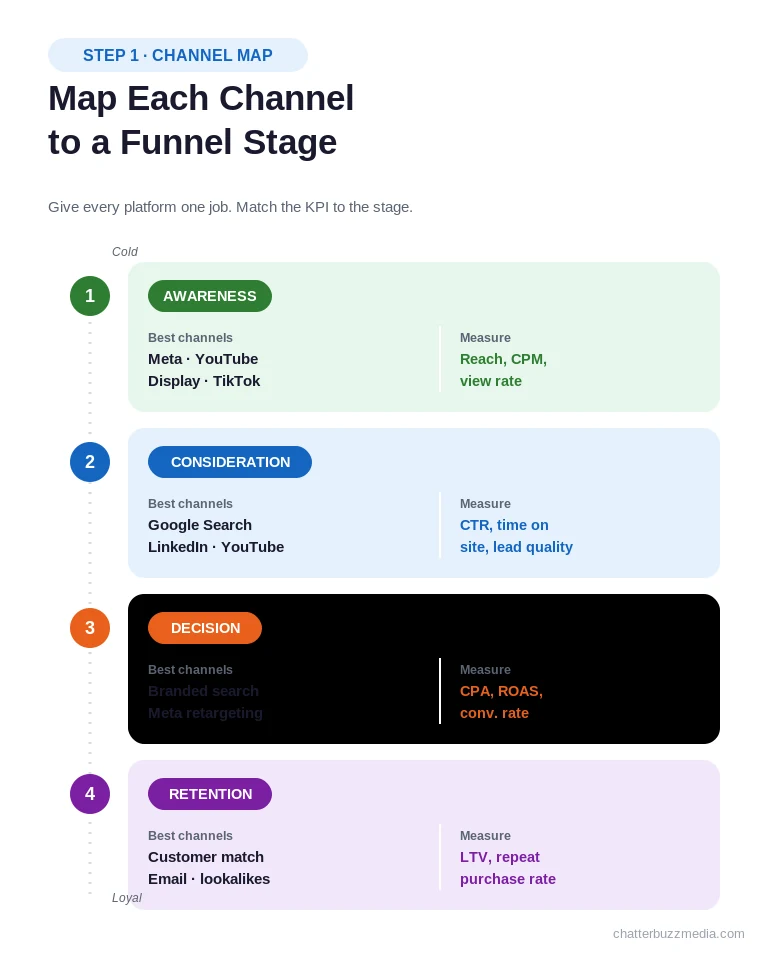
Before spending a dollar, define a top-level goal and break it into segments. A useful segment combines a channel, a platform, and a funnel target, each with its own KPI. Awareness segments should be judged on reach and cost per thousand impressions, while decision segments should be judged on cost per acquisition and return on ad spend.
Different channels earn their keep at different stages. Here is how the major platforms typically map to the funnel:
- Awareness: Meta, YouTube, display, and TikTok introduce your brand to cold audiences. Measure reach, video view rate, and brand search lift.
- Consideration: Google Search, LinkedIn, and YouTube educate and capture intent. Measure click-through rate, time on site, and lead quality.
- Decision: Branded search, Meta retargeting, and email convert warm, high-intent traffic. Measure cost per acquisition, ROAS, and conversion rate.
- Retention: Custom-audience campaigns and email upsell existing customers. Measure lifetime value and repeat purchase rate.
A worked example makes this concrete. Suppose your north-star goal is 100 qualified leads a month at a $150 blended cost per lead. You might set a Meta awareness segment measured on cost per thousand impressions, a LinkedIn consideration segment measured on cost per lead, and a branded search segment measured on conversion rate, then hold each to its own target instead of judging all three by the same number.
This mapping is also where your go-to-market strategy and your paid plan connect. Anchor each segment to a clear ideal customer profile and, for B2B, to a defined buyer persona so the audience, message, and offer all point at the same person. With goals and channel roles set, you can build the audiences that move people between those stages.
Step 2: Build Your Cross-Channel Audience Architecture
Audience architecture is the system that defines who you target at each stage and how data from one channel fuels targeting on another. It rests on three layers: seed audiences, engagement audiences, and exclusion lists.
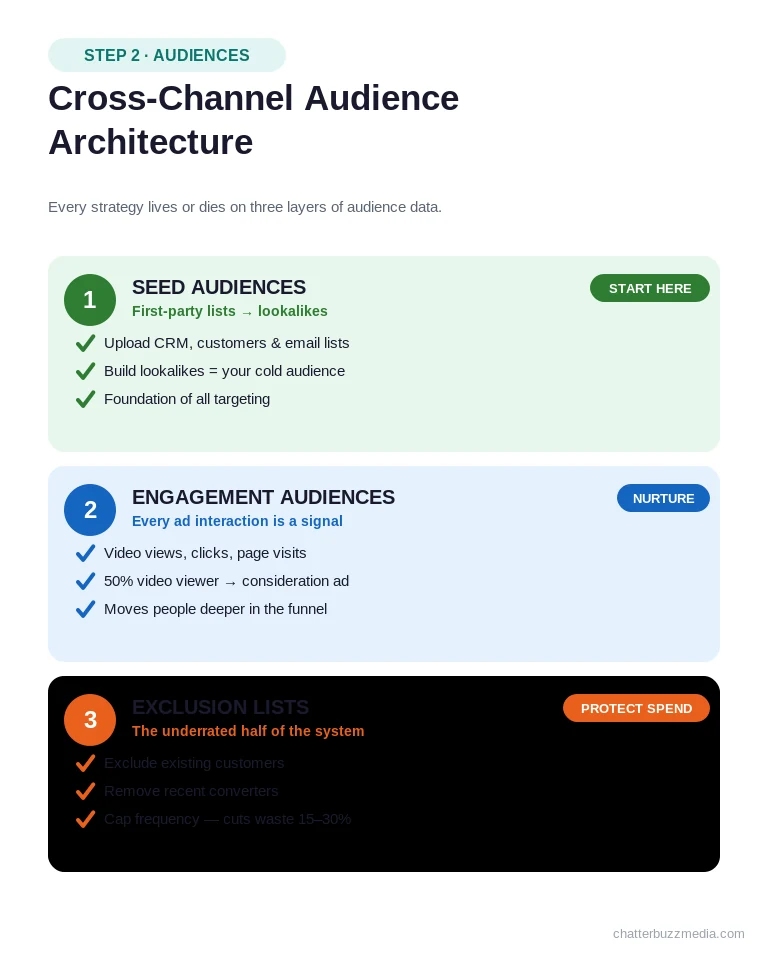
Seed audiences are your most valuable asset because they are built on real buyers. Upload your customer lists, email subscribers, and CRM exports to Meta, Google, and LinkedIn as customer-match audiences, then use them to build lookalikes. Those lookalikes become your primary cold audience because they mirror people who already buy from you.
Engagement audiences turn every ad interaction into a retargeting signal. Video views, clicks, and page visits are all trackable, so someone who watched half of your awareness video should see a consideration ad next, not the same clip again. This is the connective tissue that makes retargeting audiences work across platforms.
Exclusion lists are the underrated half of the system. Exclude existing customers from acquisition campaigns, remove recent converters from retargeting, and cap frequency so people do not see the same ad fifteen times. Clean exclusions reduce wasted spend meaningfully in most accounts.
First-party data is the fuel that makes all of this work as privacy rules tighten. Feeding your CRM and conversion data back into the platforms through tools like Google’s Enhanced Conversions and Meta’s Conversions API improves match rates and keeps optimization sharp when cookies fall short. Treat your customer data as a strategic asset, not an afterthought.
The real power comes from cross-pollination. Demographic insights from your Meta campaigns can shape your search and programmatic targeting, and high-converting search terms from Google can inform your paid social copy. You can also carry these audiences into channels like programmatic display and geofencing for precise, location-based reach. Once your audiences are defined, you can decide how much to invest behind each one.
Step 3: Allocate Your Budget Across Three Pools
Split your paid budget into three pools so it fuels a flywheel instead of draining a single channel. Demand capture takes 40–60%, demand creation takes 25–40%, and remarketing takes 10–20%. Each pool feeds the next, and breaking any link slows the whole system.
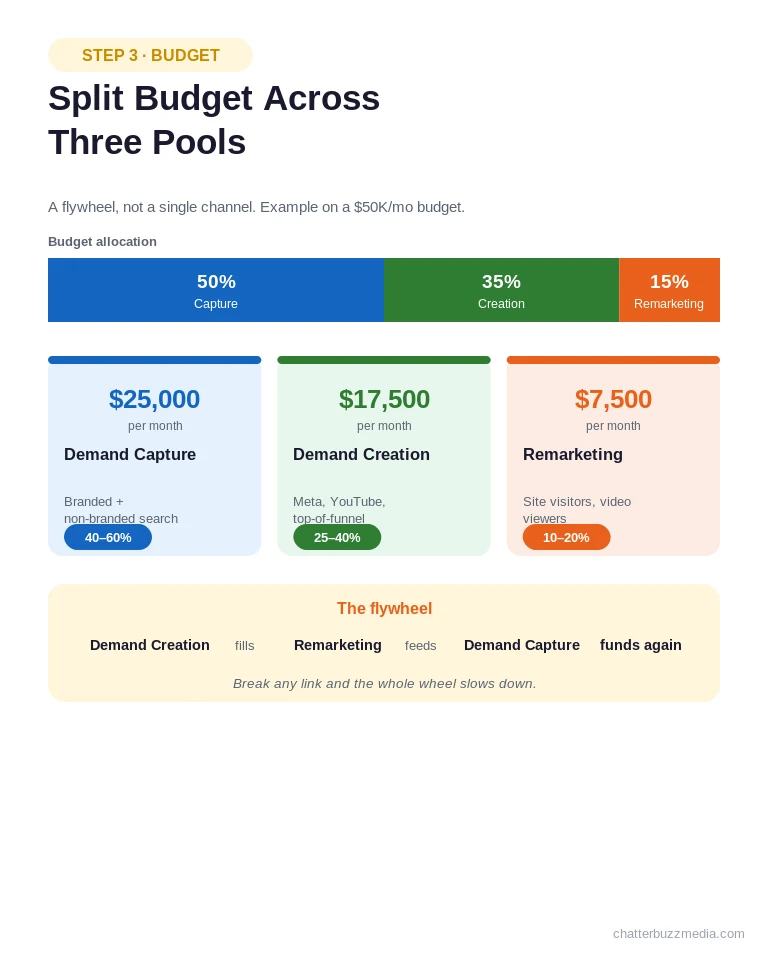
The demand capture pool funds channels that serve in-market buyers, primarily branded and non-branded search. This is where your highest short-term ROAS lives, but if it is your only pool, you eventually drain the pond of people already looking for you.
The demand creation pool funds awareness and consideration on Meta, YouTube, and top-of-funnel content. It builds the future buyers your capture pool will convert months from now, and under-investing here quietly erodes search performance over a 12- to 18-month horizon.
The remarketing pool re-engages people who already showed intent. It usually produces the highest ROAS because it targets warm audiences, but it depends entirely on the other two pools staying full. For context on setting the overall number, see our breakdown of how much to invest in marketing and this guide to building a digital marketing budget.
Here is how the split looks on a $50,000 monthly budget. Demand capture might take $25,000 for branded and non-branded search, demand creation $17,500 for Meta and YouTube, and remarketing $7,500 to re-engage warm audiences. The flywheel runs when demand creation fills the remarketing pool, remarketing feeds capture, and capture funds the next cycle of demand creation.
Reserve a slice of every pool for testing, typically 10–15%, so you always have data on the next channel or creative angle before you scale it. Marketing budgets themselves keep shifting; Gartner’s annual CMO spend survey consistently shows leaders reallocating toward the channels that prove efficient, which is exactly the discipline a three-pool model builds in.
Treat these percentages as a starting framework, not a law. Use a test-and-learn approach: start with small investments across channels, then shift budget dynamically toward what performs. Once budget is flowing, creative is what determines whether it works.
Step 4: Create Ads That Work Across Every Channel
Build one strong story and translate it into native formats for each platform rather than briefing every channel separately. The message stays consistent; the form adapts to how people actually consume content on each platform.
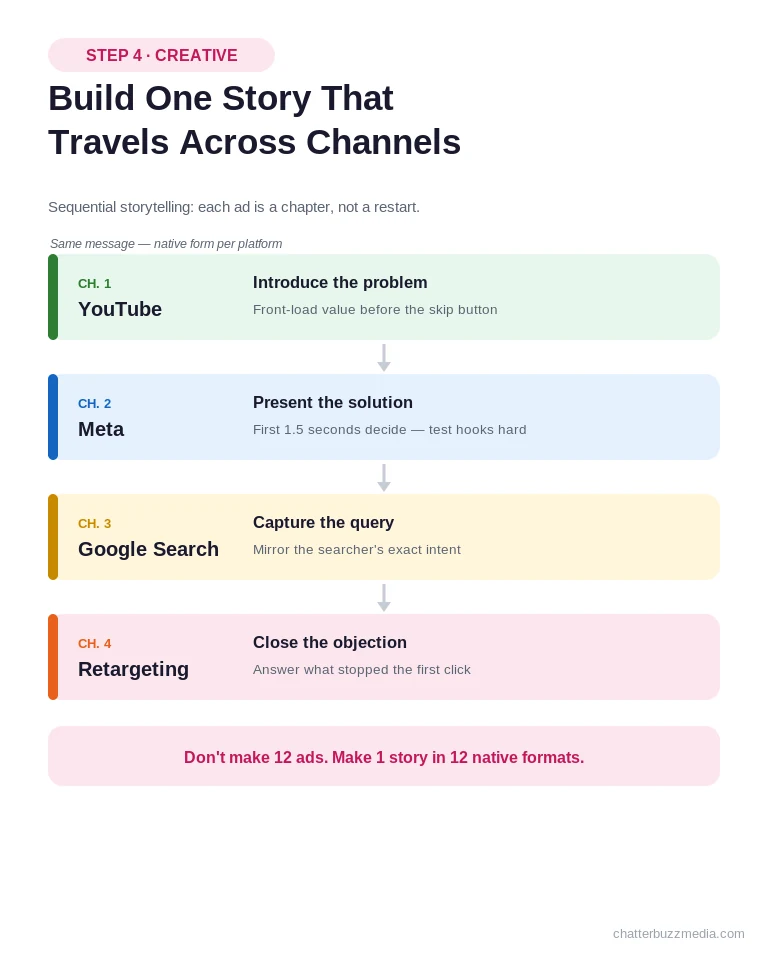
The most powerful mechanic in cross-channel advertising is sequential storytelling. Think in chapters: your YouTube ad introduces the problem, your Meta ad presents the solution, your search ad captures the query that problem triggers, and your retargeting ad closes the objection that stopped the first conversion. Each creative builds on the last.
Every platform still has its own rules for what makes creative work:
- Google Search: Relevance is everything. Reflect the searcher’s exact intent in your headline and description so the ad mirrors what they typed.
- Meta: The first 1.5 seconds decide performance. Lead with a pattern interrupt and test hooks relentlessly, since they drive most of the variance.
- YouTube: Front-load value before the skip button appears. Open with your most interesting point, not a logo animation.
- LinkedIn: Credibility beats cleverness. A specific value proposition aimed at a defined role outperforms vague brand slogans.
Volume matters as much as quality. Plan to produce several variations of each concept, use a clear naming convention so you can tell winners apart in reporting, and lean on authentic formats like user-generated content that tend to travel well across social feeds. The goal is a steady pipeline of fresh angles, not one hero ad you ride until it burns out.
Consistent testing is what turns creative into a compounding asset. Structured ad creative testing shows you which hooks and formats resonate, and rotating creative on a schedule keeps you ahead of ad fatigue. Just as important, send that traffic to a high-converting landing page so strong creative is not wasted on a weak destination. With creative in market, measurement tells you what is actually working.
Step 5: Measure Performance Beyond the Last Click
Stop giving 100% of the credit to the final click and start measuring the whole system. Last-click attribution rewards the branded search or direct visit at the end of the journey and ignores every channel that built the intent behind it.
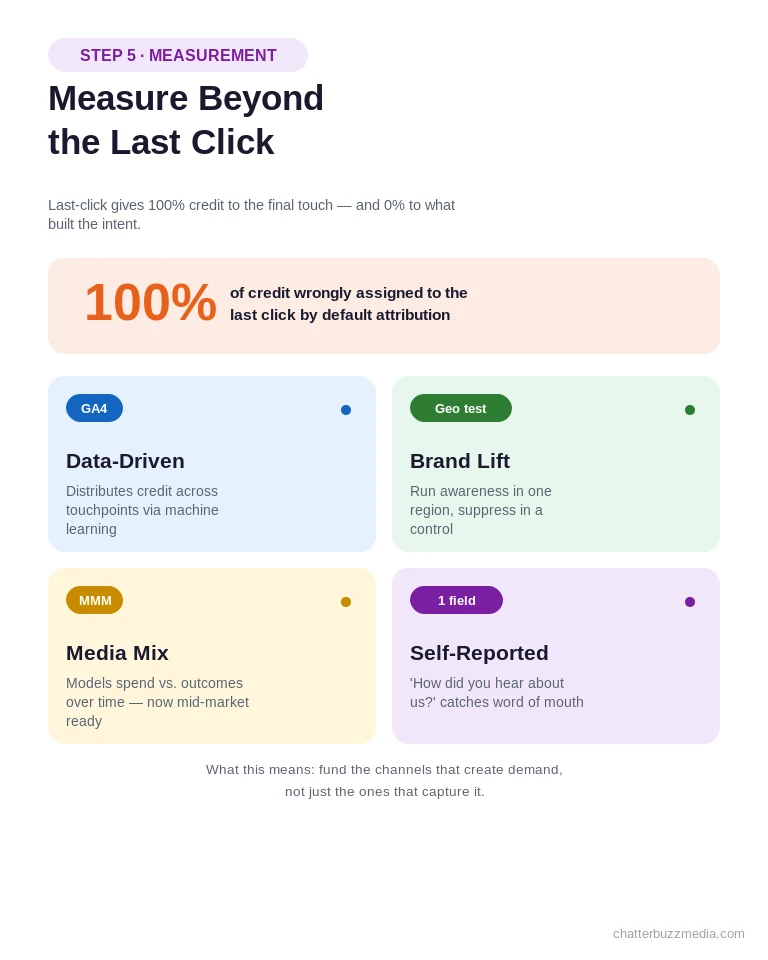
The consequence is predictable and expensive. Awareness channels look inefficient, so brands cut them, performance holds for six to twelve months on existing brand equity, and then it collapses with no obvious cause. Better measurement prevents that trap.
Four approaches give you a truer picture of cross-channel performance:
- Data-driven attribution: Available in Google Ads and GA4, it distributes credit across touchpoints using machine learning on your own conversion data.
- Brand search lift tests: Run awareness ads in one region and suppress them in a matched control to isolate the incremental impact of upper-funnel spend.
- Media mix modeling: A statistical model of spend versus outcomes over time, now accessible to mid-market advertisers, not just enterprises.
- Self-reported attribution: A simple “How did you hear about us?” field surfaces word of mouth, podcasts, and other channels platform data misses.
None of these models work without clean tracking underneath them. Set up accurate conversion tracking, adopt data-driven attribution in Google Ads and GA4, and add server-side tracking where you can so you do not lose signal to browser restrictions. Getting the plumbing right is what makes every downstream decision trustworthy.
Set a reporting cadence that matches the decision, too. Review pacing and obvious problems weekly, evaluate creative and audience performance monthly, and reassess budget splits and channel mix quarterly. Whatever mix you choose, tie it back to the metrics that matter to the business, like customer acquisition cost and lifetime value, and report on the KPIs that actually drive decisions. Clear reporting and data visualization keeps the whole team aligned on the same numbers. Even with strong measurement, a few recurring mistakes can undo the entire plan.
Avoid These Common Paid Media Strategy Mistakes
The fastest way to improve results is to stop making the mistakes that quietly drain budget. Most underperforming accounts share the same handful of problems, and each one is fixable once you name it.
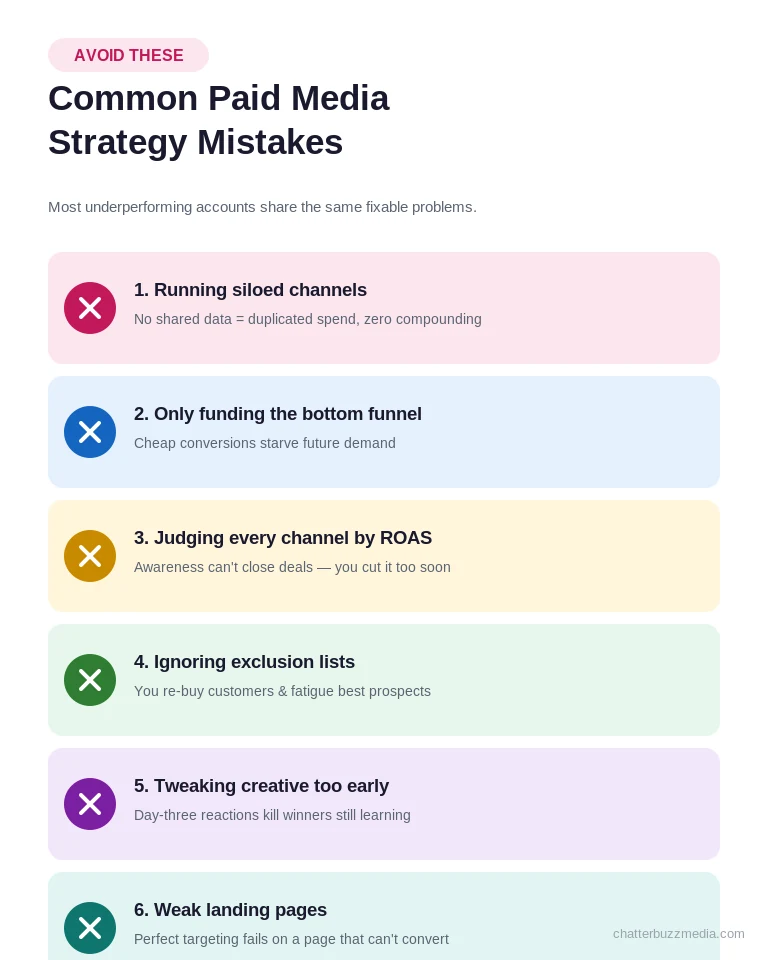
Watch for these recurring failures:
- Running siloed channels. When Google, Meta, and LinkedIn are managed by different people with no shared data, you get duplicated spend and zero compounding returns.
- Only funding the bottom of the funnel. Chasing cheap conversions starves demand creation and caps your long-term growth.
- Judging every channel by ROAS. Awareness channels are not supposed to close deals; holding them to a conversion metric guarantees you cut them too soon.
- Ignoring exclusions. Without exclusion lists, you pay to re-acquire existing customers and fatigue your best prospects.
- Tweaking too early. Creative often needs several weeks in market to prove itself, so reacting to day-three data usually kills winners.
- Sending paid traffic to weak pages. Even perfect targeting fails when the landing experience does not convert.
Fixing even two or three of these typically produces a bigger lift than adding a new channel. With the pitfalls covered, here are the questions marketers ask most about building a paid media strategy.
Frequently Asked Questions
1. 🔍 What is a paid media strategy?
A paid media strategy is a coordinated plan for spending advertising budget across paid channels to move a target audience through the buying journey. It defines which channels you use, what role each plays, and how you measure the whole system rather than individual platforms.
2. 📊 What is the difference between multi-channel and cross-channel paid media?
Multi-channel means you advertise on several platforms independently. Cross-channel means those platforms share audience data and creative learnings so each campaign strengthens the others and follows the customer across the journey.
3. ⚡ How should I allocate my paid media budget?
A reliable starting framework is 40–60% to demand capture (search), 25–40% to demand creation (awareness), and 10–20% to remarketing. Adjust the split based on performance data and how much existing demand exists for your category.
4. 🏦 How many channels should a paid media strategy include?
Start with two: one intent-based channel like Google Search and one discovery-based channel like Meta. Build the connective tissue between them first, then add YouTube, LinkedIn, or others once the core system is working.
5. 🤝 How do I measure cross-channel paid media performance?
Move beyond last-click attribution by combining data-driven attribution, brand search lift tests, media mix modeling, and self-reported attribution. Together these reveal the channels that build intent, not just the ones that capture it.
6. 💰 How much budget do I need to start with paid media?
Enough to gather meaningful data on at least two channels, which usually means committing for several months rather than a few weeks. The exact figure depends on your industry cost per click and how many conversions you need to reach statistical confidence.
7. 🚀 How long before a paid media strategy shows results?
Demand capture channels can produce conversions within weeks, but the full flywheel effect of a cross-channel strategy typically compounds over three to six months. Awareness and consideration investments pay off on a longer horizon than bottom-funnel search.
8. 📈 What KPIs matter most in paid media?
Match the KPI to the funnel stage: reach and CPM for awareness, CTR and lead quality for consideration, and CPA, ROAS, and lifetime value for decision and retention. Blended metrics like overall customer acquisition cost keep the whole system honest.
Conclusion: Build a System, Not a Campaign
The brands that win in paid media are rarely the ones with the most channels. They are the ones with the tightest feedback loops between the channels they run, where audience data, creative learnings, and budget decisions compound over time.
Here is your action plan to put this into practice:
- Set goals and map channels. Give every platform one job tied to a funnel stage and a specific KPI.
- Build your audience architecture. Layer seed audiences, engagement audiences, and exclusion lists, then cross-pollinate data between platforms.
- Split budget into three pools. Fund demand capture, demand creation, and remarketing so the flywheel keeps turning.
- Unify creative and measurement. Tell one story across native formats and measure the full system beyond the last click.
Start with two channels, connect them well, and expand only once the system proves itself. For a deeper look at how the best teams operate, explore our performance marketing guide and the full library of marketing resources.

Victoria Wallace
Victoria Wallace is a senior content strategist and marketing writer with 30+ years of experience helping more than 200 brands translate complex business goals into clear, conversion-focused content. Her background spans paid media, marketing strategy, go-to-market planning, brand positioning, and full-funnel campaign development, giving her a deep understanding of how SEO content connects to real business growth.