
 321-236-2899
UGC Ads That Convert: How Performance Creative Beats Polished Ads in 2026
UGC content agency ads are paid advertisements that use creator-style or customer-style content designed to blend into platform feeds rather than interrupt them. They consistently outperform studio-produced creative across Meta, TikTok, and YouTube because they mirror how people naturally discover and evaluate products.
This guide draws from real campaign performance data across hundreds of paid social accounts. Brands that shift even 40% of their creative budget toward UGC-style assets typically see 2–3x improvement in cost per acquisition within the first 90 days.
You’ll learn exactly how to structure a UGC creative testing framework system that produces winners on repeat — including the specific formats, briefing frameworks, and measurement models that separate high-performing teams from everyone else. Let’s start with what UGC ads actually are.
Key Takeaways
- UGC ads outperform polished studio creative because they feel native to platform feeds and build trust through authenticity rather than production value.
- The first 3 seconds determine everything — hook structure drives more performance variance than any other creative element.
- Creative testing volume is the competitive advantage — top-performing brands test 15–20 new UGC variations per month, not 2–3.
- Each platform requires different UGC execution — what works on TikTok will underperform on Meta Feed without format adaptation.
- UGC is a system, not a tactic — sustainable results come from repeatable briefing, production, testing, and iteration workflows.
- Measuring creative performance requires creative-level metrics — hook rate, hold rate, and thumbstop ratio matter more than account-level ROAS.
What UGC Ads Actually Are (and What They’re Not)
UGC ads are paid advertisements built from content that looks and feels like it was created by a real person — not a brand’s creative team. They run from the brand’s ad account, are optimized for performance, and are designed to feel native to whatever platform they appear on.
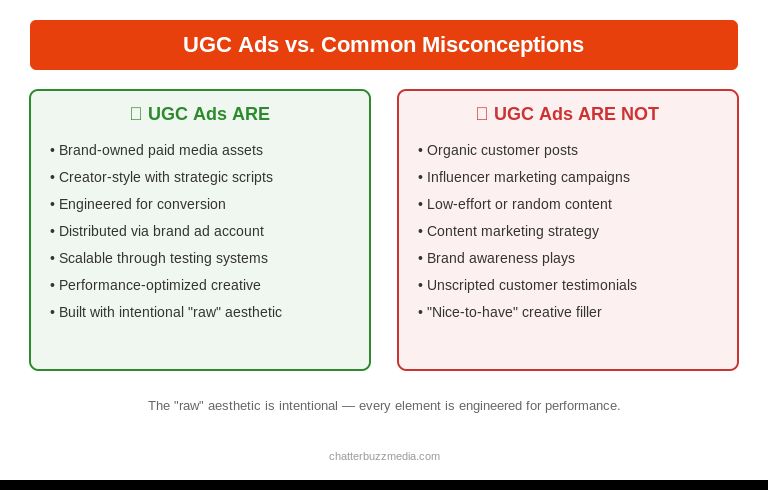
The distinction matters because most teams confuse UGC ads with three things they are not.
UGC ads are not organic user-generated content. Organic UGC is content customers post voluntarily on their own profiles. UGC ads are brand-owned assets — often produced by paid creators — that mimic the organic format but serve a performance marketing objective.
UGC ads are not influencer marketing. Influencer campaigns rely on renting access to a creator’s audience. UGC ads use the creator’s face and voice but distribute through the brand’s paid media channels. The brand controls targeting, budget, and optimization.
UGC ads are not low-effort content. The “raw” aesthetic is intentional, not accidental. Every element — the hook, the script structure, the visual pacing, the call to action — is engineered for conversion. The best UGC looks effortless but is built on rigorous creative strategy.
Understanding this distinction changes how you approach production. You’re not asking customers to create content and hoping it performs. You’re building a content production system that uses creator-style formats as a performance lever.
Why UGC Ads Outperform Polished Creative in 2026
UGC ads outperform traditional studio creative because they align with how people actually consume content on social platforms. The performance advantage isn’t about being “cheaper to produce.” It’s about matching the psychological and algorithmic dynamics that drive results on Meta, TikTok, and YouTube.
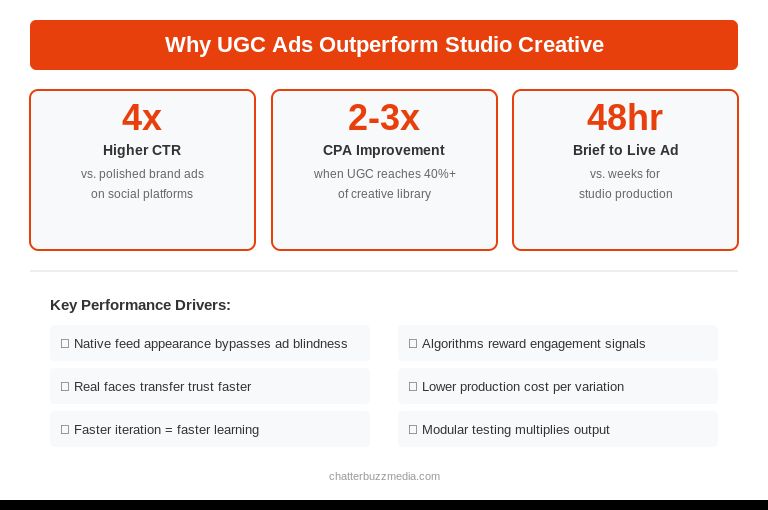
Platform algorithms reward engagement signals. UGC generates higher watch time, more saves, and stronger click-through rates because it doesn’t trigger the “skip the ad” reflex. When content looks like something a friend would post, people engage with it the same way they engage with organic content.
Trust transfers faster through real faces. Consumers have developed sophisticated filters for brand messaging. A person speaking directly to camera about their experience bypasses those filters entirely. The psychological mechanism is simple: people trust people who look like them more than they trust brands.
Creative iteration speed compounds over time. Traditional studio shoots require weeks of planning, production, and post-production. UGC can move from brief to live ad in 48 hours. That speed advantage means UGC-first teams learn faster, find winners sooner, and scale more efficiently than teams locked into quarterly production cycles.
Platform dynamics have shifted toward native content. Meta’s Advantage+ and TikTok’s Smart Performance campaigns increasingly favor creative that drives organic-style engagement metrics. UGC naturally performs well in these automated systems because the algorithms interpret high engagement as a relevance signal — which lowers cost per click and improves delivery efficiency.
The data consistently shows UGC delivering higher CTR, lower CPM, and stronger conversion rates across most verticals. The brands that still rely exclusively on polished production are paying a premium for creative that works against the platforms they’re advertising on. This doesn’t mean studio creative is dead — the strongest inbound marketing strategies combine UGC with high-production hero content at different touchpoints. But UGC should be the foundation of your paid social creative library, not an afterthought.
7 High-Converting UGC Ad Formats Worth Testing
There is no single “best” UGC format. Performance comes from testing multiple formats against different audiences and funnel stages. These seven formats consistently produce winners across industries.
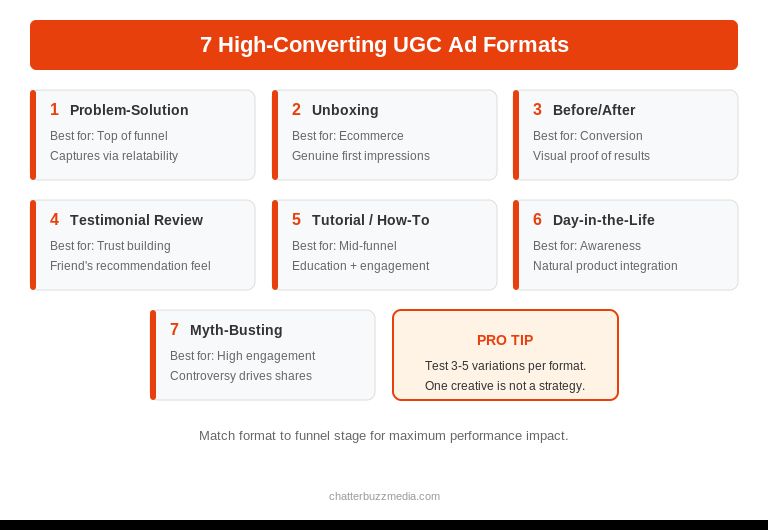
1. Problem-Solution. The creator identifies a specific pain point, demonstrates frustration, then introduces the product as the resolution. This format works best at the top of funnel because it captures attention through relatability before introducing the brand.
2. Unboxing and First Impressions. Real-time reactions to receiving and trying a product for the first time. The authenticity of a genuine first impression is nearly impossible to fake — and audiences know the difference. Unboxing content drives strong engagement for physical products, especially in ecommerce.
3. Before-and-After Transformation. Visual proof of results is the most powerful conversion driver in UGC. Whether it’s skincare, fitness, home improvement, or software dashboards, showing a clear transformation collapses the buyer’s evaluation timeline from weeks to seconds.
4. Testimonial-Style Reviews. A creator shares their experience with the product in a conversational, direct-to-camera format. The key difference from traditional testimonials: these feel like a friend’s recommendation, not a scripted endorsement. Use specific details and outcomes rather than generic praise.
5. Tutorial and How-To. Demonstrating how to use the product solves two problems simultaneously — it educates potential buyers and provides valuable content that earns engagement. Tutorial-style UGC performs exceptionally well for mid-funnel retargeting where prospects need to understand the product before purchasing.
6. Day-in-the-Life Integration. The product appears naturally within the creator’s daily routine. This format works because it answers the subconscious question every buyer has: “Would this actually fit into my life?” It’s subtle, lifestyle-driven, and highly effective for awareness campaigns.
7. Myth-Busting and Hot Takes. A creator challenges a common misconception about the category or product type. This format generates high engagement because controversy and contrarian perspectives drive comments, shares, and saves — all signals that platforms reward with increased distribution.
The most important principle across all formats: test multiple formats simultaneously. A single creative is not a strategy. Launch 3–5 variations per format, measure creative-level metrics, and double down on what the data shows.
One format that none of the current top-ranking guides cover well: comparison content. A creator directly compares your product against a competitor or a “before I found this” alternative. This format works because it acknowledges the buyer is evaluating options — and it positions your product as the obvious choice within a framework the viewer already understands.
UGC Ads Across the Marketing Funnel
One of the biggest mistakes brands make with UGC is treating every ad the same regardless of where the viewer is in their buying journey. Different funnel stages require different UGC approaches, different messaging, and different success metrics.
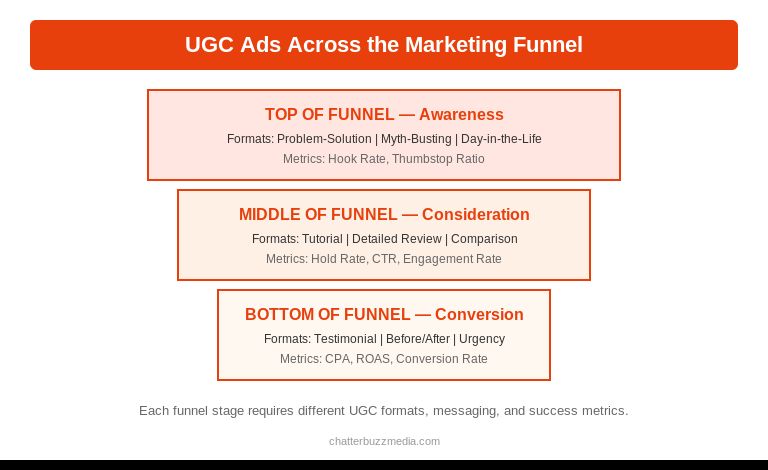
Top of Funnel (Awareness). At this stage, the viewer doesn’t know your brand exists. Your UGC needs to interrupt the scroll with a relatable problem or a surprising insight — not a product pitch. Problem-solution formats, myth-busting hot takes, and day-in-the-life content work best here. Measure success through hook rate and thumbstop ratio, not conversions. The goal is attention and brand introduction.
Middle of Funnel (Consideration). The viewer has seen your brand before and is now evaluating whether your product is worth purchasing. This is where tutorial content, detailed reviews, and comparison UGC shine. Show the product in use. Address specific objections. Provide the depth that moves a prospect from “interesting” to “I need this.” Retargeting with custom audiences ensures these deeper UGC ads reach people who’ve already engaged with your top-of-funnel content.
Bottom of Funnel (Conversion). The viewer is ready to buy but needs a final push. Testimonial-style UGC with specific outcomes, before-and-after transformations with clear results, and urgency-driven content (limited availability, seasonal offers) close the deal. At this stage, pair UGC with strong landing pages and clear conversion-optimized destinations. Measure CPA and ROAS directly.
The full-funnel UGC approach treats creative as a system of interconnected touchpoints rather than isolated ads. A viewer might see your problem-solution UGC on TikTok, encounter a tutorial on Instagram Reels three days later, and convert after seeing a testimonial in their Facebook Feed. Each piece serves a specific purpose in moving the buyer forward.
This is where UGC connects to broader marketing funnel strategy. The creative isn’t just content — it’s the mechanism that moves prospects through your acquisition pipeline.
How to Build a UGC Creative Testing System
The brands winning with UGC ads in 2026 aren’t producing better individual creatives — they’re running better creative systems. A testing system turns UGC from a one-off tactic into a repeatable engine that produces winners on a predictable cadence.
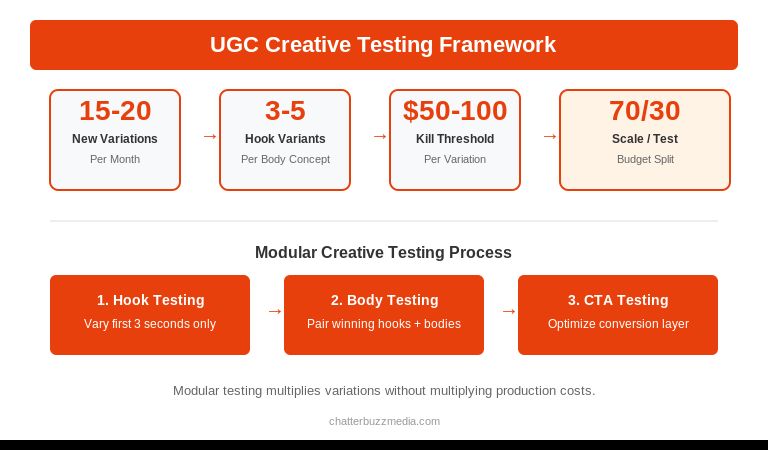
Start with creative volume. Most brands dramatically under-test. If you’re launching fewer than 10 new creative variations per month, you’re leaving performance on the table. Top-performing accounts test 15–20 new UGC assets monthly, which gives their algorithms enough data to identify winners quickly.
Use a modular creative structure. Don’t produce each UGC ad as a standalone asset. Instead, build modular components — hooks, body segments, and calls to action — that can be mixed and matched. Film three different hooks for the same body content. Test multiple CTAs against the same testimonial. This approach multiplies your testing volume without multiplying production cost.
Separate hook testing from body testing. The first 3 seconds of a UGC ad determine 80% of its performance. Run dedicated hook tests where you hold the body constant and vary only the opening. Once you find a winning hook, pair it with different body formats and CTAs to optimize the full creative.
Establish a creative kill threshold. Define clear rules for when to kill underperforming creative. A common framework: if a creative hasn’t achieved a minimum threshold of engagement (e.g., 2% CTR or 25% hook rate) after spending $50–$100, pause it and reallocate budget to the next variation.
Track creative fatigue signals. Every winning UGC ad has a shelf life. Monitor frequency, declining CTR, and rising CPM as leading indicators that creative fatigue is setting in. When you spot these signals, have replacement creative ready to deploy immediately. The best teams maintain a creative pipeline that’s always 2–3 weeks ahead of what’s currently running.
Budget allocation for creative testing. A useful rule of thumb: allocate 20–30% of your total ad spend toward testing new creative, with the remaining 70–80% scaling proven winners. Within your testing budget, spread spend evenly across new variations and enforce your kill threshold rigorously. This allocation ensures you’re always discovering new winners while maximizing returns from existing ones.
Building this system requires upfront investment in workflow and process. But the compound effect is significant — teams that systematize creative testing consistently outperform teams that rely on occasional creative refreshes. The return on content investment scales exponentially when you treat creative production as a data-driven discipline rather than an art project.
Platform-by-Platform UGC Playbook
UGC ads work across every major social advertising platform, but execution must adapt to each platform’s native behavior. Running the same creative everywhere is one of the most common — and costly — mistakes brands make.
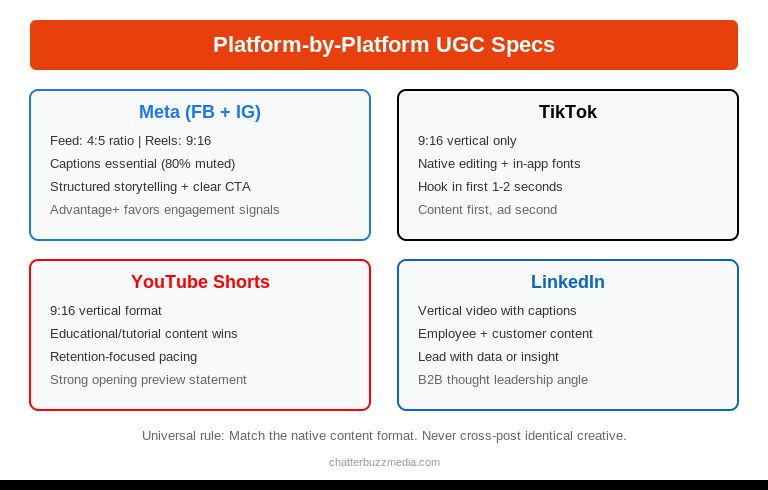
Meta (Facebook + Instagram). Meta remains the largest performance advertising platform, and UGC thrives here because of how Advantage+ campaigns optimize for engagement signals. For Facebook Feed, use 4:5 aspect ratio with clear text overlays and captions — over 80% of feed video is watched without sound. Instagram Reels demand 9:16 vertical format with faster pacing and trending audio. The key to Meta UGC: structured storytelling with a clear hook, benefit demonstration, and direct CTA. Meta’s algorithm rewards creative that drives measurable engagement, so design for thumbstop + click.
TikTok. TikTok requires the most native-feeling UGC because the platform’s entire feed is built on creator content. Anything that looks or feels like an ad gets punished by the algorithm. Film on phones, use in-app editing tools and native fonts, and prioritize raw energy over polish. TikTok UGC should feel like content first and ads second. The platform rewards watch time above all else, so hook viewers in the first 1–2 seconds and use visual pattern interrupts to maintain attention.
YouTube Shorts. YouTube Shorts audiences expect slightly more substance than TikTok. Educational UGC — tutorials, product demos, myth-busting — performs particularly well here. Retention is king: if viewers drop off in the first 5 seconds, the algorithm suppresses distribution. Use clear on-screen text, structured pacing, and a strong opening statement that previews what the viewer will learn.
LinkedIn. For B2B brands, LinkedIn UGC looks different but follows the same principles. Employee-generated content, customer success stories, and thought leadership clips shot on phones outperform polished corporate videos consistently. The native format on LinkedIn is vertical video in the feed with captions. Lead with a provocative insight or counterintuitive data point to stop the scroll.
Cross-platform repurposing strategy. While each platform demands native execution, smart teams build their production workflow around repurposing. Film every UGC asset in 9:16 vertical at the highest resolution available. Then crop and reformat for each placement — 4:5 for Meta Feed, 9:16 for Reels/TikTok/Shorts, 1:1 for carousel cards. Add platform-native captions and overlays in post-production rather than burning them into the original footage. This approach gives you 3–4 platform-ready versions from a single shoot.
The universal principle: match the native content format of each platform. What feels authentic on TikTok feels out of place on LinkedIn, and what works on Meta Feed needs reformatting for Reels. Invest the time to adapt rather than cross-posting identical creative. A well-structured approach to content asset development ensures maximum ROI from every piece of UGC you produce.
How to Brief UGC Creators for Performance
The quality of your UGC ads is directly proportional to the quality of your creative briefs. A vague brief produces generic content. A structured brief produces content that converts.
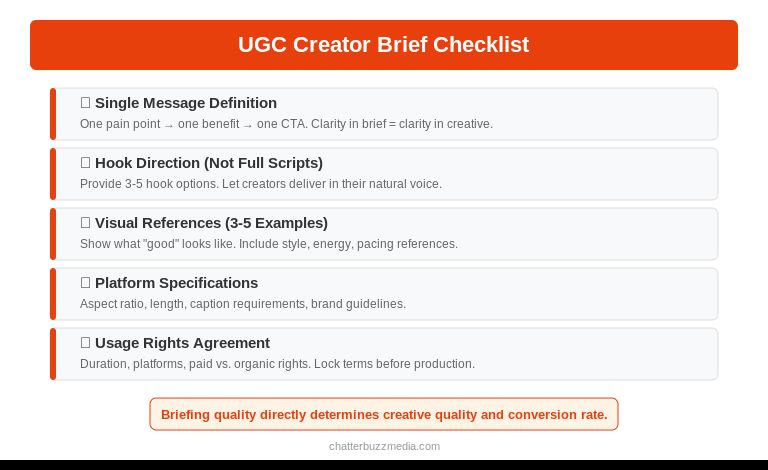
Define the single message clearly. Every UGC ad should communicate one idea. Not three benefits, not your full value proposition — one message. Identify the specific pain point the ad addresses, the single benefit it highlights, and the exact action you want the viewer to take. Clarity in the brief translates directly to clarity in the creative.
Provide hook direction, not full scripts. Over-scripted UGC kills authenticity — the thing that makes UGC effective in the first place. Instead of word-for-word scripts, provide 3–5 hook options and let creators deliver in their natural voice. Give them the key talking points and trust them to communicate like a human, not a teleprompter reader.
Include visual direction with references. Share 3–5 examples of UGC ads that represent the style, energy, and pacing you want. Show creators what “good” looks like for your brand. Include specifics: shoot in a well-lit room, show the product within the first 5 seconds, film vertically, keep it under 30 seconds. The more visual context you provide, the less revision you’ll need.
Specify platform requirements upfront. Different platforms require different creative specs. Include aspect ratio (9:16 vs 4:5), ideal length, whether captions will be added in post, and any brand messaging guidelines the creator needs to follow. Eliminating ambiguity in the brief eliminates wasted production time.
Negotiate usage rights before production begins. Determine whether you need organic posting rights, paid media rights, or both. Clarify the duration and geographic scope of usage. Lock these terms into your creator agreement before any content is produced to avoid disputes that delay launches. Standard paid media usage rights typically run 60–90 days, with renewal options. Some creators charge a flat fee that includes perpetual usage; others charge recurring licensing fees. The right model depends on your testing velocity and how frequently you rotate creative.
A strong briefing process is the difference between UGC that generates incremental revenue and UGC that gets lost in your content library. Invest the upfront time to build brief templates that your team — or your marketing strategists — can use repeatedly.
Measuring UGC Ad Performance: The Metrics That Matter
Most teams measure UGC performance at the campaign level, which hides the creative-level insights that actually drive optimization. To improve UGC results consistently, you need to measure at the individual creative level and track metrics that reveal why specific ads work or fail.
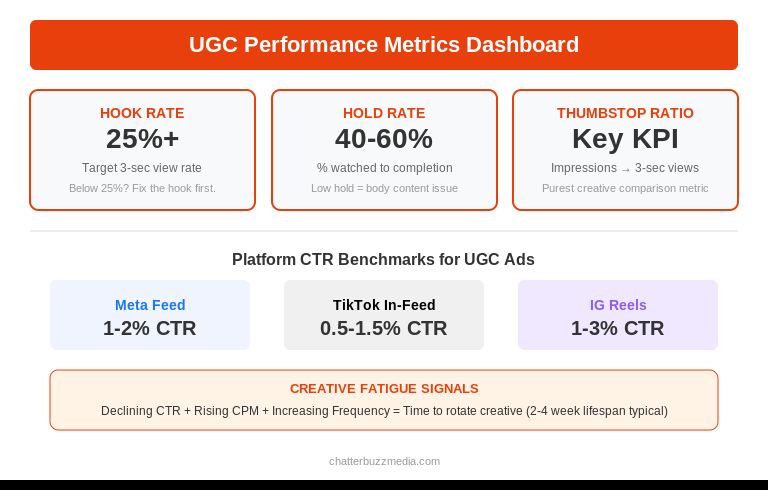
Hook Rate (3-Second View Rate). This tells you whether your opening is compelling enough to stop the scroll. If your hook rate is below 25%, the problem is your first 3 seconds — not your offer, not your targeting, not your landing page. Fix the hook before changing anything else.
Hold Rate (Percentage Watched to Completion). High hook rate but low hold rate means your body content isn’t delivering on the promise of your opening. The viewer stopped scrolling but didn’t stay engaged long enough to absorb your message. Tighten pacing, add visual variety, or restructure the narrative arc.
Thumbstop Ratio. This metric calculates the percentage of impressions that resulted in at least a 3-second view. It’s the purest measure of creative stopping power and the most important metric for comparing UGC ads head-to-head.
Click-Through Rate (CTR). CTR measures intent — did the viewer care enough to take action? For UGC ads, benchmark CTR by platform: Meta Feed typically sees 1–2%, TikTok In-Feed 0.5–1.5%, and Instagram Reels 1–3%. Consistently low CTR with high hook rate suggests a disconnect between the creative message and the CTA.
Cost Per Acquisition (CPA) and ROAS. These bottom-line metrics tell you whether the UGC is driving profitable conversions. But don’t evaluate CPA in isolation — use it alongside the creative-level metrics above to diagnose why performance is strong or weak. A high CPA might trace back to a weak hook, not a targeting issue.
Creative Fatigue Indicators. Monitor declining CTR, rising CPM, and increasing frequency over time. When these three metrics move together, it’s a reliable signal that the audience has seen the creative too many times. Build a replacement creative pipeline so you can rotate in fresh UGC before performance degrades.
Set up your reporting and data visualization to surface creative-level metrics alongside campaign metrics. The teams that win with UGC are the ones who can answer the question: “Which specific creative drove the most efficient conversions this week?” — not just “How did the campaign perform?”
Frequently Asked Questions
1. 🔍 What are UGC ads?
UGC ads are paid advertisements built from creator-style or customer-style video content designed to look native to social media feeds. They run from the brand’s ad account and are optimized for performance metrics like click-through rate and cost per acquisition. Unlike organic user-generated content, UGC ads are strategically produced with specific hooks, scripts, and calls to action engineered for conversion.
2. 📊 Do UGC ads actually outperform traditional studio ads?
In most performance marketing contexts, yes. UGC ads consistently deliver higher engagement rates, lower CPMs, and stronger conversion rates compared to polished studio creative. The performance advantage comes from the native feel — UGC doesn’t trigger ad avoidance behavior the way branded content does. However, the best results come from a hybrid approach that uses both UGC and brand creative at different funnel stages.
3. ⚡ How much does it cost to produce UGC ads?
UGC production costs vary depending on whether you use customers, micro-creators, or professional UGC creators. Micro-creators typically charge $100–$500 per video, while established UGC creators may charge $500–$2,000+ for a single deliverable with usage rights. The total cost per winning creative is usually 60–80% lower than traditional studio production because of faster turnaround and the ability to test more variations per dollar spent.
4. 🏦 How many UGC ad variations should I test per month?
Top-performing brands test 15–20 new UGC variations monthly. At minimum, aim for 8–10 new creative assets per month if your budget is under $50,000 in monthly ad spend. The goal is to give the platform algorithms enough data to identify winners. Testing fewer than 5 variations per month means you’re likely leaving significant performance improvement on the table.
5. 🤝 What’s the difference between UGC ads and influencer marketing?
UGC ads are brand-owned creative assets distributed through paid media. The brand controls targeting, budget, and optimization. Influencer marketing relies on renting access to a creator’s audience through organic posts on the creator’s profile. UGC ads are performance-focused and scalable; influencer campaigns are typically awareness-focused and limited by creator reach.
6. 💰 Which platforms work best for UGC ads?
Meta (Facebook and Instagram) and TikTok are the primary platforms where UGC ads drive the strongest performance results. YouTube Shorts is growing rapidly as a UGC channel, particularly for educational and tutorial-style content. LinkedIn is an emerging platform for B2B UGC, where employee-generated content and customer stories outperform traditional corporate video.
7. 🚀 Can AI-generated UGC replace human creators?
AI-generated UGC tools have improved significantly, but they still underperform human-created UGC in most direct comparisons. AI avatars lack the micro-expressions, vocal nuance, and genuine imperfections that make UGC trustworthy. However, AI is highly effective for generating scripts, producing caption variations, creating B-roll, and scaling post-production workflows. The best approach in 2026 uses AI to accelerate production while keeping human creators at the center of on-camera content.
8. 📈 How do I know when a UGC ad is experiencing creative fatigue?
Watch for three converging signals: declining click-through rate, rising cost per thousand impressions (CPM), and increasing frequency. When all three metrics move in the same direction over a 5–7 day window, the creative is fatigued. Most UGC ads have a 2–4 week lifespan before fatigue sets in, though high-performing creatives can last longer. The solution is maintaining a creative pipeline that’s always 2–3 weeks ahead of your live ads.
Conclusion
UGC ads represent the most significant shift in paid social creative strategy in the past five years. The brands that build systematic UGC production, testing, and optimization workflows will consistently outperform those still relying on quarterly studio shoots and single-creative launches.
The path forward is clear. Here’s your action plan:
- Audit your current creative mix. Calculate what percentage of your active ads use UGC-style formats versus traditional studio creative. If UGC represents less than 40% of your creative library, you have immediate upside to capture.
- Build your creator pipeline. Identify 5–10 UGC creators who match your target audience demographics and can produce content on a recurring basis. Lock in usage rights agreements before production begins.
- Implement a modular testing framework. Produce hooks, body segments, and CTAs as separate modules. Test 3–5 hook variations per body concept and kill underperformers after $50–$100 in spend.
- Set up creative-level reporting. Track hook rate, hold rate, thumbstop ratio, and CPA at the individual creative level — not just the campaign level. Use this data to brief your next round of UGC production.
For a deeper look at how performance creative fits into a broader performance marketing strategy, explore the complete guide to marketing resources available for your team. And if you’re ready for a comprehensive audit of your current digital marketing services, start with a free marketing audit to identify your highest-impact opportunities.

Victoria Wallace
Victoria Wallace is a senior content strategist and marketing writer with 30+ years of experience helping more than 200 brands translate complex business goals into clear, conversion-focused content. Her background spans paid media, marketing strategy, go-to-market planning, brand positioning, and full-funnel campaign development, giving her a deep understanding of how SEO content connects to real business growth.