
 321-236-2899
Here’s a question I ask every CEO I sit down with: Can you tell me exactly how much revenue your marketing generated last quarter?
Most can’t. And that’s the problem.
If you’re running a B2B company doing $10M to $200M+ in annual revenue, you’ve probably been investing in marketing for years — campaigns, agencies, software, people. But when the CFO asks for proof that it’s working, the room goes quiet.
Traditional marketing operates on faith. Performance marketing operates on math. For businesses in regulated industries like financial services, multi-location operations like med spas, or competitive markets like home building, this distinction isn’t academic — it’s the difference between scaling predictably and burning cash on hope.
What is a Performance Marketing Agency?
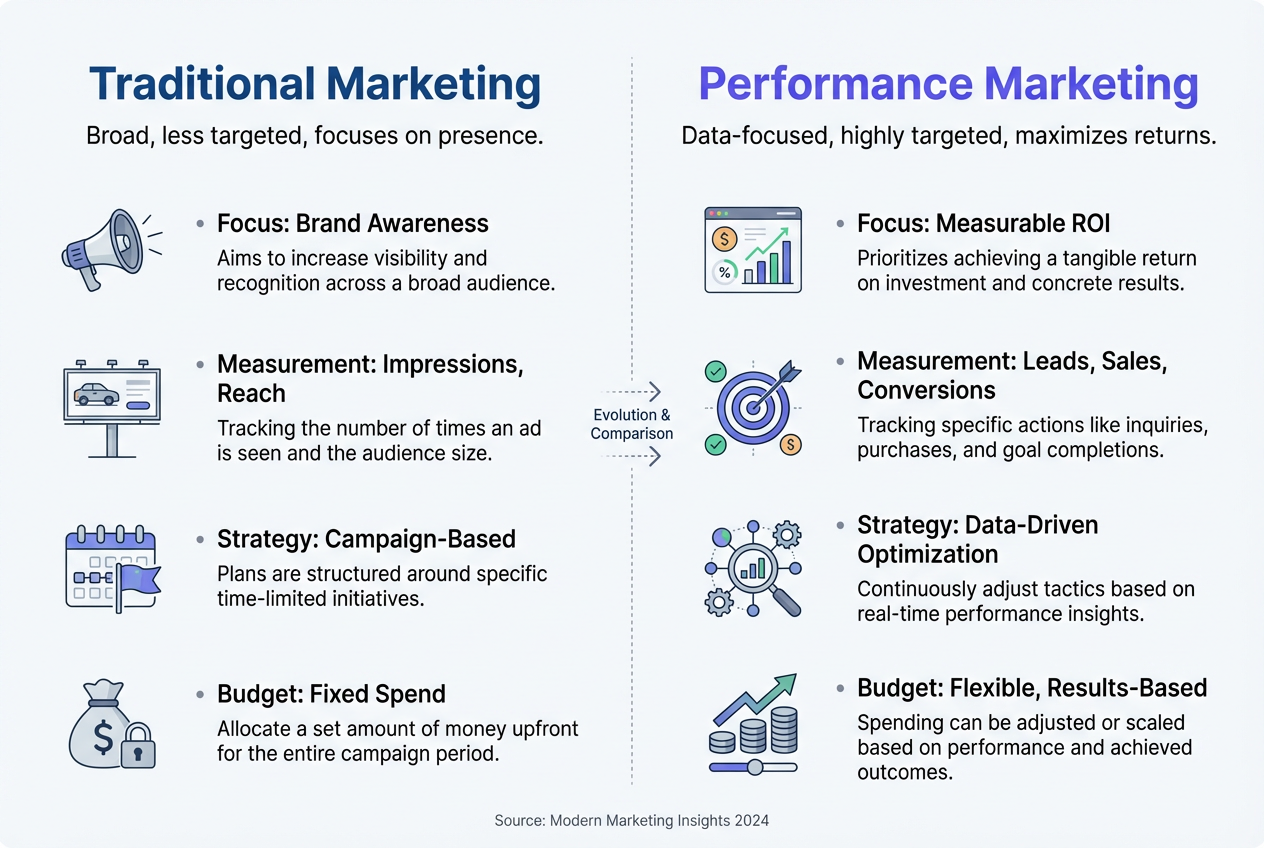
A performance marketing agency is a specialized partner that focuses exclusively on measurable, results-driven marketing strategies. Unlike traditional agencies that bill for creative services or campaign execution regardless of outcomes, performance marketing agencies tie their success directly to your business metrics: qualified leads, customer acquisitions, pipeline velocity, and ultimately, revenue growth.
The fundamental difference? Accountability. Performance marketing operates on the principle that every dollar spent should be tracked, measured, and optimized for maximum return on investment. These agencies combine data analytics, conversion optimization, and multi-channel expertise to create marketing systems that don’t just generate activity—they generate business outcomes.
Key Takeaways
- Performance marketing ties every dollar to measurable business outcomes — qualified leads, pipeline, and revenue — not impressions or clicks.
- B2B companies with $10M–$200M in revenue and small marketing teams gain the most from agency partnerships: full-spectrum expertise at a fraction of in-house cost.
- The core service stack — paid media, SEO, CRO, ABM, analytics, email, and content — works as an integrated system, not siloed tactics.
- Lead quality matters more than lead volume. The right agency optimizes for SQLs and closed revenue, not form fills.
- Multi-touch attribution is non-negotiable for B2B sales cycles of 6–18 months. Without it, you’re guessing which investments drive growth.
- Choosing the right partner comes down to vertical expertise, transparent reporting, lead quality focus, and strategic alignment with your business goals.
Performance Marketing vs. Traditional Marketing: The Fundamental Difference
Traditional marketing agencies build campaigns around impressions, reach, and creative awards. Performance marketing agencies build campaigns around conversion rates, cost per acquisition, and revenue attribution. Where traditional marketing asks “How many people saw our message?” performance marketing asks “How many people took action, and what was the business impact?”
This guide covers exactly what performance marketing agencies do, how they tackle complex B2B sales cycles, and how to choose the right partner — without the fluff.
Why Performance Marketing is Indispensable for Today’s B2B Businesses
According to Forrester, the typical B2B purchase now involves 13 internal stakeholders and nine external influencers. That complexity demands a marketing system that tracks influence across every touchpoint — not just the last click.
The Power of Measurable Results
For CEOs and CFOs evaluating marketing investments, the appeal of performance marketing is simple: you can see exactly what you’re getting for your money. Every campaign, every channel, every dollar is tracked and tied to specific business outcomes. When your board asks “What’s the ROI on our marketing spend?” you have concrete answers backed by data.
In B2B environments where sales cycles can extend 6-18 months and involve multiple decision-makers, this level of accountability is transformative. You’re not guessing which touchpoints matter—you know. You’re not hoping your marketing contributes to pipeline—you can prove it does.
Data-Driven Decisions, Not Guesswork
Performance marketing agencies build their strategies on analytics, not intuition. They use sophisticated tracking to understand which keywords drive the highest-quality leads, which ad creative resonates with your target accounts, and which content moves prospects from awareness to consideration to decision.
For marketing teams of 0-5 people—common in growing B2B companies—this data-driven approach fills critical skill gaps. Instead of relying on guesswork or outdated “best practices,” you gain access to real-time insights about what’s working in your specific market, for your specific buyers, right now.
Accelerating Complex Sales Cycles
B2B sales cycles are inherently complex. A credit union evaluating a new core banking platform might involve stakeholders from IT, operations, compliance, and the C-suite. A multi-location med spa considering expansion needs buy-in from regional managers, finance teams, and marketing directors. Home builders juggling land acquisition, development timelines, and buyer preferences face their own intricate decision-making processes.
Performance marketing agencies understand these complexities. They build multi-touch attribution models that track how prospects engage across channels over time. They create nurture sequences that deliver the right content to the right stakeholder at the right stage. They identify which touchpoints accelerate deals and which create friction—then optimize accordingly.
The result? Shorter sales cycles, higher conversion rates, and more predictable revenue growth.
Scalable Growth & Efficient Resource Allocation
When your internal marketing team is stretched thin, every decision about resource allocation matters. Should you invest in paid search or paid social? Is content marketing or account-based marketing the better bet? How do you balance lead generation with brand building?
Performance marketing agencies answer these questions with data. They test, measure, and optimize across channels to find the most efficient path to your growth goals. As they identify what works, they scale those efforts systematically—increasing spend on high-performing campaigns while cutting waste from underperforming ones.
This approach is particularly valuable for businesses with growth ambitions but limited marketing bandwidth. Instead of spreading your internal team across too many initiatives, you focus on strategic oversight while the agency executes a coordinated, data-backed growth plan.
The Complete Service Guide: How a Performance Marketing Agency Drives Results
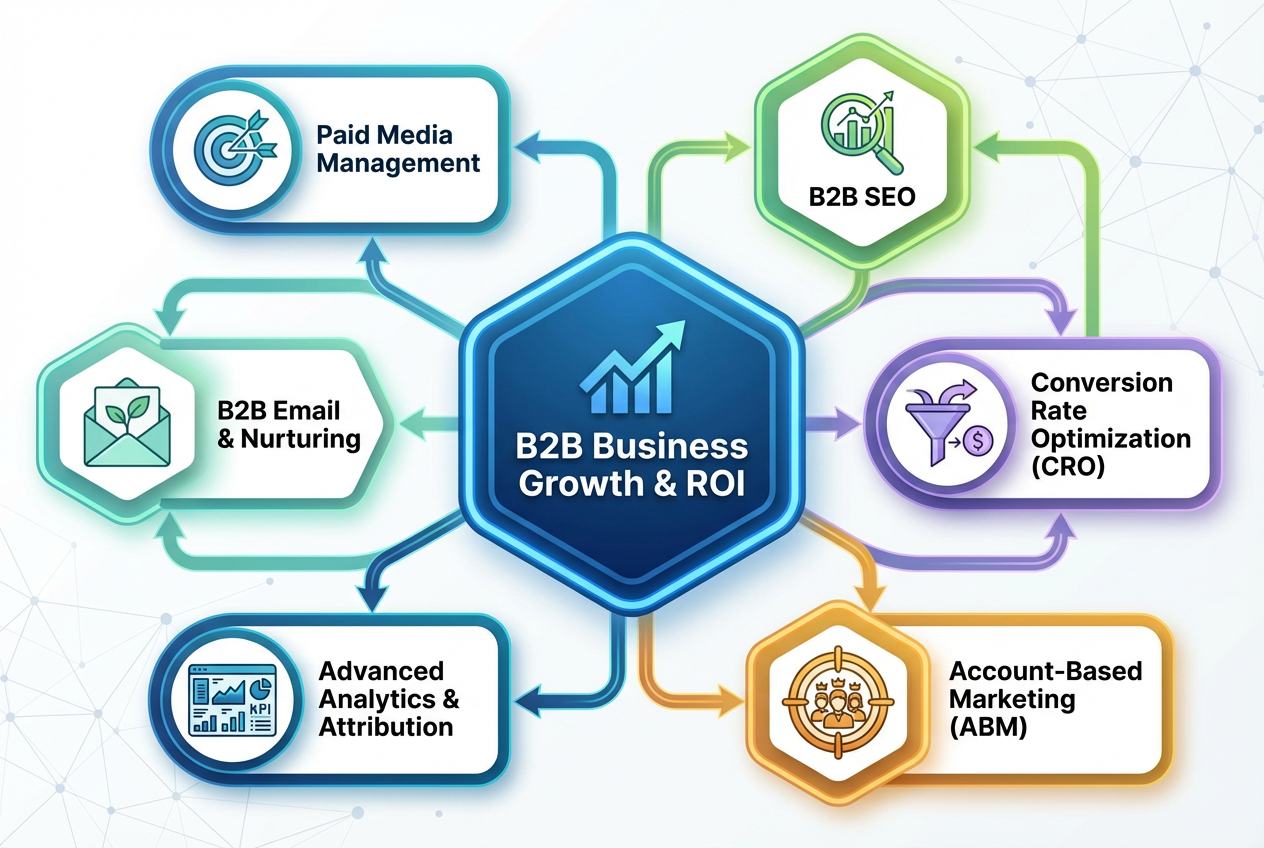
A comprehensive performance marketing agency integrates multiple specialized services into a cohesive growth engine. Each service plays a distinct role, but the real power comes from how they work together to attract, engage, and convert your ideal customers.
Paid Media Management
A strong paid media agency treats paid channels as the cornerstone of performance marketing—where precision targeting meets immediate measurability.
Google Ads Management (Search & Display)
For B2B buyers actively searching for solutions, Google Ads captures demand at the moment of highest intent. An experienced Google Ads management agency starts with comprehensive keyword research to identify not just high-volume terms but high-intent queries that signal buying readiness.
A serious Google Ads management agency doesn’t just set up campaigns and walk away. They continuously optimize through:
- Bid strategy refinement to maximize conversions within budget constraints
- Ad copy testing to improve click-through rates and message relevance
- Landing page alignment to ensure seamless post-click experiences
- Negative keyword management to eliminate wasted spend on irrelevant searches
For businesses in regulated industries like financial services, this also includes navigating advertising restrictions and compliance requirements—something specialized agencies understand intimately.
While Google captures active search demand, social media advertising creates and nurtures demand among your target accounts even before they’re actively shopping.
LinkedIn Ads are particularly powerful for B2B, offering unmatched targeting capabilities based on job title, seniority, company size, industry, and even specific companies. This makes it ideal for account-based marketing campaigns targeting high-value prospects.
Facebook and Meta platforms, while often associated with B2C, can be highly effective for certain B2B niches—particularly in industries like med spas where you’re reaching business owners and operators who use consumer platforms. The key is precise audience targeting and creative that speaks to business outcomes, not just consumer benefits.
Programmatic Advertising
Programmatic advertising uses automated bidding systems to place your ads across thousands of websites where your target audience spends time. For B2B buyers who aren’t constantly on Google or LinkedIn, programmatic extends your reach while maintaining targeting precision through firmographic and technographic data.
➤Our proprietary Paid Media GPT — trained on 13 years of cross-industry campaign data — identifies optimization opportunities most teams miss: budget reallocation signals, creative fatigue patterns, and audience saturation thresholds. It’s the difference between reactive reporting and predictive performance management. — Contact Us
B2B Specific Angle: Focus on Lead Quality Over Volume
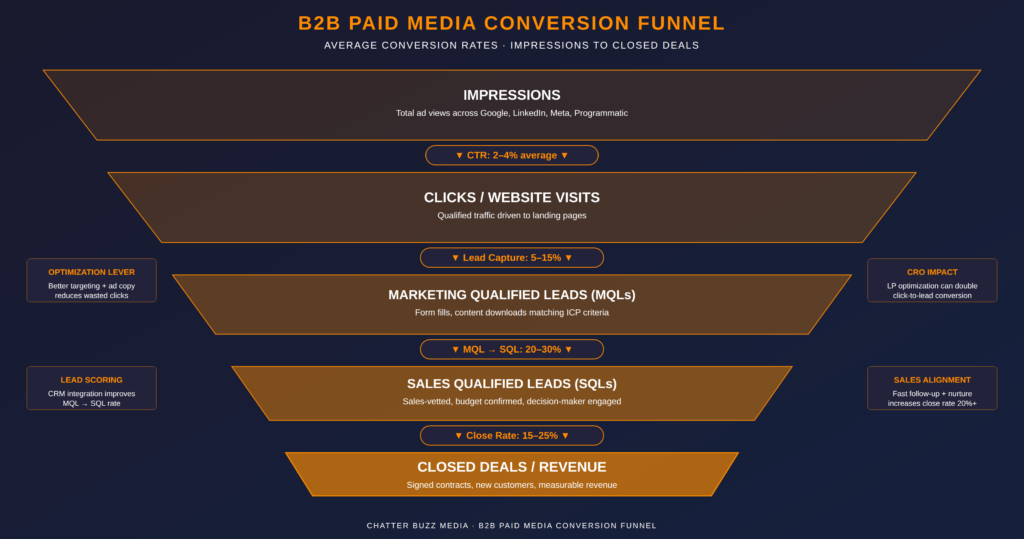
The fundamental difference in B2B paid media is the emphasis on qualified leads over raw volume. A performance marketing agency optimizes for MQLs (Marketing Qualified Leads) and SQLs (Sales Qualified Leads) that match your ideal customer profile—not just anyone who clicks an ad.
They implement lead scoring, connect campaigns to your CRM, and track conversion metrics all the way through to closed deals. This allows them to calculate true customer acquisition cost and optimize for the campaigns that drive revenue, not just traffic.
➤ At Chatter Buzz, we’ve managed $1B+ in campaign spend across Google, Meta, LinkedIn, and programmatic — giving us benchmark data most agencies simply don’t have. That data informs every recommendation we make.
— Start Advertising
B2B Search Engine Optimization (SEO)
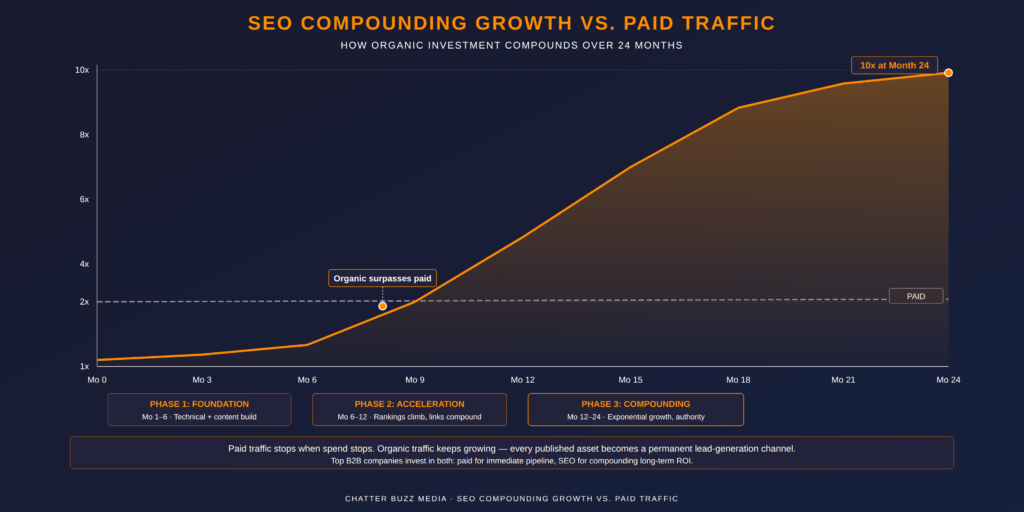
While paid media delivers immediate results, partnering with a B2B SEO agency builds a long-term asset that compounds in value over time. Organic search positions your business as a trusted authority and captures buyers throughout their research journey—often before they’re ready to engage with sales.
Technical SEO Audits
The foundation of effective SEO is a technically sound website. Performance marketing agencies conduct comprehensive audits to identify and fix issues that prevent search engines from properly crawling, indexing, and ranking your site:
- Site speed optimization to improve user experience and search rankings
- Local SEO optimization — a core B2B SEO agency capability — for businesses targeting geographic markets
- Mobile responsiveness to capture the growing number of mobile researchers
- Schema markup implementation to enhance search result appearances
- Internal linking architecture to distribute page authority and guide user journeys
For complex B2B websites with multiple product lines or service offerings, technical SEO ensures search engines understand your site structure and can surface the right pages for relevant queries.
Conversion-Oriented Content & Keyword Strategy
B2B SEO isn’t about ranking for vanity keywords—it’s about capturing the specific queries your ideal customers use when researching solutions. This requires a deep understanding of your buyer personas, their challenges, and how they articulate their needs.
Performance marketing agencies develop content strategies that target:
- Problem-aware keywords (capturing buyers who know they have a challenge but haven’t identified solutions)
- Solution-aware keywords (reaching prospects comparing different approaches)
- Product-aware keywords (engaging buyers evaluating specific offerings)
The content itself is optimized not just for rankings, but for conversion—incorporating clear calls-to-action, trust signals, and paths to deeper engagement.
Link Building & Authority
In competitive B2B spaces, building domain authority through high-quality backlinks is essential for ranking. Performance marketing agencies develop strategic link-building programs that earn links from industry publications, partner organizations, and authoritative directories.
B2B Specific Angle: Long-Term Asset Building
SEO is particularly valuable for B2B because it compounds over time. As your content library grows and your domain authority increases, you capture more traffic, generate more leads, and reduce dependence on paid channels. This creates marketing leverage—the ability to drive more results without proportionally increasing spend.
Conversion Rate Optimization (CRO)
Driving traffic to your website is only half the equation. Conversion Rate Optimization ensures that once prospects arrive, they take meaningful action—whether that’s downloading a resource, requesting a demo, or scheduling a consultation.
Landing Page Optimization
Every element of a high-converting landing page impacts conversion rates: headline clarity, value proposition strength, form length, visual hierarchy, social proof placement, and call-to-action design. Performance marketing agencies use data and psychology to optimize each component.
For B2B buyers who are often skeptical and research-intensive, this means:
- Clear articulation of specific business outcomes (not just features)
- Trust indicators like client logos, certifications, and compliance statements
- Friction reduction through progressive disclosure (asking for minimal information upfront)
- Mobile optimization for executives researching on tablets and smartphones
A/B Testing & User Experience Analysis
Rather than guessing what will improve conversions, performance marketing agencies test systematically. They run controlled experiments comparing different headlines, layouts, form designs, and calls-to-action—measuring which variations drive more conversions.
They also analyze user behavior through heatmaps, session recordings, and conversion funnel analytics to identify where prospects drop off and why. This reveals friction points that may not be obvious from design reviews alone.
B2B Specific Angle: Optimizing for High-Value Conversions
In B2B, not all conversions are created equal. A performance marketing agency focuses on optimizing the conversions that matter most to your business—qualified demo requests, consultation bookings, or high-intent content downloads—rather than vanity metrics like newsletter signups.
They also understand that B2B buying involves multiple stakeholders, so they optimize for different conversion paths depending on job role, company size, and buying stage.
Account-Based Marketing (ABM) Strategy & Execution
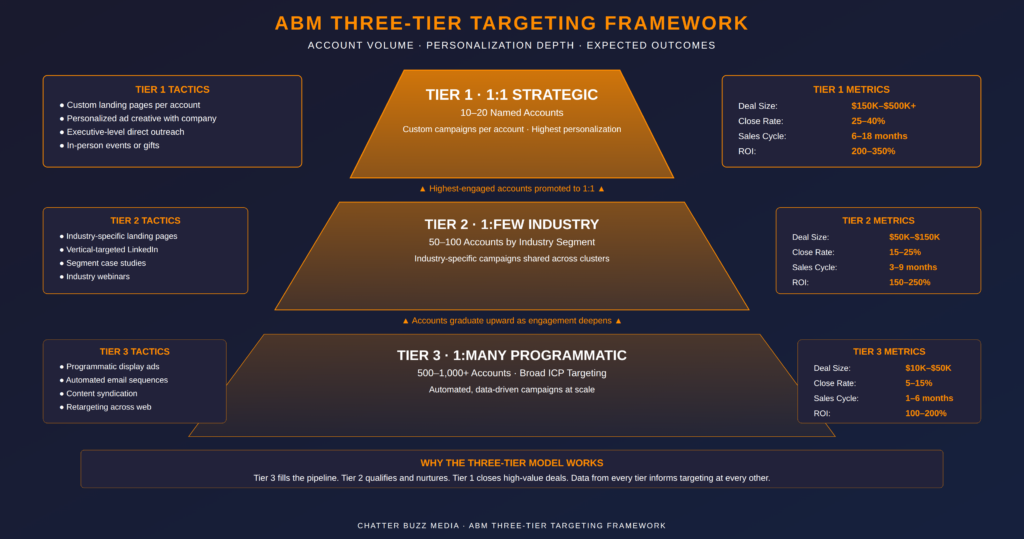
For B2B companies targeting high-value clients—particularly those with annual contracts worth $50K+—Account-Based Marketing represents a fundamental shift from broad lead generation to focused account penetration.
Target Account Identification & Personalization
ABM starts with identifying your highest-value prospects: the specific companies that perfectly match your ideal customer profile and have the greatest revenue potential. Performance marketing agencies help you build target account lists based on firmographic data (industry, size, location) and technographic data (current technology stack, tools they use).
Once identified, they create personalized campaigns tailored to each account’s specific challenges, industry context, and business priorities. This might include:
- Custom landing pages addressing industry-specific pain points
- Personalized ad creative featuring the prospect’s company or industry
- Tailored content offers relevant to their specific business challenges
Multi-Channel ABM Campaigns
Effective ABM orchestrates touchpoints across multiple channels to surround decision-makers with relevant messaging. A comprehensive ABM campaign might include:
- LinkedIn ads targeted to specific companies and job titles
- Retargeting ads that follow account visitors across the web
- Personalized email outreach from sales development representatives
- Direct mail campaigns to key decision-makers
- Customized content experiences when they visit your website
Sales & Marketing Alignment
ABM only works when sales and marketing operate as a unified team. Performance marketing agencies facilitate this alignment by:
- Establishing shared definitions of target accounts and qualified opportunities
- Creating lead intelligence that helps sales personalize their outreach
- Tracking account engagement to identify the optimal time for sales contact
- Building feedback loops so sales insights inform marketing messaging
B2B Specific Angle: Essential for Long Sales Cycles
ABM is particularly powerful for B2B organizations with complex sales cycles involving multiple decision-makers. Rather than generating hundreds of generic leads that sales must qualify, ABM delivers deep engagement with the specific accounts most likely to become high-value clients.
For industries like financial services or manufacturing where deals can take 12-18 months to close, ABM keeps your brand top-of-mind throughout the entire buying journey while providing sales with the intelligence they need to have relevant conversations at every stage.
Advanced Analytics & Cross-Channel Attribution
Without proper measurement, even the best marketing tactics are just expensive guesses. Performance marketing agencies build sophisticated analytics frameworks that connect marketing activities to business outcomes.
Tracking & Reporting
Modern B2B marketing involves dozens of touchpoints across multiple channels before a prospect converts. Performance marketing agencies implement tracking systems that capture:
- Website behavior (pages viewed, time on site, content consumed)
- Campaign interactions (ads clicked, emails opened, forms submitted)
- Cross-device activity (recognizing when the same person engages on mobile and desktop)
- Offline conversions (connecting online marketing to phone calls, in-person meetings, and closed deals)
They transform this data into clear dashboards and reports that show not just what happened, but what it means for your business. CFOs can see cost per acquisition by channel. VPs of Marketing can see which campaigns drive pipeline. CEOs can see projected revenue impact.
Multi-Touch Attribution Modeling
In B2B, buyers rarely convert on their first interaction. They might discover you through organic search, engage with your LinkedIn content, attend a webinar, visit your website multiple times, and download several resources before finally requesting a demo.
Multi-touch attribution gives credit to all the touchpoints that contributed to a conversion, not just the last one. This reveals:
- Which channels are most effective at creating initial awareness
- Which touchpoints accelerate consideration and evaluation
- Which interactions trigger the decision to engage with sales
With this insight, you can optimize budget allocation across the full buyer journey rather than over-investing in last-touch channels while starving top-of-funnel awareness programs.
Predictive Lead Scoring
Advanced performance marketing agencies use machine learning to score leads based on their likelihood to convert into customers. By analyzing patterns in your historical data—which behaviors, demographics, and engagement signals correlate with closed deals—they can prioritize sales outreach toward the prospects most likely to buy.
This is particularly valuable for sales teams working with limited bandwidth. Rather than chasing every lead equally, they focus their energy on the opportunities with the highest probability of closing.

B2B Specific Angle: Proving ROI to Financial Stakeholders
CFOs and VPs of Finance need to see clear connections between marketing spend and revenue generation. Performance marketing agencies provide this visibility through:
- Customer acquisition cost (CAC) calculations by channel and campaign
- Customer lifetime value (LTV) analysis to understand long-term revenue impact
- Pipeline contribution metrics showing how marketing influences sales opportunities
- Cohort analysis reveals which campaigns drive customers with the highest retention and expansion rates
This level of financial transparency makes marketing a strategic investment rather than a discretionary expense.
B2B Email Marketing & Nurturing
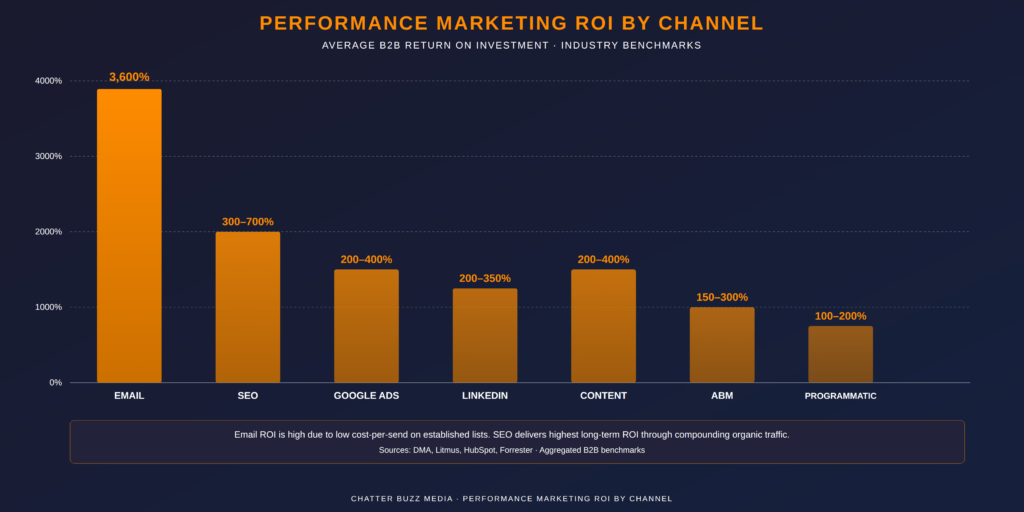
Despite the proliferation of new channels, email remains one of the highest-ROI tactics in B2B marketing. Performance marketing agencies use email strategically to nurture relationships, deliver value, and guide prospects through the buying journey.
Segmented Campaigns
Generic email blasts to your entire database generate poor results and erode trust. Performance marketing agencies segment your audience based on:
- Buyer persona (CFO vs. VP of Operations vs. IT Director)
- Industry vertical (financial services vs. healthcare vs. manufacturing)
- Company size (enterprise vs. mid-market vs. small business)
- Engagement stage (awareness vs. consideration vs. decision)
- Behavioral signals (content consumed, website pages visited, previous interactions)
This allows them to deliver highly relevant messages that speak directly to each recipient’s needs and interests.
Automated Lead Nurturing
B2B buyers need time to research, evaluate options, and build consensus internally before making purchase decisions. Automated nurture sequences keep your brand engaged with prospects throughout this journey without requiring manual effort from your team.
A typical nurture sequence might include:
- Educational content that helps prospects understand their challenge
- Comparison resources that position your solution against alternatives
- Customer success stories demonstrating proven results
- Product demonstrations showing how your offering works
- Consultation offers inviting personalized conversations
The key is timing and relevance—delivering the right message at the right stage rather than pushing for the sale prematurely.
B2B Specific Angle: Building Relationships Over Time
B2B email marketing isn’t about immediate conversions—it’s about maintaining presence and delivering value throughout extended sales cycles. For businesses where deals take 6-12 months to close, systematic email nurturing ensures you’re the obvious choice when buyers are finally ready to make a decision.
Performance marketing agencies track email engagement metrics (open rates, click rates, conversion rates) and use them to refine messaging, optimize send times, and identify which prospects are showing buying signals that should trigger sales outreach.
Performance-Based Content Creation
Content is the fuel that powers modern B2B marketing. Strategic content creation drives organic traffic and builds authority that compounds over time. But not all content is created equal—performance marketing agencies create content specifically designed to drive measurable business outcomes.
Conversion-Centric Copywriting
Every piece of content serves a purpose in your marketing funnel. Performance marketing agencies craft copy that:
- Addresses specific buyer pain points and challenges
- Articulates clear value propositions and differentiators
- Incorporates compelling calls-to-action appropriate to the funnel stage
- Uses persuasive techniques grounded in behavioral psychology
- Optimizes for both search engines and human readers
Whether it’s a blog post, landing page, email, or ad, the copy is intentionally structured to move prospects toward the next step in their journey.
Tailored Content for Different Funnel Stages
B2B buyers need different content at different stages:
Top of Funnel (Awareness):
- Educational blog posts that address industry challenges
- Research reports and industry trend analyses
- How-to guides and best practice frameworks
- Thought leadership perspectives on emerging topics
Middle of Funnel (Consideration):
- Solution comparison guides evaluating different approaches
- Webinars demonstrating expertise and thought leadership
- Case studies showing real-world results
- Product explainer content and feature overviews
Bottom of Funnel (Decision):
- Detailed ROI calculators and business case templates
- Implementation guides reducing perceived risk
- Competitive comparison sheets highlighting differentiators
- Customer testimonials and success metrics
Performance marketing agencies map content to buyer journey stages and create libraries that serve prospects wherever they are in their research process.

B2B Specific Angle: Content That Supports Solution Evaluation
B2B content marketing isn’t about going viral or generating massive traffic—it’s about providing the information decision-makers need to evaluate your solution thoroughly. This often means creating in-depth, technical content that demonstrates deep industry expertise and gives buyers confidence in your capabilities.
For regulated industries like financial services, this also means ensuring all content meets compliance requirements while still being engaging and persuasive.
The Tangible Benefits: What a Strategic Partnership Means for Your Business
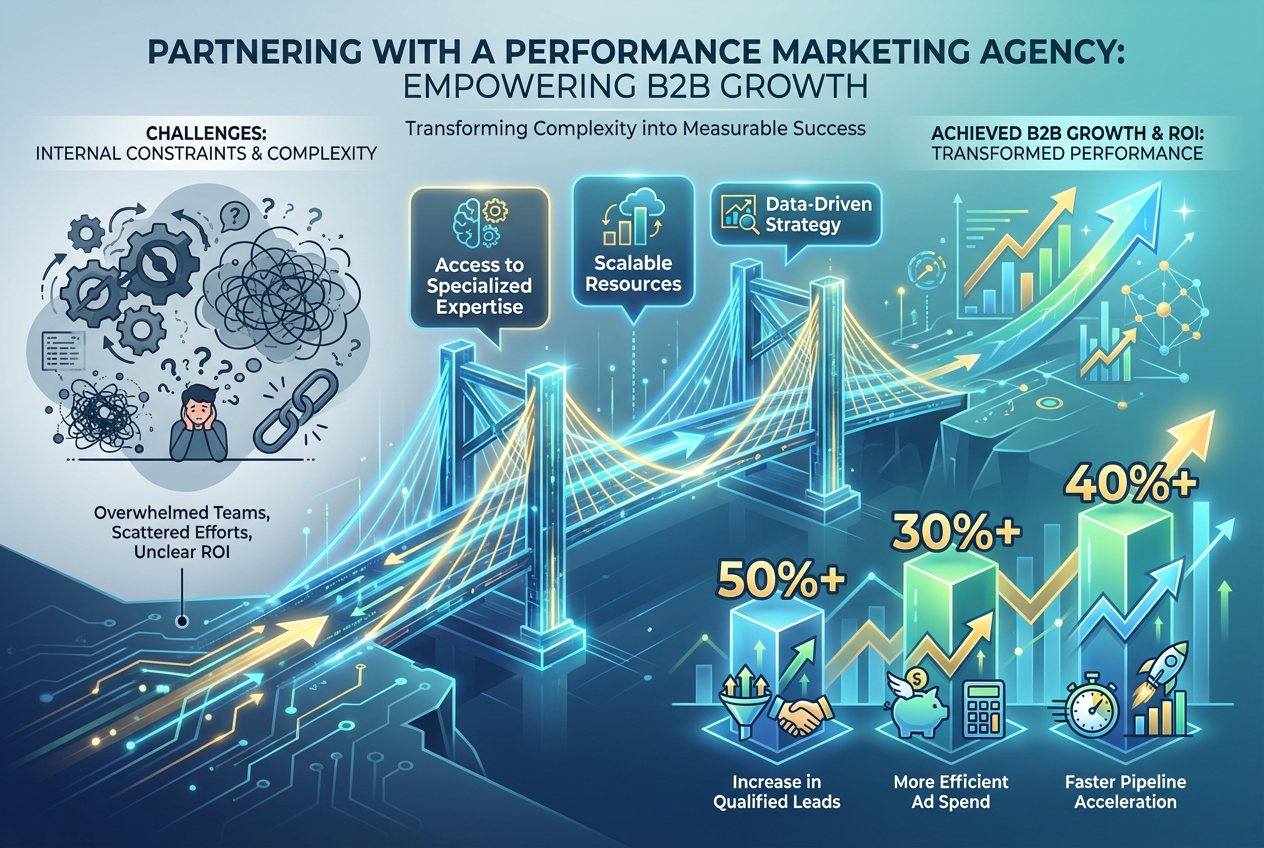
Partnering with a performance marketing agency delivers concrete advantages that extend far beyond what traditional marketing can offer.
Maximize Your Marketing Budget
The best paid media agency partners are obsessed with efficiency. They continuously test, measure, and optimize to ensure every dollar generates maximum return.
This means:
- Eliminating waste on underperforming campaigns and channels
- Doubling down on high-ROI tactics that drive business outcomes
- Negotiating better rates with advertising platforms through volume and expertise
- Avoiding expensive mistakes that less experienced teams might make
For CFOs evaluating marketing budgets, this efficiency translates directly to stronger ROI metrics and more predictable growth trajectories.
Gain a Competitive Edge
Top performance marketing agencies invest heavily in proprietary technology, advanced analytics platforms, and continuous training. As their client, you gain access to:
- Marketing automation tools that might be cost-prohibitive to license directly
- Advanced attribution modeling that reveals competitive insights
- Testing frameworks that accelerate learning and optimization
- Industry benchmarks that contextualize your performance
You also benefit from their experience across multiple clients and industries—they bring best practices and innovative approaches that your competitors may not be implementing.
Bridge Internal Skill Gaps
Building a complete in-house marketing team with expertise across paid media, SEO, content marketing, conversion optimization, analytics, and marketing automation would require hiring 5-10 specialists. For most B2B companies with $10M-$200M in revenue, that’s not financially viable or strategically optimal.
A performance marketing agency provides immediate access to this full spectrum of expertise without the overhead of full-time salaries, benefits, and management complexity. You get a complete team for the cost of 1-2 full-time employees.
This is particularly valuable when your internal marketing leader is stretched thin managing day-to-day operations, coordinating with sales, and reporting to executives. The agency becomes a force multiplier—executing sophisticated campaigns while your internal team focuses on strategy and coordination.
Faster, Smarter Decision-Making
Performance marketing agencies provide real-time data and insights that enable faster, more confident decision-making:
- Weekly performance updates showing exactly what’s working and what’s not
- Recommendations for budget reallocation based on actual performance data
- Competitive intelligence about market trends and buyer behavior changes
- Proactive alerts when campaigns need attention or opportunities emerge
This velocity of insight keeps your marketing agile and responsive rather than locked into quarterly plans that may no longer align with market realities.
Dedicated Focus on Your Core Business
Marketing is essential, but it’s not your core competency. By partnering with specialists who live and breathe digital marketing strategy, you free your team to focus on what you do best—serving customers, innovating products, building operational excellence.
CEOs and business owners — or their fractional CMO — can invest their energy in strategic growth initiatives rather than getting pulled into marketing tactics and channel management. This focus creates compounding benefits across the entire organization.
Choosing Your Strategic Partner: What to Look for in a B2B Performance Marketing Agency
Not all performance marketing agencies are created equal — whether you need a B2B SEO agency, a paid media specialist, or a full-stack partner, selecting the right one requires evaluating several critical factors.
Proven B2B Experience (Especially in Your Vertical)
B2B marketing differs fundamentally from B2C in buying cycles, decision-making complexity, and effectiveness metrics. Look for agencies with demonstrated success in B2B environments similar to yours.
Even better: find agencies with specific vertical expertise. A financial services marketing agency that understands NCUA and OCC compliance requirements brings immediate value that generalist agencies can’t match. A med spa marketing specialist knows how to navigate FDA regulations and position aesthetic services effectively. A home builder marketing expert understands community lifecycle marketing and construction timelines.
Ask to see case studies from companies in your industry or with similar business models. Request references from clients facing similar challenges.
Data-Driven Culture & Transparent Reporting
Any agency can claim to be “data-driven.” The test is whether they can explain:
- How they track conversions across multiple touchpoints
- What attribution model do they use, and why
- How they calculate and optimize for customer acquisition cost
- What specific metrics will they report on, and how frequently
- How they translate data into actionable recommendations
Demand transparency in reporting. You should have direct access to performance dashboards and regular review meetings where the agency explains what the data means and what they’re doing about it.
Beware of agencies that make results sound mysterious or proprietary. Good performance marketing is sophisticated but should be explainable in terms business leaders can understand.
Holistic, Integrated Strategy
Marketing channels don’t work in isolation. Paid search is more effective when supported by SEO content. Social media ads perform better when amplifying genuine thought leadership. Email nurturing works best when personalized based on website behavior.
Look for agencies that think holistically about your marketing ecosystem rather than specialists who only know one channel. Ask how they coordinate across tactics and what systems they use to ensure consistency.
The best agencies start with your business goals, then build integrated strategies that leverage the right mix of channels to achieve those goals—rather than pushing whatever services they happen to sell.
Emphasis on Lead Quality, Not Just Quantity
In B2B, a hundred unqualified leads are worse than useless—they waste sales time and create frustration. The right agency focuses obsessively on lead quality.
Ask how they define a qualified lead. How do they ensure campaigns attract prospects who match your ideal customer profile? What mechanisms prevent low-quality form fills? How do they use lead scoring to prioritize sales follow-up?
Agencies that promise thousands of leads without discussing qualification criteria are focused on the wrong metrics.
Strong Client-to-Team Member Ratio
You want dedicated attention, not to be one of hundreds of clients fighting for time. Ask about client-to-team-member ratios. How many accounts does each strategist manage? Will you have a dedicated account team or share resources across multiple clients?
Smaller, focused agencies often provide better service than large firms, where you’re a small account. Look for agencies that clearly explain who will work on your account, their experience levels, and how often you’ll interact.
Strategic Alignment with Your Business Goals
The best agency relationships transcend vendor-client dynamics to become true partnerships. Look for agencies that invest time in understanding:
- Your specific business model and revenue drivers
- Your sales process and how marketing supports it
- Your competitive landscape and market positioning
- Your growth targets and timeline expectations
They should ask questions about topics beyond marketing—your product roadmap, customer retention challenges, sales team structure, and leadership priorities. This context allows them to align marketing strategies with broader business objectives rather than optimizing marketing metrics in isolation.
Compliance & Regulatory Understanding
For businesses in regulated industries—financial services, healthcare, legal—marketing compliance isn’t optional. The wrong claim or promise can trigger regulatory action, damage your reputation, or create legal liability.
Choose agencies with demonstrated experience navigating your industry’s regulatory environment. They should understand:
- What claims you can and cannot make in advertising
- Required disclosures and disclaimers
- Advertising review and approval processes
- Data privacy and security requirements
This expertise prevents costly mistakes and allows you to move faster because the agency knows what will pass compliance review.
Addressing Common Concerns: Challenges & Solutions in Agency Partnerships
Even with the right agency, partnering effectively requires addressing common challenges proactively.
Goal Misalignment
Challenge: Marketing and business leadership have different definitions of success, leading to frustration and underperformance.
Solution: Establish clear KPIs at the outset that connect to business outcomes. Don’t just measure clicks and impressions—track metrics that matter to executives like cost per qualified opportunity, pipeline contribution, and customer acquisition cost. Create quarterly business reviews where the agency demonstrates marketing’s impact on revenue, not just marketing metrics.
Understanding Cost & Value
Challenge: Marketing retainers can seem expensive, especially when compared to the cost of one employee. CFOs may question whether a $10K-$40K monthly investment is justified.
Solution: Frame the comparison properly. A $20K/month retainer ($240K/year) provides access to an entire team with specialized skills across multiple disciplines. Building equivalent in-house capability would require hiring 5-7 specialists at $300K-$500K+ in total compensation, plus management overhead, benefits, and technology costs.
More importantly, focus on ROI. If the agency generates an additional $2M in pipeline from a $240K annual investment, that’s an 8x return—exceptional by any financial standard. The question isn’t “Is this expensive?” but “What’s the return on this investment?”
Integrating with Internal Teams
Challenge: Agency and internal teams work in silos, leading to duplicated efforts, misaligned messaging, or gaps in execution.
Solution: Establish clear communication rhythms and collaborative workflows. Weekly standup meetings keep everyone aligned on priorities and progress. Shared project management systems ensure transparency. Joint planning sessions leverage agency expertise and internal knowledge.
The best relationships position the agency as an extension of your team—attending sales meetings to understand customer feedback, participating in product launches, and contributing to strategic planning beyond their immediate scope.
Frequently Asked Questions
What is the difference between a performance marketing agency and a traditional marketing agency?
Traditional marketing agencies focus on brand awareness, creative campaigns, and services billed by deliverables regardless of business outcomes. Performance marketing agencies focus exclusively on measurable results—qualified leads, customer acquisitions, and revenue growth. They optimize campaigns continuously based on conversion data and typically tie their success to your business metrics rather than just delivering creative work.
How does performance marketing deliver ROI?
Performance marketing delivers ROI through systematic testing, measurement, and optimization. Agencies track every dollar spent and its impact on business outcomes—cost per lead, cost per customer, customer lifetime value. They continuously test different approaches, eliminate underperforming tactics, and scale what works. This data-driven approach maximizes return by ensuring budget flows to the highest-performing channels and campaigns.
Is B2B performance marketing different from B2C?
Yes, significantly. B2B performance marketing must account for longer sales cycles (often 6-18 months), multiple decision-makers, higher deal values, and complex buying processes. It emphasizes lead quality over quantity, implements sophisticated nurturing programs, and tracks attribution across many touchpoints. B2B campaigns also require industry-specific expertise and often navigate compliance requirements that don’t apply to B2C.
What specific metrics should I look for in reporting?
Key B2B performance marketing metrics include: cost per Marketing Qualified Lead (MQL), MQL-to-SQL conversion rate, cost per Sales Qualified Lead (SQL), SQL-to-Opportunity conversion rate, pipeline contribution by channel, customer acquisition cost (CAC), customer lifetime value (LTV), LTV: CAC ratio, and closed/won revenue attributed to marketing. The specific metrics depend on your sales process and how your business defines qualified leads.
How long does it take to see results from a performance marketing agency?
Initial results—increased traffic, improved engagement metrics—often appear within 30-60 days. Meaningful business impact—qualified leads, sales opportunities, closed deals—typically emerges within 90-180 days as campaigns optimize and nurture sequences mature. Full ROI realization, especially for businesses with long sales cycles, may take 6-12 months. However, you should see progressive improvement and clear leading indicators much sooner.
Can a performance marketing agency help with both lead generation and sales enablement?
Yes, comprehensive performance marketing agencies bridge marketing and sales. They generate qualified leads through various channels, provide lead intelligence that helps sales personalize outreach, create sales enablement content (case studies, competitive comparisons, ROI calculators), and track campaign effectiveness all the way through to closed deals. The best agencies work collaboratively with sales teams to ensure marketing delivers not just volume, but quality opportunities that convert.
What budget should I allocate for performance marketing?
A common benchmark for B2B companies is 5-15% of revenue allocated to marketing, with growth-stage companies at the higher end. Of that, 40-60% typically goes to performance marketing tactics (paid media, SEO, content, automation). For a $20M revenue company, this might mean a total marketing budget of $1.2M-$3M, with $500K-$1.8M toward performance marketing. Monthly agency retainers typically range from $10K-$40K+ depending on company size, industry complexity, and growth goals, plus separate media spend budgets.
How do I know if an agency specializes in my industry?
Ask for case studies from clients in your industry or with similar business models. Request references you can contact. Review their content and thought leadership—do they publish insights relevant to your market? Ask about team members’ backgrounds—do they have prior experience in your industry? During sales conversations, assess whether they ask intelligent questions about your specific challenges or speak only in generic marketing terms.
Conclusion: Unlock Your B2B Growth Potential
The B2B buying journey has fundamentally changed. Your prospects complete 70%+ of their research before engaging with sales, evaluating multiple vendors simultaneously, and building consensus across stakeholder teams before a single conversation happens.
That reality demands a marketing system that’s accountable to revenue, not just activity.
If you’re a CEO or CFO at a $10M–$200M company with a small marketing team and aggressive growth targets, the decision isn’t whether to invest in performance marketing — it’s how quickly you can shift from unmeasurable spend to a system that proves its own ROI every month.
Start by auditing what you currently can and can’t measure. Map your attribution gaps. Define what a qualified lead actually means for your sales team. Then evaluate whether your current approach — in-house, agency, or hybrid — has the expertise to close those gaps.
The companies that win in 2026 and beyond won’t be the ones with the biggest budgets. They’ll be the ones with the clearest line of sight from marketing dollar to closed deal.
➤ Ready to see where you’re leaving revenue on the table?
Our Performance Audit identifies your top 3 revenue leaks across paid media, SEO, and conversion paths — with a prioritized 90-day action plan. Valued at $3K–$5K. — Request Your Audit