
 321-236-2899
Marketing teams are being asked to drive measurable growth in an increasingly complex digital landscape. Buyers expect personalized experiences across every channel. Sales teams want better leads. Leadership wants proof of ROI. Meanwhile, budgets, time, and headcount rarely increase at the same pace.
This is why marketing automation services have become a cornerstone of modern growth strategies.
Marketing automation allows businesses to scale communication, improve lead quality, and create consistent customer experiences without increasing manual effort. When implemented strategically, it becomes the connective tissue between marketing, sales, and revenue.
You will not just learn what marketing automation is, but why it matters, how it works, and how to apply it in ways that drive real business outcomes. Whether you are exploring marketing automation software for the first time or refining an existing marketing automation strategy, this guide is designed to support long-term growth.
What Is Marketing Automation?
Marketing automation is the use of technology to automate, manage, and optimize marketing activities across the customer lifecycle while delivering personalized experiences at scale. The global marketing automation market size is projected to reach $15.58 billion by 2030.
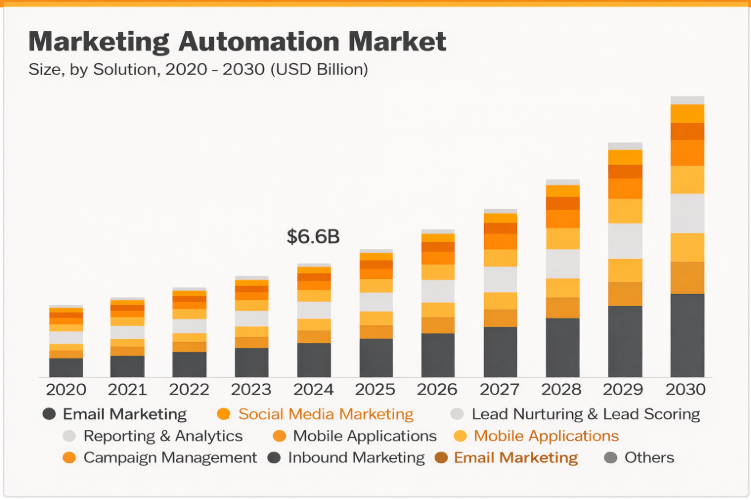
Source: Grand View Research
At its core, marketing automation software replaces manual processes with systems that respond intelligently to customer behavior. Instead of sending one-off campaigns, marketers build frameworks that adapt based on actions, interests, and intent.
This shift fundamentally changes how marketing operates. Rather than reacting to leads individually, teams design systems that nurture, qualify, and convert prospects continuously.
Why Marketing Automation Exists
Marketing automation exists because modern buying behavior is complex. Buyers research independently, interact across multiple channels, and expect relevance at every touchpoint. Manual marketing simply cannot keep up. Automation marketing solves these problems by creating structure and consistency at scale.
Without automation, teams struggle with:
- Slow follow-up times
- Inconsistent messaging
- Missed opportunities
- Poor visibility into performance
- Disconnected sales and marketing efforts
What Marketing Automation Actually Powers
A mature marketing automation platform enables businesses to:
- Track engagement across email, website, ads, and CRM
- Segment audiences dynamically based on behavior and attributes
- Deliver personalized messaging automatically
- Score and qualify leads based on real intent
- Align marketing and sales through shared data
- Measure the impact from the first touch to the closed revenue
For example, in platforms like HubSpot or Marketo, a prospect who downloads a guide, visits a pricing page, and attends a webinar can automatically be flagged as sales-ready. Sales receives full context, not just a name and email address.
How Marketing Automation Works
Marketing automation works by connecting data, logic, and execution into a single system that responds to customer behavior in real time.
While platforms vary, the underlying mechanics remain consistent.
Data Collection and Behavioral Tracking
Everything begins with data. Marketing automation software tracks interactions across digital touchpoints, including:
- Website visits and page views
- Form submissions and content downloads
- Email opens and clicks
- Ad interactions
- CRM updates
- Product usage or purchase behavior
Tools like HubSpot tracking, Google Analytics 4, Segment, and Customer.io help centralize this data so every interaction contributes to a unified customer profile. The more accurate and complete this data is, the more effective automation becomes.
Segmentation and Decision Logic
Segmentation and decision logic are what transform raw data into meaningful automation marketing outcomes. Once data is collected, marketing automation tools automatically segment contacts based on factors such as industry or role, behavioral signals like page visits and content downloads, lifecycle stage, engagement level, and specific product or service interest.
Platforms like ActiveCampaign and HubSpot use conditional logic to interpret these segments and route contacts into different automation paths, ensuring messaging, timing, and next steps align with actual intent rather than assumptions.
For example, a first-time website visitor and a returning prospect researching pricing should never receive the same messaging. Automation ensures they do not.
Automated Actions and Execution
Automation triggers actions based on defined rules. These actions happen instantly and consistently, ensuring no opportunity is missed due to human delay.
Common automated actions include:
- Sending personalized emails
- Updating CRM properties
- Assigning leads to sales reps
- Creating deals or tasks in Salesforce or HubSpot CRM
- Triggering retargeting ads
- Enrolling contacts in nurture or onboarding workflows
Why Marketing Automation Matters for Business Growth
Marketing automation is not about efficiency alone. It directly impacts revenue, customer experience, and scalability.
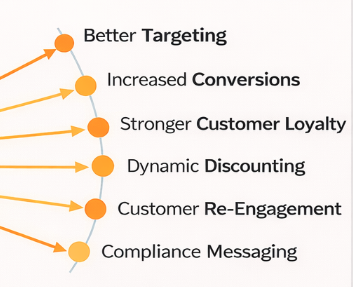
Faster and More Effective Lead Follow-Up
Speed plays a major role in conversion, and marketing automation ensures prospects receive immediate responses after form submissions, follow-up sequences remain consistent, and no leads are missed due to manual delays.
For example, when a contact submits a demo request through HubSpot, the system can instantly send a confirmation email, assign the lead to sales, and enroll them in a personalized follow-up workflow within seconds, keeping momentum high and increasing the likelihood of conversion.
Higher Quality Leads for Sales Teams
Automation marketing improves lead quality by filtering intent. Instead of sending every lead to sales, automation uses lead scoring to identify readiness based on behavior. Sales teams receive fewer leads, but better ones. This leads to:
- Shorter sales cycles
- Higher close rates
- Improved sales and marketing alignment
Consistent, Personalized Customer Experiences
Consistency builds trust. Automation ensures every prospect receives a cohesive experience regardless of when or how they engage. Marketing automation platforms like Klaviyo and Customer.io excel at delivering highly relevant experiences based on real behavior.
Personalization at scale increases:
- Engagement rates
- Conversion rates
- Brand perception
Core Components of a Marketing Automation System
A successful marketing automation system is built from several essential components that work together.
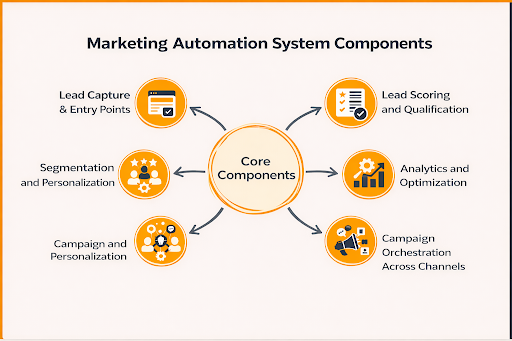
Lead Capture and Entry Points
Lead capture is where automation begins. Effective systems reduce friction and capture meaningful data without overwhelming users.
Common entry points include:
- Website forms built with HubSpot Forms or Gravity Forms
- Landing pages created with Unbounce
- Chatbots using Drift or Intercom
- Webinar registrations
- E-commerce checkout and account creation
Lead Scoring and Qualification
Lead scoring helps prioritize effort. By assigning values to actions and attributes, marketing automation software identifies which contacts are most likely to convert. Platforms like Marketo, HubSpot, and Pardot update scores dynamically, ensuring accuracy over time.
Examples of scoring criteria include:
- Job title or company size
- Repeated visits to pricing pages
- High engagement with emails
- Requests for demos or consultations
Segmentation and Personalization
Segmentation and personalization are critical to effective automation marketing because relevance drives engagement.
When automation delivers generic messaging, performance quickly declines. Segmentation allows businesses to tailor communication based on factors like industry, product interest, engagement behavior, and lifecycle stage, ensuring that prospects and customers receive messaging aligned to their actual needs.
Marketing automation platforms like HubSpot, Marketo, and ActiveCampaign use personalization tokens and dynamic content to adjust messaging automatically at scale. This allows brands to maintain consistency while still feeling human.
Campaign Orchestration Across Channels
Campaign orchestration ensures that marketing efforts feel connected rather than siloed. Modern buyers move between email, paid ads, websites, and sales conversations quickly, and automation platforms help coordinate these interactions so each touchpoint builds on the last.
By aligning messaging across channels, automation prevents redundancy and improves timing.
Analytics and Optimization
Without measurement, automation becomes guesswork. With clear visibility into engagement, conversions, pipeline contribution, and revenue attribution, teams can understand what is actually driving results. The analytics and reporting segment is projected to be the fastest-growing, with a compound annual growth rate (CAGR) of 13%, according to the 2025 Marketing Automation Market Report.
Optimization happens when teams use this data to refine workflows, improve targeting, and adjust messaging over time. As automation learns from performance, it becomes more efficient and more effective, allowing marketing efforts to compound rather than stagnate.
Tools like HubSpot reporting, Google Analytics 4, Dreamdata, and Hotjar help teams refine strategy continuously.
Marketing Automation Workflows That Drive Revenue
Marketing automation workflows are where strategy becomes execution. A workflow is not just a sequence of emails. It is a structured response to behavior that moves prospects closer to revenue with intention.
Poorly designed workflows simply send messages. Strong workflows guide decisions.
Top of Funnel Lead Nurturing Workflows
Top-of-funnel workflows exist to educate, build trust, and qualify intent. At this stage, most leads are not ready to buy. The goal is not to sell immediately but to remain relevant while learning about the prospect.
Effective lead nurturing workflows:
- Deliver educational content aligned to the original conversion
- Adapt based on engagement behavior
- Gradually introduce product or service relevance
- Prepare leads for sales conversations later
For example, a B2B company using HubSpot might create an automated nurture workflow for leads who download a beginner’s guide. Over several weeks, the workflow delivers educational blog content, short videos, and eventually a case study related to the prospect’s industry. Engagement is tracked throughout, and lead scores update automatically.
The impact of strong top-of-funnel workflows is higher engagement, better data, and warmer leads entering the sales process.
Middle of Funnel Acceleration Workflows
Middle of funnel workflows focus on evaluation and comparison. At this stage, prospects are aware of the problem and are actively considering solutions.
These workflows matter because this is where deals are often won or lost. Without structured follow-up, leads stall or disengage.
Effective middle of funnel workflows:
- Deliver proof such as case studies and testimonials
- Address common objections proactively
- Surface product differentiators
- Trigger sales involvement at the right time
For example, in Marketo or Pardot, a workflow may trigger when a contact visits a pricing page multiple times. That action enrolls them in a sequence that sends a comparison guide, invites them to a demo, and alerts sales with full engagement context.
These workflows shorten sales cycles and improve close rates by supporting informed decision-making.
Bottom of Funnel Conversion Support Workflows
Bottom-of-funnel workflows exist to remove friction and support final decision-making. These workflows do not replace sales. They reinforce sales conversations.
Effective conversion workflows:
- Follow up automatically after demos or consultations
- Provide tailored content based on objections
- Reinforce urgency without pressure
- Ensure consistent communication
For example, after a demo booked through HubSpot, an automated workflow can send recap emails, relevant case studies, and next step reminders. If the prospect does not respond, automation ensures follow-up still happens.
The impact is fewer dropped opportunities and more consistent deal progression.
Post Sale and Expansion Workflows
Revenue does not end at conversion. Post-sale workflows are critical for retention, expansion, and lifetime value.
Strong post-sale workflows:
- Accelerate onboarding and adoption
- Reduce churn risk
- Identify upsell and cross-sell opportunities
- Turn customers into advocates
Platforms like Customer.io and Klaviyo are often used to trigger onboarding emails, usage-based tips, and upgrade prompts. When customers understand value faster, they stay longer and spend more.
Email Marketing Automation Explained
Email remains one of the most powerful channels in automation marketing because it is direct, measurable, and highly adaptable. Around 71% of marketers use marketing automation, according to DemandSage. Implementing this strategy saves marketers an average of 2.3 hours per campaign.
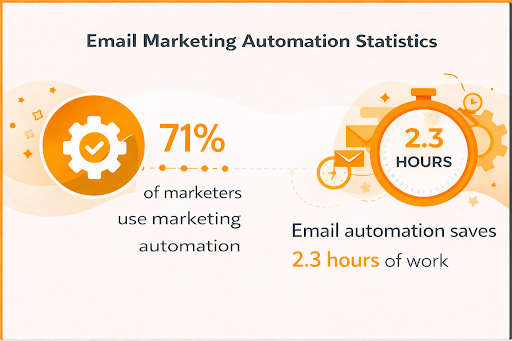
Email marketing automation is not about sending more emails. It is about sending the right emails at the right time.
Automated Welcome Series
The welcome series is one of the most important workflows in any marketing automation system because it captures attention at the moment of highest intent.
This series matters because it:
- Sets expectations for the relationship
- Reinforces why the subscriber should care
- Establishes trust early
- Influences long-term engagement
In platforms like HubSpot, ActiveCampaign, and Klaviyo, welcome series are triggered immediately after signup or account creation. Immediate delivery keeps momentum alive.
When executed well, welcome series consistently outperform standard campaigns in open rate, click rate, and downstream conversion.
Behavioral Triggered Email Automation
Behavioral emails respond to actions rather than schedules. This makes them highly relevant and effective.
These emails matter because they meet users in context. They feel timely rather than promotional.
Examples include:
- Abandoned cart emails sent through Klaviyo
- Content follow-ups triggered by downloads in HubSpot
- Usage-based alerts sent through Customer.io
For example, an e-commerce brand using Klaviyo can trigger an email when a customer views a product multiple times but hasn’t purchased. The email includes the exact product, social proof, and a reminder. This type of automation directly drives revenue.
Drip Campaigns and Educational Sequences
Drip campaigns deliver structured content over time. Their purpose is education and progression.
They matter because they:
- Prevent information overload
- Maintain consistent engagement
- Guide prospects logically through complex decisions
Common use cases include onboarding, training, thought leadership, and sales enablement. Platforms like ActiveCampaign and HubSpot allow drip campaigns to branch based on engagement, ensuring relevance.
A well-designed drip campaign builds confidence and reduces sales friction.
Re-Engagement and List Health Automation
Not every contact stays engaged forever. Re-engagement workflows protect list health and deliverability.
These workflows matter because poor engagement hurts overall performance.
Effective re-engagement automation:
- Identifies inactive contacts
- Attempts to rekindle interest with targeted messaging
- Suppresses or removes unresponsive contacts
Most marketing automation tools support inactivity triggers and suppression logic. This keeps lists healthy and ensures future campaigns perform better.
CRM and Marketing Automation Integration
CRM marketing automation integration is what transforms automation from a marketing tool into a revenue system.
Why CRM Integration Is Essential
Without CRM integration, marketing and sales operate in silos. Data becomes fragmented, and insights are lost. Companies using CRM see up to 29% increase in revenue and a 34% boost in productivity after integrating CRM into workflows.
Integration matters because it:
- Creates a single source of truth
- Improves handoffs between teams
- Enables accurate attribution
- Enhances customer experience
Platforms like HubSpot and Salesforce are designed to integrate deeply with marketing automation software, ensuring data flows both ways.
How Integration Improves Sales Effectiveness
91% of companies use CRM software, with widespread adoption driving automation, customer retention, and ROI that can justify closer integration with marketing automation tools for enhanced insight and performance. When CRM and automation are connected:
- Sales sees full engagement history
- Leads are prioritized by intent
- Follow-up is timely and relevant
- Conversations are informed
For example, a sales rep using Salesforce with Pardot can see which emails a prospect opened, which pages they visited, and which content they downloaded before making contact. This context improves conversations and close rates.
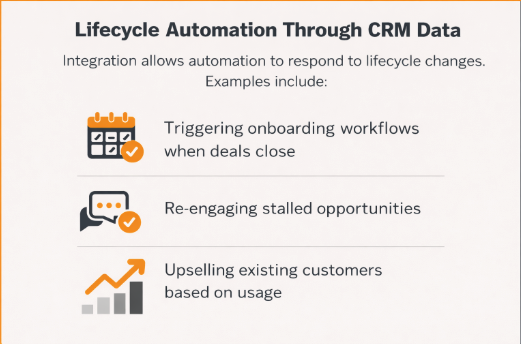
Lifecycle Automation Through CRM Data
Integration enables automation to respond dynamically to changes across the customer lifecycle. For example, it can trigger onboarding workflows as soon as deals close, re-engage stalled opportunities at the right moment, and identify upsell opportunities for existing customers based on usage patterns.
Together, these capabilities help ensure continuity and a more seamless experience throughout the entire customer journey.
Marketing Automation Tools and Software
Choosing the right marketing automation platform is a strategic decision that impacts adoption, performance, and scalability.
Marketing Automation Platforms for Small and Mid-Size Businesses
SMBs need tools that balance power with usability.
Popular options include:
- HubSpot Marketing Hub
- ActiveCampaign
- Keap
- Mailchimp Premium
- Zoho Marketing Automation
These platforms offer visual workflow builders, CRM integration, and predictable pricing. They allow small teams to implement automation marketing without heavy technical resources.
Marketing Automation Platforms for E-commerce
E-commerce automation focuses on revenue-driven workflows.
Common tools include:
- Klaviyo
- Omnisend
- Drip
These platforms specialize in abandoned cart flows, post-purchase upsells, and lifecycle messaging tied directly to transactions.
Enterprise Marketing Automation Software
Enterprise organizations require advanced customization and scalability.
Leading platforms include:
- Pardot
- Oracle Eloqua
- Adobe Marketo Engage
These tools support complex workflows, custom objects, and large data volumes but require experienced teams to manage effectively.
Marketing Automation Strategy: How to Get Started
Technology alone does not create results. Strategy determines success.
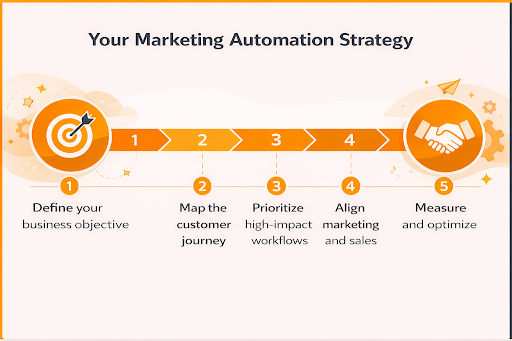
Defining Clear Business Objectives
Automation should support specific outcomes such as:
- Increasing leads to customer conversion
- Shortening sales cycles
- Improving retention
- Expanding account value
Mapping the Customer Journey
Understanding how customers move from awareness to purchase is essential.
Journey mapping identifies:
- Decision points
- Content needs
- Drop-off risks
Tools like Miro or Lucidchart help teams visualize journeys before building automation.
Prioritizing High-Impact Workflows
Starting small reduces complexity and builds momentum. Once these are optimized, additional workflows can be layered in.
High-impact starting points include:
- Welcome series
- Lead nurturing
- Sales alerts
- Onboarding automation
Aligning Marketing and Sales
Alignment prevents friction. Automation reinforces alignment when both teams trust the system.
Teams should define:
- Lead qualification criteria
- Handoff processes
- Shared KPIs
Measuring and Optimizing Over Time
Automation improves through iteration. Continuous optimization keeps automation effective.
Teams should review:
- Engagement trends
- Conversion rates
- Workflow performance
- Revenue contribution
Marketing Automation for Small and Mid-Size Businesses
Marketing automation for small and mid-sized businesses (SMBs) is not about adding complexity or enterprise-level systems. It is about creating consistency, speed, and visibility in environments where time and resources are limited.
SMBs often rely on lean teams that wear multiple hats, which makes manual follow-up and campaign execution difficult to sustain as the business grows. Automation provides structure without requiring additional headcount, allowing teams to focus on higher-value work instead of repetitive tasks.
Why Automation Is Critical for SMB Growth
For small and mid-sized businesses, growth often stalls not because of a lack of demand, but because internal processes cannot scale. SMBs benefit from automation because it:
- Reduces manual workload
- Improves response times
- Ensures consistent follow-up
- Scales without hiring
When automation is in place, prospects are contacted promptly, nurtured appropriately, and routed correctly without relying on someone to remember each step.
Choosing the Right Platform as an SMB
Selecting the right marketing automation platform is critical for adoption and long-term success. SMBs should look for tools that are easy to use, integrate cleanly with a CRM, and provide responsive support. SMBs should prioritize:
- Ease of use
- CRM integration
- Support quality
- Scalability
Platforms like HubSpot Starter and ActiveCampaign are common entry points because they offer visual workflow builders, built-in CRM capabilities, and enough flexibility to support both early-stage automation and more advanced strategies over time.
Practical SMB Automation Examples
The most effective automation for SMBs focuses on high-impact workflows that solve everyday operational challenges. Examples include:
- Automated lead follow-ups
- Appointment reminders
- Review request emails
- Referral campaigns
These workflows deliver immediate ROI.
Common Marketing Automation Mistakes to Avoid
Marketing automation can be a powerful growth driver, but only when it is implemented with intention. These issues rarely stem from the tools themselves. They come from misaligned strategy, poor execution, or unrealistic expectations.
Over Automation Without Strategy
Automation without intent creates noise. Every workflow should have a purpose, a plan, and tracking for growth.
This leads to:
- Low engagement
- Unsubscribes
- Brand fatigue
Poor Data Hygiene and Lack of Ongoing Optimization
Bad data undermines automation. It’s essential to regularly conduct audits. Quarterly reviews and annual reviews are good benchmarks to keep in mind.
Set up ongoing optimization as well; automation should not be considered static. Failing to optimize leads to decreased performance over time.
Common issues include:
- Duplicate contacts
- Incomplete fields
- Declining performance
- Outdated segmentation
The Future of Marketing Automation
The future of marketing automation is not about more automation. It is about smarter orchestration, deeper intelligence, and greater accountability to outcomes. From 2025 to 2030, the global marketing automation market is projected to have a CAGR of 15.3%, which means demand is set to increase rapidly.
Early marketing automation focused on efficiency. It helped teams send emails faster, manage lists, and reduce manual effort. While those benefits still matter, they are no longer enough to create a competitive advantage.
Automation is becoming outcome-oriented rather than activity-oriented. Businesses are no longer satisfied with metrics like email sends or opens in isolation. They want to know how automation influences pipeline velocity, deal size, retention, and lifetime value. This is pushing platforms to tighten their connection between marketing activity and revenue outcomes.
In practical terms, the future of marketing automation will:
- Reduce reliance on rigid, manually maintained workflows
- Increase responsiveness to real customer behavior
- Improve alignment between marketing, sales, and customer success
- Demand higher data quality and governance
- Require marketers to think more strategically and less tactically
Automation will no longer be judged by how much it does, but by how intelligently it guides growth.
Artificial Intelligence and Predictive Automation
Artificial intelligence is reshaping marketing automation by shifting systems from reactive to predictive. Instead of waiting for predefined triggers, AI-driven automation anticipates behavior and recommends or executes the next best action.
This matters because traditional rule-based automation has limitations. Rules are only as good as the assumptions behind them. As buyer journeys become less linear, static workflows struggle to keep up. Predictive automation helps close that gap.
Predictive Lead Scoring and Intent Modeling
Predictive lead scoring uses machine learning to analyze large volumes of historical data and identify patterns that correlate with conversion. Rather than relying solely on manually assigned point values, AI evaluates combinations of behaviors, attributes, and timing to determine intent.
This approach improves accuracy by:
- Identifying non-obvious buying signals
- Adjusting scores dynamically as behavior changes
- Reducing bias introduced by human assumptions
- Prioritizing leads more effectively for sales teams
Platforms like HubSpot, Salesforce Einstein, and Adobe Marketo use predictive models to surface leads that are statistically more likely to convert, even if they do not follow a traditional path. This results in better sales focus and higher close rates.
Intelligent Content Recommendations
AI-driven content recommendations help automation systems decide not just when to communicate, but what to communicate.
Instead of sending the same nurture content to everyone in a segment, predictive automation analyzes:
- Past engagement behavior
- Content performance across similar users
- Stage in the customer journey
- Industry or role patterns
Based on this data, the system can recommend or automatically deliver content most likely to resonate. For example, a platform might determine that a prospect in the evaluation stage responds better to case studies than blog content and adjust messaging accordingly.
This increases relevance, reduces fatigue, and improves conversion rates without requiring marketers to manually map every possible path.
Send Time Optimization and Channel Selection
AI also improves timing and channel decisions. Traditional automation often relies on fixed schedules. Predictive automation analyzes historical engagement patterns to determine when individuals are most likely to engage.
Send time optimization matters because:
- Timing directly impacts open and click rates
- Global audiences behave differently across time zones
- Individual habits vary widely
Platforms like HubSpot and Adobe use AI to adjust send times at the individual level automatically. Some systems also extend this logic to channel selection, determining whether email, SMS, or another touchpoint is most effective based on past behavior.
This reduces guesswork and improves efficiency.
Privacy and Trust
As marketing automation becomes more powerful, privacy and trust are no longer secondary concerns. They are central to long-term performance and brand credibility.
Modern automation marketing relies heavily on customer data. Behavioral tracking, personalization, and predictive modeling all depend on collecting and using information responsibly. As regulations tighten and consumer awareness grows, businesses that fail to prioritize privacy risk face more than fines. They risk losing trust.
Future-ready marketing automation platforms are responding by building privacy into the system rather than treating it as an afterthought. This includes features such as:
- Consent management that tracks when and how permission was granted
- Preference centers that allow users to control communication frequency and channels
- Automated suppression logic for non-compliant contacts
- Clear data retention and deletion policies
- Audit trails that support regulatory compliance
Platforms like HubSpot and Salesforce have invested heavily in consent tracking and permission-based marketing workflows to support regulations such as GDPR and CCPA. E-commerce-focused tools like Klaviyo allow brands to separate promotional and transactional consent, ensuring compliance without sacrificing performance.
Omnichannel Customer Orchestration
Omnichannel customer orchestration represents the next evolution of marketing automation. It moves beyond automating individual channels and focuses on coordinating experiences across every touchpoint.
In the past, automation often lived in silos. Email campaigns were managed separately from paid ads. Website personalization was disconnected from sales outreach. This fragmentation created inconsistent experiences and lost opportunities.
Modern automation marketing platforms are increasingly designed to unify channels into a single, coordinated system. This matters because customers do not experience brands in channels. They experience brands as a whole.
Effective omnichannel orchestration allows automation to:
- Deliver consistent messaging across email, SMS, and ads
- Adjust website content based on prior engagement
- Suppress ads once a lead converts or becomes a customer
- Trigger sales outreach based on cross-channel behavior
- Maintain context as users move between devices and platforms
For example, a prospect might first engage through a paid LinkedIn ad, visit a website, download a guide, receive a follow-up email, and later speak with sales. With omnichannel automation, each interaction builds on the last. The messaging remains relevant, and no channel operates in isolation.
Platforms like HubSpot, Salesforce, Braze, and Customer.io are investing heavily in cross-channel orchestration. E-commerce brands using Klaviyo increasingly coordinate email, SMS, and on-site messaging from a single automation engine.
Partner With Chatter Buzz Media to Build a Smarter Marketing Automation Strategy
Chatter Buzz Media helps businesses design and execute automation marketing strategies that align with real business goals. From selecting and implementing marketing automation software to building revenue-driven workflows, integrating CRM marketing automation, and optimizing email marketing automation, our team focuses on creating systems that scale sustainably.
If you are ready to move beyond basic automation and build a strategy that drives consistent leads, stronger customer relationships, and long-term revenue, partnering with Chatter Buzz Media ensures your marketing automation works as hard as your business does.
Frequently Asked Questions About Marketing Automation
What is automation marketing?
Automation marketing uses technology to automate marketing tasks while delivering personalized experiences at scale.
Which marketing automation platform is best?
The best platform depends on business size and goals. HubSpot suits growing businesses, Marketo supports enterprises, and Klaviyo excels in ecommerce.
How long does it take to see results?
Many businesses see engagement improvements within weeks, with revenue impact following as workflows mature.
Can marketing automation replace human marketers?
No. Automation supports execution. Strategy and creativity remain human responsibilities.
Marketing automation is no longer optional. When built intentionally and maintained consistently, automation marketing becomes one of the most powerful drivers of sustainable growth for modern businesses.