
 321-236-2899
Content Marketing for Manufacturing: The 2026 Playbook
Marketing is often the last thing on a manufacturer’s mind, and it usually falls to the sales team to figure out. That worked when buyers picked up the phone first.
They don’t anymore. Today 57% of industrial buyers make their purchase decision before they ever contact a supplier, which means your content is now your first sales rep.
This guide breaks down exactly how content marketing for manufacturing works in 2026 — the content types that generate pipeline, how to map them to the industrial buying committee, and how to prove the ROI even when the sales cycle runs four months long. By the end, you will know the one content shift that separates manufacturers who fill their funnel from those who stay invisible.
Key Takeaways
- Buyers self-educate first. 57% decide before contacting sales, so early-stage content shapes the shortlist you never see forming.
- Blogs compound. Manufacturers that blog generate 55% more leads than those that don’t, at a fraction of paid-media cost.
- Map content to roles, not just stages. Engineers want proof, procurement wants numbers, plant managers want outcomes, and executives want the business case.
- Technical depth wins. 71% of B2B buyers request whitepapers during the decision, making spec-heavy content your highest-value asset.
- Optimize for AI answers. Content structured for Answer Engine Optimization gets cited in AI Overviews before a click ever happens.
- Measure across the cycle. With a 130-day average sales cycle, attribution and influenced-pipeline reporting matter more than last-click.
What Is Content Marketing for Manufacturing?
Content marketing for manufacturing is the practice of creating and distributing technical, educational, and proof-driven content that attracts industrial buyers and moves them toward a purchase. It replaces the interruption of advertising with information buyers actively seek out.
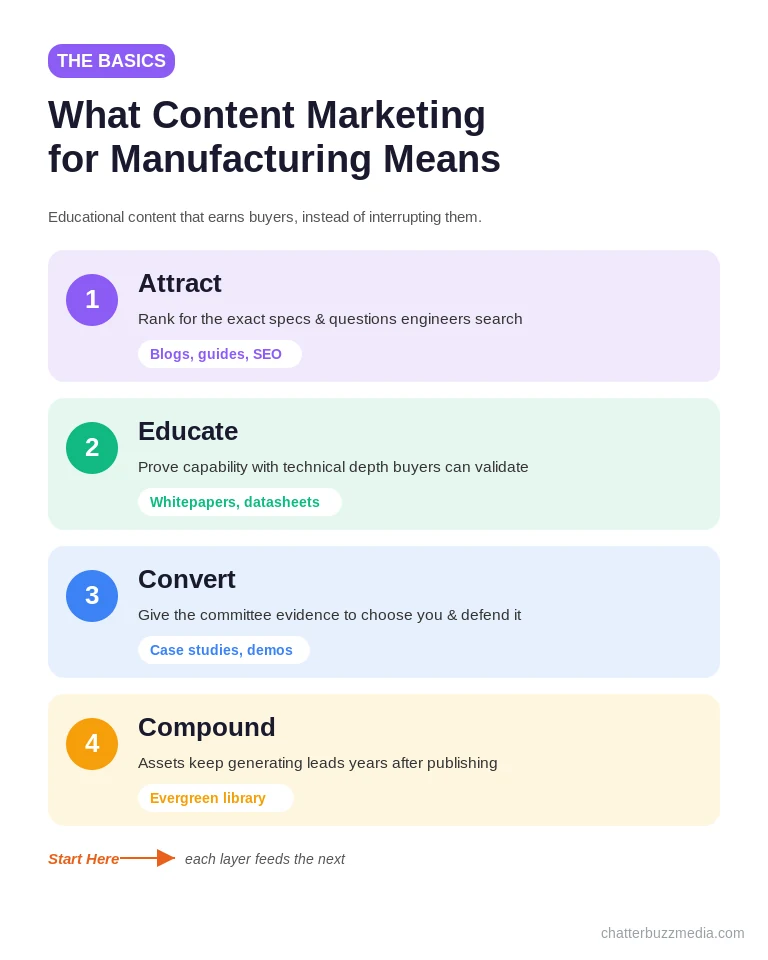
The distinction matters in industrial markets. An engineer researching a tolerance spec or a procurement manager comparing suppliers is already in problem-solving mode, and your content either earns a place on the shortlist or it doesn’t.
Manufacturing content also carries a longer shelf life than most B2C content. A guide on selecting the right alloy or meeting an ISO standard stays relevant for years, quietly generating leads the whole time.
The Content Marketing Institute defines the discipline as creating valuable, relevant, consistent content to attract a defined audience and drive profitable action. For manufacturers, “valuable” means one thing above all: technical credibility.
This is different from broad content marketing for consumer brands. Industrial content has to satisfy skeptical, specification-driven readers who compare claims against datasheets.
It also has to work harder. A complete manufacturing marketing strategy uses content as the engine that feeds SEO, email, paid media, and sales enablement at the same time.
Think of content as an asset, not a campaign. A well-built technical resource keeps attracting engineers and buyers years after you publish it, while an ad stops working the moment you stop paying.
That durability is why content compounds. Each new article, datasheet, or case study adds to a library that grows more authoritative and easier to find over time.
Understanding what qualifies as effective industrial content is step one. Understanding why it now decides deals is what makes it urgent.
Why Industrial Content Marketing Matters More in 2026
Industrial content marketing matters more than ever because the buying journey has moved almost entirely online before a human conversation happens. The manufacturers who show up during that self-guided research win the deals; the rest never learn they were in the running.
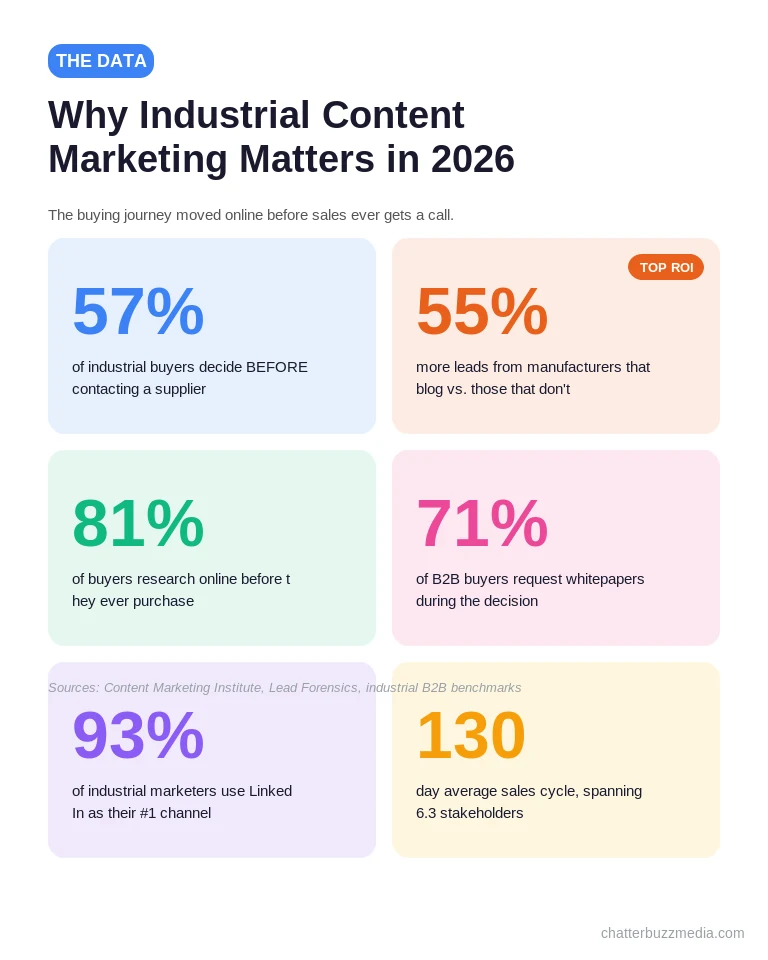
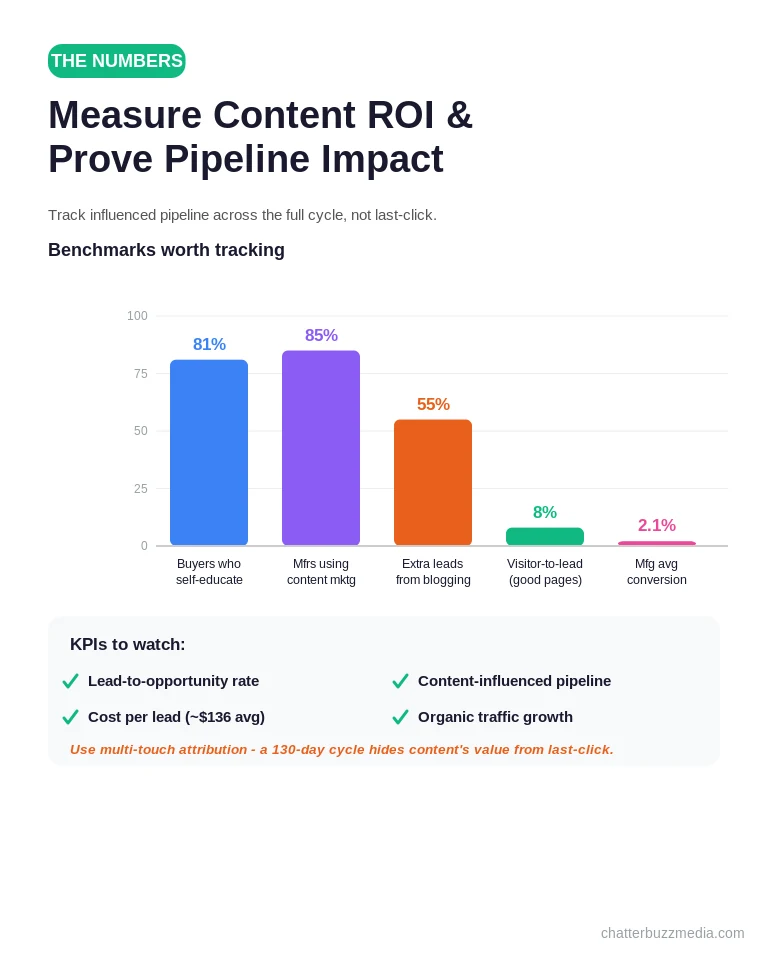
The numbers are stark. 81% of buyers conduct online research before purchasing, and most are more than halfway through their decision before engaging a salesperson.
Content is also the cheapest durable lead source you have. Manufacturers with blogs generate 55% more leads than those without, according to Lead Forensics manufacturing data, and that content keeps working long after publication.
The catch is that adoption is high but execution is weak. 85% of manufacturers use content marketing, yet only a third rate their strategy as effective — a gap that rewards anyone willing to do it properly.
Effective here means specific. Generic “we’re a trusted partner” copy loses to content that names materials, tolerances, lead times, and compliance standards.
Channel behavior reinforces the point. LinkedIn is the primary social platform for 93% of industrial B2B marketers, and video is the top-performing format for more than half of them, per industry marketing benchmarks.
Those channels only work if you feed them substance. A steady stream of technical, useful content gives your team something worth posting and worth clicking.
The long sales cycle raises the stakes further. With an average of 6.3 stakeholders and roughly 130 days per deal, you need content that keeps multiple people engaged for months. That reality shapes who you write for next.
Map Content to the Industrial Buying Committee
The single biggest upgrade to your content is writing for specific committee roles instead of a vague “buyer.” Each stakeholder judges you on a different axis, and content that speaks to all of them is what keeps a 130-day deal alive.
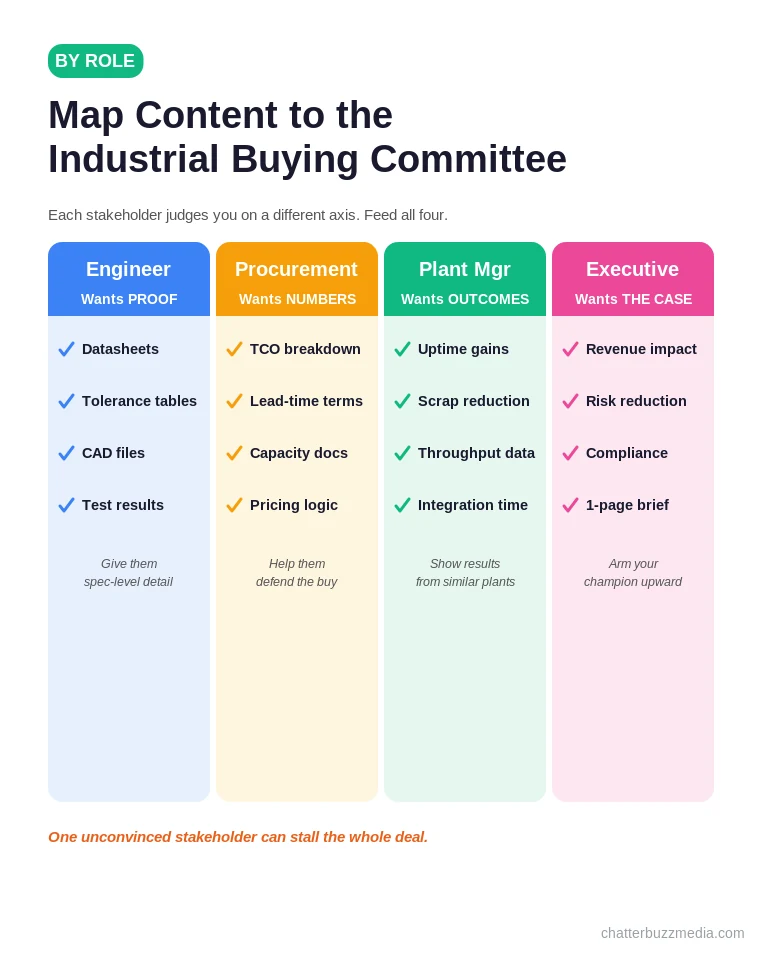
Engineers and technical evaluators want proof. Give them datasheets, tolerance tables, CAD files, application notes, and test results they can validate against their requirements.
Procurement and finance want numbers. They respond to total cost of ownership breakdowns, lead-time guarantees, capacity documentation, and pricing logic they can defend internally.
Plant managers and operations leaders want outcomes. Show them quantified results: uptime gains, scrap reduction, throughput improvements, and integration timelines from similar facilities.
Executives want the business case. A short summary tying your solution to revenue, risk, or compliance gives your internal champion the language to sell upward.
Most manufacturers write only for the engineer and forget the other three. That single blind spot is why technically strong suppliers still lose deals they should win.
The reason this matters is consensus. In a committee of six or more, a single unconvinced stakeholder can stall or kill a deal, so your content has to arm every role with the answers they need.
A practical tactic is to build a content set per opportunity type. For a given product line, pair a technical datasheet, a procurement-focused TCO sheet, an operations case study, and a one-page executive brief so your champion can circulate the right piece to each person.
Building this well starts with real research into each role’s priorities. Developing detailed B2B buyer personas turns “the buying committee” into named people with specific questions you can answer. Once you know who you’re writing for, you can choose the formats that reach them.
Content Types That Drive Manufacturing Pipeline
The content types that generate the most manufacturing pipeline are the ones that carry technical weight: blogs, whitepapers, case studies, video, and interactive tools. Each does a specific job, and the highest performers use all five together.
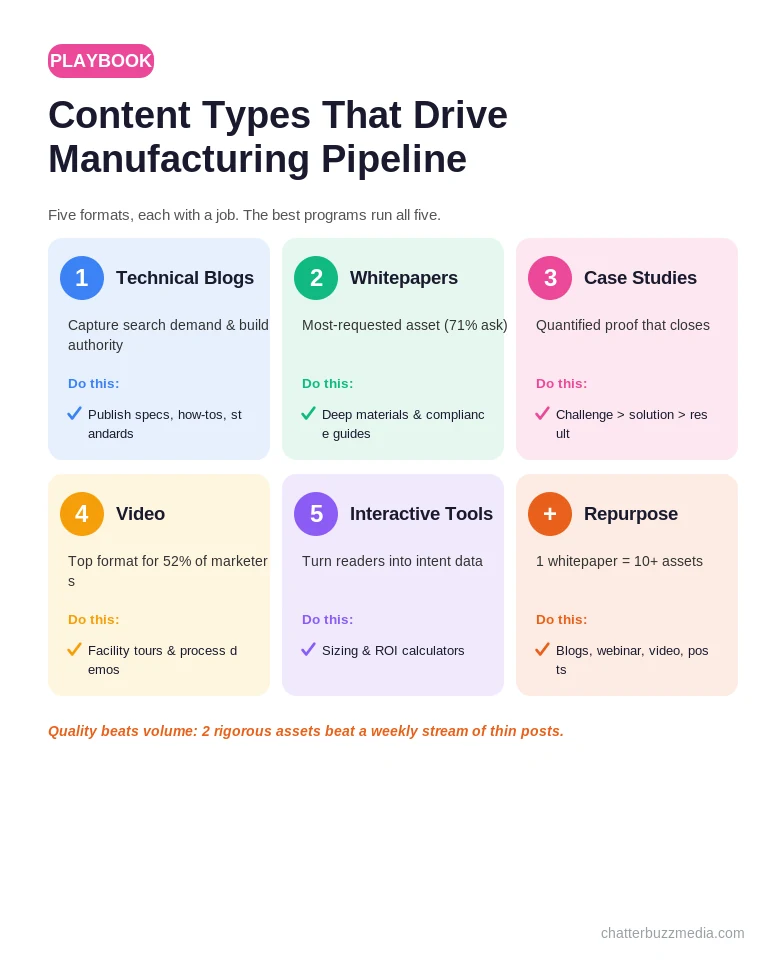
Technical blogs are your foundation. They capture search demand and establish authority, and manufacturers who publish consistently pull in far more organic leads than those who don’t.
Whitepapers and technical guides are your most requested asset — 71% of B2B buyers ask for them during the decision. Deep documents on materials, compliance, or process engineering convert researchers into named leads.
Case studies are your proof engine. A well-told case study that quantifies the challenge, solution, and result does more to close a technical buyer than any brochure.
Video punches above its weight, with 52% of industrial marketers naming it their best-performing format. Facility tours, process walkthroughs, and product demos let buyers see capability they’d otherwise have to visit to verify.
Interactive tools — sizing calculators, spec configurators, ROI estimators — turn passive readers into engaged prospects while capturing intent data. Great content also relies on storytelling that converts, even in technical formats.
Two more formats deserve a place in the mix. Webinars and product demos let you engage a whole buying committee live, while detailed FAQ and knowledge-base pages capture the specific questions buyers type into search.
The point is not to do all of these at once. Start with the two or three formats your buyers already request, prove they generate pipeline, then expand deliberately.
Don’t overlook repurposing. One in-depth whitepaper can become a series of blog posts, a webinar, a short explainer video, and a dozen LinkedIn posts, multiplying the return on a single research effort.
Quality beats volume in every format. Two rigorously researched, genuinely useful assets a month will outperform a weekly stream of thin, me-too posts that add nothing an engineer can use.
Producing the right formats is half the battle. Placing them at the right moment in the journey is the other half.
Match Content to Each Funnel Stage
Manufacturing content works best when each asset is matched to a specific funnel stage, because a buyer researching a problem needs something very different from one comparing two suppliers. Mapping content to the journey prevents the gaps where deals stall.
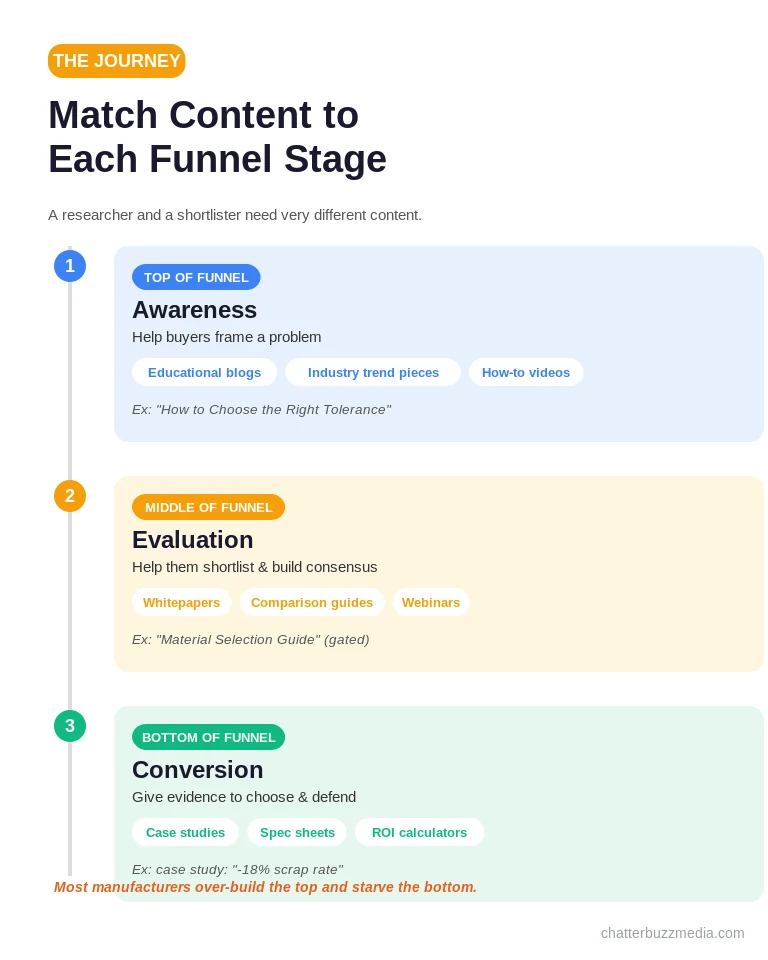
At the top of the funnel, the goal is awareness. Educational blogs, industry trend pieces, and how-to videos help buyers frame a problem they may not have fully defined yet.
In the middle of the funnel, the goal is evaluation. Whitepapers, comparison guides, webinars, and application notes help buyers shortlist suppliers and build internal consensus.
A concrete top-of-funnel example: a precision machining shop publishes “How to Choose the Right Tolerance for Your Application.” It ranks for a question engineers actually search and introduces the brand before any sales conversation.
A middle-funnel counterpart: a downloadable “Material Selection Guide for Corrosive Environments” that captures an email and signals genuine buying intent. The reader is now a known, nurturable lead.
At the bottom of the funnel, the goal is conversion. Case studies, spec sheets, ROI calculators, and product demos give the committee the evidence to choose you and defend the choice.
A bottom-funnel example seals it: a case study showing how you cut a similar plant’s scrap rate by 18% while holding lead times. That single asset answers the operations and finance questions at once.
The mistake most manufacturers make is over-investing in top-of-funnel blogs and starving the middle and bottom. Deals stall where the proof content should be.
A simple audit exposes the imbalance fast. List every asset you have, tag it by stage, and you will usually find a pile of awareness blogs and almost nothing that helps a buyer make the final call.
Fill the thin stages first. Adding one strong case study or comparison guide where a deal currently stalls often unlocks more revenue than ten more top-of-funnel articles.
A deliberate approach to mapping content to the customer journey closes those gaps and keeps momentum across the long industrial cycle. This same structure powers a strong B2B demand generation program. Once your content is mapped, it has to be findable.
Win SEO, AEO, and AI Search for Manufacturing
To get found in 2026, manufacturing content must be optimized for traditional search, answer engines, and AI-generated results at the same time. Ranking on Google is no longer enough when buyers get answers from AI Overviews before they click.
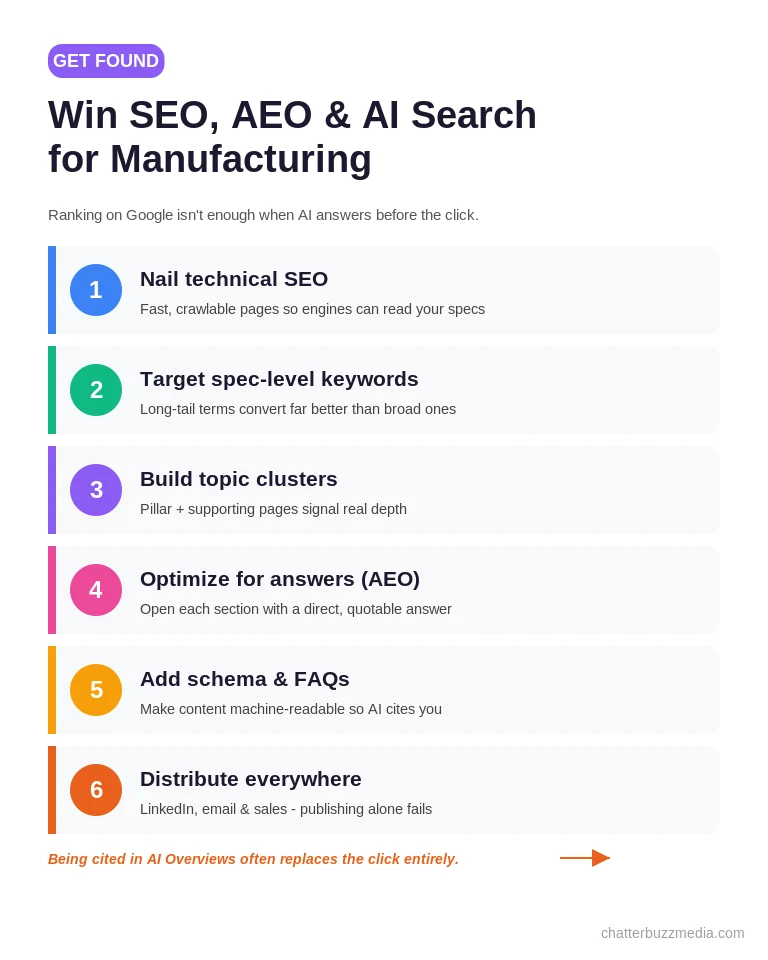
Start with the fundamentals. Technical SEO — fast pages, clean structure, indexable specs — ensures search engines can actually read the technical content you publish.
Then target the terms buyers actually use. Long-tail, specification-level keywords (“stainless steel CNC machining tolerances”) convert far better than broad terms, and a focused manufacturing SEO plan prioritizes them.
These narrow queries have low competition and high intent. A prospect searching an exact specification is far closer to buying than someone typing a generic industry term.
Build topic clusters around your capabilities. A pillar page on a core process, supported by detailed articles on its applications and materials, signals depth to both search engines and buyers.
Answer Engine Optimization is the new layer. Structure content so each section opens with a direct, quotable answer, which is exactly what earns placement in featured snippets and AI Overviews.
Use schema, FAQs, and clear headings to make content machine-readable. AI engines cite sources they can parse cleanly, and being cited often precedes or replaces the click, as Google’s own research on the messy buyer journey makes clear.
Don’t stop at publishing, either. Distribution is where most manufacturing content dies, so push every asset through LinkedIn, targeted email, and your sales team’s outreach.
Arm sales directly. When reps share the exact case study or spec sheet a stakeholder needs, content stops being a marketing metric and starts closing deals.
Search visibility feeds the top of your funnel for free. But publishing alone won’t move a 6-person buying committee — you have to actively distribute and measure.
Measure Content ROI and Prove Pipeline Impact
Measuring manufacturing content ROI requires tracking influenced pipeline across the full sales cycle, not just last-click leads. With deals averaging 130 days and multiple stakeholders, single-touch attribution badly understates content’s real impact.
Start by connecting content to pipeline, not vanity metrics. Track which assets prospects touch before becoming a lead, an opportunity, and a closed deal.
Use multi-touch attribution to credit the whole journey. A whitepaper read in month one and a case study read in month three both influenced the win, and both deserve credit.
Watch a focused set of KPIs: organic traffic, lead-to-opportunity rate, content-influenced pipeline, and cost per lead. Manufacturing leads average roughly $136 each, so content that lowers that number compounds fast.
Connect your analytics to your CRM so marketing and sales share one view of the pipeline. Without that link, content’s influence disappears into a reporting gap and gets undervalued at budget time.
Feed the data back into production. Double down on the topics and formats that influence real revenue and retire the ones that only generate clicks. A disciplined view of content marketing ROI turns your program into a predictable pipeline source.
Set realistic timelines with leadership. Because content compounds and cycles are long, judge the program on a two-to-three quarter horizon rather than expecting week-one leads.
Benchmark against your own baseline, not vanity comparisons. Improving your conversion rate from the manufacturing average of roughly 2.1% to even 3% can meaningfully change how many qualified leads your content produces.
This measurement loop is what separates a blog that exists from a content engine that drives manufacturing lead generation quarter after quarter.
Frequently Asked Questions
1. 🔍 What is content marketing for manufacturing?
It is the practice of creating technical, educational, and proof-driven content — blogs, whitepapers, case studies, video, and tools — that attracts industrial buyers during their self-guided research. It replaces interruptive advertising with information buyers actively seek, earning your company a place on the shortlist before sales ever gets involved.
2. 📊 Does content marketing actually generate leads for manufacturers?
Yes. Manufacturers with blogs generate 55% more leads than those without, and 85% of manufacturers already use content marketing to drive demand. The differentiator is execution: technically specific content dramatically outperforms generic corporate copy.
3. ⚡ What types of content work best for industrial companies?
The highest performers are technical blogs, whitepapers, case studies, video, and interactive tools like sizing calculators. Whitepapers are especially valuable because 71% of B2B buyers request them during the decision, and video is the top-performing format for 52% of industrial marketers.
4. 🏦 How long does content marketing take to work in manufacturing?
Expect a compounding curve rather than instant returns. Because the average manufacturing sales cycle runs about 130 days with 6.3 stakeholders, content typically shows lead traction within a few months and clear pipeline impact within two to three quarters as assets accumulate authority.
5. 🤝 How is manufacturing content different from other B2B content?
It has to satisfy specification-driven readers who validate claims against datasheets. That means more technical depth, more proof, and content mapped to distinct committee roles — engineers, procurement, plant managers, and executives — each of whom evaluates you on a different criterion.
6. 💰 How do you measure content marketing ROI for manufacturers?
Track content-influenced pipeline using multi-touch attribution rather than last-click leads. Focus on lead-to-opportunity rate, content-influenced pipeline value, and cost per lead, which averages around $136 in manufacturing, then reinvest in the topics and formats that influence closed revenue.
7. 🚀 Do manufacturers need to optimize content for AI search?
Increasingly, yes. Buyers now get answers from AI Overviews and assistants before clicking, so structuring content with direct answers, schema, and clear headings helps AI engines cite you. This Answer Engine Optimization layer sits on top of traditional SEO, not in place of it.
8. 📈 What is the biggest content mistake manufacturers make?
Over-investing in top-of-funnel blogs while starving the middle and bottom of the funnel of proof content. Deals stall where whitepapers, case studies, and spec sheets should be, so balance awareness content with the evaluation and decision assets a committee needs.
Turn Your Content Into a Pipeline Engine
Content marketing has become the front door to every manufacturing deal, because buyers decide long before they call. The manufacturers who win are the ones whose content shows up, proves capability, and speaks to every role on the committee.
Here is a simple action plan to put this guide to work:
- Audit and map. Inventory your existing content and map each piece to a funnel stage and committee role to expose the gaps.
- Fill the proof gap. Prioritize the middle- and bottom-funnel assets — whitepapers, case studies, spec sheets — where most manufacturers are thin.
- Optimize for search and AI. Rework key pages with direct answers, schema, and specification-level keywords so both Google and AI engines cite them.
- Measure what matters. Set up multi-touch attribution and review content-influenced pipeline every quarter, then reinvest in what drives revenue.
For a deeper roadmap tailored to industrial brands, explore our industrial marketing guide and the full library of marketing resource guides to build a program that fills your funnel for years.
Need help with SEO? Explore our SEO agency services.

Victoria Wallace
Victoria Wallace is a senior content strategist and marketing writer with 30+ years of experience helping more than 200 brands translate complex business goals into clear, conversion-focused content. Her background spans paid media, marketing strategy, go-to-market planning, brand positioning, and full-funnel campaign development, giving her a deep understanding of how SEO content connects to real business growth.