
 321-236-2899
Manufacturing Marketing Strategy: Drive Digital Growth & ROI
If you’re running a mid-sized manufacturing company, you’ve probably felt the frustration: your product is technically superior, your processes are refined, and your team delivers exceptional quality. Yet, your pipeline isn’t reflecting that excellence. Your website feels outdated. Your competitors—some with inferior offerings—seem to be winning deals you should have closed. And when you ask your CFO to increase the marketing budget, you’re met with skepticism about ROI.
Here’s the uncomfortable truth: manufacturing marketing isn’t like consumer marketing. It’s not about flashy campaigns or viral moments. It’s about reaching highly technical buyers during complex, multi-stakeholder decision processes that span 6-18 months. It demands a specialized approach that most generic marketing tactics simply can’t deliver.
This guide is different. We’re not offering theoretical frameworks or surface-level advice. Instead, we’re providing a comprehensive, actionable manufacturing marketing strategy specifically designed for B2B industrial companies with $10M-$200M+ in revenue—companies that are in the early innings of digital transformation, often with small marketing teams (0-5 people) and no full-time CMO.
By the end of this playbook, you’ll understand exactly how to attract technical buyers, optimize for extended sales cycles, prove measurable ROI, and leverage strategic partnerships (including Fractional CMO expertise) to compete with larger players. Let’s transform your marketing from a cost center into a revenue-driving engine.
Key Takeaways
- Manufacturing buyers complete 70%+ of their research online before contacting sales — if your digital presence is weak, you’re invisible during the most critical phase of the 6-18 month buying cycle.
- Generic B2B marketing fails in manufacturing. Engineers need technical depth, procurement needs specs and compliance docs, and executives need ROI proof. One-size-fits-all content doesn’t move any of them.
- The five foundational steps — define your “why,” build ICPs and personas, set SMART goals, audit your landscape, and align your budget — must come before any tactical execution.
- Seven core digital strategies drive manufacturing growth: content marketing, technical SEO, ABM, marketing automation, paid media, video, and digitally-integrated trade shows.
- Sales-marketing alignment is non-negotiable. Shared pipeline definitions, SLAs, and closed-loop reporting eliminate the “marketing sends junk leads” vs. “sales ignores our leads” standoff.
- AI is a force multiplier, not a replacement. The manufacturers winning in 2026 use AI for content acceleration, personalization, and competitive intelligence — not to replace human expertise.
- ROI measurement must connect to revenue. Track MQLs, SQLs, pipeline contribution, CAC, and marketing-influenced revenue — not impressions, clicks, or social followers.
1. Why Manufacturing Marketing Demands a Unique Strategy (Beyond Brochures & Trade Shows)
The Evolving Landscape of Industrial Buying (2026 Perspective)
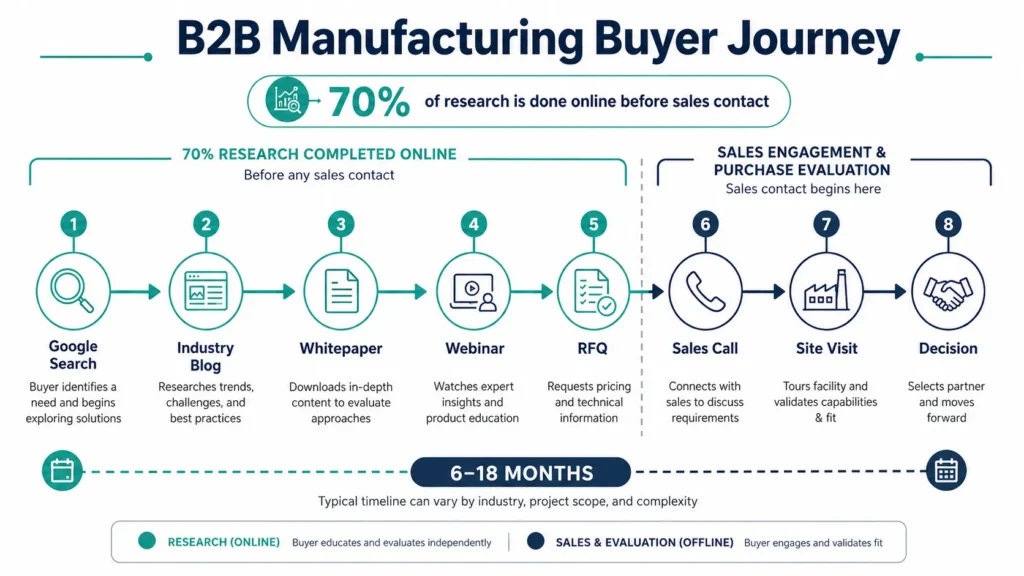
The way your customers buy has fundamentally changed. Today’s manufacturing buyers—whether they’re engineers, procurement managers, or plant operators—begin their research long before they ever contact your sales team. According to recent industry studies, 67% of the buyer’s journey is now completed digitally before a prospect reaches out to a supplier.
Understand the shift in manufacturing B2B buying. The modern journey is digital-first, involves multiple stakeholders, and requires strategic content across a longer sales cycle.
This digital-first reality creates both challenges and opportunities:
Extended, Complex Sales Cycles: Manufacturing purchases aren’t impulse decisions. Your prospects are investing in equipment, components, or services that will impact their operations for years. Sales cycles of 6-18 months are common, requiring sustained engagement and nurturing strategies that keep your company top-of-mind throughout the entire journey.
Multi-Stakeholder Decision-Making: Gone are the days when a single plant manager made purchasing decisions. Today’s buying committees include engineers evaluating technical specifications, procurement teams negotiating terms, finance leaders assessing ROI, operations managers considering implementation, and C-suite executives approving major investments. Your marketing must speak to each of these roles with tailored messaging and content.
Technical Sophistication: Your buyers are experts in their field. They demand detailed, data-driven information. Generic marketing messages that work in B2C fall flat with engineers who need CAD files, performance specifications, materials certifications, and third-party testing results. They’re researching your competitors, reading technical white papers, and consulting peer networks before ever filling out a contact form.
The Urgency of Digital Transformation: Manufacturers who haven’t invested in digital marketing infrastructure are losing ground. When a procurement engineer searches for “precision CNC machining services” or “industrial automation solutions” at 10 PM on a Tuesday—because that’s when they finally have time to research—will they find your company or your competitor’s?
Debunking Common Myths: Why Generic B2B Marketing Fails in Manufacturing
Many manufacturing leaders mistakenly believe they can apply standard B2B marketing templates to their industrial business. This approach consistently fails for several reasons:
Myth #1: “Our product speaks for itself.” While product quality matters enormously, your prospects can’t evaluate your offering if they never discover you exist. Without strategic marketing, you’re invisible during the crucial early research phase.
Myth #2: “Trade shows are enough.” Trade shows remain valuable for relationship building, but they represent only 2-3 events per year with limited reach. What happens during the other 50 weeks? Digital channels provide continuous visibility and lead generation.
Myth #3: “Engineers don’t respond to marketing.” Engineers absolutely respond to marketing—when it’s the right kind. They ignore generic brand messaging but actively seek technical content that helps them solve problems. The difference lies in respecting their expertise and providing genuine value.
Myth #4: “We’re too technical for content marketing.” Your technical complexity is actually your competitive advantage in content marketing. When you publish detailed application notes, technical comparisons, and engineering insights, you establish authority that generalist competitors can’t match.
The “Why” of Your Business: Outcomes Over Product Specs
Here’s a critical mindset shift: Your prospects don’t ultimately care about your equipment specifications, manufacturing processes, or industry certifications. They care about what these capabilities make possible for their business.
Instead of leading with “We manufacture precision components to +/- 0.0001″ tolerances,” consider “We help aerospace manufacturers eliminate costly rework and meet FAA certification requirements the first time.”
This outcome-focused positioning accomplishes several goals. First, it connects your capabilities to your prospect’s actual pain points and business objectives. Second, it differentiates you from competitors who only list technical specifications. Third, it makes your value proposition immediately clear to non-technical decision makers who control budgets.
When you start with “why”—the business outcomes your manufacturing capabilities enable—you create messaging that resonates across the entire buying committee, from the engineer who needs technical validation to the CFO who needs ROI justification.
2. Blueprinting Your Manufacturing Marketing Strategy: The Foundational Steps
Before diving into specific tactics and channels, you need a solid strategic foundation. Without this groundwork, your marketing efforts will be disconnected, inefficient, and nearly impossible to measure. Let’s build your blueprint systematically.
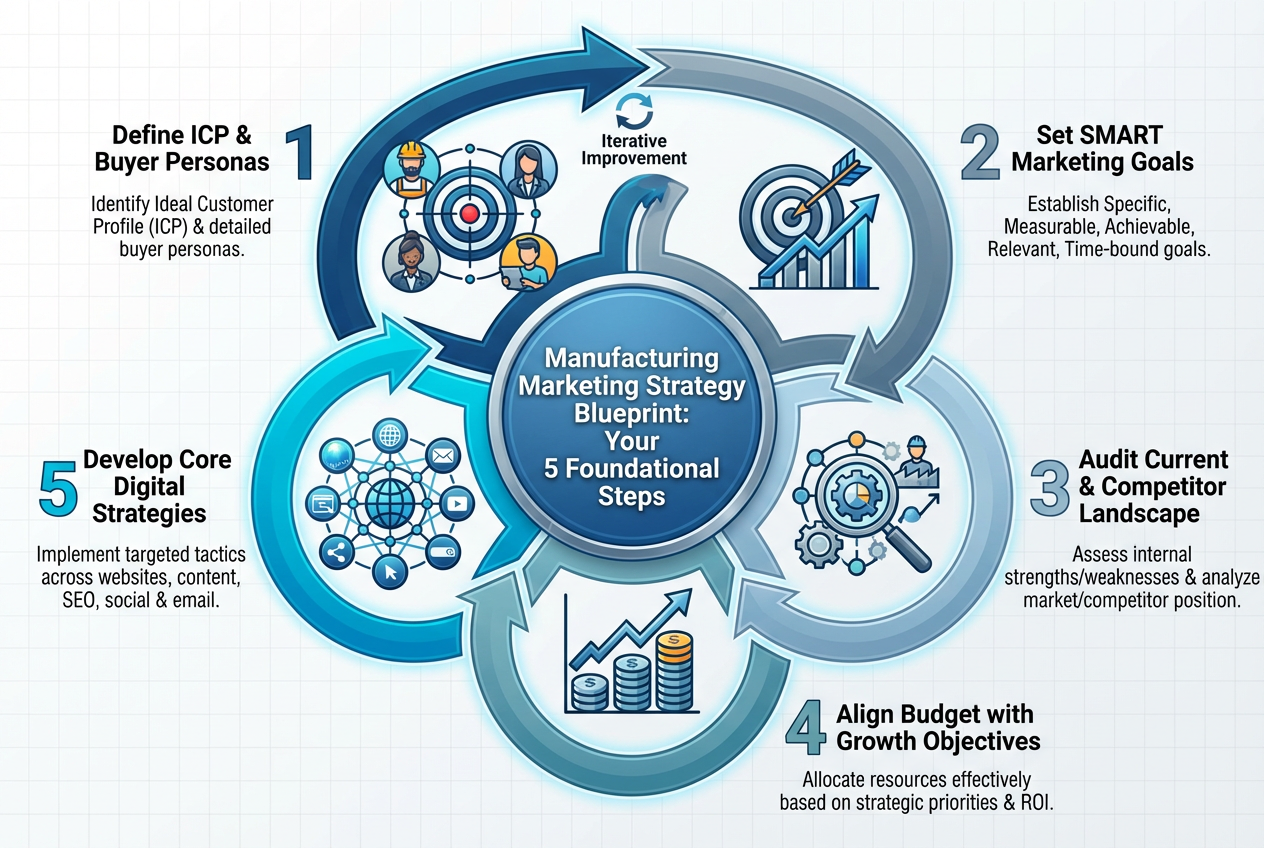
Build a robust manufacturing marketing strategy with these five foundational steps. Each stage is crucial for driving measurable growth and sustained success.
Define Your Ideal Customer Profile (ICP) & Buyer Personas
Generic targeting wastes budget and time. You need laser focus on your ideal customers—the accounts that generate the highest value, have the shortest sales cycles, and benefit most from your capabilities.
Start by analyzing your current customer base. Which clients are most profitable? Which segments have the lowest cost of acquisition? Which industries have the highest lifetime value? Look for patterns in company size, annual revenue, geographic location, industry sector, and production volumes.
Once you’ve identified your ICP at the company level, develop detailed buyer personas for the individual decision-makers within those companies. For a manufacturing business, this typically includes:
The Technical Evaluator (Engineering Manager, Product Designer, Quality Manager): This person evaluates technical specifications, conducts vendor comparisons, and makes recommendations. They need detailed technical content—CAD files, material specifications, testing data, application notes, and technical white papers.
The Operational Stakeholder (Plant Manager, Operations Director, Production Manager): They’re concerned with implementation, efficiency, uptime, and how your solution integrates with existing processes. Case studies, ROI calculators, and implementation timelines resonate with this persona.
The Financial Gatekeeper (Procurement Manager, Finance Director, CFO): They negotiate terms, evaluate total cost of ownership, and require clear financial justification. Pricing transparency, cost-benefit analyses, and financing options address their concerns.
The Executive Sponsor (VP of Operations, COO, CEO): They approve major purchases based on strategic alignment and business impact. Executive summaries, strategic benefits, and competitive advantages matter most to this group.
For a B2B digital marketing agency like Chatter Buzz working with manufacturing clients, we’ve found that companies with $10M-$200M+ in revenue and 50-500+ employees typically have buying committees of 3-7 people. Your marketing content must address each persona’s specific concerns while guiding them toward consensus.
Setting SMART Marketing Goals for Manufacturers
Vague goals like “increase brand awareness” or “generate more leads” don’t drive accountability or enable measurement. Instead, establish SMART goals (Specific, Measurable, Achievable, Relevant, Time-bound) that connect directly to business objectives.
Examples of effective manufacturing marketing goals:
- Lead Generation: “Increase monthly qualified leads from 15 to 35 within 6 months, with a focus on companies with $50M+ revenue in the aerospace sector.”
- Sales Cycle Efficiency: “Reduce average sales cycle length from 14 months to 10 months by providing better self-service technical content and automated lead nurturing.”
- Revenue Impact: “Generate $2M in marketing-sourced revenue within 12 months through inbound channels (organic search, content marketing, paid media).”
- Digital Presence: “Achieve first-page Google rankings for 15 high-intent keywords in our category within 9 months.”
- Conversion Optimization: “Improve website conversion rate from 1.2% to 2.5% by implementing conversion rate optimization best practices.”
Notice how each goal includes specific numbers, timeframes, and clear success criteria. This precision enables you to allocate resources appropriately and measure progress objectively.
Auditing Your Current Marketing Landscape & Competitors
Most manufacturers we work with discover significant gaps when they honestly assess their current marketing position. Conduct a thorough audit across these areas:
Website Assessment: Is your website mobile-responsive? How quickly does it load? Is the navigation intuitive for different buyer personas? Does it clearly communicate your unique value proposition? Are technical resources easily accessible? Does it capture leads effectively?
Content Inventory: What content do you currently have? How old is it? Does it address the questions your prospects ask during different stages of the buying journey? Are there obvious gaps where competitors provide superior content?
SEO Performance: Which keywords do you currently rank for? Where are the biggest opportunities? How visible are you compared to competitors for high-intent search terms in your category?
Competitive Analysis: Which competitors consistently appear in your lost deals? What are they doing differently in their marketing? How do their websites, content, and digital presence compare to yours? What gaps can you exploit?
Technology Stack: What marketing tools are you currently using? Is your CRM properly integrated? Can you track a lead from initial contact through closed deal? Are there technology gaps limiting your marketing effectiveness?
For many manufacturing companies in the early stages of digital transformation, this audit reveals uncomfortable truths: outdated websites, minimal content, no SEO strategy, and disconnected systems. That’s actually good news—it means you have clear opportunities for improvement.
Aligning Your Budget with Growth: Justifying Marketing Investment to the C-Suite
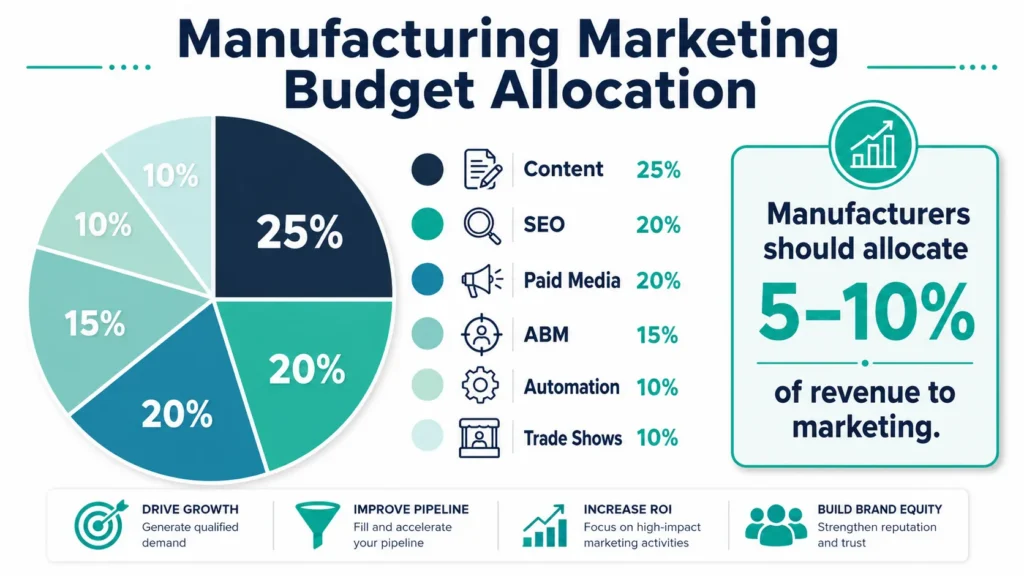
Here’s where many manufacturing marketing initiatives stall: securing adequate budget. If you’re currently spending less than 5% of revenue on marketing, you’re likely underinvesting relative to industry benchmarks and competitors.
The key to budget approval is connecting marketing investment to business outcomes. Rather than asking for “a marketing budget,” present a growth investment case:
“We’re investing $240,000 annually ($20,000/month) in strategic marketing to generate 420 qualified leads per year. Based on our 8% lead-to-customer conversion rate and $150,000 average deal value, this represents $5.04M in marketing-sourced revenue—a 21:1 return on investment. Each dollar invested in marketing returns $21 in revenue.”
This approach works because it speaks the language of business outcomes, not marketing activities. You’re not asking for money to “run campaigns”; you’re proposing an investment to drive measurable revenue growth.
Peter Drucker famously said, “Because the purpose of business is to create a customer, the business enterprise has two—and only two—basic functions: marketing and innovation. Marketing and innovation produce results; all the rest are costs.”
For manufacturers competing in increasingly digital-first markets, consistent marketing investment isn’t optional—it’s essential for long-term competitiveness and growth. Companies that view marketing as a discretionary expense rather than a growth investment will lose market share to competitors who embrace strategic marketing.
Our manufacturing marketing agency typically recommends manufacturers allocate between $10,000-$40,000+ monthly for comprehensive marketing programs, depending on company size, market competitiveness, and growth objectives. This investment typically includes strategy development, content creation, SEO, paid media, marketing automation, and ongoing optimization.
3. Core Digital Strategies to Drive Manufacturing Growth
With your foundation in place, let’s explore the specific digital marketing strategies that drive results for manufacturing companies. These aren’t theoretical concepts—they’re proven tactics our clients use to generate qualified leads, shorten sales cycles, and win competitive deals.
3.1 Content Marketing for Technical Buyers: Educate, Engage, Convert
Content marketing is particularly powerful in manufacturing because your prospects actively seek detailed technical information during their research process. Unlike consumer buyers making quick decisions, industrial buyers spend weeks or months evaluating options. Your content becomes their primary resource during this extended journey.
Types of High-Impact Manufacturing Content:
Technical White Papers: In-depth explorations of complex topics (e.g., “Comparative Analysis of Aluminum Alloys for Aerospace Applications” or “Total Cost of Ownership: Hydraulic vs. Electric Servo Systems”). These establish your engineering expertise and provide the detailed information technical evaluators demand.
Case Studies with ROI: Real-world examples showing how your solutions solved specific customer problems, including quantified results. Engineering managers share these internally to build consensus. Always include actual numbers: “Reduced scrap by 34%,” “Improved throughput by 22%,” or “Cut energy consumption by $47,000 annually.”
Application Notes: Practical guides for using your products or services in specific applications. These become valuable references that prospects download, save, and return to repeatedly.
Technical Blog Posts: Regular, focused articles addressing common questions, industry trends, or technical challenges. These drive organic search traffic and position your company as a thought leader.
Video Demonstrations: Visual proof is powerful. Show your equipment in action, demonstrate your processes, provide virtual facility tours, or explain complex technical concepts visually. Today’s engineers increasingly prefer video content for initial research.
CAD Files and Technical Specifications: Make it easy for engineers to evaluate your products by providing downloadable CAD models, detailed spec sheets, materials certifications, and testing data. Gating some of this content behind a simple form capture leads while still providing value.
Comparison Guides: Help prospects evaluate options by creating objective comparisons (your approach vs. alternative methods, newer technology vs. legacy solutions, etc.). This positions you as a trusted advisor rather than just a vendor.
The key is mapping content to your buyer’s journey. Early-stage prospects need educational content about their challenges and possible solutions. Mid-stage prospects compare options and need technical specifications, comparisons, and case studies. Late-stage prospects need implementation details, pricing information, and ROI justification.
Discover more about content marketing for manufacturing and how to create content that technical audiences actually read.
3.2 Technical SEO & Digital Visibility: Getting Found by High-Intent Prospects
When a procurement engineer searches for “precision sheet metal fabrication ISO 9001” at 11 PM, will they find your company or your competitor’s? Search engine optimization ensures your company appears when high-intent prospects are actively looking for solutions you provide.
Manufacturing SEO differs from generic SEO in several critical ways:
Long-Tail, Technical Keyword Focus: Generic keywords like “manufacturing” or “industrial equipment” are too broad and competitive. Instead, target highly specific phrases your prospects actually search: “titanium CNC machining medical devices,” “automated assembly systems automotive,” or “industrial coatings mil-spec certification.” These longer phrases have lower search volume but vastly higher conversion rates because they indicate specific intent.
Website Technical Optimization: Your website’s technical foundation directly impacts search rankings. Key elements include:
- Site Structure: Clear hierarchy that guides both users and search engines through your capabilities, industries served, and specific offerings
- Page Speed: Technical buyers won’t wait for slow-loading pages; aim for load times under 3 seconds
- Mobile Responsiveness: 30%+ of B2B industrial research now happens on mobile devices
- Secure Connection (HTTPS): Table stakes for professional websites
- Structured Data Markup: Help search engines understand your content with proper schema markup
Content Depth and Authority: Google’s algorithms increasingly reward comprehensive, authoritative content. A 2,500-word detailed guide on “Selecting Industrial Coatings for Corrosive Environments” will outperform a 300-word generic product page. Depth signals expertise.
Local SEO for Manufacturing Facilities: Many manufacturers serve regional markets or have location-based advantages (short lead times, local support, etc.). Optimize for local search by:
- Claiming and optimizing your Google Business Profile
- Building citations in industry directories
- Creating location-specific content
- Earning local backlinks from chambers of commerce, industry associations, and local business publications
Link Building for Authority: Search engines use backlinks as a proxy for authority and trustworthiness. For manufacturers, quality links come from:
- Industry publications and trade magazines
- Supplier and customer websites
- Engineering forums and technical communities
- University research collaborations
- Industry association memberships
- Trade show and conference mentions
Optimizing for AI-Driven Search: In 2026, we’re seeing increased prevalence of AI-powered search features (Google’s AI Overviews, ChatGPT search, Perplexity, etc.). To appear in these AI-generated results, focus on creating authoritative, well-structured content that directly answers specific questions. Use clear headings, bullet points, and concise explanations that AI systems can easily parse and summarize.
SEO is a long-term investment that compounds over time. While paid advertising stops generating leads the moment you pause spending, organic search rankings continue driving qualified traffic month after month, year after year. Most manufacturers see meaningful organic traffic growth within 6-9 months, with substantial results by 12-18 months.
3.3 Account-Based Marketing (ABM): Laser Focus on High-Value Manufacturing Clients
For manufacturers selling high-value solutions (equipment, services, or components with deal sizes over $50,000), account-based marketing delivers exceptional ROI by concentrating resources on your most valuable potential customers.
Traditional marketing casts a wide net, hoping to catch some fish. ABM is spearfishing—you identify the exact accounts you want to win, then marshal all your marketing and sales resources to land those specific deals.
Why ABM Excels for Manufacturing:
- Alignment with Long Sales Cycles: ABM’s sustained, multi-touch approach matches the 6-18 month buying cycles common in industrial sales
- Multi-Stakeholder Targeting: You can create personalized content for each decision-maker within a target account
- Efficient Resource Allocation: Focus budget on accounts most likely to convert rather than spreading thin across unqualified leads
- Sales-Marketing Alignment: ABM requires tight coordination between sales and marketing, improving overall efficiency
Implementing ABM for Manufacturing:
- Identify Target Accounts: Work with sales to define 25-100 ideal target accounts based on fit (industry, size, needs) and intent (recent expansion, known pain points, budget availability, or competitor dissatisfaction).
- Deep Account Research: For each target account, understand their business challenges, recent news, key decision-makers, current suppliers, technology stack, and potential pain points your solution addresses.
- Personalized Content Creation: Develop account-specific content—customized case studies featuring similar companies, personalized ROI calculators using their publicly available data, or industry-specific white papers addressing their known challenges.
- Multi-Channel Engagement: Reach target accounts through multiple touchpoints—LinkedIn ads targeted to specific companies and job titles, personalized email sequences, direct mail for key stakeholders, targeted display advertising that follows them across the web, and personalized website experiences.
- Sales-Marketing Orchestration: Marketing warms up target accounts through content and awareness campaigns, then alerts sales when accounts show engagement (visiting your site multiple times, downloading content, engaging with emails). Sales takes over with personalized outreach.
- Measurement and Optimization: Track account engagement, opportunity creation, pipeline velocity, and won deals. ABM is measured on quality of accounts engaged, not volume of leads generated.
For a detailed framework on implementing ABM in manufacturing, see our comprehensive ABM playbook for manufacturing industries.
3.4 Marketing Automation & Lead Nurturing: Sustaining Engagement Over Long Sales Cycles
In manufacturing, a prospect who downloads a technical spec sheet today may not be ready to request a quote for 6-9 months. Without systematic nurturing, they’ll forget about your company by the time their project reaches the purchasing phase.
Marketing automation platforms (HubSpot, ActiveCampaign, Marketo, etc.) enable you to maintain consistent, valuable contact with prospects throughout extended buying journeys without overwhelming your small marketing team.
Key Marketing Automation Strategies for Manufacturers:
Lead Scoring and Qualification: Not all leads are created equal. Implement scoring systems that assign points based on firmographic fit (company size, industry, revenue) and behavioral engagement (content downloads, site visits, email opens). This helps sales focus on truly qualified prospects.
Multi-Path Nurture Campaigns: Create different nurture sequences for different buyer personas and journey stages:
- An engineer who downloaded a technical white paper receives advanced technical content
- A CFO who requested ROI information receives financial justifications and case studies
- A prospect who visited your capabilities page receives service-specific information
Educational Drip Campaigns: Rather than constantly pushing sales messages, provide ongoing value through educational email series—”5-Part Email Course on Optimizing CNC Operations” or “Monthly Manufacturing Efficiency Tips.” This keeps your brand top-of-mind while building trust.
Behavioral Triggers: Set up automated responses to specific actions. When someone downloads a case study, automatically send a related white paper two days later. When someone visits your pricing page three times, alert sales for timely outreach.
Progressive Profiling: Rather than asking for extensive information upfront (which reduces conversion rates), gradually collect data over multiple interactions. First form asks for name and email. Second form asks for company and role. Third form requests specific project details.
Re-Engagement Campaigns: Automatically identify prospects who’ve gone cold (no engagement in 90+ days) and send targeted re-engagement content to rekindle interest.
Marketing automation works best when integrated with your CRM system, creating a seamless flow from initial website visitor → marketing qualified lead → sales accepted lead → opportunity → customer. This integration enables closed-loop reporting, showing exactly which marketing activities drive revenue.
Learn more about marketing automation and how it transforms lead nurturing for complex B2B sales.
3.5 Paid Media (PPC & Social): Accelerating Visibility & Targeting Decision Makers
While organic strategies like SEO and content marketing build long-term value, paid advertising delivers immediate visibility and enables precise targeting of decision-makers. For manufacturers, strategic paid media accelerates lead generation while organic channels gain traction.
Google Ads for Manufacturing:
Google Ads excels at capturing high-intent prospects actively searching for solutions. Effective strategies include:
- Search Ads on High-Intent Keywords: Target prospects searching for specific solutions (“custom injection molding services,” “industrial automation integration,” “precision grinding services”). These prospects are much further along the buying journey than social media audiences.
- Remarketing to Site Visitors: Re-engage website visitors who didn’t convert initially. These prospects already know your brand and are 7-10x more likely to convert than cold traffic.
- Product Listing Ads: For manufacturers selling standard products online, Google Shopping campaigns showcase products with images, prices, and ratings directly in search results.
LinkedIn Ads for B2B Manufacturing:
LinkedIn provides unmatched targeting precision for reaching industrial decision-makers based on job title, company size, industry, and even specific companies (account-based targeting).
- Sponsored Content: Native ads in LinkedIn feeds work well for promoting technical content, case studies, and thought leadership to target audiences.
- InMail Campaigns: Direct messages to key decision-makers at target accounts, personalized at scale.
- Account-Based Targeting: Run ads exclusively to decision-makers at your target account list, a powerful ABM tactic.
Strategic Paid Media Considerations for Manufacturers:
Start with a testing budget to identify which channels, audiences, and messages drive qualified leads. Paid media requires ongoing optimization—expect 2-3 months to refine targeting, messaging, and conversion paths. Budget approximately 15-25% of paid media spend for landing page optimization and conversion improvements. Always implement proper conversion tracking to measure cost per lead and cost per customer accurately.
For most manufacturing companies, we recommend allocating 30-40% of marketing budget to paid media (split roughly 60% Google, 40% LinkedIn for B2B manufacturers), with the remainder invested in organic strategies like SEO, content, and marketing automation.
3.6 Video Marketing: Showcasing Products & Processes
Video has emerged as one of the most effective content formats for manufacturing marketing. It provides visual proof, demonstrates complex processes clearly, and holds attention better than text alone.
High-Impact Video Types for Manufacturers:
Product Demonstrations: Show your equipment or products in action, highlighting key features, capabilities, and applications. These videos answer the “how does it work?” question that prospects can’t fully grasp from written descriptions alone.
Virtual Facility Tours: Give prospects an inside look at your manufacturing capabilities, quality processes, and scale of operations. This builds confidence and trust, especially important when prospects can’t visit in person.
How-It-Works Explainers: Break down complex technical concepts, processes, or applications in 2-3 minute animated or live-action videos. Engineers appreciate clear, visual explanations.
Customer Testimonials and Case Studies: Video testimonials from satisfied customers are significantly more persuasive than written quotes. Seeing a plant manager from a respected company explaining how your solution solved their challenge provides powerful social proof.
Engineering Insights and Thought Leadership: Short videos of your engineers or subject matter experts discussing industry trends, technical innovations, or solving common challenges position your company as a knowledge leader.
Application-Specific Guides: Create videos showing how to use your products for specific applications, industries, or use cases. These become valuable reference resources that prospects bookmark and return to.
Most manufacturing companies underestimate video’s impact because they think production requires Hollywood-level budgets. In reality, authentic, technically accurate content shot with modest equipment often outperforms highly polished corporate videos. Your audience values substance over production polish.
3.7 Trade Show Marketing with Digital Integration
Trade shows remain valuable for manufacturing companies—they provide face-to-face relationship building, hands-on product demonstrations, and concentrated access to target buyers. However, their impact multiplies when integrated with digital strategies.
Maximize Trade Show ROI Through Digital Integration:
Pre-Show Digital Campaigns: Run targeted LinkedIn and display ads to conference attendees weeks before the event, promoting your booth location and scheduling on-site meetings. Email registered attendees with compelling reasons to visit your booth. Create event-specific landing pages with schedule, location, and special show offers.
During the Show: Use digital lead capture tools (iPad apps, badge scanners) to collect attendee information instantly. Share real-time updates, booth activity, and product demos on social media. Host live streaming demonstrations for those who couldn’t attend.
Post-Show Follow-Up: Implement automated email sequences to nurture leads immediately after the show while your brand is still fresh in their minds. Segment leads based on interest level and follow up accordingly. Share recorded demos and show highlights to extend the event’s reach.
Year-Round Digital Presence: Use content from trade shows (product demo videos, seminar recordings, booth photos) throughout the year in your digital marketing. This extends the value of your trade show investment far beyond the 2-3 days of the actual event.
By integrating digital strategies with your traditional trade show presence, you transform a brief in-person interaction into an ongoing digital relationship that drives pipeline throughout the year.
4. Operationalizing Your Strategy: Sales Alignment & Execution
The most sophisticated marketing strategy fails without proper execution. This section addresses the operational realities of implementing manufacturing marketing effectively, especially for companies with limited internal resources.
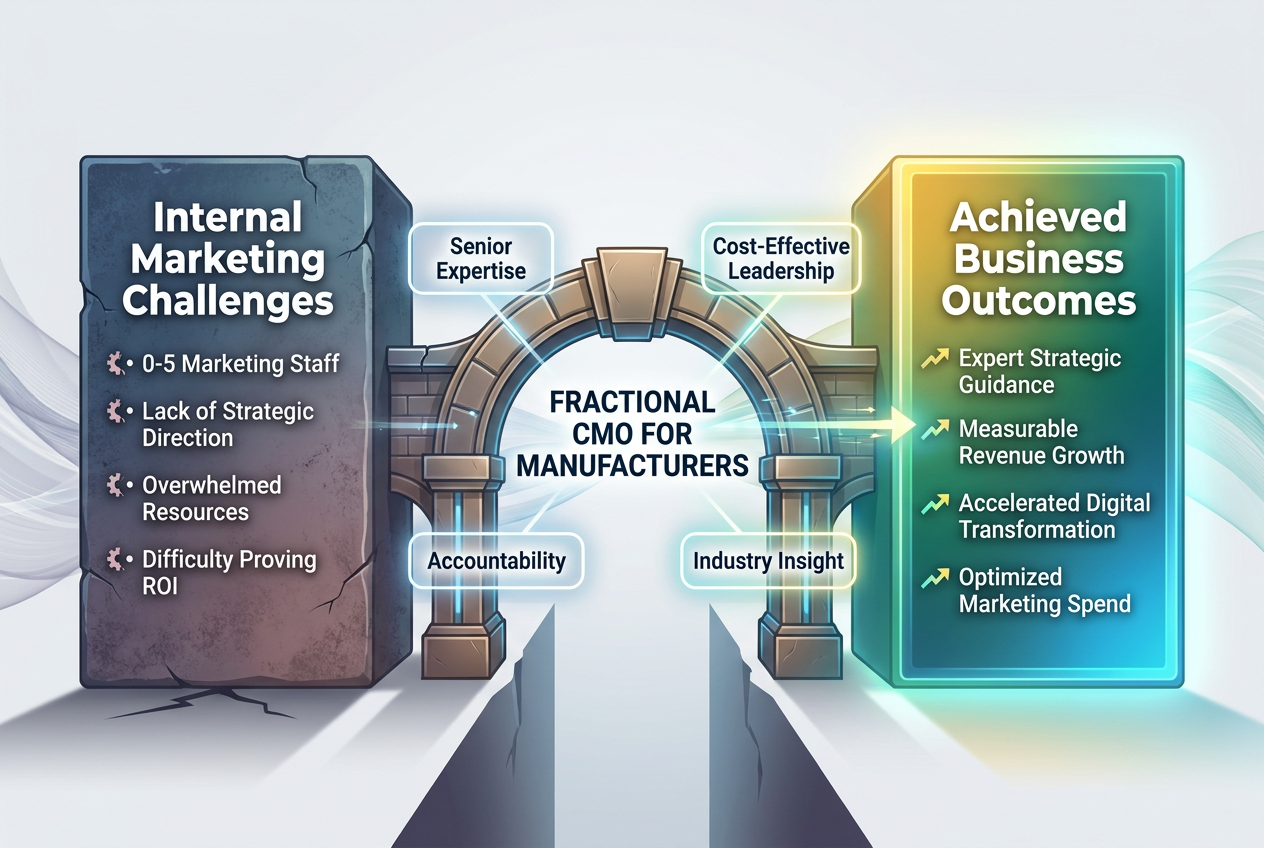
Unlock senior-level marketing expertise without the full-time cost. A Fractional CMO bridges your team’s gaps, driving strategic direction and measurable ROI for manufacturers.
Breaking Down Silos: Marketing, Sales & Production Alignment
In manufacturing companies, marketing often operates in isolation from sales, and both are disconnected from production capabilities. This fragmentation undermines effectiveness and wastes resources.
Creating True Sales-Marketing Alignment (“Smarketing”):
Shared Goals and Accountability: Both teams must work toward common revenue goals, not separate metrics. Marketing shouldn’t be measured solely on lead volume; they should be accountable for pipeline contribution and revenue influence. Sales shouldn’t judge marketing only on “lead quality” without providing specific feedback on why leads don’t convert.
Regular Communication Cadences: Implement weekly or bi-weekly meetings between sales and marketing leadership to review pipeline, discuss lead quality, share market intelligence, and align on priorities. Include monthly joint reviews of closed-won and closed-lost deals to learn what messaging and content influences decisions.
Unified Technology Platform: Your CRM system should be the single source of truth for both teams, tracking every interaction from initial website visit through closed deal. Marketing needs visibility into what happens to leads after handoff. Sales needs visibility into prospect engagement history.
Service Level Agreements (SLAs): Define clear expectations: What constitutes a qualified lead? How quickly will sales follow up on marketing-generated leads? What feedback will sales provide on lead quality? When these agreements are explicit, both teams can hold each other accountable.
Marketing as Sales Enablement: Marketing should create tools that make sales more effective—case studies for specific industries, competitive battle cards, ROI calculators, technical Q&A documents, and objection-handling guides. Regular check-ins ensure these resources actually get used.
Production Team Input: Your production capabilities, capacity, and unique processes are marketing differentiators. Regular communication with operations ensures marketing accurately represents what you can deliver and highlights genuine competitive advantages.
For more on creating effective alignment, see our guide on how to align marketing and sales in the B2B manufacturing environment.
The Fractional CMO Model: Strategic Leadership for Understaffed Marketing Teams
Here’s a common scenario: Your manufacturing company has 0-2 marketing people handling tactical execution (social posts, trade show logistics, updating the website). You have no one providing strategic direction, planning campaigns, analyzing results, or connecting marketing to business objectives. The CEO or VP of Sales tries to fill this gap but lacks specialized marketing expertise and bandwidth.
This is where the Fractional CMO model becomes transformative.
A Fractional Chief Marketing Officer is a senior marketing executive who works with your company on a part-time or project basis, providing CMO-level strategic leadership without the cost of a full-time executive (typically $180,000-$300,000+ annually for a full-time manufacturing CMO).
Why Manufacturing Companies with Small Marketing Teams Need a Fractional CMO:
Strategic Expertise You Can’t Hire Full-Time: Most mid-sized manufacturers can’t justify or afford a full-time CMO, yet they desperately need senior marketing leadership. A Fractional CMO delivers executive-level expertise at a fraction of the cost.
Objective External Perspective: An experienced fractional executive has worked with dozens of companies across various manufacturing sectors. They bring best practices, proven frameworks, and fresh perspectives unclouded by internal politics or “the way we’ve always done it.”
Immediate Impact: Unlike hiring a full-time executive (which takes months), a Fractional CMO can start making impact within weeks. They’ve solved similar challenges before and know what works in manufacturing marketing.
Accountability and Measurement: A seasoned Fractional CMO implements proper marketing measurement frameworks, connects activities to business outcomes, and provides the data-driven reporting that CFOs and CEOs demand.
Bridge Between Strategy and Execution: They develop the strategy, then guide your internal team (or agency partners) through proper execution, ensuring tactics align with strategic objectives.
How a Fractional CMO Works:
Typically, a Fractional CMO engages at 10-20 hours per week (roughly 2-3 days per month), with scope tailored to your needs. They might develop your comprehensive marketing strategy, oversee agency relationships, guide your internal marketing coordinator, implement marketing automation and CRM systems, establish KPIs and reporting, or provide ongoing strategic direction and optimization.
Investment and ROI:
Fractional CMO services typically range from $5,000-$15,000+ per month depending on scope and experience level—a fraction of a full-time CMO’s cost. When properly leveraged, they drive marketing ROI that far exceeds their cost through improved lead quality, shorter sales cycles, and more efficient resource allocation.
At Chatter Buzz, our Fractional CMO services are specifically designed for mid-sized manufacturing companies in exactly this situation—growth-oriented, underdeveloped marketing, and need for strategic leadership without full-time cost.
Outsourcing vs. In-house: When to Partner with a Manufacturing Marketing Agency
Most manufacturing companies face a critical decision: Build an internal marketing team, outsource to a specialized agency, or create a hybrid model?
Advantages of Partnering with a Manufacturing Marketing Agency:
Specialized Manufacturing Expertise: Generic marketing agencies don’t understand the complexities of manufacturing B2B sales, technical buyers, and long sales cycles. Specialized agencies bring deep experience with industrial clients, technical content, and engineering audiences.
Complete Skill Set Access: Marketing requires diverse expertise—strategy, SEO, content writing, paid media, design, web development, marketing automation, and analytics. Building an internal team with all these skills is expensive and difficult. Agencies provide the full skill set immediately.
Scalability and Flexibility: Your marketing needs fluctuate. During new product launches or major campaigns, you need more resources. During slower periods, you can scale back. Agencies provide this flexibility without the overhead of permanent staff.
Technology and Tools: Professional agencies invest in premium marketing tools, analytics platforms, and automation software that would be cost-prohibitive for individual manufacturers to license and learn independently.
Proven Processes and Frameworks: Established agencies bring battle-tested processes, templates, and frameworks refined through hundreds of client engagements. You’re not inventing the wheel; you’re leveraging proven methodologies.
Objective Performance Focus: Internal teams sometimes struggle with honest self-evaluation. Agency relationships include regular performance reviews, transparent reporting, and accountability to deliver results.
Considerations When Choosing an Agency:
Look for manufacturing-specific experience and case studies. Evaluate their understanding of technical B2B sales and long sales cycles. Assess their team’s depth across all required disciplines. Review their strategic approach, not just tactical execution. Understand their reporting and communication processes. Consider their culture fit and partnership orientation rather than vendor mentality.
The hybrid model often works best: Partner with a specialized marketing agency for strategy and execution while maintaining a small internal team for day-to-day coordination, institutional knowledge, and internal stakeholder management. This combination delivers the expertise and scale of an agency with the insider perspective of an internal team.
5. Measuring Success: Proving ROI in Manufacturing Marketing
For manufacturing executives—particularly CEOs and CFOs who control budgets—marketing must demonstrate measurable business impact. Vague metrics like “impressions,” “reach,” or “engagement” don’t justify investment. You need clear connections between marketing activities and revenue outcomes.
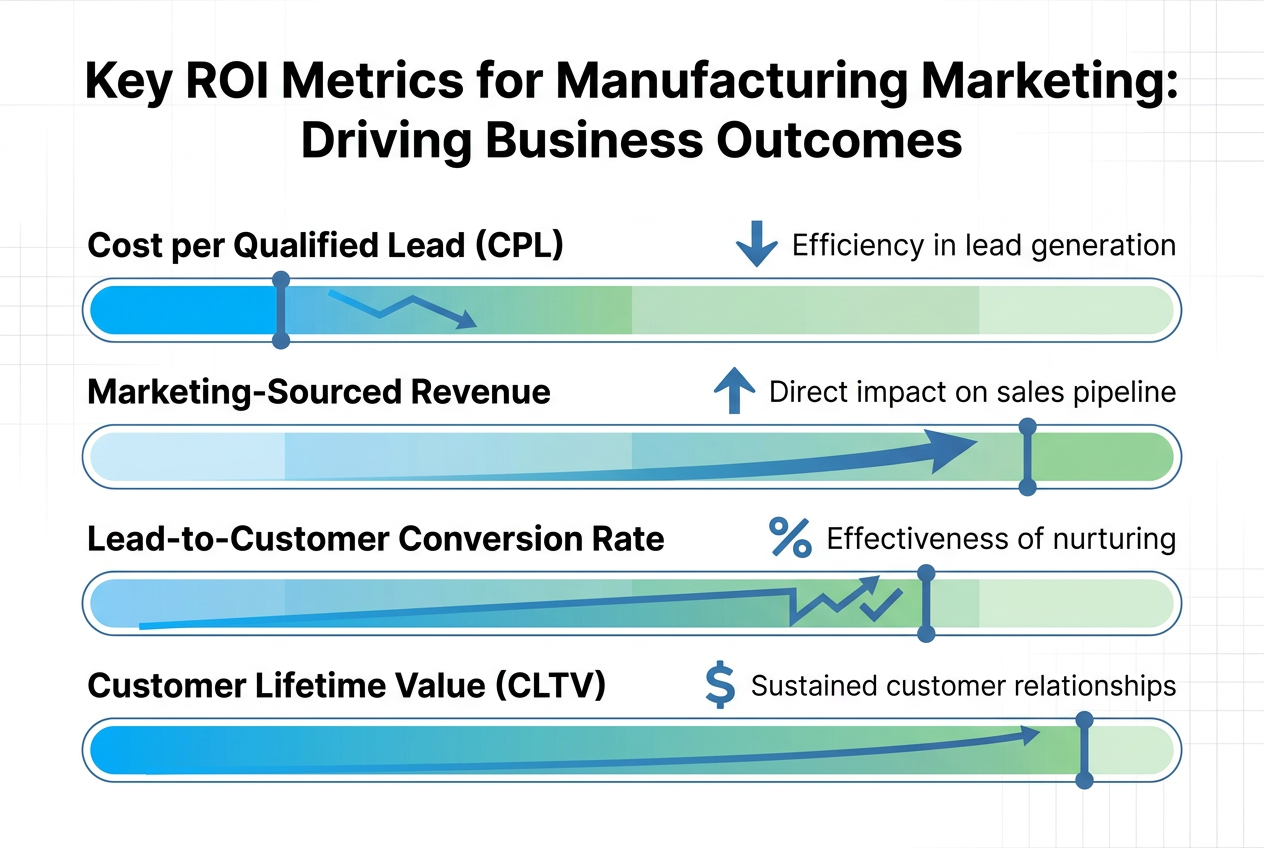
Measure what matters. These key ROI metrics connect your manufacturing marketing efforts directly to business outcomes, demonstrating real value to the C-suite.
Key Performance Indicators (KPIs) That Matter to Manufacturing Executives
Focus your reporting on metrics that directly impact business performance:
Cost Per Qualified Lead (CPL): What does it cost to generate a lead that meets your qualification criteria? Track this by channel (organic search, paid media, content marketing, trade shows) to identify your most efficient lead sources. Typical manufacturing CPLs range from $200-$1,500+ depending on solution complexity and market competition.
Marketing-Sourced Revenue: How much closed business can be attributed to marketing-generated leads? This is the ultimate justification for marketing investment. Track monthly and quarterly trends to demonstrate growth. Establish clear attribution rules (first-touch, last-touch, or multi-touch) that your team agrees on.
Sales Cycle Length: How long does it take prospects to move from initial contact to closed deal? Effective marketing should shorten sales cycles by pre-educating buyers and providing sales enablement tools. Track cycle length for marketing-sourced vs. sales-sourced opportunities to demonstrate marketing’s impact.
Lead-to-Customer Conversion Rate: What percentage of marketing-qualified leads eventually become customers? This metric reveals lead quality. A 5-10% conversion rate is typical for manufacturing. If yours is significantly lower, leads may be poorly qualified, or sales follow-up may need improvement.
Customer Lifetime Value (CLTV): What’s the total revenue a customer generates over their relationship with your company? Marketing should attract high-value customers who generate substantial lifetime revenue. Track CLTV by acquisition source to identify which marketing channels attract the most valuable customers.
Website Conversion Rate: What percentage of website visitors take desired actions (downloading content, requesting quotes, contacting sales)? Track by traffic source to identify which channels drive the most engaged visitors. Benchmark against your historical performance and improve through ongoing optimization.
Organic Search Traffic and Rankings: For manufacturers investing in SEO, track organic traffic growth, keyword rankings for target terms, and the quality/conversion rate of organic visitors. SEO typically shows compounding returns over 12-24 months.
Marketing-Influenced Pipeline: Beyond directly generated leads, how much pipeline value includes prospects who engaged with marketing content during their journey? This captures marketing’s role in the 67% of the buyer’s journey that happens before sales contact.
Attribution Models for Complex B2B Sales
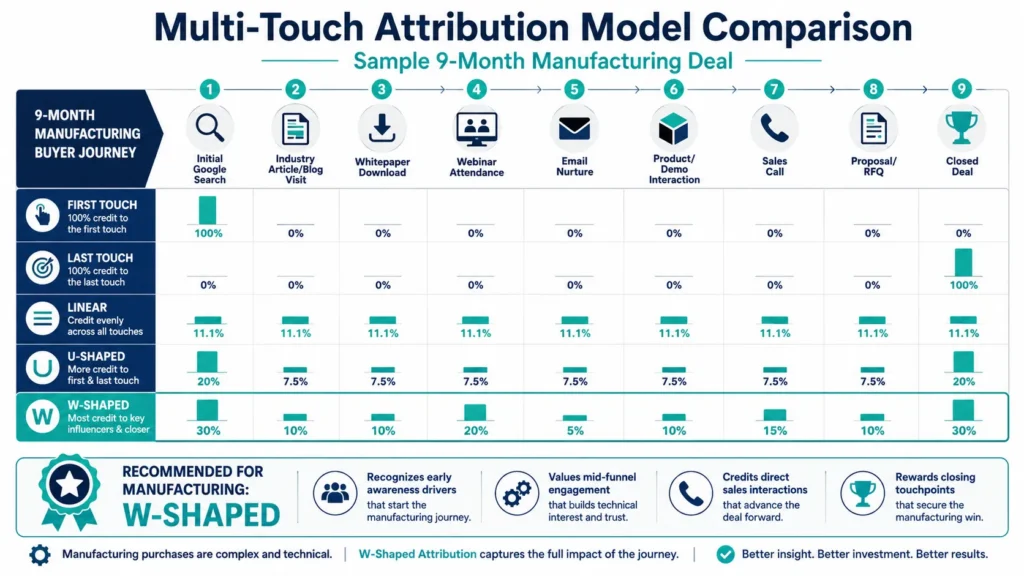
Manufacturing B2B sales involve multiple touchpoints across extended timeframes, making attribution challenging. A prospect might discover you through organic search, engage with content over several months, attend a trade show, receive sales outreach, and eventually request a quote. Which touchpoint gets credit?
Common Attribution Models:
First-Touch Attribution: Gives all credit to the first interaction (e.g., initial website visit from organic search). This model highlights top-of-funnel effectiveness but undervalues nurturing and conversion efforts.
Last-Touch Attribution: Credits the final interaction before conversion (e.g., sales call or demo request). This overemphasizes bottom-funnel activities while ignoring early awareness building.
Multi-Touch Attribution: Distributes credit across all touchpoints in the buyer’s journey. This provides a more accurate picture but requires sophisticated tracking. Options include linear (equal credit to all touches), time-decay (more credit to recent interactions), or u-shaped (more credit to first and last touches).
W-Shaped Attribution: Gives significant credit to three key moments: first touch, lead conversion, and opportunity creation, with remaining credit distributed to other interactions. This model recognizes critical transition points.
For most manufacturers, we recommend starting with a simple model (first-touch or last-touch) while implementing proper tracking infrastructure, then evolving to multi-touch attribution as your systems mature.
Most importantly, be consistent. The specific model matters less than using the same methodology over time so you can identify trends and optimization opportunities.
Connecting Marketing to Revenue: The Data-Driven Approach
The most compelling proof of marketing ROI comes from demonstrating clear connections between marketing activities and closed revenue. This requires integrated systems and disciplined data management.
Essential Elements:
Unified CRM Platform: Your CRM (HubSpot, Salesforce, etc.) must capture every prospect interaction—website visits, content downloads, email responses, sales calls, meetings, and proposals. Without complete data, accurate attribution is impossible.
Proper Lead Source Tracking: Every lead must be tagged with its original source (organic search, LinkedIn ad, trade show, referral, etc.). This requires using UTM parameters on all marketing links, tracking form submissions accurately, and training sales to log source information for phone/conference leads.
Closed-Loop Reporting: Marketing needs visibility into what happens after leads are passed to sales. Did they convert? How long did it take? What was the deal size? Which marketing touchpoints influenced closed deals? Regular closed-loop reporting connects marketing activities to business outcomes.
Regular Attribution Analysis: Monthly or quarterly, analyze which marketing channels and campaigns drive the highest-value customers, shortest sales cycles, and best conversion rates. Double down on what works; cut or optimize what doesn’t.
Executive Dashboards: Create simple, visual dashboards that show executives the metrics they care about—marketing-sourced revenue, pipeline value, lead volume and quality trends, and ROI by channel. Update these monthly and review with leadership.
When you can confidently report, “Marketing generated 127 qualified leads last quarter, which resulted in 38 opportunities worth $4.7M in pipeline, and we’ve already closed $1.2M in revenue—delivering a 6:1 ROI on our marketing investment,” you’ve justified marketing’s value in language executives understand.
6. The Future of Manufacturing Marketing: Leveraging AI & Emerging Technologies
The marketing landscape continues evolving rapidly, with artificial intelligence emerging as a transformative force. Manufacturing companies that understand and leverage these technologies will gain competitive advantages, while those that ignore them will fall behind.
AI for Enhanced Efficiency: Content Creation, Personalization & Automation
Artificial intelligence is already enhancing marketing effectiveness in practical ways:
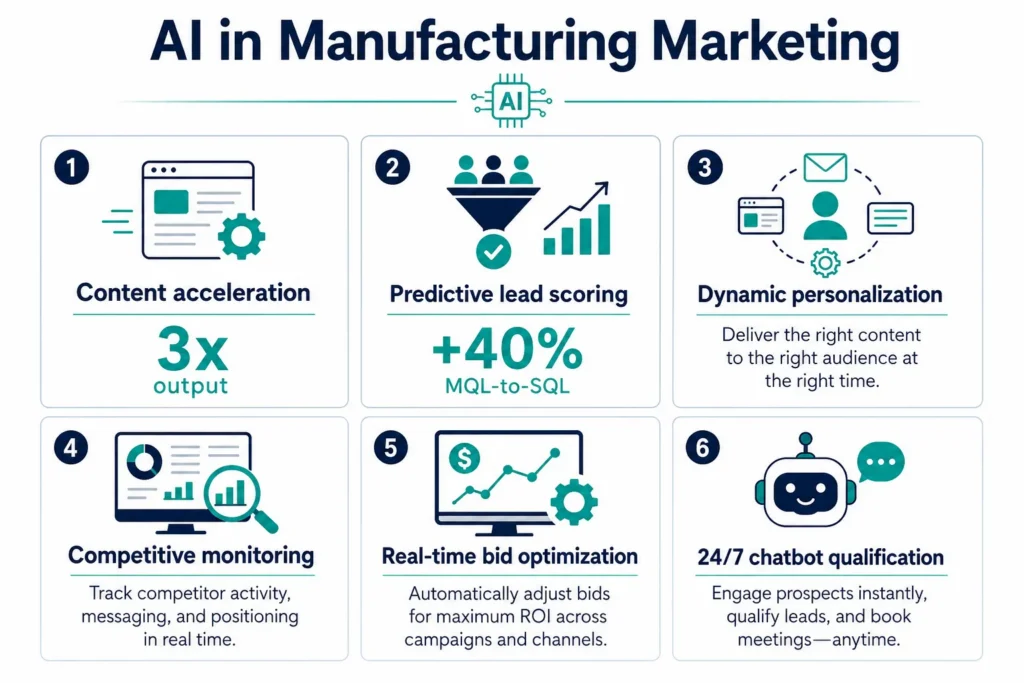
Content Creation and Optimization: AI tools help manufacturing marketers work more efficiently by generating first drafts of technical blog posts, product descriptions, and email campaigns, expanding outline ideas into full articles, optimizing headlines and CTAs through rapid testing, and translating content for international markets. The key is using AI as an accelerator—senior human experts guide strategy, provide technical accuracy, and refine outputs, while AI handles time-consuming drafting and iteration.
Personalization at Scale: AI enables hyper-personalized experiences by analyzing visitor behavior to serve relevant content, personalizing email content based on recipient industry or role, adjusting website messaging based on company size or traffic source, and recommending related content based on what similar prospects found valuable. A procurement manager from automotive sees different homepage messaging than an engineer from aerospace—both receive content relevant to their context.
Campaign Optimization: AI-powered platforms continuously optimize paid media campaigns by adjusting bids in real-time, identifying high-performing audience segments, testing ad creative variations automatically, and predicting which prospects are most likely to convert. This frees human marketers to focus on strategy while AI handles tactical optimization.
Predictive Lead Scoring: Advanced AI models analyze hundreds of data points to predict which leads are most likely to convert, enabling sales to prioritize the highest-value opportunities. These models continuously learn from outcomes, becoming more accurate over time.
AI for Competitive Advantage: Mastering Pre-Contact Research
Here’s a critical shift: In 2026, buyers increasingly use AI-powered tools (ChatGPT, Perplexity, Claude, Google’s AI Overviews) to research solutions before ever visiting company websites. An engineer might ask, “What are the best precision machining services for titanium aerospace components?” and receive AI-generated answers synthesized from multiple sources.
If your company isn’t represented in these AI responses, you’re invisible during critical early research phases.
Optimizing for AI-Driven Search:
Create Authoritative, Comprehensive Content: AI platforms favor detailed, well-structured content from authoritative sources. Your in-depth technical articles, white papers, and guides are more likely to be cited than shallow marketing copy.
Use Clear Structure and Formatting: AI systems parse and understand content more easily when it’s well-organized with clear headings, bullet points, tables, and logical flow. This also improves human readability.
Answer Specific Questions Directly: Create content that directly addresses common questions your prospects ask. FAQ sections, how-to guides, and comparison articles work well for AI citation.
Build Domain Authority: Earn backlinks from reputable industry publications, associations, and technical forums. AI platforms consider domain authority when determining which sources to cite.
Optimize for Featured Snippets: Content that already appears in Google’s featured snippets is more likely to be cited by AI tools. Structure your content to capture these prime positions.
Monitor AI Platform Mentions: Regularly query AI platforms with questions your prospects might ask, and see which competitors are being cited. This reveals content gaps you should fill.
The manufacturers who master AI-optimized content will dominate the new paradigm of AI-assisted buyer research, while those who ignore this shift will become increasingly invisible to their ideal prospects
Beyond the Hype: Practical AI Applications for Manufacturers
Cut through AI hype by focusing on practical applications that deliver measurable value today:
Competitive Intelligence: AI tools can monitor competitor websites, pricing changes, new product launches, and digital marketing activities, alerting you to market shifts. This enables proactive rather than reactive competitive positioning.
Technical Content Generation: For manufacturers with extensive technical documentation needs (spec sheets, application notes, installation guides), AI accelerates content creation while human engineers ensure technical accuracy.
Chat and Conversational Marketing: AI-powered chatbots on your website can answer common questions 24/7, qualify leads, schedule demos, and provide instant technical information—particularly valuable for international prospects in different time zones.
Customer Service Automation: AI can handle routine support inquiries, freeing your technical team to focus on complex problems. This improves response times and customer satisfaction.
Data Analysis and Insights: AI analyzes marketing data faster and more comprehensively than humans, uncovering patterns and opportunities that inform strategic decisions.
The key principle: Position AI as an accelerator for senior human expertise, not a replacement. Your engineers, subject matter experts, and strategists provide the irreplaceable elements—deep technical knowledge, strategic thinking, relationship building, and judgment. AI handles repetitive tasks, analysis, drafting, and optimization, multiplying human expertise rather than replacing it.
FAQ: Manufacturing Marketing Strategy Questions Answered
What makes manufacturing marketing different from other B2B marketing?
Manufacturing marketing is distinct because of highly technical buyers (engineers and technical evaluators), extended sales cycles (often 6-18 months), multi-stakeholder buying committees (engineering, procurement, finance, operations, executives), high-value purchases with significant business impact, and the need for detailed technical proof (specs, certifications, testing data, CAD files). Generic B2B tactics that work for software or professional services often fail in manufacturing environments because they don’t address these unique dynamics.
How long does it take to see results from manufacturing marketing?
This depends on the strategies employed. Paid advertising can generate qualified leads within 2-4 weeks once campaigns are properly optimized. Content marketing and SEO typically show meaningful results in 6-9 months, with substantial impact by 12-18 months. Account-based marketing (ABM) aligns with your sales cycle, typically 6-12 months for first closed deals. Trade show integration provides immediate connections that nurture over 3-6 months. The most effective approach combines quick-win tactics (paid media) with long-term investments (SEO, content) that compound value over time.
What budget should a manufacturing company allocate to marketing?
Industry benchmarks suggest 5-10% of revenue for established manufacturers in competitive markets. Companies in growth mode or entering new markets often invest 8-12% of revenue. For a $25M manufacturer, this means $104,000-$208,000 annually ($8,700-$17,400 monthly). For a $100M manufacturer, this translates to $416,000-$833,000 annually ($35,000-$70,000 monthly). Companies currently spending less than 5% are likely underinvesting relative to competitors. The critical factor isn’t just the amount but the strategic deployment and measurable ROI.
Should we hire an agency or build an in-house marketing team?
For most mid-sized manufacturers ($10M-$200M revenue) with limited current marketing capabilities, a hybrid model works best: partner with a specialized manufacturing marketing agency for strategy, execution, and specialized skills while maintaining a small internal team (1-2 people) for coordination and institutional knowledge. Consider adding a Fractional CMO for senior strategic leadership. This approach provides the comprehensive expertise of an agency at a fraction of the cost of building a full internal team, with the insider perspective of someone who deeply understands your business.
How do we measure marketing ROI in manufacturing?
Focus on business-impact metrics: Cost per qualified lead (CPL), Marketing-sourced revenue (closed deals from marketing-generated leads), Lead-to-customer conversion rate, Sales cycle length (marketing should help shorten it), Customer lifetime value (CLTV) by acquisition source, and Pipeline value influenced by marketing. Implement closed-loop reporting that connects marketing activities to closed revenue through integrated CRM systems. Start with simple attribution (first-touch or last-touch), then evolve to multi-touch attribution as your systems mature. Most importantly, establish consistent measurement methodologies and review metrics monthly with leadership.
What is a Fractional CMO and do we need one?
A Fractional Chief Marketing Officer is a senior marketing executive who works with your company part-time, providing CMO-level strategic leadership without full-time cost. You likely need a Fractional CMO if you have 0-5 marketing staff with no senior leadership, lack a comprehensive marketing strategy, struggle to prove marketing ROI, feel overwhelmed by digital marketing options, need to justify marketing investment to leadership, or want to scale marketing without full-time executive cost. A Fractional CMO typically costs $5,000-$15,000+ monthly versus $180,000-$300,000+ annually for a full-time CMO, making it accessible for mid-sized manufacturers who need executive expertise.
How do we get started if we currently have minimal marketing?
Begin with a comprehensive marketing audit to assess your current state—website effectiveness, competitive position, content gaps, and technology infrastructure. Define your Ideal Customer Profile and buyer personas clearly. Set specific, measurable goals tied to business outcomes (lead volume, pipeline value, revenue targets). Develop a 12-month strategic marketing plan prioritizing high-impact activities. Implement foundational technologies (CRM, marketing automation, analytics). Partner with a specialized agency or Fractional CMO who understands manufacturing to accelerate progress. Start with a realistic budget ($10,000-$20,000+ monthly) and plan to scale as you prove ROI. The most important step is simply starting—even modest, strategic marketing investments dramatically outperform doing nothing.
How can AI help our manufacturing marketing?
AI enhances marketing efficiency and effectiveness through content creation acceleration (first drafts, optimization), advanced personalization at scale, automated campaign optimization (testing, bidding, targeting), predictive lead scoring and prioritization, competitive intelligence monitoring, and optimization for AI-powered search platforms. The key is positioning AI as an accelerator for human expertise, not a replacement. Your engineers and strategists provide technical knowledge and judgment while AI handles repetitive tasks, analysis, and optimization. Start with practical applications (content drafting, campaign automation) rather than trying to revolutionize everything at once.
Your Path to Manufacturing Marketing Leadership
The manufacturing landscape has fundamentally changed. Today’s buyers research exhaustively online before ever contacting suppliers. Technical decision-makers expect detailed, data-driven content that speaks their language. Multi-stakeholder buying committees demand information tailored to their specific concerns. Extended sales cycles require sustained engagement strategies. And increasingly, AI-powered tools mediate the early research process.
In this environment, traditional marketing approaches—relying primarily on trade shows, referrals, and outbound sales—leave massive opportunities on the table. Meanwhile, manufacturers who embrace strategic, digital-first marketing are capturing market share, shortening sales cycles, and growing profitably.
The playbook we’ve outlined isn’t theoretical—it’s the proven framework that mid-sized manufacturing companies are using to compete effectively with larger competitors, justify marketing investment to skeptical CFOs, and drive measurable revenue growth.
Whether you implement this strategy with a small internal team, partner with a specialized agency, or engage a Fractional CMO for strategic leadership, the critical factor is making the commitment to transform marketing from an afterthought into a strategic growth engine.
The manufacturers who will lead their industries in 2026 and beyond are those who recognize that technical excellence alone no longer guarantees success. You must pair engineering expertise with marketing sophistication, ensuring your ideal customers discover you, understand your unique value, and choose you over alternatives.
The best time to start was five years ago. The second-best time is today.
Ready to transform your manufacturing marketing and drive measurable growth?
At Chatter Buzz, we specialize in developing and executing revenue-driven marketing strategies for mid-to-large manufacturing companies. Whether you need comprehensive strategy development, Fractional CMO leadership, or full-service marketing execution, our team brings deep manufacturing expertise and proven frameworks.
Schedule a free consultation to discuss your specific challenges and develop a customized approach for your company. No pressure—just a straightforward conversation about your goals and how we can help you achieve them.
Related: 4 Reasons Why a CRM Is Essential for Business Growth in 2026

Victoria Wallace
Victoria Wallace is a senior content strategist and marketing writer with 30+ years of experience helping more than 200 brands translate complex business goals into clear, conversion-focused content. Her background spans paid media, marketing strategy, go-to-market planning, brand positioning, and full-funnel campaign development, giving her a deep understanding of how SEO content connects to real business growth.