
 321-236-2899
Struggling to scale your marketing without spending $250,000+ on a full-time CMO? You’re not alone—and there’s a proven solution.
What is a fractional CMO? A fractional chief marketing officer is a part-time marketing executive who provides strategic leadership to your business without the commitment or cost of a full-time hire. Think of it as executive marketing leadership on demand: you get the expertise of a seasoned CMO for a fraction of the price.
Here’s what makes fractional CMOs different: they don’t just consult and hand you a strategy deck. They embed directly into your business, own your growth roadmap, align marketing to revenue targets, and work alongside your team to drive measurable results.
In this guide, you’ll learn:
- What fractional CMOs do and how they differ from agencies and consultants
- When hiring a fractional chief marketing officer makes sense (and when it doesn’t)
- Real pricing comparisons: fractional vs. full-time vs. agency
- How to select the right fractional marketing leader for your business
- The exact services and deliverables you can expect
Let’s start with the fundamentals.
What is a Fractional CMO? Definition & Core Responsibilities
A fractional CMO (also called a part-time CMO, outsourced CMO, or CMO as a service) is a senior marketing executive who works with your company on a flexible, part-time basis. Unlike traditional consultants who provide recommendations and leave, fractional chief marketing officers take ownership of your marketing strategy and guide its execution.
The Core Value Proposition
Most mid-market companies ($10M–$200M in revenue) face the same challenge: they need executive-level marketing leadership but can’t justify the $200K–$400K annual cost of a full-time CMO—plus benefits, bonuses, and equity.
Fractional CMOs solve this by delivering:
- Strategic marketing leadership from executives with 15–30 years of experience
- Hands-on execution oversight without the strategy-to-execution gap
- Flexible engagement models that scale with your business needs
- Industry-specific expertise across your exact vertical
- Revenue-focused accountability tied to pipeline, bookings, and growth metrics
What Sets Fractional CMOs Apart
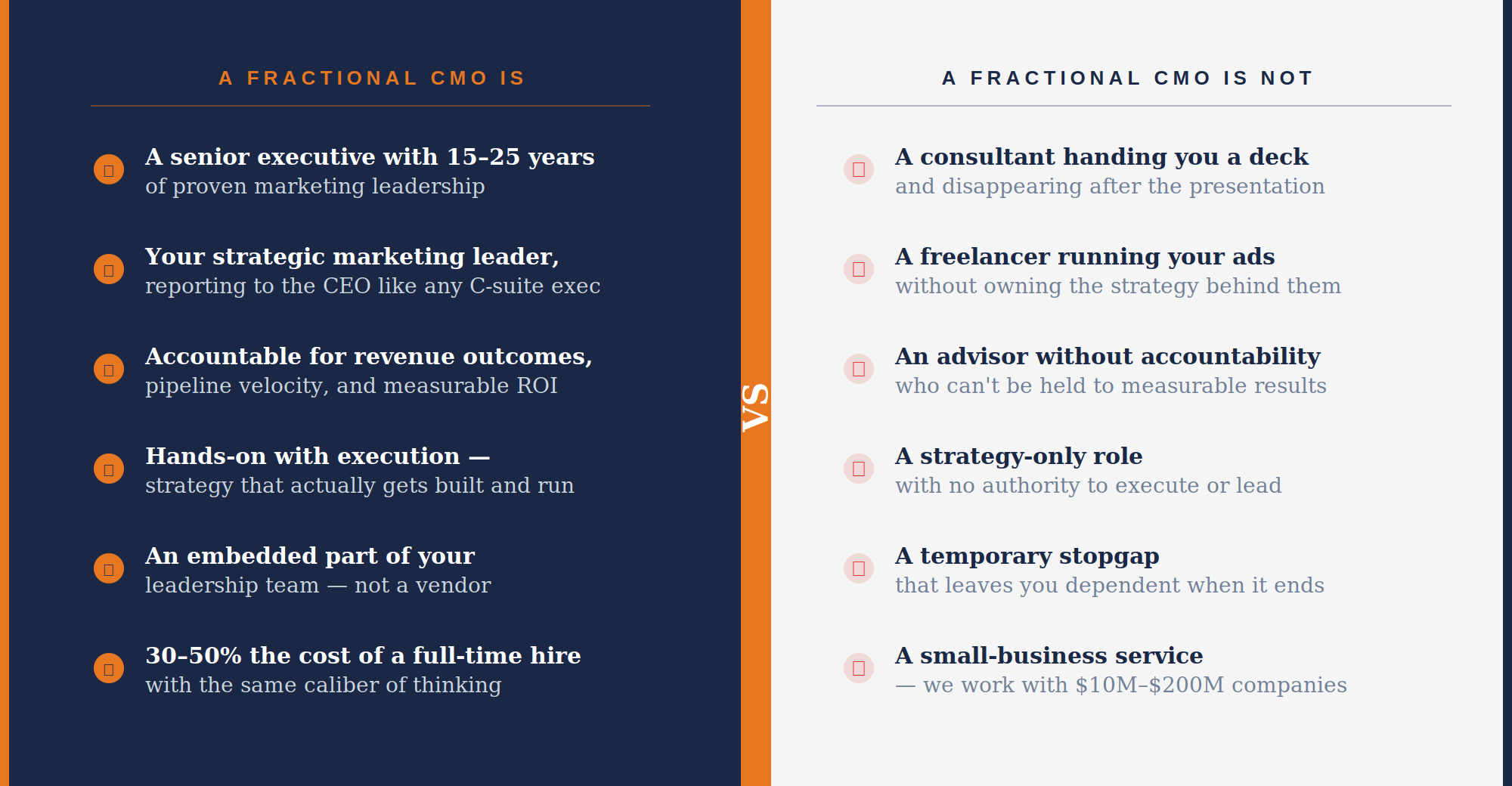
A fractional chief marketing officer is not:
- A marketing consultant who provides recommendations without implementation
- A marketing agency that executes tactics without strategic ownership
- An interim CMO filling a temporary vacancy
- A junior marketer with a fancy title
What they are: Seasoned marketing executives who embed into your leadership team, report to your CEO, define OKRs, own your growth roadmap, and drive marketing’s contribution to revenue.
Fractional CMO vs. Other Marketing Solutions: The Real Comparison
Before you hire any marketing leadership, understand exactly what you’re getting. Here’s how fractional CMOs stack up against your alternatives:
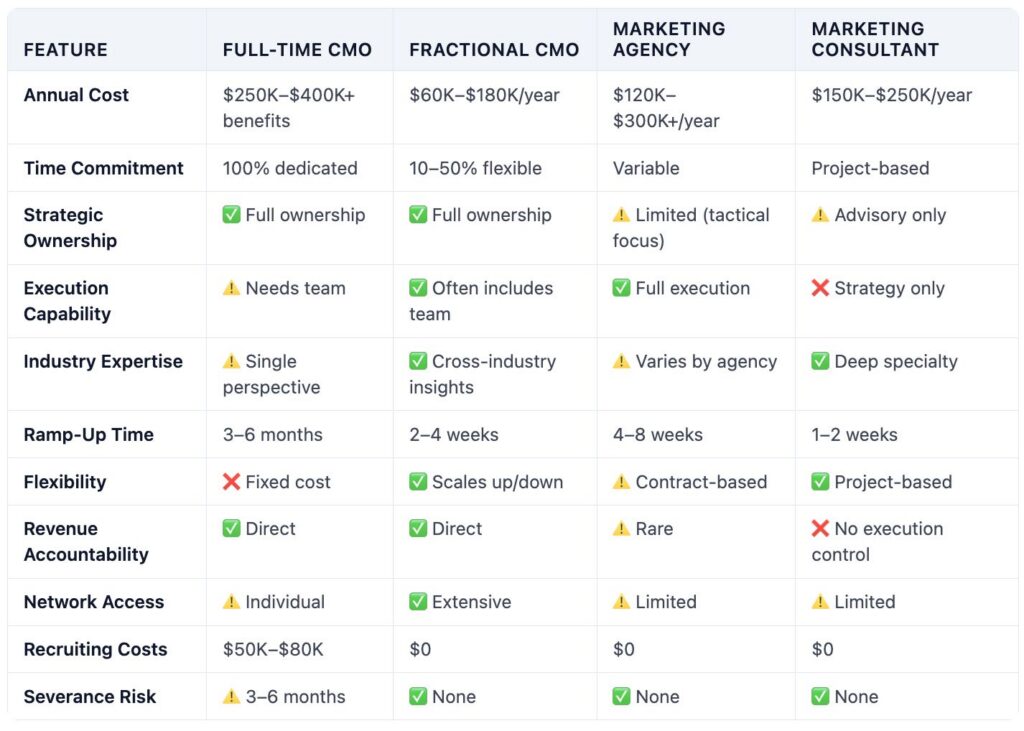
The bottom line: A fractional CMO delivers 70–80% of the value of a full-time CMO at 30–40% of the cost, with zero recruiting fees, no benefits overhead, and the flexibility to scale your investment as your business grows.
Types of Fractional Marketing Executives: Specialized Roles
Not all fractional CMOs offer the same expertise. Depending on your business needs, you might hire one of these specialized fractional marketing leaders:
Fractional Chief Marketing Officer (CMO)
The generalist strategist who owns your entire marketing function. Best for companies that need comprehensive marketing leadership across all channels, from brand to demand generation to customer retention.
Ideal for: Mid-market B2B companies, funded startups post-Series A, businesses scaling from $10M to $50M+ in revenue.
Fractional Chief Digital Officer (CDO)
Specializes in digital transformation, marketing technology integration, and data-driven growth strategies. Focuses on marketing automation, CRM optimization, analytics infrastructure, and AI/ML implementation.
Ideal for: Traditional businesses undergoing digital transformation, companies with legacy systems needing modernization, organizations struggling with martech stack complexity.
Fractional Marketing Director
A tier below CMO-level but still senior. Focuses on specific functions like demand generation, product marketing, or growth marketing. Often works under a full-time CMO or CEO to lead a particular initiative.
Ideal for: Companies with a CMO who needs specialized support, businesses tackling a specific marketing challenge (e.g., launching a new product line, building ABM capabilities).
Fractional Brand Strategist
Specializes in brand positioning, messaging architecture, creative direction, and brand revitalization. Less focused on performance marketing, more on long-term brand equity and market differentiation.
Ideal for: Consumer brands, companies undergoing rebranding, businesses in commoditized markets needing differentiation, organizations with weak brand perception.
What Does a Fractional CMO Actually Do? Core Services & Deliverables
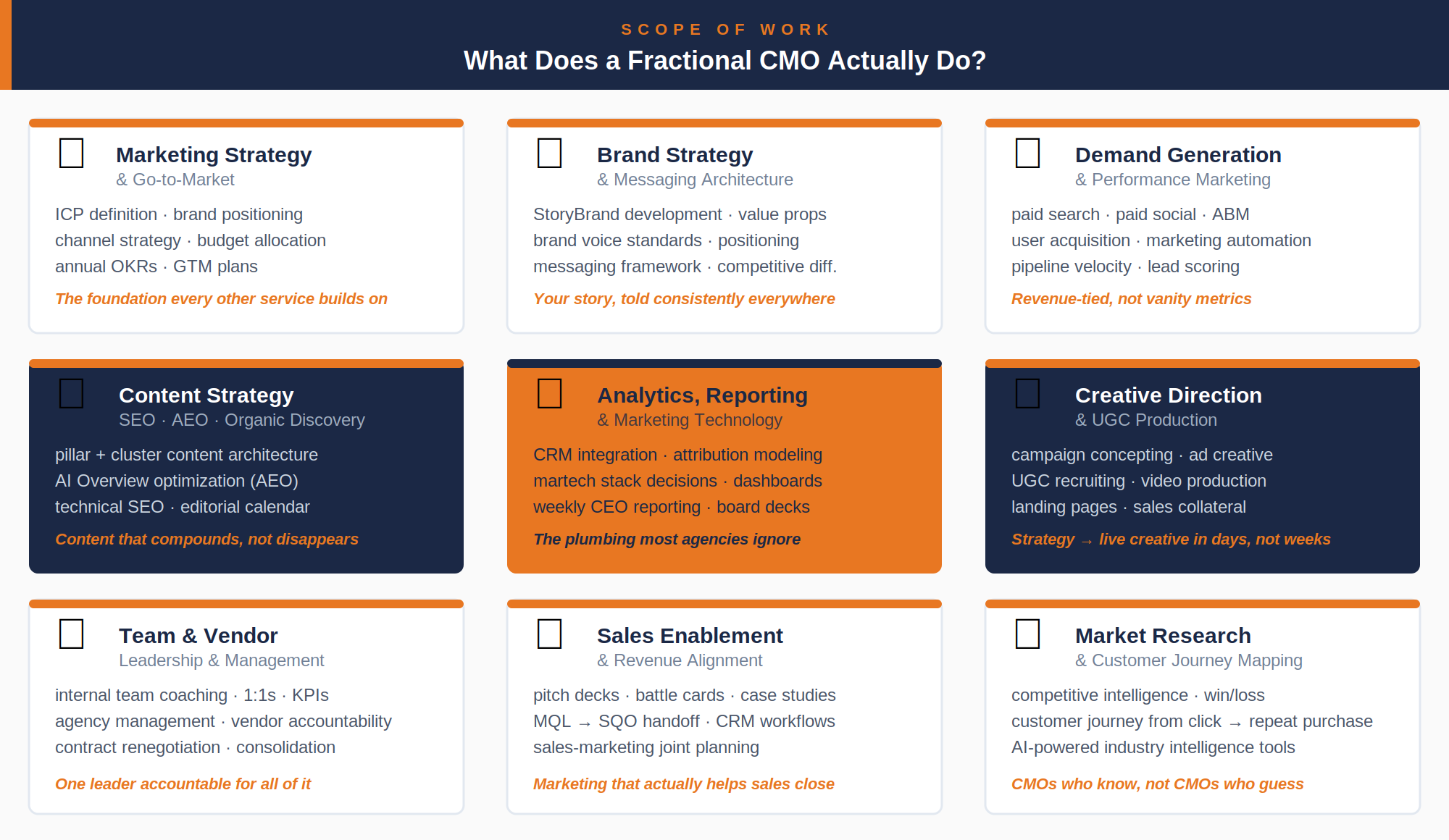
A fractional chief marketing officer provides both strategic oversight and hands-on execution support across 7 core areas. Here’s what that looks like in practice:
1. Marketing Strategy & Planning
Your fractional CMO builds the roadmap that turns marketing from a cost center into a revenue engine.
Strategic deliverables:
- Comprehensive marketing strategy aligned to revenue targets and business goals
- Go-to-market (GTM) plans for new products, markets, or customer segments
- Competitive analysis and market positioning frameworks
- Customer segmentation and ideal customer profile (ICP) definition
- Marketing budget allocation and channel mix recommendations
- 30-60-90 day execution roadmaps with clear milestones and KPIs
Tactical execution:
- They don’t just hand you a strategy deck and disappear. They own the implementation, manage the execution team, and adjust the plan based on real performance data.
Outcome: You get strategic clarity on where to invest, what messages resonate, and which channels drive the highest ROI—backed by an executive who owns the results.
2. Branding & Storytelling
Your brand is how customers perceive you. Your fractional CMO ensures that perception aligns with your value proposition and drives affinity.
Strategic deliverables:
- Brand positioning and messaging architecture
- Value proposition development and differentiation strategy
- Brand voice, tone, and personality guidelines
- Narrative frameworks using story branding principles
- Visual identity direction and creative standards
Tactical execution:
- Creative campaign development across digital and offline channels
- Brand audit and competitive brand analysis
- Customer perception research and brand health tracking
- Oversight of brand consistency across all touchpoints
Outcome: A cohesive brand identity that builds trust, stands out in your market, and creates emotional connections that drive customer loyalty.
3. Content Strategy & Creation
Content fuels every stage of your buyer journey—from awareness to consideration to decision. Your fractional CMO builds the engine that produces it consistently and strategically.
Strategic deliverables:
- Content strategy mapped to customer journey stages
- Editorial calendar and topic clusters aligned to SEO and demand generation goals
- Content distribution strategy across owned, earned, and paid channels
- Messaging frameworks for sales enablement and customer success teams
Tactical execution:
- Blog posts, whitepapers, case studies, and long-form pillar content
- Email marketing campaigns and nurture sequences
- Social media content optimized for platform-specific engagement
- Video scripts, podcast outlines, and multimedia content strategies
- Website copy, landing pages, and conversion-focused messaging
Outcome: A steady stream of high-quality content that educates prospects, nurtures leads, supports sales conversations, and drives organic search visibility.
4. Creative Direction & Design
Marketing without strong creative execution falls flat. Your fractional chief marketing officer ensures every visual element reinforces your brand and drives action.
Strategic deliverables:
- Creative briefs and campaign concepts
- Design systems and brand visual standards
- User experience (UX) recommendations for web and mobile
- Creative testing frameworks to optimize performance
Tactical execution:
- Oversight of graphic design for digital ads, email, social media, and print
- Website design direction and conversion rate optimization (CRO)
- Video and motion graphics creative direction
- Direct mail, event materials, and offline marketing collateral
Outcome: Cohesive, on-brand creative that captures attention, communicates your value clearly, and converts prospects into customers.
5. Paid Media & Performance Marketing
Your fractional CMO doesn’t just spend your ad budget—they optimize it for maximum return on ad spend (ROAS) and cost per acquisition (CPA).
Strategic deliverables:
- Paid media strategy across Google Ads, Meta, LinkedIn, and programmatic platforms
- Audience segmentation and targeting strategy
- Funnel mapping and customer acquisition modeling
- Retargeting and remarketing campaign architecture
- Demand generation and user acquisition roadmaps
Tactical execution:
- Campaign setup, creative development, and audience targeting
- A/B testing of ad creative, copy, landing pages, and offers
- Bid strategy optimization and budget pacing
- Conversion tracking implementation and attribution modeling
- Performance reporting and ROI analysis
Outcome: Lower cost per lead, higher conversion rates, and clear visibility into which campaigns drive revenue—not just clicks and impressions.
6. Marketing Technology & Automation
The average company uses 120+ marketing tools. Your fractional CMO ensures your martech stack actually works together and drives efficiency.
Strategic deliverables:
- Marketing technology stack audit and optimization recommendations
- CRM and marketing automation platform selection (HubSpot, Salesforce, Marketo, etc.)
- Lead scoring models and lifecycle stage definitions
- Marketing and sales alignment frameworks
Tactical execution:
- Marketing automation workflow setup and optimization
- Email nurture campaign development and deployment
- Integration of tools for seamless data flow (CRM ↔ ads ↔ analytics)
- AI and machine learning tool implementation for predictive analytics and personalization
- Reporting dashboard creation in Google Analytics, Looker, or similar platforms
Outcome: A streamlined, integrated marketing technology ecosystem that automates repetitive tasks, improves lead quality, and provides real-time performance visibility.
7. Analytics, Reporting & Data-Driven Decision Making
Marketing without measurement is guesswork. Your fractional CMO builds the infrastructure to track what matters and optimizes based on data, not opinions.
Strategic deliverables:
- Marketing KPI framework aligned to business objectives
- Attribution modeling to understand true ROI by channel
- Forecasting models to predict pipeline and revenue contribution
- Dashboards and reporting cadence for leadership visibility
Tactical execution:
- Google Analytics, Google Tag Manager, and conversion tracking setup
- Regular performance reporting (weekly, monthly, quarterly)
- Campaign post-mortems and optimization recommendations
- A/B testing roadmaps and experimentation frameworks
- Customer journey analysis and funnel optimization
Outcome: Complete transparency into marketing’s contribution to revenue, enabling smarter budget allocation and continuous performance improvement.
8. Team Leadership & Development
Whether you have an internal marketing team or work with external agencies, your fractional CMO provides the leadership and coordination they need to succeed.
Strategic deliverables:
- Marketing team structure and role definition
- Hiring recommendations and interview support
- Professional development plans and skill gap assessments
- Cross-functional collaboration frameworks (marketing + sales + product)
Tactical execution:
- Weekly team meetings, 1-on-1s, and performance management
- Vendor and agency management—negotiating contracts, managing deliverables, ensuring accountability
- Training and mentorship for junior team members
- Sales enablement and alignment initiatives
- Succession planning and knowledge transfer documentation
Outcome: A high-performing marketing team (internal and external) that executes flawlessly, communicates clearly, and continuously improves.
9. Sales Enablement & Alignment
Marketing doesn’t end when a lead enters the funnel. Your fractional CMO ensures marketing and sales work together seamlessly to close deals.
Strategic deliverables:
- Lead handoff criteria and service-level agreements (SLAs)
- Sales content library and battlecards
- Competitive intelligence briefs
- Joint revenue targets and shared KPIs
Tactical execution:
- Case studies, pitch decks, demo scripts, and objection handling guides
- CRM lead scoring and routing automation
- Regular sales and marketing alignment meetings
- Win/loss analysis to inform messaging and positioning
Outcome: Shorter sales cycles, higher win rates, and stronger collaboration between marketing and sales teams.
When Should You Hire a Fractional CMO? 6 Clear Scenarios
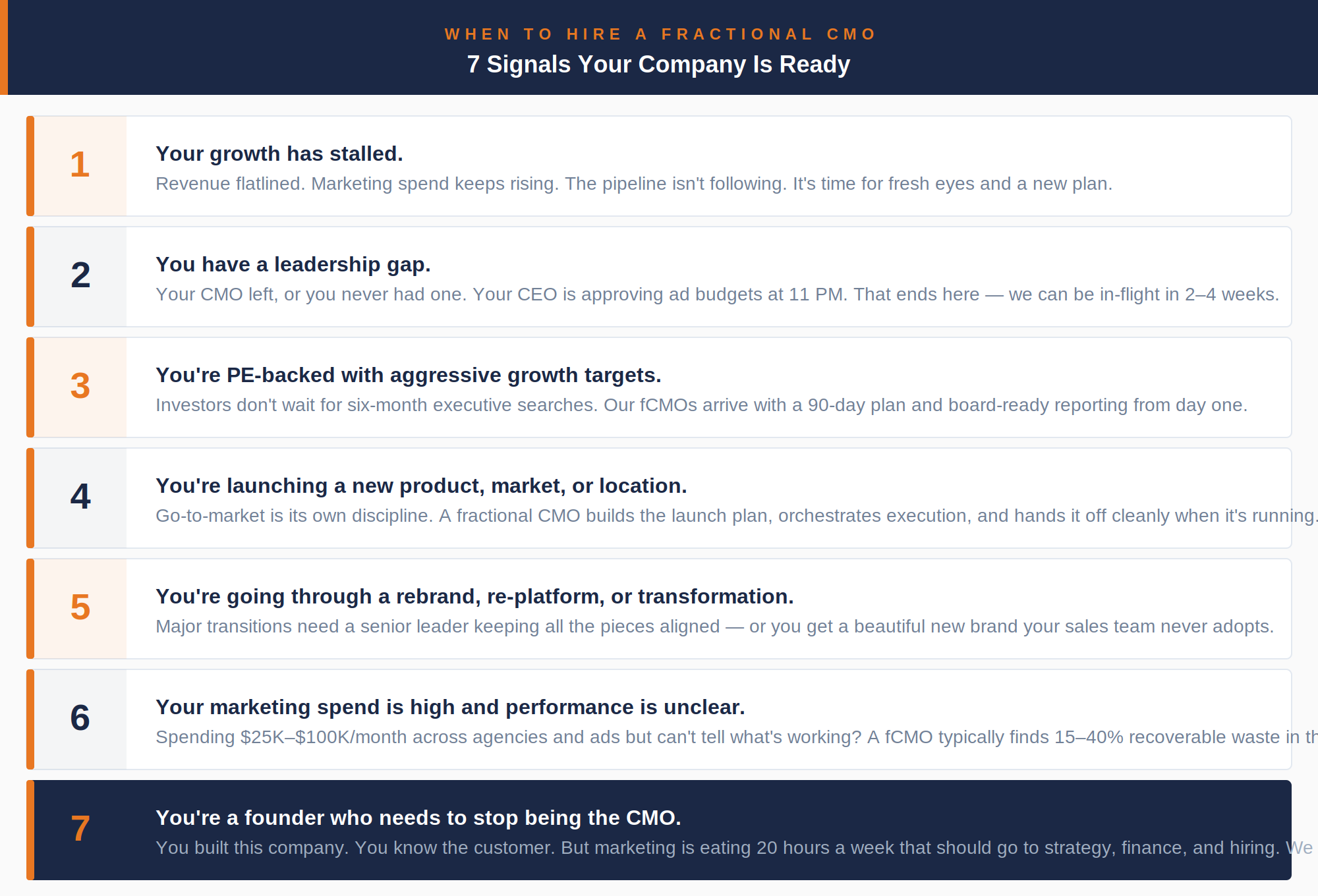
Not every business needs a fractional chief marketing officer—but if your company matches one of these profiles, the ROI is typically immediate.
1. You’re Scaling Fast But Lack Marketing Leadership
The situation: Your business is growing 30–50%+ year-over-year, but your marketing function is either non-existent or led by someone without executive-level experience. You’re hiring salespeople but struggling to generate enough qualified pipeline to support them.
Why a fractional CMO helps: They build your marketing infrastructure from scratch—defining strategy, hiring the right team, selecting tools, and establishing processes that scale. You get the strategic leadership to match your sales ambition without the 6-month recruiting timeline.
Expected outcome: A marketing function that consistently delivers qualified leads, supports sales with content and enablement, and contributes measurably to revenue growth.
2. Your Marketing Has Hit a Growth Plateau
The situation: You’ve been running the same playbook for 2–3 years. It used to work, but lead volume is flat or declining. Your cost per lead is rising. Your team is busy but not driving results.
Why a fractional CMO helps: Fresh perspective from someone who’s solved this exact problem across multiple companies. They audit what’s working, kill what’s not, and introduce new channels, tactics, and strategies based on what’s working now—not what worked three years ago.
Expected outcome: Renewed growth momentum, improved efficiency, and a roadmap that takes you to your next revenue milestone.
3. You’re Launching a New Product, Market, or Business Line
The situation: You’re entering a new market segment, launching a major product, or expanding into adjacent industries. Your current marketing team lacks the experience to execute a go-to-market (GTM) strategy at this level of complexity.
Why a fractional CMO helps: GTM launches require precise positioning, messaging, channel selection, and execution. A fractional chief marketing officer brings a repeatable framework they’ve used successfully across previous launches—dramatically reducing risk and time to market.
Expected outcome: A successful product or market launch with clear ROI, competitive differentiation, and momentum that carries through year one.
4. Your Full-Time CMO Just Left (Or You Can’t Hire One Yet)
The situation: Your CMO departed, and you’re facing a 4–6 month recruiting process. Or you need CMO-level leadership but can’t justify the $250K+ salary yet.
Why a fractional CMO helps: They step in immediately—no recruiting fees, no onboarding delays, no learning curve. They stabilize your marketing operations, retain team morale, and keep campaigns running while you decide on a permanent hire (or make the fractional role permanent).
Expected outcome: Zero disruption to marketing performance, maintained team productivity, and strategic continuity during a leadership transition.
5. You Have a Marketing Team But No Strategic Direction
The situation: You’ve hired marketers—maybe a content writer, a paid media specialist, a social media manager—but they operate tactically without a cohesive strategy. Campaigns don’t align. Messaging is inconsistent. ROI is unclear.
Why a fractional CMO helps: They become the conductor of your marketing orchestra. They set the strategy, align every team member to shared goals, establish processes and accountability, and ensure every tactic supports your business objectives.
Expected outcome: A coordinated, high-performing marketing team executing against a clear strategy with measurable results.
6. You’re in a Regulated or Complex Industry
The situation: You operate in financial services, healthcare, manufacturing, or another vertical with strict compliance requirements, long sales cycles, or technical complexity. Generic marketing agencies don’t understand your buyer or the regulatory landscape.
Why a fractional CMO helps: The best fractional CMOs specialize in specific industries. They’ve navigated your exact compliance challenges, understand your buyer’s technical language, and know which channels work in your vertical. You don’t pay for their learning curve.
Expected outcome: Marketing that resonates with sophisticated buyers, complies with industry regulations, and drives pipeline in markets where generic tactics fail.
Fractional CMO Pricing: How Much Does It Cost in 2025?
One of the biggest advantages of hiring a fractional chief marketing officer is cost predictability. Here’s exactly what you can expect to pay—and how it compares to your alternatives.
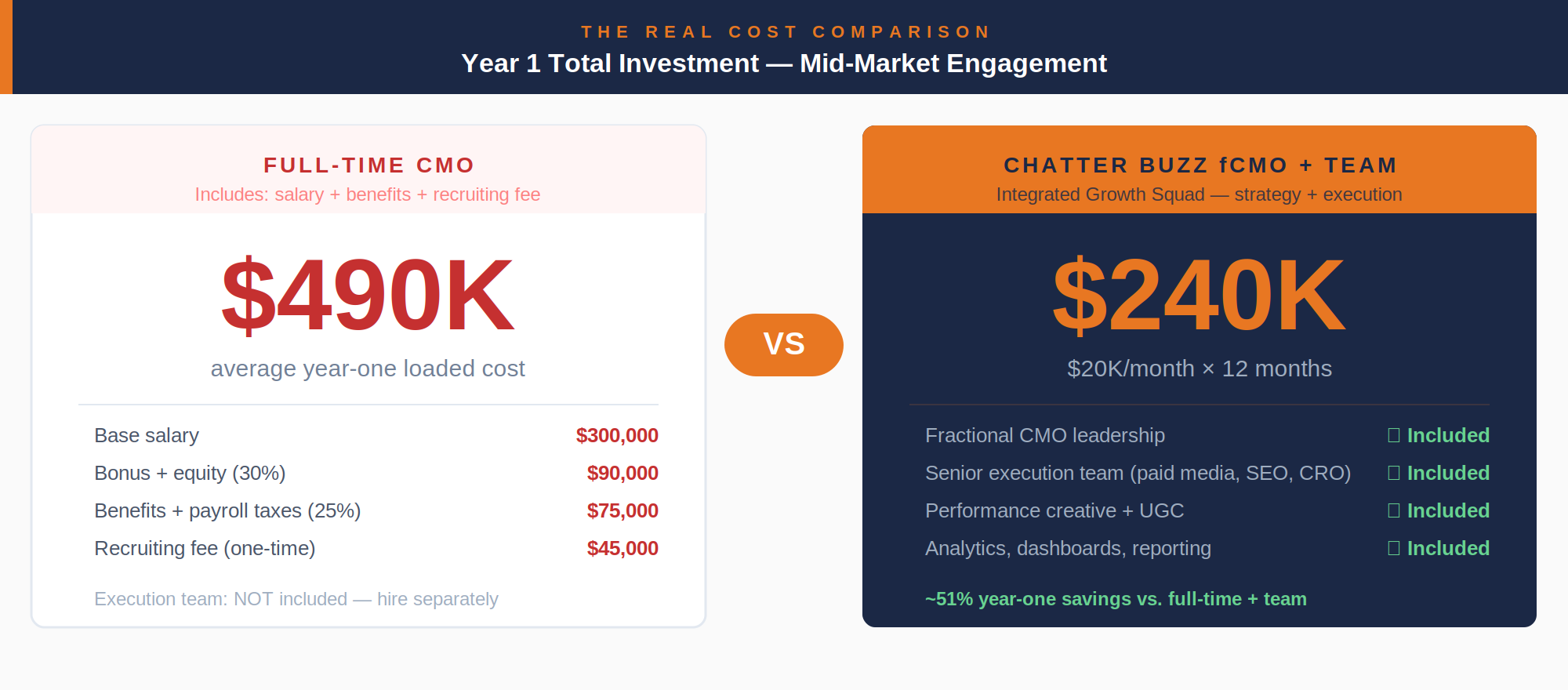
Typical Fractional CMO Pricing Models
Most fractional CMOs charge based on time commitment rather than hourly rates. Here are the four most common engagement models:
1. One-Time Audit & Strategy (10–20 Hours)
Time commitment: 10–20 hours over 2–4 weeks
Typical cost: $5,000–$15,000
What you get:
- Comprehensive marketing audit (current state analysis)
- Competitive and market research
- Strategic recommendations and prioritized action plan
- 30-60-90 day roadmap for implementation
Best for: Companies that need strategic direction but will execute internally or through existing partners.
2. Part-Time Ongoing (1/8 to 1/4 Time)
Time commitment: 5–10 hours per week
Typical cost: $5,000–$10,000/month ($60K–$120K/year)
What you get:
- Monthly strategy sessions and planning
- Campaign oversight and performance review
- Team mentorship and guidance
- Vendor and agency management
- Quarterly strategic planning
Best for: Smaller businesses ($5M–$20M revenue) or companies with an existing marketing team that needs executive-level direction.
3. Half-Time Engagement (1/2 Time)
Time commitment: 20 hours per week
Typical cost: $10,000–$15,000/month ($120K–$180K/year)
What you get:
- Everything in part-time model PLUS:
- Hands-on campaign execution and optimization
- Direct management of marketing team and agencies
- Weekly leadership team participation
- Active involvement in hiring, budgeting, and planning
Best for: Mid-market companies ($20M–$100M revenue) undergoing significant growth or transformation, or those launching major initiatives.
4. Near Full-Time (3/4 Time or More)
Time commitment: 30+ hours per week
Typical cost: $15,000–$25,000/month ($180K–$300K/year)
What you get:
- Full CMO leadership equivalent
- Day-to-day marketing operations ownership
- Complete team and vendor management
- Strategic planning and hands-on execution
- C-suite integration and board-level reporting
Best for: Companies needing full CMO capabilities but wanting flexibility, faster onboarding, or specialized expertise not available in local market.
The Real Cost Comparison: Fractional vs. Full-Time vs. Agency
Let’s break down the total annual investment for each option:
Full-Time CMO:
- Base salary: $200,000–$400,000
- Benefits (health, 401k, etc.): $40,000–$80,000
- Bonuses/equity: $30,000–$100,000
- Recruiting fees: $50,000–$80,000 (one-time)
- Severance risk: 3–6 months salary
- Total Year 1 Cost: $320,000–$660,000
Fractional CMO (Half-Time):
- Monthly retainer: $10,000–$15,000
- Benefits: $0
- Recruiting fees: $0
- Severance risk: $0
- Total Annual Cost: $120,000–$180,000
- Savings vs. Full-Time: 60–75%
Marketing Agency (Retainer):
- Monthly retainer: $10,000–$25,000+
- Strategy often extra or limited
- Execution-focused (not leadership)
- Total Annual Cost: $120,000–$300,000+
- Key difference: Tactical execution without strategic ownership
Hidden Costs You Avoid with a Fractional CMO
Beyond the direct salary savings, fractional CMOs eliminate several hidden costs:
- Recruiting fees: 20–30% of first-year salary ($50K–$80K)
- Onboarding time: 3–6 months for a full-time CMO to ramp up vs. 2–4 weeks for fractional
- Bad hire risk: If your full-time CMO doesn’t work out, you’re looking at 6–12 months of lost productivity and severance costs
- Benefits administration: Health insurance, 401(k) matching, PTO, etc.
- Office and equipment: Desk, computer, software licenses, phone
Bottom line: A half-time fractional CMO delivers 70–80% of the output of a full-time CMO at 30–40% of the total cost—with zero recruiting risk and the flexibility to scale up or down as your business evolves.
How Fractional CMO Engagements Actually Work: The Process
Wondering what working with a fractional chief marketing officer looks like day-to-day? Here’s the typical engagement arc from kickoff to ongoing optimization.

Phase 1: Discovery & Audit (Weeks 1–2)
What happens:
- Stakeholder interviews (CEO, sales leaders, product team, existing marketers)
- Marketing audit: current campaigns, tech stack, content, brand assets, data infrastructure
- Competitive analysis and market research
- Customer interviews or surveys (if applicable)
- Performance baseline establishment (current traffic, leads, pipeline, CAC, LTV)
Deliverable: Comprehensive audit report with prioritized recommendations and strategic roadmap.
Your involvement: 3–5 hours of interviews and data access.
Phase 2: Strategy Development & Planning (Weeks 3–4)
What happens:
- Marketing strategy creation: positioning, messaging, target audiences, channel mix
- Go-to-market plans for key initiatives
- Budget allocation recommendations
- Team structure and hiring plans (if needed)
- Marketing technology stack assessment and recommendations
- KPI framework and reporting infrastructure setup
Deliverable: 30-60-90 day execution plan, budget proposal, and success metrics.
Your involvement: 2–3 strategy sessions to align on priorities and get buy-in.
Phase 3: Team Alignment & Setup (Weeks 5–6)
What happens:
- Marketing team onboarding and role clarity
- Agency and vendor selection/onboarding (if needed)
- Marketing technology implementation or optimization
- Process documentation and workflow establishment
- Campaign calendar and content planning
- Sales and marketing alignment (SLAs, lead definitions, handoff processes)
Deliverable: Fully operational marketing function ready to execute.
Your involvement: Introductions to existing team/vendors, budget approvals, technology access.
Phase 4: Execution & Campaign Launch (Weeks 7–12)
What happens:
- Campaign launches across prioritized channels (paid media, SEO, content, email, social)
- Creative development and approval cycles
- Landing page and website optimization
- Marketing automation workflow deployment
- Sales enablement content creation
- Weekly performance monitoring and optimization
Deliverable: Live campaigns generating measurable results.
Your involvement: Weekly 30-minute check-ins, creative approvals, leadership team updates.
Phase 5: Optimization & Scaling (Month 4+)
What happens:
- Performance analysis and data-driven optimization
- A/B testing of messaging, creative, offers, and landing pages
- Channel expansion based on what’s working
- Budget reallocation to high-performing initiatives
- Team skill development and training
- Quarterly strategic planning and goal setting
Deliverable: Continuous improvement in CAC, conversion rates, pipeline contribution, and revenue attribution.
Your involvement: Monthly strategic reviews, quarterly planning sessions, ongoing alignment.
Communication Cadence
Expect your fractional CMO to maintain this rhythm:
- Weekly: 30-minute performance check-in and priorities alignment
- Bi-weekly: 60-minute team meetings (if you have internal marketers or agencies)
- Monthly: Detailed performance report and leadership presentation
- Quarterly: Strategic planning session and roadmap updates
- Ad hoc: Slack/email availability for urgent questions (most fractional CMOs provide same-day response)
Ensuring Continuity: Succession Planning & Knowledge Transfer
One concern companies often have: “What happens if our fractional CMO leaves? Won’t we lose all that strategic knowledge?”
Top fractional chief marketing officers build with your long-term success in mind—not dependency. Here’s how they ensure continuity and set you up to succeed even after the engagement ends.
Documentation as a Core Deliverable
From day one, your fractional CMO should be documenting:
- Marketing strategy documents: Positioning, messaging frameworks, target personas, competitive analysis
- Process documentation: Campaign workflows, approval processes, reporting procedures
- Playbooks: Channel-specific playbooks (SEO, paid media, content, email) that your team can replicate
- Performance baselines and benchmarks: Historical data showing what success looks like
- Vendor and tool documentation: Logins, contracts, relationships, and best practices for every tool in your stack
Why this matters: If your fractional CMO transitions out, your next marketing leader inherits a complete blueprint—not a black box.
Team Development & Internal Capability Building
Fractional CMOs should actively develop your internal team’s skills, not hoard knowledge:
- Training junior marketers on strategy, analytics, and campaign management
- Creating career development plans that reduce external dependency
- Running workshops on key marketing competencies
- Introducing frameworks and tools that empower your team to self-manage
Goal: By month 6–12, your internal team should be able to execute most day-to-day activities independently, with the fractional CMO providing strategic oversight rather than hands-on execution.
Transition Planning When the Engagement Ends
If you decide to hire a full-time CMO or transition the fractional relationship, expect a structured handoff:
- Transition period: 30–60 days of overlap where your fractional CMO onboards the new hire
- Knowledge transfer sessions: Dedicated meetings to walk through strategy, campaigns, team dynamics, and vendor relationships
- Documentation handoff: Complete transfer of all strategy documents, playbooks, and performance data
- Post-transition support: Many fractional CMOs offer 30–90 days of on-call support after the formal engagement ends
Bottom line: A professional fractional CMO treats your success as their success—even after they’re gone. If they’re building dependency rather than capability, they’re not doing their job right.
How to Hire a Fractional CMO: 6-Step Selection Process
Hiring the wrong fractional CMO wastes time and budget. Here’s exactly how to find the right fit.
Step 1: Define Your Objectives and Success Metrics
Before you start interviewing candidates, get crystal clear on what success looks like.
Ask yourself:
- What specific business problem are we trying to solve? (e.g., “We need to generate 50 qualified leads/month” vs. vague “improve marketing”)
- What are our revenue and growth targets for the next 12 months?
- What marketing capabilities are we missing? (Strategy? Execution? Leadership? Specialized expertise?)
- How will we measure success? (Pipeline generated? Cost per lead? Revenue attributed to marketing?)
Why this matters: Fractional CMOs specialize. Some excel at brand building, others at performance marketing, others at team development. Clarity on your goals helps you find the right specialist.
Step 2: Prioritize Industry Experience and Proven Results
Generic marketing experience isn’t enough—especially in complex or regulated industries.
Look for:
- Direct experience in your industry: Healthcare, financial services, manufacturing, SaaS, etc.
- Case studies and references from similar businesses: If you’re a $20M B2B company, references from $50M+ enterprise clients aren’t as relevant
- Specific metrics: Don’t accept “grew pipeline.” Ask “Grew pipeline by X% in Y months, contributing $Z in closed revenue.”
- Regulatory knowledge: If you’re in healthcare or financial services, ensure they understand HIPAA, FINRA, or other compliance requirements
Red flag: CMOs who claim they can “market anything” often lack the depth needed in specialized industries.
Step 3: Assess Strategic Thinking, Not Just Tactical Execution
Any marketer can run Facebook ads. A fractional CMO should think at the executive level.
During interviews, ask:
- “Walk me through how you’d approach our first 90 days.”
- “What’s a marketing strategy you developed that directly contributed to revenue growth?”
- “How do you balance brand building with performance marketing?”
- “How do you align marketing and sales around shared revenue goals?”
- “Tell me about a campaign that failed and what you learned.”
What you’re listening for:
- Strategic frameworks, not just tactics
- Data-driven decision-making
- Understanding of the full customer journey, not just top-of-funnel
- Clear connection between marketing activities and business outcomes
Step 4: Evaluate Communication and Cultural Fit
Your fractional CMO will work directly with your CEO, sales leaders, and board. They need to communicate clearly and fit your culture.
Green flags:
- Asks thoughtful questions about your business, customers, and challenges
- Explains complex marketing concepts in simple, business-focused language
- Demonstrates curiosity about your industry and competitors
- Shows enthusiasm for your mission and product
- Proposes a clear plan with realistic timelines and expectations
Red flags:
- Uses jargon without explaining it (“We’ll leverage omnichannel synergy…”)
- Oversells or makes unrealistic promises (“I’ll triple your leads in 30 days”)
- Doesn’t ask about your budget, timeline, or constraints
- Seems more focused on their credentials than your needs
Step 5: Verify Their Network and Resources
One advantage of fractional CMOs is their network—they bring vetted agencies, freelancers, and tools they’ve used successfully.
Ask:
- “What agencies, freelancers, or contractors do you typically work with?”
- “What marketing tools and platforms do you recommend for a business like ours?”
- “Can you introduce us to [specific specialist] if we need that capability?”
- “How do you handle situations where you need expertise outside your core competency?”
Why this matters: A well-connected fractional CMO can quickly assemble a full marketing team (content writers, designers, paid media specialists) without you managing individual contractors.
Step 6: Start with a Pilot Engagement
Don’t commit to a 12-month contract on day one. Start with a defined project to test the relationship.
Recommended pilot structures:
- Strategy sprint: 20 hours over 3–4 weeks to deliver a comprehensive audit and 90-day roadmap ($5K–$15K)
- 90-day trial: Part-time engagement (1/8 to 1/4 time) focused on a specific initiative ($15K–$30K)
- Single campaign: Launch one high-priority campaign (e.g., demand gen campaign, website redesign) and measure results
Why this works: You get to evaluate their strategic thinking, communication, and execution quality before committing to a long-term partnership. If it’s a great fit, extend. If not, you’ve minimized risk.
Risk Mitigation: What to Watch Out For When Hiring a Fractional CMO
Not all fractional CMOs deliver. Here’s how to avoid common pitfalls.
Red Flag #1: No Clear Deliverables or Success Metrics
The problem: Some fractional CMOs position themselves as “advisors” without concrete accountability. You end up with strategy documents that sit on a shelf and no measurable improvement.
How to avoid it: Before signing, require a clear statement of work (SOW) that includes:
- Specific deliverables with timelines
- Performance metrics tied to business outcomes (leads, pipeline, revenue)
- Reporting cadence and dashboard access
- Time commitment and availability expectations
Red Flag #2: Overpromising Results
The problem: Any marketer who guarantees “triple your leads in 30 days” or promises specific ROI without understanding your business is either inexperienced or dishonest.
How to avoid it: Look for realistic timelines and honest assessments:
- “We should see initial traction in 60–90 days, meaningful pipeline contribution by month 6.”
- “Based on your current baseline and budget, here’s what’s achievable in year one.”
Red Flag #3: One-Size-Fits-All Approach
The problem: Fractional CMOs who use the same playbook for every client—regardless of industry, business model, or target audience—deliver generic results.
How to avoid it: During the interview process, ask:
- “How would you approach marketing our business differently than your last client?”
- “What specific industry trends or competitive dynamics would influence your strategy for us?”
If their answer is vague or they pivot back to generic tactics, walk away.
Red Flag #4: Lack of Transparency on Time Allocation
The problem: Some fractional CMOs overcommit—juggling 8–10 clients simultaneously and giving each only a few hours per month. You end up paying for strategic advice you could get from an agency.
How to avoid it: Ask directly:
- “How many clients do you currently work with?”
- “What’s your maximum client capacity?”
- “How will you ensure we get the hours we’re paying for?”
- “Can we set a regular weekly meeting time that works for both of us?”
Ideal answer: 3–5 active clients maximum (depending on engagement size). Clear availability and communication norms.
Red Flag #5: No Post-Engagement Plan
The problem: Some fractional CMOs build dependency—keeping all strategic knowledge in their heads so you can’t function without them.
How to avoid it: Ask upfront:
- “How do you document your work and ensure knowledge transfer?”
- “What happens if we decide to transition to a full-time CMO in 12 months?”
- “Do you provide training and skill development for our internal team?”
Green flag: A CMO who actively builds your team’s capabilities and documents everything—they’re invested in your long-term success, not their job security.
Fractional CMO Success Stories: Real Results from Real Businesses
Here’s what fractional CMO leadership looks like in action:
Case Study 1: B2B SaaS Company ($15M ARR)
Challenge: Growing sales team but stagnant inbound pipeline. Marketing was tactical (random blog posts, sporadic social media) without strategy. No attribution or reporting infrastructure.
What the fractional CMO did:
- Implemented HubSpot and built lead scoring model
- Created content strategy mapped to buyer journey stages
- Launched targeted LinkedIn and Google Ads campaigns
- Established closed-loop reporting connecting marketing to revenue
Results in 6 months:
- Inbound leads increased 180% (from 45/month to 126/month)
- Marketing-sourced pipeline grew from 15% to 42% of total pipeline
- Cost per lead decreased 34%
- Sales cycle shortened by 18 days due to better-qualified leads
Cost: $12K/month fractional CMO vs. estimated $280K+ for full-time CMO with benefits
Case Study 2: Healthcare Services Provider ($8M Revenue)
Challenge: Zero brand awareness in local market. Relied 100% on physician referrals, which plateaued. Needed to build direct-to-consumer patient acquisition.
What the fractional CMO did:
- Developed patient-focused brand messaging and positioning
- Built HIPAA-compliant website with online booking
- Launched local SEO and Google Ads campaigns targeting specific procedures
- Created educational content and video testimonials
- Implemented CRM to track patient journey from inquiry to booking
Results in 9 months:
- Website traffic increased 425% (mostly local, high-intent searches)
- Online appointment requests grew from 0 to 47/month
- Patient acquisition cost 60% lower than physician referral channel
- Revenue from direct-to-consumer channel reached $1.2M (15% of total revenue)
Cost: $8K/month fractional CMO + $4K/month execution budget vs. $250K+ full-time hire
Case Study 3: Manufacturing Company ($40M Revenue)
Challenge: Outdated brand perception, weak digital presence, ineffective trade show strategy. New leadership wanted to modernize marketing and drive qualified B2B leads.
What the fractional CMO did:
- Rebranded company with modern positioning focused on innovation and service
- Rebuilt website with technical SEO, case studies, and clear CTAs
- Shifted budget from trade shows to account-based marketing (ABM)
- Launched targeted LinkedIn campaigns and industry-specific content
- Integrated Salesforce with marketing automation for lead tracking
Results in 12 months:
- Website leads increased 290% year-over-year
- Sales accepted 68% more leads from marketing (vs. 22% previous year)
- ABM campaigns generated 34 opportunities worth $8.3M in pipeline
- Trade show budget cut 40%, redirected to digital with 3x ROI
Cost: $15K/month fractional CMO vs. $300K+ for experienced full-time manufacturing marketing executive
Common thread: In each case, the fractional CMO delivered measurable business outcomes (pipeline, revenue, cost reduction) that directly contributed to growth—at a fraction of the cost of hiring full-time.
Frequently Asked Questions About Fractional CMOs
What’s the difference between a fractional CMO and a marketing consultant?
Fractional CMOs embed into your business as part of your leadership team. They take ownership of strategy and oversee execution, manage your marketing team or agencies, and are accountable for results—not just recommendations.
Marketing consultants typically provide strategic advice, deliver a plan, and leave. They don’t manage your team, execute campaigns, or stick around to ensure the strategy actually works.
Analogy: A consultant diagnoses the problem and prescribes the cure. A fractional CMO actually administers the treatment and monitors your recovery.
Can a fractional CMO work with my existing marketing team or agency?
Absolutely—and this is often the ideal setup.
Your fractional CMO provides the strategic leadership and direction your team or agency needs. They:
- Set priorities and align everyone to shared goals
- Manage vendor relationships and hold agencies accountable
- Bridge the gap between strategy and execution
- Train and develop your internal marketers
- Ensure cross-functional alignment (marketing + sales + product)
Think of it this way: Your agency or team members are the hands executing the work. Your fractional CMO is the brain directing those hands toward the highest-impact activities.
How quickly can a fractional CMO start delivering results?
Initial insights and strategy: 2–4 weeks (after discovery and audit)
First campaign launches: 4–8 weeks
Measurable traction: 60–90 days (depending on sales cycle length)
Significant business impact: 6–12 months
Why it’s faster than full-time: Fractional CMOs don’t need 3–6 months to “learn the ropes.” They’ve done this dozens of times. They know exactly what to audit, which questions to ask, and which levers to pull first.
Do fractional CMOs only work remotely?
Most fractional CMOs work remotely, but many also offer on-site visits for:
- Quarterly strategic planning sessions
- Team workshops and training
- Key campaign launches
- Leadership meetings and board presentations
Typical cadence: 80–90% remote (weekly video calls, Slack/email communication) + 10–20% on-site (monthly or quarterly depending on geography and engagement size).
If your business requires significant on-site presence, discuss this upfront—some fractional CMOs specialize in local/regional markets and can accommodate more frequent in-person time.
What if our fractional CMO doesn’t work out?
Most fractional CMO engagements include flexible exit terms—typically 30 days’ notice from either party.
Best practice: Start with a 90-day pilot project or include a 30–60 day “trial period” in your contract. This gives both sides a low-risk way to evaluate fit before committing to a longer-term engagement.
If it’s not working: A professional fractional CMO will recognize the mismatch early and help you transition smoothly—often referring you to a colleague whose expertise better matches your needs.
Can a fractional CMO help us hire a full-time CMO eventually?
Yes—and many do. If your goal is to eventually bring marketing leadership in-house, a fractional CMO can:
- Define the role clearly: Write the job description, identify must-have vs. nice-to-have skills, and set realistic salary expectations
- Participate in the hiring process: Screen candidates, conduct interviews, and provide objective assessments
- Onboard the new hire: Transition all strategy documents, introduce them to the team and vendors, and provide mentorship during their first 60–90 days
Why fractional CMOs often do this willingly: Their goal is your long-term success, not job preservation. Many view transitioning you to a full-time CMO as a successful engagement outcome.
Do fractional CMOs provide marketing execution or just strategy?
It depends on the engagement model:
- Strategy-only engagements: Pure advisory role—audit, strategy, roadmap, and periodic check-ins. You handle execution internally or through partners.
- Strategy + oversight: They develop strategy and manage your existing team/agencies to execute it.
- Strategy + hands-on execution: They both plan and actively execute campaigns—especially common for smaller companies without internal teams.
Most common: Strategy + oversight. The fractional CMO sets the plan, your team or agencies execute, and the CMO monitors performance and optimizes continuously.
What industries do fractional CMOs typically specialize in?
Many fractional CMOs specialize in specific verticals where they’ve built deep expertise:
- B2B/SaaS: Demand generation, ABM, product marketing
- Healthcare: Patient acquisition, HIPAA compliance, reputation management
- Financial services: Lead generation, regulatory compliance, trust-based marketing
- Manufacturing & industrial: Technical marketing, long sales cycles, trade show strategy
- Professional services: Thought leadership, content marketing, local SEO
- E-commerce & retail: Performance marketing, customer acquisition, retention strategies
- Real estate & home building: Local marketing, lead nurturing, sales enablement
Why specialization matters: Fractional CMOs with industry expertise hit the ground running—they already understand your buyer, your sales cycle, your competitive landscape, and your compliance requirements.
How do fractional CMOs stay current on marketing trends and tools?
Top fractional CMOs invest heavily in continuous learning:
- Regular training on new platforms (Google Ads updates, Meta algorithm changes, AI tools)
- Industry conferences and networking events
- Peer mastermind groups with other fractional executives
- Beta testing new marketing technologies
- Cross-pollination of insights across multiple client engagements
The advantage for you: Because they work across 3–5 clients in different industries, they see what’s working right now across multiple markets—not just within your company’s bubble.
What happens to our marketing strategy if the fractional CMO gets hit by a bus?
Professional fractional CMOs build with succession planning in mind:
- Documentation: All strategy, processes, and campaign playbooks are documented and accessible to your team
- Team enablement: Your internal marketers or agencies are trained to execute independently
- Backup coverage: Many fractional CMOs work within networks or partnerships where a colleague can step in if needed
- Transition plans: Every engagement should include knowledge transfer protocols
Bottom line: If your fractional CMO is the only person who knows how your marketing works, they’re doing it wrong. The best fractional CMOs build systems and capabilities that outlast their engagement.
How to Become a Fractional CMO: A Path for Marketing Executives
Interested in transitioning to fractional CMO work? Here’s what you need to know.
Required Experience and Credentials
Minimum qualifications:
- 10–15+ years of marketing experience, including 5+ years in senior leadership roles (VP Marketing, Director-level, or CMO)
- Proven track record of driving measurable business results (revenue growth, pipeline generation, ROI improvement)
- Deep expertise in at least 2–3 marketing disciplines (e.g., demand generation + content + analytics, or brand + paid media + team leadership)
- Experience managing teams, budgets, and cross-functional stakeholders
Helpful but not required:
- MBA or advanced marketing certifications
- Industry-specific expertise (healthcare, SaaS, financial services, etc.)
- Public speaking, writing, or thought leadership platform
How to Price Your Fractional CMO Services
Typical pricing models:
- Monthly retainer: $5K–$25K/month depending on time commitment (1/8 time to near full-time)
- Project-based: $5K–$20K for audits, strategy sprints, or defined initiatives
- Hourly (less common): $200–$500/hour for ad-hoc advisory
Factors that influence pricing:
- Your years of experience and track record
- Industry specialization (healthcare and financial services command premium rates)
- Geographic market (NYC/SF vs. smaller markets)
- Client company size and complexity
- Execution involvement (strategy-only vs. hands-on campaign management)
Getting started: Most new fractional CMOs start at the lower end ($5K–$10K/month for part-time work) and increase rates as they build case studies and reputation.
Building Your Network and Finding Clients
Lead generation strategies:
- LinkedIn thought leadership: Publish articles, share insights, engage in conversations in your target industry
- Referrals: Your strongest source. Every successful engagement should generate 2–3 referrals if you deliver results
- Fractional executive platforms: Go Fractional, Bolster, Toptal, Chief Outsiders (some charge placement fees, others are membership-based)
- Industry communities: Join associations, attend conferences, speak at events in your target vertical
- Content marketing: Build your own website, case studies, and blog demonstrating expertise
- Partnerships: Connect with business coaches, consultants, private equity firms, and agencies that refer clients needing marketing leadership
Networking best practices:
- Focus on a specific industry or business type (avoid “I can help anyone”)
- Share case studies with specific metrics and outcomes
- Ask for introductions, not direct business (“Who do you know that might need fractional CMO services?”)
- Provide value first—offer free audits, insights, or introductions to your network
Essential Skills Beyond Marketing Expertise
To succeed as a fractional CMO, you need more than marketing chops:
- Business acumen: You’re advising CEOs and boards. You need to speak their language (revenue, margins, customer acquisition cost, lifetime value).
- Adaptability: Every client is different. You’ll need to quickly learn new industries, business models, and competitive dynamics.
- Communication: You’ll present to leadership teams, write strategy documents, and explain complex marketing concepts to non-marketers.
- Self-discipline: You’re running your own business. Time management, organization, and client management are critical.
- Comfortable with ambiguity: You won’t have perfect data or unlimited resources. You’ll make strategic bets with incomplete information.
Common Challenges and How to Navigate Them
Challenge #1: Managing multiple clients simultaneously
Solution: Block time on your calendar for each client. Set clear boundaries on availability. Use project management tools (Asana, Monday, ClickUp) to stay organized.
Challenge #2: Clients expecting full-time availability at part-time rates
Solution: Set expectations upfront. Define office hours, response time SLAs, and scope of work clearly in your contract.
Challenge #3: Inconsistent income during ramp-up
Solution: Start fractional work while still employed (nights/weekends) or save 6–12 months of living expenses. Consider offering project-based work initially to build cash flow.
Challenge #4: Keeping up with marketing trends across industries
Solution: Dedicate 5–10 hours/month to learning. Subscribe to industry newsletters, take courses, attend webinars, and test new tools.
Boost Your Business With a Fractional Chief Marketing Officer
Most mid-market companies face the same dilemma: they need executive-level marketing leadership but can’t justify the $250K+ cost of a full-time CMO.
That’s exactly what fractional CMOs solve.
You get seasoned strategic leadership, hands-on execution oversight, and accountability to revenue—at 60–75% lower cost than hiring full-time. No recruiting fees, no benefits overhead, no severance risk, and the flexibility to scale your marketing investment as your business grows.
Whether you’re scaling fast, hitting a growth plateau, launching a new product, or navigating a leadership transition, a fractional chief marketing officer provides the expertise and execution capability you need to turn marketing into a measurable revenue engine.
Ready to See If a Fractional CMO Is Right for Your Business?
Chatter Buzz Media has spent 13+ years embedding fractional CMO leadership into mid-market companies across healthcare, financial services, manufacturing, tourism, and B2B sectors.
Our fractional CMOs bring 20–30 years of strategic marketing experience, supported by a 40-person senior execution team and proprietary AI tools trained on over $1 billion in marketing performance data.
What makes us different:
- We don’t just consult—we lead. Our fractional CMOs own your growth roadmap and report directly to your CEO.
- We execute. Strategy and execution under one roof means no handoff gaps or accountability issues.
- We’re industry-fluent. Named clients in your vertical. Compliance-aware. Revenue-focused.
Get started: Schedule a free 30-minute growth audit to explore whether fractional CMO leadership is right for your business—no obligation, no sales pitch, just an honest assessment of where you are and what you need.
Or download our Fractional CMO Hiring Checklist to evaluate candidates on your own.
Your marketing deserves senior leadership. You just don’t need to pay full-time prices to get it.