
 321-236-2899
Fractional CMO cost in 2026 runs $10,000 to $40,000 per month for most growth-stage companies in the $10M–$200M revenue range. Hourly rates for short-term projects fall between $200 and $500. Compared to a full-time CMO, you save 40–70% on fully-loaded annual cost while getting strategic impact in 30 to 60 days instead of six to nine months.
Most pricing guides for fractional CMOs answer the wrong question.
They give you a range — “$10K to $40K a month” — and call it a day. That range is useless if you don’t know what drives the number, what you actually get inside the retainer, and when the investment pays itself back on your P&L.
I’ve been on both sides of this conversation. As CEO of an agency, I’ve built fractional CMO engagements for credit unions, multi-location med spas, home builders, and B2B manufacturers. As a fractional CMO with a CFO mindset, I look at marketing the way a CFO looks at every line on the income statement — not as a cost, but as an investment that has to return.
So this guide is built differently. Real numbers. The factors that move them up or down. A direct head-to-head against the alternatives. And the honest answer to the question every CEO eventually asks me: when does it pay back?
📌 Key Takeaways (Read This Before You Build the Business Case)
- ✅ Most fractional CMO retainers run $10K–$40K/month — the range is wide because the scope is wide.
- ✅ Total cost vs. a full-time CMO: 40–70% savings when you account for benefits, recruitment, and ramp-up — a gap consistently reflected in SaaS Capital and OpenView benchmarks on senior marketing leadership cost.
- ✅ Time to first measurable impact: 30–60 days (versus 6–9 months for a full-time hire).
- ✅ Most growth-stage companies hit positive ROI between months 6–9.
- ❌ It is not the right move if you’re pre-product-market fit (under $5M revenue) or only need execution help.
The rest of this guide unpacks each of these so you can build a defensible business case for your board.
The Three Pricing Models You’ll See in 2026
Fractional CMO pricing isn’t one number. It’s a structure. And the structure you pick changes both your cost and your outcome.
There are three models in the market right now, and only one of them actually aligns incentives the right way.
1. Monthly Retainer — $10K to $40K+ per month
This is the model I recommend for any company in the $10M–$200M revenue range. It’s predictable on your P&L, it forces a defined scope, and it ties the engagement to outcomes instead of hours.
What you should expect inside that retainer:
- A defined scope of strategic responsibilities
- Regular executive presence (typically 2–4 days per week equivalent)
- Ongoing strategic planning and execution oversight
- Accountability for specific business outcomes — pipeline, CAC, revenue contribution
- Board-level reporting when you need it
At the lower end ($10K–$15K), you’re getting strategic advisory and planning with limited execution oversight. At the higher end ($30K–$40K+), you’re getting an embedded executive who owns your go-to-market, manages your teams and agencies, sits in board meetings, and carries a number.
If you’re paying $30K and only getting an advisor on a Zoom call twice a month, you’ve been sold the wrong package.
2. Hourly Rate — $200 to $500+ per hour
Hourly works for one-off projects. A market entry assessment. A 90-day strategic audit. Something with a defined start and end.
It does not work for sustained leadership, and I’ll tell you why directly: hourly billing rewards activity, not outcomes. The minute you pay a fractional CMO by the hour, you’ve quietly told them to optimize for time spent instead of revenue created.
Strategic marketing leadership requires deep business understanding, relationship building, and long-term thinking. None of that survives an hourly clock.
3. Performance-Based / Hybrid — Lower Base + Bonus on KPIs
This is the emerging model. A lower base retainer plus performance bonuses tied to specific KPIs — pipeline contribution, CAC reduction, MQLs delivered, member growth, loan volume, revenue per location.
It works beautifully when two conditions are true: the fractional CMO has direct influence over the metric being measured, and your data infrastructure can actually track the number cleanly.
If either of those is missing, the hybrid model creates more arguments than it solves. Get the data house in order first, then bring on hybrid pricing — not the other way around.
Fractional CMO Pricing by Revenue Band
Pricing scales with complexity. Here’s what the $10M–$200M revenue range actually pays in 2026 — and what’s typically included at each tier.

| Company Revenue | Typical Monthly Retainer | Engagement Depth | What You Usually Get |
|---|---|---|---|
| $10M–$25M | $10K–$18K | 1–2 days/week equivalent | GTM strategy, channel prioritization, agency oversight, monthly exec review |
| $25M–$75M | $15K–$28K | 2–3 days/week equivalent | Full marketing P&L ownership, team coaching, board reporting, vendor management |
| $75M–$200M | $25K–$40K+ | 3–4 days/week equivalent | Embedded executive, multi-region or multi-brand oversight, investor-ready reporting |
These are market-consensus ranges from our fractional CMO engagements and published benchmarks. A company’s stage, complexity, and pace of growth can move the number up or down inside the band — but if you’re quoted something that sits meaningfully outside it, ask what’s changing the scope.
What Actually Drives the Cost (The Five Levers)
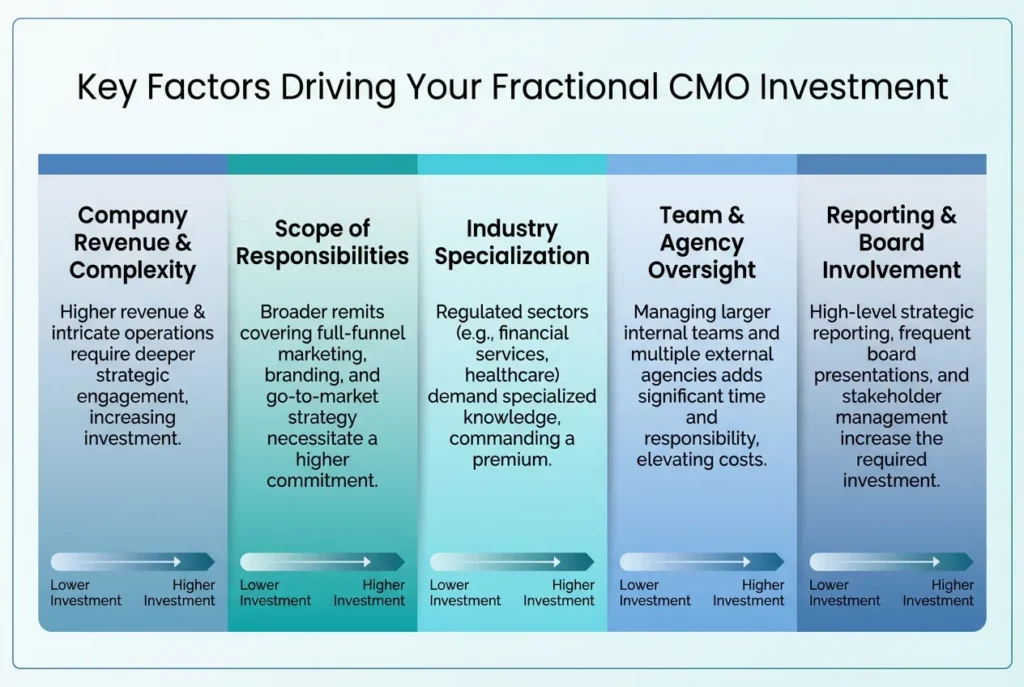
Whenever a CEO asks me “why does this fractional CMO cost $15K and that one costs $35K?” — the answer is always one of five levers. Sometimes all five.
Lever 1: Your Revenue Stage and Complexity
A $12M credit union and a $120M multi-location med spa network need fundamentally different strategic horsepower. The bigger the revenue, the more channels, the more locations, the more team layers — the deeper the involvement required.
Before you stress about the retainer number, get clear on what you should be spending on marketing in total. I’ve written about how much of your revenue should actually go toward marketing — that conversation has to happen first.
Here’s how I price the fractional CMO retainer itself in my own head:
- $10M–$30M revenue: $10K–$18K/month → foundational strategy, channel prioritization, building the system
- $30M–$75M revenue: $18K–$28K/month → market expansion, team development, multi-channel sophistication
- $75M–$200M+ revenue: $28K–$40K+/month → board participation, investor relations, M&A support, enterprise-grade planning
Lever 2: Scope — Advisor or Embedded Operator?
This is the lever most companies underweight when comparing proposals. Two fractional CMOs can quote the same dollar amount and deliver wildly different things.
An advisory-level engagement ($10K–$15K) means strategic planning, monthly reviews, and high-level guidance to your internal team. You execute. They direct.
An embedded leadership engagement ($20K–$40K+) means ownership of go-to-market, demand generation, sales alignment, agency selection, hiring decisions, board reporting, and the marketing P&L itself. They own the number.
The more accountability the fractional CMO carries, the higher the price tag. But you also get the bigger business impact. You can’t have one without the other.
Lever 3: Industry Specialization and Regulation
Regulated industries cost more. They should.
For a credit union, your fractional CMO has to understand NCUA compliance, member acquisition rules, GLBA privacy requirements, and the financial services advertising restrictions that will sink a campaign if you ignore them.
For a multi-location med spa, it’s FTC compliance on health claims, state-specific medical advertising rules, HIPAA considerations, and the ROI tracking complexity that comes with multiple locations sharing one brand.
For a home builder marketing agency, it’s lead quality over volume, 6–18 month sales cycles, model home strategies, and hyper-local market knowledge.
Specialization typically adds 15–25% to baseline pricing. It also dramatically reduces ramp-up time and the cost of compliance mistakes — which more than pays for itself in year one.
Lever 4: Team and Agency Oversight
Every layer of people management adds time, complexity, and accountability:
- No internal team → strategy-only focus, lowest oversight burden
- 1–3 internal marketers → moderate coaching and development
- 5+ team members → real people management, hiring, organizational design
- Multiple agency relationships → vendor selection, contract negotiation, performance management, integration
Each layer adds time. Time costs money. That’s the math.
Lever 5: Reporting and Board Involvement
If you need your fractional CMO in board meetings, presenting to investors, or supporting M&A due diligence, the engagement scope grows accordingly:
- Monthly executive reporting → standard, included
- Quarterly board presentations → add 10–15% to baseline
- Investor updates and fundraising support → add 15–25%
- M&A due diligence participation → typically priced as a separate project
For companies positioning marketing as a strategic growth driver to investors, this involvement isn’t optional. It’s the whole point.
Fractional CMO vs. Full-Time CMO: The Real Cost Comparison
Most CEOs look at a $25K/month fractional retainer ($300K annualized) and a $200K full-time CMO salary, and conclude full-time is cheaper.
That math is wrong. And it’s wrong in expensive ways.
Side-by-Side Comparison
| Factor | Fractional CMO | Full-Time CMO |
|---|---|---|
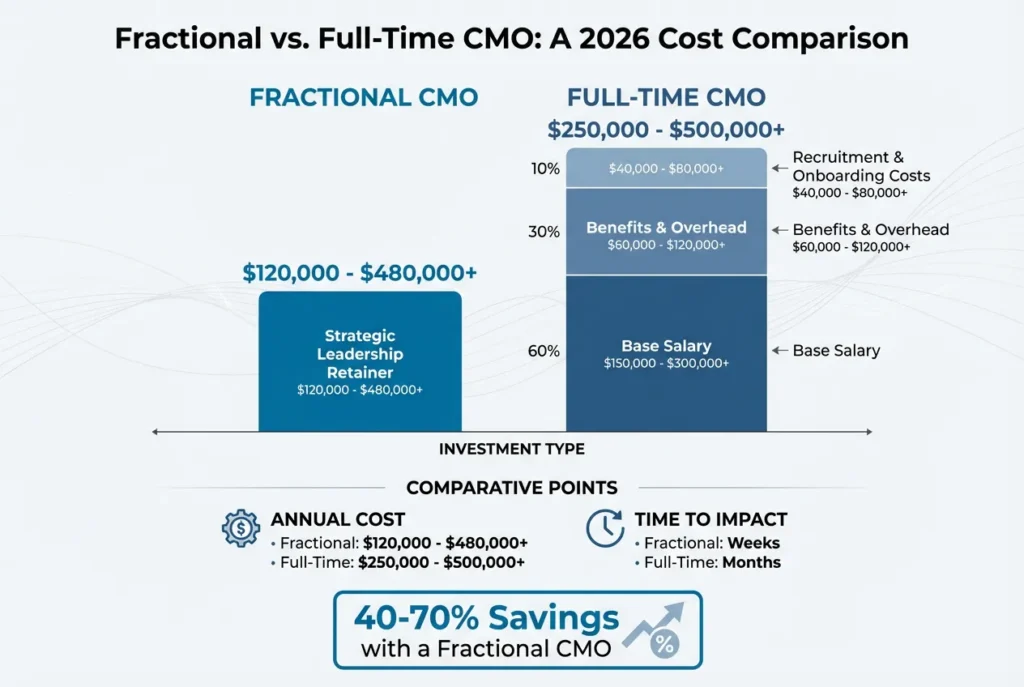
| Annual cost (total) | $120K–$480K (retainer only) | $250K–$500K+ (salary + benefits + overhead) |
| Benefits & overhead | $0 (contractor) | +20–30% of salary |
| Recruitment cost | $0 | $20K–$100K+ (recruiter, interviews, ads) |
| Time to impact | Days to weeks | 6–9 months (recruit + ramp) |
| Flexibility | High — month-to-month, scale scope as needed | Low — 12–18 month realistic commitment |
| Risk | Low — no severance, easy to disengage | High — severance, cultural mismatch, replacement cost |
| Best fit for | 0–5 internal marketers, lean team | 10+ marketing team, complex full-time function |
The True Total Cost of a Full-Time CMO
Let me put real numbers on a $200K full-time CMO. Here’s what it actually costs you in year one:
- Base salary: $200K (U.S. Bureau of Labor Statistics reports a median of roughly $160K for marketing managers, with CMO-level compensation running materially higher)
- Benefits and employer taxes (~25%): +$50K
- Recruiting fees (amortized): +$25K
- Six months of ramp-up at half effectiveness: +$50K in lost productivity
- True year-one cost: ~$325K
Now compare that to a $25K/month fractional CMO at $300K annualized — with full strategic horsepower from week two and zero hidden costs.
Year-one savings: roughly $25K. But the bigger story is the hidden $65K of ongoing overhead you eliminate every year, the $0 severance liability, and the fact that you’re getting impact in 30 days instead of nine months.
For a lean team in the $10M–$50M revenue range, the real savings land somewhere between 40% and 70% when you stack everything up.
The Strategic Advantages Most Comparisons Miss
Day-one expertise. A fractional CMO has done this dozens of times before. There’s no learning curve about what marketing leadership looks like — only about your business.
Cross-pollinated pattern recognition. One full-time CMO brings one career’s worth of experience. A good fractional CMO brings patterns from dozens of companies, multiple industries, and several growth stages. Your competitor is probably making a mistake your fractional CMO already learned from somewhere else.
Objectivity without political weight. A fractional CMO doesn’t have turf to protect or a long-term seat to defend. The recommendations are sharper because the incentives are cleaner.
Scalable agility. Big product launch this quarter? Scale up. Market is quiet next quarter? Scale down. You can’t do this with a full-time hire — and you shouldn’t have to.
Fractional CMO vs. Marketing Agency: They’re Not the Same Thing
This is one of the most expensive misunderstandings I see. Companies hire a marketing agency expecting strategic leadership, then wonder why marketing still feels rudderless 18 months later. (The same confusion shows up in the agency vs. in-house debate — different question, same root cause.)
A fractional CMO and a marketing agency do completely different jobs. You probably need both.
The Distinction in One Line
A fractional CMO is your architect. A marketing agency is your contractor.
The architect owns the design, the building permits, the structural decisions, and the accountability for whether the house actually works. The contractor builds what the architect specified, on time and on budget.
You don’t ask your contractor to design the house. And you don’t ask your architect to swing a hammer. The same logic applies here. (If you’re trying to figure out the right pricing model for an execution agency on its own, I broke down the retainer, project, and value-based pricing models agencies use in another post.)
What Each One Owns
Fractional CMO owns:
- Overall marketing strategy and budget allocation
- P&L responsibility for marketing’s revenue contribution
- Internal team and external vendor management
- CEO and board reporting on marketing’s business impact
- Outcomes — pipeline, revenue, CAC, LTV
Marketing agency owns:
- Specific tactical execution (SEO, paid media, content, design)
- Channel-level performance metrics
- Reporting up to marketing leadership (your fractional CMO)
The Optimal Model for Growth-Stage Companies
For companies in the $10M–$200M range, the structure that consistently delivers the best results is a fractional CMO providing strategic leadership, with one or more specialized execution agencies (or a small internal team) reporting into them.
The math typically lands here:
- Fractional CMO: $15K–$30K/month
- Specialized execution agency: $8K–$25K/month
- Total monthly investment: $23K–$55K
Compare that to a full-service agency at $30K–$60K/month with no real strategic accountability — or a $265K+ full-time CMO who still has to hire agencies for execution. The fractional + specialist model wins on both cost and clarity. (If you want to see how this stacks up in actual packaged form, our digital marketing packages show what the fractional + execution split looks like at different revenue stages.)
Why Full-Service Agencies Without Strategic Leadership Often Underperform
I want to be careful here, because I run an agency. But I also have to be honest: agencies are incentivized to do more work, not necessarily to drive your business outcomes.
Without a fractional CMO providing strategic oversight, what tends to happen is predictable:
- Agencies over-invest in the channels they’re best at, even when they’re not the right fit
- Reporting focuses on activity (impressions, clicks, posts) instead of revenue impact
- Strategic opportunities outside the agency’s service offering get ignored
- No one owns the total marketing P&L
The fix isn’t to fire the agency. It’s to put strategic leadership above it.
What’s Actually Inside a Fractional CMO Retainer (And What Isn’t)
Scope ambiguity is where most fractional CMO engagements go wrong. Nail this down before you sign anything.
✅ What You Should Expect
Strategic leadership: go-to-market strategy, market positioning, ICP definition, messaging framework, channel prioritization, demand gen strategy, sales-and-marketing alignment.
Revenue ownership: pipeline contribution, lead quality, CAC management, LTV optimization, attribution and ROI measurement, accountability for the marketing-influenced revenue number.
Team and vendor management: coaching internal marketers, hiring support, agency selection and oversight, marketing tech and AI stack audits, cross-functional alignment with sales, product, and customer success.
Executive reporting: monthly executive reviews, quarterly board presentations, investor updates, budget planning and forecasting, strategic recommendations.
🚫 What’s Not Included
A fractional CMO is an executive strategist, not a doer. The following are not in your retainer and should be handled by agencies, contractors, or internal team members:
- Writing blog posts, email copy, or social content
- Designing graphics, videos, or creative assets
- Day-to-day PPC bid management or campaign optimization
- Social media posting and community management
- SEO technical implementation or link outreach
- Landing page or website development
- CRM data entry and report production
- Event and webinar logistics
This division is intentional. Your fractional CMO’s time is most valuable when it’s pointed at strategic decisions, leadership, and revenue accountability — not at tasks a specialist can do for a tenth of the rate.
When Will the Investment Pay Back? The Honest ROI Timeline
This is the question I get on every initial call. CEOs want to know when the line on the spreadsheet flips from red to green.
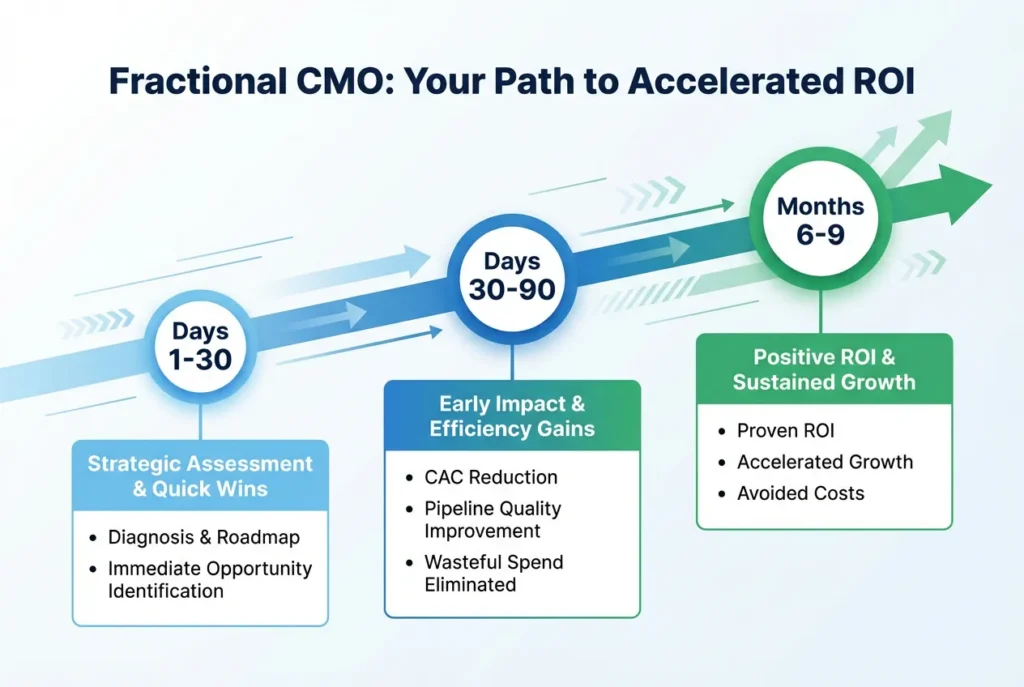
Here’s the honest answer, broken into three windows.
Days 1–30: Foundation and Quick Wins
The first month is assessment and stop-the-bleeding work. Marketing audit. Stakeholder interviews. Strategic roadmap. Identifying the wasted spend that should never have been approved in the first place.
Financial impact in this window is usually not a revenue lift — it’s cost avoidance. I’ve had clients eliminate $15K/month in underperforming display ads inside the first two weeks, just by looking at the data with fresh eyes.
Days 30–90: Early Impact
This is where the real work shows up. CAC starts coming down. Lead quality improves. Sales and marketing finally start using the same definitions. Agencies get reorganized or replaced. Conversion optimization begins on the highest-traffic landing pages.
For high-growth companies with inefficient spend, this is often where positive ROI first lands. CAC improvements of 10–20% in the first 90 days are common — not exceptional.
Months 6–9: Compounded Returns
By month six, the strategic decisions made early start compounding. Marketing-sourced pipeline contribution goes up. Team productivity improves. The agencies you replaced are now outperforming the ones you fired. The hires you avoided would have cost you $250K each.
This is where most growth-stage companies see clearly positive ROI, driven by some combination of:
- Lower customer acquisition costs
- Higher pipeline volume and velocity
- Avoided cost of a bad full-time hire
- Wasted spend that never got approved in the first place
A Real Example (Anonymized)
An eight-location medical spa group, around $15M annual revenue, came to me spending $80K/month on Google Ads with inconsistent results. Fractional CMO investment: $22K/month.
First 30 days: I found about 40% of paid spend was going to low-intent keywords with poor conversion. We reallocated immediately.
Days 30–90: Google Ads dropped to $60K/month, we layered in a $8K/month local SEO investment, and rebuilt the highest-traffic landing pages for conversion. Result: same lead volume at 25% lower cost, with a 15% lift in appointments per lead.
Months 6–9: Local SEO was driving 30% of qualified leads, fully incremental to paid. CAC per booked appointment dropped from around $180 to $130. Total monthly marketing spend (including the fractional CMO and agency layers) settled at $90K.
By month 12: 40% more booked appointments than the prior year, on roughly 10% less total marketing spend. The fractional CMO retainer paid for itself by month four — and kept paying every month after.
That’s what good looks like. Not magic. Just executive-level strategy applied to the same dollars you were already spending.
When a Fractional CMO Is the Wrong Move (Yes, I’m Going to Tell You This)
I’m not going to pretend a fractional CMO is right for every business. It’s not. And I’d rather lose a deal than take a client I can’t help.
Here are the four situations where I tell CEOs to hold off.
❌ You’re Pre-Product-Market Fit (Under $5M Revenue)
If your offer isn’t validated and you don’t have repeatable sales, no amount of marketing strategy will fix that. A fractional CMO scales what’s working — they don’t manufacture product-market fit out of thin air.
What to do instead: stay sales-led, keep the founder close to customers, iterate on the product based on direct feedback. Once you’re past $5M with repeatable sales, then bring in a fractional CMO to scale.
❌ You Only Need More Hands (Execution-Only Need)
If you already have clear strategy and direction and you just need more execution capacity, you don’t need an executive. You need doers.
Paying $10K–$40K/month for someone to think strategically when you don’t need new strategic thinking is bad math.
What to do instead: hire specialized contractors, mid-level marketing managers, or execution-focused agencies. Save the fractional CMO investment for when you actually need leadership.
❌ You Won’t Give the Role Real Authority
If your fractional CMO is going to need three approvals to reallocate $5K of ad spend, the engagement will fail. I’ve watched it happen.
Fractional CMOs need real decision-making authority over budget, vendors, and strategic direction. Without it, every recommendation turns into a political negotiation, and the value evaporates.
What to do instead: get full executive buy-in before the engagement starts. Define decision-making authority in writing. If your organization isn’t ready to empower the role, start with a one-time strategic audit and build trust first.
❌ You Won’t Fund the Execution
Strategy without execution is just expensive PowerPoint. If you’re not willing to invest in agencies, contractors, or internal team members to actually execute the strategy, the engagement will frustrate everyone.
What to do instead: budget for both leadership and execution. A typical split is 30–40% of total marketing budget on strategy and leadership, 60–70% on execution and media. So if your total marketing spend is $50K/month, plan on $15K–$20K for the fractional CMO and $30K–$35K for the agencies, team, and media. (If you’re not sure what your total marketing budget should be in the first place, here’s how to actually calculate it.)
✅ When It’s a Great Fit
Here’s the profile where fractional CMOs deliver exceptional ROI:
- Revenue: $10M–$200M+ with proven product-market fit
- Marketing maturity: $30K+/month already going to marketing, but scattered or underperforming
- Team: 0–5 internal marketers, no full-time CMO
- Org readiness: executive team will grant real decision-making authority
- Budget: willing to fund both strategy and execution
- Industry: regulated, complex, multi-location, or B2B with defined ICPs
If that profile fits, this is one of the highest-ROI investments you can make. If it doesn’t, save your money and revisit in 12 months.
Frequently Asked Questions
What is the average hourly rate for a fractional CMO?
Hourly rates run $200–$500+ per hour depending on experience, industry specialization, and geography. But most experienced fractional CMOs prefer monthly retainers, because hourly billing rewards activity instead of outcomes. Hourly is best reserved for one-time audits or short consulting engagements — not sustained leadership.
How much does it cost to hire a fractional CMO per month?
Monthly retainers run $10K–$40K+, with most growth-stage engagements ($10M–$200M revenue) landing between $15K and $30K. The exact number depends on revenue, scope, industry specialization, team and agency oversight, and how much board-level reporting you need. Lower retainers mean advisory work; higher retainers mean embedded executive leadership with real outcome accountability.
Is a fractional CMO cheaper than a full-time CMO?
Yes, in almost every case. Total annual cost for a fractional CMO runs $120K–$480K (retainer only). A full-time CMO runs $250K–$500K+ once you add benefits, recruiting, and ramp-up productivity loss. That’s typically 40–70% in total savings — plus zero severance liability, faster impact, and the flexibility to scale up or down.
The trade-off is time commitment: a full-time CMO gives you 40+ hours per week exclusively; a fractional CMO gives you 2–4 days per week equivalent. For lean teams, that’s enough.
What’s included in a typical fractional CMO retainer?
Strategy (go-to-market, positioning, ICP, demand gen framework, channel prioritization), operational leadership (team coaching, agency oversight, tech stack), and executive accountability (monthly reporting, board presentations, P&L ownership). What’s not included is execution work — content writing, ad management, design, social posting. Those go to agencies or internal staff under the fractional CMO’s direction.
Do fractional CMOs work hourly or on retainer?
Most experienced fractional CMOs work on monthly retainers, because retainers align incentives around outcomes instead of hours. Hourly is best for one-time projects. Hybrid (lower base + performance bonus) is an emerging model that works well when the data infrastructure can cleanly track the bonus metric.
How long does a fractional CMO engagement typically last?
Initial commitments are usually 3–6 months — long enough to assess, plan, and show early impact. Successful engagements then transition to month-to-month or quarterly renewals, with most lasting 12–24+ months. The right time to end an engagement is when the strategic goals are achieved, when you’ve grown to the point of needing a full-time CMO (typically $200M+ revenue or a 10+ person marketing team), or when business priorities shift away from growth focus.
How do I know if I need a fractional CMO or a marketing agency?
If you lack overall marketing strategy and leadership, if marketing efforts feel scattered, if no one owns marketing’s revenue contribution — that’s a fractional CMO problem. If you have clear strategy and just need help executing specific tactics — that’s an agency problem. For most growth-stage companies, the answer is both: a fractional CMO providing strategic leadership, with specialized agencies executing under their direction.
Is a fractional CMO worth the investment for a $10M–$200M business?
For most companies in this range with 0–5 person marketing teams and clear growth intent, yes. A 15–30% marketing efficiency improvement in the first 90 days typically covers the investment. CAC reductions often save $100K+ annually on existing spend. And the cost of a bad full-time hire — $250K+ in recruiting, onboarding, and severance — disappears entirely.
The clearest signal: if you’re spending $30K+ per month on marketing without a clear ROI story, a fractional CMO investment of $15K–$25K to provide direction and accountability typically pays for itself within the first quarter through efficiency alone.
How does a fractional CMO integrate with my existing team and agencies?
A skilled fractional CMO acts as the strategic conductor. They give the internal team direction, prioritization, and coaching. They manage agencies against business outcomes instead of activity reports. They align sales and marketing on shared definitions and pipeline contribution goals. They report up to the CEO and board on marketing’s business impact.
The fractional CMO doesn’t replace your existing resources. They make them work better together.
What kind of results can I expect to see from a fractional CMO?
In the first 30–90 days: 15–30% reduction in customer acquisition cost, elimination of underperforming spend, sharper budget allocation. In the first 60–120 days: 20–40% improvement in lead quality and conversion, increased marketing-sourced pipeline, shorter sales cycles. By months 6–12: clearly positive ROI on the investment, measurable revenue contribution, professionalized marketing reporting to the executive team.
Specifics vary by starting point. Companies with scattered marketing efforts and unclear strategy almost always see the most dramatic improvements.
The Real Question Isn’t “How Much Does It Cost?”
It’s “what is the cost of not having executive marketing leadership?”
For a growth-stage company in the $10M–$200M range, the answer is usually somewhere between wasted ad spend, slow pipeline growth, a bad full-time hire, and the opportunity cost of marketing operating as a department of activities instead of a driver of revenue.
A fractional CMO is one of the highest-leverage investments available to a CEO who wants marketing to contribute to the P&L the way every other function is expected to. You get senior strategic horsepower at a fraction of the full-time cost — with the flexibility to scale the investment as your business evolves.
If you’re considering it, the only thing I’d ask you to do is make sure the fit is real. Proven product-market fit. Organizational willingness to grant the role real authority. Budget for both strategy and execution.
Get those three things right, and the math works almost every time.
If you’d like a second set of eyes on your current marketing performance — what’s working, what’s leaking budget, and where executive-level strategy could move the number — I’m happy to take a look. You can learn more about how I work with growth-stage companies or book a no-pressure strategy session.