
 321-236-2899
Marketing Agency Pricing: What You Should Actually Pay in 2026
If you have ever asked three agencies to quote the same scope of work, you already know the problem: you got three wildly different numbers, and none of them explained why. Pricing is the single most opaque part of hiring a marketing partner, and that opacity is exactly where most budgets get wasted.
This guide breaks down what marketing agency pricing actually looks like in 2026 — the models, the real dollar ranges by service, and the tier logic that explains why one retainer costs $10,000 and another costs $40,000. It is written from the inside, by an operator who has built these pricing models, so you will see the delivery math agencies rarely put in a proposal.
By the end, you will be able to look at any quote and know whether you are paying for strategy and senior talent — or subsidizing overhead and a junior team. Let’s start with the number everyone wants first.
Key Takeaways
- Most mid-market retainers land between $5,000 and $40,000 per month. The spread reflects team seniority and scope, not a fixed quality ladder.
- Price is driven by four things: geography, agency overhead, vertical specialization, and the seniority of the people actually touching your account.
- The cheapest option is usually the most expensive. Below-market pricing is funded by offshore execution, template work, or a 4-to-1 client-to-strategist ratio.
- AI has split the market. Execution work (content, reporting) is getting cheaper; strategy, technical, and CRO work is holding or rising in price.
- A fair proposal shows you the math — who does the work, how many senior hours, and what outcome each dollar is tied to.
How Much Does a Marketing Agency Cost in 2026?
In 2026, most businesses pay a marketing agency between $5,000 and $40,000 per month on a retainer, with small-business engagements starting near $1,500 and enterprise programs exceeding $75,000. According to Clutch’s pricing data across tens of thousands of firms, the typical mid-market band sits between $5,000 and $50,000 monthly.
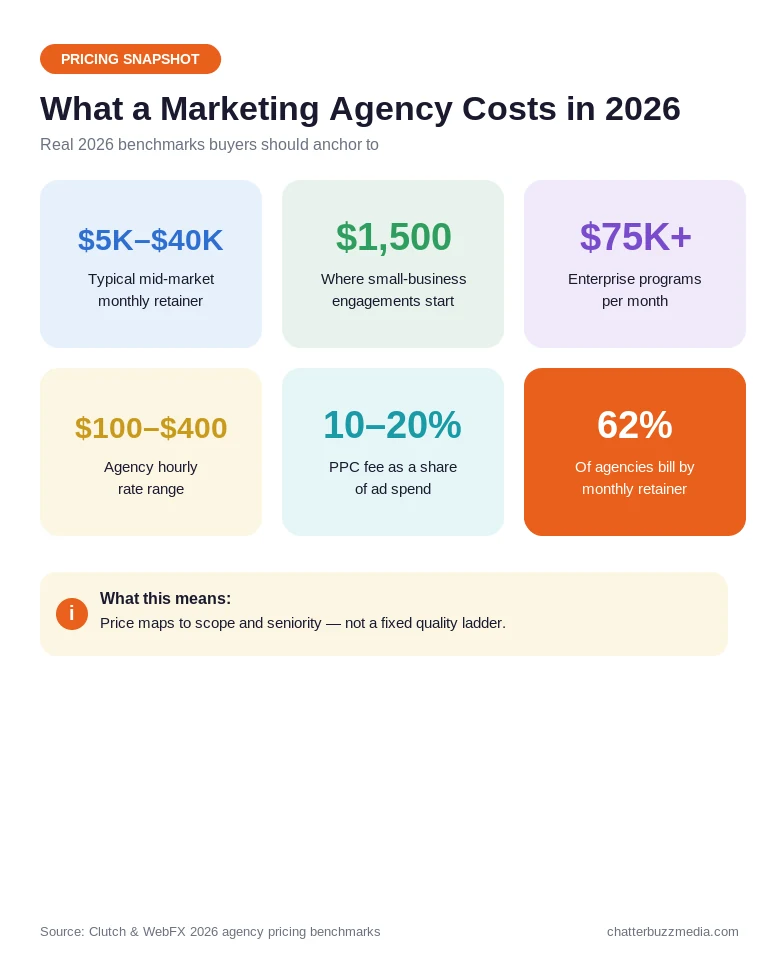
Those ranges feel enormous because they are measuring very different things. A $1,500 engagement buys a few hours of a single specialist; a $40,000 engagement buys a coordinated team, a senior strategist, and enough production capacity to move a real revenue number.
The mistake is treating price as a proxy for quality. Price is really a proxy for scope and seniority — how much gets done, and by whom.
Keep that reframe in mind for the rest of this guide. Every model, service range, and tier below is really answering one question: how much senior capacity is behind the number.
Here is a fast way to place yourself on the spectrum:
- Under $1M revenue: $1,500–$5,000/mo, usually one channel done well.
- $1M–$10M revenue: $5,000–$20,000/mo, a multi-channel program with SEO, paid, and content.
- $10M–$50M revenue: $20,000–$75,000/mo, full-funnel strategy plus analytics and a dedicated team.
It is also worth knowing why the range has widened over the last two years. AI has pulled the floor lower for commodity execution while pushing the ceiling higher for genuine strategy, so the same “marketing agency” label now covers a much broader spread than it did in 2024.
That is why a headline number tells you almost nothing on its own. Two agencies quoting $12,000 can be running completely different playbooks — one leaning on automation and a junior team, the other on a senior strategist and custom work.
Once you know the ballpark, the next question is how that fee is structured — because the billing model changes everything about your risk. Let’s break down the six you’ll encounter.
The 6 Marketing Agency Pricing Models Explained
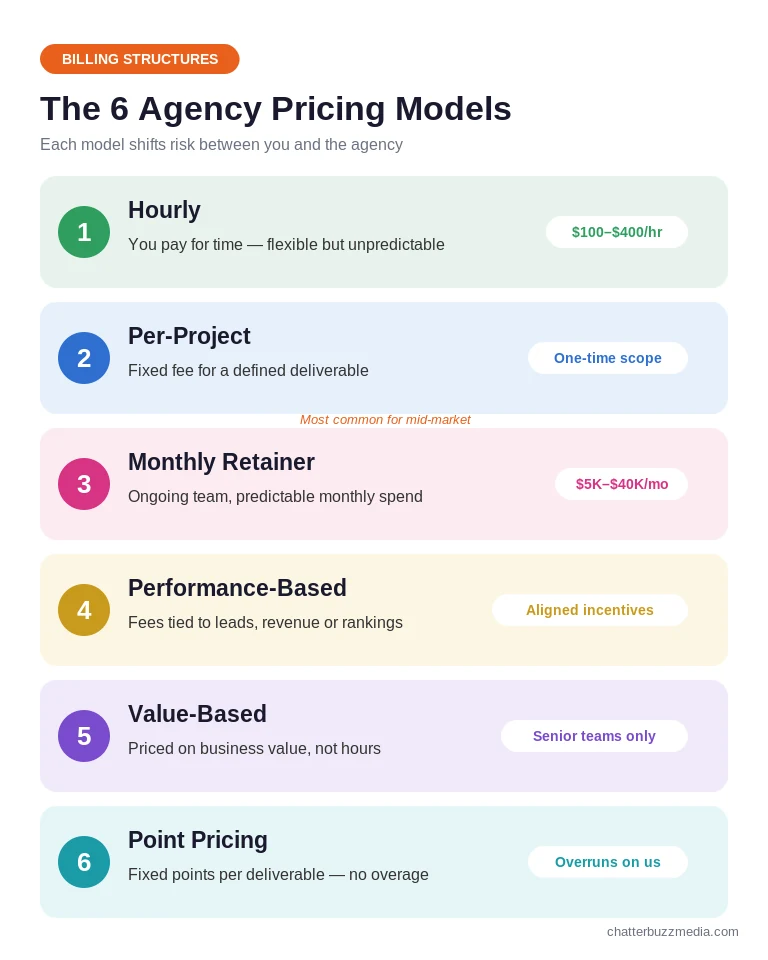
Marketing agencies bill in one of six ways, and each one shifts risk between you and the agency differently. Understanding which model you are being offered tells you as much about the agency as the price itself.
The right model depends on how predictable your work is and how much you value flexibility over certainty. Here is what each one really means for you.
- Hourly ($100–$400/hr): You pay for time. Flexible for one-off work, but costs are unpredictable and revisions get expensive fast.
- Per-project (fixed fee): A defined deliverable for a set price. Great for a website or an audit; clunky for ongoing programs.
- Monthly retainer ($5,000–$40,000): The most common model for ongoing digital marketing services. Predictable spend and consistent attention, with scope creep as the main watch-out.
- Performance-based: Fees tied to leads, revenue, or rankings. Aligns incentives but can push agencies toward short-term or vanity metrics.
- Value-based: Priced against the business value delivered, not the hours spent. Usually reserved for senior, proven teams.
- Point pricing: Every deliverable is assigned a fixed point value, and you buy points monthly. If a task runs long, you are never billed extra — the fixed cost sits with the agency, not you.
Retainers dominate the mid-market for a reason: they smooth your cash flow and let a team compound results month over month. But a retainer number alone is meaningless until you know what it buys per service — so let’s put real ranges on the table.
Marketing Agency Pricing by Service
Service-level pricing is where the abstract retainer becomes concrete, and the ranges vary widely by agency tier. A boutique shop and an enterprise firm can quote the same SEO scope with a 5x difference — and that gap reflects team depth, not a guarantee of results.
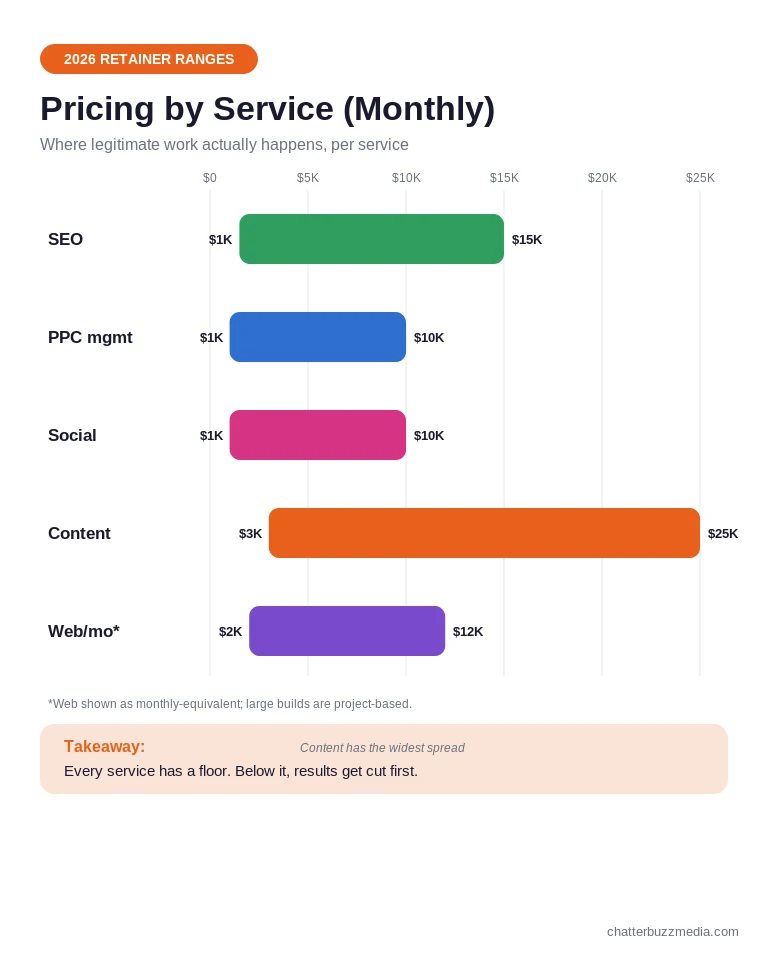
Below are the realistic 2026 monthly ranges where legitimate work actually happens, drawn from published agency benchmarks including WebFX and current market data.
- SEO: $1,500–$15,000/mo. Entry buys 10–20 keywords and light on-page work; the top end funds full technical programs and content production.
- PPC management: 10–20% of ad spend, or a $1,000–$10,000 flat fee. Higher percentages apply at lower spend levels.
- Social media: $1,000–$10,000/mo depending on platforms, posting cadence, and whether paid strategy is included.
- Content marketing: $3,000–$25,000/mo. A single long-form guide runs $1,000–$4,000 depending on research depth.
- Web design and development: $3,000 for a small business site to $150,000+ for a complex corporate or eCommerce build.
AI has reshaped these ranges unevenly, and it pays to know where. Content production and reporting have dropped 20–35% at agencies that adopted AI tooling, while technical SEO, paid media strategy, and conversion work have held steady or climbed.
The takeaway for buyers is to scrutinize where the cheap number is coming from. A low content price may simply reflect efficient tooling, but a low strategy price almost always reflects a lack of it.
Notice that every service has a floor below which real work cannot happen. When a quote falls under that floor, something is being cut — and that “something” is usually the part that drives results. The bigger question, then, is what separates a $10,000 retainer from a $40,000 one.
What You Actually Get at Each Pricing Tier
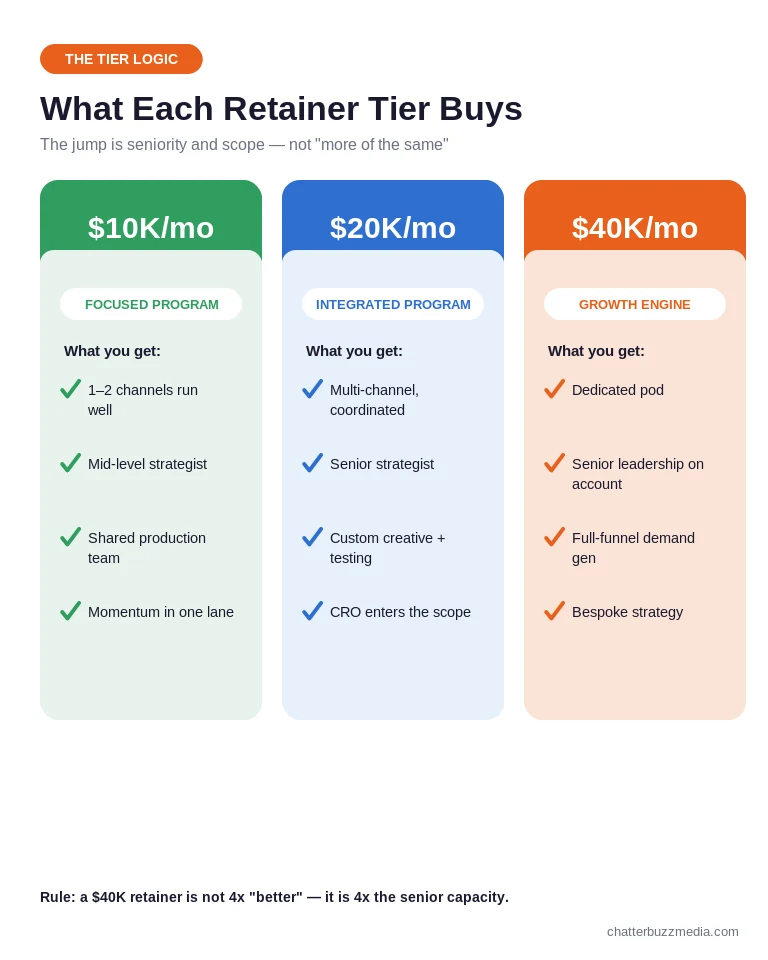
The difference between a $10,000, $20,000, and $40,000 retainer is not “more of the same” — it is a fundamental shift in seniority, scope, and speed. As someone who has built these tiers, I can tell you the jump is about who touches your account and how much of the strategy is genuinely custom.
Here is what actually changes as you move up the ladder, based on how the delivery math works inside an agency.
- $10,000/mo — the focused program. One or two channels run well, a mid-level strategist, and a shared production team. You get momentum in a single lane, not full-funnel coverage.
- $20,000/mo — the integrated program. Multiple channels coordinated by a senior strategist, custom creative, and monthly analytics. This is where conversion rate optimization and testing enter the scope.
- $40,000/mo — the growth engine. A dedicated pod, senior leadership on the account, and enough capacity to run demand generation across the full funnel. Strategy is bespoke, not templated.
The reason the tiers exist at all comes down to time. A senior strategist costs an agency several hundred dollars an hour to deploy, so the more senior attention your account needs, the higher the retainer has to be to make the math work.
This is also why “buying up” a tier can backfire if your program is not ready for it. Paying for a growth engine before you have the offer, budget, and internal capacity to feed it just means paying senior people to wait.
The honest truth is that a $40,000 retainer is not four times “better” than a $10,000 one — it buys four times the senior capacity and coordination. If your growth goal is modest, the smaller tier may be the smarter spend. So what, specifically, makes one agency charge more than another for the same tier? Four factors.
What Actually Drives Marketing Agency Prices
Four factors explain the majority of price variance between agencies: geography, size and overhead, vertical specialization, and team experience. When you understand these, a “high” quote often turns out to be perfectly reasonable — and a “cheap” one becomes a red flag.
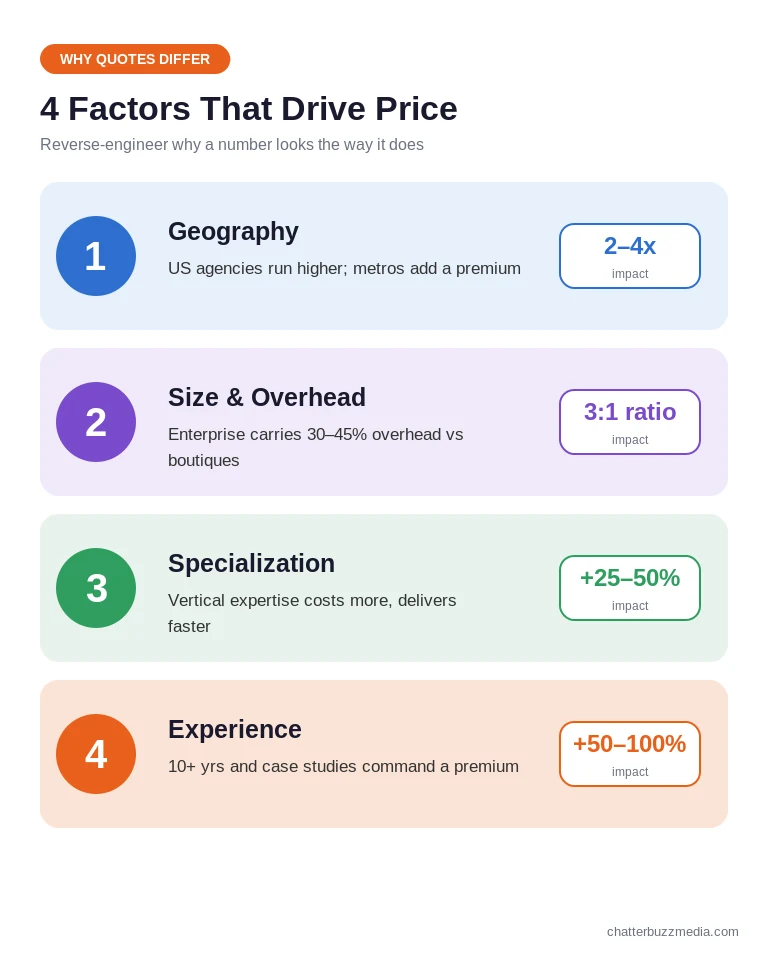
Think of these as dials rather than a single lever. An offshore generalist and a specialized US senior team can differ by 5x on the same scope, and both prices can be “fair” for what they actually deliver.
Each factor moves the price in a predictable direction, so you can reverse-engineer why a number looks the way it does.
- Geography: US agencies run 2–4x higher than offshore equivalents, and major metros add a 20–30% premium over regional markets.
- Agency size and overhead: Enterprise firms carry 30–45% overhead and often a 3-to-1 client-to-strategist ratio, versus 1-to-2 at a boutique. More of your fee goes to account management, not delivery.
- Vertical specialization: Agencies with deep experience in financial services, manufacturing, or healthcare charge a 25–50% premium — and usually earn it back in faster time-to-results.
- Experience and track record: Teams with 10+ years and documented case studies command a 50–100% premium over newer shops.
None of these factors is about greed — they are about cost structure and risk. A specialized senior team costs more to staff, so it costs more to hire. That framing matters most when you compare an agency against your other options: freelancers and an in-house hire.
Agency vs. Freelancers vs. In-House: The Real Cost
The cheapest sticker price rarely wins once you account for coverage, management time, and turnover. Comparing an agency to freelancers or an in-house hire is less about hourly rate and more about total cost of ownership.
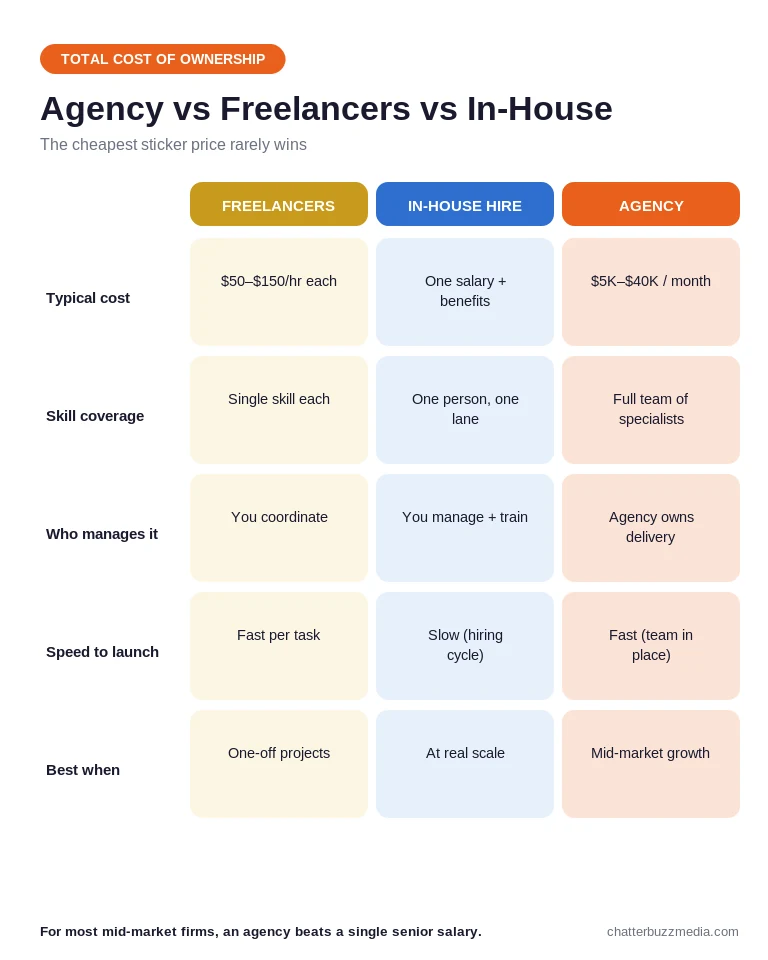
Each path solves a different problem, and the right answer depends on the breadth of skills you need and how quickly you need them.
- Freelancers ($50–$150/hr each): Ideal for a single, well-defined skill. The cost multiplies fast when a campaign needs a strategist, designer, writer, and media buyer — and no one owns the outcome.
- In-house hire ($70K–$160K+ salary): Great for institutional knowledge, but one person cannot cover every channel, and you also pay benefits, tools, and training on top of salary.
- Agency ($5,000–$40,000/mo): A full team of specialists for less than a single senior salary, with tools and process already in place. You trade some control for breadth and speed.
The hidden cost most buyers miss is management overhead. A team of freelancers still needs someone in-house to brief, coordinate, and quality-check the work, which quietly adds hours and single points of failure to a “cheaper” option.
An agency absorbs that coordination cost inside the retainer. You are effectively renting a marketing department — strategy, production, and project management — instead of assembling and managing one yourself.
For most mid-market companies, the math favors an agency until you are large enough to justify a full internal department — and even then, a hybrid model is common. If you want to work through your specific situation, our breakdown of agency versus in-house hiring walks through the trade-offs. Whichever path you choose, the fastest way to lose money is chasing a price that is too good to be true.
Pricing Red Flags: When Cheap Gets Expensive
An agency quoting far below market is not giving you a deal — it is quietly cutting the part of the work that drives results. Sustainable quality has a floor, and prices under that floor are funded by shortcuts you will pay for later.
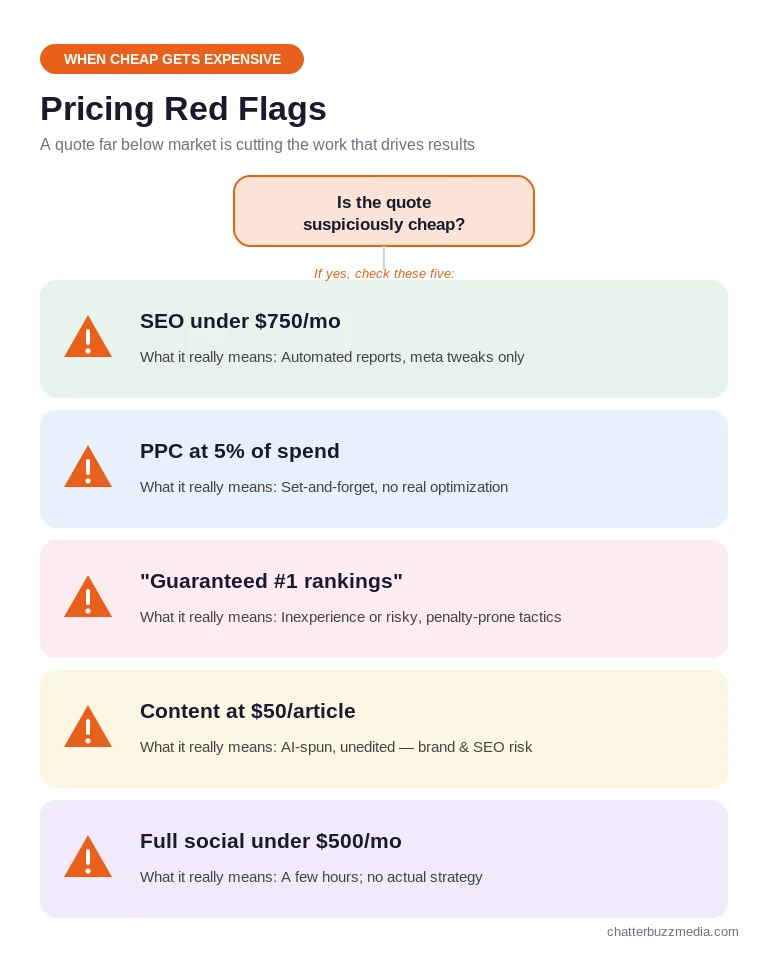
Watch for these specific warning signs when a quote looks too good to be true.
- SEO under $750/month: Not enough hours for meaningful work. You are buying automated reports and a few meta-tag edits.
- PPC at 5% of spend or less: Set-and-forget management with little real optimization. The margin cannot support quality attention.
- Guaranteed #1 rankings: No legitimate agency guarantees rankings. This signals inexperience or risky tactics that can earn a penalty.
- Content at $50 or less per article: Almost certainly AI-generated with no human editing or research, which carries real brand and ranking risk.
- Full-service social under $500/month: The math does not work. After overhead, that is a handful of hours — not a strategy.
The pattern is simple: below-market pricing is subsidized by offshore labor, template work, or a client load so high no one can pay attention to your account. Once you can spot the floor, you can budget with confidence — which brings us to how much you should actually plan to spend.
How to Budget for a Marketing Agency by Revenue Stage
The smartest way to set a marketing budget is to work backward from revenue, not forward from whatever cash is left over. A common benchmark is to invest a percentage of revenue that scales down as you grow — and Gartner’s CMO Spend Survey has tracked marketing budgets averaging roughly 8–11% of company revenue in recent years.
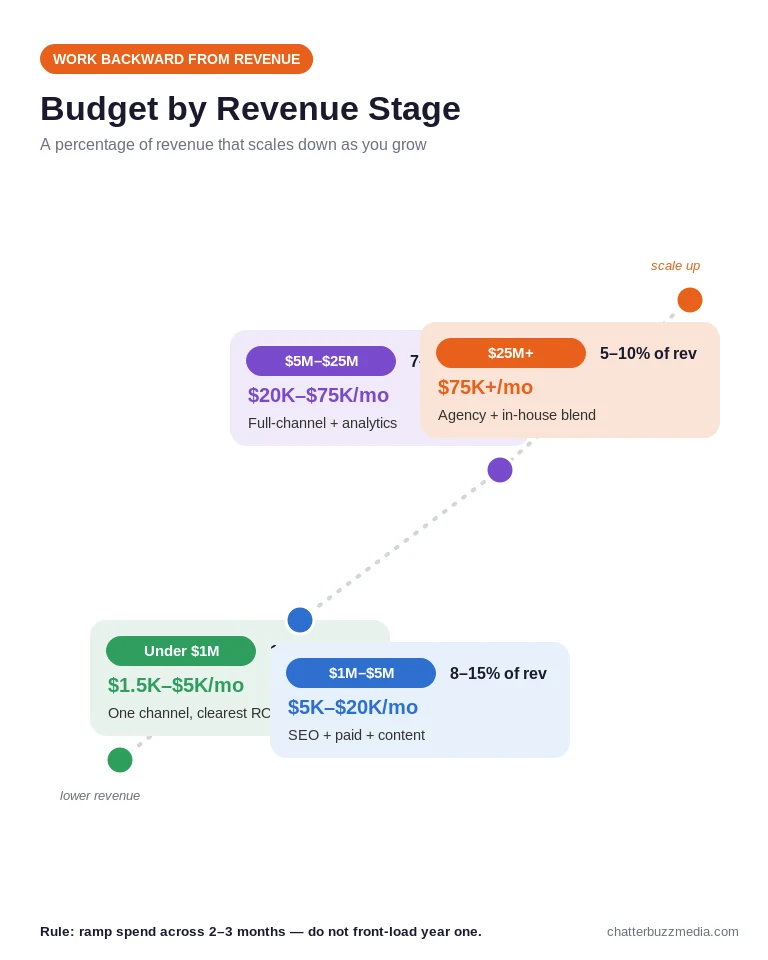
Here is a practical starting framework tied to your revenue stage.
- Under $1M (12–20% of revenue): $1,500–$5,000/mo. Pick one channel with the clearest path to ROI and do it well.
- $1M–$5M (8–15%): $5,000–$20,000/mo. Add SEO, paid, and content into a coordinated program.
- $5M–$25M (7–12%): $20,000–$75,000/mo. Full-channel strategy with real analytics and attribution.
- $25M+ (5–10%): $75,000+/mo. A blend of agency and in-house, often with specialist partners.
One more rule keeps budgets honest: ramp your spend, do not front-load it. Most programs need two to three months before results compound, so committing your full annual budget in month one just buys impatience.
Start in the channel with the clearest path to ROI, prove the return, then expand into the next one. Mature programs rebalance quarterly based on attribution data rather than annual guesswork.
Whatever the number, tie it to a specific revenue target so you can measure return instead of guessing. If you want help sizing your spend, our guide on building a digital marketing budget and the broader performance marketing framework are good next reads. Before we wrap, here are the questions buyers ask most.
Frequently Asked Questions
1. 🔍 How much does a digital marketing agency cost per month in 2026?
Most mid-market retainers run $5,000 to $40,000 per month, with small businesses starting near $1,500 and enterprise programs exceeding $75,000. The figure depends on the number of channels, the seniority of the team, and how much production capacity your goals require.
2. 📊 Why do marketing agency prices vary so much for the same scope?
Price reflects cost structure, not just quality — geography, overhead, specialization, and team experience can create a 3–5x spread on identical scope. A boutique with low overhead and an enterprise firm with heavy account-management costs will quote the same work very differently.
3. ⚡ Is it cheaper to hire an agency or build an in-house team?
For most mid-market companies, an agency delivers a full team of specialists for less than a single senior in-house salary once you add benefits, tools, and training. In-house becomes more efficient only at scale, and many companies land on a hybrid model.
4. 🏦 What should be included in a marketing agency proposal?
A strong proposal names who does the work, how many senior hours are involved, the specific deliverables, and the outcome each dollar is tied to. If a proposal only shows a lump-sum price with no delivery detail, ask for the breakdown before signing.
5. 🤝 Should I choose a retainer or project-based pricing?
Choose a retainer for ongoing programs like SEO, content, and paid media where consistency compounds results. Use project-based pricing for defined, one-time work such as a website build or a marketing audit with a clear start and end.
6. 💰 What are the red flags of an agency charging too little?
Watch for SEO under $750/month, PPC at 5% of spend or less, guaranteed rankings, and content priced at $50 or less per article. These prices are typically subsidized by offshore labor, templates, or a client load too high for real attention.
7. 🚀 How has AI changed marketing agency pricing?
AI has pushed execution costs down 20–35% for content and reporting, while strategy, technical, and conversion work has held steady or risen. Agencies that lead with strategy now command higher rates, and those selling only execution face pricing pressure.
8. 📈 What percentage of revenue should go to marketing?
A common benchmark is 7–15% of revenue, weighted higher for companies under $5M and lower as you scale past $25M. The right number depends on your growth targets and how aggressively you need to capture market share.
Conclusion
Marketing agency pricing only looks confusing until you know what the numbers represent. Once you understand that price maps to scope and seniority — not a fixed quality ladder — you can evaluate any quote with confidence.
Here is a simple action plan to put this to work:
- Anchor to revenue. Set a budget as a percentage of revenue tied to a specific growth target.
- Match the model to the work. Retainer for ongoing programs, project-based for one-time builds.
- Demand the delivery math. Ask any agency who does the work, how many senior hours, and what each dollar is tied to.
- Screen for the floor. Walk away from prices that fall below the level where real work is possible.
When you are ready to pressure-test your own numbers, the plans and packages breakdown and a free growth audit are practical next steps. You can also explore more frameworks in the resource library to keep sharpening your strategy.
Need help with SEO? Explore our SEO agency services.

Victoria Wallace
Victoria Wallace is a senior content strategist and marketing writer with 30+ years of experience helping more than 200 brands translate complex business goals into clear, conversion-focused content. Her background spans paid media, marketing strategy, go-to-market planning, brand positioning, and full-funnel campaign development, giving her a deep understanding of how SEO content connects to real business growth.