
 321-236-2899
Your CNC machines run 24/7. Your quality certifications line the conference room wall. Your engineering team solves problems competitors can’t even diagnose. And yet, when a procurement manager searches “precision CNC machining services” at 9 AM on a Tuesday, your website is nowhere to be found.
Meanwhile, a competitor with half your capabilities and a fraction of your experience is fielding the RFQs that should be landing in your inbox. The difference isn’t your product — it’s your digital visibility.
At Chatter Buzz Media, we’ve helped manufacturers across aerospace, automotive, medical device, and industrial equipment sectors build SEO programs that generate qualified leads month after month. This guide gives you the complete playbook — from keyword research to technical SEO to content strategy — so you can start ranking for the industrial terms that actually drive revenue.
Key Takeaways
- 84% of B2B buyers begin their purchasing journey with an online search — if your manufacturing website doesn’t rank, you’re invisible during the most critical phase of the buying cycle.
- Manufacturing keyword research starts with your RFQs and sales calls, not generic keyword tools. Your customers’ exact language is your highest-converting keyword list.
- Technical SEO is non-negotiable for large product catalogs — poor site architecture, slow load times, and crawl budget waste can bury thousands of product pages.
- SEO leads cost an average of $31 per lead vs. $811 for trade show leads, making organic search the most cost-efficient channel for manufacturers.
- Manufacturing SEO requires patience and precision — with sales cycles averaging 130 days, attribution demands a long-view measurement framework.
Why Manufacturing SEO Matters More Than Ever in 2026
The industrial buying process has fundamentally shifted. According to HubSpot research, 84% of B2B buyers now start their purchasing journey with an online search — and that includes the engineer specifying a custom alloy and the procurement director sourcing a new contract manufacturer.

What’s changed isn’t just where buyers start — it’s how far they go before ever picking up the phone. Research from 6sense shows that 57% to 70% of B2B buyers complete the majority of their research before contacting a single sales rep.If your website isn’t part of that research phase, you’re not even in the consideration set.
How Industrial Buyers Actually Search
Forget the myth that manufacturers rely solely on trade shows and word-of-mouth referrals. Today’s industrial buyer follows a predictable digital path: they start with a problem, move to a specification, narrow to a capability, and then evaluate suppliers — all through search.
An aerospace engineer doesn’t search “best manufacturer.” They search “AS9100 certified CNC machining titanium Grade 5” or “5-axis milling tolerance ±0.0005.” These hyper-specific queries represent buyers who are deep in the funnel and ready to engage.
The search patterns break down into three phases that mirror the industrial procurement cycle:
- Problem identification: “How to reduce weld porosity in aluminum assemblies” — early-stage searches where buyers define their challenge.
- Specification research: “ASTM A36 steel plate suppliers” or “FDA-compliant silicone gasket material” — mid-funnel searches driven by engineering requirements.
- Supplier evaluation: “Contract manufacturer ISO 13485 [region]” — late-funnel searches where buyers are comparing specific providers.
The ROI of Manufacturing SEO vs. Traditional Marketing
Manufacturers have historically poured budgets into trade shows, print advertising, and distributor relationships. Those channels still have value, but the cost comparison is staggering. SEO-generated leads average approximately $31 per lead, compared to $811 per lead for trade shows, according to data compiled by WebFX and Martal Group.
Beyond cost-per-lead, SEO delivers compounding returns. A trade show booth generates leads for three days; a well-optimized product page generates leads for three years. When you invest in B2B demand generation through organic search, every page you publish and optimize becomes a permanent asset in your lead generation infrastructure.
Manufacturing Keyword Research That Drives Qualified Traffic
Generic keyword tools will point you toward high-volume terms like “manufacturing” or “CNC machining.” Those terms drive traffic, but not the kind that converts. Effective manufacturing SEO keyword research starts with the language your actual buyers use — and that language lives in your RFQs, sales calls, and technical support tickets.
The goal isn’t to rank for every possible term. It’s to rank for the terms that signal purchase intent from qualified buyers in your target industries.
Mining Your RFQs, Sales Calls, and Technical Forums
Your sales team is sitting on a goldmine of keyword data and doesn’t know it. Every RFQ that arrives contains the exact phrases your ideal customers use when they need what you sell. Pull the last 100 RFQs and catalog the specific terms, material callouts, process descriptions, and certification requirements buyers mention.
Go further: listen to recorded sales calls (or sit in on five of them). Note the questions prospects ask before they become customers. Those questions — “Can you hold ±0.001 on a 48-inch part?” or “Do you do passivation in-house?” — are long-tail keywords waiting to become content.
Technical forums like Eng-Tips, Practical Machinist, and industry-specific LinkedIn groups reveal how engineers discuss problems in their own words. These communities surface terminology that keyword tools miss entirely.
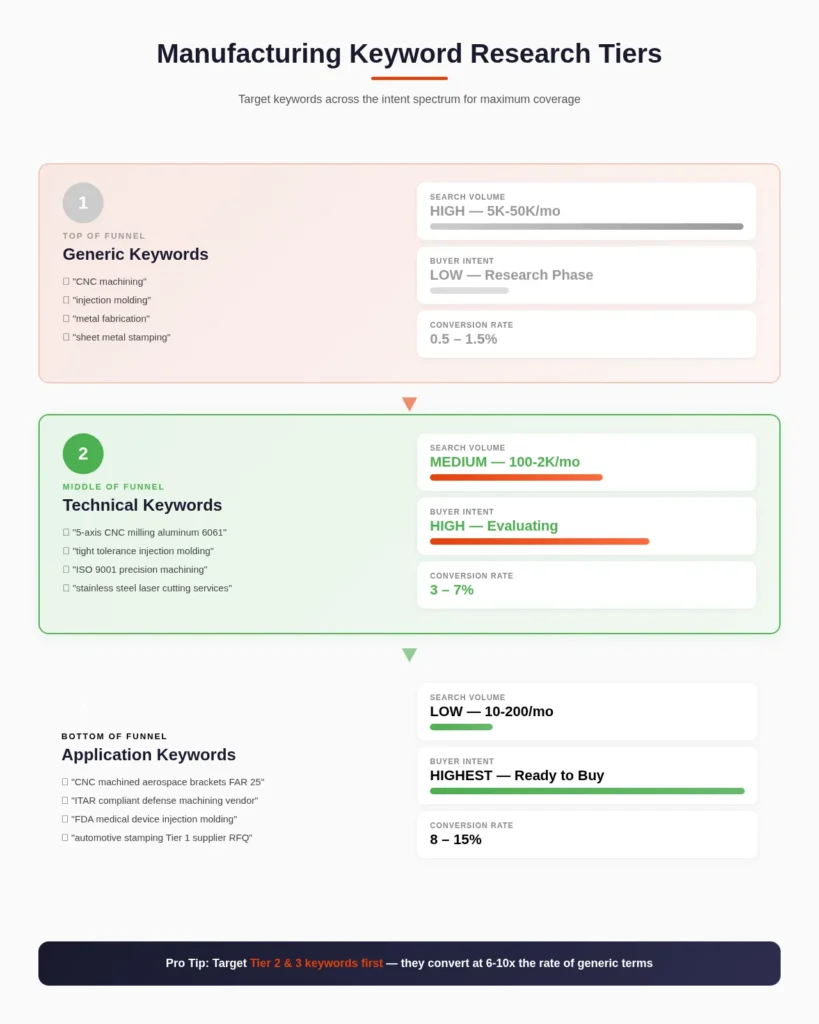
Three Keyword Tiers: Generic, Technical, and Application
We organize manufacturing keywords into three tiers based on specificity and intent. Each tier serves a different stage of the buyer’s journey and demands a different content approach.
- Tier 1 — Generic: High-volume, high-competition terms like “injection molding company” or “sheet metal fabrication.” These build awareness but convert slowly. Target with pillar pages and comprehensive guides.
- Tier 2 — Technical: Mid-volume terms with strong intent like “medical-grade silicone overmolding” or “MIG welding stainless steel to carbon steel.” These attract qualified engineers and specifiers. Target with detailed capability and process pages.
- Tier 3 — Application: Low-volume, ultra-high-intent terms like “hydraulic manifold block machining aerospace” or “FDA 21 CFR 177 compliant tubing extrusion.” These are your money keywords. Target with dedicated application pages and case studies.
Most manufacturers only target Tier 1 keywords. The real opportunity — and the fastest path to qualified leads — lives in Tiers 2 and 3, where competition is thinner and buyer intent is strongest.
Part Numbers, Material Grades, and Certification Searches
Here’s a keyword category most SEO agencies completely miss: engineers and procurement teams frequently search by part number, material specification, or certification standard. Searches like “Parker O-ring 2-012 alternative” or “ASTM B209-14 aluminum sheet supplier” represent buyers with defined specifications and immediate needs.
If you stock specific materials, hold particular certifications, or manufacture to recognized standards, those designations need to be indexable, searchable content on your website. Create dedicated pages for each major certification (ISO 9001, AS9100, ITAR, ISO 13485) and each material family you work with.
On-Page SEO for Manufacturing Websites
Manufacturing websites face a unique on-page challenge: they need to communicate technical precision to engineers while remaining accessible to procurement teams and operations managers who may not share the same technical vocabulary. The best manufacturing product pages do both — they lead with the problem they solve and back it up with specifications.
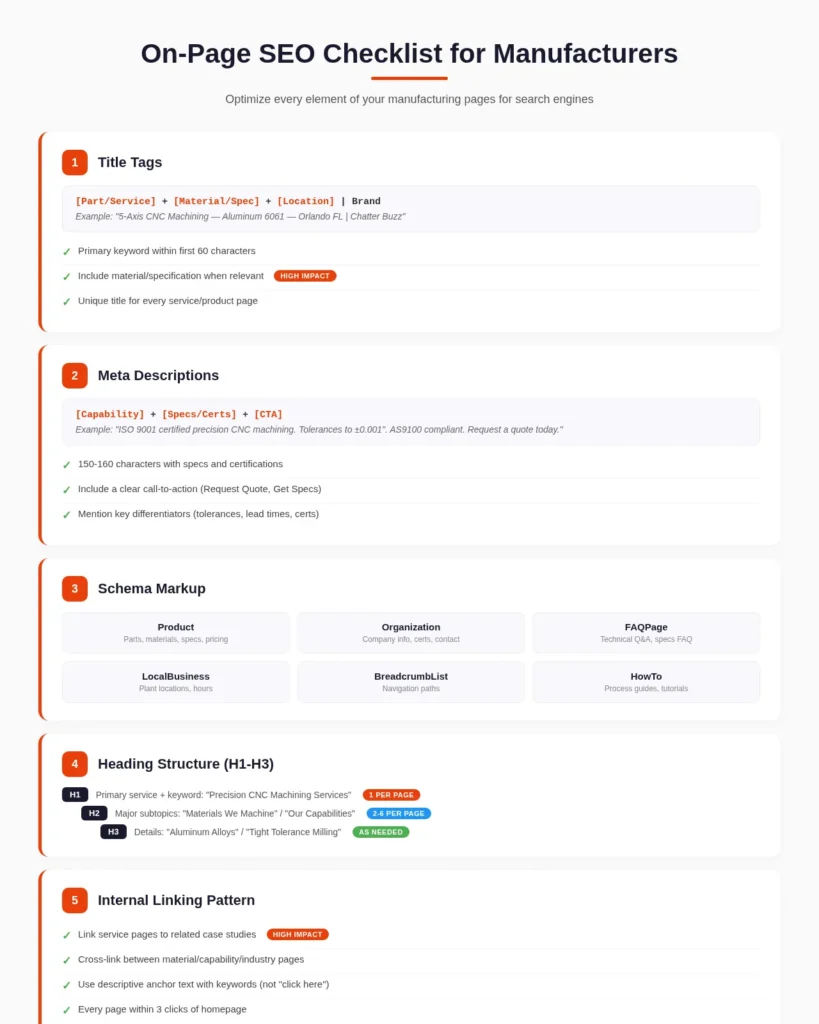
On-page SEO for industrial sites goes far beyond meta titles and descriptions. It encompasses how you structure your product information, present your technical documentation, and help search engines understand the relationship between your capabilities, industries, and materials.
Product and Service Page Optimization
Most manufacturing websites treat product and service pages as digital brochures — a paragraph of marketing copy, a stock photo, and a contact form. That approach fails both search engines and buyers. Each product or service page should be a comprehensive resource that answers every question a buyer asks before requesting a quote.
Here’s what a well-optimized manufacturing service page includes:
- Primary keyword in the H1, URL, meta title, and first 100 words — signal relevance immediately to both search engines and visitors.
- Capability specifications: tolerances, size ranges, material compatibility, production volumes, and lead times. Be specific — “±0.0005 inch tolerance” outperforms “tight tolerances” every time.
- Industry applications: explicitly list the industries you serve (aerospace, medical, defense, automotive) with brief descriptions of relevant experience.
- Certifications and compliance: dedicate visible sections to quality certifications, with links to dedicated certification pages.
- Supporting media: process videos, part galleries, and downloadable spec sheets increase time-on-page and provide additional indexable content.
- Clear CTAs: “Request a Quote,” “Download Our Capabilities Brochure,” or “Talk to an Engineer” — give the visitor multiple conversion paths based on their stage in the buying process.
Technical Document and Spec Sheet SEO
Manufacturers produce an enormous volume of technical documentation — spec sheets, material data sheets, installation guides, CAD drawings, and testing reports. Most of this content sits locked in PDFs that search engines struggle to crawl and index effectively.
The fix isn’t to eliminate PDFs entirely, but to create HTML versions of your most important technical documents. For every critical spec sheet or technical guide, build a web page that contains the key information in crawlable HTML format, then offer the PDF as a downloadable companion. This approach gives search engines content to index while giving engineers the downloadable format they prefer.
Name your PDF files descriptively (“titanium-grade-5-cnc-machining-specifications.pdf” not “document-2024-rev3.pdf”) and include relevant meta descriptions in the document properties. Every technical document is a potential landing page for a high-intent search query.
Schema Markup for Industrial Products
Schema markup helps search engines understand what your pages are about at a structured data level. For manufacturers, Product schema, Organization schema, and FAQ schema are the highest-impact implementations.
Product schema lets you mark up individual products or services with properties like name, description, manufacturer, material, and specifications. Organization schema establishes your company’s certifications, service areas, and industry affiliations. FAQ schema can earn you featured snippets for common industrial questions — prime real estate in search results that drives significant click-through rates.
If you serve specific geographic regions, LocalBusiness schema (covered in the local SEO section below) adds another layer of structured context. Implement schema using JSON-LD format and validate with Google’s Rich Results Test before deploying.
Technical SEO Foundations for Industrial Sites
Manufacturing websites often carry significant technical debt. Years of catalog expansions, platform migrations, and bolted-on product configurators create an environment where thousands of pages may exist but only a fraction are properly crawled, indexed, and ranking.

Technical SEO for industrial sites isn’t optional polish — it’s the foundation that determines whether your content investments actually pay off. Without it, even the best-optimized product pages can be invisible to search engines.
Site Architecture for Large Product Catalogs
A manufacturer with 500 SKUs across 12 product families and 8 industry verticals needs an architecture that creates clear topical hierarchies without burying pages too deep. The rule of thumb: every important page should be reachable within three clicks from the homepage.
Structure your site around a hub-and-spoke model:
- Hub pages (H2-level): Broad capability pages like “CNC Machining Services” or “Metal Stamping” that link to all related sub-pages.
- Spoke pages (H3-level): Specific process, material, or application pages like “5-Axis CNC Machining for Aerospace” or “Aluminum Die Casting — Alloy 380.”
- Cross-links: Industry pages that link to relevant capabilities across product families, and capability pages that link to relevant industry applications.
Breadcrumb navigation is essential for both users and search engines. It reinforces your site hierarchy and helps search engines understand the topical relationships between your pages. Implement breadcrumbs with structured data for maximum SEO benefit.
Core Web Vitals and Mobile Optimization
Google’s Core Web Vitals — Largest Contentful Paint (LCP), Interaction to Next Paint (INP), and Cumulative Layout Shift (CLS) — are ranking factors that many manufacturing websites fail spectacularly. Heavy product images, unoptimized CAD renderings, legacy CMS platforms, and third-party configurator widgets drag performance down.
The most common fixes for manufacturing sites include:
- Image optimization: Convert product photos to WebP format, implement lazy loading, and serve appropriately sized images for each device. A 4000×3000 pixel shop floor photo doesn’t need to load at full resolution on a mobile phone.
- Script management: Audit third-party scripts (chat widgets, analytics tags, configurators) and defer non-critical JavaScript. Many manufacturers run 15+ tracking and widget scripts that collectively add seconds to page load.
- Server response time: Upgrade hosting if your Time to First Byte (TTFB) exceeds 800ms. Content Delivery Networks (CDNs) are particularly important for manufacturers serving national or international markets.
Mobile optimization matters even for manufacturers. While engineers may spec products on desktop, procurement managers often research suppliers on tablets and phones between meetings. Google also uses mobile-first indexing, so your mobile experience directly impacts your desktop rankings.
Crawl Budget and Indexation Management
Large manufacturing sites with thousands of product pages, filtered views, and parameter-driven URLs can waste enormous amounts of crawl budget. When Googlebot spends its time crawling paginated filter results instead of your core product pages, the pages that matter don’t get indexed.
Take these steps to manage crawl budget effectively:
- Canonical tags: Ensure every page has a self-referencing canonical tag, and point filtered or parameter-based variations to the canonical version.
- Robots.txt: Block search engines from crawling faceted navigation, internal search results, and print-friendly page versions.
- XML sitemaps: Create segmented sitemaps (products, capabilities, industries, blog content) and submit them through Google Search Console. Remove any URLs that return non-200 status codes.
- Index bloat audit: Run a site:yourdomain.com search and compare indexed pages to your actual page count. If Google shows 15,000 indexed pages and you have 2,000 real pages, you have an index bloat problem that needs immediate attention.
Content Strategy That Attracts Engineers and Procurement Teams
Content marketing for manufacturers isn’t about churning out blog posts on “5 Tips for Better Manufacturing.” It’s about creating technically rigorous resources that answer the specific questions your buyers ask during a purchasing process that can take months.

The right content strategy bridges the gap between your engineering expertise and your market’s information needs. It positions your company as the authority in your specialty — which is exactly what inbound marketing is designed to do.
Content Types That Convert Industrial Buyers
Not all content types carry equal weight in manufacturing SEO. The formats that perform best align with how industrial buyers consume information — they want depth, specificity, and data they can use to justify a purchasing decision.
- Application guides: “How to Select the Right Stainless Steel Grade for Marine Environments” — these attract engineers during the specification phase and demonstrate your material science expertise.
- Process comparison pages: “Investment Casting vs. CNC Machining: Cost, Tolerance, and Volume Considerations” — these capture mid-funnel traffic from buyers evaluating manufacturing methods.
- Case studies with measurable outcomes: “How We Reduced Cycle Time 40% on a 6AL-4V Titanium Aerospace Component” — these convert late-funnel buyers by proving your capability with evidence.
- Material and specification databases: Searchable libraries of material properties, tolerance guides, and design-for-manufacturability resources that engineers bookmark and return to.
- Video content: Shop floor tours, process demonstrations, and quality inspection walkthroughs that build trust by showing your capabilities in action.
Each piece of content should target a specific keyword cluster and buyer stage. Map your content to the three keyword tiers discussed earlier: generic terms get pillar pages, technical terms get process guides, and application terms get case studies and capability pages.
Building E-E-A-T for Manufacturing Brands
Google’s E-E-A-T framework (Experience, Expertise, Authoritativeness, Trustworthiness) is particularly relevant for manufacturers. You have genuine expertise — the challenge is demonstrating it in ways that search engines can recognize and reward.
Here’s how manufacturers build E-E-A-T signals:
- Author attribution: Have your engineers, metallurgists, and quality managers author technical content under their real names with linked bio pages that list their credentials and certifications.
- Certification pages: Create dedicated pages for every quality certification you hold, with details about what the certification means, your audit history, and the scope of your certified operations.
- Industry involvement: Document your participation in standards committees, industry associations, and technical advisory boards.
- Customer logos and testimonials: Display the brands you work with (where NDAs allow) and include detailed testimonials that reference specific technical challenges you solved.
E-E-A-T isn’t a checkbox — it’s a long-term signal that compounds as you publish more expert content and earn more authoritative backlinks. Building it aligns perfectly with broader account-based marketing efforts where credibility is the currency.
Integrating SEO With Trade Shows and Offline Marketing
SEO and trade shows aren’t competing channels — they’re complementary. The manufacturers who get the most from both are the ones who create content bridges between online and offline touchpoints.
Before a trade show, publish blog content and landing pages targeting the show name and relevant industry themes. During the show, capture video of your booth presentations and demos. After the show, turn those materials into indexable web content — transcribe presentations, write follow-up articles expanding on the topics you discussed, and create recap pages that link to your core service pages.
Every piece of collateral you produce for offline marketing — brochures, technical papers, presentation decks — has an SEO afterlife. Convert it to web content, optimize it for relevant keywords, and let it work for you year-round, not just during the three days of a trade show. Marketing automation can then nurture the leads that come through these optimized pages over the course of your sales cycle.
Link Building for Manufacturing Companies
Backlinks remain one of the strongest ranking signals in Google’s algorithm, and manufacturing companies have unique advantages in earning them. Your industry connections, technical expertise, and supply chain relationships are natural sources of high-quality links that most B2C companies can’t access.
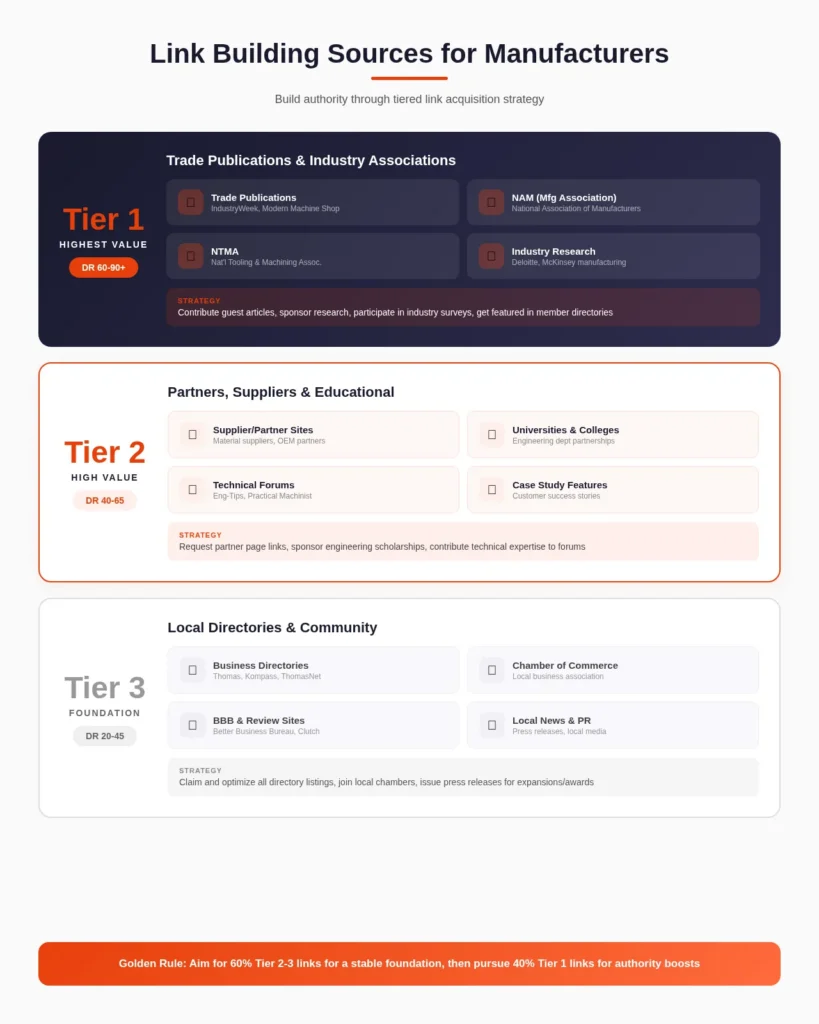
The key is shifting from a “link building” mindset to a “link earning” strategy. You don’t need to chase links — you need to create the conditions where authoritative sites want to reference your content.
Industry Associations and Trade Publications
Manufacturing is one of the most association-rich industries in existence. Organizations like SME, NTMA, PMA, AMT, and hundreds of regional manufacturing alliances maintain member directories, resource pages, and industry content hubs. Your association memberships are link building opportunities hiding in plain sight.
Here’s how to activate them:
- Claim and optimize your member directory profiles on every association you belong to. Ensure they link back to your website with accurate company information.
- Contribute technical articles to association publications and newsletters. Most welcome member-contributed content and will link to the author’s company.
- Sponsor association events or webinars and negotiate a backlink from the event page as part of the sponsorship package.
- Pitch stories to trade publications like Modern Machine Shop, The Fabricator, Plastics Technology, and Medical Design & Outsourcing. Earned media coverage from these publications carries significant domain authority.
Supplier and Partner Link Opportunities
Your supply chain is a web of business relationships, and each relationship represents a potential link. Many equipment manufacturers, material suppliers, and tooling companies maintain “customer showcase” or “case study” sections on their websites — and they’ll feature you if you ask.
If you run a specific brand of CNC equipment, contact the OEM about being featured as a customer success story. If you’re a distributor or authorized processor of specific materials, ensure the material supplier links to you on their distributor locator page. These aren’t manufactured links — they’re legitimate business relationships documented on the web.
Technical Content That Earns Links Naturally
The most sustainable link building strategy for manufacturers is creating content that’s so useful and authoritative that other sites link to it organically. Technical reference content — tolerance guides, material selection charts, DFM guidelines, and industry standards explainers — earns links because engineers and educators need to reference it.
A well-designed “Complete Guide to Surface Finish Specifications” or an interactive “Material Properties Comparison Tool” becomes a resource that engineering blogs, educational institutions, and technical forums link to repeatedly. Invest in creating one or two definitive reference pieces per year, and they’ll generate backlinks continuously.
Original research and industry data also earn links reliably. If you have manufacturing throughput data, defect rate benchmarks, or lead time trends, packaging that data into a published report positions you as a primary source that journalists and industry analysts cite.
Local SEO for Manufacturers
Many manufacturers dismiss local SEO as irrelevant — after all, you ship nationally or globally. But local search intent plays a far bigger role in manufacturing procurement than most companies realize. Buyers frequently add geographic modifiers to their searches: “injection molding company Ohio,” “precision machining near me,” or “metal fabricator Southeast.”
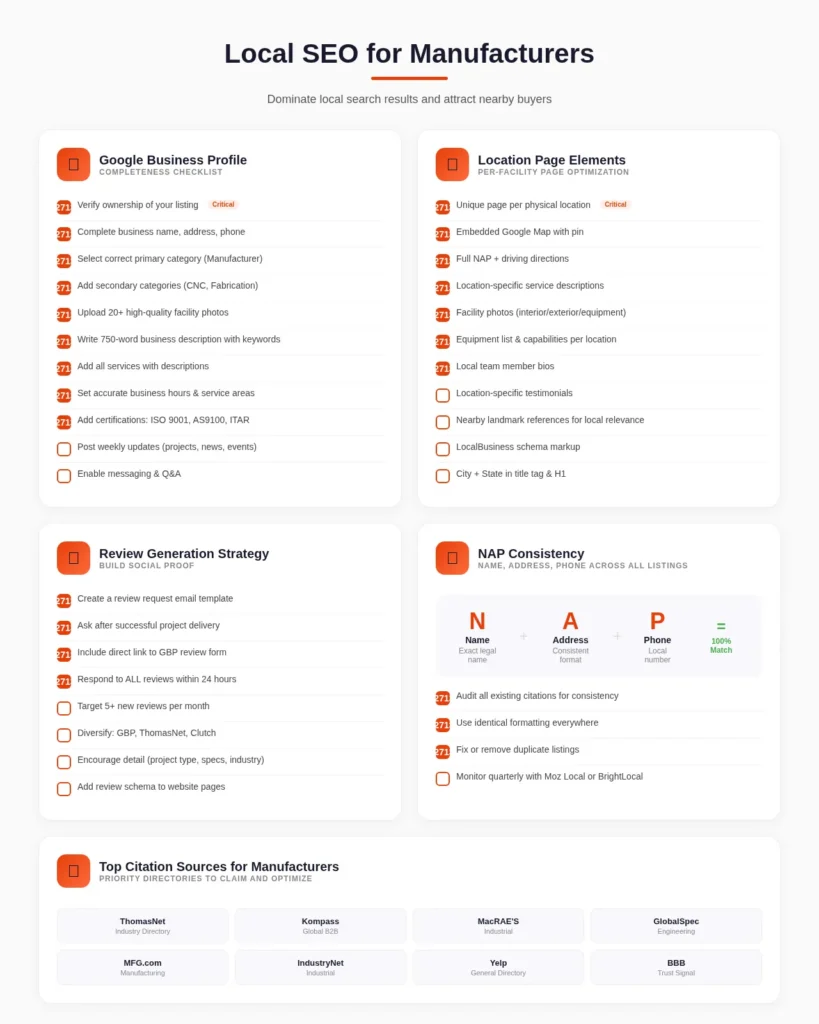
Even for manufacturers with national reach, local SEO builds a foundation of geographic relevance that strengthens your authority for non-local searches too. If you operate multiple facilities, local SEO becomes even more critical for each location.
Google Business Profile Optimization
Your Google Business Profile (GBP) is often the first impression a local buyer sees. For manufacturers, a fully optimized GBP includes far more than business hours and a phone number.
Maximize your GBP with these steps:
- Select the most specific primary category available — “Machine Shop,” “Metal Fabricator,” “Plastics Manufacturer,” etc. Add secondary categories for additional capabilities.
- Write a comprehensive business description (750 characters) that includes your primary services, certifications, industries served, and key differentiators.
- Upload high-quality photos of your facility, equipment, team, and finished products. Profiles with photos receive significantly more direction requests and website clicks.
- Actively collect and respond to Google reviews. Even in B2B manufacturing, reviews influence perception. Ask satisfied customers to leave reviews and respond professionally to every one.
- Post regular updates — new certifications earned, equipment additions, industry event participation, and hiring announcements keep your profile active and signals relevance.
Location-Specific Landing Pages and NAP Consistency
If you have manufacturing facilities in multiple locations, each location needs its own dedicated landing page with unique content — not a copy-paste of your main service page with the city name swapped in. Include location-specific details: the equipment at that facility, the certifications it holds, the industries it primarily serves, and the team that works there.
NAP (Name, Address, Phone Number) consistency across the web is fundamental to local search performance. Audit your business listings across Google, Bing, Apple Maps, industry directories, and your social profiles to ensure your company name, address, and phone number are identical everywhere. Inconsistencies confuse search engines and dilute your local ranking signals.
For manufacturers working with our SEO team, we build location-specific pages that balance local relevance with the technical depth that manufacturing buyers expect — avoiding the thin, templated location pages that Google increasingly penalizes.
Measuring Manufacturing SEO Performance
Measuring SEO for manufacturers requires a different lens than measuring SEO for an e-commerce brand. You’re not tracking add-to-cart rates — you’re tracking RFQ submissions, engineering consultation requests, and pipeline influenced by organic search over cycles that can span months.

The measurement framework needs to account for the reality of B2B manufacturing sales: long cycles, multiple stakeholders, and conversion events that often happen offline (a phone call, a plant visit, a quote negotiation). B2B digital marketing demands this kind of nuanced attribution.
The KPIs That Actually Matter
Vanity metrics like total organic traffic or keyword count give you a dashboard that looks impressive but tells you nothing about revenue impact. Focus on these KPIs instead:
- Organic RFQ/quote submissions: The most direct measure of SEO driving business outcomes. Track form submissions from organic traffic specifically.
- Organic traffic to capability and product pages: Not all pages are equal. Traffic to your “5-Axis CNC Machining” page matters more than traffic to your “About Us” page.
- Keyword rankings for commercial-intent terms: Track your Tier 2 and Tier 3 keywords specifically. Ranking #1 for “what is CNC machining” is nice; ranking #3 for “aerospace CNC machining services” is revenue.
- Organic traffic quality: Monitor bounce rate, pages per session, and time-on-site for organic visitors compared to other channels. Engaged visitors who view multiple capability pages signal qualified traffic.
- Click-through rate from search results: Low CTR despite good rankings indicates your title tags and meta descriptions need optimization.
Attribution in Long B2B Sales Cycles
Manufacturing sales cycles average 130 days according to Focus Digital research. A prospect who finds your site through organic search in January may not submit an RFQ until March and not close until June. Last-click attribution massively undervalues SEO’s contribution to manufacturing revenue.
Implement multi-touch attribution that tracks the full buyer journey:
- First-touch tracking: Use UTM parameters and CRM integration to record the first channel that brought each contact to your site.
- Assisted conversions: Google Analytics 4’s attribution models show when organic search plays a role earlier in the conversion path, even when the final conversion comes through direct traffic or a paid ad.
- CRM source tracking: Ensure your CRM (HubSpot, Salesforce, etc.) captures the original lead source and preserves it through the entire sales cycle. When a $500,000 contract closes, you need to know that it started with an organic search six months ago.
- Phone call tracking: Many manufacturing leads convert via phone call. Use dynamic number insertion to attribute phone calls to organic search sessions.
Competitive Benchmarking
Measuring your own performance in isolation gives you an incomplete picture. Competitive benchmarking reveals whether you’re gaining or losing ground against the manufacturers you compete with for the same contracts.
Track your competitors’ organic visibility for your target keywords, monitor their content publishing frequency, and audit their backlink growth. Tools like Ahrefs, SEMrush, and Moz let you compare domain authority, keyword overlap, and traffic trends. If a competitor is outranking you for a critical keyword, reverse-engineer their page to understand what they’re doing differently — then build something better.
Competitive benchmarking also reveals content gaps. If competitors rank for terms you haven’t targeted yet, those gaps represent immediate opportunities to create content and claim market share.
How to Get Started With Manufacturing SEO
You don’t need a 12-month roadmap to start seeing results from manufacturing SEO. Certain actions deliver outsized impact in the first 30 to 90 days, while larger structural improvements build momentum over time.
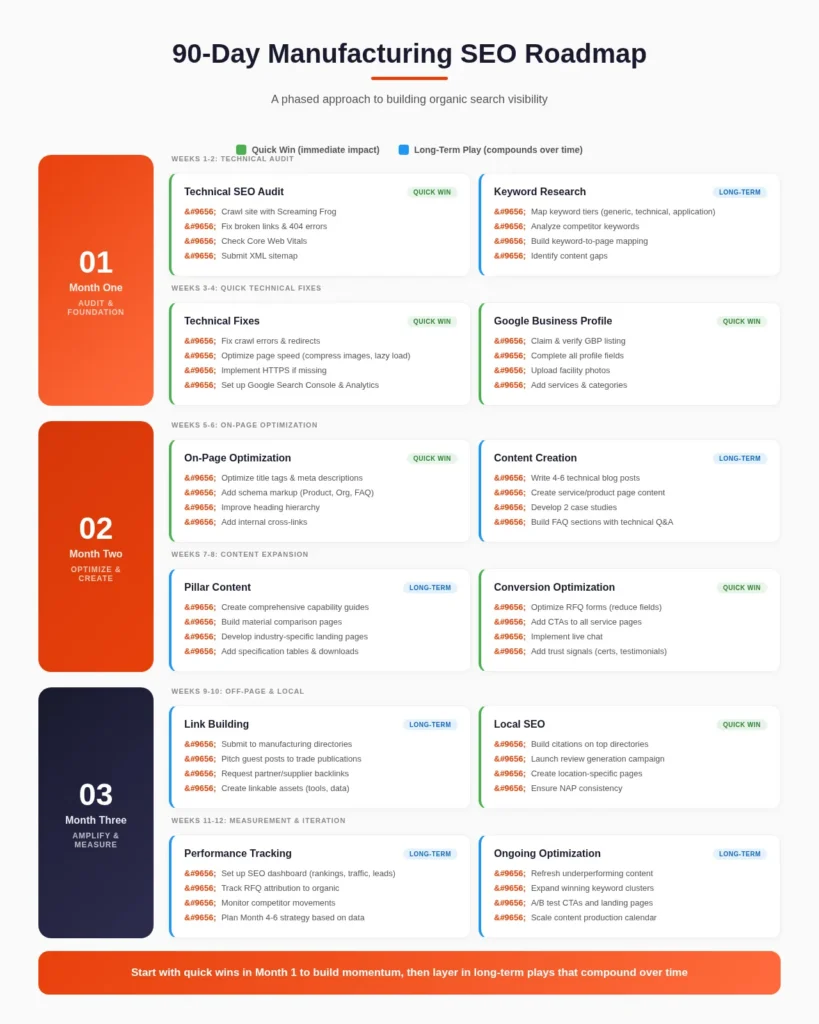
The approach that works best for manufacturers combines quick wins that generate early results with foundational investments that compound over quarters and years.
Quick Wins for Immediate Impact
These actions can move the needle within the first month and require no major technical overhauls:
- Optimize your top 10 product and service pages: Update title tags, meta descriptions, H1 headings, and first-paragraph copy to include your target keywords naturally. Add 200-500 words of additional technical content to thin pages.
- Claim and optimize your Google Business Profile: Complete every field, add photos, select the right categories, and post an update. This can improve local visibility within days.
- Fix technical errors in Google Search Console: Log in, address any crawl errors, submit your sitemap, and fix pages with coverage issues. These are often easy fixes with immediate indexation improvements.
- Create one high-value piece of content: Pick your most-asked sales question and write a comprehensive answer. One 2,000-word guide targeting a Tier 2 keyword can generate organic traffic within weeks of publishing.
- Internal linking audit: Add internal links from your blog posts and resource pages to your core capability pages. This distributes link equity and helps search engines understand your site’s priority pages.
In-House vs. Agency: Making the Right Choice
The decision to handle manufacturing SEO in-house or partner with an agency depends on three factors: your team’s digital marketing expertise, the scale of your SEO needs, and the speed at which you need results.
In-house SEO works when you have a dedicated digital marketing professional who understands both SEO and your manufacturing processes. The advantage is deep institutional knowledge — no one understands your products, customers, and competitive landscape better than your team. The challenge is that SEO requires specialized technical skills in areas like site architecture, schema markup, and link building that generalist marketers rarely possess.
An agency like Chatter Buzz Media brings specialized SEO expertise, established toolsets, and experience across multiple manufacturing clients. We’ve seen what works in aerospace, medical device, industrial automation, and contract manufacturing — and we bring those insights to every engagement. For many manufacturers, the hybrid model works best: internal marketing leadership directing strategy with an agency providing SEO execution and technical expertise.
Research from multiple industry sources consistently shows that 57% of B2B companies say SEO generates more leads than any other marketing channel. Whether you build the capability in-house or partner with specialists, the investment in manufacturing SEO delivers returns that compound over time.
If you need executive marketing leadership to oversee both in-house and agency efforts, a fractional CMO can bridge the gap — providing strategic direction without the overhead of a full-time hire.
Frequently Asked Questions About Manufacturing SEO
What is manufacturing SEO?
Manufacturing SEO is the practice of optimizing a manufacturer’s website to rank higher in search engine results for terms that industrial buyers use when searching for products, services, materials, and capabilities. It encompasses keyword research tailored to technical and industrial terminology, on-page optimization of product and capability pages, technical SEO for complex product catalogs, content creation for engineering and procurement audiences, and link building through industry-specific channels.
Unlike general SEO, manufacturing SEO must account for highly technical vocabulary, long sales cycles, multiple decision-makers, and a buying process that often spans months.
How long does manufacturing SEO take to show results?
Most manufacturers see initial improvements in keyword rankings within 3 to 6 months of implementing a structured SEO strategy. Meaningful lead generation from organic search typically begins at the 6 to 12 month mark.
The timeline depends on your starting point. A manufacturer with an established website, some domain authority, and existing content will see results faster than a company launching a new website. Quick wins like optimizing existing pages and fixing technical errors can produce ranking improvements within weeks, while new content and link building strategies take longer to mature.
What keywords should manufacturers target?
Manufacturers should target a mix of generic capability terms, technical specification terms, and application-specific long-tail keywords. Start with the language your actual customers use in RFQs and sales conversations.
High-priority keywords for most manufacturers include: specific manufacturing processes (e.g., “wire EDM services”), material-specific searches (e.g., “Inconel 718 machining”), certification-related queries (e.g., “ITAR registered machine shop”), and geographic-modified service terms (e.g., “precision machining company Midwest”). Your most valuable keywords will be the ones that match the specific capabilities and industries where you compete.
How much does manufacturing SEO cost?
Manufacturing SEO programs typically range from $3,000 to $15,000 per month depending on scope, competitiveness, and the size of your website. A mid-market manufacturer with 100-500 product pages and moderate competition should budget $5,000 to $8,000 per month for a comprehensive SEO program that includes technical optimization, content creation, and link building.
Consider the cost in context: at an average of $31 per organic lead compared to $811 per trade show lead, SEO delivers dramatically better cost efficiency. Most manufacturers see positive ROI within 12 to 18 months, with returns accelerating over time as content and link equity compound.
Should manufacturers focus on local SEO?
Yes — even manufacturers that serve national or international markets benefit from local SEO. Many industrial buyers include geographic terms in their searches, either explicitly (“metal stamping company Texas”) or through location-influenced results on Google.
Local SEO is especially important for manufacturers with multiple facilities, those serving industries where proximity matters for logistics (heavy fabrications, just-in-time delivery), and companies competing in regions with dense manufacturing clusters. At minimum, every manufacturer should optimize their Google Business Profile and ensure NAP consistency across the web.
How does manufacturing SEO differ from B2C SEO?
Manufacturing SEO differs from B2C SEO in several fundamental ways. The keywords are more technical, the content must be more detailed, the sales cycles are dramatically longer, and conversion events are often offline (phone calls, plant visits, quote negotiations).
B2C SEO typically focuses on high-volume transactional keywords and optimizing for immediate conversions. Manufacturing SEO targets lower-volume, high-intent keywords and optimizes for lead generation that feeds a multi-month sales process involving multiple stakeholders. Attribution is more complex, content must demonstrate genuine technical expertise, and the competitive landscape often includes industry-specific directories and marketplaces like Thomasnet.
Can manufacturers do SEO in-house or should they hire an agency?
Both approaches can work, and many successful manufacturers use a hybrid model. In-house teams bring deep product knowledge and can produce technical content that resonates with engineers. Agencies bring specialized SEO expertise, established toolsets, and cross-industry experience.
The critical question is whether you have the specialized skills internally. Effective manufacturing SEO requires digital marketing expertise in technical SEO, content strategy, link building, and analytics — skills that most manufacturing marketing teams don’t have in-house. If your internal team has strong product knowledge but limited SEO expertise, partnering with an agency that specializes in industrial and B2B SEO typically delivers faster results and better ROI than building the capability from scratch.
Ready to Rank for the Industrial Terms That Drive Revenue?
Your competitors are investing in manufacturing SEO right now. Every month you wait, they’re building domain authority, publishing content, and capturing the organic search traffic that should be driving your pipeline.
You don’t need to figure this out alone. At Chatter Buzz Media, we specialize in SEO for manufacturing companies — from precision machining shops to large-scale industrial OEMs. We understand your industry because we’ve spent years learning the technical language, the buying processes, and the competitive dynamics that make manufacturing SEO unique.
Whether you need a full-scale SEO program or a focused audit to identify your biggest opportunities, we’re ready to help you build the organic visibility that generates qualified leads, fills your pipeline, and drives revenue growth.
Contact our team today to schedule a free manufacturing SEO assessment. We’ll analyze your current rankings, identify your highest-value keyword opportunities, and show you exactly what it takes to outrank your competition in the searches that matter most.