
 321-236-2899
Every day, hundreds of homebuyers in your market type “new homes in [city]” into Google — and they never find you. Your competitors show up in the map pack, dominate the first page, and capture leads before buyers even know your communities exist.
That invisibility costs you real closings and real revenue, and it compounds every month you ignore it.
Home builder SEO is how you fix that. It is the discipline of structuring your website, content, and local presence so that Google connects buyers with your communities, floor plans, and model homes at exactly the moment they are searching.
97% of homebuyers use the internet during their search, and 78% of real estate searches begin with a search engine. If your builder website does not rank, you are handing those buyers to someone who does.
At Chatter Buzz Media, we have helped builders across multiple markets turn organic search into their most predictable lead channel. This guide walks you through everything — from technical foundations to community page optimization to AI search readiness — so you can build a home builder SEO strategy that ranks every page that matters.
Key Takeaways
- Community pages are your highest-leverage SEO asset. Most builders publish thin, duplicate community pages that Google ignores. Unique, content-rich community pages with proper schema markup can rank for dozens of local keywords each.
- Local SEO drives the map pack visibility that generates phone calls. Google Business Profile optimization, consistent citations, and a steady flow of reviews determine whether buyers see you first — or see your competitors.
- Technical SEO failures silently kill your rankings. Slow load times, poor mobile experience, and crawlability issues prevent Google from indexing your best pages. Fix the foundation before investing in content.
- Content strategy must mirror the buyer journey. Homebuyers research for months. Topic clusters that cover awareness, consideration, and decision stages build authority and capture traffic at every stage.
- SEO compounds — the ROI accelerates over time. Real estate SEO delivers above 1,300% ROI after three years. Every month of delay means more compounding value lost to competitors.
Why Home Builder SEO Is Different from General SEO
General SEO advice falls apart the moment you apply it to home building. The purchase cycle, the local dynamics, and the visual nature of the product create a search landscape that demands specialized strategy.
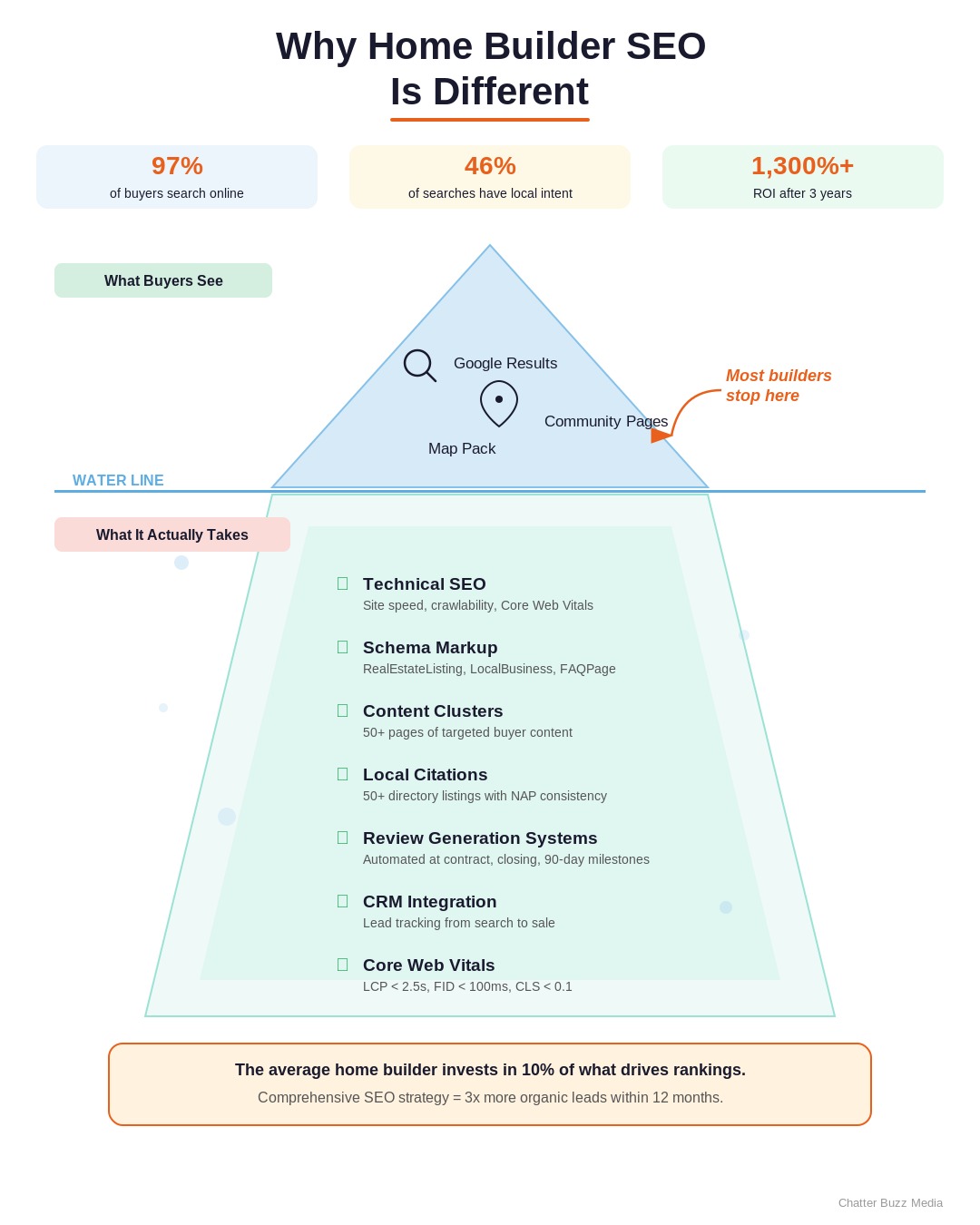
Understanding these differences is not academic — it determines whether your SEO for home builders investment pays off or wastes budget. Let us break down the three forces that make builder SEO unique.
The Local-First Reality
46% of all Google searches have local intent, and for home builders, that number is even higher. Nobody searches “buy a new construction home” without a city, county, or neighborhood in mind.
This means your site architecture must be built around geography from day one. Every community, every market, every service area needs its own optimized landing page — not a filtered view of a master list.
Home builder local SEO also means competing in the map pack, where Google Business Profile signals dominate. Builders operating across multiple markets face a unique challenge: managing dozens of GBP listings while maintaining NAP consistency across every citation source.
If your digital presence treats location as an afterthought, Google treats your site the same way. Local-first means local-everywhere — in your URLs, your content, your schema, and your link profile.
Long Sales Cycles and High-Value Transactions
A typical homebuyer spends four to six months researching before making a purchase decision. That is not a single search session — it is dozens of searches across multiple intent stages, from “best neighborhoods for families in [city]” to “builder reviews [community name]” to “move-in ready homes [zip code].”
Your SEO strategy must capture attention at every stage of that journey. A builder who only ranks for branded terms misses the 80% of searches where buyers have not yet decided who to buy from.
The transaction value also changes the math. When a single organic lead can generate $300,000 to $800,000 in revenue, even modest improvements in organic traffic produce outsized returns.
This is why real estate SEO delivers above 1,300% ROI after three years of consistent investment.
Visual-Heavy Buyer Journeys
Homebuyers do not just read — they browse floor plans, scroll through model home galleries, watch virtual tours, and study community renderings. Visual search and image SEO matter more in home building than in almost any other B2B vertical.
Google Image Search, visual results in AI Overviews, and Pinterest all drive qualified traffic to builders who optimize their visual assets. Yet most builder websites serve uncompressed, poorly tagged images that slow load times and rank for nothing.
Every rendering, every photo, and every virtual tour is a ranking opportunity. Descriptive file names, alt text with location and floor plan details, structured data for property listings, and next-gen image formats (WebP) transform visual assets from bandwidth drains into traffic drivers.
Now that you understand what makes builder SEO unique, let us build the strategy that takes advantage of it.
How to Build a Home Builder SEO Strategy That Ranks
A home builder SEO strategy is not a list of tactics — it is an integrated system where technical infrastructure, keyword targeting, and on-page optimization reinforce each other. Skip any layer and the others underperform.
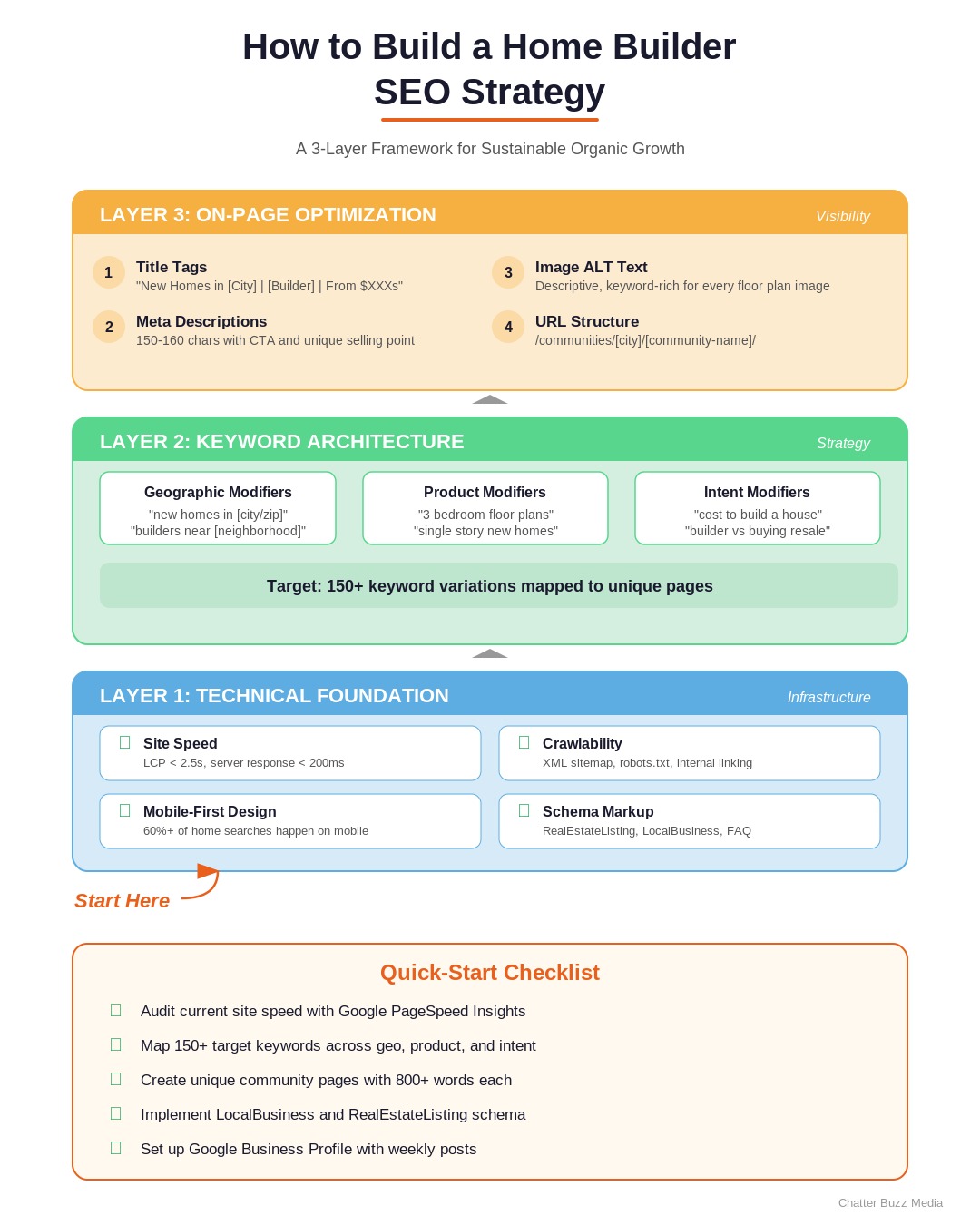
We will walk through the three foundational layers in order. Get these right, and every piece of content and every local optimization you add afterwards produces compounding results.
Start with a Technical Foundation
Before you write a single word of content, your website must be crawlable, indexable, and fast. Google cannot rank pages it cannot find, and page load times over 3 seconds increase bounce rates by 32%.
Run a technical audit that checks for broken internal links, orphaned pages, redirect chains, duplicate content from CMS templates, and XML sitemap accuracy. Builder websites — especially those using MLS integrations or custom listing feeds — are notorious for generating thousands of thin, duplicate pages that dilute crawl budget.
Your hosting environment matters, too. Builders in competitive markets should invest in a CDN, server-side caching, and image optimization pipelines.
The payoff is faster load times, better Core Web Vitals scores, and measurably higher rankings. For a deeper dive into the technical requirements, our manufacturing SEO guide covers many of the same technical foundations that apply to builder websites.
Keyword Research for Home Builders
Keyword research for builders follows a different pattern than most industries. You are not just targeting product keywords — you are targeting geography + intent + product type combinations that multiply across every market you serve.
Start by mapping your keyword universe across three dimensions:
- Geographic modifiers: City, county, neighborhood, zip code, school district, subdivision name — every geographic layer creates new keyword opportunities.
- Product modifiers: New construction homes, single-family homes, townhomes, active adult communities, luxury homes, move-in ready homes, custom homes.
- Intent modifiers: “For sale,” “prices,” “reviews,” “floor plans,” “vs [competitor],” “near [landmark],” “with [feature].”
A builder operating in five markets with three product types and ten intent variations has 150+ primary keyword targets before accounting for long-tail variations. Map these to specific pages on your site so every keyword has a clear ranking target.
Long-tail keywords like “how to rank a home builder website” or “new construction homes with first-floor master [city]” often convert better than broad terms because they signal a buyer who knows what they want. Prioritize these in your blog and FAQ content.
On-Page SEO Essentials
On-page optimization for builder website SEO requires precision. Each page needs a unique title tag that includes the primary keyword and location, a meta description that drives clicks, and header tags that create a logical content hierarchy.
Follow this checklist for every key page:
- Title tag: Primary keyword + location + brand (under 60 characters). Example: “New Homes in Windermere, FL | [Builder Name]”
- Meta description: Value proposition + call to action (under 155 characters). Include the community name and a differentiator.
- H1 tag: One per page, includes primary keyword naturally.
- Internal links: Every page links to at least 2-3 related pages on your site, using descriptive anchor text — not “click here.”
- Image optimization: Descriptive file names (not IMG_4582.jpg), alt text with keyword + location, WebP format, lazy loading enabled.
- URL structure: Clean, keyword-rich slugs like /communities/windermere-estates/ — not /page?id=4827.
These are not optional refinements — they are baseline requirements. Without them, even the best content struggles to rank against competitors who execute the fundamentals consistently.
With your technical and on-page foundations set, let us focus on the single biggest ranking opportunity most builders overlook: community pages.
Community Page SEO — Your Biggest Ranking Opportunity
Here is a truth that most builders have not internalized: your community pages are your most valuable SEO assets. They target high-intent, geo-specific keywords that buyers use when they are actively ready to visit a model home or schedule a tour. Yet the vast majority of builder community pages are thin, templated, and invisible to Google.
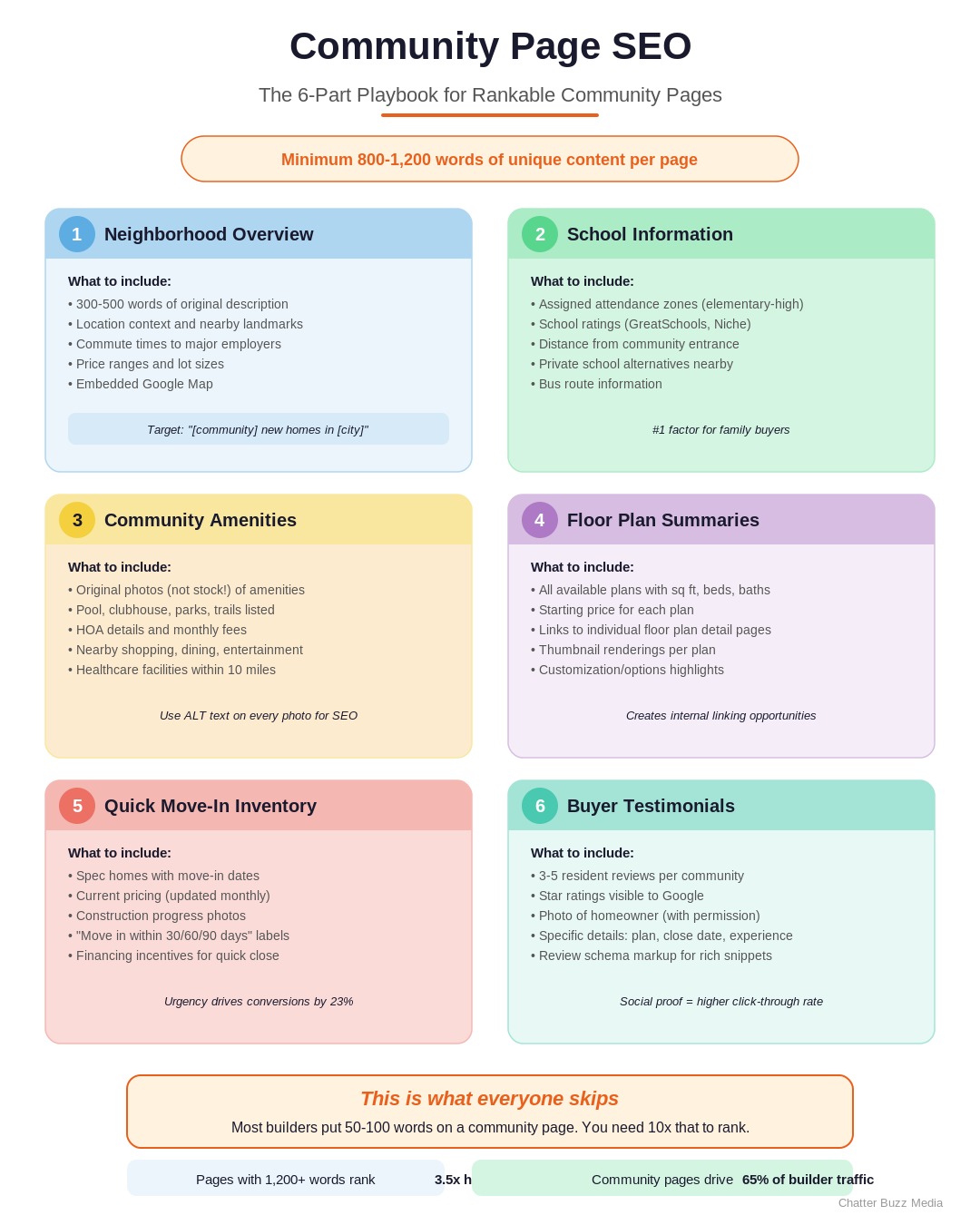
This section is the competitive gap we see most often — and it represents the fastest path to ranking improvements for any builder willing to invest in unique community content.
Why Generic Community Pages Fail
Most builder websites generate community pages from a CMS template that auto-populates a community name, a price range, a list of floor plans, and a Google Map embed. The result is dozens of pages with nearly identical content structures, minimal unique text, and no reason for Google to rank any of them.
Google’s helpful content system rewards pages that provide unique, substantial value to searchers. A page that says “Beautiful new homes from the $400s” with a bulleted feature list does not meet that bar — especially when every other builder in the market publishes the same format.
The penalty is not dramatic — it is quiet. These pages simply do not rank.
They sit on page five or deeper, invisible to the 99.37% of searchers who never scroll past position 20. Your competitors who invest in unique community content absorb that traffic instead.
What a Rankable Community Page Looks Like
A community page that ranks treats each subdivision as its own micro-market and answers every question a buyer might ask before visiting. Here is what we recommend including:
- Neighborhood overview (300-500 words): Describe the lifestyle, the surroundings, proximity to employers, schools, shopping, and recreation. Use natural language a buyer would search — “10 minutes from downtown Orlando” not “conveniently located.”
- School information: Name the specific schools in the attendance zone with ratings. Parents search for homes by school district constantly.
- Community amenities: Pools, trails, playgrounds, clubhouses — with original photos, not stock images.
- Floor plan summaries: Brief descriptions of each available plan with square footage, bedroom/bathroom count, and starting price. Link to individual floor plan pages.
- Quick move-in inventory: A dedicated section for completed or near-complete homes. This captures high-intent “move-in ready homes [community name]” searches and creates urgency.
- Embedded map and driving directions: From major highways, landmarks, and employment centers.
- Buyer testimonials: Reviews from homeowners who already live in the community add social proof and unique content that no competitor can replicate.
Each community page should contain a minimum of 800-1,200 words of unique content. That investment pays dividends because a single well-optimized community page can rank for dozens of keyword variations simultaneously.
Schema Markup for Communities and Listings
Structured data is the difference between a standard blue-link result and a rich result that displays price ranges, availability, and ratings directly in the SERP. For builder community pages, implement these schema types:
- RealEstateListing schema: Mark up individual homes and floor plans with price, square footage, number of bedrooms and bathrooms, and availability status.
- Place schema: Define the community as a geographic entity with coordinates, description, and amenities.
- Review/AggregateRating schema: Display star ratings in search results from verified buyer reviews.
- FAQPage schema: Mark up community-specific FAQs to earn expanded SERP real estate.
Validate your markup using Google’s Rich Results Test before deploying. Incorrect schema can trigger manual actions, and builder websites with dynamic listing feeds need ongoing monitoring to ensure structured data stays accurate as inventory changes.
Community pages generate the geo-specific traffic. Now let us look at how local SEO for home builders amplifies that visibility through the map pack.
Local SEO for Home Builders — Dominating the Map Pack
The Google Map Pack appears above organic results for nearly every “new homes near me” and “home builders in [city]” query. For builders, map pack visibility drives phone calls, direction requests, and model home visits at a rate that organic listings alone cannot match.
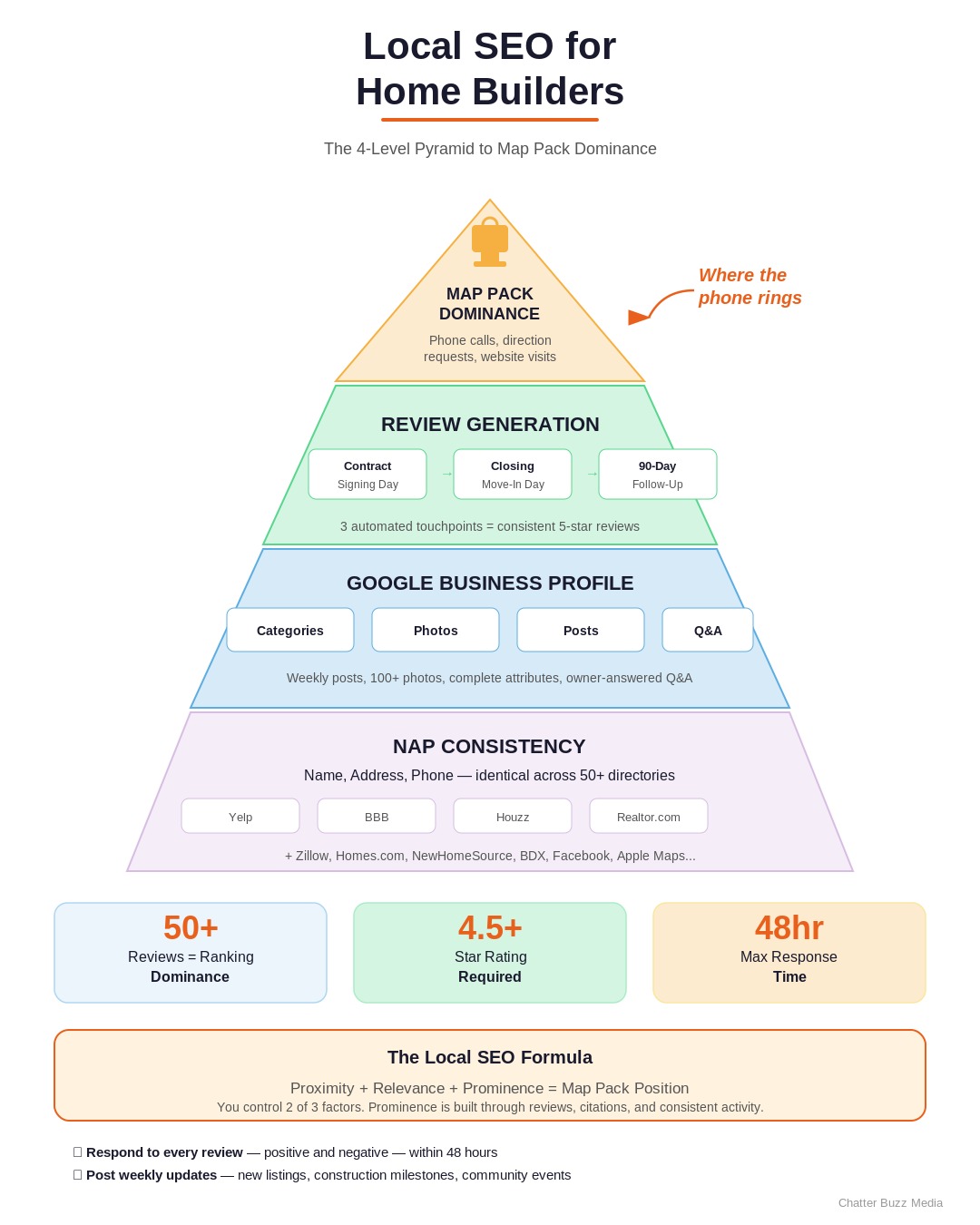
Home builder local SEO requires managing multiple locations, maintaining citation accuracy across dozens of directories, and generating reviews at a pace that signals trust to both Google and buyers.
Google Business Profile Optimization
Your Google Business Profile (GBP) is the single most important local ranking factor. For builders with model homes or sales centers, each physical location should have its own verified GBP listing.
Optimize each profile with these elements:
- Primary category: “Home Builder” — do not use generic categories like “Real Estate Agency.”
- Secondary categories: Add “Real Estate Developer,” “Construction Company,” and “Model Home” where applicable.
- Business description: 750 characters that include your primary keyword, markets served, and key differentiators.
- Photos and videos: Upload 20+ high-quality images of model homes, communities, and finished projects. Google prioritizes profiles with fresh visual content.
- Posts: Publish weekly GBP posts highlighting new communities, quick move-in specials, open house events, and buyer testimonials.
- Q&A: Seed your Q&A section with common buyer questions and detailed answers before the public does.
Multi-market builders face a specific challenge: managing 10, 20, or 50+ GBP listings while keeping information accurate and fresh. Invest in a local SEO management platform or work with an agency like Chatter Buzz that specializes in multi-location management.
Local Citations and NAP Consistency
NAP stands for Name, Address, Phone Number — and inconsistency across directories is one of the most common local SEO killers for builders. When your sales center address appears differently on Zillow, Realtor.com, your website, and your GBP listing, Google loses confidence in your location data.
Audit your citations across the top 50 directories, including real estate-specific platforms like Zillow, Realtor.com, NewHomeSource, and BDX. Standardize every listing to match your GBP exactly — same suite numbers, same phone format, same legal business name.
For builders who open and close communities regularly, citation management is ongoing. When a sales center moves or a community sells out, outdated listings persist unless you actively suppress or update them. Stale citations confuse Google and frustrate buyers.
Review Generation That Compounds
Reviews are both a ranking factor and a conversion factor. Builders with 50+ reviews and a 4.5+ star rating dominate local results and earn more clicks from buyers who use reviews as a trust signal.
Build a systematic review generation process tied to your sales milestones:
- At contract signing: Send a personalized email thanking the buyer and asking for a Google review about the buying experience.
- At closing: Follow up with a review request focused on the build quality and communication.
- At 90 days post-move-in: Request a review about living in the community — this generates the neighborhood-specific content that helps community pages rank.
Respond to every review — positive and negative — within 48 hours. Google tracks response rates, and buyers read your responses as carefully as they read the reviews themselves.
A builder who handles criticism professionally earns more trust than one with perfect ratings and no engagement.
Local visibility puts you on the map. Now let us build the content engine that captures buyers at every stage of their journey.
Content Strategy for Home Builder Websites
Content is the fuel that powers new construction SEO over the long term. A builder website with only community pages and floor plans hits a ranking ceiling quickly.
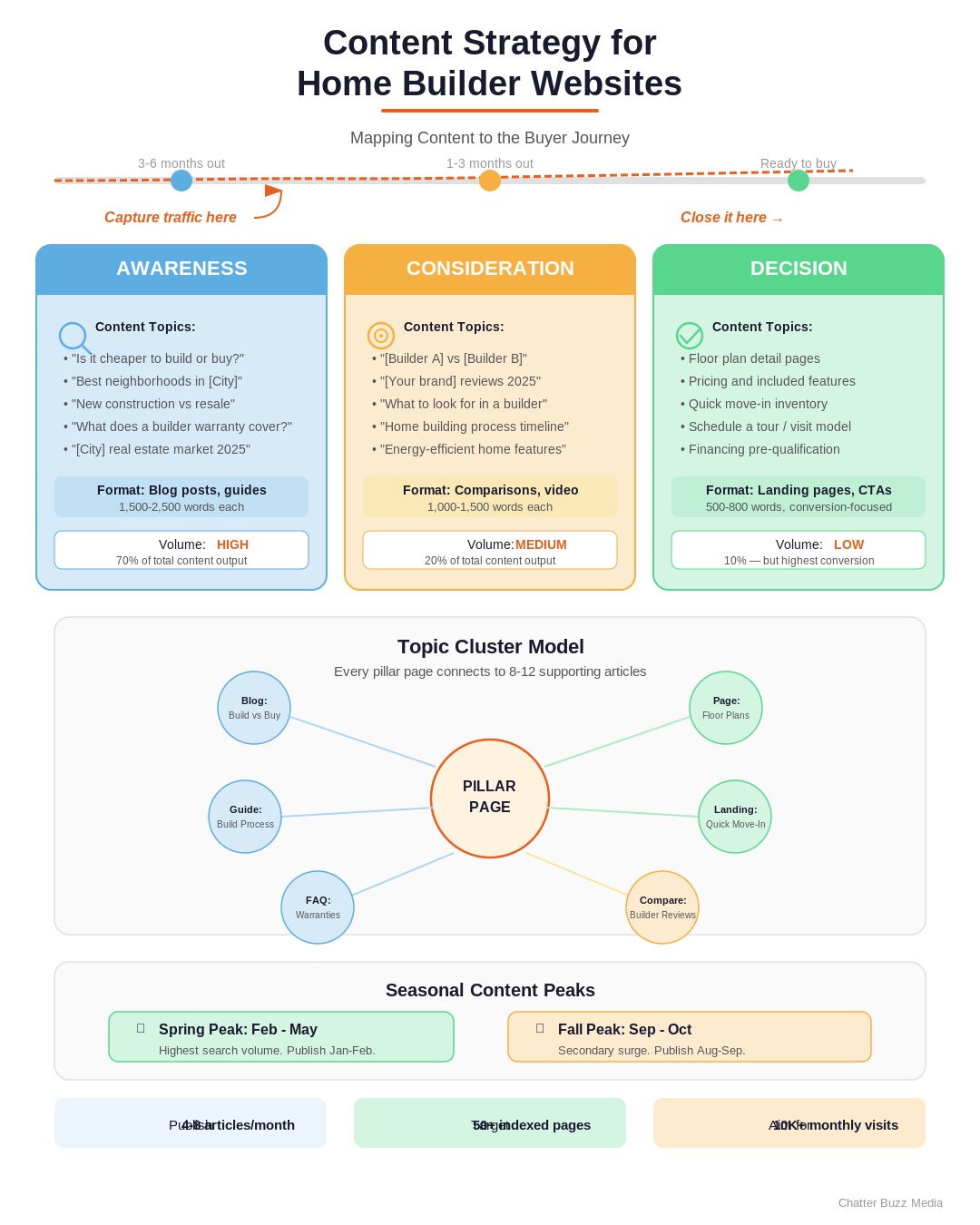
Strategic content — organized into topic clusters — expands your keyword footprint, builds topical authority, and captures buyers months before they are ready to visit a model home.
The key is aligning your content calendar with the buyer journey and inbound marketing principles that turn anonymous traffic into qualified leads.
Topic Clusters That Build Authority
Google rewards websites that demonstrate deep expertise on a topic. For builders, that means organizing content into hub-and-spoke topic clusters around your core themes.
Here is a cluster structure we recommend for builders:
- Cluster 1 — Buying a New Construction Home: Pillar page on the buying process, supported by articles on financing, design selections, builder vs. resale comparisons, inspection checklists, and closing timelines.
- Cluster 2 — [City/Market] Living: Pillar page on living in your primary market, with supporting content on neighborhoods, schools, employers, lifestyle, and cost of living.
- Cluster 3 — Home Design and Features: Pillar page on design trends, with articles on energy efficiency, smart home technology, outdoor living, aging-in-place features, and popular floor plan layouts.
- Cluster 4 — Builder Comparisons: Content that positions your brand against competitor alternatives and educates buyers on how to evaluate builders.
Every article in a cluster links to the pillar page and to related articles within the same cluster. This internal linking structure tells Google that your site has comprehensive, interconnected expertise — not just a collection of disconnected blog posts.
Blog Content That Captures Every Stage of the Buyer Journey
Map your content calendar to the three buyer journey stages, and you will capture traffic from early researchers through ready-to-buy decision makers.
- Awareness stage: “Is it cheaper to build or buy in [city]?” / “Best neighborhoods for families in [county]” / “New construction vs. resale homes.” These articles target high-volume informational keywords and introduce your brand to buyers who are 3-6 months from a purchase.
- Consideration stage: “What to look for in a new home builder” / “[Builder Name] reviews” / “Energy-efficient home features that save money.” These pieces target mid-funnel buyers comparing options.
- Decision stage: “Quick move-in homes in [community]” / “How to schedule a model home tour” / “[Community Name] floor plans and pricing.” These pages target buyers who are ready to act.
Seasonal content adds another dimension. The spring selling season (February through May) and fall surge (September through October) are peak search periods.
Publish seasonally relevant content 6-8 weeks before each peak to give Google time to index and rank it.
Plan content around events like back-to-school (drives family relocation searches), tax season (drives financial planning queries), and year-end (drives inventory clearance searches for quick move-in homes). This marketing strategy for home builders covers additional seasonal and campaign-level planning.
Floor Plan and Model Home Pages That Convert
Floor plan pages are where SEO meets sales. These pages attract high-intent traffic — buyers searching for specific square footage ranges, bedroom counts, or features — and they must convert that traffic into tour requests or contact form submissions.
Each floor plan page should include:
- Unique description (200-400 words): Describe the layout, the lifestyle it supports, and who it is designed for. “The Belmont’s open-concept layout connects the kitchen island to a covered lanai, designed for families who entertain” tells a story that a spec sheet cannot.
- Floor plan image with interactive elements: Clickable room labels, virtual walk-throughs, and 3D renderings increase time on page — a signal Google interprets as content quality.
- Pricing and availability: Always current. Outdated pricing erodes trust and triggers bounces.
- RealEstateListing schema: Structured data that helps Google display your floor plans in rich results with price and specifications.
- Related communities: Link to every community where this plan is available, creating a cross-linking network that strengthens both the floor plan page and the community pages.
Model home pages follow the same principles but add appointment scheduling, virtual tour embeds, and visitor testimonials. Optimize these pages for “[floor plan name] model home [city]” queries that buyers use when they are ready to visit in person.
Great content attracts visitors, but to rank against established competitors, you also need backlinks. Let us cover link building for builders.
Link Building for Home Builders
Backlinks remain one of Google’s strongest ranking signals. For builders, link building is less about outreach campaigns and more about leveraging the relationships you already have — with trade partners, local organizations, and media outlets.
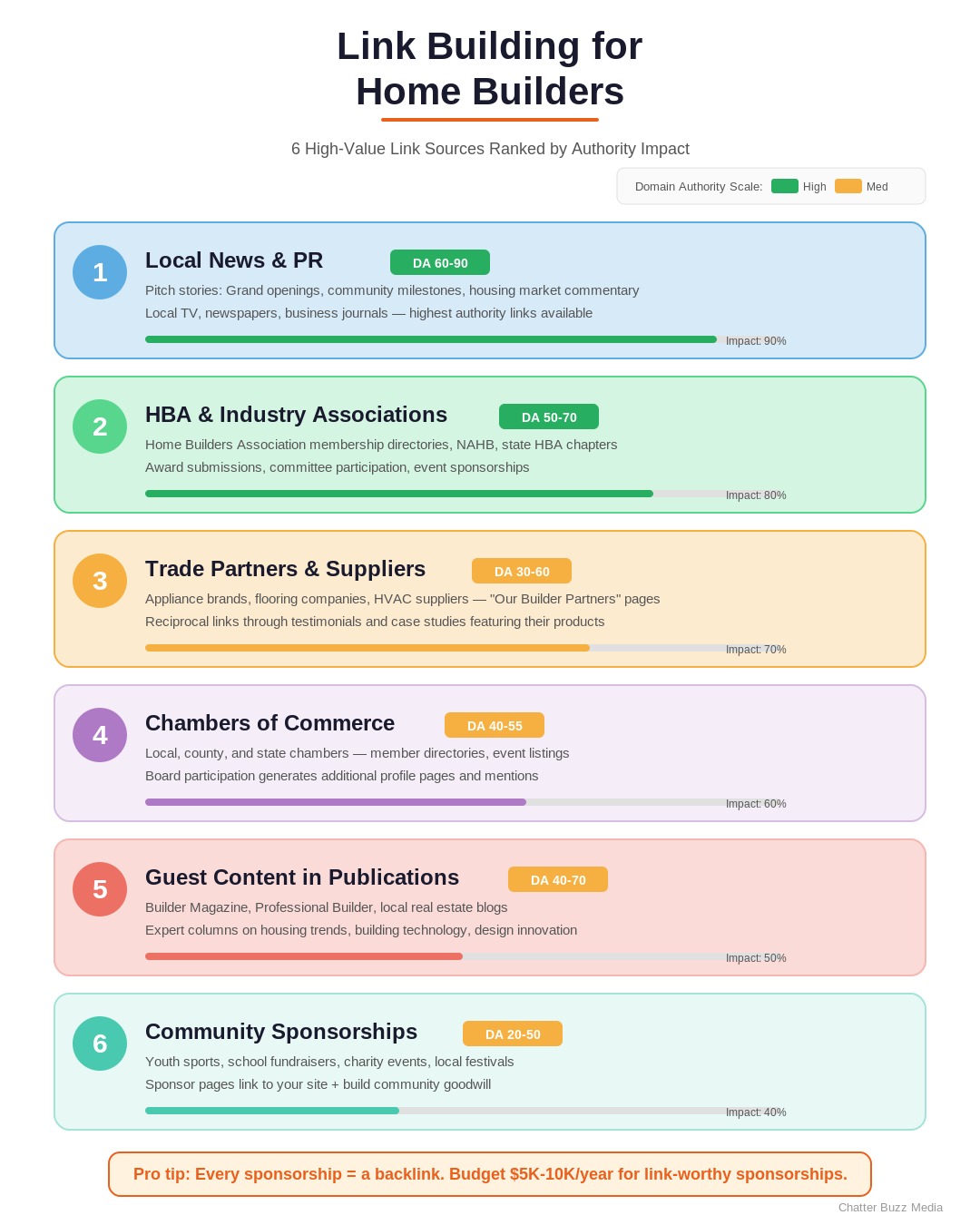
The builders who win at link building treat it as an extension of their community involvement, not as a separate marketing tactic. Here are the three strategies that consistently produce results.
Trade Partnerships and Supplier Links
Every builder works with dozens of trade partners, suppliers, and vendors — and each of those companies has a website. Request links from partner pages, case study features, and “builders we work with” directories.
These links carry relevance signals because they come from closely related industry domains.
Start with your top 20 trade partners: flooring suppliers, cabinet manufacturers, HVAC contractors, appliance brands, and design center partners. Ask if they feature builder partners on their website or if they accept case studies showcasing your projects.
Most will say yes because the content benefits both parties.
Local PR and Community Involvement
Builders are natural community anchors. Sponsor local events, youth sports teams, charity home builds, and school programs — and make sure every sponsorship includes a link back to your website from the organization’s sponsors page.
Local PR generates links from news outlets. Grand openings, community groundbreakings, design award wins, and milestone closings all produce press coverage.
Write and distribute press releases for every significant milestone. A link from a local newspaper or business journal carries significant domain authority and sends strong local relevance signals to Google.
Chambers of commerce, home builder associations (local HBA chapters), and economic development organizations all maintain member directories that provide authoritative local links. Join and claim every listing.
Guest Content and Industry Publications
Builder executives have expertise that industry publications want. Pitch articles to publications like Builder Magazine, Professional Builder, NewHomeSource’s builder blog, and local real estate publications.
Each published article earns a backlink from a high-authority domain.
Focus guest content on topics that showcase your expertise without being promotional: design trends, construction innovations, market insights, or sustainability initiatives. The link in your author bio or company mention drives authority to your domain while positioning your leadership team as industry thought leaders.
Our B2B demand generation guide covers additional strategies for building authority and generating inbound interest through content partnerships.
Links build authority, but if your technical foundation has cracks, that authority leaks. Let us run through the technical SEO checklist every builder website needs.
Technical SEO Checklist for Builder Websites
Technical SEO is the infrastructure layer that determines whether Google can find, crawl, understand, and rank your pages. Builder websites face specific technical challenges that most general SEO guides do not address — dynamic listing feeds, multi-market architectures, and heavy visual assets that strain page speed.
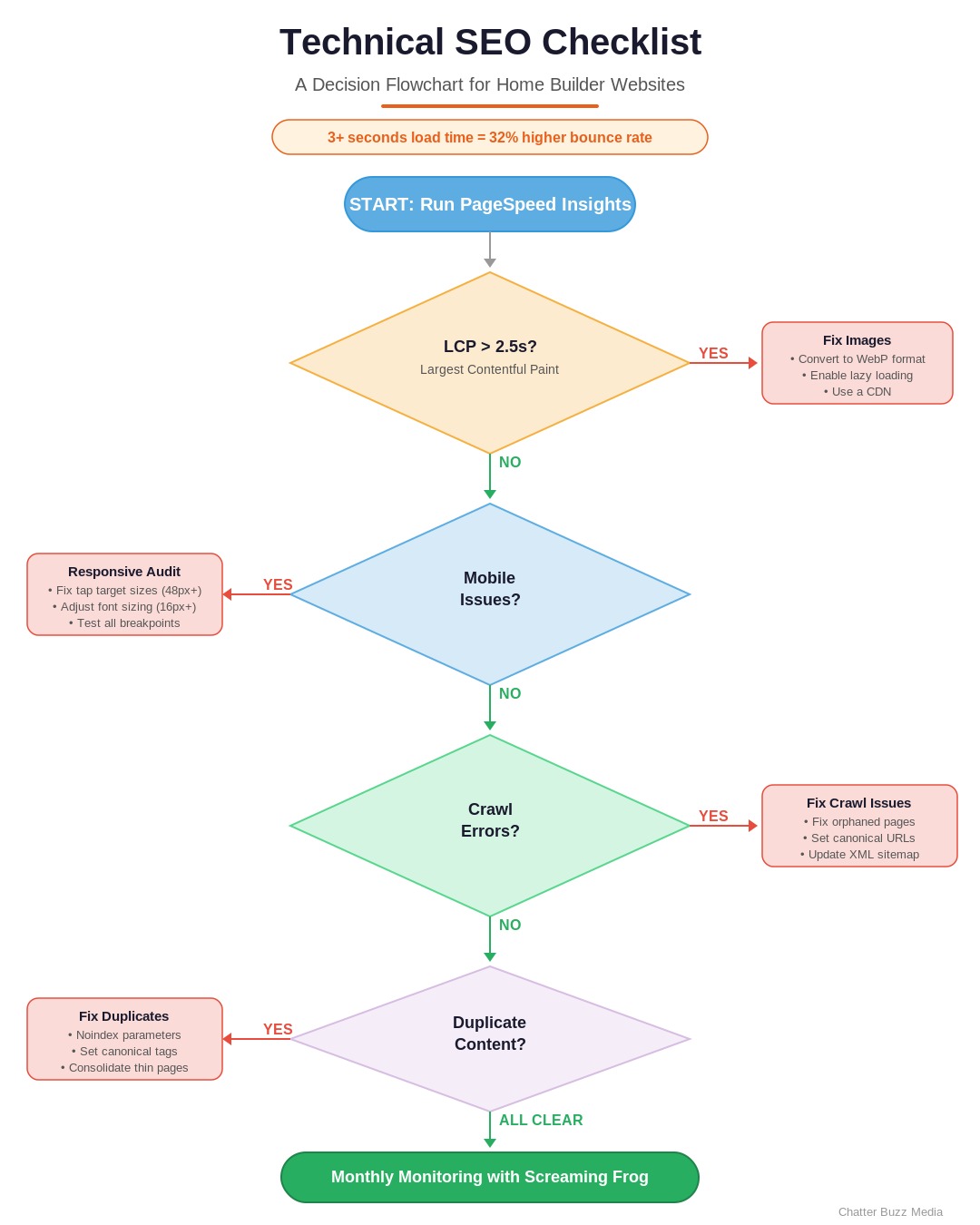
This checklist focuses on the issues we diagnose most frequently when auditing builder sites.
Site Speed and Core Web Vitals
Google’s Core Web Vitals — Largest Contentful Paint (LCP), Interaction to Next Paint (INP), and Cumulative Layout Shift (CLS) — are confirmed ranking factors. Builder websites, with their high-resolution renderings and model home galleries, frequently fail LCP thresholds.
Prioritize these fixes:
- Convert images to WebP format with responsive srcset attributes. A single unoptimized hero rendering can add 3-5 seconds to LCP.
- Implement lazy loading for all below-the-fold images and gallery carousels. Only load what the visitor can see.
- Use a CDN to serve assets from edge servers close to your buyers, especially if you operate in multiple markets.
- Minimize render-blocking JavaScript. MLS integrations, chat widgets, and tracking scripts often block the main thread. Defer or async non-critical scripts.
- Preload critical fonts and hero images to reduce LCP. This single change often drops LCP by 1-2 seconds.
Test every template (community page, floor plan page, blog post, homepage) separately in PageSpeed Insights. A fast homepage means nothing if your community pages — where the conversions happen — load in 6 seconds.
Mobile-First Indexing
Google indexes the mobile version of your website first. If your mobile experience is degraded — hidden content, broken navigation, non-tappable buttons, or horizontal scrolling — that is the version Google evaluates for ranking.
86% of homebuyers consider the builder’s website their most important information source, and the majority access it from a phone. Your community pages, floor plan galleries, and interactive site maps must work flawlessly on a 375-pixel-wide screen.
Test your mobile experience beyond just responsive layout — check that floor plan images are zoomable, forms are easy to complete with thumbs, phone numbers are tap-to-call, and maps are usable without accidental scrolling. Mobile usability is not just an SEO factor — it is a conversion factor.
Crawlability and Indexation Issues
Builder websites commonly suffer from crawlability problems that are invisible to the marketing team but devastating to rankings.
Watch for these issues:
- Orphaned pages: Community or floor plan pages that are not linked from any other page on your site. Google discovers pages through links — if a page is only accessible through search or a direct URL, it may never get crawled.
- Duplicate content from parameterized URLs: Listing filter pages (e.g., /homes?beds=3&price=400000) can generate thousands of near-duplicate URLs that waste crawl budget. Use canonical tags or noindex directives.
- Sold-out community pages: When a community sells out, do not delete the page. Redirect it to the nearest active community or convert it to a neighborhood guide. Deleting it wastes all the authority that page accumulated.
- XML sitemap bloat: Only include indexable, canonical URLs in your sitemap. Builder sitemaps frequently include noindexed pages, redirected URLs, and parameter variations that send mixed signals to Google.
- Robots.txt blocking: Some builder CMS platforms accidentally block CSS, JavaScript, or image directories in robots.txt, preventing Google from fully rendering pages.
Run a monthly crawl using Screaming Frog or Sitebulb and compare it against your Google Search Console coverage report. Any discrepancy between what you intend to be indexed and what Google actually indexes is a problem worth solving.
For builders undergoing website redesigns or platform migrations, our digital marketing services include technical SEO audits that prevent traffic loss during transitions.
Technical health keeps your pages indexable, but how do you know whether all this work is paying off? Let us talk about measurement.
Measuring Home Builder SEO Performance
SEO without measurement is guessing. The right KPIs connect your organic visibility to your sales pipeline and give you the data to optimize spending, double down on what works, and cut what does not.
Most builders track vanity metrics — total traffic, keyword counts — while ignoring the metrics that actually predict revenue. Here is how to measure what matters.
KPIs That Matter
Track these metrics monthly and trend them quarterly:
- Organic traffic to community pages: This is your highest-intent traffic segment. Growth here directly correlates with model home visits and sales inquiries.
- Keyword visibility by market: Track rankings for your top 20 keywords in each geographic market. A builder ranking in the top 5 for “new homes in [city]” captures 60-70% of organic clicks for that query.
- Organic conversion rate: What percentage of organic visitors submit a contact form, schedule a tour, or call your sales team? Benchmark this by page type — community pages should convert at 3-5%, blog posts at 0.5-1%.
- Local pack impressions and actions: Track GBP impressions, direction requests, phone calls, and website clicks from your Google Business Profile dashboard.
- Core Web Vitals scores: Monitor LCP, INP, and CLS for your key page templates monthly. Regressions often coincide with CMS updates or new feature deployments.
- Backlink acquisition rate: Track new referring domains per month. A healthy builder site should acquire 5-15 new referring domains monthly through ongoing link building efforts.
Build a monthly SEO dashboard that your leadership team can scan in five minutes. The performance marketing guide covers dashboard design and reporting cadence in detail.
Connecting SEO to Your Sales Pipeline
The ultimate measure of SEO for residential builders is closed sales attributed to organic search. Connecting that data requires integration between your website analytics, your CRM, and your sales tracking system.
Here is the tracking chain we implement for builder clients:
- Step 1: Tag every organic lead with source, medium, landing page, and keyword data using UTM parameters and hidden form fields.
- Step 2: Pass that data into your CRM (HubSpot, Salesforce, Lasso, or your builder-specific CRM) so every contact carries its acquisition source.
- Step 3: Track leads through your sales stages — appointment set, model home visit, contract, closing — with the organic source attribution intact.
- Step 4: Calculate cost per lead, cost per contract, and cost per closing for organic search versus paid channels.
CRM integration with SEO transforms organic search from a “brand awareness” line item into a measurable revenue channel. When you can prove that organic search produced 40 closings at $1,200 cost per acquisition versus paid search at $8,000 CPA, the budget conversation changes permanently.
Our marketing automation guide walks through the technical setup for connecting lead sources to pipeline stages, and our fractional CMO services help builders build the analytics infrastructure that makes this attribution possible.
AI Search and Generative Engine Optimization for Home Builders
Google’s AI Overviews, ChatGPT search, and Perplexity are changing how buyers discover builders. Instead of clicking ten blue links, buyers increasingly receive synthesized answers that cite specific sources — and if your content is not cited, you lose the referral entirely.
Generative Engine Optimization (GEO) for home builders requires a different approach than traditional SEO. AI models prioritize content that is authoritative, well-structured, and directly answers specific questions.
To position your builder website for AI search visibility:
- Structure content with clear question-and-answer formats. H2 and H3 headings that ask questions, followed by direct answers in the first sentence, give AI models clean extraction points.
- Include specific data and statistics. AI overviews preferentially cite content with concrete numbers — pricing ranges, square footage, school ratings, commute times — over vague descriptions.
- Build topical authority through content depth. AI models identify authoritative sources by assessing how comprehensively a site covers a topic. A builder with 50 interconnected pages about their market is more likely to be cited than one with 5 thin pages.
- Implement comprehensive schema markup. Structured data helps AI systems understand and categorize your content accurately, increasing the likelihood of citation.
- Earn mentions and citations from authoritative sources. AI models weight information that is corroborated across multiple trusted sources. Press coverage, industry directory listings, and mentions in real estate publications all increase your citation probability.
GEO is still an emerging discipline, but builders who optimize for it now will have a significant advantage as AI-driven search becomes the default discovery method. This is one area where a fractional CMO can help prioritize the right investments between traditional SEO and emerging AI search strategies.
Multi-Market Site Architecture for National and Regional Builders
Builders operating across multiple states or metro areas face a structural challenge that single-market builders do not: how to organize a website so that every market, community, and floor plan has its own optimized, rankable URL without creating an unmanageable content sprawl.
The right site architecture follows a geographic hierarchy:
- Level 1 — State or region: /florida/ or /central-florida/ — serves as a hub page for all communities in that region.
- Level 2 — Metro or city: /florida/orlando/ — targets “[city] new homes” and “[city] home builders” queries with a market-specific landing page.
- Level 3 — Community: /florida/orlando/windermere-estates/ — the individual community page optimized for subdivision-specific keywords.
- Level 4 — Floor plan at community: /florida/orlando/windermere-estates/belmont/ — if a plan’s availability varies by community, this level captures “[plan name] at [community]” searches.
This structure creates natural internal linking hierarchies. Each level links down to its children and up to its parent, distributing authority throughout the site while giving Google clear signals about geographic relevance.
National builders also need market-specific blog content and localized FAQs. A blog post about “best school districts in Orlando” should live under the Orlando market section or link strongly to it, reinforcing that market’s topical authority.
Our B2B digital marketing team has built these architectures for brands operating in 20+ markets simultaneously.
Conclusion
Home builder SEO is not a single tactic — it is a system of interconnected strategies that compound over time. From technical foundations to community page optimization to AI search readiness, every layer reinforces the others.
The builders who win organic search do five things consistently:
- They build technically sound websites that Google can crawl and index efficiently.
- They create unique, content-rich community pages that rank for dozens of geo-specific keywords.
- They dominate local search through optimized Google Business Profiles and systematic review generation.
- They publish content that captures buyers at every stage of a months-long purchase journey.
- They measure everything — connecting organic traffic to their sales pipeline so they can prove ROI and scale what works.
The math is simple — homebuyers search before they buy. If you do not rank, you do not exist in their consideration set.
Every month of delay hands more compounding organic traffic to competitors who started earlier.
If you are ready to build an SEO strategy that turns organic search into your most reliable lead channel, talk to our home builder marketing team. We will audit your current visibility, identify your biggest ranking opportunities, and build a roadmap that delivers measurable results within 90 days.
Frequently Asked Questions
How long does it take for home builder SEO to produce results?
Most builders see measurable ranking improvements within 3-6 months and significant traffic growth within 6-12 months. Technical fixes and local SEO optimizations produce the fastest wins, often within 30-60 days.
Content-driven strategies take longer to compound but deliver the highest long-term ROI — above 1,300% after three years for real estate organizations that invest consistently.
How much does SEO for home builders cost?
Comprehensive home builder SEO programs typically range from $3,000 to $10,000 per month, depending on the number of markets, communities, and competitive intensity. Multi-market builders at the higher end invest more in content production, local SEO management, and technical optimization across larger site architectures.
The cost should be evaluated against customer lifetime value — if a single organic lead produces a $400,000+ home sale, the ROI threshold is low.
Should home builders invest in SEO or paid search?
Both, but for different purposes. Paid search delivers immediate visibility for high-intent keywords and new community launches, while SEO builds a compounding asset that reduces your cost per lead over time.
The ideal strategy uses paid search to drive leads while SEO ramps up, then shifts budget toward SEO as organic rankings mature. Most mature builder marketing programs generate 60-70% of digital leads from organic search.
How do I rank my home builder website for multiple cities?
Create dedicated landing pages for each city or market you serve, with unique content about the local area, available communities, and market conditions. Avoid duplicating the same page template with only the city name swapped — Google recognizes and penalizes thin, templated content.
Each market page needs 800+ words of unique content, localized schema markup, and internal links to the communities within that market. A clear URL hierarchy (/state/city/community/) signals geographic relevance to search engines.
What is the most important page on a home builder website for SEO?
Community pages. They target the highest-intent, most specific buyer searches — “[community name] new homes,” “homes for sale in [subdivision],” “[community] floor plans and pricing.”
A well-optimized community page ranks for dozens of long-tail keywords and drives traffic from buyers who are actively ready to schedule a tour. Most builders underinvest in community page content, making this the single biggest opportunity for competitive differentiation.
How do home builders show up in Google AI Overviews?
AI Overviews pull from content that directly answers specific questions with authoritative, well-structured information. Format your content with clear question headings and direct first-sentence answers.
Include specific data points — pricing, square footage, school ratings, commute times — rather than vague descriptions. Build topical authority by publishing comprehensive, interlinked content about your markets and communities, and implement schema markup so AI systems can accurately categorize your content.
How important are reviews for home builder SEO?
Reviews directly impact both local rankings and click-through rates. Google’s local algorithm weighs review quantity, quality, recency, and response rate.
Builders with 50+ reviews and a 4.5+ rating consistently outrank competitors with fewer reviews. Beyond SEO, 93% of consumers say online reviews influence their purchase decisions — implement a systematic review generation process tied to your sales milestones to build a steady stream of fresh reviews.
What schema markup should home builders use?
Implement RealEstateListing schema on community and floor plan pages to display pricing, specifications, and availability in search results. Use LocalBusiness schema (specifically HomeBuilder) on your main website and location pages.
Add FAQPage schema to any page with a Q&A section to earn expanded SERP real estate. AggregateRating schema displays your star ratings directly in search results, increasing click-through rates — test all markup with Google’s Rich Results Test before deploying to production.