
 321-236-2899
Manufacturing lead generation has fundamentally changed. The playbook that worked five years ago — attend three trade shows, hand out business cards, wait for RFQs — now leaves most manufacturers with an unpredictable pipeline and a growing gap between capacity and revenue.
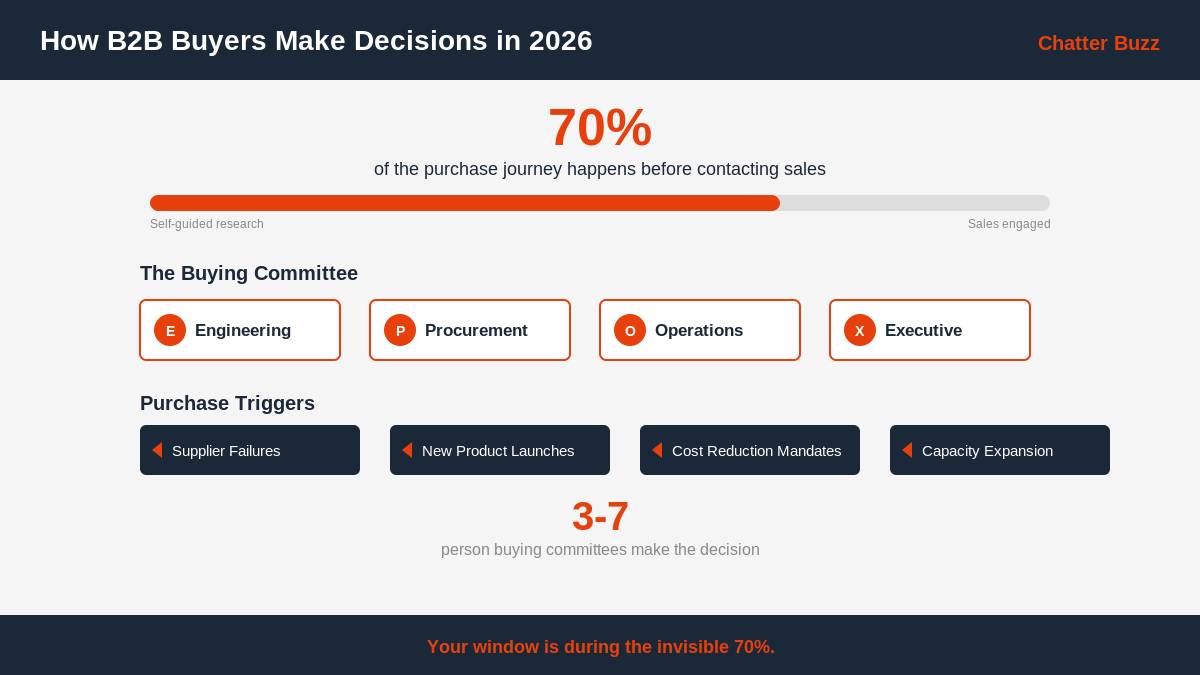
Here is the reality: Gartner research shows that B2B buyers complete roughly 70% of their purchase journey before ever contacting a sales rep. Your future customers are researching suppliers, comparing capabilities, and building shortlists — all before you know they exist.
This guide is your comprehensive, in-depth resource for building a manufacturing lead generation system that delivers qualified opportunities every month. We cover everything from SEO and paid media to outbound prospecting, marketing automation, and ROI measurement — with frameworks you can implement this quarter.
Key Takeaways
- Trade shows alone cannot sustain a manufacturing pipeline. Companies that build digital lead generation systems alongside events see 3-4x more qualified opportunities per quarter.
- Manufacturing buyers complete 70% of their research before contacting sales. If your digital presence is invisible during that window, you lose deals you never knew existed.
- SEO, paid media, and outbound prospecting work together — not in isolation. The highest-performing manufacturers run integrated, multi-channel strategies that compound over time.
- Lead scoring and marketing automation shorten long sales cycles. Automated nurture sequences keep your company top-of-mind across 6-12 month buying timelines without burdening your sales team.
- Measure pipeline contribution, not vanity metrics. Track cost per qualified lead, pipeline velocity, and revenue influenced — not clicks, impressions, or downloads.
Why Manufacturing Companies Struggle with Lead Generation
Most manufacturers face a unique set of lead generation challenges that consumer brands and SaaS companies never encounter. Understanding these obstacles is the first step toward building a system that actually works.
According to a HubSpot report, 65% of manufacturing companies cite generating traffic and leads as their biggest marketing challenge. That number has barely moved in five years — which tells us the industry has a structural problem, not just a tactical one.
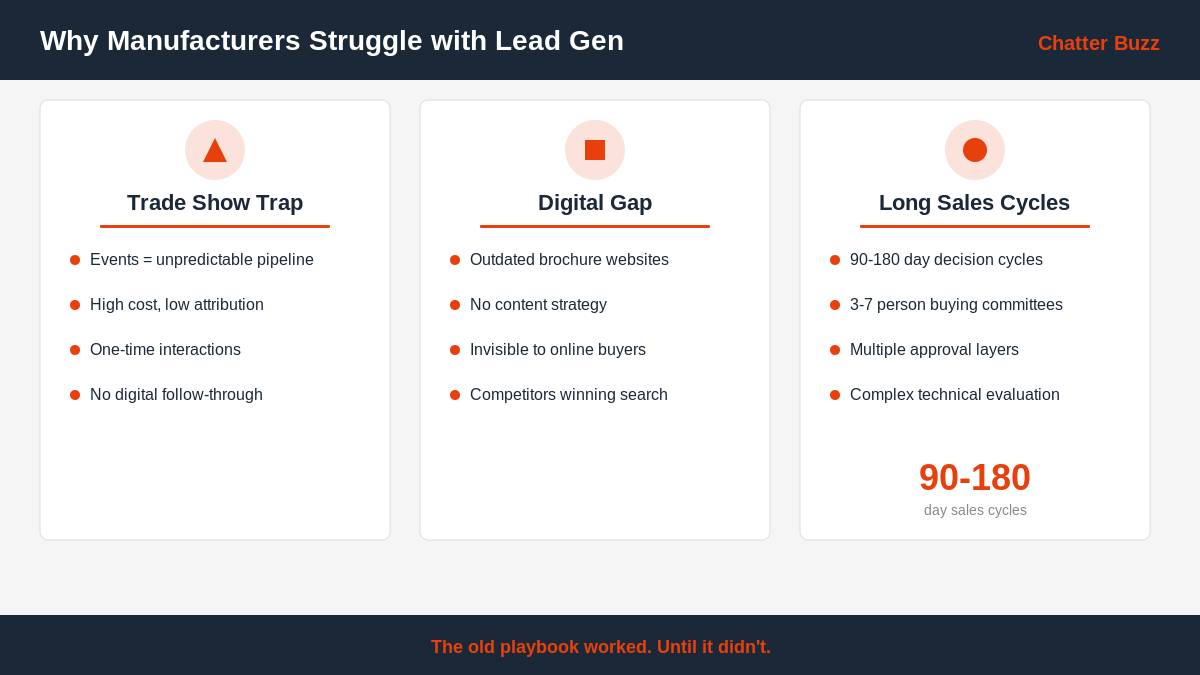
The Trade Show Dependency Trap
Trade shows remain valuable for relationship-building and brand visibility. But relying on them as your primary lead generation channel creates a boom-and-bust pipeline that makes revenue forecasting nearly impossible.
A single industry event costs $15,000–$50,000 when you factor in booth space, travel, printed materials, and staff time. That investment generates leads in bursts — a flurry of badge scans in one week, then silence for months.
The bigger problem is qualification. Most trade show “leads” are badge scans from attendees who walked past your booth, grabbed a pen, and moved on. Actual decision-makers with active projects represent a fraction of that list.
Digital lead generation systems run continuously. They generate qualified opportunities every week, not just during event season. The manufacturers winning market share treat trade shows as a pipeline accelerator — not their entire strategy.
Long Sales Cycles and Complex Buying Committees
Manufacturing purchases involve significant capital, production dependencies, and multi-stakeholder approval. A typical deal includes four to seven decision-makers across engineering, procurement, operations, and executive leadership.
The average B2B manufacturing sales cycle runs 90–180 days from first contact to signed purchase order. Some enterprise deals stretch beyond 12 months. This timeline means every lead needs sustained nurturing — something trade show follow-up emails alone cannot provide.
Each stakeholder evaluates your company through a different lens. Engineers care about tolerances and material certifications. Procurement focuses on pricing, lead times, and supplier reliability. Operations wants delivery consistency. Executives evaluate strategic fit.
Winning the deal requires engaging multiple stakeholders simultaneously. Single-threaded outreach — talking to one contact and hoping they sell internally — kills deals before they start.
The Digital Visibility Gap
Many manufacturers built their businesses through referrals, distributor relationships, and incumbent contracts. Their websites serve as digital brochures rather than lead generation engines.
This creates a massive visibility gap. When procurement managers and engineers search for suppliers online, manufacturers without optimized digital presences simply do not appear. Their competitors — who invested in SEO, content, and paid media — capture those high-intent searches instead.
The gap compounds over time. Every month you delay building digital visibility, competitors accumulate more domain authority, more indexed pages, and more brand recognition among your target buyers. Understanding why lead generation is difficult sets the stage for building a strategy that addresses each challenge head-on.
How B2B Manufacturing Buyers Actually Make Decisions in 2026
Manufacturing buyers follow a deliberate, research-heavy process that looks nothing like consumer purchasing. Understanding this process is essential for positioning your company at the right touchpoints with the right message.
The shift to digital research has accelerated dramatically. McKinsey research confirms that B2B buyers now use an average of 10 different channels during their purchase journey — up from five just a few years ago.
The 70% Research Rule
By the time a manufacturing buyer contacts your sales team, they have already identified their problem, researched potential solutions, compared multiple suppliers, and built a preliminary shortlist. Your window to influence the decision is during that invisible 70% of the journey.
This means your website, content, and digital presence do the selling long before your sales team gets involved. If your company is absent from Google search results, industry publications, and LinkedIn during the research phase, you are invisible to the buyers who matter most.
Manufacturers who understand this principle invest in content that answers the questions buyers ask during each phase of research — from “what material is best for high-temperature applications” to “how to evaluate CNC machining suppliers.”
Who Sits on the Buying Committee
A manufacturing purchase decision rarely belongs to a single person. The typical buying committee includes distinct roles with different priorities:
- Engineering teams evaluate technical specifications, material capabilities, tolerances, and quality certifications. They need detailed technical content to validate your capabilities.
- Procurement professionals compare pricing structures, lead times, minimum order quantities, and supplier reliability. They look for proof of on-time delivery and financial stability.
- Operations managers assess production capacity, delivery schedules, and supply chain risk. They want evidence you can scale with their demand.
- Executive leadership approves major supplier changes based on strategic fit, total cost of ownership, and long-term partnership potential.
Your lead generation strategy needs to create content, messaging, and touchpoints for each of these roles — not just the person who fills out your contact form first.
What Triggers a Supplier Search
Manufacturing buyers do not search for new suppliers on a whim. Specific triggers initiate the buying process:
- Current supplier failures — missed deadlines, quality defects, or capacity constraints push buyers to evaluate alternatives quickly.
- New product launches — engineering teams need new capabilities, materials, or production methods their current suppliers cannot provide.
- Cost reduction mandates — procurement receives top-down directives to reduce supplier costs by a specific percentage, opening the door for competitive bids.
- Geographic expansion — companies entering new markets often seek regional suppliers to reduce shipping costs and lead times.
Timing matters enormously in industrial lead generation. The manufacturers who consistently appear in search results, industry content, and targeted outreach are the ones who capture opportunities the moment these triggers occur. Now, let us build the strategy framework that makes this visibility systematic.

Building a Manufacturing Lead Generation Strategy That Scales
A scalable manufacturing lead generation strategy starts with clear definitions, shared goals, and a systematic approach to identifying and engaging the right buyers. Without this foundation, individual tactics — no matter how effective — produce inconsistent results.
The manufacturers generating the most consistent pipelines treat lead generation as a system, not a collection of campaigns. Here is how to build that system from the ground up.
Define Your Ideal Customer Profile (ICP)
Your ICP is the detailed description of the companies most likely to buy from you and generate the highest lifetime value. Without it, your sales and marketing teams waste resources pursuing companies that will never convert.
For manufacturers, an effective ICP typically includes industry vertical, company size (by revenue or employee count), production volume requirements, geographic proximity, required certifications, and technical capability fit.
Build your ICP by analyzing your best existing customers. Which accounts generate the highest revenue? Which have the shortest sales cycles? Which reorder most consistently? The patterns in your current customer base reveal exactly who to target next.
Map the Buyer Journey for Industrial Sales
The manufacturing buyer journey has three distinct phases, and your lead generation strategy needs content and touchpoints for each one:
- Awareness: The buyer recognizes a problem — a supplier cannot meet quality standards, a new project requires unfamiliar materials, or leadership mandates cost reductions. At this stage, educational content like blog posts, industry guides, and benchmark reports captures attention.
- Consideration: The buyer evaluates potential approaches and begins comparing suppliers. Technical white papers, case studies, capability comparisons, and webinars build credibility and differentiate your company.
- Decision: The buyer shortlists 2-3 suppliers and requests quotes, samples, or facility tours. RFQ forms, consultation offers, and detailed specification sheets convert consideration into action.
Most manufacturers only have content for the decision stage — a contact form and a capabilities brochure. The companies winning deals invest heavily in awareness and consideration content that captures buyers months before they are ready to request a quote.
Align Sales and Marketing Around Shared Pipeline Goals
Sales and marketing alignment is not a buzzword — it is the single biggest predictor of lead generation success in manufacturing. When these teams operate in silos, leads fall through cracks, follow-up is inconsistent, and neither team trusts the other’s numbers.
Start by agreeing on a shared definition of a qualified lead. What criteria must a lead meet before sales invests time? Company size, technical fit, budget authority, and project timeline are common qualifiers.
Establish a formal handoff process. When marketing generates a lead that meets qualification criteria, how quickly does sales follow up? Asking the right lead generation strategy questions upfront prevents misalignment later. With your strategy foundation in place, it is time to build the digital channels that drive qualified traffic.
SEO and Content Marketing for Manufacturing Companies
Search engine optimization is the highest-ROI lead generation channel for manufacturers who commit to it. Unlike paid advertising, SEO compounds over time — every piece of optimized content continues generating traffic and leads for years after publication.
The challenge is that most manufacturers underinvest in SEO because results take 3-6 months to materialize. The manufacturers who push through that initial period build a competitive moat that becomes extremely difficult for competitors to replicate.
Targeting High-Intent Industrial Keywords
Not all keywords are equal. High-intent keywords signal that the searcher is actively evaluating suppliers or solutions — these are the searches that turn into RFQs and purchase orders.
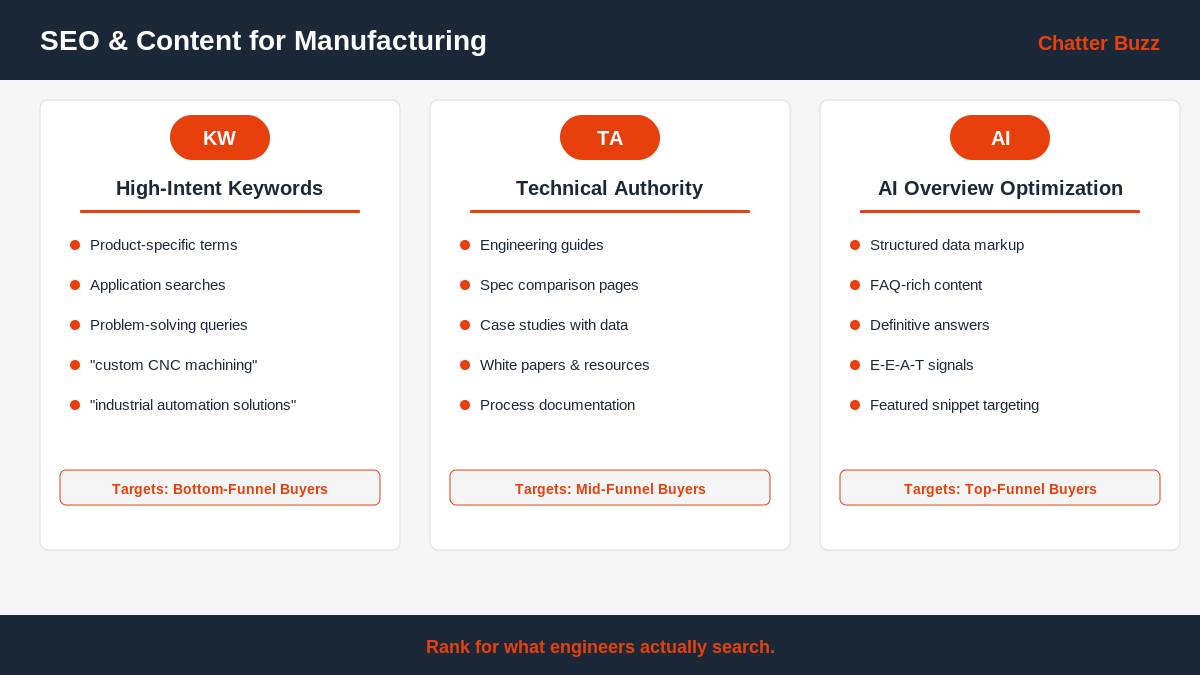
For manufacturers, high-intent keywords typically fall into three categories:
- Product-specific terms: “precision CNC machining services,” “custom injection molding,” “sheet metal fabrication company” — these searchers know exactly what they need.
- Application-based searches: “aerospace-grade titanium machining,” “medical device component manufacturing” — these buyers need industry-specific capabilities.
- Problem-solving queries: “how to reduce machining lead times,” “alternative to die casting for low-volume production” — these buyers are in the consideration phase and represent massive opportunity.
Build your keyword strategy around these high-intent categories first. Informational content drives volume, but commercial-intent pages drive revenue. A comprehensive manufacturing marketing approach prioritizes both.
Creating Technical Content That Builds Authority
Manufacturing buyers are technical professionals. They can spot thin, generic content instantly — and they will leave your site for a competitor who demonstrates deeper expertise.
Content that generates manufacturing sales leads goes deep on specific topics. Instead of “5 Benefits of CNC Machining,” write “CNC Machining Tolerance Guide: What Designers Need to Know About ±0.001″ Tolerances.” The specificity signals expertise and attracts exactly the right audience.
High-performing content formats for manufacturers include material selection guides, tolerance and specification references, application-focused case studies with measurable results, process comparison articles, and industry compliance guides. These resources become reference material that engineers bookmark and share with their teams.
Optimizing for AI Overviews and Featured Snippets
Google’s AI Overviews and featured snippets now appear for many industrial search queries. Structuring your content to win these positions dramatically increases visibility — often capturing clicks before competitors even enter the picture.
To optimize for AI Overviews, structure content with clear H2/H3 headings that match common questions, provide concise definitions in the first 1-2 sentences after each heading, use bulleted lists for processes and comparisons, and include specific data points and statistics that AI can cite.
This is not just an SEO tactic — it is a B2B demand generation strategy. When your content appears in AI-generated answers, you become the authoritative source for your entire category. SEO drives long-term organic traffic, but sometimes you need leads faster. That is where paid media enters the equation.
Paid Media Strategies for Industrial Lead Generation
Paid advertising delivers immediate visibility while your SEO strategy builds momentum. For manufacturers targeting niche industrial keywords with limited search volume, paid media often provides the fastest path to qualified conversations.
The key is precision. Manufacturing paid media campaigns should target specific buyer roles, specific industries, and specific intent signals — not broad audiences hoping for volume.
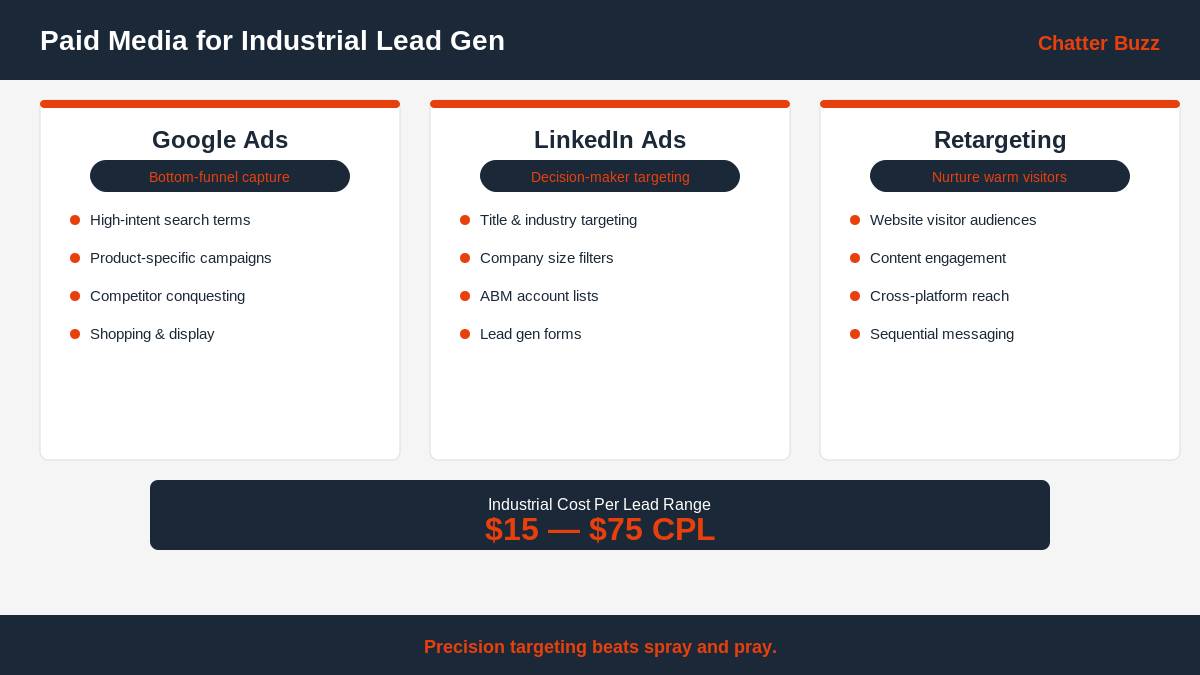
Google Ads for Manufacturing Keywords
Google Ads captures buyers at the exact moment they search for your capabilities. For manufacturing keywords, cost-per-click tends to be higher ($8–$25 for competitive industrial terms), but conversion value far exceeds that investment when each qualified lead represents a $50,000–$500,000 contract.
Structure campaigns around capability-specific ad groups that map directly to dedicated landing pages. A search for “precision aerospace machining” should land on a page specifically about your aerospace machining capabilities — not your homepage.
Use negative keywords aggressively. Manufacturing queries often attract job seekers, students, and DIY hobbyists who will never become customers. Exclude terms like “jobs,” “salary,” “DIY,” “how to start,” and “schools” to protect your budget.
LinkedIn Advertising for Engineering and Procurement Decision-Makers
LinkedIn is the only advertising platform that lets you target by job title, company, industry, and seniority with high precision. For manufacturers selling to specific roles within specific industries, this targeting capability is unmatched.
Effective LinkedIn campaigns for manufacturers typically use Sponsored Content to promote case studies and technical guides to engineering managers and procurement directors. The goal is not immediate conversion — it is brand awareness and credibility building that shortens the sales cycle when these buyers eventually need what you offer.
LinkedIn’s cost-per-click is higher than Google ($5–$15 typically), but the audience quality compensates. Every impression reaches a verified professional in your target market — not anonymous web traffic.
Retargeting Campaigns That Keep You Top of Mind
Manufacturing buyers visit supplier websites multiple times before making contact. Retargeting ensures your brand stays visible throughout that extended research period.
Set up retargeting campaigns on Google Display Network and LinkedIn that show relevant ads to visitors who viewed specific capability pages, downloaded technical content, or visited your RFQ page without converting. Segment your retargeting audiences by the pages they visited to serve relevant messaging.
A visitor who viewed your aerospace capabilities page should see ads highlighting aerospace certifications and case studies — not generic brand messaging. This relevance dramatically improves click-through and conversion rates. Driving traffic is only half the equation. Your website must convert that traffic into leads. Let us optimize for that next.

Website Conversion Optimization for Manufacturers
Your website is the hub of every lead gen for manufacturers strategy. Every SEO visit, every paid click, and every LinkedIn profile view eventually leads a prospect to your site. If that site does not convert visitors into leads, every upstream investment is wasted.
Most manufacturing websites were built as digital brochures — they describe capabilities but do nothing to capture interest or generate action. Converting your site into a lead generation engine requires intentional design changes.
RFQ Forms That Actually Get Completed
Your RFQ form is your most important conversion point. Yet many manufacturers bury it behind three navigation clicks and require 15+ fields to complete. Every unnecessary field reduces conversion rates.
Simplify your RFQ form to essential fields only: name, company, email, phone, and a free-text description of their project. You can collect additional details — material specs, quantities, tolerances — during the follow-up conversation.
Place RFQ access points on every capability page, not just a single “Contact Us” page. Sticky headers, sidebar widgets, and end-of-content CTAs ensure visitors can take action the moment they are ready — regardless of which page convinced them.
Landing Pages Built for Engineers and Procurement
Different buyer roles need different landing page experiences. An engineer evaluating your machining tolerances has different questions than a procurement manager comparing lead times and pricing.
Build capability-specific landing pages that address the concerns of each stakeholder. Include certifications (ISO 9001, AS9100, ITAR), equipment lists, tolerance ranges, material capabilities, and representative project examples. These details are not optional — they are the minimum information technical buyers need to justify a conversation.
Add social proof strategically. Customer logos, testimonials from engineers at recognizable companies, and quantified results (e.g., “reduced client’s per-part cost by 23%”) build the credibility that converts visitors into leads.
Technical Content as a Conversion Tool
Gated technical content — material selection guides, tolerance handbooks, compliance checklists — captures leads from buyers who are not ready to request a quote but are actively researching. These are early-stage leads worth nurturing.
The key is offering genuine value, not thinly veiled sales brochures. A “Complete Guide to Material Selection for High-Temperature Applications” that provides genuinely useful engineering guidance generates trust and positions your company as an expert. That trust converts to revenue months later.
Keep gating minimal. Ask for email and company name — nothing more. Progressive profiling can collect additional data over subsequent interactions without creating friction. Once you are generating leads, the challenge becomes nurturing them through long sales cycles. Marketing automation solves this problem.

Marketing Automation and Lead Nurturing for Manufacturing
Marketing automation transforms inconsistent follow-up into a systematic nurturing engine that keeps your company top-of-mind across 6-12 month manufacturing sales cycles. Without it, most leads go cold within weeks of initial contact — wasted opportunities your competitors will gladly capture.
The manufacturers seeing the highest close rates have automated nurture sequences running in the background while their sales team focuses on the hottest opportunities. Here is how to build that system.
Email Sequences That Move Prospects Through Long Sales Cycles
Manufacturing nurture sequences differ fundamentally from SaaS drip campaigns. Your buyers do not need daily emails — they need relevant, technical content delivered at a cadence that respects their timeline.
A proven manufacturing nurture framework follows this pattern:
- Week 1: Welcome email with a relevant technical resource based on their initial interest (the page they visited or content they downloaded).
- Week 3: Case study from a similar industry showing measurable results — cost savings, lead time reduction, quality improvement.
- Week 6: Industry-specific white paper or guide that addresses a common challenge their role faces.
- Week 10: Comparison guide or ROI calculator that helps them build an internal business case for switching suppliers.
- Week 14: Direct outreach offering a consultation, facility tour, or sample run — by now, they have consumed enough content to view you as a credible option.
This sequence keeps your company visible across a typical 3-4 month evaluation period without overwhelming the prospect.
Lead Scoring for Manufacturing Pipelines
Lead scoring assigns point values to prospect behaviors and attributes, helping your team prioritize the most sales-ready leads. Without lead scoring, your sales team wastes time on unqualified contacts while hot leads wait.
For manufacturers, effective lead scoring typically weighs:
- Behavioral signals (60% weight): RFQ page visits (high value), capability page views, case study downloads, email engagement, return visits.
- Demographic fit (40% weight): Company size, industry match, job title/role, geographic location.
Set a threshold score that triggers a sales handoff. When a lead crosses that threshold, they have demonstrated both fit and intent — and your sales team should contact them within 24 hours.
CRM Integration and Sales Handoff
Your marketing automation platform must integrate tightly with your CRM so sales has full visibility into every touchpoint a lead has had with your company. When a sales rep calls a qualified lead, they should already know which pages were visited, which content was downloaded, and which emails were opened.
This context transforms cold outreach into warm, informed conversations. Instead of “Hi, I see you filled out our form,” your rep can say “I noticed you downloaded our aerospace machining guide and visited our AS9100 certification page — are you working on a project that requires aerospace-grade components?”
Proper inbound marketing and automation alignment is what separates manufacturers with 20% close rates from those stuck at 5%. With nurturing systems in place, let us add outbound prospecting to accelerate pipeline growth even further.
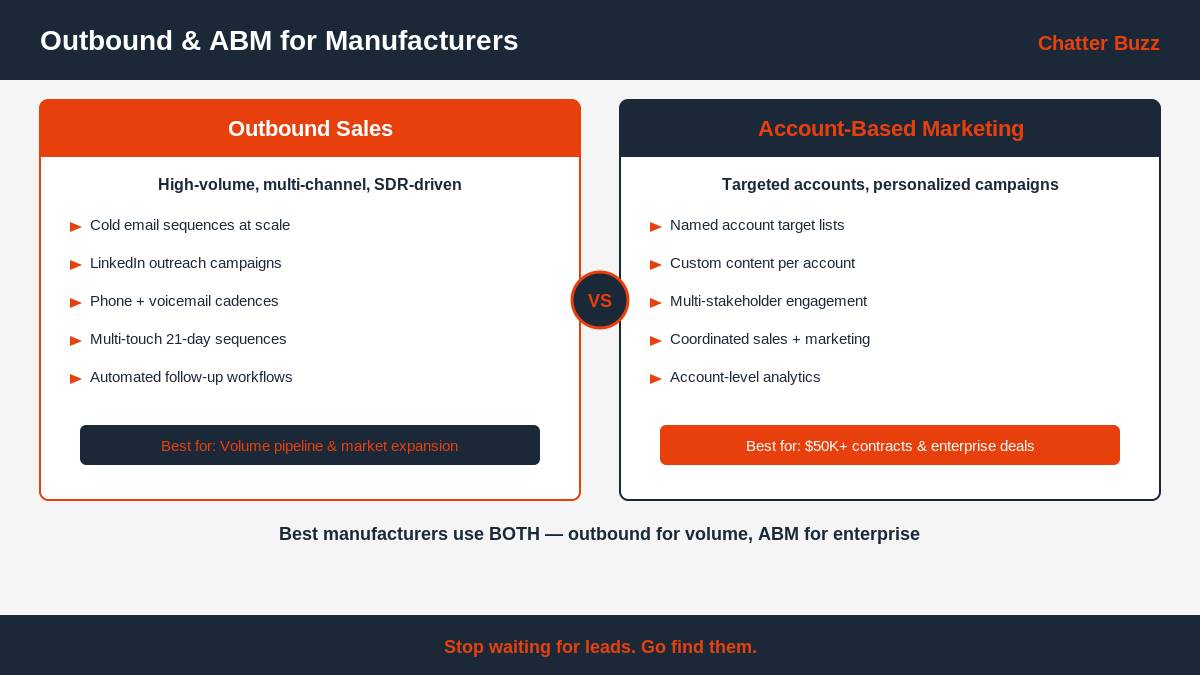
Outbound Prospecting and Account-Based Marketing for Manufacturers
Inbound strategies attract buyers who are already searching. Outbound prospecting and account-based marketing (ABM) create opportunities with companies that need your capabilities but have not started looking yet.
For manufacturers with defined target account lists and high average deal values, ABM delivers outsized returns by concentrating resources on the accounts most likely to convert.
Building Targeted Account Lists
Start with your ICP and build lists of 100-500 target accounts that match your ideal customer criteria. Use industry databases, LinkedIn Sales Navigator, trade association directories, and your existing CRM to identify companies in the right industry, size range, and geographic footprint.
Within each account, identify 3-5 contacts across the buying committee: the engineering lead, procurement manager, operations director, and an executive sponsor. Multi-threading across roles is essential — single-contact outreach rarely succeeds in manufacturing.
Multi-Channel Outreach Sequences
Effective outbound for manufacturers combines LinkedIn engagement, email outreach, and strategic phone calls in coordinated sequences:
- Day 1: LinkedIn connection request with a brief, relevant note referencing their industry or a shared challenge.
- Day 3: Personalized email highlighting a capability or case study relevant to their specific needs.
- Day 7: Follow-up email with a technical resource or industry insight — add value, do not pitch.
- Day 10: Phone call to the engineering or procurement contact — reference the content you shared.
- Day 14-21: Continue the sequence with additional touchpoints, spacing messages to avoid being aggressive.
The key is manufacturing demand generation through relevance, not volume. Generic “I’d love to connect” messages get ignored. Messages referencing specific industry challenges, certifications, or technical capabilities get responses.
Trade Shows as a Pipeline Accelerator (Not Your Entire Strategy)
Trade shows still matter — but their role has shifted. Use events to accelerate relationships with accounts already in your pipeline rather than as your primary source of new leads.
Before the event, identify which target accounts will attend and book meetings in advance. During the event, focus on deepening relationships with qualified prospects rather than collecting as many badge scans as possible. After the event, fold trade show contacts into your multi-channel nurture sequences.
This approach transforms trade shows from unpredictable lead sources into strategic touchpoints within a larger, systematic approach to B2B lead generation manufacturing. The final piece of the puzzle is measuring what works and optimizing continuously.
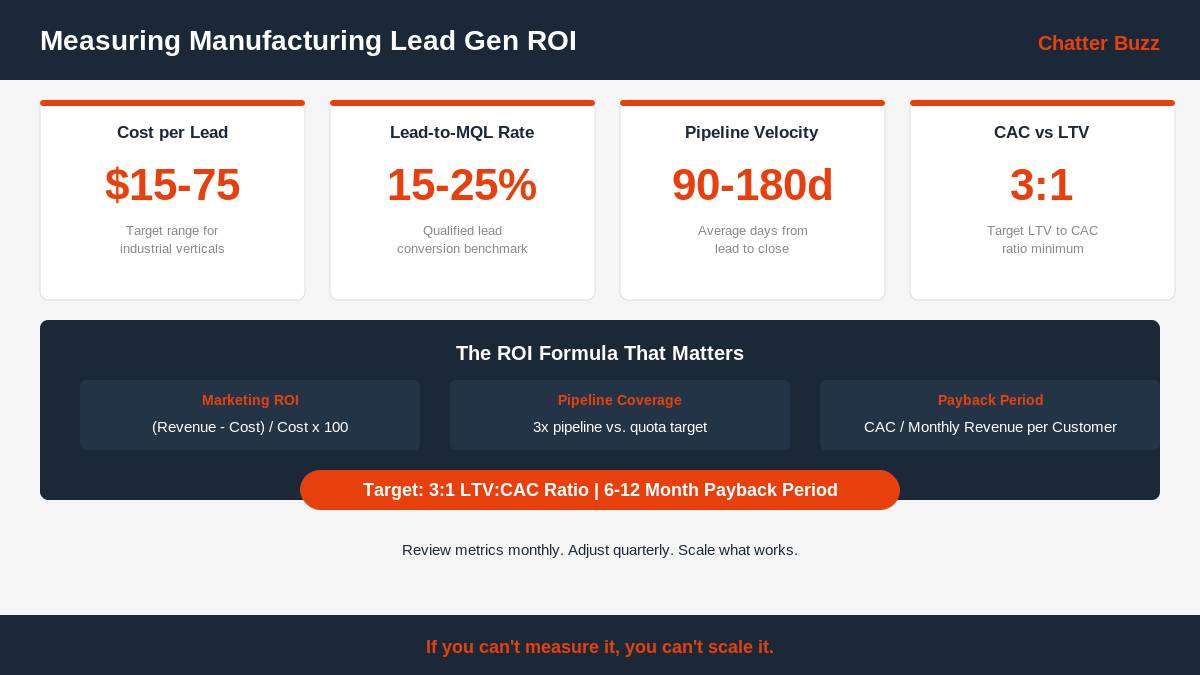
Measuring Manufacturing Lead Generation ROI
If you cannot measure it, you cannot improve it. Manufacturers who track the right metrics make smarter investment decisions, scale what works, and cut what does not. Yet most manufacturers still rely on gut feel rather than data to evaluate their marketing.
The challenge is that manufacturing sales cycles are long and multi-touch, making simple attribution nearly impossible. Here is how to build a measurement framework that accounts for this complexity.
KPIs That Actually Matter
Forget vanity metrics like website traffic, social media followers, and email open rates. These numbers feel good but tell you nothing about pipeline impact. Focus on these KPIs instead:
- Cost per qualified lead (CPQL): Total marketing spend divided by the number of leads that meet your qualification criteria. This is your efficiency metric.
- Pipeline velocity: How quickly leads move from first touch to closed deal. Faster velocity means your nurturing and sales processes are working.
- Marketing-sourced pipeline: Total dollar value of opportunities that originated from marketing activities. This proves marketing’s revenue impact.
- Customer acquisition cost (CAC): Total sales and marketing cost to acquire one new customer. Compare this to customer lifetime value (LTV) to ensure profitability.
- Lead-to-opportunity conversion rate: What percentage of marketing-qualified leads convert to sales opportunities? Low conversion signals a qualification or handoff problem.
Attribution Models for Long B2B Sales Cycles
Manufacturing deals involve dozens of touchpoints across months. First-touch attribution (crediting the first interaction) and last-touch attribution (crediting the final interaction before conversion) both paint incomplete pictures.
Multi-touch attribution distributes credit across all touchpoints in the buyer journey. For most manufacturers, a weighted model that gives extra credit to the first touch (awareness) and the lead conversion touch (the action that generated the lead) provides the most actionable insights.
If multi-touch attribution feels complex, start simpler. Track which channels generate the most qualified leads and which generate the most revenue. Over time, refine your model as your data matures.
Benchmarks and What Good Looks Like
Manufacturing lead generation benchmarks vary by sub-industry, deal size, and sales cycle length. However, these ranges provide useful reference points:
- Website conversion rate: 2-5% for manufacturing sites with optimized landing pages (industry average is below 2%).
- Cost per qualified lead: $75-$250 for digital channels; $300-$800 for trade show leads (after accounting for total event costs).
- Email nurture click-through rate: 2-4% for segmented, relevant manufacturing content.
- Lead-to-opportunity conversion: 10-25% for well-qualified leads with proper nurture sequences.
- Sales cycle length: 90-180 days for mid-market manufacturing deals.
If your numbers fall significantly below these ranges, the frameworks in this guide will help you identify and fix the gaps. A strong B2B digital marketing partner can accelerate that process.
Conclusion
Manufacturing lead generation in 2026 demands a systematic, multi-channel approach. The days of relying solely on trade shows, referrals, and cold calls to fill your pipeline are behind us.
The manufacturers growing fastest have built integrated systems that combine SEO and content marketing for long-term organic visibility, paid media for immediate reach, website optimization for higher conversion rates, marketing automation for consistent nurturing, and outbound prospecting for proactive pipeline building.
Start with your foundation: define your ICP, map the buyer journey, and align sales and marketing around shared goals. Then build channel by channel, measuring results at every step and doubling down on what generates qualified pipeline.
The competition for your buyers’ attention is intensifying. Every month you delay gives competitors more time to capture the digital visibility and mindshare that should belong to you. The best time to build your digital marketing engine was a year ago. The second-best time is today.
Frequently Asked Questions
What is manufacturing lead generation?
Manufacturing lead generation is the process of identifying and attracting potential B2B buyers — engineers, procurement managers, and operations leaders — who need your production capabilities. It encompasses digital strategies like SEO, content marketing, paid advertising, and outbound prospecting designed to fill your sales pipeline with qualified opportunities.
How do manufacturers generate B2B leads in 2026?
The most effective manufacturers use a multi-channel approach combining search engine optimization, technical content marketing, Google Ads targeting high-intent industrial keywords, LinkedIn advertising, outbound email and phone sequences, and account-based marketing. The key is integrating these channels into a unified system rather than running isolated campaigns.
How long does it take to see results from manufacturing lead generation?
Paid advertising can generate leads within the first 2-4 weeks. SEO typically takes 3-6 months to gain traction. Outbound prospecting produces initial meetings within 2-4 weeks, though the full B2B manufacturing pipeline takes 3-6 months to mature as deals progress through long sales cycles.
What is the best marketing channel for manufacturing companies?
There is no single best channel — the answer depends on your timeline, budget, and target audience. SEO delivers the highest long-term ROI. Google Ads provides the fastest results. LinkedIn reaches decision-makers with surgical precision. Outbound prospecting creates opportunities that would never find you through inbound alone. The best strategies combine all four.
How much should a manufacturing company spend on lead generation?
Manufacturing companies typically invest 2-5% of revenue in marketing, with lead generation consuming 40-60% of that budget. For a $10M manufacturer, this translates to roughly $80,000-$300,000 annually for lead generation. Companies in growth mode or entering new markets often invest at the higher end.
What is the difference between manufacturing lead generation and demand generation?
Lead generation focuses on capturing contact information from interested buyers. Demand generation creates awareness and interest in your capabilities before buyers are ready to engage — building the market for your solutions. The most effective strategies combine both: demand generation fills the top of the funnel, while lead generation converts that awareness into qualified pipeline. Read our complete guide to B2B demand generation for more.
How do you measure manufacturing lead generation ROI?
Focus on cost per qualified lead, marketing-sourced pipeline value, lead-to-opportunity conversion rate, and customer acquisition cost. Use multi-touch attribution to understand which channels contribute most across long sales cycles. Avoid measuring success by vanity metrics like website traffic or social media engagement — track metrics tied directly to revenue impact.