
 321-236-2899
Account-Based Marketing (ABM) is primarily used by B2B companies selling high-ticket products or services where deals involve long sales cycles, multiple decision-makers, and significant contract value. Unlike traditional marketing, which focuses on generating large volumes of leads, ABM concentrates marketing and sales efforts on a defined set of high-value accounts most likely to convert.
In this guide, you’ll learn how ABM works, when it outperforms lead generation, and how to structure an effective ABM strategy. We’ll also break down the core components, execution models, and metrics required to drive measurable revenue from targeted accounts.
Key Takeaways:
- Account-Based Marketing works best for high-ticket B2B sales where deal size, sales cycles, and buying committees are complex.
- Lead volume does not equal revenue; targeting the right accounts drives higher close rates and larger deals.
- ABM requires sales and marketing to operate from a single, shared account strategy.
- Personalization at the account and decision-maker level significantly increases engagement and conversion.
- ABM success is measured by account engagement, pipeline influence, and revenue—not leads.
- ABM is a long-term growth model, not a one-time campaign.
What Is Account-Based Marketing?
Account-Based Marketing (ABM) is a B2B strategy that focuses marketing and sales efforts on a defined list of high-value target accounts, rather than generating large volumes of individual leads. Unlike typical inbound or lead generation campaigns—which prioritize traffic and form fills—ABM prioritizes account-level engagement, personalized messaging, and revenue impact from the right companies.
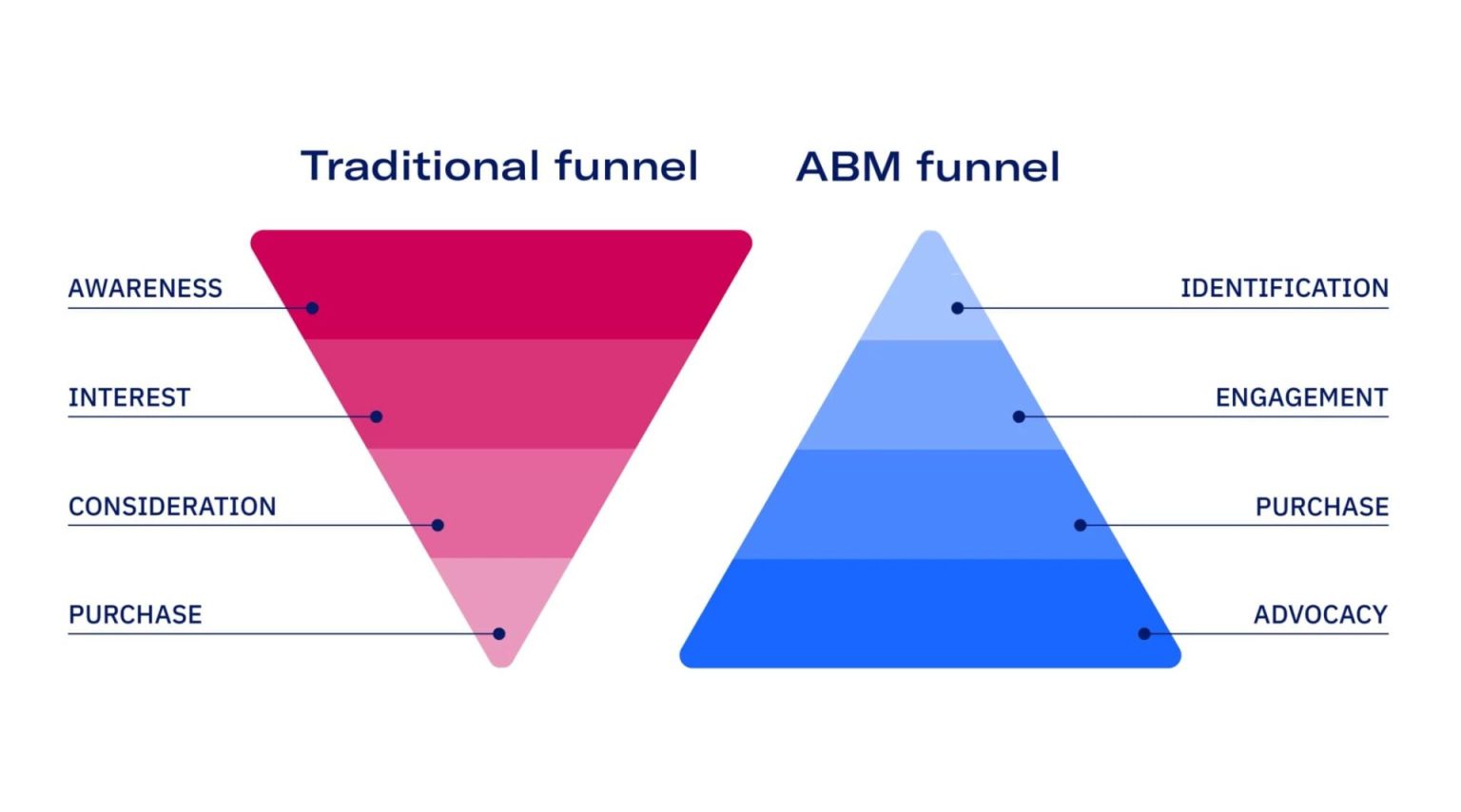
With ABM, campaign messaging is highly focused on a defined list of high-value target accounts, rather than a broad audience. Messaging is personalized at the account and decision-maker level, ensuring each target receives relevant content that speaks directly to their business needs, priorities, and buying stage.
By focusing on account-level engagement rather than lead volume, ABM consistently delivers stronger pipeline quality, higher conversion rates, larger deal sizes, and more predictable revenue than broad inbound or lead generation campaigns.
How ABM Differs from Traditional Lead Generation
Traditional lead generation focuses on casting a wide net—generating large numbers of leads. This is done through general content marketing, paid advertising, and inbound channels.
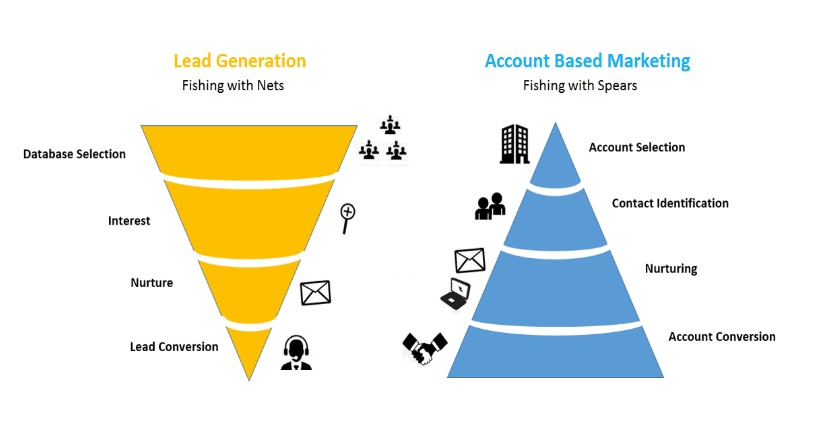
ABM, by contrast, is about precision. It identifies target accounts, researches their decision-makers, and crafts campaigns focusing on what people really want.
The Role of Sales and Marketing Alignment
Consider an ABM like a playbook for success, one that is inherently collaborative. Sales engages directly with decision-makers armed with these insights. This alignment ensures a consistent, personalized experience. This reduces friction in the buyer journey and increases conversion rates.
Technology That Enables ABM
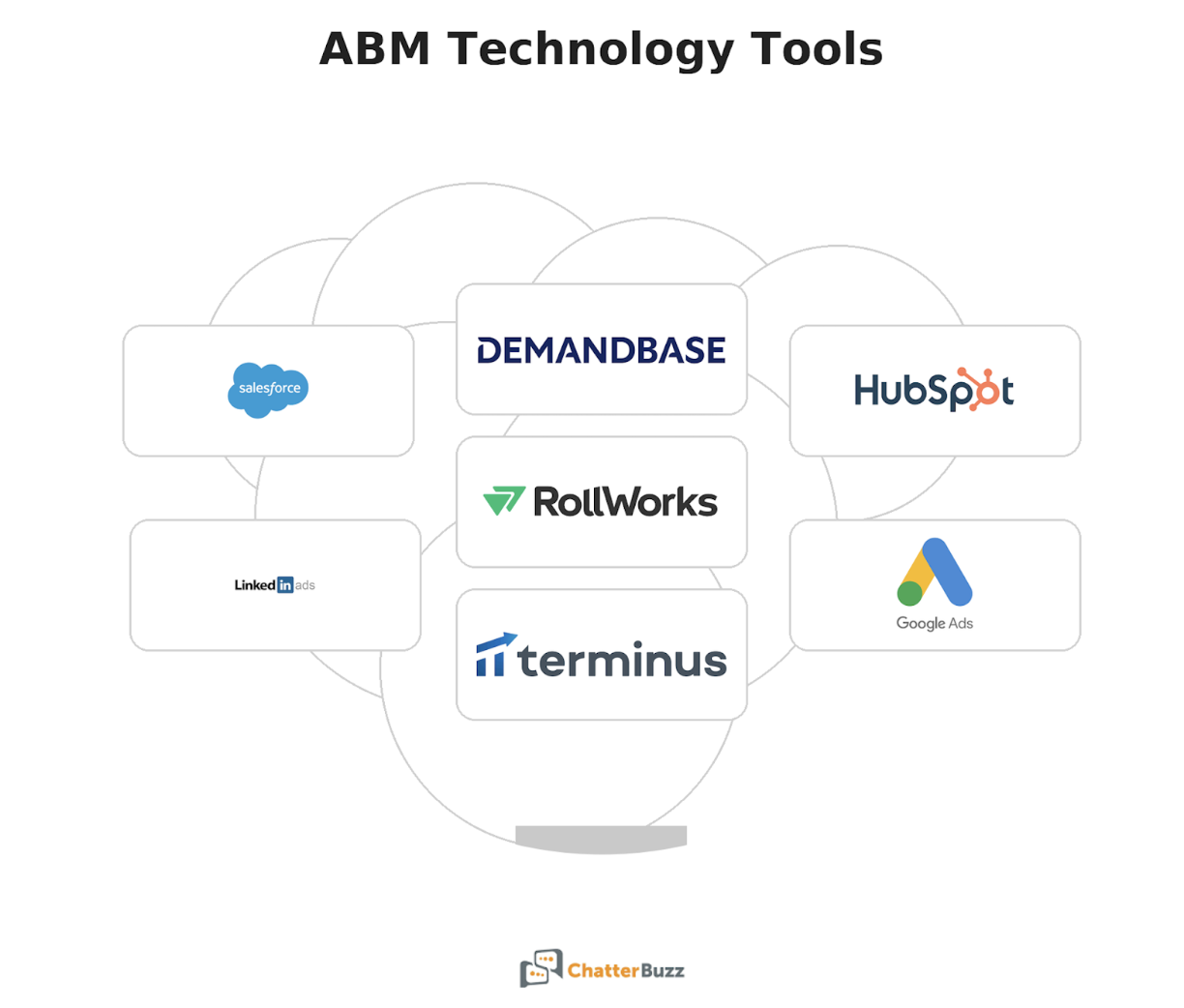
Modern ABM relies on technology to scale personalization and track engagement. CRMs like Salesforce and HubSpot help manage account data. Platforms like Demandbase, Terminus, and RollWorks enable account-level targeting and ad personalization.
LinkedIn Ads, Google Ads, and marketing automation tools deliver campaigns and track performance across multiple channels.
How Account-Based Marketing Works
Below is a step-by-step breakdown of how ABM marketing programs typically work.
1. Identify and Segment Target Accounts
Successfully implement an ABM program by identifying the accounts most likely to drive meaningful revenue. This begins with defining your Ideal Customer Profile (ICP)—a detailed description of the companies that are the best fit for your product or service. The ICP ensures your marketing and sales efforts are focused on accounts with the highest potential return.
Defining Your Ideal Customer Profile (ICP)
An ICP goes beyond basic demographics. It includes characteristics that predict long-term value and a high likelihood of adoption. Key factors to consider:
- Industry or Vertical: Identify the sectors where your solution solves pressing challenges.
- Company Size and Revenue: Tailor your targeting to companies that match your ideal deal size and resource capacity.
- Geography: Consider regional, national, or global targeting based on your operational capabilities, shipping, or support requirements.
- Technology Stack: Identify companies using complementary or competitive tools. This enables highly relevant messaging and positioning.
- Buying Signals or Intent Data: Track online behaviors, content downloads, event attendance, or industry research to detect accounts actively evaluating solutions like yours.
Segmenting and Tiering Accounts
Once your ICP is defined, the next step is segmentation and account tiering. Not all accounts are created equal—some have a stronger potential influence.
- Tier 1: High-Value Strategic Accounts
- This account tier is typically a small number of accounts that could drive major revenue.
- Requires highly personalized, resource-intensive campaigns, including executive outreach and one-to-one engagement.
Example: Targeting a Fortune 500 company with tailored messaging for each executive involved in the buying decision.
- Tier 2: Mid-Level Accounts
- Moderate revenue potential or strategic importance.
- Engagement is still personalized, but scaled—grouping accounts with similar needs into one-to-few ABM campaigns.
Example: 20 mid-market SaaS companies in the same vertical receive a semi-customized email series, targeted LinkedIn ads, and a webinar invite relevant to their industry challenges.
- Tier 3: Programmatic or Scalable Accounts
- Larger sets of accounts that fit your ICP but are less likely to yield high-value deals individually.
- Engagement is primarily automation-driven, leveraging one-to-many ABM approaches with dynamic content and programmatic ad campaigns.
Example: 200 SMB financial firms receive automated email campaigns and targeted LinkedIn content highlighting general product benefits and ROI case studies.
Key Insight: Tiering ensures resources are allocated efficiently—high-touch campaigns focus on the most strategic accounts, while scalable approaches maximize reach without sacrificing personalization entirely.
2. Research & Personalize Messaging
Once target accounts are identified, the next step is deep research and personalized messaging. ABM thrives on relevance—decision-makers respond best when content speaks directly to their challenges and business objectives.
Identify Key Decision-Makers
Every target account has multiple stakeholders—C-suite executives, department heads, and influencers. Start by mapping decision-making roles and understanding their priorities:
- CFO: ROI, cost savings, operational efficiency
- CMO: Marketing effectiveness, brand visibility, campaign performance
- CIO/CTO: Technology integration, cybersecurity, scalability
Example: A B2B software company targeting mid-market healthcare providers might identify the CIO as the primary decision-maker for EMR software, while the CMO is involved in evaluating patient engagement tools. Messaging should address each stakeholder’s unique perspective.
Understand Pain Points
Effective personalization begins with understanding challenges. Use intent data, social listening, and competitor research to identify what issues matter most to the account.
Example: If LinkedIn engagement data shows a target account discussing supply chain inefficiencies, a personalized campaign could highlight a case study where your solution improved operational efficiency for a similar company.
Craft Personalized Content
Personalization can take many forms:
- Customized emails or LinkedIn messages: Reference the company’s recent announcements, industry trends, or specific challenges.
- Role-specific content offers: Ebooks, whitepapers, or ROI calculators designed for a particular function or decision-maker.
- Industry-relevant case studies: Highlight results from companies similar in size, vertical, or geographic region.
- Direct mail or video outreach: For top-tier accounts, sending a branded gift or a personalized video message can cut through digital noise.
Example: Sending a short, personalized video to a CTO showcasing how your solution integrates seamlessly with existing systems can create an immediate connection and trust.
Why It Works
Personalized messaging increases engagement because it demonstrates that your team understands the account’s business and is invested in providing solutions—not just making a sale. It moves the conversation from transactional to strategic.
3. Engage Through Multi-Channel Campaigns
Personalization is only effective if delivered through the right channels at the right time. ABM campaigns use an integrated, multi-channel approach to maximize reach and engagement.
Email Marketing
- Personalized sequences: Triggered emails that reference account-specific insights, behavior, or stage in the buying journey.
- Example: After a webinar registration, follow up with a tailored email that highlights the content most relevant to the recipient’s role or industry.
- Best practice: Keep content concise, highlight measurable benefits, and include a clear next step (e.g., demo request, meeting).
LinkedIn Ads
- Account-specific targeting allows campaigns to reach decision-makers by company, role, or seniority.
- Sponsored content or InMail can be personalized with account-specific messaging.
- Example: Targeting VPs of Marketing at SaaS companies with a tailored ad showcasing a recent campaign ROI achieved for a similar client.
Retargeting Ads
- Reinforce your message across platforms. Use cookies or tracking pixels to retarget decision-makers who have engaged with your website or content.
- Example: If a CTO downloads a whitepaper on cloud security, retarget them with an ad highlighting a relevant case study or upcoming webinar.
Webinars & Events
- Interactive sessions allow you to educate and engage high-value accounts.
- Example: Hosting a roundtable for CFOs in the healthcare industry, addressing cost-saving strategies using your solution.
- Record sessions and share personalized follow-ups for attendees who couldn’t join live.
Direct Mail
- Tangible, high-impact touches can set your brand apart in a crowded digital landscape.
- Example: Sending a personalized book or branded kit that aligns with the account’s challenges, followed by a personalized email or LinkedIn message referencing the gift.
Key Takeaway: Multi-channel campaigns amplify the impact of personalized messaging. By coordinating emails, ads, events, and direct mail, you create consistent, engaging touchpoints that move accounts through the funnel faster.
4. Measure Engagement & Optimize
ABM is data-driven by design. Every interaction with your target account provides insights to refine your approach and improve outcomes.
Key Metrics to Track
- Content views and downloads: Measure engagement with personalized emails, whitepapers, and case studies.
- Meeting requests or demo bookings: Track which accounts respond to outreach.
- Pipeline influenced: Connect account engagement to pipeline opportunities created or influenced.
- Deal velocity and win rates: Monitor how ABM efforts shorten sales cycles and increase conversion rates.
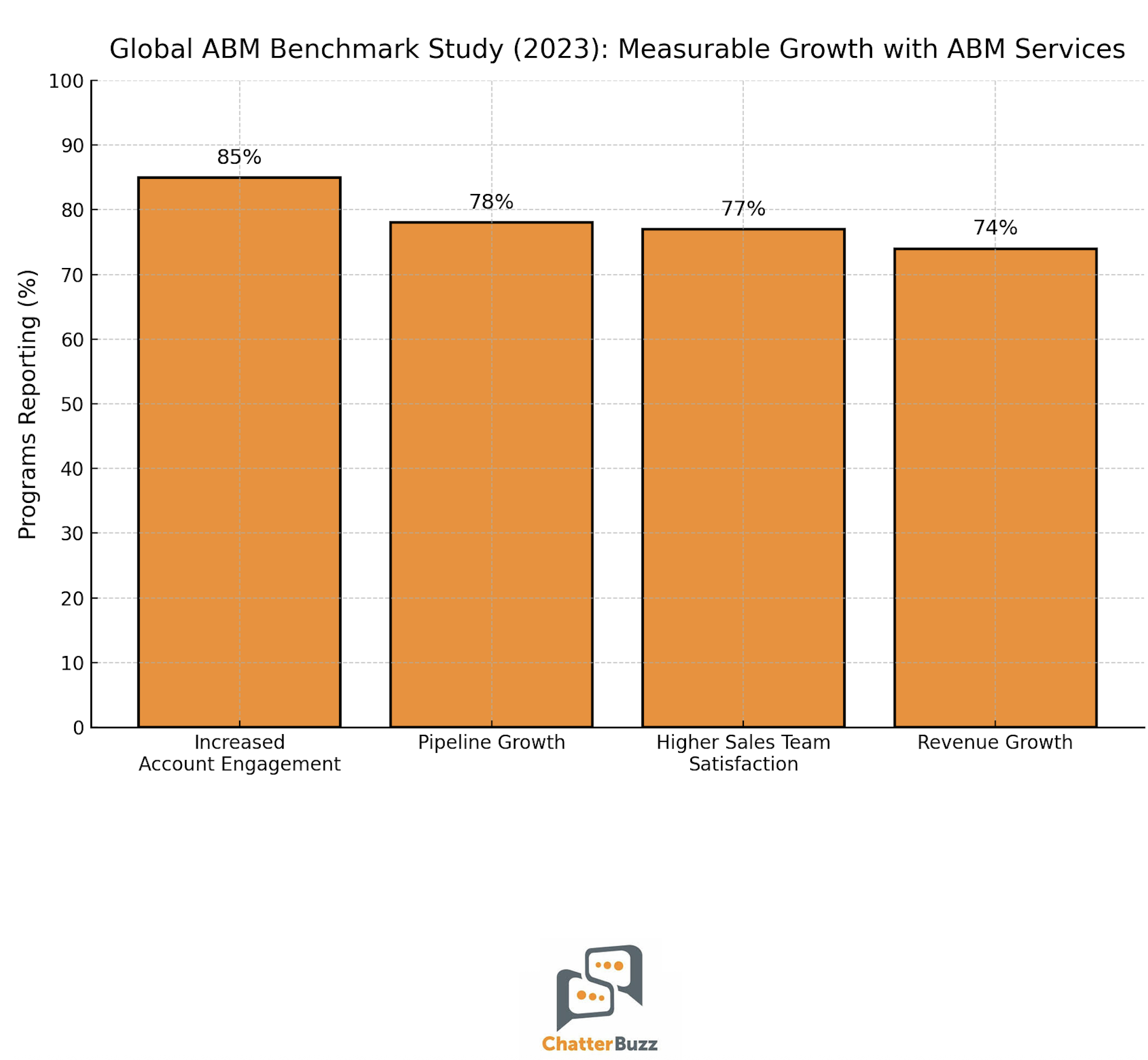
In the 2023 Global ABM Benchmark Study, there was measurable growth for those utilizing services. 85% of ABM programs report increased account engagement, 78% saw pipeline growth, 77% report higher sales team satisfaction, and 74% report revenue growth.
Optimize Campaigns
Use insights to improve targeting, messaging, and creative:
- A/B test subject lines, messaging, and visuals: Determine what resonates best with specific roles or industries.
- Adjust channel cadence: Increase touchpoints for highly engaged accounts or shift underperforming accounts to different channels.
- Refine personalization: Update messaging based on interactions or new account intelligence.
Example: A SaaS company noticed low engagement from a Tier 2 account with email alone. By adding LinkedIn InMail and personalized direct mail referencing a competitor case study, engagement increased by 45%.
Types of ABM Strategies
Not all ABM programs are the same. Below is a brief breakdown of ABM strategies. Review them to see which best suits your goals.
One-to-One ABM
- Description: Highly personalized campaigns targeting your top-tier, highest-value accounts. Every message, content piece, and touchpoint is tailored.
- Ideal For: Enterprise companies with a small set of accounts that could generate substantial revenue.
- Pros: Extremely high ROI due to personalization; builds strong strategic relationships.
- Cons: Resource-intensive; less scalable for a large number of accounts.
- Example: A global tech vendor targeting Fortune 500 companies creates individualized campaign landing pages, personalized executive outreach, and bespoke demos for each target company.
One-to-Few ABM
- Description: Targets small clusters of accounts sharing similar characteristics—such as industry, size, or business challenge.
- Ideal For: Mid-market organizations with moderate account volumes.
- Pros: Balances personalization with operational efficiency; allows reuse of content for similar accounts.
- Cons: Requires careful segmentation to ensure messaging resonates.
- Example: A SaaS provider identifies 15 healthcare organizations experiencing digital transformation challenges. They create a content series addressing compliance, security, and patient engagement that applies to the group but can be slightly personalized by the company.
One-to-Many ABM
- Description: Scalable, programmatic campaigns targeting hundreds of accounts using automation.
- Ideal For: Companies with large numbers of accounts or smaller deal sizes.
- Pros: Highly scalable, cost-effective; leverages marketing automation to reach many accounts.
- Cons: Less personalized; must rely on predictive analytics and segmentation for relevance.
- Example: A B2B marketing automation company runs targeted LinkedIn and email campaigns for 500 SMBs in the financial sector, using dynamic content blocks to customize messaging by company segment.
Core Components of an Effective ABM Program
The core components of a successful ABM program combine data, personalization, technology, and cross-functional collaboration. Each component works together to ensure that marketing and sales focus on the accounts with the highest potential for growth.
Below is a detailed exploration of each key element, with examples, best practices, and actionable insights.
1. Ideal Customer Profile (ICP) Development
Defining your ICP is foundational to ABM success. Without it, your efforts risk targeting accounts that may generate leads but fail to convert into high-value, long-term customers. The ICP serves as a blueprint for identifying accounts that align strategically with your product or service, ensuring marketing and sales focus on the most promising opportunities.
Attributes to Consider
- Industry or Vertical: Target sectors where your product solves real business problems.
- Revenue & Employee Size: Determines potential deal size, implementation complexity, and support needs.
- Geography: Focus on regions where you can provide reliable support, regulatory compliance, or local sales coverage.
- Technology Stack: Understanding the tools a company already uses allows for positioning and integration messaging.
- Pain Points & Challenges: Identify the operational, strategic, or financial challenges your product solves.
- Behavioral Indicators: Track engagement patterns, such as website visits, content downloads, webinar attendance, or competitor research, to gauge buying intent.
Best Practices
- Leverage historical CRM data to identify patterns among your most profitable clients.
- Combine quantitative metrics (revenue, employee size) with qualitative insights (strategic fit, corporate culture).
- Collaborate with sales teams to validate ICPs for practical relevance and real-world applicability.
Example in Practice
A mid-market SaaS company identifies target accounts as tech firms with 500+ employees that already use HubSpot and are engaging with content related to marketing automation. By prioritizing these accounts, the company increases its likelihood of winning deals with high long-term value.
2. Target Account Selection & Data Enrichment
Once ICPs are defined, the next step is creating a target account list and adding data. This step makes sure your campaigns reach the right people with the most relevant content.
Data Sources
- CRM Data: Identify accounts with historical engagement or existing opportunities.
- Firmographics: Segment accounts by size, industry, location, or growth potential.
- Intent Data: Detect accounts showing interest in solutions like yours via content downloads, site visits, or third-party research activity.
- Data Enrichment Platforms: Tools such as Clearbit, ZoomInfo, and Leadspace help verify contacts, append missing details, and improve targeting accuracy.
Practical Example
A marketing technology provider identifies accounts that previously attended webinars. By layering intent data showing research on AI-powered marketing tools, the company targets these accounts with relevant campaigns, boosting engagement and conversion rates.
Segmentation and Tiering
Accounts should be tiered by value and strategic importance:
- Tier 1: High-value accounts requiring high-touch, personalized engagement.
- Tier 2: Medium-value accounts with moderate personalization, often managed through semi-scaled campaigns.
- Tier 3: Low-touch accounts suitable for programmatic, automated engagement.
3. Personalized Messaging & Creative
Personalization is the cornerstone of ABM success. Generic messaging fails to resonate with high-value accounts. Role-specific content is far more effective.
Messaging Considerations
- Role-Specific Content: CEOs, CFOs, CIOs, and CMOs each have unique priorities.
- Pain Points: Address business challenges such as cost optimization, revenue growth, efficiency, or compliance.
- Buyer Journey Stage: Tailor messaging for awareness, consideration, or decision phases.
Example
A CFO at a mid-market SaaS company responds best to a case study demonstrating measurable ROI through cost reduction. A CIO, in contrast, is more likely to engage with a technical demo or integration guide. ABM allows marketers to deliver exactly the right content to the right person at the right time, increasing conversion likelihood.
4. Multi-Channel Campaigns
ABM succeeds when campaigns are delivered across multiple touchpoints, meeting decision-makers wherever they engage most frequently.
Key Channels
- LinkedIn Ads: Target by company, role, or seniority with sponsored content or InMail.
- Email Sequences: Deliver personalized, role-specific nurturing campaigns.
- Webinars & Events: Host interactive educational sessions for top accounts.
- Retargeting Ads: Reinforce messaging across digital platforms.
- Direct Mail & Gifts: Deliver tangible engagement for Tier 1 accounts, such as personalized videos, kits, or handwritten notes.
Example
A mid-market technology company launches an ABM campaign:
- Tier 1: Personalized videos and direct mail.
- Tier 2: Targeted LinkedIn content and semi-personalized email sequences.
- Tier 3: Automated retargeting campaigns and downloadable guides.
5. Sales & Marketing Alignment
ABM cannot succeed without close alignment between marketing and sales teams. Misalignment leads to inconsistent messaging, missed opportunities, and wasted resources.
Best Practices
- Shared KPIs: Number of target accounts engaged, pipeline influenced, and opportunities created.
- Communication Cadence: Weekly check-ins, reporting dashboards, and feedback loops.
- Handoff Rules: Define when marketing-qualified accounts transition to sales outreach.
Example
A software company builds a shared dashboard for Tier 1 accounts. Marketing tracks engagement metrics and signals sales when accounts are ready for personalized outreach. Sales feedback informs adjustments to messaging and targeting.
6. Tech Stack & Tools
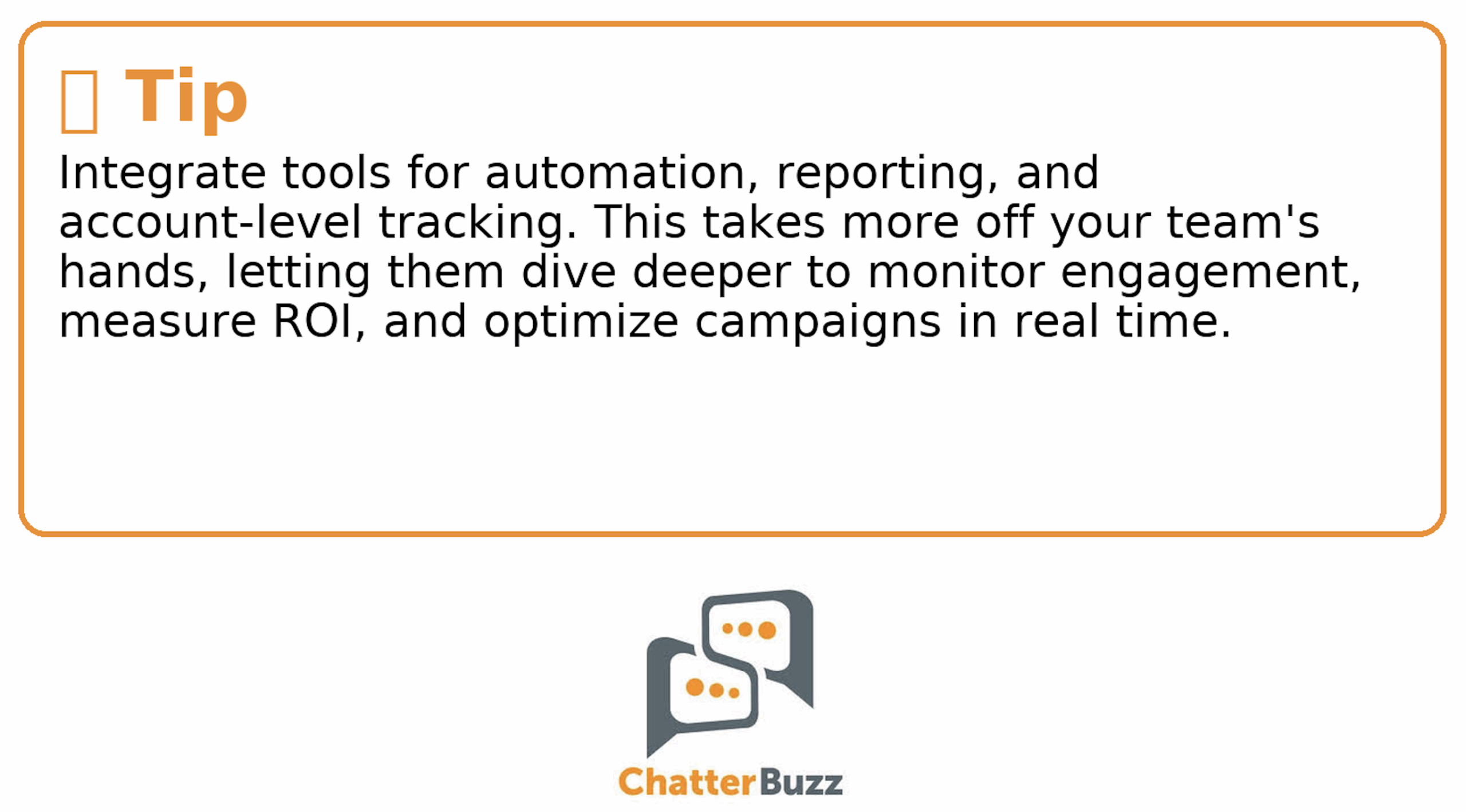
Technology is the engine that powers ABM at scale. Without it, executing multi-touch, data-driven campaigns is nearly impossible.
Essential Tools
- CRM: Salesforce, HubSpot
- ABM Platforms: Demandbase, Terminus, RollWorks
- Analytics: Google Analytics, Dreamdata, Bizible
- Advertising Platforms: LinkedIn Ads, Google Ads
7. Performance Measurement & Optimization
ABM is not static—it requires continuous measurement and refinement.
Metrics to Track
- Account Engagement: Email opens, content downloads, social interactions.
- Pipeline Influenced: Deals affected by ABM campaigns.
- Deal Velocity: Time from first engagement to close.
- ROI per Account & Channel: Identify the most effective channels for each account.
Optimization Techniques
- A/B Testing: Experiment with subject lines, messaging, and creative assets.
- Channel Adjustments: Reallocate resources to higher-performing channels or accounts.
- Refined Personalization: Update content based on engagement signals or new account intelligence.
Example
A SaaS company observed low email engagement for Tier 2 accounts. By introducing personalized LinkedIn InMail and retargeting ads, engagement increased by 50%.
Common ABM Challenges (and How to Solve Them)
Even the most sophisticated ABM programs face hurdles. DemandGen sent out a survey to identify top pain points. Top ABM challenges include proving ROI (47%), aligning sales and marketing (43%), and scaling programs (40%). Understanding these challenges and implementing practical solutions is crucial.
1. Sales & Marketing Misalignment
The Challenge: ABM requires tight collaboration between sales and marketing. Without shared goals and communication, campaigns can falter. Sales may ignore qualified accounts, or marketing may invest in the wrong targets.
The Solution:
- Establish shared KPIs such as target accounts engaged, pipeline influenced, or opportunities created.
- Conduct regular alignment meetings to review account progress, discuss messaging, and adjust strategy.
- Define clear handoff rules: when a marketing-qualified account becomes a sales-qualified opportunity.
Example: A SaaS company noticed Tier 1 accounts were not advancing due to inconsistent outreach. By creating a shared dashboard, marketing could notify sales when engagement thresholds were met, leading to a 35% increase in opportunity conversion.
2. Poor Data Quality
The Challenge: ABM relies heavily on accurate data. Incomplete or outdated CRM records, incorrect emails, or inaccurate firmographic information can severely impact personalization and outreach.
The Solution:
- Regularly clean and update CRM records.
- Use data enrichment platforms like ZoomInfo, Clearbit, or Leadspace to fill missing fields and verify accuracy.
- Incorporate intent data to prioritize accounts showing active buying signals.
Example: A B2B technology provider discovered that 40% of target contacts had outdated email addresses. After data enrichment, email open rates increased by 60%, improving campaign ROI.
3. Limited Personalization
The Challenge: Generic messaging reduces engagement and conversion rates. ABM demands content tailored to the account, decision-maker role, and business pain points.
The Solution:
- Use dynamic content in emails and ads to display messages based on role or company size.
- Develop personalized case studies or ROI calculators relevant to each target account.
- Include videos or direct mail for high-value accounts to add a human touch.
Example: A mid-market software company created personalized video demos for Tier 1 accounts. Engagement increased by 50%, and three deals closed faster than historical averages.
4. Target Lists Too Small or Too Large
The Challenge: Targeting too few accounts limits potential revenue, while targeting too many dilutes focus and wastes resources.
The Solution:
- Revisit your ICP to ensure the right balance of quality and quantity.
- Tier accounts (Tier 1, Tier 2, Tier 3) and allocate resources based on potential value.
- Scale Tier 3 accounts with programmatic campaigns and automation for efficiency.
Example: A mid-market SaaS company initially targeted 500 accounts equally, resulting in diluted effort. By creating tiered engagement, Tier 1 received high-touch outreach while Tier 3 accounts were nurtured with automated campaigns, improving ROI by 45%.
5. Tech Adoption Challenges
The Challenge: ABM relies on multiple platforms (CRM, ABM tools, analytics). Teams often struggle to adopt new technology or integrate platforms effectively.
The Solution:
- Roll out automation in phases instead of a full-scale deployment.
- Provide hands-on training and documentation for sales and marketing teams.
- Establish cross-functional champions to ensure adoption and troubleshooting.
Example: A B2B marketing team implemented Terminus alongside HubSpot but struggled to track engagement. After a phased rollout with training sessions, dashboards were correctly configured, improving campaign tracking accuracy by 70%.
ABM vs Traditional Marketing
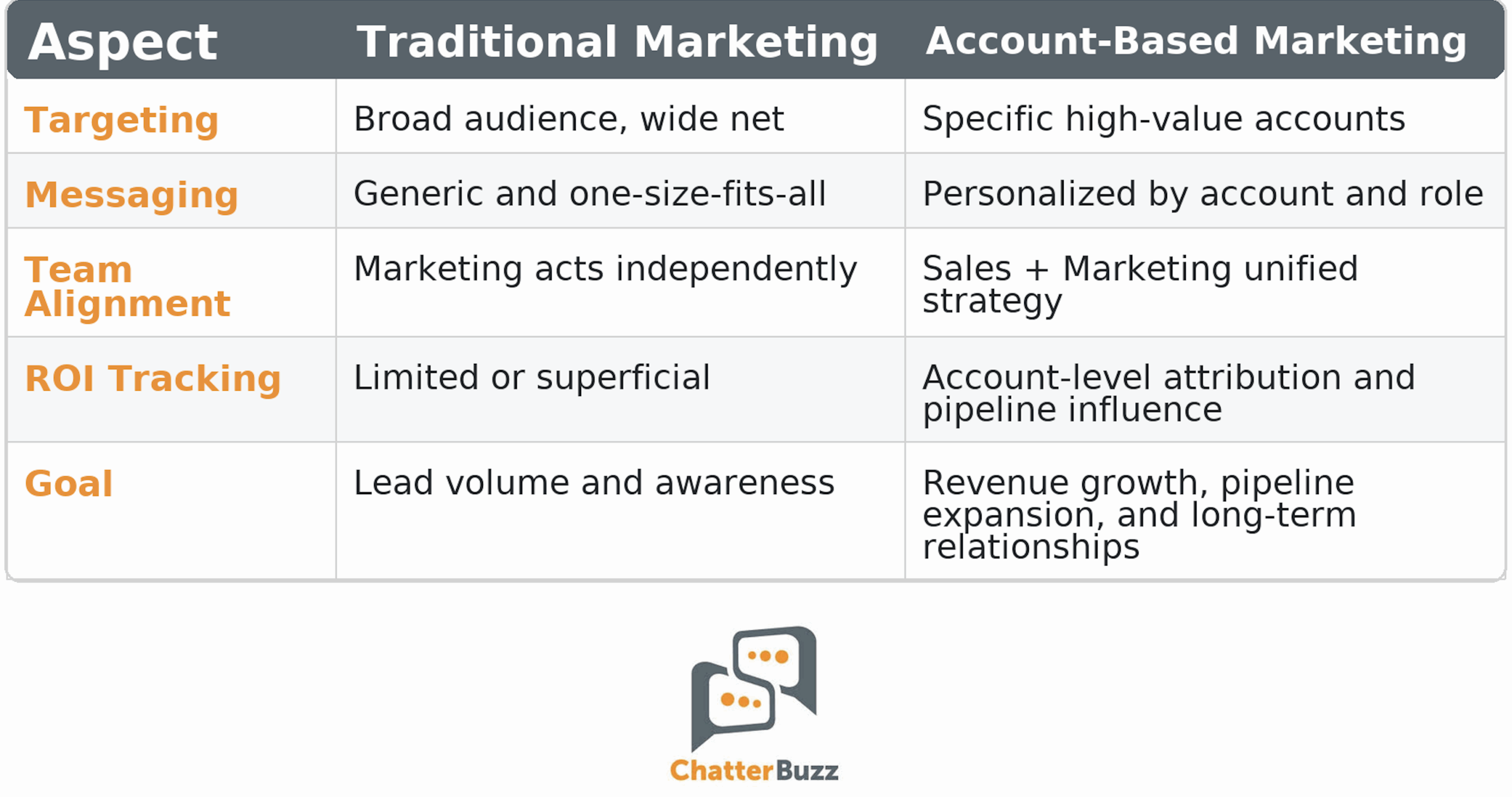
ABM is fundamentally different from traditional marketing. Understanding these differences helps companies decide where ABM fits within their broader strategy.
Example:
Traditional campaigns might run Facebook ads for 10,000 leads, hoping for conversions. ABM focuses on 50 high-value accounts with personalized outreach, resulting in better deals, even if the number of contacts is smaller.
Key Metrics to Measure ABM Success
Measuring success is critical to refining and scaling ABM programs. Unlike traditional campaigns, ABM focuses on account-level performance rather than raw lead volume.
1. Account Engagement
Track engagement across email, ads, social media, webinars, and direct mail. Look for patterns in who is opening emails, clicking links, or attending webinars.
Example: Tier 1 accounts engaged in three or more touchpoints per month often advance to sales faster than less-engaged accounts.
2. Pipeline Influenced
Measure the value of deals influenced by ABM campaigns. This shows the impact of marketing on revenue growth rather than just lead generation.
Example: A SaaS firm tracked that 25% of its new opportunities in Q1 were influenced by Tier 1 ABM campaigns, resulting in a pipeline increase of $1.5M.
3. Average Deal Size
ABM often targets high-value accounts, meaning the average deal size tends to be higher than in traditional campaigns.
Example: Instead of $15K average deals from inbound leads, ABM campaigns produced $45K average deal size by focusing on Tier 1 accounts.
4. Customer Lifetime Value (CLV)
ABM nurtures strategically aligned accounts that increase retention and lifetime value.
Example: A B2B financial services company reported a 30% increase in CLV for accounts engaged in ABM versus standard marketing campaigns.
5. Win Rate
ABM services are linked to higher close rates—SiriusDecisions reports a 16% lift in win rate among companies that implement ABM.
Example: Targeted ABM efforts increased the win rate from 18% to 33% in a six-month pilot program.
Tips for Tracking ABM Metrics
- Use CRM dashboards to aggregate engagement and pipeline influence.
- Employ attribution models to connect multi-touch campaigns to revenue.
- Regularly track benchmark performance to identify which channels, messages, and content types perform best.
Pricing, Budget & Resource Planning
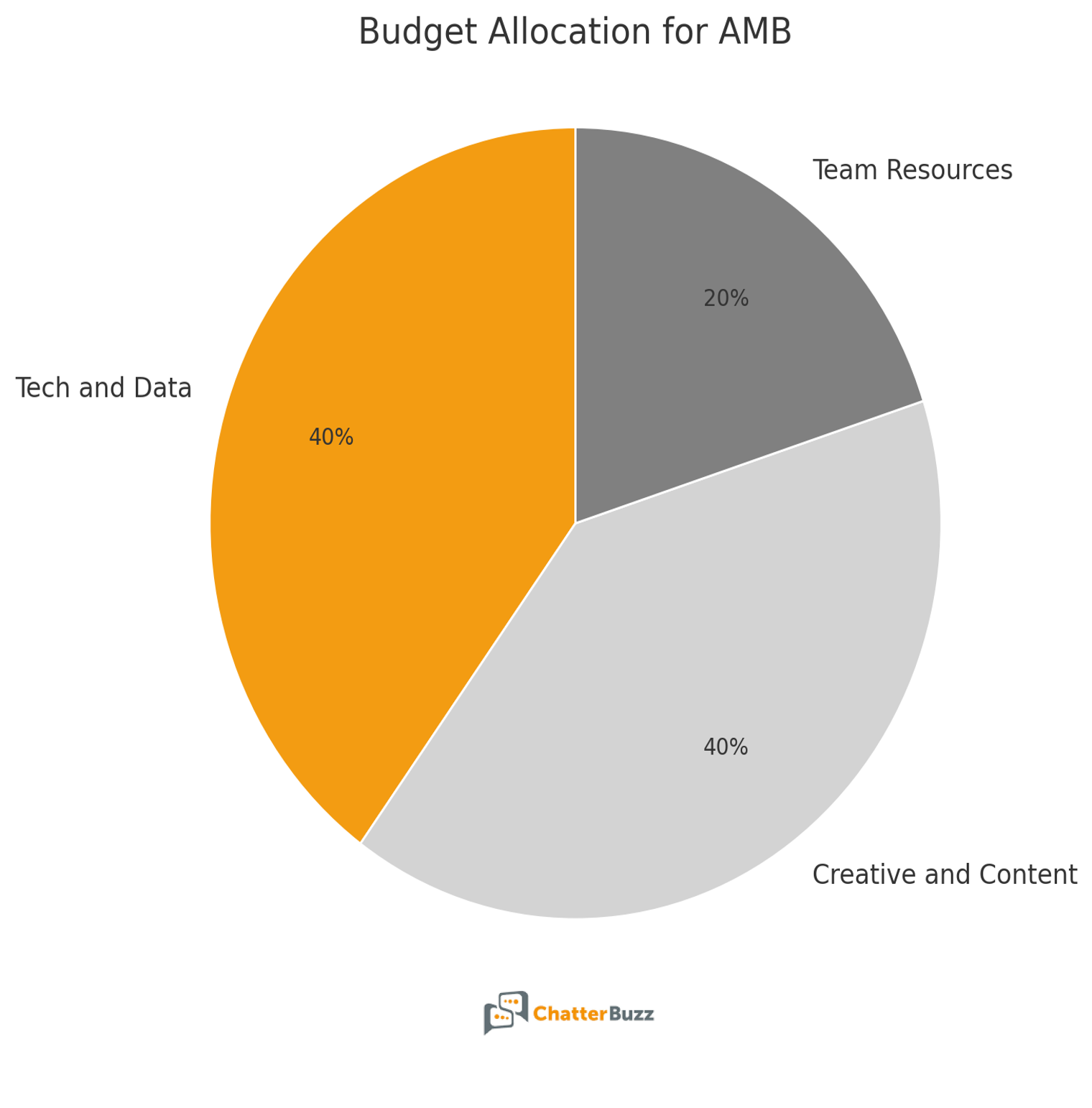
ABM campaigns require investment in creativity, data, and people:
- Creative and Content: Personalized campaigns for each tier of accounts.
- Data and Tools: CRM, ABM platforms, analytics, enrichment.
- Team Resources: Dedicated marketers, analysts, and sales collaboration.
Example Allocation:
- 40% Tech & Data
- 40% Creative and Content
- 20% Team Resources
ABM Frequently Asked Questions (FAQs)
How is ABM different from inbound marketing?
ABM is different from inbound marketing because it focuses on high-value accounts rather than broad leads.
What size business benefits most from ABM services?
Generally, mid-market to enterprise B2B companies are likely the best business sizes to benefit from ABM services. Contact our team to confirm if your business is best suited for these services.
How long until I see results with ABM services?
Results can vary; you should generally see improvements within 3 to 6 months of hiring an ABM specialist.
What tools are needed?
CRM, ABM platforms, and marketing automation are required for ABM services.
How do you measure ABM ROI?
You can measure ABM ROI through engagement, pipeline influence, deal velocity, and revenue.
What industries can benefit the most from ABM?
Technology, SaaS, financial services, and professional services are key industries likely to have the most growth from ABM.
Drive Smarter B2B Growth with ABM
Now that you understand the benefits of ABM, it’s evident why it’s the best method to deliver successful and measurable growth. Forget about trying to secure every customer and focus on creating a curated strategy for those who will have a long-term relationship.
If you’re ready to take your strategy to the next level, hire an ABM specialist. Let us help you identify your ideal accounts, personalize engagement, and scale campaigns that drive revenue.