
 321-236-2899
You have landed on the most comprehensive, in-depth guide to med spa SEO written specifically for multi-location aesthetics groups. Everything here is built for practices that need to rank in ten markets at once, not just one.
Local search is where med spa demand actually lives. 76% of people who search for a nearby business visit it within 24 hours, and the local 3-pack captures the majority of clicks before a single ad is seen.
At Chatter Buzz Media, we build organic search into the most predictable patient-acquisition channel our aesthetics clients have. This guide walks you through the full playbook — foundation, Google Business Profile, the multi-location content architecture that actually ranks, reviews, AI search, and how to measure it all the way to booked revenue — so you can master SEO for med spas across every location you operate.
Key Takeaways
- Med spa SEO is a local game first. Google ranks the map pack on relevance, distance, and prominence — not domain authority — so Google Business Profile completeness, review velocity, and citation consistency matter more than raw link count.
- Multi-location groups win or lose on content architecture. The practices that dominate build service pages around the primary market and distinct location pages for each suburb, without cloning thin city pages that trip Google’s doorway filters.
- Treatment-specific service pages are your highest-intent assets. Patients search “lip filler [city]” days before they book, and the spa that answers first earns the consultation.
- AI Overviews are the new front door. Structured, question-led content with schema is what gets your practice cited in AI search — a channel most competitors are ignoring in 2026.
- SEO compounds, but only if you measure it correctly. Track qualified visibility, engagement, and completed bookings by location — not a single vanity keyword rank.
Why Med Spa SEO Is Different — And Harder for Multi-Location Groups
General SEO advice breaks the moment you apply it to a med spa with locations in six suburbs. The local dynamics, the regulated nature of the treatments, and the sheer multiplication of pages create a search problem that demands a specialized approach.
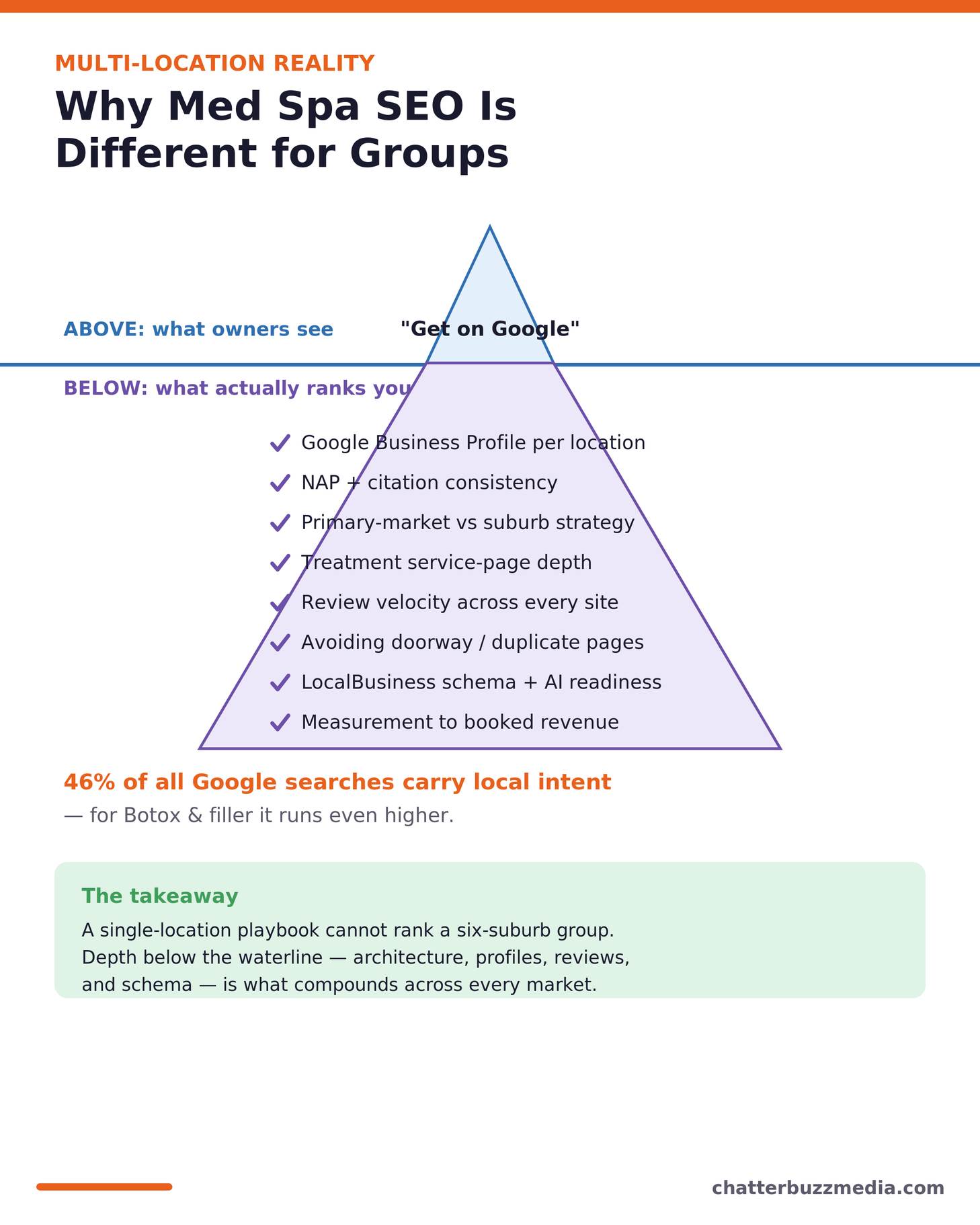
Understanding these differences is not academic — it decides whether your medical spa SEO budget compounds or leaks. Let us break down the three forces that make aesthetics SEO its own discipline.
The Local-First Reality
A med spa is a physical destination, so nearly every valuable search carries local intent. 46% of all Google searches have local intent, and for treatments like Botox and filler that number runs even higher.
Nobody searches “microneedling” in a vacuum — they search “microneedling near me” or “microneedling in Winter Park.” Your entire site architecture has to be built around geography from the first URL.
This is also where the med spa local SEO battle is won or lost in the map pack. The three-business local pack earns roughly 44% of clicks on a local results page, and those signals are driven by your Google Business Profile, not your homepage.
Multiple Locations, Multiplied Complexity
A single-location spa optimizes one homepage and a handful of service pages. A multi-location group manages a separate Google Business Profile, citation set, review stream, and location page for every address it operates.
Get this wrong and the locations compete against each other, splitting rankings and confusing Google. Get it right and each suburb becomes its own ranking engine feeding the group’s overall authority.
This is the exact challenge we solve for aesthetics brands, and it mirrors the multi-market work in our home builder SEO guide, where dozens of local pages have to rank without cannibalizing one another.
High-Consideration, Regulated Treatments
Aesthetic treatments are health-adjacent, high-cost, and high-trust. Google applies stricter quality expectations to this “Your Money or Your Life” content, rewarding demonstrated expertise and penalizing thin, generic pages.
Patients also research for weeks before booking, moving through dozens of searches from “does Botox hurt” to “best med spa in [city].” Your content has to earn trust at every one of those touchpoints, with medically accurate, compliant information.
Now that you understand what makes aesthetics SEO unique, let us build the foundation that everything else depends on.
How to Build Your Med Spa SEO Foundation
A strong foundation is what makes every later tactic work harder. Skip it and your Google Ads, social, and content all underperform because the site underneath them cannot be crawled, understood, or trusted.
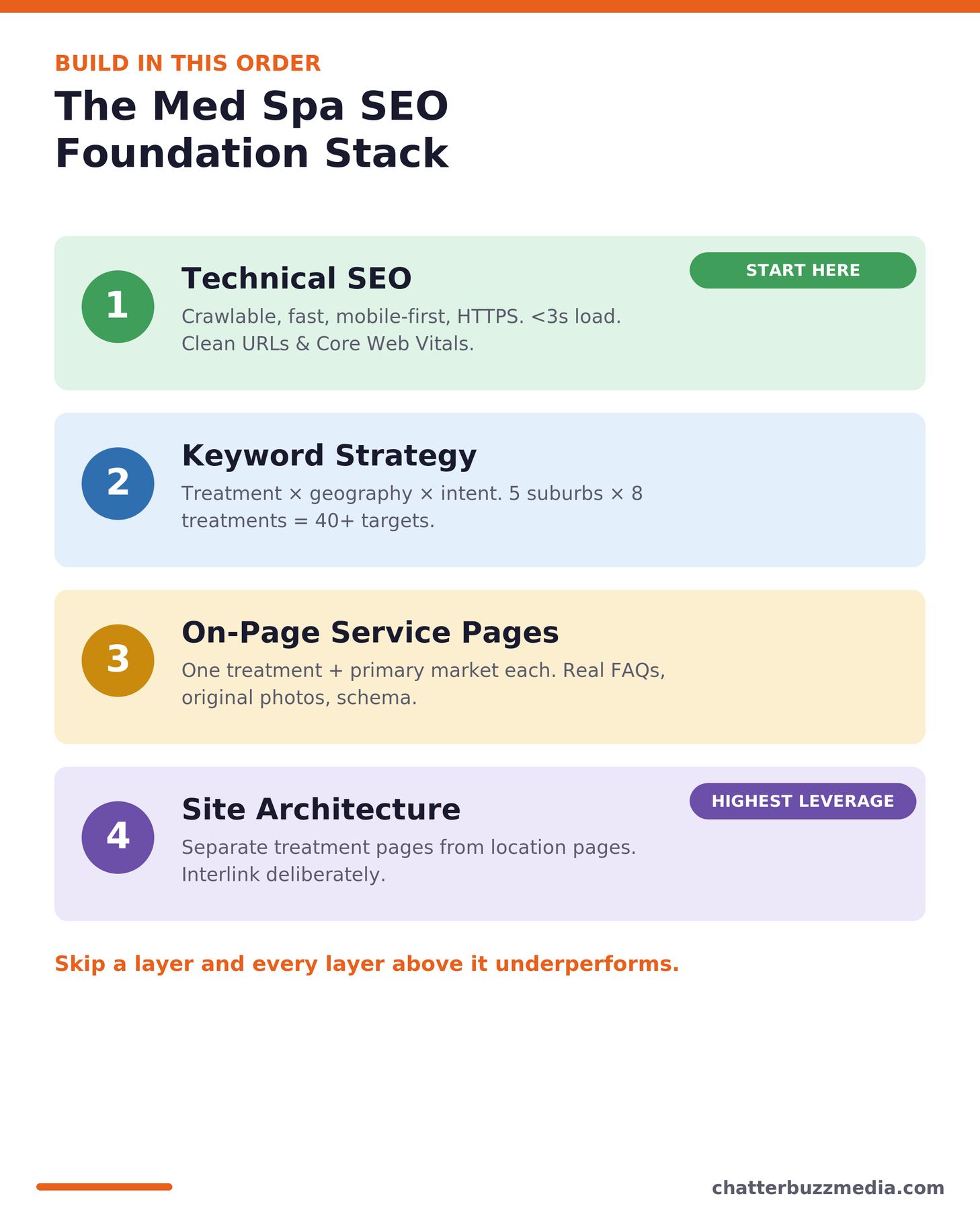
We build the foundation in three layers — technical, keyword strategy, and on-page — in that order. Here is how each one works for a med spa.
1. Lock Down Technical SEO
Before a word of content matters, Google has to be able to crawl, render, and index your site fast. Page load times over three seconds sharply increase bounce rates and quietly suppress rankings.
Prioritize mobile performance, since the overwhelming majority of “near me” med spa searches happen on a phone. Compress images, enable caching, run HTTPS everywhere, and keep URLs clean and descriptive.
The same technical discipline we detail in our manufacturing SEO guide applies here: crawlability, Core Web Vitals, and clean site structure are non-negotiable baselines, not refinements.
2. Research Keywords by Treatment and Geography
Med spa keyword research follows a distinct pattern: you are targeting treatment + geography combinations that multiply across every market you serve. A group in five suburbs offering eight treatments has 40 primary targets before long-tail variations.
Map your keyword universe across three layers:
- Treatment modifiers: Botox, dermal fillers, lip filler, laser hair removal, microneedling, CoolSculpting, HydraFacial, chemical peel, medical weight loss.
- Geographic modifiers: Primary metro, each suburb, neighborhood names, and “near me” variations.
- Intent modifiers: “cost,” “near me,” “before and after,” “reviews,” “vs,” and “how long does it last.”
Prioritize the primary metro terms first, because a metro-level keyword like “dermal fillers [city]” often carries far more volume than any single suburb variant. Capture the high-volume head terms, then layer in suburb and long-tail pages.
3. Optimize Every Service Page On-Page
Your treatment service pages are your highest-intent, highest-converting SEO assets. Each one should target one treatment plus the primary market and answer the questions a patient asks before booking.
Follow this checklist on every service page:
- Title tag: Treatment + city + brand, under 60 characters.
- H1: One per page, primary keyword used naturally.
- Real patient FAQs: Cost, pain, downtime, results, and longevity for that treatment.
- Original media: Real before-and-after photos and team images, never stock, with consent.
- Schema markup: Service and FAQ structured data that matches the visible page.
- Internal links: Descriptive anchors to related treatments and the relevant location page.
4. Map Your Site Architecture to the Group
Site structure is where multi-location SEO quietly succeeds or fails. Google needs a clear, crawlable hierarchy that separates what you do (treatments) from where you do it (locations).
Use a simple, repeatable URL pattern the whole group can scale into:
- Treatment pages: /treatments/lip-filler/ — one authoritative page per service, anchored to the primary market.
- Location pages: /locations/winter-park/ — one page per physical address with its own NAP, team, and reviews.
- Location-treatment pages: only when a location has real, differentiated demand and content — never as a template fill.
Interlink these deliberately so every treatment page points to the locations that offer it, and every location page links to its available treatments. This internal linking is what distributes authority across the group and tells Google how your markets relate.
In our own work with multi-location aesthetics and healthcare clients, this architecture is consistently the highest-leverage fix — more impactful than any single on-page tweak. When we restructure a cloned, flat site into a clean treatment-and-location hierarchy, indexation and local visibility follow.
With the foundation set, the single biggest lever for a physical med spa comes next: your Google Business Profile and local presence.
Google Business Profile and Local SEO for Multi-Location Med Spas
For a med spa, the Google Business Profile is the highest-ROI local asset you own. It is the storefront that decides whether you appear in the map pack when someone nearby is ready to book.
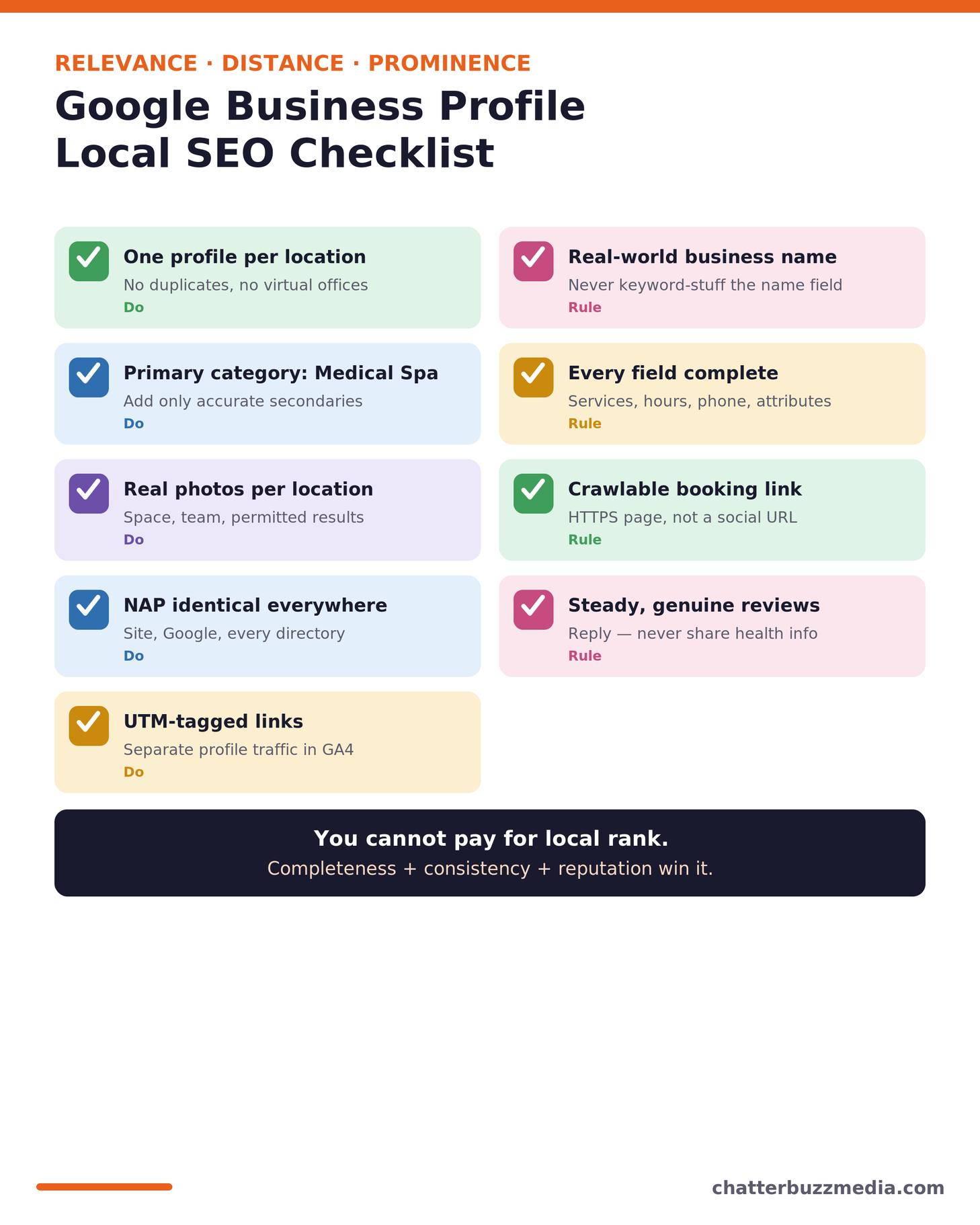
Google is explicit that local results are ranked on relevance, distance, and prominence. You cannot buy your way up, but you can make each location dramatically more complete, consistent, and trusted than the competition.
One Accurate Profile Per Location
Every staffed, eligible location gets exactly one profile — no duplicates, no virtual offices, no keyword-stuffed business names. Google’s guidelines require the profile name to match your real-world signage, so resist the urge to append “| Botox & Filler [City].”
Maintain a single owner-access register so the group — not a departing employee or former agency — always controls every listing. For a multi-location group, that governance discipline is as important as any optimization.
Complete and Differentiate Each Profile
Fill every field for each location: the correct primary category (“Medical Spa”), services with descriptions, hours, phone, booking link, and attributes. Then differentiate — upload real photos of that specific location’s space, team, and results.
Post weekly updates about promotions and new treatments at each location. An active, complete profile signals relevance and prominence far better than a set-and-forget listing.
Run each location profile against a consistent optimization checklist:
- Primary category: “Medical Spa,” with only accurate secondary categories added.
- Services and descriptions: every treatment listed with a short, keyword-natural description.
- Photos: current, real exterior, interior, team, and permitted results imagery per location.
- Booking link: a crawlable HTTPS booking or consultation page, not a social or shortener URL.
- Reviews: a steady, genuine stream with professional, privacy-safe responses.
- UTM tracking: tagged website and booking links so analytics can separate profile traffic.
Build Consistent Citations and NAP
Your name, address, and phone number must match exactly across your website, Google, and every directory. Consistent citations are a well-documented local ranking factor, and inconsistency is one of the most common reasons multi-location groups underperform.
Prioritize healthcare-relevant directories — Healthgrades, RealSelf, Yelp, WebMD — over volume-driven low-quality lists. Use a citation manager to catch duplicates and drift as hours and suites change.
Earn Locally Relevant Authority
Prominence also comes from genuine local links and mentions, not bulk directory spam. Each real link from a community partner, local publication, or event tells Google your locations belong in that market.
Pursue authority the way a real business would earn it:
- Local partnerships: cross-promotions with gyms, salons, and wellness studios near each location.
- Community involvement: event sponsorships and health-fair participation that earn a linked mention.
- Earned media: local press for new treatments, provider hires, or location openings.
Pair this with a content engine that answers real patient questions, the same inbound approach behind our inbound marketing guide. Authority built on relevance compounds, while purchased links put your listings at risk.
With local presence locked in, we reach the piece most multi-location groups get wrong: how to structure content across every market.
The Multi-Location Content Architecture That Actually Ranks
This is the section that separates med spa groups that dominate from those that plateau. The architecture of your service pages and location pages determines whether Google rewards your locations or flags them as duplicates.
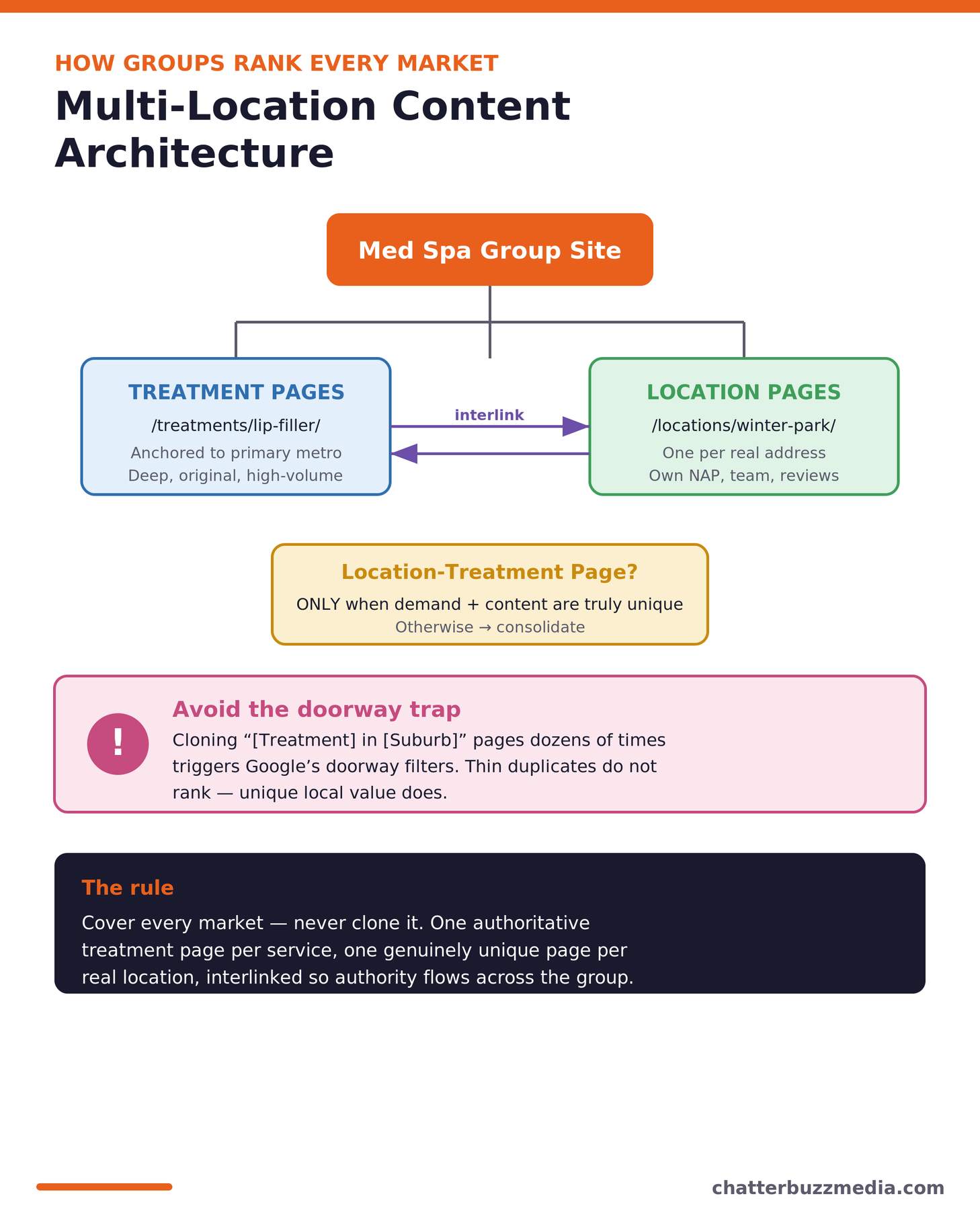
Most groups either build one generic page per treatment or clone the same “[Treatment] in [Suburb]” page dozens of times. Both approaches leave rankings on the table — here is the model that works instead.
Anchor Service Pages to the Primary Market
Build your core treatment pages around the primary metro, because that is where the search volume concentrates. A term like “dermal fillers Columbus” can carry nearly 20x the volume of a suburb equivalent, making the metro page the more valuable asset.
These pages become deep, authoritative, non-commoditized resources — original photography, real practitioner insight, and treatment detail that AI and competitors cannot replicate. They rank for the head terms and pull traffic across the whole group.
Give Each Real Location a Distinct Page
Every physical location earns its own page that answers local questions: address, hours, the practitioners who work there, parking and arrival details, location-specific reviews, and an embedded map.
Make each one genuinely different by interviewing the team at that site and using real interior, exterior, and staff photography. That firsthand specificity is exactly the kind of experience signal Google’s quality systems reward.
Avoid the Doorway-Page Trap
Do not build a near-identical “[Treatment] in [Suburb]” page for every treatment-suburb combination. Google’s spam policies explicitly target doorway pages — thin variants created only to funnel searchers to the same destination.
Publish a separate local page only when a real location, staff, and patient experience make it meaningfully unique. When suburb-level demand is thin, consolidate it into the metro service page and the location page instead of manufacturing dozens of duplicates.
This architectural discipline is the same principle behind the campaigns in our multi-location med spa marketing guide — scale coverage without cannibalizing yourself.
Reviews and Reputation at Scale
Reviews are simultaneously a ranking factor and your most persuasive conversion asset. For a group, the challenge is generating and managing genuine reviews consistently across every location.
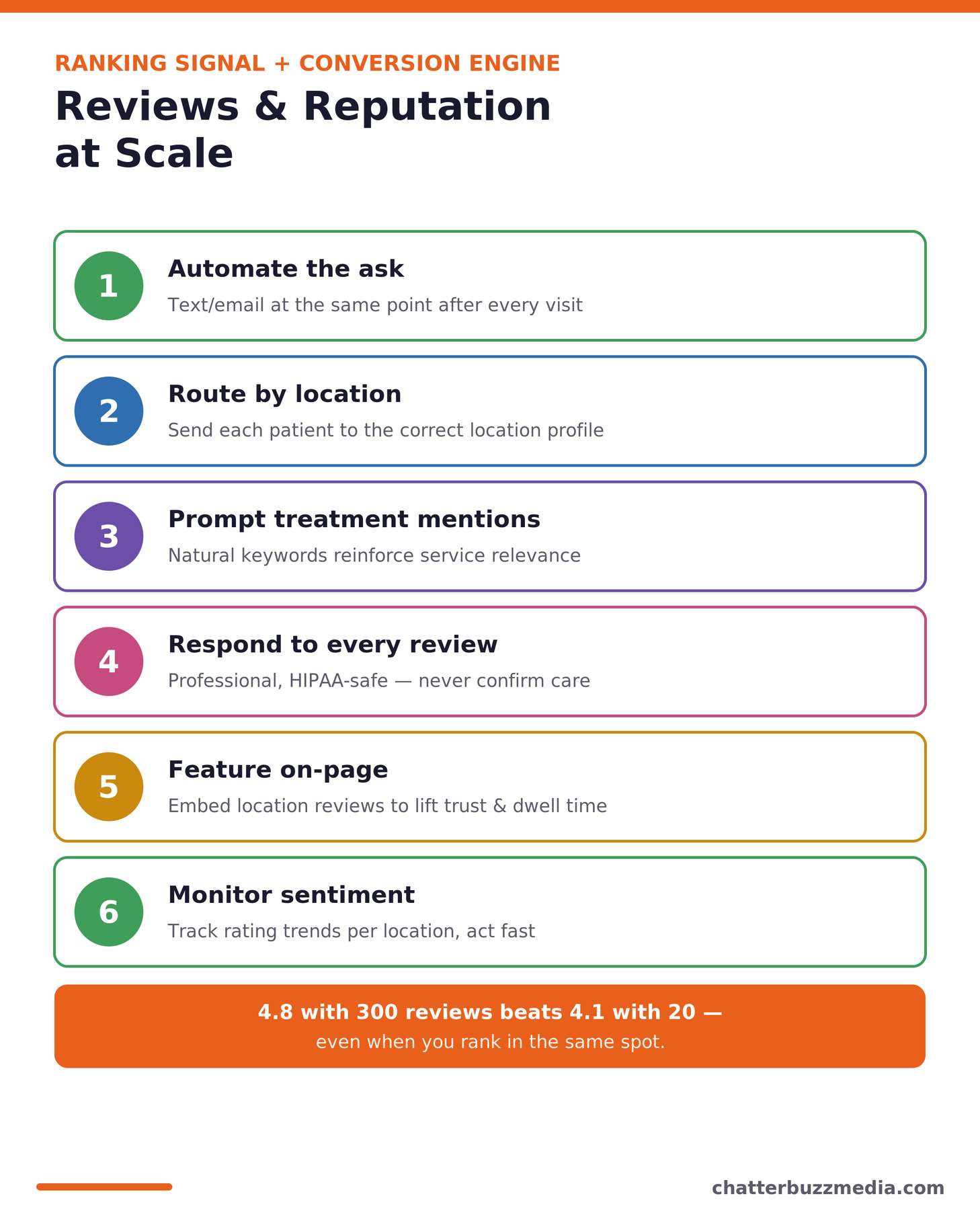
Patients compare practices side by side, and rating gaps decide bookings. A location with a 4.8 average and hundreds of reviews will beat a nearby competitor sitting at 4.1 with twenty, even when both rank.
Engineer Review Velocity Ethically
Build review generation into the patient journey at a consistent point after each visit, using automated text or email requests. Never offer discounts or gifts for reviews and never solicit only your happy patients — both violate Google’s policy and put listings at risk.
Encourage patients to mention the specific treatment they received, since that natural keyword language reinforces relevance for that service. Marketing automation makes this repeatable across every location, a workflow we detail in our guide to marketing automation.
Respond Professionally and Compliantly
Respond to every review, positive and negative, while protecting patient privacy. Never confirm a treatment or disclose any health detail in a public reply — route clinical concerns to an offline channel.
Prompt, professional responses build trust with prospective patients and signal an active, legitimate business to Google. For regulated aesthetics practices, that compliance discipline is part of the SEO, not separate from it.
Turn Reviews into Ranking and Conversion Assets
Reviews should work twice — once for local ranking and again for conversion on your site. Surface your strongest, treatment-specific reviews on the relevant service and location pages.
Put these practices to work across the group:
- Automate the ask: trigger a review request by text or email at the same point after every appointment.
- Distribute by location: route each patient to the correct location profile so reviews land where they rank.
- Feature real feedback: embed location-specific testimonials on the matching page to lift trust and dwell time.
- Monitor sentiment: track rating trends per location and act on recurring themes quickly.
Winning AI Overviews and AI Search for Med Spas
Search increasingly answers the patient before they ever click. AI Overviews and assistant-style search now sit between your practice and the booking, and most med spas have no strategy for them.
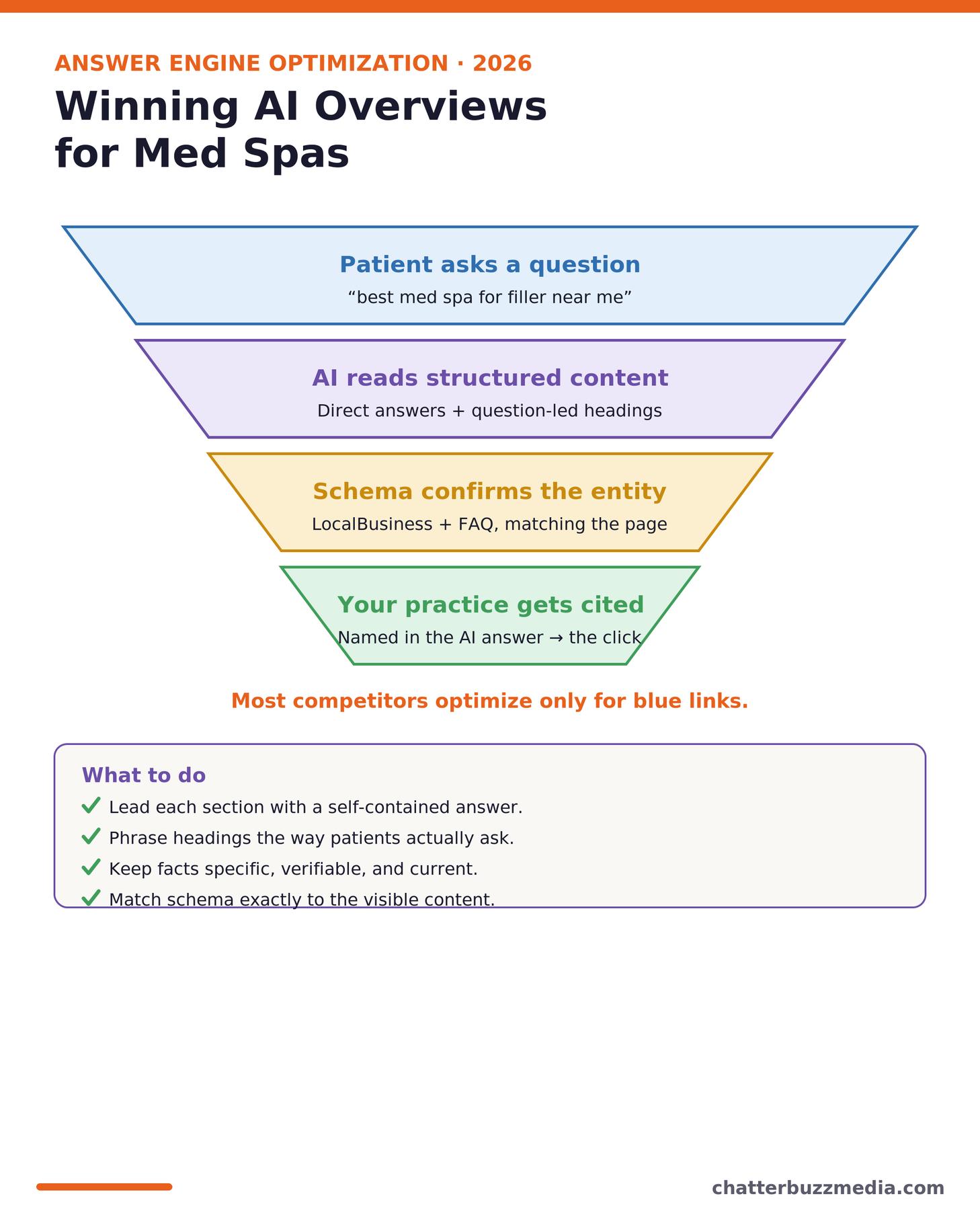
Answer Engine Optimization — structuring content so AI can extract and cite it — is the fastest-moving opportunity in med spa SEO right now. The practices that adapt in 2026 will own the answer while competitors are still optimizing only for blue links.
Structure Content for Extraction
Lead each section with a direct, self-contained answer to the implied question, then support it with detail. AI systems favor clear, question-led content with concise definitions and specific, verifiable facts.
Use descriptive headings phrased the way patients actually ask, and keep paragraphs short and scannable. This is the same writing discipline that makes content readable for humans, which is not a coincidence.
Feed the Machines with Schema and Entities
Implement LocalBusiness structured data for each location and FAQ schema on treatment pages, all matching the visible content. Structured data helps AI and search engines understand exactly what your practice is, where it operates, and what it offers.
Reinforce your entity by keeping your name, treatments, and locations consistent everywhere they appear online. The clearer your digital footprint, the more confidently an AI system will surface and cite you.
Measuring Med Spa SEO — From Visibility to Booked Revenue
The most common mistake in med spa SEO is measuring a single keyword rank and calling it progress. Rankings fluctuate by device, location, and time; bookings are what pay for the strategy.
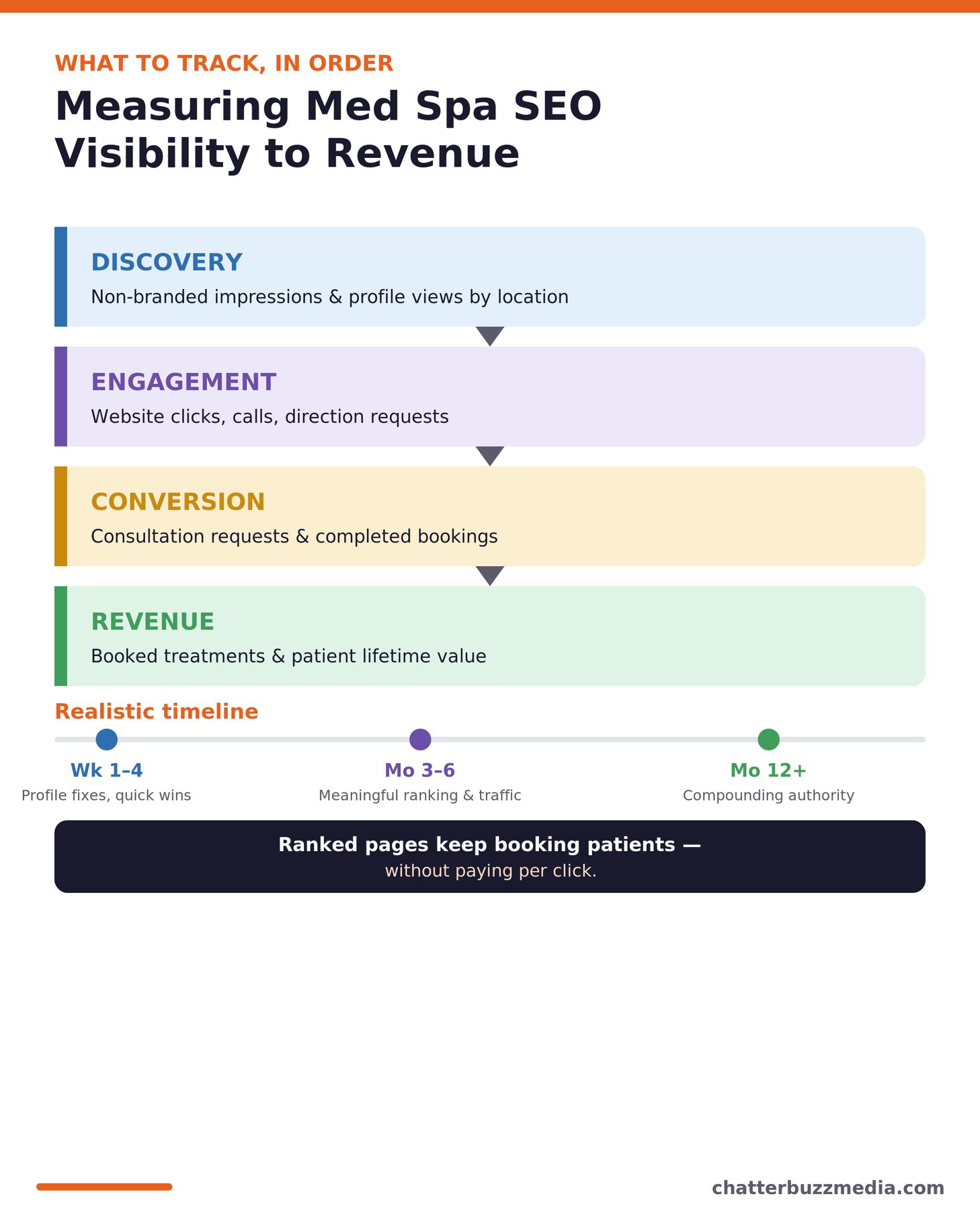
Instead, track a measurement chain that connects search visibility to real business results, reviewed monthly by location. This is where a rigorous, CFO-minded approach separates real ROI from vanity metrics.
Track the Full Conversion Chain
Measure performance in a sequence, not as isolated numbers:
- Discovery: Non-branded impressions and profile views growing by service and location.
- Engagement: Website clicks, calls, and direction requests from your profiles and organic pages.
- Conversion: Consultation requests and completed bookings, tracked with call tracking and form analytics.
- Revenue: Booked treatments and patient lifetime value attributed back to organic search.
Annotate every profile edit, content release, and review campaign so you can interpret what actually moved the numbers. Tools like Google Search Console, GA4, and call tracking make this chain measurable end to end.
Set Realistic Timeline Expectations
Profile corrections and quick wins can show movement in weeks, but durable organic authority takes time. Most med spas see meaningful ranking and traffic gains within three to six months, with compounding results after twelve.
The math still favors SEO heavily. Once a service page ranks, it keeps producing high-intent bookings month after month without paying per click — the opposite of a paid campaign that stops the moment budget pauses.
DIY, In-House, or a Specialized Agency
A single-location spa in a light market can make progress in-house with discipline and time. A multi-location group competing across busy metros usually needs specialized help, because the architecture, citations, and review operations scale beyond what one owner can manage.
The right partner understands aesthetics, local SEO, and compliance together. Whether you build in-house or hire out, the difference-maker is a strategy that treats SEO as a system — the same philosophy behind our fractional CMO services and full digital marketing services.
Conclusion: Build One Accurate Presence, Then Scale It
Med spa SEO rewards the group that gets the fundamentals right at scale: accurate local profiles, a content architecture that ranks each market without duplication, genuine reviews, AI-ready structure, and measurement that ends at booked revenue.
The opportunity is real because most competitors execute only half of this. A practice that builds one accurate local presence per location and a clean path from discovery to booking will steadily take market share across every suburb it serves.
As a healthcare digital marketing agency with deep local SEO experience from Orlando to Tampa, we help aesthetics groups turn organic search into their most predictable growth channel. When you are ready to dominate local search across every location, our team is ready to build the system with you.
Frequently Asked Questions About Med Spa SEO
What is med spa SEO?
Med spa SEO is the process of optimizing your website, service pages, and Google Business Profiles so your practice ranks when patients search for treatments like Botox, fillers, or laser hair removal nearby. It combines technical SEO, on-page optimization, and local SEO to turn high-intent searches into booked consultations.
How long does med spa SEO take to work?
Most med spas see meaningful ranking and traffic improvement within three to six months, with the strongest results compounding after twelve months of consistent work. Google Business Profile fixes and low-competition local terms can move faster, while competitive metro terms take longer.
How much does med spa SEO cost?
Pricing varies with market competitiveness and the number of locations, and most specialized agencies structure med spa SEO as a monthly retainer. The right way to evaluate cost is against patient lifetime value — a single recurring injectable patient can return the monthly investment many times over.
How do multi-location med spas rank on Google?
Multi-location groups rank by anchoring service pages to the primary metro, giving each physical location a distinct and genuinely unique page, and maintaining one complete Google Business Profile per address. The key is covering every market without cloning thin, duplicate suburb pages that trigger Google’s doorway filters.
Should each med spa location have its own Google Business Profile?
Yes — every staffed, eligible location should have exactly one profile that matches its real-world name, address, and phone number. Creating duplicate profiles, virtual-office listings, or keyword-stuffed names violates Google’s guidelines and can suppress or suspend your listings.
Do online reviews affect med spa SEO rankings?
Reviews contribute to the prominence signal Google uses for local ranking, and they heavily influence whether searchers choose you. Focus on genuine, policy-compliant review velocity across every location, and always respond without disclosing any patient health information.
How is med spa SEO different from regular SEO?
Med spa SEO is local-first, treatment-specific, and subject to stricter quality and compliance expectations because aesthetic care is health-adjacent content. It also requires managing multiple locations, profiles, and review streams at once — complexity that general SEO advice rarely addresses.
Can med spa SEO help my practice show up in AI search and AI Overviews?
Yes — structuring content with direct answers, question-led headings, and accurate LocalBusiness and FAQ schema makes your practice easier for AI systems to extract and cite. In 2026, this Answer Engine Optimization is one of the biggest untapped opportunities in aesthetics marketing.