
 321-236-2899
Choosing a bank marketing agency is one of the highest-leverage decisions a community bank leader will make this year, and it is also one of the easiest to get wrong. The wrong partner burns your budget on vanity metrics and generic campaigns; the right one grows deposits, loans, and lasting local trust.
This is a comprehensive, in-depth guide built for community bank CEOs, CMOs, and marketing directors who need clarity before they sign a contract. We wrote it because most agencies that pitch banks have never navigated a compliance review, a core conversion, or a deposit campaign in a rate war.
You will learn what a specialized bank marketing agency actually does, the core services to expect, how to evaluate partners against real criteria, what modern programs cost in 2026, and how to measure the return. By the end, you will be able to run a confident selection process instead of a hopeful one.
Key Takeaways
- A bank marketing agency is a specialist, not a generalist. The right partner understands deposit economics, lending funnels, and financial compliance from day one.
- Compliance is a feature, not a friction point. Agencies fluent in Truth in Savings, UDAAP, and FDIC advertising rules keep you fast and safe.
- Local search and trust win where big banks cannot. Community institutions using disciplined digital marketing grow deposits meaningfully faster than those relying on branches alone.
- Attribution must connect marketing to accounts opened and deposits funded, not just clicks and impressions.
- Most banks land on a hybrid model: a lean internal team plus an agency that supplies strategy, execution horsepower, and specialized channels.
Let’s start with what a bank marketing agency really does before you spend a dollar evaluating one.
What a Bank Marketing Agency Actually Does
A bank marketing agency plans and executes the campaigns that grow a financial institution’s deposits, loans, and market share. It combines strategy, creative, media buying, and analytics into one accountable engine built for regulated banking.
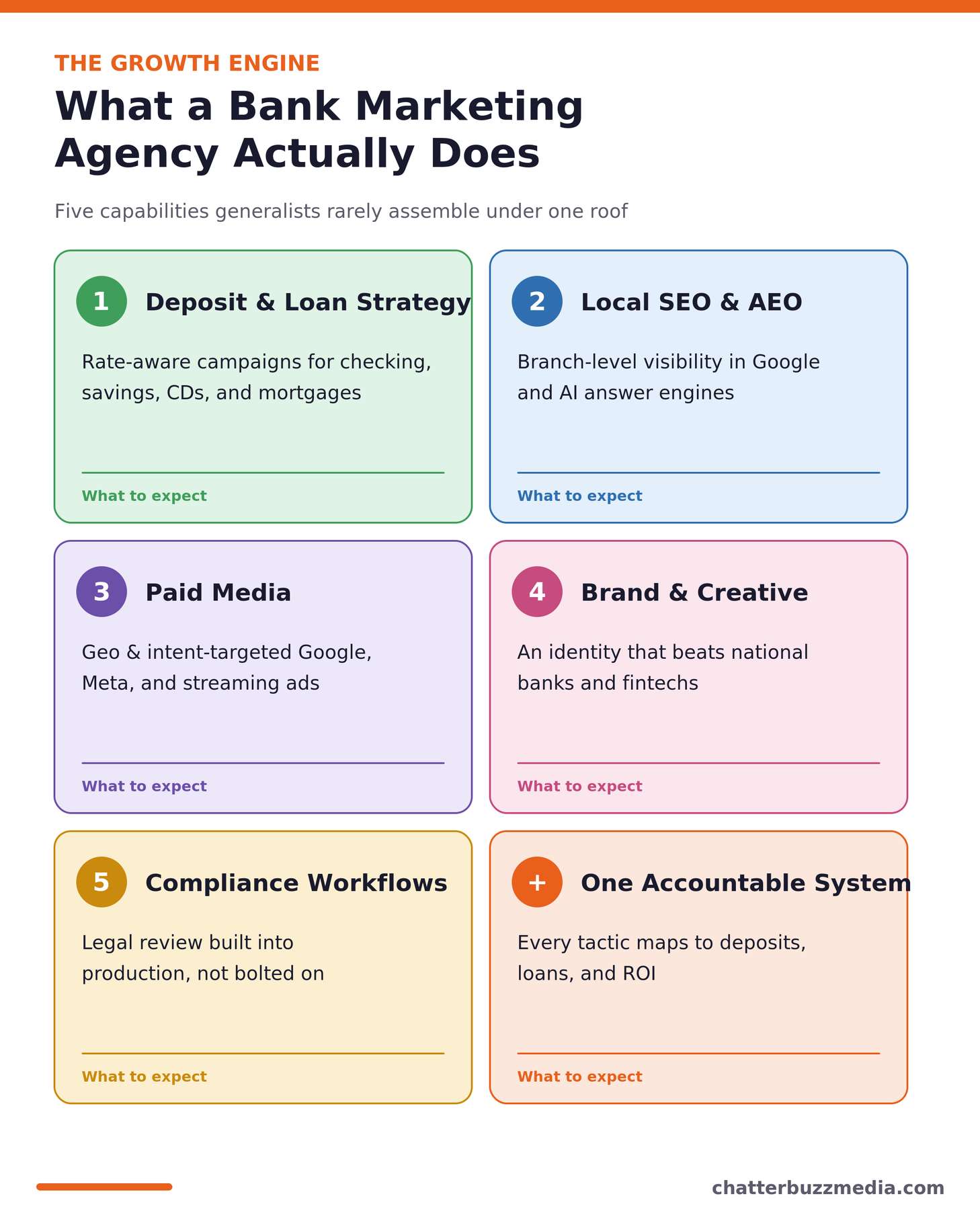
The best partners think like a growth team, not a vendor. They connect every campaign to a business outcome your board actually cares about.
Core Capabilities That Define the Category
A specialized agency brings a defined set of capabilities that generalists rarely assemble under one roof. These are the functions that move deposits and fund loans.
- Deposit and loan growth strategy: Campaigns tied to checking, savings, CD, money market, and mortgage products with rate-aware messaging.
- Local SEO and answer engine optimization: Branch-level visibility so nearby customers find you in Google and AI search.
- Paid media management: Google, Meta, and streaming campaigns targeted by geography, life event, and intent.
- Brand and creative: A distinct identity that separates you from the national banks and the fintechs.
- Compliance-ready workflows: Legal and compliance review baked into production, not bolted on at the end.
Together, these capabilities form a system rather than a set of one-off tactics. That system is what compounds results over time.
How This Differs From a Generalist Agency
A generalist agency can build a pretty website and run ads, but it will stall the first time your compliance officer asks about disclosure placement. Banking is a regulated, trust-driven category with rules that shape every headline and rate callout.
A specialist already knows that a “free checking” claim triggers specific disclosure requirements and that FDIC membership must be represented correctly. That fluency saves weeks of rework and protects your charter.
For a broader look at how regulated financial brands should approach this, our guide to choosing a financial services marketing agency covers the evaluation lens in depth.
Why Community Banks Need a Specialized Marketing Partner
Community banks compete against national banks with billion-dollar ad budgets and fintechs with venture funding. Winning that fight requires a partner who understands your structural advantages and your regulatory constraints.
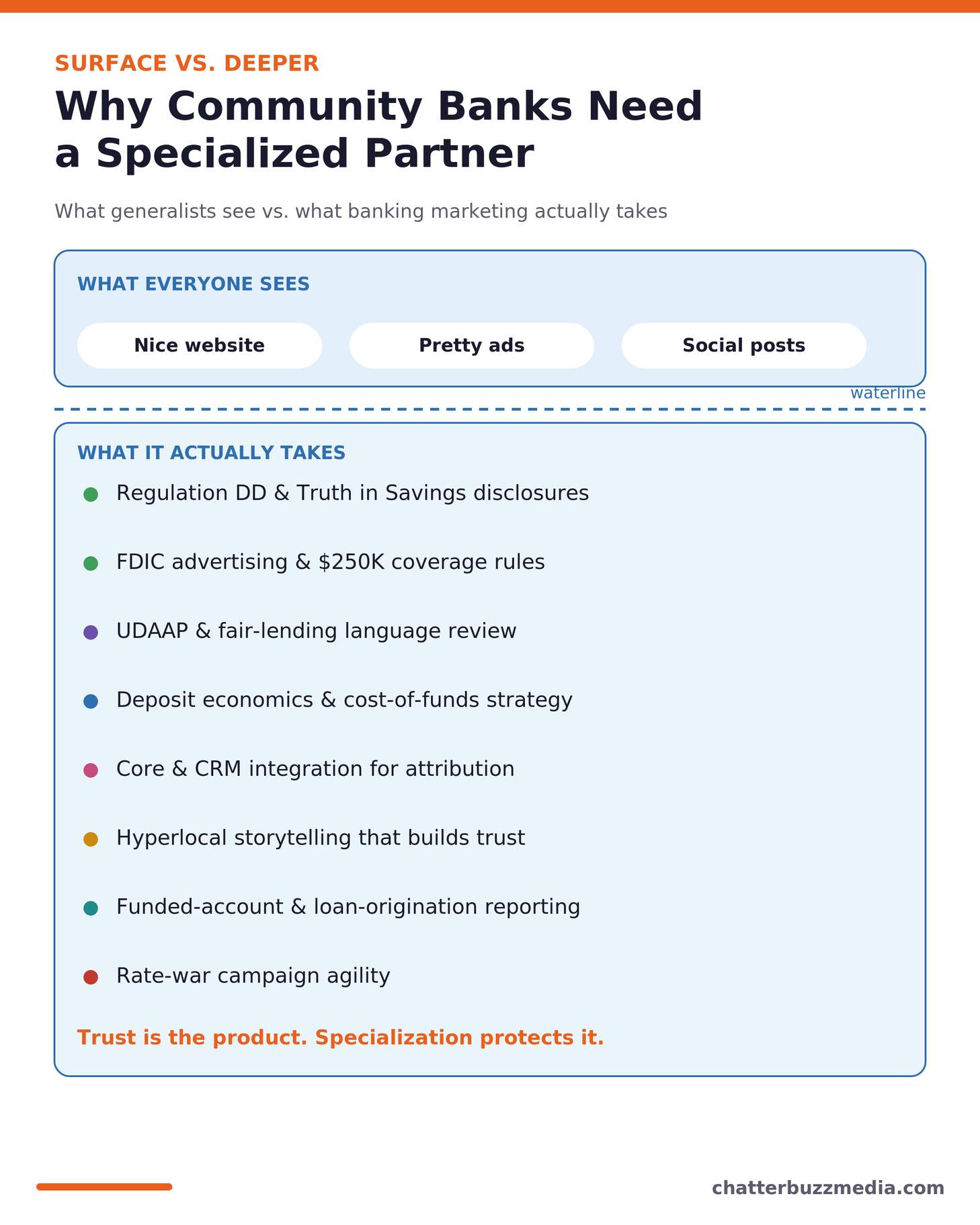
Specialization is not a luxury here. It is the difference between marketing that compounds and marketing that creates compliance risk.
The Compliance Landscape Shapes Every Campaign
Bank marketing operates under rules that most agencies have never read. Truth in Savings (Regulation DD), Truth in Lending (Regulation Z), UDAAP, and FDIC advertising requirements all govern how you promote rates and products.
According to the Consumer Financial Protection Bureau, deposit and credit advertising must present terms accurately and avoid misleading claims. A specialized partner treats these requirements as design constraints, not surprises.
The same discipline applies to how you represent deposit insurance. The FDIC sets specific rules for advertising membership and the standard $250,000 coverage, and getting the official signage and language right is non-negotiable.
Trust Is the Product You Are Actually Selling
People do not switch banks casually, because they are handing over their money and their financial future. Every touchpoint either builds or erodes the trust that drives that decision.
Community institutions have a natural trust advantage through local roots and relationships. A specialist knows how to amplify that story instead of burying it under generic financial stock imagery.
Local Is Your Unfair Advantage
Consumers increasingly search for financial services with “near me” intent and local modifiers. National banks cannot authentically own “the bank that sponsors our high school” the way you can.
A partner who understands hyperlocal storytelling and branch-level search turns your community presence into measurable pipeline. Our complete guide to credit union marketing explores many of the same local-first principles that apply to community banks, and our dedicated credit union and banking marketing agency team lives in this world every day.
Core Services to Expect From a Bank Marketing Agency
A capable bank marketing agency delivers an integrated stack of services, not a menu of disconnected tactics. Each service should feed the same goal: profitable deposit and loan growth.
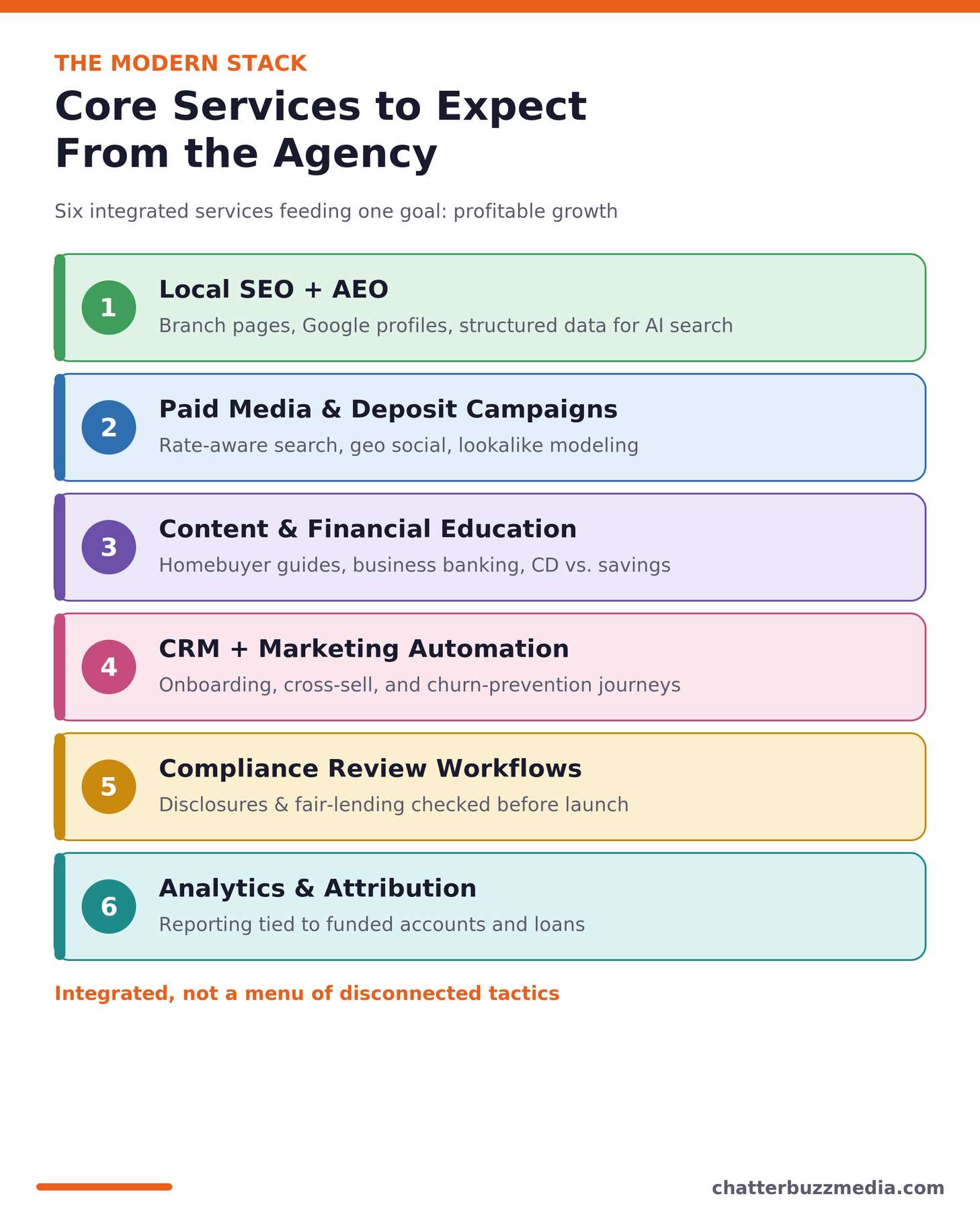
Here is what a modern program should include in 2026.
Local SEO and Answer Engine Optimization
Local SEO ensures every branch appears accurately across Google, Bing, Apple Maps, and AI answer engines. This is now the front door for new customer acquisition, often before anyone visits a branch.
- Branch location pages individually optimized for each market and product set.
- Google Business Profile management including hours, reviews, and posts.
- Structured data and AEO so large language models cite your bank in local answers.
Done well, this compounds into durable visibility that paid media cannot replace.
Paid Media and Deposit Campaigns
Paid media drives immediate, measurable demand for specific products. The best agencies run rate-aware campaigns that adjust as your offers and the market change.
- Search ads for high-intent terms like “high-yield savings” and “small business checking.”
- Geo-targeted social and streaming to build awareness in your footprint.
- Audience and lookalike modeling using your existing customer data to find similar prospects.
For a deeper view of how this discipline works across channels, see our performance marketing agency guide.
Commercial and business banking deserve their own playbook, because winning treasury, SBA, and commercial lending relationships is a longer, multi-stakeholder sale. Approaches like account-based marketing and B2B demand generation help you land higher-value business accounts, not just retail deposits.
Content Marketing and Financial Education
Educational content builds authority and positions your team as trusted advisors. Financial literacy framed through local context is a genuine differentiator, not a commodity.
Think first-time homebuyer guides, small business banking explainers, and CD-versus-savings comparisons written for your actual customers. This content also feeds SEO, email, and branch conversations.
This is the engine behind inbound marketing, where helpful content attracts prospects before they are ready to switch banks. For a broader financial-services view, our mid-market financial services marketing playbook shows how the pieces fit together.
CRM Integration and Marketing Automation
Automation turns one-time campaigns into lifecycle journeys that grow customer value. Onboarding sequences, cross-sell prompts, and churn-prevention flows all run more effectively when connected to your core and CRM.
Our guide to marketing automation breaks down how to build these journeys without overwhelming a lean team.
Compliance Review Workflows
The right agency builds compliance approval into the production timeline. Disclosures, rate accuracy, and fair-lending language are checked before anything ships.
This protects you from regulatory risk while keeping campaigns moving at market speed.
Analytics, Reporting, and Attribution
Reporting should connect marketing activity to accounts opened, deposits funded, and loans originated. Monthly, board-ready reporting keeps everyone aligned on ROI instead of vanity metrics.
If attribution stops at clicks and form fills, you cannot prove the program’s worth to your board.
How to Evaluate a Bank Marketing Agency
Evaluating a bank marketing agency comes down to fit, proof, and accountability. Use a consistent framework so you compare partners on substance rather than pitch polish.
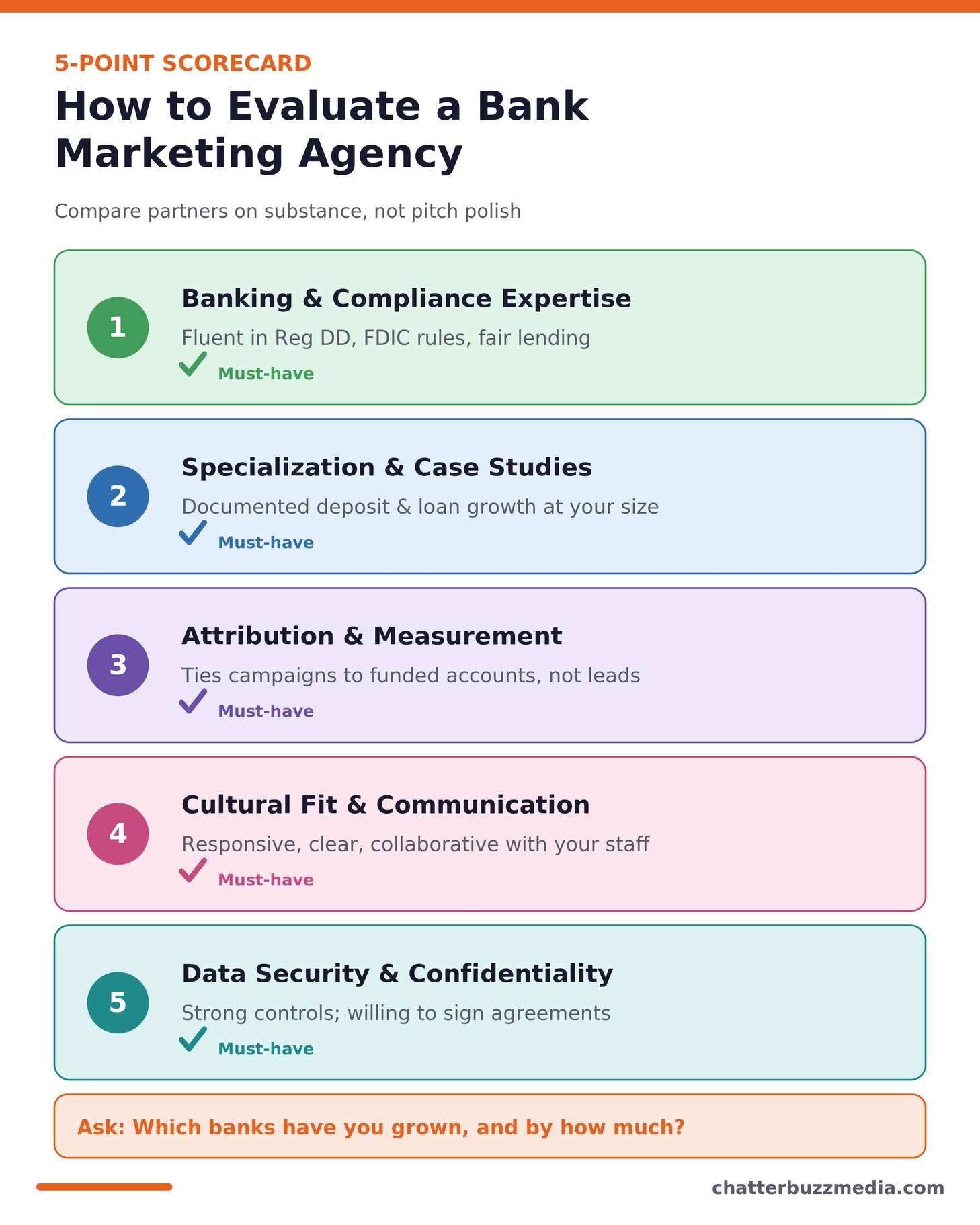
These five criteria separate specialists from generalists dressed up for a banking pitch.
1. Banking and Compliance Expertise
Ask how they handle Regulation DD disclosures, FDIC advertising rules, and fair-lending language. A strong partner answers fluently and can show compliant work they have already shipped.
2. Industry Specialization and Case Studies
Look for documented results with banks or credit unions of your size and structure. Deposit growth, cost-per-account, and loan volume are the outcomes that matter.
3. Attribution and Measurement Capabilities
Confirm they can tie campaigns to funded accounts and originated loans, not just leads. Ask specifically how they integrate with your core and CRM.
4. Cultural Fit and Communication
You will work with this team weekly, often alongside your compliance and retail staff. Responsiveness, clarity, and a collaborative style matter as much as capability.
5. Data Security and Confidentiality
Banks handle sensitive data, so your agency’s security posture is your security posture. Verify their handling practices, access controls, and willingness to sign appropriate agreements.
Questions to Ask During the Evaluation
- Which banks or credit unions have you grown, and by how much?
- How do you build compliance review into your workflow?
- How will you attribute results to funded accounts and loans?
- Who is on my day-to-day team, and what is your response time?
- How do you report to a board or executive committee?
Red Flags That Signal the Wrong Bank Marketing Partner
Some warning signs appear before you ever sign. Spotting them early saves you a wasted year and a frustrated board.
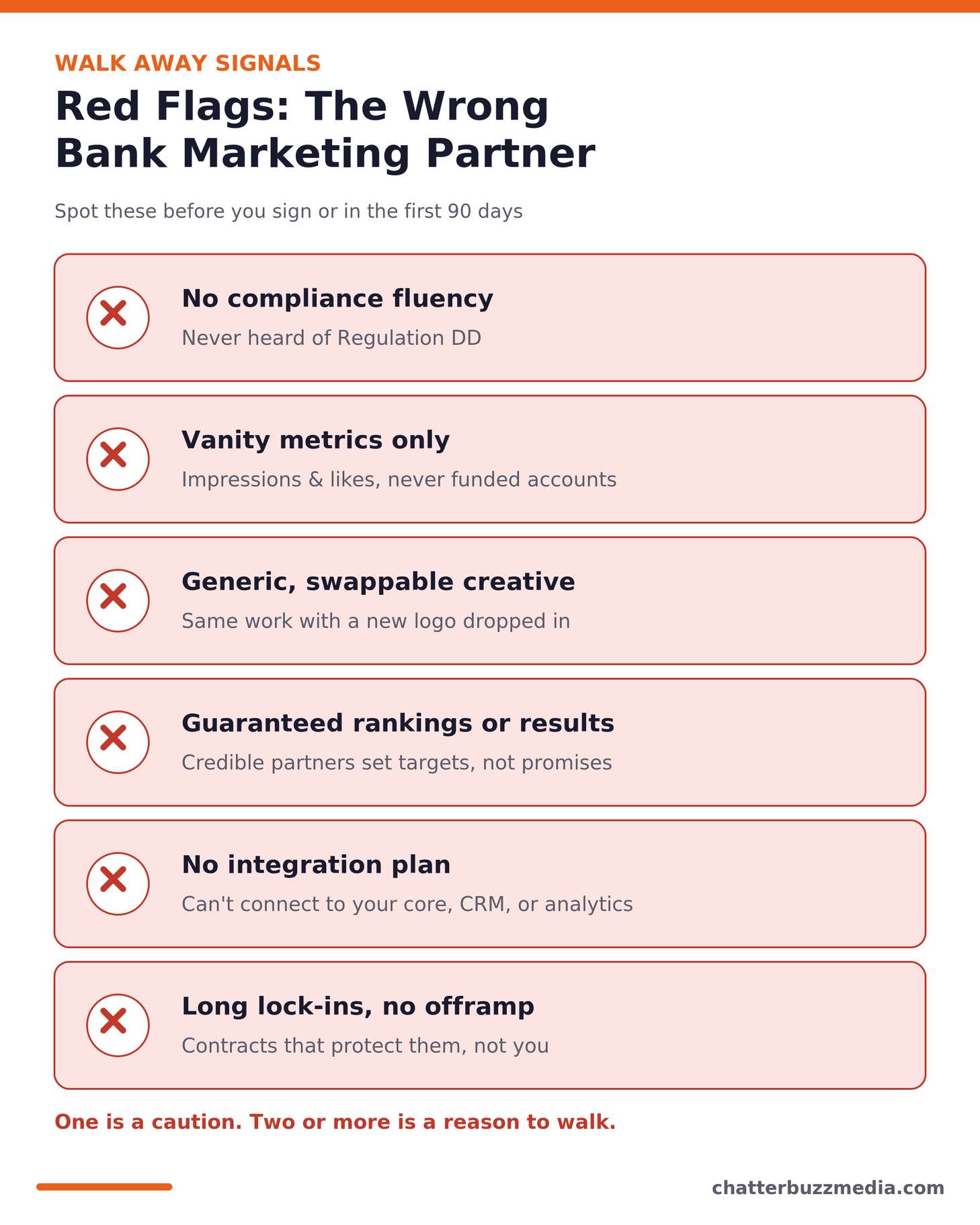
Watch for these red flags during the pitch and the first ninety days.
- No compliance fluency: They have never heard of Regulation DD or wave off disclosure questions.
- Vanity metrics only: Reports celebrate impressions and likes but never funded accounts.
- Generic, swappable creative: Their bank work looks identical with a different logo dropped in.
- Guaranteed rankings or results: Credible partners set targets, not impossible promises.
- No integration plan: They cannot explain how they will connect to your core, CRM, or analytics.
- Long contracts, no offramp: Lengthy lock-ins with no performance checkpoints protect them, not you.
Any one of these is a reason to slow down. Two or more is a reason to walk.
In-House vs. Agency vs. Hybrid for Bank Marketing
There is no single right structure, only the right structure for your size and goals. The decision hinges on budget, in-house talent, and how many channels you need to run well.
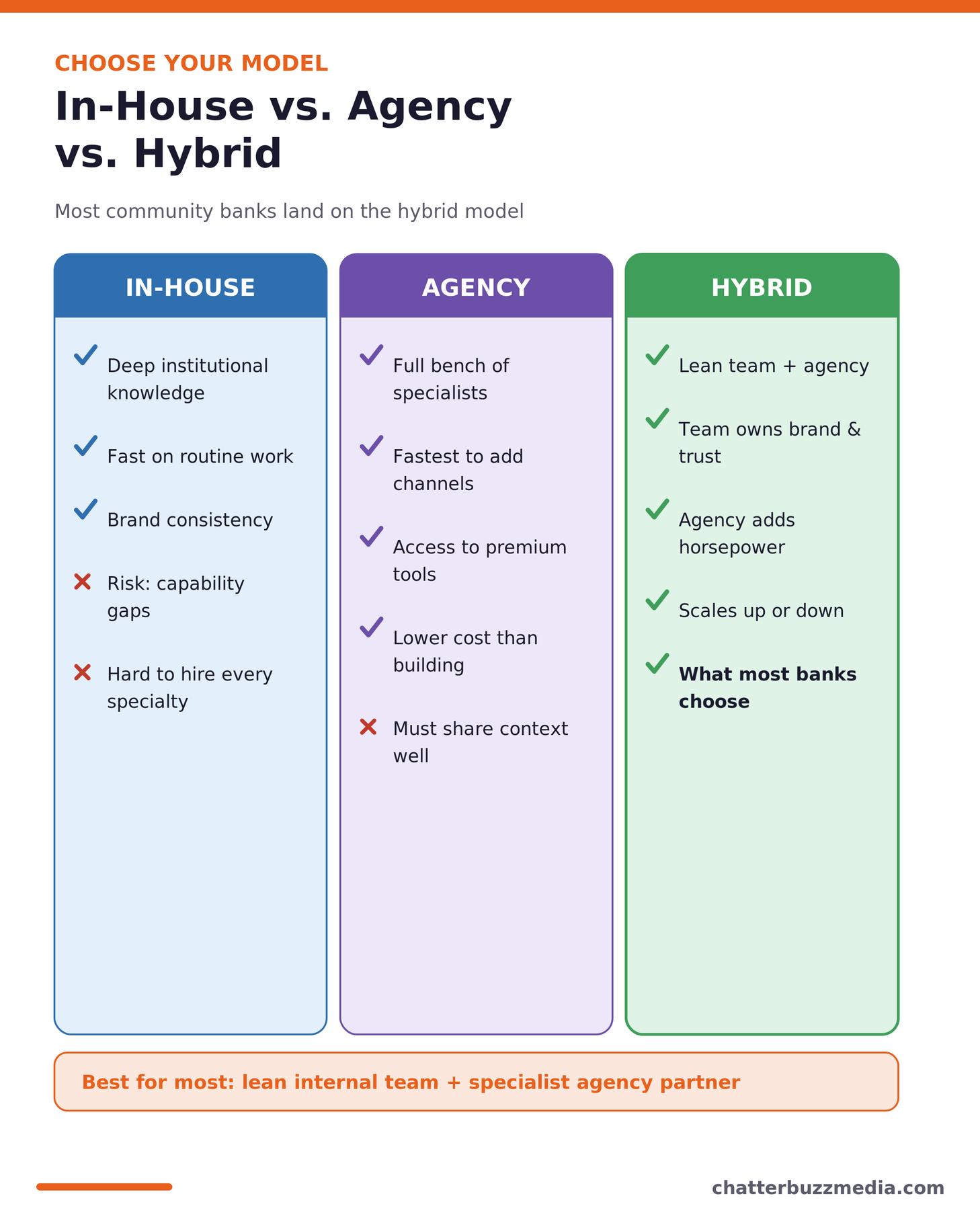
Most community banks eventually land somewhere on a spectrum between fully internal and fully outsourced.
When In-House Makes Sense
An internal team excels at institutional knowledge, brand consistency, and speed on routine work. It works best when you have enough volume to justify salaries and enough specialization to cover modern channels.
The risk is capability gaps in areas like paid media, SEO, and analytics that are hard to hire for one seat at a time.
When an Agency Makes Sense
An agency gives you a full bench of specialists for less than the cost of building one internally. It is the fastest way to add channels, scale campaigns, and access tools your team cannot justify alone.
The tradeoff is that you must manage the relationship and share context deliberately.
The Hybrid Approach Most Banks Choose
The hybrid model pairs a lean internal team with an agency partner for strategy and execution horsepower. Your team owns brand and relationships; the agency supplies specialized channels and capacity.
For institutions that need senior strategic leadership without a full-time hire, a fractional CMO engagement can anchor the internal side of this model. Our fractional CMO services are built for exactly this hybrid structure.
What Bank Marketing Costs in 2026
Bank marketing budgets vary widely based on asset size, footprint, and growth ambition. What matters is not the sticker price but the return each dollar generates in deposits and loans.
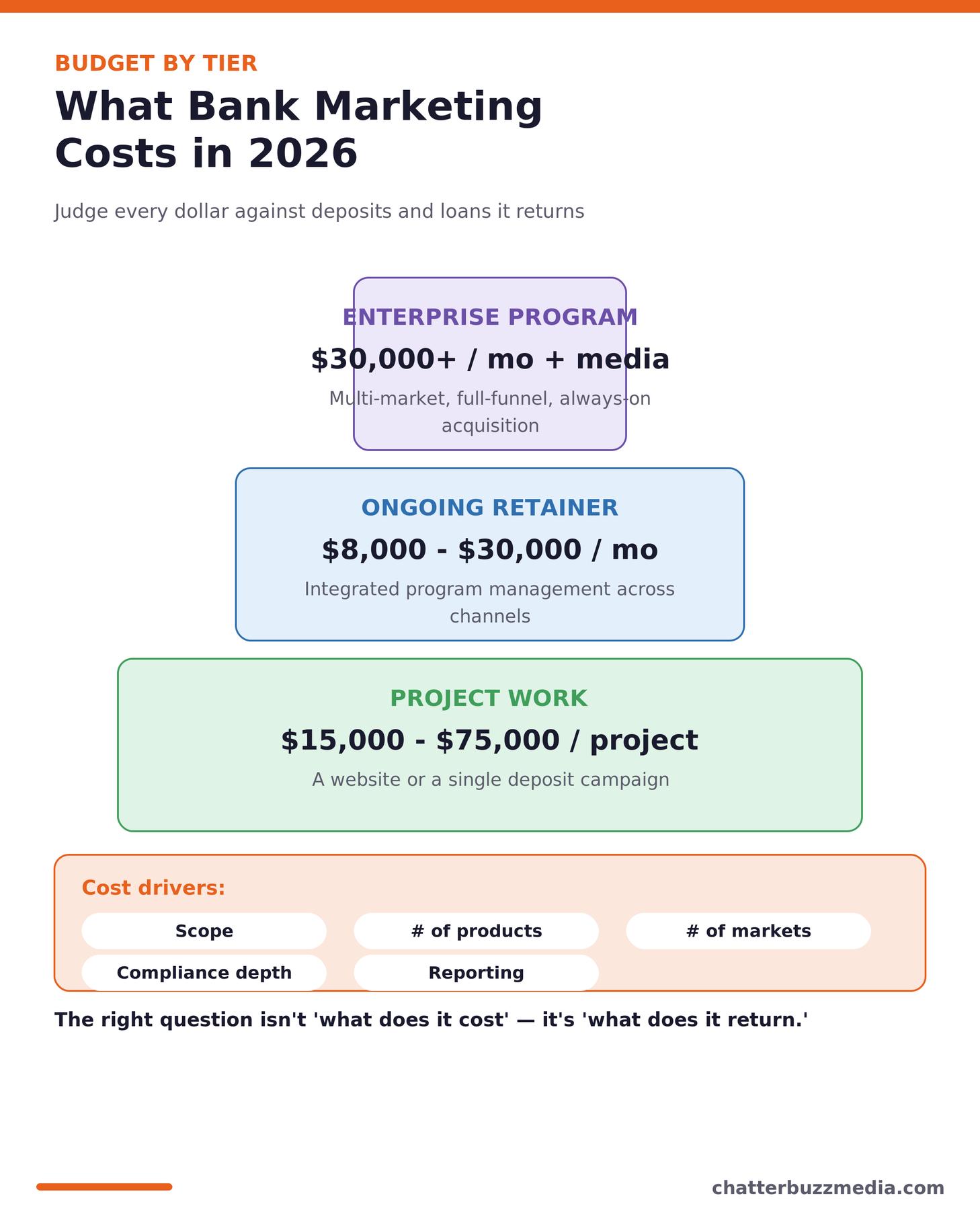
Here is a realistic view of what community banks invest in 2026.
Budget Ranges by Engagement Type
- Project work (a website or a single campaign): roughly $15,000 to $75,000 per project.
- Ongoing retainer (integrated program management): roughly $8,000 to $30,000 per month depending on scope.
- Enterprise programs (multi-market, full-funnel): $30,000+ per month plus media spend.
Media budget sits on top of agency fees and scales with your growth targets.
What Drives Cost Variation
Scope is the biggest driver, followed by the number of products and markets you support. Compliance complexity, creative volume, and reporting depth also move the number.
A single-branch bank running one deposit campaign will spend far less than a ten-branch institution running always-on acquisition.
The ROI Lens
The right question is not “what does this cost” but “what does this return.” A program that costs $15,000 a month and funds several million in new deposits is inexpensive at twice the price.
Industry benchmarking from groups like the Independent Community Bankers of America underscores that disciplined, digital-first banks consistently outgrow those relying on foot traffic alone.
How to Measure ROI From Your Bank Marketing Agency
You measure ROI by connecting marketing spend to funded accounts, originated loans, and retained relationships. Anything less leaves you guessing at a board meeting.
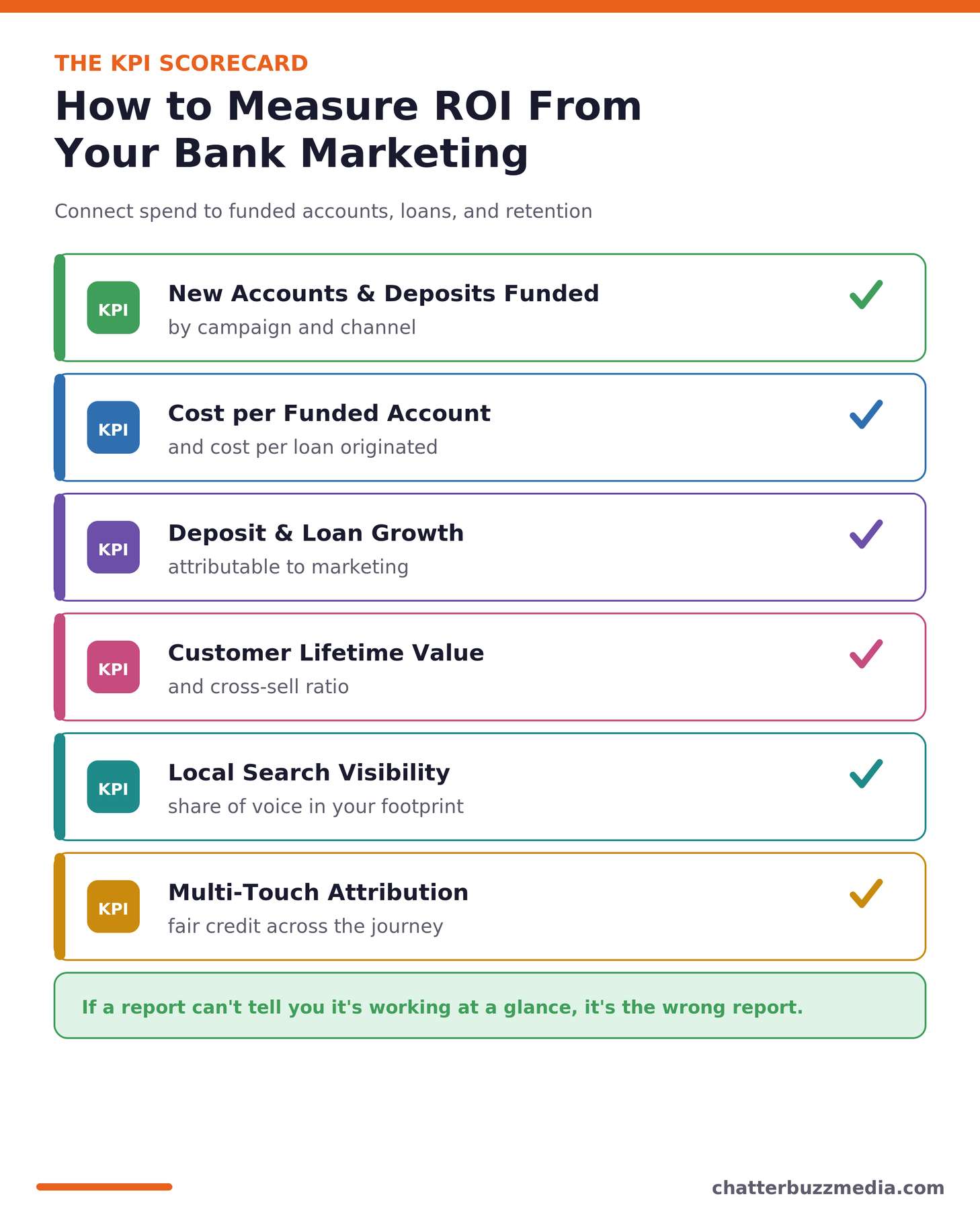
Set the measurement framework before the first campaign launches, not after.
KPIs That Actually Matter
- New accounts opened and deposits funded by campaign and channel.
- Cost per funded account and cost per loan originated.
- Deposit and loan growth attributable to marketing.
- Customer lifetime value and cross-sell ratio.
- Local search visibility and share of voice in your footprint.
These KPIs translate marketing activity into the language your board already speaks.
Attribution for a Considered Purchase
Opening a bank account is a considered decision that can span many touchpoints and weeks. Multi-touch attribution gives fair credit across search, social, email, and branch instead of crowning the last click.
A capable partner will integrate with your core and CRM to close the loop from ad to funded account.
Reporting Cadence and Structure
Expect monthly reporting that ladders up to quarterly business reviews. Reports should lead with outcomes, explain the drivers, and recommend the next move.
If you cannot skim a report and know whether the program is working, it is the wrong report.
How Chatter Buzz Media Approaches Bank Marketing
We are a performance-driven agency that treats bank marketing as a growth system, not a series of campaigns. We combine engineer-first execution with a CFO’s respect for every dollar and every disclosure.
Our role is to guide your team to measurable deposit and loan growth while keeping you compliant and confident.
Our Methodology
We start with your economics: cost of funds, target products, and the markets where growth is most profitable. From there we build an integrated plan across local SEO, paid media, content, and automation, with compliance review built into every step.
Every tactic maps to a metric, and every metric maps to a business outcome your board cares about. You can see how this philosophy extends across sectors in our digital marketing services guide.
What Sets Us Apart
We have run marketing for regulated financial institutions, so compliance is a starting assumption rather than an obstacle. We report on funded accounts and loans, not applause metrics, and we treat your brand’s local trust as its most valuable asset.
As a full-service digital marketing agency, we can scale channels up or down as your goals evolve without forcing you to re-staff.
Our Process in Practice
The first ninety days focus on foundations: measurement, compliant creative, local search, and one or two priority deposit campaigns. Once the engine is proven, we expand into always-on acquisition and lifecycle automation.
This sequencing lets you see wins early while building toward compounding growth.
Conclusion: Choosing the Right Bank Marketing Agency
The right bank marketing agency is a specialist who understands deposits, lending, compliance, and the local trust that makes community banking work. It reports on funded accounts and loans, builds compliance into every campaign, and treats your budget like its own.
Use a consistent evaluation framework, watch for the red flags, and insist on attribution that reaches all the way to a funded account. Do that, and marketing becomes one of the most reliable growth levers your bank has.
When you are ready to build a program that grows deposits and loans, our team is here to help you get there.
FAQ: Bank Marketing Agency
What does a bank marketing agency do?
A bank marketing agency plans and runs the campaigns that grow a bank’s deposits, loans, and market share. That includes local SEO, paid media, brand and creative, content, marketing automation, and compliance-ready reporting tied to funded accounts.
How much does a bank marketing agency cost in 2026?
Most community banks invest between $8,000 and $30,000 per month on an ongoing retainer, plus media spend, with project work running from roughly $15,000 to $75,000. The right figure depends on your markets, product mix, and growth goals, and should be judged against the deposits and loans it returns.
What is the best marketing agency for community banks?
The best agency for a community bank is one with proven banking experience, genuine compliance fluency, and attribution that connects campaigns to funded accounts. Fit, transparency, and specialization matter more than agency size or a flashy pitch.
Why can’t I just use a generalist marketing agency for my bank?
A generalist rarely understands Regulation DD, FDIC advertising rules, or fair-lending language, which creates compliance risk and constant rework. A specialized bank marketing agency treats these requirements as design constraints and keeps campaigns both compliant and fast.
What marketing channels work best for banks?
Local SEO, paid search, geo-targeted social, email and lifecycle automation, and educational content consistently perform for community banks. The strongest results come from integrating these channels around specific deposit and loan goals rather than running them in isolation.
How long does it take to see results from bank marketing?
Paid media can drive measurable account openings within weeks, while SEO and content compound over three to six months and beyond. A good partner sequences quick wins early and builds toward durable, lower-cost growth over time.
Can a bank marketing agency help with compliance?
Yes, a specialized agency builds compliance review directly into its production workflow and understands the regulations governing deposit and credit advertising. It should collaborate with your compliance team, not work around it, so campaigns ship accurately and on schedule.