
 321-236-2899
Your company hit $10 million in revenue with hustle, a strong product, and marketing that “worked well enough.” But now growth has stalled, your marketing team lacks senior leadership, and every agency pitch feels like a gamble. You need a chief marketing officer — but the $400K+ price tag for a full-time hire doesn’t match the stage you’re at.
That gap between where you are and what you need is exactly why fractional CMO services have become the fastest-growing leadership model in B2B marketing. You get the strategic horsepower of a seasoned executive without the overhead, the 6-month recruiting cycle, or the risk of a bad full-time hire.
This guide breaks down everything mid-market companies ($5M–$100M in revenue) need to know about fractional CMO services — what they include, what they cost, how to measure ROI, and how to choose the right partner. Whether you’re evaluating this model for the first time or comparing candidates, you’ll walk away with a clear framework for making the right decision.
Key Takeaways
- Fractional CMO services give mid-market companies C-suite marketing leadership at 40–60% of the cost of a full-time hire — with faster time-to-impact and lower risk.
- Companies between $5M and $100M in revenue are the ideal fit because they’ve outgrown tactical execution but aren’t ready for (or can’t justify) a $350K+ salary plus equity.
- A structured 90-day framework — audit, strategy, execution oversight — separates serious fractional CMOs from glorified consultants who deliver slide decks and disappear.
- ROI measurement requires both leading and lagging indicators, from pipeline velocity in the first 90 days to revenue attribution and customer acquisition cost at the 12-month mark.
- The best fractional CMO engagements pair strategy with execution access — the officer builds the plan and stays accountable for results, not just recommendations.
What Are Fractional CMO Services?
Fractional CMO services provide your company with an experienced chief marketing officer on a part-time or contract basis, typically 10–20 hours per week. The “fractional” model means you get a share of a senior executive’s time — and the full weight of their expertise — without adding a permanent C-suite salary to your payroll.
This isn’t a new concept, but the model has matured dramatically. According to data from GrowTal and the Frak Conference, the fractional CMO market doubled from 60,000 to 120,000 professionals between 2022 and 2024 — and that growth has only accelerated through 2026.
What a Fractional CMO Is (and Isn’t)
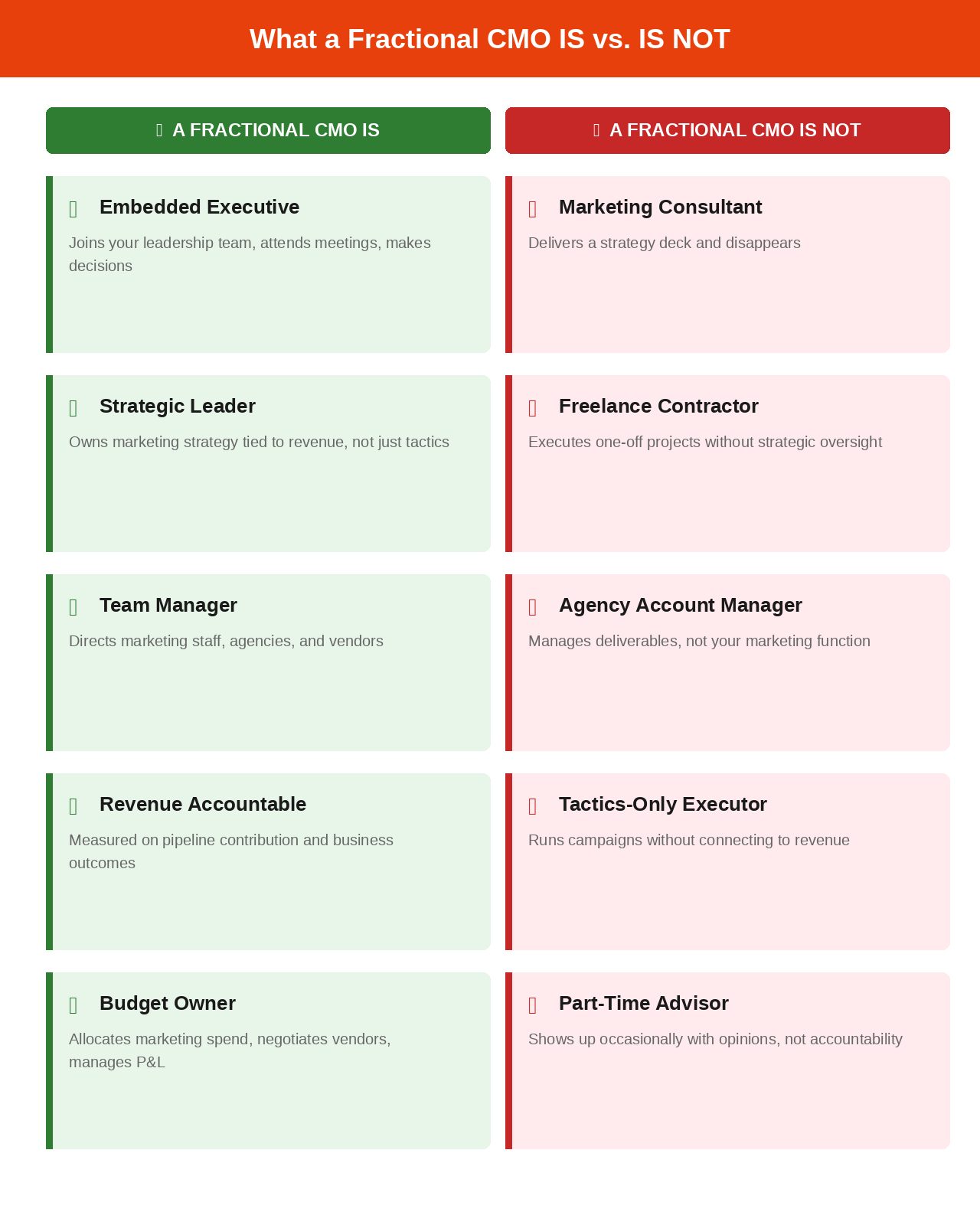
A fractional chief marketing officer is a senior marketing executive who serves as a true member of your leadership team. They attend executive meetings, own the marketing P&L, manage or direct your marketing staff, and take accountability for revenue-impacting outcomes.
What they are not is a consultant who drops off a strategy deck and moves on. They are not a freelancer executing one-off projects, and they are not an agency account manager with an inflated title.
The distinction matters because the value of a fractional CMO comes from ongoing strategic leadership, not episodic advice. They make decisions, build systems, and stay accountable for outcomes quarter over quarter.
- A fractional CMO IS: An embedded executive who leads strategy, manages teams, reports to the CEO, and owns marketing performance metrics.
- A fractional CMO IS NOT: A marketing consultant, a project-based contractor, or an agency strategist operating under a different label.
Core Services Included in Every Engagement
While deliverables vary by provider, a legitimate fractional CMO engagement should include a baseline set of strategic services. These form the foundation of every effective engagement, regardless of your industry or company size.
- Marketing strategy development — Building a comprehensive go-to-market plan tied to revenue goals, not vanity metrics.
- Brand positioning and messaging — Defining how your company communicates its value in a way that resonates with your ideal customer profile.
- Team assessment and leadership — Evaluating your existing marketing staff, identifying skill gaps, and providing day-to-day direction.
- Budget allocation and forecasting — Determining where every marketing dollar goes and modeling expected returns by channel.
- Marketing technology stack audit — Assessing your CRM, marketing automation tools, analytics platforms, and data infrastructure.
- KPI framework and reporting — Establishing the metrics that matter and building dashboards the CEO and board can actually use.
- Vendor and agency management — Overseeing external partners to ensure alignment with strategy and accountability for results.
- Executive-level reporting — Presenting marketing performance to the CEO, board, and leadership team with a focus on business impact.
These core services represent the strategic layer that most mid-market companies are missing. The execution layer — content production, paid media, SEO, email campaigns — either gets managed by your internal team, an agency partner, or both under the fractional CMO’s direction.
Why Mid-Market Companies Are the Ideal Fit for Fractional CMO Services
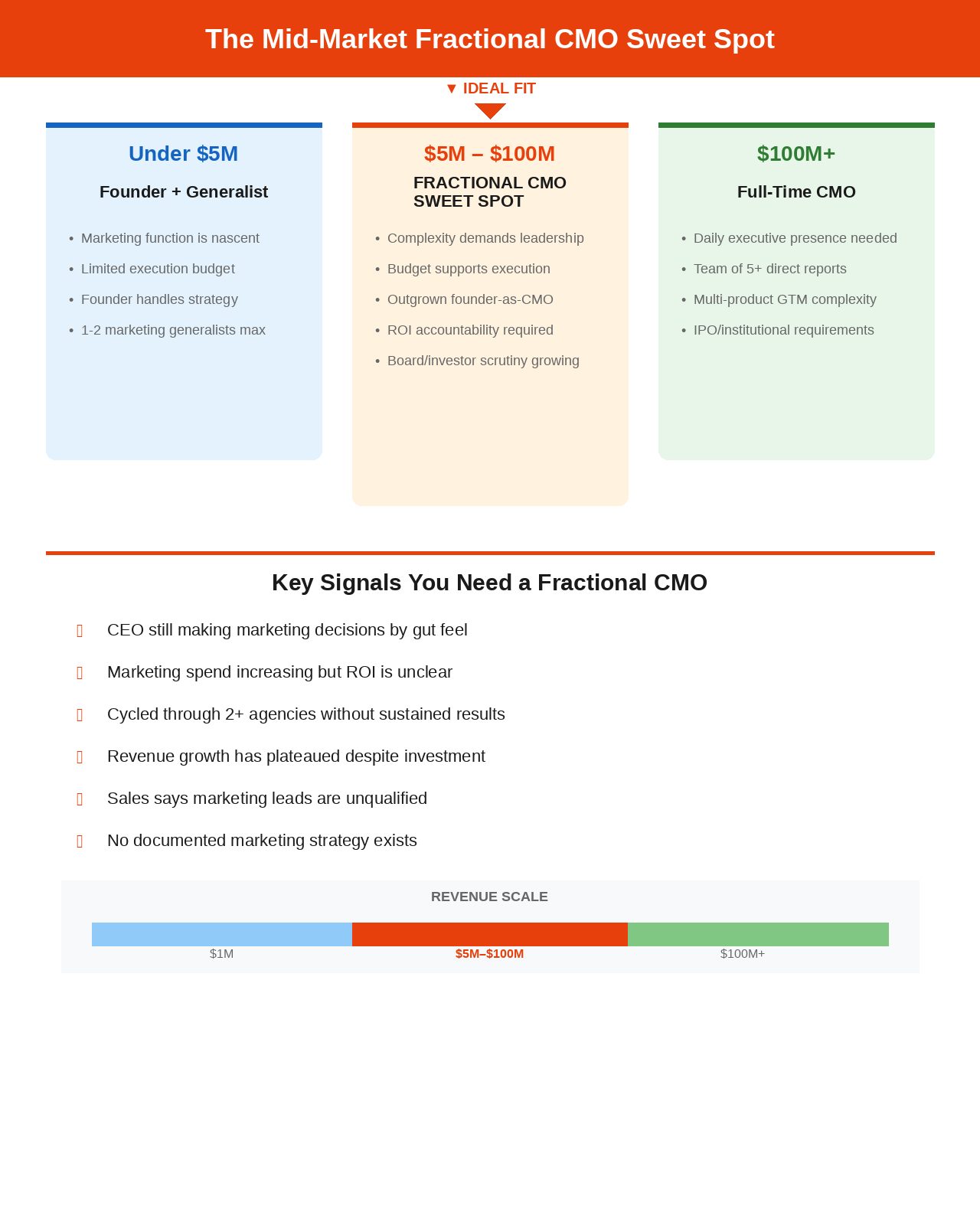
Not every company needs a fractional CMO, but mid-market companies between $5M and $100M in revenue are consistently the best fit for this model. They’ve reached a stage where marketing complexity demands senior leadership, but the economics of a full-time C-suite hire often don’t pencil out.
This isn’t about company size as a vanity metric. It’s about the specific operational challenges that emerge at this revenue stage — and the strategic gap that a fractional CMO is uniquely positioned to fill.
The $5M–$100M Revenue Sweet Spot
Below $5M in revenue, most companies can’t fully leverage a CMO’s skill set — the marketing function is still too nascent, and the budget to execute strategy is limited. Above $100M, companies typically have the resources and organizational complexity to justify a full-time CMO with a dedicated team of directors beneath them.
In between, the math favors fractional. A company doing $15M in revenue with a 10% marketing budget has $1.5M to deploy — enough to fund meaningful campaigns but not enough to absorb a $350K+ salary before a single dollar goes to execution.
At this stage, companies face a set of challenges that are remarkably consistent across industries:
- Marketing spend is increasing but ROI is unclear — you’re investing more but can’t trace revenue back to specific initiatives.
- You have doers but no strategist — your team can execute tasks but lacks someone who can build the plan those tasks ladder up to.
- Sales and marketing aren’t aligned — leads come in, but sales says they’re unqualified, and nobody owns the handoff process.
- You’ve tried agencies but feel stuck — external partners execute tactics, but nobody is connecting those tactics to your revenue targets.
- Board or investor scrutiny is increasing — stakeholders want to see marketing as a revenue driver with measurable returns, not a cost center.
Signs Your Company Has Outgrown the “Founder as CMO” Phase
In the early stages, most companies have a founder or CEO who doubles as the de facto head of marketing. That model works when you’re scrappy and the market is forgiving. It breaks when the business reaches a level of complexity where marketing decisions require dedicated expertise and full-time attention.
Here are the signals that your company has hit that inflection point:
- The CEO is making marketing decisions by gut feel rather than data, customer research, or competitive analysis.
- Marketing campaigns launch without a documented strategy — there’s activity, but no cohesive plan connecting it to pipeline and revenue.
- You’ve cycled through multiple agencies in the past two years without seeing sustained improvement.
- Your best marketing hire is a manager-level generalist who’s great at execution but not equipped to own strategy, budgeting, or board reporting.
- Revenue growth has plateaued despite increasing investment in marketing channels.
If three or more of these sound familiar, you’ve outgrown the founder-as-CMO phase. The question isn’t whether you need senior marketing leadership — it’s how to get it without overcommitting your budget. That’s the calculus that makes the fractional CMO model compelling.
Fractional CMO vs. Full-Time CMO vs. Marketing Agency
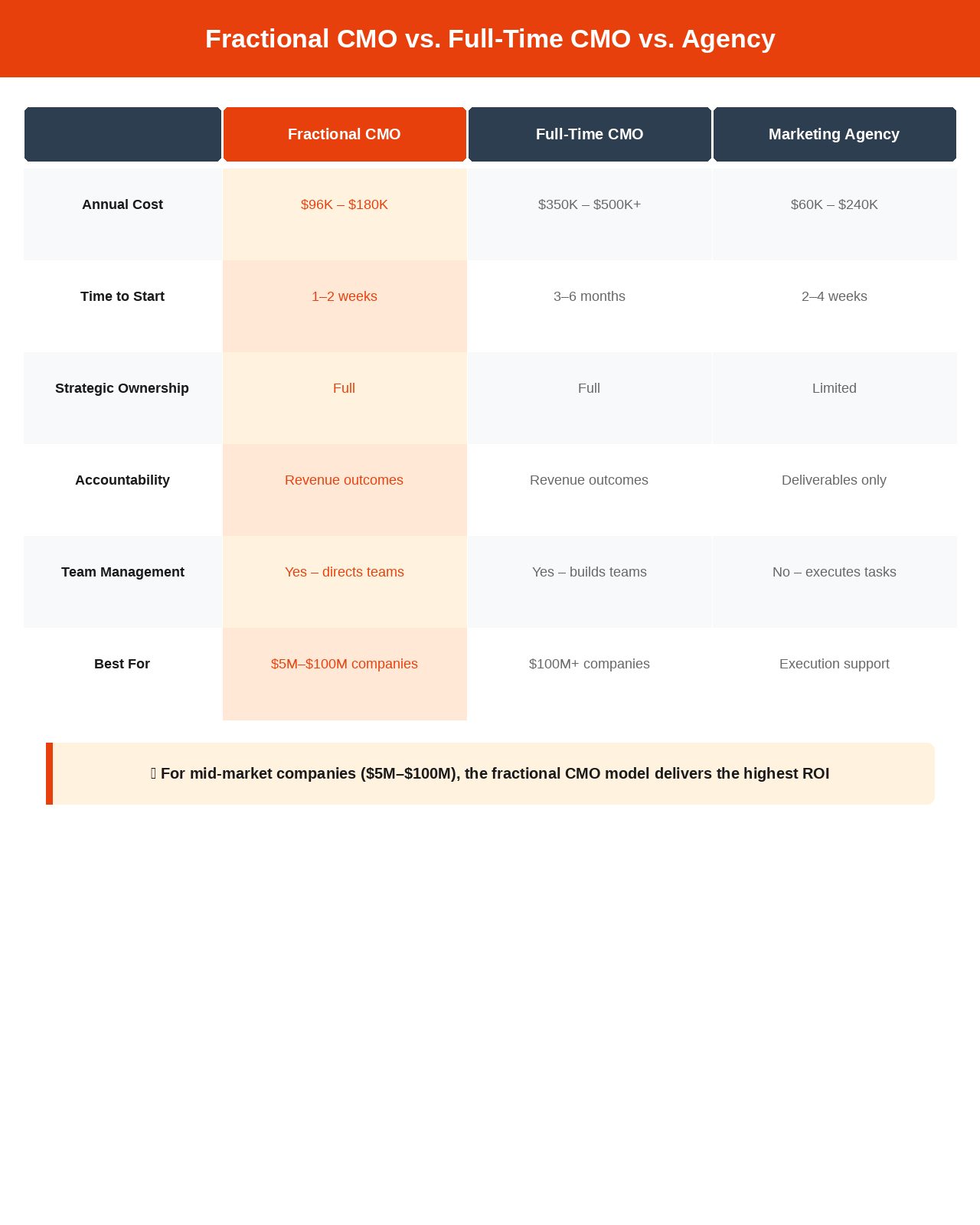
This is the comparison every mid-market CEO runs in their head — and the answer depends on your stage, budget, and what kind of marketing problem you’re actually solving. Each model has a clear use case, and choosing the wrong one wastes time and money.
Here’s how the three options compare across the dimensions that matter most:
| Factor | Fractional CMO | Full-Time CMO | Marketing Agency |
|---|---|---|---|
| Annual Cost | $100K–$200K | $300K–$500K+ (salary + benefits + equity) | $120K–$360K+ (retainer-dependent) |
| Strategic Ownership | Full — owns strategy, budget, KPIs | Full — owns strategy, budget, KPIs, team | Partial — executes within a defined scope |
| Time to Impact | 2–4 weeks to audit; 90 days to full strategy | 3–6 months recruiting + 90 days onboarding | 2–4 weeks for campaign launch |
| Team Leadership | Yes — directs internal staff and vendors | Yes — builds and manages a full department | No — manages their own team, not yours |
| Flexibility | High — scale up or down quarterly | Low — long-term commitment with severance risk | Moderate — tied to contract terms |
| Breadth of Experience | Wide — works across multiple companies and industries simultaneously | Deep — singular focus on your business | Variable — depends on agency specialization |
| Board/Exec Reporting | Yes — presents as a member of leadership | Yes — permanent member of leadership | Rarely — reports to your marketing lead |
| Execution Capability | Strategy-focused; oversees execution teams | Strategy-focused; builds execution teams | Execution-focused; needs strategic direction |
When Each Option Makes Sense
Choose a fractional CMO when you need strategic marketing leadership but your revenue stage or growth trajectory doesn’t justify a full-time C-suite hire. This is the strongest fit for companies between $5M and $100M that already have some marketing execution capability — whether internal staff, agency partners, or both.
Choose a full-time CMO when your company exceeds $75M–$100M in revenue, marketing is a primary growth lever, and you need someone dedicated 50+ hours per week to building a department from scratch. According to Spencer Stuart’s CMO Tenure Study, the average CMO tenure is approximately 4.2 years — so factor in the recruiting cost, ramp time, and turnover risk before committing.
Choose a marketing agency when you already have clear strategic direction and primarily need execution muscle — content production, paid media management, SEO, or demand generation campaigns. An agency without strategic oversight, however, is a team running plays without a coach. That’s why the most effective model pairs a fractional CMO with an execution partner.
How Much Do Fractional CMO Services Cost in 2026?
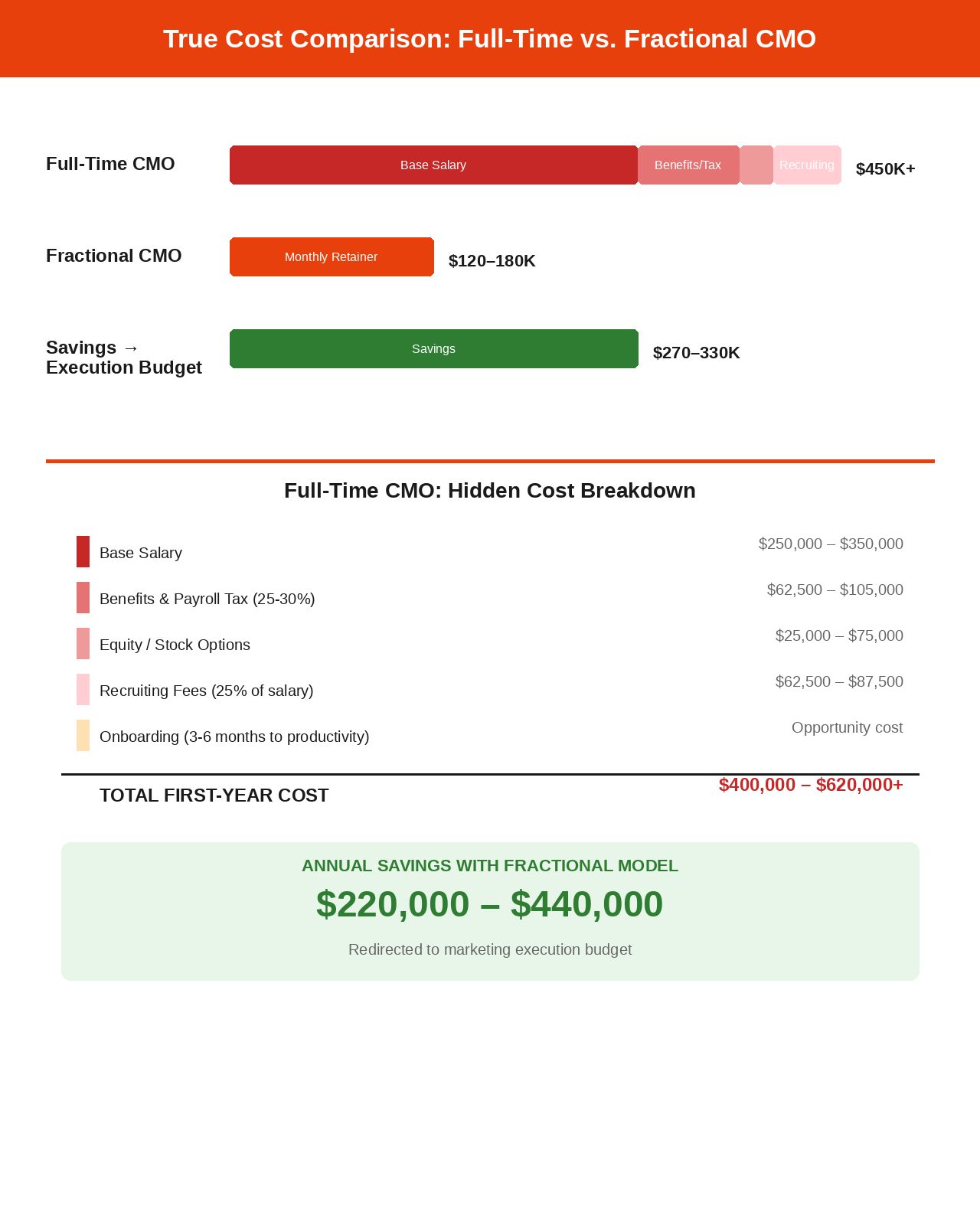
Fractional CMO services typically cost between $7,000 and $15,000 per month, with most mid-market engagements landing in the $8,000–$12,000 range for 10–15 hours per week. That translates to an annual investment of $96,000–$180,000 — a fraction of the total cost of a full-time CMO.
But cost alone doesn’t tell the full story. The right question isn’t “how much does a fractional CMO cost?” — it’s “what does the alternative cost, and what’s the cost of doing nothing?” For a deeper breakdown of current pricing, see our 2026 fractional CMO cost analysis.
Pricing Models — Retainer, Hourly, and Project-Based
Fractional CMOs structure their fees in three primary ways. Each model suits a different engagement type, and understanding the trade-offs helps you negotiate the right arrangement.
- Monthly retainer (most common): $7,000–$15,000/month for a set number of hours or days per week. This model works best for ongoing strategic leadership and is the standard for mid-market engagements. You get predictable costs and consistent access.
- Hourly rate: $250–$500/hour, typically used for advisory-only relationships or short-term projects. This model suits companies that need occasional strategic input rather than embedded leadership. The downside is unpredictable monthly costs and transactional dynamics.
- Project-based: $15,000–$50,000+ for defined deliverables like a go-to-market plan, brand repositioning, or marketing technology overhaul. This works for companies with a specific strategic need and a clear end date. It lacks the ongoing accountability that makes fractional CMOs most valuable.
The True Cost Comparison (with Data)
A full-time CMO’s loaded cost extends well beyond base salary. According to Glassdoor, the average CMO base salary in the U.S. is approximately $347,000 — but that’s just the starting point.
When you add benefits (15–25% of salary), performance bonuses (20–40% of salary), equity or stock options, recruiting fees (typically 25–33% of first-year salary), and severance risk, the total annual cost of a full-time CMO ranges from $450,000 to $600,000+. A fractional CMO at $10,000/month delivers comparable strategic output for roughly $120,000 per year — a 70–80% savings on the leadership layer.
The savings free up budget for what actually drives results: execution. A mid-market company that spends $120K on a fractional CMO instead of $500K on a full-time hire redirects $380K toward digital marketing campaigns, content production, technology, and talent — all under the strategic direction of their fractional CMO.
What Does a Fractional CMO Actually Do? The 90-Day Framework
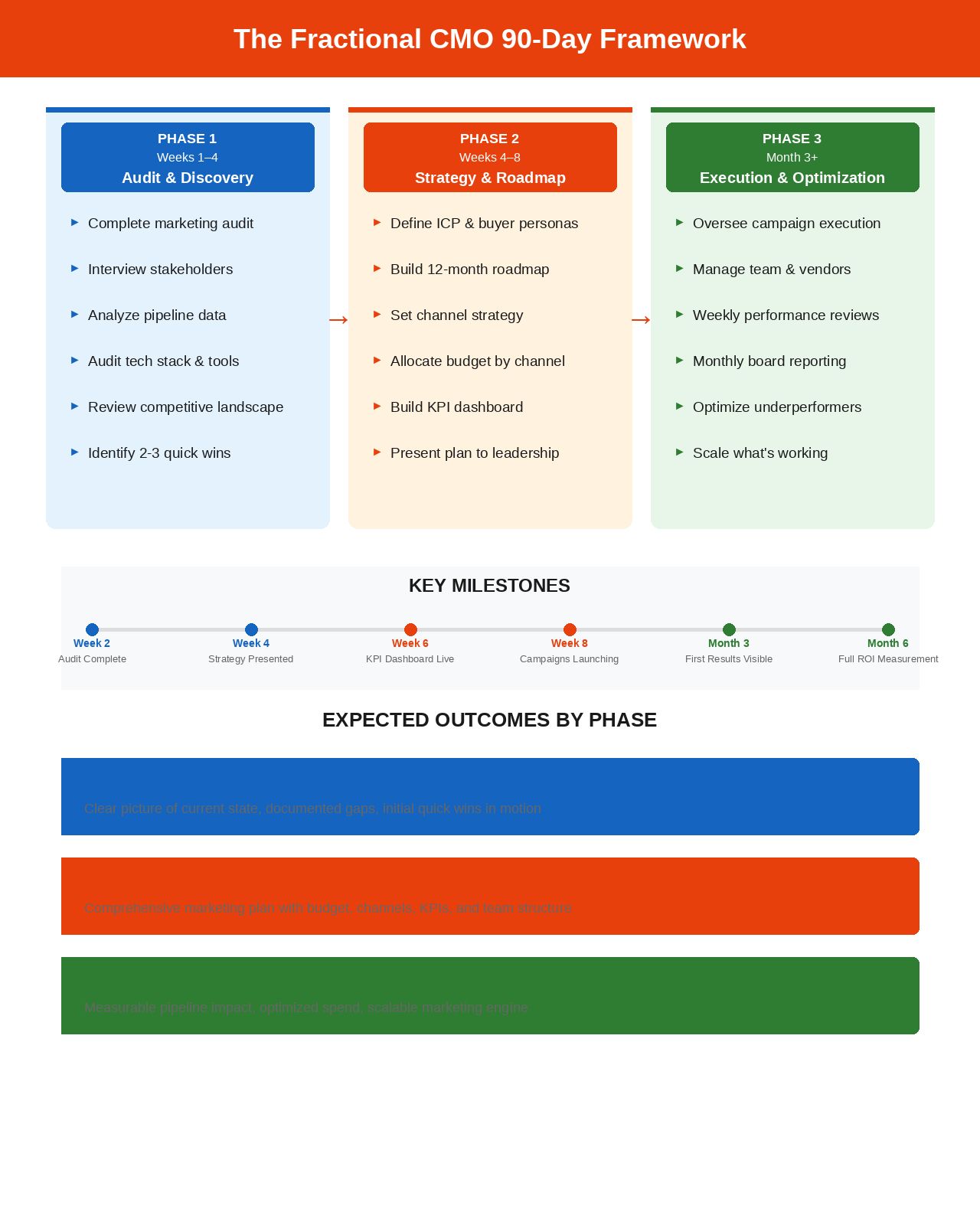
The first 90 days of a fractional CMO engagement determine whether the relationship delivers real value or becomes another line item that disappoints. A structured onboarding framework separates effective fractional CMOs from those who wing it — and it gives you a clear way to evaluate progress at each stage.
Here’s what a disciplined 90-day engagement looks like, broken into three phases.
Phase 1 — Audit and Discovery (Weeks 1–4)
The first phase is about understanding what exists before changing anything. A fractional CMO who starts making strategic recommendations in week one without a thorough audit is guessing — and expensive guessing is worse than no guessing at all.
During this phase, your fractional CMO should complete:
- Marketing performance audit — Reviewing all active campaigns, channels, and spend against actual revenue attribution.
- Technology stack assessment — Evaluating your CRM, analytics, automation tools, and data quality.
- Team capability review — Interviewing marketing staff and key stakeholders to understand skills, bandwidth, and gaps.
- Competitive landscape analysis — Mapping your positioning against three to five key competitors.
- Sales-marketing alignment assessment — Examining lead definitions, handoff processes, and pipeline stage criteria.
- Customer journey mapping — Documenting how prospects find, evaluate, and buy from your company today.
- Quick wins identification — Flagging two to three immediate opportunities that can generate results while the larger strategy takes shape.
The output of Phase 1 is a comprehensive audit document and a prioritized list of findings. This becomes the foundation for everything that follows.
Phase 2 — Strategy and Roadmap (Weeks 4–8)
With the audit complete, Phase 2 translates findings into a strategic roadmap. This is where the fractional CMO earns their keep — not by producing a generic marketing plan, but by building a strategy custom-fit to your company’s revenue goals, competitive position, and operational capacity.
Key deliverables in this phase include:
- 12-month marketing strategy — A documented plan with quarterly objectives, channel priorities, budget allocation, and revenue targets.
- Messaging and positioning framework — Clear articulation of your value proposition, differentiators, and ideal customer profile.
- KPI dashboard setup — Defining the 8–12 metrics that will be tracked weekly and reported monthly to leadership.
- Team restructuring recommendations — Defining roles, hiring priorities, and whether to build internally or outsource specific functions.
- Vendor evaluation — Assessing current agency partners and recommending changes if performance doesn’t justify cost.
- Content and inbound marketing strategy — Building a content plan that supports demand generation, SEO, and thought leadership objectives.
By the end of Phase 2, the CEO and leadership team should have full visibility into the marketing strategy, understand why each initiative was prioritized, and see a clear connection between marketing activity and revenue outcomes.
Phase 3 — Execution Oversight and Optimization (Month 3+)
Phase 3 is where the fractional CMO shifts from planning to performance management. They’re not doing the hands-on execution — they’re directing the team, managing vendors, monitoring KPIs, and making the weekly decisions that keep campaigns on track and budget on target.
Ongoing responsibilities include:
- Weekly team standups and campaign reviews — Keeping execution on pace with clear priorities and deadlines.
- Monthly performance reporting to the CEO and board — Translating marketing data into business language that leadership cares about.
- Budget management and reallocation — Shifting spend toward channels that are working and cutting what isn’t.
- Pipeline and revenue tracking — Working with sales leadership to ensure marketing-sourced leads are converting at expected rates.
- Quarterly strategy refinement — Updating the roadmap based on performance data, market shifts, and new opportunities.
- Hiring and onboarding support — Recruiting key marketing roles as the team scales.
This phase is ongoing and typically lasts 6–18 months. The best fractional CMO engagements include a defined success criteria for transition — either to a full-time CMO hire the fractional CMO helps recruit, or to a steady-state where the team operates independently with reduced oversight.
How to Evaluate and Hire a Fractional CMO
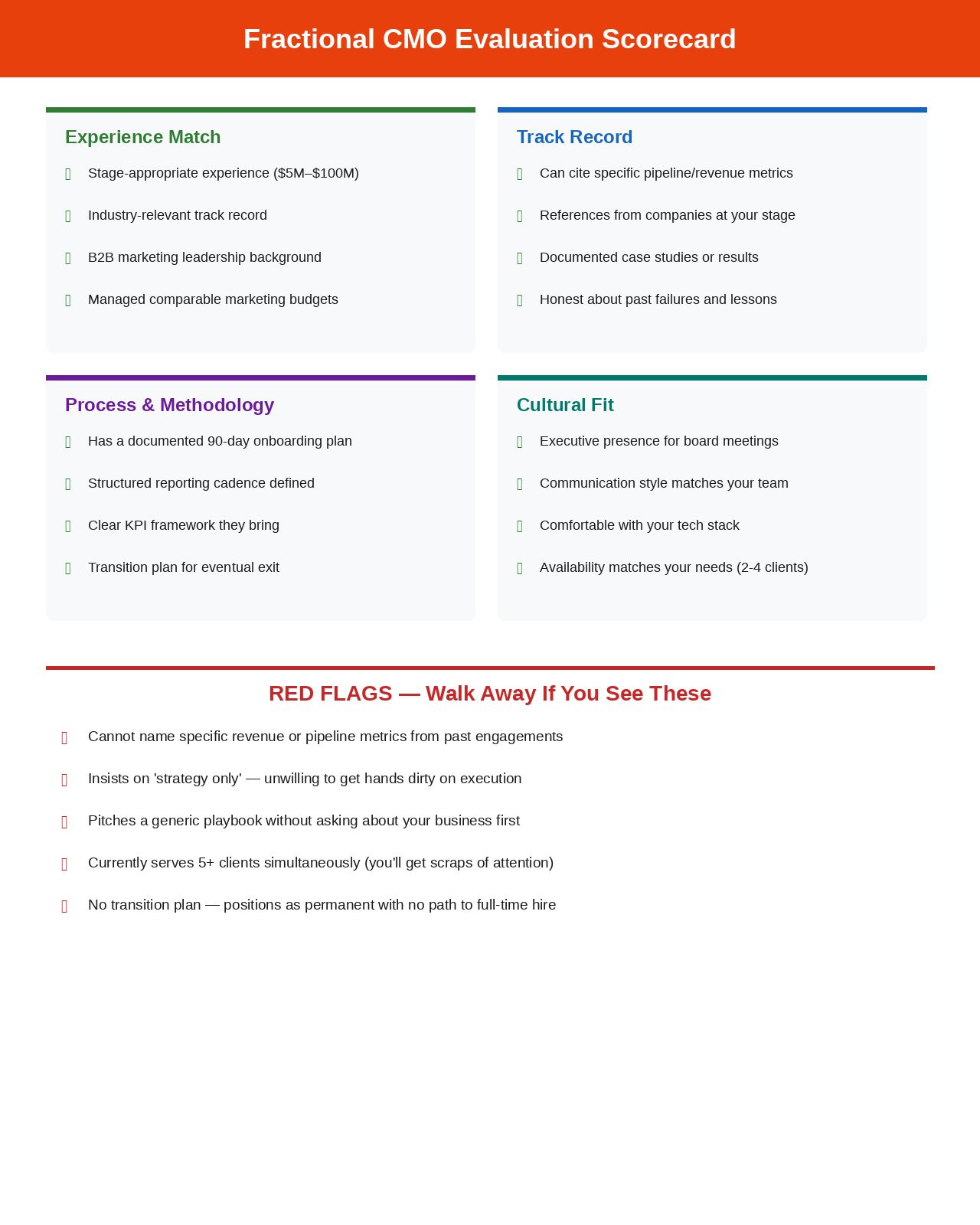
Hiring a fractional CMO is a strategic decision that deserves the same rigor you’d apply to any C-suite hire — just with a faster timeline. The market is crowded, and not everyone calling themselves a fractional chief marketing officer has the experience, temperament, or operating model to deliver results.
Here’s how to separate the contenders from the pretenders.
5 Questions to Ask Every Candidate
These questions go beyond surface-level vetting. They’re designed to reveal whether a candidate can operate as a true executive in your business, not just a strategic advisor on the sidelines.
- “Walk me through the first 30 days of your last engagement.” You’re looking for a structured approach — audit, stakeholder interviews, quick-win identification. If they can’t describe a repeatable process, they’re improvising.
- “How do you build a KPI framework, and what metrics do you report to the CEO?” The answer should center on revenue-connected metrics — pipeline value, customer acquisition cost, marketing-sourced revenue — not vanity metrics like impressions or social followers.
- “Tell me about a strategy that failed. What happened, and what did you change?” You want intellectual honesty and adaptability. A fractional CMO who’s never failed either hasn’t taken enough risk or won’t admit when something isn’t working.
- “How do you handle the handoff between strategy and execution?” This reveals whether they stay accountable for outcomes or pass a plan to your team and move on. The best answer describes ongoing involvement in execution oversight.
- “What’s your approach to sales and marketing alignment?” Look for specifics — shared definitions of qualified leads, joint pipeline reviews, SLA structures. Research from McKinsey shows companies with aligned marketing and sales teams achieve 15–20% higher revenue growth.
Red Flags That Signal a Bad Fit
Not every fractional CMO will be right for your company, and some won’t be right for any company. Watch for these warning signs during the evaluation process.
- They can’t name specific revenue outcomes from past engagements. A seasoned CMO should speak in dollars and pipeline metrics, not activity metrics or case studies that describe effort without results.
- They want to bring in their own agency without a competitive evaluation. This often signals a referral fee arrangement or a setup where the fractional CMO profits from the vendor relationship rather than your results.
- They position themselves as a “marketing guru” or “growth hacker.” Legitimate C-suite executives don’t use these terms. This branding signals a consultant or tactician who has repackaged themselves.
- They resist structured reporting or defined KPIs. Accountability is non-negotiable for an executive role. If they push back on regular performance reporting, they’re protecting themselves from scrutiny.
- They have no experience in your revenue range or business model. A fractional CMO who has only worked with startups under $2M will struggle with the organizational complexity of a $30M company. Industry experience is a bonus; stage experience is a requirement.
- They promise results in 30 days. Meaningful marketing transformation takes 90 days at minimum. Anyone promising dramatic results in a month is either exaggerating or planning to cherry-pick a vanity metric to claim credit for.
Fractional CMO Services by Industry
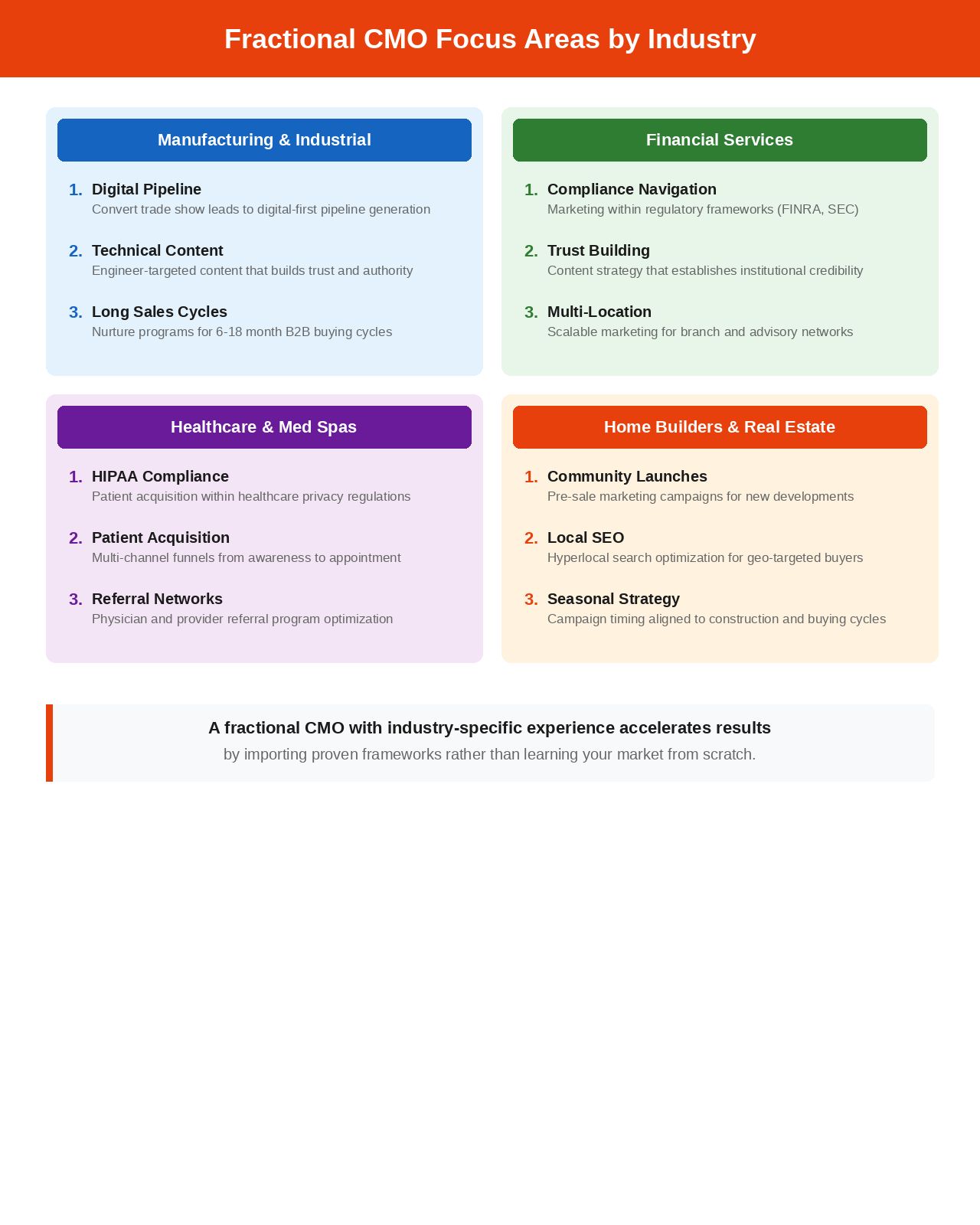
While the core responsibilities of a fractional CMO remain consistent, the strategic priorities shift significantly by industry. A fractional CMO working with a manufacturer faces different challenges than one serving a healthcare network or a financial services firm. Understanding these nuances helps you evaluate whether a candidate has the contextual expertise your business requires.
Manufacturing and Industrial
Manufacturing companies face a unique marketing challenge: long sales cycles, technical buyers, and a historical reliance on trade shows and relationships over digital channels. A fractional CMO in this space needs to bridge the gap between traditional relationship-driven sales and modern account-based marketing strategies.
Key priorities for manufacturing marketing include:
- Digital transformation of lead generation — Moving from trade-show dependency to inbound and ABM strategies that generate pipeline year-round.
- Technical content development — Creating content that speaks to engineers, procurement managers, and plant operations leaders without dumbing down the material.
- Sales enablement — Building tools, case studies, and ROI calculators that help long sales cycles progress faster.
- Distributor and channel marketing — Supporting indirect sales channels with co-marketing programs and lead sharing systems.
Financial Services and Credit Unions
Financial services and credit union marketing operate under strict compliance requirements that add complexity to every campaign. A fractional CMO in this industry must understand regulatory guardrails while still driving growth through digital channels.
Key priorities include:
- Compliance-first content strategy — Building approval workflows that keep content moving without violating FINRA, NCUA, or state-level regulations.
- Member/customer acquisition through digital channels — Competing with fintech disruptors who are winning attention with better digital experiences.
- Community engagement and trust-building — Developing campaigns that reinforce the institution’s role as a trusted community partner.
- Data-driven personalization — Using customer data to deliver targeted offers and communications without crossing privacy boundaries.
Healthcare and Med Spas
Healthcare marketing requires balancing patient education with business growth — all under HIPAA constraints and evolving consumer expectations. Med spas face the added challenge of competing in a market where consumer-brand expectations clash with medical credibility requirements.
Key priorities include:
- Patient acquisition strategy — Building multi-channel campaigns that drive new patient volume while maintaining clinical credibility.
- Reputation management — Developing systems for generating and responding to online reviews, which directly impact local search visibility.
- HIPAA-compliant marketing operations — Ensuring every campaign, form, and data integration meets privacy requirements.
- Provider brand development — Positioning physicians and practitioners as thought leaders in their specialties.
Home Builders and Real Estate
Home builder marketing operates on unique timelines — development phases, model home openings, community launches — that demand precision timing in campaign execution. A fractional CMO in this space needs to understand the buyer’s journey from community research to contract signing.
Key priorities include:
- Community launch marketing — Orchestrating multi-channel campaigns timed to construction milestones and model home openings.
- Visual content strategy — Managing renderings, virtual tours, video walkthroughs, and photography that sell the lifestyle, not just the floor plan.
- Local SEO and geo-targeted advertising — Dominating search results in the specific zip codes and communities where you’re building.
- CRM and sales process optimization — Building systems that track prospects from first website visit through contract, with nurture campaigns for the 6–18 month decision timeline.
Across every industry, the fractional CMO’s role is to bring strategic clarity and execution discipline to marketing efforts that have historically been fragmented or reactive. The industry-specific expertise determines how quickly they can diagnose problems and implement solutions that move revenue.
How to Measure Fractional CMO ROI
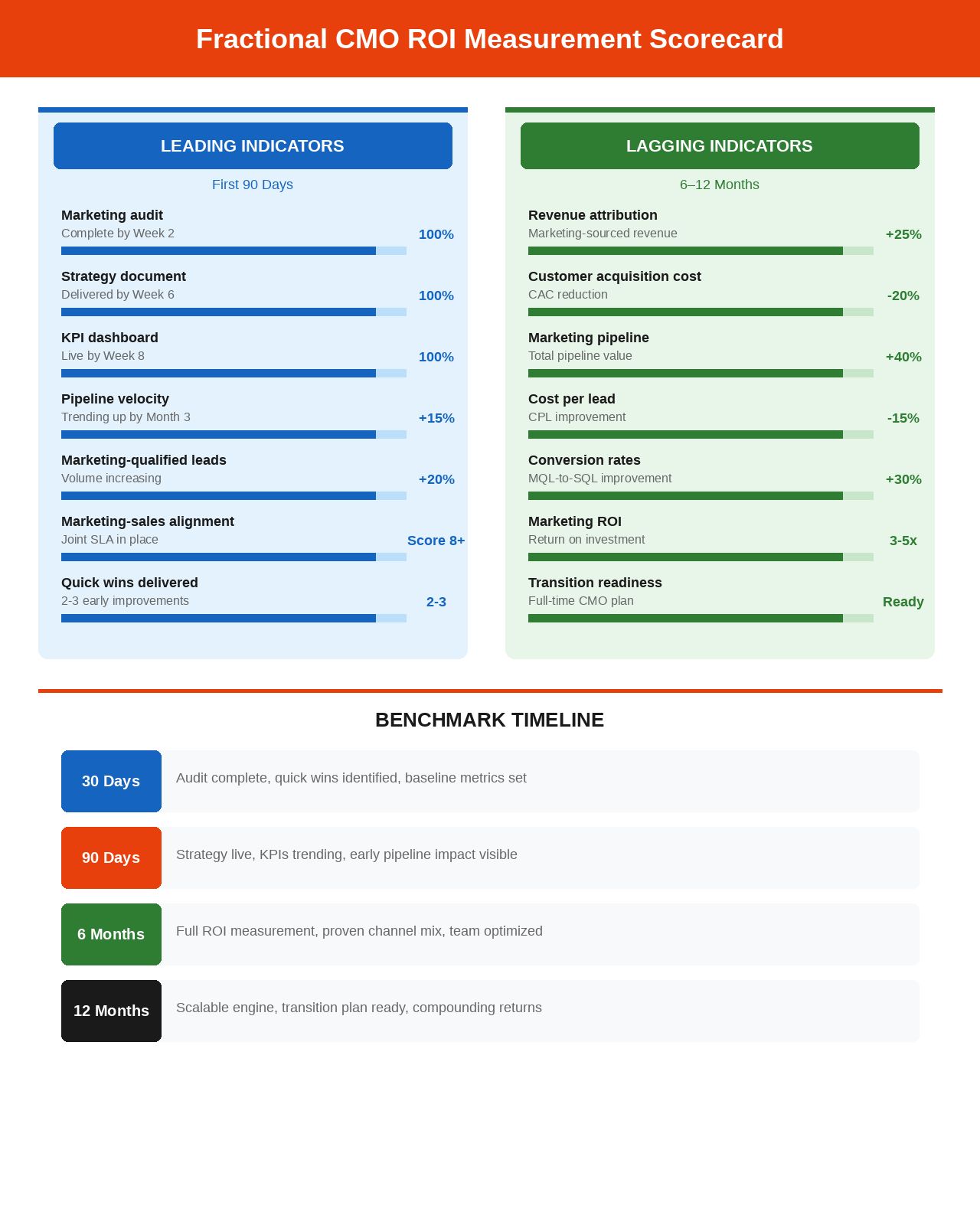
Measuring ROI on a fractional CMO engagement requires a two-tier approach — leading indicators that confirm progress in the first 90 days, and lagging indicators that prove revenue impact over 6–12 months. Too many companies evaluate their fractional CMO on lagging metrics alone, which creates a false sense that nothing is happening during the critical foundation-building phase.
Here’s the framework for measuring whether your investment is delivering returns.
Leading Indicators (First 90 Days)
These metrics won’t show up on a revenue report, but they’re the operational signals that predict future performance. If these indicators are trending positive by day 90, the engagement is on track.
- Marketing strategy documentation completed — A written strategy with measurable objectives, channel plans, and budget allocation should exist within 60 days.
- KPI dashboard operational — The fractional CMO should have built or refined a reporting dashboard that tracks the metrics that matter within the first month.
- Sales-marketing SLA established — Lead definitions, handoff criteria, and feedback loops should be documented and agreed upon by both teams.
- Pipeline velocity improvement — Track how quickly leads move through stages. Even before revenue increases, faster movement signals better targeting and messaging.
- Marketing qualified lead (MQL) volume and quality — Both volume and sales-accepted rate should trend upward as targeting and messaging improve.
- Content production cadence — A regular publishing rhythm should be established, with content mapped to buyer journey stages and SEO opportunities.
- Technology and process improvements — Specific changes to your martech stack, automation workflows, or data quality should be underway.
Lagging Indicators (6–12 Months)
These are the metrics that justify the investment at the executive and board level. They require time to develop because marketing influence on revenue operates on a delayed cycle, especially in B2B where sales cycles span months.
- Marketing-sourced revenue — Revenue directly attributed to marketing-generated leads. This is the definitive ROI metric.
- Customer acquisition cost (CAC) — Total marketing and sales spend divided by new customers acquired. A fractional CMO should drive this number down over time through better targeting and efficiency.
- Marketing ROI ratio — Total revenue attributed to marketing divided by total marketing investment. A healthy B2B marketing program should deliver 5:1 or better over a 12-month period.
- Pipeline coverage ratio — Total pipeline value divided by revenue target. A 3:1 ratio is a common benchmark — the fractional CMO should ensure marketing contributes its fair share of pipeline to maintain this coverage.
- Brand awareness and share of voice — Measured through organic search visibility, direct traffic growth, branded search volume, and media mentions.
- Sales cycle length — The time from first touch to closed deal. Better marketing qualification and content should shorten this over time.
- Customer lifetime value (CLV) impact — Improvements to onboarding, cross-sell marketing, and retention campaigns should increase average customer value.
The most effective measurement approach combines both tiers into a single scorecard that gets reviewed monthly. Leading indicators provide confidence that the strategy is working before revenue appears; lagging indicators provide the proof that justifies continued or expanded investment.
The Role of AI and Technology in Fractional CMO Engagements (2026)
The fractional CMO model has been transformed by the rapid adoption of AI and automation tools over the past two years. In 2026, a fractional CMO who isn’t leveraging AI to multiply their impact is operating with one hand tied behind their back — and charging you for the inefficiency.
Here’s how AI is reshaping what a fractional CMO can accomplish in fewer hours:
- Competitive intelligence at scale — AI tools now monitor competitor messaging, pricing changes, content strategies, and ad spend in real time, replacing what used to require hours of manual research each week.
- Content strategy and production acceleration — AI-assisted content tools allow a fractional CMO to oversee higher-volume content programs without proportionally increasing team size or budget.
- Predictive analytics for budget allocation — Machine learning models forecast channel performance with greater accuracy, enabling smarter budget decisions based on data rather than historical bias.
- Personalization at the mid-market level — Tools that were previously only accessible to enterprise companies now enable mid-market firms to deliver personalized experiences across email, web, and advertising channels.
- Reporting automation — AI-powered dashboards synthesize data from multiple platforms into executive-ready reports, reducing the time a fractional CMO spends on manual reporting and increasing time spent on strategic decisions.
The practical impact is significant. A fractional CMO who effectively deploys AI can deliver the strategic output of 15–20 hours per week in 10–12 hours — which either reduces your cost or increases the scope of what they accomplish within the same budget. When evaluating candidates, ask how they use AI in their workflow. The answer will tell you whether they’re operating in 2026 or 2020.
Contract and SOW Guidance for Fractional CMO Engagements
A well-structured statement of work protects both parties and sets clear expectations from day one. Too many fractional CMO engagements fail not because of strategic misalignment but because deliverables, time commitments, and success criteria were never documented with specificity.
Your fractional CMO contract or SOW should include these elements:
- Scope of responsibilities — Define whether the role includes team management, vendor oversight, board reporting, and budget authority, not just strategy development.
- Time commitment — Specify hours per week, on-site days (if any), and availability expectations for urgent matters outside scheduled hours.
- Deliverables by phase — Document what gets delivered in the first 30, 60, and 90 days. This includes the audit report, strategic plan, KPI dashboard, and any restructuring recommendations.
- KPI targets and review cadence — Establish the metrics that define success and the frequency of formal performance reviews (typically quarterly).
- Term and termination — Most engagements start with a 6-month minimum commitment and 30-day termination notice. Avoid month-to-month arrangements that encourage short-term thinking.
- Confidentiality and non-compete — Address whether the fractional CMO can simultaneously serve competitors and how proprietary strategy and data are protected.
- Transition plan — Define what happens when the engagement ends — whether that’s hiring a full-time CMO (with the fractional CMO’s involvement in recruiting), transitioning to a reduced advisory role, or documenting all processes for continuity.
The contract sets the tone for accountability. A fractional CMO who resists specific deliverables or measurable targets in the SOW is telling you something about how they plan to operate — and it’s not a good sign.
Frequently Asked Questions About Fractional CMO Services
What is a fractional CMO?
A fractional CMO is an experienced chief marketing officer who works with your company on a part-time or contract basis, typically 10–20 hours per week. They serve as a true member of your leadership team — owning marketing strategy, managing teams, setting budgets, and reporting to the CEO — without the full-time salary and benefits commitment.
Unlike consultants who advise from the outside, a fractional CMO operates as an embedded executive. They make decisions, lead people, and take accountability for measurable marketing outcomes tied to revenue.
How much does a fractional CMO cost?
Most fractional CMO engagements cost between $7,000 and $15,000 per month, with mid-market companies typically paying $8,000–$12,000 for 10–15 hours per week. This translates to $96,000–$180,000 annually — roughly 40–60% less than the fully loaded cost of a full-time CMO, which typically exceeds $450,000 when you include salary, benefits, bonuses, equity, and recruiting fees.
Pricing varies based on the CMO’s experience, the scope of the engagement, and the complexity of your business. Project-based engagements for specific initiatives like a go-to-market strategy may range from $15,000 to $50,000.
What is the difference between a fractional CMO and a marketing consultant?
A fractional CMO leads — they own the marketing function, manage your team, make budget decisions, and take accountability for results. A marketing consultant advises — they analyze your situation, deliver recommendations, and leave execution to you.
The practical difference is significant. A consultant hands you a strategy document; a fractional CMO builds the strategy, directs the team that executes it, reports progress to your board, and adjusts course when results don’t meet expectations. They carry the responsibility of the role, not just the title.
When should you hire a fractional CMO vs. full-time?
Hire a fractional CMO when your company generates between $5M and $100M in revenue, needs senior marketing leadership, but can’t justify or doesn’t yet need a full-time $350K+ executive. The fractional model is also ideal when you need to move quickly — a fractional CMO can start within weeks, while a full-time CMO search takes 3–6 months.
Hire a full-time CMO when your company exceeds $75M–$100M in revenue, marketing requires 40+ hours per week of strategic attention, and you need someone who will build and lead a department of five or more people. Many companies use a fractional CMO as a bridge — they lead marketing while helping you define the profile and recruit the right full-time hire.
What does a fractional CMO do day-to-day?
On a typical week, a fractional CMO splits time between strategic planning, team leadership, and executive communication. This includes reviewing campaign performance data, leading weekly marketing team standups, meeting with the CEO and sales leadership, managing agency or vendor relationships, and making budget allocation decisions.
They also handle the work that falls through the cracks when no senior marketer exists — evaluating new marketing technology, defining the messaging for a product launch, resolving a conflict between sales and marketing, or preparing the quarterly marketing review for the board. The day-to-day balance shifts depending on the phase of the engagement and the maturity of your marketing team.
Is a fractional CMO worth it for small businesses?
For businesses under $5M in revenue, a fractional CMO may be premature. At that stage, the marketing budget often can’t support the execution that a CMO’s strategy requires, which creates a frustrating dynamic where you have a great plan but no resources to implement it.
However, businesses in the $3M–$5M range that are growing quickly and preparing for a significant growth phase can benefit from a short-term fractional CMO engagement focused on building the marketing foundation — establishing the strategy, defining the tech stack, and hiring the first marketing team member. The engagement may look more like a 3–6 month project than an ongoing retainer.
How long does a fractional CMO engagement last?
Most fractional CMO engagements last 12–24 months, with a 6-month minimum commitment being standard. The first 90 days are dedicated to audit, strategy, and initial execution — so engagements shorter than six months rarely deliver meaningful ROI.
Some companies retain a fractional CMO for three or more years, particularly if the model continues to deliver results and the company hasn’t reached the scale that justifies a full-time hire. Others use the engagement as a 12-month bridge to hiring a full-time CMO, with the fractional CMO leading the search and onboarding process.
What should I look for when hiring a fractional CMO?
Prioritize candidates with direct experience at your revenue stage, a track record of measurable revenue impact, and a structured onboarding process. They should be able to articulate their 90-day plan, explain how they measure success, and provide references from companies similar to yours in size and complexity.
Beyond experience, look for cultural fit and communication style. Your fractional CMO will interact with your CEO, sales leader, and potentially your board — they need the executive presence and communication skills to operate at that level. Avoid candidates who lead with tactics over strategy, can’t describe past failures, or resist accountability through defined KPIs.
Conclusion: Making the Fractional CMO Decision
Fractional CMO services have moved from an emerging trend to a proven leadership model for mid-market companies. The economics are clear — you get C-suite strategic capability at a fraction of the cost, with faster time-to-impact and lower risk than a traditional full-time hire.
The companies that get the most from this model share a few characteristics. They’re in the $5M–$100M revenue range where marketing complexity demands senior leadership. They’ve reached the limits of what a founder, director-level marketer, or agency can deliver without strategic oversight. And they’re ready to treat marketing as a revenue function with the measurement rigor that implies.
Whether you’re exploring fractional CMO services for the first time or comparing candidates for an engagement, use the frameworks in this guide — the 90-day onboarding structure, the evaluation questions, the ROI measurement scorecard — to make a decision that’s grounded in data and aligned with your growth objectives. The right fractional CMO doesn’t just fill a leadership gap; they build the marketing engine that drives your next stage of growth.