
 321-236-2899
Your last agency treated your CNC machining center like it was a SaaS free trial. They ran a few LinkedIn ads, wrote blog posts that made your engineers wince, and disappeared the moment a procurement manager asked a technical question. Hiring an industrial marketing agency that actually understands specification sheets, 12-month buying cycles, and how a plant manager makes a purchase decision isn’t a nice-to-have — it’s the difference between marketing that fills your pipeline and marketing that drains your budget.
You’ve landed on a comprehensive, in-depth guide. We’ll walk through exactly what an industrial marketing agency does, how to evaluate one, what it costs in 2026, and how to measure whether it’s working.
The stakes are higher in industrial markets than almost anywhere else. Industrial buyers carry deep technical knowledge, and they can smell generic copy from the first sentence. A single vague claim or a misused engineering term erodes the credibility you’ve spent decades building on the shop floor.
By the end of this guide, you’ll know how to separate a genuine industrial marketing partner from a generalist agency wearing a hard hat in its stock photos. Let’s start with what these agencies actually do.
Key Takeaways
- An industrial marketing agency specializes in the manufacturing ecosystem — engineering-heavy OEMs, contract manufacturers, distributors, and industrial equipment makers — and speaks the technical language of engineers, plant managers, and procurement teams.
- Specialization is the entire value proposition. Gartner research shows B2B buyers spend just 17% of the buying journey with any supplier’s sales team, so the digital content that reaches technical buyers must be credible enough to earn a spot on the shortlist without a rep in the room.
- The right agency measures pipeline, deal velocity, and revenue — not impressions and followers — and can prove it with attribution reporting tied to your CRM.
- Expect to invest roughly $5,000 to $25,000+ per month depending on scope, channels, and whether you need fractional CMO-level strategy on top of execution.
- Ask for manufacturing case studies with real pipeline numbers. Any agency that can’t show measurable business outcomes in an industrial vertical isn’t ready for yours.
What an Industrial Marketing Agency Actually Does
An industrial marketing agency is a specialized firm that builds and runs marketing programs for companies in manufacturing, industrial equipment, engineering, distribution, and related technical sectors. The word “specialized” is doing the heavy lifting in that sentence.
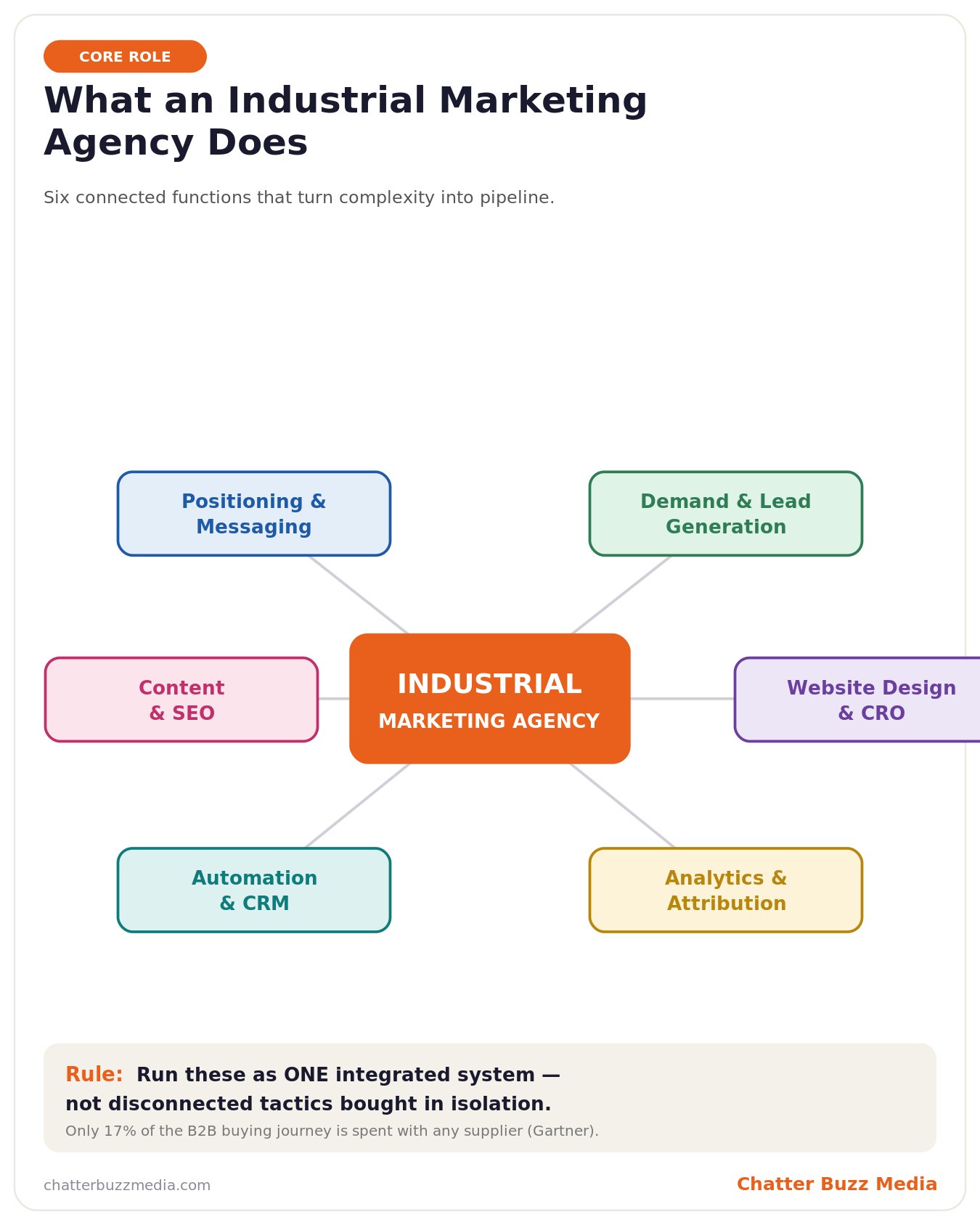
Unlike a generalist agency that treats your account like a restaurant chain, an industrial agency starts from the reality of your market: long sales cycles, multiple technical decision-makers, and buyers who research extensively before they ever fill out a form. Their job is to turn that complexity into a predictable pipeline.
In practice, a strong industrial marketing agency delivers across a few connected fronts:
- Positioning and messaging that resonate with engineers, plant managers, and C-suite buyers — not consumer-style slogans.
- Demand and lead generation through manufacturing SEO, paid search, and account-based programs.
- Content that earns trust — technical guides, application notes, spec-driven landing pages, and case studies.
- Website design and development that converts a spec-hunting engineer into a sales conversation.
- Analytics and attribution that connect marketing activity to closed revenue.
The difference shows up in the details. A generalist might launch a broad awareness campaign and celebrate impressions, while an industrial specialist targets the exact accounts and job titles that fit your ideal customer profile.
That precision matters because industrial audiences are small and high-value. You may only have a few hundred realistic buyers in your entire addressable market, so every impression and every lead has to count.
Put simply, a good industrial agency does what your in-house team wishes it had the time, tools, and specialized expertise to do. It builds a system that generates qualified demand and proves its own return.
That system only works when the agency truly understands your buyer — which is exactly why specialization matters so much. Let’s look at why generalists fall short.
Why Industrial Companies Need a Specialized Agency, Not a Generalist
Industrial companies need a specialized agency because generalists don’t speak the language, understand the sales cycle, or know where technical buyers actually look for information. The gap between “knows marketing” and “knows industrial marketing” is where most budgets go to die.
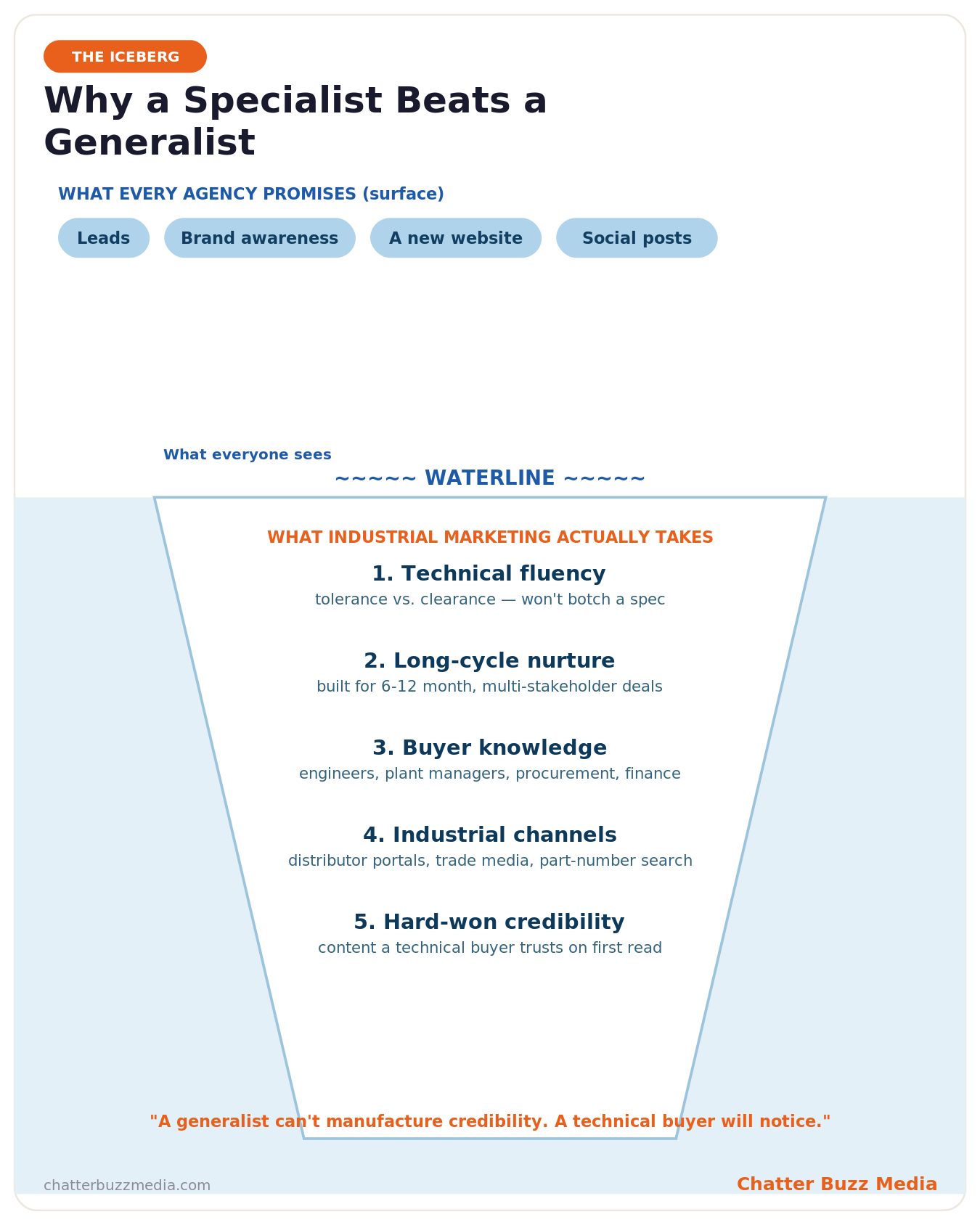
On the surface, every agency promises the same things: leads, brand awareness, a shiny new website. The real difference sits below the waterline, where industrial marketing is genuinely different from consumer or standard B2B work.
Here’s what specialized experience actually buys you:
- Credibility with technical audiences. An agency that has written for design engineers knows the difference between tolerance and clearance — and won’t publish copy that gets you dismissed on the first read.
- Comfort with long, multi-stakeholder cycles. Industrial deals often involve engineering, operations, procurement, and finance across many months. Specialists build nurture programs for that reality.
- Knowledge of industrial channels. They know that a spec sheet on the right distributor portal or a targeted trade publication can outperform a generic social campaign.
The stakes are backed by data. Gartner found that B2B buyers spend only 17% of their total buying time meeting with potential suppliers, according to its research on the B2B buying journey — which means the vast majority of the decision happens through independent research on content your agency produces.
When most of the sale happens before a rep is involved, the quality and technical accuracy of your marketing becomes the sale. A generalist can’t manufacture that credibility, and a technical buyer will notice.
Once you accept that specialization is non-negotiable, the next question becomes practical: who exactly is this marketing supposed to reach? Let’s meet the buying committee.
Who You’re Really Marketing To: The Industrial Buying Committee
Industrial marketing rarely persuades one person — it has to win over a committee of engineers, operators, purchasers, and executives who each judge you differently. Miss any one of them and the deal stalls.
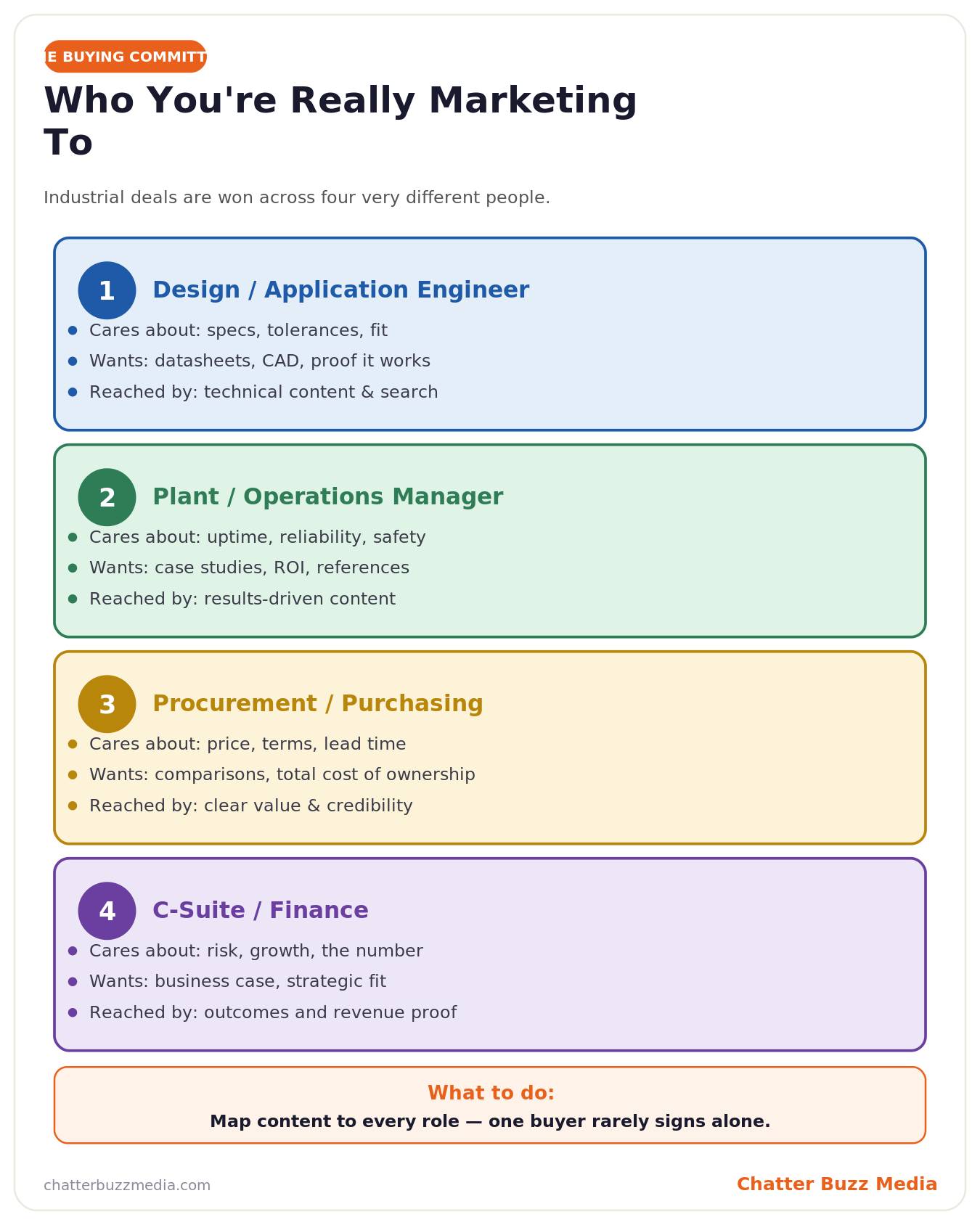
Understanding these roles is the difference between content that resonates and content that gets ignored. A specialized agency builds messaging for each seat at the table. Here’s who you’re actually marketing to:
- The design or application engineer cares about specs, tolerances, and whether your product fits. Win them with datasheets, technical content, and search visibility on the terms they actually type.
- The plant or operations manager cares about uptime, reliability, and safety. Win them with case studies, references, and proof your solution performs in the real world.
- Procurement and purchasing care about price, terms, and total cost of ownership. Win them with clear value and credibility, not just the lowest quote.
- The C-suite and finance care about risk, growth, and the number. Win them with a business case tied to outcomes and revenue.
A generalist agency writes one message and hopes it lands. A specialist maps content to every role, because in industrial deals one buyer rarely signs alone. That committee-aware approach is exactly what separates a pipeline that moves from one that stalls in “evaluation.”
Reaching all four roles takes a full toolkit — which brings us to the services a complete industrial agency should deliver.
Core Services an Industrial Marketing Agency Should Deliver
A complete industrial marketing agency should deliver strategy, content, demand generation, web, and analytics as one integrated program — not a menu of disconnected tactics. The value comes from how the pieces reinforce each other.
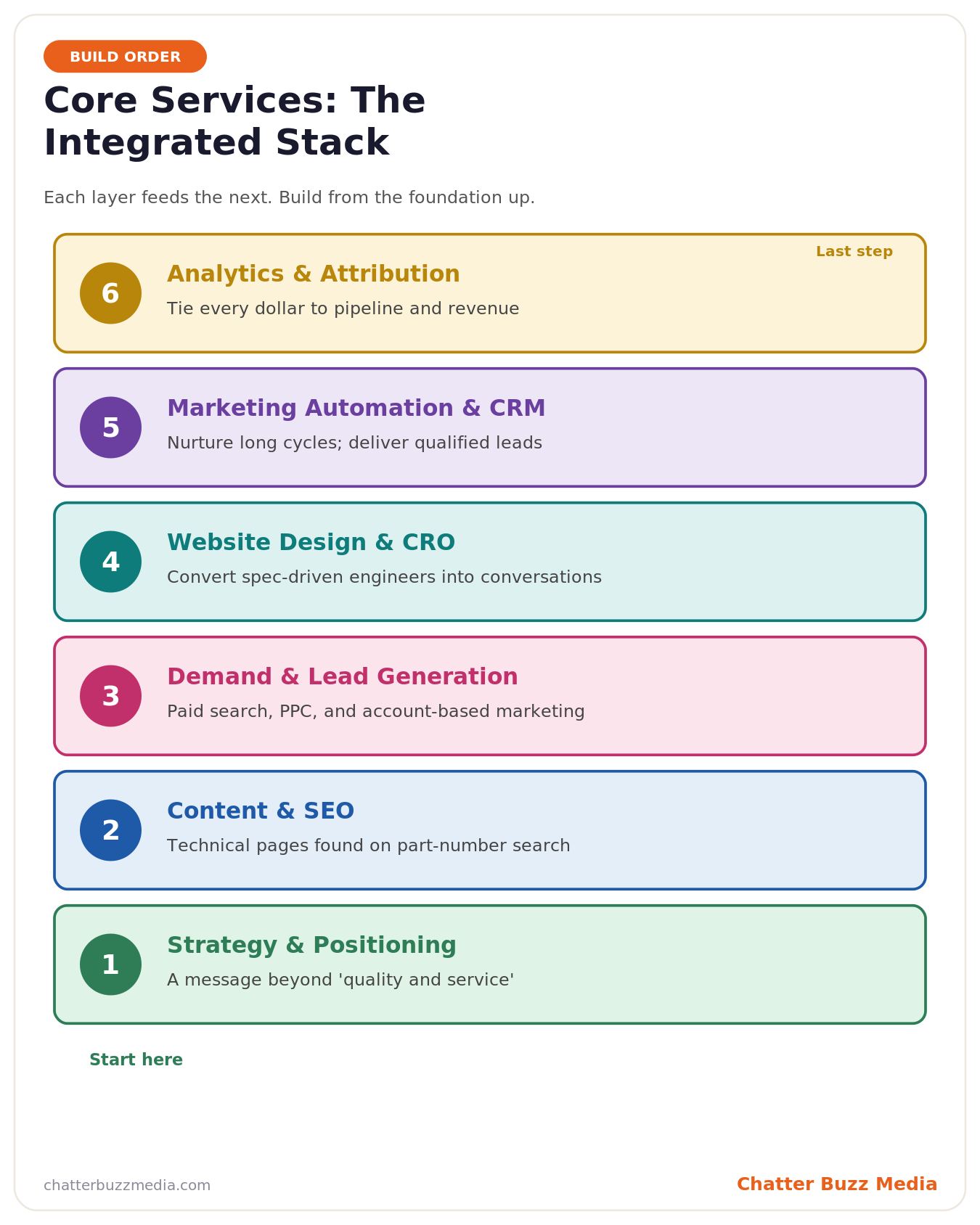
Too many manufacturers buy “SEO” or “some ads” in isolation and wonder why nothing compounds. A real program stacks capabilities so each layer feeds the next. Here are the layers that matter most.
- Strategy and positioning: Market research, buyer personas, and a message that differentiates you beyond “quality and service.” This is the foundation everything else stands on.
- Content and SEO: Technical articles, application guides, and search-optimized pages that get you found when an engineer searches a part number or process.
- Demand and lead generation: Paid search, PPC management, and account-based marketing aimed at your highest-value target accounts.
- Website design and CRO: A manufacturing website that converts spec-driven visitors, plus conversion optimization to lift results over time.
- Marketing automation and CRM: Automation and CRM integration that nurture long cycles and hand sales a qualified lead, not a cold name.
- Analytics and attribution: Dashboards that tie every dollar to pipeline and revenue.
Notice how these build on one another: strategy shapes content, content fuels demand gen, the website converts it, and automation nurtures it toward a closed deal. An agency that only sells one slice can’t be accountable for the whole outcome.
Knowing which services you need is only half the battle. The harder part is judging whether a given agency can actually execute them — so let’s turn to evaluation.
How to Evaluate and Choose an Industrial Marketing Agency
To choose the right industrial marketing agency, evaluate proof of results, industry fit, technical fluency, process, and how they measure success. Judge agencies on evidence, not on the polish of the pitch deck.
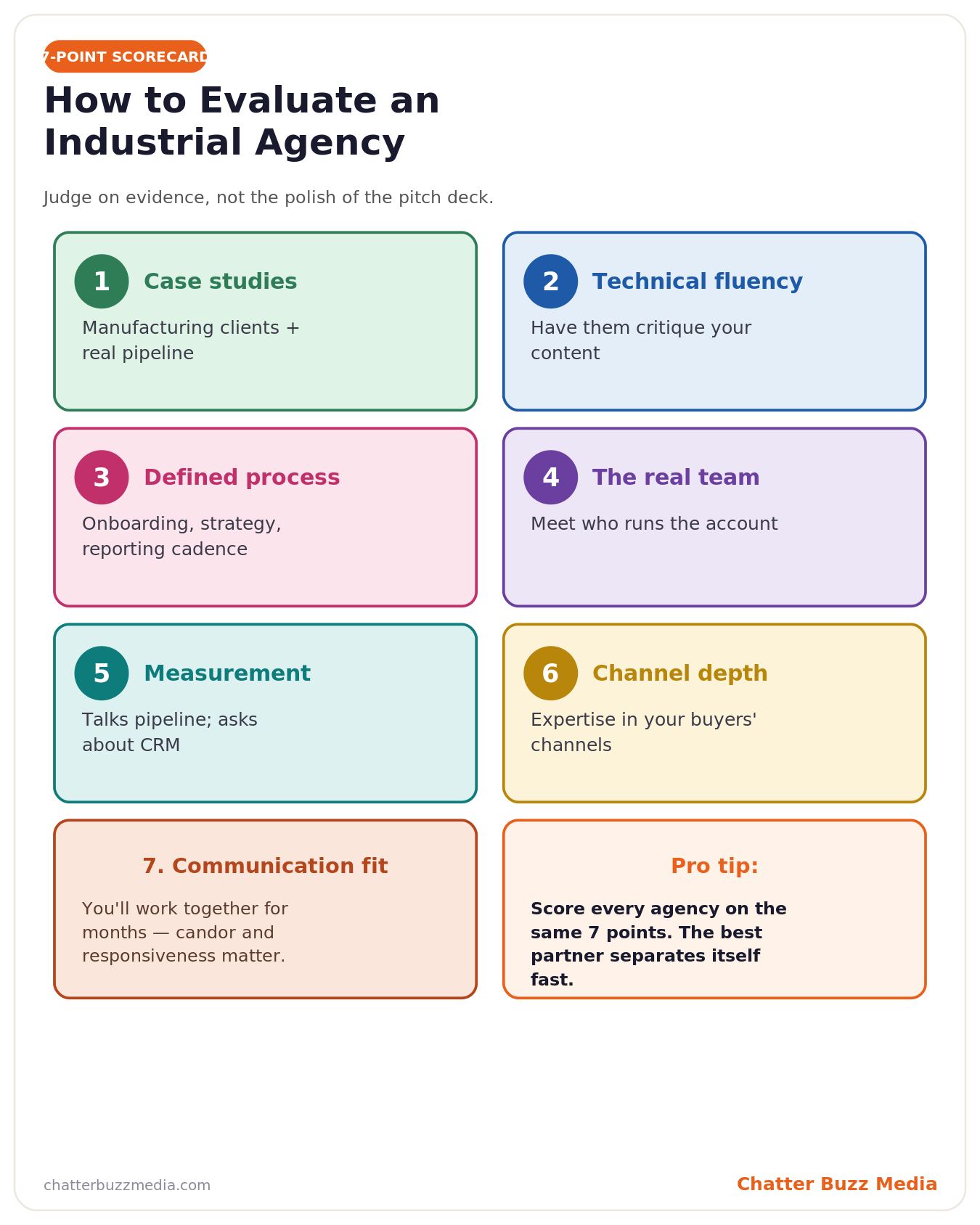
The best-sounding agency in the room is often the one with the best salesperson, not the best results. Use a consistent scorecard so you compare partners on what actually predicts success. Here are the seven criteria that matter most.
- Relevant case studies with real numbers. Ask for manufacturing or industrial clients and specific outcomes — pipeline generated, cost per qualified lead, revenue influenced.
- Technical fluency. Have them critique a page of your existing content. A specialist will spot the technical gaps immediately.
- A defined process. Look for a clear onboarding, strategy, and reporting cadence — not “we’ll figure it out as we go.”
- The right team, not just a slick pitch. Meet the strategist and specialists who’ll actually run your account, not only the sales lead.
- Measurement philosophy. They should talk about pipeline and revenue, and ask about your CRM, in the first conversation.
- Channel depth where you need it. Confirm real expertise in the specific channels your buyers use, from search to trade media to ABM.
- Cultural and communication fit. You’ll work closely for months, so responsiveness and candor matter as much as capability.
Score every agency against the same seven criteria and the right partner usually separates itself quickly. For a deeper list of vetting questions, our team put together 14 questions to ask before hiring any agency. A structured evaluation protects you from a charismatic pitch that hides a thin bench.
Just as important as knowing what to look for is knowing what to run from. Next, the warning signs.
Red Flags That Signal the Wrong Industrial Marketing Partner
The clearest red flags are guaranteed rankings, no industrial references, vanity-metric reporting, and a refusal to talk about revenue. Any one of these should give you serious pause.

Most bad agency relationships were predictable from the sales process — the signals were there before the contract was signed. Watch for these specific warning signs.
- Guarantees of #1 rankings or exact lead counts. No credible partner promises what the algorithm and market ultimately control.
- No verifiable industrial references. If they can’t name a single manufacturer or industrial client, you’d be their experiment.
- Reports built on vanity metrics. Impressions, likes, and “reach” that never connect to pipeline are a distraction from results.
- Discomfort discussing revenue and CRM. An agency that dodges attribution is protecting itself, not your budget.
- One-size-fits-all packages. A “manufacturing plan” identical to their restaurant plan tells you everything.
- High-pressure, act-now contracts. Urgency tactics signal a sales-first, delivery-second operation.
Spot two or more of these and keep looking, no matter how good the pitch feels. The cost of the wrong agency isn’t just wasted fees — it’s a year of lost pipeline and internal credibility.
Once you’ve filtered for quality and screened out the risks, the practical question becomes budget. Let’s talk numbers.
What Industrial Marketing Costs in 2026
Most industrial companies invest between $5,000 and $25,000+ per month with an agency, depending on scope, channels, and the level of strategy involved. Price should map to the outcomes you need, not just the hours billed.
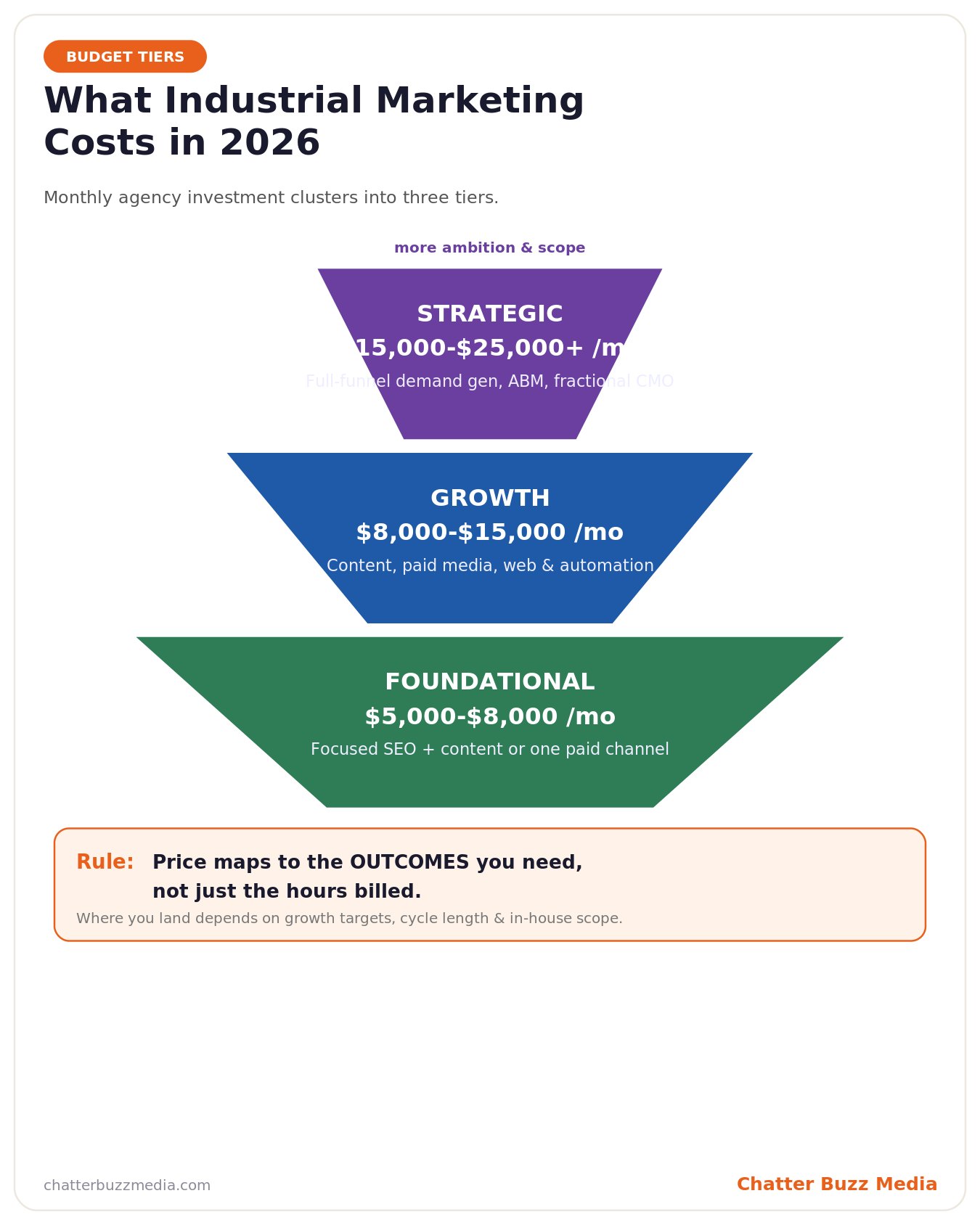
Marketing budgets in industrial verticals vary widely, but they tend to cluster into three tiers based on ambition and scope. Here’s how the investment usually breaks down.
- Foundational ($5,000–$8,000/mo): A focused program — typically SEO plus content or a single paid channel — for smaller manufacturers building a digital presence.
- Growth ($8,000–$15,000/mo): An integrated program spanning content, paid media, web optimization, and marketing automation for companies actively chasing pipeline growth.
- Strategic ($15,000–$25,000+/mo): Full-funnel demand generation, ABM, and fractional CMO-level strategy for organizations treating marketing as a core growth engine.
A few factors push your number up or down. Costs rise with the number of channels you run, the volume of custom content you need, and whether you require senior strategy alongside execution.
Costs come down when you keep some work in-house, focus on one or two high-leverage channels, or start with a defined pilot before scaling. The smartest manufacturers start narrow, prove ROI, then reinvest the gains into a broader program.
Where you land depends on your growth targets, sales cycle, and how much of the work stays in-house. For a broader framework on setting the number, see our guide to building a digital marketing budget. The right question isn’t “what’s cheapest” but “what investment produces the pipeline we need.”
Cost naturally raises a related decision: should you spend that money on an agency at all, or build the capability in-house? That’s the next trade-off.
In-House vs. Agency vs. Hybrid: Choosing Your Model
In-house teams offer control and product depth, agencies offer specialized breadth and speed, and a hybrid model blends both. The best choice depends on your team’s maturity and how fast you need to move.
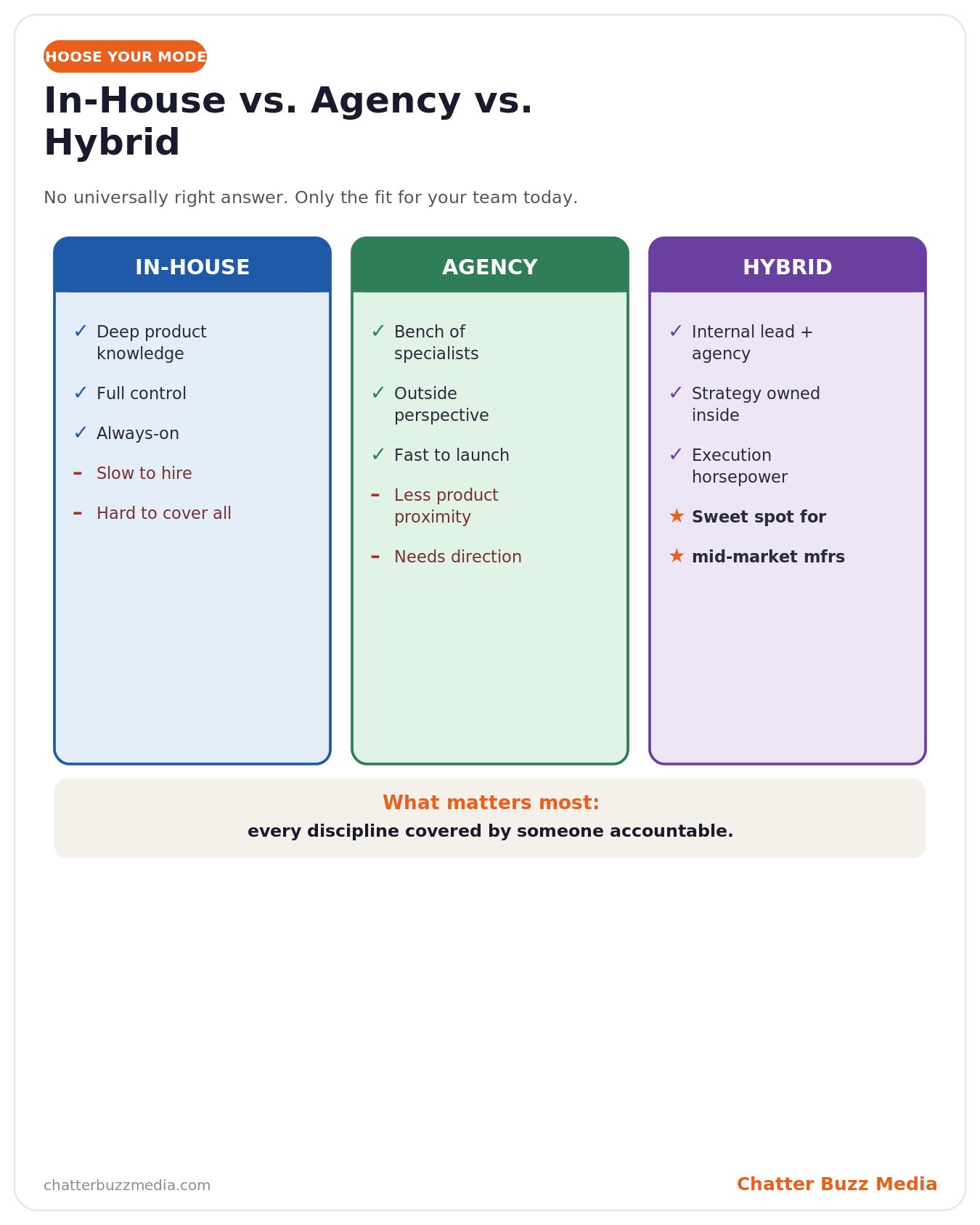
There’s no universally correct answer here — only the model that fits your situation today. Weigh the three options honestly against your resources.
- In-house strengths: Deep product knowledge, full control, and always-on availability — but hiring is slow and one or two people rarely cover every discipline.
- Agency strengths: A full bench of specialists, outside perspective, and speed to launch — with less day-to-day proximity to your product.
- Hybrid strengths: An internal marketing lead who owns strategy and product context, paired with an agency for execution horsepower. For many mid-market manufacturers, this is the sweet spot.
A common and effective pattern: keep a marketing manager in-house to own the relationship and brand, and lean on an agency for specialized execution across search, content, and paid. We break down the trade-offs further in our look at agency vs. in-house marketing. The model matters less than making sure every critical discipline is genuinely covered by someone accountable.
Whichever model you choose, it only works if you can prove it’s working. Measurement is where great industrial marketing separates itself — so let’s finish there.
How to Measure ROI and Marketing Attribution
Measure industrial marketing on pipeline, qualified leads, cost per acquisition, and revenue influenced — the metrics that connect marketing to money. If a metric can’t be tied to a deal, it doesn’t belong in the executive report.

Long industrial sales cycles make measurement harder, but they make it more important, not less. You need a framework that follows a buyer from first touch to closed order. Track these core metrics.
- Marketing-qualified and sales-qualified leads: Volume and quality of the demand entering your funnel.
- Pipeline generated and influenced: The dollar value of opportunities marketing sourced or touched.
- Cost per qualified lead and per acquisition: Efficiency of the spend, by channel.
- Deal velocity: Whether marketing is helping deals move through the pipeline faster.
- Revenue influenced and ROI: The bottom line — what marketing returned on what it cost.
Attribution in long industrial cycles is genuinely hard, and no model is perfect. First-touch attribution shows what generates awareness, last-touch shows what closes, and multi-touch spreads credit across the journey.
The point isn’t to find a flawless model — it’s to pick one, apply it consistently, and use it to make better decisions. A good agency will help you choose a model that fits your sales motion and reporting maturity.
Making this real requires CRM integration and honest attribution, so marketing and sales agree on the same numbers. Manufacturing marketers are increasingly turning to AI and analytics to close this gap — the Content Marketing Institute reports that 76% of manufacturing marketers now use generative AI tools, yet only 20% rate their content strategy as very effective, per its manufacturing content marketing research. The winners aren’t the ones with the most tools — they’re the ones who measure honestly and act on what the data says.
That focus on measurable outcomes is exactly how we approach every industrial engagement at Chatter Buzz. Here’s what that looks like in practice.
The Chatter Buzz Approach to Industrial Marketing
We built our industrial practice around a simple idea: marketing should be accountable to revenue, and every tactic should earn its place. We think like engineers and report like a CFO.
As a B2B digital marketing agency, we’ve helped manufacturers, industrial firms, and technical B2B companies build programs that generate qualified pipeline — not vanity metrics. We start with strategy, map your buyer’s journey, and build an integrated program across search, content, paid media, and automation.
What sets our work apart is depth over polish. We’ve run ABM programs for manufacturers, rebuilt industrial websites that convert engineers, and connected every campaign to CRM so leadership can see the return. You get a partner that treats your budget like our own money.
Our team has built technical content programs, run paid search on high-intent industrial keywords, and stood up marketing automation that shortens long quote-to-close cycles. We know that a single well-optimized application page can outperform months of untargeted social posting for a niche manufacturer.
We also know when not to spend. If a channel isn’t producing qualified pipeline, we say so and reallocate — because our job is your return, not our retainer.
Our team has built technical content programs, run paid search on high-intent industrial keywords, and stood up marketing automation that shortens long quote-to-close cycles. We know that a single well-optimized application page can outperform months of untargeted social posting for a niche manufacturer.
We also know when not to spend. If a channel isn’t producing qualified pipeline, we say so and reallocate — because our job is your return, not our retainer.
Whether you’re in Orlando, Tampa, New York City, or anywhere your buyers are, we build the same accountable, engineer-first programs. Let’s turn your marketing into a pipeline engine.
Conclusion: Choosing an Industrial Marketing Partner That Delivers
Choosing an industrial marketing agency comes down to one question: can they prove they understand your buyer and can move your pipeline? Everything in this guide points back to that test.
You now know what these agencies do, why specialization is non-negotiable, which services form a complete program, how to evaluate partners and spot red flags, what to budget, how to choose your operating model, and how to measure real ROI. Use the seven-point scorecard, insist on industrial case studies, and hold every agency accountable to revenue.
Do that, and you’ll avoid the generalist trap that costs manufacturers a year of lost momentum — and find a partner that turns marketing into a measurable growth engine. When you’re ready, our team is here to help.
Frequently Asked Questions
What does an industrial marketing agency do?
An industrial marketing agency builds and runs marketing programs for manufacturers and industrial companies, spanning strategy, content, SEO, paid media, web design, and analytics. Its core job is to generate qualified pipeline from technical buyers — engineers, plant managers, and procurement teams — and tie that activity to revenue.
How much does an industrial marketing agency cost?
Most industrial companies invest between $5,000 and $25,000+ per month, depending on scope and channels. Foundational programs start around $5,000–$8,000, integrated growth programs run $8,000–$15,000, and full-funnel strategic programs with fractional CMO-level guidance reach $15,000–$25,000 or more.
How is industrial marketing different from regular B2B marketing?
Industrial marketing involves longer sales cycles, more technical decision-makers, and buyers who research extensively before contacting a supplier. It demands genuine technical fluency and industrial channel knowledge that generalist B2B agencies typically lack, which is why specialization matters so much.
How do I choose the right industrial marketing agency?
Score every agency on the same criteria: relevant industrial case studies with real numbers, technical fluency, a defined process, the actual account team, a revenue-focused measurement philosophy, channel depth, and communication fit. Ask them to critique your existing content — a true specialist will spot the technical gaps immediately.
Should I hire an agency or build an in-house industrial marketing team?
It depends on your team’s maturity and how fast you need results. In-house offers product depth and control, an agency offers specialized breadth and speed, and a hybrid model — an internal lead plus agency execution — is often the best fit for mid-market manufacturers.
How do you measure the ROI of industrial marketing?
Measure pipeline generated, marketing- and sales-qualified leads, cost per qualified lead, deal velocity, and revenue influenced. This requires CRM integration and clear attribution so marketing and sales agree on the same numbers, especially across long industrial buying cycles.
What services should an industrial marketing agency provide?
A complete agency delivers strategy and positioning, content and SEO, demand and lead generation, website design and conversion optimization, marketing automation with CRM integration, and analytics with attribution. The value comes from running these as one integrated program rather than disconnected tactics.
How long does industrial marketing take to show results?
Paid channels can generate leads within weeks, while SEO and content programs typically take three to six months to build momentum and six to twelve months to compound. Because industrial sales cycles are long, judge early progress on leading indicators like qualified leads and pipeline, not just closed revenue.