
 321-236-2899
Most brands do not have a content problem. They have a performance problem — creative that looks polished, tests flat in the ad account, and quietly drives up the cost of every lead and sale.
A UGC marketing agency exists to fix that. It sources real creators, produces authentic video and photo content at volume, and — done well — feeds that content straight into your paid media so it earns its keep in revenue, not just impressions.
This is a comprehensive, in-depth guide to hiring and working with a UGC marketing agency in 2026 — what one actually does, how user-generated content outperforms branded creative in paid ads, what it costs, and how to measure whether it is working. As a performance-driven digital marketing agency, we build UGC into paid social and search programs every day, and below we share exactly how we turn creator content into a revenue channel.
Key Takeaways
- A UGC marketing agency sources, briefs, and manages creators — then licenses the content and plugs it into your paid media, all under one roof. It is not a video vendor.
- UGC wins in paid ads because it is trusted. 84% of consumers are more likely to trust a campaign that features user-generated content, and UGC ads routinely deliver higher click-through rates at a lower cost per acquisition than polished brand creative.
- Expect to pay $150–$500+ per video from a creator, and $3,000–$10,000+ per month for a managed agency program that includes strategy, licensing, and paid integration.
- An agency, a platform, and a freelancer solve different problems. Agencies sell managed labor and strategy; platforms sell software and access; freelancers sell one relationship at a time.
- Measure cost per acquisition and creative win rate, not view counts. UGC is performance creative — it should be judged by the same metrics as the rest of your paid media.
Here is everything you need to choose the right partner and turn creator content into pipeline.
What a UGC Marketing Agency Actually Does
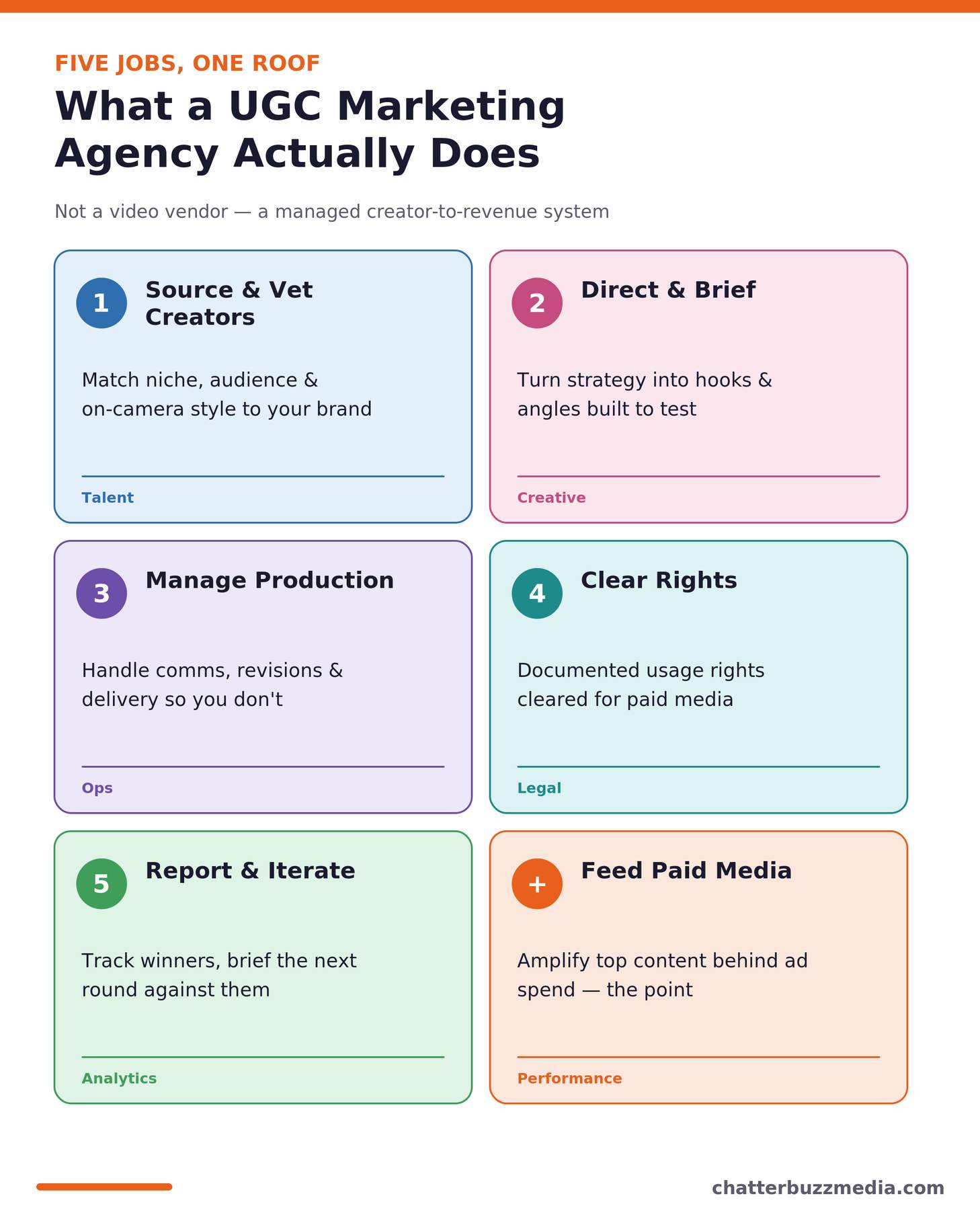
A UGC marketing agency sources, vets, and manages content created by real people, then integrates that content into your broader marketing and paid media strategy. It is a fundamentally different job than a traditional content agency, which produces polished brand creative in-house.
The distinction matters because the two produce different results. Branded content carries an inherent trust gap — consumers know it came from the brand — while user-generated content reads as a recommendation from a real person.
A capable agency owns the entire operation, not just the filming. That means five moving parts working together instead of a stack of one-off invoices.
- Creator sourcing and vetting: finding creators whose audience, niche, and on-camera style fit your brand and product.
- Creative direction and briefing: turning your strategy into briefs creators can actually execute, with hooks and angles built to test.
- Production management: handling communication, revisions, deadlines, and delivery so your team is not chasing files.
- Rights and licensing: securing documented usage rights so you can run the content in paid media without legal exposure.
- Reporting and iteration: tracking which creators and hooks perform, then briefing the next round against what won.
The best agencies treat that final step as the point of the whole exercise. This is the difference between a content shop and a UGC content agency that ties creative to results.
UGC Is Not the Same as Influencer Marketing
The two overlap, but they are not interchangeable. Influencer marketing buys access to a creator’s audience — you pay for their reach and post to their followers.
UGC buys the content itself. You license the video, then run it on your channels and behind your ad spend, where you control the targeting and the budget.
That is why UGC lives closer to your ad account than your PR calendar, and why we often run it alongside a lighter influencer marketing layer rather than in place of it.
Why UGC Outperforms Branded Content in Paid Media
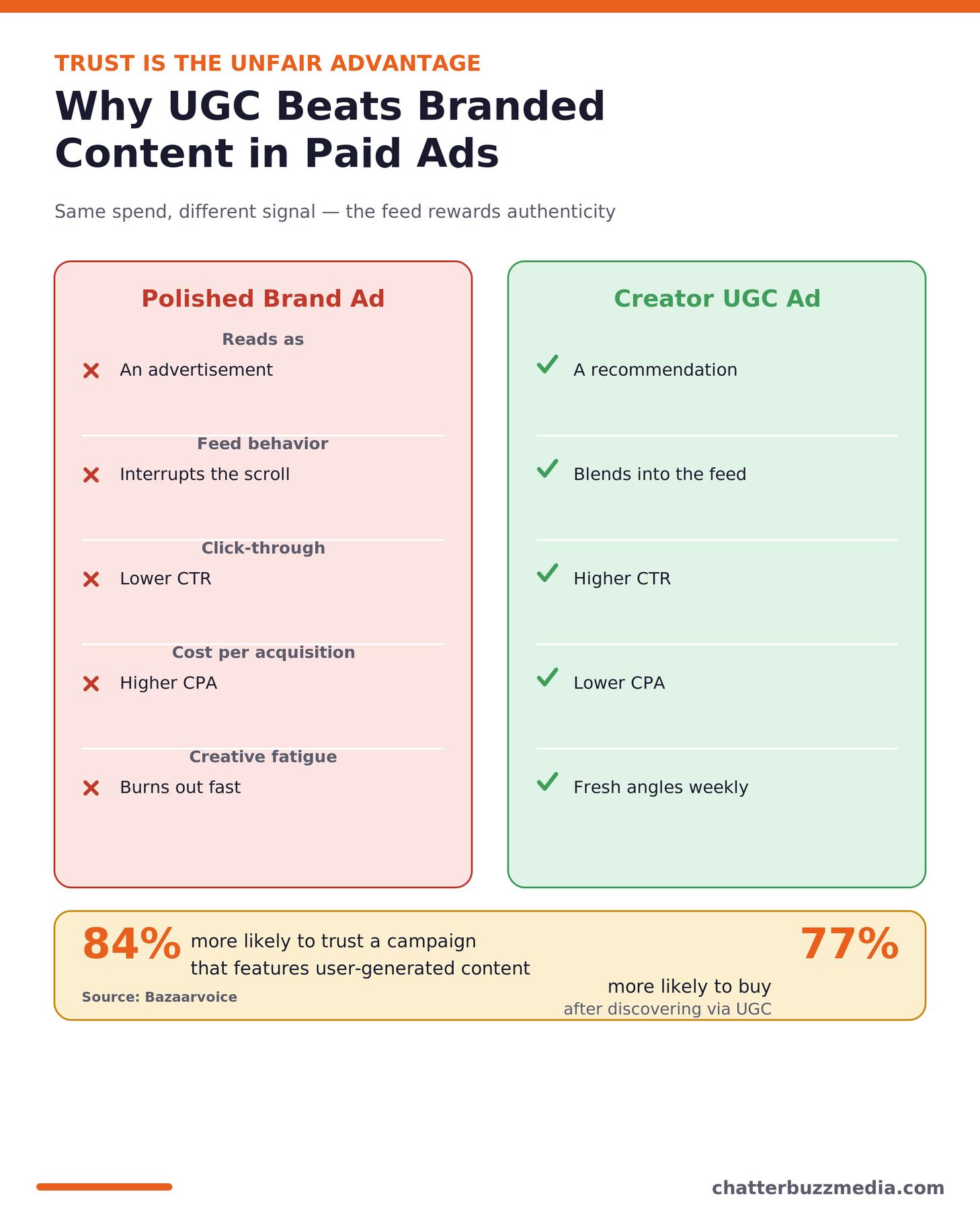
User-generated content wins in paid media because it is trusted in a way brand creative cannot be. According to Bazaarvoice research, 84% of consumers are more likely to trust a brand’s marketing campaign when it features user-generated content, and 77% are more likely to buy a product they discovered through it.
That trust compounds in the feed. Nielsen has long found that 88% of consumers trust recommendations from people they know more than any other form of advertising — and native, creator-made content borrows that same signal.
The result shows up where it counts: in the ad account. UGC creative consistently generates higher click-through rates and a lower cost per acquisition than standard brand creative, because it slips into the organic feed instead of interrupting it.
- Higher click-through rates: native-feeling video earns the click that a polished product spot does not.
- Lower cost per acquisition: more relevant, higher-performing creative pulls your CPA down across the account.
- Slower creative fatigue: a steady stream of fresh creator angles keeps campaigns from burning out.
- More volume, faster: a creator network produces at a pace an in-house team cannot match.
This is why we treat UGC as performance creative rather than social filler. In today’s ad platforms, the creative is the targeting — the algorithm finds the buyer once the content earns attention.
The Andromeda Shift: Creative Is the New Targeting
Meta’s newer delivery systems reward volume and variety of creative more than manual audience settings. The platform tests dozens of variations and finds the audience for the winners on its own.
That changes the job. Feeding the algorithm a deep, rotating library of UGC is now one of the highest-leverage things a brand can do, a shift we break down in our look at Meta’s creative-first targeting.
UGC Agency vs. UGC Platform vs. Hiring Creators Directly
There are three ways to get UGC, and they solve three different problems. Choosing the wrong model is the most common — and most expensive — mistake brands make.
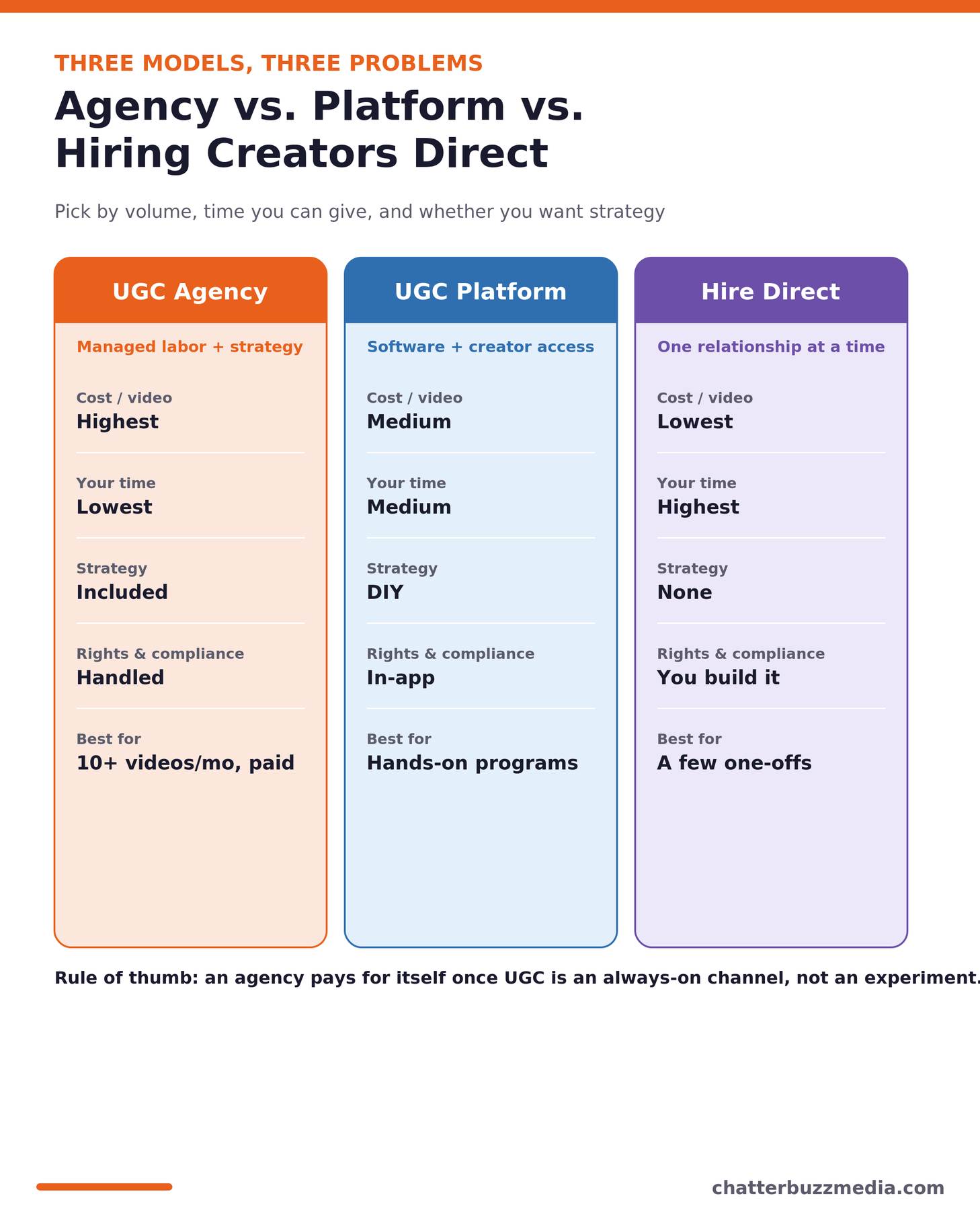
The right choice comes down to how much volume you need, how much time your team can give, and whether you want strategy included or just content delivered.
- A UGC agency sells managed labor and strategy. You hand over the objective; the agency sources creators, briefs them, manages revisions, licenses the content, and reports on performance. It costs the most per video but demands the least of your time — and it is the only model that includes strategic guidance.
- A UGC platform sells software and access. You post briefs, vetted creators apply, and content is delivered and licensed inside one system. It costs less per video, but someone on your team still has to run the process.
- Hiring creators directly sells one relationship at a time. You get full control and custom terms, but you rebuild the infrastructure — discovery, contracts, payment, rights, management — for every creator, which quietly eats 5 to 10 hours per hire.
As a rule, brands producing UGC at scale — roughly 10 or more videos a month tied to active paid campaigns — get the most from an agency. Brands testing the waters with a handful of videos are often fine on a platform or with a trusted freelancer.
When an Agency Is Worth the Premium
An agency earns its retainer when UGC is a channel, not an experiment. If creator content is feeding live paid campaigns that need fresh angles every week, the coordination alone justifies managed help.
The premium also buys accountability. A platform hands you files; an agency owns the outcome, ties creative to performance marketing results, and rotates new creators in before fatigue sets in.
What to Look For in a UGC Marketing Agency
The right UGC marketing agency is judged less by its creator roster and more by whether it can turn content into measurable results. Reels and testimonials are easy to produce; a system that improves your cost per sale is not.
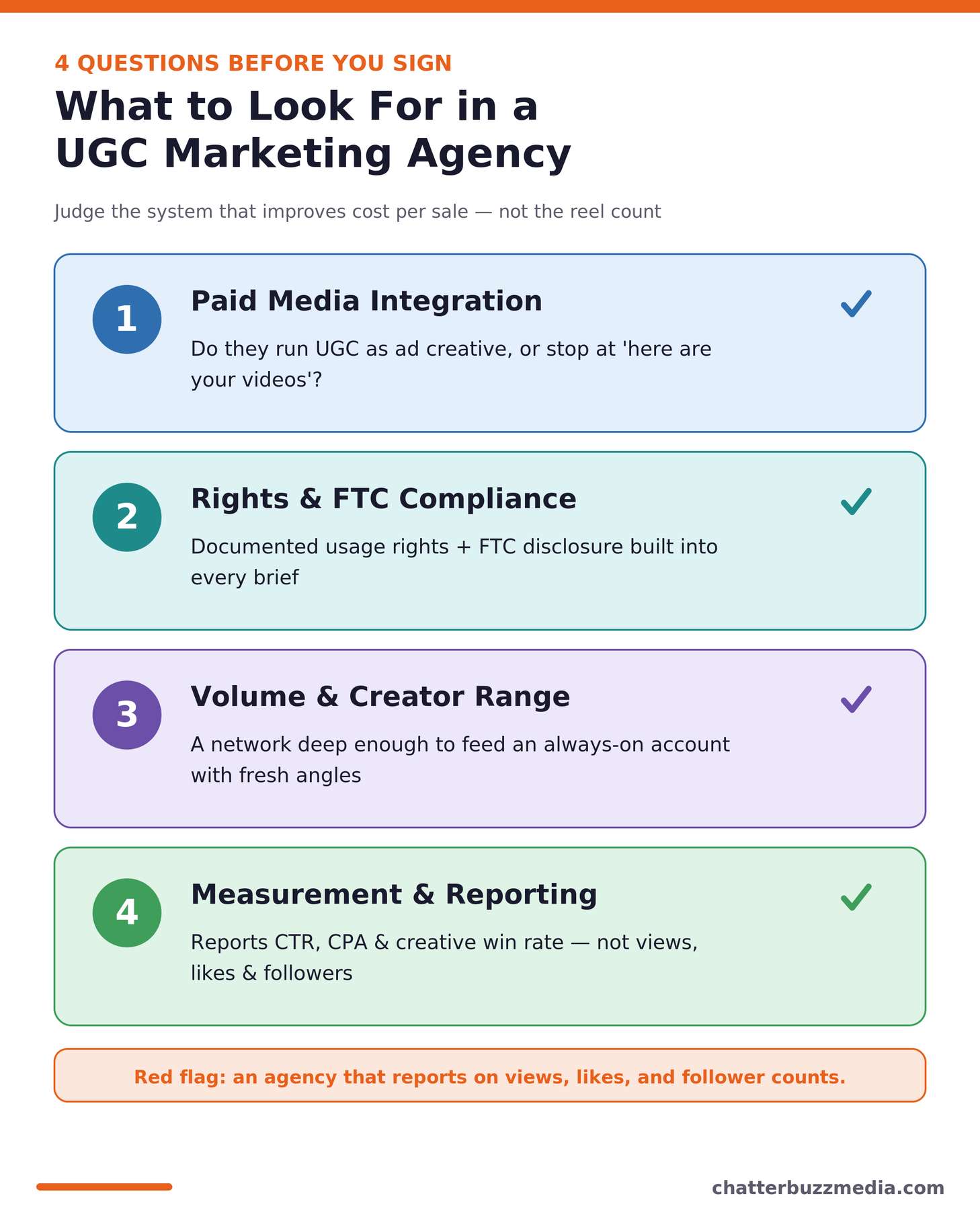
Before you sign, pressure-test a prospective partner against the criteria that actually predict performance.
1. Paid Media Integration
The single most important question: does the agency treat UGC as organic filler or as ad creative? The most valuable use of UGC is amplification — taking top-performing creator content and running it behind paid spend.
An agency that stops at “here are your videos” is leaving the highest-value part of the strategy on the table. Look for a partner that thinks in hooks, variations, and creative testing, not just deliverables.
2. Rights and FTC Compliance
UGC cannot simply be repurposed into ads without documented usage rights. Running content you do not have cleared rights to is real legal exposure, and it multiplies with every creator.
Any sponsored UGC is also subject to disclosure rules under the FTC’s Endorsement Guides. A serious agency builds rights management and compliance into its process from the first brief.
3. Volume, Consistency, and Creator Range
Paid campaigns need a steady supply of fresh angles across platforms and products at the same time. Ask how large and how diverse the creator network is, and how quickly the agency can turn a new brief around.
A boutique with five creators cannot feed an always-on ad account. Match the agency’s capacity to the volume your media plan actually requires.
4. Measurement and Reporting
Ask exactly which metrics the agency reports on. If the answer is views, likes, and follower counts, keep looking — those are vanity metrics that rarely correlate with revenue.
You want a partner that reports on click-through rate, cost per acquisition, and creative win rate, and that ties reporting back to your own marketing KPIs.
How Much a UGC Marketing Agency Costs in 2026
UGC pricing works on two levels — what individual creators charge, and what a managed agency charges to run the whole program. Understanding both keeps you from overpaying or under-scoping.
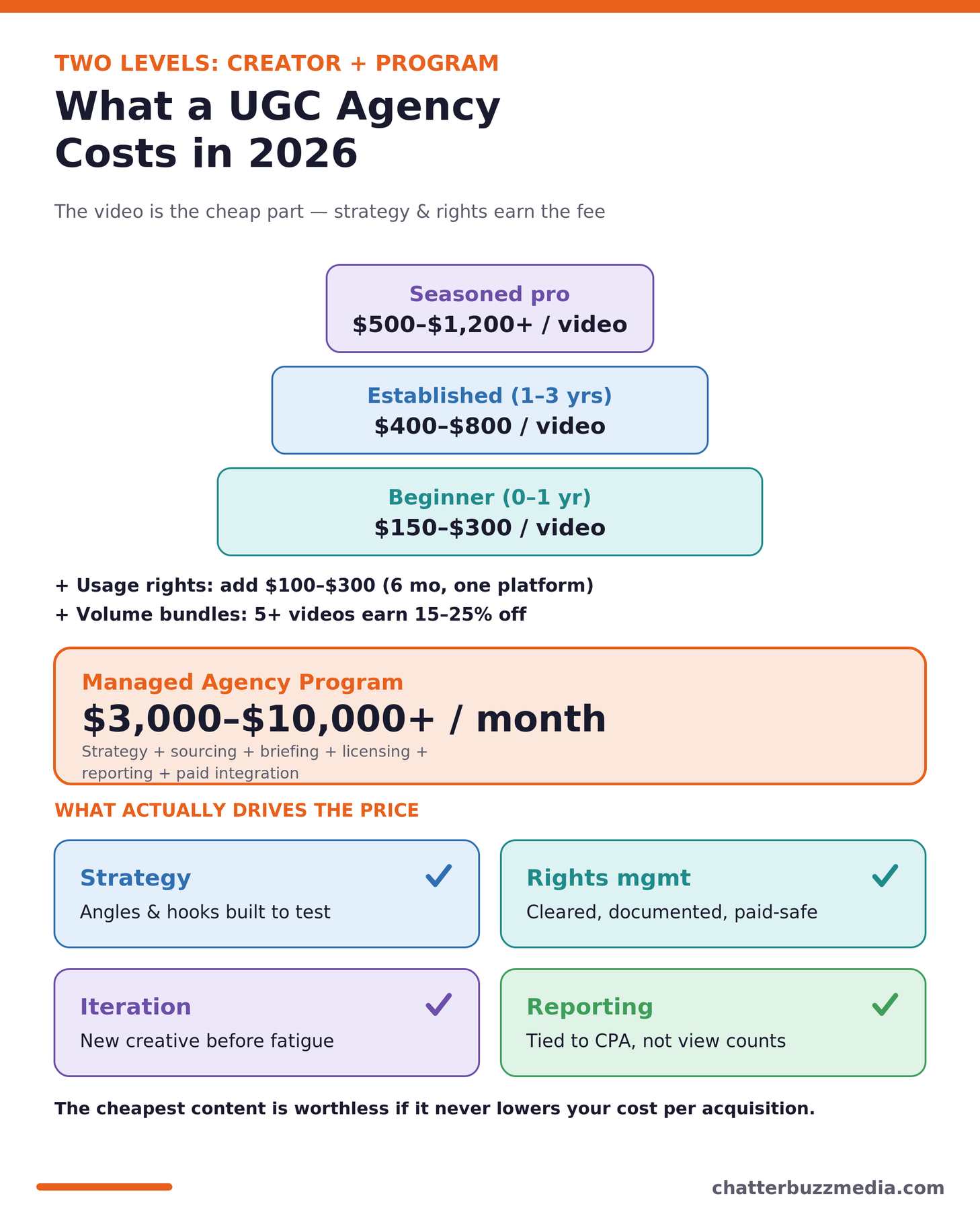
At the creator level, rates have settled into a predictable range in 2026. Per the latest UGC rate benchmarks and creator pricing guides, a single video generally runs $100 to $500 or more depending on experience.
- Beginner creators (0–1 year): roughly $150–$300 per video deliverable.
- Established creators (1–3 years): roughly $400–$800 per video.
- Seasoned professionals: $500–$1,200+ per video, especially for polished TikTok and Reels.
- Usage rights: add roughly $100–$300 for standard paid rights (six months, one platform).
- Volume bundles: ordering 5+ videos typically earns a 15–25% discount.
At the agency level, a managed program bundles strategy, sourcing, briefing, licensing, reporting, and paid integration into a monthly engagement. Most brands should budget $3,000 to $10,000+ per month depending on volume and how deeply the agency runs the paid media.
What Actually Drives the Price
The video is the cheap part. Strategy, rights management, creative iteration, and reporting are where a managed program earns its fee — and where a bargain freelancer quietly costs you more in wasted spend.
Think about it the way you would any agency pricing model: you are buying an outcome — better creative feeding better campaigns — not a stack of raw files. The cheapest content is worthless if it never lowers your cost per acquisition.
The Performance Creative Workflow: From Brief to Revenue
A UGC program that drives revenue runs on a repeatable loop, not a one-time content drop. The goal is a system that gets smarter every cycle, feeding your ad account winners and retiring losers.
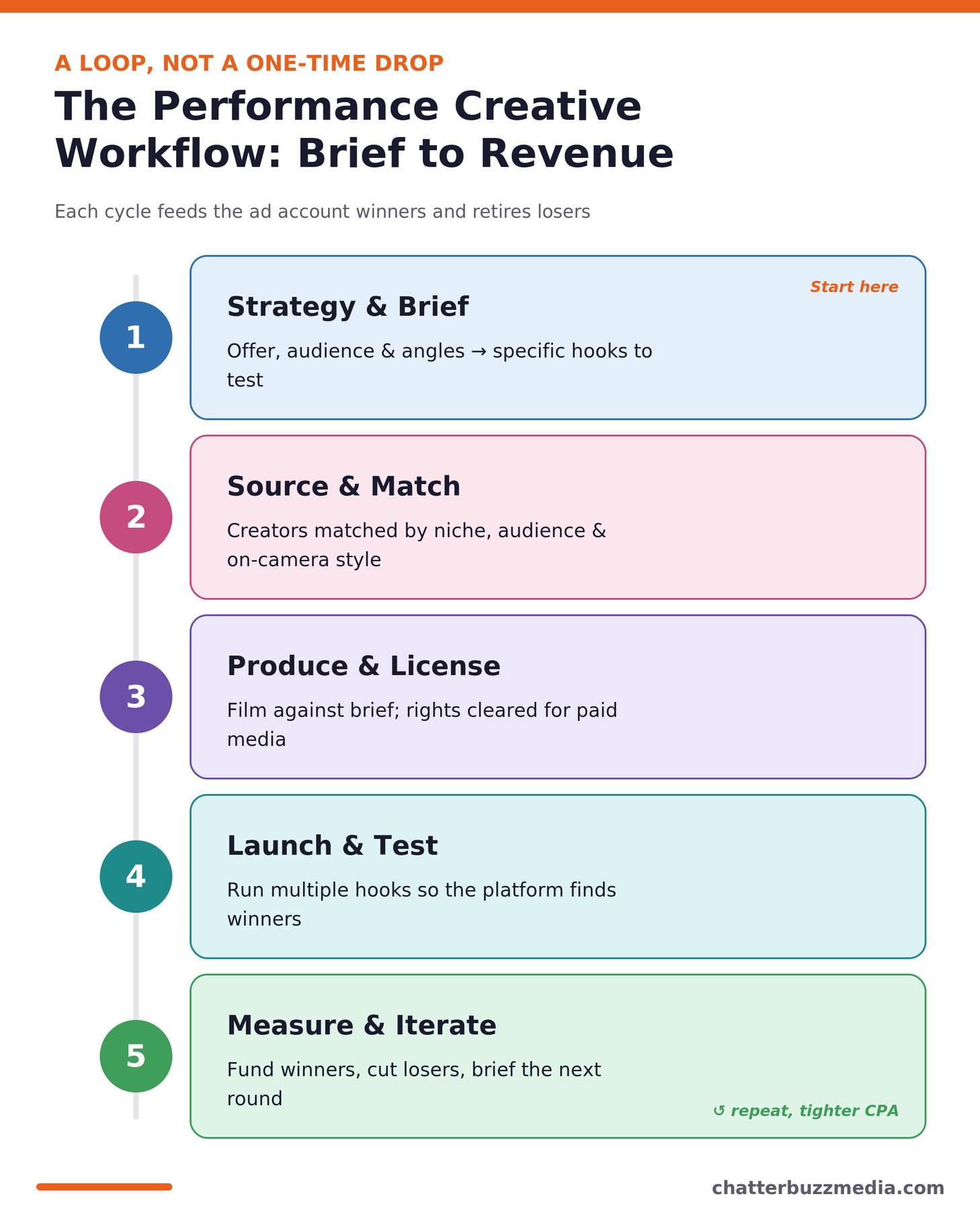
Here is the workflow we run, and the one a strong agency should be able to walk you through in detail.
1. Strategy and Brief
Every cycle starts with the offer, the audience, and the angles worth testing. The brief translates your positioning into specific hooks, formats, and calls to action — the raw material of a real performance creative strategy.
2. Source and Match
Creators are matched to the brief by niche, audience, and on-camera style. The right creator for a skincare hook is rarely the right one for a B2B software demo.
3. Produce and License
Creators film against the brief, revisions are managed, and every asset is delivered with documented usage rights cleared for paid media. Nothing runs in an ad without rights in hand.
4. Launch and Test
Content goes live as ad creative across the priority platforms. Multiple hooks and variations run against each other so the platform can find the winners — the heart of disciplined ad creative testing.
5. Measure and Iterate
Winners get more budget; losers get cut. The next brief is written against what actually performed, and the loop repeats — each cycle tightening cost per acquisition.
This is what turns UGC from a cost center into a growth engine, and it is why the content should sit inside your paid media strategy, not beside it.
Platform-Specific UGC Strategy That Actually Converts
UGC does not behave the same way on every platform, and the agency you choose should brief for each one differently. Content that wins on TikTok can fall flat on YouTube.
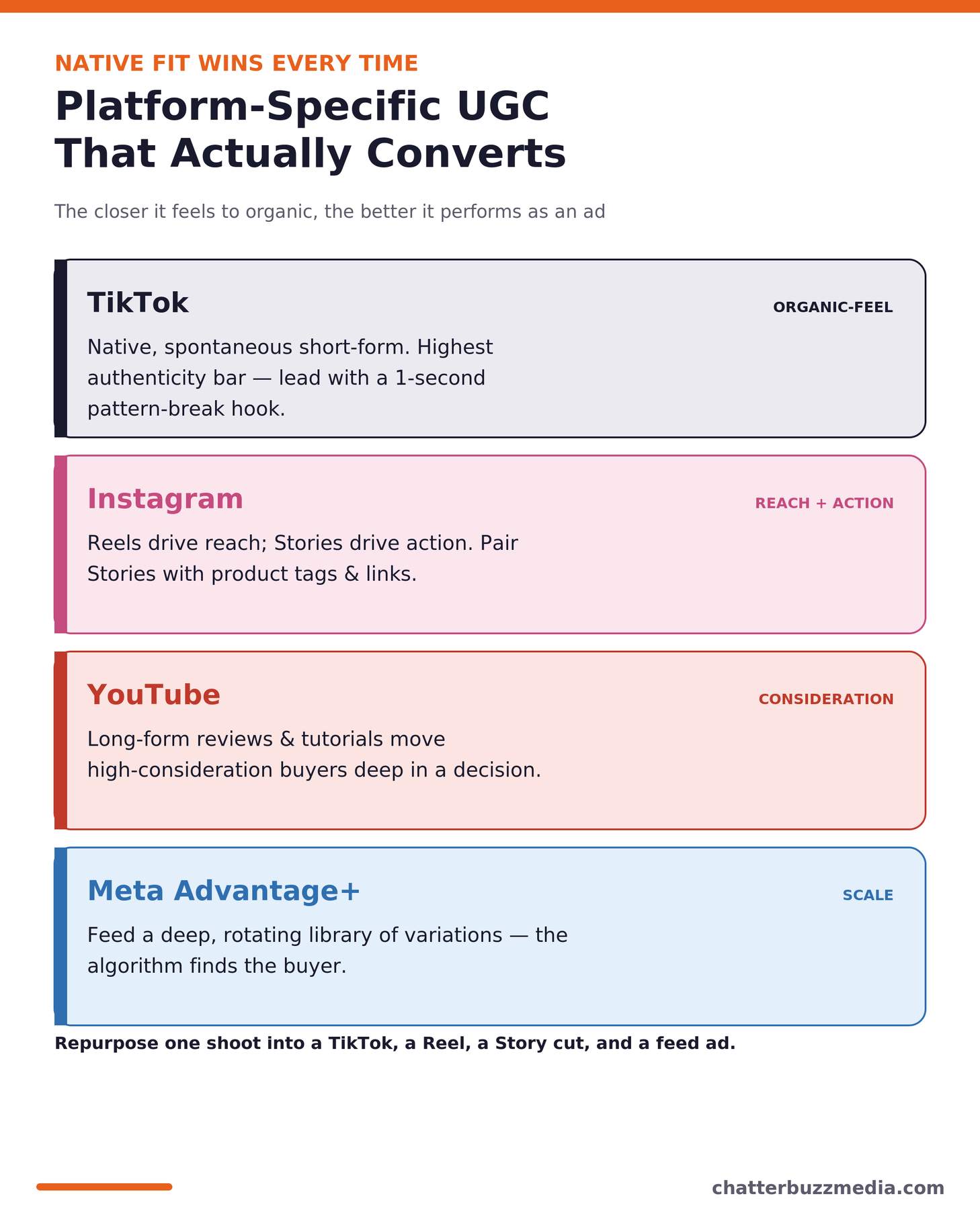
The through-line is native fit: the closer your content feels to what the audience already watches, the better it performs as an ad.
- TikTok: native, spontaneous, short-form video wins. The bar for authenticity is highest here — anything that looks like a commercial gets skipped. Lead with a pattern-breaking hook in the first second.
- Instagram (Reels & Stories): Reels drive reach, Stories drive direct action. Pair Stories UGC with product tags and links to convert intent that already exists.
- YouTube: longer-form reviews, tutorials, and honest assessments influence high-consideration purchases. This is where a credible niche voice moves buyers already deep in a decision.
- Meta feed & Advantage+: a deep, rotating library of UGC variations is the fuel for algorithmic delivery — feed it volume and let the system find the buyer.
Matching format to platform is the same discipline we bring to any paid social advertising program. The creative changes by channel even when the offer does not.
Repurpose, Do Not Reinvent
One strong creator shoot should fuel content across several placements. A single video becomes a TikTok, a Reel, a Story cut, and a feed ad with platform-appropriate edits.
A good agency plans for that reuse from the brief, stretching every dollar of production across your content mix instead of filming everything from scratch.
How to Measure UGC Performance
UGC is performance creative, so it should be measured against performance metrics — not views, likes, or follower growth. If your reporting stops at engagement, you cannot tell whether the content is making you money.
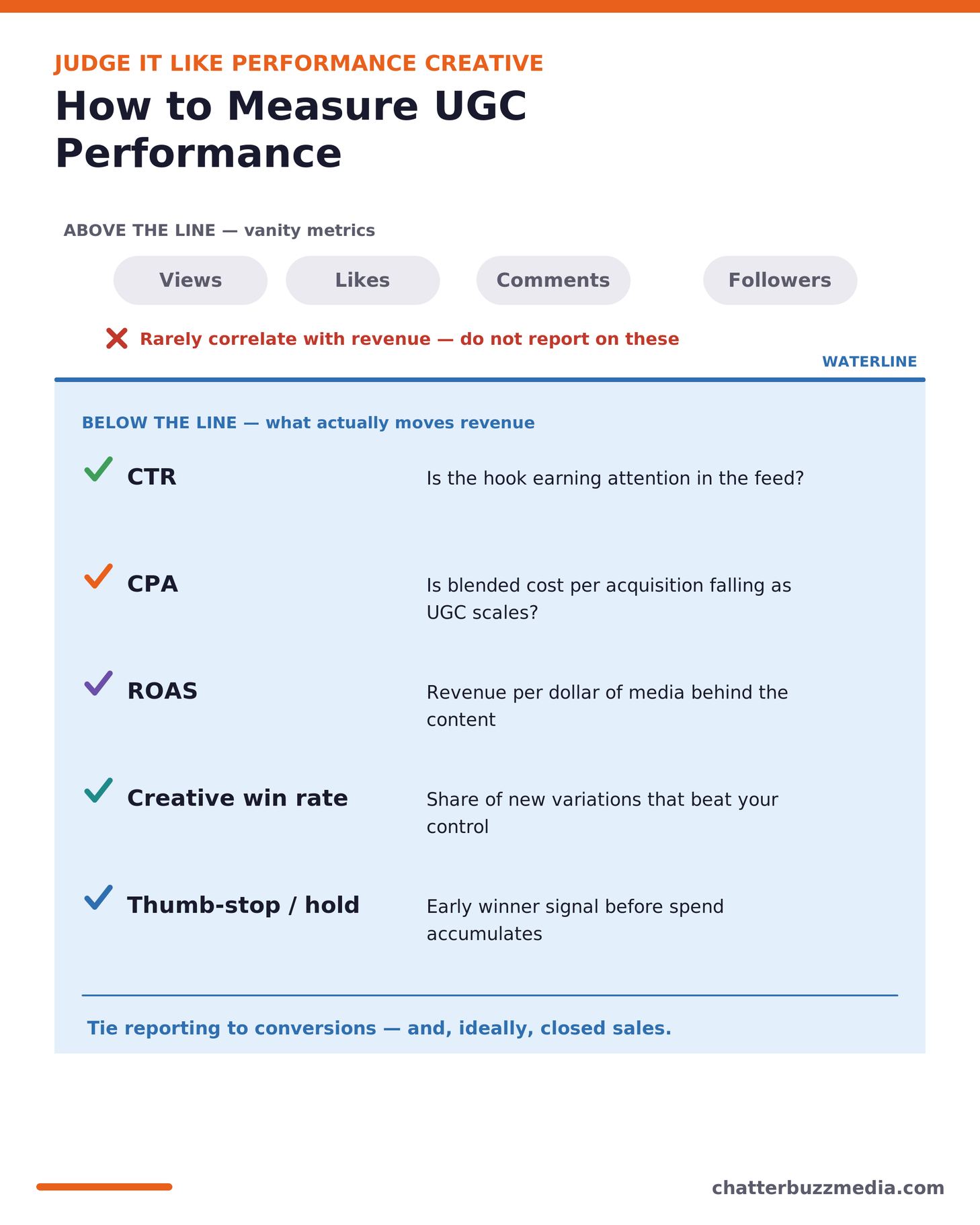
Set the metrics that matter before the first video runs, and hold the program to them every cycle.
- Click-through rate (CTR): the fastest read on whether a hook is earning attention in the feed.
- Cost per acquisition (CPA): the metric that decides whether UGC is actually cheaper creative — is your blended CPA falling as UGC scales?
- Return on ad spend (ROAS): revenue generated for every dollar of media behind the content.
- Creative win rate: the share of new UGC variations that beat your current control — the truest measure of a healthy creative pipeline.
- Thumb-stop and hold rate: how many viewers stop and keep watching, an early signal of a winner before spend accumulates.
The discipline is connecting creative decisions to revenue, which is exactly the case we make for learning to measure creativity in paid campaigns. When you can see which hook drove which sale, UGC stops being a guess.
Attribution: Tie Creative to Closed Revenue
The best programs trace performance past the click to actual conversions and, for considered purchases, to closed revenue. That requires clean tracking and a feedback loop back into the brief.
Pairing UGC with sharp conversion rate optimization is what closes the gap between a great ad and a completed sale.
How Chatter Buzz Approaches UGC as Performance Creative
We do not treat user-generated content as a social checkbox. We build it as a revenue channel — briefed for the ad account, licensed for paid media, and measured against cost per acquisition like every other line in the plan.
That means creator content is never divorced from strategy. It runs inside a full performance marketing program with an engineer’s rigor and a CFO’s eye on what it returns.
We produce both text and video UGC with rights cleared for paid use, and we run it for brands from our home base in Orlando to Tampa and New York. Whether you are a B2B brand or a consumer one, the standard is the same: content that earns its place in the media plan.
Conclusion: UGC Is a Revenue Channel, Not a Content Line Item
The brands winning with user-generated content are not the ones producing the most videos. They are the ones treating UGC as performance creative — briefed to test, licensed to run, and measured against cost per acquisition.
A UGC marketing agency is worth the premium when it owns that full loop: sourcing and briefing the right creators, clearing the rights, feeding the ad account fresh angles, and reporting on the metrics that move revenue. Anything less is just a video vendor with a nicer deck.
If you are ready to make creator content a channel instead of an experiment, start with a free marketing audit and we will show you where UGC fits in your paid media — and what it could do for your cost per sale.
Frequently Asked Questions About UGC Marketing Agencies
What does a UGC marketing agency do?
A UGC marketing agency sources and vets creators, briefs them, manages production and revisions, licenses the finished content for paid use, and integrates it into your paid media. The best agencies also report on performance and iterate, treating user-generated content as ad creative rather than organic filler.
How much does a UGC marketing agency cost?
Individual creator videos generally run $150 to $500+ each, with usage rights adding $100 to $300. A managed agency program — including strategy, licensing, and paid integration — typically costs $3,000 to $10,000+ per month depending on volume and how deeply the agency runs your ad campaigns.
What is the difference between a UGC agency and a UGC platform?
A UGC agency sells managed labor and strategy — it runs the whole process and owns the outcome. A UGC platform sells software and creator access, but your team still coordinates the work. Agencies cost more per video and suit brands producing at scale; platforms cost less and suit smaller, hands-on programs.
Is UGC better than influencer marketing?
They serve different goals. Influencer marketing buys access to a creator’s audience, while UGC buys the content itself so you can run it behind your own ad spend and targeting. Many brands use both — UGC to feed paid media, a lighter influencer layer for reach.
Does UGC really perform better in paid ads?
In most accounts, yes. UGC feels native to the feed, so it typically earns higher click-through rates and a lower cost per acquisition than polished brand creative. It also fatigues more slowly because a creator network supplies a steady stream of fresh angles.
How do you measure whether UGC is working?
Measure it like performance creative: click-through rate, cost per acquisition, return on ad spend, and creative win rate — the share of new variations that beat your control. Views and likes are vanity metrics that rarely correlate with revenue, so tie reporting to conversions and, ideally, closed sales.
How many UGC videos does my brand need per month?
It depends on how much you are spending and how fast creative fatigues, but always-on paid programs usually need a steady flow of fresh angles — often 10 or more variations a month. That volume is the point at which a managed agency typically pays for itself over a platform or freelancers.