
 321-236-2899
Performance Creative: 4 Steps to Build Ads That Actually Drive ROAS
Most ad teams still treat creative like decoration — a layer of polish applied after the “real” strategy work is done. That approach burns budget faster than any bad targeting setting ever could.
Here’s the reality: creative quality drives roughly 49% of a campaign’s sales impact, according to research from Nielsen Catalina Solutions. In 2026, an estimated 80% of performance work sits squarely inside creative operations — not media buying, not audience segmentation, not bid strategy.
This post walks you through the 4-step creative scoring framework that separates winning ad concepts from budget waste before a single dollar goes to media. You’ll learn how to build a performance creative system that treats every asset as a testable hypothesis, every sprint as a learning cycle, and every dollar as an investment with measurable return.
Let’s start with what performance creative actually means — because the term gets thrown around loosely.
Key Takeaways
- Performance creative is a system, not a deliverable. It integrates data-driven insights, testable hypotheses, and structured production sprints into a repeatable engine that compounds results over time.
- Creative is the single largest lever in paid media. Nielsen/NCS research shows creative quality accounts for ~49% of sales lift — more than reach, targeting, or placement combined.
- Every concept should start with a hypothesis. Use the formula: “If we lead with [pain] and [proof], then [audience] will [action]” — and score concepts on hook strength, proof density, CTA clarity, and format-channel fit before production.
- Structured sprints beat random production. Test 2-3 variants per sprint with attribute-level tagging to isolate what’s working. Target a 30-40% creative win rate.
- Creative fatigue is predictable and manageable. Refresh cadences vary by channel — Meta every 2-3 weeks, Google every 4-6 weeks, LinkedIn every 3-4 weeks — and a feedback loop turns every retired asset into compounding insight.
- Funnel-stage alignment determines creative ROI. Matching ad creative to funnel stage — and maintaining message match to landing pages — can lift conversion rates by 15% or more.
What Performance Creative Actually Means (and Why It’s Not Just “Good Design”)
Performance creative is a system for producing, testing, and scaling ad assets that are designed to hit specific, measurable business outcomes. It is not a design style, an aesthetic preference, or a synonym for “ads that look professional.”
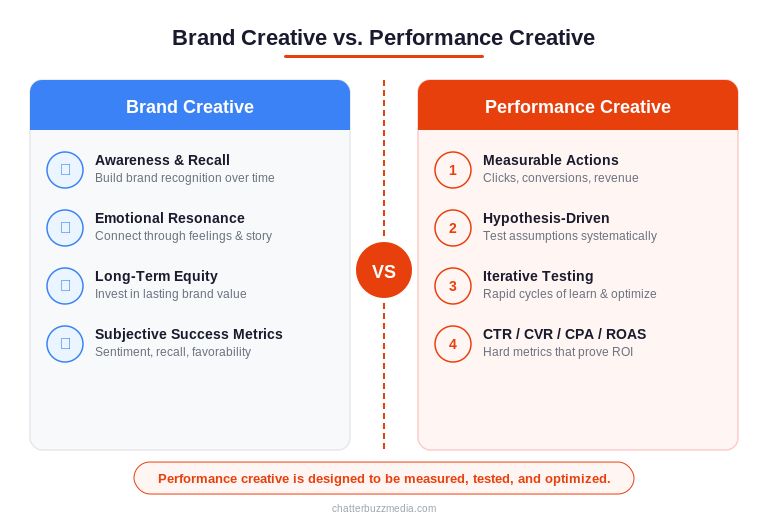
The distinction between brand creative and performance creative matters for every dollar in your PPC management budget. Brand creative optimizes for recall, emotional resonance, and long-term equity.
Performance creative optimizes for action — clicks, conversions, purchases, sign-ups — within a defined measurement window.
That doesn’t mean performance creative ignores brand. The best performance creative systems encode brand guidelines as constraints within the production process, ensuring every variant stays on-brand while being engineered for response.
Why does this matter so much right now? Because creative has become the single largest lever in paid media — Nielsen Catalina Solutions found that creative quality drives approximately 49% of a campaign’s sales impact, more than reach (22%), brand (15%), targeting (9%), or recency (5%) combined.
When platforms automate bidding, targeting, and placement, creative is the one variable you still fully control.
The metrics that matter in creative performance measurement are direct and unambiguous:
- Click-Through Rate (CTR): Measures hook effectiveness — is the creative stopping the scroll and earning attention?
- Conversion Rate (CVR): Measures persuasion — does the creative drive the intended action after the click?
- Cost Per Acquisition (CPA): Measures efficiency — what does each conversion cost relative to creative variant?
- Return on Ad Spend (ROAS): Measures value — does the revenue generated by the creative justify the spend?
These metrics form the backbone of every decision in a performance creative system. Track them at the asset level, not just the campaign level, and you’ll start seeing which creative elements actually move numbers.
But knowing the metrics isn’t enough — you need the right mindset to act on them.
The Creative Director Mindset: Think Like an Engineer, Execute Like an Artist
A performance creative director is a strategist who starts with a hypothesis, not a mood board. This role blends analytical rigor with creative execution — and that combination is what separates teams that scale profitably from teams that produce beautiful ads nobody clicks.
The “engineer-first” approach means every concept begins with a testable assumption about human behavior. Instead of “let’s make something that feels premium,” the starting point is: “We believe that leading with a specific cost-savings stat will outperform an emotional testimonial for mid-market CFOs evaluating this category.” That’s a hypothesis you can prove or disprove with data.
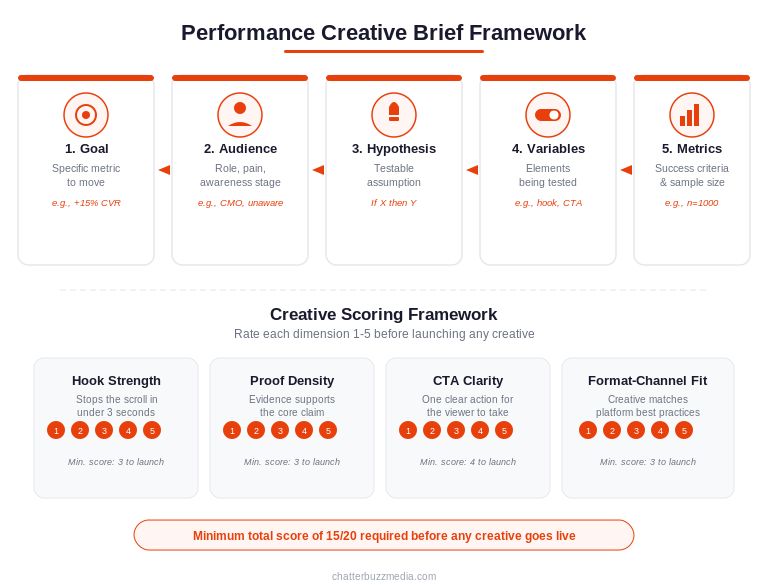
This mindset shift starts with the creative brief. Most briefs are vague wishlists — “make it pop” or “something fresh.” A performance-oriented marketing strategy brief follows a structured framework:
- Goal: What specific metric are we trying to move? (e.g., reduce CPA by 15% on Meta retargeting campaigns)
- Audience: Who exactly are we speaking to — what role, pain point, and stage of awareness? (e.g., VP of Ops at 200-500 employee companies evaluating workflow tools)
- Hypothesis: What do we believe will work, and why? (e.g., “Social proof from a named case study will outperform generic benefit claims because this audience is risk-averse.”)
- Variables: What specific elements are we testing? (e.g., headline approach, visual format, CTA phrasing)
- Metrics: How will we measure success, and what’s the minimum sample size for significance? (e.g., CTR > 1.8%, minimum 5,000 impressions per variant)
This creative brief template framework ensures every piece of creative has a job to do, a way to be measured, and a clear line back to business outcomes. It turns your brand messaging into testable, improvable assets.
The second tool in the performance creative director’s arsenal is the creative scoring framework. Before any concept enters production, score it across four dimensions:
- Hook Strength (1-5): Does the first 1-3 seconds (video) or headline (static) interrupt the scroll with a specific, relevant pattern interrupt?
- Proof Density (1-5): Does the creative contain concrete evidence — numbers, testimonials, case results, demonstrations — that supports the claim?
- CTA Clarity (1-5): Is the desired action obvious, low-friction, and aligned with the audience’s stage of awareness?
- Format-Channel Fit (1-5): Is the creative format optimized for the platform’s consumption behavior? (e.g., vertical video for Meta Stories, document carousels for LinkedIn)
Any concept scoring below 14/20 goes back for revision. This pre-production filter saves thousands in wasted production and media spend — the kind of discipline that turns your marketing KPIs from lagging indicators into leading ones.
Now, let’s put that mindset into a repeatable system.
4 Steps to Build a Performance Creative System
A performance creative system turns ad production from a reactive, project-based scramble into a continuous engine that compounds insights over time. Here are the four steps that make it work.
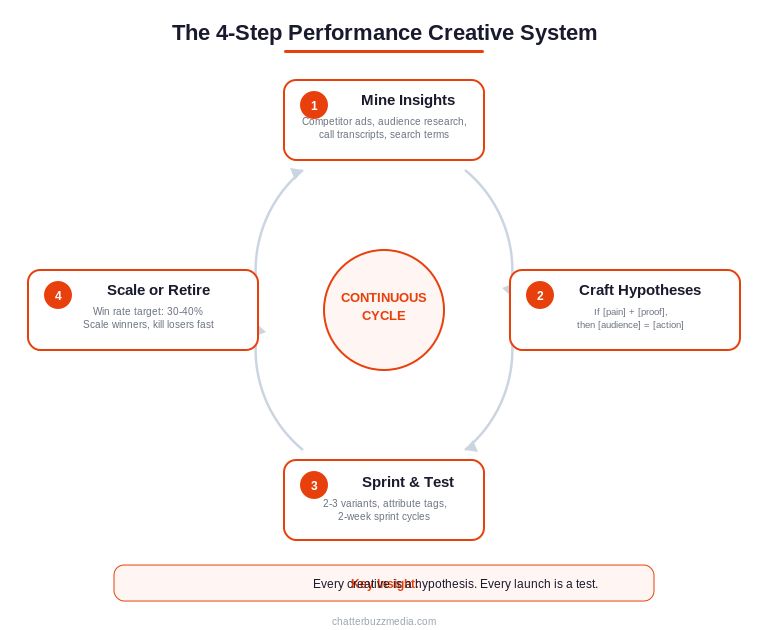
Step 1: Mine Insights Before You Design
Great performance creative doesn’t start in a design tool — it starts in the data. Before your team opens Figma or After Effects, build an insight bank from four sources:
- Competitor ad libraries: Use Meta Ad Library and Google Ads Transparency Center to identify what competitors run longest (longevity = performance signal).
- Audience research: Pull qualitative data from customer reviews, G2 feedback, Reddit threads, and social listening to identify the exact language your audience uses to describe their pain.
- Sales call transcripts: Mine objections, buying triggers, and the phrases prospects repeat. These become headline candidates and hook scripts.
- Search term reports: Your SEO and PPC data reveals what your audience actively searches — use high-intent queries as creative messaging anchors.
This research phase takes 2-3 hours per sprint and pays for itself many times over. You’re not guessing at messaging — you’re building creative from proven demand signals (a free digital marketing audit can help you identify where your current creative gaps live).
Step 2: Craft Testable Hypotheses
Every ad concept needs a hypothesis statement before it earns a production slot. Use this formula:
“If we lead with [pain/insight] and [proof type], then [audience segment] will [desired action] because [behavioral rationale].”
For example: “If we lead with the stat that 68% of ad spend is wasted on untested creative and show a before/after dashboard, then performance marketers will click to download our audit template because they need to justify spend to leadership.”
This discipline forces clarity — vague ideas like “let’s try something bold” get replaced with specific, falsifiable assumptions. Document every hypothesis in a shared tracker, because win or lose, each test adds to your institutional knowledge and feeds your reporting and data visualization capabilities.
Step 3: Produce and Test in Structured Sprints
Produce 2-3 variants per sprint, with each variant isolating a single variable. Change only the hook, or only the proof point, or only the CTA — never multiple elements at once.
According to Google’s creative performance best practices, testing one variable at a time is the only way to attribute performance differences to specific creative decisions.
Tag every asset at the attribute level — track hook type (question, stat, story, pattern interrupt), proof format (testimonial, case study, data point, demo), CTA type (direct, soft, value-add), and visual style (live action, motion graphic, UGC, static). This tagging system turns individual test results into a searchable database of creative intelligence.
Run sprints on a 2-week cycle: week one to produce and launch, week two to gather data, analyze results, document learnings, and brief the next sprint. This cadence keeps momentum high without rushing statistical significance.
Step 4: Scale Winners, Retire Losers
Set a clear creative win rate target of 30-40%, meaning 3-4 out of every 10 concepts should outperform your current baseline. If your win rate drops below 20%, your insight-mining step needs more rigor; if it exceeds 50%, you’re probably not testing boldly enough.
When a creative wins, scale it by adapting across formats and placements — turn a winning static into a video, a carousel, and a story variant. When a creative loses, document exactly why: was the hook too generic, the proof not credible enough, or the CTA asking too much too soon?
This system creates a compounding advantage — every sprint makes your next sprint smarter. After 6 months, teams running this system typically see 20-30% improvements in CPA compared to teams producing creative ad-hoc.
That’s the kind of content marketing ROI that justifies the investment in process.
Of course, even your best-performing creative eventually stops working. Here’s how to manage that.
Creative Fatigue, Refresh Cadence, and the Feedback Loop
Creative fatigue is the predictable decline in ad performance that occurs when your audience sees the same creative too many times — and it’s not a matter of if, but when. Recognizing and managing it is a core competency of any ad creative strategy.
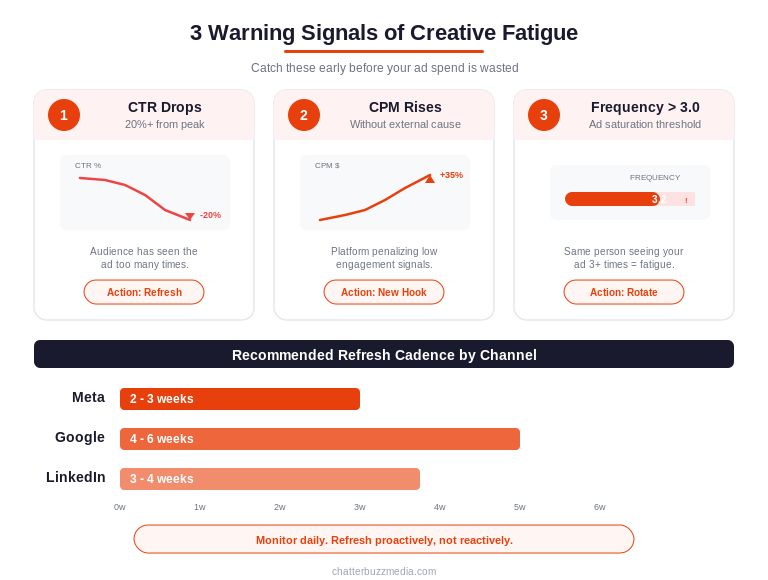
Watch for these three warning signals:
- Declining CTR over 7-10 days: If click-through rate drops 20% or more from its peak, fatigue is setting in.
- Rising CPM without external cause: When your cost-per-thousand-impressions climbs but you haven’t changed targeting or budget, the platform is signaling that your creative is losing auctions for attention.
- Frequency exceeding 3.0: When your average audience member has seen the ad more than three times, diminishing returns accelerate sharply. AppsFlyer’s performance creative research confirms that frequency-driven fatigue is one of the top creative performance killers across mobile ad campaigns.
Refresh cadence varies by channel because each platform’s consumption velocity differs:
- Meta (Facebook/Instagram): Refresh every 2-3 weeks. High scroll velocity and repeat exposure make fatigue onset fastest here.
- Google Display and YouTube: Refresh every 4-6 weeks. Broader inventory and less repetitive consumption patterns give creative more runway.
- LinkedIn: Refresh every 3-4 weeks. Smaller, more defined audiences see your ads more quickly, but lower session frequency slows fatigue slightly.
These are starting benchmarks — your actual cadence depends on budget, audience size, and frequency caps. Track at the asset level through your social media advertising platform and let data override any rule of thumb.
The most valuable part of the performance creative system is the feedback loop between creative and media teams. Structure it with these rituals:
- Weekly sprint reviews: Creative and media teams meet for 30 minutes to review what’s winning, what’s fatiguing, and what hypotheses to test next.
- Documented learnings: Every retired creative gets a post-mortem — one paragraph explaining what worked, what didn’t, and what it teaches you about the audience.
- Compounding insight library: Over time, your documented learnings become your most valuable strategic asset. Six months of sprint data tells you more about your audience than any third-party research report.
AI accelerates this loop but doesn’t replace it. Generative AI tools in 2026 excel at producing creative variants at speed — turning one winning concept into 20 format-adapted versions, generating copy alternatives, and resizing assets across placements.
But strategic thinking — the hypothesis, the insight mining, the interpretation of results — remains a human job. Use AI to increase your iteration velocity, not to abdicate your content marketing strategy.
Now let’s talk about how creative strategy shifts across the funnel.
Performance Creative Across the Funnel
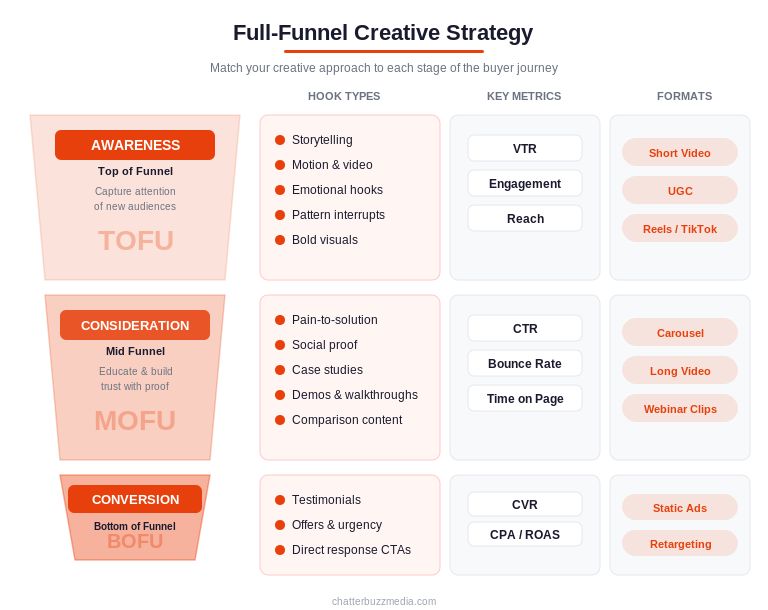
The same ad creative strategy that works at the top of the funnel will fail at the bottom — and vice versa. Performance creative requires funnel-stage alignment, where every asset is designed for the specific awareness level, intent signal, and action threshold of its audience.
Awareness Stage: Earn Attention
At the top of the funnel, your audience doesn’t know you exist — or doesn’t know they have a problem you solve. Creative here must interrupt, educate, and create emotional resonance without asking for a commitment.
- Creative approach: Storytelling hooks, bold visual motion, relatable problem statements, and “did you know” pattern interrupts.
- Format winners: Short-form video (6-15 seconds), animated graphics, UGC-style content that blends into the feed.
- Primary metrics: Video Through Rate (VTR), engagement rate, cost per ThruPlay. You’re measuring attention, not conversion.
The biggest mistake at this stage is optimizing for clicks too early. Awareness creative should build familiarity and plant the problem — conversions come later in the marketing funnel.
Consideration Stage: Bridge Pain to Solution
Here, your audience recognizes their problem and is actively evaluating options. Creative at this stage must connect the specific pain they feel to the specific solution you offer with enough proof to earn the next click.
- Creative approach: Pain-agitation-solution frameworks, comparison content, “how it works” demonstrations, and specific proof points (stats, mini case studies, expert endorsements).
- Format winners: Carousel ads with progressive storytelling, longer-form video (30-60 seconds), lead magnet promotions, educational content previews.
- Primary metrics: CTR, landing page bounce rate, cost per lead. You’re measuring engagement and intent.
This is where your B2B demand generation strategy lives. Creative must be specific enough to filter out non-buyers while being compelling enough to pull qualified prospects deeper.
Conversion Stage: Close the Gap
At the bottom of the funnel, your audience is ready to act — they just need the final push. Creative here must remove friction, provide social proof, and make the next step obvious.
- Creative approach: Customer testimonials with specific results, limited-time offers, guarantee messaging, and clear, direct calls to action.
- Format winners: Static images with strong offers, testimonial video clips, retargeting ads that reference specific pages visited.
- Primary metrics: CVR, CPA, ROAS. You’re measuring direct business impact.
One critical element at this stage is ad-to-landing-page continuity. Message match — where the headline, visual style, and offer on the landing page mirror the ad creative — can lift conversion rates by 15% or more.
If your ad promises a free audit and the landing page leads with a generic “contact us” form, you’ve created a trust gap that kills conversions.
Make sure your landing pages aren’t inviting users to leave by maintaining visual and verbal consistency from ad click to page load. This single improvement often delivers the highest ROAS lift of any optimization you can make.
The funnel framework also applies to programmatic buying — where creative is dynamically served based on audience signals and funnel position. The system principles are the same; only the delivery mechanism changes.
Let’s address the most common questions teams ask when building these systems.
Frequently Asked Questions About Performance Creative
1. 🔍 What is performance creative in advertising?
Performance creative is an ad production system designed to generate measurable business outcomes — clicks, conversions, revenue — rather than just brand awareness. It combines data-driven insight mining, hypothesis-based concepting, structured testing sprints, and a continuous feedback loop to improve creative quality over time.
Unlike traditional creative development, which often relies on intuition and subjective review, performance creative treats every asset as a testable experiment. The goal is to build a compounding knowledge base that makes each successive round of creative more effective than the last.
2. 📊 How do you measure creative performance in paid campaigns?
Measure creative performance at the individual asset level using four core metrics: CTR (hook effectiveness), CVR (persuasion strength), CPA (acquisition efficiency), and ROAS (revenue return). Track these through your ad platform’s creative-level reporting and your data visualization dashboards.
Beyond these primary metrics, advanced creative measurement includes attribute-level tagging (tracking which hook types, proof formats, and CTA styles correlate with performance) and creative win rate analysis (the percentage of new concepts that beat your current baseline).
3. ⚡ What is the difference between brand creative and performance creative?
Brand creative optimizes for long-term recall and emotional equity, while performance creative optimizes for short-to-mid-term measurable actions. Brand creative asks, “Will they remember us?” — performance creative asks, “Will they act now?”
In practice, the best digital marketing programs integrate both. Performance creative operates within brand guidelines but prioritizes response-driving elements — specific hooks, concrete proof, and clear CTAs — over purely aesthetic considerations.
4. 🏦 How do you write a creative brief for performance ads?
A performance creative brief follows a five-part structure: Goal (specific metric target), Audience (role, pain point, awareness stage), Hypothesis (testable assumption about what will drive action), Variables (specific elements being tested), and Metrics (success criteria and minimum sample size).
This structure replaces subjective direction (“make it feel modern”) with measurable intent (“beat our current CPA of $47 by testing a customer quote headline against a stat-based headline on Meta feed placements”). Write briefs that give your marketing strategy team clear guardrails and clear success criteria.
5. 🤝 How often should you refresh ad creatives?
Refresh cadence depends on channel and audience size. As a baseline: Meta every 2-3 weeks, Google Display/YouTube every 4-6 weeks, and LinkedIn every 3-4 weeks.
Watch for declining CTR, rising CPM, and frequency exceeding 3.0 as trigger signals.
Larger budgets and smaller audiences accelerate fatigue — monitor asset-level performance daily and set automated alerts for performance drops exceeding 20% from peak. Having a pipeline of pre-scored concepts ready to deploy prevents gaps when fatigue hits unexpectedly.
6. 💰 What is a good ROAS for performance creative campaigns?
Good ROAS varies by industry, funnel stage, and business model. E-commerce benchmarks typically range from 3:1 to 5:1, while B2B campaigns with longer sales cycles often target 5:1 to 10:1 when measured across the full customer journey.
The more useful metric is ROAS improvement rate over time. A well-run performance creative system should deliver 15-25% ROAS improvement over 6 months through compounding creative intelligence, regardless of your starting benchmark — track this through your core marketing KPIs.
7. 🚀 How does AI change performance creative production?
AI dramatically accelerates iteration and variant production — the mechanical parts of the creative process. In 2026, AI tools can generate copy variants, adapt formats across placements, produce image variations, and even draft video scripts at a fraction of the time and cost of manual production.
What AI doesn’t replace is the strategic layer: insight mining from qualitative data, hypothesis formation based on audience understanding, and the interpretation of test results. Think of AI as a force multiplier for your content marketing engine — not a replacement for strategic thinking.
Build Your Performance Creative Engine
Performance creative isn’t a trend or a tactic — it’s an operational system that turns every ad dollar into a learning opportunity and every campaign into a data asset. The teams that build this system now will compound their advantage over competitors still treating creative as an afterthought.
Here’s your action plan:
- Audit your current creative process. Map how concepts go from idea to live ad today. Identify where data enters (or doesn’t) and where subjective opinion replaces structured testing.
- Implement the creative brief framework. Start using the Goal-Audience-Hypothesis-Variables-Metrics structure on your next campaign. Score every concept before production begins.
- Run your first structured sprint. Pick one channel, create 2-3 variants with single-variable differences, tag attributes, and commit to a 2-week test cycle with documented learnings.
- Build the feedback loop. Schedule weekly sprint reviews, create a shared learnings database, and start tracking your creative win rate. After three months, you’ll have an insight library no competitor can replicate.
The performance creative system works because it replaces hope with evidence and gut instinct with compounding intelligence. Start building yours today.
For a deeper dive into building a measurement-driven paid media strategy, explore the performance marketing agency guide. And if you’re ready to apply these creative frameworks to social media advertising campaigns, the principles above translate directly to every platform where your audience spends attention.
You’ll find additional frameworks, templates, and tactical guides in the resources hub.
Related: UGC Ads That Convert: How Performance Creative Beats Polishe

Victoria Wallace
Victoria Wallace is a senior content strategist and marketing writer with 30+ years of experience helping more than 200 brands translate complex business goals into clear, conversion-focused content. Her background spans paid media, marketing strategy, go-to-market planning, brand positioning, and full-funnel campaign development, giving her a deep understanding of how SEO content connects to real business growth.