
 321-236-2899
Most B2B companies spend six figures on marketing every year and still can’t answer one question: which campaigns actually drive revenue? According to HubSpot’s State of Marketing report, fewer than half of marketers feel confident measuring the ROI of their campaigns.
That disconnect between spend and results is exactly what performance marketing services exist to solve. This guide breaks down what those services actually include, how to measure them, how to evaluate an agency partner, and what realistic results look like — so you can make investment decisions grounded in data, not hope.
Whether you’re evaluating agencies, building an in-house team, or trying to fix a program that isn’t delivering, this is the resource we wish every B2B leader had before signing their first marketing contract.
Key Takeaways
- Performance marketing services tie every dollar to a measurable outcome — clicks, leads, pipeline, and revenue — unlike traditional marketing that optimizes for awareness alone.
- A complete retainer includes strategy, execution, analytics, and martech management — not just ad spend. Understanding the full scope protects you from overpaying or under-resourcing.
- Attribution is the foundation of ROI measurement — without a multi-touch attribution model, you’re making budget decisions based on incomplete data.
- The best programs blend performance and brand marketing — short-term conversion and long-term demand creation aren’t opposing strategies; they’re complementary.
- A full in-house performance team costs $600K–$900K+ annually in loaded salaries alone — making agency and hybrid models financially compelling for most mid-market companies.
What Are Performance Marketing Services?
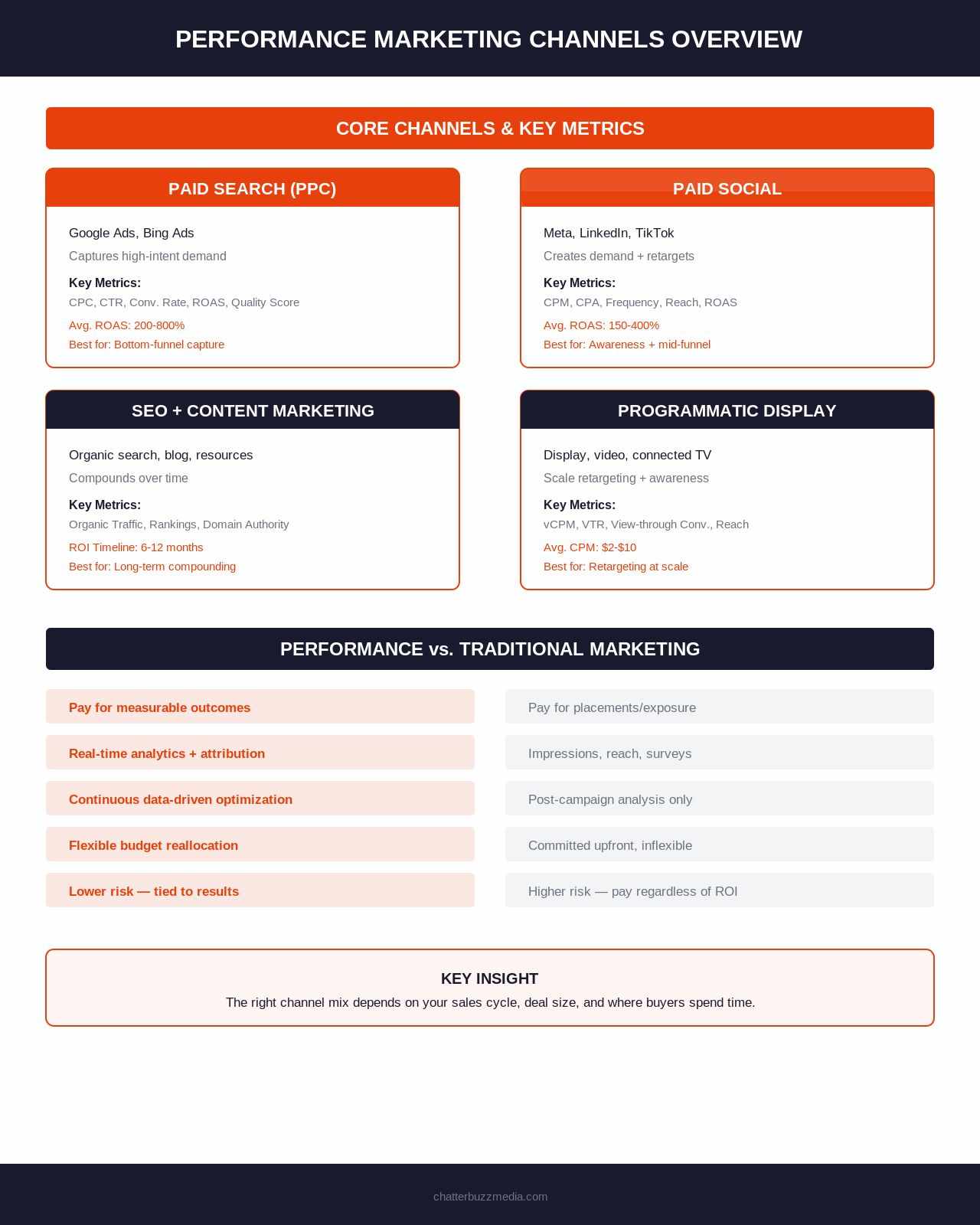
Performance marketing services are marketing programs where every activity is tied to a measurable business outcome. Unlike traditional marketing — where you pay for placements and hope they work — performance-based marketing means you can trace spend directly to results like leads, conversions, pipeline, and revenue.
The term covers a broad ecosystem of channels, tactics, and measurement frameworks within digital marketing services. But the defining characteristic is accountability: every campaign has a target metric, every dollar has a job, and every report shows what worked and what didn’t.
How Performance Marketing Differs from Traditional Marketing
Traditional marketing operates on a “spray and pray” model. You buy a billboard, run a TV spot, or sponsor a conference and measure success in impressions, reach, or brand recall surveys — metrics that live several steps removed from revenue.
Results-based marketing flips that model. You define the outcome first — a target cost per acquisition, a return on ad spend threshold, a pipeline contribution goal — then engineer campaigns to hit those numbers.
Every channel, creative asset, and audience segment earns its place based on measured performance.
This doesn’t mean traditional channels are obsolete. It means the measurement framework changes.
A conference sponsorship becomes a performance channel when you track sourced meetings, influenced pipeline, and closed revenue against the investment — not just badge scans.
The Core Channels in a Performance Marketing Program
A comprehensive performance marketing solutions program typically includes five core channels, though the mix varies based on your market, audience, and growth stage.
- Paid Search (PPC): Google Ads and Microsoft Ads campaigns that capture high-intent demand from buyers actively searching for solutions like yours. The backbone of most B2B performance programs.
- Paid Social: LinkedIn, Meta, and increasingly TikTok campaigns that target specific job titles, industries, and company sizes. Critical for B2B demand generation where buyers aren’t yet searching.
- SEO and Content Marketing: Organic search programs that build compounding, owned traffic over time. Performance-oriented SEO ties every keyword target to a revenue opportunity, not just a ranking.
- Programmatic Display and Video: Automated media buying across thousands of publisher sites, targeted by audience data and optimized by algorithms. Useful for retargeting and awareness at scale.
- Affiliate and Partner Marketing: Revenue-share arrangements where you pay partners only when they deliver qualified leads or sales. The purest form of pay for performance marketing.
The right channel mix depends on your sales cycle, average deal size, and where your buyers spend their time. A SaaS company selling $50K contracts needs a fundamentally different approach than an e-commerce brand selling $50 products.
The channels are tools — the strategy determines which ones to pick up.
What’s Actually Included in a Performance Marketing Retainer
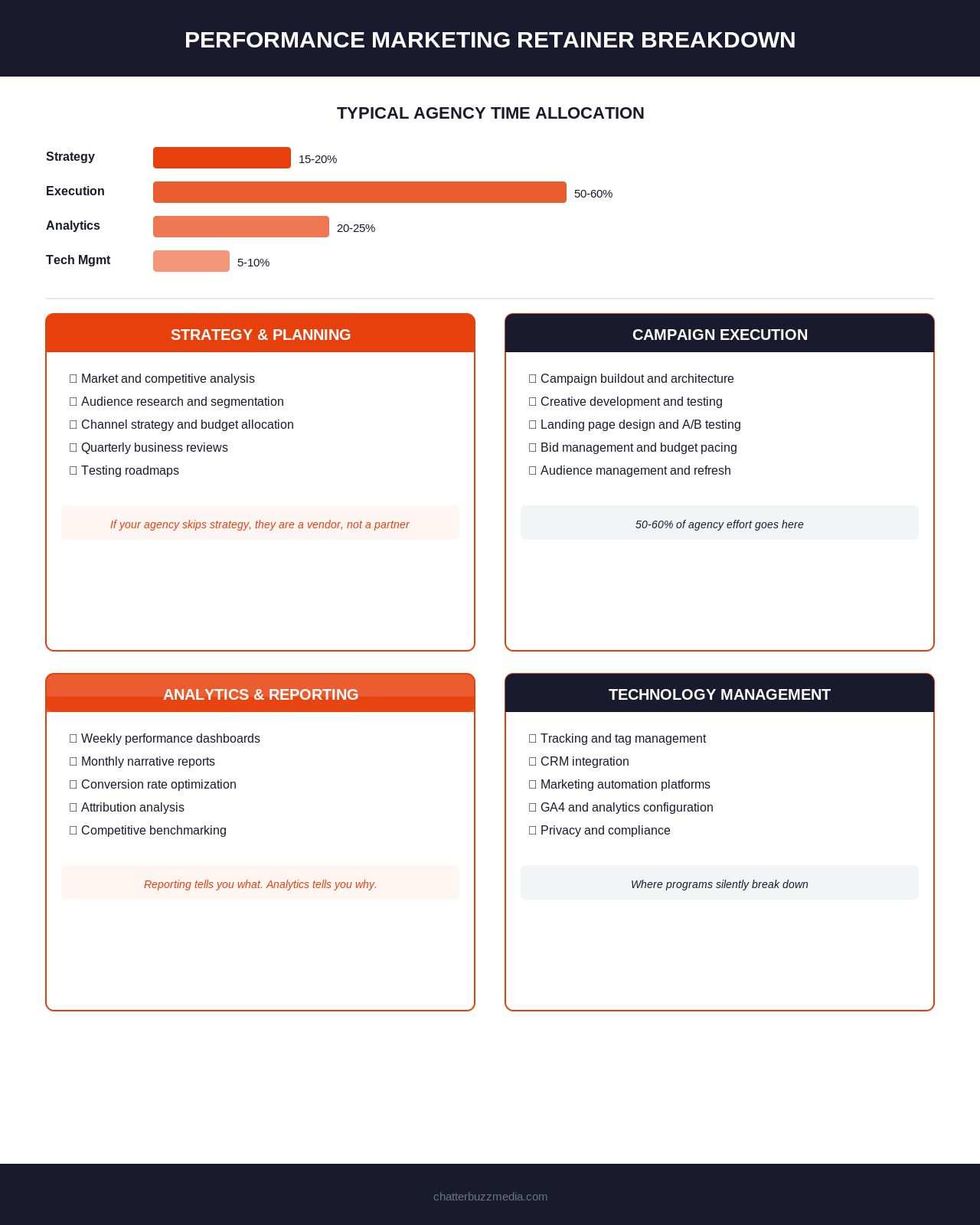
This is where most agency evaluations fall apart. Companies compare monthly fees without understanding what’s actually included — then end up surprised when their “affordable” agency delivers a PDF report and nothing else.
Here’s what a comprehensive performance marketing services retainer should cover, month by month.
Strategy and Planning
Strategy isn’t a one-time deliverable at the start of an engagement. It’s an ongoing discipline that should consume 15–20% of your agency’s time every month.
- Market and competitive analysis: Regular audits of competitor positioning, messaging, ad creative, and keyword strategies. Your agency should know your competitive landscape as well as you do.
- Audience research and segmentation: Building and refining ideal customer profiles, buyer personas, and audience segments using first-party data and market research.
- Channel strategy and budget allocation: Determining which channels get what percentage of budget based on historical performance, market opportunity, and growth goals.
- Quarterly business reviews: Structured sessions that connect marketing performance to business outcomes, recalibrate goals, and align on priorities for the next 90 days.
- Testing roadmaps: Structured experimentation plans for creative, audiences, landing pages, offers, and channels — because optimization without a testing framework is just guessing.
If your agency skips strategy and jumps straight to execution, they’re a vendor, not a partner. Strategy is what separates ROI-driven marketing from activity-driven marketing.
Campaign Execution and Management
Execution is the most visible part of the retainer — the daily work of building, launching, and managing campaigns across channels. This is where most agencies spend 50–60% of their time.
- Campaign buildout: Account structure, campaign architecture, ad group creation, keyword mapping, audience setup, and bid strategy configuration across all active channels.
- Creative development: Ad copy, display banners, video scripts, landing page copy, and email sequences. A performance agency should either produce creative in-house or manage a creative partner.
- Landing page design and optimization: Dedicated landing pages for each campaign or audience segment, with ongoing A/B testing of headlines, layouts, forms, and CTAs.
- Bid management and budget pacing: Daily or algorithmic bid adjustments, budget reallocation between campaigns, and spend pacing to maximize performance within monthly budgets.
- Audience management: Building lookalike audiences, retargeting pools, exclusion lists, and CRM-matched segments. Refreshing audiences regularly to prevent fatigue.
The depth of execution should match the complexity of your program. A three-channel program with $30K/month in ad spend demands different attention than a single-channel program at $5K/month.
Ask agencies to show you their task-level workflow so you understand what “management” actually means.
Analytics, Reporting, and Optimization
Reporting tells you what happened. Analytics tells you why.
Optimization turns both into better results. This pillar should consume 20–25% of your agency’s monthly effort.
- Weekly performance dashboards: Real-time or near-real-time dashboards showing key metrics by channel, campaign, and audience segment. You should never have to ask how campaigns are performing.
- Monthly performance reports: Detailed narrative reports that go beyond the numbers to explain trends, diagnose problems, and recommend actions. Numbers without context are just noise.
- Conversion rate optimization (CRO): Ongoing testing of landing pages, forms, CTAs, and user flows to increase the percentage of visitors who become leads.
- Attribution analysis: Tracking how multiple touchpoints contribute to conversions and revenue, so you can allocate budget to the channels that actually drive pipeline.
- Competitive benchmarking: Comparing your performance metrics against industry benchmarks and direct competitors to contextualize results.
If your agency sends a monthly PDF with impressions and clicks but can’t tell you which campaigns influenced closed-won deals, you don’t have a performance marketing partner. You have a media buyer.
Technology and Martech Stack Management
Modern performance marketing runs on technology. Your agency should manage — or at minimum advise on — the tools that power your program.
- Tracking and tag management: Google Tag Manager, conversion pixels, UTM frameworks, and server-side tracking setup. Proper tracking is the foundation everything else depends on.
- CRM integration: Connecting ad platforms to your CRM (HubSpot, Salesforce, etc.) so leads flow seamlessly and closed-loop reporting is possible.
- Marketing automation: Managing or advising on marketing automation platforms for lead nurturing, scoring, and handoff to sales.
- Analytics platforms: GA4 configuration, custom event tracking, data studio dashboards, and integration with business intelligence tools.
- Privacy and compliance: Ensuring tracking implementations comply with GDPR, CCPA, and evolving browser privacy restrictions. This has become a critical capability as third-party cookies phase out.
Technology management often gets overlooked in agency scoping conversations, but it’s where many programs silently break down. Misconfigured tracking, broken CRM integrations, and outdated tag setups corrupt your data — and corrupted data leads to bad decisions.
How to Measure Performance Marketing ROI
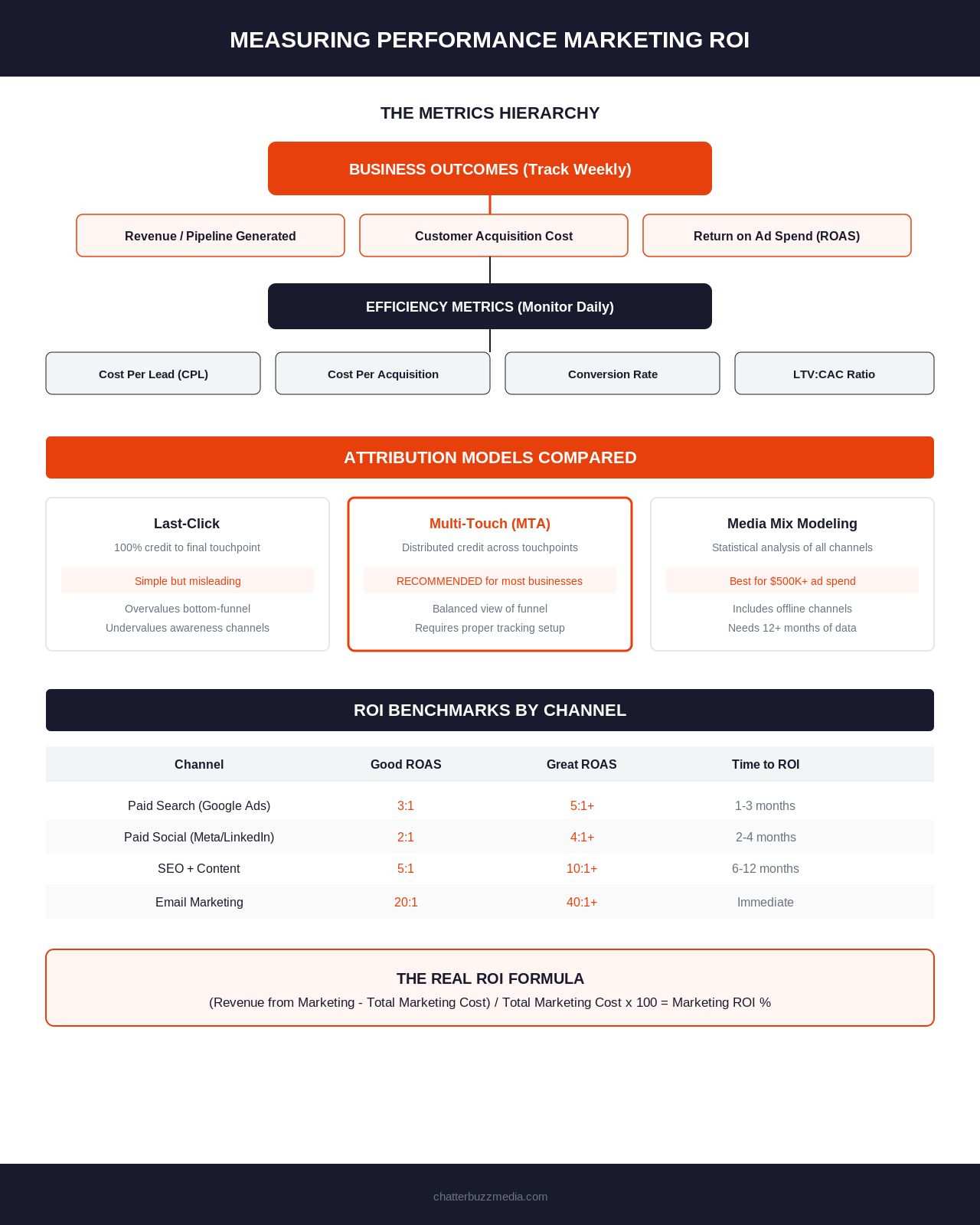
Measuring ROI sounds straightforward — divide revenue by cost — but in practice, B2B measurement is layered and complex. Long sales cycles, multiple decision-makers, and dozens of touchpoints make simple ROI calculations misleading.
Here’s how to build a measurement framework that actually works.
The Metrics That Actually Matter
Most agencies report on dozens of metrics. But only a handful directly connect to business outcomes.
- Cost Per Acquisition (CPA): What you pay to acquire a customer, calculated across the full journey from first touch to closed deal. Not just cost per lead — cost per actual customer.
- Return on Ad Spend (ROAS): Revenue generated for every dollar spent on advertising. A ROAS of 5:1 means $5 in revenue for every $1 in ad spend. Essential for e-commerce and transactional B2B models.
- Customer Lifetime Value to Customer Acquisition Cost Ratio (LTV:CAC): The most important metric for subscription and recurring-revenue businesses. A healthy B2B SaaS company targets a 3:1 ratio or higher.
- Pipeline Velocity: How quickly qualified leads move through your sales pipeline. Faster velocity means shorter sales cycles and more efficient revenue generation.
- Marketing-Sourced Pipeline and Revenue: The total dollar value of pipeline and closed revenue that originated from marketing activities. This is the number your CFO cares about.
Vanity metrics like impressions, clicks, and even marketing qualified leads (MQLs) have their place — they’re diagnostic indicators. But they’re not outcomes.
ROI-driven marketing measures what matters to the business, not just what’s easy to track.
Attribution Models Explained
Attribution is how you assign credit for conversions and revenue across multiple marketing touchpoints. According to Forrester Research, the average B2B buyer engages with 27 touchpoints before making a purchase decision.
Without a clear attribution model, you have no idea which of those touchpoints actually mattered.
Here are the most common attribution models and when each makes sense.
- First-Touch Attribution: Gives 100% credit to the first interaction. Useful for understanding which channels drive initial awareness, but ignores everything that happens after.
- Last-Touch Attribution: Gives 100% credit to the final interaction before conversion. Favors bottom-of-funnel channels and undervalues awareness and nurture activities.
- Linear Attribution: Distributes credit equally across all touchpoints. Simple and fair, but treats a blog visit the same as a demo request, which rarely reflects reality.
- Time-Decay Attribution: Gives more credit to touchpoints closer to conversion. Reflects the intuition that recent interactions matter more, but can undervalue the campaigns that started the relationship.
- Data-Driven (Algorithmic) Attribution: Uses machine learning to determine each touchpoint’s actual contribution based on your data. The most accurate model, but requires significant data volume to work well.
No single model is “right.” Most sophisticated B2B companies use multi-touch attribution — running two or three models simultaneously and comparing the results to build a complete picture.
The key is picking a model, documenting it, and being consistent so you can track trends over time.
Building a Reporting Framework That Drives Decisions
Reporting without a decision framework is just data tourism. Every report should answer three questions: What happened, why did it happen, and what are we going to do about it?
Structure your reporting cadence around decision timelines. Weekly reports drive tactical optimizations — bid adjustments, budget reallocation, creative swaps.
Monthly reports drive strategic shifts — channel mix changes, audience expansion, offer testing. Quarterly reviews drive investment decisions — budget increases, new channel launches, team changes.
Build dashboards for real-time monitoring and narrative reports for context. Your marketing leadership needs both: the dashboard to spot anomalies quickly and the report to understand what they mean.
Performance Marketing vs. Brand Marketing: Understanding the Balance
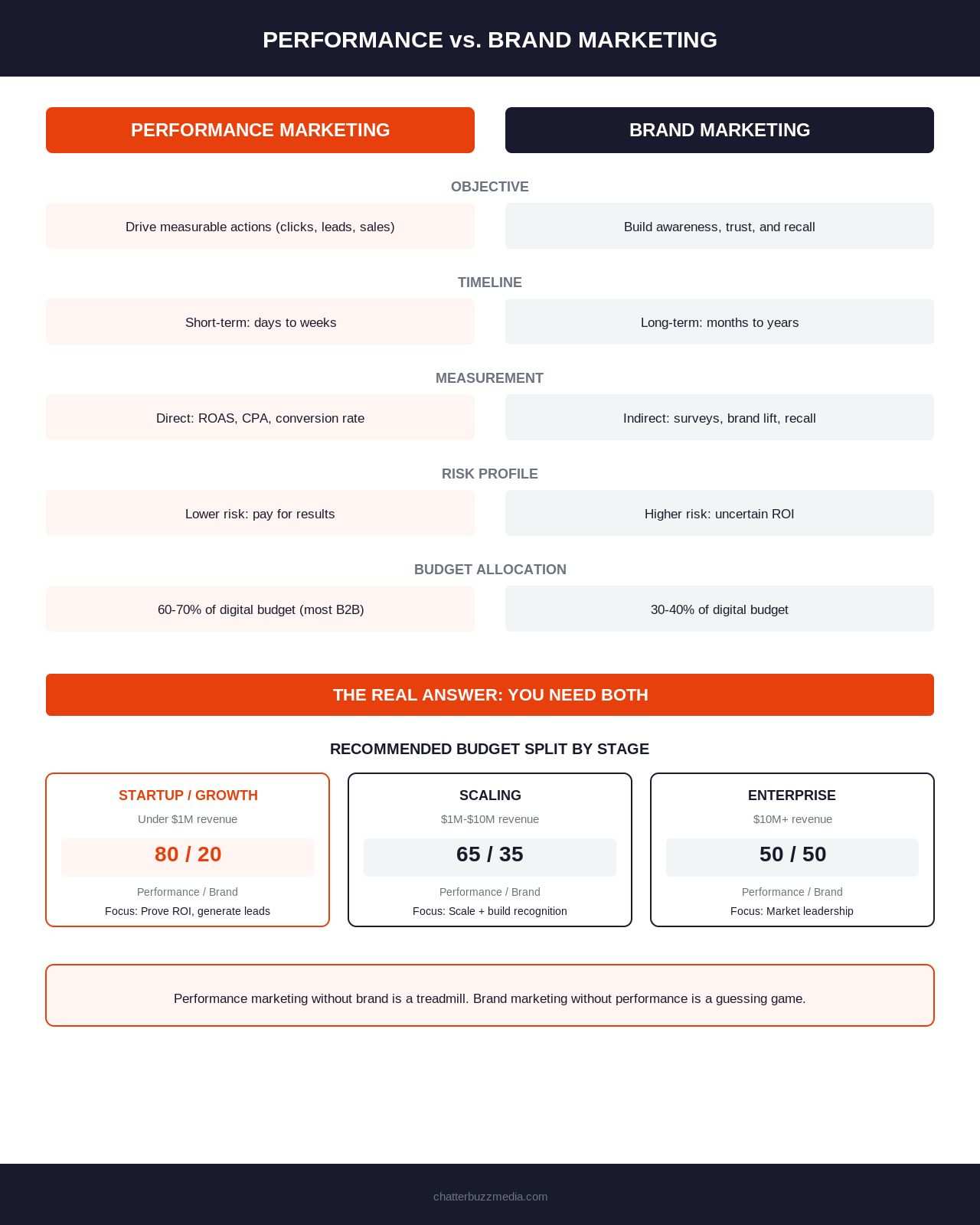
One of the most common questions B2B leaders ask is: what’s the difference between performance marketing and brand marketing? The short answer — performance marketing optimizes for measurable actions now, while brand marketing builds recognition and trust that compounds over time.
But framing them as opposites is a mistake.
When to Invest in Performance vs. Brand
Early-stage companies with limited budgets should lean heavily into performance. You need leads, pipeline, and revenue to survive.
Brand building at this stage happens as a byproduct of good execution — consistent messaging, professional creative, and a great customer experience.
As companies mature, the balance should shift. LinkedIn’s B2B Institute research shows that companies allocating roughly 50% of budget to brand and 50% to performance generate the strongest long-term results.
Brand marketing makes performance marketing more efficient — higher brand awareness leads to higher click-through rates, lower CPAs, and stronger conversion rates.
How the Best B2B Companies Combine Both
The best programs don’t treat performance marketing vs brand marketing as an either/or choice. They integrate both into a unified strategy where brand campaigns build the audience and performance campaigns convert it.
Here’s what that looks like in practice. A B2B SaaS company might run LinkedIn thought leadership campaigns (brand) that drive their ideal audience to a high-value content hub (demand creation), then retarget engaged visitors with demo ads (performance), and nurture leads through email sequences (conversion).
Each layer makes the next more effective.
If your inbound marketing program is generating traffic but not converting, the issue is often a performance layer problem. If your paid campaigns are converting but at unsustainable costs, the issue is often a brand layer problem.
The diagnosis determines the prescription.
How to Evaluate a Performance Marketing Agency
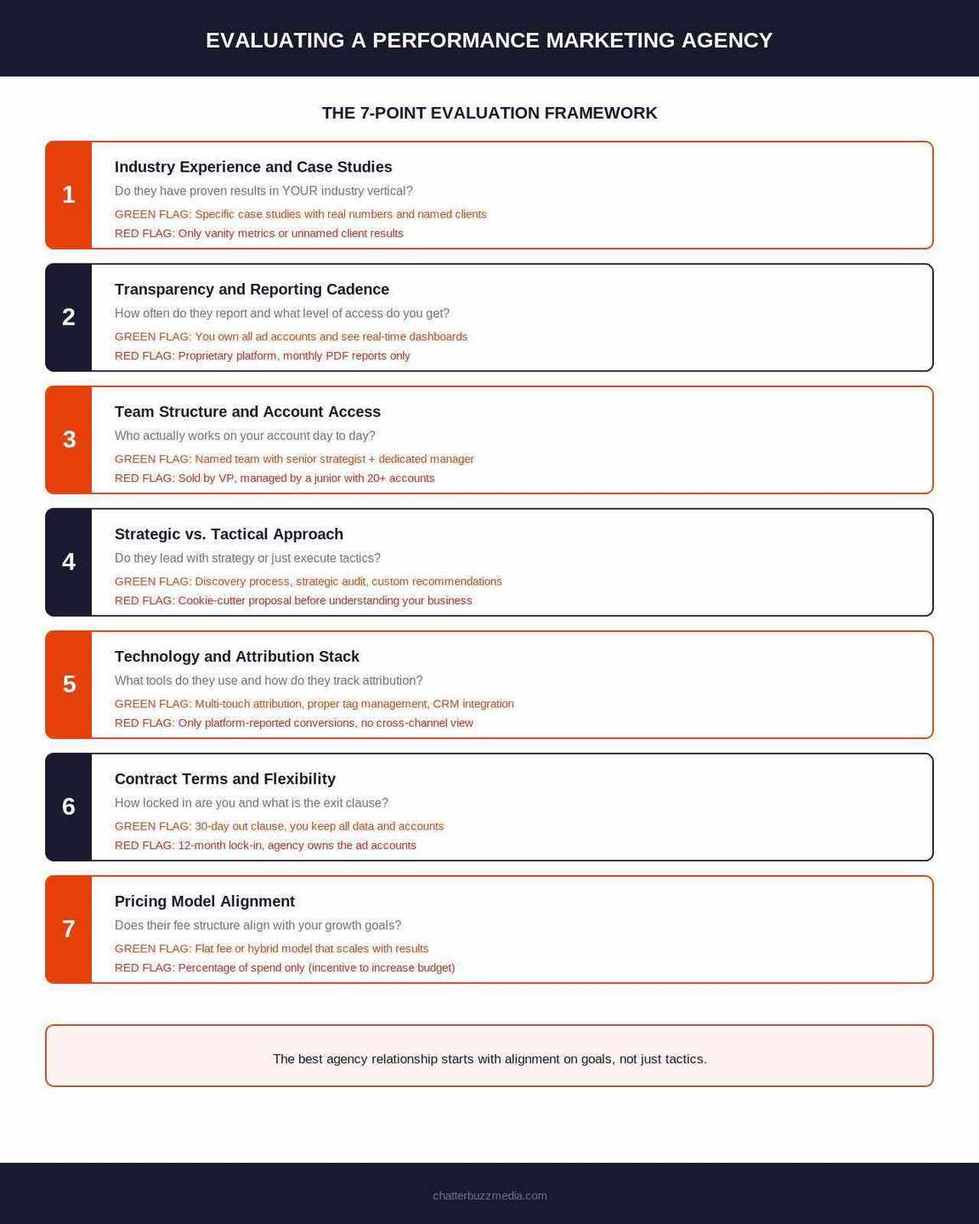
Choosing the wrong agency is expensive — not just in fees, but in lost time, missed market windows, and opportunity cost. Here’s how to evaluate potential partners with the rigor the decision deserves.
For a deeper framework, see our complete guide to choosing a performance marketing agency.
7 Questions to Ask Before Signing a Contract
These questions reveal whether an agency operates as a true performance partner or just a media buying shop with good sales materials.
- “What does your onboarding process look like, and how long before campaigns go live?” Good agencies invest 2–4 weeks in discovery, audits, and strategy before touching an ad platform. If they promise to launch in a week, they’re skipping the foundation.
- “How do you handle attribution, and what model do you recommend for our business?” This question separates strategists from tacticians. An agency that can’t articulate an attribution philosophy will struggle to prove their impact.
- “Who will actually work on our account, and what’s their experience level?” Senior talent sells the engagement; junior talent executes it. Ask for names, bios, and the percentage of their time dedicated to your account.
- “Can you walk me through a specific optimization you made for a client and the business impact?” Vague answers (“we optimized their campaigns and improved performance”) signal shallow execution. Look for specifics: what they changed, why, and the measurable result.
- “What happens if campaigns underperform in the first 90 days?” Every program has rough patches. You want an agency that has a diagnostic process for underperformance, not one that points fingers at your sales team or market conditions.
- “How do you communicate, and what’s the escalation path if something goes wrong?” Weekly calls, monthly reports, and a named point of contact are the minimum. Ask about their response time for urgent issues.
- “Do we own all accounts, data, and creative assets if we leave?” This is non-negotiable. If an agency builds campaigns in their own accounts, you lose everything when the relationship ends. Your data and assets must live in accounts you own.
Red Flags That Signal the Wrong Partner
Walk away from any agency that exhibits these warning signs. They indicate structural problems that no amount of good intentions will fix.
- They guarantee specific results. No agency can guarantee rankings, lead volumes, or revenue targets — marketing involves too many variables outside any agency’s control. Guarantees are a sales tactic, not a service commitment.
- They won’t share their methodology. If an agency treats their process as a “secret sauce” and won’t explain how they plan to achieve results, they either don’t have a real process or they’re hiding something.
- They lock you into long-term contracts without performance benchmarks. A 12-month contract is reasonable if it includes defined performance milestones and exit clauses — a 12-month contract with no outs is a red flag.
- They focus on activity metrics instead of business outcomes. An agency that reports on impressions and clicks but can’t connect campaigns to pipeline and revenue isn’t practicing performance-based marketing — they’re practicing media buying.
- Their case studies lack specifics. “We increased leads by 300%” without context (baseline numbers, timeframe, industry, client size) is meaningless. Demand the details.
What Good Agency Communication Looks Like
Communication quality is one of the most reliable predictors of agency performance. Here’s the standard you should expect.
Weekly communication should include a brief performance update (10 minutes of reading, not a 60-minute call that could’ve been an email), any urgent issues flagged proactively, and context on what’s being tested or changed.
Monthly communication should include a detailed performance report with narrative analysis, strategic recommendations for the next 30 days, and a clear agenda for the monthly review call.
The best agencies communicate like an extension of your team. They flag problems before you notice them, propose solutions before you ask, and bring strategic ideas you hadn’t considered.
If you’re the one constantly chasing your agency for updates, that’s a relationship problem masquerading as a communication problem.
In-House vs. Agency: The Real Cost Comparison
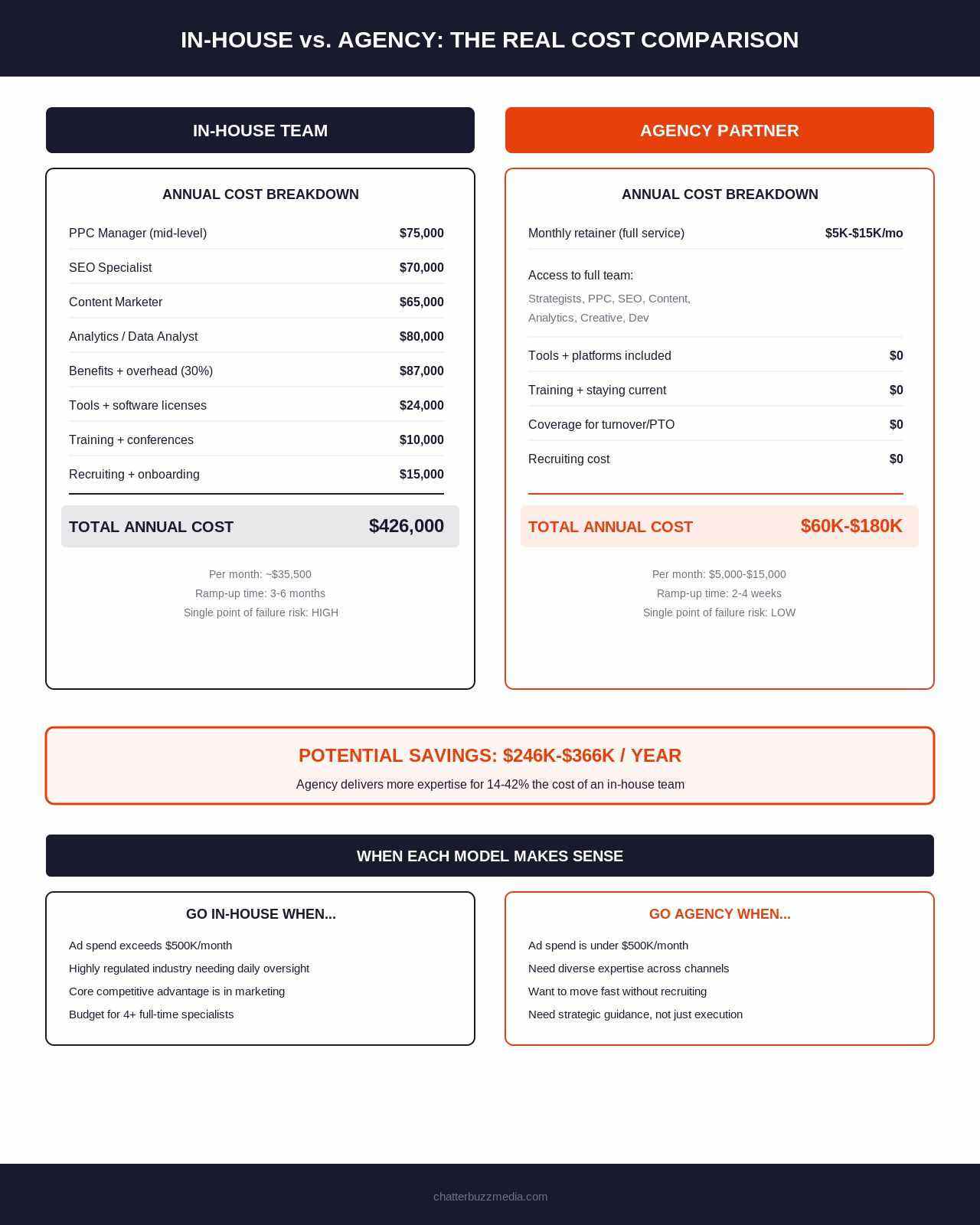
The “build or buy” decision shapes your entire marketing operation. Both models work — the right choice depends on your budget, growth stage, hiring capacity, and how fast you need to move.
Here are the real numbers for 2026.
What a Full In-House Team Actually Costs
A fully staffed in-house performance marketing team requires multiple specialized roles. Here’s what those roles cost in 2026 based on national average salaries for mid-market B2B companies.
- Performance Marketing Director: $140,000–$180,000 base salary
- Paid Media Manager: $85,000–$120,000 base salary
- SEO Manager: $80,000–$110,000 base salary
- Marketing Analyst / Data Scientist: $95,000–$130,000 base salary
- Content Strategist / Copywriter: $70,000–$95,000 base salary
- Marketing Operations / Martech Specialist: $85,000–$115,000 base salary
That’s $555,000–$750,000 in base salaries alone. Add 25–35% for benefits, payroll taxes, equipment, and overhead, and your loaded cost reaches $695,000–$1,012,000 annually.
Then factor in recruiting costs ($15,000–$30,000 per hire), onboarding time (2–3 months before full productivity), and employee turnover (marketing roles average 2.5 years of tenure).
Those figures don’t include software subscriptions (SEMrush, HubSpot, analytics tools), ad spend management tools, or ongoing training. A realistic all-in cost for a six-person in-house team is often north of $900,000 per year before a single dollar of ad spend.
The Agency Model: What You Get for the Investment
Agency retainers for mid-market B2B companies typically range from $8,000–$25,000 per month ($96,000–$300,000 annually), depending on scope, channel complexity, and ad spend volume. Some agencies also charge a percentage of ad spend (typically 10–20%) on top of the retainer.
For that investment, you get access to a full team of specialists — strategists, channel managers, analysts, and creative professionals — without the recruiting, onboarding, or management overhead.
You also get institutional knowledge from working across multiple clients and industries, which accelerates learning and reduces costly mistakes.
The math becomes compelling when you compare outputs. An agency at $15,000/month ($180,000/year) delivers a comparable scope of work to an in-house team costing $700,000+.
The trade-off is control: you have less direct oversight of daily activities, and your team serves multiple clients, not just you.
The Hybrid Approach
Many mid-market B2B companies find that the optimal model is a hybrid: a lean in-house team that handles strategy, brand, and cross-functional coordination, paired with an agency that handles execution, specialized channel management, and analytics.
A common hybrid structure includes an in-house marketing director or fractional CMO who owns strategy and vendor management, plus an agency partner who handles paid media, SEO execution, analytics, and reporting. This gives you strategic control without the overhead of a full specialist team.
The hybrid model works particularly well for companies in the $5M–$50M revenue range. You get senior strategic thinking without the $180K salary, specialized execution without the $700K team cost, and the flexibility to scale up or down as business needs change.
Common Performance Marketing Mistakes That Destroy ROI
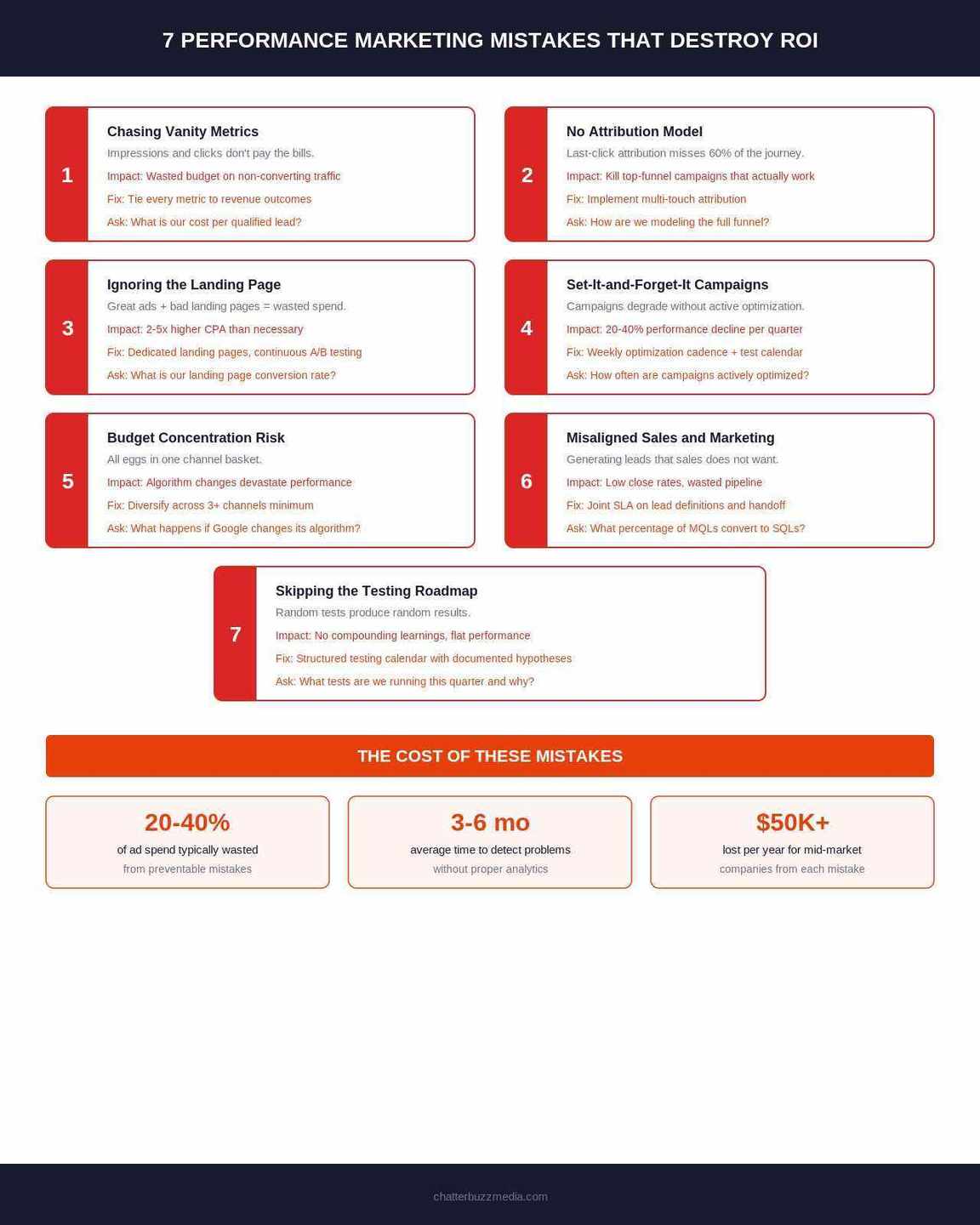
After working with hundreds of B2B companies, these are the four mistakes we see most frequently. Every one of them is fixable — but only if you recognize the pattern.
1. Optimizing for Vanity Metrics
What it is: Celebrating increases in impressions, clicks, or even MQLs without connecting those metrics to pipeline and revenue. Your LinkedIn campaign generated 10,000 impressions — but how many turned into qualified conversations?
Why it hurts: Vanity metrics create the illusion of progress. Teams invest more budget into campaigns that “perform” well on surface metrics while starving campaigns that actually drive revenue.
Over time, this misallocation compounds — your cost to acquire a customer rises while pipeline shrinks.
How to fix it: Establish a metric hierarchy that connects every activity metric to a business outcome — clicks map to leads, leads map to opportunities, opportunities map to revenue.
Report on the full chain, and make budget decisions based on the metrics closest to revenue.
2. Ignoring the Full Funnel
What it is: Spending 100% of budget on bottom-of-funnel conversion campaigns (demo requests, free trials, contact forms) while investing nothing in the awareness and consideration stages that feed the funnel.
Why it hurts: Bottom-of-funnel campaigns only capture buyers who are already in market. According to Gartner research, only 5% of your total addressable market is actively buying at any given time.
If you’re only targeting that 5%, you’re ignoring the 95% who will buy in the next 6-18 months.
How to fix it: Allocate budget across all funnel stages — a common framework is 20% to awareness, 30% to consideration, 50% to conversion.
Then use account-based marketing to nurture the 95% until they enter an active buying cycle.
3. Underinvesting in Creative
What it is: Spending $50,000/month on ad placement and $500 on creative, running the same three ads for six months. Using stock photography and generic copy that sounds like every other vendor in your space.
Why it hurts: In a world where your buyers see thousands of ads daily, mediocre creative is invisible creative. Poor creative doesn’t just underperform — it actively suppresses your results by training algorithms to show your ads to fewer people, increasing your costs and decreasing your reach with every passing week.
How to fix it: Allocate 10–15% of your total program budget to creative development. Refresh ad creative every 4–6 weeks and test messaging variations systematically, not randomly.
Invest in creative that looks and sounds different from your competitors — differentiation in the ad is just as important as differentiation in the product.
4. Skipping Attribution Setup
What it is: Launching campaigns without proper UTM tracking, conversion pixel configuration, CRM integration, or a documented attribution model. Running a multi-channel program but measuring each channel in isolation.
Why it hurts: Without attribution, you can’t tell which campaigns drive revenue and which waste money. Every budget conversation becomes a political debate instead of a data-driven decision.
You can’t optimize what you can’t measure — so your program plateaus while your competitors pull ahead.
How to fix it: Set up attribution infrastructure before launching campaigns, not after. Implement a UTM framework, configure conversion tracking across all platforms, integrate ad platforms with your CRM, and choose an attribution model that matches your sales cycle.
This isn’t optional — it’s the operating system your entire program runs on.
Bringing It All Together
Performance marketing services work when they’re built on a foundation of clear strategy, rigorous measurement, and continuous optimization. The companies that get the best results invest in the full system — not just ad spend, but the analytics, creative, technology, and talent that make every dollar work harder.
Whether you build in-house, partner with an agency, or create a hybrid model, the principles are the same: define your outcomes before your tactics, measure what matters to the business, and never stop testing.
The difference between a good program and a great one isn’t budget — it’s discipline.
If you’re evaluating your current marketing program or considering a new investment, the FAQ section below answers the most common questions we hear from B2B marketing leaders at every stage.
Frequently Asked Questions About Performance Marketing Services
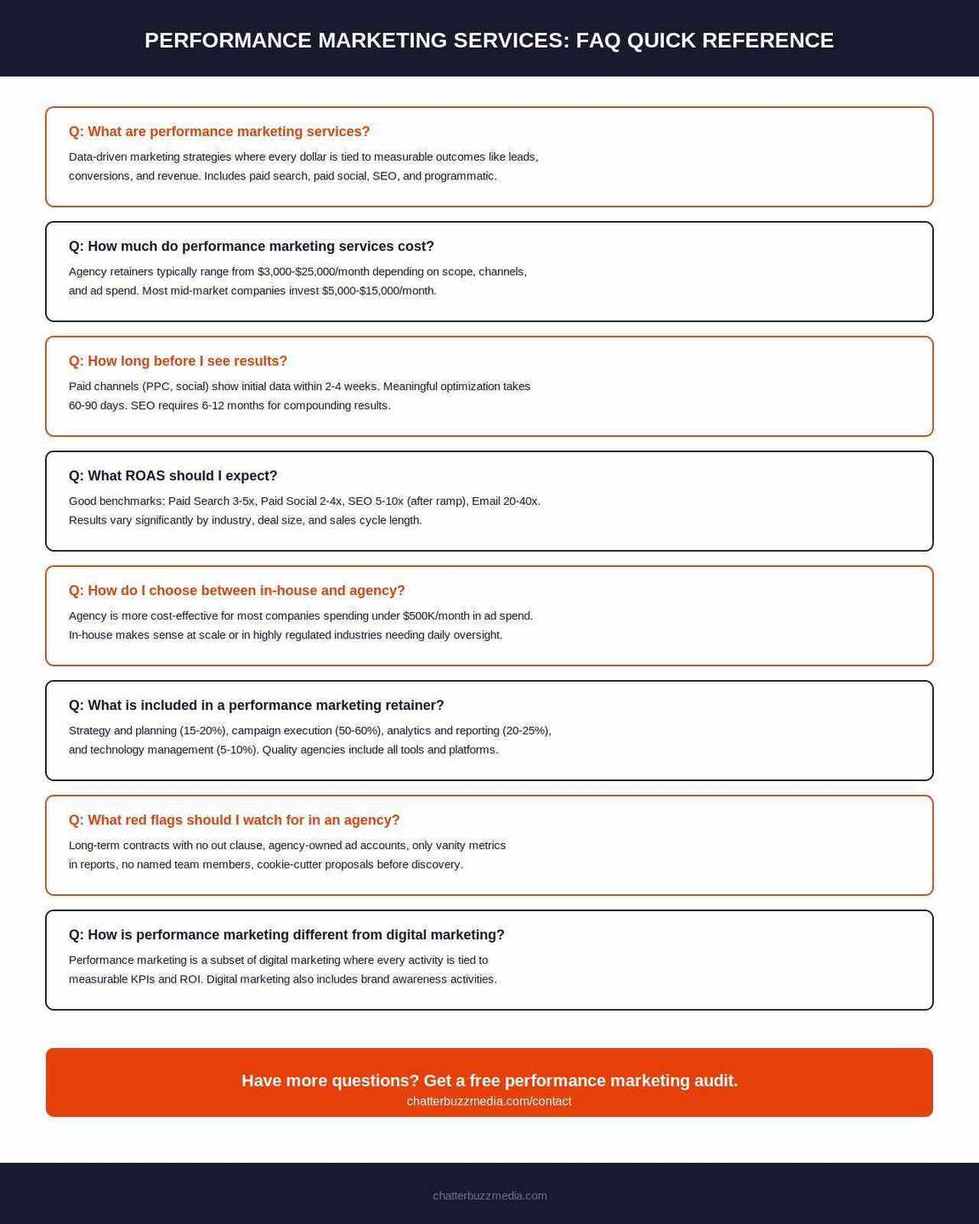
What are performance marketing services?
Performance marketing services are marketing programs where every activity is tied to a measurable outcome — clicks, leads, pipeline, or revenue. Unlike traditional marketing that charges for placements and exposure, performance marketing services focus on delivering specific, trackable results.
Core services typically include paid search, paid social, SEO, programmatic advertising, analytics, and conversion optimization.
How much do performance marketing services cost?
For mid-market B2B companies, agency retainers typically range from $8,000–$25,000 per month, depending on scope and complexity. This fee covers strategy, execution, and reporting — ad spend is usually separate.
Some agencies also charge a percentage of ad spend (10–20%). Total program investment (retainer plus ad spend) commonly ranges from $15,000–$75,000 per month for a comprehensive multi-channel program.
What’s the difference between performance marketing and digital marketing?
Digital marketing is the broader category — it includes any marketing activity that happens online, from social media posts to email newsletters to website content. Performance-based marketing is a subset of digital marketing defined by its measurement approach: every campaign targets a specific, measurable outcome, and budget allocation is driven by results data.
All performance marketing is digital marketing, but not all digital marketing is performance marketing.
How long does it take to see results from performance marketing?
Paid channels (search and social ads) can generate leads within the first 2–4 weeks of launch, but meaningful optimization takes 60–90 days as algorithms learn and your team gathers enough data to make informed adjustments. SEO results typically take 4–6 months to materialize.
A fully optimized, multi-channel program usually hits its stride around the 6-month mark, with compounding improvements from there.
What industries benefit most from performance marketing?
Performance marketing works across industries, but it delivers the strongest ROI for companies with clearly defined target audiences, quantifiable customer values, and digital buyer journeys. B2B SaaS, professional services, technology companies, financial services, healthcare technology, and manufacturing companies with complex sales cycles all see strong results.
The key factor isn’t industry — it’s whether you can track the journey from first click to closed revenue.
Should I hire an agency or build an in-house team?
It depends on your budget, growth stage, and hiring capacity. A full in-house team costs $700K–$1M+ annually in loaded expenses, while an agency delivers comparable scope for $100K–$300K annually.
Most mid-market companies benefit from a hybrid approach: a lean in-house team (or fractional CMO) for strategy and coordination, plus an agency for specialized execution and analytics.
What is performance-based marketing pricing?
Pay for performance marketing pricing models charge based on results rather than activity. Common structures include cost-per-lead (you pay for each qualified lead delivered), cost-per-acquisition (you pay for each closed customer), and revenue share (the agency earns a percentage of revenue generated).
These models align incentives but can create perverse optimization — agencies may prioritize volume over quality. Most sophisticated programs use a hybrid of retainer plus performance bonuses.
How do I know if my performance marketing agency is delivering results?
Evaluate your agency on three dimensions: leading indicators (are campaigns trending in the right direction month over month?), lagging indicators (is marketing-sourced pipeline and revenue growing relative to investment?), and partnership quality (are they proactive, strategic, and transparent?).
Request access to real-time dashboards, insist on closed-loop reporting that connects ad spend to revenue, and conduct quarterly business reviews that compare actual results against the goals established at the start of the engagement.