
 321-236-2899
You have landed on the most comprehensive, in-depth guide to multi-location marketing written for brands that need to grow across many markets at once. Everything here is built for the organization running ten, thirty, or a hundred locations — not a single storefront with a single map pin.
Scaling from one location to many is a milestone, right up until your marketing starts to buckle under the weight. Coordinating messaging, websites, local search, and budgets across dozens of markets is one of the hardest problems in modern marketing, and most brands solve it with duct tape instead of a system.
At Chatter Buzz Media, we build multi-location programs that behave like an engine rather than a pile of one-off campaigns. This guide walks you through the full playbook — brand architecture, operating model, local SEO at scale, national-local budgeting, AI search, martech, and portfolio measurement — so you can scale performance across every market without losing the local relevance that drives revenue.
Key Takeaways
- Multi-location marketing is a systems problem, not a campaign problem. The brands that win build a repeatable engine that defines what stays consistent and what flexes by market, then run it the same way at location #3 and location #30.
- Brand architecture comes before tactics. Decide your non-negotiables (voice, promise, visual identity) and your local variables (team, offers, neighborhood references) before you launch a single location page.
- Copy-paste location pages are invisible. Google filters near-identical pages out of results, so cloned city pages don’t just feel generic — they effectively don’t rank at all.
- Your biggest competitor is often yourself. Without geo-discipline and budget rules, locations cannibalize each other, inflating costs and breaking attribution across shared markets.
- Governance and measurement decide whether it scales. Assign ownership, standardize the location-launch process, and measure each market by tier — not by one vanity keyword rank.
What Multi-Location Marketing Really Means (And Why It Breaks)
Multi-location marketing is the practice of planning and executing campaigns across many physical locations while holding one brand together and staying locally relevant in each market. It is the discipline of running centralized strategy and local execution at the same time, without letting either one collapse.
The reason it matters is simple: local intent drives the demand. 46% of all Google searches have local intent, and a huge share of those searches end in a visit or call within a day. Multiply that across every market you serve and local performance becomes the whole ballgame.
Multi-Location vs. Single-Location vs. Franchise Marketing
Single-location marketing optimizes one homepage, one Google Business Profile, and one review stream. The strategy is linear, and the whole operation points at one geography.
Multi-location marketing multiplies every one of those assets and adds a coordination problem on top. You are now managing many profiles, many location pages, many local reputations, and the relationships between them.
Franchise marketing is multi-location marketing with a governance twist: corporate owns the brand while independent franchisees own execution and budgets. The tension between brand control and local autonomy is sharper, which is why franchise systems live or die on clear guidelines and templates.
The Two Failure Modes: Chaos and Clone
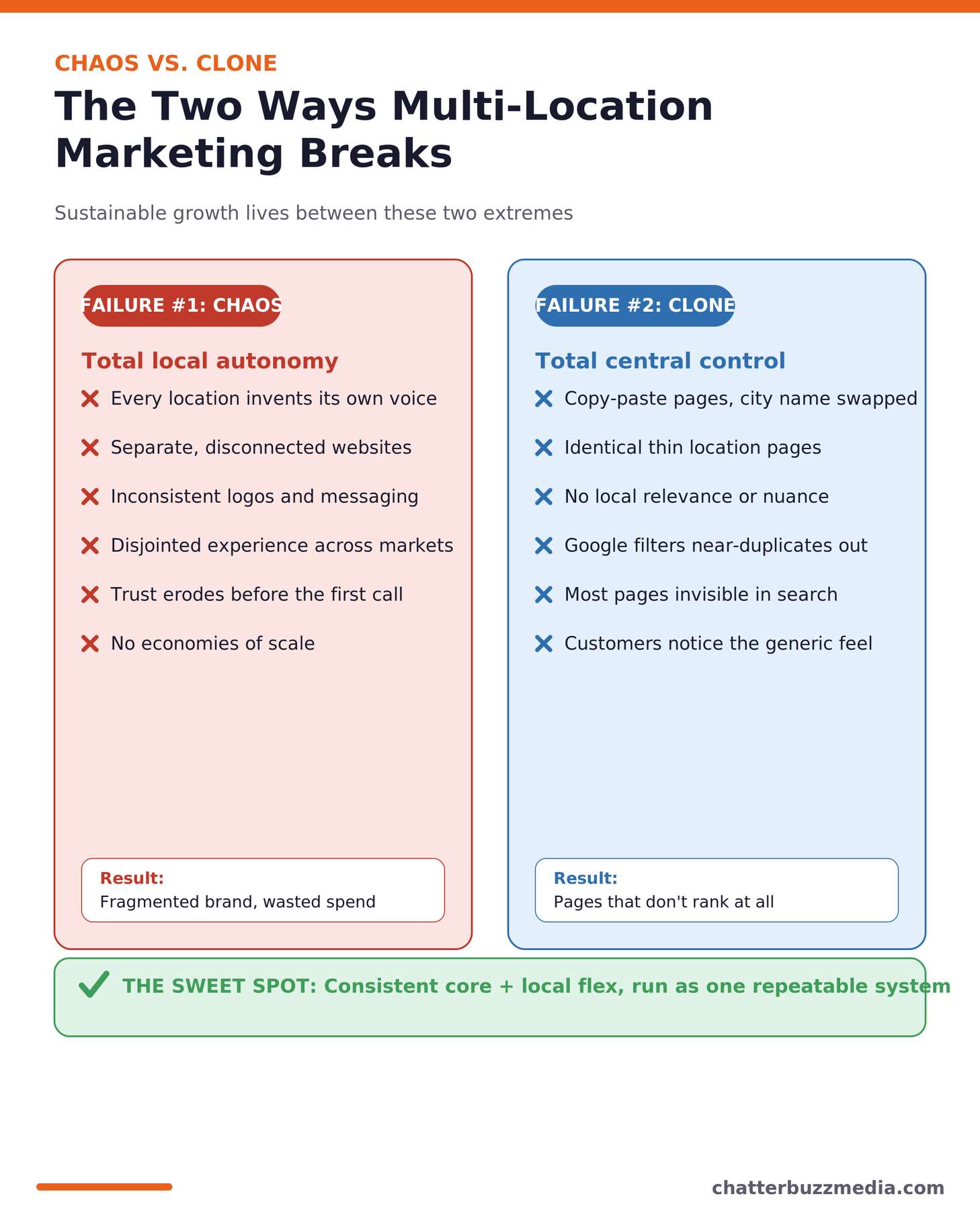
Most struggling programs fail in one of two opposite directions. The first is chaos — every location invents its own voice, its own offers, and sometimes its own website, so customers researching you across two markets get a disjointed experience that erodes trust.
The second is clone — corporate copy-pastes identical pages with only the city name swapped, and Google filters those near-duplicates out of search results. Sustainable growth lives in the narrow band between total control and total autonomy.
Why This Gets Exponentially Harder as You Scale
Complexity does not grow in a straight line as you add locations — it compounds. Every new market adds a profile to maintain, a reputation to defend, a page to keep fresh, and a budget to balance against neighbors.
Data management and attribution get messier at the same time, because national, regional, and local campaigns now overlap. Without a system, the work that kept three locations ranking quietly breaks at fifteen.
Build Your Brand Architecture Before You Add a Single Location
Brand architecture is the blueprint that decides what is identical everywhere and what adapts locally. Get it right and every later tactic runs on a stable foundation; skip it and you are negotiating brand decisions market by market forever.
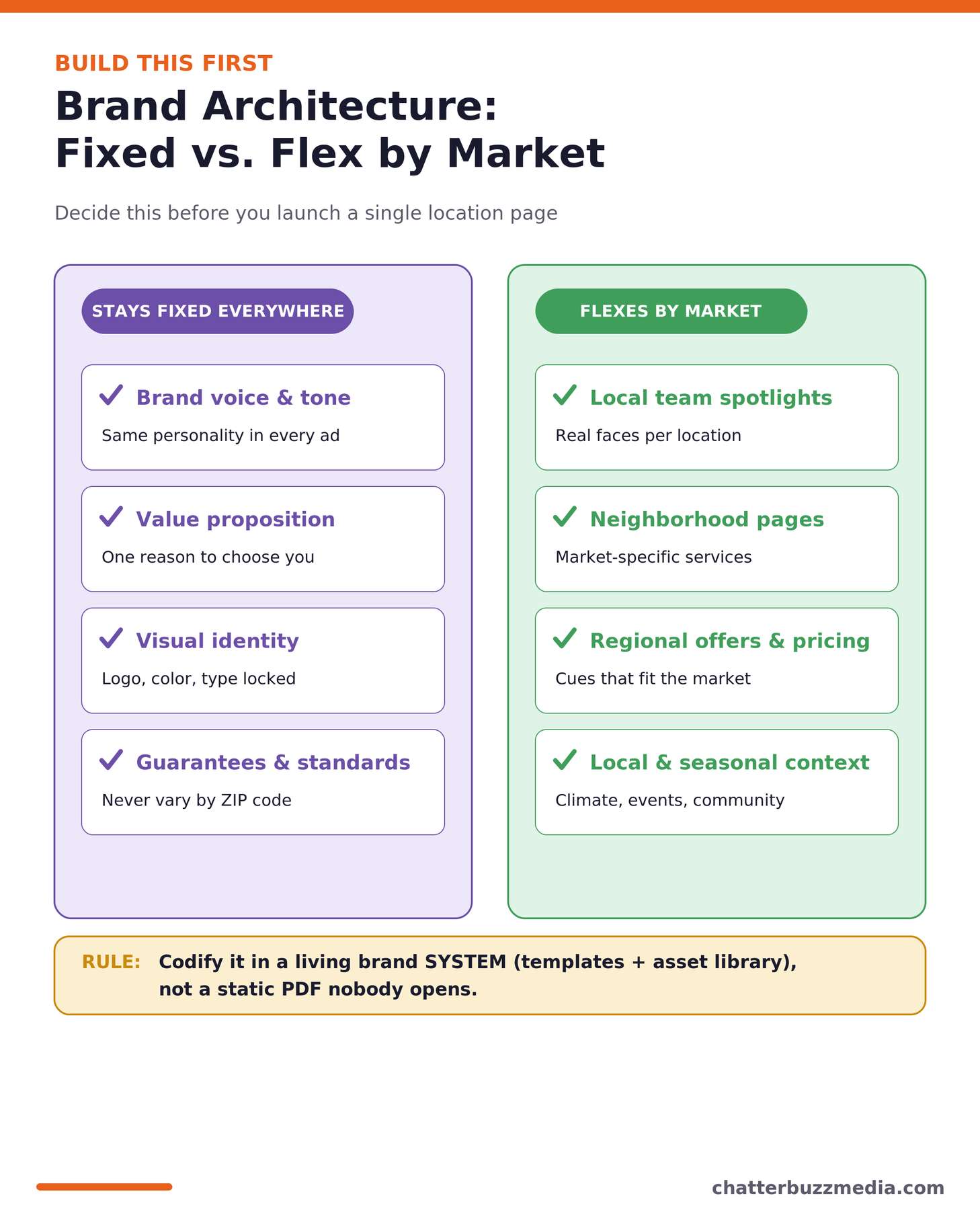
The goal is a clear line between the fixed core and the local flex. Here is how we draw that line for the multi-location brands we work with.
1. Define What Stays Fixed (The Non-Negotiables)
Some elements must be identical in every market to protect recognition and trust. These are the anchors customers use to know they are dealing with the same company no matter where they are.
The usual non-negotiables include:
- Brand voice and tone — the same personality in every caption, ad, and email.
- Core value proposition and promise — the reason to choose you, stated the same way everywhere.
- Visual identity — logo, color, type, and photography style locked to one system.
- Guarantees and service standards — warranties and commitments that never vary by ZIP code.
2. Define What Flexes by Market
The counterweight to consistency is genuine local relevance, and that requires deliberate room to flex. Customers now expect messaging that feels tailored to their community, not just their demographic.
What should flex by location includes local team spotlights, neighborhood-specific service pages, regional offers and pricing cues, and references to local climate, events, or seasonal demand. This is the layer that turns a national brand into a neighbor.
3. Codify It in a Brand System, Not a PDF
A static brand PDF that lives in a shared drive does not survive contact with thirty markets. You need a living system — templates, approved asset libraries, and lightweight guardrails — that makes the on-brand choice the easy choice.
This is exactly the kind of operational scaffolding a fractional CMO engagement is built to install, and it is the same rigor we bring to any digital marketing program that has to run consistently across teams.
Choose Your Operating Model: Centralized, Local, or Hybrid
Your operating model is the decision about who controls strategy, budget, and execution across the portfolio. It is the single choice that most determines whether your program feels coordinated or chaotic, and most winning brands land on a hybrid.
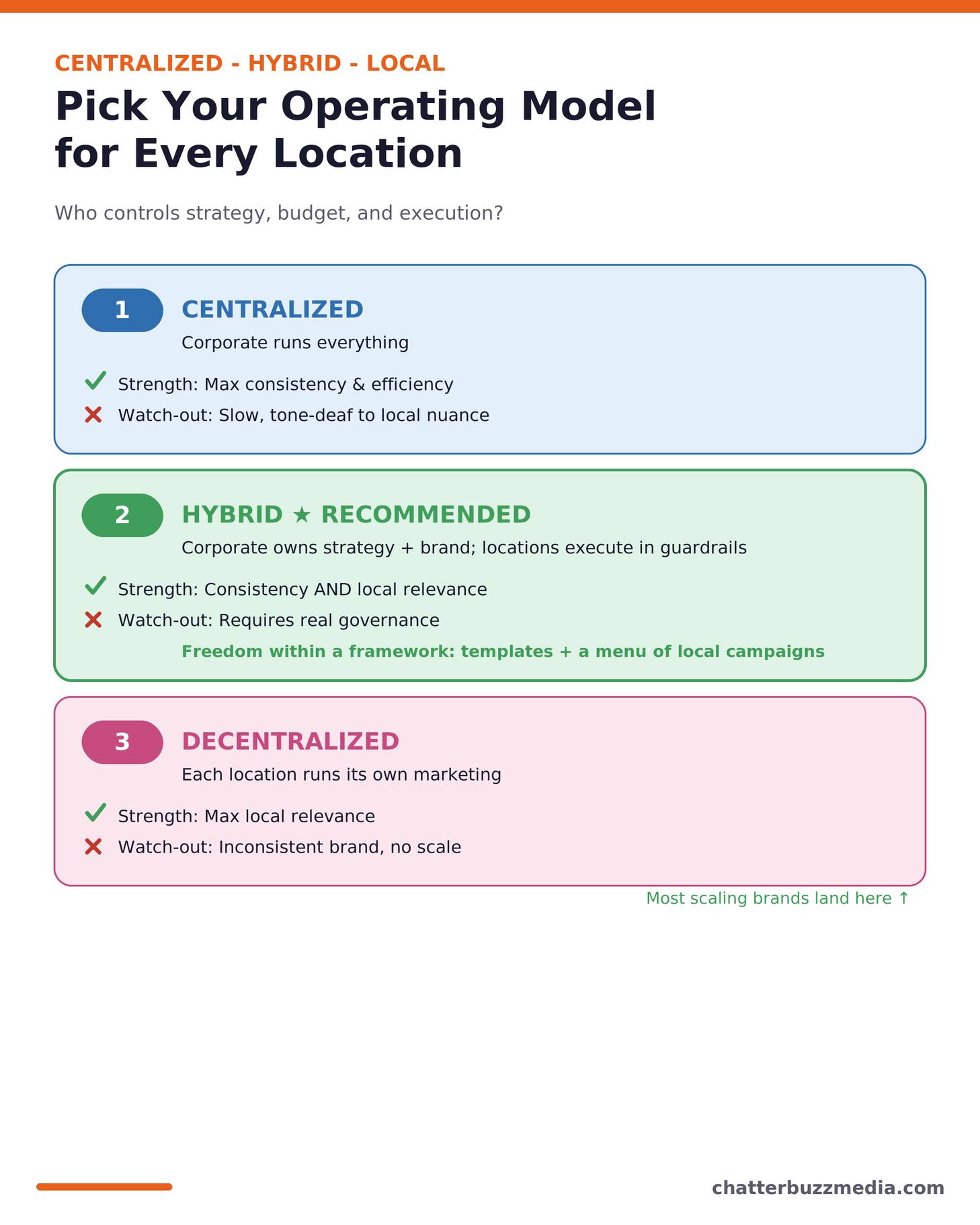
There is no universally correct answer — the right model depends on your team, your channels, and how much local nuance your markets actually demand. What matters is choosing deliberately instead of defaulting into one by accident.
The Three Models Compared
Each model trades control for speed and local relevance in a different way:
- Centralized — corporate runs everything. Maximum consistency and efficiency, but slow to adapt and often tone-deaf to local nuance.
- Decentralized (local) — each location runs its own marketing. Maximum local relevance, but inconsistent brand, duplicated effort, and no economies of scale.
- Hybrid — corporate owns strategy, brand, and shared infrastructure while locations execute within guardrails. The best of both, and the model we recommend for nearly every scaling brand.
Governance: Who Owns What
Governance is the piece most scaling plans overlook, and its absence is what lets a location’s page go stale for six months before anyone notices. As you add markets, you need explicit answers to who approves content, who owns each Google Business Profile, and who is accountable for each market’s numbers.
Build a simple ownership map before you need it. Corporate typically owns brand, national campaigns, and the martech stack, while regional or location leads own local content, community engagement, and reviews — with one clear approver in the middle.
The “Freedom Within a Framework” Playbook
The hybrid model works when locations get real freedom inside firm boundaries. Give them approved templates, a menu of pre-built local campaigns, and editable-but-guarded pages, so they can move fast without breaking the brand.
This mirrors the way great account-based marketing programs balance central orchestration with rep-level personalization. The framework protects consistency; the freedom protects relevance.
Local SEO at Scale: The System That Actually Ranks
Local SEO is where multi-location marketing is most often won or lost, because each location has to function as its own entity in Google’s eyes. That means a dedicated profile, unique local pages, and consistent data for every single address.
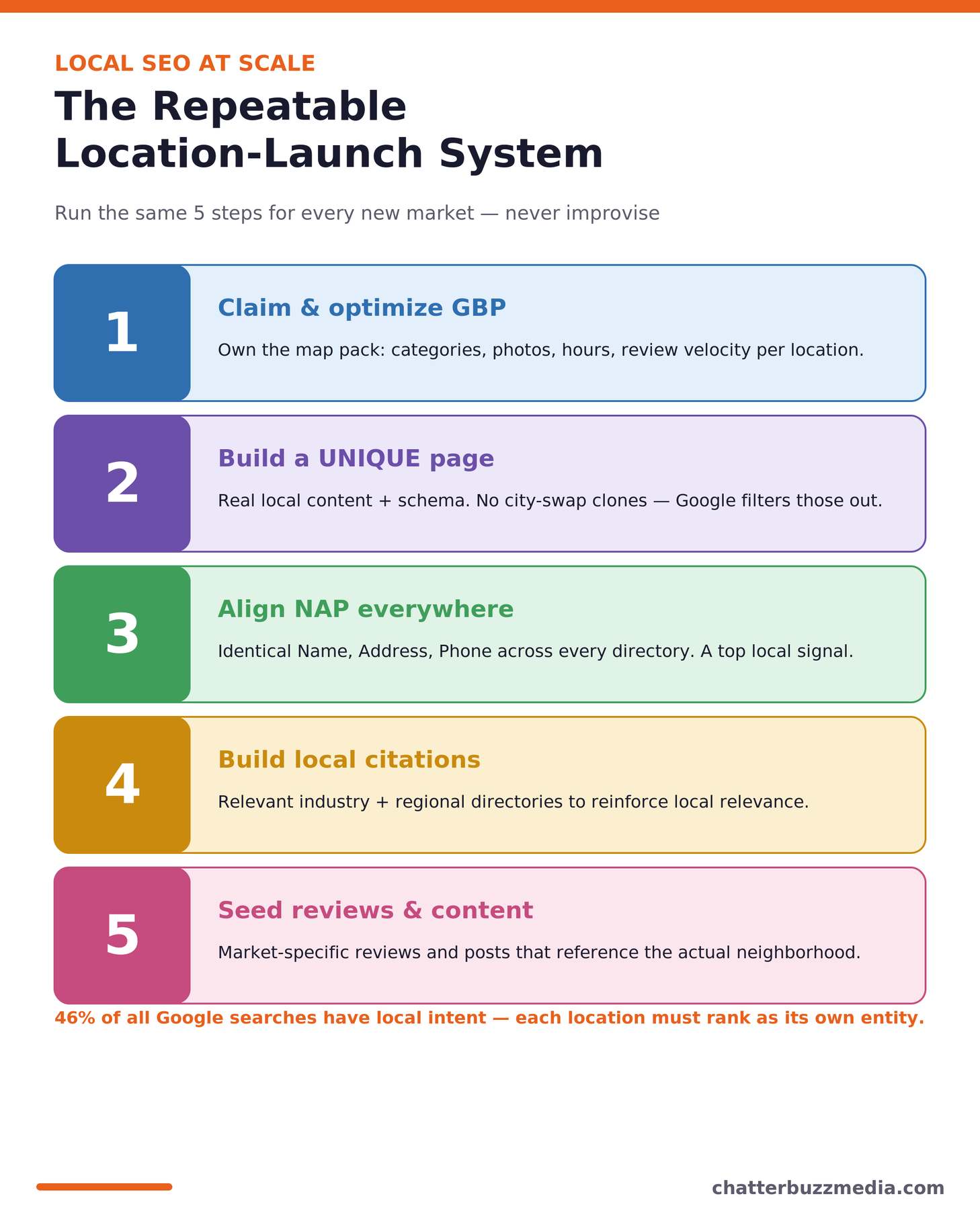
The brands ranking in forty markets are not doing anything magic — they are running a repeatable process instead of reacting one listing at a time. Here is the system.
Google Business Profile Per Location
The map pack is driven by your Google Business Profile, not your homepage, so each location needs its own fully optimized profile. Google ranks that pack on relevance, distance, and prominence — signals you influence through completeness, categories, photos, and review velocity.
Claim and verify every location, then keep hours, categories, services, and posts current. A neglected profile quietly surrenders the most valuable local real estate on the results page.
Location Pages That Don’t Trigger Duplicate Filters
Each location needs a unique, genuinely useful page — not a template with the city name swapped in. Google does not issue a formal duplicate-content penalty, but it filters near-identical pages out of results, which has the same practical effect on visibility according to multi-location SEO research from Rio SEO.
Give every page real local substance: the specific team, directions and parking, local reviews, market-specific services, and community references. This is the same architecture discipline we detail in our home builder SEO guide, where dozens of community pages have to rank without cannibalizing one another.
NAP Consistency and Citation Management
Your Name, Address, and Phone data has to be identical across every directory and listing. BrightLocal consistently ranks citation and NAP consistency among the top local search signals, because inconsistencies split authority and signal uncertainty to Google.
Audit your listings, fix conflicting variations, and manage them from a single source of truth. At scale, this is a listings-management job, not a spreadsheet job.
The Repeatable Location-Launch Checklist
Every new location should trigger the same standardized sequence, so nothing gets missed as you grow. Treat it as a system you run, not a project you improvise:
- Claim and fully optimize the Google Business Profile.
- Build a unique location page with real local content and schema.
- Audit and align NAP across every directory.
- Build local citations in relevant industry and regional directories.
- Seed reviews and local content that reference the specific market.
The National-Local Media Mix (And How to Budget It)
The national-local question is not whether to invest in one or the other — it is how to orchestrate both so they compound. National media builds the brand equity that makes local conversion cheaper, and local media turns that awareness into booked revenue.
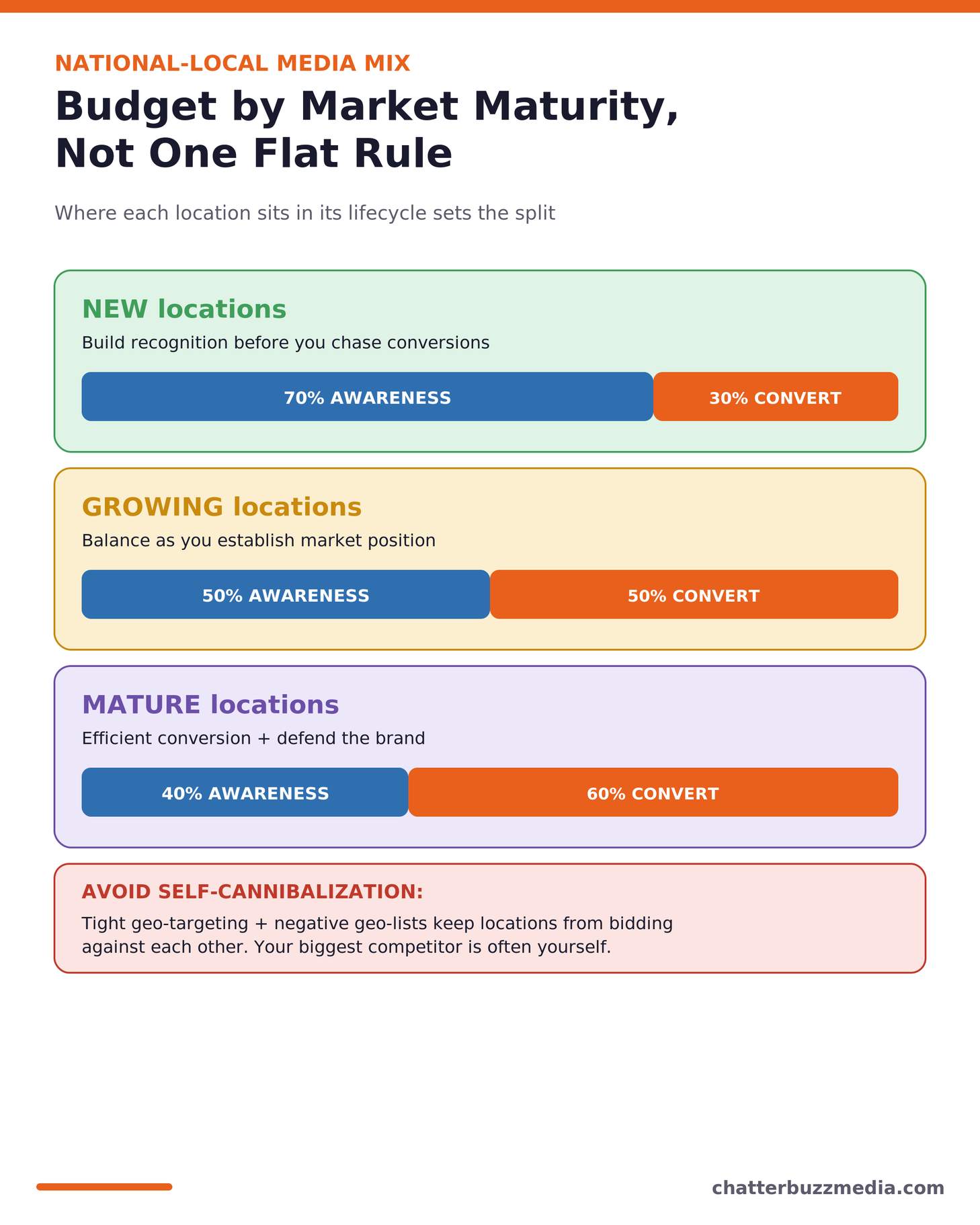
The mistake is treating them as competing line items. Handled well, national trust lowers your local cost per acquisition, and local proof reinforces the national brand.
Budget Allocation by Market Maturity
The right split depends on where each location sits in its lifecycle, not on a single company-wide rule. A brand-new market needs awareness; a mature market needs efficient conversion.
A practical framework by maturity:
- New locations: roughly 70% upper-funnel awareness and consideration, 30% conversion capture for early adopters.
- Growing locations: about a 50/50 split as recognition builds and you establish position.
- Mature locations: around 60% lower-funnel conversion and retargeting, 40% brand maintenance.
The constant across all three is presence at every funnel stage — abandoning brand building in mature markets creates the vulnerability competitors exploit.
How to Stop Your Locations From Cannibalizing Each Other
In multi-location marketing, your biggest competitor is often yourself. When one location’s campaign bleeds into a neighbor’s market, you inflate costs in shared areas and break attribution across both.
Prevent it with tight geo-targeting, clear market boundaries, negative geo-lists, and audience segmentation that keeps each location in its lane. The economics of demand generation only work when locations amplify each other instead of bidding against themselves.
Channel Roles: Awareness vs. Conversion
Give every channel a defined job in the funnel so budgets stop overlapping. National awareness lives in connected TV, programmatic, streaming audio, and social, while local conversion lives in geo-targeted paid search, local service ads, and location-based mobile.
Harvard Business Review makes the case plainly that brand building and performance marketing work best together, not in opposition. National creates trust at scale; local converts it into action.
Win AI Search and AI Overviews Across Every Market
AI Overviews and AI assistants are becoming the new front door to local discovery, and most multi-location brands are ignoring the channel entirely. Answer engine optimization is how you get your locations cited when a customer asks an AI for the best option near them.
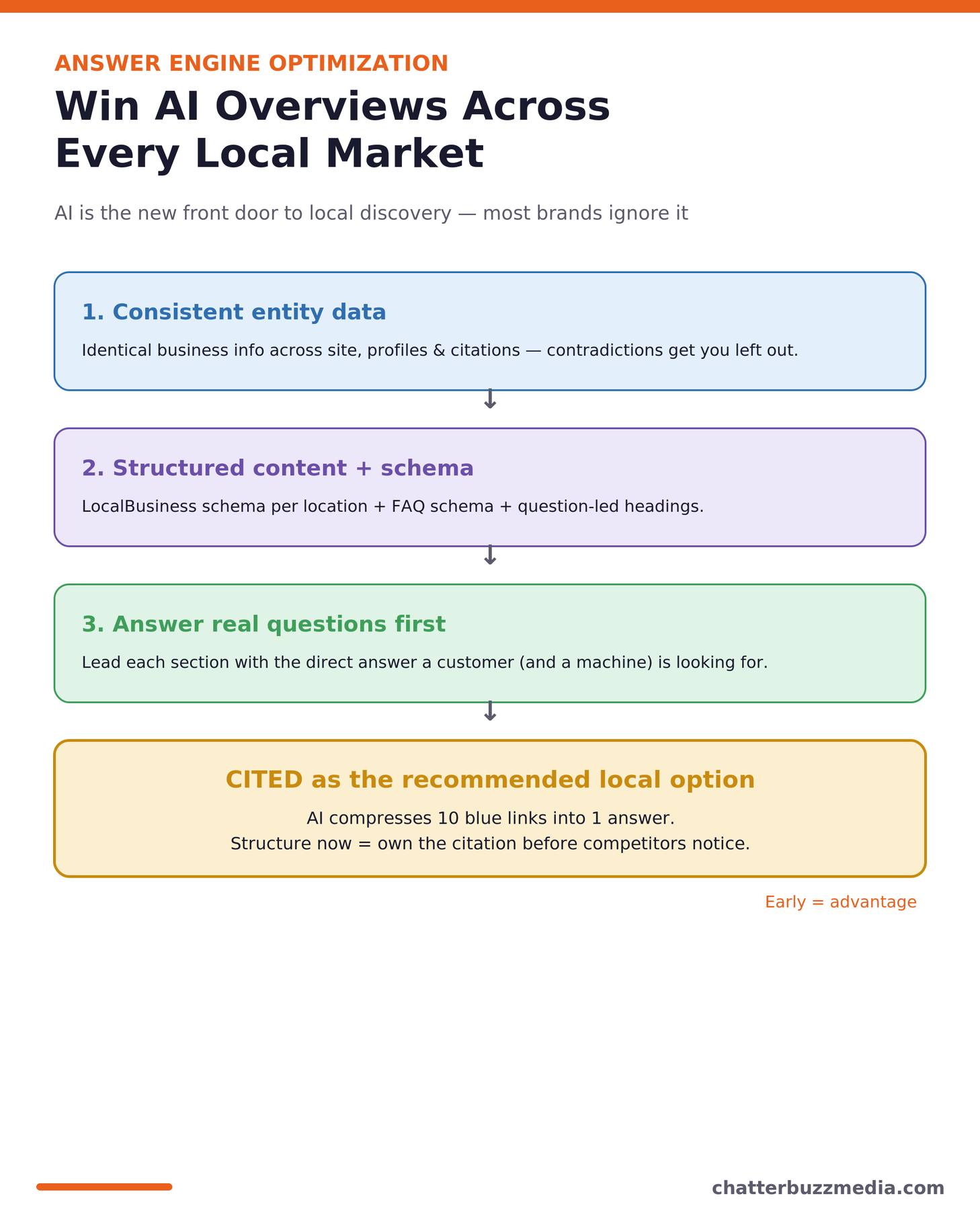
This is a rare window where being early is a real advantage. The brands that structure their content for machines now will own the citations before their competitors realize the door opened.
Why AI Search Changes Local Discovery
AI answers compress ten blue links into one recommendation, which raises the stakes on being the cited source. For local queries, that means the clarity and structure of your location data increasingly decides whether you appear at all.
Consistent entity information across your site, profiles, and citations is what makes you legible to these systems. Ambiguity gets you left out of the answer.
Structured Content and Schema for Multi-Location
Question-led content paired with structured data is what earns AI citations. Use LocalBusiness schema per location, FAQ schema on your service and location pages, and clear headings that directly answer real customer questions.
This is the same structured, answer-first approach we apply across our inbound marketing work, now aimed at machines as much as readers. Clean markup is no longer optional infrastructure.
Feeding the Machines Consistent Entity Data
AI systems assemble their picture of your business from many sources, so contradictions between your site, your listings, and third-party data actively hurt you. One conflicting address or phone number introduces the doubt that keeps you out of the recommendation.
Treat your entity data as a single asset managed centrally. Consistency is the cheapest AI-visibility investment you can make across a large portfolio.
Build the Martech Stack That Scales With You
As you grow, managing campaigns, listings, and data across locations becomes impossible by hand, and the right technology is what keeps it sane. Your stack should centralize control while still allowing local flexibility, without requiring a developer for every update.
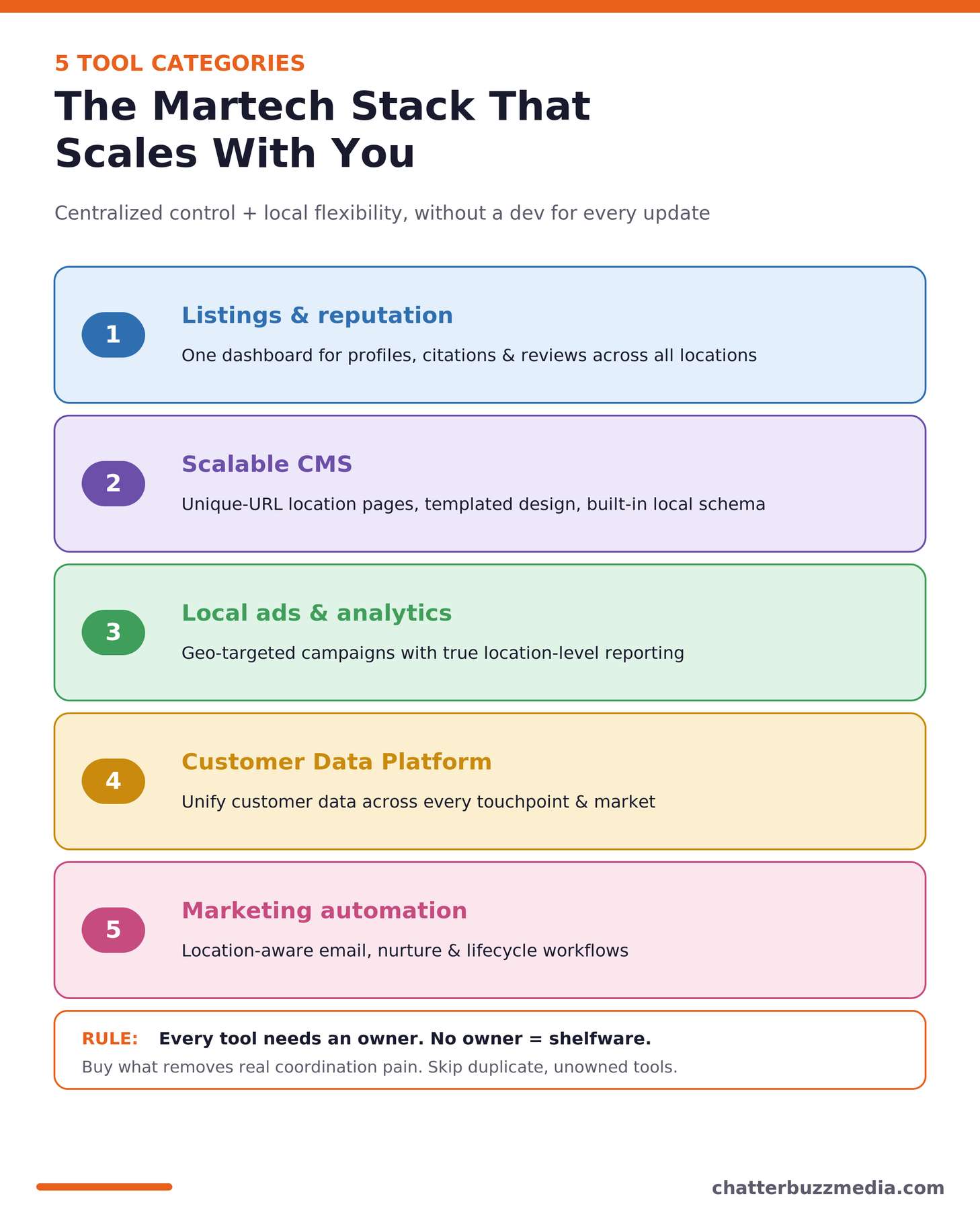
The platform matters less than the strategy running on it — a poorly structured program underperforms on any tool. Still, the right categories of technology are what let a small team run a large footprint.
The Five Tool Categories You Actually Need
Most multi-location stacks come down to five jobs to be done:
- Listings and reputation management — one dashboard for profiles, citations, and reviews across every location.
- A scalable CMS — location pages with unique URLs, templated design, and built-in local schema.
- Local advertising and analytics — geo-targeted campaigns with location-level reporting.
- A customer data platform — unified customer data across touchpoints and markets.
- Marketing automation — location-aware email, nurture, and lifecycle workflows.
Centralize Data With a CDP
A customer data platform pulls signals from every location and touchpoint into one accessible, actionable database. That unified view is what makes real personalization and honest cross-market comparison possible.
Without it, each location becomes a data island and your best insights never travel. The compounding value of a well-run marketing automation engine depends on that clean, centralized data underneath.
What to Buy vs. What to Skip
Buy the platforms that remove genuine coordination pain — listings management and location-level analytics earn their cost almost immediately at scale. Skip the shiny tools that duplicate capabilities you already own or that no one on the team has time to run.
Every tool you add is a tool someone must own and maintain. If there is no clear owner, the platform becomes shelfware no matter how good the demo looked.
Measure What Matters: Attribution Across a Portfolio
Multi-location measurement creates complexity that traditional single-touch attribution was never built to handle. When national, regional, and local campaigns run at once across dozens of markets, last-click reporting actively misleads you.
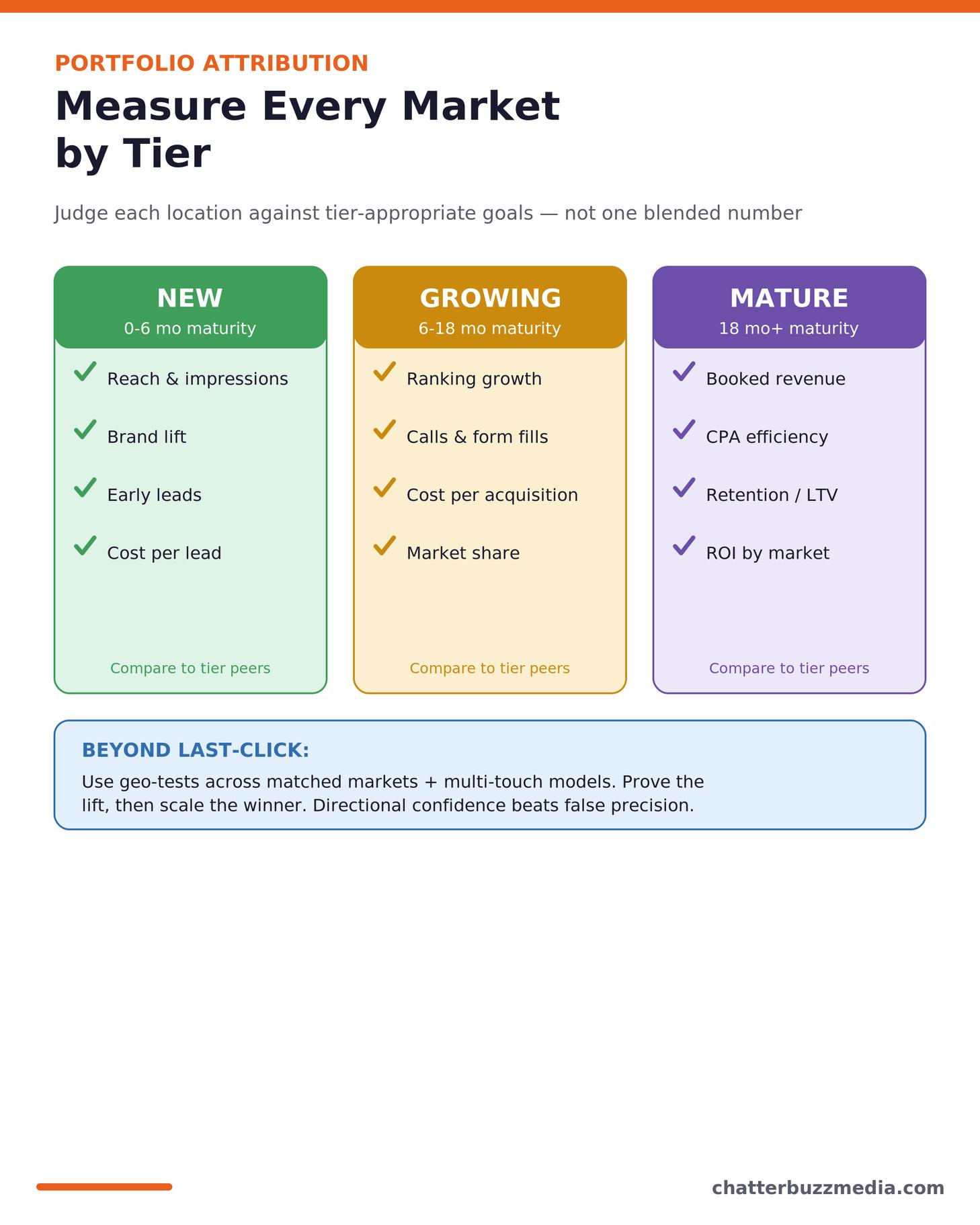
The fix is a measurement architecture designed for a portfolio, with clear rules for what you track at the location, regional, and national levels. You measure the system and the markets, not just the last ad clicked.
The Location Scorecard by Tier
Group locations into tiers — new, growing, and mature — and judge each against tier-appropriate goals. Holding a three-month-old market to a mature market’s cost per acquisition tells you nothing useful and demoralizes good local teams.
Track a consistent scorecard per location: local visibility and rankings, calls and form fills, cost per acquisition, and completed revenue. Compare each market to its tier peers, and your reallocation decisions become obvious.
Attribution Models That Survive Multi-Touch Reality
Move past last-click to models that credit the brand building that made conversion possible. Foot-traffic studies, geo-level performance tracking, and multi-touch models give you a far truer read on what actually drives results.
The point is not perfect attribution — it is directional confidence to move budget on evidence instead of intuition. That confidence is the entire payoff of doing measurement properly.
Geo-Testing and Learning Agendas
Turn your portfolio into a laboratory by running controlled geo-tests across similar markets. Test a different national-local split in matched cities, measure the lift, and scale what wins.
A structured learning agenda compounds an advantage competitors cannot copy, because it is grounded in your own markets. Over time, your program gets smarter every quarter instead of just busier.
In-House, Agency, or Hybrid: How to Resource Multi-Location Marketing
The last decision is who actually does the work, and there is no single right answer. The best structure depends on your headcount, the number and diversity of your markets, and how much specialized capability you need on demand.
Many scaling brands land on a hybrid: a lean internal team for brand and coordination, plus a partner for specialized execution at scale. The goal is capability and consistency, not simply the lowest cost.
When In-House Makes Sense
An internal team is strongest when your markets are similar, your channel mix is stable, and institutional knowledge matters more than specialized range. In-house owners live the brand daily and move fast on what they already know.
The limits show up in specialized skills and surge capacity, from technical SEO to creative production across many markets. Few internal teams can staff every discipline a large footprint demands.
When to Bring In a Partner
A partner earns its keep when you need range, scale, and speed your team cannot staff alone. Launching many markets at once, standing up local SEO at scale, or running always-on paid media across regions are classic triggers.
The right agency brings a system and a process, not just extra hands. That is the difference between buying capacity and buying capability.
What to Look for in a Multi-Location Marketing Agency
Look for a partner who leads with your market and your goals rather than a generic checklist. They should show real multi-market experience, a repeatable location-launch process, and transparent location-level reporting.
We bring an engineer-first, CFO-minded approach to exactly this problem across verticals — from home builders to healthcare to B2B — with teams working out of Orlando, Tampa, and New York City. The right partner should make your program more predictable, not more complicated.
Conclusion: Build the System Before You Need It
Multi-location marketing is most effective when you treat it as a single system rather than a stack of disconnected campaigns. Get your brand architecture right, choose a hybrid operating model with real governance, run local SEO as a repeatable process, budget national and local as partners, and measure every market by tier.
The brands that scale from three markets to thirty without the chaos are the ones that build the engine before they need it. If you are ready to turn a growing footprint into a compounding growth channel, our team is ready to help you build it.
Frequently Asked Questions About Multi-Location Marketing
What is multi-location marketing?
Multi-location marketing is the practice of planning and executing marketing across multiple physical locations while maintaining one consistent brand and staying locally relevant in each market. It combines centralized strategy — brand, national campaigns, and shared technology — with local execution like Google Business Profiles, location pages, and community engagement for each address.
How do you market multiple business locations effectively?
Start by defining your brand architecture — what stays fixed everywhere and what flexes by market — then choose a hybrid operating model with clear ownership. From there, run local SEO as a repeatable per-location system, budget national and local media by each market’s maturity, and measure results by location tier rather than one blended number.
What is the difference between multi-location and franchise marketing?
Multi-location marketing covers any brand operating several company-owned locations, where corporate usually controls strategy and budget. Franchise marketing adds an ownership split: corporate owns the brand while independent franchisees own local execution and spend, which makes brand guidelines, templates, and governance even more critical to prevent drift.
How do you maintain brand consistency across multiple locations?
Codify a clear brand system — voice, value proposition, and visual identity — into living templates and approved asset libraries rather than a static PDF. Then give locations freedom within that framework, using pre-built local campaigns and guarded page templates, plus periodic brand audits to catch drift across markets.
How much should you budget for multi-location marketing?
Budget by each location’s maturity instead of a single flat rule. New markets typically weight around 70% toward awareness and 30% toward conversion, growing markets run closer to a 50/50 split, and mature markets shift to roughly 60% conversion and 40% brand maintenance — while always keeping some presence across the full funnel.
How do you stop locations from competing against each other?
Market cannibalization happens when one location’s campaigns bleed into a neighbor’s territory, inflating costs and breaking attribution. Prevent it with tight geo-targeting, defined market boundaries, negative geo-lists, and audience segmentation so each location stays in its own lane and locations amplify rather than undercut each other.
How do you measure multi-location marketing success?
Use a portfolio measurement architecture that tracks results at the location, regional, and national levels rather than relying on last-click. Score each location against tier-appropriate goals — visibility, calls and form fills, cost per acquisition, and completed revenue — and use geo-testing to prove what drives lift before you scale it.
How long does multi-location marketing take to show results?
Paid media can generate visibility and leads in specific markets almost immediately, while local SEO and brand-building compound over several months. The durable advantage comes from combining both and running the same repeatable system in every market, so each new location ramps faster than the last.