
 321-236-2899
Every year, fintech companies pour millions into marketing agencies that treat financial technology like any other SaaS product. They run the same playbook — generic paid ads, boilerplate blog posts, templated email sequences — and then wonder why customer acquisition costs keep climbing while conversion rates flatline.
The problem isn’t marketing itself. It’s that fintech operates under constraints most agencies have never navigated: regulatory compliance frameworks, trust-deficit buyer psychology, and advertising platforms that flag or reject financial promotions without warning. The global fintech market is projected to reach $460 billion in 2026 and $1.76 trillion by 2034, according to Fortune Business Insights. That growth is attracting fierce competition — and the companies winning market share are the ones partnering with agencies that understand the terrain.
This guide breaks down exactly what a fintech marketing agency should deliver, how to evaluate one, what the engagement actually costs, and which strategies produce measurable growth in 2026’s landscape. Whether you’re a Series B neobank or an established payments company rethinking your agency relationship, you’ll walk away with a clear framework for choosing the right performance partner.
Key Takeaways
- Generalist agencies cost fintech companies more in the long run — compliance mistakes, rejected ad creatives, and misaligned messaging burn budget faster than higher agency fees ever will.
- A qualified fintech marketing agency must demonstrate regulatory fluency across KYC/AML, GDPR, and financial advertising policies on Meta, Google, and LinkedIn before you sign a contract.
- Fintech customer acquisition costs have risen 40-60% since 2023 — making marketing efficiency ratio and LTV:CAC optimization non-negotiable capabilities for any agency partner.
- The first 90 days with a new agency determine long-term success — structured onboarding with clear discovery, strategy, and execution phases prevents the “churn and burn” cycle.
- AI search visibility and generative engine optimization (GEO) are table stakes in 2026 — agencies that only optimize for traditional SERPs are already behind.
Why Fintech Companies Need a Specialized Marketing Agency
Fintech marketing isn’t harder than other industries — it’s differently hard. The combination of regulatory oversight, trust-sensitive buyers, and multi-stakeholder decision-making creates a marketing environment where generalist playbooks actively work against you.
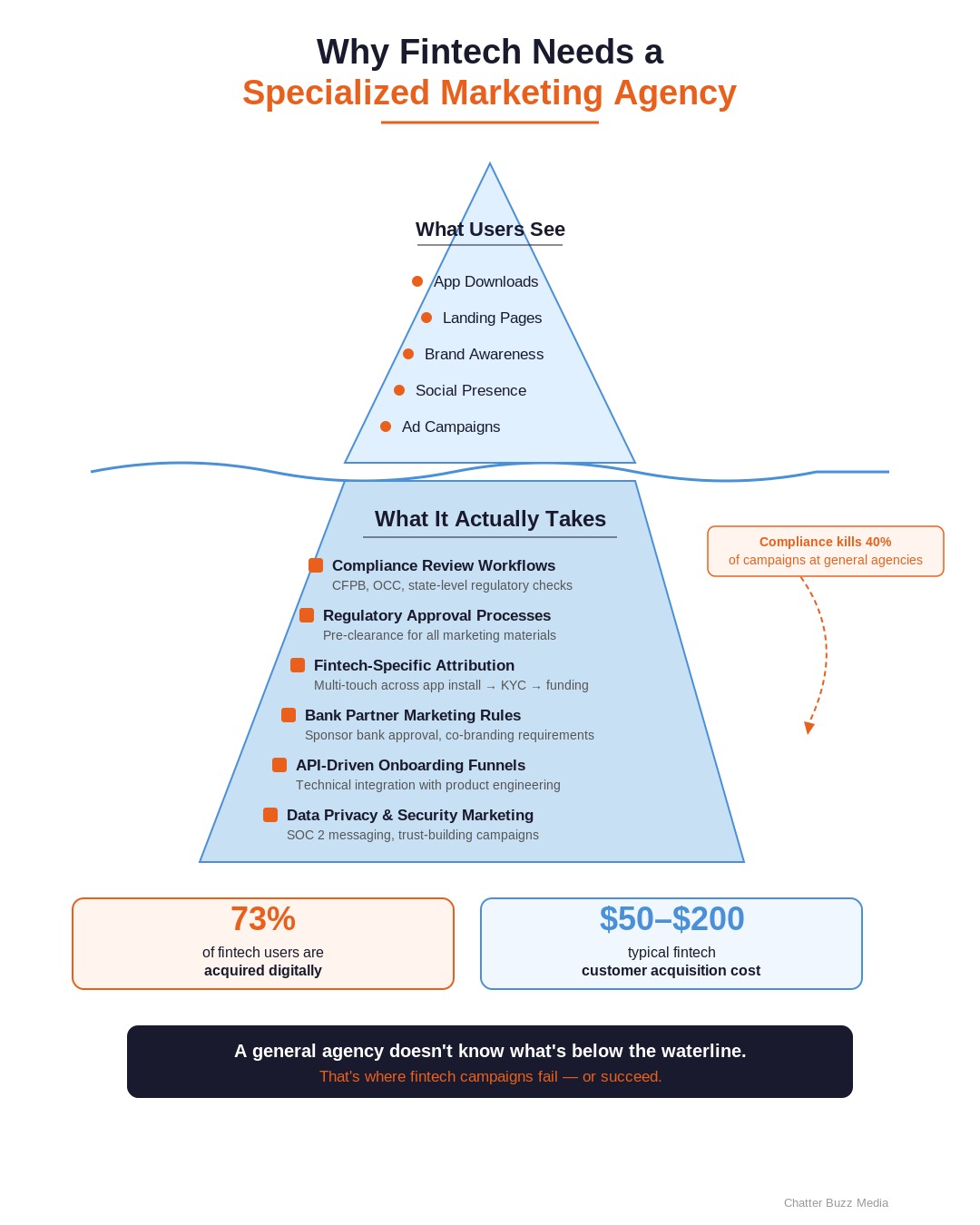
A specialized fintech marketing agency doesn’t just know how to run campaigns. It knows which campaigns will survive compliance review, resonate with risk-averse buyers, and produce revenue — not just impressions.
Compliance and Regulatory Fluency
Financial services advertising is one of the most regulated categories in digital marketing. Every ad, landing page, email, and social post must navigate a web of requirements including KYC (Know Your Customer), AML (Anti-Money Laundering), GDPR, and jurisdiction-specific regulations from bodies like the FCA, SEC, and FINRA.
But regulatory compliance extends beyond legal disclaimers on landing pages. Meta, Google, and LinkedIn each enforce their own financial products advertising policies — policies that change frequently and vary by product category, geography, and advertiser certification status.
- Google Ads requires specific certifications for cryptocurrency, lending, and credit products — and restricts targeting options for financial services advertisers.
- Meta’s financial products policy prohibits misleading claims about returns, requires clear fee disclosures, and can reject entire ad accounts without warning.
- LinkedIn restricts financial service ads in specific regions and requires documentation proving regulatory authorization.
A generalist agency learns these rules reactively — after ads get rejected, accounts get flagged, or worse, after a compliance violation triggers regulatory scrutiny. A fintech-specialized agency builds compliance into the creative process from the start, reducing delays and protecting your brand.
Understanding the regulatory landscape is foundational, but compliance alone doesn’t win customers. Your agency also needs to understand how fintech buyers think.
Trust-Driven Buyer Psychology
Financial products carry inherent risk perception that most technology products don’t. When someone evaluates a project management tool, the worst-case scenario is wasted time. When someone evaluates a fintech platform, the worst-case scenario involves their money, their data, or their regulatory standing.
According to Deloitte’s 2024 research, 67% of fintech buyers won’t adopt a new financial technology solution without substantial trust signals. That means your marketing must do more than generate interest — it must systematically dismantle objections around security, reliability, and regulatory compliance before a prospect ever talks to sales.
- Social proof architecture — case studies, regulatory certifications, and third-party security audits positioned at every stage of the funnel.
- Transparency-first messaging — clear pricing, explicit data handling practices, and upfront fee disclosures that build credibility rather than burying risk.
- Authority positioning — thought leadership content that demonstrates deep domain expertise, not surface-level fintech commentary.
A specialized agency understands that trust is the conversion mechanism in fintech — not clever copy or aggressive retargeting. They build campaigns that earn trust at each touchpoint, from first click to closed deal.
Complex Multi-Stakeholder Sales Cycles
Most B2B fintech sales involve multiple decision-makers — often spanning finance, compliance, IT, and executive leadership. Each stakeholder evaluates your solution through a different lens, and your marketing must address all of them simultaneously.
The CFO cares about ROI and total cost of ownership. The compliance officer needs to know you won’t create regulatory exposure. The CTO evaluates integration complexity and security architecture. A fintech marketing agency that only targets one persona leaves the other stakeholders to be convinced by competitors.
Effective account-based marketing strategies address this by creating stakeholder-specific content journeys that align messaging to each buyer’s priorities. This isn’t something you can template — it requires deep understanding of fintech buying committees and how decisions actually get made.
Now that we’ve established why specialization matters, let’s look at the specific services a fintech marketing agency should bring to the table.
Core Services a Fintech Marketing Agency Should Deliver
Not every fintech marketing company offers the same depth of service, and not every service matters equally for your growth stage. But there are five capability areas that separate agencies who understand fintech from those who simply list it as an industry they serve.
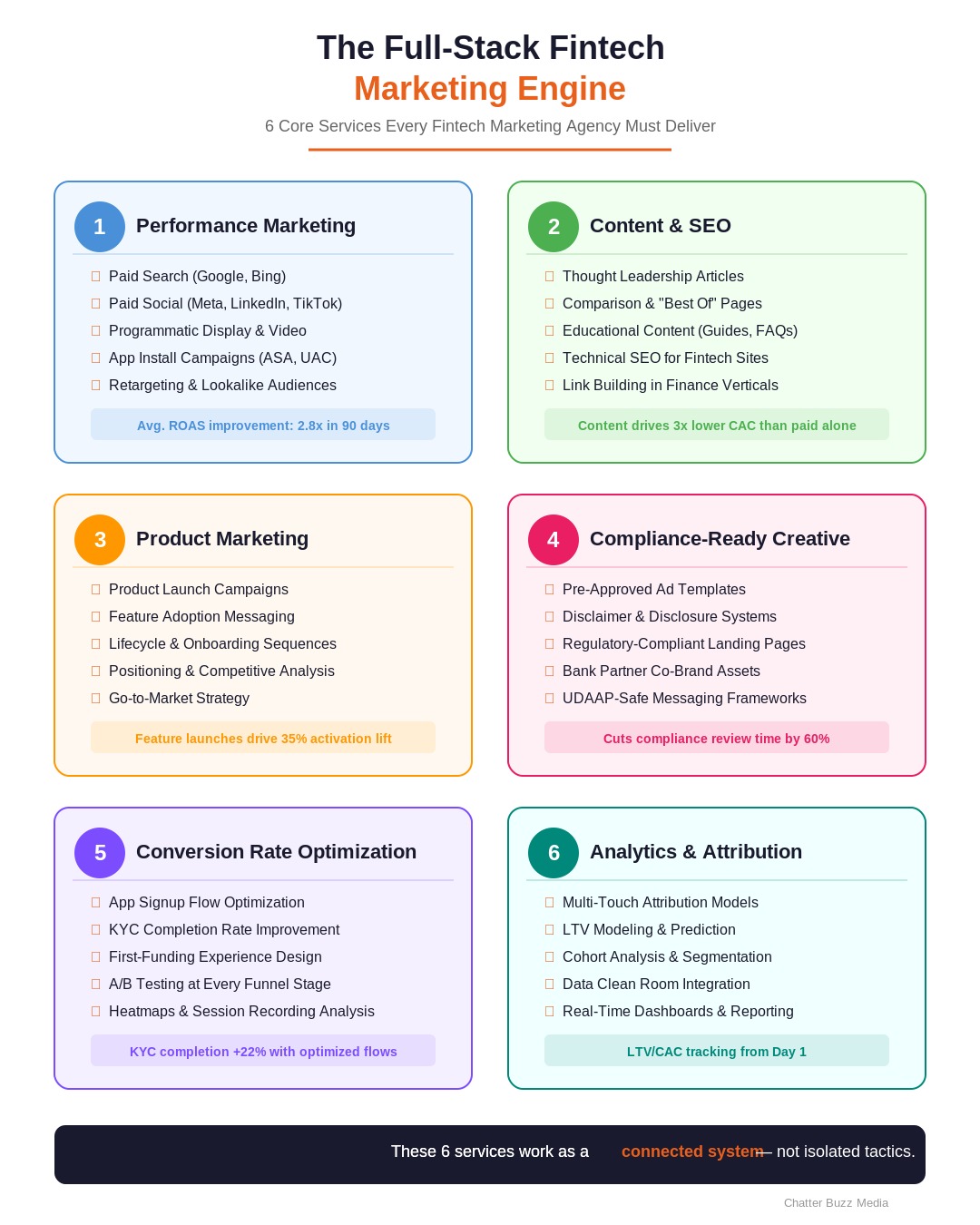
Here’s what each service should look like when it’s built for the fintech context.
SEO and Generative Engine Optimization (GEO)
Traditional SEO still matters in fintech — high-intent keywords like “business banking API” or “payment processing for SaaS” drive qualified pipeline. But in 2026, organic visibility means appearing in AI-generated answers, not just traditional search results.
Generative engine optimization (GEO) focuses on structuring your content so that AI models — ChatGPT, Gemini, Perplexity, and others — cite your brand when users ask fintech-related questions. This requires a fundamentally different content architecture than traditional SEO.
- Entity-based content strategies that establish your brand as a topical authority across interconnected fintech concepts.
- Structured data and semantic markup that helps AI models understand and cite your content accurately.
- Long-form resource content — like this demand generation guide — that covers topics comprehensively enough to become a training signal for AI models.
- EEAT signals (Experience, Expertise, Authoritativeness, Trustworthiness) baked into every page, especially critical for YMYL (Your Money, Your Life) fintech content.
A fintech marketing agency should show you how they approach both traditional SERP rankings and AI search visibility. If they’re only optimizing for Google’s ten blue links, they’re solving last decade’s problem.
Performance-Driven Paid Media
Paid media in fintech isn’t just about getting ads approved — it’s about building a media strategy that accounts for longer sales cycles, higher CPAs, and regulatory constraints on targeting. A fintech advertising agency should demonstrate expertise across the platforms where your buyers actually spend time.
That typically means a multi-channel approach combining Google Ads (including Performance Max with manual guardrails), LinkedIn for B2B fintech, and programmatic display for retargeting. Each channel requires fintech-specific knowledge.
- Google’s financial services certification requirements and how to maintain advertiser status without interruption.
- LinkedIn’s account-based targeting capabilities for reaching specific job titles at target accounts in banking, insurance, and financial services.
- Compliant ad creative frameworks that pass platform review on the first submission rather than burning cycles on rejections.
- Attribution models that account for 60-180 day sales cycles rather than optimizing for last-click conversions that misallocate budget.
The right fintech agency doesn’t just manage your ad spend — they architect a paid media system that connects spend to pipeline and revenue, not just leads and clicks.
Compliance-Safe Content Marketing
Content marketing in fintech walks a tightrope. You need content that educates, builds trust, and drives organic traffic — but every piece must survive compliance review without losing its edge.
The best fintech content marketing doesn’t treat compliance as a hurdle. It treats regulatory knowledge as a competitive advantage — producing content that competitors without compliance fluency simply can’t create.
- Regulatory explainer content that positions your brand as a trusted guide through complex compliance landscapes.
- Data-driven research reports that generate backlinks, media coverage, and thought leadership positioning.
- Product-adjacent educational content that addresses buyer pain points without making regulated claims about your product.
- Case studies structured to demonstrate results while respecting client confidentiality requirements common in financial services.
Your agency should have a documented compliance review workflow for content — not just a note that says “legal will check it later.” That workflow should include pre-production compliance briefing, mid-production review checkpoints, and final sign-off protocols.
Branding and Conversion-Focused Design
Fintech branding occupies a unique space: it must communicate innovation and reliability simultaneously. Push too far toward “disruptive startup” and you erode trust. Lean too hard into “established institution” and you lose the differentiation that makes fintech compelling.
A fintech marketing agency should deliver design that converts — not just design that looks good in a portfolio. That means landing pages optimized for fintech buyer behavior, where trust signals, security badges, and social proof are integrated into the conversion flow rather than tacked on as afterthoughts.
- Conversion-optimized landing pages with fintech-specific trust elements (SOC 2 badges, regulatory certifications, security architecture callouts).
- Product demo and trial flows designed for the risk-averse fintech buyer who needs more reassurance than a typical SaaS user.
- Brand systems that scale across regulatory environments, product lines, and geographic markets.
RevOps Integration and Marketing Analytics
Marketing data in a vacuum is meaningless for fintech companies, where the distance between a marketing-qualified lead and closed revenue can span six months or more. A fintech marketing agency must connect its work to your revenue operations stack.
This means integrating with your CRM, building attribution models that account for multi-touch, long-cycle B2B buying journeys, and reporting on metrics that your CFO actually cares about — not vanity numbers that look good in a monthly deck. Understanding marketing automation workflows is essential for tracking these complex buyer journeys.
- Multi-touch attribution that assigns appropriate credit across a 90-180 day sales cycle.
- Pipeline velocity tracking — not just lead volume, but how quickly marketing-sourced leads move through your funnel.
- Marketing efficiency ratio (MER) reporting that connects total marketing spend to total revenue generated.
- Cohort analysis that tracks LTV by acquisition channel and campaign to identify your most profitable customer sources.
With a clear picture of what services to look for, the next question is how to separate agencies that genuinely deliver these capabilities from those that merely list them on their website.
How to Evaluate a Fintech Marketing Agency
Every agency claims fintech expertise on their website. The gap between claimed expertise and actual capability is where most fintech companies make expensive mistakes. Here’s a concrete evaluation framework that surfaces the truth before you sign a retainer.
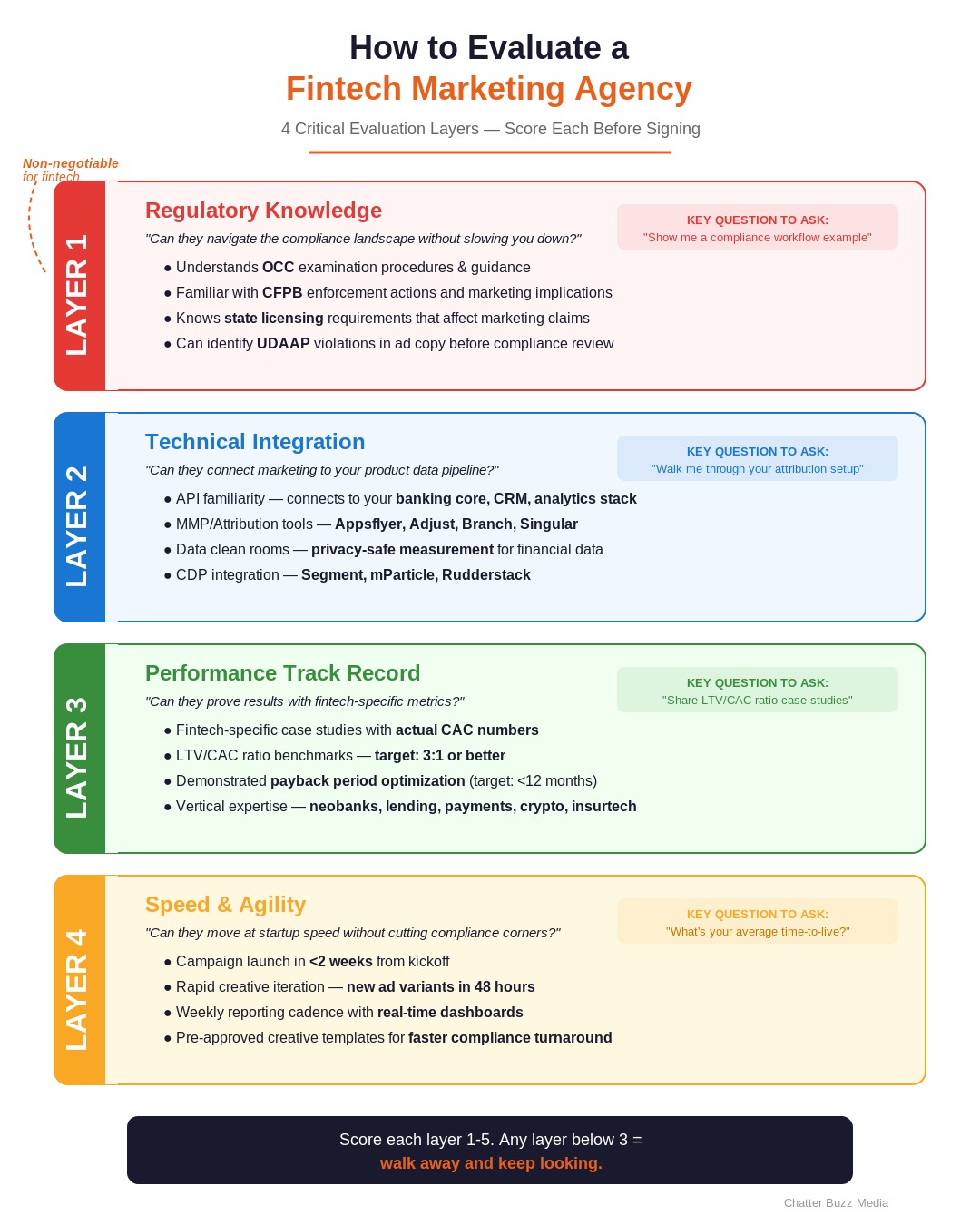
Demand Fintech-Specific Case Studies
Generic “financial services” case studies aren’t enough. A lending platform, a B2B payments API, and a consumer neobank face completely different marketing challenges — an agency that lumps them together probably doesn’t understand the nuances of any of them.
Ask to see case studies from companies at your growth stage, in your sub-vertical, targeting your buyer profile. If the agency can’t produce at least two relevant examples, that’s a data point worth weighing heavily.
- Look for specific metrics — cost per qualified lead, pipeline contribution, customer acquisition cost reduction, or revenue influenced.
- Ask about campaign duration — results from a 90-day sprint don’t tell you whether the agency can sustain performance over 12-18 months.
- Request client references and ask those references about the agency’s compliance capabilities, responsiveness, and strategic thinking.
Assess Their Compliance Workflow
This is the single most revealing question you can ask a prospective fintech marketing agency: “Walk me through your compliance review process for a paid ad campaign.” The answer tells you everything about their readiness to work in regulated markets.
Agencies with genuine fintech experience will describe a structured process — pre-production compliance briefs, platform-specific creative guidelines, review checkpoints before launch, and monitoring protocols for post-launch compliance. Agencies without real experience will mumble something about “running things by legal.”
Prioritize Performance Metrics Over Vanity Numbers
If an agency leads with impressions, clicks, and social media followers in their pitch, they’re telling you what they optimize for — and it’s not revenue. Fintech marketing requires a direct line from marketing activity to business outcomes.
The right agency talks about customer acquisition cost, cost per qualified opportunity, pipeline velocity, and marketing-sourced revenue. They understand the metrics covered in a thorough financial services marketing evaluation.
- CAC by channel and campaign — not blended averages that hide underperforming spend.
- Sales cycle compression — how their marketing reduces time-to-close, not just time-to-lead.
- LTV:CAC ratio improvement — demonstrating they optimize for customer quality, not just quantity.
Evaluate Their Technology and Attribution Stack
Ask what tools the agency uses and how they integrate with your existing tech stack. A fintech marketing agency should be platform-agnostic but technically proficient — able to work within your CRM, analytics, and marketing automation environment rather than forcing you onto their preferred tools.
Pay special attention to their attribution methodology. Agencies that rely solely on platform-reported conversions (Google Ads says, Meta says) are reporting inflated numbers that don’t match your actual revenue. Sophisticated agencies use independent attribution alongside platform data to give you an honest picture.
Understanding what to look for is half the battle. The other half is deciding whether you need an agency at all — or whether an in-house team better fits your situation.
In-House Marketing vs. Fintech Agency: When Each Makes Sense
This isn’t a binary decision, and any agency that tells you in-house marketing never works is selling you something. The right answer depends on your growth stage, budget, regulatory complexity, and the talent you can realistically attract and retain.
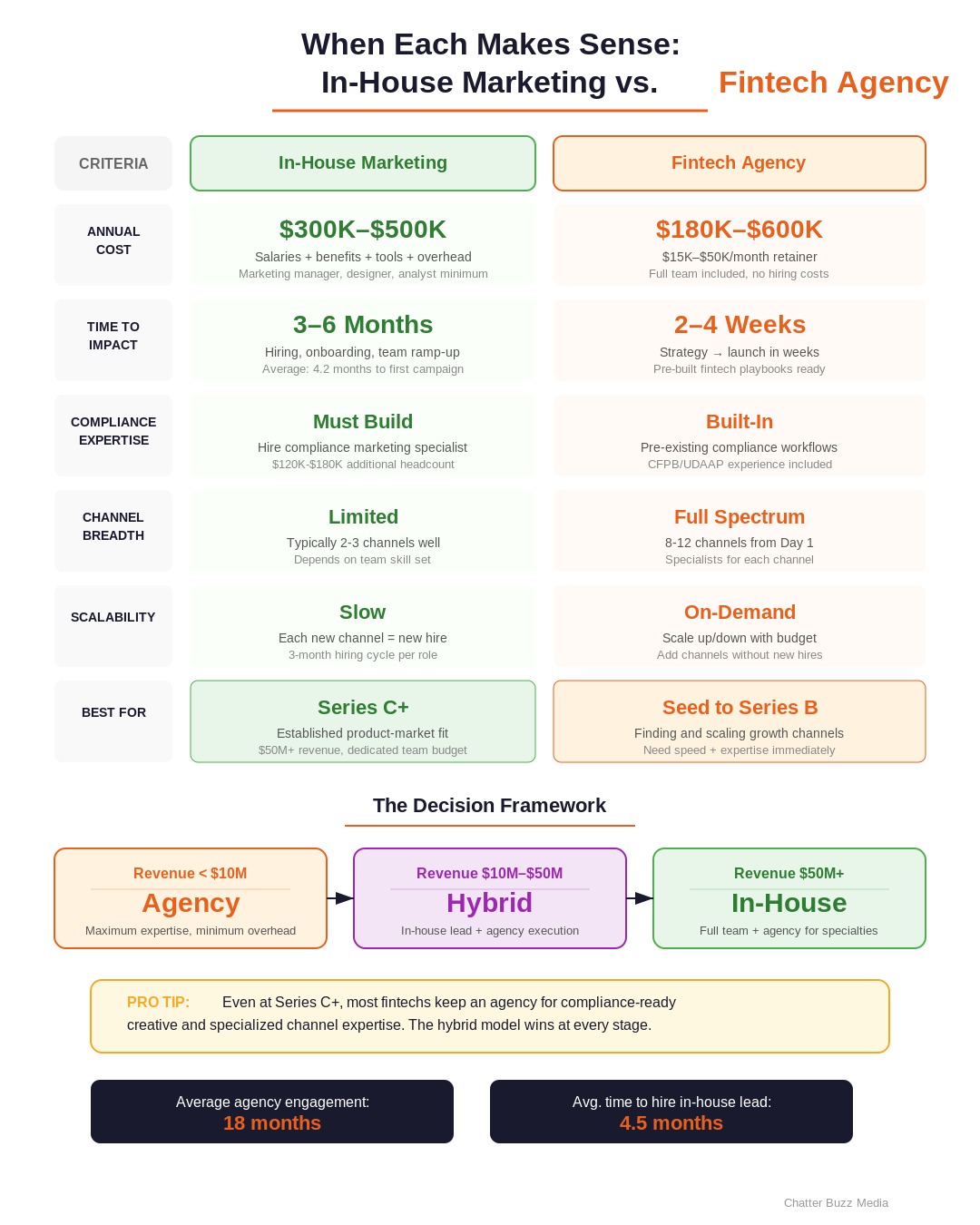
Here’s an honest breakdown of when each model delivers the best return.
When Building In-House Works
In-house marketing makes sense when you have deep institutional knowledge that’s difficult to transfer — particularly around complex products or highly regulated use cases. If your marketing requires daily coordination with product, engineering, and compliance teams, proximity matters.
It also makes sense when you’ve reached a scale where you can attract and retain senior marketing talent — typically Series C and beyond, or established fintech companies with recognized brands. At this stage, a strong in-house team with a fractional CMO or full-time marketing leader can build institutional marketing capabilities that compound over time.
- Deep product marketing for complex, technical fintech products that require extensive internal knowledge.
- Brand building at scale where consistent, long-term institutional voice matters more than campaign-level execution.
- Regulatory environments so specific that only embedded team members can navigate them efficiently.
When an Agency Accelerates Growth
Agencies deliver the highest ROI when you need to move fast, access specialized capabilities, or scale without the overhead of full-time hires. For early and mid-stage fintech companies, an agency provides a breadth of expertise — SEO, paid media, content, design, analytics — that would require five to eight full-time hires to replicate internally.
The math usually favors agencies when your total marketing budget is under $2 million annually. Below that threshold, the cost of a competent in-house team (salaries, benefits, tools, management overhead) typically exceeds what you’d pay an agency for equivalent or broader capabilities. Exploring comprehensive digital marketing services from a specialized partner often makes more financial sense at this stage.
- Speed to market — agencies bring established processes, tested playbooks, and experienced teams that don’t need a ramp-up period.
- Specialized expertise on demand — access to SEO specialists, paid media experts, and compliance-trained content creators without individual hires.
- Flexibility to scale spend up or down based on fundraising cycles, seasonal demand, or market conditions.
The Hybrid Model Most Mid-Market Companies Use
The most effective fintech marketing organizations typically combine a lean in-house team with agency support for specialized execution. The in-house team owns strategy, brand, and stakeholder relationships. The agency delivers channel expertise, campaign execution, and analytics rigor.
This hybrid model works because it gives you strategic control without requiring you to hire for every tactical capability. A fractional CMO can bridge the gap, providing senior leadership to manage both the in-house team and agency relationship without the cost of a full-time C-suite hire.
Whether you choose in-house, agency, or hybrid, knowing what to avoid is just as important as knowing what to look for. Here are the warning signs that a fintech marketing partner isn’t right for you.
Red Flags That Signal the Wrong Fintech Marketing Partner
Bad agency partnerships don’t just waste money — they waste time, which is the more expensive resource for growth-stage fintech companies. These red flags should disqualify a prospective agency immediately, regardless of how polished their pitch deck looks.
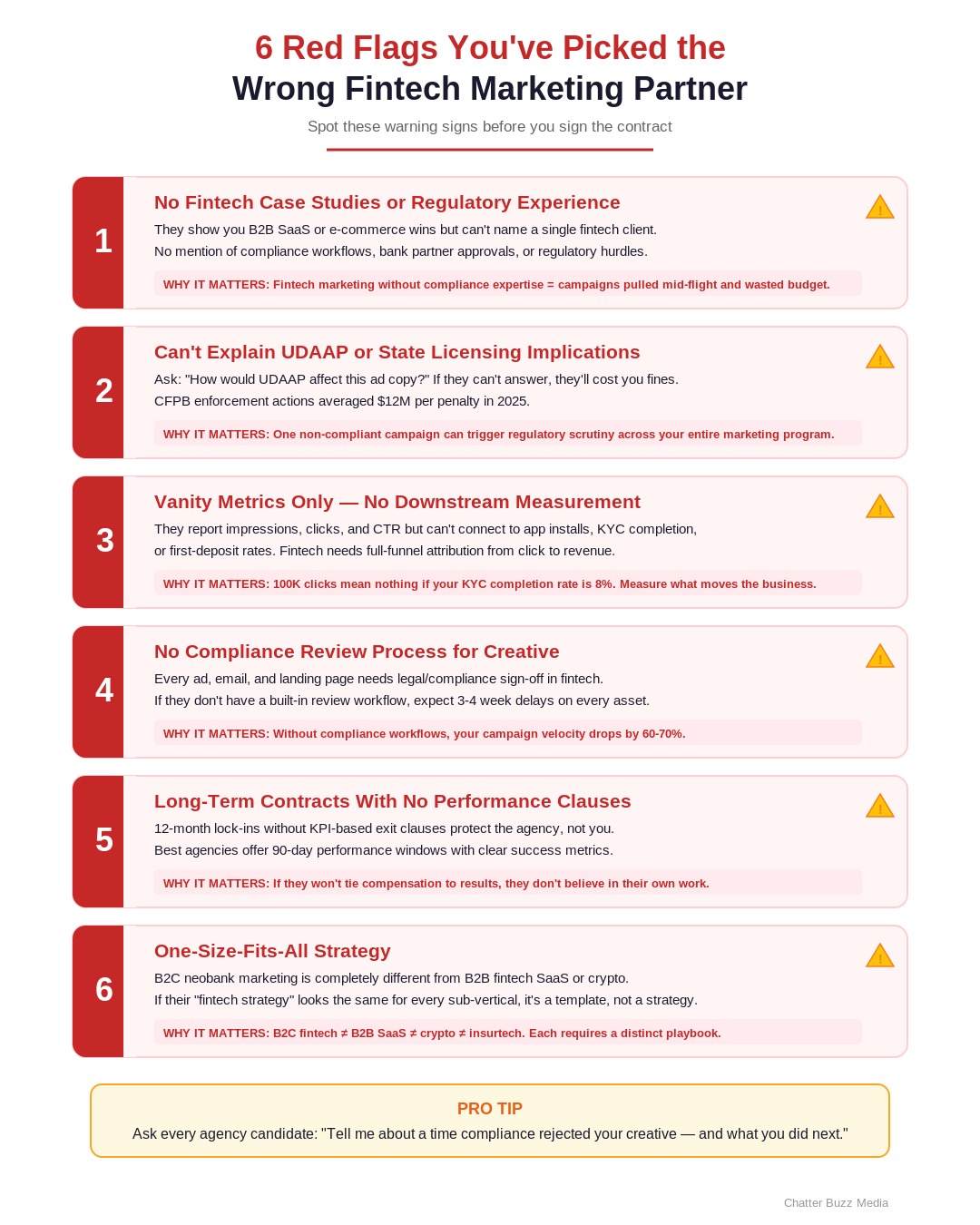
- No financial services portfolio. If they can’t show you work for fintech, insurtech, or banking clients, you’re paying them to learn on your budget. Sub-vertical experience matters — a B2C neobank campaign is fundamentally different from a B2B payments API campaign.
- Vanity metric promises. Agencies that guarantee specific impression counts, follower growth, or “first page rankings” without qualifying those metrics against revenue impact are optimizing for their own retention, not your growth.
- No compliance process. Ask how they handle ad rejections, regulatory disclaimers, and platform-specific financial advertising requirements. If the answer is vague or reactive, they’ll create compliance risk you’ll have to clean up.
- Cookie-cutter proposals. If the agency sends you a proposal within 48 hours of an initial call with detailed pricing but no discovery about your specific product, market, or regulatory environment, they’re selling a package — not building a strategy.
- No understanding of fintech unit economics. Your agency should speak fluently about CAC, LTV, payback period, and marketing efficiency ratio. If they can’t explain how their work impacts these metrics, they don’t understand what success looks like in your business.
- Reluctance to discuss attribution methodology. Agencies that avoid detailed conversations about how they measure and attribute results are often hiding behind platform-reported numbers that overcount conversions.
- Single-channel fixation. Fintech buyers don’t live on one platform. An agency that only knows paid search or only knows content marketing will leave significant growth on the table. Look for integrated, multi-channel thinking.
Spotting red flags helps you avoid bad fits. But understanding what the engagement actually costs helps you budget accurately and set realistic expectations for return.
What Fintech Marketing Services Actually Cost in 2026
Fintech marketing agency pricing varies significantly based on scope, sub-vertical, and growth stage. But having realistic cost benchmarks helps you evaluate proposals critically and allocate budget effectively.
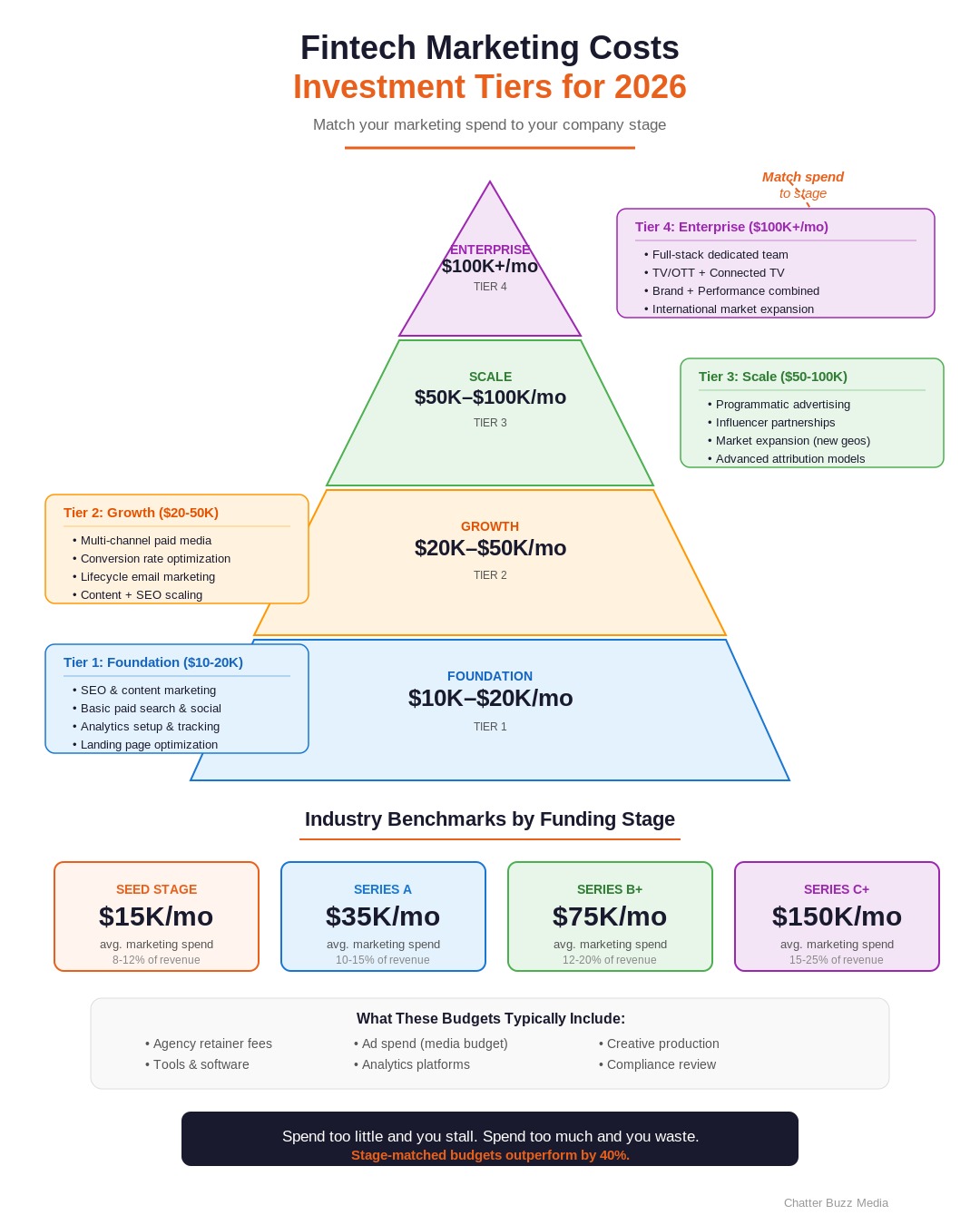
For B2B fintech companies, expect monthly retainers between $8,000 and $25,000 for a comprehensive agency engagement that includes strategy, content, paid media management, SEO, and reporting. Enterprise fintech programs with global scope and complex compliance requirements can run $30,000-$50,000+ monthly.
- $8,000-$12,000/month — typically covers two to three core channels (SEO + content, or paid media + landing pages) with monthly strategy and reporting. Best suited for seed through Series A companies.
- $12,000-$20,000/month — full-funnel programs including SEO, content, paid media, CRO, and integrated analytics. Appropriate for Series A through B companies scaling pipeline.
- $20,000-$25,000+/month — enterprise-grade engagements with dedicated strategy, multi-market execution, advanced attribution, and RevOps integration. For Series B+ and established fintech companies.
What drives cost variation comes down to five factors: the number of channels managed, content production volume, geographic and regulatory complexity, the level of strategic involvement required, and whether the agency manages ad spend in addition to charging management fees. A B2B digital marketing agency that specializes in fintech will typically price higher than generalists — and deliver measurably better returns because of that specialization.
Measuring ROI: CAC, LTV, and Marketing Efficiency Ratio
Fintech customer acquisition costs have risen 40-60% since 2023, driven by increased competition for digital ad inventory, stricter platform policies that limit targeting options, and rising content production costs. According to First Page Sage’s fintech CAC benchmark report, SMB fintech SaaS companies now face an average CAC of approximately $1,461.
These rising costs make marketing efficiency the defining metric for fintech agency partnerships. Here’s how to measure whether your agency investment is delivering adequate return.
- LTV:CAC Ratio. The ideal target is 4:1 or higher — meaning each customer generates at least four times the cost to acquire them. Below 3:1, your unit economics don’t support sustainable growth. Above 5:1, you may be underinvesting in growth.
- Marketing Efficiency Ratio (MER). Total revenue divided by total marketing spend. Unlike ROAS, MER captures the full picture including organic, referral, and brand-driven revenue that marketing influences but paid channels don’t directly attribute.
- CAC Payback Period. How many months of revenue it takes to recover acquisition cost. For B2B fintech SaaS, anything under 18 months is strong. Over 24 months signals a problem with either pricing, retention, or acquisition efficiency.
- Pipeline Velocity. The speed at which marketing-generated opportunities move through your sales funnel. Faster velocity means shorter cash conversion cycles and more predictable revenue.
Understanding costs and ROI measurement sets the foundation. Now let’s examine the specific strategies that high-performing fintech marketing agencies deploy to drive that return.
Fintech Marketing Strategies That Drive Measurable Growth
Strategy without execution is a slide deck. Execution without strategy is chaos. The best fintech marketing agencies combine strategic clarity with disciplined execution across four high-impact areas.
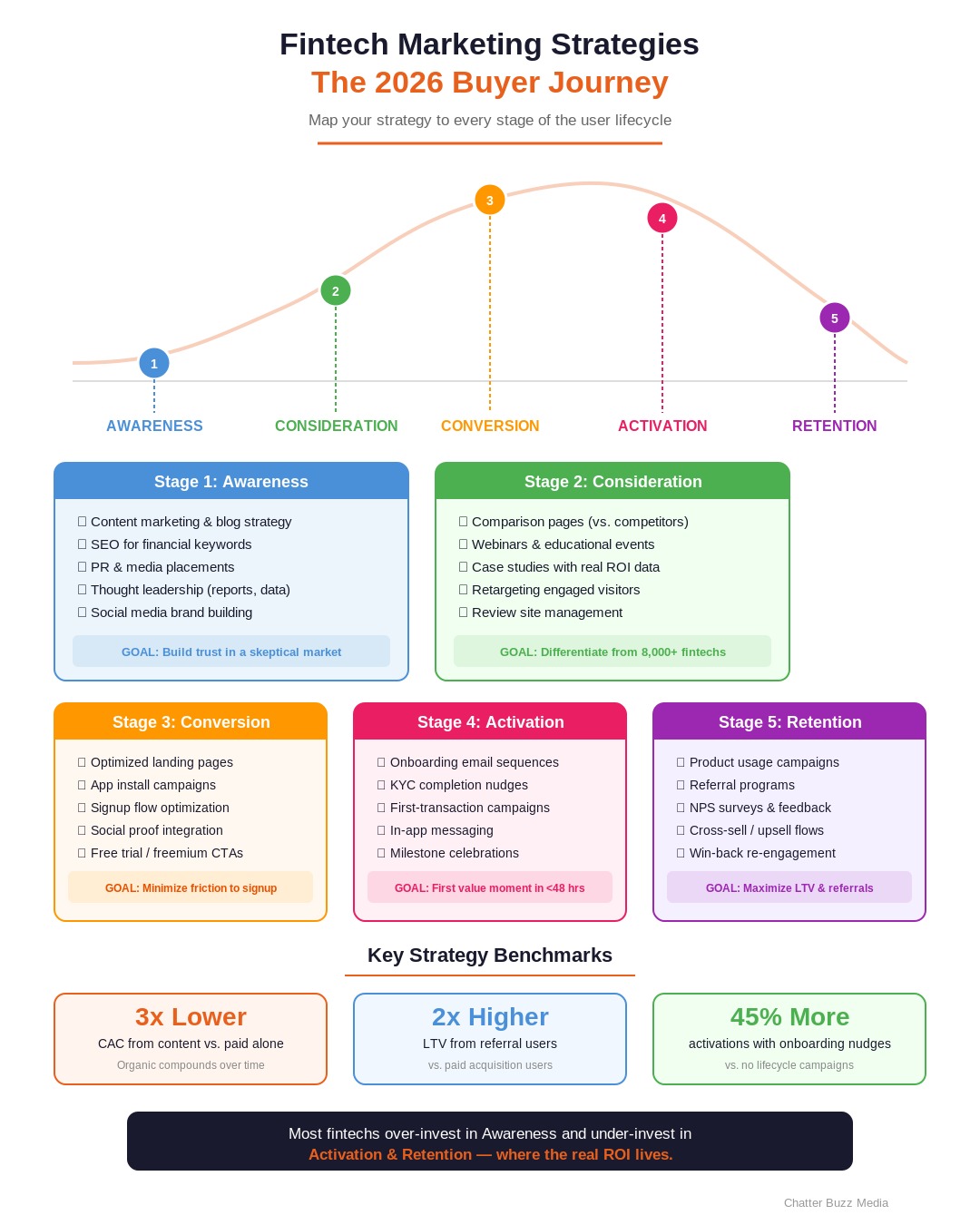
Here are the strategies producing measurable results for fintech companies in 2026.
Compliance-First Content That Still Converts
The agencies driving real results in fintech have flipped the compliance paradigm. Instead of creating content and then stripping it down during compliance review, they start with the compliance framework and build compelling content within it.
This approach produces content that’s both compliant and effective because the constraints are treated as creative parameters, not obstacles. The result: fewer revision cycles, faster time to publish, and content that competitors without compliance fluency can’t replicate.
- Regulatory explainers that rank for high-intent keywords like “PSD2 compliance requirements” or “SOC 2 for fintech” — content your competitors avoid because it’s hard to produce.
- Comparison content that addresses buyer questions directly while staying within fair competition guidelines — no misleading competitor claims, just transparent feature-by-feature analysis.
- Customer outcome narratives structured to demonstrate results without making forward-looking promises or implying guaranteed returns.
AI Search Visibility and Generative Engine Optimization
By 2026, a significant share of fintech research queries start in AI tools rather than traditional search engines. Your prospective buyers ask ChatGPT “what’s the best payment processing API for marketplace platforms” and act on whatever answers they get.
Generative engine optimization ensures your brand appears in those AI-generated answers. This requires a different approach than traditional SEO — one focused on entity authority, structured data, and comprehensive topical coverage rather than keyword density and backlink volume.
- Build topical authority clusters — interconnected content that covers a fintech topic from every angle, making your brand the most comprehensive source AI models can reference.
- Invest in original research and data — AI models prioritize citing primary sources. Proprietary benchmarks, surveys, and analysis give AI tools a reason to cite your brand specifically.
- Optimize for entity recognition — ensure your brand is consistently associated with specific fintech categories, products, and expertise across the web.
- Structure content for extraction — clear definitions, step-by-step frameworks, and comparison tables that AI models can easily parse and cite.
Account-Based Marketing for Enterprise Fintech
Enterprise fintech sales cycles can span 12-18 months and involve buying committees of six to ten stakeholders. Account-based marketing (ABM) concentrates resources on high-value target accounts rather than spraying budget across broad audiences and hoping the right buyers find you.
Effective ABM for fintech requires deep integration between marketing and sales — shared account intelligence, coordinated outreach sequences, and content personalized to the specific challenges each target account faces. This goes far beyond putting a company logo on a landing page. A comprehensive account-based marketing approach aligns every touchpoint with the target account’s buying journey.
- Intent data integration — identifying when target accounts are actively researching your category so you can time outreach to buying windows.
- Stakeholder-specific content journeys — technical documentation for the CTO, ROI calculators for the CFO, compliance briefs for the risk officer, all coordinated into a single account strategy.
- Multi-channel orchestration — LinkedIn ads, personalized email sequences, direct mail, and event invitations working together to surround the buying committee.
Community Building and Thought Leadership
Fintech buyers trust their peers more than they trust vendor marketing. Community-driven marketing creates environments where your target buyers engage with your brand through peer interaction, expert content, and shared problem-solving rather than traditional promotional messaging.
This strategy takes longer to produce measurable pipeline than paid media, but the leads it generates are higher quality, lower cost, and more likely to convert. Companies that invest in community building create moats that competitors with bigger ad budgets can’t easily replicate.
- Industry research and benchmarking reports that give your brand a reason to be cited, shared, and discussed within fintech circles.
- Webinar and event programs featuring customer panels and industry experts — not product demos disguised as thought leadership.
- Executive thought leadership that positions your founders and senior leaders as genuine contributors to fintech discourse, not just self-promoters.
- Developer communities and technical forums for API-driven fintech products where product feedback and peer support reduce churn and increase expansion revenue.
Having the right strategies matters, but execution depends on how well you onboard your agency partner. The first 90 days set the trajectory for the entire engagement.
How to Onboard Your Fintech Marketing Agency (The First 90 Days)
Most failed agency relationships don’t fail because the agency lacked capability. They fail because the onboarding was rushed, expectations were misaligned, and neither side invested enough in the discovery phase. A structured 90-day onboarding prevents the most common failure modes.
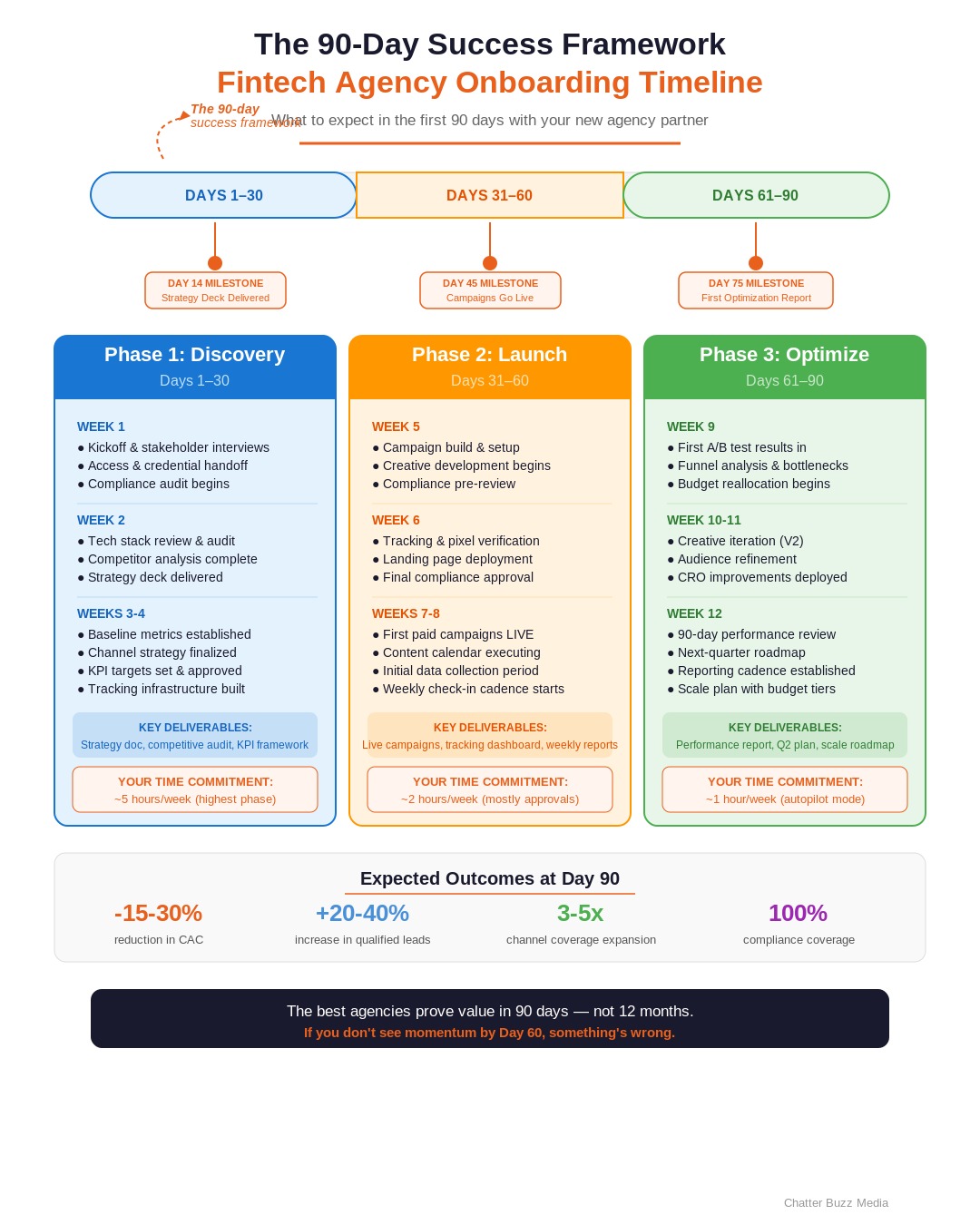
Here’s what each phase should accomplish and what you should expect from your agency at each stage.
Discovery Phase (Weeks 1-2)
The first two weeks should be entirely dedicated to understanding your business — not executing campaigns. An agency that starts running ads in week one hasn’t done the work to run them effectively.
During discovery, your agency should conduct deep interviews with your marketing, sales, product, and compliance teams. They should audit your existing marketing performance, tech stack, and competitive landscape. They should identify quick wins and long-term opportunities.
- Business model and unit economics deep-dive — understanding your pricing, margins, LTV, and growth targets.
- Compliance and regulatory audit — documenting the specific requirements, review processes, and approval workflows that will govern all marketing output.
- Competitive analysis — mapping your competitors’ marketing strategies, channel presence, messaging, and content investments.
- Tech stack and data audit — evaluating your CRM, analytics, attribution, and marketing automation infrastructure to identify gaps and integration requirements.
- Stakeholder interviews — conversations with sales, product, and customer success teams to understand buyer objections, win/loss patterns, and customer language.
Strategy and Roadmap (Weeks 3-4)
Based on discovery findings, the agency should present a documented strategy and 90-day execution roadmap that connects marketing activities to your specific business objectives. This isn’t a generic marketing plan — it should reflect the unique insights from discovery.
The roadmap should include clear milestones, success metrics, and resource requirements for both the agency and your internal team. If the strategy document looks like it could have been written without the discovery phase, the agency didn’t listen.
- Channel strategy and budget allocation — where to invest based on your buyer journey, competitive landscape, and growth targets.
- Content calendar — a 90-day editorial plan aligned with your keyword strategy, buyer personas, and compliance requirements.
- KPI framework — specific, measurable targets for each channel and campaign tied to pipeline and revenue outcomes.
- Quick-win execution plan — the highest-impact, lowest-effort improvements that can deliver early results while longer-term initiatives ramp up.
Execution and Optimization (Months 2-3)
Months two and three shift from planning to execution. Your agency should launch initial campaigns, begin content production, and establish the reporting cadence that will govern the ongoing relationship.
During this phase, expect an emphasis on learning and iteration rather than mature performance. The agency is testing messaging, audiences, and channels — building the data foundation that will drive optimization in months four through twelve.
- Campaign launches with built-in A/B testing frameworks that generate actionable data from day one.
- Weekly performance check-ins — short, focused calls to review early data and make rapid adjustments.
- Content production and publication — executing against the editorial calendar with compliance review integrated into the workflow.
- Attribution and tracking validation — confirming that data flows correctly from ad platforms through your CRM to revenue reporting.
- Month-three performance review — a comprehensive assessment of what’s working, what’s not, and strategic adjustments for the next quarter.
Conclusion
Choosing a fintech marketing agency isn’t a vendor decision — it’s a growth strategy decision that directly impacts your customer acquisition costs, market position, and competitive trajectory. The right partner brings regulatory fluency, trust-driven marketing expertise, and performance accountability that generalist agencies simply can’t match.
Start your evaluation by demanding fintech-specific case studies and a documented compliance workflow. Prioritize agencies that speak in CAC, LTV, and marketing efficiency ratio rather than impressions and clicks. Understand whether your situation calls for full agency support, in-house capabilities, or the hybrid model most mid-market fintech companies use successfully.
Budget realistically — $8,000 to $25,000 monthly for meaningful engagement — and measure return against your unit economics, not vanity metrics. Structure the first 90 days around deep discovery, documented strategy, and disciplined execution with clear milestones.
The fintech companies growing fastest in 2026 aren’t the ones with the biggest marketing budgets. They’re the ones with the most efficient marketing operations — and the right agency partner is the fastest path to building that efficiency.
Frequently Asked Questions About Fintech Marketing Agencies
What does a fintech marketing agency do?
A fintech marketing agency provides specialized digital marketing services for financial technology companies, including SEO, paid media, content marketing, branding, and analytics. What sets it apart from generalist agencies is deep expertise in financial services compliance, regulated advertising platforms, and the trust-driven buyer psychology unique to fintech.
How is fintech marketing different from traditional marketing?
Compliance is the primary differentiator. Every marketing asset — ads, landing pages, emails, social posts — must comply with financial regulations (KYC, AML, GDPR, FCA, SEC) and platform-specific financial advertising policies. Beyond compliance, fintech marketing must overcome higher buyer skepticism, navigate longer B2B sales cycles, and build trust signals that traditional SaaS marketing doesn’t require.
How much does a fintech marketing agency cost?
Monthly retainers for B2B fintech marketing agencies typically range from $8,000 to $25,000, depending on scope, channel mix, and growth stage. Enterprise programs with global reach and complex regulatory requirements can exceed $30,000 monthly. These fees usually cover strategy, execution, and reporting — ad spend is typically separate.
What’s the average ROI from fintech marketing services?
ROI varies significantly by sub-vertical, growth stage, and sales cycle length. Well-executed fintech marketing programs target a 4:1 LTV:CAC ratio and a CAC payback period under 18 months. Most agencies need three to six months to optimize campaigns before hitting target efficiency — expect to invest in learning before harvesting returns.
Should I hire a generalist agency or a fintech specialist?
A fintech specialist nearly always delivers better ROI for financial technology companies. Generalist agencies lack compliance fluency, don’t understand regulated advertising platforms, and typically can’t produce content that resonates with trust-sensitive fintech buyers. The cost premium for specialization is typically offset by fewer compliance mistakes, faster campaign launches, and higher conversion rates.
What fintech marketing strategies work best in 2026?
The highest-performing strategies in 2026 combine compliance-first content marketing, generative engine optimization (GEO) for AI search visibility, account-based marketing for enterprise deals, and community-driven thought leadership. Performance-driven paid media remains essential but works best when integrated with organic strategies that build long-term brand authority and reduce dependence on paid channels.
How long before I see results from a fintech marketing agency?
Expect 90 days for initial data and early signals, six months for meaningful pipeline impact, and 12 months for mature, optimized performance. Paid media can produce leads within weeks, but those leads won’t convert at optimal rates until messaging, targeting, and landing pages have been tested and refined. SEO and content marketing investments typically show compounding returns starting at month four to six.