
 321-236-2899
A new community launch is the highest-stakes moment on a home builder’s calendar: the budget is the biggest of the year, the timeline is fixed, and you are spending before you have a single lead to learn from.
Done right, home builder advertising fills the model home weeks before the ribbon is cut and keeps the pipeline full through close-out. Done wrong, you burn the launch budget on the wrong buyer and spend the next two quarters trying to recover absorption you never should have lost.
This is a comprehensive, in-depth guide to paid media for new community launches — the channels, the phased timeline, the 2026 budgets, and the measurement that ties spend to homes sold. As a performance-driven digital marketing agency, we build and run these campaigns for builders and developers, and below we share exactly how a launch that sells out ahead of schedule is planned, funded, and measured.
Key Takeaways
- Home builder advertising is a full-funnel paid media system — paid search, paid social, CTV, display, and geofencing working together, not a single “Google Ads” line item.
- A community launch is different from ongoing marketing — there is no performance history to lean on, so the buyer profile and channel mix have to be right before the first dollar runs.
- Start 3 to 6 months before the model home opens. That window is for buyer research, creative, audience testing, and priming awareness channels — not for scrambling at grand opening.
- Budget $3,000–$5,000 per month per active community for paid search alone, scaling to $8,000–$12,000 for multi-community builders, with awareness channels funded on top.
- Measure cost per sale, not just cost per lead. A launch is winning when qualified tours and signed contracts climb — attribution has to reach all the way to the sales office.
Here is everything you need to plan a launch that opens strong and closes out on schedule.
What Home Builder Advertising Actually Covers
Home builder advertising is the paid media a builder runs to put a community in front of in-market buyers and convert them into model-home tours and contracts. It spans search, social, streaming, and location-based channels, all pointed at a defined buyer in a defined market.
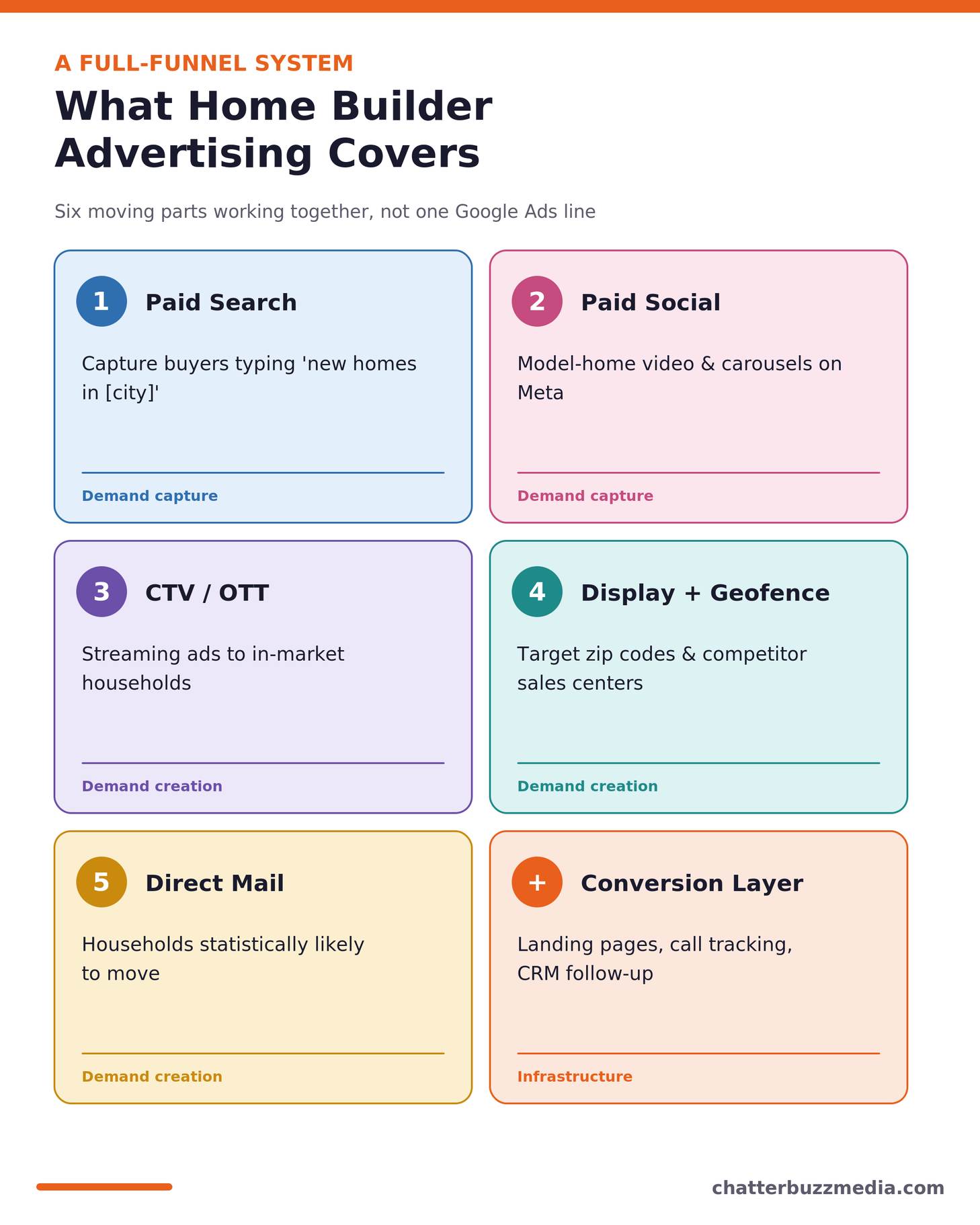
The mistake is treating it as one channel. “We run Google Ads” is a tactic, not a strategy, and a launch that leans on a single platform leaves most of its in-market buyers untouched.
A complete program works across the funnel. Awareness channels build recognition before buyers start searching, and demand-capture channels convert them the moment they do.
- Demand capture: paid search, Performance Max, retargeting — reaching buyers who are already looking.
- Demand creation: CTV/OTT, paid social, display, and geofencing — reaching buyers before they search.
- Conversion infrastructure: community landing pages, call tracking, and CRM follow-up that turn clicks into booked tours.
This is what separates advertising from a boosted post. Paid media for builders is an orchestrated system, and it belongs inside the broader home builder marketing plan alongside your website and SEO.
Where Advertising Fits Next to SEO
Paid media and organic search do different jobs on different timelines. Paid campaigns can generate qualified leads within the first few weeks, while home builder SEO compounds over four to eight months.
For a launch, that makes advertising the primary engine and SEO the long-term asset. You buy the traffic you need now and build the rankings that lower your cost per lead later, and our roundup of home builder marketing strategies covers the organic side in depth.
Why New Community Launches Rewrite the Paid Media Playbook
A community launch is different from ongoing marketing because it has no performance history to lean on. You cannot look at last quarter’s conversion rate, because there was no last quarter — every channel decision is made before you have any real feedback.

That matters because new communities typically get the largest marketing budgets in a builder’s portfolio. Launches are where the biggest spending mistakes happen, because every assumption in the plan gets funded at scale.
Soft targeting at launch means soft targeting across every channel you funded. Display, direct mail, CTV, and paid search can all be pointed at the wrong audience from day one if the buyer profile is a guess.
The fix is to start with the buyer, not the community. The temptation is to lead with floor plans, amenities, and price points, but stronger launches begin by understanding who is actually shopping for new homes in that specific market.
Map the Competing Communities First
Before you write a single ad, identify the three to five communities competing for the same buyer. Understand their pricing, positioning, and current absorption rate.
This tells you where a differentiated message can cut through. It also tells you where to point geofencing later, because a buyer touring a competitor is a buyer you can reach.
Set Measurement Before You Launch
Decide what success looks like before the first impression runs. Lead volume is the obvious metric, but it is not enough on its own — you need lead quality, traffic quality, and attribution back to closings.
If you cannot tell which channel drove each sale, you cannot optimize in-flight or defend the spend afterward. That discipline is the difference between a launch you steer and one you simply hope works.
The Paid Media Channel Mix for a New Community Launch
The right channel mix for a launch combines awareness plays with precision plays, and the ratio depends on how well-known your brand already is in the market. Less recognition means more awareness budget early; an established brand can lean harder on demand capture immediately.
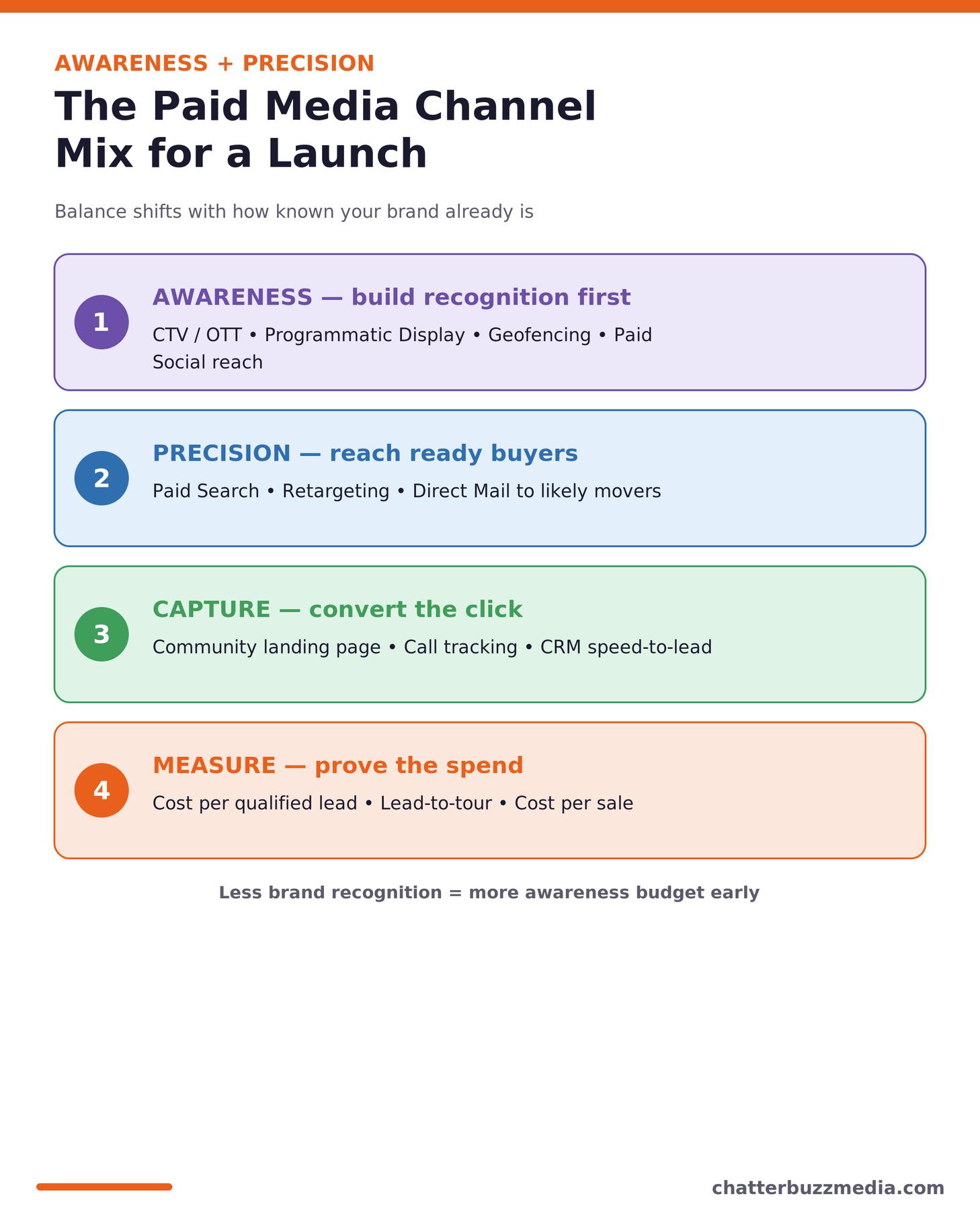
No single channel carries a launch. Each one reaches the buyer at a different stage, and the value is in the overlap.
The Core Channels and What Each One Does
- Paid search (Google Ads): captures buyers typing “new homes in [city]” or “new construction homes near me.” This is your highest-intent demand-capture channel.
- Paid social (Meta): carousel ads for model homes, video for virtual tours, and retargeting for prior visitors. Strong for both awareness and re-engagement.
- CTV/OTT: streaming video ads that build community awareness with in-market households before they start searching.
- Programmatic display and geofencing: banner and native ads targeted to buyers in specific zip codes — including geofences around competing sales centers.
- Direct mail: still a precision play when targeted to households statistically likely to move, and a natural pairing with digital retargeting.
- YouTube: model-home walkthroughs, drone footage, and neighborhood guides that do the selling video does best.
Paid search, CTV, and direct mail consistently perform well for new construction because they combine reach with intent. The builders who win layer them deliberately, using the same buyer profile and creative across every channel.
Match the Ratio to Your Brand Recognition
A regional builder entering a new submarket needs heavier awareness spend, because in-market buyers have to see the community several times before they engage. A national builder with existing brand equity can shift budget toward paid search and retargeting sooner, and builders running many communities at once should read our guide to multi-location marketing.
The through-line is consistency. The buyer who saw your CTV spot should see the same value proposition in your search ad and on your landing page, which is core to any effective performance marketing program.
How to Phase a Community Launch: Pre-Launch, Launch, and Momentum
A community launch should be run in three phases, and most of the work happens before the model home opens. Marketing starts as soon as the community becomes real, but the bulk of the effort begins three to six months before opening.

That runway is what gives you time to research the buyer, build creative against a real profile, test audience segments, and prime your activation channels. Skip it and you launch blind.
Phase 1 — Pre-Launch (3–6 Months Out)
This phase is about demand generation and list-building before you can sell. The goal is a warm audience waiting the day the model opens.
- Build the buyer profile from real market data — income tiers, life stages, and where buyers are moving from.
- Launch a coming-soon landing page with a VIP interest list to capture early demand.
- Run awareness ads on CTV, display, and paid social to seed recognition.
- Test creative and audiences at low spend so you know what works before budgets scale.
Phase 2 — Launch (Grand Opening Window)
This is where demand capture takes over and budgets peak. Paid search goes live at full weight, retargeting activates against your warm list, and every channel points to tour scheduling.
A VIP or founders’ phase before the public opening lets you reward the list you built and create urgency. Scarcity — limited release homesites, pre-public pricing — does real work here.
Phase 3 — Momentum (Post-Opening Through Close-Out)
Once the model is open, the job shifts to steady absorption and efficiency. You reallocate budget toward the channels proving out, and you keep enough awareness running to backfill demand as inventory sells.
Set weekly performance reviews from week one. By month three you have spent most of the launch budget, so the builders who reallocate fast are the ones who protect their cost per sale.
What Home Builder Advertising Costs in 2026
Home builders should budget $3,000–$5,000 per month for paid search on a single active community, scaling to $8,000–$12,000 per month for builders marketing three or more communities at once. Awareness channels like CTV and display are funded on top of that, not carved out of it.
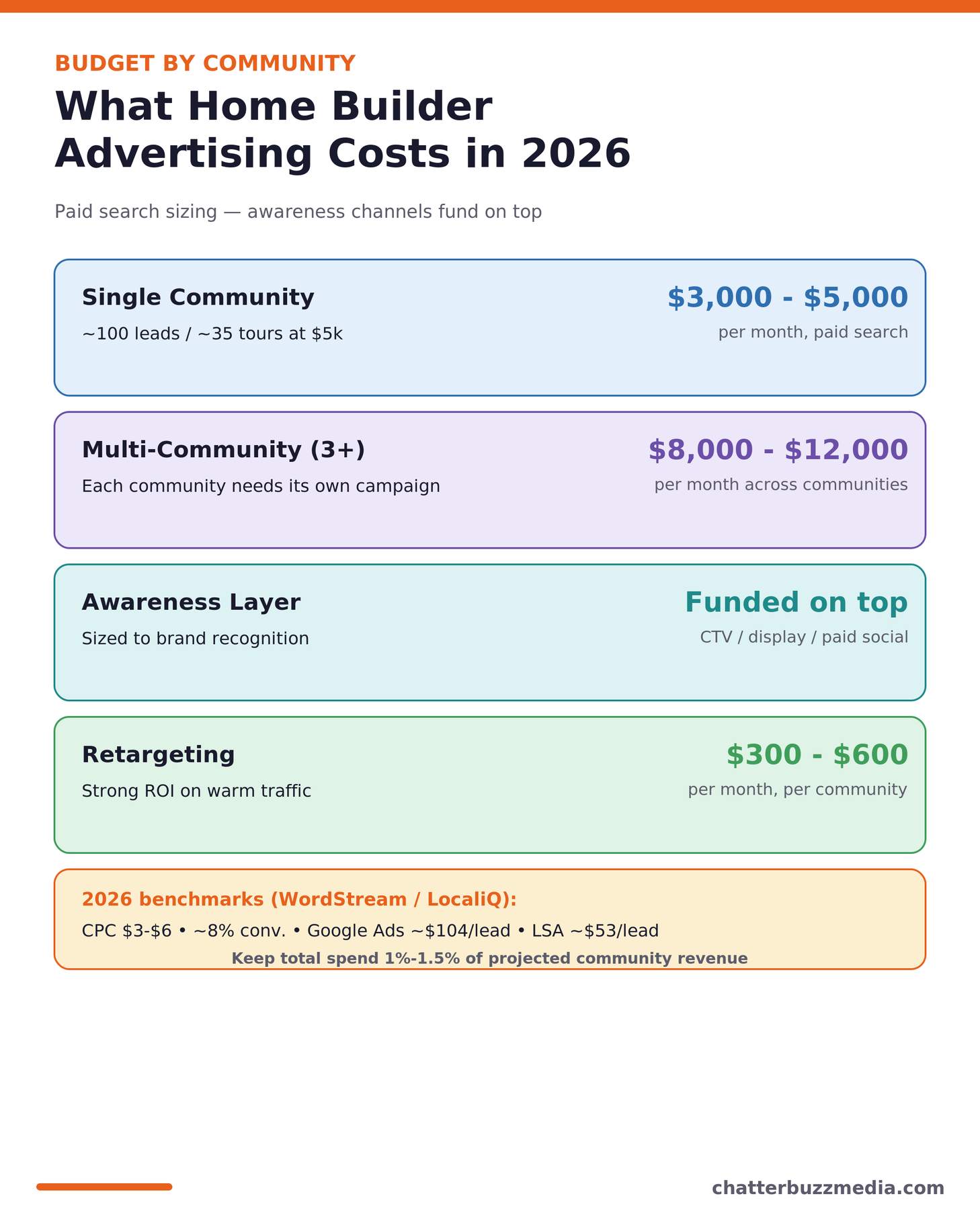
Budget should scale with the number of active communities, not just total marketing spend, because each community needs its own keywords, ad copy, and landing page. Spreading one community’s budget across four starves them all.
What the Benchmarks Say
Cost-per-click for new-construction and home-builder keywords typically runs $3–$6, and can climb higher in competitive metros, according to WordStream’s Google Ads benchmark data. Real estate and home-services search ads convert at roughly 8%, well above the all-industry average, because the searches are so intent-driven.
On a cost-per-lead basis, traditional Google Ads for home services average around $104 per lead, while Google Local Services Ads run closer to $53, based on LocaliQ’s home-services benchmarks. The spread is why channel choice matters as much as budget size.
How Budget Translates to Tours
At a $4 average CPC and an 8% conversion rate, a $5,000 monthly search budget produces roughly 1,250 clicks and about 100 leads. At a typical 30–35% lead-to-tour rate, that is roughly 35 booked model-home tours a month from search alone.
Keep total marketing investment in a healthy band. Builders spending under 1% of projected community revenue risk underinvesting, while spending above 1.5% often signals waste — the right number usually sits in between.
- Single community, paid search: $3,000–$5,000/month.
- Multi-community builder: $8,000–$12,000/month across communities.
- Awareness layer (CTV/display/social): funded on top, sized to brand recognition.
- Retargeting: often $300–$600/month per community for strong ROI on warm traffic.
Building Google Ads Campaigns That Fill the Model Home
Google Ads works for home builders because of intent: a buyer typing “new construction homes [city]” is qualifying themselves as in-market. The platform places your community above organic listings at the exact moment they are shopping.
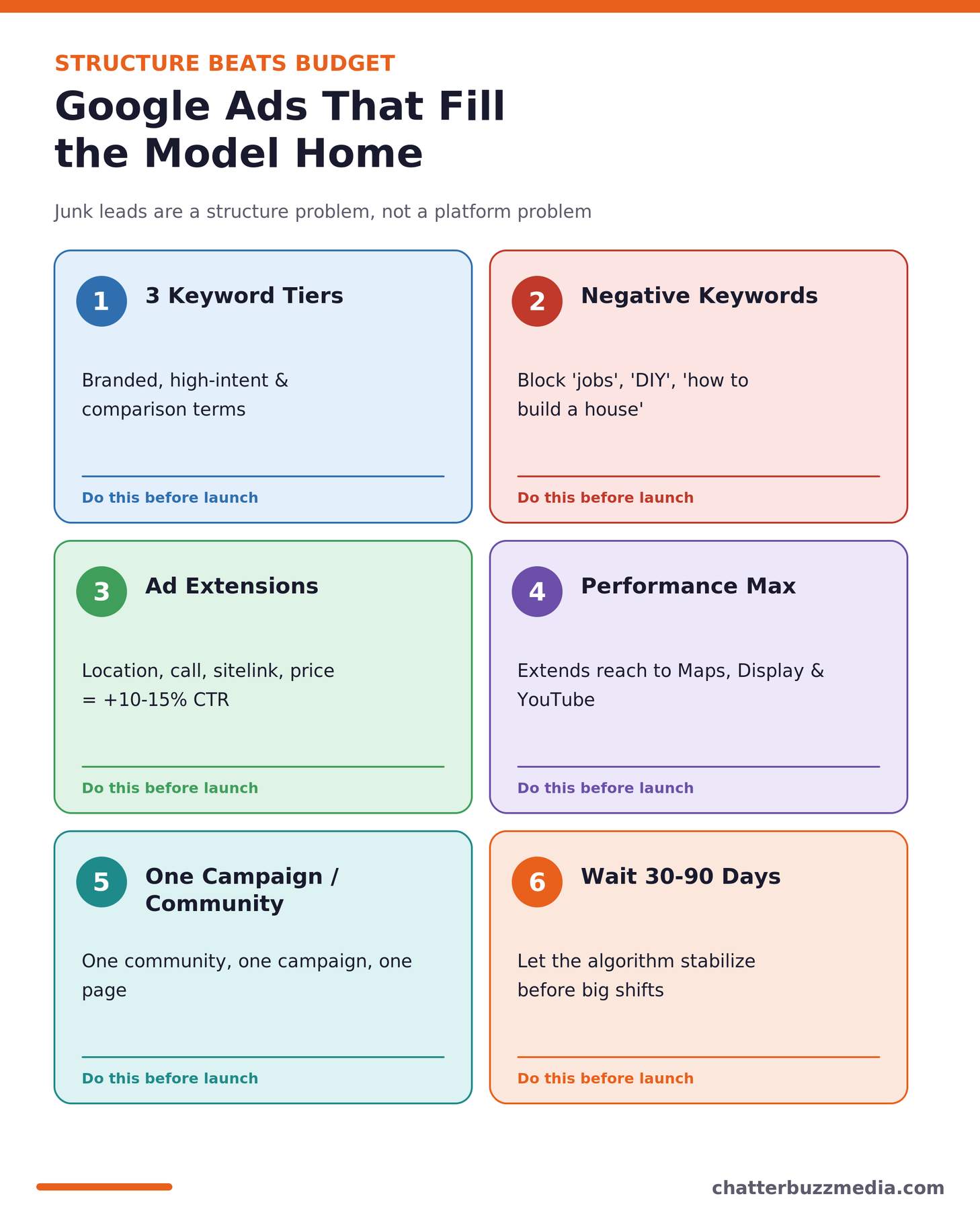
But “launching some Google Ads” and running a high-performance program are different things. Most builders who tried Google Ads and got junk leads did not have a platform problem — they had a structure problem.
Keyword Tiers and Negative Keywords
Target three keyword tiers so budget stays on buyers close to a decision. Layer them with tight match types and a disciplined negative list.
- Branded terms: your community name, builder name, and floor plan names.
- High-intent terms: “new construction homes [city],” “model homes for sale near me,” “new homes under $[price].”
- Comparison terms: “new build vs. resale,” “best new home communities in [area].”
Negative keywords matter as much as what you bid on. Blocking “home builder jobs,” “how to build a house,” and “DIY” stops wasted spend within the first week rather than after the first bad report.
Extensions, Performance Max, and Local Services Ads
Use location, call, sitelink, and price extensions so a single ad shows directions, phone number, floor plan links, and starting price. Ad extensions can lift clickthrough rate by roughly 10–15% versus a text-only ad, per Google’s own guidance.
Performance Max extends reach into Maps, Display, and YouTube from one campaign, while Google Local Services Ads fit custom and remodel-oriented builders with pay-per-lead pricing and the Google Guarantee badge. Neither replaces a well-structured search campaign — they layer on top of it.
Structure and Cadence
A clean account runs one search campaign on your highest-intent keywords, a Performance Max campaign for reach, and a retargeting campaign on display. One community, one campaign, one dedicated landing page.
Review search-term reports weekly in the early weeks, adjusting bids, copy, and negatives on real data. Give the algorithm at least 30 days before major budget shifts, and 60–90 for reliable cost-per-lead.
Paid Social and Creative That Sells New Homes
Paid social sells new homes because the product is visual and the buying decision is emotional. A model-home walkthrough or a drone pass over the community does more selling than any headline, which is why creative — not targeting alone — drives paid social performance for builders.
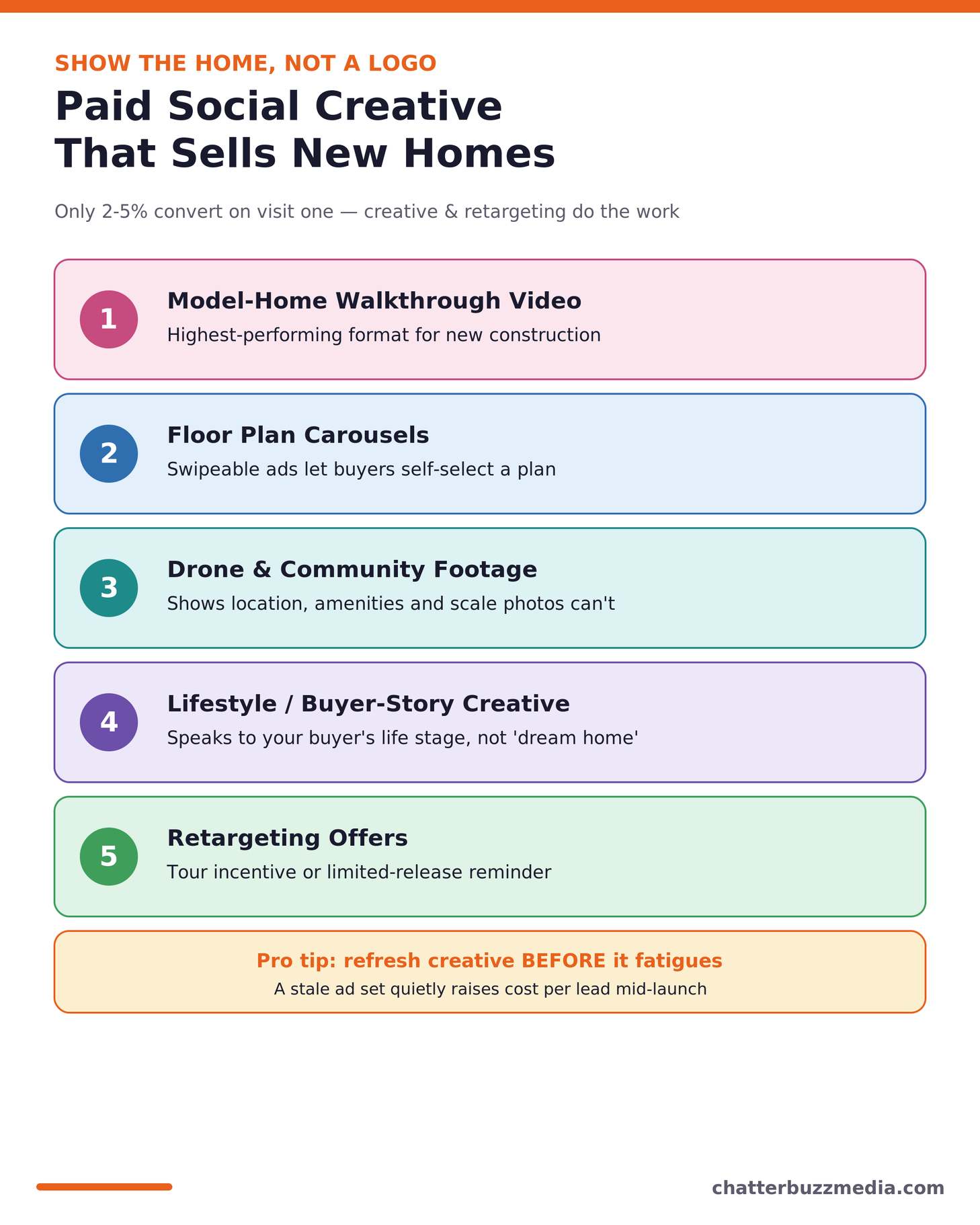
Meta (Facebook and Instagram) carries most builder social budgets, working as both an awareness channel early and a retargeting workhorse throughout, and its advertising formats map neatly to how buyers shop a new home. Only 2–5% of first-time landing-page visitors convert, so re-engaging the other 95% is where paid social earns its keep.
The Creative Formats That Convert
- Model-home walkthrough video: the highest-performing format for new construction — show the home, not a logo.
- Floor plan carousels: swipeable ads letting buyers self-select the plan that fits.
- Drone and community footage: conveys location, amenities, and scale that photos cannot.
- Lifestyle and buyer-story creative: speaks to the life stage of your actual buyer, not generic “dream home” copy.
- Retargeting offers: a tour incentive or limited-release reminder for warm visitors.
Match Creative to the Funnel Stage
Awareness creative should build recognition and emotion, while retargeting creative should drive a specific action — book a tour, join the VIP list, download the floor plan. The same buyer needs a different message depending on where they are.
Refresh creative before it fatigues. In a fixed-length launch, a stale ad set quietly raises your cost per lead in the exact window you can least afford it.
Landing Pages and Speed-to-Lead: Where Launch Budgets Are Won or Lost
The ad earns the click, but the landing page earns the appointment. Sending paid traffic to your homepage is one of the most common and costly mistakes builders make.
A dedicated community landing page removes every distraction — other communities, unrelated content, generic navigation — so the visitor sees only what is relevant to the search that brought them. Average landing pages convert around 2–3%, while top-quartile pages convert above 5% by matching the ad’s promise, per WordStream benchmark data.
What a High-Converting Community Page Includes
- A headline that matches the ad — location-specific and keyword-relevant.
- Real pricing and floor plans so buyers do not have to click again to qualify themselves.
- A short “Schedule a Tour” form above the fold, four to five fields maximum.
- Trust signals — ratings, reviews, awards, and warranties.
- Fast mobile load, since most new-home searches now happen on a phone.
Speed-to-Lead Decides the Contract
Paid media puts the lead in the funnel; response time decides whether it converts. New-home shoppers research for weeks, but once they raise a hand they are comparing you against the community down the road in real time.
A lead contacted in minutes converts far better than one called the next day. Pair your ad spend with a CRM and follow-up cadence — a natural fit with marketing automation and a broader inbound marketing engine — so no launch lead sits cold.
Measuring Home Builder Advertising: From Cost Per Lead to Cost Per Sale
The right way to measure a launch is to track the full funnel from click to signed contract, not just cost per lead. Clicks and leads tell you the campaign is producing activity; only cost per sale tells you it is producing buyers.
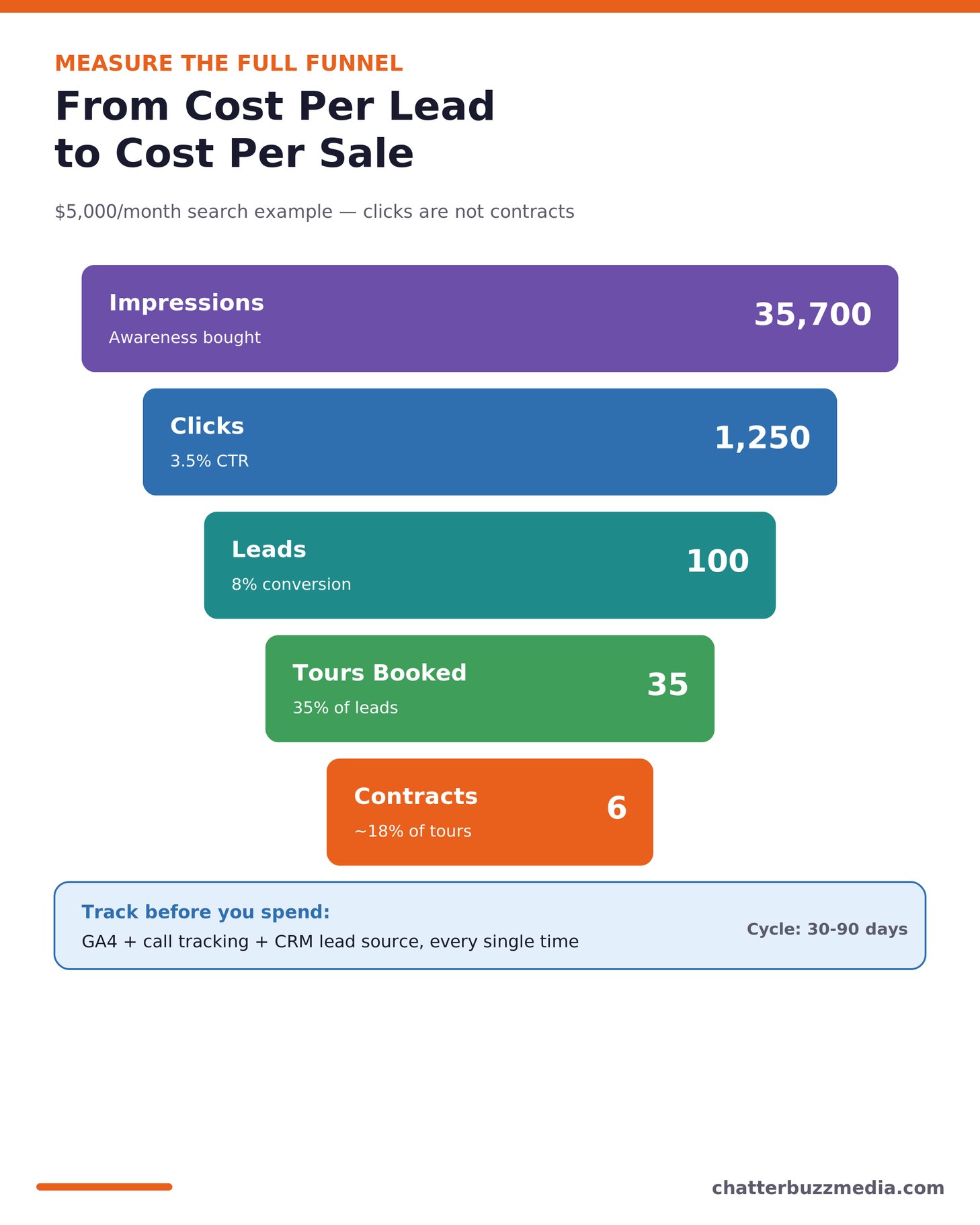
Attribution connects each sale back to the keyword, ad, or channel that started the journey. Without it, you are optimizing bids on clicks instead of contracts.
The Metrics That Actually Matter
- Cost per qualified lead, not raw lead count — quality over volume.
- Lead-to-tour rate, a leading indicator of traffic quality (aim for 30–35%).
- Tour-to-contract rate, typically 15–20% for new construction.
- Cost per sale and absorption pace, the numbers that decide whether the launch worked.
Build the Tracking Before You Spend
Install GA4 conversion tracking and a call-tracking tool like CallRail before launch, not after week two. Phone calls carry disproportionate weight in this category, because high-intent buyers often call with questions about lot availability or move-in timing.
Then close the loop in the CRM. A new-home sales cycle runs roughly 30–90 days from inquiry to contract — consistent with National Association of Home Builders research on the buyer journey — so judging a campaign at two weeks judges it too early, and a lead-source field your sales team fills in every time is what ties spend to closings.
Common Home Builder Advertising Mistakes to Avoid
Most launch underperformance traces to a handful of repeatable mistakes. Knowing them in advance is the cheapest optimization available.
Each one inflates cost per lead or hides which channel is actually working. Fixing them is usually faster and cheaper than adding budget.
- Designing the plan around features instead of the buyer. Floor plans do not tell you who is buying — start with the buyer and let features become the message.
- Underinvesting in awareness early. Jumping straight to conversion tactics skips the exposure in-market buyers need before they engage.
- Running one campaign for multiple communities. It makes performance impossible to diagnose and starves each community of data.
- Sending ad traffic to the homepage. Generic pages convert a fraction of what a dedicated community page does.
- Waiting until month three to evaluate. By then the budget is spent — review weekly and reallocate fast.
- Measuring leads but not sales. Volume without attribution to closings hides the channels quietly wasting spend.
Avoiding these is not about spending more. It is about spending the launch budget where the buyer actually is, and proving it.
Conclusion
Home builder advertising for a new community launch is not one channel or one campaign — it is a phased, full-funnel paid media system built around a real buyer and measured all the way to cost per sale.
The builders who sell out ahead of schedule start three to six months early, fund both awareness and demand capture, send every click to a dedicated community page, and reallocate on weekly data. The ones who struggle guess at the buyer, lean on a single channel, and measure leads instead of homes sold.
Get the buyer profile, the channel mix, and the measurement right before the model opens, and the launch becomes something you steer rather than something you hope works. That is the difference between a strong opening and a scramble — and it is exactly the kind of program our team builds with builders and developers every day, whether you need full digital marketing services or senior leadership through our fractional CMO services. Builders in our home markets of Orlando and Tampa can reach us directly to map a launch plan.
Frequently Asked Questions
How much should a home builder spend on advertising for a new community?
Plan on $3,000–$5,000 per month for paid search on a single active community, scaling to $8,000–$12,000 for builders running three or more communities at once. Awareness channels like CTV, display, and paid social are funded on top of that, and total marketing investment generally lands between 1% and 1.5% of projected community revenue.
How early should home builders start advertising a new community?
Marketing gets involved from the earliest days of a community, but the bulk of the launch work starts three to six months before the model home opens. That runway is used to research the buyer, build creative against a real profile, test audiences, and prime awareness channels so demand exists the day you open.
What are the best paid media channels for a new home community launch?
The strongest mix combines awareness plays — CTV/OTT, display, paid social, and geofencing — with demand-capture plays like paid search and retargeting. Paid search, CTV, and direct mail consistently perform well for new construction, and the right ratio depends on how recognized your brand already is in the market.
How much does Google Ads cost for home builders?
Cost-per-click for new-construction keywords typically runs $3–$6, with real estate search ads converting near 8%, according to WordStream benchmark data. A $5,000 monthly search budget produces roughly 100 leads and about 35 model-home tours, though competitive metros push costs higher.
How do home builders measure advertising ROI on a community launch?
Measure the full funnel: cost per qualified lead, lead-to-tour rate, tour-to-contract rate, and ultimately cost per sale and absorption pace. Install GA4 and call tracking before launch and log lead source in the CRM every time, since the new-home sales cycle of 30–90 days means early lead numbers alone can be misleading.
Is paid advertising or SEO better for selling new homes?
They do different jobs on different timelines, so a launch needs both. Paid advertising generates qualified leads within weeks and carries the launch, while home builder SEO compounds over four to eight months and lowers your cost per lead over time.
Should home builders use paid social for new community launches?
Yes — paid social is strong for both awareness and retargeting, and new homes are a highly visual, emotional purchase that video and carousel creative sell well. Because only 2–5% of first-time visitors convert, retargeting warm audiences on Meta is often where paid social delivers its best return.
Do home builders need a marketing agency to run paid media?
Not always, but someone needs to review the account weekly for search terms, negatives, budget pacing, and creative fatigue. Many builders start with one internal marketer for a single community, then bring in an agency once two or more communities run at the same time and the work outgrows a single person.