
 321-236-2899
Choosing the wrong credit union marketing agency costs more than budget. It costs momentum, board credibility, and months of growth you can’t get back.
We’ve seen it firsthand working with financial institutions at Chatter Buzz Media. Credit unions hire a generalist agency, get campaigns that fail compliance review, and end up with dashboards full of impressions that their board doesn’t care about.
This guide gives you the complete framework for evaluating, selecting, and onboarding a credit union marketing agency that actually drives member growth. You’ll learn what to look for, what to avoid, and exactly which questions to ask before signing a contract.
Key Takeaways
- Credit union marketing requires specialized expertise — NCUA compliance, member-first messaging, and cooperative business knowledge that generalist agencies don’t have
- Evaluate agencies on balance sheet outcomes — funded loans, new member accounts, and deposit growth matter more than impressions and click-through rates
- Ask seven critical questions before signing — compliance workflow, attribution methodology, and performance benchmarks separate partners from vendors
- Watch for red flags — agencies that say “customers” instead of “members,” can’t explain attribution, or lead with tactics instead of strategy
- Expect 60-90 days for onboarding — campaigns built on solid strategic foundations outperform rushed launches every time
What Does a Credit Union Marketing Agency Actually Do?
A credit union marketing agency is a specialized firm that helps credit unions grow membership, increase loan originations, and strengthen member loyalty through strategic marketing built for the cooperative model.
That distinction matters more than most CU leaders realize.
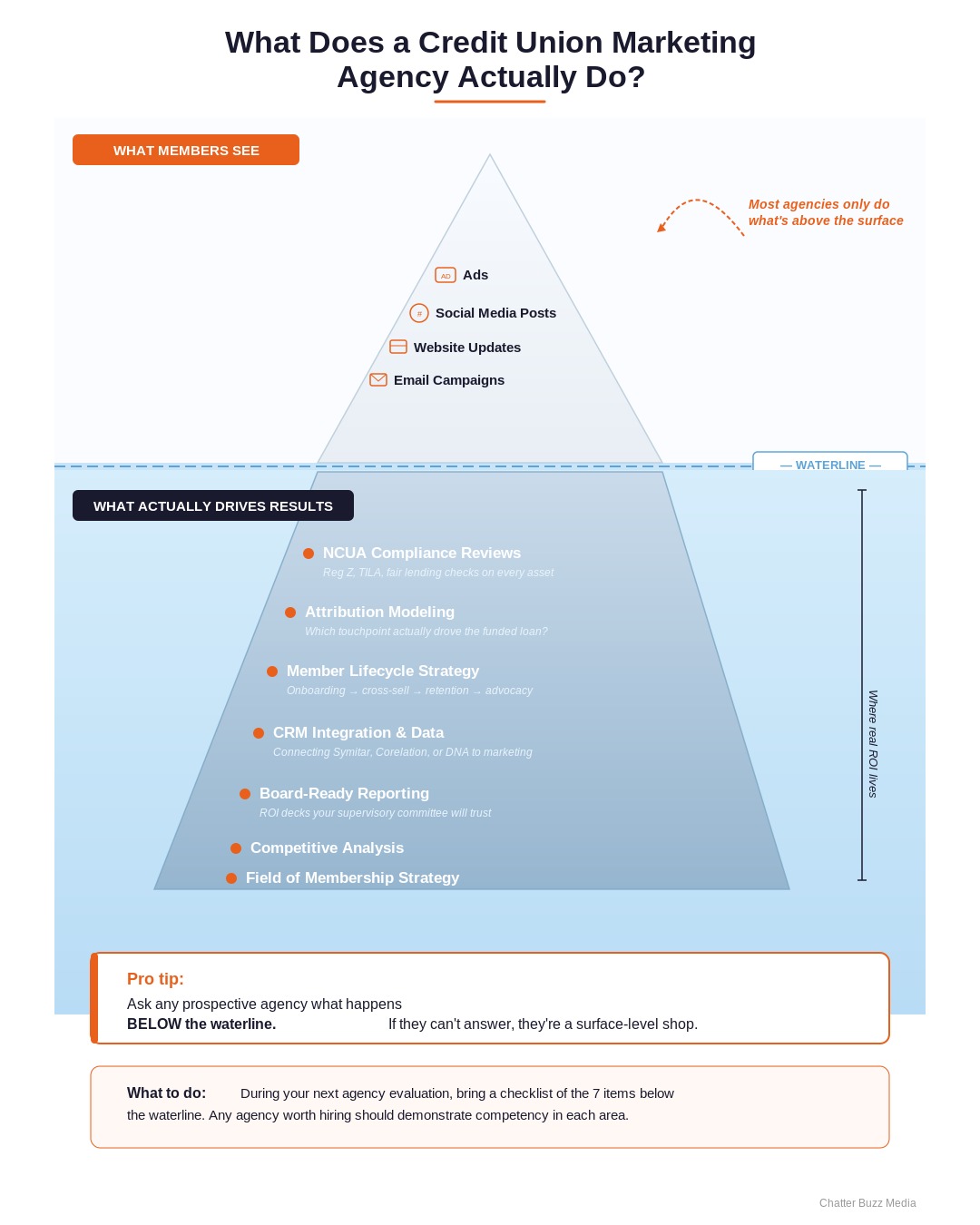
General marketing agencies know how to run ads and build websites. But credit unions operate under NCUA regulations, field-of-membership constraints, and board-level reporting requirements that generalists consistently get wrong.
A true credit union marketing firm understands that your members are owners, not customers. That changes everything — from messaging to media mix to how you measure success.
Core Services to Expect
The strongest credit union marketing agencies deliver a connected system, not a menu of isolated tactics. Here’s what a full-service engagement typically includes:
- Brand strategy and positioning — defining your cooperative advantage in a market dominated by big banks and fintech apps
- Website design and optimization — building digital experiences that convert visitors into funded accounts, not just pageviews
- SEO and content marketing — ranking for high-intent searches like “credit union near me,” “best auto loan rates,” and product-specific terms
- Paid media (Google Ads, Meta, LinkedIn) — capturing demand from members actively searching for checking, savings, mortgage, and auto loan products
- Email marketing and automation — nurturing prospects and deepening relationships with existing members through personalized sequences
- Social media management — building community presence and trust across the platforms your members actually use
- Analytics and reporting — connecting every campaign to funded loans, deposit growth, and member acquisition — not vanity metrics
The key differentiator? A specialized agency ties every dollar of marketing spend back to balance sheet impact. That’s the difference between a partner your board trusts and one they question.
How CU-Specialized Agencies Differ from Generalists
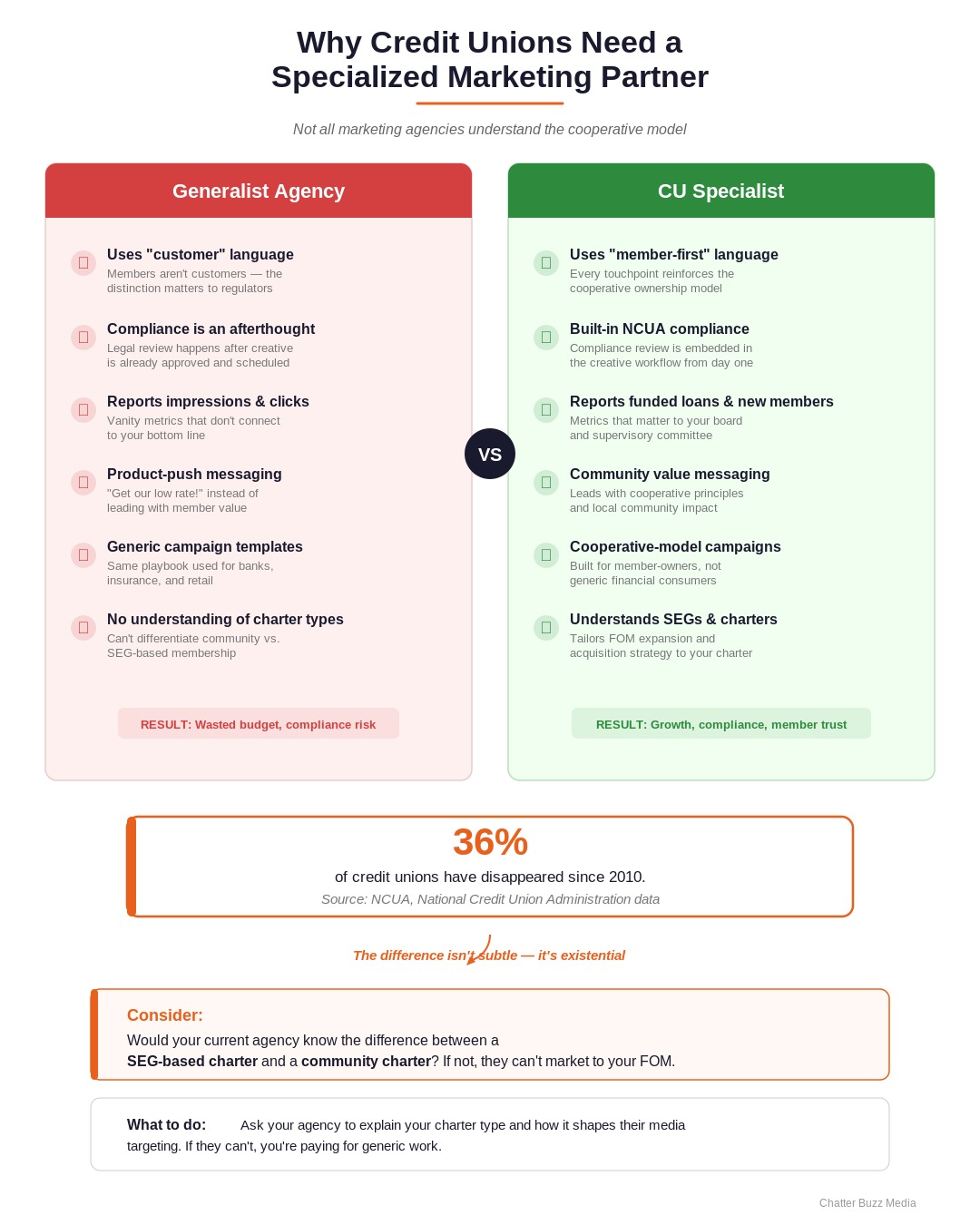
The gap between a credit union advertising agency and a generalist is wider than most executives expect.
Generalist agencies build campaigns that routinely fail compliance review. They don’t understand dividend communications, field-of-membership expansion rules, or how to present products within NCUA advertising guidelines.
Specialized agencies already speak your language. They know TISA disclosure requirements, truth-in-savings rules, and how to market loan products without triggering regulatory issues.
More importantly, they understand that credit union marketing isn’t about selling — it’s about earning trust in a member-owned institution.
Why Credit Unions Need a Specialized Marketing Partner in 2026
The credit union landscape is consolidating fast. Roughly 36% of credit unions have disappeared since 2010, with another 40% projected to consolidate in the next decade.
Surviving — and thriving — requires marketing that does more than generate awareness. It requires a growth engine that produces measurable, board-ready results.
The Compliance Challenge Most Agencies Ignore
Financial marketing isn’t like marketing software or restaurants. Every ad, landing page, and email must comply with NCUA regulations, TISA requirements, and federal advertising standards.
One non-compliant campaign can trigger examiner scrutiny, fines, and reputational damage. A marketing agency for credit unions should have compliance baked into their creative process — not bolted on as an afterthought.
Ask any agency you’re evaluating: How does your team handle compliance review before campaigns go live? If they hesitate, that tells you everything.
Member-First Messaging vs. Customer-First Messaging
Banks sell products. Credit unions serve members.
That’s not just philosophy — it fundamentally changes how you write headlines, structure landing pages, and position offers. A credit union marketing firm that also works with regional banks will default to product-push messaging that feels transactional.
The best credit union marketing leads with community value, financial empowerment, and the cooperative advantage — then backs it up with competitive rates and digital convenience.
Digital-First Member Acquisition
Here’s a stat that should reshape your marketing strategy: approximately 76% of interactions between members and credit unions now happen online, with mobile platforms accounting for nearly half of those interactions.
By 2029, roughly 85% of new credit union membership will come from Millennials and Gen Z. These generations don’t walk into branches. They Google “best credit union near me” and make decisions in minutes.
If your digital marketing isn’t optimized for these behaviors, you’re invisible to your fastest-growing demographic.
How to Evaluate a Credit Union Marketing Agency: A Selection Framework
Choosing the wrong agency wastes budget, stalls growth, and burns internal goodwill. Choosing the right one can transform your institution.
Here’s the evaluation framework we recommend to credit union leaders navigating this decision.

1. Industry Experience and Proven Results
This is non-negotiable. Ask every agency on your shortlist to show credit union-specific case studies with measurable outcomes.
Not impressions. Not clicks. Funded loans, new member accounts, deposit growth, and application completion rates.
Look for specifics like:
- Membership growth percentages (e.g., moving from 1% to 5% annual growth)
- Online application completion rate improvements
- Cost per funded loan or cost per new member
- Auto loan, mortgage, or consumer loan origination increases
If an agency can only show you “brand awareness” metrics, they’re not measuring what your board cares about.
2. Service Capabilities and Technology Stack
Your agency should function as an extension of your marketing team — not a vendor that handles one channel in isolation.
Evaluate whether they offer:
- Full-funnel capabilities — from awareness (SEO, content, social) through conversion (landing pages, paid media, email nurture) to retention (member lifecycle marketing)
- CRM and marketing automation integration — can they connect with your core banking system, marketing automation platform, or digital banking provider?
- Data infrastructure — do they build dashboards that tie marketing activity directly to balance sheet outcomes?
An agency that runs ads but can’t tell you how many of those clicks became funded accounts is leaving money on the table.
3. Cultural Fit and Communication Style
You’re going to work closely with this team. Chemistry matters.
During the evaluation process, pay attention to how the agency communicates. Do they listen first, or lead with a pitch? Do they ask about your strategic plan, growth targets, and member demographics — or jump straight to tactics?
The best agency relationships feel like a partnership, not a vendor transaction. Your account team should understand your board’s priorities, your CEO’s vision, and the day-to-day pressures your marketing department faces.
4. Measurement and Reporting Approach
This is where most agency relationships break down.
Insist on seeing a sample report before signing a contract. Look for:
- Board-ready dashboards that connect campaigns to funded accounts, deposits, and membership growth
- Clear attribution methodology — how do they track the path from ad click to funded loan?
- Regular cadence — monthly reporting at minimum, with quarterly strategic reviews
- Transparent budget allocation — you should know exactly where every dollar goes
If an agency reports on impressions and click-through rates without tying those to real business outcomes, they’re optimizing for the wrong things.
7 Questions to Ask Before You Sign a Contract
Before committing to any credit union marketing agency, these seven questions separate the specialists from the generalists — and the partners from the vendors.
1. How many credit unions do you currently serve?
Experience matters. An agency with five or more active credit union clients understands the nuances that a generalist never will.

Follow up by asking for references you can actually call.
2. How does your team handle NCUA compliance review?
The right answer describes a built-in compliance workflow — not “we’ll send it to your compliance officer.” Great agencies proactively flag issues before they reach your desk.
3. Can you show me a campaign that directly increased funded loans?
This question forces specificity. Vague answers like “we improved brand awareness” are red flags.
You want to hear: “We ran a Google Ads campaign for auto loans that generated 247 applications and 189 funded loans in Q3, at a cost per funded loan of $43.”
4. What does your onboarding process look like?
A structured onboarding process — typically 30-60 days — signals professionalism. Expect a brand audit, competitive analysis, tech stack review, and strategic roadmap before any campaigns launch.
5. How do you integrate with our existing technology?
Your agency should work with your core banking system, CRM, marketing automation platform, and digital banking tools — not require you to replace everything.
6. What’s your reporting cadence and format?
Monthly performance reports, quarterly strategic reviews, and real-time dashboards should be standard. If reporting is an “add-on,” keep looking.
7. What happens if results don’t meet expectations?
Listen for accountability. The best agencies have 90-day performance benchmarks and a clear optimization process when campaigns underperform.
The worst response? Blaming your budget or your audience.
Red Flags That Signal the Wrong Agency Partner
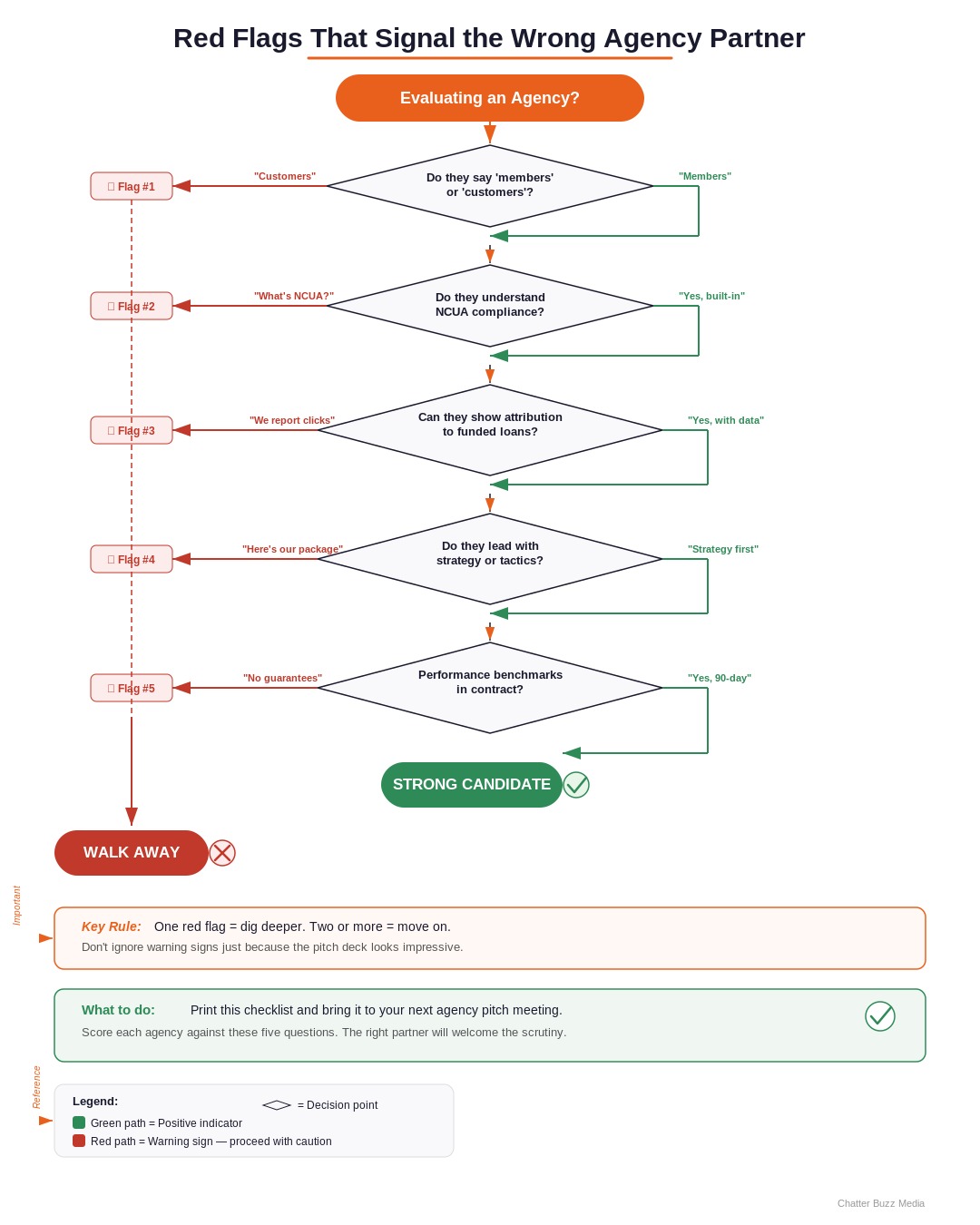
Not every credit union advertising agency is built for this work. Here are the warning signs we see credit union leaders miss most often.
They Lead with Tactics, Not Strategy
An agency that opens with “we’ll run Facebook ads” without asking about your growth targets, member demographics, or competitive landscape is selling execution — not partnership.
Strategy comes first. Tactics follow.
They Can’t Explain Their Attribution Model
If an agency can’t clearly explain how they track the journey from ad impression to funded account, they’re guessing. Your board doesn’t accept guesses — and neither should you.
They Treat Credit Unions Like Banks
This one is subtle but critical. Watch the language they use in their pitch. If they say “customers” instead of “members,” “sell” instead of “serve,” or “profit” instead of “member value” — they don’t understand the cooperative model.
They Lock You Into Long Contracts with No Performance Benchmarks
Beware of 12-month minimum contracts that don’t include performance milestones. The best agencies earn your business monthly and set clear benchmarks at 90, 180, and 365 days.
They Don’t Understand Compliance
Ask about TISA, Regulation Z, and NCUA advertising guidelines. If they look confused, walk away. Compliance isn’t optional — it’s the foundation of every campaign they’ll build for you.
What to Expect: Budget, Timeline, and ROI
One of the biggest barriers to choosing a credit union marketing agency is uncertainty about cost, timing, and return. Let’s remove that uncertainty.
Budget Benchmarks
Marketing budgets vary by asset size and growth goals. But as a baseline, credit union member acquisition costs averaged $428 in 2026, according to industry data.
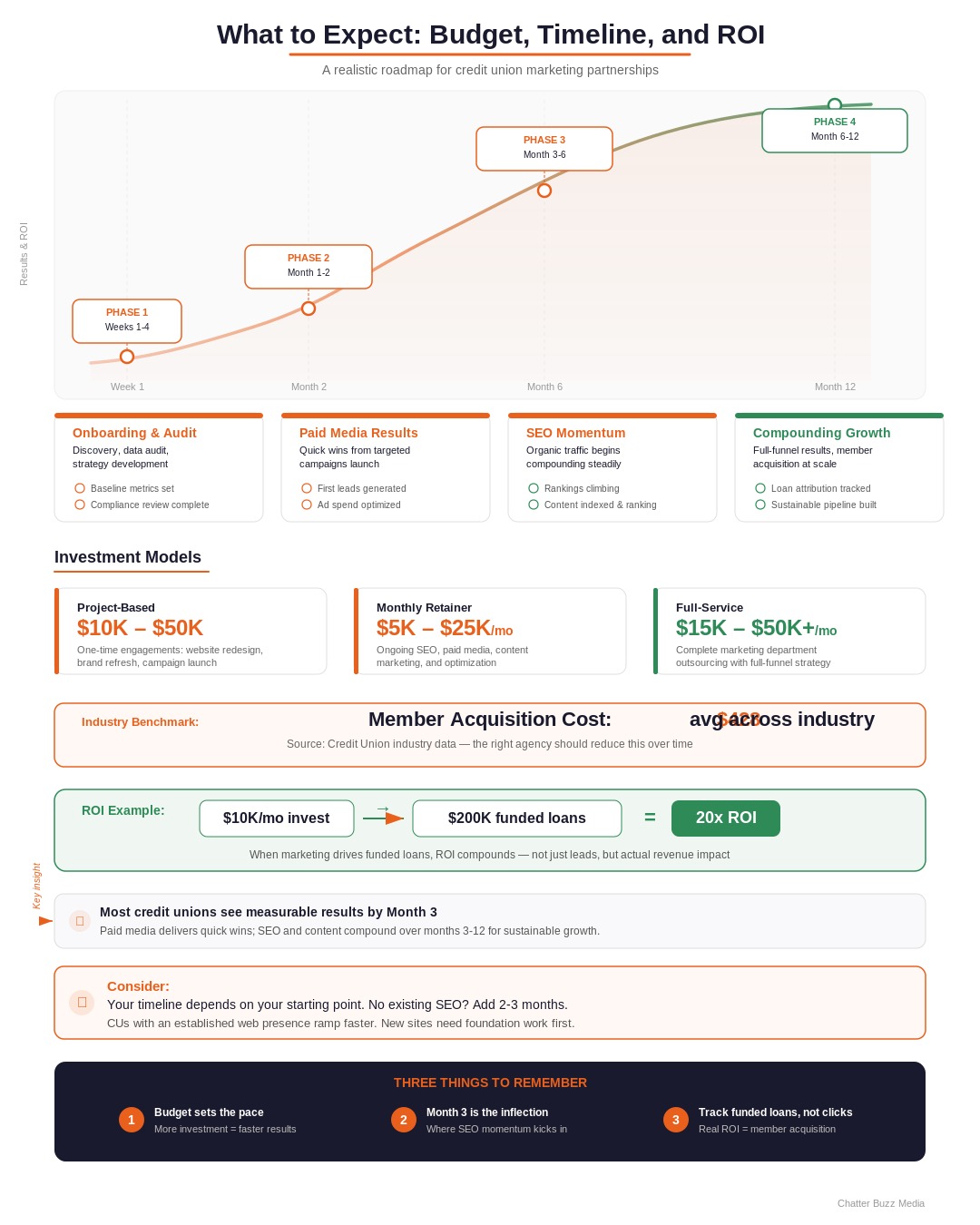
Here’s what agencies typically charge across engagement levels:
- Project-based (one-time): $10,000–$50,000 for website redesigns, brand refreshes, or campaign launches
- Retainer-based (monthly): $5,000–$25,000/month for ongoing SEO, paid media, content, and reporting
- Full-service partnership: $15,000–$50,000+/month for comprehensive digital marketing services including strategy, execution, and analytics
The key isn’t spending more — it’s spending where you can track funded outcomes. A $10,000/month investment that produces $200,000 in new loans is a 20x return.
Realistic Timelines
Set expectations with your board before campaigns launch:
- Paid media (Google Ads, Meta): Results within days to weeks. Most credit unions see measurable lead flow within 30 days.
- SEO and content marketing: Momentum builds over 3-6 months. Compounding effects become significant by months 4-6.
- Brand and website projects: 60-120 days from kickoff to launch, depending on scope.
- Full go-to-market transformation: 6-12 months to see the full impact of an integrated strategy.
Any agency promising page-one rankings in 30 days is either lying or using tactics that will eventually hurt you.
How to Measure ROI
Stop measuring marketing in impressions and start measuring it in balance sheet impact.
The KPIs your board actually cares about:
- Cost per new member — what does it cost to acquire a funded account?
- Cost per funded loan — how efficiently are campaigns driving originations?
- Online application completion rate — are digital funnels converting or leaking?
- Member lifetime value (LTV) — what’s the long-term revenue of each new relationship?
- Deposit growth tied to campaigns — can you attribute deposit increases to specific marketing efforts?
If your current agency can’t report on these metrics, you have a reporting problem — and possibly an agency problem. Data visualization and reporting should be built into every engagement.
In-House Marketing vs. Agency: When to Make the Shift
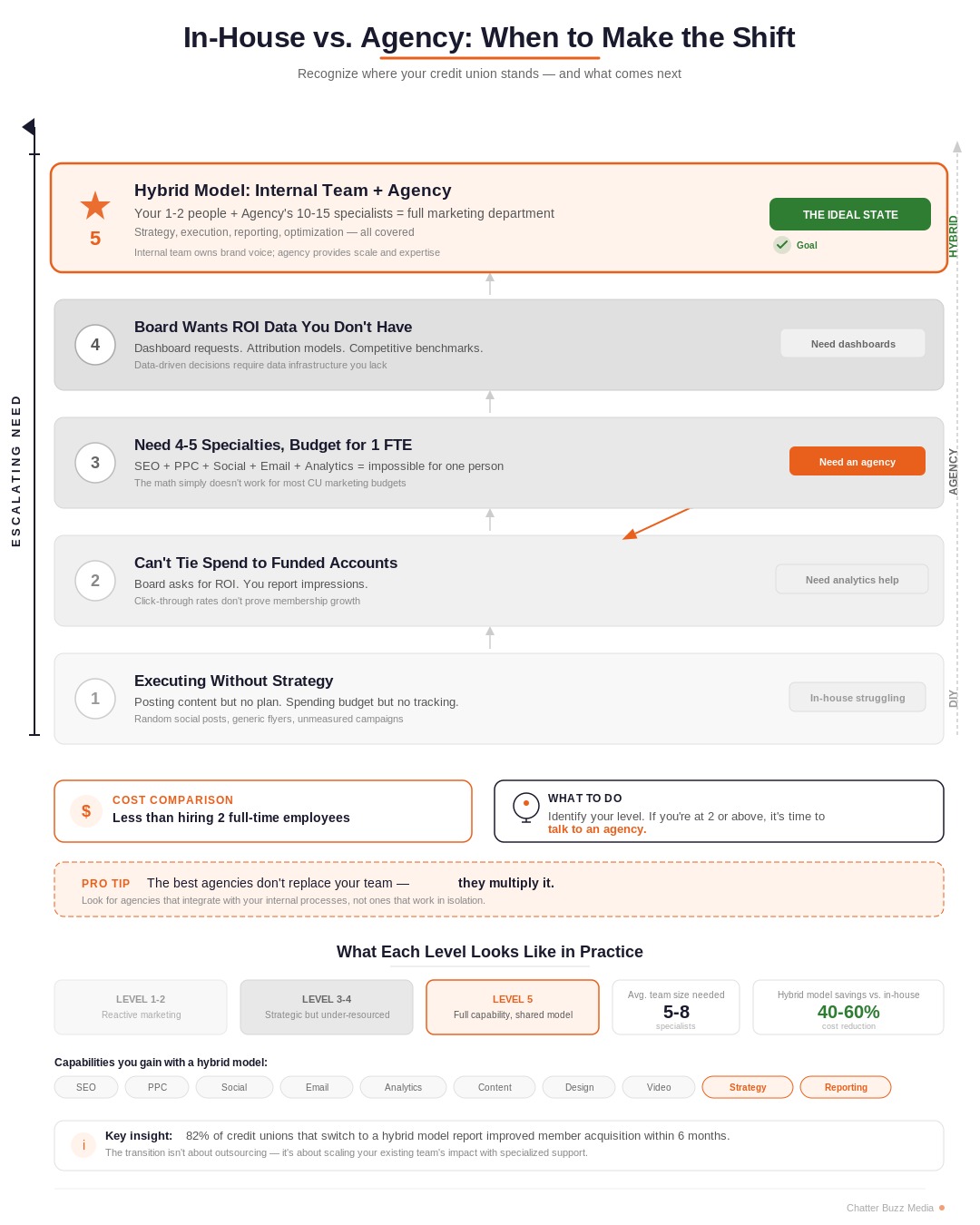
Many credit unions start with a one- or two-person marketing department. That works — until it doesn’t.
Here’s when an agency partnership makes more sense than adding headcount.
Signs You’ve Outgrown In-House
- Your marketing team is executing tactics without a strategic plan
- You’re spending on digital ads but can’t tie spend to funded accounts
- Your website hasn’t been redesigned in 3+ years and mobile conversion rates are below 2%
- You need expertise across SEO, paid media, email, and social — but can’t afford 4-5 specialists
- Your board is asking for marketing ROI data you don’t have
A full-service agency gives you access to 10-15 specialists — strategists, designers, developers, copywriters, media buyers, and analysts — for less than the cost of two full-time hires.
When In-House Still Makes Sense
In-house teams excel at day-to-day member communications, branch marketing, and internal campaigns. The best model is usually a hybrid: an internal team that handles brand voice and member relationships, paired with an agency that provides strategic leadership and specialized execution.
This is similar to how a fractional CMO works — you get executive-level marketing leadership without the $250,000+ salary commitment. For credit unions between $100M and $1B in assets, this combination of fractional CMO services plus agency execution often delivers the strongest results.
How to Transition to a New Credit Union Marketing Agency
Switching agencies feels daunting. But a structured transition protects your momentum and sets the new relationship up for success.
Planning the Switch
Start the transition process 60-90 days before your current contract ends. Here’s your checklist:
- Document everything: Collect all login credentials, campaign data, creative assets, and analytics access from your current agency
- Export your data: Download all historical campaign performance data — ad accounts, Google Analytics, email lists, and CRM records
- Review contract terms: Check for non-compete clauses, IP ownership provisions, and data portability rights
- Brief the new agency: Share your strategic plan, growth targets, competitive landscape, and lessons learned from the previous engagement
The biggest mistake credit unions make? Losing access to historical data. Make sure you own every account, login, and asset before the relationship ends.
Onboarding Essentials
A professional credit union marketing firm will run a structured onboarding process that typically includes:
- Discovery phase (weeks 1-2): Brand audit, competitive analysis, technology review, and stakeholder interviews
- Strategy development (weeks 3-4): Channel strategy, budget allocation, KPI framework, and content calendar
- Setup and launch (weeks 5-8): Campaign buildout, tracking implementation, and initial content creation
- Optimization (ongoing): Weekly performance monitoring, monthly reporting, and quarterly strategic reviews
Expect the first 60 days to focus on infrastructure. Campaigns built on a solid strategic foundation outperform rushed launches every time.
Conclusion: Choosing a Partner, Not Just a Vendor
Selecting the right credit union marketing agency is one of the most consequential decisions your leadership team will make.
The right partner doesn’t just run campaigns — they understand your cooperative mission, speak your board’s language, and tie every marketing dollar to measurable member growth.
Here’s what to remember:
- Demand credit union specialization — generalists waste time learning what specialists already know
- Evaluate on outcomes, not outputs — funded loans and member growth, not impressions and clicks
- Ask hard questions — compliance knowledge, attribution methodology, and performance benchmarks reveal the real agency behind the pitch deck
- Start with strategy — an agency that leads with tactics instead of strategy will optimize the wrong things
Your credit union exists to serve its members. The right marketing partner makes sure more people know that — and acts on it.
At Chatter Buzz Media, we work with credit unions and financial institutions to build marketing systems that drive real growth. If you’re evaluating agencies, schedule a strategy session to see how we approach credit union marketing differently.
FAQ: Credit Union Marketing Agency Selection
What is a credit union marketing agency?
A credit union marketing agency is a specialized firm that helps credit unions grow membership, increase loan originations, and build member loyalty through compliant, strategic marketing. The best agencies understand NCUA regulations, cooperative business principles, and how to measure success in funded accounts — not just marketing metrics.
How much does a credit union marketing agency cost?
Costs range from $5,000 to $50,000+ per month depending on the scope of services. Project-based work like website redesigns typically runs $10,000-$50,000. The more important question is ROI: a well-executed campaign should produce 5-20x return measured in funded loans and new member accounts.
How do I choose the best credit union marketing agency?
Evaluate agencies on four criteria: credit union-specific experience with measurable case studies, full-funnel service capabilities, compliance knowledge (NCUA, TISA, Regulation Z), and a reporting approach that ties campaigns to balance sheet outcomes. Ask for references from current credit union clients.
What’s the difference between a credit union marketing agency and a bank marketing agency?
Credit unions are member-owned cooperatives with unique compliance requirements, messaging needs, and growth metrics. An agency that primarily serves banks will default to product-push, profit-driven messaging that misaligns with the cooperative model. The best credit union marketing firms lead with community value and member empowerment.
How long does it take to see results from a credit union marketing agency?
Paid media channels typically deliver measurable leads within 2-4 weeks. SEO and content marketing build momentum over 3-6 months. Most credit unions see significant, compounding growth by months 4-6. Full go-to-market transformations take 6-12 months for complete impact.
Should a credit union hire an in-house marketing team or an agency?
Most credit unions benefit from a hybrid model: an internal team handling day-to-day communications and brand voice, paired with an agency providing strategic leadership and specialized execution (SEO, paid media, analytics). This gives you access to 10-15 specialists for less than the cost of two full-time hires.
What red flags should I watch for when evaluating credit union marketing agencies?
Watch for agencies that: can’t show credit union-specific case studies, use “customer” instead of “member” language, don’t understand NCUA compliance, lead with tactics instead of strategy, lock you into long contracts without performance benchmarks, or report on impressions and clicks without tying them to funded outcomes.
How do credit unions measure marketing ROI?
The most meaningful metrics are cost per new member, cost per funded loan, online application completion rate, member lifetime value, and deposit growth attributed to specific campaigns. Your agency should report on these balance sheet metrics — not just clicks, impressions, or website traffic.