
 321-236-2899
You have landed on the most comprehensive, in-depth guide to med spa advertising written for practices that want paid media to become a predictable engine for patient acquisition. Everything here is built for owners and operators who need booked consultations, not just impressions.
Paid media is where high-intent aesthetic demand gets captured. Med spa Google Ads campaigns commonly deliver a cost per lead between $20 and $60 for non-surgical treatments, and the practices that win are the ones treating advertising as a system rather than a series of one-off promotions.
At Chatter Buzz Media, we build medical spa advertising programs that connect ad spend to revenue across every channel and location. This guide walks you through the full playbook — the channels that work, the compliant way to advertise injectables, the funnel that converts, what it all costs in 2026, and how to measure it to booked revenue — so you can turn paid media into your most reliable source of new patients.
Key Takeaways
- Med spa advertising is a paid patient-acquisition system, not a promotion. The practices that scale run Google, Meta, and retargeting as one connected funnel with clear ownership and measurement.
- Compliance is the entry ticket, not an afterthought. Injectables are prescription products, so LegitScript certification is required to advertise brand names on Google and Meta.
- Search captures demand; social creates it. Google Ads intercepts patients already looking for a treatment, while Meta and YouTube build desire and feed retargeting.
- Your offer and landing page decide your cost per booking. A strong first-visit offer plus a fast, mobile-first booking path often matters more than the ad itself.
- ROAS below 3:1 signals a broken funnel. Healthy med spa injectable campaigns run 5:1 to 8:1 in the first month, with lifetime value pushing far higher.
What Med Spa Advertising Actually Is
Med spa advertising is the paid promotion of aesthetic treatments and your practice across search engines, social platforms, and digital media to attract and book new patients. It is distinct from organic marketing because you pay for placement and control exactly who sees your message.
Done well, advertising is the fastest lever a practice has for filling the calendar. Where med spa SEO compounds slowly over months, paid media can put your Botox or laser offer in front of qualified patients this week.
The Core Channels at a Glance
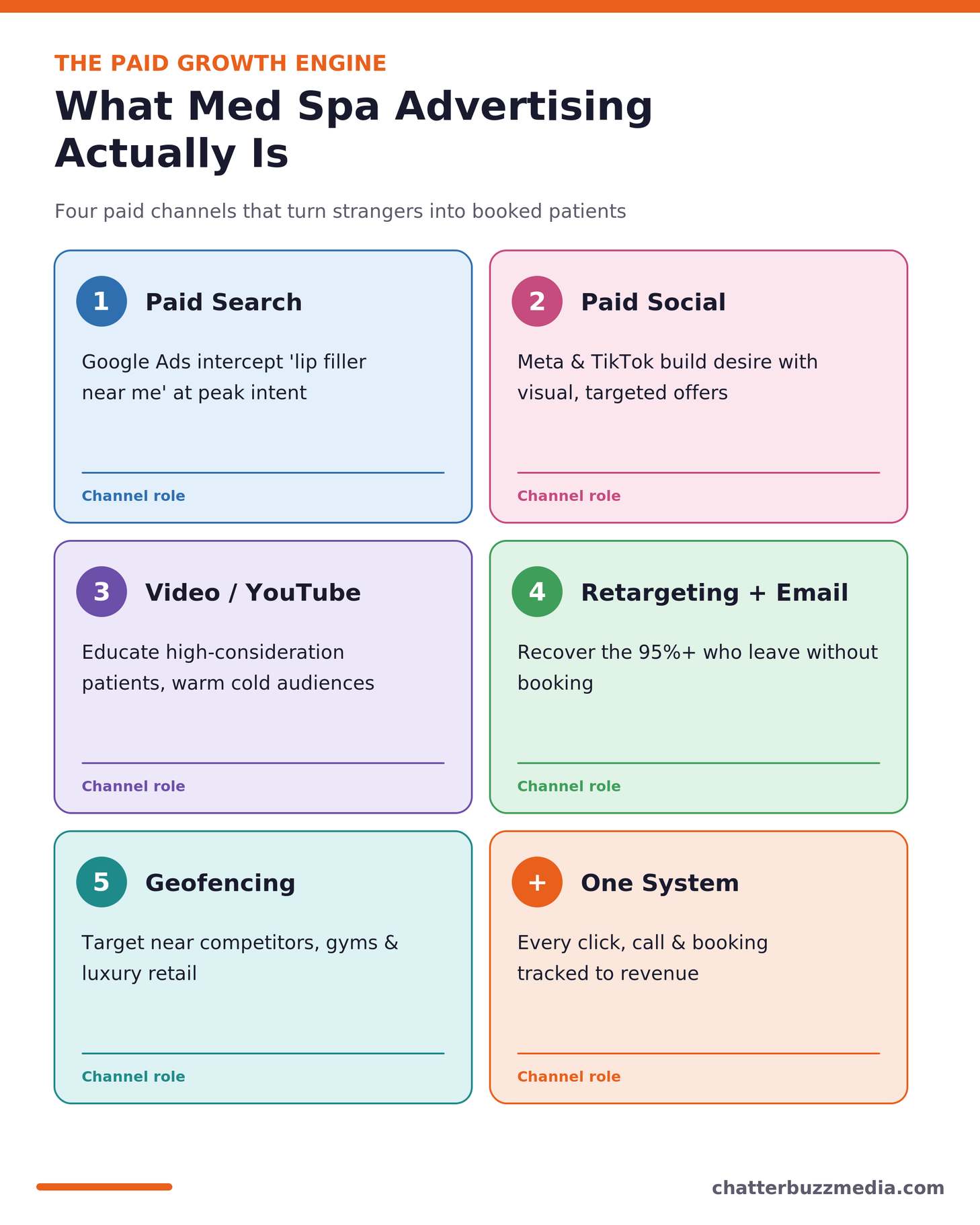
Most successful programs combine paid search, paid social, and retargeting. Each channel plays a different role, and skipping one usually means paying more for the others.
- Paid search (Google Ads): Captures patients actively searching “lip filler near me” or “laser hair removal [city].”
- Paid social (Meta, TikTok): Builds awareness and desire with visual before-and-after storytelling and targeted offers.
- YouTube and video: Educates high-consideration patients and lowers the cost of later retargeting.
- Retargeting and email: Re-engages the majority of visitors who leave without booking.
Why Paid Media Wins Patients
Aesthetic patients research for weeks and compare several practices before booking. Advertising lets you show up at each of those moments with the right message instead of hoping organic reach finds them.
It also gives you data. Every click, call, and booking is measurable, so you can move budget toward what works — a discipline we bring to every social media advertising engagement. With the landscape clear, let us look at why aesthetics advertising demands a specialized approach.
Why Med Spa Advertising Is Different From Ordinary Paid Media
Med spa advertising is harder than standard e-commerce or local-service advertising because the treatments are medical, regulated, and high-trust. The tactics that work for a restaurant or gym will get your ads disapproved — or your account suspended.
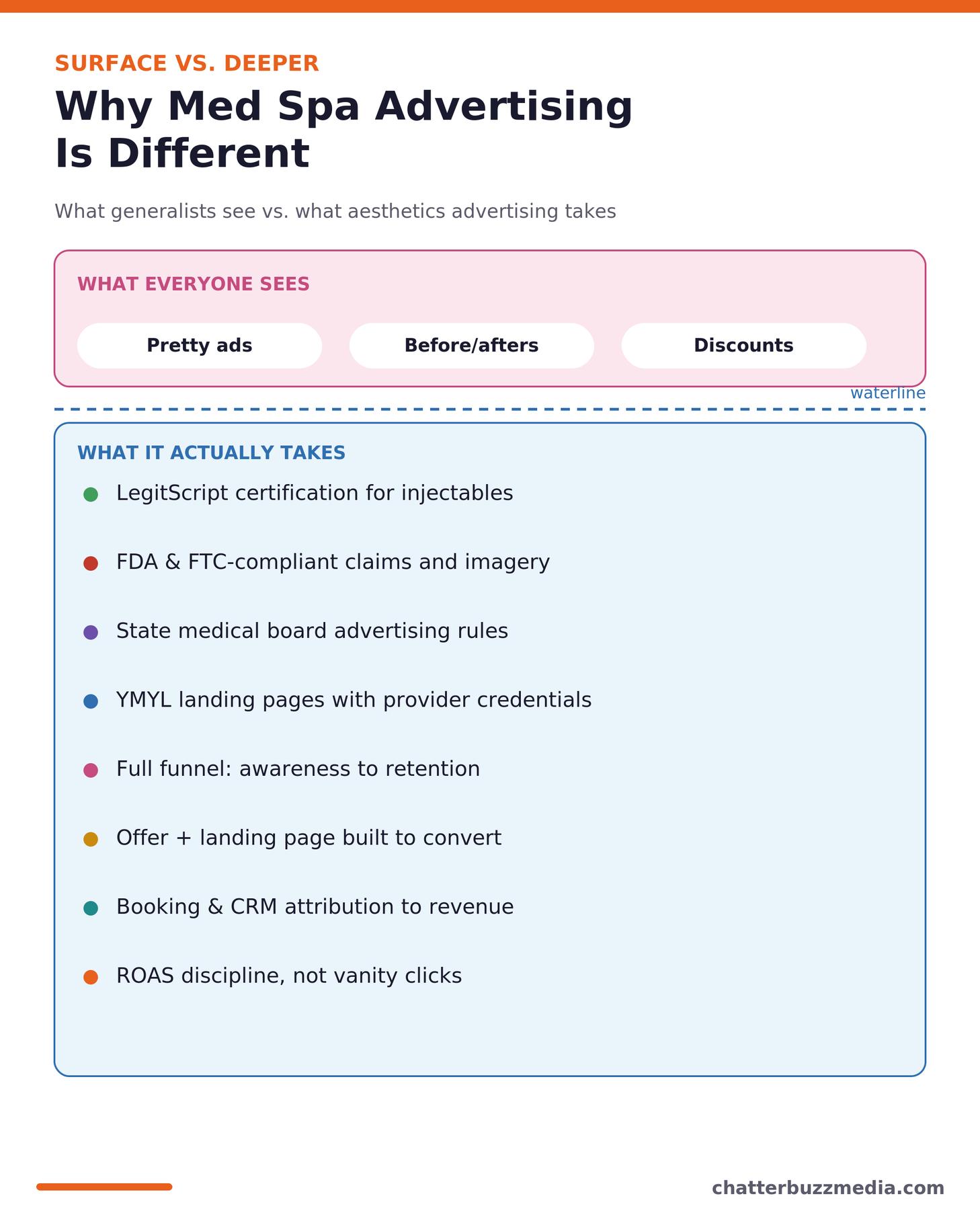
Understanding these constraints is what separates a program that scales from one that stalls. Three forces make aesthetics advertising its own discipline.
Regulated, Prescription-Based Treatments
Botox is a prescription drug and dermal fillers are FDA-regulated medical devices, which changes what you can say and show. Using brand names like Botox or Juvederm in ads almost always requires LegitScript certification before major platforms will run them.
Platforms also restrict graphic before-and-after imagery, needles, and claims that overpromise results. Advertising for these treatments has to be built to be approved, not just to convert.
Your Money or Your Life Scrutiny
Google and Meta apply their strictest quality standards to health-adjacent advertising. Landing pages need clear medical accuracy, provider credentials, and trust signals, or quality scores fall and costs climb.
This is the same trust bar we navigate across our healthcare digital marketing work, where credibility is a ranking and conversion factor, not a nicety.
High-Consideration, High-Value Decisions
A single injectable patient can be worth thousands of dollars in lifetime value, which justifies real ad investment. But that same patient weighs safety, results, and reputation carefully before booking.
That means advertising has to do more than announce a discount — it has to build confidence. Now let us map the specific channels that move aesthetic patients from scroll to booked consultation.
The Paid Channels That Drive Med Spa Patient Acquisition
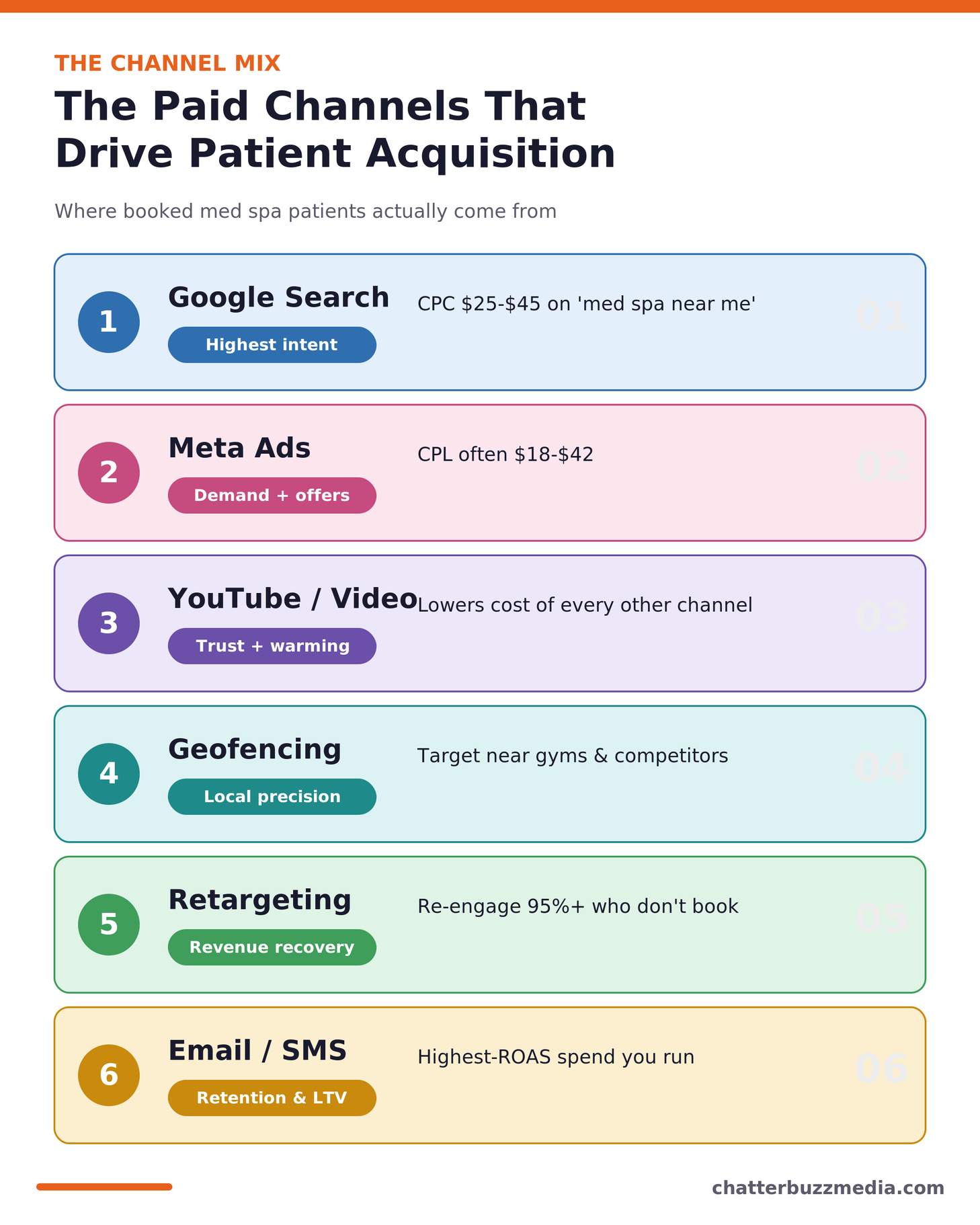
The channels that consistently produce booked patients for med spas are Google Search, Meta, YouTube, and local geofencing, each reinforcing the others. The goal is a portfolio, not a single bet.
Choosing where to spend depends on your treatments, market, and margins. Here is how each channel earns its place in a modern med spa advertising mix.
1. Google Search and Local Service Ads
Paid search is your highest-intent channel because it intercepts patients who are already looking. Bidding on treatment-plus-city terms puts you above the fold for “microneedling near me” the moment demand appears.
Expect competitive clicks — high-intent terms like “med spa near me” can exceed $25 to $45 per click — so tight geo-targeting and negative keywords protect your budget. Pair search with a conversion-focused PPC management approach to keep cost per lead controlled.
2. Meta Ads (Facebook and Instagram)
Meta is where aesthetic desire is created and offers are distributed. Strong visual storytelling and a compelling first-visit offer typically deliver a lower cost per lead than search — often in the $18 to $42 range — while filling your retargeting pool.
Because injectable brand names are restricted, winning Meta creative focuses on outcomes, experience, and education rather than prohibited claims. This is the visual-first discipline behind our UGC content production for aesthetics brands.
3. YouTube and Short-Form Video
Video lowers the cost of every other channel by warming patients before they ever click an offer. Educational clips on “what to expect from RF microneedling” build trust and expand your retargeting audiences.
Short-form video on Reels and TikTok extends that reach to younger, treatment-curious audiences at a low cost per view.
4. Geofencing and Local Display
Geofencing lets you target patients near competitors, gyms, or luxury retailers with precise, location-based ads. It is a powerful way to capture in-market patients that broad campaigns miss, as we detail in our geofencing advertising approach.
5. Retargeting and Email Automation
Most first-time visitors leave without booking, so retargeting is where much of your revenue is actually recovered. Layered display, social retargeting, and automated email nudge undecided patients back to the calendar at a fraction of the cost of a cold click.
With the channels mapped, the next step is connecting them into a funnel that converts. Let us build it.
Building a Med Spa Advertising Funnel That Converts
A med spa advertising funnel moves patients through four stages — awareness, consideration, conversion, and retention — with a specific channel and message at each one. Isolated ads leak money; a funnel compounds.
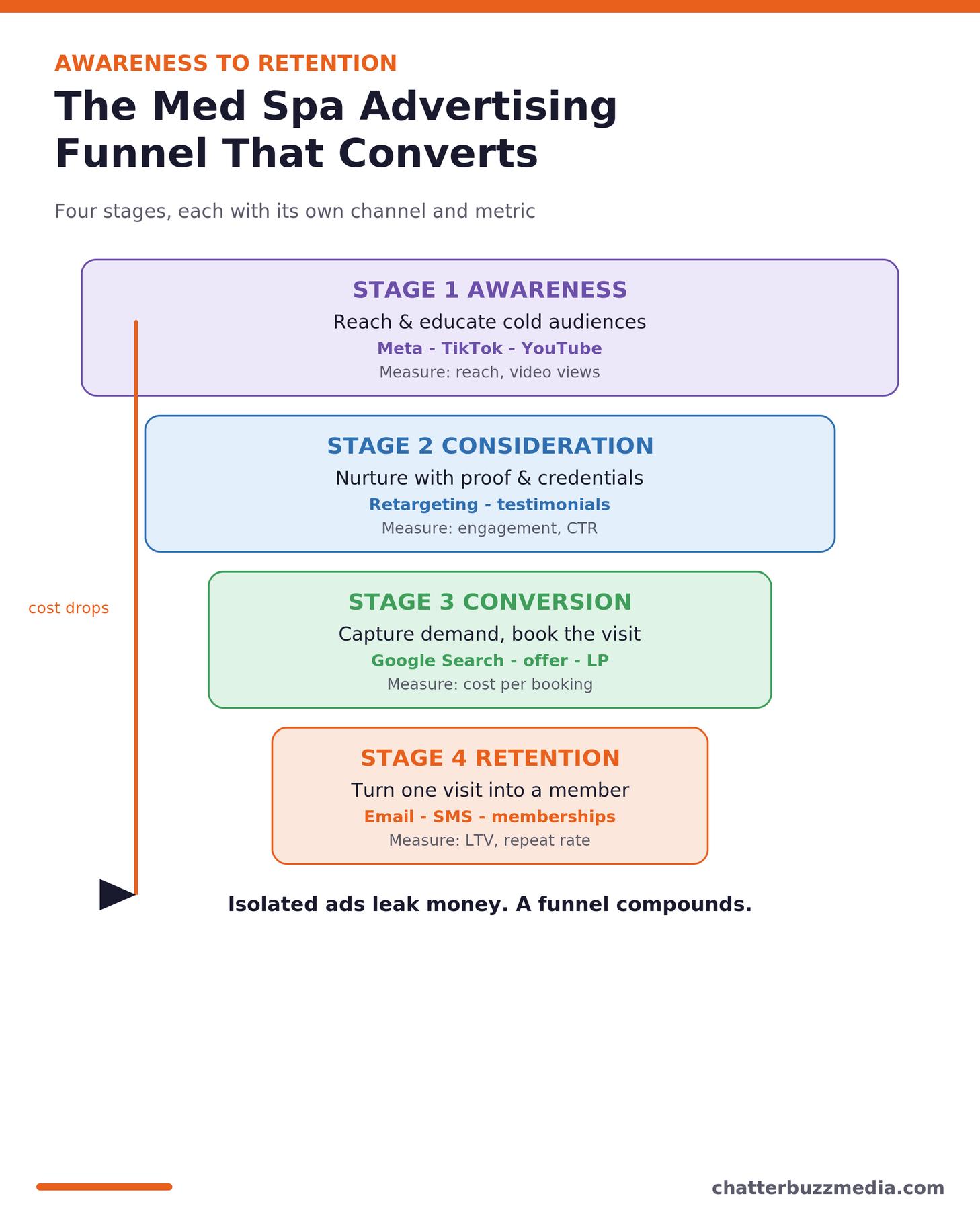
The funnel matters because aesthetic patients rarely book on first exposure. Each stage exists to lower friction toward the next.
Stage 1: Awareness
At the top, the job is reach and education, not a hard sell. Use Meta, TikTok, and YouTube to introduce treatments, results, and your brand to cold audiences in your market.
Measure this stage on reach, video views, and cost per new audience member — not immediate bookings.
Stage 2: Consideration
Now you nurture interest with proof and specifics. Retarget engaged viewers with testimonials, provider credentials, and treatment explainers that answer safety and result questions.
This is where trust is built, and where a clear offer starts to appear.
Stage 3: Conversion
Here you capture demand with search ads and a strong first-visit offer aimed at booking a consultation. Every element points to one action: schedule now, with as little friction as possible.
A dedicated, fast landing page and click-to-call are non-negotiable, a principle we apply through conversion rate optimization.
Stage 4: Retention
The most profitable advertising you run targets patients you already have. Email, SMS, and membership offers turn a single injectable visit into a recurring, high-value relationship.
With the funnel in place, we have to address the constraint that governs all of it: compliant advertising for injectables.
Compliant Advertising for Botox, Fillers, and Injectables
Compliant med spa advertising means promoting regulated treatments in a way that satisfies platform policy, FDA rules, and state medical board standards. Getting this wrong risks disapproved ads, suspended accounts, and real legal exposure.
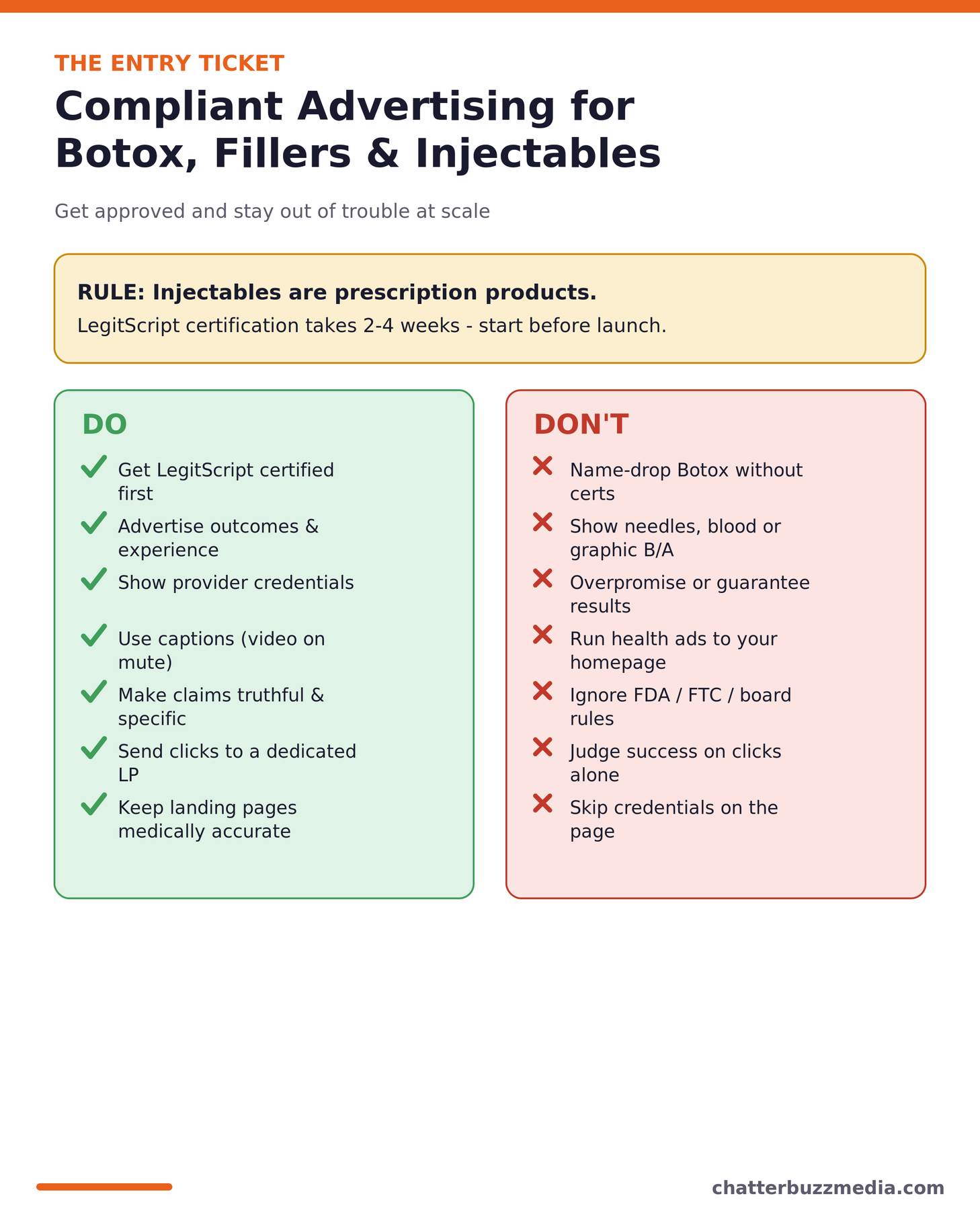
Compliance is not a reason to advertise less — it is the framework that lets you advertise confidently at scale. Here is what disciplined practices get right.
Secure LegitScript Certification First
To advertise injectable brand names on Google and Meta, most practices need LegitScript certification, which typically takes two to four weeks. Without it, platforms block the ads and payment processors may restrict online charging.
Build this into your launch timeline so campaigns are not stalled waiting on approval.
Advertise Outcomes, Not Prohibited Claims
Focus creative on experience, confidence, and results rather than brand names, guarantees, or graphic imagery. Avoid needles, blood, and dramatic before-and-after shots that platforms routinely reject.
Frame treatments around patient goals — smoother skin, refreshed appearance — which converts well and stays within policy.
Keep Claims Accurate and Substantiated
The FTC and state boards prohibit false, deceptive, or misleading health advertising. Every claim needs to be truthful, and provider credentials and licensing should be visible on your landing pages.
Treat medical accuracy as a conversion asset, because in aesthetics, trust is what closes. With compliance handled, let us talk budgets and what med spa advertising actually costs.
What Med Spa Advertising Costs in 2026
Most med spas should expect to invest between $3,000 and $15,000 per month in paid media plus management, scaling with market competitiveness and the number of locations. The right number is the one that produces profitable patient acquisition, not the lowest one.
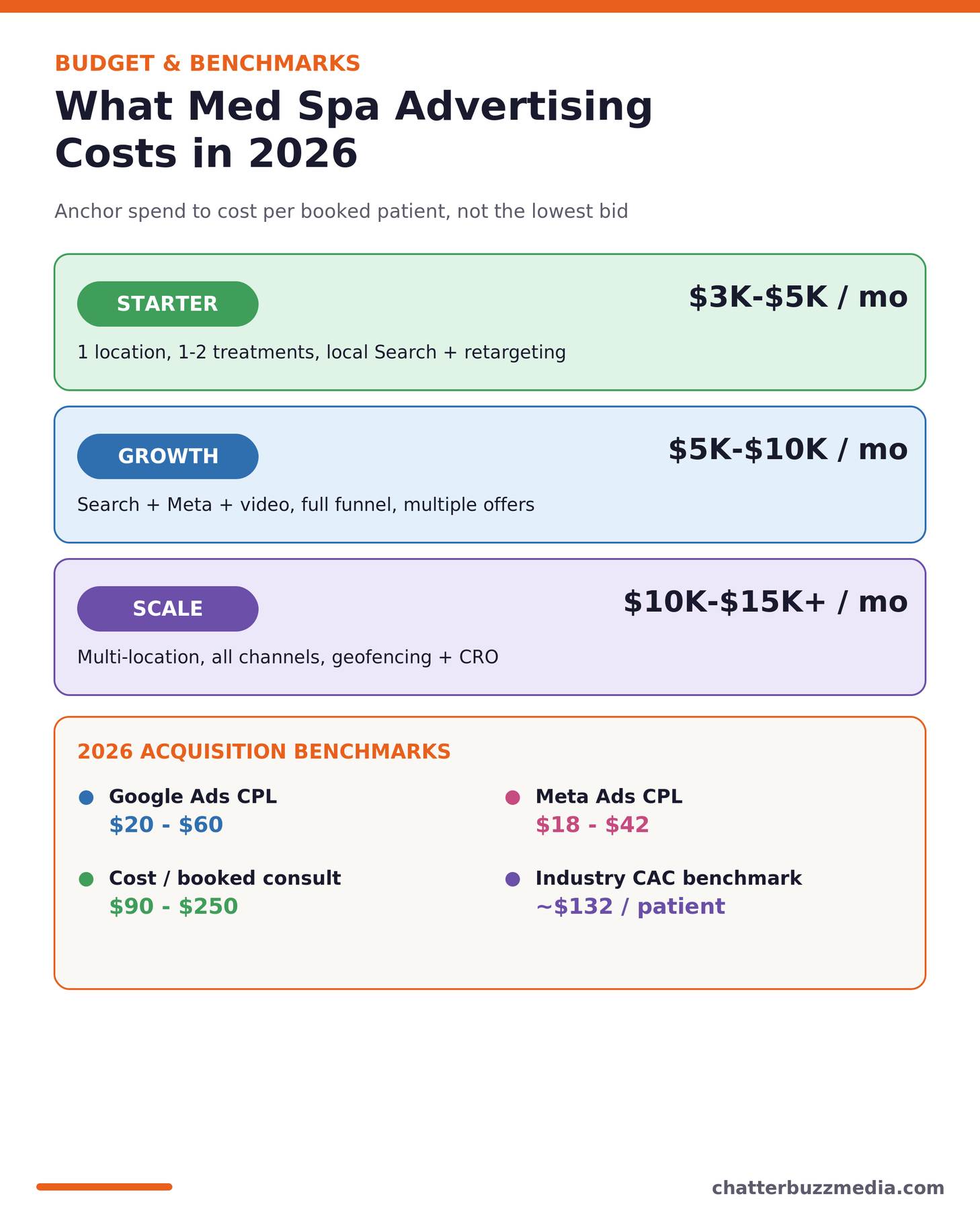
Cost conversations only make sense against outcomes, so anchor budget to cost per lead and cost per booked patient. Here is what the benchmarks look like heading into 2026.
Cost Per Lead and Acquisition Benchmarks
Lead costs vary by platform and treatment complexity, but the ranges are well established.
- Google Ads CPL: Roughly $20 to $60 for non-surgical treatments, higher for surgical or high-competition markets.
- Meta Ads CPL: Often $18 to $42 depending on creative and offer quality.
- Cost per booked consultation: Typically $90 to $250 for most non-surgical treatments once lead quality is factored in.
- Industry CAC: The often-cited aesthetic patient acquisition cost benchmark sits near $132 per patient, though this varies widely by treatment.
How to Set a Budget That Works
Start from your economics, not a competitor’s spend. If a new injectable patient is worth $1,500 in first-year value, a $150 acquisition cost is a strong investment.
Fund enough budget to gather data quickly, then reallocate toward the channels and offers that produce booked patients. Budgeting like this is core to the performance marketing model we run for clients.
Agency and Management Fees
Expect management fees on top of media spend, whether a percentage of spend or a flat monthly retainer. The value of good management shows up as lower cost per booking and cleaner attribution, not just campaign setup.
Cost only converts to growth when the creative and landing pages do their job. Let us turn to what actually books consultations.
Offers, Creative, and Landing Pages That Book Consultations
The offer, the creative, and the landing page decide whether your ad spend becomes booked patients or wasted clicks. In med spa advertising, these three elements usually move results more than targeting alone.
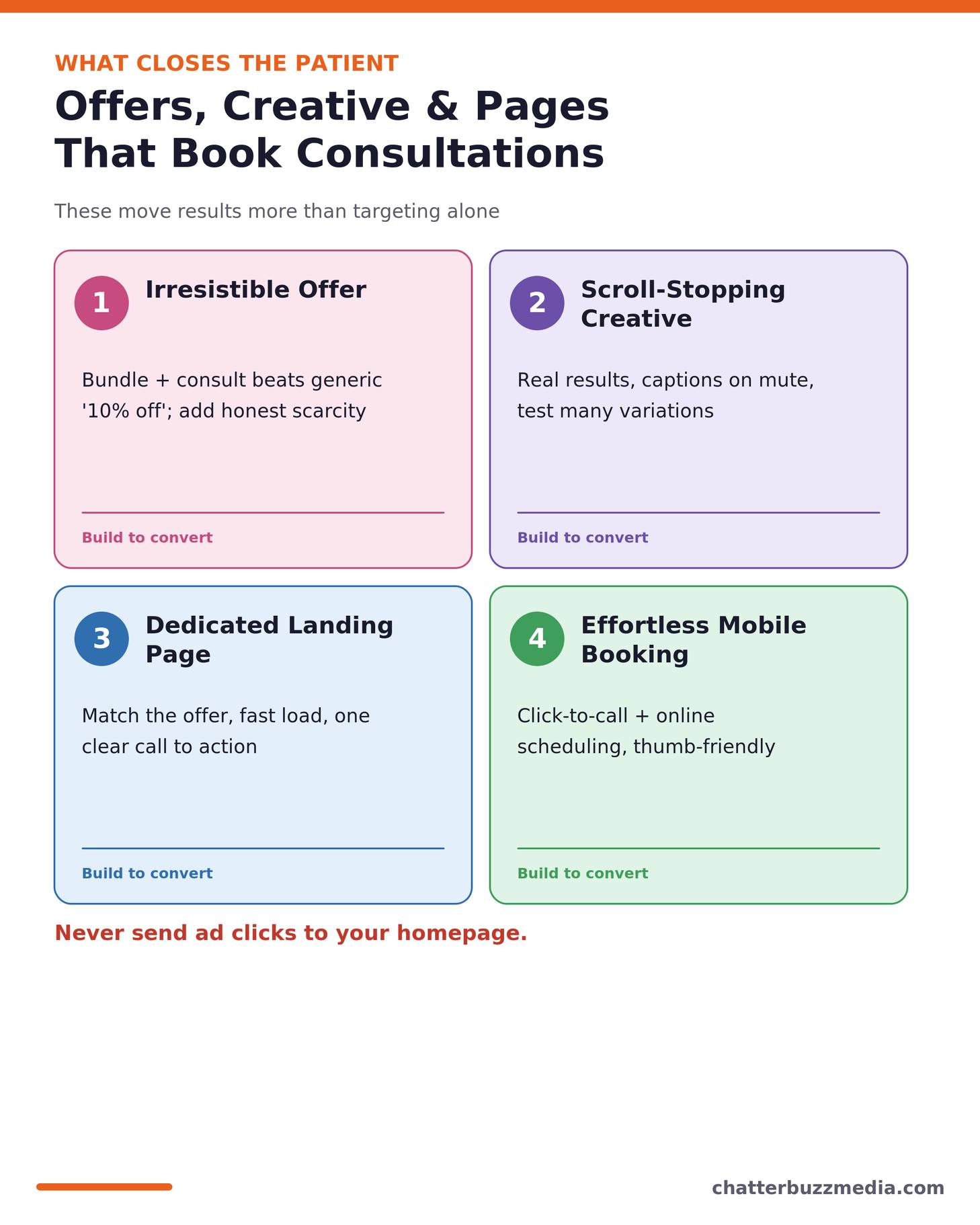
Patients act on clarity and confidence. Here is how to build each element to convert.
1. Craft an Irresistible First-Visit Offer
New-patient offers work because they lower the risk of trying a new practice. Move beyond a generic “10% off” to specific, valuable hooks like a treatment-plus-consultation bundle or a limited introductory price.
Add honest scarcity — a real deadline or limited slots — to create urgency without gimmicks.
2. Build Scroll-Stopping, Compliant Creative
Great aesthetic creative shows experience and outcomes through high-quality photography, provider footage, and authentic patient stories. Because most social video is watched on mute, use captions and text overlays to carry the message.
Test multiple variations — different offers, hooks, and formats — and let performance decide the winner.
3. Send Traffic to a Dedicated Landing Page
Never send ad clicks to your homepage. A dedicated landing page matched to the ad’s offer, with fast load times, clear proof, and one obvious call to action, is what turns interest into a booking.
Include click-to-call, online scheduling, and trust signals like credentials and reviews above the fold.
4. Make Booking Effortless on Mobile
The overwhelming majority of med spa ad clicks happen on a phone, so the booking path has to be thumb-friendly and instant. Every extra field or slow-loading step quietly costs you patients.
Once your creative and pages are converting, the final discipline is measurement — knowing exactly what your advertising returns.
Measuring ROI and Scaling Your Med Spa Ad Spend
Measuring med spa advertising ROI means tracking the full chain from ad click to booked, completed, and repeat patient revenue — not clicks or leads alone. Without this, you cannot know which campaigns to scale and which to cut.
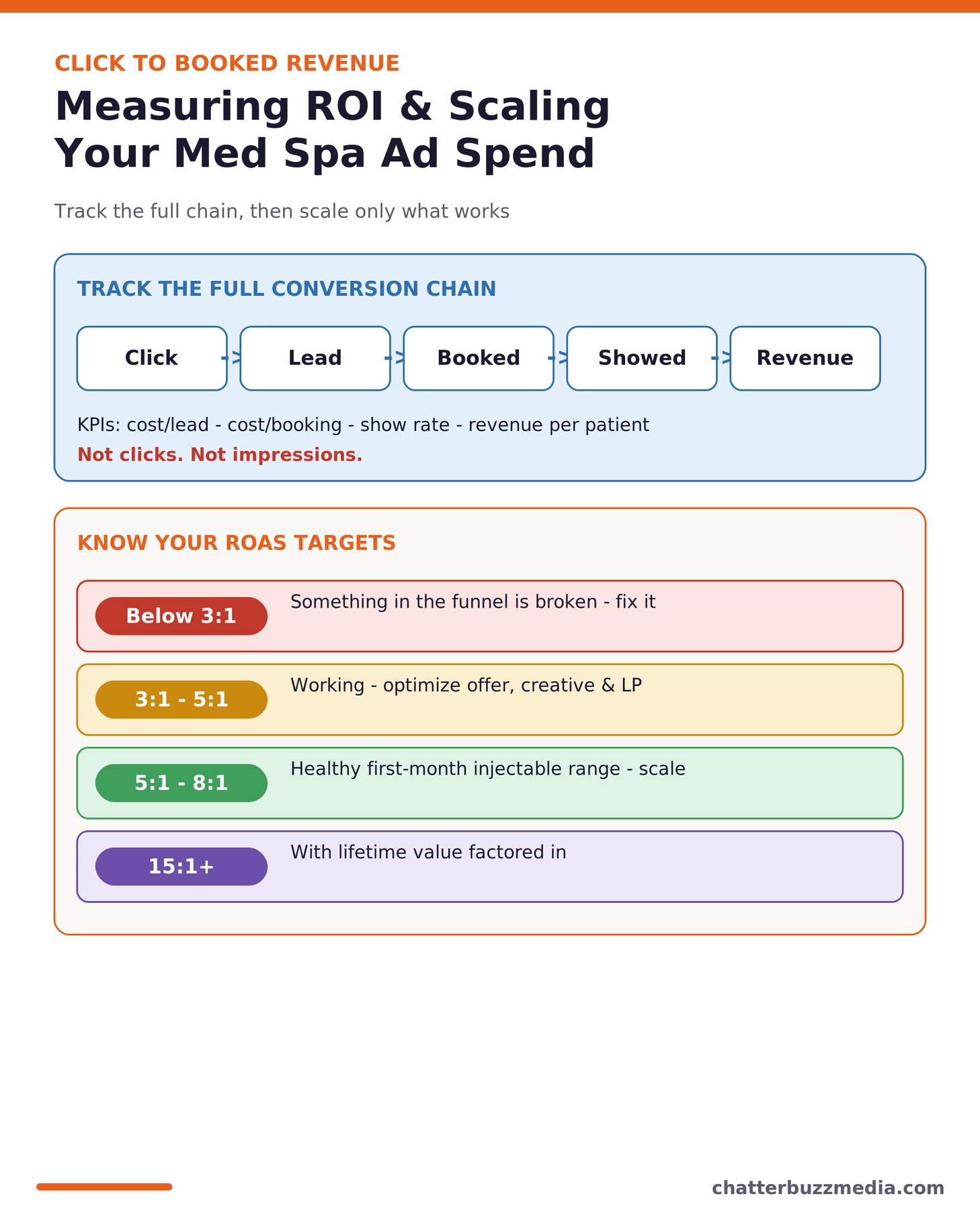
Measurement is what turns advertising from an expense into an investment. Here is the framework we use to prove and grow returns.
Track the Full Conversion Chain
Connect ad platforms to your booking and CRM systems so you can follow a lead to revenue. Measure cost per lead, cost per booked consultation, show rate, and revenue per patient, not just top-of-funnel clicks.
This is the same closed-loop reporting we install through our reporting and data visualization engagements.
Know Your ROAS Targets
Return on ad spend is the clearest signal of program health. Healthy med spa injectable campaigns run about 5:1 to 8:1 in the first month, with lifetime value pushing returns far higher.
If first-month ROAS is below 3:1, something in the funnel is broken; at 5:1 or above, you should be scaling budget deliberately.
Scale What Works, Cut What Does Not
Scaling is not spending more everywhere — it is spending more on proven winners. Shift budget toward the channels, offers, and audiences that produce booked revenue, and pause the rest.
For multi-location groups, apply this at the location level so each market scales on its own performance, an approach we detail in our med spa marketing agency guide.
Conclusion: Turn Paid Media Into a Predictable Patient Engine
Med spa advertising works when you treat it as a connected system rather than a string of promotions. The practices that win pair high-intent search with desire-building social, run everything through a real funnel, and measure all the way to booked revenue.
Compliance is the entry ticket, your offer and landing page decide your cost per booking, and disciplined measurement tells you when to scale. Get those fundamentals right and paid media becomes the most predictable patient-acquisition channel your practice has.
At Chatter Buzz Media, we build and run these programs end to end for aesthetics practices and groups. If you want advertising that produces booked patients, not just impressions, start with a free marketing audit.
Frequently Asked Questions About Med Spa Advertising
How much does med spa advertising cost?
Most med spas invest between $3,000 and $15,000 per month in paid media plus management, scaling with market competitiveness and number of locations. Cost per lead typically runs $20 to $60 on Google Ads and $18 to $42 on Meta, with cost per booked consultation around $90 to $250 for non-surgical treatments.
Is med spa advertising worth it?
Yes, when it is measured to booked revenue. Because a single injectable patient can be worth thousands in lifetime value, healthy campaigns returning 5:1 to 8:1 in the first month make paid media one of the highest-ROI investments a practice can make.
Can you advertise Botox and fillers on Facebook and Google?
You can advertise the treatments, but using prescription brand names like Botox usually requires LegitScript certification, which takes about two to four weeks. Most compliant campaigns focus on outcomes and experience rather than brand names, and avoid graphic before-and-after imagery that platforms reject.
What is the best advertising platform for a med spa?
There is no single best platform — the strongest programs combine Google Search to capture high-intent patients with Meta and video to build demand and feed retargeting. Google intercepts patients already searching, while social creates interest among those who are not yet looking.
How do I advertise a med spa on a limited budget?
Start with tightly geo-targeted Google Search on your most profitable treatments and a single strong first-visit offer, then reinvest early returns into Meta retargeting. Concentrating a small budget on high-intent search and warm retargeting beats spreading it thin across every channel.
How long before med spa advertising produces results?
Paid search can generate leads within days of launch, while social and full-funnel programs usually need four to eight weeks to optimize creative, audiences, and offers. Advertising produces faster results than SEO, but still improves as the algorithms and your data mature.
What are the biggest med spa advertising mistakes to avoid?
The most common mistakes are sending ad traffic to a homepage instead of a dedicated landing page, ignoring compliance requirements, and judging campaigns on clicks rather than booked patients. Weak offers and slow mobile booking paths quietly waste otherwise solid ad spend.
Should I hire a med spa advertising agency or run ads in-house?
An in-house team can work for a single location with dedicated expertise, but most practices see lower cost per booking with a specialized agency that understands aesthetics compliance and multi-channel funnels. The right partner earns its fee through better attribution and a lower cost per acquired patient.