
 321-236-2899
Running marketing for one med spa location is complicated enough. Running it across five, ten, or twenty locations without a specialized partner? That’s where most multi-location aesthetics groups watch their patient acquisition costs spiral while brand consistency crumbles.
The U.S. medical spa market is projected to grow from $7.4 billion in 2025 to $25.8 billion by 2034. That growth is attracting more competition at every level, and the practices scaling fastest are the ones with dedicated marketing infrastructure behind them.
This guide breaks down exactly what a med spa marketing agency does for multi-location groups, how to evaluate one, and how to build a marketing system that scales with your growth. Let’s get into it.
Key Takeaways
- Multi-location med spas face marketing challenges that single-location tactics can’t solve. Brand inconsistency, fragmented data, and local-vs-corporate tension require a specialized agency approach.
- Not every marketing agency understands medical aesthetics. Compliance requirements, treatment cycles, and patient lifetime value models demand industry-specific expertise.
- The best agencies centralize brand strategy while localizing execution. This means unified messaging and creative with market-specific SEO, ads, and community engagement.
- Measure what matters: cost per booked appointment, patient lifetime value, and location-level ROI. Clicks and impressions don’t pay the bills.
Why Multi-Location Med Spas Need a Specialized Marketing Agency

Scaling a med spa from one location to multiple markets changes the marketing equation entirely. What worked at a single location rarely survives the transition to three, five, or twenty.
Here’s why multi-location groups hit a wall with generic marketing approaches.
The Multi-Location Marketing Challenge
Every new location introduces complexity that multiplies, not just adds. You’re now managing separate Google Business Profiles, location-specific ad campaigns, different competitive landscapes, and unique community dynamics.
Meanwhile, your brand needs to feel the same everywhere. A patient who visits your Miami location should have the same brand experience as someone walking into your Atlanta clinic.
Three bottlenecks consistently stall multi-location med spa growth:
- Brand inconsistency: Individual locations create their own messaging, visuals, and promotions. The brand fragments. Patients lose trust when the experience varies wildly from one location to the next.
- Fragmented data: Marketing performance lives in silos. You can’t compare cost-per-acquisition across markets or identify which locations are underperforming without centralized reporting.
- Local vs. corporate tension: Corporate wants brand control. Location managers want autonomy. Without a framework that serves both, neither side gets what they need.
A specialized healthcare marketing agency solves these problems by building systems that scale, not just campaigns that run.
Single-Location Tactics Don’t Scale
The Instagram account that drove bookings for your first location won’t produce the same results when you copy it across ten markets. The Google Ads campaign that delivered $40 cost-per-lead in one city might cost $120 in another.
Multi-location marketing demands a different operating model. You need centralized strategy with localized execution, shared creative assets with market-specific messaging, and unified reporting that shows performance at both the group and individual location level.
That’s the gap a med spa marketing agency fills. Not just “doing marketing” for you, but building the infrastructure that lets marketing scale alongside your practice growth.
What a Med Spa Marketing Agency Actually Does
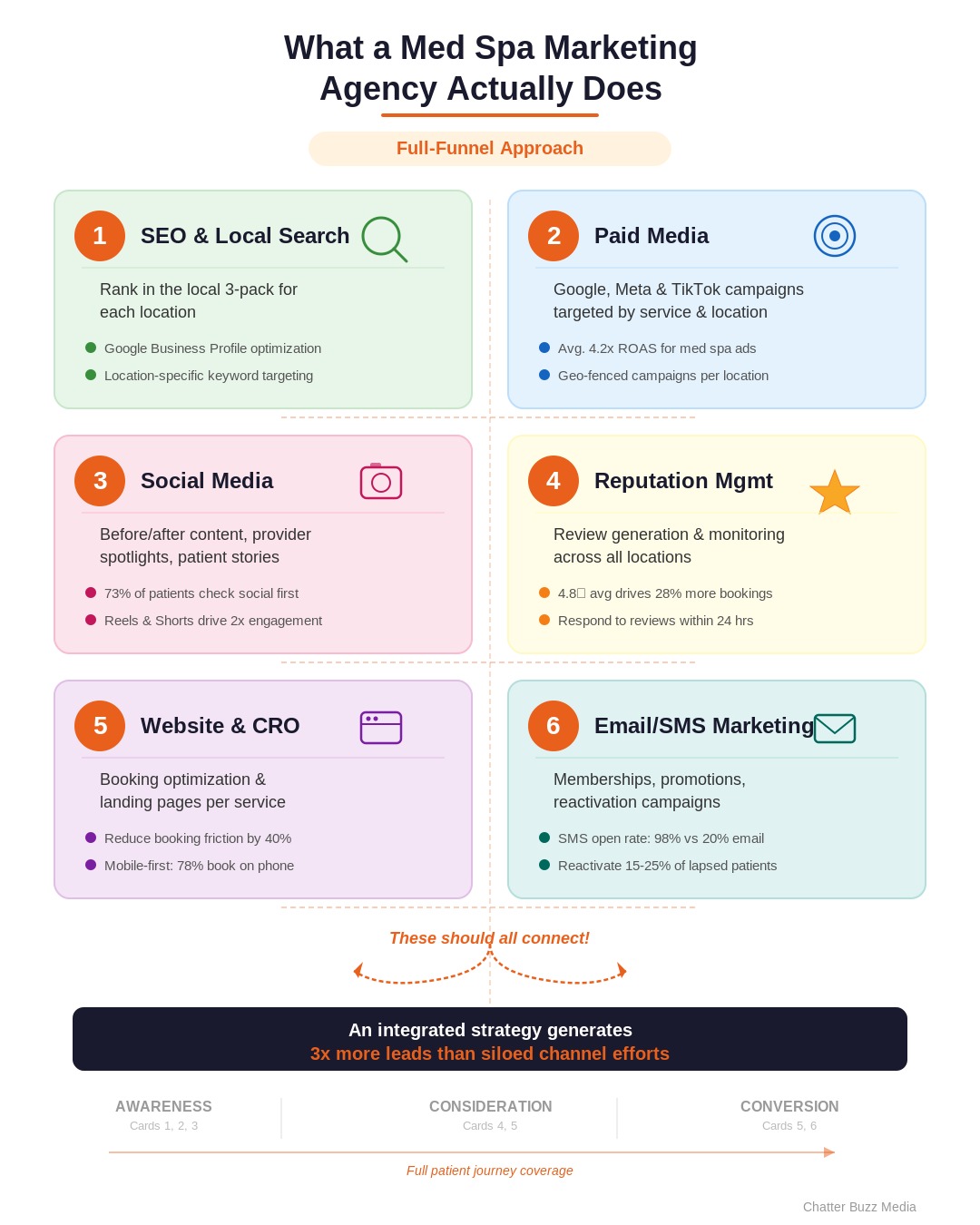
A legitimate med spa marketing agency isn’t just running your Facebook ads and posting on Instagram. The best agencies operate as a full marketing department, purpose-built for the medical aesthetics industry.
Here’s what that looks like in practice.
Core Services to Expect
Any agency positioning itself as a med spa marketing partner should deliver across these channels:
- SEO and local search optimization: Location-specific keyword strategies, Google Business Profile management for every location, and treatment-focused content that ranks in both traditional and AI-powered search results.
- Paid media management: Google Ads, Meta (Facebook and Instagram), and retargeting campaigns structured by location and treatment type. Budget allocation that shifts based on performance data, not guesswork.
- Social media strategy: Content planning that balances brand-level campaigns with location-specific content. Before-and-after photos, provider spotlights, and educational content that builds trust.
- Reputation management: Automated review request systems, response protocols, and monitoring across Google, Yelp, and RealSelf for every location.
- Email and SMS marketing: Patient retention campaigns including re-treatment reminders, membership promotions, and re-engagement sequences for lapsed patients.
- Website design and conversion rate optimization: Location-specific landing pages, treatment pages optimized for conversions, and booking flows that reduce friction.
- Analytics and reporting: Centralized dashboards that show location-level and group-level performance, attribution modeling, and actionable recommendations.
Medical Aesthetics Expertise Matters
Here’s where most generalist agencies fall short. Medical aesthetics marketing has unique constraints that a B2B SaaS agency or even a general healthcare agency won’t understand.
Compliance and advertising restrictions vary by state. Before-and-after photos have specific consent and disclosure requirements. Treatment claims must be carefully worded to avoid regulatory issues.
Treatment cycles create natural rebooking windows. Botox patients return every 3-4 months. Filler touch-ups happen at 6-12 months. Laser treatment packages run in series. An agency that understands these cycles builds marketing automation around them, not generic drip campaigns.
Patient lifetime value in aesthetics is exceptionally high. A single Botox patient who returns quarterly for five years represents $15,000-$25,000+ in revenue. The right agency optimizes for lifetime value, not just first-appointment cost-per-lead.
How to Evaluate a Med Spa Marketing Agency
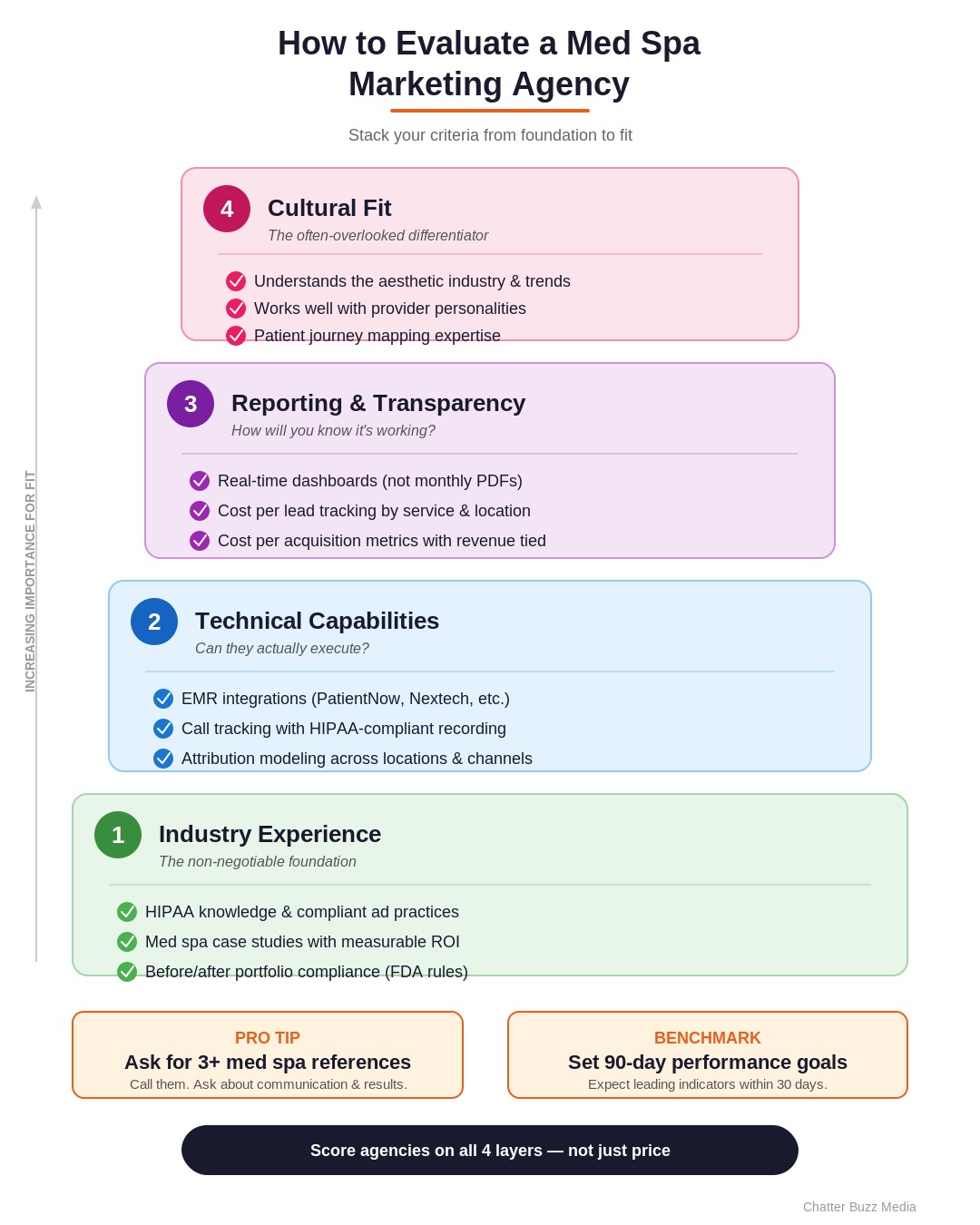
Choosing the wrong agency is expensive. Not just in fees, but in the months of lost momentum while you recover and restart with a new partner.
Use this framework to evaluate any med spa marketing agency before signing.
The 7-Point Evaluation Framework
1. Industry specialization. Do they work exclusively or primarily with med spas and aesthetics practices? Ask for client examples. An agency that lists “healthcare” alongside “restaurants” and “real estate” probably doesn’t understand your business deeply enough.
2. Multi-location experience. Have they managed marketing for groups with three or more locations? Multi-location marketing requires different systems, reporting structures, and budget allocation models than single-location work.
3. Transparent reporting. Will you see actual data? Cost-per-lead by location, cost-per-booked-appointment, patient acquisition cost, and return on ad spend should all be visible in a shared dashboard. If they won’t show you the numbers, that’s your answer.
4. Proven case studies with real numbers. Look for specifics: “Reduced cost-per-lead by 38% across six locations” is meaningful. “Helped grow their social media presence” is not.
5. Technology stack. What platforms do they use for reporting, automation, call tracking, and attribution? Their tech stack should integrate with your practice management software and booking system.
6. Scalable processes. Can they onboard a new location quickly? Do they have templates, playbooks, and workflows that make expansion predictable rather than chaotic?
7. Cultural fit. This matters more than most groups realize. Your agency will interact with location managers, front desk staff, and injectors. They need to communicate clearly and understand the day-to-day reality of running a med spa.
Red Flags That Signal the Wrong Fit
Walk away if you see any of these:
- Guaranteed rankings or specific lead volumes. No ethical agency guarantees search rankings. Patient volume depends on too many variables to promise exact numbers.
- Long-term contracts with no performance benchmarks. Month-to-month or quarterly agreements with clear KPIs protect both sides.
- They can’t explain their strategy in plain language. If they hide behind jargon or refuse to explain how they’ll achieve results, they’re either inexperienced or obscuring weak performance.
- No access to your own ad accounts and data. You should always own your ad accounts, analytics access, and creative assets. If the agency controls everything and won’t share access, you’ll lose all your data and history if you switch partners.
The Multi-Location Marketing Playbook
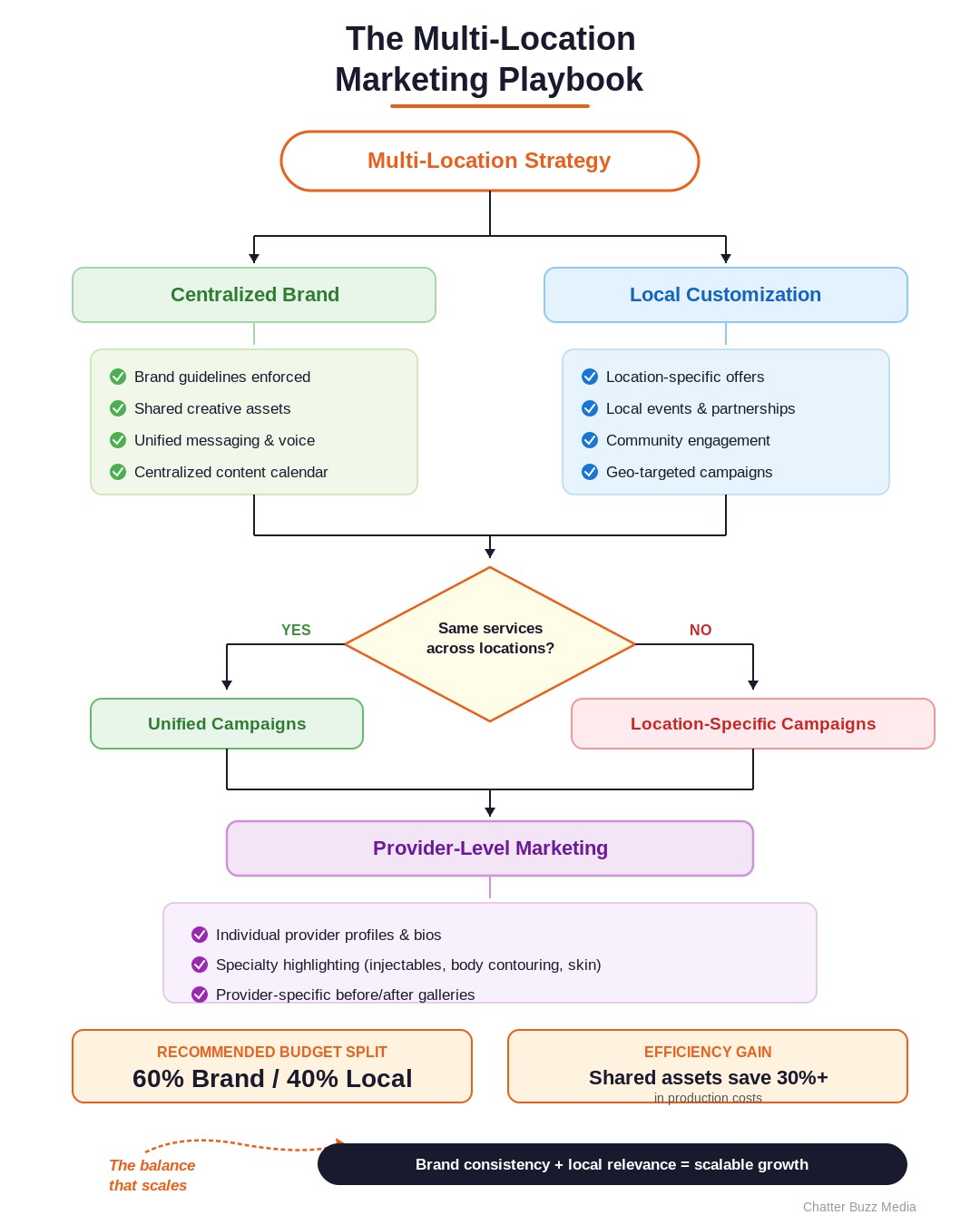
The most effective multi-location med spa marketing follows a simple principle: centralize strategy, localize execution.
Here’s how that works in practice.
Centralized Brand, Localized Execution
At the brand level, you centralize:
- Brand guidelines, logo usage, and visual identity
- Core messaging and value propositions
- Creative assets and content templates
- Pricing strategy and promotional calendar
- Compliance review processes
At the location level, you localize:
- Google Business Profile optimization for each market
- Location-specific ad targeting and keywords
- Community engagement and local partnerships
- Location-specific landing pages and content
- Review management and responses
This framework gives corporate the brand consistency they need while giving location managers the local relevance that drives bookings.
Location-Specific SEO at Scale
Local SEO for multi-location med spas requires a systematic approach. Each location needs its own:
- Google Business Profile with unique descriptions, photos, and regular posts
- Location page on your website with unique content (not just city-name-swapped templates)
- Treatment pages optimized for local terms like “Botox in [city]” or “laser hair removal [neighborhood]”
- Local citation profiles with consistent NAP (name, address, phone) data across directories
- Location-specific review generation campaigns
The key is unique content for every location. Google penalizes thin, duplicated content. Each location page should highlight that specific market’s providers, services, photos, and community involvement.
Paid Media Across Markets
Running paid media for multiple locations requires different budget allocation, bidding strategies, and creative for each market.
Budget allocation should reflect opportunity, not equality. A location in a competitive metro area might need $8,000/month in ad spend. A location in a smaller market might thrive on $3,000. Allocate based on market size, competition, and growth targets for each location.
Creative should feel local. Ads featuring your actual providers, your actual clinic photos, and location-specific offers outperform generic branded creative every time.
Structure campaigns by location and treatment type. This gives you clean data on what’s working where, and lets you shift budget to the highest-performing combinations.
Key Marketing Channels for Med Spa Groups

Not all marketing channels deliver equal results for med spas. Here’s where to focus your investment, ordered by typical impact for multi-location aesthetics groups.
Local SEO and Google Business Profile Management
For location-based businesses, Google Business Profile is the single highest-leverage marketing asset you own. It determines whether you appear in the local 3-pack, the map results that capture roughly 42% of local search clicks.
For multi-location groups, this means managing each profile individually. Every location needs complete information, current photos updated monthly, 2-3 posts per week, and prompt responses to every review.
Combine GBP optimization with treatment-specific service pages and location-specific SEO content. Target both “[treatment] + [city]” searches and broader “best med spa [city]” queries.
Paid Search and Social
Google Ads captures patients at the bottom of the funnel. They’re already searching for treatments and ready to book. The cost-per-click on core med spa keywords routinely exceeds $20 in competitive markets, so precision matters.
Structure campaigns with tight keyword groups, dedicated landing pages per treatment and location, call tracking, and aggressive negative keyword management to cut waste.
Meta and Instagram Ads create demand. Paid social shows your results, providers, and offers to people who weren’t actively searching. Real patient content, especially short-form video and before-and-after photos, consistently outperforms polished stock creative.
Email, SMS, and Patient Retention
Because most aesthetic treatments recur, retention marketing quietly compounds into your most profitable channel. Re-engaging an existing patient costs a fraction of acquiring a new one.
Build these automated flows:
- Re-treatment reminders timed to treatment cycles (12 weeks for Botox, 6 months for filler touch-ups)
- Membership promotions for patients who’ve had multiple visits
- Win-back sequences for patients who haven’t visited in 6+ months
- Post-treatment follow-ups combining aftercare information with review requests
A med spa marketing agency should build these once at the brand level, then deploy them across all locations with location-specific personalization.
Reputation Management at Scale
Reviews are both a direct local ranking factor and the most persuasive proof point for nervous first-time patients. Multi-location groups need a systematic approach.
Automate the ask. Send review request texts 2-3 hours after each appointment, when the patient is most likely to feel positive about their experience.
Respond to everything. Your responses are written for the next patient reading them, not just the reviewer. Keep responses professional, grateful, and on-brand.
Monitor across platforms. Google, Yelp, RealSelf, and Facebook. Each location’s reputation should be visible in a central dashboard so you can spot issues before they escalate.
Med Spa Marketing Costs and Budget Allocation

One of the most common questions multi-location med spa groups ask: how much should we spend on marketing?
The short answer is 7-12% of revenue, depending on growth stage and market competitiveness. But the allocation matters more than the total.
What Multi-Location Groups Should Expect to Invest
Early-stage locations (first 12 months) typically need heavier marketing investment, often 12-15% of projected revenue, to establish awareness and build a patient base in a new market.
Established locations can maintain growth at 7-10% of revenue as organic channels, retention programs, and word-of-mouth start contributing more significantly.
Agency fees for multi-location med spa marketing typically range from $5,000-$15,000 per location per month, depending on services included and market complexity. This is separate from ad spend.
Budget Allocation by Channel
For a mature multi-location med spa marketing program, here’s a recommended allocation framework:
- Paid media (Google + Meta): 35% of total marketing budget
- SEO and content marketing: 25%
- Social media management: 15%
- Reputation management: 10%
- Email and SMS marketing: 10%
- Technology and tools: 5%
Weight more toward paid media during new location launches, then gradually shift toward SEO and retention as each location matures. The compounding effect of organic search and patient retention means your blended acquisition cost should decrease over time.
Track cost-per-booked-appointment by location, not cost-per-click. Clicks are vanity. Booked chairs are revenue.
Measuring Med Spa Marketing Performance
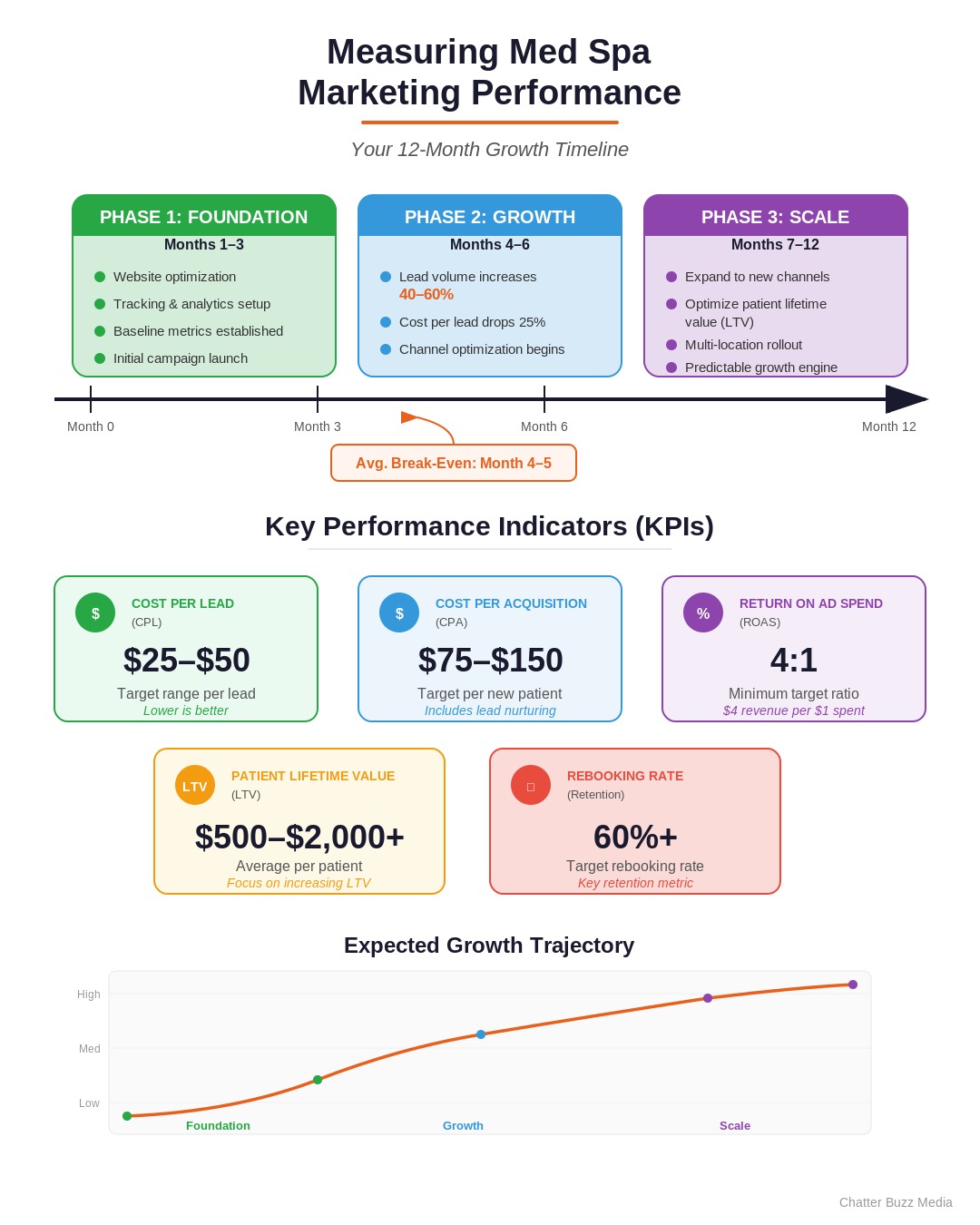
If your agency can’t show you exactly how marketing drives revenue at each location, something is wrong. Here’s what to measure and why.
KPIs That Matter for Multi-Location Groups
Cost per acquisition (CPA). What does it cost to acquire a new patient at each location? This should be tracked by channel so you know which investments are efficient and which are burning budget.
Patient lifetime value (LTV). A Botox patient returning quarterly for three years is worth far more than a one-time facial booking. Your agency should optimize for high-LTV treatments and patient retention, not just first-visit volume.
Location-level ROI. Compare marketing spend to revenue generated at each location. This reveals which markets are thriving and which need strategic adjustments.
Booking rate. What percentage of leads actually book an appointment? If this number is low, the problem isn’t marketing volume, it’s your conversion process, front desk follow-up, or website booking flow.
Retention rate. What percentage of new patients return for a second visit? The American Med Spa Association reports that 73% of med spa patients are repeat visitors. If your retention rate falls significantly below this benchmark, your post-treatment experience needs work.
Review velocity. How many new reviews is each location generating per month? A steady stream of recent reviews signals active, satisfied patients and directly impacts local search rankings.
Attribution and Reporting
Multi-location attribution is inherently messy. A patient might see a Meta ad, Google your location name, read reviews, and then call to book. Which channel gets credit?
The answer: use a multi-touch attribution model that gives partial credit to every touchpoint. First-touch shows you what creates awareness. Last-touch shows you what closes. Both matter.
Your agency should provide a centralized reporting dashboard that rolls up location-level data into group-level insights while still letting you drill down to individual market performance.
In-House vs. Agency vs. Hybrid: Which Model Works Best
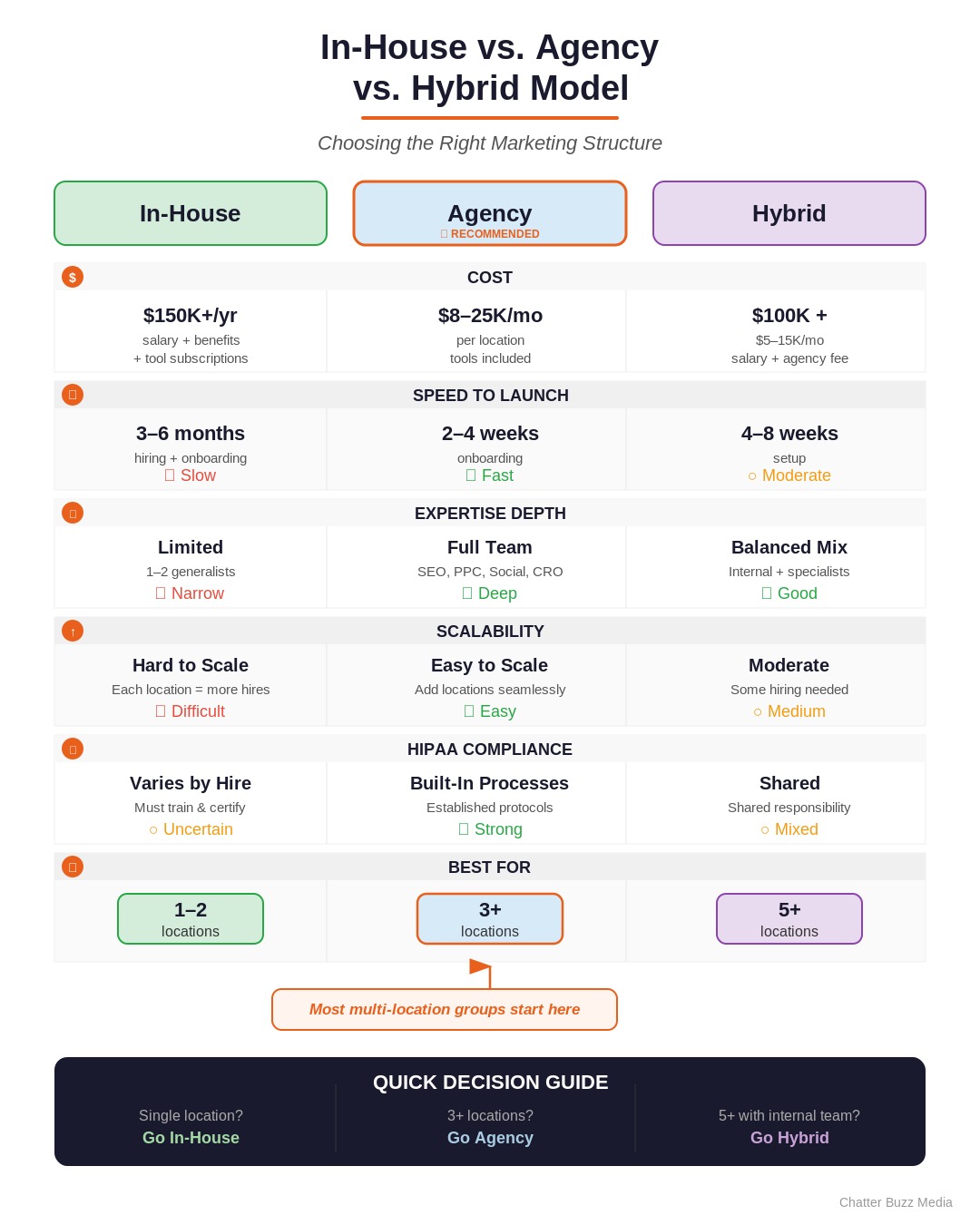
There’s no one-size-fits-all answer here. The right model depends on your group’s size, growth rate, and internal capabilities.
Pros and Cons of Each Approach
In-house marketing team. You get full control, deep brand knowledge, and faster communication. But building an in-house team that covers SEO, paid media, social, email, analytics, and creative requires 4-6 specialists minimum. For most mid-market med spa groups, that’s $400,000-$600,000+ in annual salaries and benefits before ad spend.
Full-service agency. You get specialized expertise, established processes, and scalability without the hiring burden. The tradeoff is less day-to-day control and potentially slower communication. Agency costs are typically 30-50% less than an equivalent in-house team.
Hybrid model. This is increasingly the sweet spot for growing med spa groups. Keep one or two people in-house for brand management, internal communications, and agency coordination. Partner with a specialized agency for execution, strategy, and specialized channels.
The hybrid model works because it gives you internal brand ownership with external execution expertise. Your in-house team maintains the relationship with location managers and providers. Your agency brings the technical skills, tools, and scalable processes that would take years to build internally.
At Chatter Buzz Media, we frequently operate as an extension of our clients’ teams in this exact model. We bring the fractional CMO-level strategy and full-service execution while working alongside internal marketing coordinators who know the brand inside and out.
Choosing the Right Med Spa Marketing Agency for Your Group
Selecting a med spa marketing agency is one of the highest-impact decisions a multi-location aesthetics group makes. The right partner accelerates growth across every location. The wrong one costs you months of momentum and thousands in wasted spend.
Here’s what we recommend as your evaluation process:
Start with specialization. Prioritize agencies that focus on medical aesthetics or healthcare marketing specifically. Generalist agencies will learn on your dime.
Ask for multi-location references. Talk to other med spa groups they’ve worked with. Ask about onboarding new locations, reporting quality, and responsiveness.
Request a strategic assessment. A good agency will audit your current marketing before proposing a plan. If they pitch a cookie-cutter package without understanding your business, keep looking.
Negotiate for transparency. Insist on owning your ad accounts, having dashboard access, and receiving regular performance reviews with clear action items.
The med spa groups that scale successfully treat their agency relationship as a strategic partnership, not a vendor arrangement. When your agency understands your growth targets, patient demographics, and competitive landscape as well as you do, that’s when the results compound.
Frequently Asked Questions
How much does a med spa marketing agency charge?
Agency fees for multi-location med spa marketing typically range from $5,000 to $15,000 per location per month, depending on services included. This is separate from ad spend, which varies by market competitiveness and growth targets. Total marketing investment should fall between 7-12% of revenue.
What’s the difference between a med spa marketing agency and a general digital marketing agency?
A specialized med spa marketing agency understands treatment cycles, patient lifetime value, before-and-after photo compliance, and the unique patient decision journey in aesthetics. Generalist agencies often lack this knowledge, leading to campaigns that generate leads but not bookings from qualified patients.
How long does it take to see results from med spa marketing?
Paid search can generate bookings within the first two weeks. Social media advertising typically produces measurable results within 30-60 days. SEO and organic content take 3-6 months to show significant traction. Full program maturity, where all channels work together efficiently, usually takes 6-9 months.
Should each med spa location have its own marketing strategy?
Each location needs localized execution within a centralized brand strategy. This means location-specific Google Business Profiles, local ad targeting, market-specific content, and community engagement, all operating under unified brand guidelines, messaging, and creative standards.
What marketing channels have the highest ROI for med spas?
For most med spa groups, patient retention (email and SMS re-treatment reminders, memberships) delivers the highest long-term ROI because treatments are recurring. For new patient acquisition, Google Ads on treatment-specific keywords typically delivers the fastest return. Local SEO provides the best compounding value over time.
How do I know if my med spa marketing agency is performing well?
Track cost-per-booked-appointment by location, patient retention rates, review velocity, and location-level ROI. If your agency can’t report on these metrics clearly, or if your cost per acquisition is rising without corresponding revenue growth, it’s time for a conversation about strategy adjustments.
Can a med spa marketing agency help with new location launches?
Yes, and this is one of the most valuable services a specialized agency provides. Launch marketing should include pre-opening buzz campaigns, Google Business Profile setup and optimization, location-specific landing pages, targeted paid media, and grand opening promotions. Experienced agencies have launch playbooks that accelerate time-to-profitability for new locations.
What role does AI play in med spa marketing in 2026?
AI is changing how patients discover med spas. A growing share of queries like “best med spa near me” and “is Botox worth it” are now answered directly by ChatGPT, Google AI Overviews, and Perplexity. Med spas with structured, authoritative content get cited in these AI-generated responses. Agencies should be optimizing for AI search visibility alongside traditional SEO.