
 321-236-2899
You just landed on the most comprehensive credit union marketing guide published in 2026. Whether you manage marketing for a $50 million community credit union or a $5 billion institution, this resource gives you the strategies, channels, and frameworks that drive measurable member growth.
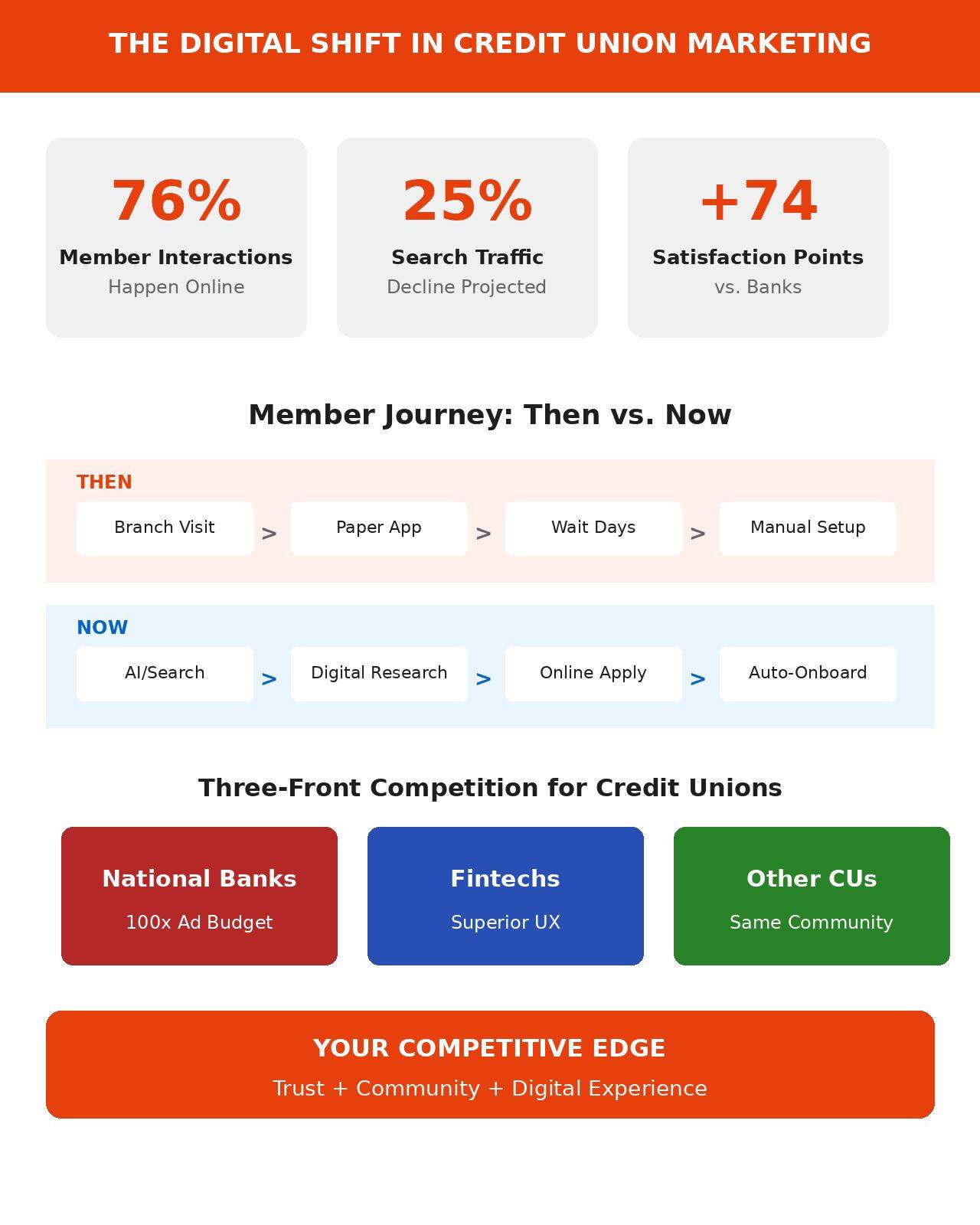
Here’s what’s changed: 76% of member interactions now happen online, according to Finalytics.ai’s 2023 research. Traditional search traffic faces a projected 25% decline by 2026 as AI-powered answer engines reshape how consumers find financial products. Credit unions that rely on branch traffic and word-of-mouth alone will lose ground fast.
This guide helps you master credit union marketing strategies that match how members actually discover, evaluate, and join financial institutions today. We built it as your playbook — from foundational strategy through advanced digital execution.
Key Takeaways
- Digital-first member acquisition isn’t optional — credit unions that invest in SEO, paid media, and lifecycle automation outperform peers by 3-5x in new member growth.
- Answer Engine Optimization (AEO) is the new SEO frontier — optimizing for AI-generated answers protects your visibility as traditional search declines.
- Personalization drives engagement and retention — 80% of consumers engage more with brands that deliver personalized experiences.
- Your marketing budget should scale with asset size — we break down allocation frameworks for credit unions under $500M, $500M–$2B, and $2B+.
- Member personas must go beyond demographics — financial life stage, digital behavior, and product triggers matter more than age brackets.
Why Credit Union Marketing Has Changed Forever
The playbook that grew your credit union five years ago no longer works. Member expectations, competitive threats, and digital channels have all shifted simultaneously — and most marketing for credit unions hasn’t kept pace.
The Digital Shift Credit Unions Can’t Ignore
Members research financial products the same way they research everything else: online, on mobile, often through AI assistants. The branch visit now happens after a member has already decided — not before.
This means your credit union digital marketing presence determines whether prospects ever learn you exist. If you don’t show up in search results, AI-generated answers, and social feeds, you’ve lost the member before the conversation starts.
We’ve seen this firsthand working with financial institutions through our financial services marketing practice. Credit unions that shifted budget toward digital channels between 2023 and 2025 grew membership at 2-4x the rate of those that didn’t.
The data backs this up. Traditional organic search — the channel most credit unions depend on — faces a projected 25% traffic decline as AI answer engines serve results directly. Credit unions need to optimize for both traditional search and the emerging answer-engine landscape.
What Members Actually Expect in 2026
Speed, personalization, and seamless digital experiences. That’s the baseline, not the differentiator. Members who grew up with Venmo and Apple Pay expect instant everything.
According to industry research, 80% of consumers engage more with organizations that deliver personalized experiences. Generic “low rates and great service” messaging fails to cut through.
Even more telling: 55% of consumers abandon applications if the onboarding process feels too complex. Your marketing can drive thousands of clicks — but if your digital application takes 20 minutes and requires a branch visit to finish, you’ve wasted that spend.
Members also expect financial guidance, not just product pitches. Credit unions that publish educational content — rate comparisons, financial literacy resources, life-stage planning tools — build trust that converts over time. This is where inbound marketing principles transform credit union growth.
The Competitive Landscape (Banks, Fintechs, Other CUs)
Credit unions compete on three fronts simultaneously. National banks outspend you 100-to-1 on advertising. Fintechs out-innovate you on user experience. And neighboring credit unions target the same community you serve.
The good news: credit union member satisfaction scores 74 points higher than banks, according to J.D. Power’s 2025 Banking Satisfaction Study. Members love credit unions once they join. The challenge isn’t retention — it’s awareness and acquisition.
Fintechs like SoFi, Chime, and Robinhood spend heavily on digital acquisition. They win members with sleek apps and aggressive rate marketing. But they can’t replicate community trust, local presence, or the member-owner model.
Your competitive edge lives in the intersection of trust and digital experience. Market your values and community impact — but deliver them through modern digital channels that meet members where they already spend time.
Now that we’ve established why the landscape demands a new approach, let’s build your credit union marketing plan from the ground up.
Building Your Credit Union Marketing Strategy From Scratch
Strategy before tactics. We’ve watched credit unions waste six-figure budgets on disconnected campaigns because they skipped foundational planning. A clear credit union marketing strategy aligns every dollar and every channel toward measurable growth.
Define Your Member Personas Beyond Demographics
Most credit union personas stop at age, income, and geography. That’s not enough. Two 35-year-olds in your field of membership might have completely different financial needs, digital behaviors, and product triggers.
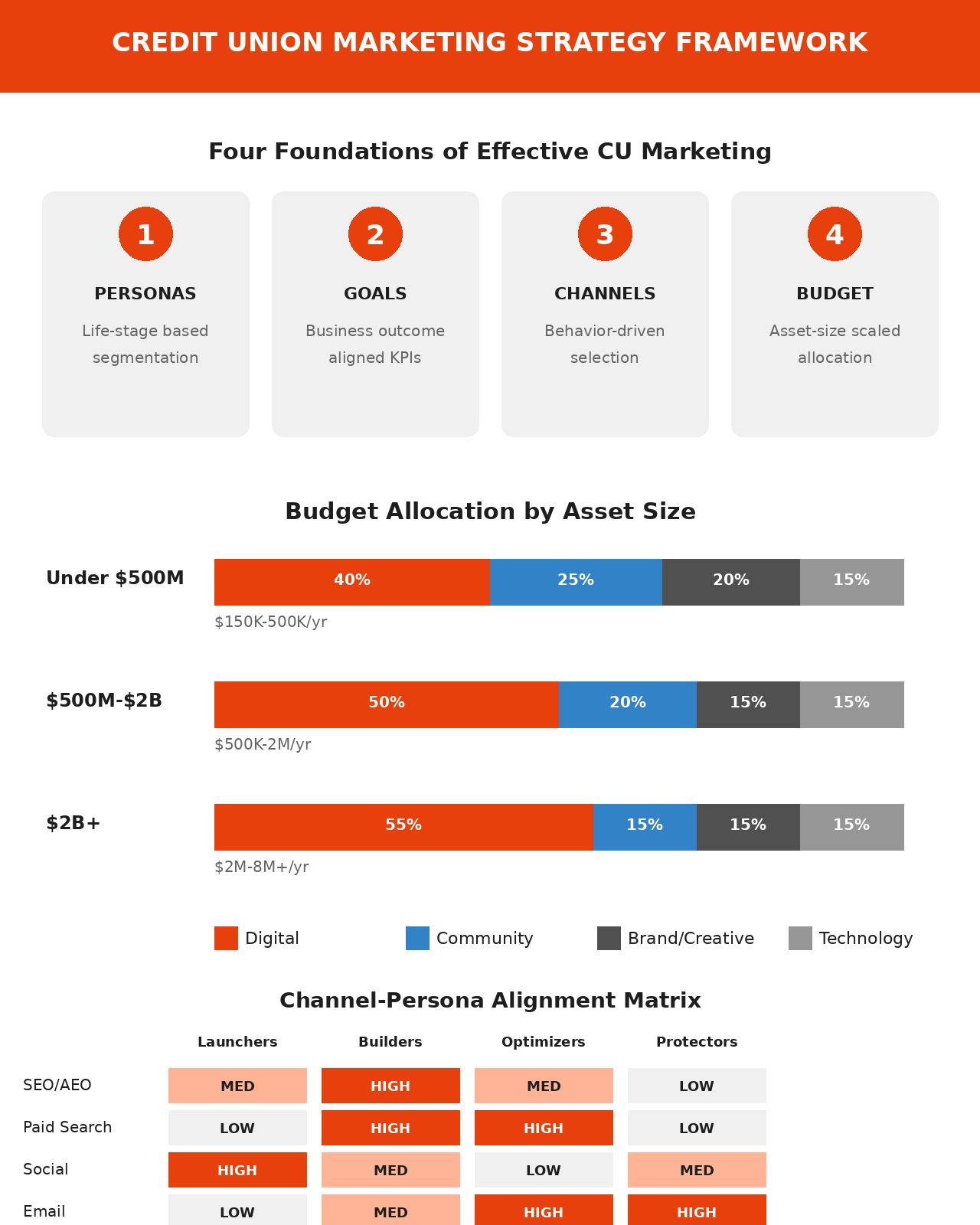
Build personas around financial life stages instead:
- Launchers (18-24) — first checking account, building credit, student loans. They live on TikTok and Instagram. They’ll join for a no-fee checking account with a great mobile app.
- Builders (25-39) — first home purchase, growing families, career advancement. They research heavily before committing. They find you through Google, comparison sites, and peer recommendations.
- Optimizers (40-55) — refinancing, college savings, wealth accumulation. They value expertise and personalized advice. They respond to educational content and financial planning resources.
- Protectors (55+) — retirement planning, estate considerations, downsizing. They want human connection backed by digital convenience. They still read email and respond to direct outreach.
For each persona, document their primary financial trigger (what event makes them seek a new financial relationship), preferred channels, content preferences, and objections. This drives every downstream marketing decision.
We use a similar persona-driven approach in our demand generation work — the principle applies whether you’re targeting businesses or individual members.
Set Goals That Connect to Business Outcomes
“Increase brand awareness” isn’t a goal. It’s a wish. Effective credit union marketing goals connect directly to membership growth, product adoption, and revenue impact.
Start with your credit union’s strategic plan. If leadership wants to grow auto loans by 15%, your marketing goal is specific: generate X qualified auto loan applications per month from digital channels.
Use this framework to set marketing goals that leadership respects:
- Acquisition goals: New member applications, cost per new member, source attribution by channel
- Product goals: Cross-sell rate, product applications per channel, product-specific conversion rates
- Engagement goals: Digital banking adoption, email engagement rates, content consumption by persona
- Retention goals: Member attrition rate, Net Promoter Score, share-of-wallet metrics
Every goal needs a number, a timeline, and a clear owner. “Generate 200 qualified mortgage applications per quarter from organic search and paid media” beats “grow mortgage lending” every time.
Choose Your Channels Based on Member Behavior
Don’t pick channels because competitors use them or because a vendor pitched you. Pick channels because your target personas spend time there and respond to financial messaging in those environments.
Here’s how to market a credit union effectively by matching channels to personas:
- Launchers: Instagram, TikTok, YouTube Shorts, influencer partnerships, campus events
- Builders: Google Search, SEO/content marketing, Facebook, email nurture, retargeting display
- Optimizers: Google Search, LinkedIn, email marketing, webinars, direct mail (yes, still)
- Protectors: Email, Facebook, local newspaper digital, direct mail, community events
Most credit unions should prioritize SEO, paid search, and email as their foundation — these channels capture intent-driven demand. Layer social, display, and community channels on top for awareness and nurture. Our full breakdown of digital marketing services shows how these channels integrate.
One critical principle: invest in owned channels (email, website, content) before rented channels (social media, paid ads). Algorithm changes can destroy your reach overnight on rented platforms. Owned channels compound over time.
Budget Allocation Frameworks by Asset Size
The right marketing budget depends on your credit union’s asset size, growth goals, and competitive environment. Industry benchmarks suggest credit unions spend between 0.2% and 0.5% of assets on marketing annually.
Under $500M in assets:
- Total marketing budget: $150K–$500K annually
- Allocation: 40% digital (SEO, paid search, email), 25% community/events, 20% brand/creative, 15% technology/tools
- Priority: Build your digital foundation before diversifying. A strong website, local SEO, and Google Ads capture ready-to-convert members.
$500M–$2B in assets:
- Total marketing budget: $500K–$2M annually
- Allocation: 50% digital (broader channel mix), 20% community/sponsorships, 15% brand/creative, 15% technology/automation
- Priority: Scale digital channels, invest in marketing automation, and build a content engine that drives organic growth.
$2B+ in assets:
- Total marketing budget: $2M–$8M+ annually
- Allocation: 55% digital (full omnichannel), 15% community/sponsorships, 15% brand/creative, 15% technology/data/AI
- Priority: Sophisticated personalization, multi-touch attribution, and integrated campaigns across every member touchpoint.
These frameworks give you a starting point. Adjust based on your market’s competitive intensity, your growth targets, and which channels already produce results.
With strategy locked in, let’s dive into the specific credit union digital marketing channels that drive member growth in 2026.
Credit Union Digital Marketing Channels That Drive Growth
Strategy tells you where to go. Channels get you there. This section breaks down the credit union marketing best practices 2026 demands — channel by channel, with tactical depth you can implement immediately.
SEO and Answer Engine Optimization (AEO)
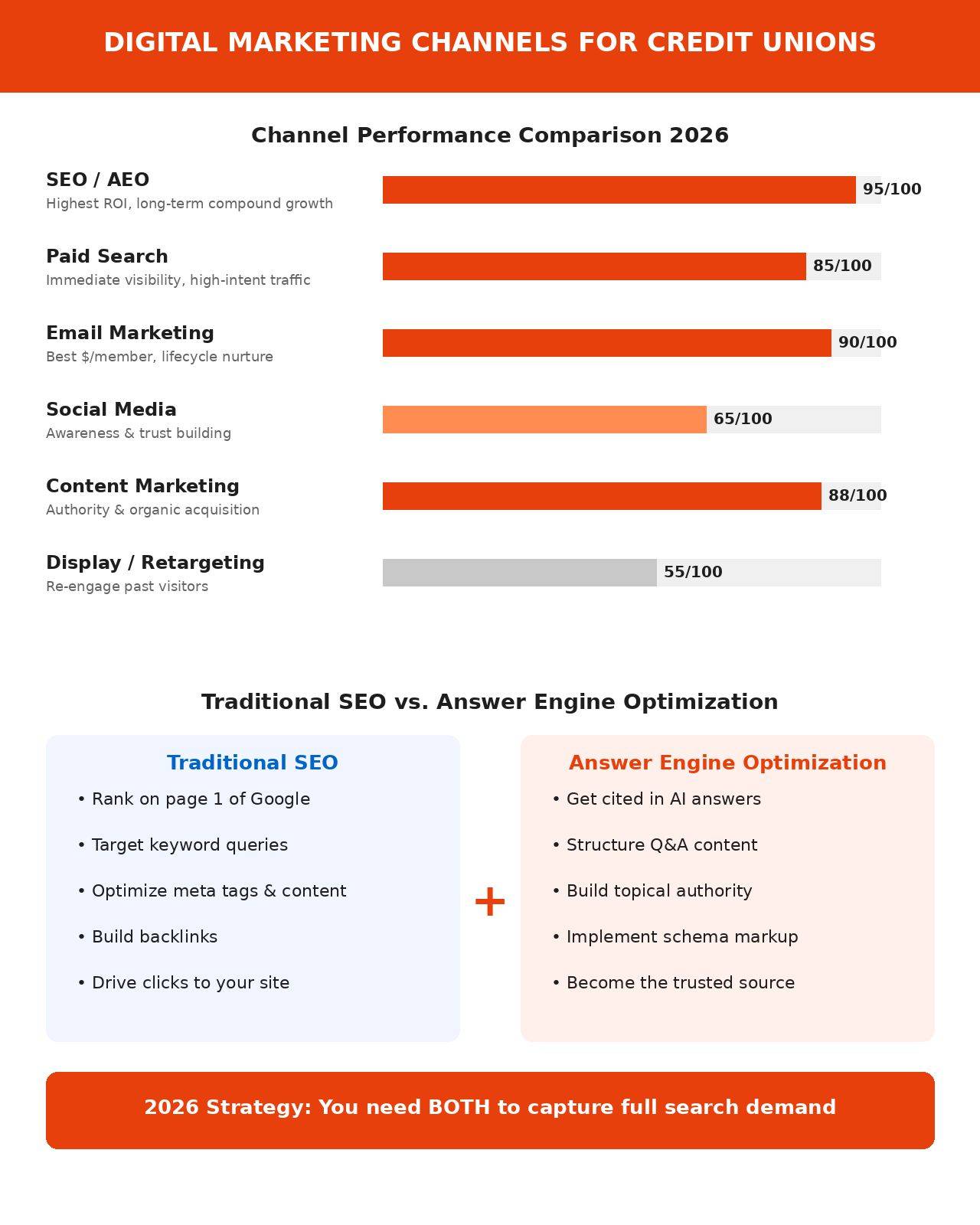
Search engine optimization remains the highest-ROI channel for credit unions. Members actively searching “best credit union near me” or “credit union auto loan rates” carry purchase intent that no other channel matches.
But SEO in 2026 means more than ranking on page one. AI-powered answer engines — Google’s AI Overviews, ChatGPT, Perplexity — now answer financial questions directly. Your content needs to be the source these engines cite.
Here’s what credit union SEO requires today:
- Local SEO dominance: Optimize Google Business Profile for every branch. Build consistent NAP citations. Generate and respond to member reviews. Target “near me” and city-specific keywords.
- Answer Engine Optimization: Structure content with clear questions and concise answers. Use schema markup extensively. Build topical authority through comprehensive financial education hubs.
- Technical foundation: Fast-loading pages (under 2 seconds), mobile-first design, clean site architecture, and proper internal linking.
- Content depth: Publish authoritative guides on every product category. Go deeper than competitors. Cover related questions members ask before, during, and after making financial decisions.
We detail the full approach in our digital marketing for credit unions guide, including how to audit your current SEO performance and identify quick wins.
One non-negotiable: every credit union needs a keyword strategy built around product terms (“credit union mortgage rates”), educational terms (“how much house can I afford”), and branded terms (your credit union name + products). Cover all three to capture members at every stage of their decision journey.
Paid Media (Google Ads, Social Ads, Display)
Paid media delivers immediate visibility while your organic channels build momentum. For credit unions, Google Ads captures the highest-intent traffic available — people actively searching for the exact products you offer.
Start with these paid media priorities:
- Google Search Ads: Bid on product-specific terms (auto loans, checking accounts, mortgages) and local modifiers. Use ad extensions for rates, branch locations, and member reviews.
- Google Local Service Ads: Appear at the top of local searches with a “Google Guaranteed” badge. Particularly effective for mortgage and auto lending.
- Social media advertising: Facebook and Instagram ads excel at awareness and retargeting. Target by geography, life events (recently moved, newly married), and financial interests.
- Display and retargeting: Serve ads to website visitors who didn’t convert. A member who viewed your auto loan page but didn’t apply sees your rates across the web for 30 days.
Budget allocation within paid media: Start with 60% search, 25% social, 15% display/retargeting. Shift budget toward whatever delivers the lowest cost per qualified application.
Track beyond clicks and impressions. Measure cost per application started, cost per funded loan, and return on ad spend by product category. If a $50 click produces a $250,000 mortgage, your ROI is extraordinary — but you’ll never know without proper attribution.
Email Marketing and Lifecycle Automation
Email remains the most profitable credit union marketing channel dollar-for-dollar. You own the list, control the timing, and personalize at scale. No algorithm stands between you and your members’ inboxes.
Effective credit union email strategy operates on two levels:
- Lifecycle automation: Trigger-based emails that fire when members take specific actions or hit specific milestones. New member onboarding sequences, product cross-sell triggers, renewal reminders, and re-engagement campaigns.
- Campaign emails: Planned sends around rate promotions, seasonal products (back-to-school auto loans, spring home equity), educational content, and community events.
Essential automated sequences every credit union needs:
- New member welcome series (5-7 emails over 60 days) — introduce digital tools, cross-sell relevant products, gather feedback
- Onboarding completion — nudge members who started but didn’t finish setting up direct deposit, mobile app, or e-statements
- Product cross-sell triggers — when a checking member’s balance consistently exceeds $10K, suggest savings or investment options
- Anniversary and milestone emails — celebrate membership anniversaries, congratulate loan payoffs, recognize life events
- At-risk member intervention — detect declining engagement patterns and trigger retention outreach before members leave
Personalization makes or breaks email performance. Segment by product holdings, account tenure, engagement level, and life stage. A 25-year-old renter and a 50-year-old homeowner should never receive the same email.
Social Media Strategy for Credit Unions
Social media for credit unions isn’t about going viral. It’s about building trust, demonstrating community impact, and staying visible between the moments members need financial products.
Choose platforms based on your persona priorities:
- Facebook: Still the broadest reach for credit unions. Best for community storytelling, member spotlights, event promotion, and retargeting ads. Your 35-65 audience lives here.
- Instagram: Visual storytelling, behind-the-scenes content, employee spotlights, and financial tips in carousel format. Reaches 25-44 effectively.
- LinkedIn: Business development, employer partnerships, thought leadership from executives, and recruiting. Essential if your field of membership includes employer groups.
- TikTok/YouTube Shorts: Financial education in short-form video. Credit unions that demystify money topics (“How credit scores actually work” in 60 seconds) build massive awareness with younger audiences.
Content pillars for credit union social media:
- Community impact stories (40%) — sponsorships, volunteer events, member success stories, local partnerships
- Financial education (30%) — tips, explainers, myth-busting, rate comparisons
- Product awareness (20%) — promotions, new features, rate announcements, application CTAs
- Culture and people (10%) — employee spotlights, hiring, behind-the-scenes, celebrations
Post consistently rather than sporadically. Three quality posts per week on two platforms beats daily mediocre posts across five platforms.
Content Marketing and Financial Education Hubs
Content marketing is where credit unions can outperform banks and fintechs. You have genuine expertise, local relevance, and member-first motivation that bigger competitors can’t replicate authentically.
Build a financial education hub on your website that serves two purposes: attract organic search traffic from members researching financial decisions, and nurture existing members toward their next product.
High-performing content types for credit unions:
- Decision guides: “Renting vs. Buying in [Your City]: 2026 Analysis” — localized, timely, genuinely helpful
- Rate comparison tools: Interactive calculators that let members model payments, compare products, and see personalized scenarios
- Life-stage content: “Financial Checklist for New Parents” or “Retirement Readiness Assessment” — aligns content with product triggers
- Local financial content: First-time homebuyer programs in your state, local employer benefit guides, community economic updates
- Video explainers: Short videos breaking down complex topics (HELOCs, refinancing decisions, credit building strategies)
Every piece of content should include a clear next step. A mortgage education article links to your mortgage calculator. A credit-building guide links to your secured credit card application. Content without conversion paths is just expense.
The credit unions winning at content marketing publish 4-8 pieces monthly, optimize aggressively for search, and promote every piece through email and social. They treat content as a growth engine — not a checkbox.
We’ve now covered the foundation: why credit union marketing changed, how to build your strategy, and which digital channels drive growth. In the next section, we’ll dive into credit union advertising creative best practices, member retention strategies, compliance considerations, and how to measure everything with precision. If you want to explore how we help credit unions execute these strategies, visit our credit union and banking marketing agency page.
Member Onboarding and Lifecycle Marketing
Winning a new member means nothing if you lose them within six months. Credit union marketing strategies must extend far beyond acquisition — they need to nurture every member through a deliberate lifecycle journey.
We help credit unions build onboarding sequences and lifecycle campaigns that turn new sign-ups into lifelong advocates. Here’s the framework that drives measurable retention and wallet share.
The First 90 Days That Define the Relationship
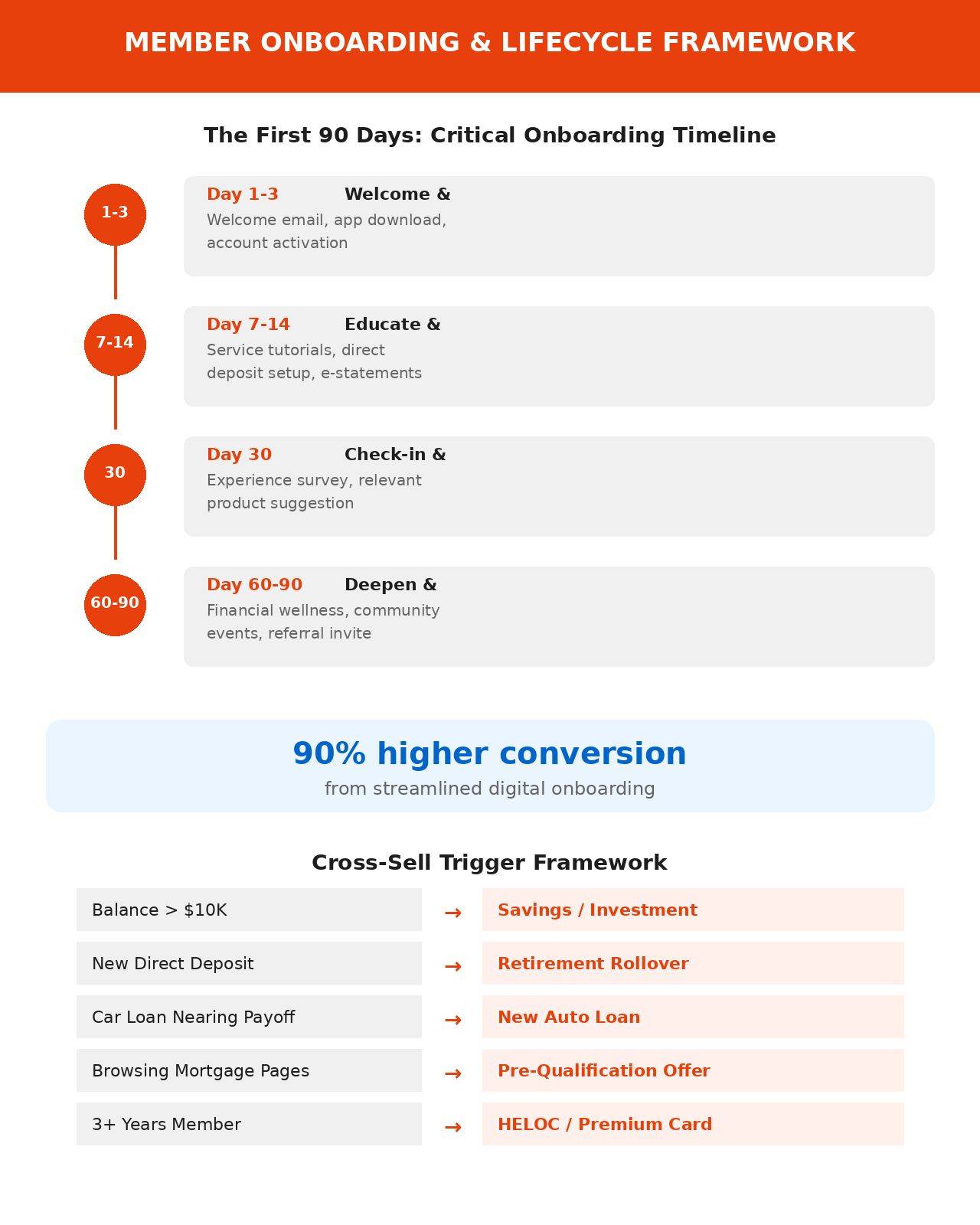
The first 90 days after a member joins determine whether they become engaged or dormant. Streamlined digital onboarding increases conversion rates by 90%, making this window your highest-leverage marketing investment.
Your onboarding sequence should deliver value immediately and remove friction at every step. Map out a communication cadence that welcomes, educates, and activates — without overwhelming.
- Day 1-3: Welcome email with account setup checklist, mobile app download link, and a personal introduction from their branch team
- Day 7-14: Educational content about available services they haven’t activated (bill pay, direct deposit, mobile check deposit)
- Day 30: Check-in asking about their experience, paired with a relevant product suggestion based on their account type
- Day 60-90: Deeper engagement content — financial wellness resources, community events, or a referral program invitation
Every touchpoint should feel personal, not automated. Use the member’s name, reference their specific account type, and tailor content to their demographic segment.
Cross-Sell and Next-Best-Product Campaigns
Multi-channel members spend 4x more than single-channel users. Your cross-sell strategy should focus on moving members from a single product into a full financial relationship.
AI-driven product recommendations increase acceptance rates by 30%, making intelligent targeting essential for modern credit union marketing. Instead of blasting every member with the same auto loan promotion, serve the right offer to the right person at the right time.
- Trigger campaigns based on life events — a new direct deposit might signal a job change, making retirement rollover content relevant
- Use transaction data to identify members who could benefit from products they don’t yet hold
- Build “next-best-product” models that predict which service a member is most likely to need within 90 days
- A/B test offer positioning — sometimes “save $200/month” outperforms “4.5% APR”
A fractional CMO for your credit union can architect these data-driven campaigns without the cost of a full-time executive. The key is connecting marketing automation to your core banking data.
Retention Strategies That Reduce Attrition
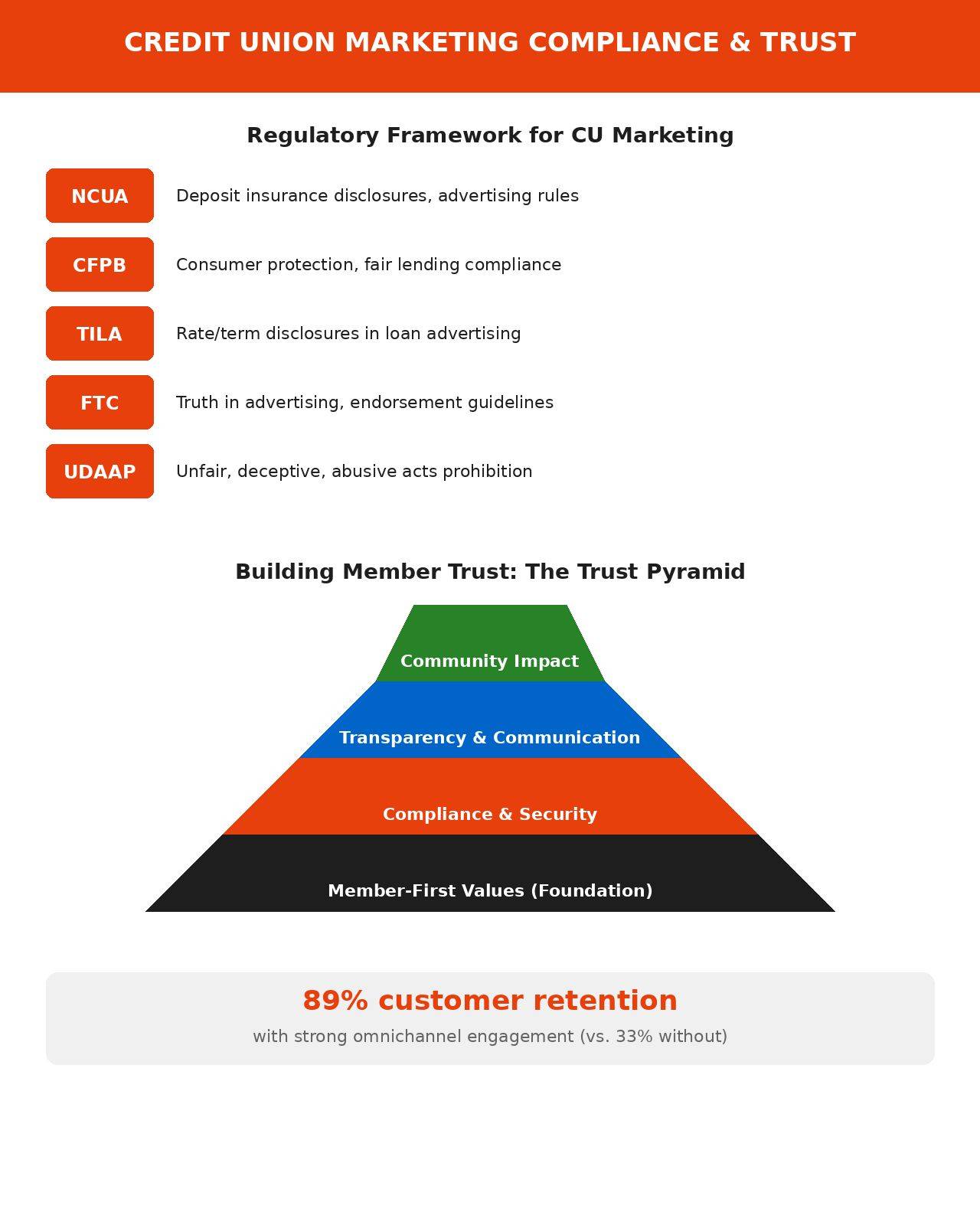
Organizations with strong omnichannel engagement retain 89% of customers versus 33% for those with weak strategies. For credit unions, retention isn’t just about keeping accounts open — it’s about keeping members actively engaged.
Build early-warning systems that flag disengagement before a member leaves. Watch for reduced transaction frequency, declining balances, or dormant digital banking sessions.
- Create re-engagement campaigns triggered by inactivity thresholds
- Offer loyalty rewards tied to product depth, not just tenure
- Survey departing members to identify systemic issues you can fix
- Build community connections that make switching emotionally costly — not just financially inconvenient
Retention marketing costs a fraction of acquisition. Invest here first, and your growth numbers will compound faster than any ad campaign can deliver.
Of course, even the best lifecycle campaigns fall flat if your digital front door pushes members away. Let’s look at how your website either accelerates or kills conversion.
Credit Union Website Optimization for Conversions
Your website is your largest branch — open 24/7, serving every demographic, handling more interactions than all physical locations combined. Yet most credit union websites function as digital brochures rather than conversion engines.
Credit union digital marketing starts and ends with your website experience. Every campaign, every ad, every email drives traffic here — and what happens next determines your ROI.
Mobile-First Design Requirements
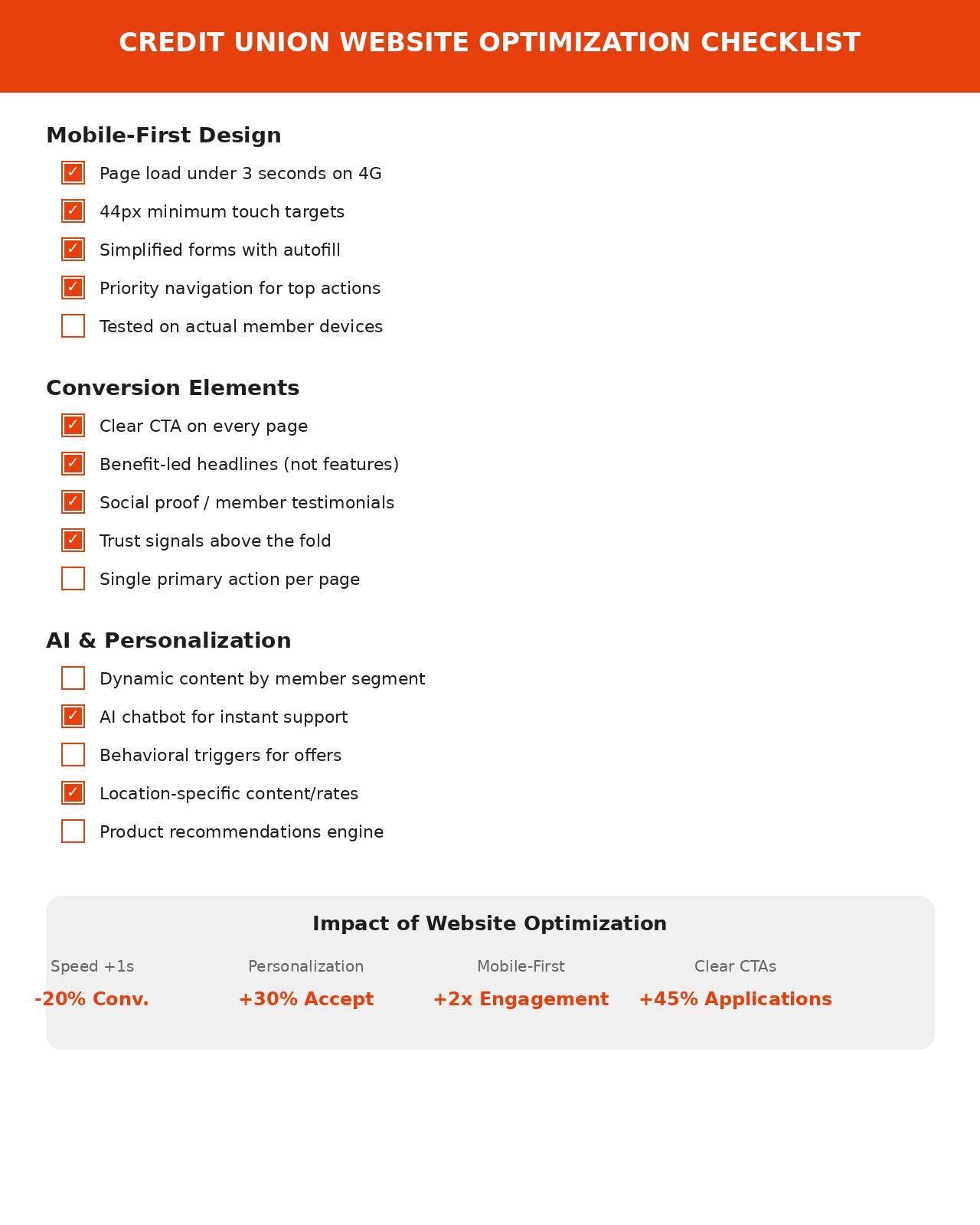
Over 70% of your members interact with your credit union on a mobile device first. If your site isn’t built mobile-first, you’re delivering a degraded experience to your majority audience.
Mobile-first doesn’t mean “responsive.” It means designing for the small screen as the primary experience, then expanding for desktop.
- Speed: Pages must load in under 3 seconds on 4G connections — every additional second drops conversions by 20%
- Touch targets: Buttons and links need minimum 44px tap areas with adequate spacing
- Forms: Reduce fields to the absolute minimum, use autofill attributes, and break long applications into progress-step flows
- Navigation: Prioritize the actions members take most — check balance, transfer funds, find a branch, apply for a loan
Test your site on actual devices your members use, not just Chrome DevTools. Real-world performance on mid-range Android phones reveals problems simulators miss.
Landing Pages That Convert Prospects to Members
Generic “become a member” pages convert poorly because they try to speak to everyone. High-performing credit union landing pages target specific audiences with specific offers and specific proof points.
Build dedicated landing pages for each major campaign, each product line, and each audience segment. One page per intent.
- Lead with the benefit, not the feature — “Keep more of your paycheck” beats “Free checking account”
- Include social proof specific to the audience — a first-time homebuyer testimonial on your mortgage page, not a generic member quote
- Reduce friction with clear CTAs — one primary action per page, not five competing buttons
- Add trust signals above the fold: NCUA insurance badge, member count, community tenure, security certifications
Every landing page needs a clear measurement plan. Track not just clicks, but completed applications and funded accounts tied back to the original traffic source.
Personalization and AI-Powered Experiences
Members expect their credit union website to know them. When a logged-in member sees the same generic homepage as an anonymous visitor, you’ve wasted a personalization opportunity.
Modern marketing for credit unions leverages AI to deliver dynamic experiences based on member data, browsing behavior, and predictive models.
- Show logged-in members relevant product offers based on their current portfolio gaps
- Display location-specific content, rates, and promotions based on the member’s branch affiliation
- Use AI chatbots trained on your product catalog to answer questions and route qualified leads to the right team
- Implement behavioral triggers — if a member views auto loan rates three times, surface a pre-qualification offer
Personalization isn’t creepy when it’s helpful. The line is simple: use data to save members time and money, never to pressure or manipulate.
A personalized, high-converting website generates the data you need to prove marketing’s value. Which brings us to the metrics that matter most.
Measuring Credit Union Marketing Performance
If you can’t measure it, you can’t improve it — and you certainly can’t justify the budget. A solid credit union marketing plan includes measurement frameworks built before campaigns launch, not after.
We work with credit unions to build dashboards that connect marketing activity to business outcomes. Here’s how to measure what actually matters.
KPIs That Actually Matter (Not Vanity Metrics)
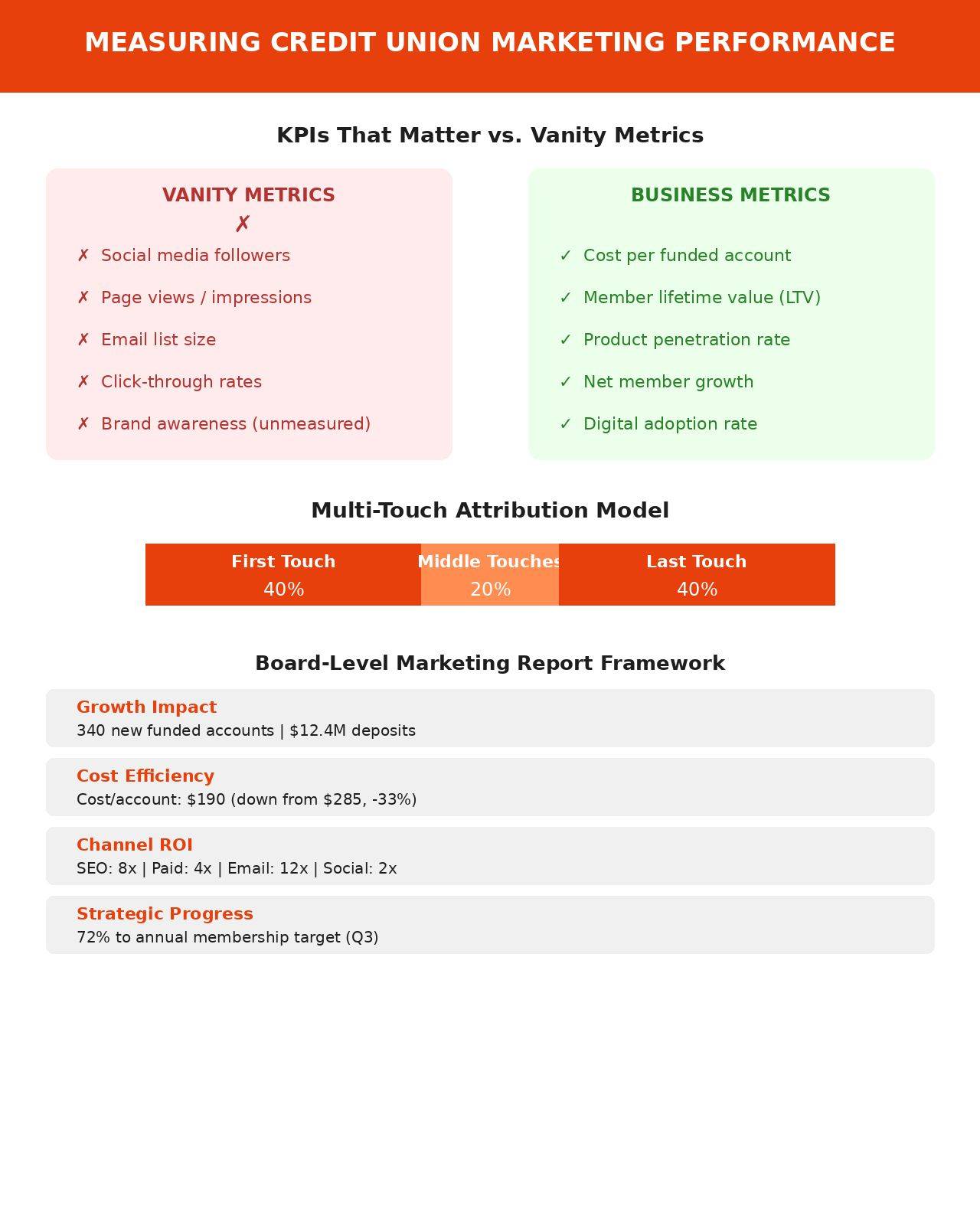
Impressions, followers, and page views feel good in reports but mean nothing to your bottom line. Credit union marketing best practices 2026 demand metrics tied directly to membership growth, product adoption, and revenue.
Focus your measurement on these high-value KPIs:
- Cost per funded account: Not cost per lead — the full cost to move someone from awareness to an active, funded membership
- Member lifetime value (LTV): Average revenue per member over their relationship tenure, segmented by acquisition channel
- Product penetration rate: Average products per member, tracked over time and by cohort
- Net member growth: New members minus closed accounts — the only growth number that matters
- Digital adoption rate: Percentage of members actively using mobile banking, online services, and digital lending tools
Set benchmarks before launching campaigns. Without a baseline, you can’t distinguish signal from noise in your results.
Attribution Models for Multi-Channel Campaigns
A member might see your social ad, read your blog post, receive a direct mail piece, and then walk into a branch to open an account. Which channel gets credit?
Multi-touch attribution distributes credit across every touchpoint in the member journey. Single-touch models (first-click or last-click) systematically undervalue channels that assist but don’t close.
- Start with a position-based model: 40% credit to first touch, 40% to last touch, 20% distributed across middle interactions
- Track offline-to-online journeys using unique promo codes, QR codes, and branch-specific landing page URLs
- Connect your CRM to your marketing platform so you can trace funded accounts back to original campaign exposure
- Review attribution data quarterly and adjust channel budgets based on true contribution, not assumed value
Perfect attribution is impossible. But directionally correct attribution — knowing which channels drive real growth — transforms your budget allocation from guesswork to strategy.
Reporting to Your Board in Language They Understand
Your board doesn’t care about click-through rates. They care about membership growth, loan volume, deposit growth, and return on marketing investment.
Translate marketing metrics into financial language every month. If you need help building a strategic marketing leadership framework, consider how a fractional CMO bridges the gap between marketing execution and board-level reporting.
- Lead with business outcomes: “Marketing drove 340 new funded accounts worth $12.4M in deposits this quarter”
- Show cost efficiency: “Our cost per funded account dropped from $285 to $190 — a 33% improvement year-over-year”
- Connect to strategic goals: Tie every metric back to the credit union’s annual plan and growth targets
- Benchmark against peers: Use CUNA or Callahan data to show how your marketing performance compares to similar-sized credit unions
When you report in outcomes — not activities — you earn budget increases instead of budget cuts. Understanding what strategic marketing leadership costs helps frame the investment conversation.
Strong metrics build credibility. But in financial services, credibility also depends on something harder to quantify: trust.
Credit Union Marketing Compliance and Brand Trust
Credit unions hold a natural trust advantage over banks. Members own the institution — that cooperative structure creates goodwill no advertising budget can buy.
But trust is fragile. One compliance misstep, one tone-deaf campaign, or one data breach can erase decades of community credibility. Credit union advertising must balance creativity with regulatory responsibility.
Regulatory Considerations for Financial Marketing
Every piece of marketing content your credit union publishes lives under regulatory scrutiny. NCUA, CFPB, FTC, and state regulators all have rules governing what you can say and how you say it.
Build compliance review into your content workflow — not as a bottleneck, but as a standard step before publication.
- Truth in Savings Act: APY disclosures must follow specific formatting and prominence requirements
- TILA requirements: Loan advertising triggers specific disclosure obligations when you mention rates or terms
- Fair lending: Marketing targeting must not inadvertently exclude protected classes — audit your digital targeting criteria regularly
- UDAAP: Avoid unfair, deceptive, or abusive practices in all marketing communications, including social media
Marketing teams at credit unions serving regulated industries understand this tension well — creativity within guardrails. Document your compliance review process and train every team member who touches external communications.
Building Trust Through Transparency
Members increasingly reward institutions that communicate openly — about fees, about data usage, about decision-making processes. Transparency isn’t a marketing tactic; it’s a brand position.
Lead with honesty in every communication, even when the message isn’t what members want to hear.
- Publish fee schedules prominently — don’t bury them in PDFs that require three clicks to find
- Explain rate-setting decisions in plain language through blog posts or member newsletters
- Share your credit union’s financial performance with members annually — they’re owners, treat them like it
- When you make mistakes, acknowledge them publicly and explain what you’re doing differently
Trust compounds over time. Every transparent interaction adds to a reservoir of goodwill that carries your credit union through difficult moments.
Community Engagement as a Marketing Strategy
Community involvement isn’t charity — it’s strategy. Credit unions that embed themselves in local communities build brand awareness, generate referrals, and create emotional loyalty that no rate advantage can overcome.
Approach community engagement with the same strategic rigor you apply to digital campaigns.
- Sponsor events where your target demographic already gathers — youth sports for young families, professional associations for business members
- Offer financial literacy workshops in schools, workplaces, and community centers — education builds trust and creates future members
- Partner with local nonprofits on initiatives aligned with your credit union’s values and member interests
- Document everything for social content — community involvement generates authentic stories that resonate on digital channels
The credit unions growing fastest in 2026 treat community engagement and digital marketing as one integrated strategy, not competing budget items. A full-service digital marketing agency can help you connect offline community presence to measurable online growth.
When compliance, trust, and community work together, your marketing doesn’t just generate leads — it builds an institution members are proud to belong to.
Conclusion
Credit union marketing in 2026 demands more than good intentions and a modest budget. It requires a strategic framework that integrates digital channels, data-driven personalization, lifecycle nurturing, and authentic community connection — all while maintaining regulatory compliance and member trust.
The credit unions winning market share today share common traits: they invest in digital infrastructure, they measure what matters, they personalize every touchpoint, and they never lose sight of the cooperative values that differentiate them from banks. Every strategy in this guide — from onboarding automation to AI-powered personalization to board-level reporting — serves one goal: growing membership while deepening relationships with existing members.
You don’t need to implement everything at once. Start with the gaps causing the most pain — whether that’s member attrition, low product penetration, or an underperforming website. Build momentum with quick wins, then scale what works. If you need strategic marketing leadership without the full-time executive cost, our fractional CMO services give you the expertise to prioritize, execute, and measure a credit union marketing plan built for sustainable growth.
Frequently Asked Questions About Credit Union Marketing
What is credit union marketing?
Credit union marketing encompasses all strategies and tactics used to attract new members, retain existing ones, and promote financial products and services. Unlike bank marketing, it emphasizes the cooperative ownership model, community values, and member-first philosophy that differentiate credit unions from for-profit financial institutions.
How much should a credit union spend on marketing?
Most credit unions allocate between 0.5% and 2% of total assets to marketing, though high-growth institutions invest closer to 3%. The right budget depends on your growth goals, competitive landscape, and current market position. What matters more than the total number is allocating spend to channels with proven ROI and measuring cost per funded account rather than cost per impression.
What are the best marketing channels for credit unions?
The highest-performing channels for credit unions in 2026 include SEO and content marketing for organic growth, targeted paid search for high-intent prospects, email automation for lifecycle nurturing, and community partnerships for local awareness. Multi-channel members spend 4x more than single-channel users, so an integrated approach outperforms any single-channel strategy.
How do credit unions compete with banks in marketing?
Credit unions compete by leaning into advantages banks can’t replicate: cooperative ownership, community commitment, lower fees, and member-first values. Instead of outspending banks on mass advertising, successful credit unions use targeted digital marketing, authentic storytelling, financial education content, and hyper-local community engagement to build relationships that matter more than brand recognition.
What is Answer Engine Optimization for credit unions?
Answer Engine Optimization (AEO) prepares your content to appear in AI-generated responses from tools like ChatGPT, Google AI Overviews, and Perplexity. For credit unions, this means structuring content to directly answer member questions about rates, products, and financial decisions in formats that AI systems can easily extract and cite. AEO complements traditional SEO as more consumers use AI assistants for financial research.
How do you measure credit union marketing ROI?
Measure credit union marketing ROI by tracking cost per funded account, member lifetime value by acquisition channel, product penetration rates, and net member growth. Use multi-touch attribution to understand how channels work together, and report results in financial terms your board understands — deposit growth driven, loan volume influenced, and revenue generated versus marketing spend invested.
Should credit unions hire a marketing agency?
Credit unions benefit from agency partnerships when they need specialized expertise (SEO, paid media, marketing automation) without the cost of building an in-house team, or when they need strategic leadership to align marketing with business goals. A fractional CMO combined with agency execution gives credit unions enterprise-level marketing capability at a fraction of the cost of a full internal department. The right agency understands financial services compliance and credit union values — not just marketing tactics.