
 321-236-2899
Ad Creative Testing: The 4-Step Framework for Finding Winning Ads Faster
Every ad you launch without a testing framework is a coin flip. You might get lucky — but you can’t replicate lucky.
After managing $50M+ in ad spend across Meta, Google, and TikTok, one pattern holds: the teams that test systematically outperform the teams with bigger budgets every single time. The difference isn’t creative talent. It’s process.
Below is the exact 4-step framework for isolating what works, killing what doesn’t, and scaling winners before creative fatigue sets in. Step 2 alone — the hook matrix — will change how you think about ad variation forever.
Key Takeaways
- Test one variable at a time — changing hooks, visuals, and CTAs simultaneously produces noise, not signal.
- Use a hook matrix (5 hooks x 2 angles) to generate 10 testable ad variants from a single concept in under an hour.
- Apply the 48-hour kill rule — pause underperformers at 1,000 impressions instead of letting them drain budget for weeks.
- Three metrics decide everything: hook rate, hold rate, and CPA. Ignore vanity metrics like likes and shares.
- Scale winners into variant trees by cloning proven hooks across new formats, lengths, and angles — not by simply increasing budget.
Why Most Ad Creative Tests Fail (And Waste Your Budget)
Most ad creative tests fail because advertisers change too many variables at once. They swap the headline, image, CTA, and audience simultaneously — then have no idea which element actually drove results.
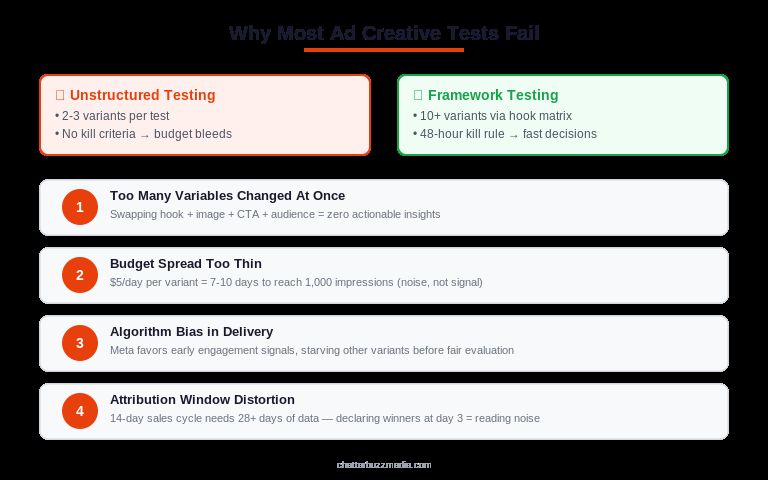
The second problem is budget allocation. Spreading $500 across 10 ad variations gives each creative just $50 — not enough data to reach statistical significance before you’re forced to make a call.
Platform algorithms compound the issue. Meta’s delivery system doesn’t split traffic evenly. It favors whichever ad gets early engagement signals, creating a self-fulfilling prophecy that starves other variations before they’ve had a fair chance.
Attribution windows add another layer of distortion. Products with a 14-day average sales cycle won’t show reliable conversion data until day 28 at the earliest. Declaring winners after 3 days means you’re reading noise, not signal.
The fix isn’t running more tests — it’s running structured tests with clear hypotheses, isolated variables, and hard decision rules.
Step 1: Define Your Hypothesis and Isolate One Variable
Every ad creative test starts with a hypothesis — a specific, falsifiable prediction about what will change performance and why.
A strong hypothesis follows this format: “We believe [change] will [improve metric] because [reason].” For example: “We believe a problem-focused hook will lower CPA by 15% compared to a feature-focused hook because our audience is problem-aware but not solution-aware.”
The critical principle here is variable isolation. Change one element per test — everything else stays constant. Same audience, same offer, same placement strategy, same landing page.
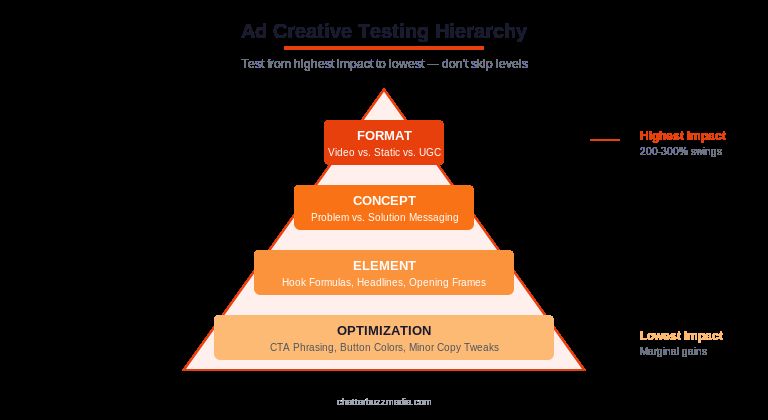
Here’s the testing hierarchy, ordered by impact:
- Format tests (highest impact) — video vs. static vs. UGC-style. These produce the biggest performance swings, often 200-300% differences in engagement.
- Concept tests — problem-focused vs. solution-focused messaging, emotional vs. rational appeals.
- Element tests — different hooks, headlines, or opening frames within a proven format.
- Optimization tests (lowest impact) — button colors, minor copy tweaks, CTA phrasing.
Start at the top. Most advertisers waste months optimizing button colors when they haven’t validated their creative format or core message.
Set your success metrics before the test starts — not after. Changing success criteria mid-test to favor a creative you personally like invalidates your results.
Step 2: Build a Hook Matrix to Generate Test Variants Fast
The hook — the first 3 seconds of your video ad or the headline of your static — drives the vast majority of performance variance. If the hook fails, your script, offer, and CTA are irrelevant because the viewer already scrolled past.
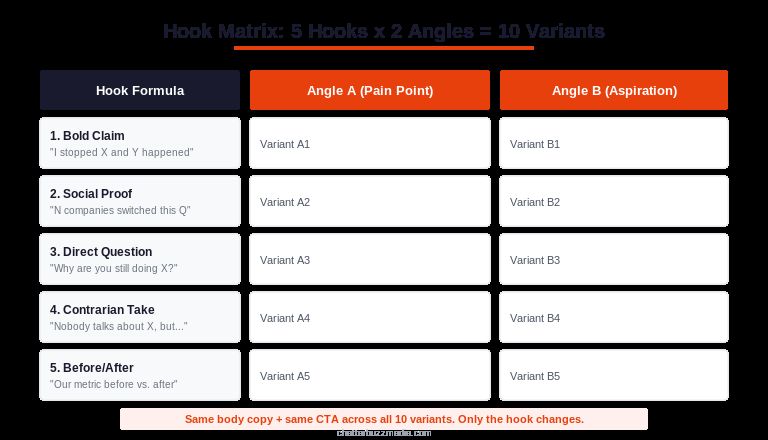
A hook matrix is the fastest way to generate high-volume test variants from a single concept. Take 5 proven hook formulas, cross them with 2 creative angles, and you get 10 variants ready to test.
The five hook formulas that consistently perform across industries:
- Bold claim — “I stopped [old way] and [result happened]”
- Social proof — “[Number] companies switched to [approach] this quarter”
- Direct question — “Why are [audience] still [doing ineffective thing]?”
- Contrarian take — “Nobody talks about this, but [insight]”
- Before/after — “Our [metric] before vs. after [change]”
Cross each hook with two angles. Angle A might be pain-focused (the problem your audience faces). Angle B might be aspiration-focused (the outcome they want). Same body copy, same CTA — only the hook changes.
This approach isolates the hook as the single variable while producing enough variants (10) to find real signal. Testing just 2-3 creatives is sampling from a pool too small to be meaningful.
The body of every variant stays identical. The hook just earns you the chance to sell. When you find a winning hook formula, you’ve learned something transferable — not just which ad won, but which messaging approach resonates with your audience.
Step 3: Launch, Measure, and Apply the 48-Hour Kill Rule
Launching ad creative tests without hard kill criteria is like gambling without a stop-loss. Budget keeps flowing to underperformers while you wait for data that may never become conclusive.

Budget allocation: Each variant needs a minimum of $20-50/day. Testing 10 variants at $5/day each produces noise, not insight.
Campaign structure: Run all variants in a single ad set with Advantage+ Creative turned OFF. When Advantage+ is on, Meta remixes your ads behind the scenes. You lose the ability to isolate which hook actually worked.
Audience selection: For pure creative tests, use proven audiences where you have baseline performance data.
After 48 hours and at least 1,000 impressions per variant, every creative gets one of three verdicts:
- Scale — hook rate above 30% and CPA at or below target. Move to a dedicated scaling campaign.
- Iterate — hook rate above 25% but CPA 10-30% above target. Keep the hook, rewrite the body or CTA.
- Kill — hook rate below 25% OR CPA more than 50% above target. Turn off immediately.
Meta’s algorithm needs roughly 50 conversion events per ad set to exit the learning phase — but hook rate tells you within 24 hours whether a creative has potential, long before CPA data stabilizes.
After each review cycle, document what you learned. After 4-6 testing cycles, clear patterns emerge. That’s your compounding creative intelligence.
Step 4: Scale Winners Into Variant Trees (Not Just Bigger Budgets)
Most advertisers scale winning ads by increasing budget on the same creative. That works until creative fatigue sets in — typically 2-3 weeks on Meta, faster on TikTok.
The smarter approach is building a variant tree from your winning hook + body combination.
Variation axes for your winning creative:
- Format — the same script as a talking-head video, a text overlay, and a UGC-style testimonial
- Length — 15-second cut, 30-second full version, 45-second extended with additional proof points
- Tone — skeptic delivery, enthusiast delivery, expert delivery of the same message
- Visual style — different backgrounds, caption styles, vertical vs. square aspect ratio
- Opening frame — same hook formula, slightly different visual or first-frame treatment
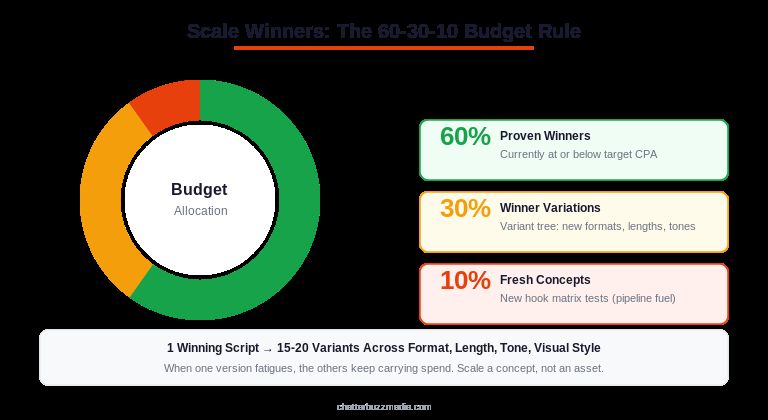
A single winning script can generate 15-20 variants at minimal cost.
Apply the 60-30-10 budget rule to your scaling campaigns:
- 60% budget to proven winners currently performing at or below target CPA
- 30% budget to winner variations (variant tree extensions)
- 10% budget to completely fresh concepts (feeding new entries into Step 1)
This allocation keeps your performance marketing engine running continuously.
The 3 Metrics That Actually Matter (Ignore Everything Else)
You don’t need a 15-column dashboard. Three metrics tell you everything about whether a creative is working — and exactly what to fix if it isn’t.
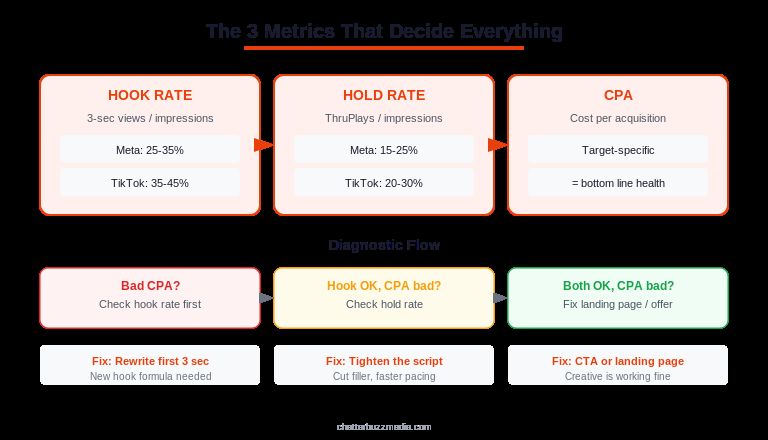
Hook rate (3-second video views / impressions) tells you whether the opening stops the scroll. Benchmark: 25-35% on Meta, 35-45% on TikTok.
Hold rate (ThruPlays or 15-second views / impressions) tells you whether the body keeps attention after the hook. Benchmark: 15-25% on Meta, 20-30% on TikTok.
CPA (cost per acquisition) tells you whether the ad makes money.
The diagnostic flow is sequential:
- Bad CPA? Check hook rate first.
- Hook rate good but CPA still bad? Check hold rate.
- Both rates good but CPA still bad? The problem is downstream — your landing page or offer needs work.
Everything else — likes, shares, comments, reach — is a vanity metric for paid media. Hook rate is the leading indicator.
Track these three numbers after every 48-hour kill cycle. After 4-6 weeks, you’ll have a performance pattern library that makes every future test more informed.
Common Ad Creative Testing Mistakes (And How to Avoid Them)
Even disciplined teams make testing mistakes that contaminate data. Here are the five most expensive errors.
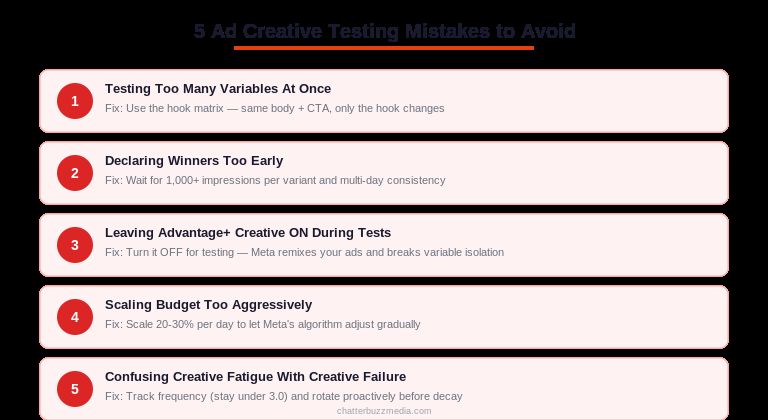
1. Testing too many variables simultaneously. The hook matrix solves this by design: same body, same CTA, only the hook changes.
2. Declaring winners too early. Aim for 1,000+ impressions per variant and look for consistency across multiple days, not just a single spike.
3. Leaving Advantage+ Creative on during tests. Turn it off for every testing campaign. Only enable it for scaling campaigns with proven winners.
4. Scaling budget too aggressively. Scale 20-30% per day to let the algorithm adjust gradually.
5. Confusing creative fatigue with creative failure. Track frequency (aim to stay under 3.0) and rotate proactively before full performance decay.
Keep a testing log that documents every cycle’s outcomes, including failures. Failed tests narrow the search space for your next round.
Weekly Creative Testing Calendar: Put the Framework on Autopilot
A framework only works if it runs on a schedule. This 4-week calendar turns ad creative testing into a repeatable system.

Week 1: New concept test. Build your hook matrix (5 hooks x 2 angles = 10 variants). Launch the test ad set with $20-50/day per variant.
Week 2: Kill/scale decisions + iteration. Run the 48-hour review at day 2 and day 4. Scale top 2-3 performers. Kill bottom 60%.
Week 3: Scale + variant tree. Clone winners into 5-10 variants across different formats, lengths, and tones.
Week 4: Fatigue check + next concept prep. Monitor scaling ads for fatigue signals (frequency above 3.0, CPA up 25%+). Prep the next hook matrix.
After 3 months, you’ve tested 30+ hooks, scaled 6-10 proven winners, and built a documented library. Competitors running unstructured tests can’t match that learning velocity regardless of their ad budget.
FAQ
1. How much budget do I need for ad creative testing?
Allocate $20-50 per day per variant. For a 10-variant hook matrix test, that’s $200-500/day for a 48-hour cycle — roughly $400-1,000 per complete test round.
2. How long should I run an ad creative test before making a decision?
Apply the 48-hour kill rule: after 48 hours and 1,000+ impressions per variant, evaluate hook rate and CPA. The exception is high-ticket products with long sales cycles — extend to 5-7 days.
3. Should I use Meta’s Advantage+ Creative for testing?
No. Keep it OFF for all testing campaigns. Only turn it on for scaling campaigns with proven winners.
4. What’s the difference between concept testing and element testing?
Concept testing compares entirely different creative approaches. Element testing refines details within a proven concept. Always validate the concept first.
5. How many ad creatives should I test at once?
Ten variants per test cycle is the sweet spot when using a hook matrix.
6. How do I know when an ad creative is fatigued vs. genuinely underperforming?
Check frequency and trend direction. Rising CPA with frequency above 3.0 = fatigue (fix: rotate). Never hitting target CPA with low frequency = underperformance (fix: new concept).
7. Can I test on Meta and TikTok at the same time?
Yes, but treat them as separate tests. Evaluate results independently. The winning hook formula often transfers, but execution needs platform-native adaptation.
8. What should I do when none of my test variants hit the benchmarks?
Go back to the concept level: try a different product benefit, target a different pain point, or reposition your value proposition. A full wipeout after 48 hours and $400-600 is far cheaper than slowly bleeding $5,000 over a month on a concept that never worked.
Build Your Ad Creative Testing System This Week
Ad creative testing separates the advertisers who reliably find winners from those who gamble on every launch.
Here’s your action plan:
- Set your hypothesis and KPIs before you touch a single ad.
- Build your first hook matrix — 5 hooks x 2 angles = 10 variants.
- Run the 48-hour kill rule — scale winners, iterate on middle performers, cut the bottom 60%.
- Clone winners into variant trees — extend the life of proven concepts across formats, lengths, and tones.
After 4-6 weeks of disciplined testing, you’ll have more documented creative intelligence than most teams accumulate in a quarter.
For a deeper dive into performance marketing frameworks and how creative testing fits into your broader paid media strategy, explore the full resource guide.

Victoria Wallace
Victoria Wallace is a senior content strategist and marketing writer with 30+ years of experience helping more than 200 brands translate complex business goals into clear, conversion-focused content. Her background spans paid media, marketing strategy, go-to-market planning, brand positioning, and full-funnel campaign development, giving her a deep understanding of how SEO content connects to real business growth.