
 321-236-2899
Ad Fatigue: 5 Steps to Fix Your Failing Meta Ads
Your Meta ads were crushing it six weeks ago. Now your CPA is creeping up, your CTR is sliding, and nobody on the team can pinpoint what changed.
Nothing changed. Your ads just got old. That slow, invisible bleed has a name — ad fatigue — and it’s the most expensive problem in paid media that most companies aren’t actively measuring.
After auditing hundreds of ad accounts spending $20K to $500K per month, the pattern is almost always the same. Top-performing ads are 45 to 90 days old, the “testing” is three new ads dropped into a six-figure account, and the creative pipeline hasn’t scaled with the budget. Under Meta’s Andromeda algorithm, that gap is punished faster than ever.
In this guide, you’ll learn exactly how to diagnose ad fatigue before it drains your budget, why creative fatigue hits harder under Andromeda, and the 5-step fix — including why UGC creative might be your most fatigue-resistant creative format. Let’s start with what’s actually happening inside your account.
Key Takeaways
- Ad fatigue is a supply chain problem, not a creative quality problem. Your ads didn’t get worse — your audience ran out of patience for seeing them.
- Under Meta’s Andromeda algorithm, fatigue windows have compressed from 6+ weeks to 2–3 weeks at moderate spend levels.
- For every $3,000 in monthly spend, produce one new ad. For every $10,000, produce one genuinely new concept.
- UGC-style creative is the most fatigue-resistant format because it blends into the feed and avoids “ad blindness.”
- Track spend-weighted creative age, not just calendar age. If the bulk of your budget flows through 60-day-old creative, you’re already behind.
- Allocate 3–4x your CPA per new concept in dedicated testing budget. Without real test spend, new creative never gets a fair shot.
What Is Ad Fatigue — And Why Andromeda Makes It Worse
Ad fatigue is what happens when the same audience sees the same creative too many times and stops responding. Click-through rates drop, conversion rates fall, and your cost per acquisition climbs — not dramatically, but steadily enough that no single week looks catastrophic.
That’s what makes it dangerous. Ad fatigue doesn’t look like a crisis — it looks like a slow Tuesday.
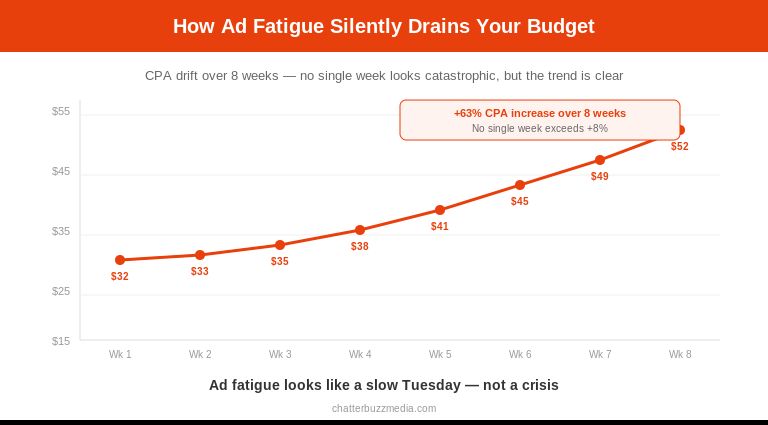
Your CPA rises 5% one week, another 3% the next, then 7%. Zoom out over two months and you’ve gone from a $35 CPA to a $52 CPA while everyone wonders what broke.
Here’s the critical distinction: ad fatigue is not a creative quality problem — it’s a supply chain problem. The ad didn’t get worse. The audience simply ran out of patience for seeing it. The fix isn’t better ads — it’s building a system to replace ads before they die.
Why Fatigue Hits Harder Under Andromeda
Meta’s Andromeda ranking system evaluates significantly more ads per auction than its predecessor. That means the algorithm surfaces your best creative faster — but it also burns through it faster.
Before Andromeda, a strong ad could carry an account for six to eight weeks at moderate spend. Now, fatigue windows have compressed to two to three weeks for accounts spending $200 or more per day. At $1,000-plus per day, expect seven to fourteen days before a creative starts declining.
Andromeda also changed what fatigue means strategically. Because the algorithm uses each distinct creative to find different audience pockets, creative diversity has become a targeting play. When all your creatives fatigue simultaneously, Andromeda has nothing to fall back on — and your entire account performance collapses at once instead of degrading gradually.
This is what “creative is the new targeting” actually means in practice. Diverse creative simultaneously reduces fatigue and expands your total addressable reach.
How to Measure Ad Fatigue Before It Costs You
Most companies don’t measure ad fatigue — they feel it. Performance declines, questions surface in the weekly meeting, and then a scramble begins. By the time you feel it, you’ve wasted weeks of spend on creative well past its prime.
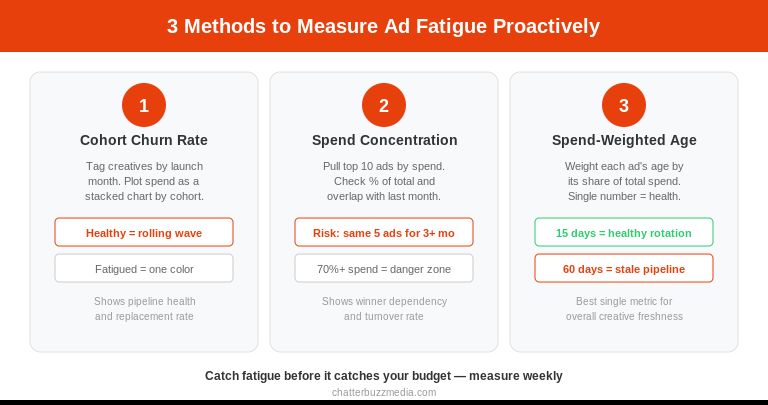
The goal is catching fatigue proactively. Here are three methods that work.
Method 1: Track Creative Churn Rate by Cohort
Tag each batch of creatives by launch month — January cohort, February cohort, March cohort. Plot total ad spend as a stacked chart colored by cohort.
In a healthy account, this chart looks like a rolling wave. Each cohort rises, peaks, and gives way to the next. In a fatigued account, one color stretches across the entire chart with nothing layering on top — that’s your pipeline falling behind.
Method 2: Spend Concentration Analysis
Pull your top 10 ads by spend this month. Ask two questions: what percentage of total spend do they represent? And how many were also in last month’s top 10?
If the same five or six ads have dominated for three-plus months while representing 70% or more of spend, fatigue is coming — whether the numbers have declined yet or not. A healthy account shows regular turnover in its top performers as new winners emerge.
Method 3: Spend-Weighted Average Creative Age
Take every active ad, note how many days it’s been running, and weight each ad’s age by its share of total spend. The result is a single number: on average, how old is the creative your money is being spent on?
A spend-weighted age of 15 days means healthy rotation. An age of 60 days means most of your budget flows through stale creative — even if you recently launched a few new ads. If this number trends upward month over month, you’re falling behind on production.
The Metrics That Signal Fatigue
Use these thresholds as early-warning triggers for your reporting dashboards:
- CTR declining 20–30% from its peak — this is the leading indicator. By the time CPA rises, you’ve already lost weeks.
- Frequency above 2.5–3.0 for prospecting campaigns or above 4.0–6.0 for retargeting.
- CPA increasing 15% or more over a 2-week rolling window with no changes to targeting, budget, or offer.
- CPM rising while CTR holds steady — the algorithm is charging you more because it’s running out of responsive users to show your ad to.
Meta’s own research found that click-through rates decay following a power-law pattern of (N+1)^-0.43, where N is the number of prior exposures. By the fourth exposure, conversion likelihood drops roughly 45%. There is no “wear-in” period for direct-response ads — performance peaks on first impression and declines from there.
Knowing how to spot fatigue is the first step. Now let’s fix it.
Step 1: Size Your Creative Pipeline to Your Spend Level
Creative doesn’t fatigue over time — it fatigues under spend pressure. The same ad can run for two years at $500 per month. Put $50,000 behind it in a single week and it’s dead by Friday.
More spend means more impressions, higher frequency, and faster audience exhaustion. This is why scaling ad budgets kills performance — brands find a winning ad, increase the budget, and watch results collapse within two weeks.
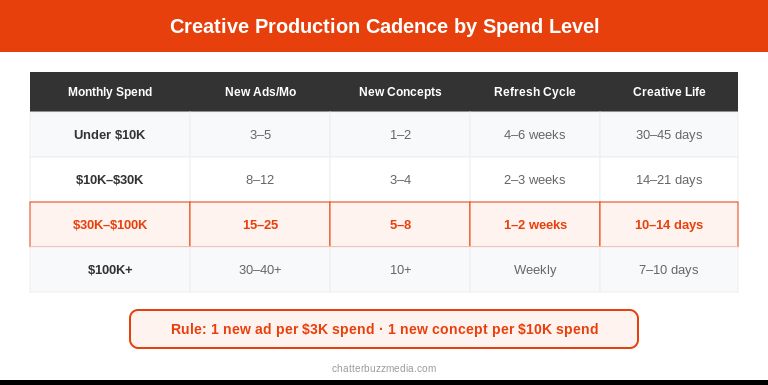
Use this production cadence as a baseline:
- Under $10K/month: 3–5 new ads per month, refresh creative every 4–6 weeks.
- $10K–$30K/month: 8–12 new ads per month across 3–4 distinct concepts.
- $30K–$100K/month: 15–25 new ads per month across 5–8 concepts. Introduce 2–4 genuinely new concepts per week.
- $100K+/month: 30–40+ new ads per month across 10+ concepts. You need a dedicated creative team or production partner.
The simplified rule: one new ad per $3,000 of monthly spend, one new concept per $10,000. Most companies produce creative at the rate that worked when they were spending $20K, then scale to $80K without adjusting production. That gap is exactly where fatigue lives.
Volume alone won’t save you if every ad looks the same. That brings us to diversification.
Step 2: Diversify Concepts, Not Just Variations
Producing 40 variations of the same creative concept is almost worthless. From Meta’s perspective — and from the audience’s perspective — they’re all the same ad. Your “30 ads” might actually be four or five true concepts in the algorithm’s eyes.
Genuine creative differentiation means varying across three dimensions simultaneously:
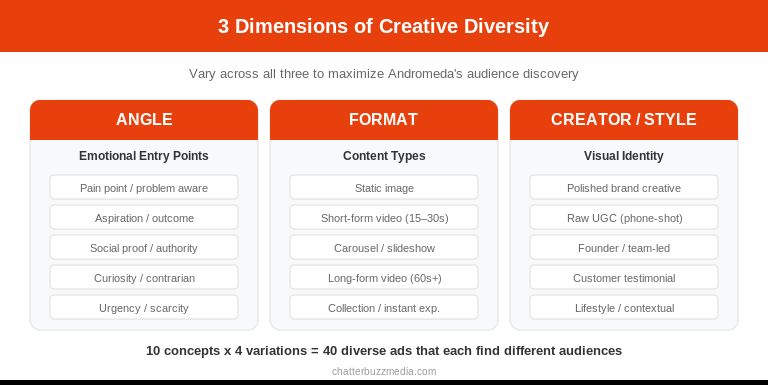
- Angle: Different emotional entry points — pain, aspiration, curiosity, social proof, urgency. Each angle attracts a different subset of your audience.
- Format: Static images, short-form video, carousel, long-form video, slideshow. Different formats perform differently by placement and audience segment.
- Creator/Style: Polished brand content, raw UGC, founder-led video, customer testimonial, lifestyle imagery. Each visual style signals differently and reaches different people.
When you run genuinely diverse creative, Andromeda uses each distinct piece to find different pockets of your audience. A polished product demo reaches a different person than raw UGC from a customer. Diverse creative simultaneously reduces fatigue and expands your total addressable reach.
Think of your creative portfolio in two buckets:
- Replacement creative: Built on learnings from current top performers. Take the winning elements — hook type, visual style, emotional angle — and apply them to genuinely new concepts.
- Expansion creative: Completely new angles designed to open audience segments your current creative hasn’t reached. Higher risk, but the only path to real scale.
Split your production budget between both. Replacement keeps your account from falling off a cliff. Expansion is where you find your next winner.
Of all the format types available, one stands out as the most fatigue-resistant.
Step 3: Use UGC to Break the Ad Fatigue Cycle
User-generated content is the most fatigue-resistant ad format because it doesn’t look like an ad. UGC blends into the feed, avoids the “ad blindness” that triggers fatigue, and delivers the authenticity that Andromeda’s engagement signals reward.
Here’s why UGC works mechanically against fatigue:
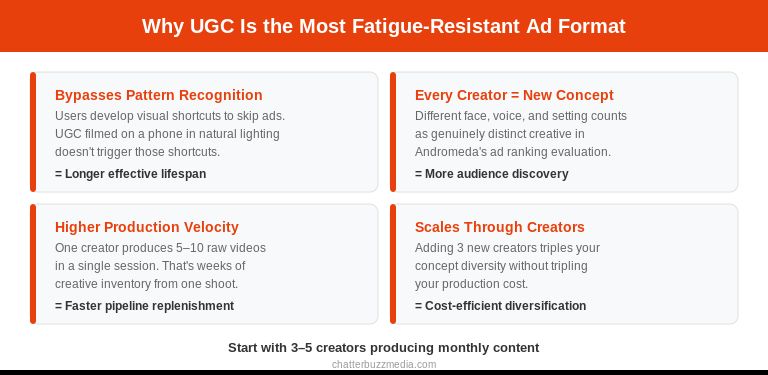
- It bypasses pattern recognition. Users develop visual shortcuts to identify and skip ads. UGC filmed on a phone in natural lighting doesn’t trigger those shortcuts.
- Every creator is a new “concept.” A different face, voice, and setting counts as genuinely distinct creative in Andromeda’s evaluation — even if the script covers the same talking points.
- Production velocity is higher. One creator can produce 5–10 raw videos in a single session. That’s weeks of creative inventory from a single shoot.
- It scales through creators, not production budgets. Adding three new creators triples your concept diversity without tripling your cost.
Building a UGC Pipeline for Fatigue Prevention
Don’t wait until your polished ads fatigue to start producing UGC. Build it into your creative rotation from day one.
Start with three to five creators producing content monthly. Brief each creator on the same core message but let them deliver it in their own voice and style. The natural variation between creators gives Andromeda multiple distinct creative signals to work with.
Repurpose each raw video into multiple assets: full-length, 15-second cut, hook variation, and static thumbnail. A single creator session should yield 15–20 ad variations across formats.
UGC isn’t a replacement for polished brand creative — it’s the complement that keeps your account running when your hero ads start to tire. Together, they create the format diversity that Andromeda needs to keep finding new audiences.
Having the right creative is only half the equation. You also need a testing structure that gives new ads a real shot at competing.
Step 4: Build a Testing Structure That Surfaces Winners
Producing more creative doesn’t help if your account structure isn’t set up to test it. The most common failure: a brand produces 20 new ads, launches them into existing campaigns, and two weeks later 90% of spend still goes to the same three old winners.
The new ads never got a fair shot. This is a testing structure problem, not a creative problem.
Allocate Real Testing Budget
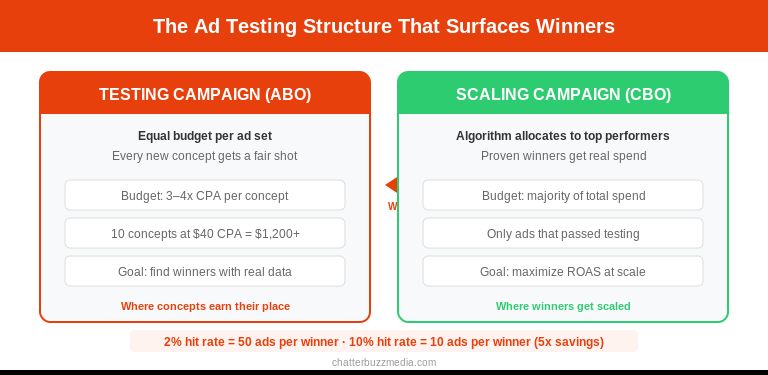
Spend 3–4x your target CPA per new concept in dedicated testing budget before drawing conclusions. If your CPA target is $40, each new concept needs $120–$160 in committed test spend.
Launching 10 new concepts at $40 CPA means $1,200–$1,600 in testing investment. Compare that to what you’re currently wasting on fatigued creative spending $500 per day at a CPA 40% above target. The math becomes clear quickly.
Separate Testing From Scaling
Use ABO (ad set budget optimization) campaigns for testing — this forces equal budget distribution across new creatives so each one gets a fair evaluation. Use CBO (campaign budget optimization) for scaling proven winners.
The testing campaign is where new concepts earn their place. The scaling campaign is where winners get real spend. Mixing the two means the algorithm always defaults to existing winners and starves new creative of data.
Improve Your Hit Rate
Volume and structure aren’t enough if what you’re testing is low quality. At a 2% hit rate, you need 50 ads to find one winner. At a 10% hit rate, you need 10. That’s a 5x difference in production cost for the same outcome.
Improve hit rate by mining your existing data. Break down current winners by hook type, visual style, creator, angle, and format. Understand why they worked — not just that they worked. Then brief new creative based on those patterns applied to genuinely new concepts.
Informed quantity beats blind volume every time. The goal is a creative system that gets smarter with every ad you run.
Step 5: Automate Fatigue Detection and Creative Rotation
Manual monitoring catches fatigue after it’s already cost you. The most effective teams build automated rules that flag — or pause — fatiguing creative before the damage compounds.
Set up these two automated rules in your ad management platform:
Fatigue Pause Rule
Pause any ad where:
- CTR has declined 30% or more from its 14-day running average, AND
- Impressions exceed 1,000 (enough data to be meaningful), AND
- Frequency exceeds 3.0 for prospecting (or 5.0 for retargeting).
This catches the ads that are actively draining budget. Pausing is always better than reducing spend — a fatigued ad at lower budget just fatigues slower while continuing to deliver poor results.
Fatigue Warning Rule
Send an alert (no automatic action) when:
- CTR has declined 15–25% from its peak, AND
- The ad has been running for 14+ days, AND
- CPA is trending upward over a 7-day window.
This gives your team a heads-up to prepare replacement creative before the ad fully fatigues. The warning buys you the production lead time that prevents gaps in your pipeline.
Maintain a 3-Stage Creative Pipeline
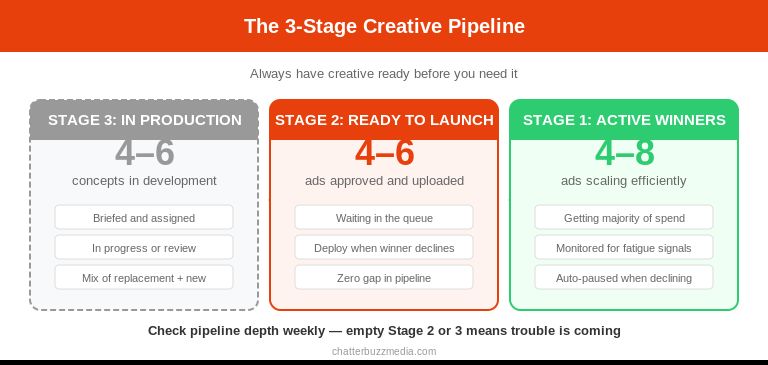
At any given time, your account should have creative in three stages:
- Active winners: 4–8 ads currently scaling and spending efficiently.
- Ready to launch: 4–6 ads approved, uploaded, and waiting to enter testing when a winner starts declining.
- In production: 4–6 concepts in development — briefed, in progress, or in review.
This pipeline ensures you always have creative ready before you need it. When an automated rule pauses a fatigued ad, the next concept is already waiting in the queue.
Build this rhythm into your weekly KPI reviews: check creative pipeline depth alongside performance metrics. If Stage 2 or Stage 3 is empty, you’re about to have a problem — even if today’s numbers look fine.
Frequently Asked Questions About Ad Fatigue
1. 🔍 How do I know if my Meta ads have ad fatigue?
Look for a gradual CPA increase over two to four weeks with no corresponding change in targeting or budget. Check whether your top-spending ads are more than 30 days old. Calculate the spend-weighted average age of your active creative — anything above 25 days in a high-spend account warrants attention. CTR is your leading indicator — it declines before CPA rises.
2. 📊 How long does a Meta ad last before it fatigues?
It depends entirely on spend level and audience size — not calendar time. An ad spending $500 per month might last a year. The same ad spending $50,000 per month could be done in two weeks. Under Andromeda, expect two to three weeks at $200-plus per day and seven to fourteen days at $1,000-plus per day.
3. ⚡ What’s the difference between ad fatigue and creative fatigue?
Ad fatigue is the broad performance decline from overexposure to any ad element — creative, copy, offer, or landing page. Creative fatigue specifically means the visual and messaging elements have lost their impact. A third category, audience fatigue, occurs when you’ve simply exhausted your targetable pool. Each requires a different fix: new creative, new messaging, or broader targeting.
4. 🏦 How many ads should I run to avoid fatigue?
Use the $3K/$10K rule: one new ad per $3,000 of monthly spend, one genuinely new concept per $10,000. At $50K per month, that’s approximately 5 new concepts with 3–4 variations each — roughly 15–20 ads per month — with a dedicated testing structure to evaluate each one.
5. 🤝 Does UGC really fatigue slower than polished ads?
Yes. UGC blends into the feed and avoids the visual patterns that trigger ad blindness. Each new creator functions as a genuinely distinct concept in Meta’s ranking system, even with similar messaging. UGC also has higher production velocity — one creator can produce 5–10 raw assets in a single session, giving you weeks of creative inventory.
6. 💰 Should I increase budget on a fatiguing ad to push through?
No — that accelerates fatigue by increasing frequency faster. Pause the fatigued creative entirely rather than reducing its budget. A fatigued ad at lower spend just fatigues slower while continuing to deliver poor results. Redirect that budget to your testing campaign or to proven winners that still have room to scale.
7. 🚀 Does ad fatigue affect Google Ads for financial services the same way?
The mechanism differs. On Google, creative fatigue shows up primarily in Display and YouTube campaigns where frequency is a factor. Search campaigns are keyword-intent driven, so fatigue manifests more as quality score erosion and increasing CPCs over time. The principles of creative diversification and pipeline management still apply across platforms.
8. 📈 How does Andromeda change my ad fatigue strategy?
Andromeda evaluates more ads per auction and uses creative diversity as a targeting signal. This means fatigue cycles are shorter, but it also means diverse creative reaches more audience segments automatically. The strategy shift: prioritize concept diversity over volume of variations. Ten genuinely different concepts with four variations each outperform 40 variations of the same idea.
The Bottom Line on Ad Fatigue
Ad fatigue is not the algorithm turning against you. It’s not a sign that social media advertising doesn’t work anymore. It’s a predictable, measurable, and fixable supply chain problem.
The companies that win at paid media over time treat creative production as an operational function — not something the marketing coordinator handles between other projects. Under Andromeda, the creative pipeline is the targeting strategy.
Here’s your action plan:
- Audit your current creative portfolio. Calculate your spend-weighted creative age and cohort churn rate. Know where you stand before making changes.
- Size your pipeline to your spend. Apply the $3K/$10K rule. If there’s a gap between your production rate and your spend level, close it.
- Add UGC to your creative mix. Start with three to five creators producing monthly. Build format diversity across angles, formats, and creator styles.
- Automate detection and build a 3-stage pipeline. Set up fatigue pause and warning rules. Keep 4–6 ready-to-launch concepts in queue at all times.
For a deeper dive into building a performance marketing system that scales, explore the full guide to structuring paid campaigns for sustainable growth.
Shalyn Dever
Shalyn is the Founder & Chief Growth Consultant at Chatter Buzz. An engineer recruited by Google, she loves solving the most complex business growth problems and utilizing technology as solutions. She loves amazing UI/UX, out of the box SEO tactics and forward thinking paid campaigns.