
 321-236-2899
Meta Andromeda: How Meta’s AI Replaced Audience Targeting With Creative Targeting
Meta’s Andromeda update is the most significant overhaul to Facebook and Instagram ad delivery since Advantage+ launched in 2022. If your Meta ads “used to work” and now feel inconsistent, this guide explains exactly what changed — and how to restructure your creative strategy to win under the new algorithm.
At Chatter Buzz, we manage paid social campaigns across dozens of B2B and e-commerce accounts. We’ve tested Andromeda-optimized structures against legacy setups since early 2025 and tracked which levers actually move performance. This guide distills everything we’ve learned into an actionable playbook.
You’ll learn exactly how Andromeda’s content-aware retrieval system works, why creative diversity now outweighs audience targeting, and the specific production framework that keeps your ad account fed with what the algorithm needs.
Key Takeaways
- Meta Andromeda replaced the legacy ad retrieval system with a content-aware AI engine that reads your creative to decide who sees it — making creative diversity the primary performance lever.
- Brands testing 20+ new ads per month see 65% higher ROAS than those testing fewer than 10, and ad fatigue now hits in 2-3 weeks instead of 6+.
- Campaign simplification wins: one ad set with 25 diverse creatives generates 17% more conversions at 16% lower cost than five ad sets with five creatives each.
- Creative Similarity Scores above 60% trigger retrieval suppression — the algorithm collapses similar ads into one entity, so cosmetic variations don’t count as separate ads.
- Signal quality is non-negotiable: Pixel + Conversions API redundancy, one prioritized conversion event, and server-side tracking form the foundation Andromeda needs.
- The 50/30/20 creative refresh model (50% new concepts, 30% refined variants, 20% proven performers) balances exploration with stability on a 2-3 week cycle.
What Is Meta Andromeda and Why It Matters
Meta Andromeda is the AI-powered ad retrieval engine that replaced Meta’s legacy ad selection system between late 2024 and October 2025.
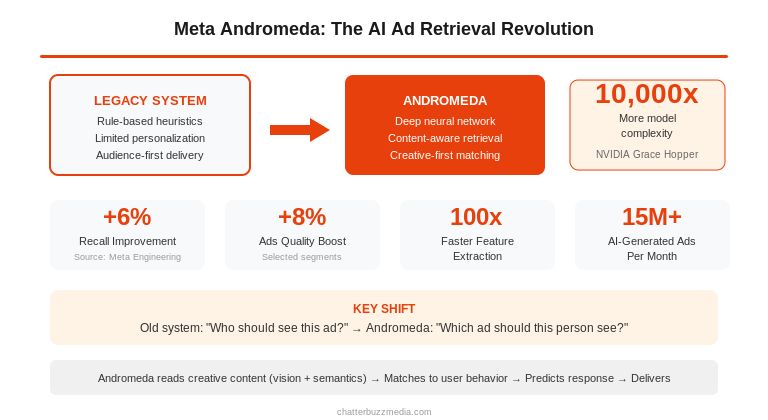
It represents the most fundamental overhaul of how Facebook and Instagram ads get delivered since the platform introduced Advantage+ social media advertising in 2022.
Before Andromeda, Meta’s retrieval layer used rule-based heuristics and smaller models to narrow tens of millions of eligible ads down to a few thousand candidates for auction. Advertisers controlled delivery primarily through audience definitions — interests, demographics, lookalikes, and exclusions acted as hard gates.
Andromeda flipped that model entirely. Built on the NVIDIA Grace Hopper Superchip, it introduced a 10,000x increase in model complexity at the retrieval stage. Meta’s engineering team reported a +6% recall improvement and +8% ads quality improvement on selected segments after deployment.
The system now uses computer vision and semantic analysis to read what’s actually inside your ad creative — the product, the style, the text, the colors, the mood, the pacing. It matches creative content to individual users based on behavioral patterns and predicted response, not advertiser-defined audience segments.
For advertisers, the downstream effect is clear: targeting matters less, bidding matters less, and creative does most of the work the algorithm used to do for you.
How Andromeda Changed Ad Delivery Forever
The old Meta Ads system asked: “Who should see this ad?” Andromeda asks: “Which ad should this person see?”
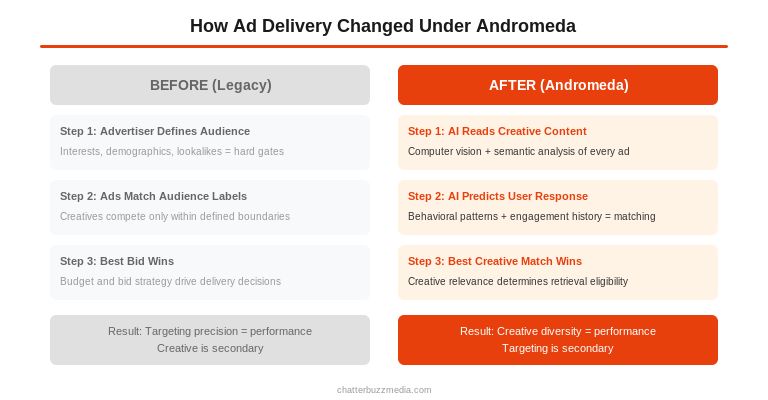
That single reframe changes everything about how you structure campaigns, produce creative, and measure success.
The Retrieval Stage Is Now Content-Aware
Andromeda operates at the retrieval stage — the first filter that narrows tens of millions of ads to a few thousand candidates before ranking and auction even begin. If your ad never gets retrieved, your bid size and PPC optimization settings become irrelevant.
The retrieval model achieves over 100x improvement in feature-extraction throughput compared to the CPU-based system it replaced. It processes creative elements in near real-time: hooks, themes, formats, visual structure, narrative style, and emotional valence.
Audience Targeting Becomes a Soft Suggestion
Interest targeting still exists, but it no longer acts as a rigid gate that controls delivery. Under Andromeda, your targeting provides context — not command.
The algorithm overrides your audience definitions if creative signals suggest a better match elsewhere. Every creative effectively becomes a self-selecting filter that defines who sees it based on predicted engagement patterns.
Campaign Structure Simplification Wins
Meta’s internal testing found that one ad set with 25 diverse creatives generated 17% more conversions at 16% lower cost than five ad sets with five creatives each. Over-segmentation now fights the algorithm by fragmenting signals and slowing learning.
The winning structure in 2026: fewer campaigns, fewer ad sets, more creatives per ad set, and broader targeting across placements.
Creative Is the New Targeting: What That Actually Means
Under Andromeda, creative relevance effectively becomes the audience. Meta has been explicit that creative diversification — not narrow audiences — is the most potent lever advertisers have.
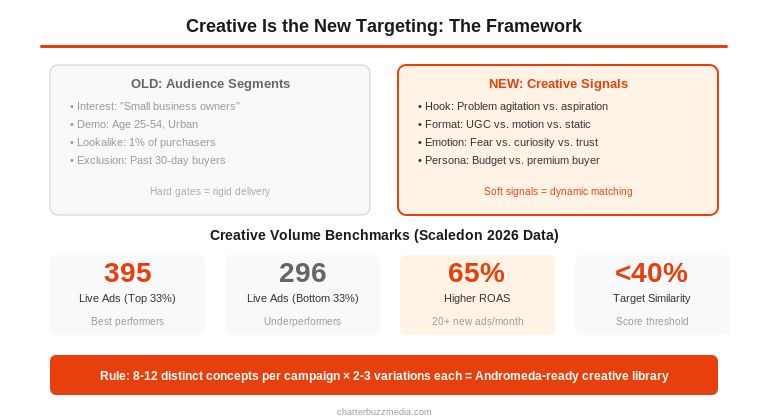
Creative volume supplies the raw material Andromeda needs to do its job.
The Volume Requirement Is Real
Data from Scaledon’s 2026 analysis shows the top third of Andromeda-era advertisers run roughly 395 live ads at any given time, while the bottom third runs 296 — a 33% gap. Brands testing 20+ new ads per month see 65% higher ROAS than brands testing under 10.
The math is straightforward. Give Andromeda three creative options, and it picks the best of three. Give it 30 distinct options, and it finds optimal matches across many user segments simultaneously.
Diversity Matters More Than Quantity
Here’s the critical nuance most guides miss: Andromeda doesn’t count 100 lookalike ads as 100 ads.
Meta now exposes a Creative Similarity Score in Ads Manager. When scores exceed 60%, the system collapses similar ads into a single Entity ID and makes them compete against each other instead of expanding reach. Ads that look different to you may look identical to the algorithm.
True diversity means varying at the structural level:
- Different hooks — problem agitation, aspiration, identity alignment, social proof, curiosity, urgency
- Different formats — UGC testimonials, founder-led videos, motion graphics, static carousels, before/after, educational content
- Different awareness levels — cold audiences need education, warm audiences need validation, hot audiences need friction removal
- Different buyer personas — budget-sensitive buyers vs. premium buyers vs. convenience-driven buyers respond to fundamentally different messages
Keep your Creative Similarity Score below 40% by building 8-12 conceptually distinct ad concepts per campaign with 2-3 variations per concept.
The Andromeda Readiness Audit: Is Your Account Optimized?
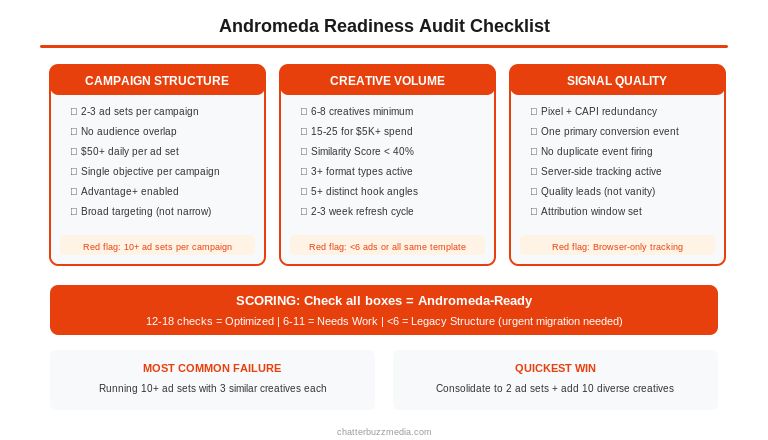
Most advertisers are still running legacy account structures that actively fight Andromeda’s logic. Here’s how to audit your account for readiness.
Campaign Structure Assessment
Check how many ad sets you’re running per campaign. If the answer is more than 3-5 per objective, you’re likely fragmenting the algorithm’s learning capacity.
Red flags: More than 10 ad sets per campaign, overlapping audiences across ad sets, budget less than $50/day per ad set, and multiple campaigns targeting the same objective.
Creative Volume Assessment
Count your active, unique creatives per ad set. If you’re running fewer than 6 distinct ads per ad set, the system lacks enough options to learn effectively. The minimum viable creative volume for Andromeda is 6-8 creatives per ad set, with 15-25 being optimal for accounts spending $5K+ monthly.
Audit your creative similarity: are your “different” ads actually just headline swaps on the same template? The algorithm sees through cosmetic changes.
Signal Quality Assessment
Andromeda depends on clean conversion data to validate predictions. Check that your Pixel and Conversions API fire consistently with redundancy, that you have one clearly prioritized conversion event aligned with actual business outcomes, and that you’re not optimizing for vanity conversions that inflate volume without value.
Broken events, duplicate firing, and incomplete attribution paths introduce noise that compounds over time — making even diverse creative underperform.
Creative Production Framework for the Andromeda Era
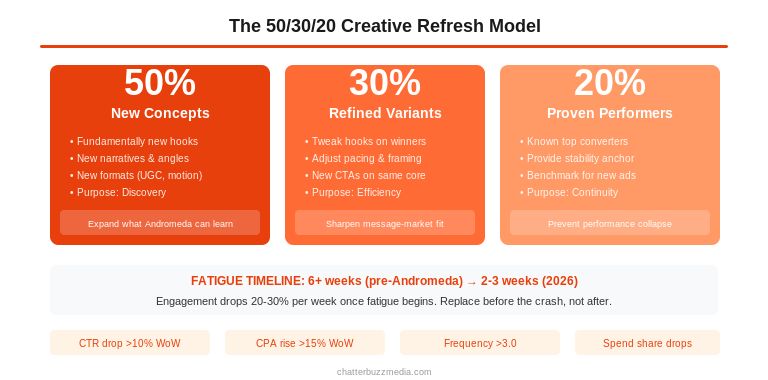
Producing enough creative to feed Andromeda requires a system, not sporadic bursts of production. The teams winning in 2026 operate on a structured 2-3 week refresh cycle.
The 50/30/20 Creative Refresh Model
This allocation framework balances exploration with stability:
- 50% new concepts — fundamentally new hooks, narratives, formats. Purpose: discovery and expanding the system’s learning pathways.
- 30% refined variants — the core idea stays intact but hooks, pacing, framing, or CTAs change. Purpose: improving efficiency without destabilizing performance.
- 20% proven performers — known contributors that provide continuity, anchor learning, and prevent collapse during experimentation.
Refresh Cadence: Signal-Driven, Not Schedule-Driven
Ad fatigue windows have compressed from 6+ weeks to 2-3 weeks under Andromeda, according to Pixel Panda Creative’s 2026 analysis. Engagement on a fatigued ad drops 20-30% per week once decline begins.
Watch these leading indicators at the creative level:
- CTR falling more than 10% week-over-week
- CPA rising more than 15% week-over-week
- Frequency exceeding 3.0 on prospecting campaigns
- Spend share dropping without a budget change
Replace creatives while they’re still working — not after they’ve crashed.
How to Brief Creative Teams for Andromeda
Your content marketing and creative briefs need to specify angle diversity, not just visual treatments. Each brief should define the emotional trigger, awareness level, persona, and format type.
A brief that says “make 10 versions of our hero ad” produces 10 ads that Andromeda treats as one. A brief that says “create 10 ads covering 5 different angles across UGC, motion, and static formats” produces assets the algorithm can actually differentiate.
Campaign Structure Migration: From Legacy to Andromeda-Optimized
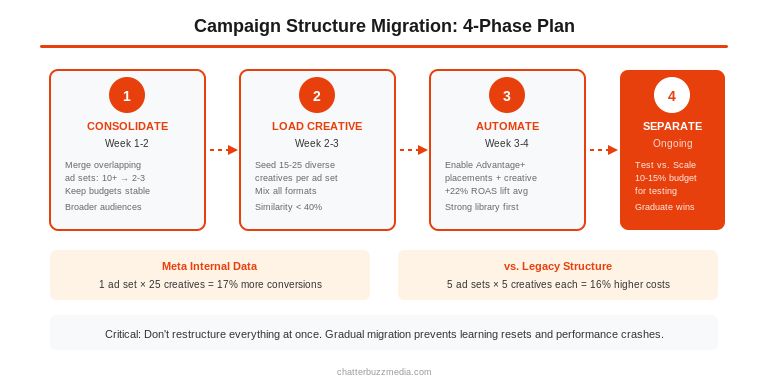
Migrating from a legacy campaign structure to an Andromeda-optimized setup requires a methodical approach. Sudden restructuring can reset learning and crash performance.
Phase 1: Consolidate Ad Sets (Week 1-2)
Identify ad sets with overlapping audiences and merge them. Move from 10+ ad sets per campaign down to 2-3 maximum: one for prospecting (broad), one for retargeting, and optionally one for testing.
Keep budgets stable during consolidation. The goal is to give Andromeda room to explore without fragmented signal pools.
Phase 2: Load Creative Diversity (Week 2-3)
Seed your consolidated ad sets with 15-25 diverse creatives. Mix formats: video (short and long), carousels, static images, and UGC-style content.
Ensure each creative represents a genuinely different hook, angle, or value proposition. Monitor the Creative Similarity Score — if it’s above 40%, you need more conceptual variety.
Phase 3: Enable Advantage+ Features (Week 3-4)
Turn on Advantage+ placements, Advantage+ creative optimizations, and consider Advantage+ Shopping campaigns for e-commerce brands. These automation features are deeply aligned with Andromeda’s logic.
Meta’s data shows Advantage+ creative drives a 22% ROAS lift over manual setups. The automation amplifies good creative — but punishes poor inputs.
Phase 4: Separate Testing From Scaling (Ongoing)
Testing thrives on variance. Scaling thrives on consistency. Blending them resets learning as fast as it gains traction.
Run a dedicated testing campaign (10-15% of budget) where new concepts compete. Graduate winners into your scaling campaigns.
Measurement and Attribution Under Andromeda
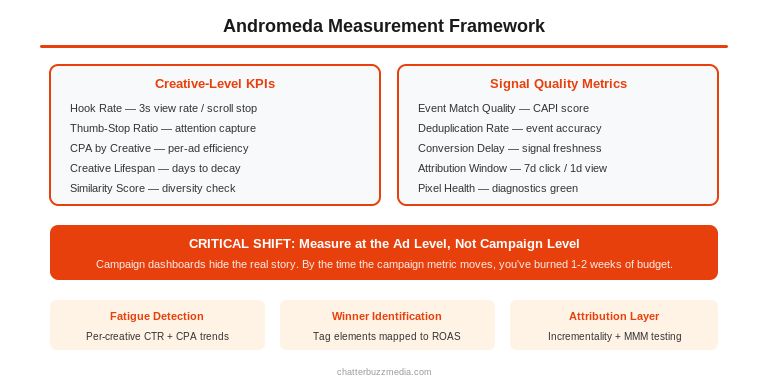
Traditional campaign-level dashboards hide the real story under Andromeda. You need creative-level measurement to understand what’s driving results.
Creative-Level KPIs That Matter
Track these metrics at the individual ad level:
- Hook rate — percentage of viewers who watch past the first 3 seconds (video) or stop scrolling (static).
- Thumb-stop ratio — how your creative captures initial attention relative to benchmarks.
- Cost per acquisition by creative — which specific ads drive efficient conversions.
- Creative lifespan — days from launch to performance decay.
Signal Quality: The Foundation Andromeda Needs
Ensure your Facebook Pixel and Conversions API fire in parallel with redundancy. Prioritize one primary conversion event that reflects genuine business value.
Server-side tracking through CAPI has become non-negotiable. Browser-side signals degrade with every privacy update.
Attribution in a Broad-Targeting World
When targeting is broad and Andromeda controls delivery, last-click attribution breaks down. Use Meta’s built-in attribution models as a baseline, then supplement with incrementality testing and marketing mix modeling for ROI measurement.
Industry-Specific Creative Strategies for Andromeda
Andromeda’s effects vary by industry and objective. Here’s how to adapt your marketing strategy based on your business model.
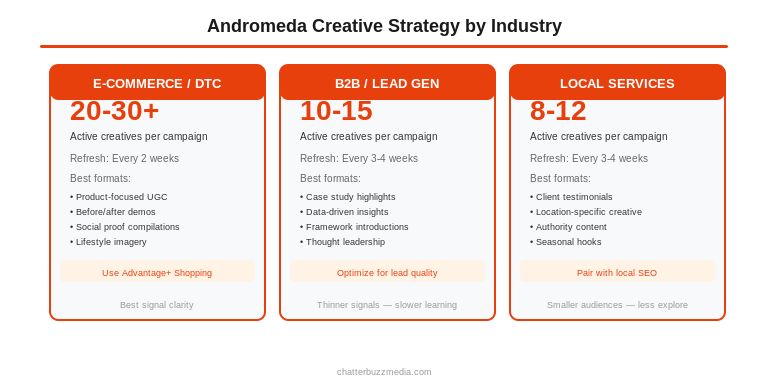
E-Commerce and DTC Brands
E-commerce benefits most from Andromeda because conversion data is abundant and clear.
Optimal approach: 20-30+ active creatives per campaign, heavy rotation of product-focused UGC, lifestyle imagery, before/after demonstrations, and social proof compilations. Refresh every 2 weeks. Use Advantage+ Shopping campaigns for your e-commerce marketing.
B2B and Lead Generation
Lead gen faces more friction because form completion signals are thinner and delayed.
Optimal approach: 10-15 active creatives per campaign, emphasize educational content that pre-qualifies intent. Use lead quality signals as your optimization event. Pair with strong demand generation and B2B digital marketing strategies.
Local Services and Professional Services
Smaller addressable audiences mean Andromeda has less room to explore.
Optimal approach: 8-12 active ads with testimonial-heavy creative, location-specific messaging, and seasonal hooks. Pair social ads with strong local SEO for omnichannel coverage across your Orlando or Tampa service area.
Frequently Asked Questions
1. 🔍 What exactly is Meta Andromeda?
Meta Andromeda is the AI-powered retrieval engine that decides which ads are eligible to appear in a user’s feed before the auction begins. Built on NVIDIA Grace Hopper Superchips, it introduced 10,000x more model complexity than the system it replaced, using computer vision and semantic analysis to match creative content to individual users based on predicted behavior.
2. 📊 How many creatives do I need to run on Meta in 2026?
At minimum, 6-8 distinct creatives per ad set. For accounts spending $5K+ monthly, 15-25 is optimal. Brands testing 20+ new ads per month see 65% higher ROAS than those testing fewer than 10. The key word is “distinct” — cosmetic variations count as one creative in Andromeda’s eyes.
3. ⚡ Does Andromeda mean audience targeting is dead?
Not dead, but fundamentally downgraded. Interest targeting now acts as a soft contextual signal rather than a hard delivery gate. PPC campaign structure matters far less than creative quality and diversity.
4. 🏦 What is the Creative Similarity Score and why does it matter?
Creative Similarity Score measures how alike your ads are within an ad set. When it exceeds 60%, Andromeda collapses similar ads into one Entity ID — making them compete against each other instead of expanding reach. Keep it below 40% by varying hooks, formats, and emotions across your paid campaign creatives.
5. 🤝 What’s the difference between Advantage+ and Andromeda?
Advantage+ is the automation suite you toggle on in campaign setup. Andromeda is the underlying AI retrieval engine that powers ad selection across all Meta campaigns. Advantage+ is what you click; Andromeda is what runs underneath. They’re complementary.
6. 💰 Why are my Meta ads suddenly underperforming in 2026?
Three likely culprits: insufficient creative variety, Creative Similarity Score above 60%, or creative fatigue hitting the compressed 2-3 week window. Check creative-level CTR, CPA, and frequency before assuming the algorithm broke. Also verify your Conversions API setup.
7. 🚀 How often should I refresh creatives under Andromeda?
When signals flatten — not on a fixed schedule. Fatigue windows have compressed to 2-3 weeks. Watch for CTR dropping 10%+ week-over-week, CPA rising 15%+, or frequency exceeding 3.0. Teams spending $5K+ monthly typically need 5-15 new creatives per week.
8. 📈 Does Andromeda favor big-budget advertisers?
Not directly. Andromeda favors signal density and creative diversity over raw spend. A $5K/month account with 20 diverse creatives and clean data can outperform a $50K/month account running 5 variations of the same concept.
Conclusion: Your Andromeda Action Plan
Meta Andromeda represents a permanent shift from precision targeting to predictive relevance. The advertisers winning in 2026 aren’t the ones with the biggest budgets — they’re the ones who’ve restructured around creative as the primary optimization lever.
The data is unambiguous: more diverse creatives, simplified campaign structures, clean signal quality, and faster refresh cycles produce 20-35% higher ROAS than legacy approaches.
Your 4-step action plan:
- Audit your account structure — consolidate to 2-3 ad sets per campaign, eliminate audience overlap, verify your Creative Similarity Score stays below 40%.
- Build a creative system — implement the 50/30/20 refresh model, produce 8-12 distinct concepts per campaign, and brief teams on angle diversity.
- Fix your signal quality — ensure Pixel + CAPI fire redundantly, prioritize one meaningful conversion event, and eliminate duplicate events.
- Measure at the creative level — track hook rate, creative lifespan, and per-ad CPA. Replace assets at the first sign of decay.
The shift from audience-first to creative-first isn’t temporary — it’s the new operating model for performance marketing. The earlier you restructure around it, the larger your competitive advantage becomes.
For a comprehensive assessment of your current digital marketing strategy and Andromeda readiness, explore our free digital marketing audit.

Victoria Wallace
Victoria Wallace is a senior content strategist and marketing writer with 30+ years of experience helping more than 200 brands translate complex business goals into clear, conversion-focused content. Her background spans paid media, marketing strategy, go-to-market planning, brand positioning, and full-funnel campaign development, giving her a deep understanding of how SEO content connects to real business growth.