
 321-236-2899
Most companies don’t need more marketing tactics. They need someone senior enough to decide which tactics deserve the budget in the first place.
A fractional CMO agency gives you that person, plus the team to execute the plan they build. You get executive-level marketing leadership and a full delivery bench under one roof, for a fraction of the cost of a full-time chief marketing officer.
This is a comprehensive, in-depth guide to how the model works, what it costs in 2026, and how to choose the right partner. We’ve built and led fractional CMO engagements for manufacturers, financial institutions, and mid-market B2B firms, and below we share exactly what separates a growth engine from an expensive experiment.
Key Takeaways
- A fractional CMO agency combines senior strategy with an execution team — you get a marketing leader and the people to run the plan, not just advice.
- It costs a fraction of a full-time CMO. Retainers typically run $8,000–$22,000/month versus $270,000–$320,000+ all-in for a full-time hire.
- Mid-market companies ($8M–$50M revenue) are the sweet spot — big enough that marketing is a daily strategic decision, not yet ready for a full C-suite marketing salary.
- The best agencies own outcomes, not hours — strategy, team leadership, execution oversight, and revenue accountability in one engagement.
- The first 90 days should produce a strategy, a plan, and early wins — if month three is still “discovery,” you hired the wrong partner.
Here’s everything you need to evaluate the model and pick a partner with confidence.
What a Fractional CMO Agency Actually Is
A fractional CMO agency installs part-time, executive-level marketing leadership inside your company and backs that leader with a team that executes the plan. You get the strategist and the doers in a single engagement.
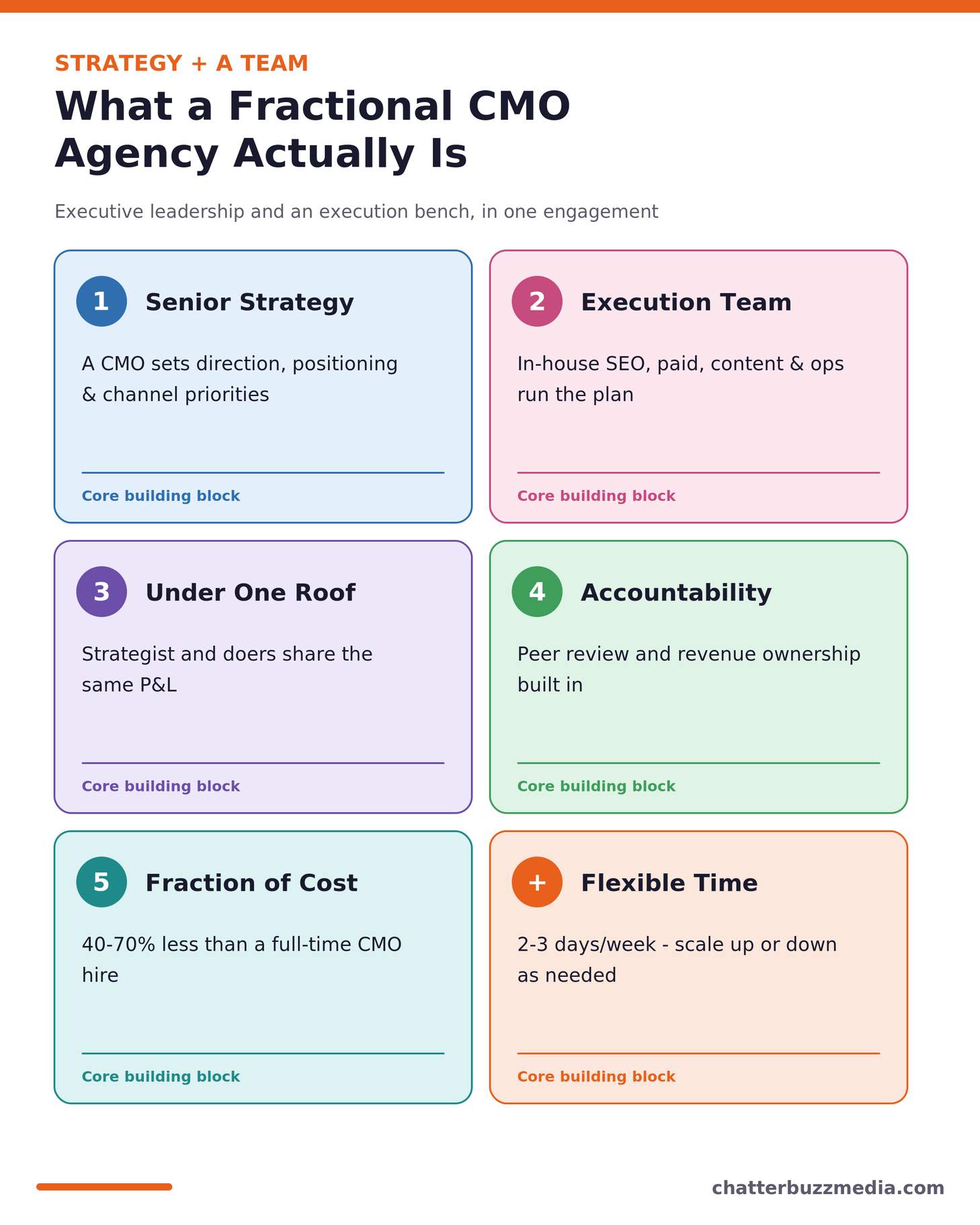
This matters because the two are usually sold separately. A solo fractional CMO brings strategy and leadership but has no team to build the campaigns, and a traditional digital marketing agency brings execution capacity but no one accountable for the overall growth strategy.
The agency model closes that gap. Your fractional Chief Marketing Officer sets direction, and the same organization that employs them handles the SEO, paid media, content, and marketing operations work underneath.
There’s a quality dimension too. A fractional CMO inside an agency has peer review, internal support, and an accountability structure that a freelancer working alone simply can’t offer.
The model has grown for a structural reason: senior marketing leadership is both expensive and unstable. The average CMO at an S&P 500 company now stays just 4.1 years — the shortest tenure of any core C-suite role, according to Spencer Stuart’s tenure research.
For a mid-market company, that math is unforgiving. Recruiting a full-time CMO who may leave in a few years is a large bet, and a fractional agency lets you get the leadership without carrying the full risk.
Who It’s Built For
This model fits companies that need marketing strategy, team leadership, and measurement but aren’t ready to commit to a full-time CMO salary. If you recognize the guide to the fractional chief marketing officer role, you already understand the leadership half — the agency simply adds the execution half.
Fractional CMO Agency vs. Consultant vs. Traditional Agency vs. Full-Time Hire
The fastest way to understand a fractional CMO agency is to compare it against the three alternatives most companies weigh. Each solves a different problem, and picking the wrong one is expensive.
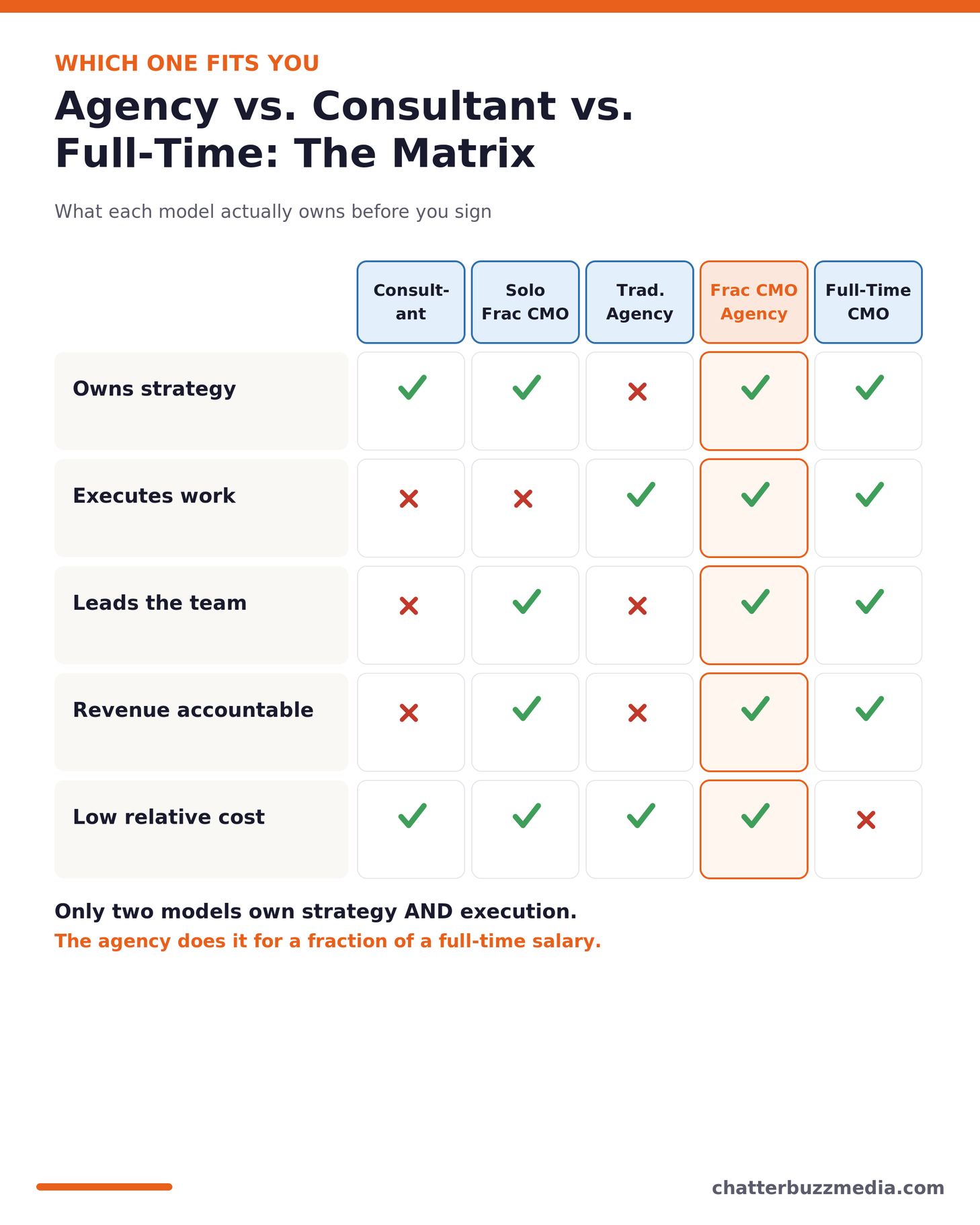
A marketing consultant is brought in to solve a defined problem and hand you a recommendation. They advise, but they rarely stay to implement, and they don’t lead your team.
A solo fractional CMO leads strategy and owns long-term marketing success, but you still need to hire or manage the people who do the work. A traditional agency sells execution capacity across channels, but no one there owns whether your overall marketing strategy is correct.
A full-time CMO gives you dedicated senior leadership, but at a base salary often exceeding $250,000 before bonus, benefits, and equity. For most mid-market firms, that’s leadership you can’t yet justify.
The trap is choosing on price alone. A consultant looks cheap until you realize no one implements the plan, and a traditional agency looks efficient until you notice no one is steering it toward revenue.
- Consultant: Best for a one-time strategic problem with a clear scope and end date.
- Solo fractional CMO: Best when you already have a capable execution team that just needs a leader.
- Traditional agency: Best when your strategy is already set and you only need hands to run it.
- Fractional CMO agency: Best when you need both the strategy and the team, held accountable together.
- Full-time CMO: Best once marketing is a full-time, board-level function you can staff at the top.
The fractional CMO agency exists precisely because so many companies fall in the gap between “just advice” and “just execution.” If you want a deeper cost breakdown of each path, our analysis of how much a fractional CMO costs in 2026 lays out the numbers side by side.
Signs Your Company Is Ready for a Fractional CMO Agency
Readiness is less about a revenue number and more about operational maturity. Most companies that benefit sit between $8M and $50M in revenue, where marketing has become a daily strategic decision rather than an occasional project.
The clearest signal is that marketing feels busy but not accountable. You’re spending money across channels without clarity on what’s actually driving pipeline, and sales keeps raising concerns about lead quality.
Another common trigger is a growth mandate the current team can’t carry alone. A funding round, an aggressive target, or an expansion into a new market suddenly demands leadership the founder or a junior manager can’t provide.
The Readiness Checklist
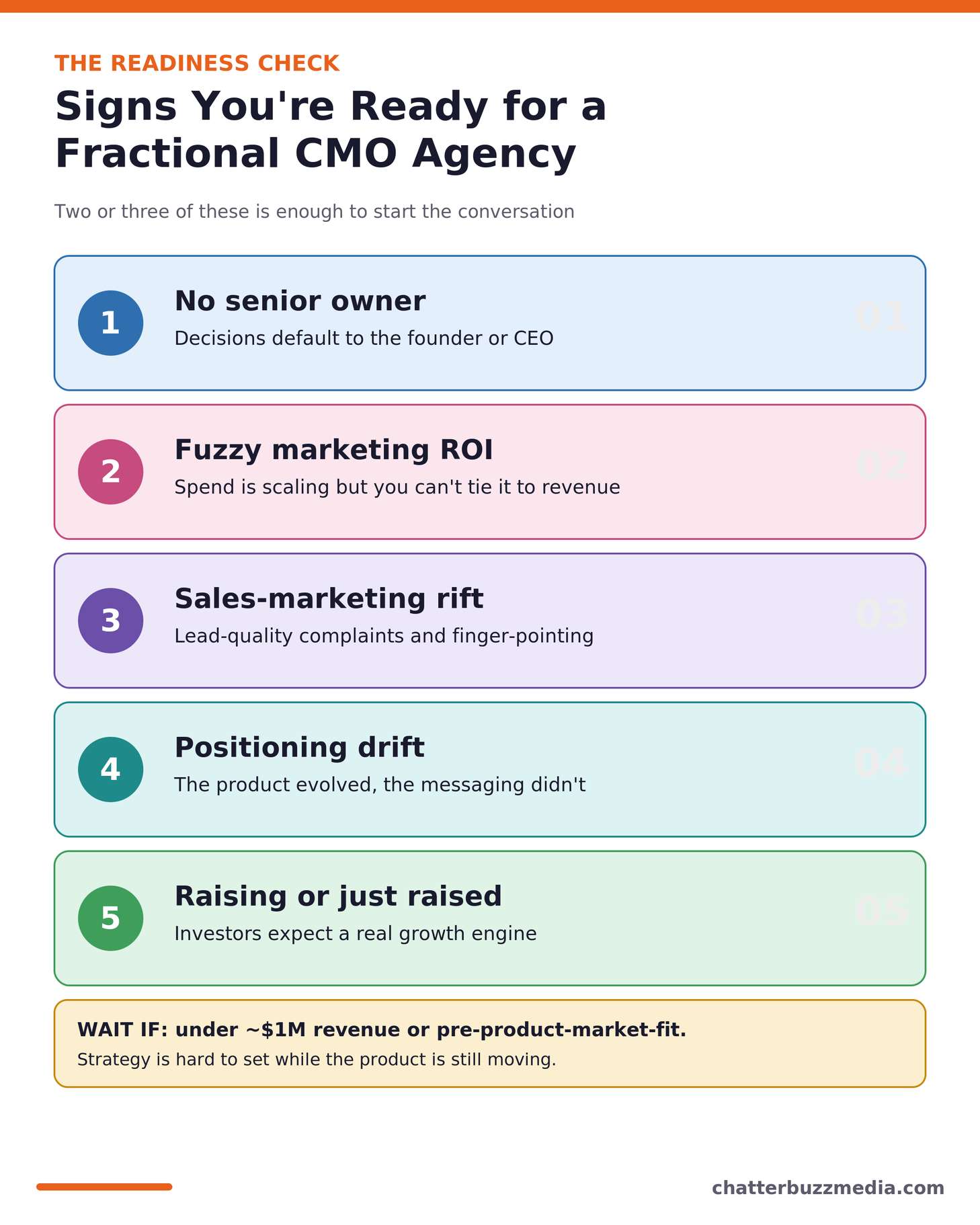
- Marketing has no senior owner. Decisions default to the founder, the CEO, or whoever is loudest that week.
- Spend is scaling but ROI is fuzzy. You can report activity, but not revenue contribution.
- Sales and marketing are misaligned. Lead quality complaints and finger-pointing are routine.
- Your ICP or positioning has drifted. The product evolved, but the messaging didn’t keep up.
- You’re about to raise or have just raised. Investors expect a credible growth engine, not a pile of tactics.
None of these signals require all five to be true. Two or three is usually enough to justify a conversation, because the cost of drifting for another year almost always exceeds the cost of senior help.
A structured hiring process, like the frameworks used to hire a fractional CMO, helps you move from “we might need this” to a scoped engagement quickly. The goal is to diagnose the gap first, then match the engagement to it.
When to Wait
If you’re below roughly $1M in revenue and still hunting for product-market fit, hold off. Strategy is hard to set while the product is still moving, and a fractional leader often gets pulled into work that should still belong to the founder.
The same caution applies if leadership isn’t ready to give marketing real authority. A fractional CMO can’t fix growth if every decision still routes back to a founder who overrides the plan, so buy-in has to come before the engagement, not after.
What a Fractional CMO Agency Delivers
A strong engagement produces a small set of high-leverage deliverables, not a long list of busywork. Five outcomes form the backbone of nearly every fractional CMO engagement worth paying for.
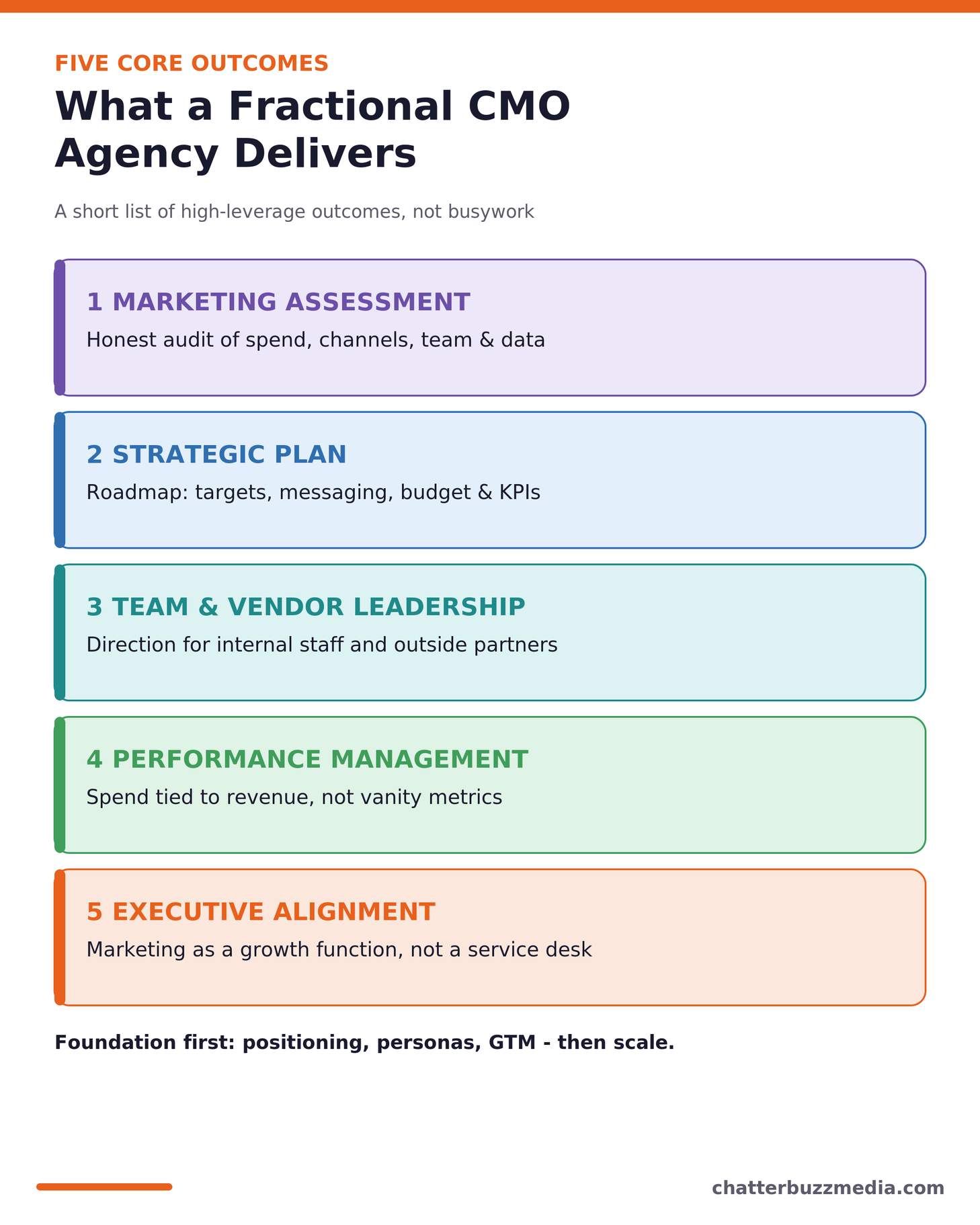
It starts with a marketing assessment — an honest audit of your current spend, channels, team, and data. From there comes the strategic marketing plan, the operational roadmap that sets targets, messaging, budget allocation, and KPIs.
The remaining three are ongoing. The agency provides team and vendor leadership, performance management that ties spend to revenue, and executive alignment so marketing operates as a growth function rather than a service desk.
Industry breakdowns of what’s included in fractional CMO services land on the same short list. The value isn’t in the volume of deliverables — it’s in having a senior owner who decides which few things actually move the business.
Notice what’s not on the list: a flood of one-off tactics. A good fractional CMO agency resists the urge to look busy and instead concentrates budget where it compounds.
The Foundation They Build First
In the first phase, expect the agency to rebuild your foundation: positioning, buyer personas, brand narrative, go-to-market architecture, and a content strategy with real sequencing. This is the same groundwork we emphasize in our B2B demand generation guide, because campaigns built on a weak foundation waste budget.
The Execution That Follows
Once the strategy is set, the delivery team runs it — SEO, paid media, marketing automation, and content production against the plan. That execution layer is what separates an agency from a solo consultant, and it draws on disciplines like marketing automation and account-based marketing to turn the roadmap into pipeline.
The “Strategy Plus Execution Under One Roof” Model
The single biggest failure point in fractional marketing is the handoff. Strategy lives with one party, execution lives with another, and accountability evaporates in the gap between them.
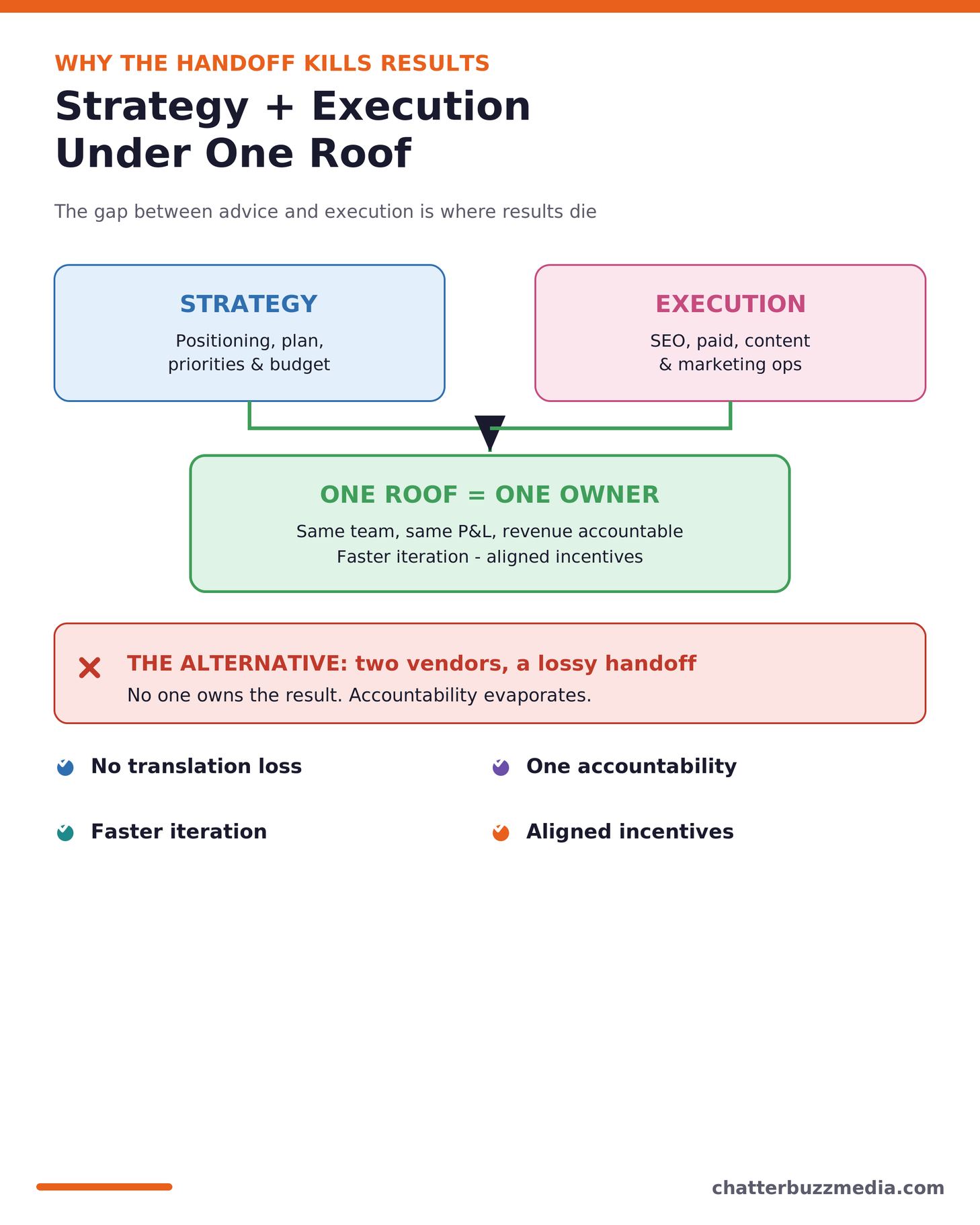
The under-one-roof model removes that gap. The leader who sets the strategy and the team that executes it report to the same organization, so there’s no one left to blame when results stall.
That structure changes the incentives. When the strategist and the delivery team share a P&L, the plan gets built to be executed — not to look impressive in a slide deck and then get quietly abandoned.
Why the Handoff Kills Results
- No translation loss. The strategy doesn’t degrade as it passes from an advisor to an outside execution vendor.
- One point of accountability. Revenue results sit with a single partner, not split across two contracts.
- Faster iteration. When performance data comes in, the same team adjusts strategy and execution together.
- Aligned incentives. The agency wins only when the plan actually produces growth.
This is the approach behind our own fractional CMO services — a growth leader engineering the strategy with a CFO’s eye on ROI, backed by the team that runs it. It’s also why we think about marketing like engineers: build the system, measure it, and improve it deliberately.
The practical payoff is speed. When the person setting strategy sits beside the people executing it, a signal from the data on Monday can reshape the campaign by Wednesday — instead of waiting weeks for a strategy memo to reach an outside vendor.
It also protects your budget. Every dollar is allocated against a plan the same team is accountable for, so spend follows performance rather than habit or the loudest channel of the month.
What a Fractional CMO Agency Costs in 2026
Most fractional CMO engagements are priced as a monthly retainer, and in 2026 that retainer typically runs $8,000 to $22,000 per month. The midpoint of $12,000–$15,000 covers an experienced leader working the equivalent of two to three days a week.
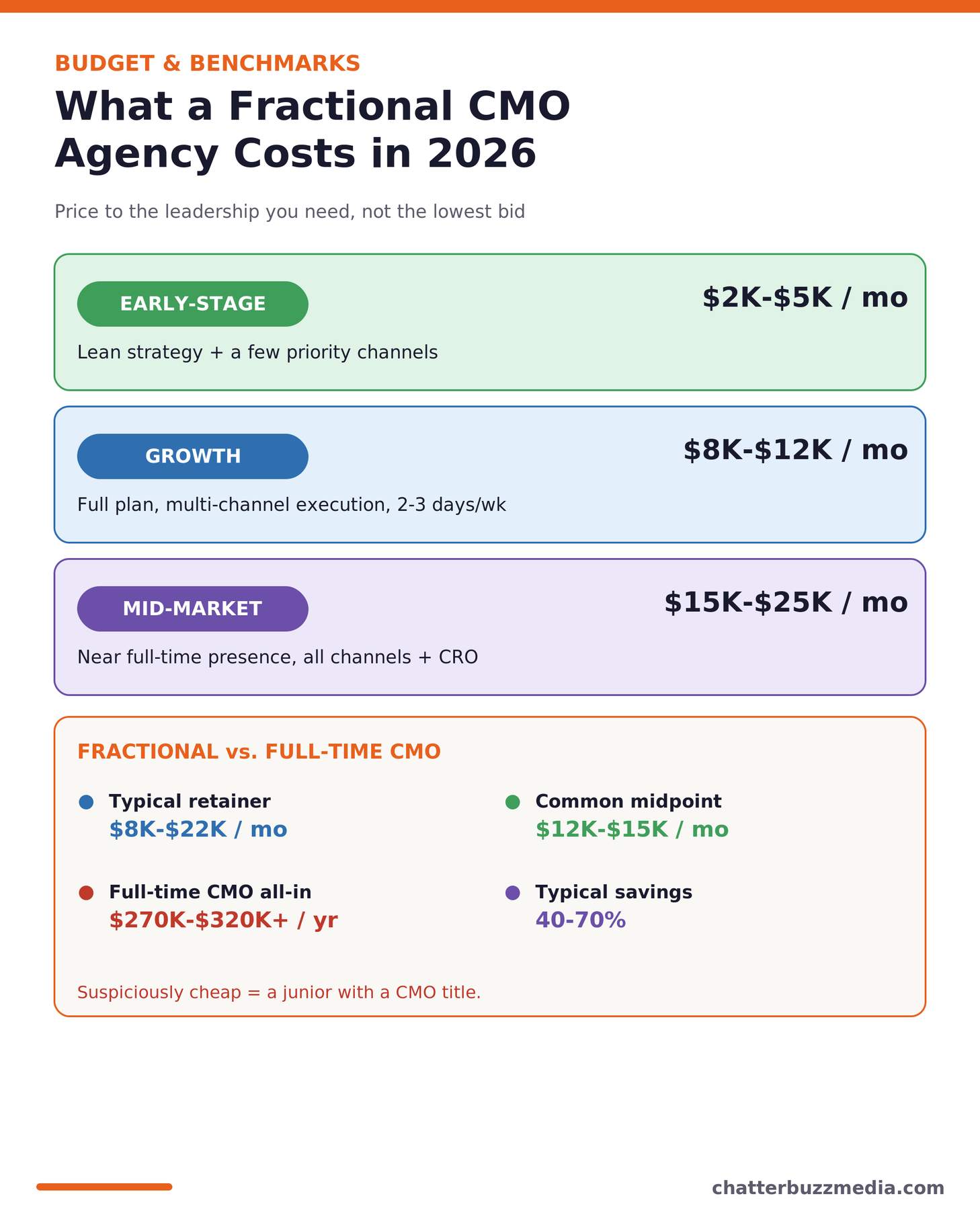
Pricing scales with stage. Early-stage companies often spend $2,000–$5,000 per month, growth-stage firms average $8,000–$12,000, and mid-market companies needing a near full-time presence pay $15,000–$25,000.
Some agencies also offer hourly or performance-based structures. Hourly rates range from $150 to $500 depending on experience, though most meaningful engagements run 20 to 40 hours a month with a three-to-six-month minimum.
Be skeptical of anything priced far below these ranges. Deep senior leadership rarely comes for a few thousand dollars a month, and a suspiciously cheap retainer usually means you’re getting a junior manager with a fractional CMO title.
How It Compares to a Full-Time CMO
A full-time CMO costs $270,000–$320,000+ per year once you include benefits, payroll taxes, and recruiting fees. A fractional CMO agency at $12,000–$15,000 a month typically saves companies 40–70% while still delivering senior leadership.
According to 2026 market data on fractional CMO rates, that gap is the core reason mid-market firms choose the fractional path. You’re buying the same caliber of leadership, priced to the time your business actually needs it.
What Should Be Included
- Strategy and planning — assessment, roadmap, and quarterly re-planning.
- Team leadership — management of internal staff and outside vendors.
- Execution — the channels and campaigns the plan calls for.
- Reporting — revenue-tied dashboards, not vanity metrics.
How to Choose the Right Fractional CMO Agency
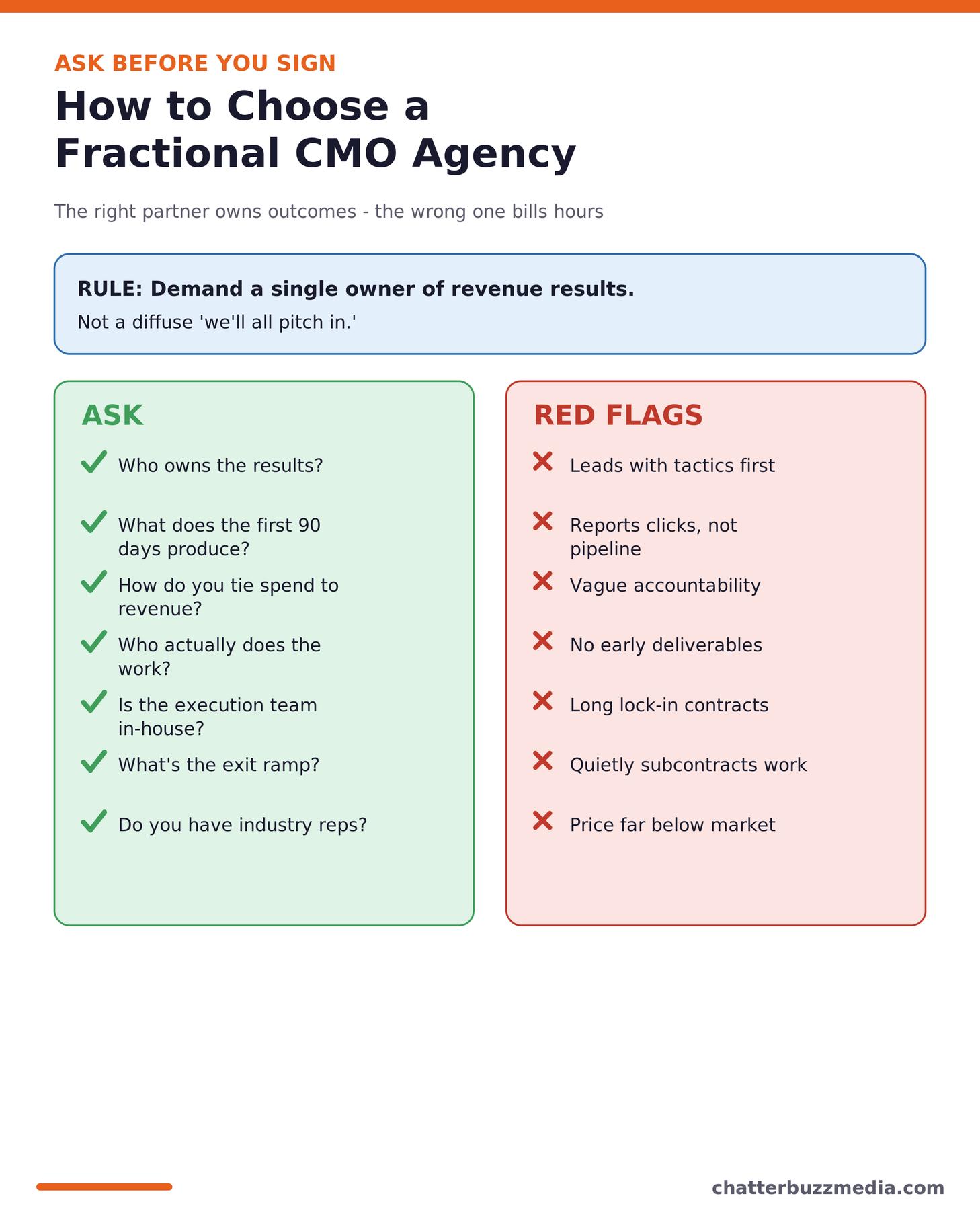
The right partner owns outcomes; the wrong one bills for hours. That distinction should guide every question you ask during evaluation.
Start with relevant experience. An agency that has driven growth in your industry — whether that’s financial services, manufacturing, or B2B more broadly — will ramp faster and make fewer expensive mistakes.
Then interrogate the model. You want proof that strategy and execution live together, a clear accountability structure, and reporting that connects spend to revenue.
Industry fit deserves real weight here. A regulated field like banking and credit unions has compliance and buyer dynamics a generalist will learn on your dime, so a partner with sector reps saves both time and money.
Questions to Ask Before You Sign
- Who owns the results? Confirm a single point of accountability for growth, not a diffuse “we’ll all pitch in.”
- What does the first 90 days produce? A credible partner can describe concrete deliverables, not just “getting to know you.”
- How do you tie spend to revenue? Ask to see a sample dashboard and the metrics they report on.
- Who actually does the work? Verify the execution team is real and in-house, not quietly subcontracted.
- What’s the exit ramp? A good agency helps you eventually build internal capability, not permanent dependence.
Red Flags to Avoid
Walk away from any agency that leads with tactics before understanding your business, or that reports clicks and impressions instead of pipeline and revenue. Vague accountability and long contracts with no early deliverables are equally telling.
What to Expect in the First 90 Days
The first 90 days set the tone for the entire engagement, and they should be structured. If month three still looks like discovery, you hired the wrong partner.
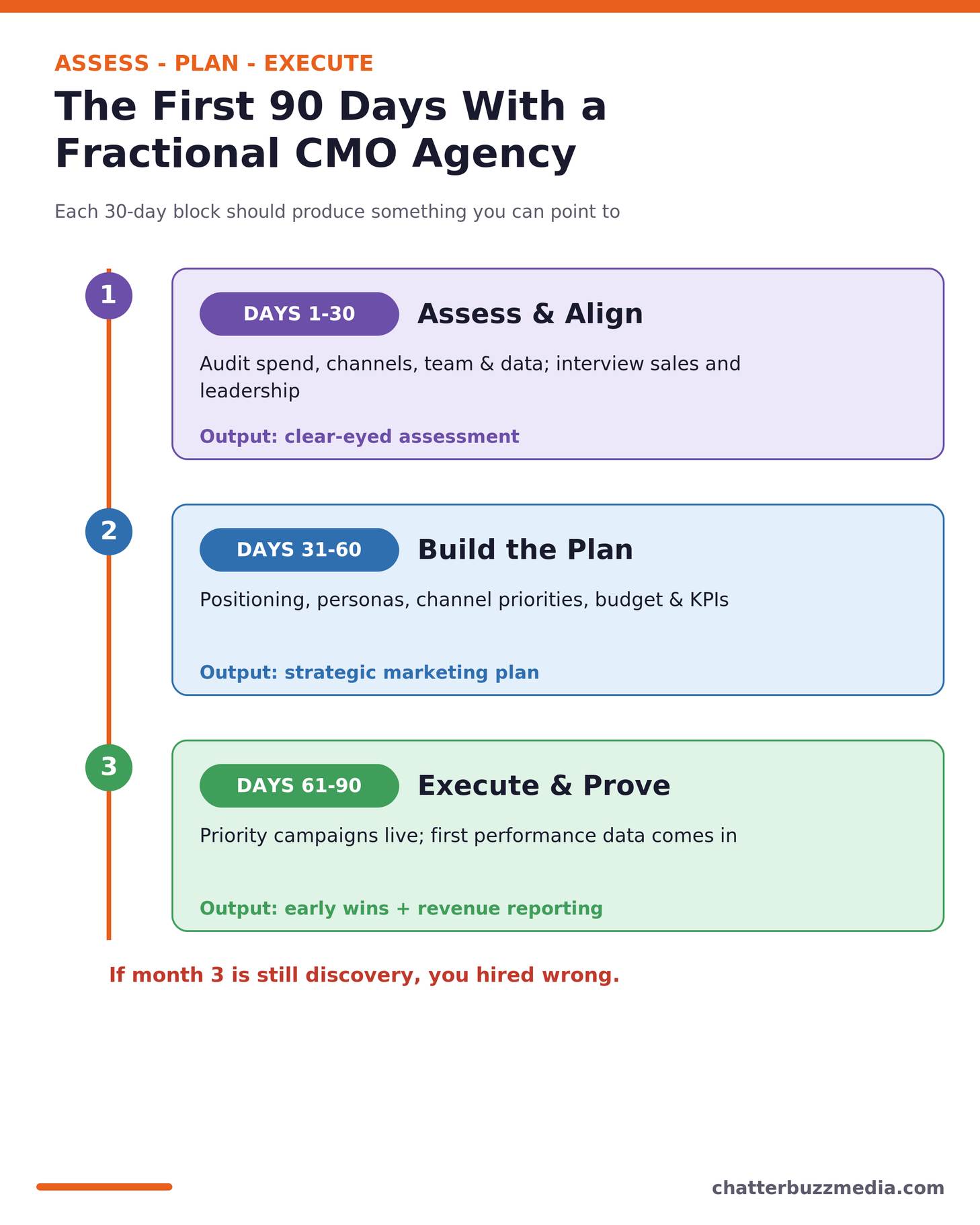
A well-run start moves from understanding to strategy to early execution in a deliberate sequence. Each 30-day block should produce something you can point to.
Days 1–30: Assess and Align
The agency audits your spend, channels, team, and data, and interviews sales and leadership. The output is a clear-eyed assessment of what’s working, what’s wasted, and where the biggest opportunities sit.
Days 31–60: Build the Plan
Next comes the strategic marketing plan: positioning, personas, channel priorities, budget allocation, and KPIs. This is the roadmap everything else runs against, and it should read like a business plan, not a wish list.
Days 61–90: Execute and Prove
By the third month, the delivery team is running priority campaigns and the first performance data is coming in. You should see early wins and a reporting cadence that ties activity to revenue — the same discipline we bring to every digital marketing engagement we lead.
Conclusion
A fractional CMO agency solves a specific, expensive problem: the gap between marketing advice and marketing execution. It gives mid-market companies senior leadership and a delivery team under one roof, held to one standard — revenue.
The model works when the strategist and the doers share accountability, when pricing reflects outcomes rather than hours, and when the first 90 days produce a plan and early wins. Get those three things right, and you get CMO-caliber growth leadership without the CMO-caliber salary.
Marketing rarely fails for lack of effort — it fails for lack of a senior owner deciding where that effort goes. A fractional CMO agency puts that owner in place and gives them the team to prove the plan works.
If you’re weighing the model for your own company, we’re happy to help you think it through. Explore our fractional CMO services or start from the Chatter Buzz homepage to see how we combine strategy and execution.
Frequently Asked Questions
What is a fractional CMO agency?
A fractional CMO agency provides part-time, executive-level marketing leadership backed by an in-house team that executes the strategy. You get a Chief Marketing Officer setting direction and the people running the campaigns in a single engagement, for a fraction of a full-time CMO’s cost.
How is a fractional CMO agency different from a solo fractional CMO?
A solo fractional CMO brings strategy and leadership but no team to do the work, so you still have to staff or manage execution yourself. A fractional CMO agency pairs that leadership with an execution bench and adds peer review and accountability that a lone freelancer can’t provide.
How much does a fractional CMO agency cost in 2026?
Monthly retainers typically range from $8,000 to $22,000, with a common midpoint of $12,000–$15,000 for two to three days a week of senior leadership. That’s roughly 40–70% less than a full-time CMO, who costs $270,000–$320,000+ per year once benefits and recruiting are included.
When should a company hire a fractional CMO agency?
The sweet spot is $8M–$50M in revenue, where marketing has become a daily strategic decision but a full-time CMO isn’t yet justified. Common triggers include unclear marketing ROI, sales-marketing misalignment, a funding round, or an aggressive growth target the current team can’t carry.
What does a fractional CMO agency actually deliver?
Expect five core outcomes: a marketing assessment, a strategic marketing plan, ongoing team and vendor leadership, revenue-tied performance management, and executive alignment. The agency also rebuilds the foundation — positioning, personas, and go-to-market architecture — before scaling execution.
Is a fractional CMO agency better than a traditional marketing agency?
They solve different problems. A traditional agency sells execution capacity but doesn’t own your overall strategy, while a fractional CMO agency owns both the strategy and the execution, held to a single revenue standard — which is why it fits companies that lack senior marketing leadership.
How quickly should a fractional CMO agency show results?
The first 90 days should move from assessment to strategy to early execution, with concrete deliverables in each 30-day block. You should see a marketing plan by day 60 and live campaigns with revenue-tied reporting by day 90 — if month three is still discovery, the engagement is off track.