
 321-236-2899
Outsourced Marketing Team: In-House vs. Agency Guide
Every growing company hits the same fork in the road: build a marketing team in-house, or hand execution to an outsourced marketing team. Get it wrong and you either burn six figures on overhead you don’t need, or you leave growth on the table with a team that’s stretched too thin.
We’ve watched hundreds of mid-market companies make this call, and the ones who choose well share a pattern. They stop asking “which is cheaper?” and start asking “which structure gets me the most revenue per marketing dollar at my stage?”
This guide gives you the real cost math, an honest decision framework, and a straight answer to the objections that keep leaders stuck. By the end, you’ll know exactly when to hire in-house, when to outsource, and when a hybrid model wins.
We’ll treat this as a business decision, not a philosophical one. The goal is the structure that produces the most growth per dollar at your stage — nothing more, nothing less.
Key Takeaways
- A fully loaded in-house team of four runs $350K–$540K a year once you add benefits, tools, and management overhead — far more than the sticker salaries suggest.
- An outsourced marketing team typically costs $60K–$300K a year and starts executing in weeks, not the three-to-six months an internal hire needs to ramp.
- Speed and specialization favor outsourcing; deep brand immersion and daily strategic control favor in-house.
- The hybrid model wins most often for $1M–$10M companies: one internal owner plus outsourced specialists for execution.
- Match the structure to your revenue stage, not to ego or org-chart optics.
What Is an Outsourced Marketing Team?
An outsourced marketing team is a group of external specialists — strategists, media buyers, designers, writers, and analysts — who run some or all of your marketing without sitting on your payroll. You get a full department’s worth of skills for the cost of a partial one.
This matters because modern marketing is no longer one job. Paid media, SEO, content, CRO, analytics, and marketing automation each demand a specialist, and no single hire is genuinely excellent at all of them.
The shift toward outsourcing has accelerated for a simple reason: the tooling, channels, and privacy rules change faster than any one internal person can keep up with. An external team spreads that learning curve across dozens of accounts, so best practices reach you without you paying to discover them.
This decision reaches further than the marketing org chart. It shapes how fast you can launch, how consistent your brand stays, and how much of your leadership’s time gets pulled into managing execution instead of running the business.
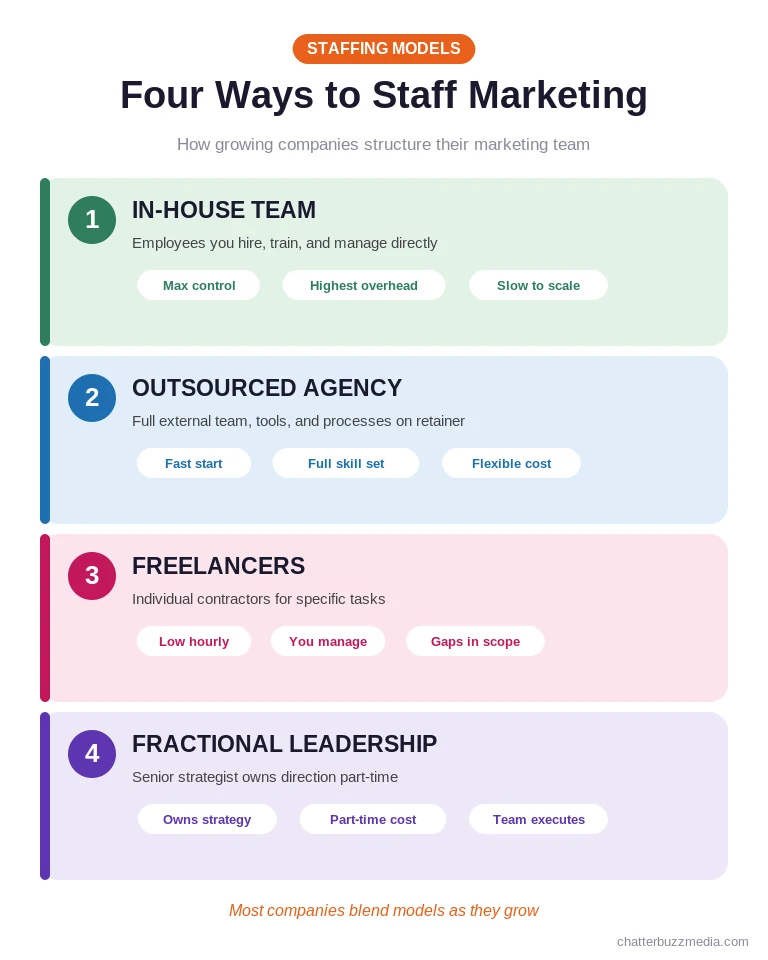
There are really four ways to staff marketing, and most companies use more than one over time. Understanding the trade-offs is the foundation of a smart decision.
- In-house team: Employees you hire, train, and manage directly. Maximum control, maximum overhead.
- Outsourced agency: An external team that brings a full skill set, established processes, and enterprise tools on a monthly retainer.
- Freelancers: Individual contractors for specific tasks. Flexible and cheap per hour, but you become the project manager.
- Fractional leadership: A senior strategist — often a fractional CMO — who owns direction part-time while a team executes.
The right answer depends on your budget, your stage, and how much marketing sits at the center of your company’s direction. Most companies blend these models over time, shifting the mix as their needs and revenue change. That’s the question the rest of this guide answers.
In-House vs. Outsourced Marketing: The Real Cost Comparison
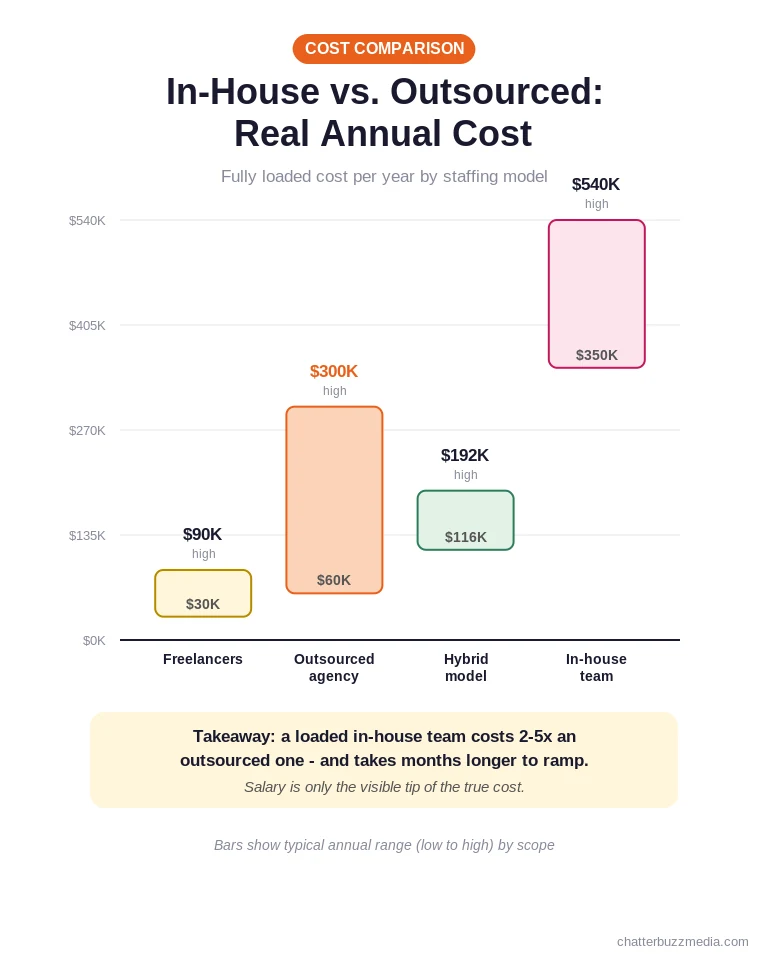
The honest answer: a competent in-house team costs roughly $350K–$540K per year fully loaded, while an outsourced marketing team runs $60K–$300K depending on scope. The gap is wider than most budgets assume because salary is only the visible tip.
Most leaders compare a $60K coordinator salary to a $48K annual retainer and call it even. That’s like comparing a car’s sticker price to another car’s total cost of ownership — you’ve ignored insurance, fuel, and depreciation.
A realistic in-house marketing department needs at least four roles to cover the core disciplines. Here’s what that looks like before benefits.
- Marketing manager: ~$85K–$110K to own strategy and coordination.
- Paid media / performance specialist: ~$70K–$95K.
- Content and SEO lead: ~$65K–$85K.
- Designer or creative generalist: ~$60K–$80K.
That’s roughly $280K–$370K in base pay alone. Add the employer burden and the number climbs fast — which is exactly where the next section digs in.
Consider a $5M company that hires a single $60K coordinator to save money. Once you add benefits, a $1,500-per-month tool stack, and 20 hours of monthly management time, the true cost clears $95K — and that one generalist still can’t run paid media, SEO, and content at an expert level.
By contrast, an outsourced team folds all of those roles, their software, and their management into one predictable monthly number. Retainers vary by scope, but a useful benchmark is $3,000–$5,000 a month for early-stage programs, $5,000–$12,000 for mid-market, and $12,000–$25,000+ for enterprise breadth.
The fairest way to judge a retainer is cost per outcome, not cost per hour. Map each deliverable — campaigns launched, content shipped, reports delivered — against what replicating it internally would cost in salary, tools, and time, and the value picture usually sharpens quickly.
The key advantage isn’t only price — it’s that the cost flexes with your needs instead of locking you into fixed payroll. You can scale spend up for a launch and back down afterward without hiring or layoffs, which is a meaningful edge for companies with seasonal or campaign-driven demand.
For a deeper look at what fair pricing actually covers, see our breakdown of what you should actually pay a marketing agency in 2026, and if you’re benchmarking a first hire, our guide to how much to invest in marketing gives a revenue-based rule of thumb.
The Hidden Costs of Building an In-House Team
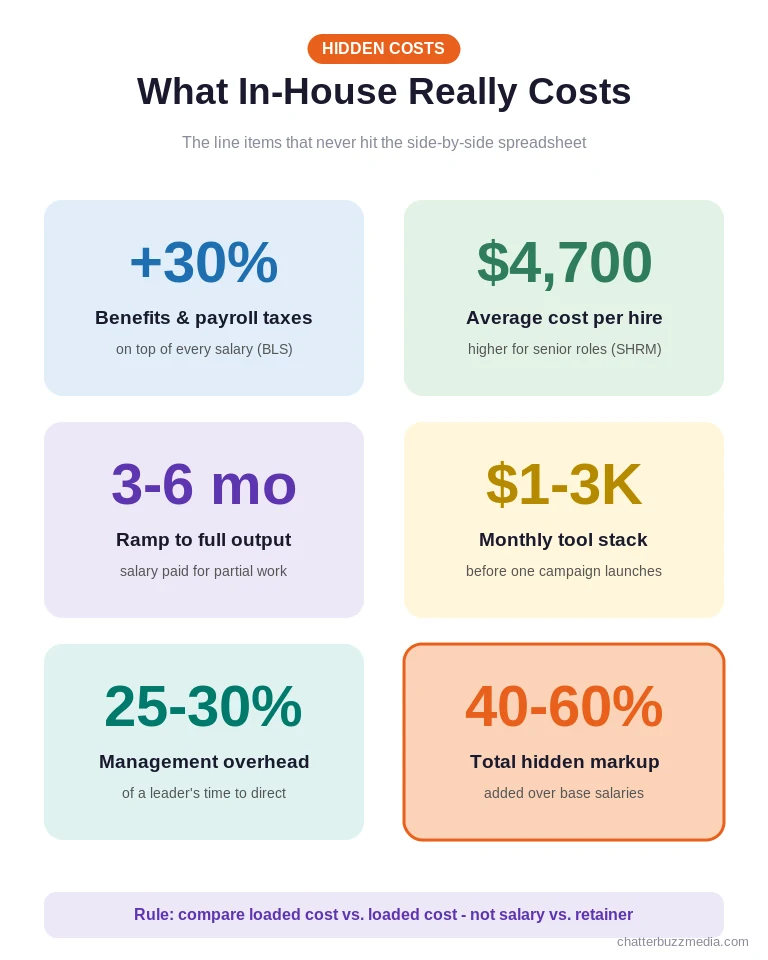
The hidden costs of an in-house team routinely add 40–60% on top of base salaries. These are the line items that never make it into the side-by-side spreadsheet — and they’re the reason “cheaper” hires end up costing more.
Employer-paid benefits alone are substantial. According to the U.S. Bureau of Labor Statistics, benefits account for roughly 30% of total employer compensation costs, so a $70K salary really costs closer to $91K.
There’s also a quality cost that rarely shows up in a budget. A single mid-level generalist priced at $60K–$75K will be strong in one discipline and merely passable in the rest, which means your paid media, SEO, or analytics quietly underperforms even though the seat is filled.
Then come the costs that compound quietly over the first year and beyond.
- Recruiting and onboarding: The average cost per hire is around $4,700 per SHRM, and senior roles run far higher.
- Ramp time: A new hire needs three to six months to reach full productivity — months of salary paid against partial output.
- The tech stack: Email, analytics, SEO, design, and automation tools can run $1,000–$3,000 a month before a single campaign launches.
- Management overhead: Someone has to direct and review the work, and coordination can consume 25–30% of a leader’s time.
- Turnover: Marketers change jobs often, and each departure restarts recruiting, onboarding, and ramp from zero.
The most overlooked cost isn’t on any invoice at all — it’s the revenue you never earn while you wait to hire. If effective marketing could bring in 10 customers a month at $2,000 each, a three-month recruiting-and-ramp delay quietly costs $60,000 in lost pipeline, often more than the entire price gap between your options.
Speed cuts the other way for an outsourced team. Because the people and processes already exist, campaigns can go live in the first few weeks — so you capture demand now instead of watching competitors claim market share you’ll have to win back later.
That waste compounds because marketing budgets are finite. Marketing spend averages close to 8–10% of company revenue according to Gartner’s annual CMO Spend Survey, so every dollar tied up in idle overhead is a dollar not driving growth.
None of this means in-house is wrong. It means the true comparison has to be loaded cost versus loaded cost — a point that reshapes the decision entirely.
When to Hire In-House vs. When to Outsource
Hire in-house when marketing sits at the center of your company’s direction and you have the volume to keep specialists busy; outsource when you need speed, specialized skill, or flexible capacity you can’t justify full-time. Most decisions come down to those two variables.
The wrong structure at the wrong stage is one of the most expensive mistakes a mid-market company makes. The signals below tell you which way to lean — and most companies will recognize themselves in one column more than the other.
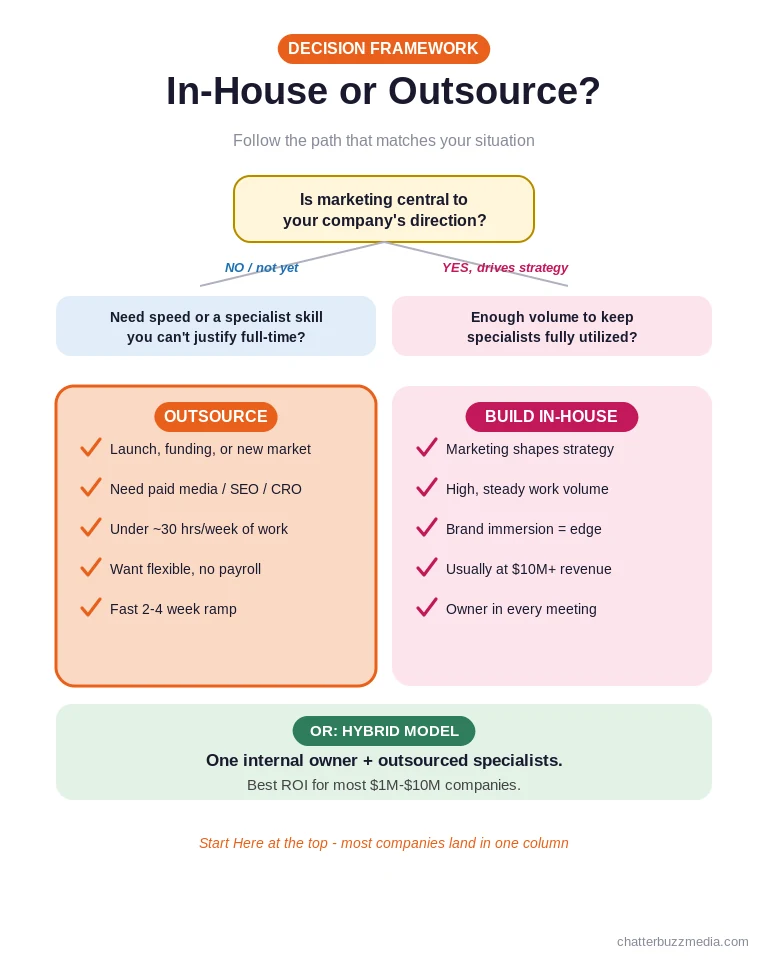
Lean toward outsourcing when:
- You need results in the market now — a funding round, product launch, or new-market push can’t wait on a hiring cycle.
- You need specialized expertise (paid media, SEO, CRO) but not a full-time person for each.
- Your marketing workload is under ~30 hours a week, which doesn’t justify a full-time hire.
- You want to preserve flexibility and avoid long-term payroll commitments.
Lean toward in-house when:
- Marketing decisions shape company strategy and need an owner in every planning meeting.
- Your volume is high enough to keep specialists fully utilized.
- Deep, daily product and brand knowledge is a genuine competitive edge.
The cleanest way to decide is to map structure to revenue stage, because what works at $500K looks nothing like what works at $10M.
- Under $1M (early stage): Outsource. You need expertise and output but can’t justify full-time specialized roles, and an agency delivers capability without long-term overhead.
- $1M–$10M (growth stage): Go hybrid. You have enough volume to justify internal coordination but still benefit from outside specialists for technical work.
- $10M+ (scale): Build in-house selectively. You can keep specialists fully utilized, and deeper integration starts to pay off — though many companies keep agency partners for surge capacity.
If you’re weighing this against a senior strategic hire, our guide to what a fractional CMO costs in 2026 maps the middle path many companies miss. You can also pressure-test your plan with our go-to-market strategy by revenue stage framework.
The Hybrid Model and What a Full-Service Team Includes
The hybrid model — one internal owner plus an outsourced team for execution — delivers the best ROI for most companies between $1M and $10M in revenue. You keep strategic control in-house while renting specialized firepower exactly where you need it.
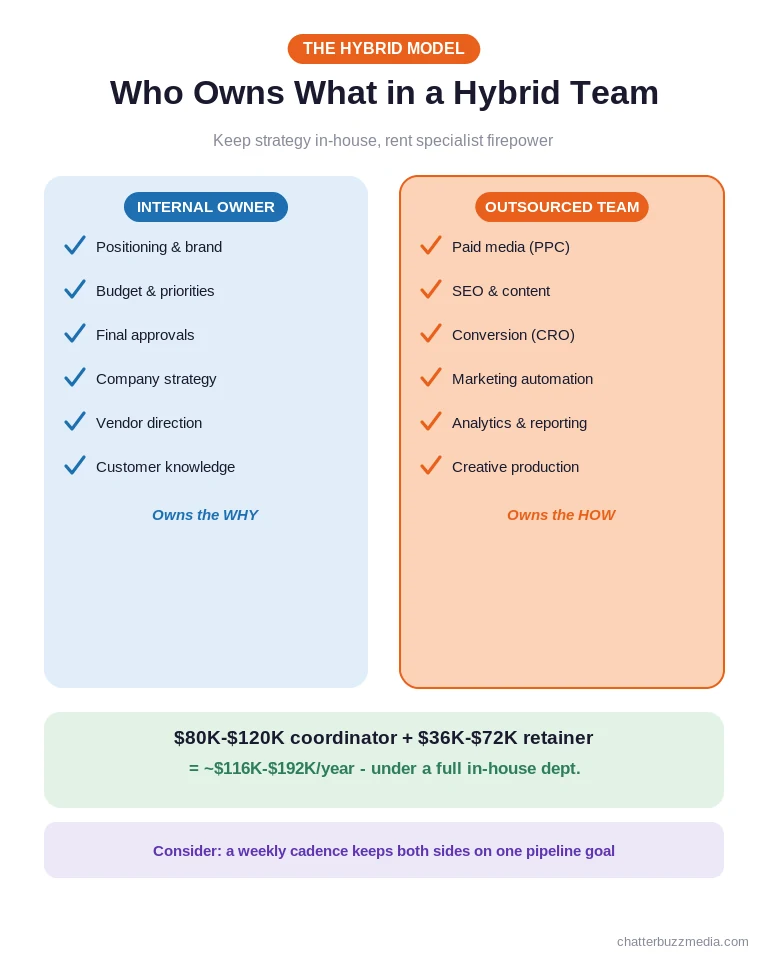
In this setup, your internal person (or fractional leader) is the quarterback. They own strategy, brand, and priorities, and they direct outside specialists on the technical execution that’s expensive to hire and easy to under-utilize.
Clarity on who owns what is what makes it work. The internal owner holds positioning, budget, and final approval; the outsourced team holds execution, optimization, and reporting — and a weekly cadence keeps both sides aligned to the same pipeline goals.
What a strong outsourced or hybrid team actually covers is broader than any single hire could deliver, and the breadth is the point. Instead of one person context-switching across six disciplines, each function is owned by someone who does it every day. A complete marketing function includes:
- Strategy and planning: Positioning, go-to-market planning by revenue stage, and budget allocation.
- Paid media: PPC and paid social management across Google, Meta, and LinkedIn.
- SEO and content: Technical SEO, editorial, and content production that compounds over time.
- Conversion optimization: CRO so the traffic you pay for actually converts.
- Marketing automation and CRM: HubSpot setup and nurture workflows.
- Analytics and reporting: Dashboards that tie spend to pipeline and revenue.
The economics are compelling. A hybrid setup — one internal coordinator at $80K–$120K plus a $36K–$72K annual retainer for specialist execution — totals roughly $116K–$192K a year, well under a full in-house department while covering more disciplines.
This is also where reporting earns its keep. When one owner sees every channel’s spend and pipeline contribution in a single view, you can shift budget toward what’s working instead of guessing — something our approach to reporting and data visualization is built around.
The staged version of this model is powerful: start outsourced, build internal capability as volume grows, and bring functions in-house only when the economics clearly favor it. If you want help structuring that plan, our marketing strategy and planning resources walk through the sequencing.
How to Vet an Outsourced Marketing Partner
Vet an outsourced marketing partner on transparency, specialized proof, and cultural fit — not on the lowest retainer. The cheapest option is rarely the one that generates the most revenue per dollar, and switching partners mid-stream is costly.
The best partnerships feel like an extension of your team. These are the criteria that separate a real partner from a vendor.
Pay attention to the first 90 days and the exit terms as closely as the pitch. A structured onboarding, a clear ramp plan, and a reasonable notice period signal a partner confident in results rather than one relying on lock-in to keep your business.
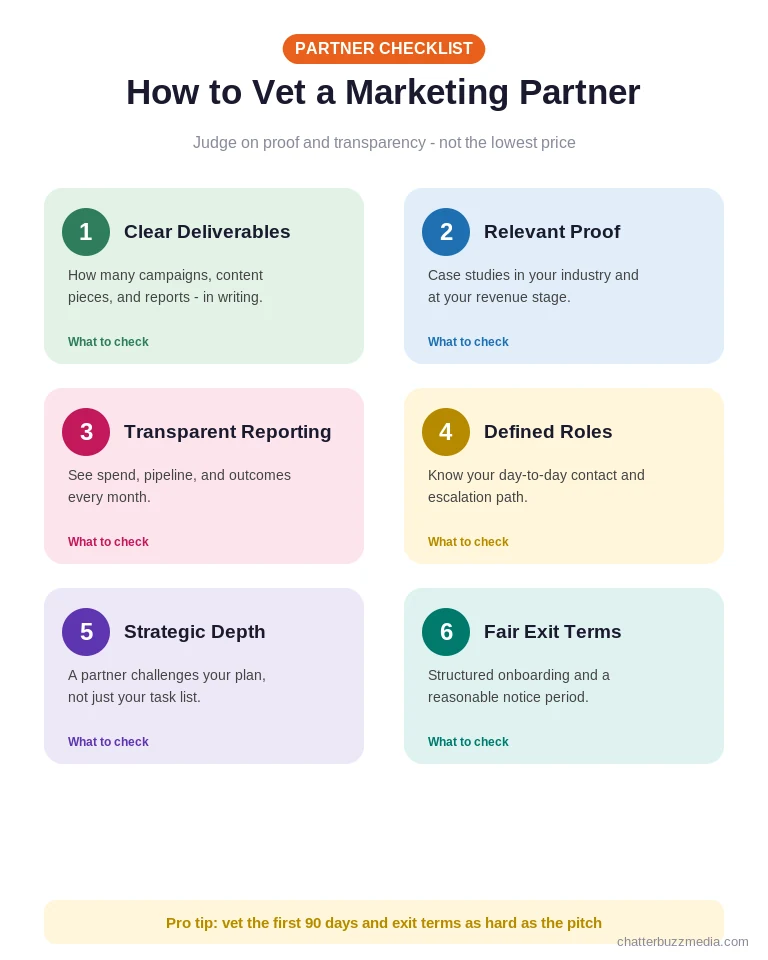
- Clear deliverables: Insist on specifics — how many campaigns, how many content pieces, what’s in the monthly report. Vague scopes hide thin work.
- Relevant proof: Ask for case studies and results in your industry and at your revenue stage, not just logos.
- Transparent reporting: You should see spend, pipeline, and outcomes — the metrics that matter, covered in our guide to the marketing KPIs an agency should report.
- Defined roles: Know who your day-to-day contact is and how the client-agency relationship is structured.
- Strategic depth: A good partner challenges your plan, not just executes tasks. Watch for the red and green flags before you sign.
Do this diligence once and do it well. The right partner compounds results for years; the wrong one resets your progress every time you switch, so the upfront rigor pays for itself many times over.
A few honest objections tend to stall this decision, so it’s worth answering them head-on:
- “An outside team won’t understand our brand.” A strong partner runs a structured onboarding to absorb your positioning, and a hybrid model keeps brand ownership internal by design.
- “We’ll lose control.” You trade day-to-day task management for outcome accountability, which is usually a better trade — you direct strategy while specialists own execution.
- “In-house is cheaper long-term.” Only at real scale. Below the volume that keeps four specialists fully utilized, outsourced and hybrid structures win on both cost and capability.
Frequently Asked Questions
1. 🔍 What does an outsourced marketing team actually do?
It runs some or all of your marketing — strategy, paid media, SEO, content, CRO, automation, and reporting — using external specialists. You get a full department’s range of skills without carrying each role on payroll.
2. 💰 Is an outsourced marketing team cheaper than hiring in-house?
Usually, yes, once you compare loaded costs. A fully staffed in-house team runs $350K–$540K a year, while outsourced teams typically fall between $60K and $300K depending on scope and channel mix.
3. ⚡ How fast can an outsourced team start delivering results?
Most outsourced teams launch campaigns within the first two to four weeks because the team and processes already exist. An in-house hire, by contrast, needs three to six months to reach full productivity.
4. 📊 When does it make sense to build an in-house team instead?
Build in-house when marketing volume is high enough to keep specialists fully utilized and when daily brand and product immersion is a real competitive edge. That threshold usually arrives around $5M+ in revenue.
5. 🤝 What is a hybrid marketing model?
A hybrid model keeps one strategic owner in-house — often a fractional CMO or marketing manager — while outsourcing specialized execution. It delivers the best ROI for most companies between $1M and $10M in revenue.
6. 🚀 What should I look for when choosing an outsourced marketing partner?
Prioritize clear deliverables, transparent reporting, and proof in your industry over the lowest price. The right partner behaves like an extension of your team and challenges your strategy, not just your task list.
7. 📈 Can I outsource only part of my marketing?
Absolutely, and many companies should. Keeping strategy and brand in-house while outsourcing paid media, SEO, or creative is often the most cost-efficient structure at the mid-market stage.
8. 🎯 How do I calculate the true cost of an in-house marketing hire?
Start with base salary, then add roughly 30% for benefits and payroll taxes, plus recruiting, software, and management time. Factor in a three-to-six-month ramp where output is partial, and you’ll typically land 40–60% above the sticker salary.
Conclusion: Choosing the Right Structure for Your Stage
The in-house versus outsourced decision isn’t about which is cheaper — it’s about which structure generates the most revenue per marketing dollar at your current stage. The math, the speed, and the specialization usually favor outsourcing or a hybrid until your volume justifies a full internal department.
Whatever you choose, revisit it as you grow. The structure that’s right at $2M can become a constraint at $10M, so treat this as a decision you’ll refine — not one you make once and forget.
Here’s a simple action plan to make the call with confidence:
- Calculate your loaded in-house cost: Add benefits, tools, ramp time, and management to every salary before you compare anything.
- Audit your real marketing workload: Total the weekly hours to see whether you need full-time capacity, fractional support, or a full team.
- Match structure to revenue stage: Outsource early, go hybrid in growth, and build in-house at scale.
- Vet partners on proof, not price: Choose the team that shows results in your industry and reports transparently.
If you want a clearer picture of where your budget is working and where it’s leaking, start with a free digital marketing audit or explore the full library of growth resources in our marketing resource center.
Need help with SEO? Explore our SEO agency services.

Victoria Wallace
Victoria Wallace is a senior content strategist and marketing writer with 30+ years of experience helping more than 200 brands translate complex business goals into clear, conversion-focused content. Her background spans paid media, marketing strategy, go-to-market planning, brand positioning, and full-funnel campaign development, giving her a deep understanding of how SEO content connects to real business growth.