
 321-236-2899
What Is Financial Services Marketing?
Financial services marketing is the strategic process of attracting, engaging, and converting clients for banks, credit unions, wealth management firms, insurance companies, and fintech platforms. It blends digital precision with relationship-driven messaging to build trust in an industry where trust is everything.
Here’s what makes it different from other industries. Your prospects aren’t buying a product they can return. They’re trusting you with their financial future.
That distinction changes everything about how you position, promote, and measure your marketing. The global financial services market is projected to reach $38.6 trillion in 2026, growing at 6.8% CAGR. Competition isn’t slowing down. Mid-market firms that treat marketing as a cost center, rather than a growth engine, will continue losing ground to competitors who invest strategically.
This guide is your comprehensive, in-depth playbook for financial services marketing in 2026. Whether you’re a CMO at a regional bank, a VP of Marketing at a wealth management firm, or leading growth at a fintech company, you’ll walk away with actionable strategies you can implement this quarter.
We built this guide the same way we build campaigns at Chatter Buzz Media — with an engineer-first mindset and a CFO’s demand for measurable returns. Let’s get into it.
Key Takeaways
- Financial services marketing requires a trust-first approach that balances regulatory compliance with compelling, educational content that positions your firm as the obvious choice.
- Mid-market firms gain the biggest competitive advantage by investing in SEO, content marketing, and marketing automation — channels where strategy beats budget.
- Personalization drives measurable ROI — 71% of customers expect personalized interactions, and firms that deliver see higher engagement, faster conversions, and stronger retention.
- First-party data is your most valuable marketing asset as third-party cookies phase out. Firms that build owned data strategies now will dominate the next decade.
- The best financial marketers measure pipeline impact, not vanity metrics — cost per acquisition, customer lifetime value, and revenue influence matter more than impressions or clicks.
Why Financial Services Marketing Is Different (And Why That Matters)
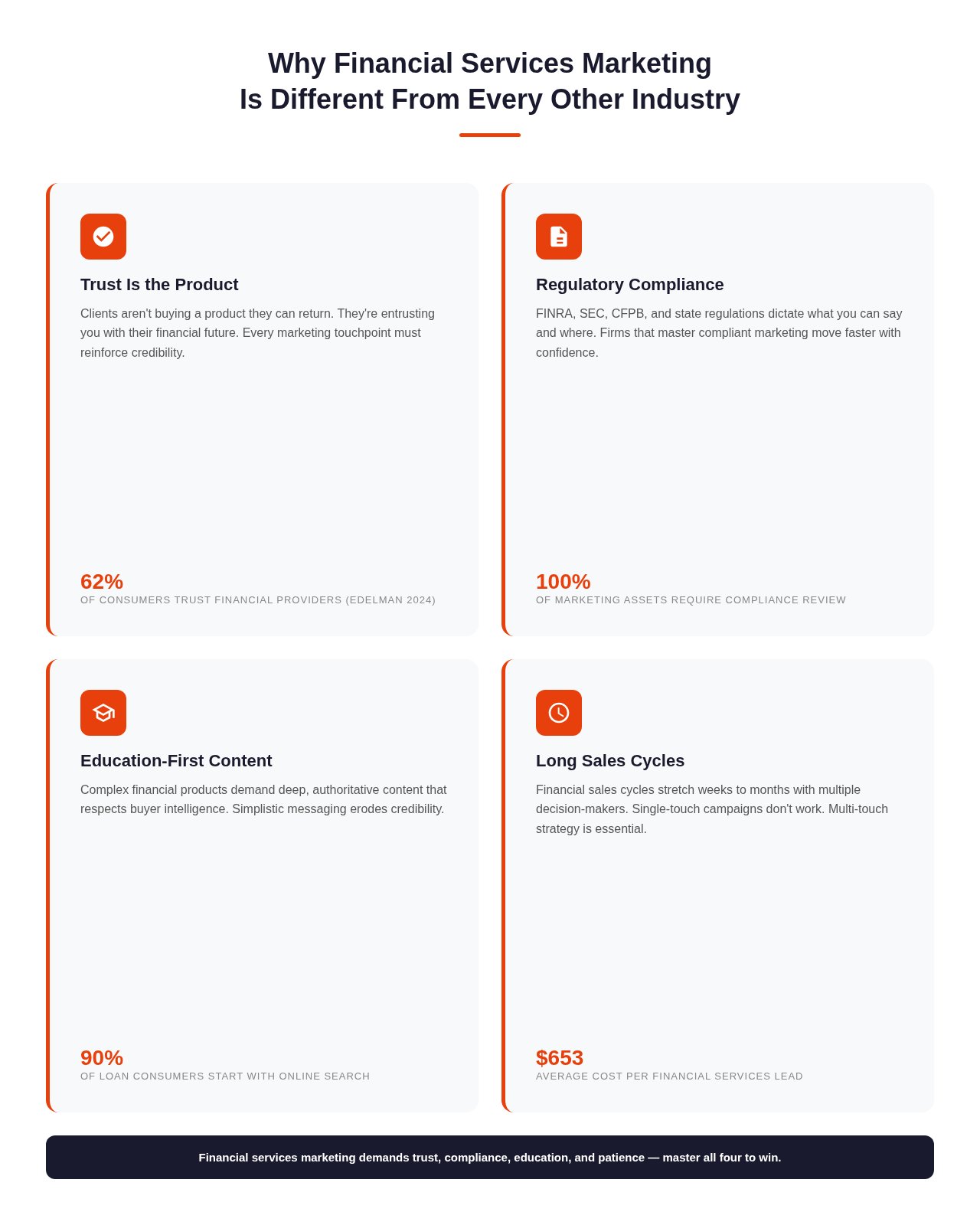
Marketing financial services isn’t like marketing SaaS or e-commerce. The stakes are higher, the sales cycles are longer, and the regulatory landscape adds complexity that most industries never face.
Understanding these differences isn’t optional. It’s the foundation of every strategy that follows.
1. Trust Is the Product
The 2024 Edelman Trust Barometer found that only 62% of consumers trust financial service providers. That number should concern every financial marketer reading this.
When trust is low, marketing must work harder. Every touchpoint — from your website copy to your email nurture sequences — needs to reinforce credibility, transparency, and expertise. Flashy campaigns without substance actually erode trust in financial services.
2. Regulatory Compliance Shapes Everything
Financial marketers operate within strict guardrails. FINRA, SEC, CFPB, state-level regulations, and industry-specific compliance requirements dictate what you can say, how you can say it, and where you can say it.
This isn’t a limitation — it’s a differentiator. Firms that master compliant marketing gain a competitive edge because they move faster with confidence. Firms that avoid marketing because of compliance fears fall behind.
3. Complex Products Demand Education-First Content
Your prospects aren’t comparison shopping for the cheapest option. They’re evaluating complex financial instruments, long-term relationships, and outcomes that impact their livelihood or business.
Education-first marketing works because it respects the buyer’s intelligence. Instead of simplifying your value proposition to a tagline, use content to demonstrate depth, expertise, and a clear understanding of your prospect’s specific challenges.
4. Long Sales Cycles Require Multi-Touch Strategies
A B2B demand generation approach is critical here. Financial services sales cycles can stretch from weeks to months, involving multiple decision-makers and layers of due diligence.
Single-touch campaigns don’t work. You need an integrated strategy that delivers the right message at the right stage — from awareness through consideration to decision. That’s where marketing automation becomes essential.
Now that you understand what makes financial services marketing unique, let’s break down the core strategies that drive results in 2026.
7 High-Impact Financial Services Marketing Strategies for 2026
The most effective financial services marketing strategies balance digital innovation with the human trust factor that defines this industry. These aren’t theoretical — they’re the strategies driving measurable growth for mid-market financial firms right now.
Here’s your tactical playbook.
1. SEO and Content Marketing
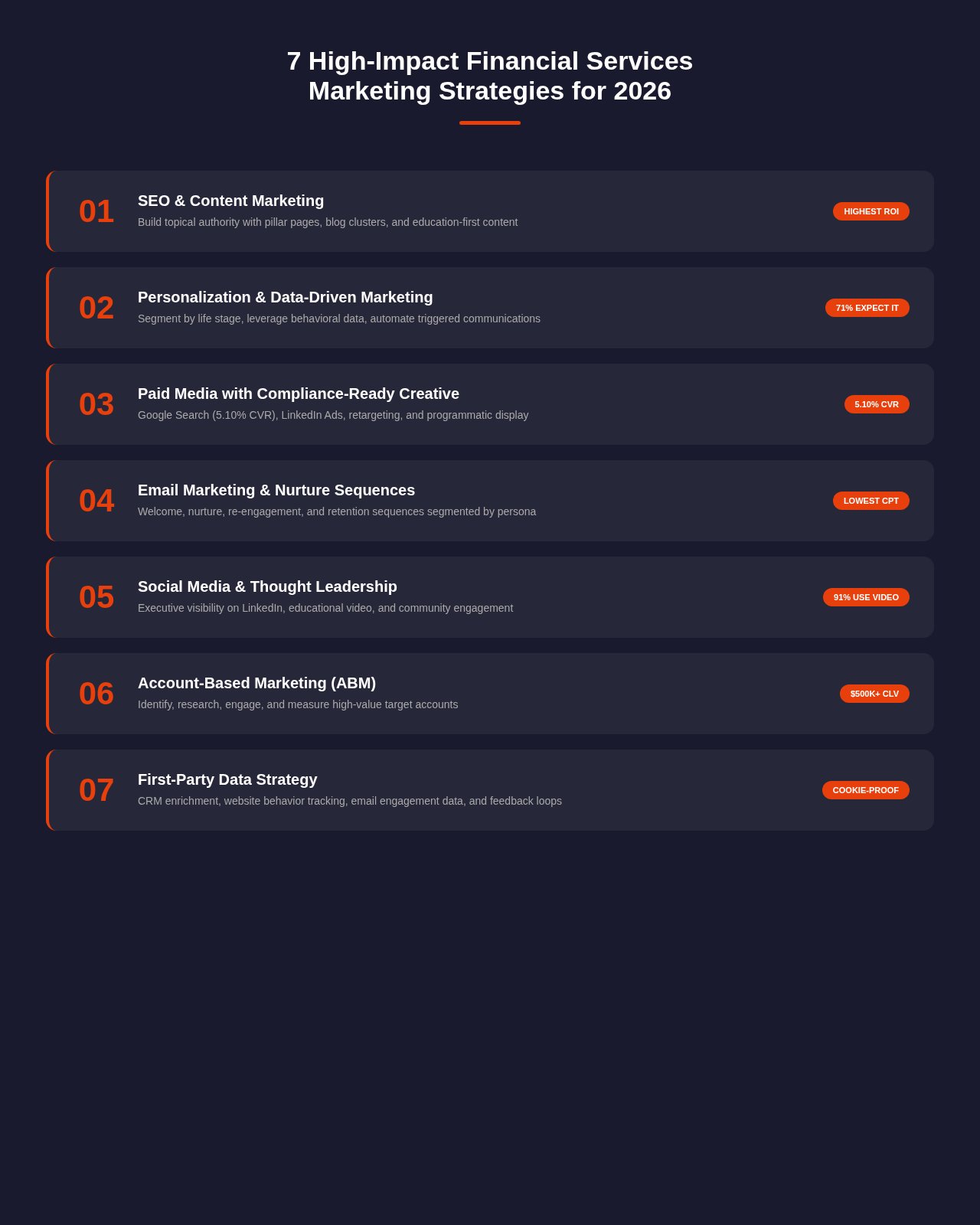
90% of loan and mortgage consumers start their journey with an online search. If your firm doesn’t appear in those results, you’re invisible to the majority of your potential clients.
Financial services SEO goes beyond basic keyword optimization. It requires building topical authority through pillar pages, cluster content, and strategic internal linking that signals expertise to both search engines and prospects.
Here’s what a high-performing financial content strategy includes:
- Pillar pages that comprehensively cover core topics (like this guide)
- Blog clusters targeting long-tail keywords and specific client questions
- Case studies demonstrating measurable client outcomes
- Educational resources — calculators, comparison tools, and downloadable guides
- Thought leadership positioning your team as industry experts
The key principle: create content that answers the exact questions your prospects are typing into Google. Not content about how great your firm is. Content that solves real problems.
At Chatter Buzz Media, we’ve seen financial services clients increase organic traffic by 200%+ within 12 months by executing a disciplined content strategy aligned with buyer intent. The compounding effect of SEO makes it one of the highest-ROI channels for financial marketers.
2. Personalization and Data-Driven Marketing
Generic messaging is a revenue killer in financial services. 71% of customers expect personalized interactions, and 76% get frustrated with generic messaging, according to McKinsey research.
Personalization in financial services marketing means delivering the right message to the right prospect at the right stage of their financial journey. Here’s how to execute it:
- Segment by life stage — a first-time homebuyer needs completely different messaging than a business owner planning succession
- Leverage behavioral data — which pages they visit, which emails they open, which calculators they use
- Automate triggered communications — when a prospect downloads a retirement planning guide, follow up with related content, not a sales pitch
- Personalize across channels — email, website experience, paid ads, and even direct mail should reflect what you know about each prospect
The firms that win don’t just collect data — they activate it. Marketing automation platforms like HubSpot make this executable at scale, even for mid-market teams with limited resources.
3. Paid Media With Compliance-Ready Creative
The average cost for a financial services lead is $653. That’s not a number you can afford to waste on poorly targeted campaigns.
Effective paid media for financial services requires precision targeting, compliance-approved messaging, and relentless optimization. Here’s where to focus:
- Google Search Ads — capture high-intent prospects actively searching for financial solutions (average conversion rate: 5.10%)
- LinkedIn Ads — reach B2B decision-makers by title, company size, and industry with thought leadership content
- Retargeting campaigns — stay top-of-mind with prospects who’ve visited high-intent pages like pricing, services, or comparison content
- Programmatic display — build awareness across your target market with brand messaging
The critical difference: financial services paid media must be built for compliance from day one. Every ad, landing page, and disclosure needs legal review before launch. Build a compliance approval workflow into your campaign process, not as an afterthought.
4. Email Marketing and Nurture Sequences
Email remains one of the highest-ROI marketing channels for financial services. Unlike social media, you own your email list. Unlike paid media, the marginal cost of each send approaches zero.
But financial email marketing fails when it becomes a broadcast channel for firm announcements. The most effective approach treats email as a relationship-building tool.
- Welcome sequences that educate new subscribers on your firm’s approach and expertise
- Nurture campaigns segmented by prospect type, interest area, and engagement level
- Re-engagement sequences for prospects who’ve gone quiet
- Client retention emails that reinforce value and surface cross-sell opportunities
Segmentation is what separates effective financial email from spam. Use enriched data to segment lists by wealth tier, professional background, product interest, or life stage. The more relevant the message, the higher the engagement.
5. Social Media and Thought Leadership
Financial services firms historically underinvest in social media. That’s a mistake — especially on LinkedIn, where B2B financial decision-makers actively research partners and solutions.
Social media for financial services isn’t about going viral. It’s about building authority and staying visible to your target audience between touchpoints. Here’s the approach that works:
- Executive thought leadership — your CEO, CIO, and advisors sharing insights builds credibility faster than any brand account
- Educational content — market commentary, regulatory updates, and financial planning tips that demonstrate expertise
- Client success stories — with appropriate permissions and compliance review, showcasing outcomes builds social proof
- Community engagement — responding to questions, participating in industry discussions, and adding value to conversations
Video has become especially powerful. 91% of businesses now use video as a marketing tool, and financial services firms that create video content explaining complex topics see significantly higher engagement than text-only approaches.
6. Account-Based Marketing (ABM) for High-Value Prospects
When your ideal client represents $500K+ in lifetime value, mass marketing isn’t efficient. Account-based marketing focuses your resources on the specific accounts most likely to become high-value clients.
ABM for financial services works by identifying target accounts, researching their specific needs, and delivering personalized outreach across multiple channels. Here’s the framework:
- Identify — build a target account list based on firmographic data, financial indicators, and fit criteria
- Research — understand each account’s challenges, decision-makers, and buying triggers
- Engage — deliver personalized content, ads, and outreach tailored to each account’s specific situation
- Measure — track account-level engagement, pipeline influence, and deal velocity
The most effective ABM programs combine marketing automation, sales alignment, and enriched data to deliver experiences that feel custom-built for each prospect. This is where mid-market firms can out-execute larger competitors — you may not have their budget, but you can deliver a more personalized experience.
7. First-Party Data Strategy
With third-party cookies phasing out and privacy regulations tightening, first-party data is the most valuable asset in your marketing stack. Financial services firms sit on a goldmine of proprietary data — they just need to activate it.
A strong first-party data strategy includes:
- CRM enrichment — ensure every contact record is complete, current, and actionable
- Website behavior tracking — understand which pages prospects visit, how long they stay, and what content they consume
- Email engagement data — opens, clicks, and conversion patterns reveal intent signals
- Customer feedback loops — surveys, NPS scores, and advisory feedback inform positioning and messaging
First-party data isn’t just more accurate — it’s fully owned, doesn’t carry the compliance exposure of purchased data, and gives you a sustainable competitive advantage that grows stronger over time.
These seven strategies form the foundation of a complete financial services marketing system. But execution without measurement is just activity. Let’s talk about how to measure what actually matters.
How to Measure Financial Services Marketing Performance
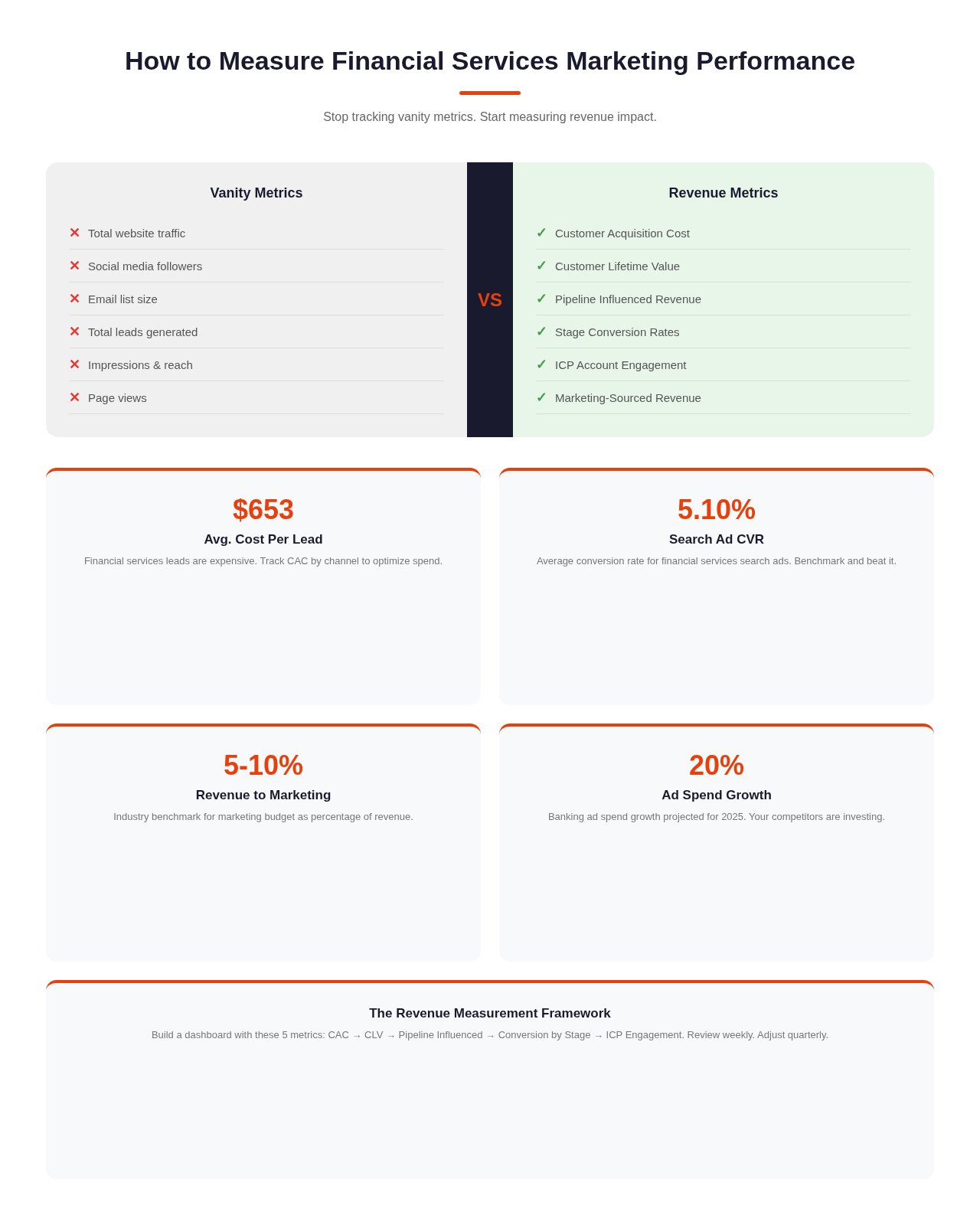
Most financial marketers track the wrong metrics. Impressions, clicks, and even lead volume tell you very little about whether your marketing is actually driving revenue.
The shift from vanity metrics to performance metrics is what separates mid-market firms that grow from those that stagnate. Here’s the framework we use at Chatter Buzz Media.
1. Customer Acquisition Cost (CAC)
What it measures: The total cost to acquire one new client, including all marketing and sales expenses.
Why it matters: With the average financial services lead costing $653, understanding your full acquisition cost reveals whether your marketing is efficient or just expensive. Track CAC by channel to identify which strategies deliver the best return.
2. Customer Lifetime Value (CLV)
What it measures: The total revenue a client generates across their entire relationship with your firm.
Why it matters: CLV justifies marketing investment. When you know a wealth management client is worth $50,000+ over 10 years, spending $2,000 to acquire them makes obvious sense. CLV also informs which segments deserve the most marketing attention.
3. Pipeline Influenced Revenue
What it measures: The dollar value of deals in your pipeline that marketing touched at any stage.
Why it matters: This metric connects marketing activity to revenue outcomes. Not all marketing creates new leads — some accelerates existing opportunities. Pipeline influence captures both.
4. Conversion Rate by Funnel Stage
What it measures: The percentage of prospects that advance from one stage to the next — visitor to lead, lead to opportunity, opportunity to client.
Why it matters: Stage-specific conversion rates reveal exactly where your funnel breaks down. A strong top-of-funnel with a weak middle indicates a nurturing problem. A strong middle with a weak bottom signals a sales enablement gap.
5. Content Engagement From Target Accounts
What it measures: How deeply your ideal prospects interact with your content — time on page, pages per session, return visits, and content downloads.
Why it matters: High engagement from ideal customer profiles is one of the strongest leading indicators of future pipeline. Track engagement by account, not just in aggregate.
Build a dashboard that surfaces these five metrics weekly. Review trends monthly. Make strategic adjustments quarterly. This rhythm keeps your marketing accountable to revenue, not just activity.
Understanding your metrics is essential, but you also need the right technology to execute. Let’s look at the marketing technology stack that powers high-performing financial services teams.
Building Your Financial Services Marketing Technology Stack
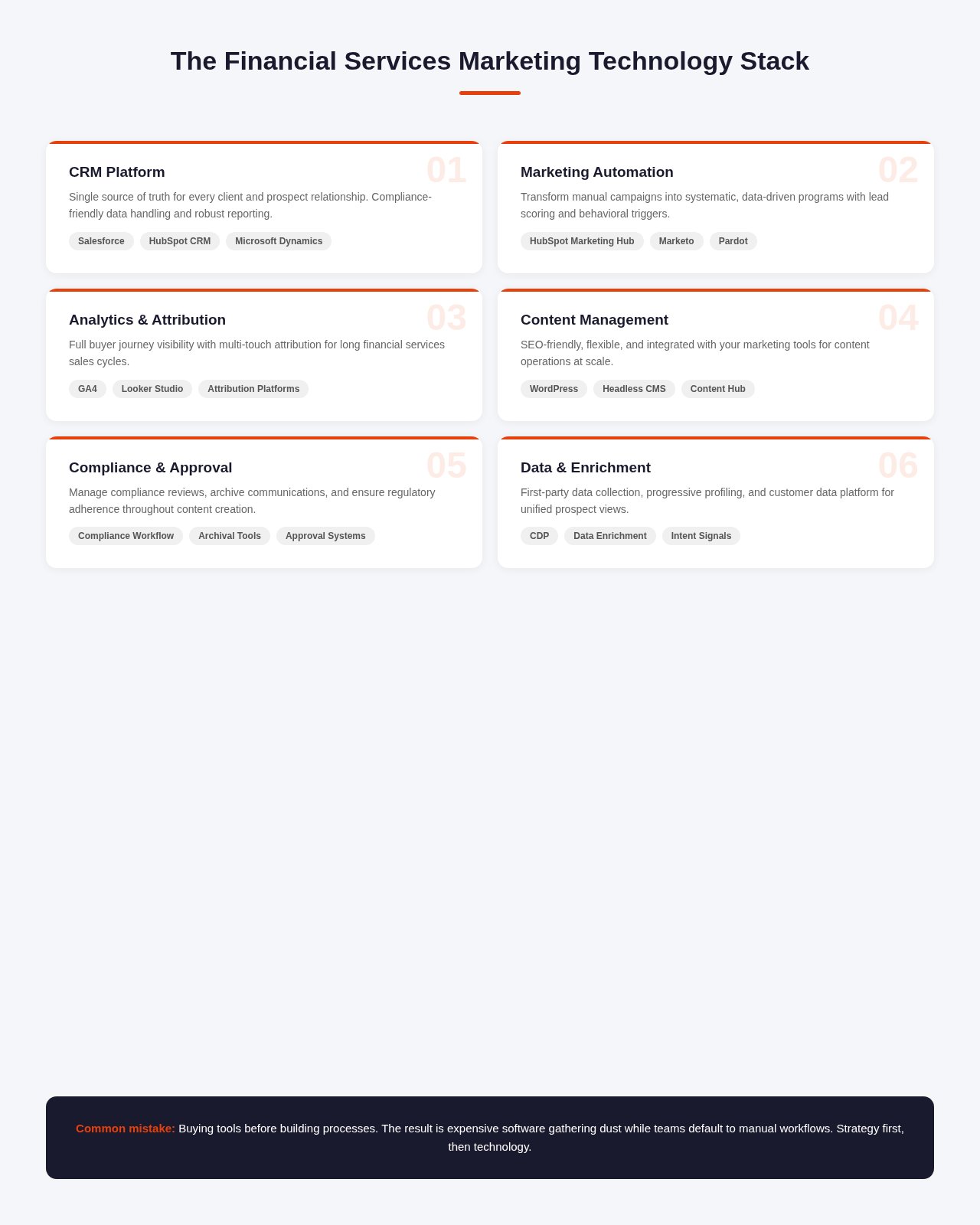
Technology doesn’t replace strategy — it amplifies it. The right martech stack gives your team the infrastructure to execute personalized, compliant, and measurable campaigns at scale.
But here’s the mistake most firms make: they buy tools before building processes. The result is expensive software gathering dust while teams default to manual workflows.
1. CRM Platform
Your CRM is the single source of truth for every client and prospect relationship. Salesforce and HubSpot dominate the financial services space, and the right choice depends on your firm’s size, complexity, and integration requirements.
What to look for: compliance-friendly data handling, robust reporting, integration with your other tools, and scalability as your firm grows.
2. Marketing Automation
Marketing automation transforms manual campaigns into systematic, data-driven programs. Automated email sequences, lead scoring, behavioral triggers, and multi-channel orchestration become possible at scale.
For mid-market financial firms, HubSpot’s Marketing Hub offers the best balance of capability and usability. Enterprise firms often pair Marketo with Salesforce for deeper customization.
3. Analytics and Attribution
You can’t improve what you don’t measure. Google Analytics 4, combined with your CRM’s native reporting, should give you visibility into the full buyer journey — from first touch to closed deal.
Multi-touch attribution is especially important in financial services because of long sales cycles. First-touch models overvalue awareness; last-touch models overvalue conversion. Use a multi-touch model that gives appropriate credit across the entire journey.
4. Content Management System
Your website is your digital headquarters. WordPress powers the majority of financial services websites for good reason — it’s flexible, SEO-friendly, and integrates with virtually every marketing tool on the market.
Pair WordPress with a headless CMS or content hub for larger content operations that require compliance workflows and multi-author management.
5. Compliance and Approval Tools
This is the layer most marketing guides ignore. Financial services marketers need tools that manage compliance reviews, archive communications, and ensure regulatory adherence.
Build compliance approval into your workflow — not as a gate at the end, but as a collaborative process throughout content creation. This speeds up time-to-market while maintaining regulatory standards.
With your technology stack in place, let’s address one of the biggest challenges in financial services marketing: building trust and navigating compliance effectively.
Compliance and Trust: The Financial Marketer’s Competitive Advantage
Most financial marketers view compliance as a constraint. The smartest ones treat it as a competitive advantage.
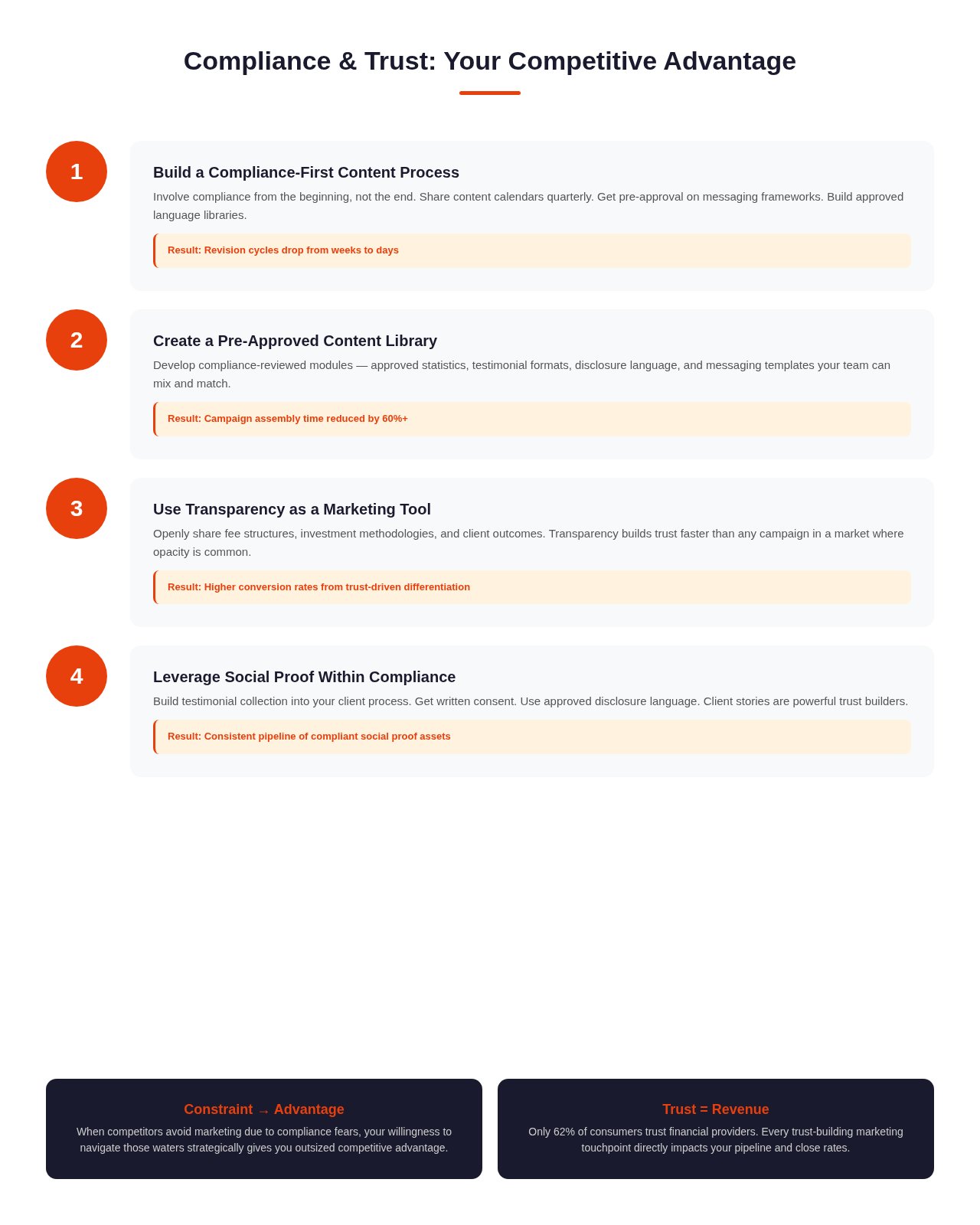
When your competitors are afraid to publish content, launch campaigns, or engage on social media because of compliance concerns, your willingness to navigate those waters strategically gives you an outsized advantage. Here’s how to turn compliance from a bottleneck into a differentiator.
1. Build a Compliance-First Content Process
Instead of creating content and submitting it for compliance review at the end, involve your compliance team from the beginning. Share your content calendar quarterly. Get pre-approval on messaging frameworks and key claims. Build a library of approved language for common topics.
This approach reduces revision cycles from weeks to days. It also builds trust between marketing and compliance teams — a relationship that pays dividends over time.
2. Create a Pre-Approved Content Library
Develop a collection of compliance-reviewed content modules — approved statistics, testimonial formats, disclosure language, and messaging templates. Your marketing team can assemble campaigns faster by mixing and matching pre-approved elements.
This library grows over time and becomes one of your most valuable operational assets.
3. Use Transparency as a Marketing Tool
Transparency builds trust faster than any campaign. Financial firms that openly share their fee structures, investment methodologies, and client outcomes differentiate themselves in a market where opacity is still common.
Content that demonstrates transparency — like publishing your firm’s approach to fiduciary responsibility or breaking down how advisory fees work — resonates deeply with prospects who’ve been burned by hidden costs elsewhere.
4. Leverage Social Proof Within Compliance Boundaries
Client testimonials, case studies, and success metrics are powerful trust builders. Work with your compliance team to develop approved formats for sharing client outcomes. Even within strict regulatory guidelines, there are compliant ways to showcase results.
The key is preparation. Build testimonial collection into your client relationship process. Get written consent. Use approved disclosure language. The firms that do this consistently have a significant advantage over those that avoid social proof entirely.
Compliance mastery enables everything else in your marketing strategy. Now let’s look at the emerging trends that will shape financial services marketing over the next 12 to 24 months.
Financial Services Marketing Trends Reshaping 2026
The financial services marketing landscape is evolving faster than ever. AI, privacy regulations, and shifting consumer expectations are creating both challenges and opportunities for marketers who pay attention.
Here are the trends you need to act on now — not next year.
1. AI-Powered Personalization at Scale
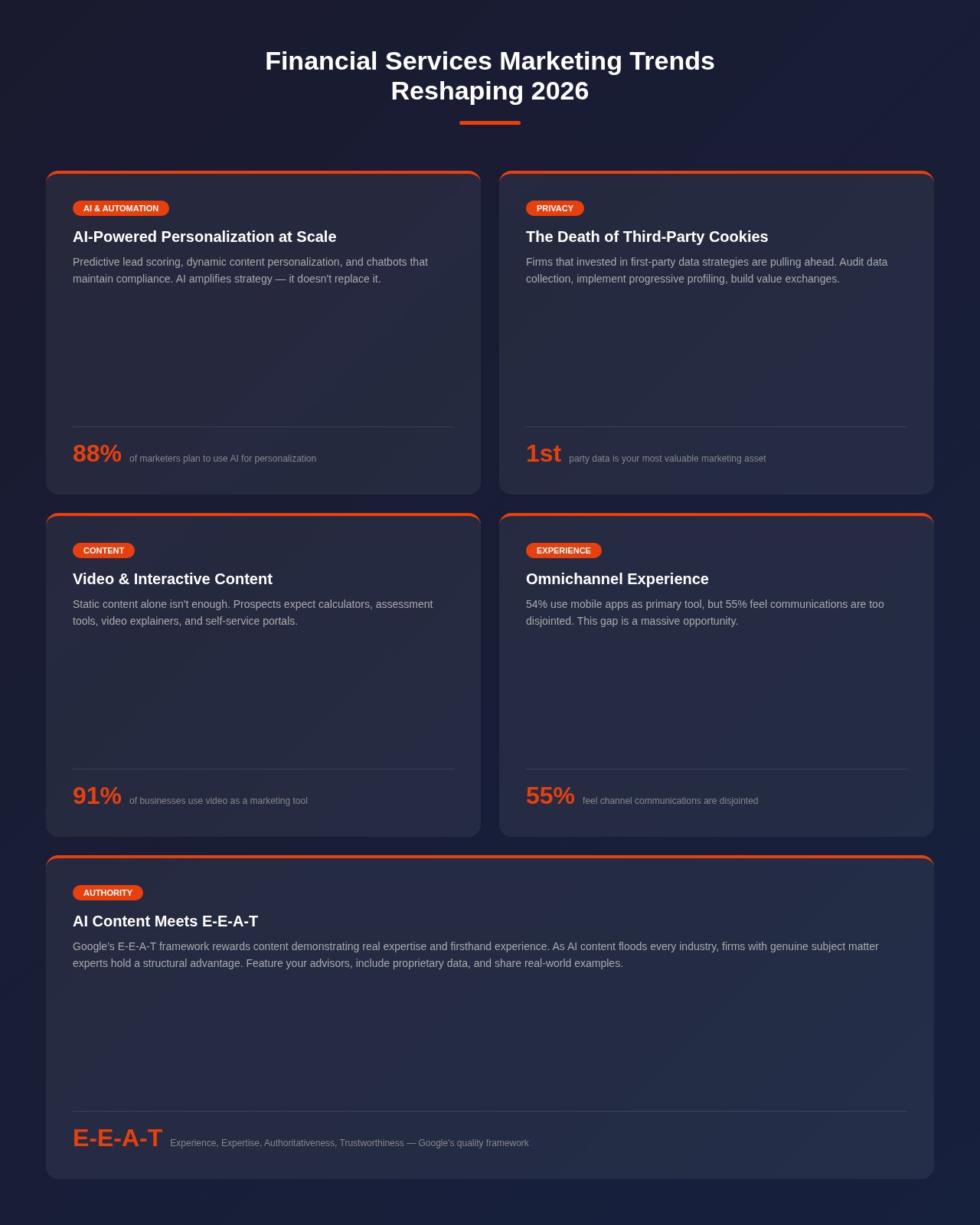
Nearly 88% of marketers plan to use AI for personalization efforts. In financial services, AI enables hyper-personalized experiences that were previously impossible for mid-market firms.
AI-driven marketing applications include predictive lead scoring that identifies which prospects are most likely to convert, dynamic content personalization that adapts website and email experiences in real time, and chatbots that handle initial client inquiries while maintaining compliance standards.
But here’s the critical nuance: AI amplifies strategy, it doesn’t replace it. Firms that deploy AI without a clear marketing strategy end up automating mediocrity. Build the strategy first, then use AI to scale execution.
2. The Death of Third-Party Cookies
As third-party cookies phase out, financial marketers who’ve relied on purchased audiences and behavioral targeting face a reckoning. The firms that invested in first-party data strategies are pulling ahead.
Action items: audit your current data collection practices, implement progressive profiling on your website, build value exchanges that incentivize prospects to share information, and invest in a customer data platform (CDP) that unifies data across touchpoints.
3. Video and Interactive Content
Static content alone isn’t enough anymore. Financial services prospects increasingly expect interactive experiences — calculators, assessment tools, video explainers, and self-service portals.
Video is particularly powerful for explaining complex financial concepts. Short-form educational videos on LinkedIn and YouTube build awareness. Long-form webinars and explainer series build authority. The format matters less than the quality and relevance of the content.
4. Omnichannel Experience Expectations
54% of U.S. bank customers use a mobile app as their primary account management tool. Yet 55% of customers feel communications across channels are too disjointed.
This gap represents a massive opportunity. Financial firms that deliver a seamless experience across digital, mobile, in-branch, phone, and email will earn deeper loyalty and higher lifetime value. The technology exists today — the challenge is organizational alignment and commitment to omnichannel execution.
5. AI-Generated Content Meets E-E-A-T
Google’s E-E-A-T framework (Experience, Expertise, Authoritativeness, Trustworthiness) is especially relevant for financial services content. As AI-generated content floods every industry, content that demonstrates real expertise and firsthand experience will outperform generic, AI-produced material.
This is a structural advantage for firms with genuine subject matter experts. Feature your advisors, analysts, and leaders in your content. Include proprietary data, client insights (with permission), and real-world examples that only come from hands-on experience.
These trends are shaping the future, but what about the practical question every marketing leader asks? Let’s talk about budgets.
How Much Should Financial Firms Spend on Marketing?
Marketing budget allocation is one of the most debated topics in financial services leadership. Spend too little and you lose market share. Spend without strategy and you waste resources.
Here’s a data-driven framework for budget planning.
Industry Benchmarks
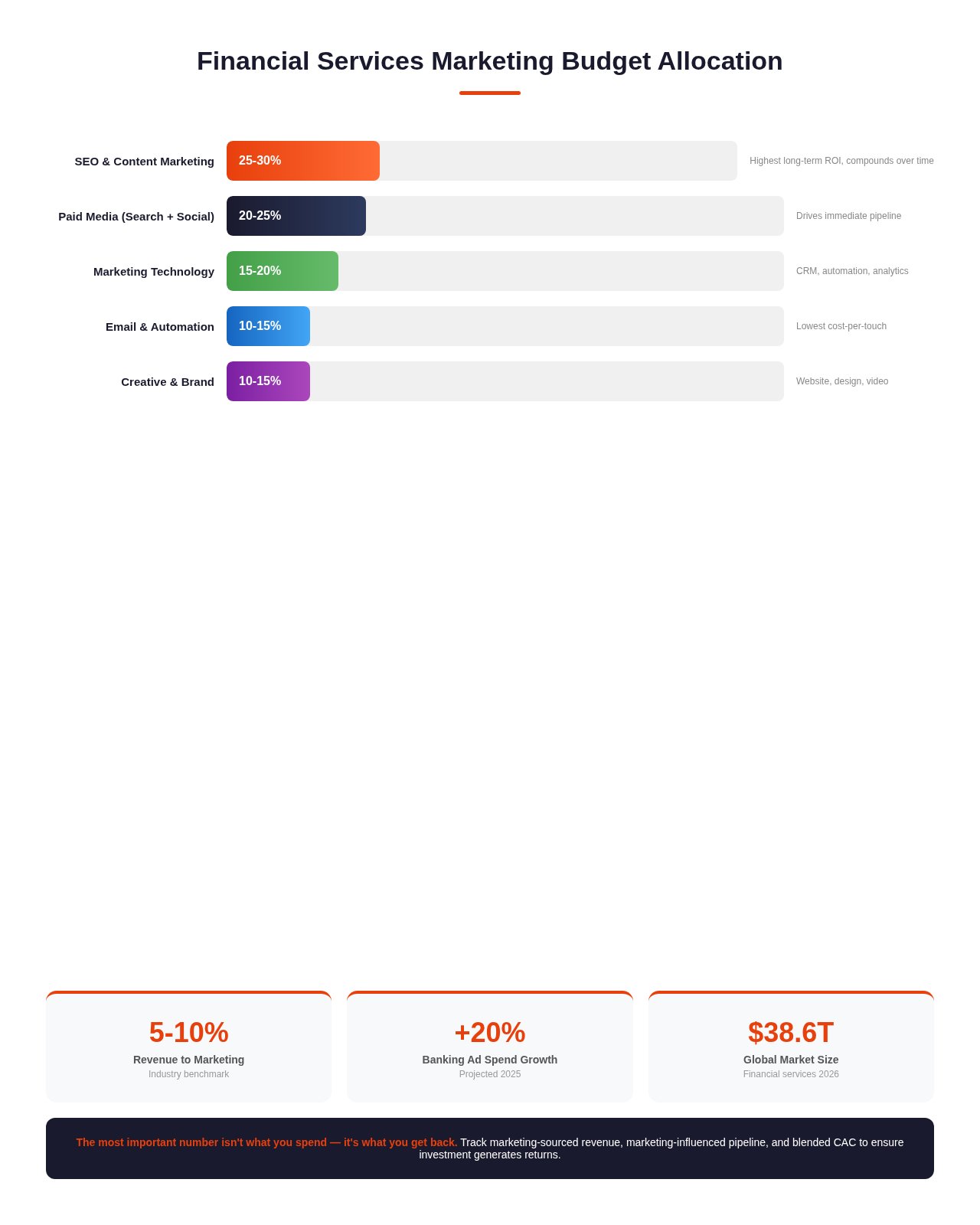
Financial services firms typically allocate 5-10% of revenue to marketing. Growth-stage firms and those entering new markets should skew toward the higher end. Established firms with strong brand recognition can operate effectively at the lower end.
Ad spend across the financial services industry is growing significantly — banking and lending ad spend is projected to increase 20% in 2025, with insurance at 17% and wealth management at 14%.
Channel Allocation Framework
For mid-market financial services firms, we recommend this general allocation:
- SEO and Content Marketing: 25-30% — highest long-term ROI, compounds over time
- Paid Media (Search + Social): 20-25% — drives immediate pipeline while organic builds
- Marketing Technology: 15-20% — CRM, automation, analytics infrastructure
- Email and Marketing Automation: 10-15% — lowest cost-per-touch, highest retention impact
- Creative and Brand: 10-15% — website, design, video production
These percentages shift based on your firm’s maturity, competitive landscape, and growth targets. A firm launching its first digital marketing program will invest more heavily in technology and content foundation. An established firm may shift more toward paid media and ABM.
Measuring Marketing ROI
The most important number isn’t what you spend — it’s what you get back. Track marketing-sourced revenue, marketing-influenced pipeline, and blended CAC to ensure your investment is generating returns.
If your marketing team can’t tell you the revenue impact of last quarter’s spend, you don’t have a measurement problem — you have a strategy problem. Fix the measurement first, then optimize the budget.
Budget planning gives you the resources. But building and executing takes the right team structure. Let’s look at how to build a financial services marketing team that delivers results.
Building a Financial Services Marketing Team
The right team structure makes or breaks your marketing investment. Financial services marketing requires a blend of creative talent, analytical rigor, and industry expertise that’s difficult to find in a single hire.
Here’s how to think about team structure based on your firm’s size and growth stage.
In-House vs. Agency vs. Hybrid
Most mid-market financial firms don’t need a 15-person marketing department. They need the right combination of internal leadership and specialized external partners.
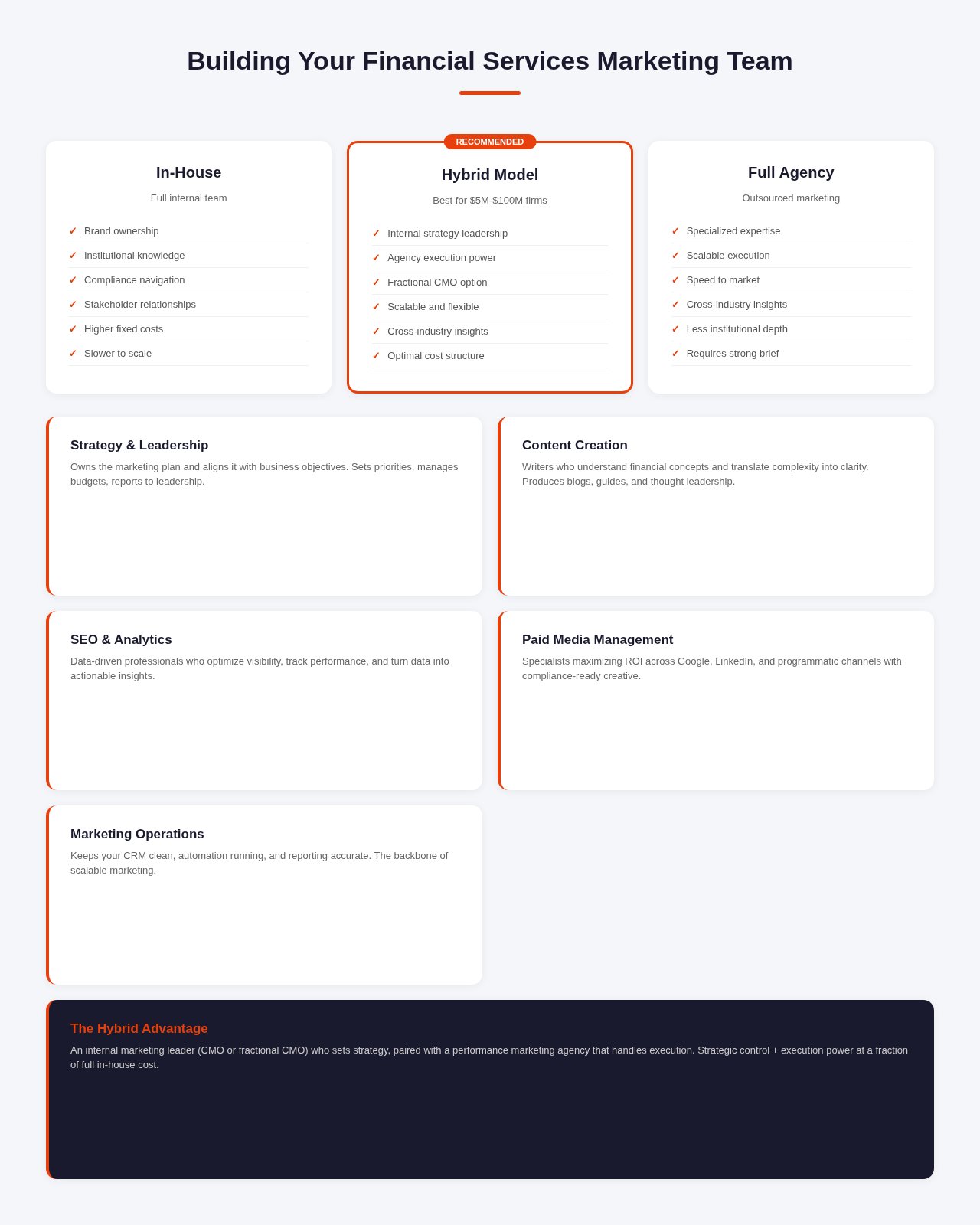
- In-house strengths: Brand ownership, institutional knowledge, compliance navigation, stakeholder relationships
- Agency strengths: Specialized expertise (SEO, paid media, content production), scalable execution, cross-industry insights, speed to market
- Hybrid model: An internal marketing leader (CMO, VP Marketing, or fractional CMO) who sets strategy, paired with a performance marketing agency that handles execution
The hybrid model offers the best balance of strategic control and execution power for firms in the $5M-$100M revenue range. You get leadership-level thinking without the overhead of a full department.
Core Roles for Financial Services Marketing
Whether these roles sit in-house or with an agency partner, every financial services marketing function needs these capabilities:
- Strategy and leadership — someone who owns the marketing plan and aligns it with business objectives
- Content creation — writers who understand financial concepts and can translate complexity into clarity
- SEO and analytics — data-driven professionals who optimize visibility and measure performance
- Paid media management — specialists who maximize ROI across Google, LinkedIn, and programmatic channels
- Marketing operations — the person who keeps your CRM clean, your automation running, and your reporting accurate
At Chatter Buzz Media, we often fill all five of these roles for our financial services clients. We operate as a fractional marketing department — delivering executive strategy plus hands-on execution at a fraction of the cost of building internally.
With the right team and strategy in place, you’re ready to execute. But first, let’s address the questions we hear most from financial services marketers.
Frequently Asked Questions About Financial Services Marketing
What is financial services marketing?
Financial services marketing is the strategic process of promoting products and services offered by banks, credit unions, insurance companies, wealth management firms, and fintech platforms. It combines digital marketing, content strategy, compliance management, and relationship-building to attract and retain clients in an industry where trust and credibility drive purchase decisions.
How is marketing for financial services different from other industries?
Financial services marketing faces unique challenges including strict regulatory compliance (FINRA, SEC, CFPB), long sales cycles with multiple decision-makers, complex products that require education-first content, and an industry-wide trust deficit. These factors demand specialized strategies that balance creative marketing with regulatory adherence.
What are the best marketing channels for financial services?
The highest-performing channels for financial services include SEO and content marketing (for long-term organic growth), Google Search Ads (for capturing high-intent prospects), LinkedIn (for B2B and wealth management audiences), email marketing (for nurturing and retention), and account-based marketing (for high-value prospect targeting). The best channel mix depends on your target audience, products, and growth goals.
How much should financial services companies spend on marketing?
Financial services firms typically allocate 5-10% of revenue to marketing. Growth-stage firms should invest toward the higher end, while established firms with strong brand recognition can operate effectively at lower levels. The more important question is ROI — every dollar should be tracked against pipeline impact and revenue contribution.
What role does compliance play in financial marketing?
Compliance is foundational to every financial marketing activity. Rather than viewing compliance as a bottleneck, high-performing firms build compliance into their workflow from the start — involving legal and compliance teams early, developing pre-approved content libraries, and using compliance as a trust-building differentiator with prospects.
How can financial services firms build trust through marketing?
Trust is built through consistency, transparency, and education. Publish content that demonstrates genuine expertise. Share fee structures and methodologies openly. Showcase client outcomes (within compliance guidelines). Feature your actual team members and their credentials. Every marketing touchpoint should reinforce credibility rather than making unsupported claims.
What is the role of AI in financial services marketing?
AI enhances financial services marketing through predictive lead scoring, dynamic content personalization, automated campaign optimization, and chatbot-driven engagement. However, AI is most effective when it amplifies a strong underlying strategy. Firms should focus on building their data foundation and strategy first, then use AI tools to scale execution and improve efficiency.
Should financial services firms hire an agency or build an in-house team?
Most mid-market financial firms benefit from a hybrid approach — internal marketing leadership (a CMO or fractional CMO) who sets strategy, paired with a specialized financial services marketing agency that handles execution. This model delivers strategic control with execution power at a fraction of the cost of building a full internal department.
Your Next Move: From Playbook to Pipeline
Financial services marketing isn’t about following trends or copying what larger firms do with bigger budgets. It’s about building a systematic approach that turns your firm’s genuine expertise into measurable pipeline growth.
Here’s what you learned in this guide:
- Financial services marketing requires a trust-first, compliance-aware approach that most industries don’t demand
- Seven core strategies — from SEO and content to ABM and first-party data — form the foundation of a complete marketing system
- Measurement must focus on revenue metrics (CAC, CLV, pipeline influence) not vanity metrics (impressions, clicks, lead volume)
- The right technology stack amplifies strategy but doesn’t replace it
- Compliance is a competitive advantage when you build it into your process rather than treating it as a gate
- AI and personalization are accelerating what’s possible, but only for firms that build the strategic foundation first
The firms that act on these strategies now will compound their advantage over the next 12 to 24 months. The firms that wait will keep losing ground to competitors who invested earlier.
If you’re ready to build a financial services marketing system that drives real revenue, schedule a strategy session with Chatter Buzz Media. We work exclusively with mid-market firms across financial services, credit unions, and B2B organizations — bringing the strategy, execution, and measurement your growth demands.