
 321-236-2899
The multi-location med spa market represents one of the most lucrative opportunities in aesthetic medicine. With patient demand for non-invasive treatments reaching record highs and the industry projected to exceed $27.6 billion by 2026, savvy owners are rapidly expanding their footprints across multiple markets.
But here’s the uncomfortable truth: most multi-location med spa groups plateau at location three.
Why? The marketing strategies that propelled a single location to success become unmanageable at scale. What worked for one location creates operational chaos across four, eight, or twelve sites. Brand consistency suffers. Local relevance gets lost. ROI becomes impossible to track accurately. And the owner who once knew every patient by name now struggles to maintain quality standards across diverse markets.
The 2026 Playbook addresses this exact inflection point. This isn’t about generic med spa marketing advice— and it’s not a recycled med spa digital marketing checklist pulled from a blog. It’s a strategic framework specifically engineered for multi-location groups generating $5M to $50M+ in annual revenue. Groups where centralized brand control must coexist with localized market penetration. Where sophisticated owners demand transparent ROI metrics for every advertising dollar spent across every location.
This playbook delivers a systematic approach to overcome the inherent complexity of multi-location marketing while capitalizing on the immense growth opportunities ahead. From architecting scalable digital ecosystems to leveraging AI for hyper-personalization, we’ll explore the exact strategies that separate thriving multi-location empires from those stuck in operational quicksand.
If you’re ready to transform your multi-location group from a collection of individual practices into a unified, high-performing brand that dominates every market you enter, this is your strategic roadmap.
Navigating the Multi-Location Maze: Understanding the Unique 2026 Landscape
The Multi-Location Med Spa Paradox: Growth vs. Complexity
Every multi-location med spa owner started with the same vision: replicate the magic of that first successful location. Scale the systems. Multiply the revenue. Build an empire.
The reality? Expansion introduces exponential complexity that most operators drastically underestimate.
Your first location thrives on founder intimacy. You know every client. You feel the pulse of the market daily. You make quick decisions based on direct observation. Marketing adjustments happen organically because you’re embedded in the operation.
Location two adds complications but remains manageable. You split your attention. Systems require more documentation. Marketing campaigns need slight adjustments for the new geography. But your hands-on leadership still drives results.
Then comes location three—and everything breaks.
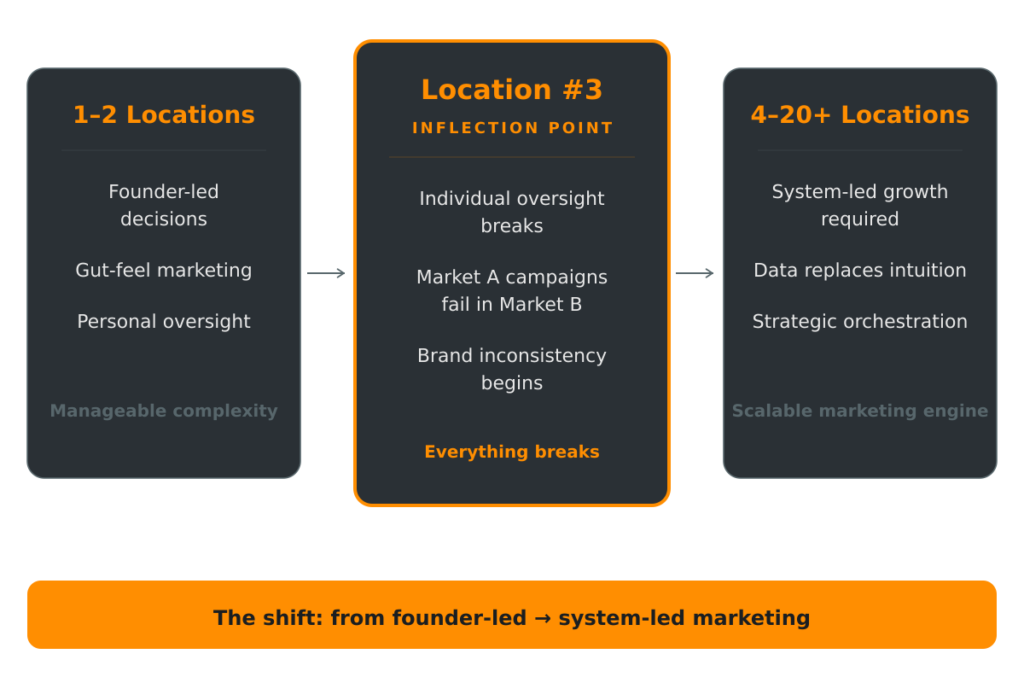
Understand the critical “Location #3 Bottleneck” that transforms simple single-location management into complex multi-location challenges, demanding a strategic playbook.
Industry veterans call this the “Location #3 Bottleneck.” It’s the point where individual oversight becomes physically impossible. Where inconsistent execution across locations erodes your brand. Where marketing campaigns that crush it in Market A completely fail in Market B. Where you’re simultaneously everywhere and nowhere.
This bottleneck reveals a fundamental truth: multi-location success demands a shift from founder-led operations to system-led growth. Your marketing can’t depend on your personal involvement at each location. It needs to function as a repeatable, scalable machine that delivers consistent results whether you’re present or not.
The paradox? The very qualities that made you successful initially—hands-on control, personal relationships, intuitive decision-making—become obstacles to scaling. Multi-location dominance requires replacing intuition with data, personal oversight with robust systems, and reactive marketing with strategic orchestration.
Critical Challenges for Multi-Location Med Spas in 2026
The 2026 landscape presents unique obstacles that demand sophisticated solutions:
Brand Cohesion vs. Local Relevance
Your brand needs a unified identity that patients recognize across all locations. Consistent messaging. Cohesive visual standards. Standardized service protocols. Yet each location operates in a distinct market with unique demographics, competitive dynamics, and cultural nuances.
A campaign highlighting advanced body contouring might resonate powerfully in an affluent suburban market but fall flat in a college town where Botox and fillers drive revenue. Your West Coast location’s aesthetic preferences differ dramatically from your Southeast locations. State regulations vary—what you can advertise for GLP-1 weight loss in Florida differs from restrictions in California.
The challenge? Maintaining brand integrity while adapting to local market realities without creating dozens of disconnected marketing campaigns.
Operational & Technological Silos
Most multi-location groups operate with fragmented systems. Each location uses different scheduling software. Patient data lives in isolated databases. Marketing campaigns run independently. Reporting requires manually compiling spreadsheets from multiple sources.
This fragmentation creates blind spots. You can’t identify which marketing channels drive the highest-value patients across the organization. You can’t quickly implement successful campaigns from one location across the entire group. You can’t track lifetime patient value when clients visit multiple locations.
Without integrated technology connecting every location into a unified ecosystem, you’re essentially operating multiple independent businesses rather than one scalable enterprise.
ROI Attribution & Performance Tracking
Your CFO asks a simple question: “Which locations deliver the best return on our marketing investment?”
If you can’t answer immediately with precise data, you have an attribution problem.
Multi-location groups typically struggle with murky performance metrics. Ad spend gets allocated across locations without clear tracking. Some locations might be crushing it while others drain resources—but without location-specific analytics, these patterns remain invisible. Leadership makes budget decisions based on incomplete information.
Sophisticated owners demand transparency: cost per lead by location, return on ad spend by market, lifetime value by acquisition channel, revenue per location normalized for market size. Without this granular visibility, you’re marketing blind.
Navigating Regulatory Compliance
The 2026 regulatory environment adds another layer of complexity. Marketing high-demand treatments like GLP-1 medications (semaglutide, tirzepatide), hormone replacement therapy, and IV wellness requires navigating a patchwork of state-specific regulations.
What you can claim in your marketing varies dramatically by jurisdiction. Telehealth restrictions differ. Prescribing authority varies. Even the language you use in advertising faces different scrutiny depending on your state medical board’s interpretation.
Multi-location groups must ensure every marketing message, every ad creative, every landing page complies with regulations in each state where they operate. A single compliance violation can jeopardize licenses across your entire network.
Attracting & Retaining Top Talent
Your marketing challenges extend beyond digital campaigns. Staff quality directly impacts patient experience, and in aesthetics, inconsistent provider skill destroys brand reputation faster than any marketing misstep.
Multi-location groups face intense competition for experienced injectors, laser technicians, and medical directors. High turnover disrupts operations and patient relationships. When your star injector leaves, do their loyal clients follow—or does your brand loyalty keep them?
Building a culture where patients connect with your brand rather than individual providers requires intentional systems. Your marketing must emphasize the brand promise, the standardized protocols, the unified experience across all locations—not just individual provider personalities.
The 2026 Playbook: Strategic Pillars for Multi-Location Med Spa Marketing Mastery
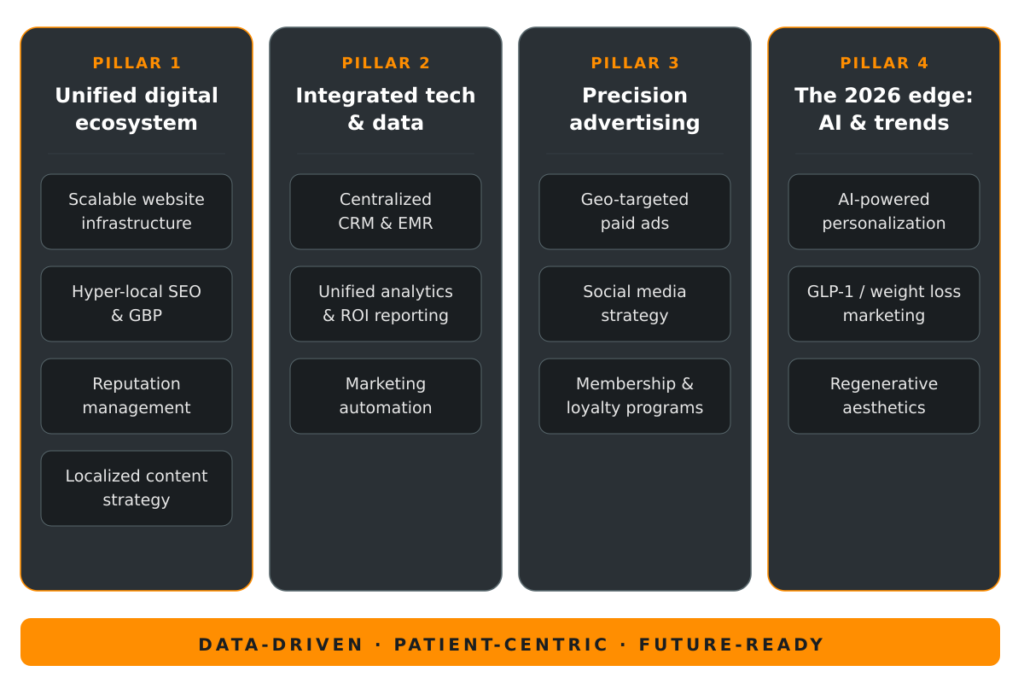
Explore the four strategic pillars of the 2026 Playbook, designed to build a comprehensive, scalable, and future-proof digital marketing strategy for your multi-location med spa.
Successful multi-location marketing isn’t about doing more of what works at a single location. It requires a completely different strategic architecture—one that balances standardization with customization, automates without losing the human touch, and scales while maintaining quality.
The 2026 Playbook rests on four interdependent pillars that work together to create a marketing engine capable of driving predictable patient flow across your entire organization.
Pillar 1: Architecting a Unified & Localized Digital Ecosystem
Your digital presence forms the foundation of every patient interaction. In med spa digital marketing, the infrastructure decisions you make at the platform level determine whether everything downstream, ads, SEO, content, automation, compounds, or collapses. Get this wrong, and every marketing dollar you spend works against you.
Scalable Website Infrastructure
Most multi-location groups make a critical early mistake: they build separate websites for each location or use cookie-cutter templates that ignore local market dynamics. Both approaches sabotage your search engine optimization and fragment your brand authority.
The correct architecture uses a single authoritative domain with dedicated, uniquely optimized location pages. Think yourmedspa.com/locations/miami and yourmedspa.com/locations/orlando rather than separate domains or generic franchise-style pages.
Why? Google consolidates domain authority. Every quality backlink to any page on your site strengthens your entire domain. Separate websites split this authority, requiring you to build SEO power for each site independently—a dramatically slower and more expensive approach.
Your location pages need unique, substantial content tailored to each market. Not thin, templated pages that swap out city names. Each location page should include:
- Detailed service descriptions highlighting treatments most relevant to that market
- Local team bios and credentials (patients want to know who they’ll see)
- Unique before-and-after galleries showing results specific to that location’s patient demographic
- Location-specific FAQs addressing common questions in that market
- Embedded Google Maps with accurate NAP (Name, Address, Phone) details
- Local schema markup signaling to search engines that this is a legitimate local business
- Internal links connecting to relevant service pages and blog content
- Clear calls-to-action specific to how patients in that market prefer to book (some markets prefer phone calls, others favor online booking)
This infrastructure supports both brand-level SEO (competing for terms like “best med spa chain” or “multi-location medical aesthetics”) and location-specific SEO (dominating “Botox Miami” or “CoolSculpting Orlando”). For insights on creating high-converting landing pages that drive action, explore our guide on crucial components every landing page needs.
Hyper-Local SEO & Google Business Profile Domination
Your Google Business Profile represents prime digital real estate—often the first impression potential patients get of your brand. Yet most multi-location groups treat GBP optimization as an afterthought, uploading basic information and never touching it again.
Exceptional multi-location groups treat each GBP as a miniature website, constantly optimized for maximum local visibility.
Start with the fundamentals:
- Claim and verify every location’s profile
- Ensure NAP consistency across your website, GBP, and all directories (even minor inconsistencies like “St.” vs “Street” confuse search engines)
- Select the most specific primary category and add all relevant secondary categories
- Upload high-quality photos monthly (interiors, exteriors, staff, treatments, results when compliant)
- Respond to every review within 24 hours with personalized, professional responses
- Post weekly updates highlighting promotions, new services, patient success stories, and educational content
But truly dominant players go further. They use GBP posts strategically to target seasonal demand (think “summer body sculpting” in April and May, “wedding skin prep” during engagement season). They leverage the Q&A section to address common objections and educate prospective patients. They upload service-specific content highlighting unique offerings at each location.
Track these GBP metrics religiously:
- Search queries triggering your profile
- Actions taken (website clicks, direction requests, phone calls)
- Photo views and engagement
- Review volume, rating, and response rate
Med spa SEO for multi-location groups starts with dominating ‘near me’ searches and location-specific service terms. ‘Med spa near me’ searches have exploded, with patients expecting to find a convenient location offering exactly what they need. Your GBP optimization determines whether you appear in those critical high-intent searches.
To dive deeper into local search strategies, check out our comprehensive guide on local SEO services.
Proactive Reputation Management
Reviews make or break med spas. A single negative review about a botched procedure or poor customer service can devastate new patient acquisition for that location—and damage your entire brand if not handled properly.
Multi-location groups need centralized reputation management systems that work across all locations while respecting local nuances.
The system starts with proactive review generation. Automated post-appointment requests are sent at the optimal time (typically 2-3 days after treatment when results start showing but before any complications appear). These requests should feel personal, not robotic—using the patient’s name, referencing their specific treatment, and coming from their provider when possible.
Make leaving reviews frictionless. Direct links to your preferred platforms (Google for SEO value, RealSelf for aesthetics credibility). Mobile-optimized review pages that take 30 seconds to complete.
But here’s where most groups fail: they only ask happy patients for reviews. This creates selection bias. Instead, use a two-step process. First, send a private satisfaction survey. Happy patients (9-10 ratings) get directed to public review platforms. Neutral patients (7-8 ratings) receive a personal follow-up to understand concerns. Unhappy patients (below 7) immediately trigger an internal alert for immediate intervention—before they post publicly.
Your response protocol matters as much as generating reviews. Every review requires a response within 24 hours:
- Positive reviews: Thank them specifically, mention what they appreciated, invite them back for future treatments, and potentially highlight other services they haven’t tried yet
- Neutral reviews: Acknowledge their feedback, address any specific concerns raised, and offer to discuss how you can improve their experience
- Negative reviews: Respond promptly, professionally, and empathetically—never defensively. Apologize for their experience, offer to resolve the issue offline, and demonstrate your commitment to patient satisfaction
Never argue with reviewers publicly. Never make excuses. Never blame patients. Your response signals to hundreds of future patients reading these reviews how you handle problems.
Track reputation metrics across all locations:
- Average rating by platform and location
- Review volume trends (declining reviews signal problems)
- Response rate and response time
- Common themes in negative feedback (these reveal operational issues requiring attention)
- Review conversion rate (what percentage of patients asked actually leave reviews)
Use reputation insights to identify training needs, operational weaknesses, and standout team members who consistently generate glowing reviews. For strategies on building trust through transparency and data, read our insights on data visualization and business intelligence.
Localized Content Strategy
Generic content doesn’t work for multi-location groups. A blog post about “Top Anti-Aging Treatments” published on your main site might drive some traffic, but it fails to capitalize on local search opportunities and doesn’t address market-specific patient concerns.
Your content strategy needs three layers:
1. Brand-Level Content
Broad, authoritative content establishes your expertise across the industry. Think comprehensive guides to treatment categories, comparisons of different approaches, and scientific explanations of how treatments work. This content lives on your main blog and targets national-level keywords while building domain authority.
2. Market-Specific Content
Content tailored to each market you operate in, but applicable across multiple locations in that region. For example, “Miami Med Spa Guide: What to Know Before Your First Treatment” or “Seattle’s Top Body Contouring Options Compared.” This content addresses regional demographics, climate considerations, and cultural factors.
3. Location-Specific Content
Hyper-local content tied to individual locations. Staff spotlights. Local event participation. Partnerships with nearby businesses. Patient success stories from that specific location. These create genuine local relevance that search engines reward.
Develop a centralized content calendar that coordinates these three layers. Your corporate marketing team creates the brand-level framework and guidelines. Regional managers adapt that framework to their markets. Individual locations contribute local angles and stories.
This systematic approach maintains brand consistency (all content reflects your core messaging and quality standards) while enabling local customization (each piece addresses specific market needs). It also dramatically reduces content creation workload compared to each location independently developing content from scratch.
Don’t forget to adapt your med spa SEO content strategy for emerging treatment categories dominating 2026 search volume: GLP-1 weight loss programs, bio-identical hormone replacement, regenerative aesthetics, and combination treatment protocols. Each of these requires compliant, educational content that positions your locations as the trusted local authority.
Pillar 2: Integrated Technology & Data Intelligence for Scale
Technology separates multi-location groups that scale smoothly from those that collapse under operational complexity. But technology alone isn’t the answer—integrated technology working as a unified system is what creates the leverage you need.
Centralized CRM & EMR Integration
Your patient relationship management and medical records systems form the operational backbone of your business. Yet many multi-location groups operate with fragmented systems—each location on different software, or worse, partially digitized with paper records still in use.
This fragmentation destroys efficiency and prevents you from seeing the complete patient journey.
The right approach uses a unified CRM and EMR system across all locations with these critical capabilities:
Centralized Patient Records
A single patient profile accessible from any location, containing complete treatment history, purchase patterns, communication preferences, and lifetime value. When a patient books at a different location than usual, the staff immediately sees their full background and can provide personalized service.
Automated Lead Management
Every inquiry—whether from your website, phone calls, social media, or online ads—flows into the CRM with proper source attribution. Leads automatically route to the appropriate location based on geography and get added to location-specific nurture sequences.
Cross-Location Insights
The ability to identify patients who visit multiple locations, track which services they purchase at each site, and understand cross-location behavior patterns. This data reveals opportunities for unified loyalty programs and cross-promotion strategies.
Intelligent Scheduling: Systems that handle multi-location complexities like provider availability across sites, treatment room capacity, and equipment sharing between nearby locations.
Unified Communication Tools: Centralized email, SMS, and messaging capabilities that maintain conversation history regardless of which location the patient contacts. Staff at any location can see previous communications and maintain context.
The integration between CRM and EMR matters enormously. Marketing campaigns become dramatically more effective when connected to treatment outcomes. You can automatically trigger re-engagement campaigns based on clinical milestones (time for Botox refresh, recommended maintenance schedule for laser treatments). You can identify high-value patients based on both spending and clinical results, then create VIP programs that increase retention.
Most importantly, integration eliminates manual data entry and duplicate work. When a patient books through your website, that information flows automatically to your EMR without staff needing to re-enter details. When they check out, purchase history updates the CRM for future marketing segmentation.
Unified Analytics & ROI Reporting
Ask most multi-location med spa owners, “What’s your return on ad spend across all locations?” and you’ll get vague answers based on gut feeling rather than hard data.
This is unacceptable in 2026. The technology exists to track every dollar spent and every dollar earned with precision—you just need the right infrastructure.
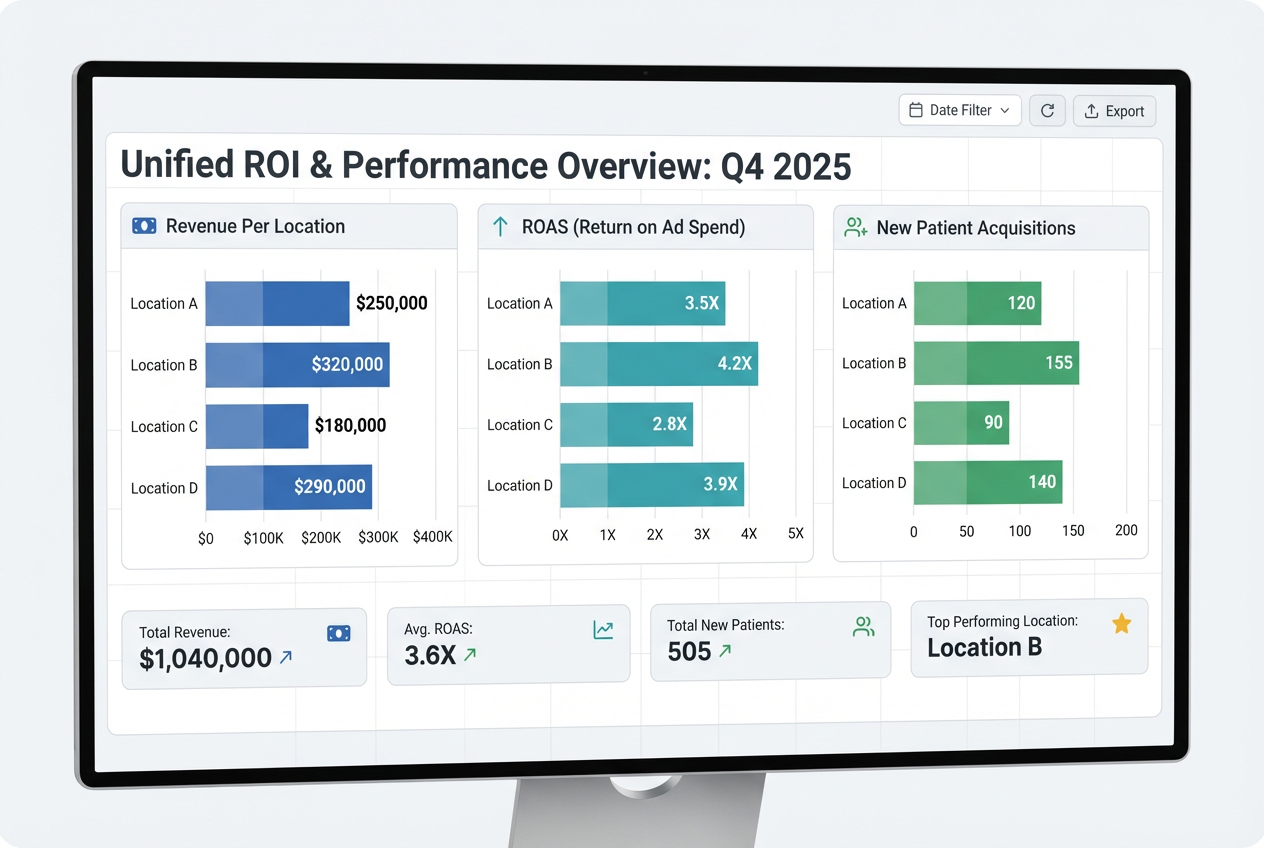
Gain clarity with a unified ROI dashboard, providing real-time insights into revenue, ROAS, and new patient acquisition across all your med spa locations for data-driven decisions.
Your analytics infrastructure should provide real-time visibility into these critical metrics:
By Location:
- New patient acquisition cost
- Return on ad spend (ROAS) by channel
- Average transaction value
- Patient lifetime value
- Appointment conversion rates (how many leads become patients)
- Treatment mix and service popularity
- Staff productivity metrics
By Marketing Channel:
- Cost per lead across Google Ads, Facebook/Instagram, SEO, email, SMS, and other channels
- Lead-to-patient conversion rate by source
- Time-to-conversion by channel (how long from first contact to first appointment)
- Channel-specific ROAS
- Attribution across the patient journey (which touchpoints influenced the conversion)
By Campaign:
- Performance of specific promotions and offers
- Geographic targeting effectiveness
- Ad creative performance
- Landing page conversion rates
- A/B test results comparing different messaging, offers, and designs
Aggregate Enterprise Metrics:
- Total marketing spend across the organization
- Consolidated ROAS across all locations
- Market share trends by location
- Comparative performance between locations (controlling for market size and demographics)
- Year-over-year growth trajectories
This data needs to flow into customized dashboards accessible to different stakeholders. Executives need high-level strategic dashboards showing enterprise-wide trends and location comparisons. Location managers need tactical dashboards showing daily performance and actionable insights for their specific market. Marketing teams need campaign-level dashboards for rapid optimization. Our reporting and data visualization services help transform raw data into strategic insights that drive growth decisions.
The key is connecting advertising platforms (Google Ads, Meta, etc.) to your CRM, your EMR, and your financial systems. When these systems communicate, you can track a patient’s complete journey: which ad they clicked, what landing page converted them, how much they spent on their first visit, which services they purchased subsequently, their total lifetime value, and ultimately whether that marketing dollar delivered positive ROI.
Without this integration, you’re making marketing decisions based on incomplete information—essentially flying blind.
Multi-Location Marketing Automation
Automation allows you to deliver personalized patient experiences at scale without proportionally increasing headcount. But poorly implemented automation feels robotic and damages relationships. Sophisticated automation enhances the patient experience while freeing staff to focus on high-value interactions.
Key automation workflows for multi-location groups:
1. New Lead Nurture Sequences
When someone requests information, they immediately enter a location-specific automated sequence. Early messages educate about your services, address common concerns, share patient testimonials from that location, and gradually encourage booking a consultation. The sequence adapts based on engagement—if they click links about Botox, subsequent messages focus on injectables rather than laser treatments.
2. Appointment Confirmation & Reminders
Automated confirmations are sent immediately after booking with clear directions, parking information, and preparation instructions. Reminders at 72 hours, 24 hours, and 2 hours before the appointment significantly reduce no-shows. Post-appointment follow-ups, checking on results, and satisfaction.
3. Treatment-Specific Education
When patients book specific services, they automatically receive pre-treatment education tailored to that procedure. What to expect, how to prepare, what results look like, and aftercare instructions. This reduces anxiety and improves outcomes while reducing the burden on staff to verbally explain everything.
4. Maintenance & Rebooking Campaigns
Different treatments require different follow-up timing. Botox patients need reminders around 3-4 months. Laser hair removal requires a series booked in advance. Fillers last 12-18 months, depending on the product. Your automation should track each patient’s treatment history and send timely reminders when they’re due for maintenance—personalized to their specific treatment plan.
5. Reactivation Campaigns
Patients who haven’t visited in 6+ months automatically enter win-back sequences. These messages acknowledge their absence, share new services they might be interested in based on past purchases, and offer incentives to return.
6. Birthday & Special Occasions
Automated personalized messages on birthdays and treatment anniversaries with exclusive offers create touchpoints that feel thoughtful while driving revenue.
7. Cross-Location Promotions
When you launch a new service at one location, automated campaigns can target patients from nearby locations who’ve expressed interest in related treatments, encouraging them to visit the new site.
The sophistication comes from segmentation and personalization. Not every patient receives the same messages. Your system should segment based on:
- Treatment history and preferences
- Spending tier (VIP vs. occasional patients)
- Geographic proximity to different locations
- Communication preferences (email vs. SMS frequency)
- Engagement patterns (highly engaged vs. dormant)
Then personalize messages using dynamic content that references their name, past treatments, their location, and tailored recommendations based on their history.
For a comprehensive understanding of implementing automated systems effectively, explore our ultimate guide to marketing automation.
Pillar 3: Precision Advertising & Engaging Patient Journeys
Med spa advertising at scale requires a fundamentally different approach than single-location campaigns. You need a centralized strategy with localized execution, maintaining brand consistency while addressing each market’s unique dynamics.
Geo-Targeted Paid Advertising
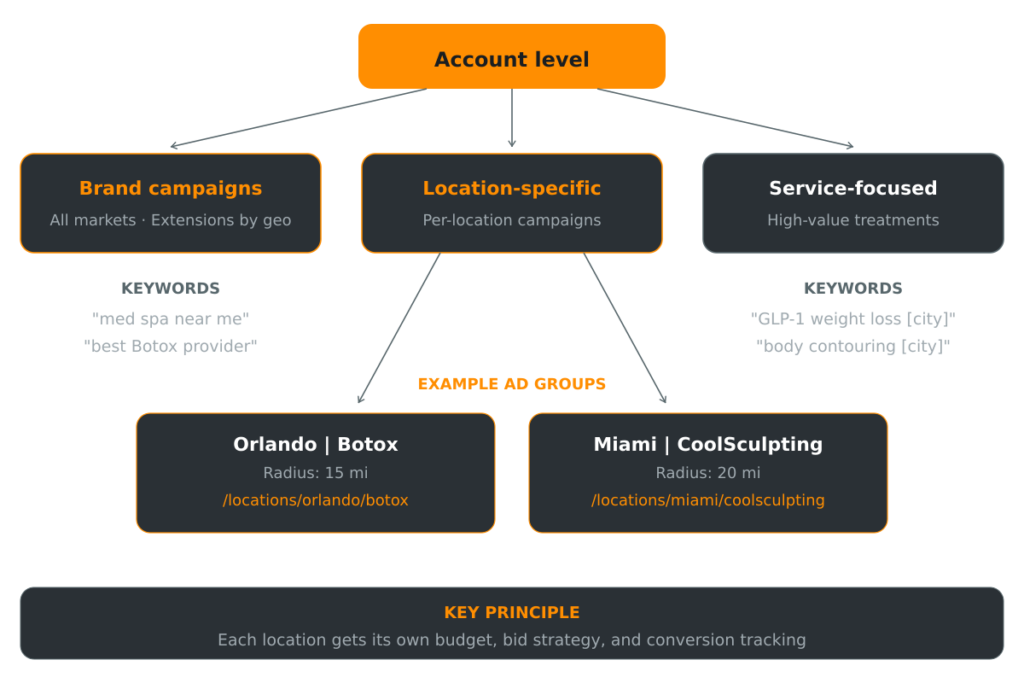
Your paid advertising strategy needs two dimensions: brand campaigns driving overall awareness and consideration across your footprint, and hyper-local campaigns targeting specific geographic areas around each location.
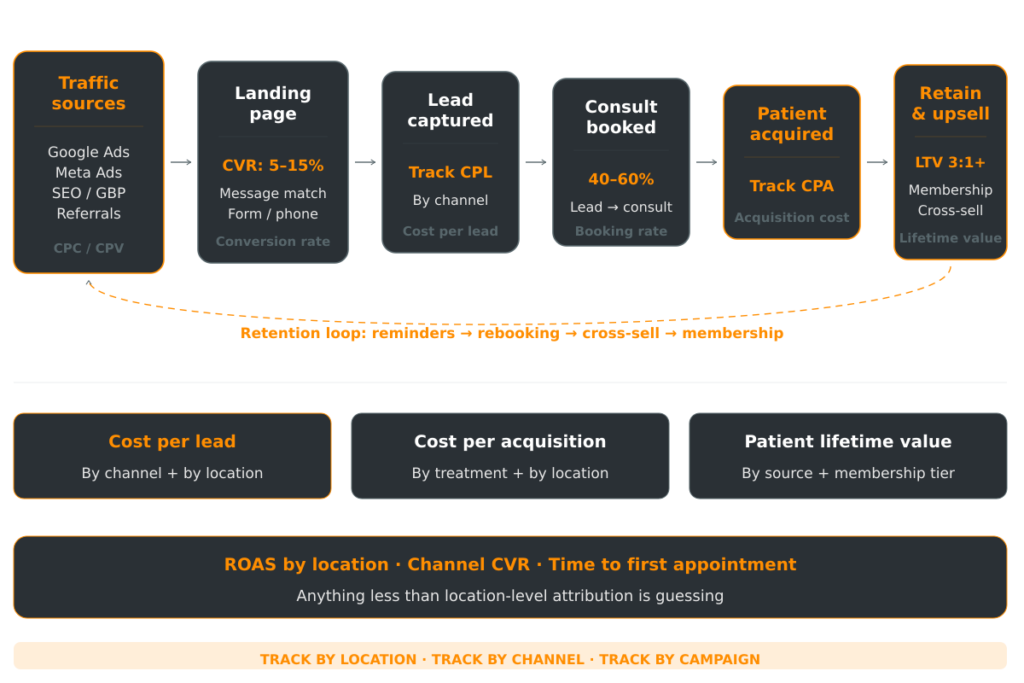
Google Ads Structure for Multi-Location Groups:
Build campaigns with this hierarchy:
- Brand Campaigns: Target broader terms like “med spa near me” and “best Botox provider” across all your markets, with ad extensions showing your nearest location based on the searcher’s geography
- Location-Specific Campaigns: Separate campaigns for each location targeting “med spa [city]” and service-specific local terms like “CoolSculpting Miami” or “lip filler Orlando”
- Service-Focused Location Campaigns: For high-value services, create dedicated campaigns promoting that specific treatment in specific markets, allowing much tighter control over messaging and bidding
Use radius targeting around each location (typically 15-25 miles, depending on market density) to ensure ads reach patients who will actually visit. Adjust bids based on proximity—someone searching 5 miles from your location is far more valuable than someone 20 miles away.
Location extensions are non-negotiable. They show your address, phone number, and business hours directly in search results, dramatically improving click-through rates for local searches.
Dynamic location insertion in ad copy creates personalization at scale. Instead of manually writing ads for each location, use dynamic text replacement to automatically insert the appropriate city name based on the searcher’s location: “Orlando’s Premier Med Spa” vs. “Miami’s Premier Med Spa” from a single ad template.
Facebook/Instagram Strategy for Multi-Location Groups:
Social advertising offers powerful targeting based on demographics, interests, and behaviors—perfect for reaching your ideal patient profile across different markets.
Structure campaigns by:
- Awareness: Broad audience targeting across all your markets, introducing your brand and core services
- Consideration: Retargeting people who’ve engaged with your content or visited your website, providing more detailed information about treatments
- Conversion: Hyper-targeted campaigns with clear offers, driving appointment bookings
Create location-specific ad sets with unique creatives tailored to each market’s demographics and preferences. What resonates with 25-35 year old professionals in Manhattan differs dramatically from 45-60 year old suburban mothers in Tampa. Your creative should reflect these differences while maintaining core brand elements.
Use Advantage+ campaigns (Meta’s AI-powered optimization) for efficiency, but maintain control over geographic targeting and budget allocation between locations. The AI excels at finding your ideal patients within the parameters you set, but it needs direction about which markets to prioritize.
Test aggressively. Run A/B tests comparing:
- Different offers (discount vs. added value vs. financing)
- Creative formats (static images vs. carousel vs. video)
- Messaging angles (results-focused vs. experience-focused vs. science-focused)
- Audience targeting (broader vs. narrow)
Winning combinations get scaled across other markets—but always test localized versions rather than assuming what works in one market automatically works everywhere. For deeper insights into optimizing paid campaigns, read about measuring creativity in paid campaigns.
Social Media Strategy: Brand & Local Engagement
Social media serves two distinct purposes for multi-location groups: building cohesive brand presence and fostering local community engagement. Both are essential; neither alone is sufficient.
Centralized Brand Content:
- Your main social profiles represent the brand across all locations. Content should:
- Showcase your expertise and thought leadership in medical aesthetics
- Highlight patient results (with appropriate permissions and compliance)
- Educate about different treatments and technologies
- Announce company-wide initiatives, new services, and awards
- Share team culture and behind-the-scenes content, humanizing your brand
Post consistently (ideally daily) with high-quality, professional content. Video dramatically outperforms static images—before-and-afters, treatment demonstrations, patient testimonials, and educational clips explaining procedures.
Location-Specific Engagement:
Each location needs its own social presence for a genuine community connection. These accounts should:
- Feature staff at that location (making them local celebrities)
- Highlight patients from that community
- Participate in local events and causes
- Respond to location-specific questions and concerns
- Share location-specific promotions and availability
The balance is critical. Too much emphasis on brand-level content, and you lose local relevance. Too much fragmentation across location accounts and you dilute brand authority and confuse patients about where to follow you.
Many successful multi-location groups use a hub-and-spoke model: a strong central brand account with location-specific accounts for their largest markets, plus location tags and geo-targeted content for smaller locations.
Influencer & Partnership Strategy:
Influencer marketing has evolved from celebrity endorsements to authentic partnerships with local micro-influencers who genuinely connect with your target demographic in specific markets.
For multi-location groups, influencer strategy should include:
- National/Regional partnerships with larger influencers for brand-level awareness
- Market-specific partnerships with local influencers for each location
- Long-term ambassador programs where influencers receive regular treatments and share their ongoing results (far more authentic than one-off posts)
- Staff as influencers (many injectors and medical directors have substantial personal followings—leverage this with proper brand guidelines)
Track influencer ROI meticulously using custom discount codes and landing pages. Too many med spas waste money on influencer partnerships that generate impressive vanity metrics (likes, comments) but zero actual bookings.
Membership & Loyalty Programs
Recurring revenue transforms your business model. One-time patients generate revenue in the months they visit; members generate a predictable monthly income regardless of treatment frequency.
The most effective multi-location membership programs include:
Tiered Membership Structures:
- Entry-level tier offering basic discounts and benefits
- Mid-tier adding more substantial discounts and perks
- VIP tier with maximum benefits, exclusive access, and premium service
This allows patients to choose their commitment level while creating an upgrade path.
“Beauty Bank” Models:
Patients pay a monthly fee that accumulates as credits in their account. Credits can be used for any service at any location. This model offers several advantages:
- Captures consistent monthly revenue even when patients don’t immediately use treatments
- Encourages patients to try new services they might not have considered (since they’ve already paid, they’re more likely to use credits)
- Reduces price sensitivity on additional services
- Creates flexibility for patients who travel between your locations
Multi-Location Benefits:
Design programs that specifically reward patients for visiting multiple locations:
- Credits work at any location in your network
- Special bonuses for visiting a new location for the first time
- Referral programs that work across locations (refer someone to any location, earn rewards at your preferred location)
- Exclusive events bringing members from different locations together
Retention Mechanics:
Build in features that increase long-term retention:
- Credits that expire if membership is canceled (incentivizing continued enrollment)
- Seniority benefits (longer membership tenure unlocks better perks)
- Anniversary gifts and recognition
- Birthday bonuses
- Friends-and-family discounts exclusive to members
Track membership metrics religiously:
- Monthly enrollment rate by location
- Cancellation rate and reasons for cancellation
- Average membership duration
- Credits earned vs. credits redeemed (unused credits represent profit)
- Upgrade rate from lower to higher tiers
- Additional revenue per member beyond membership fees
Membership programs create predictable revenue, increase patient lifetime value, and build deep loyalty to your brand rather than individual providers—exactly what multi-location groups need for sustainable growth. To understand how membership models fit into broader growth strategies, see our guide on B2B demand generation.
Pillar 4: The 2026 Edge – Innovating with AI & Emerging Trends
The groups that will dominate multi-location medical aesthetics in 2026 and beyond aren’t just implementing today’s best practices—they’re positioning themselves at the forefront of emerging technologies and treatment categories.
AI for Hyper-Personalization & Operational Efficiency
Artificial intelligence has moved from experimental novelty to competitive necessity. Multi-location groups have unique opportunities to leverage AI because they generate the data volume necessary to train effective models.
AI-Powered Lead Qualification:
Advanced chatbots and conversational AI handle initial patient inquiries 24/7 across all locations. These systems:
- Answer common questions about services, pricing, and availability
- Qualify leads by asking relevant questions about treatment goals and medical history
- Schedule consultations directly into your calendar based on location availability
- Route complex inquiries to the appropriate human team member
- Capture contact information and add leads to your CRM automatically
The key difference from traditional chatbots: 2026 AI understands context, maintains natural conversations, and provides genuinely helpful responses rather than frustrating pre-programmed scripts.
Predictive Analytics for Demand Forecasting:
AI analyzes historical data to predict:
- Which services will be most in demand in the upcoming weeks/months at each location
- Optimal staffing levels based on expected appointment volume
- Inventory requirements for products and consumables
- Revenue projections by location and service category
- Which existing patients are most likely to book additional treatments
These predictions enable proactive decision-making. Stock up on filler before peak wedding season. Increase ad spend for body contouring in January and February when demand surges. Identify at-risk patients who might not rebook and intervene with targeted outreach.
Hyper-Personalized Patient Communications:
AI enables genuinely personalized messaging at scale. Rather than generic email blasts to your entire database, AI-powered systems analyze individual patient history, preferences, and behaviors to craft personalized recommendations:
- Treatment suggestions based on past purchases and stated goals
- Timing of communications based on when each patient typically engages
- Content format preferences (some patients prefer educational content, others prefer visual results, others respond to limited-time offers)
- Channel preferences (email vs. SMS vs. social media)
This personalization dramatically improves engagement rates and conversion compared to one-size-fits-all campaigns.
AI-Assisted Content Creation:
Creating location-specific content at scale requires enormous effort. AI serves as a powerful accelerator for your marketing team—not replacing human creativity but amplifying it.
Use AI to:
- Generate first drafts of blog posts based on strategic outlines
- Create variations of ad copy tailored to different markets
- Analyze top-performing content and identify patterns to replicate
- Optimize headlines and calls-to-action based on performance data
- Translate content for multilingual markets while maintaining brand voice
The human remains essential for strategy, quality control, brand voice, and adding authentic local insights that AI can’t replicate. But AI handles time-consuming first drafts and variations, allowing your team to produce far more content without proportionally increasing headcount.
Marketing New Treatments: GLP-1s, Semaglutide, Hormone Therapy
The 2026 treatment landscape is dominated by three categories generating explosive patient demand:
Medical Weight Loss (GLP-1 Medications):
Semaglutide (Ozempic, Wegovy) and tirzepatide (Mounjaro, Zepbound) have revolutionized weight loss. Patient interest has surged beyond diabetes and obesity treatment to include aesthetic weight management.
For med spas, this represents a massive opportunity—and a compliance minefield. Marketing these medications requires:
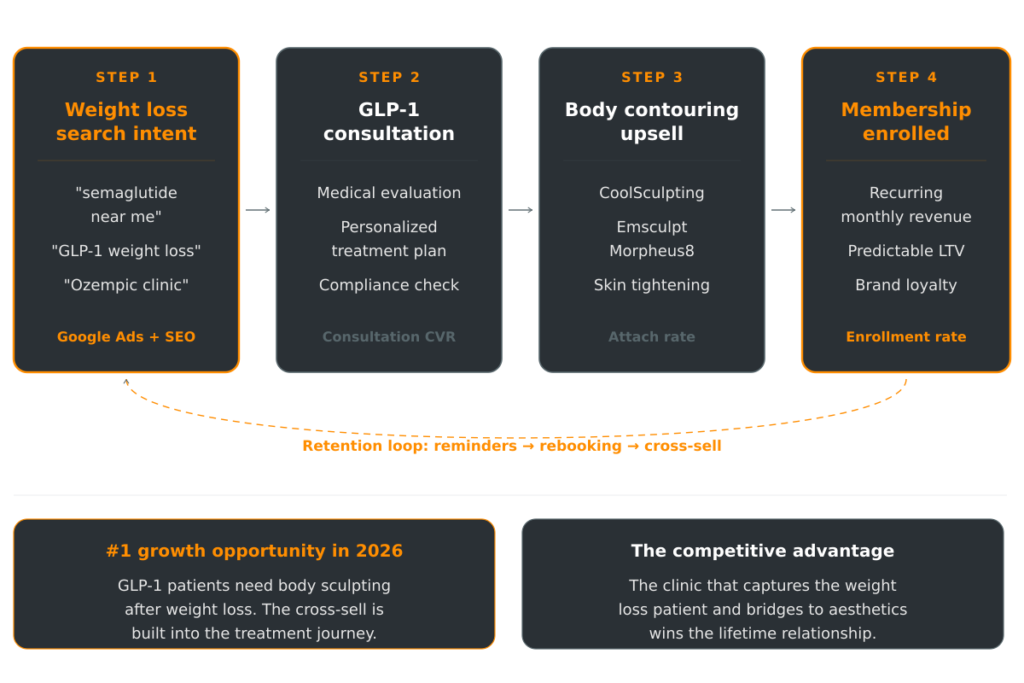
- Clear medical oversight and prescribing protocols
- Education-first approach explaining how GLP-1s work, expected results, and appropriate candidates
- Transparent pricing (many patients comparison shop extensively)
- Combination positioning (GLP-1s plus body contouring for optimal results)
- State-specific compliance with telehealth regulations and prescribing requirements
- Management of supply chain challenges (shortages have plagued these medications)
Your marketing should emphasize your medical credentials, safety protocols, and comprehensive weight management programs—not just medication access. Position yourselves as the medically-supervised destination for weight loss, not just a prescription mill.
Bio-Identical Hormone Replacement Therapy:
As aging populations seek vitality and longevity solutions, BHRT has exploded in popularity. Both men (testosterone replacement) and women (estrogen, progesterone, thyroid optimization) represent enormous markets.
Marketing BHRT effectively requires:
- Educational content explaining hormone decline, symptoms, and treatment benefits
- Medical credibility (board-certified physicians, proper testing protocols)
- Personalized approach (cookie-cutter hormone protocols don’t work)
- Ongoing monitoring and optimization messaging
- Addressing safety concerns and misconceptions
- Targeting both aesthetic benefits (body composition, skin quality, energy) and broader wellness impacts
Regenerative Aesthetics:
Treatments like PRP (platelet-rich plasma), PRF (platelet-rich fibrin), exosomes, and stem cell therapies represent the cutting edge of medical aesthetics. These science-forward treatments appeal to patients seeking natural, long-lasting results.
Marketing regenerative treatments requires:
- Heavy educational focus (most patients don’t understand these technologies)
- Scientific credibility and research citations
- Clear differentiation between different modalities
- Realistic expectation-setting (results take time, not instant gratification)
- Combination treatment protocols (regenerative aesthetics work synergistically with other services)
For all three categories, compliance is paramount. Work with legal counsel familiar with medical marketing regulations in each state you operate. Different states have vastly different rules about:
- What can be claimed in advertising
- Telehealth prescribing requirements
- Required patient consultations before treatment
- Permitted marketing channels for prescription medications
A compliance violation in one location can jeopardize your entire multi-location operation. Invest in proper legal guidance upfront.
Why a Strategic Agency is Your 2026 Growth Partner
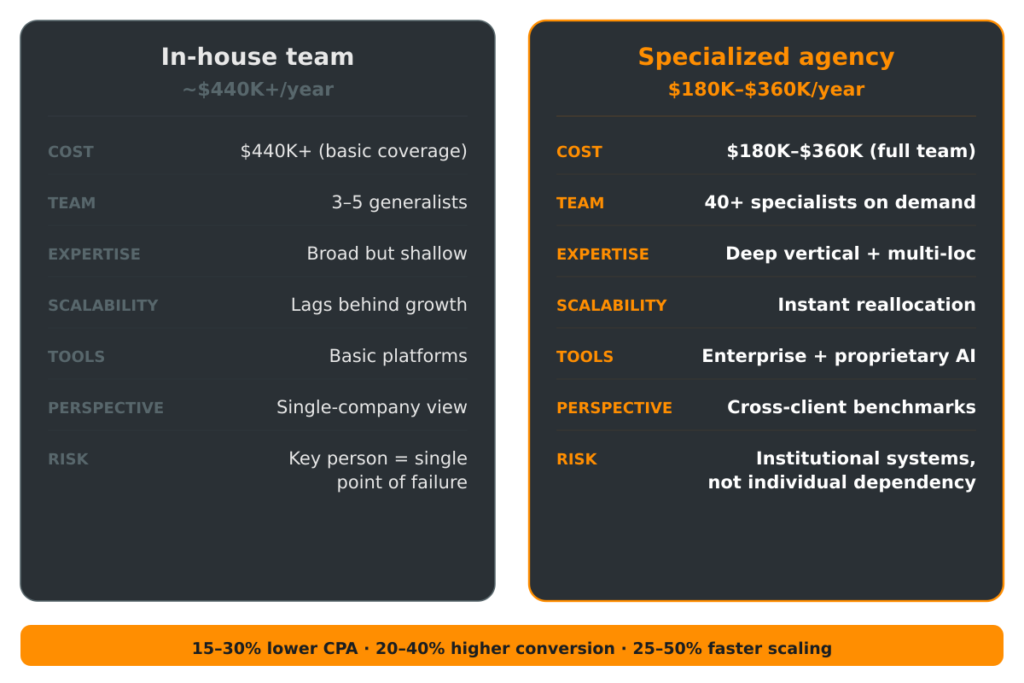
Evaluate your options for multi-location med spa growth: In-house teams offer limited specialization, while a strategic agency provides deep expertise, scalable solutions, and measurable ROI.
The Limits of In-House & The Power of Specialization
Your internal marketing team faces structural limitations that prevent them from executing the 2026 playbook at the level your business requires.
Most multi-location med spa groups have 0-5 internal marketing people. These individuals typically handle tactical execution: posting social content, responding to reviews, coordinating promotions, and managing basic advertising. They’re generalists by necessity—one person wearing multiple hats across different marketing functions.
This structure worked fine at 1-3 locations. But as you scale, the complexity multiplies faster than you can reasonably hire.
Consider what comprehensive multi-location marketing actually requires:
- Paid Search Expertise: Sophisticated Google Ads management across multiple locations, proper geo-targeting, conversion tracking, bid optimization, and competitive analysis
- Paid Social Expertise: Meta advertising strategy, creative production, audience targeting, performance analysis across platforms
- Med Spa SEO Specialists: Technical site optimization, content strategy, link building, local SEO for each location, ongoing algorithm updates
- Content Creation: Writers, designers, videographers producing location-specific and brand-level content at scale
- CRO Experts: Conversion rate optimization testing landing pages, forms, and user flows
- Analytics & Data Science: Building dashboards, implementing proper tracking, analyzing complex data sets, and providing strategic insights
- Marketing Automation: Workflow design, email/SMS campaign management, segmentation strategy
- Reputation Management: Review generation systems, response protocols, and monitoring
- Compliance Oversight: Ensuring all marketing adheres to state-specific regulations
That’s not a 5-person team—that’s a 15+ person team with specialized expertise in each function. And that’s before you consider the management overhead of coordinating all these specialists across multiple locations.
Building this team in-house creates several problems:
- Cost: Senior marketing specialists command $75K-$150K+ salaries depending on expertise and market. Building a full internal team costs $1M+ annually in payroll alone, not including benefits, tools, training, and overhead.
- Recruitment Challenge: Finding, vetting, and hiring top marketing talent is extraordinarily difficult, especially in smaller markets where your locations operate. Many of these specialists prefer agency environments offering variety and career growth.
- Retention Risk: When a key person leaves (and they will), you lose critical knowledge and momentum. Replacing them takes months. Their absence creates immediate performance degradation.
- Limited Perspective: Internal teams only see your business. They can’t benchmark against competitors or cross-pollinate strategies from other industries. Their perspective becomes insular.
- Technology Limitations: Internal teams typically lack access to enterprise-level tools and platforms agencies use (comprehensive analytics platforms, advanced testing tools, proprietary technologies).
- Scalability Constraints: Scaling an internal team proportionally with your growth creates lag. You’re always understaffed during rapid expansion periods.
The Agency Advantage: Specialized Expertise Meets Scalable Systems
A specialized multi-location medical aesthetics marketing agency solves these limitations systematically.
Deep Vertical Expertise: Agencies working exclusively with med spas and aesthetic practices understand your industry intimately. They know what messaging resonates with patients. They understand the treatment journey. They’ve navigated the compliance landscape. They’ve seen what works across dozens of similar clients.
This specialization means you’re not paying for them to learn your industry—they bring accumulated expertise from hundreds of campaigns and millions in ad spend across the vertical.
Complete Team, Immediate Access: Rather than building a team over months or years, you immediately access the full breadth of specialists needed: strategists, account managers, paid media experts, SEO specialists, content creators, designers, developers, and analysts. All coordinated, all aligned, all focused on your success.
Proven Systems & Methodologies: Agencies have refined playbooks based on extensive testing across multiple clients. They know what works. They’ve identified patterns. They’ve systematized approaches that consistently deliver results.
These proven systems dramatically reduce the trial-and-error period. Rather than experimenting to figure out what works for your multi-location group, you implement strategies already validated across similar businesses.
Scalable Resource Allocation: As your business grows, the agency scales support seamlessly. Opening new locations doesn’t require hiring and training new internal team members—it’s a simple resource allocation adjustment within the agency.
Technology & Tools: Agencies invest in enterprise-level platforms that would be prohibitively expensive for individual clients: comprehensive analytics platforms, testing tools, automation systems, and proprietary technologies. You benefit from these investments without bearing the full cost.
Objective Strategic Perspective: External agencies bring a fresh perspective unburdened by internal politics or legacy assumptions. They’ll challenge strategies that aren’t working and push for changes internal teams might avoid suggesting.
Continuous Optimization: Agencies monitor your campaigns daily, testing constantly, optimizing relentlessly. This is their full-time focus—not something squeezed between other operational responsibilities.
The ROI Case: Agency Partnership vs. Internal Build
Consider the math:
Internal Marketing Team (Moderate Scale):
- Marketing Director: $120K
- Paid Media Specialist: $75K
- Content Manager: $65K
- Social Media Manager: $55K
- Benefits & Overhead (30%): $94K
- Tools & Software: $30K
Total Annual Cost: ~$440K
This gets you basic coverage with significant gaps. No specialized SEO. Limited analytics. No CRO expertise. No video production. Constant capacity constraints.
Specialized Agency Partnership:
- Monthly Agency Fee: $15K-$30K ($180K-$360K annually)
- Includes complete team: strategy, execution, optimization
- Includes tools and technology
- Scales with your growth
Total Annual Cost: $180K-$360K
The agency delivers more comprehensive coverage at comparable or lower cost. But the real ROI comes from performance, not just cost comparison.
An exceptional agency generates measurably better results:
- 15-30% lower cost per acquisition (better optimization, proven strategies)
- 20-40% higher conversion rates (superior landing pages, better creative)
- 25-50% faster scaling velocity (proven systems allow rapid expansion)
- Significantly reduced risk (compliance expertise prevents costly mistakes)
These performance improvements easily justify the investment. A 20% improvement in cost per acquisition across a $500K annual ad spend saves $100K annually—covering more than half the agency cost just from efficiency gains. To learn more about how specialized agencies deliver results, explore our comprehensive digital marketing services.
Chatter Buzz: Your Architects of Multi-Location Med Spa Growth
At Chatter Buzz, we’ve engineered our entire practice around one specific challenge: helping multi-location service businesses scale their marketing systematically and profitably.
We’re not generalists. We don’t serve every industry. We focus on businesses with multiple locations where a centralized brand strategy must coexist with localized market execution—exactly your challenge.
Our Approach:
We begin every partnership with deep discovery. We need to understand your business model, growth objectives, competitive landscape, current marketing performance, technology stack, and operational capabilities. This isn’t a quick sales process—it’s strategic due diligence ensuring we can genuinely deliver the results you need.
From that foundation, we architect a comprehensive playbook customized to your specific situation:
- Which locations have the highest growth potential based on market dynamics
- How to allocate budget across locations for maximum ROI
- What technology integrations will deliver the most value
- Which marketing channels will drive the most efficient patient acquisition
- How to structure campaigns balancing brand-building and direct response
- What content strategy will support both local SEO and brand authority
- How to measure and optimize performance across your entire organization
Then we execute relentlessly. Daily campaign monitoring. Weekly optimization. Monthly strategic reviews. Quarterly planning sessions align marketing with your evolving business objectives.
Our Differentiators:
- ROI-Obsessed Culture: We’re not impressed by vanity metrics. We care about the numbers that actually matter to your business: cost per patient acquisition, return on ad spend, revenue per location, and patient lifetime value. Every campaign, every tactic, every optimization is evaluated through an ROI lens.
- Integrated Technology Stack: We’ve built proprietary systems connecting advertising platforms, analytics tools, and reporting dashboards to give you unprecedented visibility into marketing performance. You see exactly what’s working, what’s not, and where to invest more.
- Scalable Processes: Our methodologies are explicitly designed for multi-location businesses. We’ve solved the inherent complexity—you benefit from those solutions.
- Vertical Expertise: We understand medical aesthetics intimately. We know the patient journey. We understand compliance requirements. We’ve marketed every treatment category. We know what resonates with different demographic segments.
- Strategic Partnership Mindset: We don’t see ourselves as a vendor executing your instructions. We’re your strategic growth partner, providing high-level guidance and proactively identifying opportunities you might not see internally. Our compensation aligns with your success—we win when you win.
This isn’t an “agency as order-taker” relationship. It’s a true partnership where we invest deeply in understanding your business and commit to driving measurable growth across your entire organization. Explore how our fractional CMO services can provide executive-level strategic guidance alongside comprehensive execution.
See It in Action:
The Challenge: Age Rejuvenation operates 5 locations across Florida, each with different service mixes, patient demographics, and competitive landscapes. Their previous agency ran a single Google Ads strategy across all locations. Results were inconsistent. Cost per booked appointment varied wildly by market. The owner couldn’t tell which locations were profitable from paid media and which were bleeding budget.
What Chatter Buzz Built: Per-location Google Ads campaigns with geo-targeted bidding, location-specific landing pages, and unified reporting that breaks down cost per lead, cost per booked appointment, and ROAS by individual location. We manage $300K+/month in Google Ads spend across their network — with each dollar tracked to a specific market.
The Result: Location-level visibility that turned guesswork into precision. The owner now sees exactly which markets deliver the strongest return and reallocates budget accordingly, every month, based on data, not intuition.
Read the full Age Rejuvenation case study.
Selecting Your 2026 Marketing Partner: What to Look For
Not all agencies claiming multi-location expertise actually deliver results. Here’s how to identify exceptional partners from vendors who’ll waste your time and money:
1. Demonstrable Multi-Location Expertise
Ask for case studies specifically showing how they’ve helped other multi-location businesses scale. Not generic “healthcare marketing” examples—multi-location case studies with concrete results.
Look for evidence they understand the unique challenges: centralized brand control with local customization, cross-location analytics, geo-targeted campaigns, location-specific SEO, and integrated technology systems.
If their case studies focus on single-location businesses or lack specificity about multi-location strategies, they’re learning on your dime.
2. Vertical Specialization
Agencies serving “everyone” serve no one particularly well. Look for partners specializing in medical aesthetics, med spas, or medical practices. This specialization ensures they understand:
- Your patient journey and decision-making process
- Compliance requirements and advertising restrictions
- Treatment categories and seasonal demand patterns
- Competitive dynamics in your markets
- What messaging resonates with different demographic segments
Ask specific questions about your industry. If they fumble basic concepts or provide generic answers, their “expertise” is superficial.
3. Integrated Technology & Transparent Reporting
Exceptional agencies provide unified dashboards showing performance across all locations and campaigns. You should see:
- Real-time performance metrics by location and channel
- Cost per lead and cost per acquisition by location
- Return on ad spend by campaign
- Attribution showing which touchpoints influence conversions
- Year-over-year growth trends
- Comparative performance between locations
If an agency can’t show you its reporting dashboards during the sales process, assume their reporting is inadequate.
Also, examine their technology stack. What tools do they use for analytics, testing, automation, and optimization? Are they using cutting-edge platforms or relying on basic tools anyone can access?
4. Proven Track Record with Quantifiable Results
Demand specific performance metrics from their existing clients:
- Average cost per acquisition achieved
- Typical return on ad spend
- Growth rates they’ve delivered
- Time to profitability for new campaigns
- Client retention rates
Vague claims about “increasing leads” or “growing revenue” without specific numbers indicate they either don’t measure properly or don’t deliver meaningful results.
Ask for client references. Speak with their existing clients about:
- Communication quality and responsiveness
- Strategic value provided beyond tactical execution
- Problem-solving capability when challenges arise
- How they handle market-specific issues
- Whether the results justify the investment
5. Strategic Consultation, Not Just Execution
You don’t need another vendor executing your instructions. You need strategic guidance from partners who’ve solved problems you haven’t encountered yet.
During sales conversations, evaluate whether they:
- Ask penetrating questions about your business and growth objectives
- Challenge assumptions or strategies that won’t scale
- Proactively identify opportunities you haven’t considered
- Demonstrate strategic thinking about your market dynamics
- Provide valuable insights during the sales process itself (if they’re not helpful before you’re a client, they won’t be after)
The best partners function as an extension of your leadership team, providing executive-level strategic advice alongside tactical execution.
6. Cultural Fit & Communication Style
You’ll interact with this agency weekly for years if the partnership works. Cultural fit matters.
Evaluate:
- Do they communicate in your preferred style (data-driven? Creative? Balance?)
- Are they responsive to questions and concerns?
- Do they respect your time?
- Do they seem genuinely interested in your success or just closing a sale?
- Do their values align with yours?
Misalignment in communication style and values creates friction that undermines the partnership regardless of technical competence.
7. Realistic Expectations & Honest Assessments
Beware agencies promising unrealistic results, guaranteeing specific outcomes, or claiming they can deliver everything immediately.
Ethical agencies set realistic expectations:
- SEO takes months to deliver meaningful results
- Paid advertising performance improves with testing and optimization over time
- Some markets will be more difficult/expensive than others
- Budget constraints limit what’s achievable
- Your website may need improvements before campaigns will convert optimally
They’ll be honest about challenges, realistic about timelines, and transparent about what they can and cannot control.
If an agency’s sales pitch sounds too good to be true, it probably is. Choose partners who earn your trust through honesty, not those who make exaggerated promises.
Conclusion: Unlock Your Multi-Location Med Spa’s Full Potential in 2026
The multi-location medical aesthetics market has never offered more opportunities. Patient demand continues to surge. Treatment options expand constantly. The industry matures, favoring sophisticated operators who can scale professionally while maintaining quality.
But the window for competitive advantage is closing. As more groups adopt the systematic approaches outlined in this playbook, standing out becomes harder. The groups implementing these strategies now will build insurmountable leads over competitors who delay.
You have three options:
Option 1: Continue Your Current Approach
If your current marketing delivers the growth you need, maintains consistent performance across all locations, provides clear ROI visibility, and positions you for continued expansion, continue what works.
But if you’re experiencing the common pain points of multi-location marketing (inconsistent results, unclear ROI, operational complexity, difficulty scaling), staying the course means accepting these limitations permanently.
Option 2: Build Internal Capabilities
You could invest in building a comprehensive internal marketing team, implementing the 2026 playbook. This requires significant time, capital, and recruiting effort. It means accepting the learning curve as they figure out what works for your multi-location operation.
For groups with massive scale (20+ locations generating $50M+), building world-class internal capabilities may make strategic sense. For most groups, it’s a less efficient path than partnering with specialists.
Option 3: Partner with Specialized Experts
You could engage a specialized agency that’s already implemented these strategies for similar multi-location businesses. You’d access proven systems, comprehensive expertise, integrated technology, and strategic guidance—delivered immediately rather than built over years.
This option delivers the fastest time to results, lowest risk, and often the best overall ROI for groups scaling from 4-20 locations.
The choice depends on your specific situation, resources, and growth timeline. But one thing is certain: the status quo won’t deliver the results you need in 2026 and beyond. The multi-location groups dominating your markets five years from now are implementing sophisticated marketing systems today.
Take Action Now
If you’re ready to implement the 2026 playbook and unlock your multi-location group’s full growth potential, let’s start a conversation.
At Chatter Buzz, we offer complimentary strategy sessions for qualified multi-location med spa groups. During this 45-minute consultation, we’ll:
- Analyze your current marketing performance and identify immediate opportunities
- Assess your competitive positioning in each market you operate in
- Evaluate your technology stack and integration opportunities
- Identify your highest-leverage growth opportunities
- Provide actionable recommendations you can implement regardless of whether we work together
We’re selective about partnerships—we only work with groups where we’re confident we can deliver exceptional results. This consultation helps both of us determine if there’s a genuine fit.
There’s no pressure. No sales pitch. Just strategic insights from experts who’ve helped dozens of multi-location groups scale profitably.
Schedule your complimentary 2026 Multi-Location Med Spa Marketing Strategy Session now.
Your competitors are implementing these strategies today. Don’t give them a two-year head start.
Contact our team of digital marketing specialists to begin your transformation.
Frequently Asked Questions
Q: How much should a multi-location med spa group budget for marketing annually?
A: A common benchmark is 7-12% of gross revenue for established locations, potentially 15-20% for new locations in their first year. However, the right budget depends on your growth objectives, market competitiveness, and current patient acquisition cost.
Groups focused on aggressive expansion often invest more heavily in med spa advertising and patient acquisition. The key is ensuring your customer lifetime value significantly exceeds acquisition cost, typically targeting at least a 3:1 LTV: CAC ratio.
Rather than starting with a percentage, calculate your growth objectives (e.g., “We need 200 new patients per location this year”), determine how many leads that requires based on conversion rates, then calculate the budget needed to generate those leads at your target cost per lead. For detailed guidance on budgeting, see our article on how to calculate your digital marketing budget.
Q: How long does it take to see results from a new multi-location marketing strategy?
A: Expect 3-6 months to see meaningful results from comprehensive strategic changes.
Here’s the typical timeline:
- Months 1-2 focus on foundation-building—implementing tracking, optimizing your website, and establishing campaigns.
- Months 3-4 show initial results as campaigns mature and optimization kicks in.
- Months 5-6 deliver more predictable, scalable results as you’ve gathered sufficient data to optimize effectively.
SEO specifically takes longer—6-12 months for significant organic traffic improvements. Paid advertising delivers faster results but still requires 90+ days to optimize properly.
Anyone promising instant, dramatic results is either exaggerating or planning unsustainable tactics. Sustainable, scalable growth takes time to build correctly. For realistic expectations on specific channels, read our insights on how long SEO takes to work.
Q: Should each location have its own website or social media accounts?
A: For websites, use a single authoritative domain with dedicated location pages rather than separate websites. This consolidates SEO authority and simplifies management while still allowing location-specific optimization.
For social media, it depends on scale. Your main brand accounts are essential. Large, established locations benefit from their own local social presences for community engagement. Smaller or newer locations can be served through geo-targeted content on brand accounts.
Many groups use a “hub and spoke” model—strong central brand presence with individual accounts for major markets only. This balances brand consistency with local community connection without creating unmanageable fragmentation across too many channels.
Q: How do we maintain brand consistency while allowing local customization?
A: Create clear brand guidelines defining what must remain consistent (logo usage, color palette, core messaging, service standards, tone of voice) versus what can be customized locally (specific promotions, local events, staff spotlights, community partnerships).
Implement approval workflows where local teams can develop customized content within established parameters, with final approval from corporate marketing for anything falling outside guidelines. Use templated resources that maintain brand standards while allowing local personalization—think customizable flyer templates, social media graphics with local information fields, and email templates adaptable for local promotions.
Regular training ensures location teams understand both the “what” and “why” of brand standards. Technology also helps—many platforms allow corporate-controlled brand elements with location-specific variable content.
Q: What’s the best way to allocate marketing budget across multiple locations?
A: Start with baseline funding for all locations, ensuring minimum viable presence, then allocate additional budget based on several factors: market opportunity (size, demographics, competition), location maturity (new locations typically need more investment), historical performance (allocate more to locations with proven efficient conversion), and strategic priorities (markets you’re prioritizing for growth).
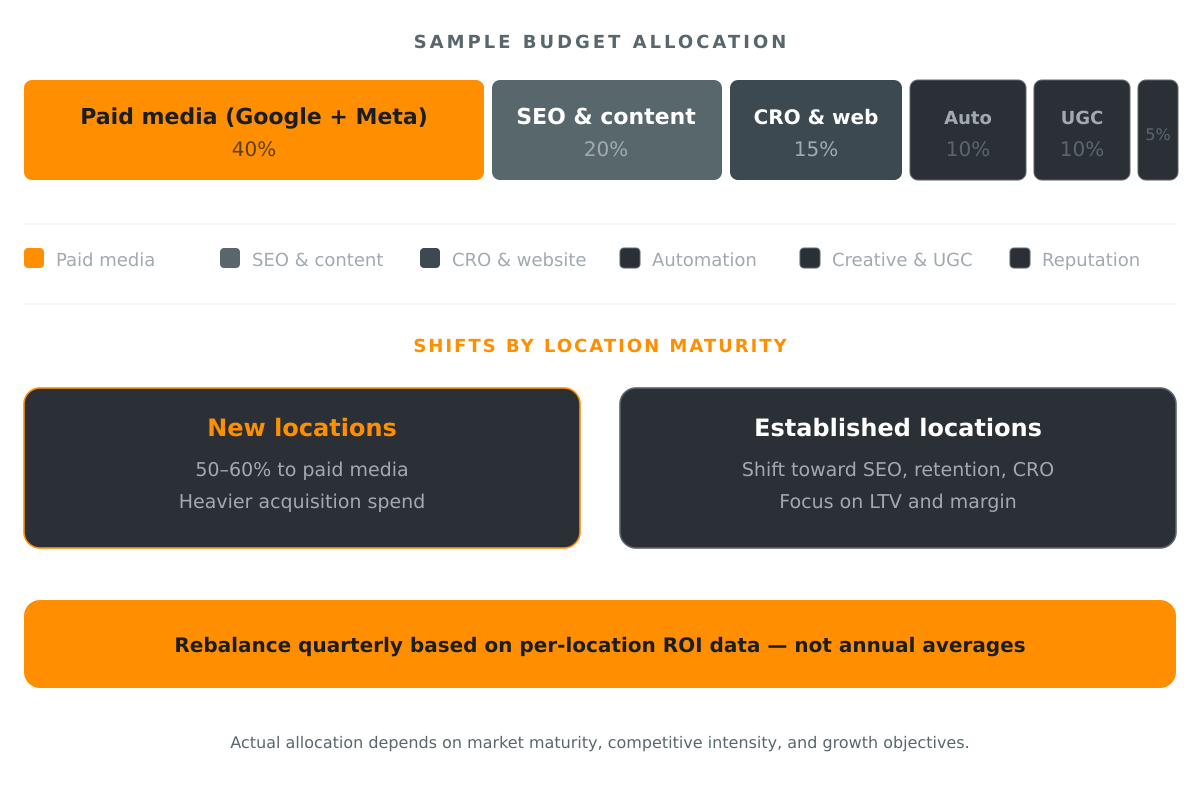
Implement dynamic budget allocation that shifts resources toward top-performing locations and markets, but avoid completely defunding underperforming locations before you’ve given strategies adequate time to work. Track ROI by location and use that data to optimize allocation quarterly.
Set minimum and maximum thresholds—no location should receive less than X% or more than Y% of the total budget to prevent either complete neglect or over-concentration. Most importantly, allocate based on strategic objectives, not just historical patterns. Sometimes your lowest-performing location simply needs more investment and better strategy, not less budget.
Q: How do we handle different regulations for medical services across states?
A: Work with legal counsel experienced in multi-state medical marketing compliance to develop state-specific guidelines. Create a compliance matrix documenting what can/cannot be claimed for each treatment in each state you operate. Implement mandatory legal review for any marketing materials promoting medical services before they go live. Use geo-targeting to ensure marketing messages only appear in appropriate jurisdictions where they’re compliant.
Train local teams on their state’s specific requirements and provide them with pre-approved marketing templates. Build compliance checks into your approval workflows so non-compliant materials can’t launch accidentally. Stay current on regulatory changes through industry associations and legal counsel—regulations evolve constantly.
When in doubt, err on the conservative side; non-compliance penalties far outweigh any marginal benefit from aggressive marketing claims. Many successful multi-location groups designate a compliance officer responsible for monitoring regulations across all markets and ensuring marketing adheres to the most restrictive standards anywhere you operate.
Q: Should we hire a fractional CMO or work with an agency for multi-location marketing?
A: This depends on your internal capabilities and needs. A fractional CMO provides strategic leadership, develops marketing vision, and oversees execution—but typically doesn’t handle tactical implementation directly. This works well if you have competent execution resources (internal team or agencies) but lack senior strategic guidance.
An agency provides both strategy and comprehensive execution, offering a complete solution if you lack internal marketing depth. The best option for many multi-location groups: combine both. A fractional CMO sets strategic direction and provides executive-level oversight while a specialized agency handles day-to-day execution.
This creates accountability (the CMO evaluates agency performance objectively) while ensuring both strategic vision and tactical excellence. It’s particularly effective during rapid growth phases when internal marketing leadership hasn’t scaled to match organizational needs. For more insights on when to consider this model, read our comprehensive guide to fractional chief marketing officer services.
Q: What key performance indicators should we track for multi-location med spa marketing?
A: Track these essential KPIs across all locations and by individual location:
- Patient Acquisition Metrics: Cost per lead (CPL), lead-to-consultation conversion rate, consultation-to-patient conversion rate, overall cost per acquisition (CPA), and new patient volume by source.
- Financial Metrics: Return on ad spend (ROAS), revenue per location, average transaction value, patient lifetime value (LTV), and marketing cost as a percentage of revenue.
- Operational Metrics: Appointment booking rates, no-show rates, treatment mix, cross-sell/upsell rates, membership enrollment, and retention.
- Digital Performance: Website traffic by location, organic search rankings for key terms, Google Business Profile impressions and actions, social media engagement, email open and click rates.
- Comparative Metrics: Location performance against budget, location performance against peer locations, market share by location.
Build dashboards, making these metrics visible in real-time for rapid decision-making. Most importantly, establish clear targets for each metric and review regularly to identify trends requiring strategic adjustments.
Learn more about effective reporting and data visualization to transform these metrics into actionable insights.