
 321-236-2899
B2B Buyer Persona: 6 Steps to Build Profiles Sales Uses

Most B2B buyer persona documents end up exactly where they belong — buried in a shared drive, never opened by the sales reps they were built for. This guide changes that by walking you through six steps to build persona profiles that sales teams actually reference before calls, marketing teams actually use for targeting, and leadership actually trusts for strategic planning.
The stakes are higher than ever. Gartner research found that B2B buying groups now involve five to sixteen people, each with competing priorities, different risk tolerances, and distinct information needs.
Drawing on years of B2B marketing experience across manufacturing, credit union, healthcare, and financial services verticals, this guide shows you how to map entire buying committees, build vertical-specific personas, and activate those profiles across every revenue-generating function. Let’s start with the foundation most teams get wrong.
Key Takeaways
- A B2B buyer persona must account for buying committees of 5-16 people, not just a single decision maker.
- Start persona research with CRM win/loss data and interviews — not demographic worksheets.
- Each role in the buying committee (Champion, Decision Maker, Blocker, End User) needs its own persona variant.
- Generic personas fail across industries — build vertical-specific profiles for manufacturing, healthcare, financial services, and other sectors.
- Negative personas protect your pipeline by defining who you should NOT sell to.
- A persona that lives only in a document is worthless — activation across sales and marketing is what drives revenue.
What Is a B2B Buyer Persona (and Why It Differs from B2C)
A B2B buyer persona is a research-backed, semi-fictional representation of a key stakeholder in your target company’s purchasing process. Unlike B2C personas that focus on individual consumers, a B2B customer persona captures professional goals, organizational constraints, buying authority, and the internal politics that shape every purchasing decision.

The differences between B2B and B2C personas run deeper than most marketers realize. B2C purchases are often impulsive, individual, and emotion-driven. B2B purchases involve committees, compliance gatekeepers, multi-month evaluation cycles, and rational justification requirements that must satisfy everyone from the CFO to the IT security team.
Here’s where confusion creeps in: an ideal customer profile (ICP) describes the company you want to sell to, while a buyer persona describes the person within that company. Your ICP might be “mid-market manufacturing firms with $50M-$200M revenue.” Your buyer persona is the VP of Operations at that firm who champions new technology purchases.
Most B2C persona templates fail for B2B because they obsess over demographics like age, hobbies, and favorite social platforms. A B2B decision maker’s Netflix preferences tell you nothing useful. What matters is their reporting structure, budget authority, evaluation criteria, and the internal obstacles they face when trying to approve a vendor.
The b2b buyer journey also moves differently. Forrester research shows that today’s B2B buyers expect an equal partner relationship, not a vendor pitch. They self-educate extensively before ever talking to sales, which means your personas must inform content strategy as much as they inform talk tracks.
Step 1 — Start With CRM Data and Win/Loss Interviews
The best B2B buyer personas are built from revenue data, not guesswork. If you start with a blank demographics worksheet or a downloadable buyer persona template B2B from the internet, you’re already headed in the wrong direction — start with your CRM instead.

Pull data from your last 50-100 closed deals, both wins and losses. For each deal, document who initiated the conversation, who joined the evaluation, who had veto power, what objections surfaced, and what content they consumed before signing.
Pay special attention to patterns in lost deals. The objections that killed deals reveal more about your personas’ real concerns than any survey ever will. If your CRM tracks contact roles, you already have a head start on mapping the buying committee.
Next, conduct 8-12 win/loss interviews. The minimum viable set is three won customers, three lost prospects, and three churned accounts. Ask open-ended questions about their evaluation process, not leading questions about your product.
Questions like “Walk me through how the decision to evaluate solutions happened” and “Who else was involved, and what were their concerns?” generate verbatim quotes that become persona gold. These direct quotes — the exact language buyers use to describe their problems — are more valuable than any demographic data point because they become the foundation for compelling sales copy and content.
Record these interviews with permission and transcribe them. When your sales team hears a prospect say “I spent three months trying to get budget approval because my CFO didn’t understand why we needed this,” that story shapes how they handle the next deal. For more on structuring these conversations effectively, explore these lead generation strategy questions that reveal buyer motivations.
Step 2 — Map the Full Buying Committee
In B2B, you don’t sell to a person — you sell to a committee. That Gartner finding about 5-16 people touching a purchase decision isn’t an outlier; it’s the norm in enterprise and mid-market sales. Every one of those people can slow, stall, or kill your deal if you haven’t anticipated their concerns.
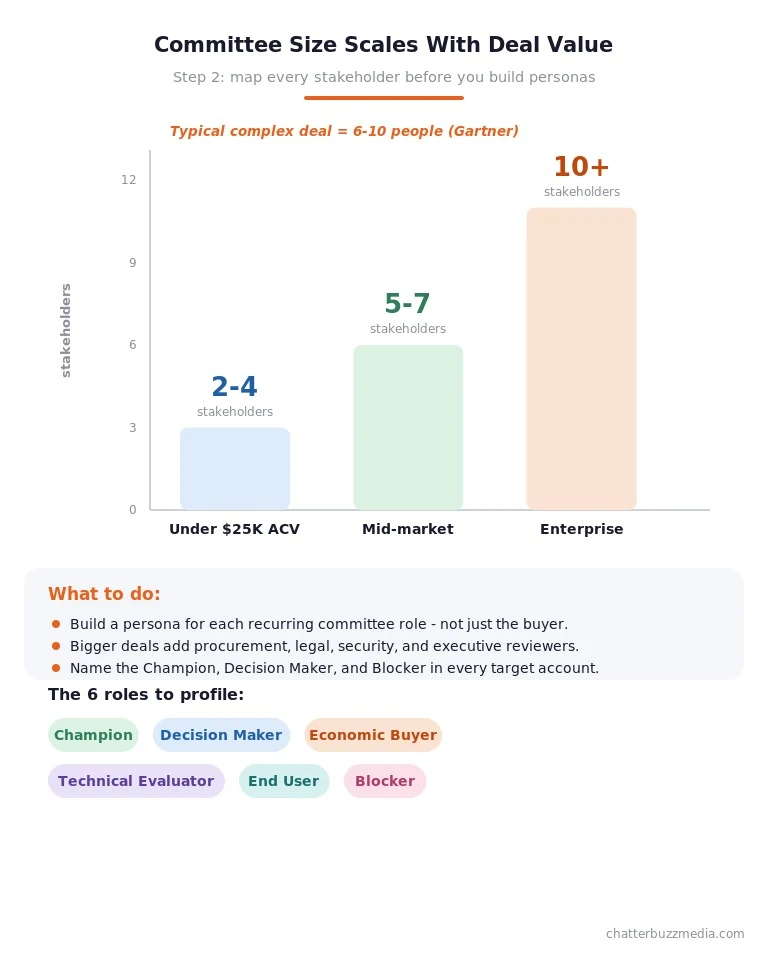
Start by identifying five core roles that appear in nearly every B2B purchase. The Champion is your internal advocate — the person who found you, believes in the solution, and fights for budget. The Decision Maker holds final sign-off authority, usually a VP or C-suite executive.
The Influencer shapes the evaluation criteria without having direct authority. This might be a consultant, an industry analyst the team trusts, or a senior peer in another department. The Blocker is the person with veto power who surfaces objections around security, compliance, integration risk, or budget — and every buying committee has at least one blocker.
Finally, the End User is the person who will live with the solution daily. Their adoption concerns around ease of use, training requirements, and workflow disruption are frequently ignored in the sales process, which leads to post-sale churn.
Each of these roles needs its own persona or persona variant. A Champion persona and a Blocker persona for the same deal look completely different — different pain points, different content needs, different objections, and different communication preferences.
Map reporting structures to understand who influences whom. In many organizations, the Champion reports to the Decision Maker but the Blocker (often IT or Legal) has a dotted-line veto that can override both. Your sales team needs to understand this hierarchy before they walk into a meeting. Account-based marketing strategies depend on this committee mapping to deliver the right message to the right stakeholder at the right time.
If you want evidence that this committee-level approach drives real results, review how ABM delivers measurable ROI when personas align with buying committee roles.
Step 3 — Document Pain Points, Goals, and Decision Criteria
Every persona needs three layers of insight: what keeps them up at night, what success looks like in their role, and what criteria they use to evaluate vendors. Without these three layers, you have a contact profile — not a persona that drives revenue.
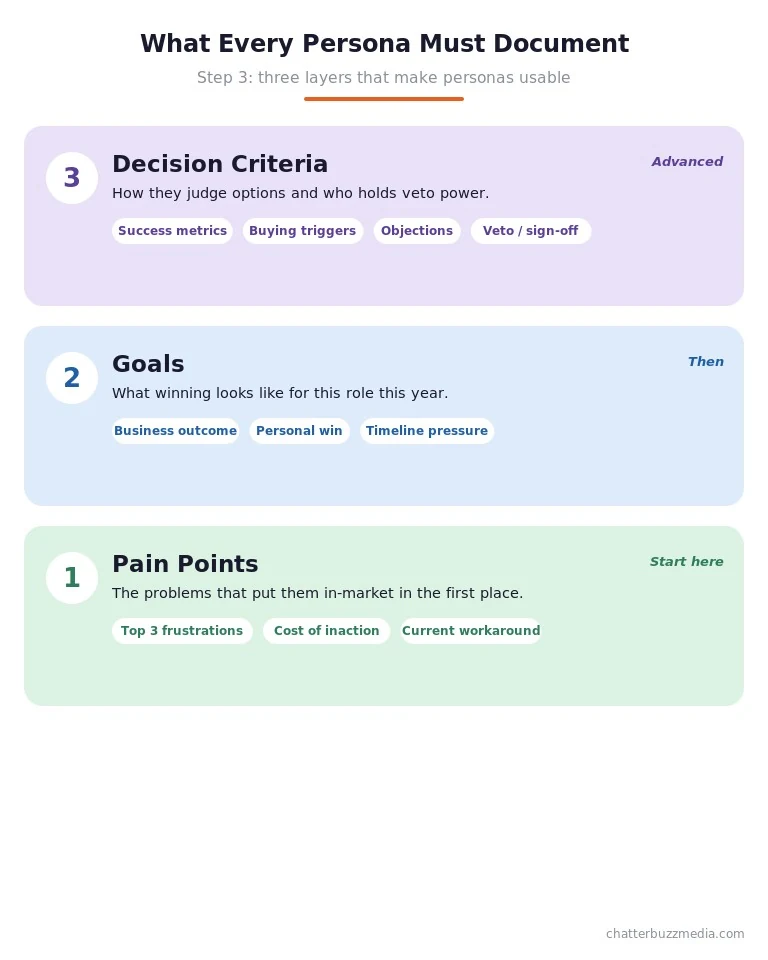
Start with pain points by role. The CFO’s pain point is unpredictable costs and unclear ROI. The IT Director worries about integration complexity, data security, and adding another tool to an already bloated tech stack. The End User dreads a clunky interface that makes their daily work harder.
Decision criteria vary just as dramatically. A CFO evaluates total cost of ownership and payback period. An IT Director evaluates API documentation, SSO support, and SOC 2 compliance. An End User evaluates the learning curve and whether the tool actually solves their workflow friction.
Next, identify buying triggers — the specific events that cause a stakeholder to start searching for a solution. Common B2B triggers include a failed audit, a competitor gaining market share, a new executive joining with a mandate to modernize, leadership setting aggressive growth targets, or a key vendor raising prices. Documenting these triggers lets your marketing team create content mapped to each stage of the customer journey so you’re visible at the moment intent forms.
Finally, document preferred channels and content formats for each persona. A C-suite executive consumes executive summaries, peer benchmarking data, and analyst reports. A technical evaluator wants documentation, architecture diagrams, and sandbox access. An End User wants video demos and peer reviews. Understanding these preferences transforms your content marketing assets from generic to precisely targeted.
The depth of this documentation separates personas that collect dust from personas that close deals. When a sales rep can reference the exact language a CFO uses to describe their budget concerns, the conversation shifts from pitching to partnering. Your content marketing ROI improves because every asset serves a specific persona at a specific stage.
Step 4 — Build Vertical-Specific Persona Profiles
A generic B2B buyer persona fails the moment you cross industry lines. The procurement manager at a manufacturing company and the VP of Marketing at a credit union may share the same title seniority, but their buying processes, regulatory environments, and decision timelines are fundamentally different.
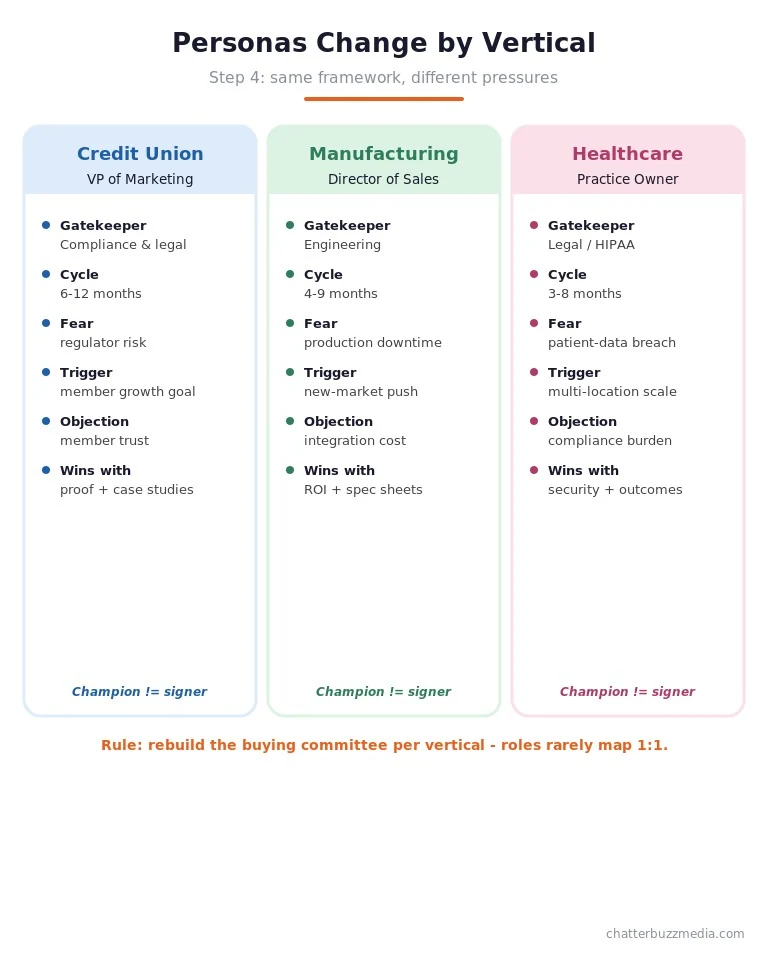
Manufacturing example: A procurement manager in a mid-market manufacturing firm operates within 6-month RFP cycles that involve detailed specification reviews, compliance documentation, and multi-vendor comparison matrices. This persona values spec sheets and technical data over case studies. They need to justify purchases to plant managers, safety officers, and finance — and they’ve been burned before by vendors who over-promised on implementation timelines. Build your manufacturing digital strategy around these realities, and explore manufacturing lead generation approaches designed for these longer cycles.
Credit union example: A VP of Marketing at a credit union needs board approval for nearly every significant vendor decision. Regulatory constraints from NCUA shape what they can say in marketing, and community-first messaging matters more than aggressive growth language. This persona responds to peer institution success stories and needs compliance-ready deliverables. The credit union marketing guide dives deeper into these unique constraints.
Healthcare and financial services share a critical persona type that other industries often lack: the compliance gatekeeper. This person doesn’t care about features or ROI — they care about whether your solution meets HIPAA, SOX, PCI-DSS, or state-specific regulations. They have absolute veto power and typically enter the evaluation late, which means deals can die at the finish line if you haven’t prepared for their objections. Financial services firms face similar dynamics, detailed in this financial services marketing guide.
Here’s a sample persona profile template with the key fields every B2B team should document:
Persona Profile Template
- Persona Name: [Descriptive role-based name, e.g., “Compliance-First CFO”]
- Job Title(s): [Common titles this persona holds]
- Industry Vertical: [Specific vertical and company size range]
- Buying Committee Role: [Champion / Decision Maker / Influencer / Blocker / End User]
- Reports To: [Direct manager title and department]
- Budget Authority: [Can approve up to $X / Needs VP approval / Needs board approval]
- Top 3 Pain Points: [Role-specific, in their own words]
- Success Metrics: [How their performance is measured]
- Decision Criteria: [What they evaluate vendors on, ranked]
- Buying Triggers: [Events that initiate a search]
- Common Objections: [Verbatim from win/loss interviews]
- Preferred Content Formats: [Reports, demos, peer reviews, etc.]
- Trusted Information Sources: [Analysts, publications, peer networks]
- Verbatim Quotes: [2-3 real quotes from interviews]
This template becomes the single source of truth that sales and marketing share. Customize it per vertical, and you’ll have profiles that reflect how people actually buy in their industry — not how a generic template assumes they buy. For guidance on designing content that resonates with each vertical, align assets to these persona-specific fields.
Step 5 — Create Negative Personas to Protect Your Pipeline
A negative persona defines who you should NOT sell to — and it’s one of the most underused tools in B2B pipeline management. Knowing who wastes your team’s time is just as valuable as knowing who converts, because every hour spent on a bad-fit prospect is an hour stolen from a deal that could close.
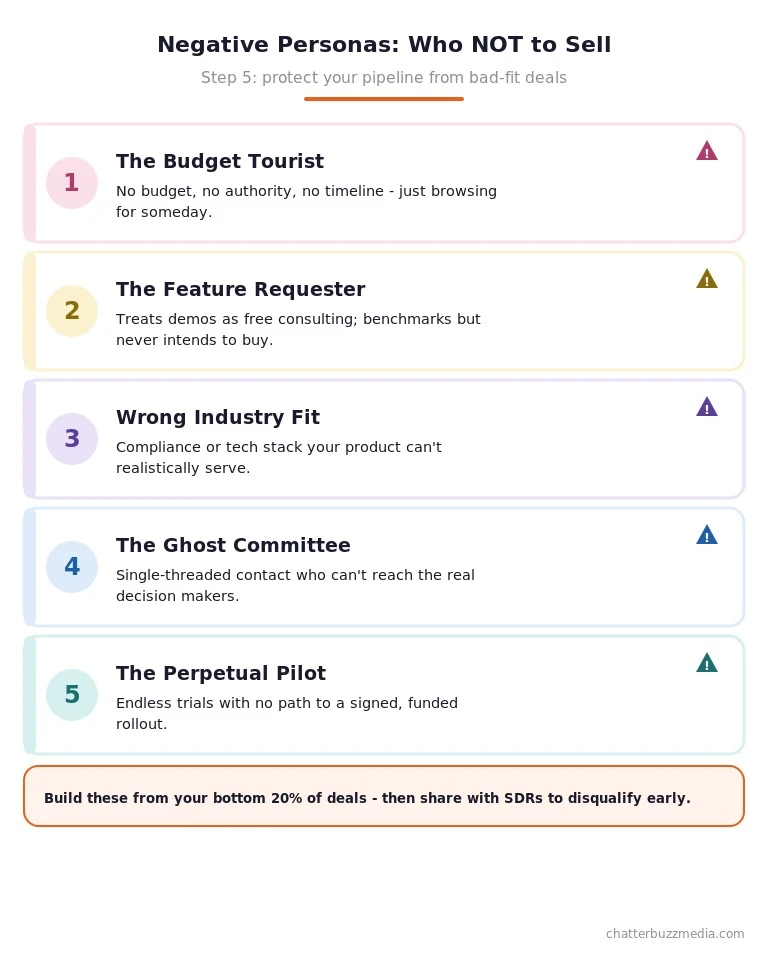
Three negative persona types appear in nearly every B2B sales pipeline. Budget tourists engage enthusiastically, attend every demo, request detailed proposals — and then reveal they have no budget, no authority, or no timeline. Feature requesters treat your sales process like a product feedback session, asking for capabilities you don’t offer and will never build, consuming engineering resources without any purchase intent.
Wrong industry fits look good on paper but operate in verticals where your solution genuinely doesn’t work — different regulatory requirements, incompatible tech stacks, or use cases your product wasn’t designed to serve. Selling to them leads to painful implementations, low NPS scores, and churn that damages your reputation.
The practical way to build negative personas is to review your lost deals and churned accounts for patterns. Look at deals that consumed significant sales resources but never closed. Identify common characteristics: company size too small to afford implementation, industries where your solution lacks compliance certifications, or prospects who consistently stall at the procurement stage.
Negative personas directly improve your marketing KPIs by filtering out unqualified leads before they consume resources. When marketing scores and routes leads, negative persona traits should trigger disqualification — not nurturing. Conduct a regular marketing audit to verify that your lead scoring models reflect these exclusions.
Document negative personas with the same rigor as your positive personas. Give them names, list their characteristics, and share them with every SDR, AE, and marketing manager. When your team can identify a budget tourist in the first discovery call instead of the fifth, your close rates improve and sales cycle length drops.
Step 6 — Activate Personas Across Sales and Marketing
A persona sitting in a Google Doc is worthless — activation is what turns research into revenue. The majority of B2B companies invest weeks building personas and then fail at the single step that matters most: embedding those personas into daily sales and marketing operations.
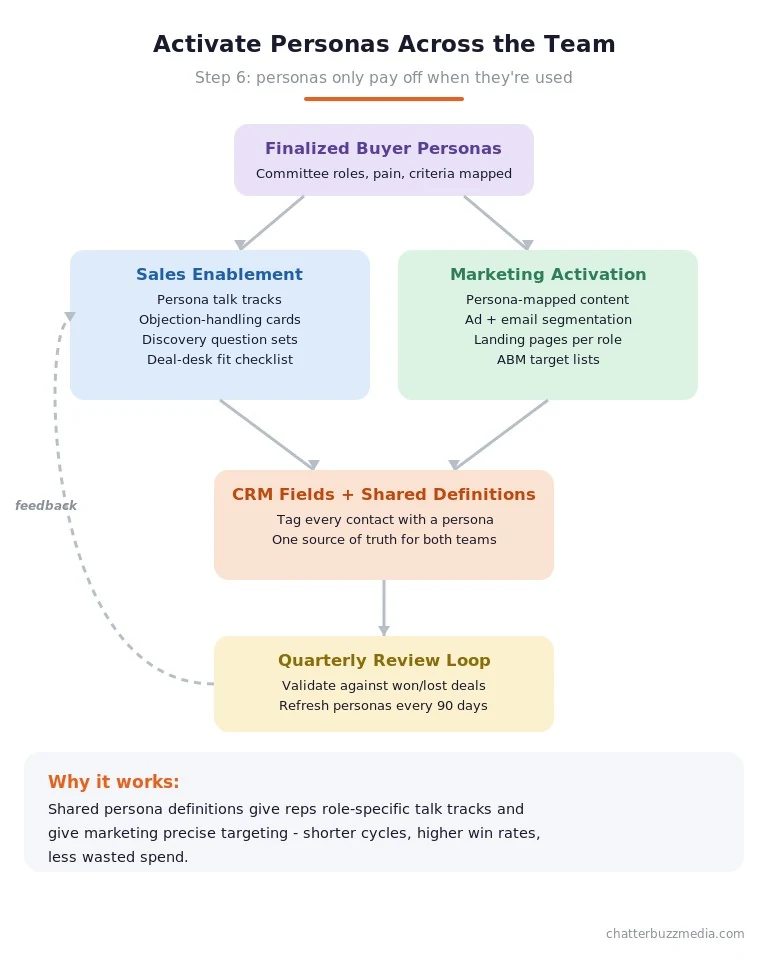
Sales activation starts with role-specific enablement materials. Build talk tracks tailored to each persona — the questions you ask a Champion differ from the questions you ask a Blocker. Create objection-handling guides organized by persona, so when a CFO raises budget concerns, the rep has a tested response ready. Design email sequences that speak to each persona’s specific pain points rather than blasting the same message to everyone in the account.
For sales teams running outbound, persona-driven lead generation dramatically outperforms generic outreach. When your SDR references a prospect’s actual buying trigger instead of leading with product features, response rates climb.
Marketing activation means mapping every content asset to a specific persona and buying stage. Your blog posts, whitepapers, webinars, and case studies should each serve a defined persona at a defined point in the b2b buyer journey. Ad targeting should use persona-based audience segments rather than broad firmographic filters. Landing pages should speak directly to the persona most likely to arrive from each campaign.
Your marketing funnel automation should route leads differently based on persona signals. A marketing automation platform becomes exponentially more effective when workflows trigger based on persona characteristics rather than simple form fills. Explore different types of marketing automation to match the right tool to each persona’s journey.
CRM integration is the connective tissue that makes activation work. Tag every lead and contact by persona in HubSpot or your CRM of choice so you can segment nurturing sequences, measure conversion rates by persona, and identify which personas close fastest. A clean HubSpot onboarding setup makes persona tagging seamless from day one.
Finally, establish a review and refresh cadence. Conduct quarterly reviews where sales and marketing compare persona assumptions against recent deal data. Perform a full annual rebuild where you re-interview customers, pull fresh CRM analytics, and update every profile. Markets shift, buying committees reorganize, and new compliance requirements emerge — your personas must evolve with them.
For companies in SaaS, these activation steps align directly with SaaS marketing strategies that depend on persona-driven segmentation. And if you’re working with a performance marketing partner, share your persona documentation so campaigns reflect real buyer behavior rather than generic targeting assumptions.
Frequently Asked Questions
1. 🔍 What is a B2B buyer persona?
A B2B buyer persona is a research-backed profile of a key stakeholder involved in a business purchasing decision. It captures their job role, goals, pain points, decision criteria, and buying behavior within a committee-driven purchasing process. Unlike B2C personas, B2B personas must account for organizational hierarchy, budget approval chains, and compliance requirements.
2. 📊 How many buyer personas should a B2B company have?
Most B2B companies need 3-7 primary personas that represent distinct buying committee roles across their target verticals. Start with the roles that appear in your highest-value deals — Champion, Decision Maker, and primary Blocker — then expand as your data supports it. Having too many personas dilutes focus; too few means you’re missing key stakeholders who influence deals.
3. ⚡ What is the difference between an ICP and a buyer persona?
An ideal customer profile (ICP) defines the company you want to sell to — industry, revenue, size, tech stack. A buyer persona defines the person within that company — their role, motivations, and decision criteria. You need both: the ICP tells you which accounts to target, and personas tell you how to engage the people inside those accounts.
4. 🏦 How do you research B2B buyer personas?
Start with CRM data from won and lost deals, then conduct 8-12 win/loss interviews with recent customers, lost prospects, and churned accounts. Supplement with sales team input, support ticket analysis, and review mining from G2 or industry forums. Avoid relying solely on surveys or demographic templates — verbatim buyer language from interviews is your most valuable data source.
5. 🤝 What should a B2B buyer persona template include?
A strong buyer persona template B2B should include job title, buying committee role, budget authority, top three pain points, success metrics, decision criteria, buying triggers, common objections, preferred content formats, and verbatim quotes. Include the persona’s reporting structure and who holds veto power in their organization.
6. 💰 How often should you update buyer personas?
Review personas quarterly with a cross-functional meeting between sales and marketing to validate assumptions against recent deal outcomes. Conduct a full rebuild annually by re-running win/loss interviews, pulling fresh CRM data, and updating every profile. Market shifts, organizational changes, and new regulations can make personas stale faster than most teams expect.
7. 🚀 How do buyer personas improve sales performance?
Buyer personas improve sales performance by giving reps persona-specific talk tracks, objection-handling frameworks, and targeted content for each stakeholder in the buying committee. Sales cycles shorten because reps anticipate objections before they surface. Close rates increase because messaging resonates with each stakeholder’s actual concerns rather than relying on generic pitches.
Conclusion
Building a B2B buyer persona that actually drives revenue requires moving beyond demographic templates and into the messy, valuable reality of how buying committees make decisions. The six steps outlined here — starting with CRM data, mapping the full committee, documenting role-specific pain points, building vertical profiles, creating negative personas, and activating across every team — form a system that turns persona research into closed deals.
The companies that win in B2B are the ones that understand their buyers better than their competitors do. That understanding doesn’t come from guesswork or generic templates. It comes from rigorous research, honest analysis of wins and losses, and a commitment to keeping personas current as markets evolve.
Your four-step action plan starts now:
- This week: Pull your last 50 closed/lost deals from your CRM and identify patterns in who was involved and why deals were won or lost.
- Within 30 days: Complete 8-12 win/loss interviews and document verbatim buyer language for each buying committee role.
- Within 60 days: Build vertical-specific persona profiles using the template in Step 4 and share them with sales and marketing leadership.
- Within 90 days: Activate personas in your CRM with lead tagging, build persona-specific sales enablement materials, and map existing content to each persona and buying stage.
To deepen your demand generation strategy around these personas, explore the complete guide to B2B demand generation for frameworks that connect persona research to pipeline growth. And for the broader inbound methodology that brings the right buyers to you, the inbound marketing guide shows how personas fuel every stage of attraction, engagement, and conversion.
For additional B2B marketing resources and frameworks, visit the Chatter Buzz resource library for guides spanning digital marketing services and beyond.

Victoria Wallace
Victoria Wallace is a senior content strategist and marketing writer with 30+ years of experience helping more than 200 brands translate complex business goals into clear, conversion-focused content. Her background spans paid media, marketing strategy, go-to-market planning, brand positioning, and full-funnel campaign development, giving her a deep understanding of how SEO content connects to real business growth.