
 321-236-2899
Digital Marketing Audit: Find What’s Wasting Your Budget

Are you spending thousands every month on ads, SEO, and content but struggling to trace a single dollar back to revenue? A digital marketing audit is the fastest way to find the leaks, cut the waste, and rebuild a strategy around what actually works.
Marketing teams that audit regularly see measurably better returns. One analysis found companies that run structured, recurring audits improve marketing ROI by roughly 24% compared to teams that never step back and review, according to Harvard Business School Online.
This guide walks through the exact steps to run a digital marketing audit that finds wasted budget, including the channel-by-channel red flags most audits miss. By the end, you will know how to turn a pile of scattered metrics into a single prioritized action plan.
Key Takeaways
- A digital marketing audit is a systematic review of every channel, asset, and dollar to find what is working, what is wasting budget, and where the biggest gains hide.
- Studies show roughly 15% of paid search budgets are lost to irrelevant search terms alone, making paid media the fastest place to recover cash.
- Scope and clean data come first. An audit without accurate tracking measures the wrong things and produces confident but wrong conclusions.
- Work channel by channel: website and technical health, SEO and content, paid media, and analytics and attribution each have their own waste signals.
- Findings are worthless without prioritization. Rank every fix by impact versus effort so the team ships the high-value changes first.
- Run a full audit annually before budget planning, with lighter quarterly channel checks in between.
What a Digital Marketing Audit Actually Uncovers
A digital marketing audit is a structured, top-to-bottom review of your marketing channels, assets, and spend designed to reveal what drives results and what quietly drains budget. It replaces gut feel with evidence.
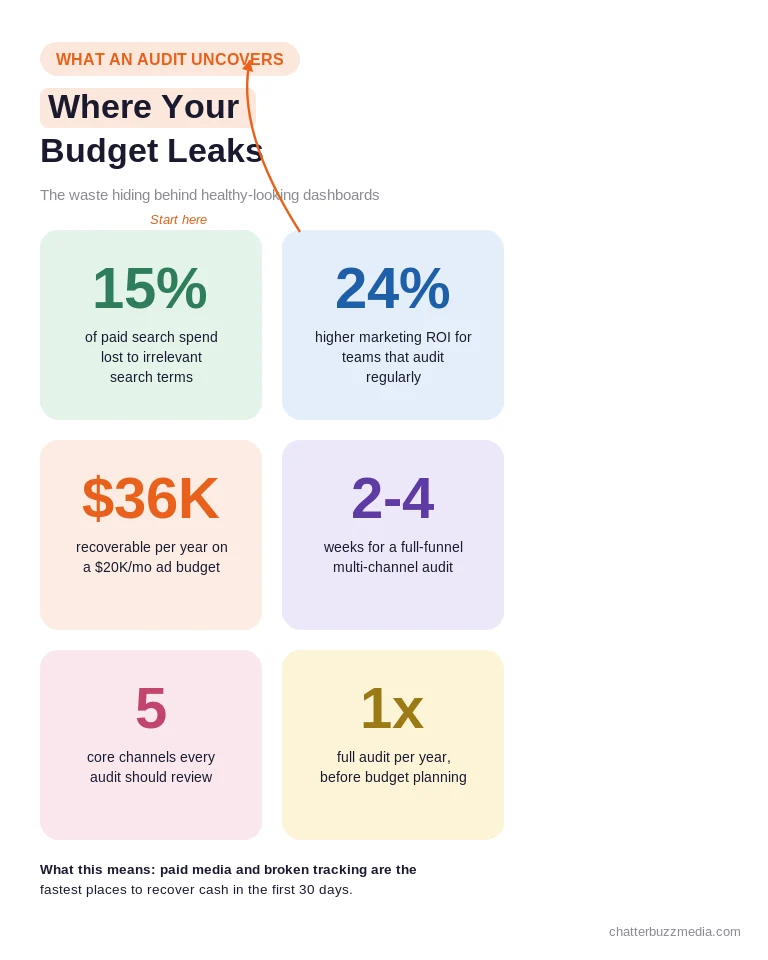
Most budget waste is invisible in day-to-day reporting because dashboards show activity, not efficiency. You see clicks, sessions, and impressions, but not the campaigns burning cash on the wrong audience or the pages killing conversions.
An audit surfaces the expensive problems hiding in plain sight. Common finds include ad spend flowing to irrelevant search terms, broken conversion tracking that inflates or hides results, content ranking for keywords no buyer searches, and landing pages leaking qualified traffic.
It also answers the questions leadership actually cares about. Which channels drive real pipeline, where is money being wasted, and what single change would move results the most this quarter?
A complete audit spans every channel that touches revenue. That means your website, SEO and content, paid media, email, social, and the analytics layer underneath all of it.
The value comes from looking at those channels together, not in isolation. Wasted ad spend, weak tracking, and thin content usually feed each other, and only a full-funnel view exposes how the leaks connect.
The goal is not to prove your strategy is fine. It is to take an honest, unbiased look at the entire operation so you can make data-driven decisions instead of defending assumptions, the same discipline behind any serious marketing strategy.
That mindset is the difference between an audit that changes results and a report that gets filed and forgotten. Before you touch a single channel, you need a clear scope and clean data.
Before You Start: Set Scope, Goals, and Your Data Toolkit
Start every audit by defining three things: what you are reviewing, what success looks like, and where the data lives. Skipping this step is the single most common reason audits produce vague, unusable conclusions.
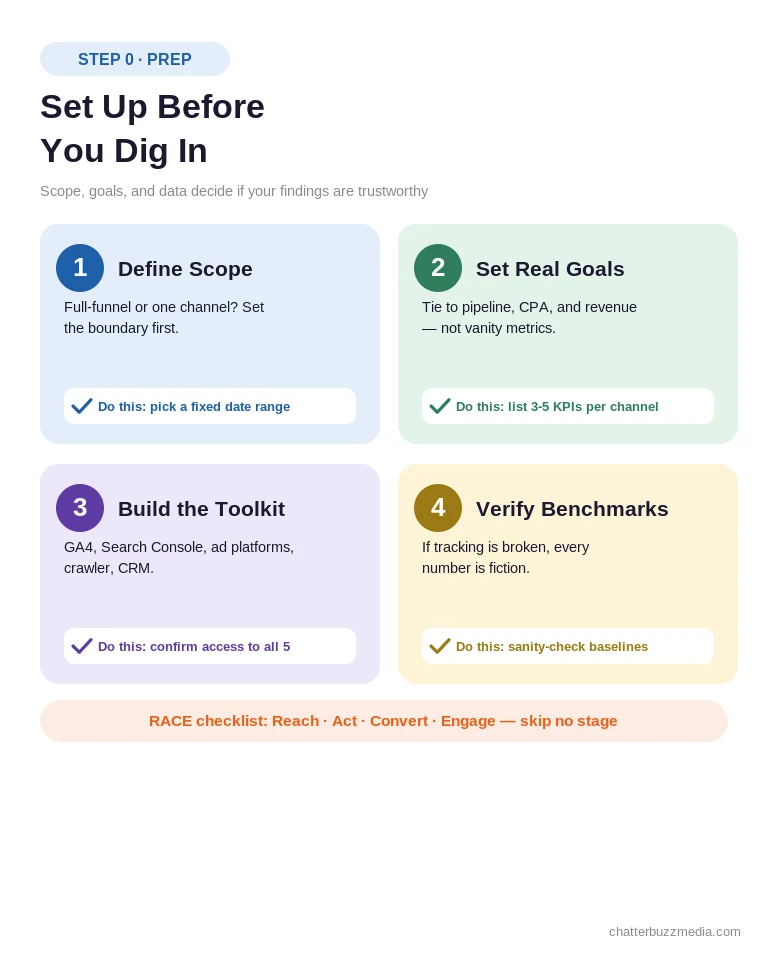
Scope keeps the audit finishable. A full-funnel review across every channel can take two to four weeks, so decide upfront whether you are auditing everything or zeroing in on one problem area like paid media or technical SEO.
Next, tie goals to outcomes that matter. Impressions and follower counts are vanity metrics for an audit, so anchor your review to pipeline, leads, cost per acquisition, and revenue instead.
Then assemble your data toolkit before you dig in:
- Google Analytics 4 for traffic, conversions, and channel performance.
- Google Search Console for organic queries, impressions, and technical coverage issues.
- Your ad platforms (Google Ads, Meta, LinkedIn) for spend, conversions, and search-term reports.
- A crawler or site tool for broken links, page speed, and indexation.
- Your CRM to connect marketing activity to closed revenue.
A repeatable structure makes the review faster and comparable over time. Many teams organize their marketing audit checklist around the RACE framework, which maps the customer journey into Reach, Act, Convert, and Engage so no stage gets skipped, as Smart Insights lays out.
Set benchmarks before you judge anything. Pull a consistent date range, note your baseline for each metric, and where it helps, compare against a close competitor so “good” and “bad” are grounded in reality rather than opinion.
Build the review as a reusable digital marketing audit template. Capturing each channel, the metric, the finding, and the recommended action in one place turns a one-time project into a system you can run every quarter without starting from scratch.
If tracking is broken, every number downstream is fiction, which is why the analytics audit later in this guide matters so much. With scope set and tools connected, start where the whole funnel begins: your website.
Step 1: Audit Your Website and Technical Foundation
Audit your website first because every other channel sends traffic to it, so technical problems here multiply waste everywhere else. A fast, crawlable, conversion-ready site makes every marketing dollar work harder.
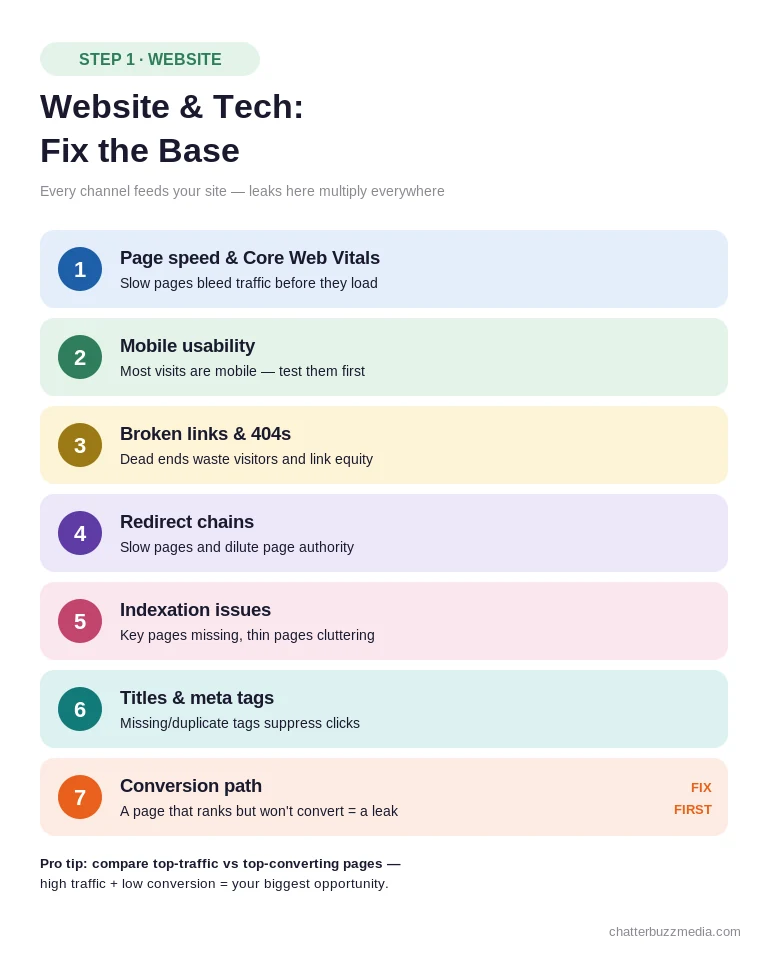
Begin with the fundamentals that quietly cost you rankings and conversions. Page speed, mobile usability, and Core Web Vitals directly influence both search visibility and how many visitors stay long enough to convert.
The math here is unforgiving. A page that takes several seconds to load can lose a large share of visitors before it even renders, so every campaign pointing at a slow page is paying full price for a fraction of the traffic.
Then hunt for the technical leaks that waste crawl budget and traffic:
- Broken links and 404 errors that send visitors and link equity into dead ends.
- Redirect chains that slow pages and dilute authority.
- Indexation problems where important pages are missing from Google or thin pages are cluttering it.
- Missing or duplicate title tags and meta descriptions that suppress click-through.
- Insecure or mixed-content pages that erode trust and rankings.
Prioritize the pages that matter most. A 404 on a forgotten page costs little, but a slow, broken template on your top landing pages quietly taxes every campaign that points there, so fix the high-traffic, high-intent pages first.
Do not stop at technical health. Review the conversion path on your highest-traffic pages, because a page that ranks well but converts poorly is a slow, expensive leak that a conversion rate optimization review is built to catch.
Pro tip: pull a “top pages by traffic” report and a “top pages by conversion” report side by side. The pages with high traffic and low conversion are your biggest, fastest opportunities to recover revenue you are already paying to attract.
With the foundation checked, move up the funnel to how people find you in the first place.
Step 2: Audit SEO and Content Against Buyer Intent
Audit your SEO and content by asking one question: does this rank for terms real buyers use, and does it move them forward? Traffic that never converts is a cost, not a win.
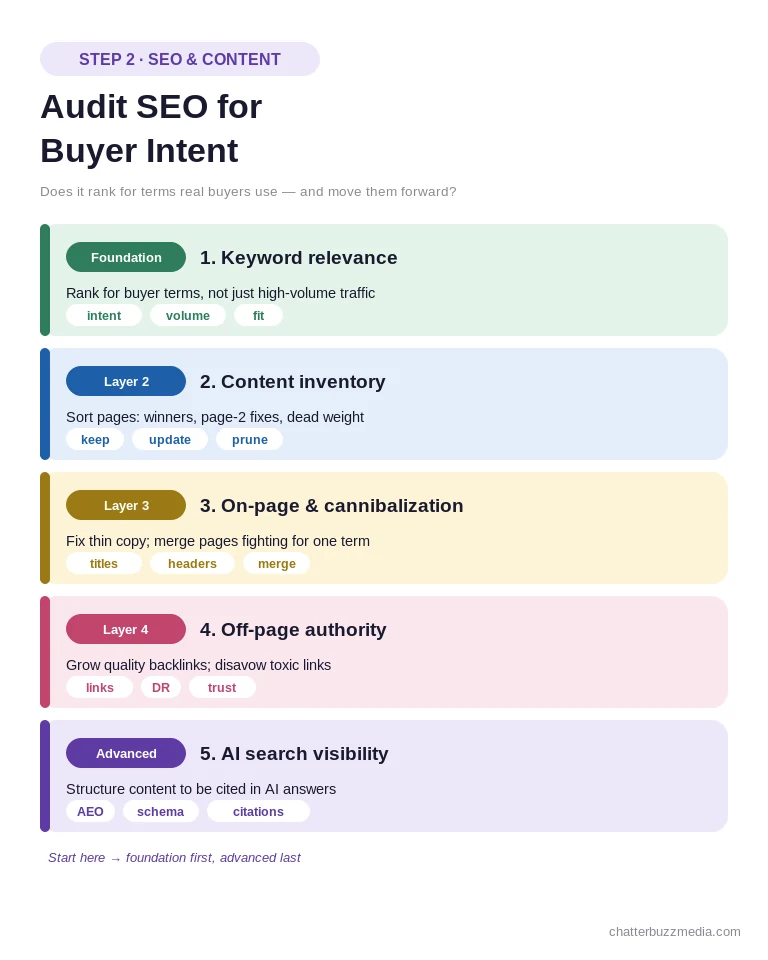
Start with keyword relevance. Pull your top organic pages and check whether they attract buyers or just browsers, because ranking for high-volume, low-intent terms often inflates traffic while starving pipeline.
Next, run a content inventory to find the three types of pages worth acting on:
- Winners that rank and convert, which deserve more internal links and refreshes.
- Underperformers stuck on page two, which often need only a targeted update to break through.
- Dead weight that gets no traffic and no links, which should be improved, consolidated, or pruned.
Then check whether your content actually maps to the buyer journey. Many sites over-invest in top-of-funnel blog posts and have almost nothing for people ready to choose a vendor, a gap that a clear content-to-journey map exposes fast.
Review on-page basics on your priority pages too. Weak title tags, missing headers, and thin copy leave rankings on the table, and these are often the cheapest wins in the entire audit to fix.
Check for keyword cannibalization while you are in there. When several pages target the same term, they compete with each other and split rankings, so consolidating them into one strong page often lifts the whole cluster.
Review off-page signals too. A quick look at your backlink profile shows whether authority is growing or stagnating, and whether any low-quality links need to be disavowed before they drag down trust.
Do not ignore the newest visibility channel. As buyers increasingly ask AI tools for recommendations, audit whether your content is structured to be cited in AI answers, not just ranked in traditional search results, a shift the balance between earned and paid visibility makes more urgent every year.
Organic tells you what you earn. Paid media tells you what you are buying, and that is usually where the fastest savings live.
Step 3: Audit Paid Media for Wasted Spend
Audit paid media by tracing every dollar to a conversion, because this is the single fastest place to recover budget. Studies suggest roughly 15% of paid search spend is lost to irrelevant search terms alone, according to Reboot Online.
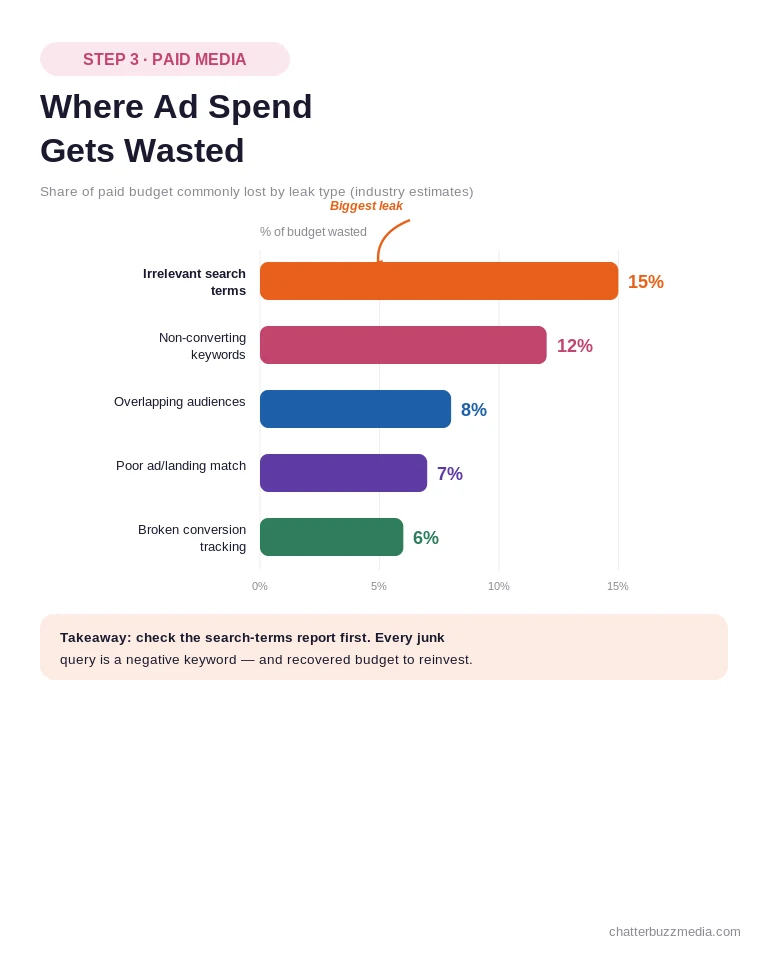
Open the search-terms report first. You will almost always find money flowing to queries that will never convert, and every one of them is a negative keyword waiting to be added.
Then work through the classic budget leaks that hide inside accounts that look healthy:
- Non-converting keywords and campaigns still receiving spend out of habit.
- Overlapping audiences that make you bid against yourself.
- Broad match with weak negatives that opens the floodgates to junk traffic.
- Poor ad-to-landing-page match that tanks Quality Score and inflates cost per click.
- Conversion tracking counting the wrong actions, so you optimize toward the wrong goal.
Judge every campaign on cost per acquisition and return, not clicks or impressions. A campaign with a great click-through rate and no pipeline is a well-disguised loss, and understanding the tradeoff between paid clicks and on-site conversion keeps you from over-investing in traffic you cannot convert.
Audit the creative, not just the targeting. Stale ads that have run for months quietly lose efficiency as audiences tune them out, so flag any creative with declining click-through and rising costs as a candidate for a refresh.
Check your bidding and budget pacing as well. Campaigns capped too low never gather enough data to optimize, while automated bidding pointed at the wrong conversion event will spend confidently toward a goal that does not matter.
Put the waste in real numbers to see the stakes. On a $20,000 monthly ad budget, trimming even 15% of wasted spend frees up $3,000 a month, or $36,000 a year, to reinvest in campaigns that convert.
Do not judge every campaign by the same yardstick, either. Awareness campaigns and bottom-funnel conversion campaigns have different jobs, so measure each against the goal it was built for rather than a single blanket metric.
Reallocate ruthlessly. The money you recover from wasted spend should flow to the channels and campaigns your audit proves are profitable, and this reallocation is exactly the kind of edge a dedicated performance marketing approach is built around.
None of these numbers mean anything if the tracking underneath them is broken, which brings us to the most overlooked step.
Step 4: Audit Analytics, Tracking, and Attribution
Audit your analytics and tracking before you trust any other finding, because broken measurement quietly corrupts every decision you make. If the data is wrong, a confident audit just helps you make the wrong call faster.
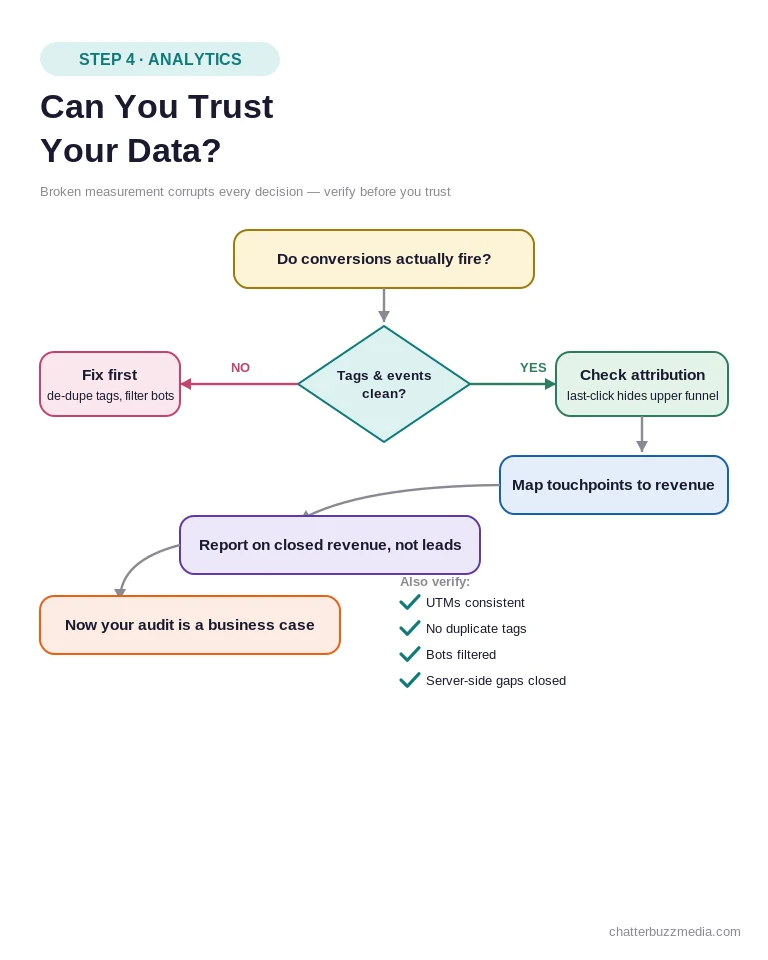
Start by verifying that conversions actually fire. Test your key forms, calls, and checkout events, and confirm each one records correctly in analytics and your ad platforms.
This one check saves more wasted spend than almost any other. When an ad platform cannot see conversions, its algorithm optimizes blind, pouring budget toward clicks that never turn into customers.
Then check the plumbing that shapes your reporting:
- Duplicate or missing tracking tags that double-count or drop conversions.
- Unfiltered internal and bot traffic that pollutes your benchmarks.
- Broken UTM conventions that scatter campaign data across mislabeled buckets.
- Server-side or first-party tracking gaps that undercount conversions as browser restrictions tighten, which better conversion tracking setups are designed to fix.
Next, examine your attribution model. A last-click model gives all the credit to the final touch and can make you defund the upper-funnel channels that actually start the journey.
Do not assume your historical data is comparable. Analytics platforms change how they count sessions and conversions over time, so confirm you are comparing like for like before you read any trend as real.
Finally, make sure your reporting connects marketing to revenue, not just to leads. Tying activity to closed deals through clean reporting and data visualization is what turns an audit into a business case, and it is often where a strong view of true marketing ROI finally comes into focus.
Once your data is trustworthy and your channels are reviewed, the real work begins: deciding what to fix first.
Step 5: Turn Findings Into a Prioritized Action Plan
Turn your findings into results by ranking every fix on impact versus effort, then shipping the high-impact, low-effort changes first. A list of 40 problems with no priority order is how audits die in a spreadsheet.
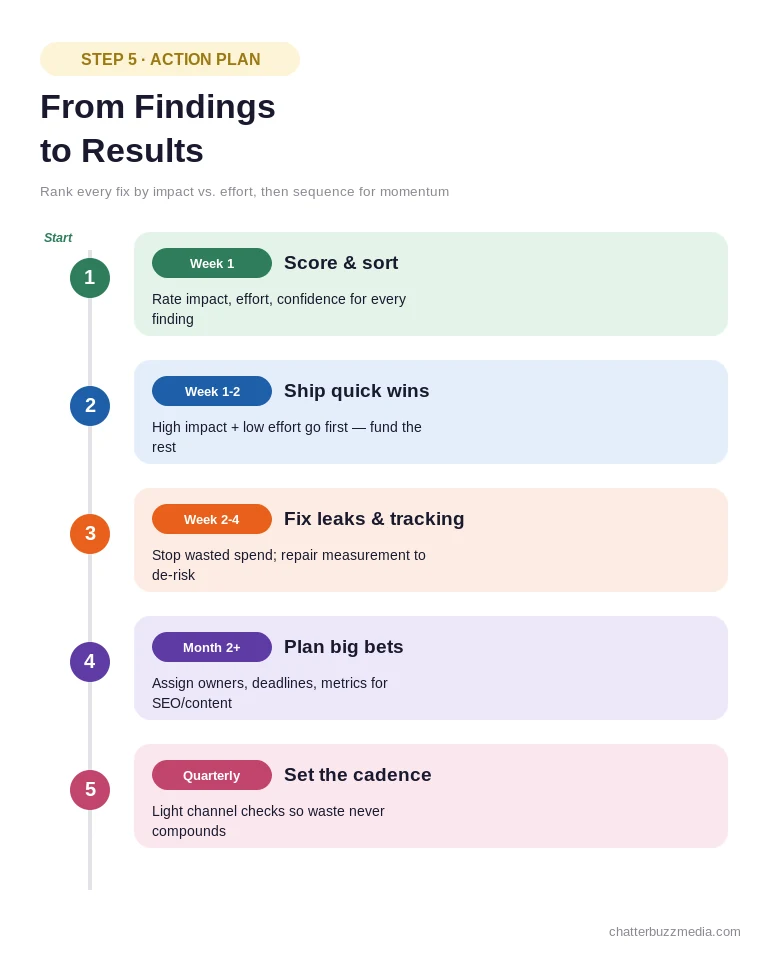
Sort every finding into a simple grid. Quick wins that are high impact and low effort go first, big bets that are high impact and high effort get planned, and low-impact items wait or get dropped.
Score consistently so the ranking holds up under scrutiny. Rate each finding on the size of the potential gain, the effort to implement, and your confidence it will work, then let those scores decide the order instead of whoever argues loudest.
Then give each priority a real owner, a deadline, and a metric. A finding without an accountable owner is a suggestion, not a plan, and suggestions do not move revenue.
Sequence the rollout so momentum compounds. Fix the tracking and the biggest budget leaks first, because those changes fund and de-risk everything that follows, then move into the longer SEO and content plays.
Communicate the plan in the language of the business. Frame each fix around the dollars it recovers or the pipeline it protects, because that is what wins buy-in and keeps the audit from stalling once the meeting ends.
Finally, set a cadence to keep results from slipping. Pair a full annual audit with lighter quarterly channel checks so problems get caught in weeks, not after a quarter of wasted spend, all anchored to your broader marketing strategy and planning.
Before you begin, one decision shapes everything else: whether to run the audit yourself or bring in outside help.
DIY vs. Professional Marketing Audit Services: How to Decide
Choose a DIY audit when your scope is narrow, your team has the tools and time, and you mainly need a health check. Choose professional marketing audit services when the stakes are high, the picture is complex, or you need an unbiased outside read.
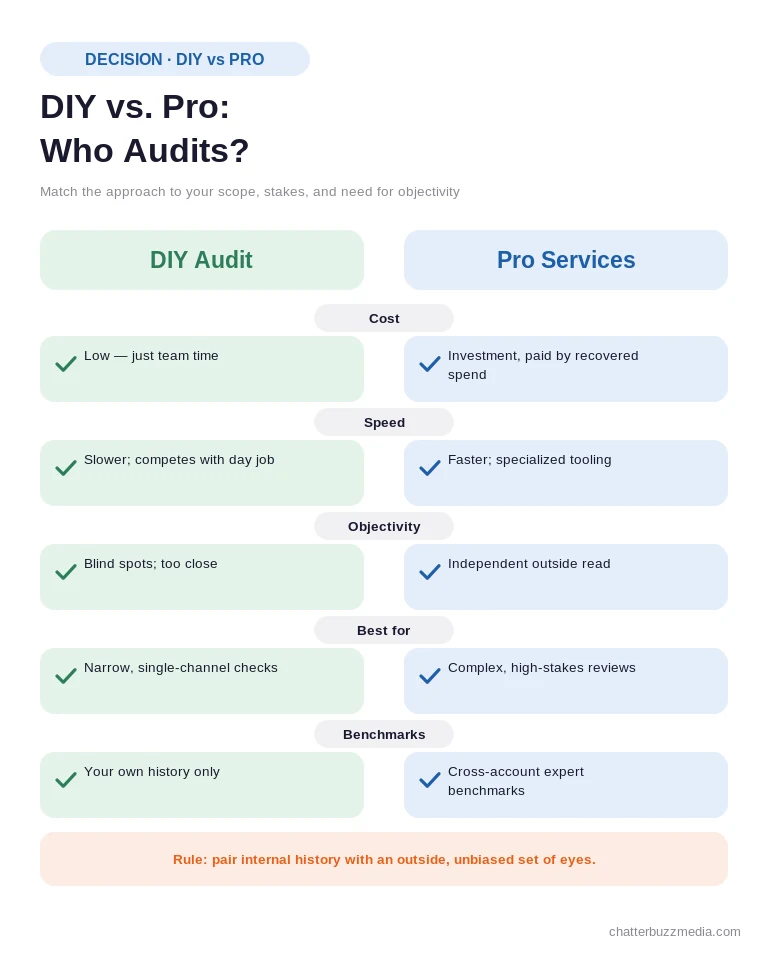
A do-it-yourself audit has real strengths. It costs little beyond time, your team already knows the history, and a focused single-channel review is very doable with the tools listed earlier in this guide.
But internal audits carry two persistent risks. Teams are close to the decisions being reviewed, which creates blind spots, and the day-to-day workload means the audit often stalls before the findings turn into action.
An outside audit trades some cost for speed, breadth, and objectivity:
- Independence that surfaces uncomfortable findings an internal team may avoid.
- Cross-account benchmarks from experts who audit many accounts and know what “good” looks like.
- Speed and specialized tooling that compress a multi-week review into a tighter window.
Cost varies with scope. A quick channel review is inexpensive or free, while a comprehensive, multi-channel audit with a documented action plan is a larger investment that typically pays for itself in recovered spend, especially given that studies from ad-verification firm Lunio repeatedly show how much paid budget leaks to invalid and low-quality traffic.
Whichever path you choose, the audit is only as good as what you do next. A few common questions tend to come up before teams begin.
Frequently Asked Questions
1. 🔍 What is a digital marketing audit?
A digital marketing audit is a systematic review of your marketing channels, assets, and spend to identify what is working, what is wasting budget, and where the biggest opportunities are. It typically covers your website, SEO, content, paid media, and analytics, and ends with a prioritized plan of action.
2. 📊 How do you conduct a digital marketing audit?
Start by setting a clear scope and goals, then confirm your tracking and data are accurate. From there, review each channel one at a time, document what you find, and finish by ranking every fix by impact versus effort into a single action plan.
3. ⚡ How long does a digital marketing audit take?
A focused single-channel audit can take a few days, while a full-funnel audit across every channel usually takes two to four weeks. The timeline depends on the number of channels, the size of your site, and how clean your existing data is.
4. 💰 How much of my budget is a marketing audit likely to recover?
It varies, but paid media alone commonly hides double-digit percentages of wasted spend, with studies citing around 15% lost to irrelevant search terms. Most teams also recover value by reallocating budget from underperforming channels to proven ones.
5. 📈 How often should you run a digital marketing audit?
Run a comprehensive audit at least once a year, ideally right before budget planning. Supplement it with lighter quarterly channel checks and a triggered audit after any major change like a website redesign, an algorithm update, or a sudden drop in performance.
6. 🤝 Should I run the audit in-house or hire an outside team?
Internal teams know the history, but they also carry blind spots and are close to the decisions being reviewed. An independent, outside perspective tends to surface uncomfortable findings faster, which is why many teams pair internal knowledge with an external audit.
7. 🚀 What tools do I need to run a digital marketing audit?
At minimum you need Google Analytics 4, Google Search Console, access to your ad platforms, a site crawler, and your CRM. These cover traffic, search visibility, spend, technical health, and the revenue connection that ties it all together.
Conclusion: From Audit to Action
A digital marketing audit only pays off when it changes what you do next. The teams that win treat it as the start of a plan, not the end of a report.
The payoff compounds over time. Every leak you close and every dollar you reallocate makes the next audit start from a stronger baseline, turning a one-time cleanup into steady, durable efficiency.
Here is the four-step action plan to put this guide to work:
- Fix your measurement first. Verify tracking, conversions, and attribution so every decision rests on real data.
- Stop the biggest leaks. Cut wasted paid spend and prune the dead-weight pages draining budget and crawl equity.
- Prioritize by impact versus effort. Ship the quick wins now and schedule the big bets with owners and deadlines.
- Set a recurring cadence. Lock in a full annual audit and quarterly channel checks so waste never compounds unnoticed.
If you would rather see your leaks mapped out for you, a free digital marketing audit is a low-risk way to get a fresh, expert set of eyes on your numbers. You can also explore the full range of digital marketing services or browse more strategy resources in the resource library to keep building momentum.
Need help with SEO? Explore our SEO agency services.

Victoria Wallace
Victoria Wallace is a senior content strategist and marketing writer with 30+ years of experience helping more than 200 brands translate complex business goals into clear, conversion-focused content. Her background spans paid media, marketing strategy, go-to-market planning, brand positioning, and full-funnel campaign development, giving her a deep understanding of how SEO content connects to real business growth.