
 321-236-2899
Customer Persona Template: How to Build Buyer Profiles

Most customer persona templates are decorative. They get filled in during a workshop, exported to a PDF, and never opened again — while the campaigns they were meant to guide go out targeting “marketing managers, 30-45.”
This guide gives you a customer persona template that survives contact with a real quarter. You’ll get the nine fields that belong in it, the five template types and when each applies, a six-step build process, and the 18-question interview script that turns guesses into evidence.
Here’s the part almost nobody publishes: the actual questions to ask. Every guide on this topic says “interview your customers” and then stops, so we’ll spend a full section on the script — including the one follow-up question that reliably breaks a persona open.
Let’s start with what a persona template actually is, because most teams are building the wrong artifact.
Key Takeaways
- A persona is a research artifact, not a character sketch. If it contains no direct quotes from real buyers, it’s fiction with a stock photo attached.
- Nine fields do the work. Trigger event, job to be done, evaluation criteria, and objections drive decisions — age, income, and favorite brands almost never do.
- Six interviews is the floor, twelve is the ceiling. Peer-reviewed research on qualitative saturation found 80% of themes emerge in the first six interviews, with saturation reached by twelve.
- B2B needs a persona set, not a persona. Gartner puts the average enterprise buying group at five to 11 stakeholders across five business functions.
- Personalization maturity is where everyone stalls. 89% of B2B marketers personalize content, but 59% do it at a basic level and only 1% call it comprehensive.
- Retire personas on a schedule. A persona nobody has questioned in 18 months isn’t validated — it’s just old.
What a Customer Persona Template Actually Is (and What It Isn’t)
A customer persona template is a structured document that captures what a specific type of buyer is trying to accomplish, what’s blocking them, and how they decide — based on research rather than assumption. The template is the container; the research is the product.
That distinction is where most teams go wrong. They treat the template as the deliverable, fill every box with something plausible, and ship it.
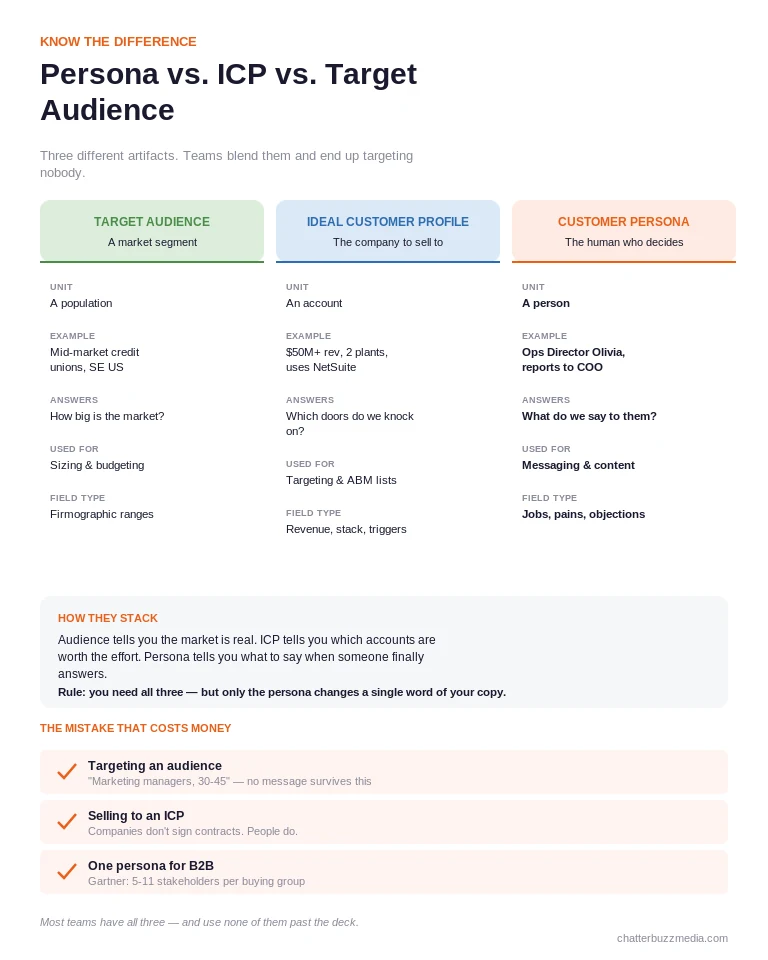
The fastest way to understand a persona is to separate it from the two things it gets confused with.
- Target audience is a market segment — “mid-market credit unions in the Southeast.” It describes a population, not a person.
- Ideal customer profile describes the company worth selling to: revenue, headcount, tech stack, trigger events. Our guide to building an ideal customer profile that drives revenue covers this layer in depth.
- Persona describes the human inside that company who has a problem, a budget, and a boss. For the B2B-specific version, see our guide to building a B2B buyer persona sales actually uses.
You need the ICP to know which doors to knock on. You need the persona to know what to say when someone answers.
What a persona is not
A persona is not a demographic profile. Age brackets and income ranges are the least predictive fields on most templates, and they’re the ones teams fill first because they’re easiest to guess.
A persona is not a customer segment either. Segments are analytical groupings you query in a database; personas are narrative tools that make a team behave differently.
And a persona is not a one-time deliverable. The 2016 Cintell benchmark study of 137 B2B marketers found companies exceeding revenue and lead goals were 7.4x more likely to have updated their personas in the previous six months.
The same study found 82.4% of those over-performers ran qualitative interviews, versus 30.4% of under-performers. Treat both numbers as directional — the study is a decade old, vendor-sponsored, and correlational.
The honest case against personas
Personas have a real credibility problem, and pretending otherwise is why so many get ignored. The critique is that they’re invented people, assembled from vibes, used to justify decisions someone already wanted to make.
That critique is correct — for personas built without research. Plenty of teams have watched a persona workshop produce a document that describes the team’s own assumptions back to them in a nicer font.
The fix isn’t a prettier template. It’s a single rule: no field goes in unless you can point to the interview, ticket, call recording, or dataset it came from.
Apply that rule and half your template will be empty on day one. That emptiness is the honest starting point, and it tells you exactly what to go research.
Once you accept that the research is the real work, the next question is which template shape fits what you’re researching.
The 5 Types of Customer Persona Templates (and When to Use Each)
There is no single customer persona template — there are five common shapes, and choosing the wrong one is why your persona feels useless. The right shape depends entirely on what decision the persona needs to inform.
Picking the type first saves you from the most common failure mode. That’s a bloated template that collects every fact about a buyer and prioritizes none of them.
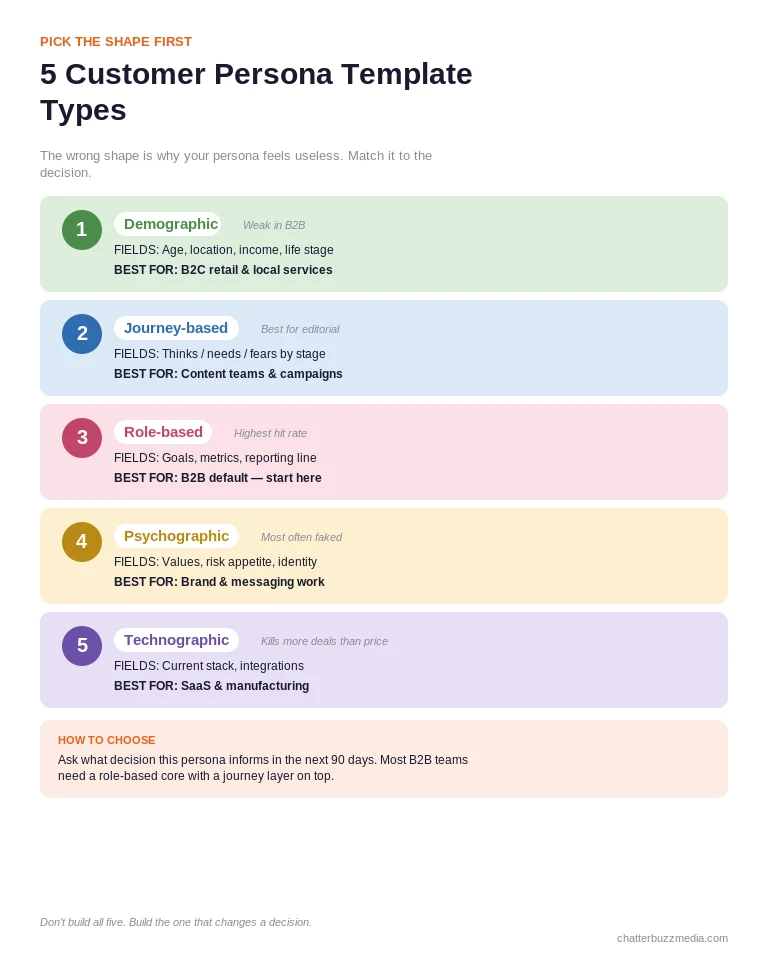
1. Demographic persona template. Captures age, location, income, education, and family status.
Genuinely useful in B2C retail and local services, where life stage predicts purchase. Close to worthless in B2B, where a 34-year-old and a 51-year-old ops director buy nearly identically.
2. Journey-based persona template. Organizes everything by stage: what the buyer thinks, needs, and fears during awareness, consideration, decision, and adoption.
This is the most useful type for content teams, because it maps directly onto what you publish and when. If you’re building content around it, pair it with our walkthrough on how to map content to the customer journey.
3. Role-based persona template. Built around a job function — the CFO, the plant manager, the marketing director.
Fields cover responsibilities, success metrics, reporting line, and what gets them promoted or fired. This is the default for B2B and the one most teams should start with.
4. Psychographic persona template. Captures values, attitudes, risk tolerance, and professional identity.
Powerful for brand and messaging work, and the type most likely to be fabricated. Hold it to the highest evidence bar you have.
5. Technographic persona template. Captures the tools they already run, integration constraints, and procurement realities.
Badly underrated in B2B SaaS and manufacturing. “Does it work with our ERP” kills more deals than price does.
How to choose
Ask what decision the persona will inform in the next 90 days. That question resolves the choice faster than any framework.
Ad targeting pulls toward demographic and psychographic. Content calendars pull toward journey-based, while sales enablement and account-based marketing pull toward role-based and technographic.
Most B2B teams need a role-based core with a journey-based layer on top. That combination answers both “who is this person” and “what do they need from us right now.”
Once you’ve picked the shape, you need to know which fields actually earn their place.
What Belongs in Your Template: The 9 Core Fields
Nine fields carry almost all the decision-making weight in a customer persona template. Everything else is optional detail that makes the document longer without making it more useful.
The test for any field is simple. If this changed, would we do something differently?
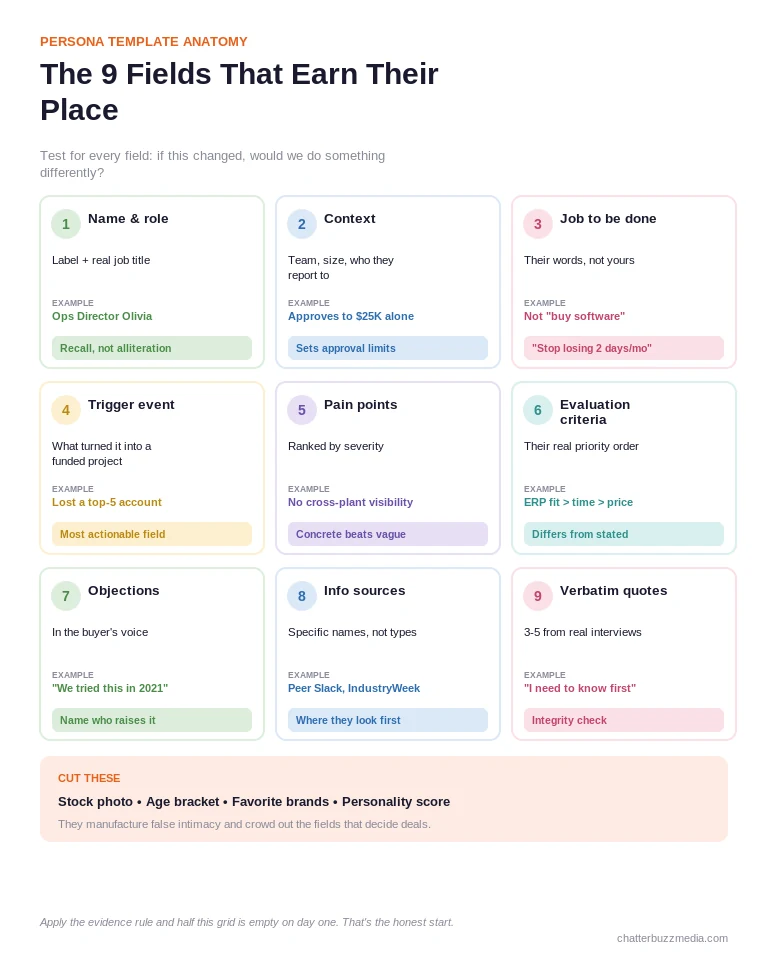
1. Name and role. A short label plus the actual job title. “Ops Director Olivia” is fine — the alliteration isn’t the point, the recall is.
2. Context. Two sentences on the company, team size, and where this person sits. Include who they report to, because that shapes what they can approve alone.
3. Job to be done. What they’re trying to accomplish, stated in their words. Not “buy software” but “stop losing two days a month reconciling reports by hand.”
4. Trigger event. The thing that turns a background annoyance into a funded project — new leadership, a failed audit, a lost customer, a compliance deadline. This is the most actionable field on the template and the one most often left blank.
5. Pain points. The specific frictions, ranked in their order of severity. Vague pain produces vague copy, so push for the concrete version — our breakdown of how to identify customer pain points is a useful companion.
6. Evaluation criteria. What they compare vendors on, in priority order. Note how that order differs from what they say publicly, because it usually does.
7. Objections and blockers. The reasons this stalls: budget timing, a skeptical peer, a bad experience three years ago. Write the objection in the buyer’s voice, then name who inside the company raises it — our guide to overcoming sales objections goes deeper on handling them.
8. Information sources. Where they actually look — specific communities, publications, peers, and increasingly AI assistants. Name names, not categories.
9. Verbatim quotes. Three to five direct quotes from real interviews. This field is the integrity check on the entire template.
The fields to cut
Delete the stock photo, the “favorite brands” row, and the personality-type score unless you can name the decision each one changes. They manufacture a false sense of intimacy while crowding out the fields that matter.
A filled-in customer persona example
Here’s what those nine fields look like completed, using a B2B manufacturing buyer. Copy this structure straight into your own template.
Name and role: Ops Director Olivia — Director of Operations, 180-person contract manufacturer, reports to the COO.
Context: Owns production scheduling and vendor management across two plants. Approves up to $25K alone; anything above goes to the COO and CFO.
Job to be done: “Stop finding out about a line delay from the customer instead of from my own system.”
Trigger event: Lost a top-five account after three consecutive missed delivery dates. The post-mortem got escalated to the board.
Pain points (ranked): 1) No real-time visibility across plants. 2) Two days a month rebuilding reports by hand. 3) Scheduling lives in one veteran employee’s head.
Evaluation criteria: ERP integration first, implementation time second, price third. Says price is first on the initial call — it isn’t.
Objections and blockers: “We tried a system like this in 2021 and the team never adopted it.” Raised by the plant manager, who built the current spreadsheet process.
Information sources: Peer operators in a private industry Slack group, IndustryWeek, two specific LinkedIn voices. Increasingly starts with an AI assistant before searching.
Verbatim quotes: “I don’t need more dashboards. I need to know before the customer does.” / “The last rollout failed because we bought it for me, not for the floor.”
Notice what’s doing the work here. The trigger event and the 2021 objection tell you more about winning this deal than any demographic field could.
Notice also that the stated evaluation criteria and the real one differ. You only find that gap by asking about a specific past decision rather than a hypothetical future one.
If your buyers are consumer-side rather than committee-side, the emphasis shifts — our breakdown of B2B vs B2C marketing covers where the journey diverges.
Now let’s fill those nine fields with something real.
How to Build a Customer Persona in 6 Steps
Building a customer persona takes about three weeks of part-time work: one week of data, one week of conversations, one week of synthesis. Teams that try to do it in a single workshop end up documenting their own assumptions.
Here’s the sequence that produces a persona your team will actually use.
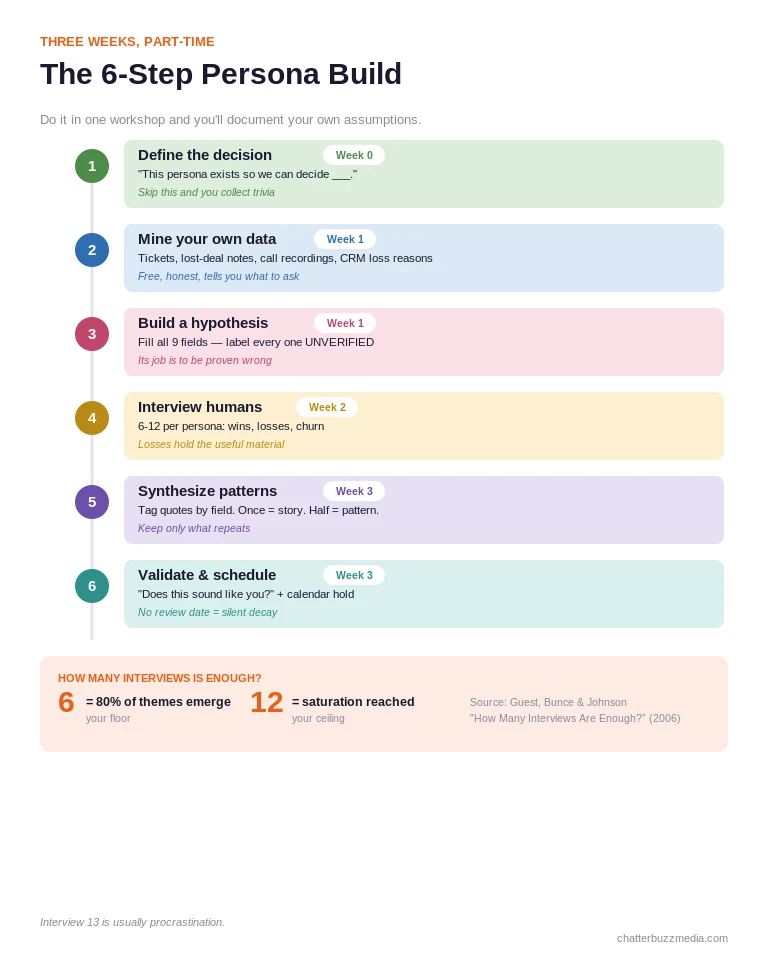
Step 1: Define the decision the persona will inform. Write one sentence: “This persona exists so we can decide ___.”
Without it, you’ll collect trivia. This step also tells you how many personas you need — usually three to five, because a team can’t hold eight in its head.
Step 2: Mine the data you already have. Before you talk to anyone, read your own evidence: support tickets, lost-deal notes, sales call recordings, chat logs, site search queries, CRM close and loss reasons.
This costs nothing and it’s honest, because nobody was performing for a researcher when they wrote it. It also tells you what to ask about later.
Step 3: Build a hypothesis persona. Fill the nine fields with your best guesses and label every one unverified.
This is a legitimate artifact as long as the label stays on. Its entire job is to be proven wrong.
Step 4: Interview real humans. Six to twelve conversations per persona, mixing recent wins, recent losses, and churned accounts.
Losses and churn are where the useful material lives, which is exactly why most teams skip them. A persona built only from happy customers describes your existing base, not your market.
Step 5: Synthesize into patterns. Pull quotes into a spreadsheet, tag them by field, and look for what repeats.
If a theme appears once, it’s a story. If it appears in half your interviews, it’s a pattern worth building on.
Step 6: Validate, distribute, and schedule the review. Show the finished persona to two customers who match it and ask, “does this sound like you?”
Then put a recurring calendar hold on it — quarterly for fast-moving markets, twice a year otherwise. A persona without a review date is a persona with an expiry date nobody wrote down.
How many interviews is enough?
This is where most guides wave their hands, so here’s the actual research. The landmark study on qualitative saturation, Guest, Bunce, and Johnson’s “How Many Interviews Are Enough?”, analyzed 60 interviews across two research sites.
They found 80% of themes emerged within the first six interviews, and saturation was reached within twelve. Additional interviews produced diminishing returns rather than new insight.
Translated for your purposes: six is the floor, twelve is the ceiling, and interview 13 is usually procrastination. If you can predict what someone is about to say before they say it, stop scheduling.
The quality of those twelve conversations is entirely determined by the questions you bring.
The Interview Script: 18 Questions That Get Real Answers
The best persona interview question is “walk me through the day you decided to do something about this” — because it forces a specific memory instead of a general opinion. Everything below is built on that principle.
Two rules before you start. Never pitch, and never ask what they want — ask what they did.
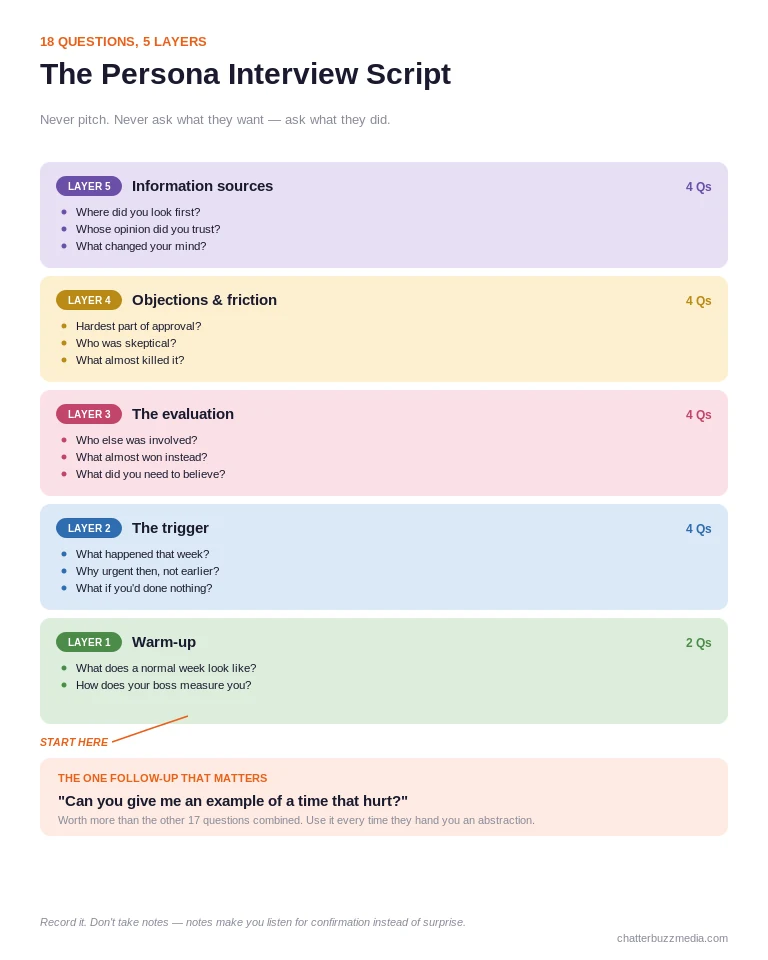
Layer 1: Warm-up (2 questions)
- Walk me through what you’re responsible for — what does a normal week look like?
- How does your boss measure whether you had a good quarter?
Layer 2: The trigger (4 questions)
- Take me back to when you first started looking for a solution. What happened that week?
- How long had that problem existed before you did something about it?
- What made it urgent then rather than six months earlier?
- What would have happened if you’d done nothing?
Layer 3: The evaluation (4 questions)
- Who else was involved in the decision, and what did each of them care about?
- What options did you consider — including building it in-house or doing nothing?
- What almost made you choose someone else?
- What did you need to believe before you could say yes?
Layer 4: Objections and friction (4 questions)
- What was the hardest part of getting this approved internally?
- Who was skeptical, and what was their argument?
- What did you have to give up or defer to fund this?
- What almost killed the project?
Layer 5: Information sources (4 questions)
- Where did you look first when you started researching?
- Whose opinion did you trust most, and why them?
- What did you read, watch, or ask that actually changed your mind?
- If a peer asked you about this tomorrow, what would you tell them?
How to run the call
Record it with permission and don’t take notes. Notes make you listen for confirmation instead of surprise.
Aim for 30 minutes and follow the tangents. The unplanned five minutes is usually where the persona actually lives.
When someone hands you an abstraction — “we needed better reporting” — respond with “can you give me an example of a time that hurt?” That single follow-up is worth more than the other 17 questions combined.
Who to interview (and how to get them on a call)
Recruit across three groups, not one. Recent wins tell you what worked, recent losses tell you what your messaging missed, and churned accounts tell you what you oversold.
Aim for roughly half wins, a quarter losses, and a quarter churn. Getting them to say yes is easier than people expect, provided you’re honest about the ask.
- Have the right person ask. A request from a founder or researcher converts far better than one from an account rep, because it doesn’t read as a disguised upsell.
- Say it isn’t a sales call — and mean it. If a rep joins the line, you’ve burned the relationship and corrupted the data in one move.
- Ask for 30 minutes, not “a quick chat.” Specific asks get accepted; vague ones get deferred forever.
- Offer something real. A gift card works, and so does sharing the anonymized findings — that often appeals more to senior buyers who want the benchmark.
- Lost deals will talk. Buyers who chose someone else are often the most candid, because they have nothing left to negotiate for.
The mistakes that ruin persona interviews
Four errors account for most useless transcripts. All four are avoidable once you know to watch for them.
- Asking hypotheticals. “Would you use a tool that did X?” produces polite fiction — ask about the last time they actually faced X instead.
- Leading the witness. “So integration was important, right?” hands them your answer. Ask “what mattered most?” and stay quiet.
- Stopping at the first answer. The first response is the rehearsed one, and the real answer lives two follow-ups deeper.
- Filling silence. Count to five after they finish. People fill pauses with the thing they weren’t sure they should say.
These questions also surface something most templates ignore entirely: the buyer was never deciding alone.
How to Build Personas for a B2B Buying Committee
In B2B, a single persona is almost always the wrong unit — you need a persona set, because the person with the problem is rarely the person with the budget. Gartner’s B2B Buying Report puts the average enterprise buying group at five to 11 stakeholders representing five distinct business functions.
Modeling that group as “Marketing Manager Maria” is how deals stall at legal for six weeks with no explanation.
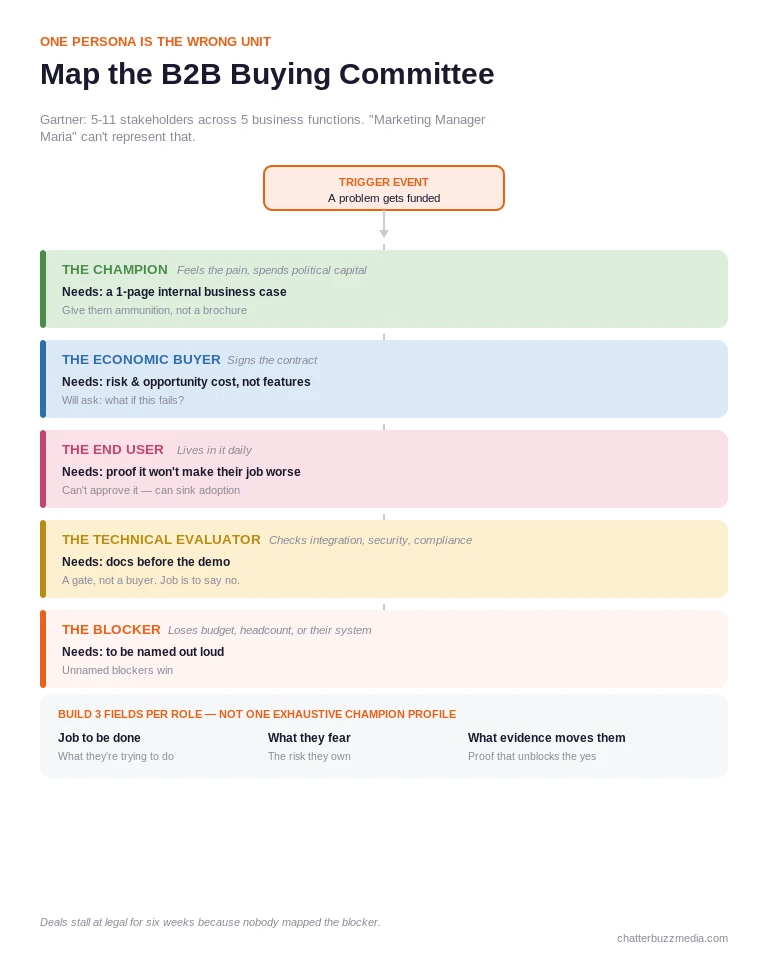
Map the committee by role rather than title. Titles vary wildly between companies; roles don’t.
- The champion feels the pain and spends political capital to fix it. Build them a one-page internal business case, not a brochure.
- The economic buyer signs. They care about risk and opportunity cost, rarely about features, and they will ask what happens if this fails.
- The end user lives in the thing daily. They can’t approve the purchase, but they can quietly sink adoption after it.
- The technical evaluator checks integration, security, and compliance. They’re a gate rather than a buyer, and their job is to find reasons to say no.
- The blocker loses something if this happens — budget, headcount, or the system they personally built. Name them explicitly, because unnamed blockers win.
Build an abbreviated persona for each role: job to be done, what they fear, and what evidence moves them. Three fields per role beats one exhaustive profile of the champion.
Why this matters more than it used to
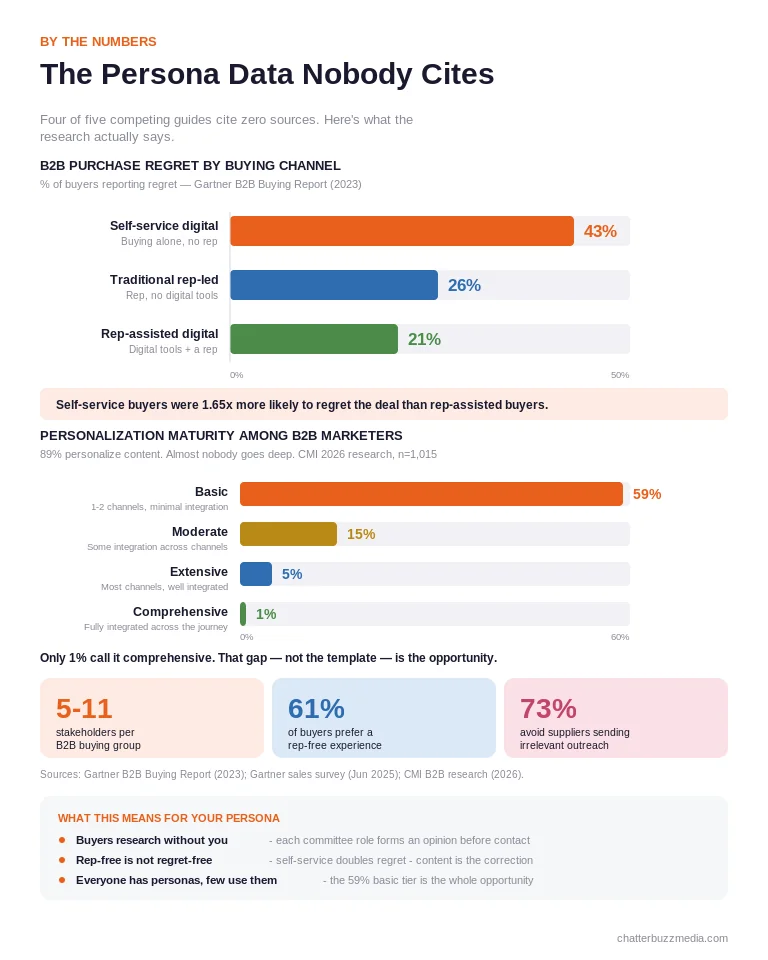
Buyers are doing more of this without you in the room. Gartner’s June 2025 sales survey found 61% of B2B buyers prefer an overall rep-free buying experience, and 73% actively avoid suppliers who send irrelevant outreach.
But rep-free isn’t the same as better. Gartner’s buying research found buyers using self-service digital channels reported purchase regret 43% of the time, versus 21% for rep-assisted digital buying.
Self-service buyers were 1.65x more likely to regret the deal. That’s the cost of a buying committee researching in isolation with no one correcting the misunderstandings.
The implication for your persona set is direct. Each committee role is now forming opinions before anyone talks to them, and mostly avoiding you if your message is generic.
If your motion is committee-driven, our account-based marketing strategy guide and the B2B demand generation guide cover how to reach each role in parallel.
The obvious next question: how do you know any of this is working?
How to Know Your Customer Persona Is Actually Working
A persona is working when it changes a decision you can point to — a campaign you killed, a message you rewrote, a segment you stopped funding. Everything else is a vanity artifact.
This is the section every competing guide skips, which is also why so many personas quietly die.
The four signals
1. Usage. Can three people on your team name the personas without looking? If not, the problem is distribution, not research.
2. Decision traceability. Keep a running log of every decision the persona changed. If that log is empty after a quarter, the persona is decoration.
3. Message performance by segment. Compare engagement and conversion for persona-informed messaging against a generic control. This is the only signal that produces a number your CFO respects, and it pairs naturally with tracking customer acquisition cost by segment.
4. Sales adoption. If sales doesn’t use it, it’s wrong. They talk to buyers daily, and their rejection is data — our guide on how to align marketing and sales covers closing that loop.
The maturity gap nobody talks about
Here’s the uncomfortable benchmark. The Content Marketing Institute’s 2026 B2B content marketing research, based on 1,015 B2B marketers, found 89% personalize content — but 59% do it at a “basic” level of one or two channels with minimal integration.
Only 5% called their personalization extensive. Just 1% called it comprehensive.
Almost everyone has personas. Almost nobody uses them past the surface, and that gap is the actual opportunity.
Closing it means turning persona fields into shipped work — different messaging, offers, and channels per segment. Our guide to personalizing content for your highest-value buyers covers how to operationalize it, and tying it to a broader go-to-market strategy keeps the persona attached to revenue rather than to a slide.
When to retire a persona
Kill a persona when it stops earning its place. Four signals tell you it’s time.
- No campaigns targeted it in two quarters. If nobody reached for it, nobody needed it.
- Its win rate trails your average. You’re funding attention toward buyers who don’t convert.
- The trigger event stopped happening. Markets shift, and the pain that created this persona may simply be solved now.
- Nobody can remember the last decision it changed. That’s the clearest signal of all.
Retiring personas is a sign of a healthy practice, not a failed one. Teams that only ever add personas end up with twelve documents and zero focus.
Frequently Asked Questions
1. 🔍 What is a customer persona template?
A customer persona template is a structured document that captures a specific buyer type’s goals, trigger events, pain points, evaluation criteria, objections, and information sources — built from research rather than assumption. The template standardizes the fields so personas stay comparable across your team.
The value comes from the evidence behind each field, not the layout.
2. 📊 How many customer personas should I create?
Three to five for most companies. Fewer than three usually means you’re collapsing genuinely different buyers into one profile, and more than five means your team can’t hold them in mind when it matters.
Start with two or three core personas and add only when a real decision demands it.
3. ⚡ What’s the difference between a buyer persona and an ideal customer profile?
An ICP describes the company worth selling to — revenue, industry, headcount, tech stack, trigger events. A persona describes the person inside that company who evaluates and buys.
Use the ICP to decide which accounts to pursue, and the persona to decide what to say to the humans inside them.
4. 🏦 Can I build a persona without doing interviews?
Yes, but label it a hypothesis persona and treat every field as unverified. Support tickets, lost-deal notes, call recordings, CRM close reasons, and site search queries will get you a credible first draft.
Then validate with six conversations — that’s usually enough to confirm or demolish most of your assumptions.
5. 🤝 What should be included in a customer persona?
Nine fields carry the weight: name and role, company context, job to be done, trigger event, ranked pain points, evaluation criteria, objections and blockers, information sources, and verbatim quotes from real buyers.
Cut the stock photo, the age bracket, and the “favorite brands” row unless you can name the decision each one changes.
6. 💰 How often should I update my customer personas?
Quarterly in fast-moving markets, twice a year otherwise — and immediately after any major shift in your market, pricing, or product. Put it on the calendar as a recurring hold, because personas don’t decay visibly.
A persona nobody has questioned in 18 months isn’t validated, it’s just old.
7. 🚀 What is a negative persona?
A negative persona describes who you deliberately don’t want — the buyer who churns, haggles, consumes support, and never expands. They’re worth documenting because they’re often the easiest to attract, and because sales needs explicit permission to disqualify.
If your cheapest leads convert fastest and leave soonest, you have a negative persona you haven’t written down.
8. 📈 How do I know if my customer persona is working?
Track four signals: whether your team can name the personas unprompted, whether you can point to specific decisions the persona changed, how persona-informed messaging performs against a generic control, and whether sales actually uses it.
If the decision log is empty after a quarter, the persona is decoration regardless of how good it looks.
Putting Your Customer Persona Template to Work
The difference between a persona that drives decisions and one that gathers dust isn’t the template — it’s whether every field traces back to evidence. Nine fields, six to twelve interviews, a persona set instead of a single profile, and a scheduled review date will put you ahead of the 59% of B2B marketers still personalizing at a basic level.
Here’s your action plan for the next four weeks.
- Week 1 — Mine what you have. Pull 20 lost-deal notes, 20 support tickets, and five call recordings. Draft a hypothesis persona and label every field unverified.
- Week 2 — Run six interviews. Use the 18-question script. Include at least two losses and one churned account, and record every call.
- Week 3 — Synthesize and validate. Tag quotes by field and keep only patterns that repeat. Then show the result to two real customers and ask if it sounds like them.
- Week 4 — Distribute and schedule. Get it in front of sales, start a decision log, and put a quarterly review on the calendar before you close the doc.
If you’re building this as part of a broader targeting system, the natural next step is connecting your personas to the accounts they live inside. Start with the ideal customer profile guide, then browse the full library of marketing strategy resource guides to go deeper on demand generation, ABM, and content strategy.

Victoria Wallace
Victoria Wallace is a senior content strategist and marketing writer with 30+ years of experience helping more than 200 brands translate complex business goals into clear, conversion-focused content. Her background spans paid media, marketing strategy, go-to-market planning, brand positioning, and full-funnel campaign development, giving her a deep understanding of how SEO content connects to real business growth.