
 321-236-2899
B2B vs B2C Marketing: Key Differences in Strategy and Execution
B2B vs B2C marketing isn’t just an academic distinction — it’s the difference between a strategy that converts and one that burns budget. Most marketers understand the surface-level contrast: one sells to businesses, the other sells to consumers. But the real gap runs deeper than audience labels, and it starts with how buyers actually move from awareness to purchase.
After years of building campaigns across B2B industries like manufacturing, financial services, and credit union marketing — alongside B2C markets like med spa marketing, home builders, and ecommerce — a consistent pattern emerges. The buyer journey dictates everything: channel selection, content format, messaging tone, budget allocation, and the metrics that actually matter.
This guide breaks down exactly how and why B2B and B2C marketing diverge. You’ll learn why the same channel can produce 10x ROI for a B2C brand and fall flat for a B2B company, and how to adjust your marketing strategy based on how your buyers actually make decisions. Let’s start with what these terms really mean — beyond the textbook definitions.
Key Takeaways
- The buyer journey — not the product — is the fundamental difference between B2B and B2C marketing strategies.
- B2B purchases involve an average of 6.8 decision-makers and sales cycles of 6-12 months, while most B2C decisions happen in minutes.
- Channel effectiveness depends entirely on where your buyer spends time and how they research — LinkedIn dominates B2B while short-form video drives B2C.
- B2B content must build trust across a buying committee; B2C content must trigger an emotional response in a single individual.
- The metrics that define success are completely different — pipeline velocity and MQLs for B2B versus ROAS and conversion rate for B2C.
- Smart marketers borrow from both playbooks — SEO, email, and personalization work across models when adapted to the buyer’s decision-making process.
What B2B and B2C Marketing Actually Mean
B2B (business-to-business) marketing targets organizations as buyers, while B2C (business-to-consumer) marketing targets individuals making personal purchases. But that definition only scratches the surface — the real distinction isn’t what you sell, it’s who buys and how they buy.
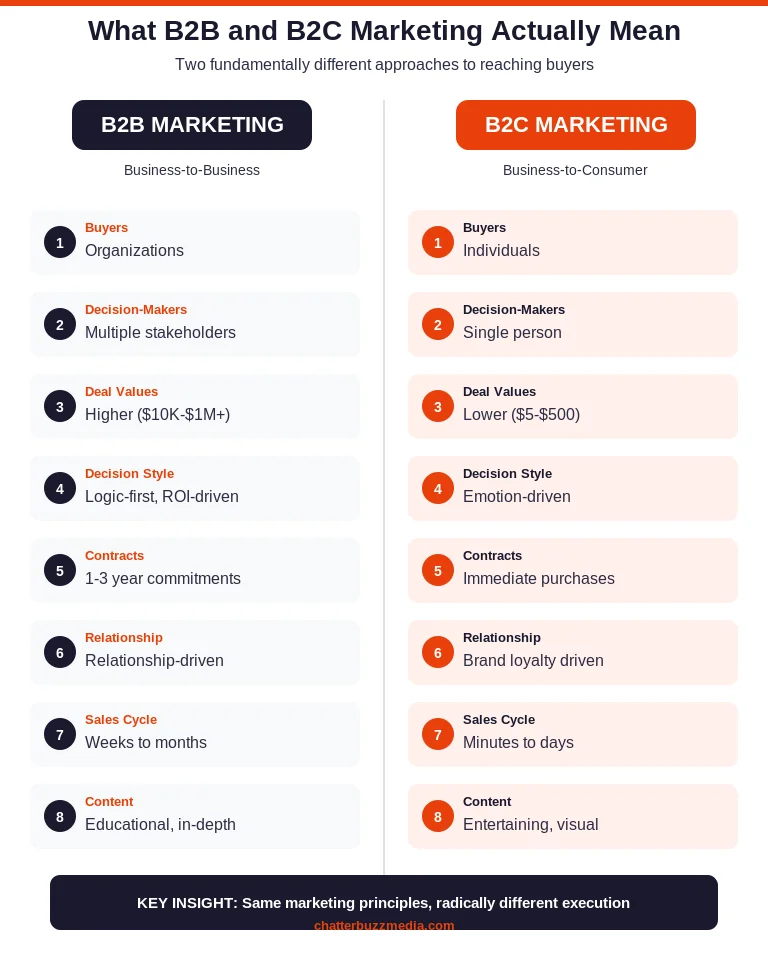
A software company selling project management tools could serve both markets. The B2B version involves demos, procurement teams, security reviews, and six-month negotiations. The B2C version means a user signs up with a credit card in under three minutes.
Same product category. Completely different marketing approach based on the customer journey.
B2B: Selling to Organizations
B2B marketing speaks to multiple stakeholders within a single account. Your buyer is rarely one person — it’s a committee of influencers, evaluators, budget holders, and final decision-makers who all need to reach consensus.
This means your messaging must address different concerns simultaneously. The CFO cares about ROI and total cost of ownership. The end user cares about ease of implementation. The IT director cares about security and integration.
- Higher deal values — B2B transactions typically range from thousands to millions of dollars, justifying longer sales processes.
- Relationship-driven — trust and credibility carry more weight than brand awareness or emotional appeal.
- Logic-first decisions — buyers need data, case studies, and documented proof of results before they commit budget.
- Longer commitment periods — B2B contracts often lock in for 1-3 years, making the stakes of a wrong decision significantly higher.
Industries like manufacturing and financial services exemplify this model. Every purchase decision gets scrutinized because mistakes are expensive and visible.
B2C: Selling to Individuals
B2C marketing targets one person making a purchase decision for themselves or their household. The buyer is also the user, the budget holder, and the decision-maker — all rolled into one.
This compresses the entire marketing funnel. You don’t need to convince a committee. You need to capture attention, create desire, and make the purchase frictionless.
- Lower price points — most B2C purchases range from a few dollars to a few thousand, reducing perceived risk.
- Emotion-driven decisions — identity, aspiration, convenience, and social proof outweigh spreadsheet analysis.
- Volume-dependent — success depends on reaching large audiences and converting at scale.
- Brand loyalty matters — repeat purchases and lifetime value drive profitability more than any single transaction.
Whether you’re selling skincare treatments or home renovations, the fundamental challenge is the same: connect emotionally, remove friction, and make buying easy.
How the Buyer Journey Differs Between B2B and B2C
The B2B buyer journey takes 6-12 months and involves 6-10 touchpoints across multiple stakeholders, while the B2C buyer journey can collapse into minutes with just 1-3 touchpoints. This single difference — the length and complexity of the path to purchase — shapes every marketing decision you’ll make.
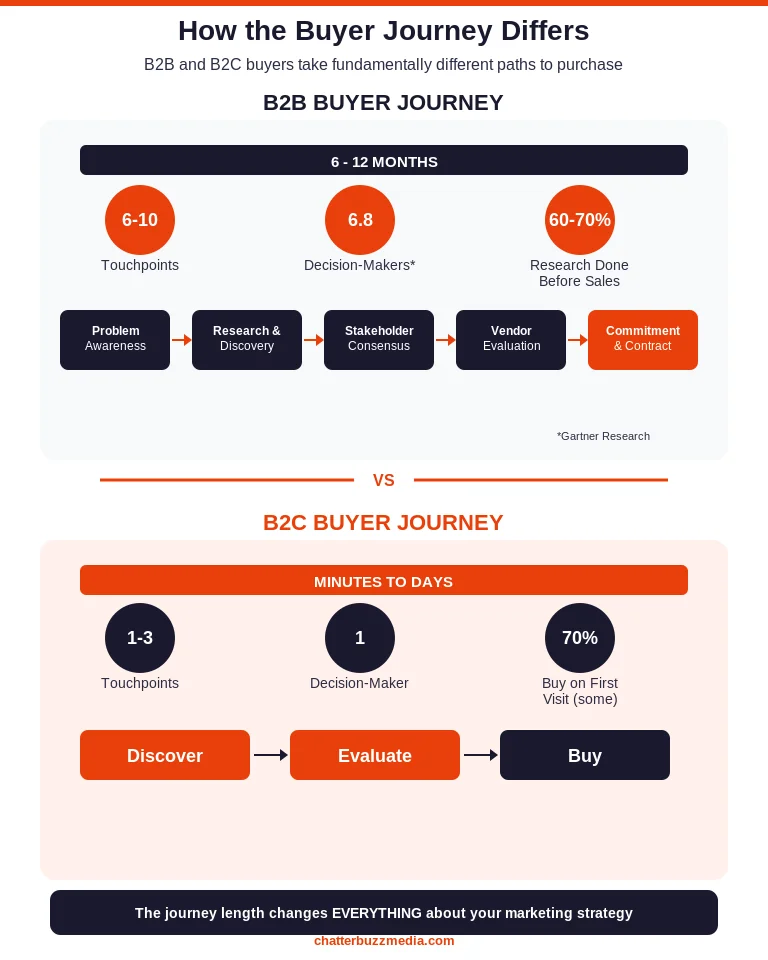
According to Gartner’s research on B2B buying, the average B2B purchase now involves 6.8 decision-makers. Meanwhile, Google’s consumer research shows that most B2C purchase decisions happen in under 20 seconds for everyday consumer goods. That’s not a minor variation — it’s a fundamentally different process that demands a fundamentally different strategy.
The B2B Buyer Journey: Research, Consensus, Commitment
B2B buyers don’t impulse-buy a $200,000 software platform. They research exhaustively, build internal business cases, evaluate alternatives, and navigate organizational politics before a single contract gets signed.
The typical B2B journey unfolds across three distinct phases, each requiring different content and messaging:
- Research phase (weeks 1-8) — buyers identify a problem, search for solutions, and consume educational content like blog posts, whitepapers, and industry reports. Your inbound marketing strategy lives or dies here.
- Consensus phase (weeks 8-20) — the primary researcher brings options to the broader team, triggering a second wave of evaluation. Different stakeholders examine your solution through different lenses.
- Commitment phase (weeks 20-48) — final vendor selection, negotiation, procurement, legal review, and contract signing. ABM effectiveness peaks during this phase because targeting becomes highly specific.
Forrester’s research confirms that B2B buyers complete 60-70% of their decision-making process before ever talking to a sales rep. Your marketing must do the heavy lifting long before sales gets involved.
The B2C Buyer Journey: Discover, Evaluate, Buy
B2C buyers move fast because they’re spending their own money on their own terms. No committees. No procurement departments. No six-month evaluation cycles.
The B2C journey compresses into three rapid phases:
- Discovery — a buyer sees a social ad, hears a recommendation from a friend, or searches for a solution to an immediate need. First impressions are everything.
- Evaluation — they check reviews, compare 2-3 alternatives, and look for social proof. This phase can last seconds for a $30 purchase or a few weeks for a $5,000 one.
- Purchase — if the experience is frictionless and the value proposition is clear, they buy. One extra form field or a confusing checkout can kill the sale.
The speed of this journey puts enormous pressure on conversion rate optimization. Every second of friction costs revenue.
Decision-Making: Committees vs. Impulse
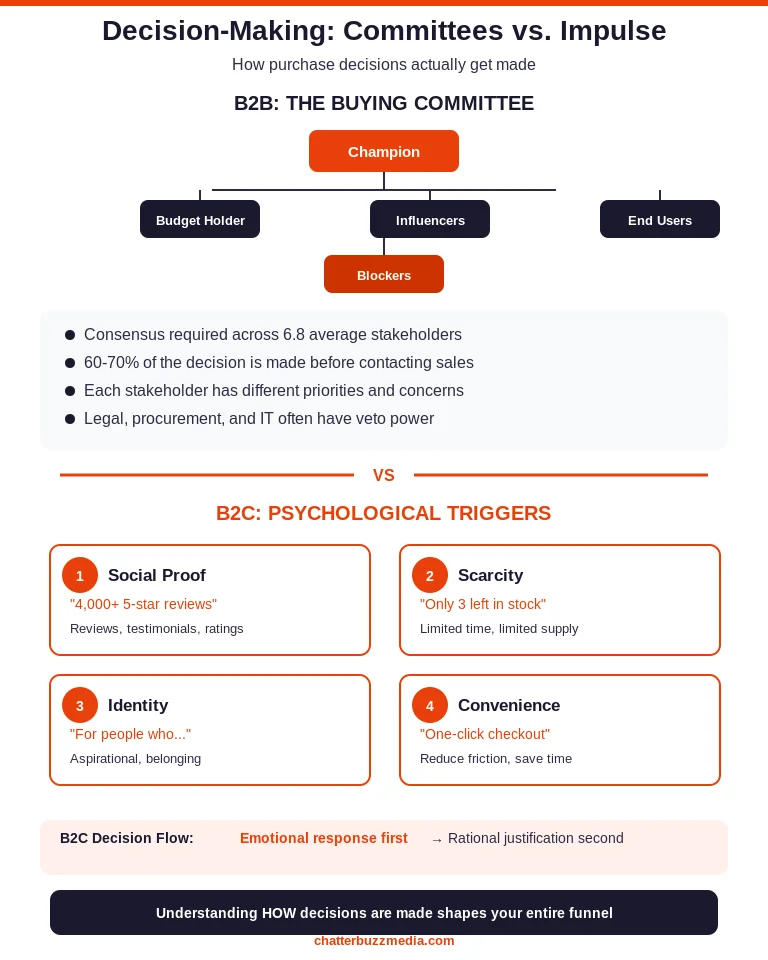
B2B decisions are made by committees seeking consensus, while B2C decisions are made by individuals driven by a blend of logic and emotion. Understanding this distinction determines how you structure your messaging, what content you create, and where you invest your budget.
The way someone buys enterprise software has almost nothing in common with the way someone buys running shoes. Yet marketers routinely apply B2C tactics to B2B audiences (and vice versa), then wonder why results fall short.
How B2B Buying Committees Actually Work
A B2B buying committee isn’t a formal group that holds meetings. It’s a fluid collection of stakeholders who each have veto power and different evaluation criteria.
Gartner’s data reveals that as the number of decision-makers increases, the likelihood of a “high-quality, low-regret” purchase drops dramatically. More people means more conflicting priorities, longer timelines, and higher chances the deal stalls entirely.
- Champions — the internal advocate who discovered your solution and pushes it forward. Your content must arm them with the ammunition they need to sell internally.
- Influencers — technical evaluators, end users, and department heads who shape the recommendation. They need proof your solution actually works in practice.
- Budget holders — finance leaders who approve the spending. They care about ROI, payback period, and total cost of ownership.
- Blockers — stakeholders (often IT or legal) who can kill a deal over security, compliance, or integration concerns. Ignoring them is the fastest way to lose.
This is exactly why account-based marketing has become essential for complex B2B sales. You need to reach multiple stakeholders within the same organization with personalized messaging that addresses each person’s specific concerns.
The Psychology Behind B2C Purchase Decisions
B2C buyers make decisions emotionally first, then rationalize them logically after the fact. Decades of behavioral psychology research confirms this pattern across virtually every consumer category.
This doesn’t mean B2C buyers are irrational. It means the triggers that initiate a purchase are fundamentally different from B2B:
- Social proof — reviews, ratings, testimonials, and user-generated content reduce perceived risk. A product with 10,000 five-star reviews sells itself.
- Scarcity and urgency — limited-time offers, low-stock warnings, and countdown timers accelerate decisions by triggering fear of missing out.
- Identity alignment — people buy brands that reflect who they are or who they want to become. Brand messaging that connects with identity outperforms feature-focused copy every time.
- Convenience — the easier the purchase process, the higher the conversion rate. Amazon didn’t win on price alone — they won on frictionless buying.
Effective B2C marketing taps into these psychological triggers while ensuring the logical justification — quality, value, durability — is readily available for buyers who need it.
Marketing Channels That Work for B2B vs. B2C
The best marketing channel is wherever your buyer spends time and is receptive to your message — and that differs dramatically between B2B and B2C audiences. Pouring budget into Instagram for a manufacturing company or relying on LinkedIn for a consumer skincare brand ignores how each audience actually discovers and evaluates solutions.
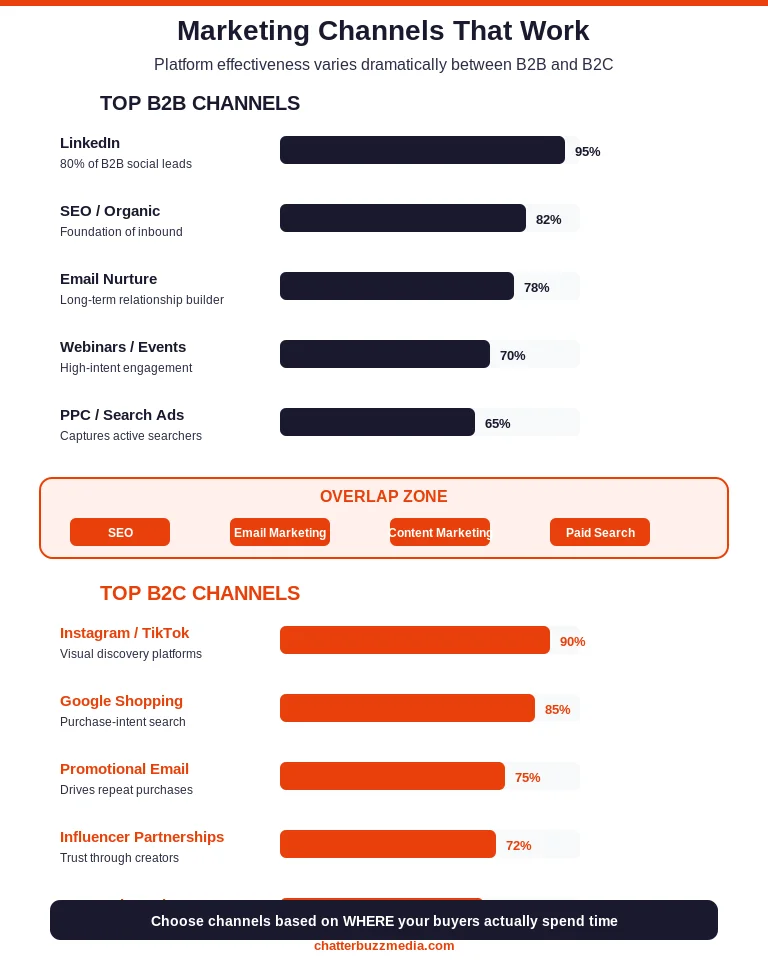
Channel selection should follow buyer behavior, not marketing trends. Here’s where each model generates the highest returns.
Top B2B Marketing Channels
B2B channels must support long consideration cycles and reach multiple stakeholders. The channels that work best are those that build credibility over time and nurture prospects through a complex decision process.
- LinkedIn — the dominant social platform for B2B, with LinkedIn’s B2B Institute reporting that 80% of B2B social leads originate here. Organic thought leadership and targeted advertising both perform well.
- SEO and organic search — B2B buyers start with search. Ranking for high-intent keywords like “enterprise CRM comparison” or “manufacturing SEO” captures buyers already in research mode.
- Email nurture sequences — long sales cycles require sustained engagement. Marketing automation platforms enable sophisticated drip campaigns that deliver the right content at the right stage.
- Webinars and virtual events — these generate qualified leads while demonstrating expertise. A 45-minute webinar builds more trust than 100 social media posts.
- Paid search (PPC) — pay-per-click advertising targeting high-intent B2B keywords consistently delivers qualified leads, especially when paired with dedicated landing pages.
Top B2C Marketing Channels
B2C channels must capture attention quickly and drive immediate action. The best-performing channels offer visual storytelling, broad reach, and short paths to purchase.
- Instagram and TikTok — short-form video and visual content dominate B2C discovery. Social media advertising on these platforms delivers massive reach with precise audience targeting.
- Google Shopping and paid search — product-focused search ads capture high-intent buyers at the exact moment they’re ready to purchase.
- Email marketing — promotional emails, abandoned cart sequences, and loyalty campaigns generate some of the highest ROI in B2C. The approach is transactional rather than educational.
- Influencer partnerships — HubSpot’s State of Marketing report consistently shows influencer marketing as a top-performing channel for consumer brands.
- Retargeting ads — bringing back visitors who browsed but didn’t buy is one of the most cost-effective B2C tactics.
Channel Overlap: Where Both Models Win
Some channels perform well for both B2B and B2C — but the execution strategy must differ. SEO works universally, but B2B SEO targets informational queries with long-form content while B2C SEO targets transactional queries with product pages. Understanding the nuances of SEO vs PPC helps allocate budget effectively across either model.
Email marketing also spans both worlds. The difference lies in frequency, tone, and purpose: B2B emails educate and nurture over months, while B2C emails promote and convert within days. Content marketing is table stakes for both — it’s the format and depth that change.
Content Strategy: Depth vs. Speed
B2B content succeeds through depth, expertise, and sustained value over time, while B2C content wins through speed, emotion, and instant engagement. The format, length, tone, and distribution of your content should directly reflect how your buyer consumes information and makes decisions.
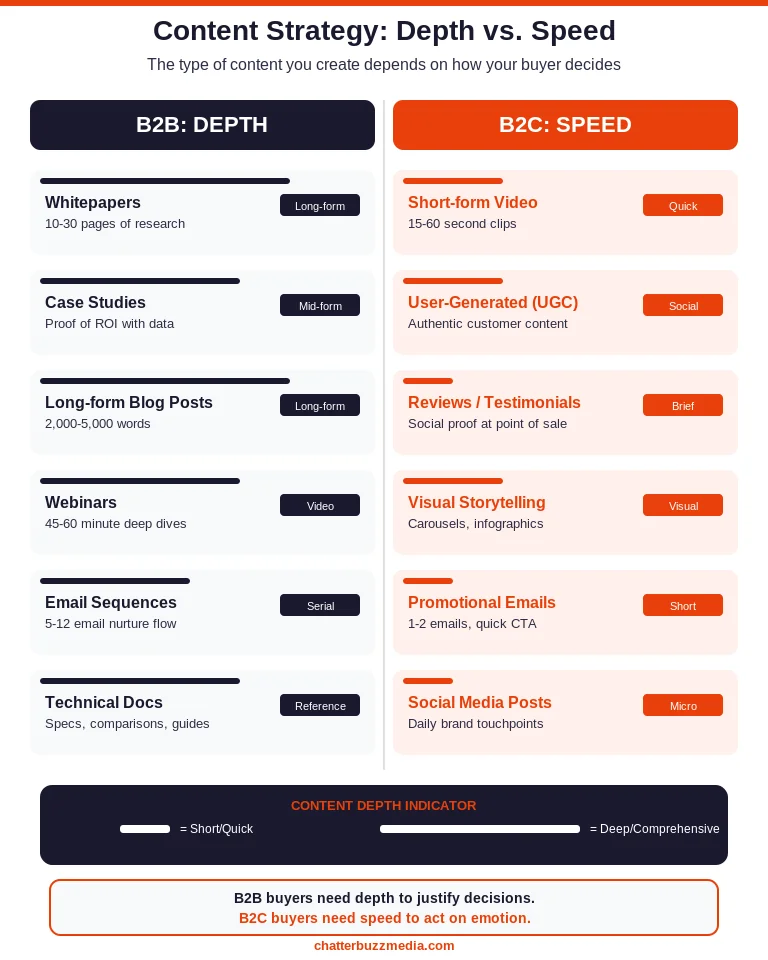
Getting this wrong is one of the most expensive mistakes in marketing. A B2B company investing heavily in TikTok trends while ignoring whitepapers and case studies is leaving pipeline on the table. A B2C brand publishing 5,000-word technical guides when their audience wants 30-second videos is wasting resources.
B2B Content That Converts
B2B content must earn trust with a skeptical, well-informed audience that’s evaluating your company over weeks or months. Every piece of content serves a specific role in moving the buyer closer to a decision.
- Whitepapers and research reports — these establish thought leadership and provide the data-driven justification buyers need to build internal business cases. Gate them behind forms to generate qualified leads.
- Case studies — proof that your solution delivers results for companies similar to the prospect. Include specific metrics — “reduced cost per lead by 40%” is infinitely more persuasive than “improved performance.”
- Long-form blog posts — educational content targeting high-intent search queries positions your brand as a resource. Measuring content marketing ROI ensures these efforts pay off.
- Webinars and expert panels — live and on-demand events let prospects experience your expertise firsthand. They’re particularly effective during the consensus phase when multiple stakeholders need convincing.
- Email nurture sequences — a strategic drip campaign that delivers relevant content based on engagement signals, buyer stage, and persona. This is where B2B demand generation efforts compound over time.
B2C Content That Converts
B2C content must grab attention in seconds and create an emotional connection that motivates immediate action. The window of opportunity is tiny, and competition for attention is fierce.
- Short-form video — 15-60 second videos on TikTok, Instagram Reels, and YouTube Shorts dominate B2C discovery. They showcase products in action and build brand personality.
- User-generated content (UGC) — real customers sharing real experiences generates more trust than polished brand content. UGC consistently outperforms studio-produced creative in ad performance.
- Reviews and testimonials — star ratings, written reviews, and video testimonials serve as social proof. For most consumer products, reviews are the single most influential content type.
- Visual storytelling — lifestyle photography, before-and-after imagery, and aspirational content that helps buyers imagine themselves using the product.
- Promotional emails — flash sales, new arrivals, abandoned cart reminders, and loyalty rewards. B2C email is direct and transactional — not the educational drip sequences used in B2B.
Metrics and KPIs That Matter for Each Model
B2B marketing tracks pipeline-focused metrics like MQLs and customer lifetime value, while B2C marketing measures transactional metrics like conversion rate and ROAS. Tracking the wrong KPIs is worse than tracking none at all — it leads to false confidence and misallocated budget.
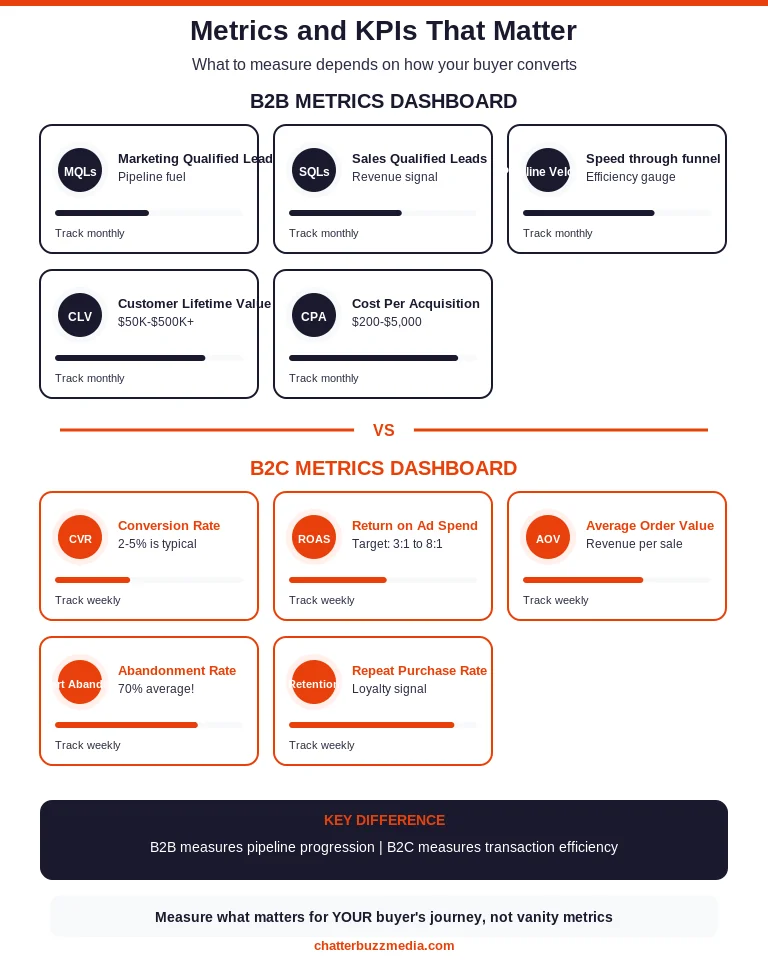
The metrics you report on should directly reflect the length and complexity of your buyer journey. A B2B marketer celebrating high website traffic without tracking pipeline contribution is optimizing for the wrong outcome. A B2C marketer ignoring cart abandonment rate is leaving money on the table.
B2B Marketing Metrics
B2B metrics must capture the full funnel, from initial awareness through closed-won revenue. Because sales cycles span months, your measurement framework needs to track progress at every stage.
- Marketing Qualified Leads (MQLs) — contacts who’ve shown enough engagement to warrant sales follow-up. Define clear MQL criteria to avoid flooding sales with unqualified leads.
- Sales Qualified Leads (SQLs) — MQLs that sales has accepted and is actively pursuing. The MQL-to-SQL conversion rate reveals content quality and lead scoring accuracy.
- Pipeline velocity — how quickly leads move through your funnel. Faster velocity means more efficient marketing and sales alignment.
- Customer lifetime value (CLV) — the total revenue a customer generates over the entire relationship. B2B CLV often runs 10-100x higher than B2C, justifying higher acquisition costs.
- Cost per acquisition (CPA) — the total marketing and sales cost to acquire one customer. Track this by channel to identify your most efficient lead generation strategies.
Effective marketing reporting and analytics connects these metrics into a cohesive picture that shows how marketing drives revenue — not just activity.
B2C Marketing Metrics
B2C metrics focus on transaction velocity and the efficiency of converting traffic into revenue. The short purchase cycle means you can measure and optimize in near-real-time.
- Conversion rate — the percentage of visitors who complete a desired action, whether it’s a purchase, signup, or booking. This is the single most actionable B2C metric.
- Return on ad spend (ROAS) — revenue generated for every dollar spent on advertising. A healthy ROAS threshold varies by industry but typically ranges from 3:1 to 8:1.
- Average order value (AOV) — increasing AOV through upsells, bundles, and cross-sells improves profitability without acquiring new customers.
- Cart abandonment rate — the percentage of shoppers who add items to their cart but don’t complete the purchase. Industry average sits around 70%, and reducing it even slightly has an outsized revenue impact.
- Customer retention rate — acquiring new customers costs 5-7x more than retaining existing ones. Loyalty programs, personalized offers, and exceptional experience drive retention.
Knowing which marketing KPIs to prioritize prevents your team from drowning in data without making better decisions.
When B2B and B2C Marketing Strategies Overlap
Despite their differences, B2B and B2C marketing share several foundational strategies that work across both models when adapted to the buyer’s context. The smartest marketers borrow tactics from both playbooks and adjust execution to match their audience.
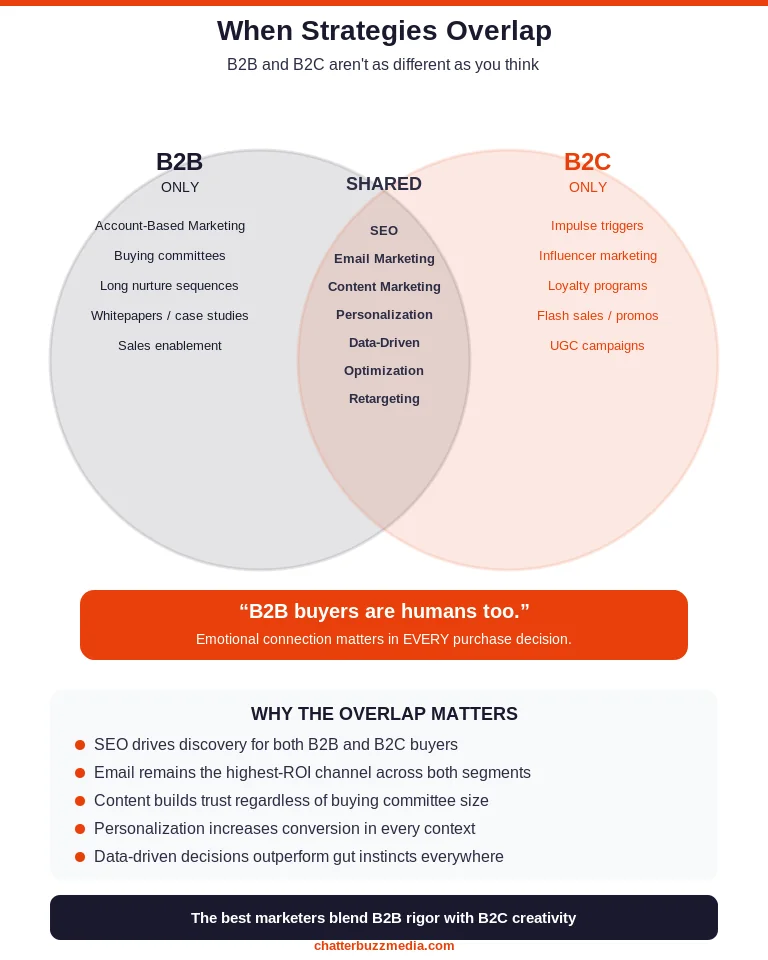
The “B2B buyers are robots and B2C buyers are emotional” framing is a myth. B2B buyers are humans with emotions, and B2C buyers use logic. The differences are matters of degree and context, not absolute categories.
- SEO is universal — both B2B and B2C buyers start with search. The keyword strategy, content depth, and page types differ, but search visibility is non-negotiable for either model.
- Email marketing drives ROI everywhere — the approach changes (nurture vs. promotional), but email remains the highest-ROI channel across marketing models.
- Content marketing is table stakes — every buyer, whether corporate or consumer, expects valuable content before they engage. The format and depth vary, but the need for quality content doesn’t.
- Personalization wins in both worlds — whether you’re personalizing an ABM campaign for a Fortune 500 target or tailoring product recommendations based on browsing behavior, relevance increases conversion.
- Data-driven optimization applies universally — A/B testing, audience segmentation, and performance analysis improve results regardless of whether you’re selling to organizations or individuals.
Hybrid models are increasingly common. B2B2C companies, DTC brands that also sell to retailers, and SaaS companies with both enterprise and individual plans must blend strategies from both playbooks. Understanding the full spectrum of digital marketing services helps you choose the right mix.
How to Choose the Right Approach for Your Business
The right marketing approach depends on three factors: who your buyer is, how long their journey takes, and what triggers their purchase decision. Getting this framework right saves you from wasting months and budget on tactics that don’t match your market.

Don’t choose based on what’s trendy or what a competitor is doing. Choose based on how your specific buyers actually behave.
Start with these three diagnostic questions:
- Who holds the purchasing authority? — If one person decides, you’re in B2C territory. If 3-10 stakeholders must align, you need a B2B approach. This single question determines whether your content targets an individual or a committee.
- How long does a typical purchase take? — Same-day to two-week decisions require B2C speed and conversion optimization. Multi-month decisions require B2B nurture sequences and relationship building.
- What triggers the purchase? — Emotional triggers (desire, frustration, aspiration) point toward B2C tactics. Rational triggers (contract renewal, business growth, operational problems) point toward B2B B2B digital marketing.
When to blend approaches: If your product serves both audiences, build separate funnels. A single-track strategy that tries to appeal to everyone appeals to no one. Create dedicated landing pages, content tracks, and ad campaigns for each segment.
Common mistakes to avoid:
- Applying B2C urgency tactics to B2B — “Buy now, limited time” messaging feels desperate in a B2B context. Your buyers can’t “buy now” even if they wanted to — they have procurement processes to follow.
- Using B2B depth for B2C — a 3,000-word whitepaper won’t sell sneakers. Match content depth to decision complexity.
- Ignoring the post-purchase experience — both models benefit from retention marketing, but the tactics differ. B2B focuses on customer success and expansion revenue. B2C focuses on loyalty programs and repeat purchases.
- Copying competitor channels without understanding context — a competitor’s success on a particular channel might depend on factors invisible to you: audience size, budget, team expertise, or content library depth.
Build your strategy from the buyer journey outward, and the right channels, content, and metrics will follow naturally. Explore the resource library for deeper frameworks on specific tactics.
Frequently Asked Questions
1. 🔍 What is the main difference between B2B and B2C marketing?
The main difference is the buyer journey. B2B marketing targets multiple stakeholders within organizations who make consensus-driven decisions over months. B2C marketing targets individual consumers who make personal purchase decisions in minutes to days. This fundamental difference in how decisions get made shapes every downstream choice — from channel selection and content format to messaging tone and measurement framework.
2. 📊 Which has a longer sales cycle, B2B or B2C?
B2B has significantly longer sales cycles, typically ranging from 6 to 12 months. Complex B2B purchases involving enterprise software, professional services, or manufacturing equipment can extend well beyond 12 months. B2C sales cycles range from seconds (impulse buys) to a few weeks (considered purchases like appliances or vacations). The length of your sales cycle directly determines your content cadence, nurture strategy, and attribution model.
3. ⚡ Can a company use both B2B and B2C marketing strategies?
Yes — and many successful companies do. B2B2C models, SaaS companies with both enterprise and individual plans, and DTC brands that also sell wholesale must blend approaches. The key is maintaining separate funnels, messaging tracks, and measurement frameworks for each audience rather than trying to serve both with a single strategy.
4. 🏦 What marketing channels work best for B2B companies?
LinkedIn, SEO, email nurture campaigns, webinars, and paid search consistently deliver the best results for B2B companies. LinkedIn generates the majority of B2B social media leads. SEO captures buyers in research mode. Email nurture sequences maintain engagement across long sales cycles. Webinars build trust and demonstrate expertise. Paid search targets high-intent queries from buyers actively seeking solutions.
5. 🤝 How does content marketing differ between B2B and B2C?
B2B content marketing prioritizes depth, expertise, and trust-building with formats like whitepapers, case studies, and long-form blog posts. B2C content marketing prioritizes speed, emotion, and visual engagement with formats like short-form video, user-generated content, and social media posts. Both models require high-quality content — the difference lies in format, depth, distribution channel, and how directly the content connects to a purchase action.
6. 💰 What metrics should B2B marketers track vs. B2C marketers?
B2B marketers should track MQLs, SQLs, pipeline velocity, customer lifetime value, and cost per acquisition. B2C marketers should focus on conversion rate, ROAS, average order value, cart abandonment rate, and customer retention rate. The fundamental difference: B2B metrics measure progress through a complex funnel over time, while B2C metrics measure transaction efficiency and revenue velocity.
7. 🚀 Is B2B or B2C marketing more expensive?
B2B marketing typically costs more per lead and per acquisition, but B2B customer lifetime value is significantly higher. A B2B lead might cost $200-$500 compared to a B2C lead at $5-$50, but a single B2B customer might generate $100,000+ in lifetime revenue versus $500 for B2C. The question isn’t which costs more — it’s which delivers a better return relative to customer value.
8. 📈 How is AI changing B2B vs. B2C marketing?
AI is accelerating both models but in different ways. For B2B, AI enhances lead scoring, predictive analytics, content personalization at scale, and ABM strategies through better account identification and intent data analysis. For B2C, AI powers product recommendations, dynamic pricing, chatbot-driven customer service, and hyper-personalized ad creative. Both models benefit from AI-driven audience segmentation and campaign optimization, but the applications reflect each model’s core challenge: B2B uses AI to navigate complexity, B2C uses AI to maximize speed and personalization.
Conclusion: Let the Buyer Journey Drive Your Strategy
The distinction between B2B and B2C marketing isn’t about labels or industries — it’s about understanding how your specific buyer moves from problem awareness to purchase decision. Every strategic choice flows from that understanding: which channels to invest in, what content to create, how to measure success, and where to allocate budget.
The companies that consistently outperform their competitors are the ones that build their entire marketing operation around the buyer journey rather than following generic best practices. They know who their buyer is, how long the decision takes, who else is involved, and what triggers action.
Here’s your action plan:
- Map your actual buyer journey — Interview recent customers. Document every touchpoint, stakeholder, and decision point. Don’t assume — validate with real data from mapping content to the customer journey.
- Audit your channel and content mix — Compare where you’re investing against where your buyers actually spend time. Kill channels that don’t match your buyer’s behavior, no matter how popular they are in your industry.
- Align your metrics to your model — Stop tracking vanity metrics. If you’re B2B, measure pipeline. If you’re B2C, measure conversion velocity. Build dashboards that connect marketing activity to business outcomes.
- Test across boundaries — Borrow one tactic from the opposite model and test it. B2B companies can test short-form video for brand awareness. B2C companies can test educational content for high-consideration purchases. The best strategies evolve through experimentation.
Ready to go deeper on building a B2B pipeline that actually converts? Start with the Complete Guide to B2B Demand Generation for a step-by-step framework you can implement immediately.
Related: B2B vs B2C Marketing: Why the Buyer Journey Changes Everythi
Need help with SEO? Explore our SEO agency services.

Victoria Wallace
Victoria Wallace is a senior content strategist and marketing writer with 30+ years of experience helping more than 200 brands translate complex business goals into clear, conversion-focused content. Her background spans paid media, marketing strategy, go-to-market planning, brand positioning, and full-funnel campaign development, giving her a deep understanding of how SEO content connects to real business growth.