
 321-236-2899
B2B vs B2C Marketing: Why the Buyer Journey Changes Everything
B2B and B2C marketing look similar on the surface, but the buyer journey behind each one changes almost every decision you make. This guide breaks down exactly how the two approaches differ across audience, decision-making, sales cycle, channels, and measurement, using real examples from verticals like manufacturing, credit unions, med spas, and home builders.
The stakes are real: many B2B buyers say a typical purchase cycle now lasts six months or longer, while most B2C purchases close in a single session. Get the model wrong and you either rush a committee that needs nurturing, or you smother an impulse buyer in whitepapers.
By the end, you will know one thing most comparison articles skip: how to run the same channel, like Meta or Google Ads, two completely different ways depending on who is buying. Let’s start with the core distinction.
Key Takeaways
- The buyer defines everything: B2B sells to a committee, B2C sells to an individual, and that single fact reshapes strategy, channels, and metrics.
- Journey length is the core divide: B2B cycles run weeks to months of looping research, while B2C often closes in a single session.
- B2B decisions reduce risk: six to ten stakeholders demand proof, ROI, and references before anyone signs.
- B2C decisions run on emotion and speed: friction removal and strong creative win the moment of intent.
- Same channels, different playbooks: Meta and Google Ads serve both audiences with completely different targeting and follow-up.
- Match your metrics to the model: track pipeline and lifetime value for B2B, ROAS and conversion rate for B2C.
What Is the Difference Between B2B and B2C Marketing?
The core difference is the buyer: B2B marketing sells to organizations through a group of decision-makers, while B2C marketing sells to individuals making a personal choice. That single distinction cascades into different messaging, channels, timelines, and metrics.
B2B stands for business-to-business. Your customer is a company, and the “buyer” is actually a committee of managers, technical evaluators, and finance approvers who each weigh the purchase differently.
B2C stands for business-to-consumer. Your customer is one person spending their own money, often on emotion, convenience, or identity rather than documented ROI.
Reviews shape both worlds, but unevenly. Studies compiled by G2 show the vast majority of buyers read reviews before purchasing, and B2B buyers often say negative reviews add credibility by showing a product’s real trade-offs.
This matters because the wrong lens wastes budget. A logic-heavy, ROI-driven campaign falls flat on an impulse shopper, and a fast, emotional promo rarely survives a six-person procurement review.
Picture the same agency serving two clients. A manufacturer selling industrial equipment markets to procurement teams and plant engineers over a long, technical cycle, while a med spa selling injectables markets to local consumers ready to book this week.
Both need great marketing, but almost nothing about the playbooks overlaps. The manufacturer needs authority and proof; the med spa needs emotion, urgency, and a frictionless booking flow.
Here are the fundamentals that separate the two approaches:
- Audience: B2B targets roles and accounts; B2C targets demographics and interests.
- Motivation: B2B buys to reduce risk and prove return; B2C buys to solve a personal want quickly.
- Deal size and frequency: B2B means fewer, larger, recurring contracts; B2C means many smaller, transactional purchases.
- Sales cycle: B2B runs weeks to months; B2C often runs minutes to days.
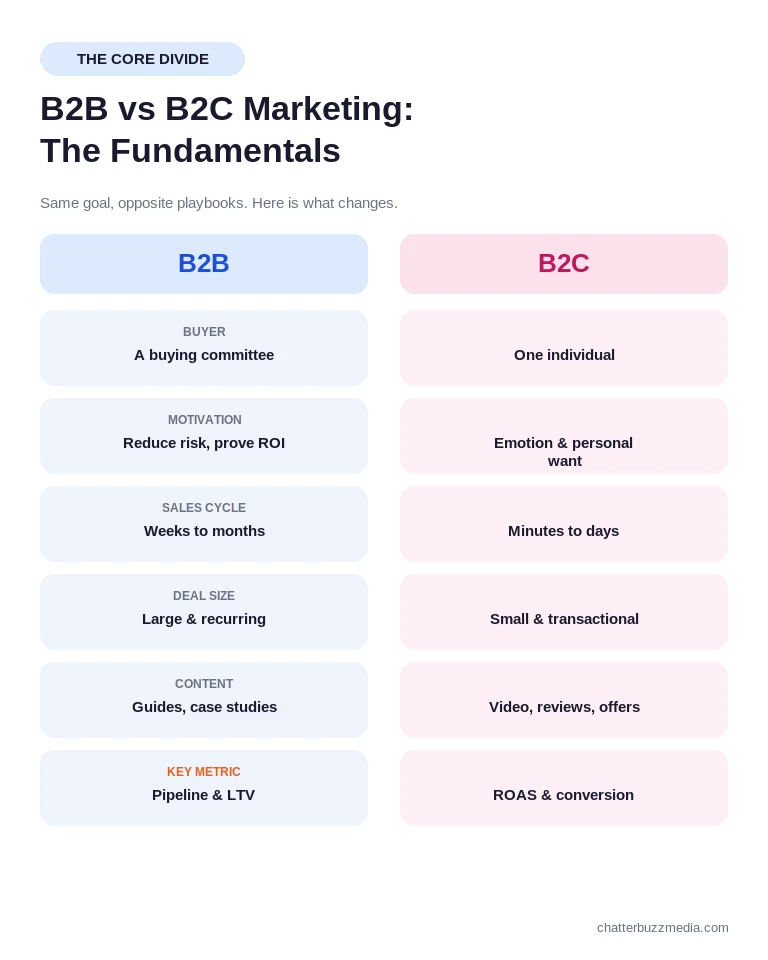
Understanding these fundamentals is step one, but the real divergence shows up in how each buyer actually moves toward a purchase. That journey is where strategy lives or dies.
The B2B vs B2C Buyer Journey: Why the Path Changes Everything
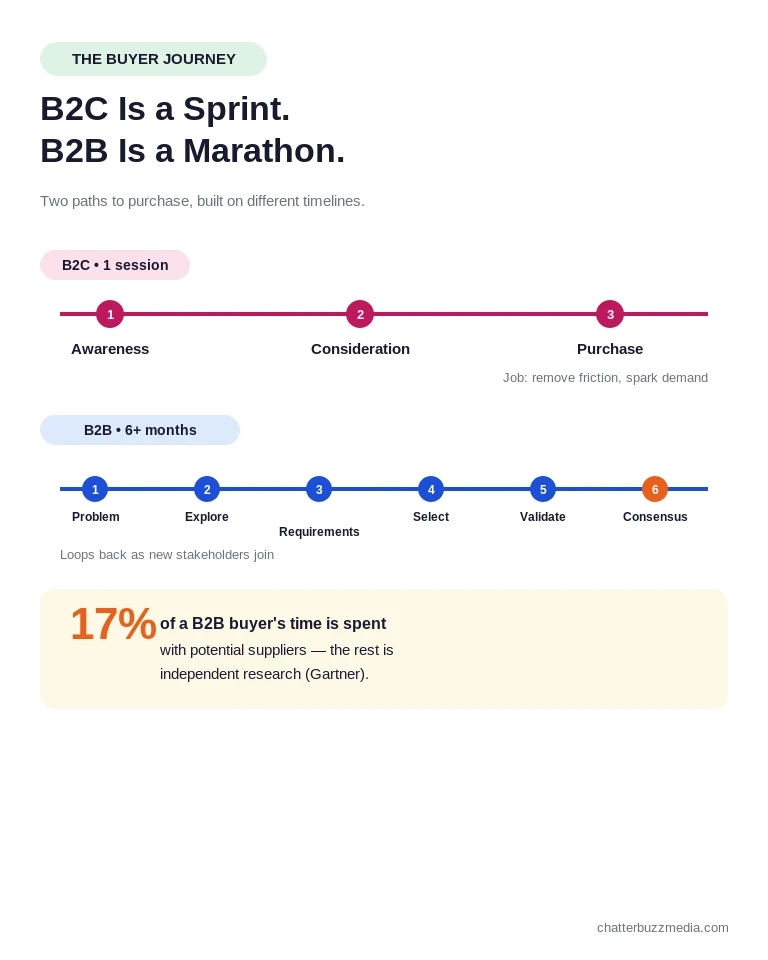
The b2b vs b2c buyer journey differs most in length and shape: B2C is short and mostly linear, while B2B is long, looping, and driven by independent research. Map your marketing to the wrong shape and you lose buyers at the exact moment they need something from you.
A B2C journey usually runs awareness, consideration, then purchase in one tight arc. Because a single person decides, your job is to remove friction and stimulate demand: fast pages, social proof, a clear offer, and a checkout that takes seconds.
Speed is the whole advantage in B2C. Every extra form field, slow-loading image, or unclear price is a reason to bounce, so the winning brands obsess over shaving seconds off the path to purchase.
A B2B journey rarely moves in a straight line. Gartner found that B2B buyers spend only about 17% of their time meeting with potential suppliers, and even less with any single vendor.
Most of that journey happens without you in the room. Buyers loop through problem identification, solution exploration, requirements building, and internal consensus, often repeating stages as new stakeholders join.
Filling that gap is the whole point of B2B demand generation. You create demand and educate buyers long before they raise their hand, so you shape the criteria they eventually use.
That means B2B marketing has to arm buyers to sell internally when you are not there. Comparison guides, ROI calculators, and case studies do the persuading on your behalf.
Consider a credit union evaluating a new digital banking platform. The journey spans compliance review, board approval, and IT security checks, so a single demo never closes the deal on its own.
Now compare that to a consumer choosing a home renovation product online. They see an ad, read a few reviews, and buy the same afternoon, compressing the entire journey into one sitting.
The lesson is to build for the shape of the journey you actually have. Long journeys need sustained nurturing; short journeys need speed and clarity at the moment of intent.
Here is how the two journeys compare stage by stage:
- Trigger: B2C starts with a personal want; B2B starts with a documented business problem.
- Research: B2C skims reviews and social; B2B runs deep, independent evaluation across many sources.
- Validation: B2C trusts ratings and peers; B2B demands case studies, references, and security checks.
- Decision: B2C is one click; B2B needs sign-off from finance, legal, and leadership.
The journey shape is set by who is actually making the decision. And in B2B, that is almost never one person, which changes everything about how you sell.
Decision-Making: Buying Committees vs Individual Choice
B2B decisions are made by committees; B2C decisions are made by individuals. This is the single most important difference in b2b vs b2c decision making, and it reshapes your targeting, content, and follow-up.
Gartner’s research shows the typical buying group for a complex B2B solution involves six to ten decision-makers, each armed with their own information and priorities. You are not persuading a person; you are helping a group reach consensus.
Each stakeholder cares about something different. The end user wants ease, the technical lead wants integration, procurement wants price, and the executive wants strategic fit and ROI.
This is exactly why account-based marketing exists. Instead of chasing one lead, ABM playbook markets to the whole buying group inside a target account at once.
B2C compresses all of that into one head. The same person feels the want, weighs the options, and pulls the trigger, often in the same sitting and often on emotion.
That does not make B2C easy. It means the entire persuasion has to land in seconds, through a single ad, page, or review, with no committee to slowly talk around.
So how do B2B buyers make decisions in practice? They reduce risk. They gather proof, socialize it internally, and look for reasons to feel safe spending the company’s money and staking their reputation on the choice.
Risk aversion explains almost every B2B buying behavior. Nobody gets fired for asking for one more case study, so buyers stall, gather consensus, and default to the safest-looking option.
That is why social proof carries different weight in B2B. Peer reviews, analyst reports, and named references reassure the group that others like them made the same choice and succeeded.
To market to a committee, cover every seat at the table:
- For the user: show ease of adoption and day-to-day wins with demos and walkthroughs.
- For the technical evaluator: provide specs, integrations, and security documentation.
- For finance: supply ROI math, pricing clarity, and total cost of ownership.
- For the executive: connect the purchase to strategic goals and competitive advantage.
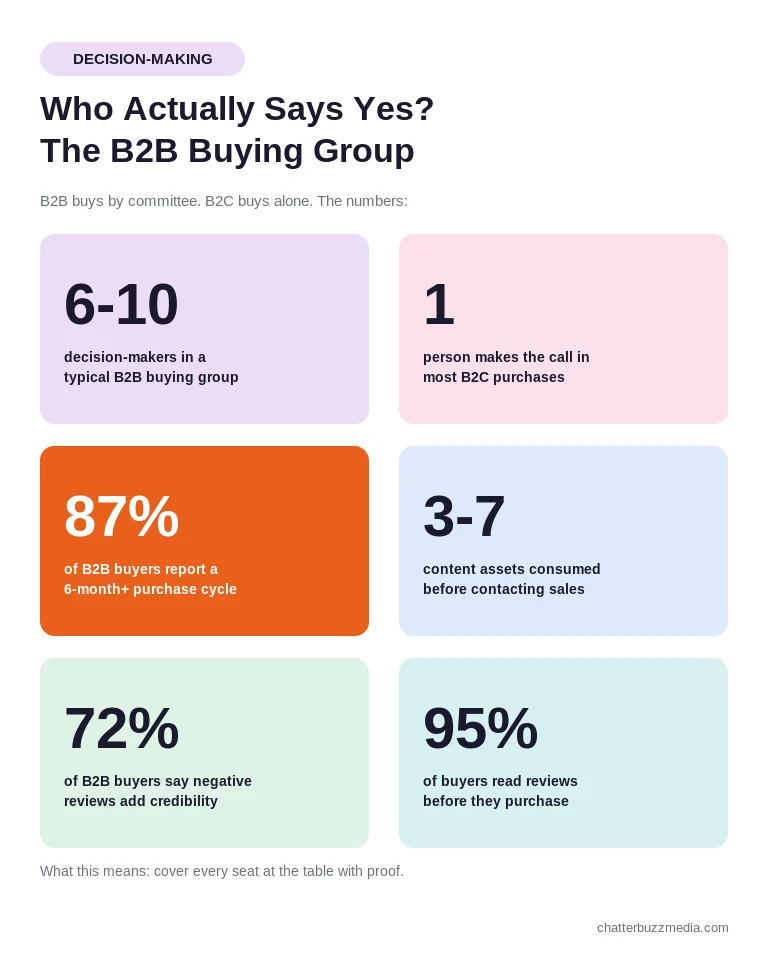
Mapping stakeholders is powerful, but it only works if you understand the actual sequence a B2B purchase moves through. That process is more structured than most marketers assume.
The B2B Purchase Process, Stage by Stage
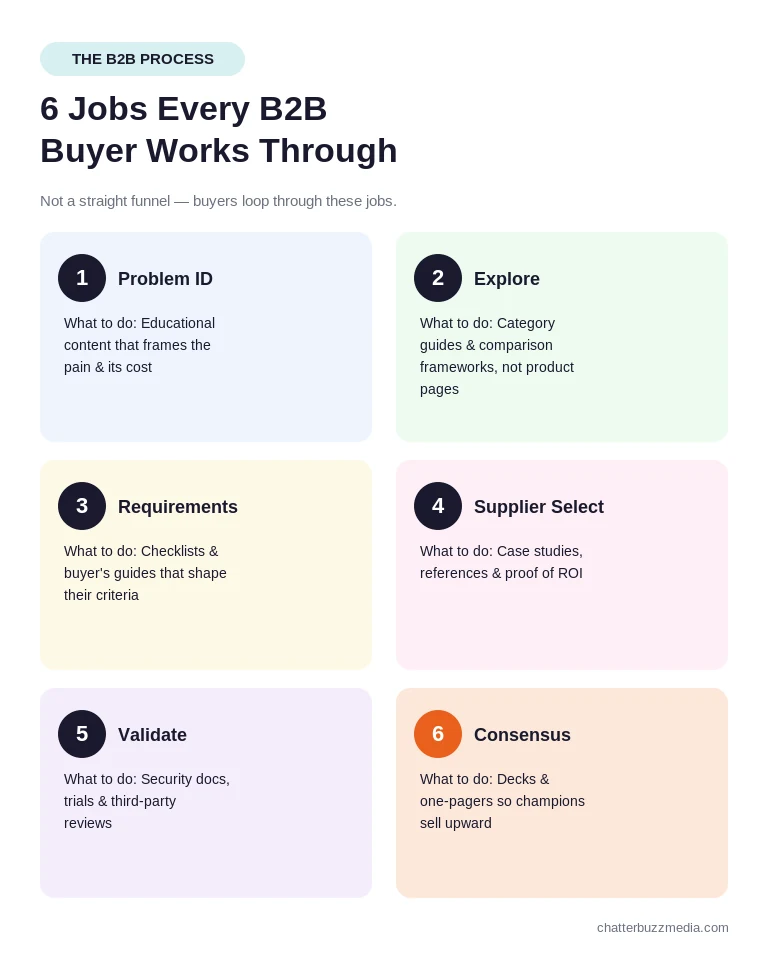
The b2b purchase process follows a repeatable sequence: problem identification, solution exploration, requirements building, supplier selection, validation, and consensus creation. Buyers move through these “jobs” in any order, often looping back as new information surfaces.
Unlike a linear funnel, these stages overlap. A buyer might be validating one vendor while still exploring the category, which is why consistent nurturing beats a single big pitch.
The hardest stage is consensus creation. Your champion has to sell your solution internally to peers and executives who never saw your demo, so the assets you hand them do the heavy lifting.
Your content should map to each job the buyer is trying to complete. When you match the message to the stage, you shorten the cycle and build trust at every step.
Timing is everything here. Pushing a pricing page on someone still identifying their problem feels pushy, while withholding proof from a buyer ready to validate stalls the deal.
A simple content-to-journey map keeps you aligned. List each stage, name the buyer’s question, and assign the one asset that answers it best.
Here is how to support each stage of the process:
- Problem identification: publish educational content that frames the pain and its cost.
- Solution exploration: offer category guides and comparison frameworks, not just product pages.
- Requirements building: provide checklists and buyer’s guides that shape their criteria around your strengths.
- Supplier selection: deliver case studies, references, and proof of ROI.
- Validation: supply security docs, trials, and third-party reviews.
- Consensus creation: give internal champions decks and one-pagers to sell upward.
Structure gets a buyer through the process, but the words you use determine whether they feel confident or confused. That is where B2B and B2C messaging split hard.
Messaging and Content: Logic vs Emotion
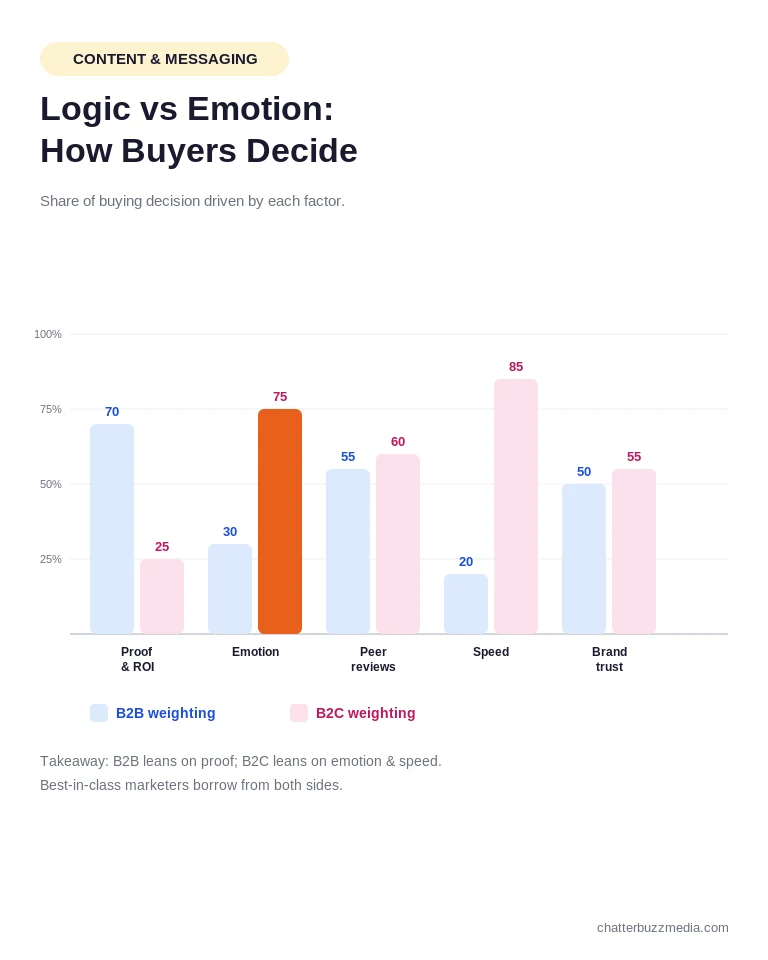
B2B messaging leans on logic, proof, and ROI; B2C messaging leans on emotion, identity, and speed. The best marketers borrow from both, but the center of gravity is different for each audience.
B2B content earns trust by educating. In-depth blog posts, whitepapers, webinars, and case studies help a buyer justify the decision to skeptical colleagues and a budget-conscious boss.
The goal is enablement, not just visibility. Every strong B2B asset should give a champion language they can repeat, numbers they can defend, and a reason their boss will feel comfortable signing off.
B2C content earns attention by connecting. Short-form video, social proof, and lifestyle storytelling tap the feeling that a product will make life better, easier, or more fun.
Video now dominates that connection. Industry research from HubSpot consistently ranks short-form video as the highest-ROI format in consumer marketing, and B2B teams are adopting it fast.
The data backs this split. B2B buyers consume multiple pieces of content, often 3 to 7 assets, before they even talk to sales, while B2C buyers frequently decide from a single ad or review.
Tone follows the same logic. B2B can use industry language because the audience speaks it, while B2C should cut the jargon and keep the message instantly relatable.
The gap is narrowing, though. Smart B2B brands now borrow B2C storytelling to stand out in a sea of feature lists, and smart B2C brands add substance to justify premium prices.
Volume differs too. A B2C brand can publish one punchy video and win, while a B2B brand typically needs a full content engine spanning top-of-funnel education to bottom-of-funnel proof.
Use these content rules to match the audience:
- B2B formats: guides, case studies, ROI calculators, webinars, and LinkedIn thought leadership.
- B2C formats: short video, influencer content, user reviews, and scroll-stopping social ads.
- B2B tone: credible, specific, and outcome-focused.
- B2C tone: warm, simple, and benefit-forward.
Great messaging still needs the right stage to perform on. And a common myth is that B2B and B2C live on different platforms, when the truth is they often share the same channels and use them differently.
Channels: Same Platforms, Different Playbooks
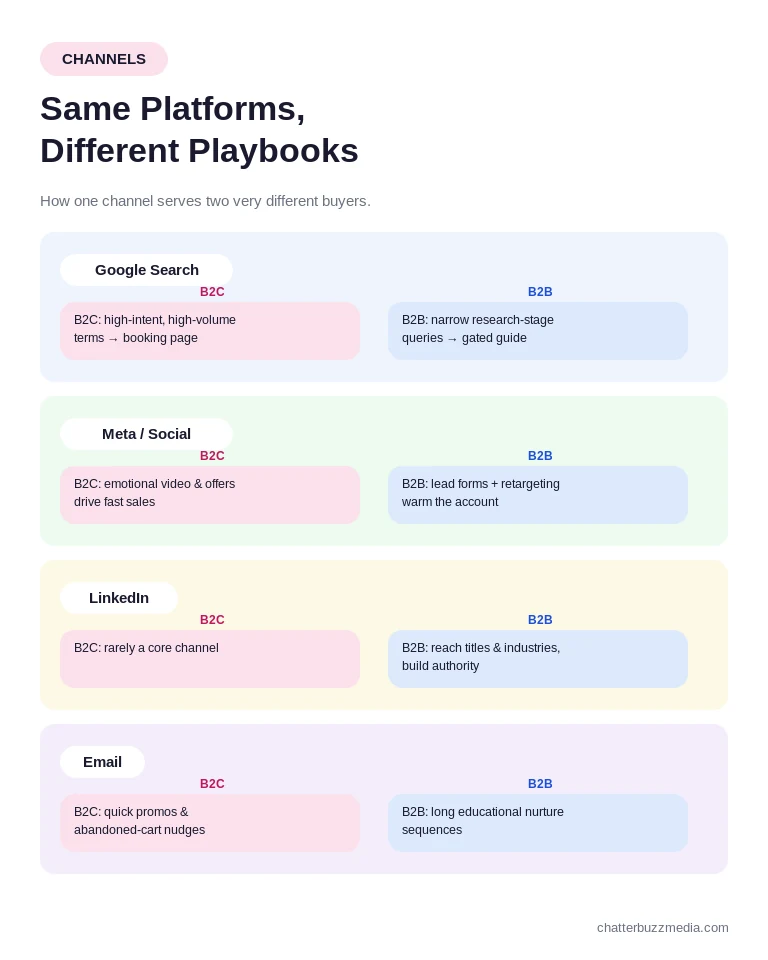
B2B and B2C often run on the same platforms, but the playbook for each is completely different. Meta, Google, and even LinkedIn can serve both audiences; the targeting, creative, and follow-up are what change.
Take Google Ads. A B2C med spa bids on high-intent local terms like “botox near me” and sends traffic straight to a booking page, because the buyer is ready now.
The intent gap changes everything downstream. A ready-to-buy consumer needs the shortest possible path to conversion, so the med spa optimizes for calls, forms, and instant bookings.
A B2B manufacturer bids on niche technical terms with low volume and long consideration, then routes clicks to a gated guide, because the buyer is researching, not buying today.
Meta works for both too. A home builder runs emotionally rich carousel and video ads of finished communities, while a credit union targeting business accounts uses lead forms and retargeting tied to a longer nurture.
The vertical shapes the plan. Home builder marketing leans on aspirational visuals and community storytelling, while credit union marketing balances consumer appeal with strict compliance.
Manufacturers play a different game entirely. Industrial marketing often pairs narrow paid search with long educational nurture, because the buyer needs months of proof before signing.
Even the same tactic shifts by audience. Retargeting nudges a B2C shopper back to a cart within days, but nurtures a B2B account across weeks with sequential proof points.
Organic social splits too. B2C brands chase reach and entertainment, while B2B brands use LinkedIn thought leadership to build credibility with named accounts over time.
Here is how core channels translate across the divide:
- Google Search: B2C chases high-intent, high-volume terms; B2B targets narrow, technical, research-stage queries.
- Meta and social: B2C sells the feeling with video and offers; B2B captures leads and warms accounts over time.
- LinkedIn: a B2B workhorse for reaching titles and industries; rarely core for B2C.
- Email: B2C drives quick promos; B2B runs long, educational nurture sequences.
Once your channels are firing, the final split appears in how you prove any of it worked. B2B and B2C measure success on very different scoreboards.
Measuring Success: ROI, Attribution, and Lifetime Value
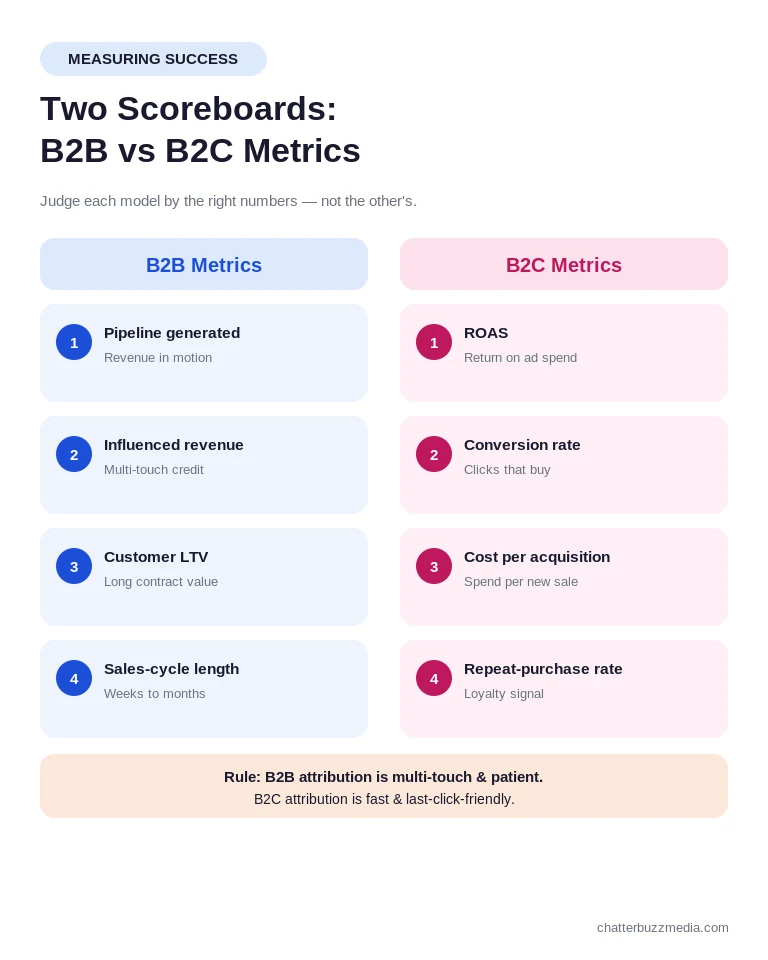
B2B ties marketing to revenue and pipeline over months; B2C measures faster signals like conversions, ROAS, and repeat purchase. Judge either one by the other’s metrics and you will make bad calls.
B2B attribution is hard because the cycle is long and multi-touch. A closed deal might trace back to a webinar, three blog posts, a sales call, and a case study spread across five months.
Single-touch models break under that complexity. If you credit only the last click, you starve the top-of-funnel content that actually started the deal, so B2B teams need multi-touch attribution and patience.
That is why B2B leans on pipeline, influenced revenue, and customer lifetime value rather than last-click conversions. The higher deal size and recurring contracts mean CLV often dwarfs the initial sale.
B2C measurement moves faster and cleaner. Return on ad spend, conversion rate, and cost per acquisition tell you within days whether a campaign is working.
The practical risk is impatience. A B2B leader who judges a six-month-cycle campaign on 30-day conversions will kill programs right before they pay off.
Set expectations up front by tracking customer acquisition cost against lifetime value. That ratio, not last-click conversions, tells you whether the model actually works.
Loyalty still matters in B2C, just differently. Brands grow CLV through repeat purchases, rewards programs, and community rather than multi-year contracts.
On the acquisition side, both models live or die on the landing experience. Tightening conversion rate optimization lifts B2C ROAS and B2B lead quality at the same time.
Match your metrics to the model:
- B2B primary metrics: pipeline generated, influenced revenue, CLV, and sales-cycle length.
- B2C primary metrics: ROAS, conversion rate, cost per acquisition, and repeat-purchase rate.
- B2B attribution: multi-touch across a long window.
- B2C attribution: shorter windows and cleaner last-click signals.
Knowing these differences is powerful, but the smartest marketers also know when the two worlds blur together. That gray area is where a lot of real revenue hides.
When the Lines Blur: Considered Purchases and Human-to-Human Marketing
Not every purchase fits neatly into B2B or B2C, and the most effective marketing borrows from both. Considered B2C purchases and increasingly human B2B buying prove the categories are guides, not walls.
Some B2C purchases behave like B2B. Buying a home from a builder or a high-ticket procedure at a med spa involves research, multiple visits, and family input, so it needs nurturing, not just an impulse offer.
These considered purchases reward a hybrid approach. A med spa marketing plan that adds educational content and follow-up to its emotional hooks will out-convert one that relies on impulse alone.
Meanwhile, B2B buying keeps getting more human. Buyers expect the same clean, personalized, self-serve experience they get as consumers, which is why “boring” B2B brands now invest in brand, video, and emotion.
Generational change is accelerating this. Millennial and Gen Z buyers now fill most B2B buying committees, and they research like consumers, distrust hard selling, and reward brands that feel authentic.
The takeaway is that every buyer is still a person. As the saying goes, all marketing is H2H, human-to-human, whether the invoice goes to a company or a household.
Use this quick test to choose your approach:
- One decision-maker, fast, emotional? Lead with a B2C playbook.
- Multiple stakeholders, long cycle, ROI-driven? Lead with a B2B playbook.
- High-consideration consumer purchase? Blend B2B-style nurturing with B2C emotion.
- Always: write to a human, then adjust for the buying context.
Frequently Asked Questions
1. 🔍 What is the main difference between B2B and B2C marketing?
The main difference is the buyer. B2B marketing sells to organizations through a committee of decision-makers focused on ROI and risk, while B2C marketing sells to individuals who buy quickly and often emotionally.
2. 📊 Why is the B2B buyer journey longer than B2C?
B2B purchases involve multiple stakeholders, larger budgets, and detailed evaluation, so the cycle stretches across weeks or months. B2C buyers usually decide alone and can move from awareness to purchase in a single session.
3. ⚡ How do B2B buyers make decisions?
B2B buyers make decisions by reducing risk and building internal consensus. A group of six to ten people gathers proof, runs independent research, and validates ROI before anyone signs, which is why case studies and references matter so much.
4. 🏦 Can a company do both B2B and B2C marketing?
Yes. Many companies sell to both businesses and consumers, but they should not use identical strategies for each. The messaging, channels, and sales process need to match each audience’s buying behavior.
5. 🤝 Which channels work best for B2B vs B2C?
B2B tends to perform on LinkedIn, email nurture, webinars, and research-stage search terms. B2C thrives on social platforms, influencer content, high-intent search, and paid social with strong creative.
6. 💰 How does ROI measurement differ between B2B and B2C?
B2B measures pipeline, influenced revenue, and lifetime value across a long, multi-touch window. B2C measures faster signals like ROAS, conversion rate, and cost per acquisition, often within days of a campaign launching.
7. 🚀 Is B2B or B2C marketing more emotional?
B2C marketing is traditionally more emotional, but emotion drives both. B2B decisions still hinge on trust, reputation, and fear of a bad choice, so the best B2B marketing pairs logic with genuine human connection.
8. 📈 How do I know which approach my business needs?
Look at your buyer and your cycle. If one person buys fast on emotion, lead with B2C tactics; if several stakeholders evaluate over months, lead with B2B tactics; and for high-consideration consumer purchases, blend the two.
Conclusion: Match Your Marketing to the Buyer
B2B and B2C marketing are not better or worse than each other, they are answers to different buying behaviors. Once you see the buyer journey clearly, every other choice, from channel to metric, falls into place.
The differences are consistent: B2B sells to committees over long, research-heavy cycles measured in pipeline and lifetime value, while B2C sells to individuals in fast, emotional, conversion-focused arcs. The winning move is to match your playbook to the actual buyer, not to a label.
Here is your action plan:
- Map your real buyer journey. Document who decides, how long it takes, and where buyers get stuck.
- Identify every stakeholder. For B2B, list each seat at the table and the proof each one needs.
- Match content and channels to the journey. Feed each stage the format and message it requires.
- Pick metrics that fit the model. Track pipeline and CLV for B2B, ROAS and conversion for B2C.
The clearer your view of the buyer, the sharper your strategy. For a deeper foundation, start by building a precise ideal customer profile and detailed buyer personas, then explore the full library of growth playbooks in the marketing resources hub.

Victoria Wallace
Victoria Wallace is a senior content strategist and marketing writer with 30+ years of experience helping more than 200 brands translate complex business goals into clear, conversion-focused content. Her background spans paid media, marketing strategy, go-to-market planning, brand positioning, and full-funnel campaign development, giving her a deep understanding of how SEO content connects to real business growth.