
 321-236-2899
Ideal Customer Profile: How to Build an ICP That Actually Drives Revenue
Sales teams close only 18% of the leads marketing hands them at most B2B companies, and the number one reason is that nobody agreed on who those leads should be in the first place. Without a documented ideal customer profile, marketing generates volume instead of value, sales chases accounts that will never close, and revenue leaders are left explaining a growing pipeline that never turns into growth.
The good news is that this is fixable, and it does not require a bigger budget. It requires a rigorous, data-backed ideal customer profile that aligns your entire go-to-market motion around the accounts most likely to buy, close fast, and stick around.
At Chatter Buzz Media, we have built and refined ICPs for mid-market B2B companies across manufacturing, financial services, healthcare, and SaaS, and we have watched the same pattern play out every time: companies with a sharp, validated ICP outperform companies guessing at their market. This guide breaks down exactly how to build one.
Key Takeaways
- An ideal customer profile describes your best-fit company at the account level, while a buyer personas describes the individual people inside that account — you need both, but the ICP comes first.
- Companies with a documented ICP see significantly higher win rates and shorter sales cycles because marketing and sales are chasing the same accounts for the same reasons.
- Building an accurate ICP requires analyzing your best existing customers, not guessing based on who you wish your customers were.
- A strong ICP includes firmographic, technographic, and behavioral data, plus explicit negative criteria for who you should not sell to.
- Your ICP should power everything downstream, including account-based marketing marketing, demand generation content, and marketing budget allocation.
- ICPs are not static documents; they need a quarterly review cadence tied to real triggers like win/loss data and market shifts.
What Is an Ideal Customer Profile (And Why Most Companies Get It Wrong)
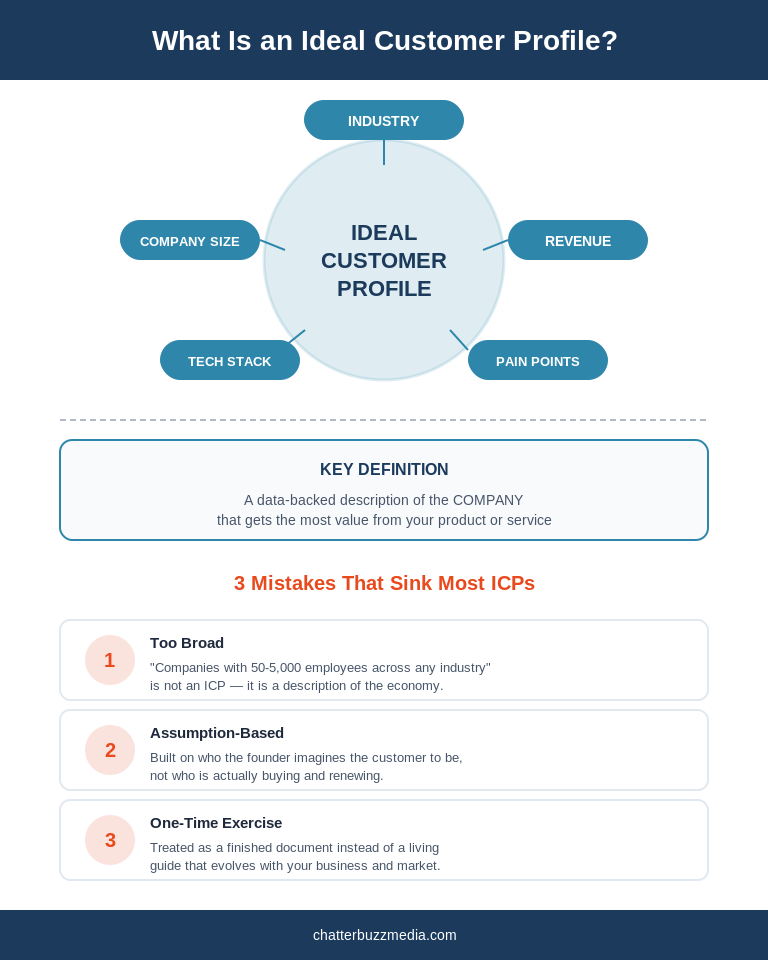
An ideal customer profile is a detailed description of the company — not the person — that gets the most value from your product or service and delivers the most value back to you. It is built from data about your existing best customers: their industry, size, revenue, technology stack, and the specific business problems that made them buy.
Think of your ICP as the filter that determines which accounts are worth pursuing at all. Everything else, from your messaging to your channel mix to your sales qualification criteria, should flow from this single foundational document.
ICP Is Company-Level, Not Person-Level
This is the single most common point of confusion in B2B marketing. An ideal customer profile describes a company: its firmographics, its technographics, its growth trajectory, and its operational customer pain points.
A buyer persona, by contrast, describes an individual human inside that company: their job title, their goals, their objections, and how they consume content. You need both, but they answer different questions.
The Three Mistakes That Sink Most ICPs
The first mistake is building an ICP that is too broad. If your ICP includes “companies with 50 to 5,000 employees across any industry,” you do not have an ICP — you have a description of the entire economy.
The second mistake is building the ICP from assumptions instead of data, often based on who the founder imagines the customer to be rather than who is actually buying and renewing. The third mistake is treating the ICP as a one-time exercise instead of a living document that gets revisited as your business and market evolve.
Getting this foundation right is also the starting point for a broader marketing strategy — you cannot build channel plans, content calendars, or budgets on a target market that is not clearly defined.
ICP vs. Buyer Persona: Understanding the Critical Difference
Marketing and sales teams frequently use “ICP” and “buyer persona” interchangeably, and that habit causes real strategic damage. Confusing the two leads to campaigns that target the right job titles at the wrong companies, or the right companies with messaging that misses the actual decision-makers.
What Belongs in an ICP
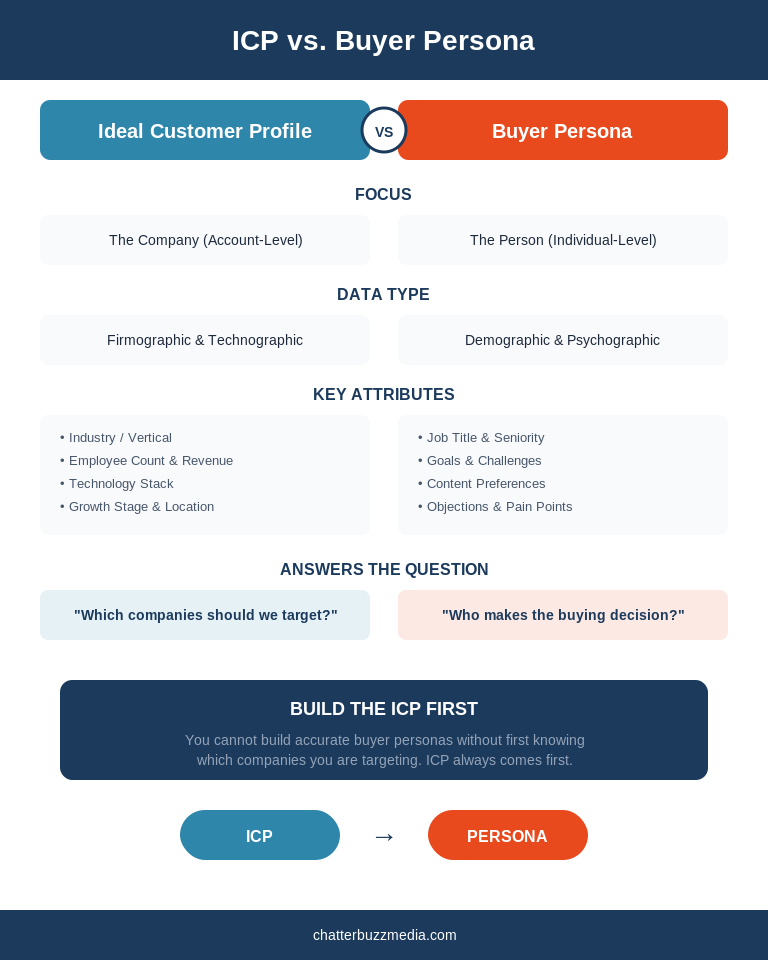
Your ideal customer profile should be built entirely from firmographic and technographic data: company size, annual revenue, industry vertical, geographic footprint, growth stage, funding status, and the technology stack currently in place. These are attributes of the organization itself, independent of who happens to work there.
What Belongs in a Buyer Persona
A buyer persona captures demographic and psychographic detail about the individual humans who influence or make the purchase decision: job title, seniority, department, daily responsibilities, professional goals, and the specific pain points that keep them up at night. Personas also document how that person prefers to consume information and what objections they typically raise.
Why Sequence Matters
You cannot build an accurate buyer persona without first knowing which companies you are targeting, because the same job title behaves differently depending on company size and industry. A “VP of Operations” at a 50-person manufacturer has a completely different budget, buying process, and risk tolerance than a VP of Operations at a 2,000-person enterprise.
Build the ICP first, then layer personas on top of it. This sequencing is foundational to any effective inbound marketing guide or outbound motion, because content and messaging need to speak to both the company-level fit and the individual-level pain simultaneously.
Why Your Ideal Customer Profile Is the Foundation of B2B Marketing
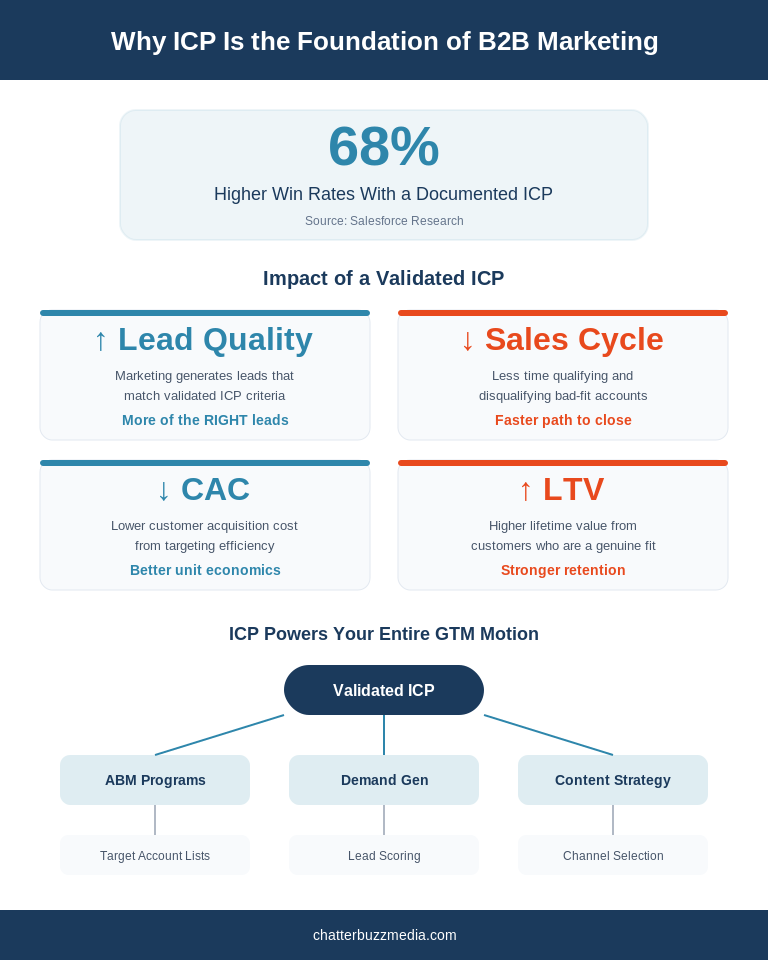
An accurate ICP is not a nice-to-have marketing document sitting in a shared drive. It is the single variable that most directly impacts lead quality, sales cycle length, customer acquisition cost, and lifetime value.
The Data Behind ICP-Driven Growth
Research from Salesforce has found that companies with a well-documented ideal customer profile report win rates up to 68% higher than companies without one. That gap is not about better salespeople — it is about not wasting sales cycles on accounts that were never going to close.
When marketing generates leads that match a validated ICP, sales spends less time qualifying and disqualifying, which directly compresses the sales cycle. Shorter cycles mean lower customer acquisition costs and faster payback periods, which compound over time into meaningfully better unit economics.
How ICP Clarity Improves Lead Quality
Every lead generation strategy is only as good as the targeting criteria behind it. Without an ICP, “more leads” becomes the goal, and marketing teams end up optimizing for volume metrics that look good on a dashboard but do not translate into pipeline.
With an ICP, the goal shifts to “more of the right leads,” which changes how you build landing pages, score leads, and measure success. This is also why ICP work sits at the center of a strong marketing KPIs framework — you cannot measure the right things if you have not defined who “right” actually means.
The Connection to ABM and Demand Generation
Every mature account-based marketing program starts with a validated ICP, because ABM is fundamentally about concentrating resources on a smaller number of high-fit accounts rather than casting the widest possible net. Demand generation strategy, content planning, and even paid media targeting all become sharper once the ICP is locked in.
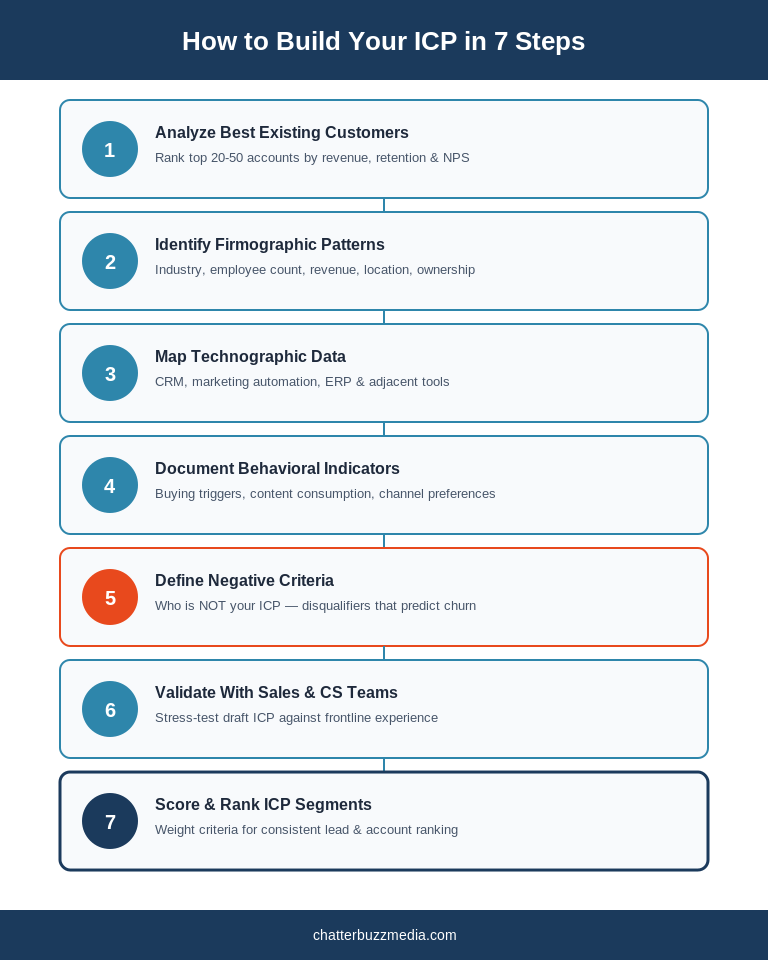
How to Build an Ideal Customer Profile in 7 Steps
Building an ICP is a research exercise, not a brainstorming session. The following seven steps will take real time with real data, but skipping any of them is exactly how companies end up with an ICP that looks good in a slide deck and fails in the market.
Step 1: Analyze Your Best Existing Customers
Start by pulling a list of your top 20 to 50 customers ranked by revenue, retention, and Net Promoter Score. These are the accounts that pay you the most, stay the longest, and would recommend you to a peer — they are your best available evidence of what “ideal” actually looks like.
Step 2: Identify Firmographic Patterns
Look across that list for shared characteristics: industry, employee count, annual revenue, geographic location, and ownership structure (public, private, private equity-backed). Patterns that repeat across your best accounts are strong signals for your ICP criteria.
Step 3: Map Technographic Data
Document the technology stack your best customers were already using before they bought from you, including their CRM, marketing automation platform, and any adjacent tools. Technographic fit often predicts implementation success and expansion revenue better than firmographic data alone.
Step 4: Document Behavioral Indicators
Identify the buying triggers that preceded your best customers’ purchase decisions, such as a leadership change, a funding round, or a compliance deadline. Also note which content, channels, and touchpoints they engaged with before converting, since that tells you where to find more accounts like them.
Step 5: Define Negative Criteria
Just as important as defining who your ICP is, define who it is not. List the firmographic and behavioral traits that reliably predict churn, support drain, or a stalled sales cycle, and treat those as disqualifiers rather than “maybe” accounts.
Step 6: Validate With Sales and Customer Success
Marketing rarely has the full picture alone. Sit down with sales and customer success teams, who talk to these accounts daily, and stress-test your draft ICP against their firsthand experience before finalizing anything.
Step 7: Score and Rank ICP Segments
Most companies do not have a single ICP — they have a primary ICP and one or two secondary segments. Build a simple scoring model that weights your criteria so sales and marketing can rank inbound leads and outbound targets consistently.
The ICP Template: A Framework You Can Use Today
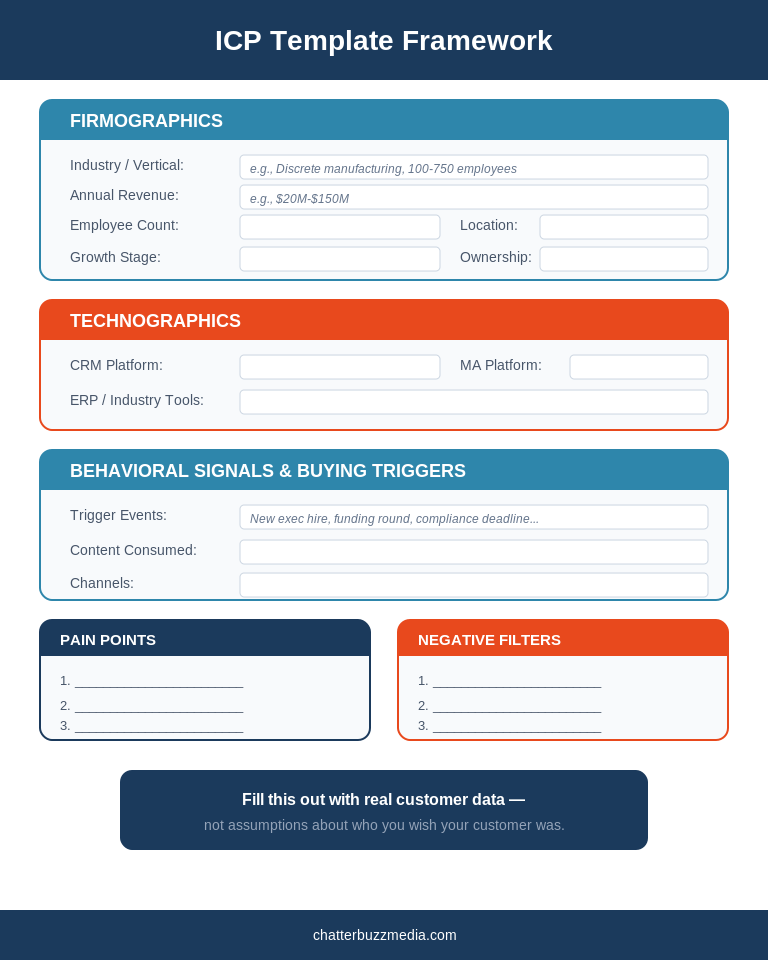
Theory is useful, but your team needs something they can actually fill out this week. Below is the framework we use with clients when we build out a B2B demand generation strategy from the ground up.
Firmographics
Document industry or vertical, employee count range, annual revenue range, geographic footprint, ownership structure, and growth stage (startup, scaling, mature, or declining). Be specific — “manufacturing” is not enough, but “discrete manufacturing with 100 to 750 employees and $20M to $150M in revenue” is usable.
Technographics
List the CRM, ERP, marketing automation, and industry-specific software your ideal accounts typically run. Note whether they are actively evaluating new tools or locked into long-term contracts, since that affects timing.
Behavioral Signals and Buying Triggers
Capture the events that typically precede a purchase decision: new executive hires, funding rounds, mergers, regulatory changes, or a specific operational pain reaching a breaking point. These triggers become the basis for intent-based targeting in your outbound and ABM programs.
Pain Points and Desired Outcomes
Write out the two or three business problems your ICP is actively trying to solve and the measurable outcome they are chasing, whether that is revenue growth, cost reduction, or risk mitigation. This section becomes the backbone of your messaging.
Negative Filters
List explicit disqualifiers: company size below a certain threshold, industries with poor historical retention, geographies you cannot service, or budget ranges that do not support your pricing. Negative filters save sales significant time by preventing bad-fit accounts from ever entering the funnel.
Once this template is filled out, it becomes the shared reference document for everything from your marketing funnel strategy to your sales qualification criteria. It should live somewhere both teams can access, not buried in a single strategist’s notebook.
Vertical-Specific ICP Examples That Drive Results
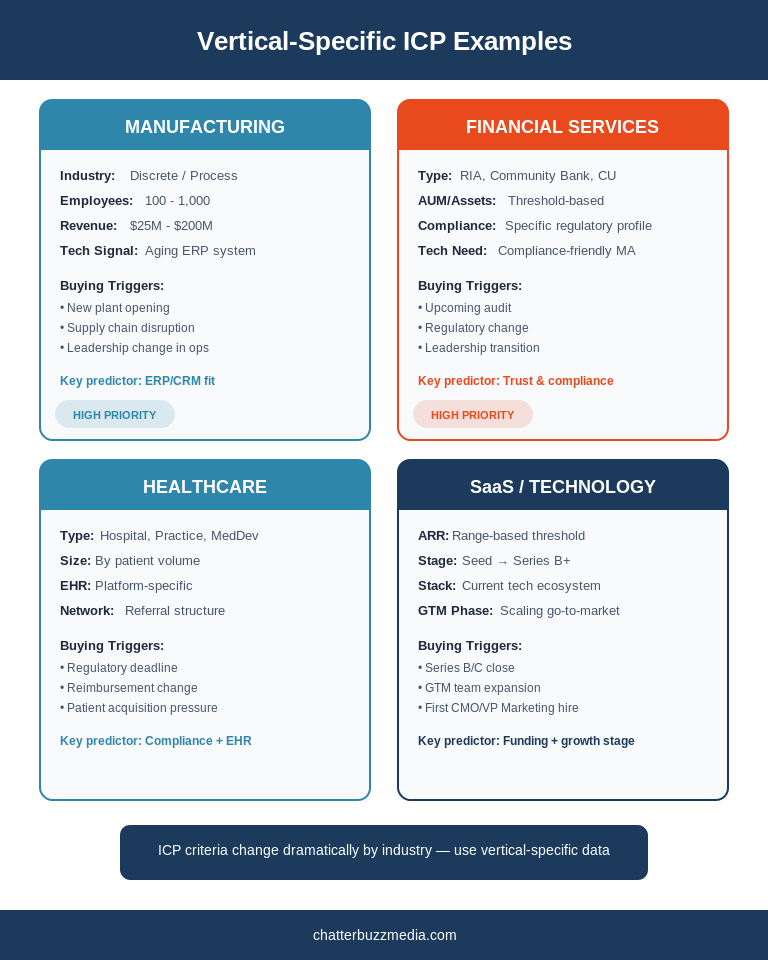
An ideal customer profile looks completely different depending on the industry, because the buying committee, sales cycle length, and risk tolerance vary widely by vertical. Below are examples drawn from the industries where Chatter Buzz Media does the most work.
Manufacturing ICP Example
A typical manufacturing ICP might target discrete or process manufacturers with 100 to 1,000 employees, $25M to $200M in revenue, and an aging ERP system that is due for replacement. Buying triggers often include new plant openings, supply chain disruptions, or a recent leadership change in operations.
Our work in manufacturing lead generation consistently shows that technographic fit — specifically, what ERP and CRM systems a manufacturer already runs — is one of the strongest predictors of deal success in this vertical.
Financial Services ICP Example
In financial services, a strong ICP typically includes firms with specific regulatory profiles (RIAs, community banks, credit unions), assets under management or asset size thresholds, and a documented need for compliance-friendly marketing technology. Behavioral signals include upcoming audits, regulatory changes, or leadership transitions.
This is precisely the kind of nuance we build into every financial services marketing engagement, since generic B2B targeting criteria almost always miss the compliance and trust factors unique to this space.
Healthcare ICP Example
Healthcare ICPs need to account for organization type (hospital system, private practice, medical device company, health tech vendor), patient volume, EHR platform in use, and referral network structure. Buying triggers in healthcare are frequently tied to regulatory deadlines, reimbursement changes, or patient acquisition pressure, which our healthcare marketing team factors directly into targeting criteria.
SaaS and Technology ICP Example
For SaaS and technology companies, the strongest ICP signals are usually ARR range, employee headcount, current tech stack, and funding stage rather than industry alone. A company that just closed a Series B and is scaling its go-to-market team behaves very differently than a bootstrapped company at the same revenue level, which is why SaaS marketing strategies should always start with funding and growth-stage segmentation, not just company size.
How Your ICP Powers Account-Based Marketing and Demand Generation
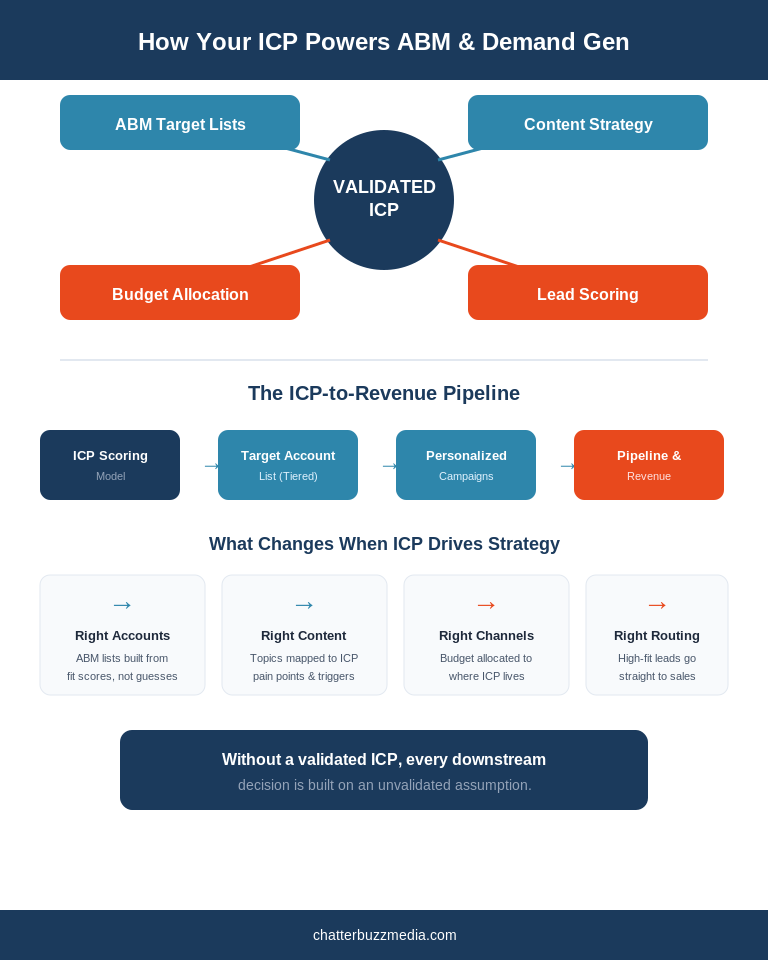
An ICP that lives in a document and never touches your campaigns is a wasted exercise. The real value shows up when it becomes the connective tissue across your entire go-to-market motion.
From ICP to ABM Target Account List
Your ICP scoring model should feed directly into your target account list for any ABM agency engagement, ranking accounts by fit score so sales and marketing agree on the same priority tiers. This is the difference between an ABM program that scales and one that stalls out after the first quarter — our ABM guide walks through this handoff in detail.
From ICP to Demand Generation Content
Once you know your ICP’s pain points and buying triggers, content strategy becomes far more efficient because you are writing for a known audience instead of guessing at general interest topics. This directly shapes which channels earn budget and how content gets sequenced across the funnel — a connection we cover in depth in our B2B demand generation guide.
Well-targeted content built around a validated ICP also improves content marketing ROI, since every asset is built for an audience that is statistically more likely to convert.
From ICP to Budget Allocation
Knowing exactly who your ICP is changes how you allocate spend across channels, since some channels reach your ICP efficiently and others simply do not. This is a core input into any serious marketing budget allocation decision, and it is one of the first things we review when building out a client’s performance marketing plan.
From ICP to Marketing Automation
ICP fit scores can also be built directly into your lead scoring and routing rules inside your marketing automation platform, so high-fit leads route to sales immediately while low-fit leads stay in nurture. Getting this configured correctly inside HubSpot or a similar platform is exactly the kind of work we handle through HubSpot implementation engagements.
Common ICP Mistakes (And How to Fix Them)
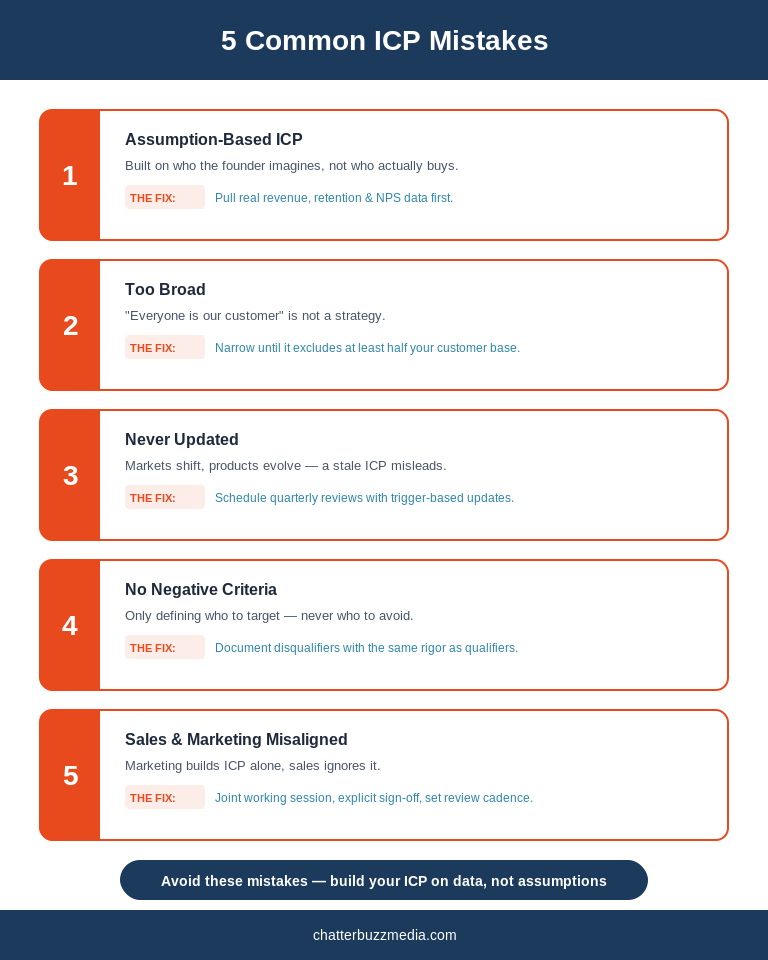
Even companies that understand the theory behind an ideal customer profile often stumble in execution. Here are the five mistakes we see most often, along with the fix for each.
Mistake 1: Building ICP From Assumptions Instead of Data
Teams frequently build their ICP around who they wish their customer was rather than who is actually renewing and expanding. The fix is simple but requires discipline: pull real revenue, retention, and NPS data before writing a single ICP criterion.
Mistake 2: Making the ICP Too Broad
“Everyone is our customer” is not a strategy — it is the absence of one. Force yourself to narrow the ICP until it excludes at least half of your current customer base, because a profile that includes everyone provides no useful filter.
Mistake 3: Never Updating the ICP
Markets shift, products evolve, and yesterday’s ICP can quietly become inaccurate without anyone noticing. Fix this by scheduling a recurring review, which we cover in detail in the next section.
Mistake 4: Ignoring Negative ICP Criteria
Companies that only define who to target, without defining who to avoid, end up burning sales capacity on accounts that were never going to close. Document your negative criteria with the same rigor as your positive criteria and enforce it in lead routing.
Mistake 5: Not Aligning Sales and Marketing on ICP
An ICP built in isolation by marketing, without sales buy-in, gets ignored the moment sales starts prospecting on their own instincts. Run a joint working session, get explicit sign-off from sales leadership, and revisit the document together on a set cadence — the same alignment discipline we recommend during any marketing audit.
How Often Should You Update Your Ideal Customer Profile?
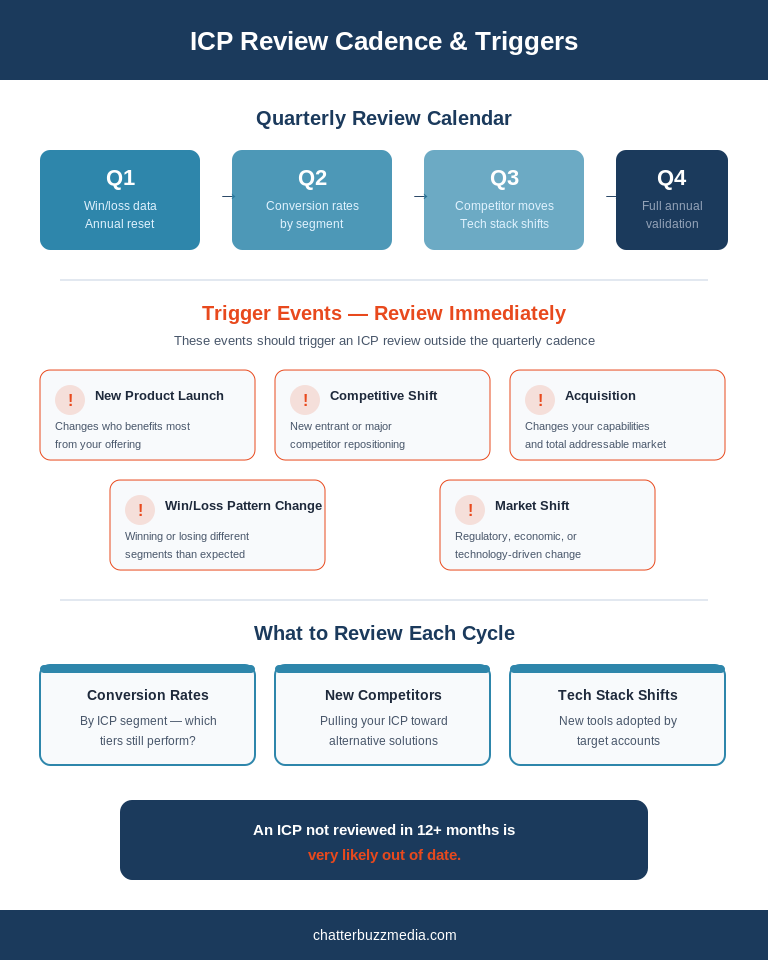
An ICP is a living document, not a one-time deliverable. Treating it as “finished” is one of the fastest ways to watch a once-accurate profile drift out of step with your actual market.
The Quarterly Review Cadence
At minimum, review your ICP every quarter alongside your broader marketing KPIs review. Pull fresh win/loss data, updated retention numbers, and any new patterns in your closed-won accounts to check whether the profile still holds.
Trigger Events That Demand an Immediate Review
Certain events should trigger an ICP review outside the normal quarterly cadence: a new product launch that changes who benefits most from your offering, a shift in the competitive landscape, an acquisition that changes your capabilities, or a noticeable change in your win/loss pattern. Waiting for the next scheduled review in these cases can cost an entire quarter of misdirected spend.
What to Actually Review Each Cycle
Look at conversion rates broken out by ICP segment to see which tiers are still performing and which have cooled off. Also track new competitor entries that might be pulling your ICP toward alternative solutions, and monitor technographic shifts as your target accounts adopt new tools that change how they buy.
Revisiting the ICP alongside your digital marketing lead generation results ensures the profile stays grounded in what is actually converting, not what converted eighteen months ago.
Frequently Asked Questions About Ideal Customer Profiles
1️⃣ What is an ideal customer profile?
An ideal customer profile is a detailed, data-backed description of the type of company that gets the most value from your product and provides the most value back to your business. It is built from firmographic, technographic, and behavioral data pulled from your best existing customers, not from assumptions about who you wish your customer was.
2️⃣ How is an ICP different from a buyer persona?
An ICP describes the company you are targeting — its size, industry, revenue, and technology stack. A buyer persona describes the individual person inside that company, including their job title, goals, and pain points, and the two documents work together rather than replacing one another.
3️⃣ How many ICPs should a company have?
Most B2B companies should have one primary ICP and no more than one or two secondary segments. Trying to maintain five or six “ideal” profiles usually signals that the targeting has not been narrowed enough to be useful.
4️⃣ What data do you need to build an ICP?
You need revenue, retention, and satisfaction data on your existing customers, along with firmographic details like industry, size, and location. You also need technographic data on the tools your best customers use and behavioral data on the events that preceded their purchase decision.
5️⃣ How often should you update your ICP?
Review your ICP at least quarterly, and revisit it immediately after major trigger events like a new product launch, an acquisition, or a noticeable shift in your win/loss pattern. An ICP that has not been reviewed in over a year is very likely out of date.
6️⃣ Can small businesses benefit from an ICP?
Yes, and arguably small businesses benefit even more, since they have less budget to waste chasing bad-fit prospects. A tightly defined ICP lets a small marketing team punch above its weight by concentrating limited resources on the accounts most likely to close.
7️⃣ What tools help build an ideal customer profile?
Your CRM is the starting point, since it holds the revenue, retention, and deal history data needed to identify patterns among your best customers. From there, firmographic and technographic enrichment tools, along with a properly configured marketing automation platform, help you operationalize the ICP into lead scoring and routing.
8️⃣ How does an ICP improve marketing ROI?
An ICP improves marketing ROI by ensuring every dollar spent on content, advertising, and outbound outreach is directed at accounts statistically likely to convert and retain. This reduces wasted spend on low-fit leads and shortens the path from first touch to closed revenue, which compounds into a materially lower customer acquisition cost over time.
Your Ideal Customer Profile Action Plan
Building an ideal customer profile is not a one-afternoon project, but it does not need to take a quarter either. Here is the exact sequence we recommend to get from zero to a validated, working ICP.
- Pull your best-customer data. Rank your existing accounts by revenue, retention, and NPS, and export the top 20 to 50 for analysis.
- Identify firmographic and technographic patterns. Document the shared industry, size, revenue, and tech stack characteristics across that list.
- Draft your ICP template. Fill in firmographics, technographics, behavioral triggers, pain points, and negative criteria using the framework above.
- Validate with sales and customer success. Test the draft against frontline experience before treating it as final.
- Operationalize it across marketing and sales. Build the ICP into your lead scoring, your ABM agency target list, and your quarterly review calendar.
If your team has never built a formal ICP, or if the one you have has not been touched since it was created, this is the highest-leverage marketing project you can run this quarter. It is also exactly the kind of foundational strategy work our team handles for mid-market companies every day, whether through a fractional CMO engagement or a full B2B digital marketing agency partnership.
Chatter Buzz Media has helped B2B companies across manufacturing, financial services, healthcare, and technology build ICPs that actually drive pipeline, not just paperwork. Contact our team to talk through your ICP and see where the gaps are costing you revenue.

Victoria Wallace
Victoria Wallace is a senior content strategist and marketing writer with 30+ years of experience helping more than 200 brands translate complex business goals into clear, conversion-focused content. Her background spans paid media, marketing strategy, go-to-market planning, brand positioning, and full-funnel campaign development, giving her a deep understanding of how SEO content connects to real business growth.