
 321-236-2899
Go-to-Market Strategy: The Complete Guide for Mid-Market Companies

This guide breaks down exactly how mid-market companies build go-to-market strategies that generate pipeline — not just PowerPoint slides. You’ll get the frameworks, the step-by-step process, and the metrics that separate GTM strategies that drive revenue from the ones that collect dust in a shared drive.
We’ve spent 18 years building and executing GTM plans for B2B companies between $10M and $500M in revenue. The patterns are clear: the companies that nail their GTM motion grow 2-3x faster than those that launch and pray.
By the end of this guide, you’ll know how to build a value matrix that aligns your entire buying committee — the single most overlooked step in mid-market GTM execution. Let’s start with what a go-to-market strategy actually is and why most companies get it wrong.
Key Takeaways
- A go-to-market strategy coordinates marketing, sales, pricing, and distribution around a specific launch or growth initiative — it is not the same as a marketing plan.
- The 7 core GTM components are market sizing, ICP, buyer personas, value proposition, pricing, channel strategy, and metrics — skip one and the entire motion weakens.
- Mid-market companies should start with 2-3 channels and master them before expanding — spreading budget across every channel simultaneously dilutes impact.
- The biggest GTM killer is misalignment between sales and marketing — a shared playbook with defined MQL/SQL criteria and weekly pipeline reviews prevents this.
- Track leading indicators weekly during the first 90 days — waiting for lagging indicators like closed revenue means catching problems 60-90 days too late.
What Is a Go-to-Market Strategy (And Why Most Companies Get It Wrong)
A go-to-market strategy is a structured plan that defines how a company will reach its target customers, deliver its value proposition, and achieve competitive advantage when launching a new product, entering a new market, or repositioning an existing offering. It coordinates every revenue-generating function — marketing, sales, product, and customer success — around a single launch or growth initiative.
Most mid-market companies confuse a GTM strategy with a marketing plan. They are not the same thing.
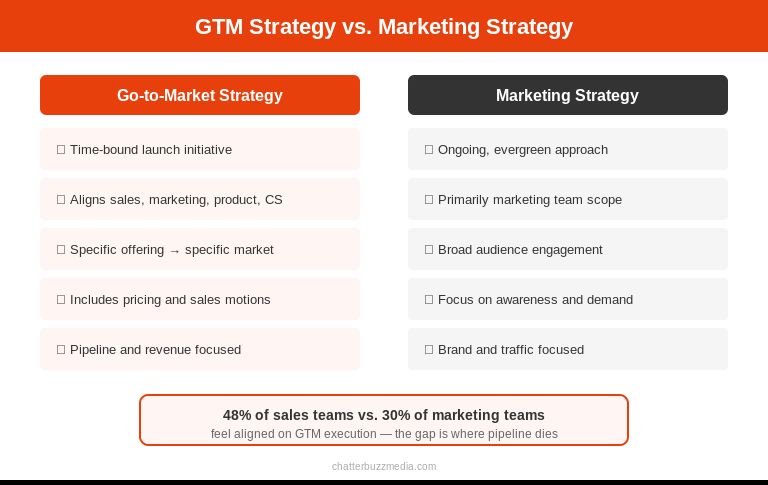
A marketing strategy focuses on how you attract and engage an audience over time. A go-to-market strategy focuses on how you bring a specific offering to a specific market at a specific moment — with aligned sales motions, pricing, messaging, and channel decisions all working in concert.
The difference matters because companies that treat GTM as “just marketing” consistently underperform. They build awareness without building pipeline. They generate leads without converting revenue. They launch products without aligning their sales team on positioning, pricing, or ideal customer profiles.
According to a 2025 survey of 450 GTM leaders, 48% of sales teams and only 30% of marketing teams felt aligned on go-to-market execution. That 18-point gap is where pipeline dies.
A well-built go-to-market strategy eliminates that gap by answering five foundational questions before a single dollar gets spent:
- Who is this for? — Your ideal customer profile and buyer personas, defined with enough specificity to disqualify the wrong prospects.
- What problem are we solving? — The pain point your offering addresses, stated in the customer’s language.
- How will we reach them? — The channels, sales motions, and distribution strategies that put your offering in front of the right decision-makers.
- Why should they choose us? — Your differentiated positioning against alternatives, including the status quo.
- How will we know it’s working? — The metrics, milestones, and feedback loops that tell you whether to accelerate or adjust.
For mid-market companies — typically $10M to $500M in revenue — getting this right is especially critical. You don’t have the budget to brute-force your way through a bad launch, and you don’t have the brand awareness to recover quickly from a misfire. Every GTM motion needs to be precise, coordinated, and measurable.
The four Ps of go-to-market — Product, Price, Place, and Promotion — provide a useful starting framework. But for mid-market B2B companies, they’re a floor, not a ceiling. The complete GTM model requires deeper work on buyer personas, sales motions, competitive positioning, and cross-functional alignment that the 4 Ps don’t address.
The rest of this guide breaks down exactly how to build one.
When You Actually Need a Go-to-Market Strategy
You need a go-to-market strategy any time your company is introducing something new to the market or introducing your existing offering to a new audience. This is not a “nice to have” planning exercise — it’s the operational blueprint that determines whether a launch generates revenue or burns budget.
Here are the four scenarios that demand a formal GTM strategy:
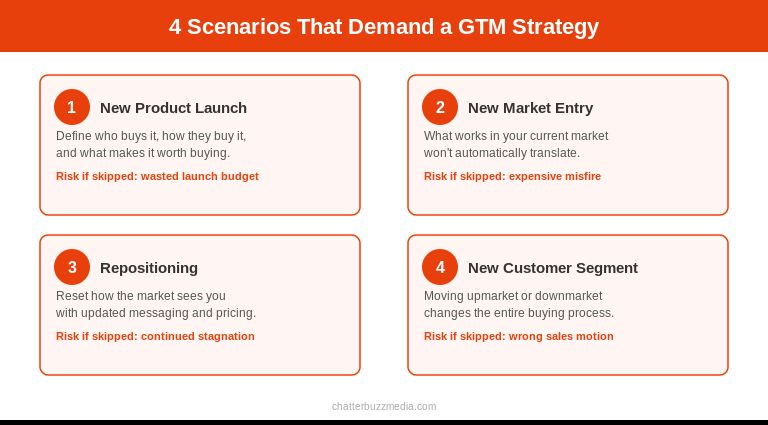
Launching a new product or service. This is the most obvious trigger. Whether it’s a SaaS product, a professional service line, or a physical product, you need a GTM strategy to define who buys it, how they buy it, and what makes it worth buying. Without one, you’re guessing at pricing, messaging, and channels simultaneously — and guessing at three variables at once is not a strategy.
Entering a new market or geography. Expanding from one region to another, or from one industry vertical to a new one, requires a fresh GTM plan. What worked in your current market won’t automatically translate. Lead generation strategies that perform in financial services may fall flat in manufacturing. Buyer expectations, sales cycles, competitive landscapes, and channel preferences all shift.
Repositioning an existing offering. If your product or service has stalled — flat pipeline, declining win rates, or a perception problem — a GTM strategy resets how the market sees you. This includes reworking your brand messaging, adjusting your pricing model, and realigning your sales team around updated positioning.
Targeting a new customer segment. Moving upmarket from SMB to mid-market, or from mid-market to enterprise, fundamentally changes your GTM motion. The buying process gets more complex, the stakeholder count increases, and the sales cycle lengthens. You need a dedicated strategy for how you’ll penetrate the new segment — not just a tweak to your existing playbook.
If none of these scenarios apply, you probably don’t need a new GTM strategy. You need better execution of the one you already have. Knowing the difference saves you from wasting months on strategic planning when the problem is tactical.
The 7 Core Components of a Winning GTM Strategy
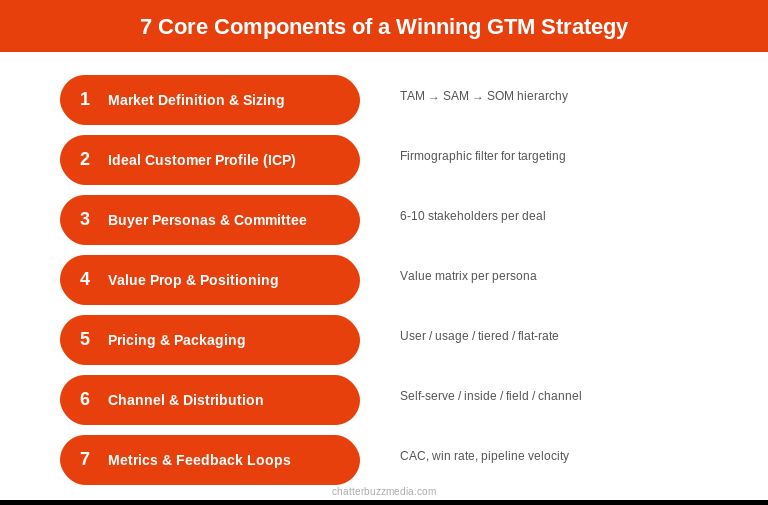
Every effective go-to-market strategy is built on seven interconnected components. Skip one, and the entire motion weakens. Get all seven right, and you create a launch engine that compounds results over time.
1. Market Definition and Sizing
Before you build anything, you need to know the size of the opportunity. Market sizing follows a hierarchy: TAM (Total Addressable Market) is the total revenue opportunity if you captured 100% of the market. SAM (Serviceable Addressable Market) is the portion you can realistically serve given your current capabilities. SOM (Serviceable Obtainable Market) is the slice you can capture in the near term.
Mid-market companies should focus on SOM. It grounds your revenue projections in reality and prevents the kind of “if we just get 1% of a $50B market” fantasy that kills credibility with boards, investors, and your own sales team.
2. Ideal Customer Profile (ICP)
Your ICP defines the company-level characteristics of your best-fit customers. This includes industry, company size (revenue and headcount), geography, technology stack, and organizational maturity. The ICP is not a buyer persona — it’s the firmographic filter that tells your sales team which accounts to pursue and which to disqualify.
A strong ICP should be specific enough to cut your total market by at least 50%. If your ICP describes “any company with a marketing team,” it’s not an ICP — it’s a wish list.
3. Buyer Personas and the Buying Committee
Within your ICP accounts, multiple people influence the purchase decision. In mid-market B2B, the average buying committee includes 6-10 stakeholders across four roles: the Champion (internal advocate), the Decision Maker (budget authority), the Influencer (technical evaluator), and the Blocker (the person who can kill a deal with a single objection).
Your GTM strategy needs messaging and content tailored to each role. The Champion needs ammunition to sell internally. The Decision Maker needs ROI data. The Influencer needs technical depth. The Blocker needs risk mitigation.
4. Value Proposition and Positioning
Your value proposition answers one question: why should the customer choose you over every alternative, including doing nothing? Positioning defines where you sit relative to competitors in the buyer’s mind.
The strongest go-to-market strategies use a value matrix — a grid that maps each buyer persona to their specific pain points, your unique value, and the proof points that back it up. This matrix becomes the source of truth for every piece of messaging your team produces.
5. Pricing and Packaging
Pricing is a go-to-market decision, not just a finance decision. The four dominant pricing models for mid-market companies are user-based (price per seat), usage-based (price per unit of consumption), tiered (good/better/best packages), and flat-rate (single price for all features).
Your pricing model should align with how your customer perceives value. If they measure value by the number of users who benefit, user-based works. If they measure value by output or volume, usage-based makes more sense.
6. Channel and Distribution Strategy
This component defines how your offering reaches the buyer. The four primary sales models are self-service (customer buys without talking to a human), inside sales (remote sales team drives deals), field sales (in-person, high-touch relationships), and channel sales (partners and resellers sell on your behalf).
Most mid-market companies use a hybrid approach — inside sales for deals under a certain threshold, field sales for larger opportunities, and conversion-optimized self-service for low-complexity purchases.
7. Metrics and Feedback Loops
A GTM strategy without measurement is just a launch party with a budget. The KPIs that matter most for go-to-market execution include customer acquisition cost (CAC), sales cycle length, win rate, pipeline velocity, and time-to-first-value for new customers.
Build weekly review cadences into your GTM plan from day one. The companies that win at GTM are not the ones with the best initial strategy — they are the ones that adjust fastest when the data tells them something isn’t working.
How to Build a Go-to-Market Strategy in 8 Steps
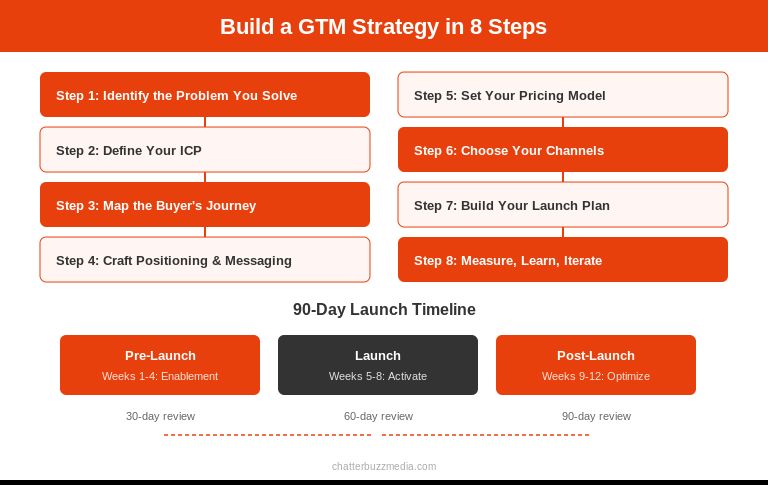
Building a go-to-market strategy follows a sequential process where each step informs the next. Skipping ahead — writing messaging before defining your ICP, for example — creates rework and misalignment downstream.
Step 1: Identify the Problem You Solve
Start with the customer’s pain, not your product’s features. Interview 15-20 existing customers and ask: “What would have happened if you hadn’t solved this problem?” Their answers reveal the urgency, the cost of inaction, and the language they use to describe the pain. That language becomes your messaging foundation.
Document the problem in a single sentence. If you can’t, your offering might be solving too many problems — or none clearly enough.
Step 2: Define Your Ideal Customer Profile
Analyze your best 20% of customers — the ones with the highest lifetime value, shortest sales cycles, and lowest churn. What do they have in common? Build your ICP from those patterns, not from aspirational targets.
Include firmographic data (industry, size, geography), technographic data (what tools they use), and behavioral signals (what triggers them to look for a solution). The more specific, the better your targeting and the lower your marketing investment waste.
Step 3: Map the Buyer’s Journey
For each persona in the buying committee, document how they move from unaware to evaluating to purchasing. Identify what triggers them to start looking, where they research solutions, what content they consume at each stage, and what objections they raise.
Mapping content to the customer journey ensures your marketing and sales teams deliver the right message at the right time. A CFO evaluating ROI in the decision stage doesn’t need the same content as a marketing director discovering the problem for the first time.
Step 4: Craft Your Positioning and Messaging
Build your value matrix: a grid with buyer personas on one axis and pain points, value statements, and proof points on the other. This matrix generates every piece of external messaging — website copy, sales decks, email sequences, ad creative, and outbound scripts.
Test your positioning against the “so what?” filter. Every claim should have a concrete answer to “so what does that mean for me?” If it doesn’t, it’s a feature statement, not a value proposition.
Step 5: Set Your Pricing Model
Price based on the value you deliver, not the cost to deliver it. Research competitor pricing, talk to your target customers about willingness to pay, and test pricing tiers with small audience segments before committing.
For mid-market B2B, consider a three-tier pricing structure that anchors the highest tier at the top, makes the middle tier the obvious choice, and uses the lowest tier to reduce friction for first-time buyers.
Step 6: Choose Your Channels
Select channels based on where your ICP already spends time and how they prefer to buy. Don’t spread across every channel simultaneously. Pick two to three primary channels, master them, then expand.
For mid-market B2B companies, the highest-performing channel combinations typically include organic search (SEO) paired with account-based marketing, or paid search (PPC) combined with targeted social media advertising. The right mix depends on your sales cycle length and average deal size.
Step 7: Build Your Launch Plan
A launch plan turns strategy into execution. It includes a timeline (typically 90 days for mid-market launches), assigned owners for every deliverable, and dependencies between workstreams.
Structure the launch in three phases: Pre-launch (weeks 1-4) covers sales enablement, content creation, and channel setup. Launch (weeks 5-8) activates campaigns, outbound sequences, and PR. Post-launch (weeks 9-12) focuses on optimization, pipeline analysis, and iteration based on early signals.
Step 8: Measure, Learn, and Iterate
Set weekly check-ins for the first 90 days. Track leading indicators — website traffic, demo requests, pipeline generated — not just lagging indicators like closed revenue. If a channel isn’t producing pipeline by week 6, diagnose why before doubling down or cutting it.
The best go-to-market strategies are not the ones that work perfectly on day one. They are the ones with built-in feedback loops that let you adjust messaging, targeting, and channels based on real market data instead of assumptions.
Go-to-Market Strategy Frameworks: Which One Fits Your Business
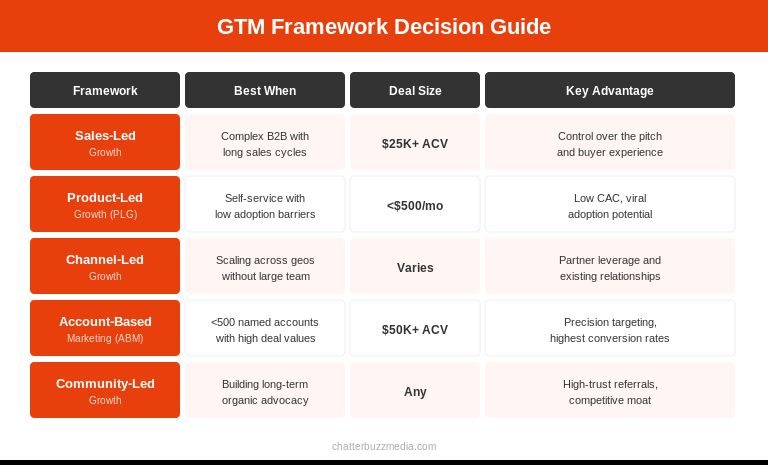
Not every go-to-market strategy follows the same playbook. The right framework depends on your product complexity, deal size, buyer behavior, and growth stage. Here are the five dominant GTM frameworks used by mid-market companies today.
Sales-Led Growth
In a sales-led GTM, the sales team drives revenue through direct outreach, relationship building, and consultative selling. This framework works best for complex B2B offerings with high average contract values (ACV above $25K), long sales cycles, and multi-stakeholder buying committees.
The advantage is control. Sales reps tailor the pitch to each prospect. The disadvantage is cost — sales-led motions require significant investment in hiring, training, and enablement before revenue scales.
Product-Led Growth (PLG)
Product-led growth uses the product itself as the primary acquisition, activation, and retention engine. Users sign up for a free trial or freemium tier, experience value firsthand, and convert to paid plans based on usage.
PLG works best for self-service products with low barriers to adoption. Think Slack, Zoom, and Dropbox in their early growth stages. For mid-market companies with complex products that require onboarding or integration, pure PLG is rarely sufficient — but a PLG layer (free audit tools, calculators, or diagnostic features) can accelerate top-of-funnel pipeline.
Channel-Led Growth
Channel-led GTM relies on partners, resellers, or integrators to sell and deliver your offering. This framework is powerful for reaching markets where you lack direct presence — new geographies, regulated industries, or enterprise accounts where the partner has existing relationships.
The trade-off is margin compression and reduced control over the buyer experience. Build your channel program with clear rules of engagement, co-marketing commitments, and shared pipeline visibility.
Account-Based Marketing (ABM)
Account-based marketing flips the traditional funnel. Instead of casting a wide net and filtering down, ABM identifies high-value target accounts first, then orchestrates personalized marketing and sales motions for each one.
ABM is the most effective framework for mid-market companies targeting enterprise buyers. It concentrates resources on the accounts most likely to close at the highest deal values. When combined with demand generation, ABM creates a precision pipeline engine that outperforms volume-based approaches.
Community-Led Growth
Community-led GTM builds an audience of practitioners, advocates, and users who organically drive awareness and adoption. This framework generates high-trust referrals and creates a moat that competitors can’t easily replicate.
The downside is time. Community-led growth compounds slowly and requires consistent investment in content, events, and community management before it generates meaningful pipeline. For most mid-market companies, community-led is a complementary strategy, not the primary GTM motion.
Choosing the Right Framework
Use this decision filter: If your ACV is above $50K and your product requires customization, go sales-led. If your product delivers value within minutes and costs under $500/month, consider PLG. If you need to scale across geographies or verticals without hiring a large sales team, explore channel-led. If you’re targeting fewer than 500 named accounts with high deal values, ABM is your best bet.
Most successful mid-market companies don’t use a single framework in isolation. They layer two or three — for example, sales-led with an ABM overlay and a PLG free tool for top-of-funnel awareness.
Go-to-Market Strategy Examples That Actually Worked
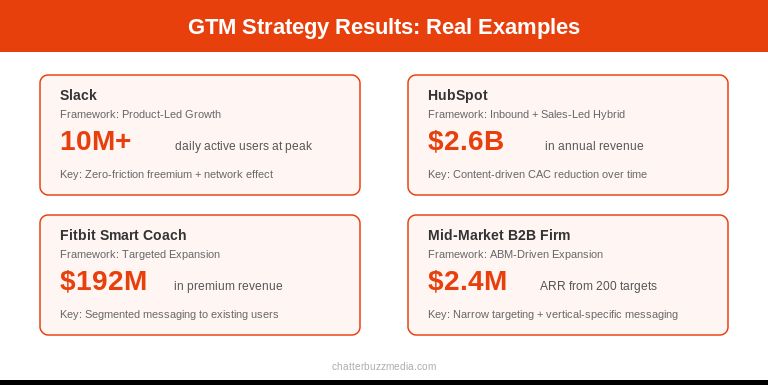
Theory is useful. Execution examples are better. Here are four go-to-market strategies from companies at different stages and in different markets that show how the frameworks above play out in practice.
Slack: Product-Led Growth With a Network Effect
Slack launched with a freemium model that let teams adopt the product without IT approval or procurement processes. The GTM genius was the network effect — every user who invited a teammate made the product more valuable for everyone. By the time enterprise buyers were ready to negotiate contracts, entire departments were already using Slack daily.
The lesson for mid-market companies: if your product creates more value as more people use it, design your GTM motion to reduce adoption friction to near zero.
HubSpot: Inbound + Sales-Led Hybrid
HubSpot built its entire GTM strategy around the concept of inbound marketing — attracting buyers through educational content rather than interrupting them with outbound sales. They published thousands of blog posts, free tools (Website Grader, CRM), and certifications that generated massive organic traffic and inbound leads. A sales team then qualified and closed those leads.
This inbound marketing approach works for mid-market companies that can invest in content marketing with measurable ROI. The content investment compounds over time, reducing CAC as organic traffic grows.
Fitbit Smart Coach: Feature Launch With Targeted Messaging
When Fitbit launched its Smart Coach premium feature, it used a focused GTM strategy that targeted existing users most likely to upgrade. They segmented their user base by engagement level, created messaging specific to each segment’s fitness goals, and launched with a 90-day free trial to reduce conversion friction. The result: $192M in premium revenue.
The lesson: GTM strategies are not just for new products. Repositioning or expanding an existing offering with segmented messaging can unlock significant revenue from your current customer base. This approach also works when marketing automation enables personalized nurture paths for each segment.
A Mid-Market B2B Example: ABM-Driven Market Expansion
A $40M professional services firm needed to expand from one vertical (healthcare) into financial services. They built a GTM strategy around ABM: identified 200 target accounts using firmographic and intent data, created vertical-specific messaging addressing compliance and regulatory pain points, and ran a coordinated campaign across LinkedIn ads, personalized email sequences, and direct mail.
Within six months, they generated 34 qualified opportunities and closed 8 new accounts worth $2.4M in annual recurring revenue. The key was narrowing the target list and going deep rather than going wide.
This is the power of a focused GTM motion. When you know exactly who you’re targeting and why, every dollar works harder. The financial services marketing playbook they developed became a repeatable template for entering additional verticals.
The 5 GTM Mistakes That Kill Mid-Market Growth
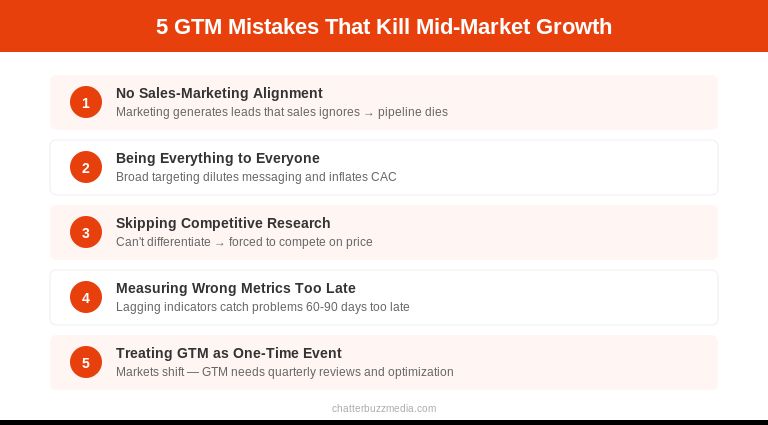
Knowing what to do is only half the equation. The other half is knowing what will sabotage your go-to-market execution. These five mistakes are the most common — and most expensive — failures we see in mid-market GTM launches.
Mistake 1: Launching Without Sales and Marketing Alignment
When sales and marketing are not aligned on ICP, messaging, lead qualification criteria, and handoff processes, the GTM motion fractures. Marketing generates leads that sales ignores. Sales blames marketing for low quality. Both teams waste budget.
Fix this by building a shared GTM playbook that both teams co-author. Define what constitutes a Marketing Qualified Lead (MQL) versus a Sales Qualified Lead (SQL), agree on SLAs for lead follow-up, and hold joint pipeline reviews weekly during the launch period.
Mistake 2: Trying to Be Everything to Everyone
Mid-market companies often resist narrowing their ICP because a smaller target market feels limiting. The opposite is true. Broad targeting dilutes your messaging, increases CAC, and forces your sales team to spend time on prospects who will never close.
A focused ICP lets you craft messaging that resonates deeply with a specific audience. You can always expand later once you’ve dominated a niche. Start narrow, prove the motion works, then scale.
Mistake 3: Skipping Competitive Research
If you don’t know how competitors position themselves, price their offerings, and structure their sales processes, you can’t differentiate. And if you can’t differentiate, you’re competing on price — the worst possible GTM position for a mid-market company.
Conduct a thorough marketing audit and competitive analysis before finalizing your positioning. Talk to prospects who chose a competitor. Understand not just what they bought, but why they bought it from someone else.
Mistake 4: Measuring the Wrong Metrics Too Late
Companies that only track lagging indicators — closed revenue, new customers acquired — don’t catch problems until it’s too late to fix them. By the time you see declining revenue, the root cause happened 60-90 days earlier in your pipeline.
Build a reporting dashboard that tracks leading indicators weekly: demo requests, pipeline created, sales cycle velocity, and conversion rates at each funnel stage. Use the data to make real-time adjustments.
Mistake 5: Treating GTM as a One-Time Event
A go-to-market strategy is not a document you create and file away. Markets shift. Competitors launch new offerings. Buyer behavior evolves. The companies that win at GTM treat it as a living process with quarterly reviews, ongoing optimization, and continuous learning.
Schedule formal GTM reviews at 30, 60, and 90 days post-launch, then quarterly thereafter. Each review should assess what’s working, what’s not, and what needs to change based on market feedback and performance data.
How to Measure Go-to-Market Strategy Success
The metrics you track determine whether your GTM strategy generates insight or just noise. Focus on the metrics that tell you whether your go-to-market motion is healthy, scalable, and sustainable.
Pipeline Metrics
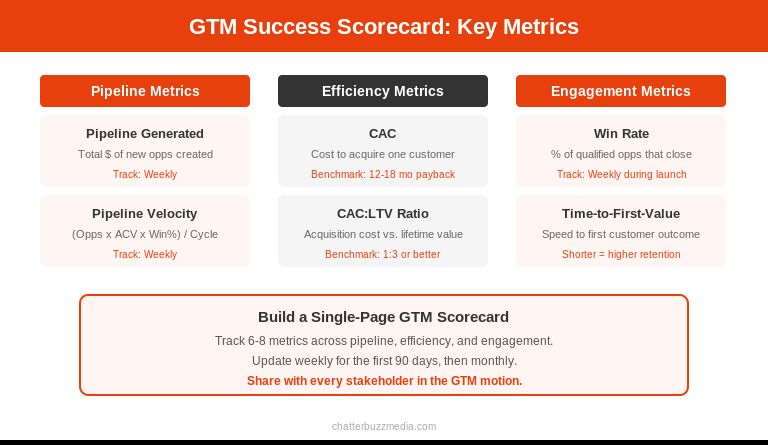
Pipeline generated measures the total dollar value of new opportunities created during the GTM period. This is the earliest signal of whether your targeting and messaging are working.
Pipeline velocity measures how fast deals move through your funnel. Calculate it as: (number of qualified opportunities × average deal value × win rate) ÷ average sales cycle length. If velocity is declining, diagnose which variable is the bottleneck.
Efficiency Metrics
Customer Acquisition Cost (CAC) is the total cost of acquiring a new customer, including marketing spend, sales salaries, tools, and overhead. For mid-market B2B, a healthy CAC payback period is 12-18 months.
CAC-to-LTV ratio compares your acquisition cost to the lifetime value of the customer. A ratio of 1:3 or better is the benchmark. Below 1:3, you’re either spending too much to acquire or not retaining long enough to recoup your investment.
Engagement Metrics
Win rate tracks the percentage of qualified opportunities that close. If your win rate drops during a GTM launch, it usually means your ICP is too broad or your sales team isn’t enabled on the new positioning.
Time-to-first-value measures how quickly a new customer reaches their first meaningful outcome after purchase. Shorter time-to-first-value correlates directly with higher retention and expansion revenue.
Building Your GTM Scorecard
Create a single-page scorecard that tracks 6-8 metrics across pipeline, efficiency, and engagement. Update it weekly during the first 90 days, then monthly. Share it with every stakeholder involved in the GTM motion — marketing, sales, product, and leadership.
The scorecard is not about perfection. It’s about creating a shared language for diagnosing what’s working and making decisions based on data instead of opinions.
Frequently Asked Questions
1. 🔍 What is a go-to-market strategy?
A go-to-market strategy is a comprehensive plan that outlines how a company will launch a product or service, reach its target customers, and achieve competitive advantage. It coordinates marketing, sales, pricing, and distribution into a unified approach for bringing an offering to market.
2. 📊 What are the 5 pillars of a go-to-market strategy?
The five pillars are market analysis, customer definition (ICP and buyer personas), value proposition and positioning, channel and distribution strategy, and metrics and measurement. Each pillar must be defined before the GTM motion launches.
3. ⚡ What is the difference between a GTM strategy and a marketing strategy?
A marketing strategy is an ongoing plan for attracting and engaging audiences over time. A GTM strategy is a time-bound plan for bringing a specific offering to a specific market. The GTM strategy includes marketing but also encompasses sales motions, pricing, channel selection, and cross-functional alignment.
4. 🏦 How long does it take to build a go-to-market strategy?
For mid-market companies, building a comprehensive GTM strategy typically takes 4-8 weeks of focused work. This includes customer research, competitive analysis, messaging development, channel selection, and launch planning. Rushing the process usually leads to gaps that cost more to fix later.
5. 🤝 What is product-led growth vs. sales-led growth?
Product-led growth uses the product itself to drive acquisition, activation, and retention — users experience value through a free trial or freemium tier before purchasing. Sales-led growth relies on a sales team to drive revenue through direct outreach and consultative selling. Most mid-market companies use a hybrid approach.
6. 💰 How much should a mid-market company invest in a GTM launch?
Investment varies by market and complexity, but a typical mid-market GTM launch allocates 15-25% of the first-year revenue target toward launch costs. This covers content creation, campaign spend, sales enablement materials, and tools. The key is ensuring CAC payback within 12-18 months.
7. 🚀 What are the biggest go-to-market strategy mistakes?
The five most common GTM mistakes are launching without sales-marketing alignment, targeting too broad an audience, skipping competitive research, measuring the wrong metrics, and treating GTM as a one-time event instead of a continuous process.
8. 📈 How do you measure go-to-market strategy success?
Track pipeline generated, pipeline velocity, customer acquisition cost (CAC), CAC-to-LTV ratio, win rate, and time-to-first-value. Use a weekly scorecard during the first 90 days to catch problems early and adjust before small issues become expensive failures.
Conclusion
A go-to-market strategy is the difference between launching with precision and launching with hope. For mid-market companies, where every dollar and every quarter matters, getting the GTM motion right is not optional — it’s foundational to sustainable growth.
The frameworks, steps, and metrics in this guide give you the blueprint. But a blueprint only works when it’s executed with discipline, measured with rigor, and refined based on what the market actually tells you.
Here is your action plan:
- Audit your current GTM motion. Score yourself on each of the 7 core components. Identify the biggest gap and fix it first.
- Define or sharpen your ICP. Analyze your best 20% of customers, build your ICP from those patterns, and disqualify everything that doesn’t fit.
- Build your value matrix. Map each buyer persona to their pain points, your differentiated value, and your proof points. Use this matrix to generate every piece of messaging.
- Launch with a 90-day plan. Set weekly metrics reviews, assign clear owners, and build in decision points at 30, 60, and 90 days.
For a deeper dive into the marketing strategies that power GTM execution, explore our resource library — including guides on B2B demand generation, account-based marketing, and fractional CMO leadership.

Victoria Wallace
Victoria Wallace is a senior content strategist and marketing writer with 30+ years of experience helping more than 200 brands translate complex business goals into clear, conversion-focused content. Her background spans paid media, marketing strategy, go-to-market planning, brand positioning, and full-funnel campaign development, giving her a deep understanding of how SEO content connects to real business growth.