
 321-236-2899
ICP Marketing: How to Personalize Content for Buyers
ICP marketing only works when you translate your ideal customer profile into content decisions your team makes every day. This guide shows you exactly how to map ICP attributes to specific content types, personalize email sequences, tailor landing pages and ad creative, and use AI to scale it all in 2026.
Companies that excel at personalization generate 40% more revenue than companies that don’t, according to McKinsey research. Businesses with a clear ICP also see 36% higher customer retention and 38% higher sales win rates, and when sales and marketing align around that ICP, marketing revenue jumps by 208%.
By the end of this guide, you’ll have a repeatable framework for turning ICP data into personalized emails, ads, and landing pages — not just a static persona document collecting dust. Let’s start with what ICP marketing actually means and why most teams get it wrong.
Key Takeaways
- ICP marketing means using firmographic, technographic, and behavioral data to personalize content — not just to identify who to target.
- Personalization can cut customer acquisition costs by up to 50% and boost marketing ROI by 10-30%, per McKinsey.
- Every ICP attribute should map to a specific content decision, from subject lines to landing page headlines.
- Email sequences need different triggers, proof points, and CTAs depending on which ICP segment a lead falls into.
- AI tools now let mid-size teams personalize at a scale that used to require enterprise budgets.
- The metrics that matter aren’t vanity metrics — they’re win rate, sales cycle length, and revenue per segment.
What ICP Marketing Actually Means (and Why It Matters for Content)
ICP marketing is the practice of shaping every piece of content around the specific attributes of your ideal customer profile, rather than writing generic content and hoping it resonates. Most teams stop at building the ICP document and never connect it to content production.
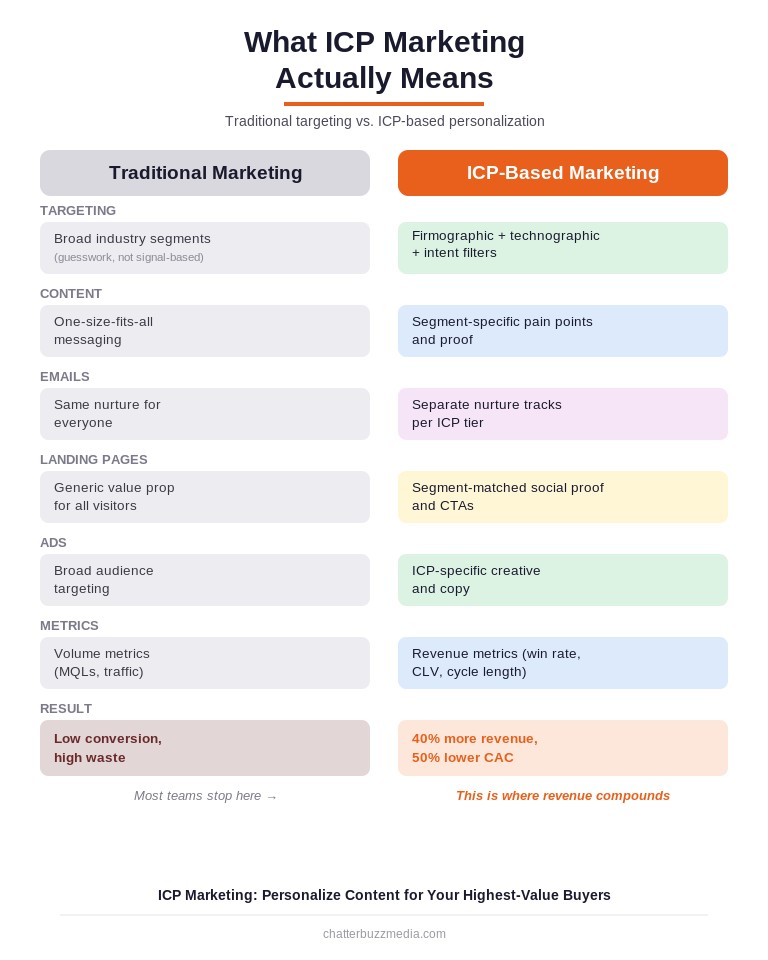
That gap matters because an ICP without content action is just a slide in a deck. The real value shows up when a marketer sits down to write an email or brief a designer and already knows exactly which pain point, proof point, and tone to use.
Traditional segmentation groups buyers by industry or company size and calls it done. ICP-based marketing goes deeper, layering in technographic signals, buying triggers, and behavioral data to inform the actual words on the page.
This is different from a buyer persona, which describes a person. An ICP describes the company profile most likely to become your highest-value, longest-retained customer, and that distinction changes how you write content.
Think of persona as “who” and ICP as “which companies are worth the content investment.” When you combine both, you get content that speaks to a specific human inside a specific type of company.
The stakes are high because personalization directly affects revenue. McKinsey found personalization can cut customer acquisition costs by up to 50% and lift marketing ROI by 10-30%.
Companies with clearly defined ICPs also report 38% higher win rates, which means sales teams close more of the deals marketing sends them. That’s the return on doing ICP marketing correctly instead of treating it as a one-time exercise.
A quick example makes this concrete. A cybersecurity vendor selling to both 50-person startups and 5,000-employee enterprises can’t use the same case study, the same pricing anchor, or the same CTA for both.
The startup buyer cares about implementation speed and price predictability. The enterprise buyer cares about compliance, integration depth, and vendor stability — and your content needs to reflect that split.
Understanding this distinction is the foundation for everything else in this guide. Once you know why ICP-based content personalization matters, the next step is building an ICP that’s actually usable for content teams, not just for sales targeting.
How to Build an ICP That Drives Content Decisions
A content-ready ICP includes firmographic, technographic, behavioral, and psychographic attributes — not just industry and headcount. Most ICP documents stop at firmographics, which leaves content teams guessing at tone and messaging.
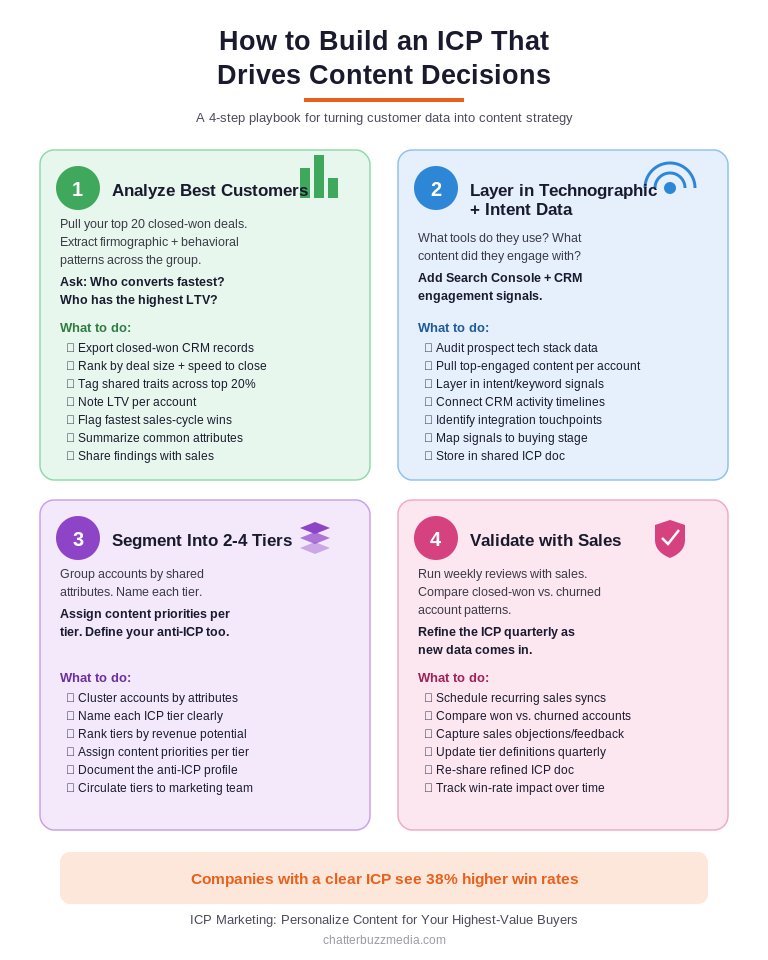
Start by pulling your closed-won data from the last 12-18 months. Look for patterns in company size, industry, tech stack, growth stage, and the specific triggers that preceded their purchase.
Step 1: Analyze Your Best Customers
Pull your top 20% of accounts by revenue, retention, and expansion. These are the accounts you want more of, and their shared traits become your ICP baseline.
Look beyond revenue at qualitative signals too. Did they have a champion who drove internal buy-in, or did they need heavy sales involvement to close?
Step 2: Layer in Technographic and Intent Data
Technographic data tells you what tools your best accounts already use, which informs integration messaging in your content. Intent data shows you what they’re researching before they ever fill out a form.
This is where demand generation strategy and ICP work start to overlap directly. You can’t run effective demand gen without knowing which signals actually predict a good-fit buyer.
Step 3: Segment Your ICP Into 2-4 Tiers
Most B2B companies have more than one ICP, even if they only have one product. Segmenting into tiers — for example, “Enterprise Compliance-Driven” versus “Mid-Market Growth-Driven” — gives content teams a clear brief to work from.
Each tier should include a one-paragraph “content lens” summary. This tells writers and designers exactly how to frame value for that segment without re-explaining strategy every time.
Step 4: Validate with Sales
Your sales team talks to prospects daily and can confirm or challenge your ICP assumptions. This alignment step is exactly why companies that connect sales and marketing around a clear ICP see a 208% boost in marketing revenue.
Document objections your sales team hears repeatedly, because these become content opportunities. A well-built ICP turns those objections into proactive messaging before prospects ever raise them.
This foundational work takes real time, but skipping it means every downstream personalization effort rests on guesswork. For a deeper framework on connecting ICP work to full-funnel strategy, review this account-based marketing guide.
With a content-ready ICP in hand, you’re ready to map those attributes directly to the content types your team produces every week.
Map Your ICP Attributes to Content Types
Every ICP attribute should connect to a specific content decision — this is the step most competitors skip entirely. Instead of a static ICP document, build a mapping table that tells your team exactly what to change based on each attribute.
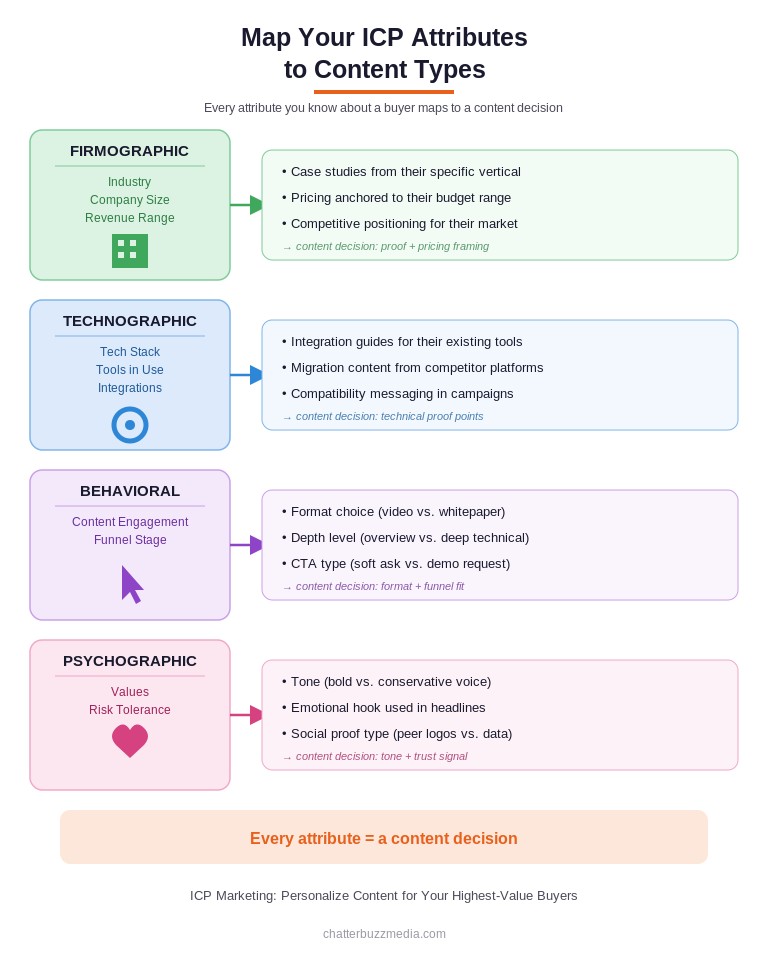
Firmographic Attributes → Proof and Positioning
Company size should dictate which case studies you feature and which pricing language you use. A 200-person company wants to see a similarly sized customer story, not a Fortune 500 logo that feels out of reach.
Industry vertical should shape your terminology and compliance references. A healthcare ICP segment needs HIPAA-aware language; a fintech segment needs SOC 2 and audit-trail language.
Technographic Attributes → Integration Messaging
If your ICP segment already uses HubSpot, your content should reference that integration by name in headlines and email subject lines. This single change increases relevance instantly because it signals “we already fit into your stack.”
This is especially important in HubSpot implementation conversations, where technical buyers want proof of compatibility before they’ll engage further.
Behavioral Attributes → Content Format and Depth
Buyers who consume long-form guides respond well to detailed whitepapers and comparison content. Buyers who engage mostly with short-form social content need punchier landing pages and shorter email copy.
Track this through content engagement data, not assumptions. Your reporting and analytics setup should surface which formats each ICP segment actually consumes.
Psychographic Attributes → Tone and Emotional Hook
A risk-averse buyer persona within your ICP responds to stability and proof; a growth-stage buyer responds to speed and competitive advantage. The same product benefit needs two entirely different framings depending on which psychographic profile you’re addressing.
Build this mapping into a shared reference document your whole content team can access. When a writer sits down to draft an email, they should be able to look up the ICP segment and immediately see which proof points, tone, and format to use.
This mapping exercise is the single biggest lever for scaling personalized content without reinventing strategy every time. Once your mapping table exists, the next step is applying it to your highest-volume content channel: email.
How to Personalize Email Sequences by ICP Segment
Email personalization by ICP means changing the trigger, subject line, proof point, and CTA for each segment — not just inserting a first name. Generic drip sequences underperform because they treat a 50-person startup the same as a 5,000-person enterprise.
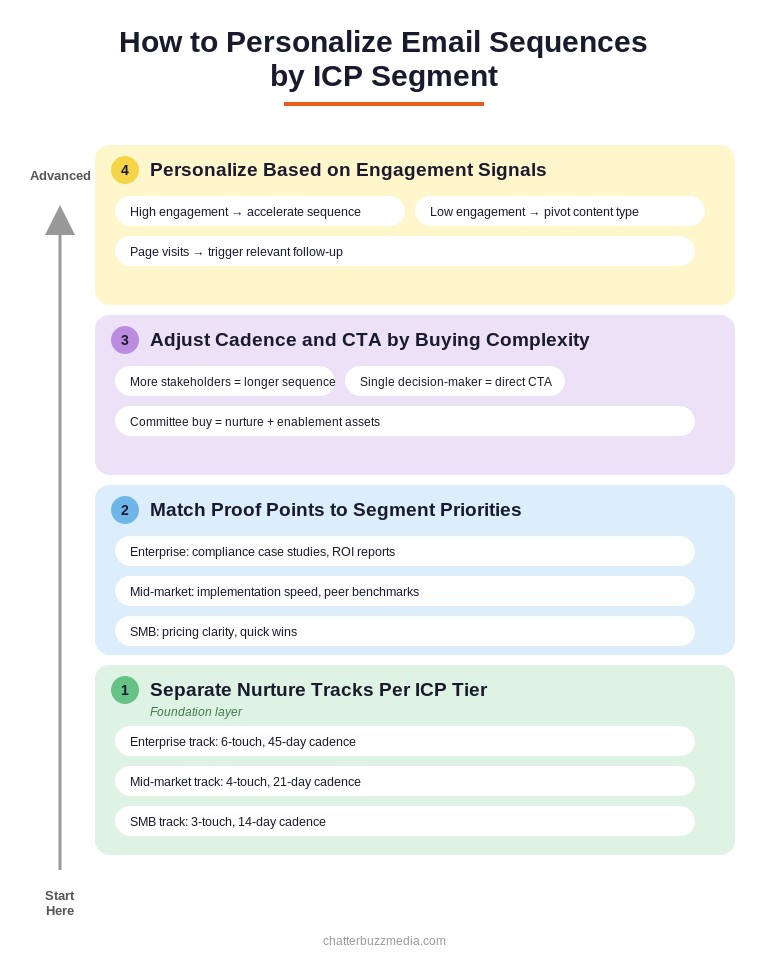
Build Separate Nurture Tracks Per ICP Tier
Start by branching your nurture sequence at the point of lead capture, using firmographic data to route contacts into the right track. This single decision point determines everything downstream in the sequence.
Each track should have its own subject line style, since enterprise buyers respond to specificity while smaller companies respond to speed and simplicity. Test this directly rather than assuming.
Match Proof Points to Segment Priorities
An enterprise ICP segment wants to see security certifications and analyst validation inside email 2 or 3 of the sequence. A mid-market segment wants to see time-to-value and implementation speed instead.
Pull these proof points from your content marketing ROI data to confirm which assets actually drive replies for each segment. Don’t guess when the data already exists.
Adjust Cadence and CTA by Buying Complexity
Enterprise ICP segments typically involve longer buying committees, so their sequences should run longer with more educational touches before the sales CTA. Smaller ICP segments can move to a demo or trial CTA much faster.
This is where marketing automation becomes essential, since manually tracking which segment gets which cadence isn’t realistic at scale. Automation platforms let you build these branches once and let the system handle routing.
Personalize Based on Engagement Signals Mid-Sequence
If a contact clicks a pricing link, shift their next email toward objection-handling content regardless of which ICP track they’re on. Behavioral signals should override the default sequence when they contradict it.
This dynamic branching is what separates static drip campaigns from true ICP-based marketing. For a broader view of how these sequences fit into the full customer journey, see this content journey mapping guide.
Personalized email sequences consistently outperform generic ones because they meet buyers where their actual priorities sit. Next, apply that same segment-specific thinking to landing pages and ad creative, where first impressions matter even more.
Personalize Landing Pages and Ad Creative for Each ICP
Landing pages and ads should change headline, hero image, and social proof based on which ICP segment clicked through — this is one of the highest-leverage personalization tactics available. A single generic landing page forces every visitor to translate your message into their own context, and most won’t bother.
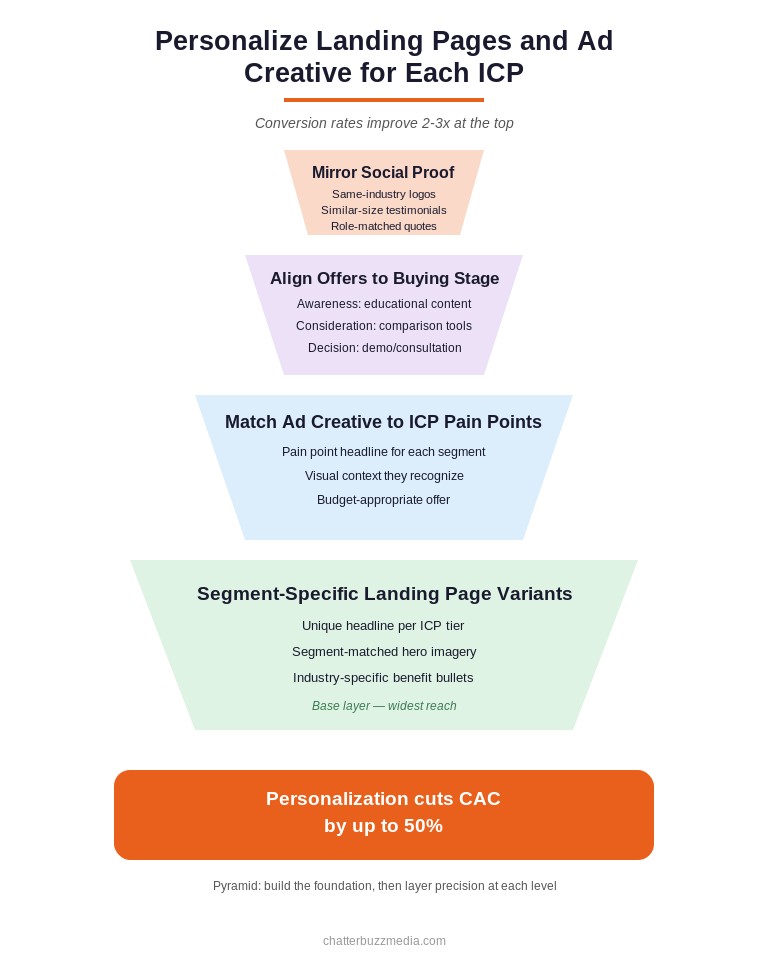
Build Segment-Specific Landing Page Variants
Create a base landing page template, then swap the headline, hero copy, and testimonial based on UTM parameters tied to ICP segment. This doesn’t require building entirely new pages every time.
Dynamic content blocks let you show a healthcare-specific testimonial to healthcare traffic and a fintech-specific testimonial to fintech traffic on the same URL. Review the fundamentals in this landing page conversion guide before building segment variants.
Match Ad Creative to ICP Pain Points
Ad creative should lead with the specific pain point that matters most to each ICP segment, not a generic value proposition. An ad targeting IT directors should reference security and uptime; an ad targeting marketing directors should reference speed and ROI.
This requires tighter coordination between your PPC management and content teams than most organizations have today. Build a shared brief template that pulls directly from your ICP content-mapping table.
Align Landing Page Offers to Buying Stage Within Each Segment
An enterprise ICP segment early in their journey needs an educational offer like a benchmark report. That same segment late in their journey needs a comparison guide or ROI calculator instead.
Mismatched offers are one of the most common reasons personalized ad spend underperforms. Map offer type to both ICP segment and funnel stage before you launch a campaign, not after.
Use Social Proof That Mirrors the Visitor
A visitor from a 5,000-employee company wants to see a logo and testimonial from a company their size, not a small business success story. This single swap can measurably lift conversion rates because it removes the mental step of “does this apply to me?”
This same logic extends to account-based campaigns, where personalization can go down to the individual account level. See real results in this ABM case study for how far this can be pushed.
Landing pages and ads are where ICP personalization becomes visible to the buyer for the first time, so they carry outsized weight. The challenge is doing this at scale without a massive content team, which is exactly where AI tools now change the equation.
Use AI and Automation to Scale ICP Content Personalization
AI tools in 2026 let mid-size marketing teams personalize content at a scale that used to require enterprise budgets. The bottleneck was never strategy — it was production capacity, and AI removes much of that constraint.
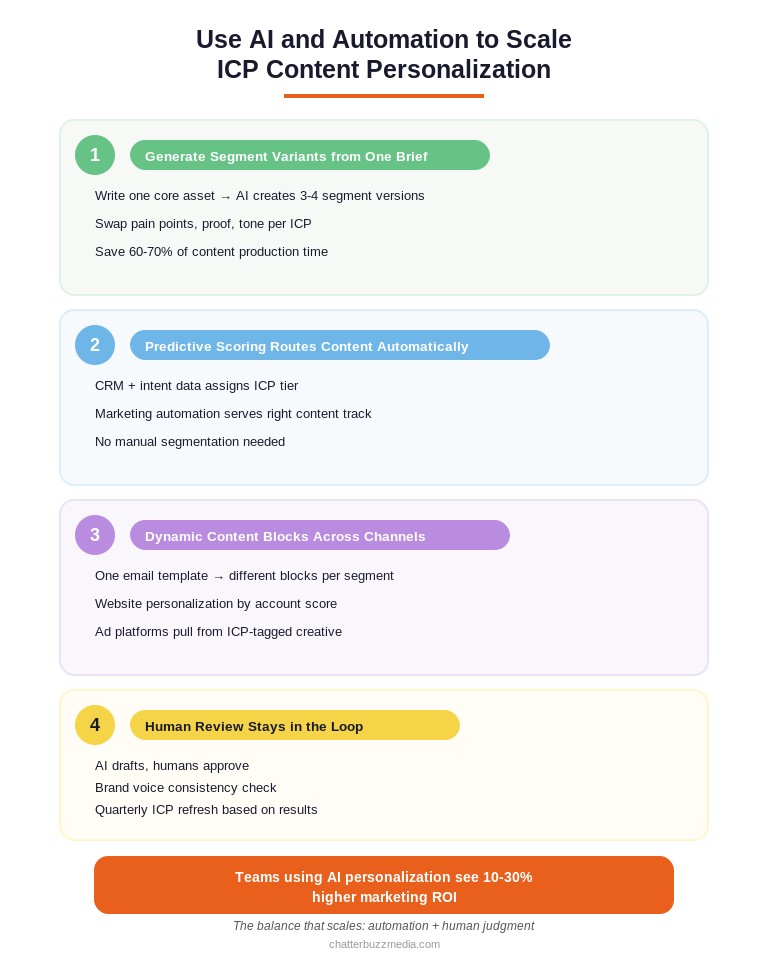
Use AI to Generate Segment Variants from a Single Brief
Instead of writing five versions of an email manually, feed your ICP content-mapping table into an AI drafting tool and generate segment-specific variants from one core brief. This cuts production time dramatically while keeping messaging consistent.
The key is feeding the AI tool specific ICP attributes, not vague instructions. “Write for a 500-employee SaaS company evaluating security compliance” produces far better output than “write for enterprise.”
Use Predictive Scoring to Route Content Automatically
Modern automation platforms can score incoming leads against your ICP in real time and automatically route them to the matching content track. This removes the manual tagging step that slows down most personalization programs.
Pair this with your marketing automation types to understand which workflows benefit most from predictive routing. Lead scoring and content routing work best when they’re built together, not bolted on separately.
Use Dynamic Content Blocks Across Channels
Website personalization tools can now swap entire content blocks based on firmographic data pulled from IP lookup or CRM enrichment. This means a visitor from a target account can see different messaging than an anonymous visitor, without any manual work per visit.
This connects directly to account-based marketing execution, where account-level personalization at scale used to require a much larger team. AI-driven dynamic content closes that gap.
Keep Human Review in the Loop
AI-generated variants still need a human check for tone accuracy and factual correctness before they go live. Treat AI as a first-draft engine for scale, not a replacement for strategic judgment on messaging.
This balance matters because a mismatched or slightly-off variant can hurt trust with exactly the high-value accounts you’re trying to win. Build a lightweight review step into your workflow so speed doesn’t come at the cost of quality.
AI and automation solve the production bottleneck that used to make true ICP personalization impractical at scale. Once your personalized content is live across email, ads, and landing pages, you need a measurement framework to know what’s actually working.
Measure What’s Working: ICP Content Performance Metrics
The right metrics for ICP marketing are win rate, sales cycle length, and revenue per segment — not generic engagement metrics. Open rates and click-through rates tell you content got attention, but they don’t tell you if it moved the right accounts closer to a deal.
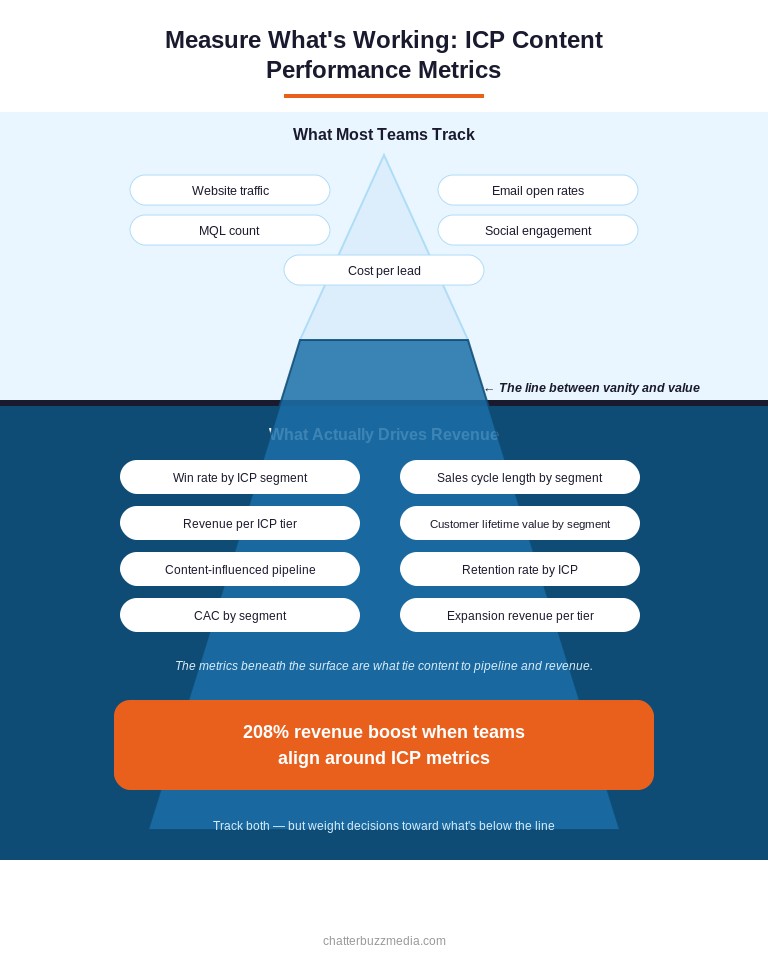
Track Win Rate by ICP Segment
Break your win rate data out by ICP tier to see which segments your personalized content is actually converting. Companies with a clear ICP already see 38% higher win rates overall, and segment-level tracking shows you exactly where that lift is coming from.
If one segment’s win rate lags behind others, that’s a signal your content mapping for that segment needs revision. Don’t wait for a quarterly review to catch this — build it into your regular reporting cadence.
Track Sales Cycle Length by Segment
Personalized content should shorten sales cycles by pre-answering objections before a rep ever raises them. If cycle length isn’t improving for a given segment, your content likely isn’t addressing that segment’s real concerns.
Compare cycle length before and after you launch segment-specific sequences to isolate the impact. This is a cleaner signal than engagement metrics because it ties directly to revenue timing.
Track Revenue and Retention per ICP Tier
Ultimately, the goal is more revenue and better retention from your best-fit accounts. Companies with clear ICPs see 36% higher retention rates, and tracking retention by segment shows you which content is building durable relationships versus just generating initial interest.
Feed this data back into your reporting and data visualization setup so it’s visible to both marketing and sales leadership. Shared visibility is what keeps both teams aligned around the same ICP definition over time.
Benchmark Against Broader Personalization Research
External research provides useful context for your internal numbers. Salesforce’s connected customer research and Gartner’s personalization studies both confirm that buyers increasingly expect tailored experiences, and companies that fall behind on this lose consideration earlier in the funnel.
Use these benchmarks to set realistic targets rather than comparing yourself only to competitors. Your marketing strategy and planning process should revisit these targets at least quarterly as your ICP evolves.
Measurement closes the loop on ICP marketing, turning a content strategy into a system you can continuously improve. With the full framework in place, here are the questions marketers ask most often about putting this into practice.
FAQ: ICP Marketing and Content Personalization
1. 🔍 What’s the difference between ICP marketing and buyer persona marketing?
ICP marketing targets the company profile most likely to become a high-value, long-retained customer. Buyer persona marketing targets the individual human inside that company, and the strongest content strategies combine both layers.
2. 📊 How many ICP segments should a B2B company have?
Most B2B companies work well with 2-4 ICP tiers, since more than that becomes difficult to operationalize across content and sales teams. Start with your top 2 tiers based on closed-won revenue and expand only if the data supports it.
3. ⚡ Can small marketing teams do ICP-based content personalization without a big budget?
Yes — AI drafting tools and marketing automation platforms have significantly lowered the production cost of segment-specific content. A small team can now generate multiple ICP variants from a single content brief in a fraction of the time it used to take.
4. 🏦 Which ICP attributes matter most for content personalization?
Firmographic data (company size, industry) shapes proof points and positioning, while technographic data (existing tools) shapes integration messaging. Behavioral and psychographic data shape tone, format, and emotional framing, and all four layers matter for truly personalized content.
5. 🤝 How does ICP marketing connect to account-based marketing?
ICP marketing defines the criteria for a good-fit account, while account-based marketing executes highly personalized campaigns against specific named accounts within that ICP. Review this account-based marketing guide for how the two strategies work together in practice.
6. 💰 What’s the ROI of personalizing content by ICP segment?
McKinsey research shows personalization can cut customer acquisition costs by up to 50% and lift marketing ROI by 10-30%. Companies with a clear ICP also report 208% higher marketing revenue when sales and marketing collaborate around it.
7. 🚀 How does ICP-based content personalization fit with inbound marketing?
Inbound marketing attracts prospects through valuable content, and ICP-based personalization ensures that content speaks directly to your best-fit prospects rather than a generic audience. Explore this connection further in this inbound marketing guide.
8. 📈 How often should a company update its ICP-based content strategy?
Review your ICP and its content mapping at least twice a year, or immediately after a major shift in your customer base or product line. Markets move fast enough that a stale ICP will quietly degrade the accuracy of every personalized campaign built on top of it.
Conclusion: Turn Your ICP Into a Content Engine
ICP marketing only creates value when it changes what you actually write, design, and send. The data backs this up clearly: 40% more revenue for personalization leaders, 38% higher win rates, and up to 50% lower acquisition costs when it’s done right.
Use this four-step action plan to put everything in this guide into motion.
1. Build a content-ready ICP with firmographic, technographic, behavioral, and psychographic layers, then validate it with your sales team.
2. Create an attribute-to-content mapping table that tells every writer and designer exactly what to change per segment.
3. Personalize your highest-leverage channels first — email sequences, landing pages, and ad creative — before trying to personalize everything at once.
4. Track win rate, cycle length, and revenue by segment so you know which personalization efforts are actually paying off.
Start small, measure fast, and expand what works. For a deeper look at building the strategic foundation behind this work, explore the full resource library or review the B2B digital marketing fundamentals that support every step above.

Victoria Wallace
Victoria Wallace is a senior content strategist and marketing writer with 30+ years of experience helping more than 200 brands translate complex business goals into clear, conversion-focused content. Her background spans paid media, marketing strategy, go-to-market planning, brand positioning, and full-funnel campaign development, giving her a deep understanding of how SEO content connects to real business growth.