
 321-236-2899
HubSpot CRM Setup: The Diamond Partner’s Guide to Getting It Right the First Time
Most HubSpot CRM setups fail quietly. The software installs fine, a few users log in, and six months later the pipeline is half-empty, the reports are wrong, and the team has quietly gone back to spreadsheets.
Getting HubSpot CRM setup right the first time is less about clicking through the onboarding checklist and more about the decisions you make before you import a single contact. As a HubSpot Diamond Partner, our team has rebuilt dozens of portals that were configured too fast, and the pattern is always the same: rushed structure, weak data, and automation layered on a shaky foundation.
This guide walks through the exact seven-step sequence we use to configure a portal for real adoption, including the properties, pipelines, and permissions that make or break month one. You will also see what HubSpot implementation actually costs in 2026 so you can decide between DIY, HubSpot direct onboarding, and a partner. Let’s start with what a successful setup really requires.
Key Takeaways
- Strategy before software: Define your funnel, data model, and success metrics before configuring anything in HubSpot.
- Structure drives adoption: Properties, pipelines, and lifecycle stages must mirror how your team actually sells, not HubSpot defaults.
- Clean data first: A rushed import is the single most common reason a HubSpot CRM setup has to be redone.
- Automation comes last: Workflows and integrations should sit on top of a solid foundation, never replace one.
- Budget realistically: Expect $1,500–$7,000 for HubSpot direct onboarding and roughly $8,000–$20,000 for a full partner-led implementation.
What HubSpot CRM Setup Really Involves in 2026
HubSpot CRM setup is the process of configuring your portal’s data model, pipelines, permissions, automation, and reporting so the platform reflects how your business actually operates. It is not a one-click install, and it is not the same as onboarding.
The distinction matters because it changes what you are paying for. Onboarding is guidance on how to use the tools, while implementation is the hands-on work of building the system correctly.
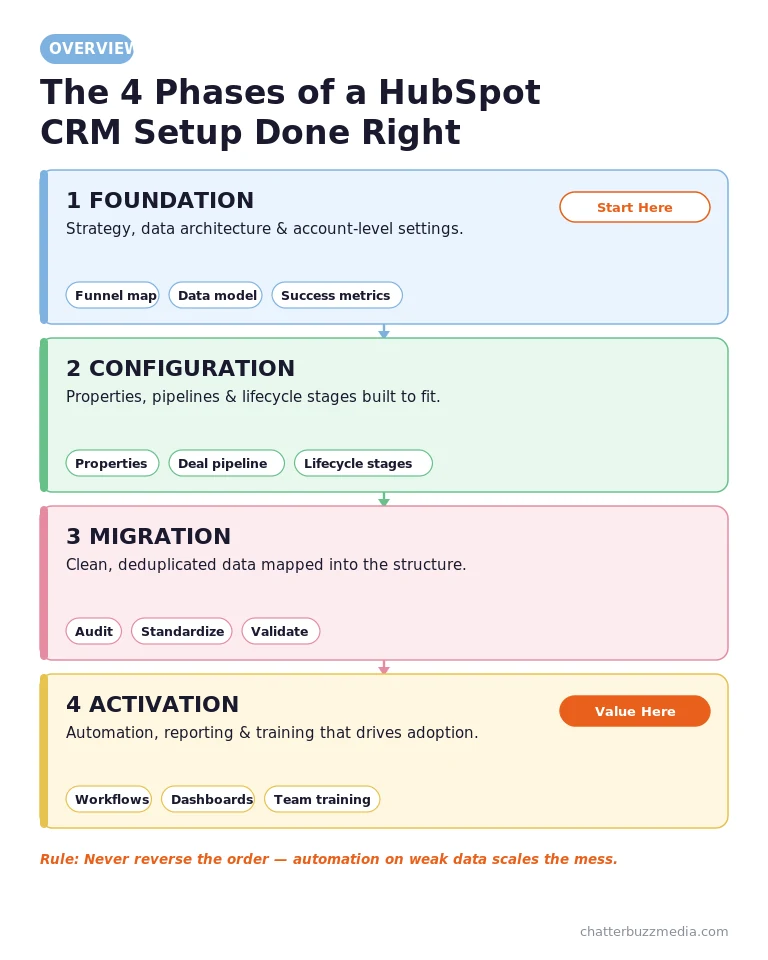
A complete setup moves through four connected phases: foundation, configuration, migration, and activation. Skip or rush any one of them and the cracks show up later as bad reports or abandoned records.
Foundation covers strategy, your data architecture, and account-level settings. This is where you decide what “good data” looks like before anything else happens.
Configuration is where properties, pipelines, and lifecycle stages get built to match your real sales motion. Migration then moves clean, deduplicated data into that structure.
Finally, activation layers in automation, integrations, reporting, and the training that drives adoption. The order is deliberate, and reversing it is why so many portals need a rebuild.
Think of it like building a house. You would never install smart lighting before pouring the foundation, yet that is exactly what teams do when they build workflows before defining their data model.
The teams that succeed treat setup as a project with a clear owner, a timeline, and sign-off at each phase. The teams that struggle treat it as an afternoon of clicking through settings. Here is where to start.
Step 1: Define Your Strategy and Data Architecture First
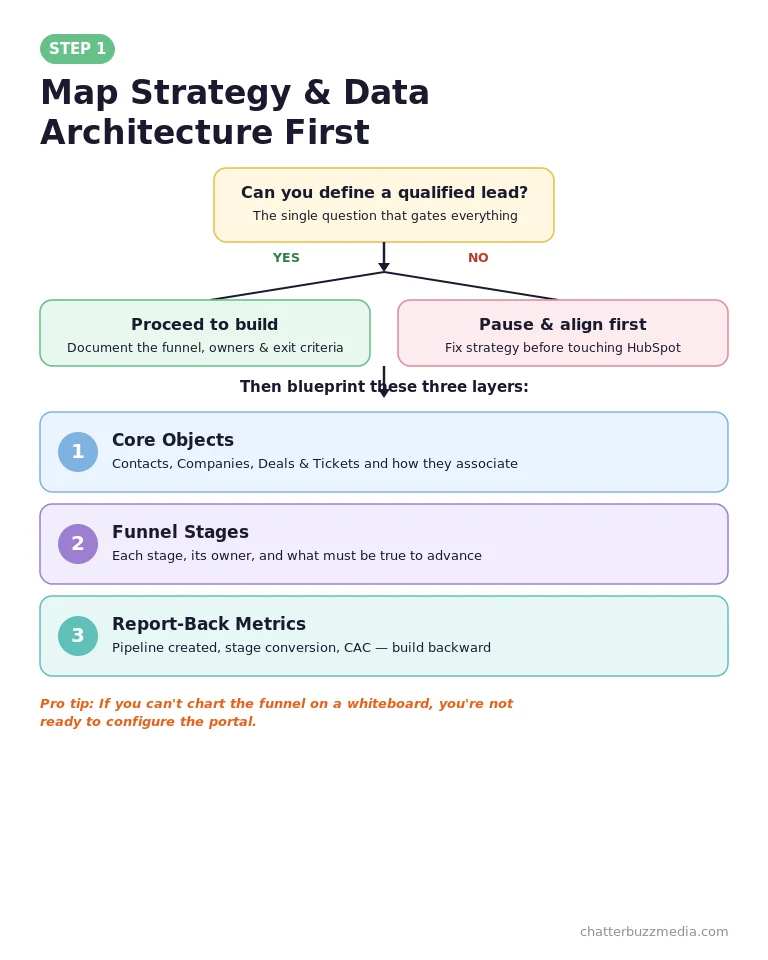
Before you configure anything, map your funnel, your core objects, and the exact metrics you need HubSpot to report on. The tool should model your business, not force your business to model the tool.
This step matters because every downstream decision, from properties to dashboards, depends on it. A portal built without a data blueprint becomes a landfill of duplicate fields and unusable reports within months.
Start by documenting how a lead becomes a customer in your business. Write out each stage, who owns it, and what has to be true to move forward.
Next, decide how your four core objects, contacts, companies, deals, and tickets, relate to one another. Getting these associations right prevents the messy one-to-many problems that break reporting later.
Then define the handful of metrics leadership actually cares about, such as pipeline created, conversion rate by stage, and customer acquisition cost. Work backward from those reports to the exact properties you must capture.
A clear ideal customer profile and documented go-to-market strategy make this step dramatically faster. If you can’t yet answer “what does a qualified lead look like,” pause here before touching HubSpot. With the blueprint set, you can configure the account.
Step 2: Configure Accounts, Users, Roles, and Permissions
Set up your users, teams, roles, and permissions before importing data, because these settings control who owns records, who sees what, and how accountability works. Getting this wrong forces painful re-permissioning after people are already working in the system.
Account-level settings are the guardrails for everything that follows. They are tedious to change once records and workflows depend on them, so it pays to be deliberate now.
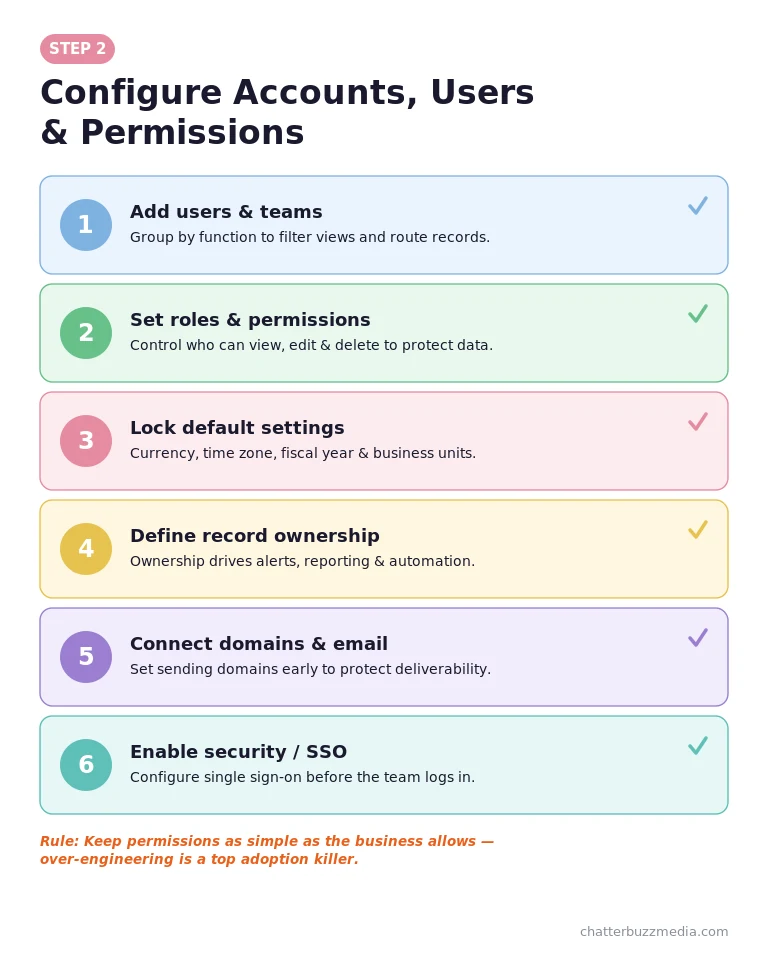
Start with the essentials that shape data behavior across the portal:
- Users and teams: Add every user and group them by function so you can filter views and route records by team.
- Roles and permissions: Define what each role can view, edit, and delete to protect data integrity and reporting.
- Default settings: Set your currency, time zone, fiscal year, and business units before any data enters.
- Record ownership: Decide how owners are assigned, since ownership drives notifications, reporting, and automation.
Also configure your domain connections, email sending, and security settings like single sign-on early. These touch deliverability and compliance, and retrofitting them is disruptive.
Keep permissions as simple as your business allows. Over-engineered permission schemes are a leading cause of “I can’t find my records” complaints that quietly kill adoption. Once the account is locked in, build the structures your team will live in every day.
Step 3: Build Properties, Pipelines, and Lifecycle Stages
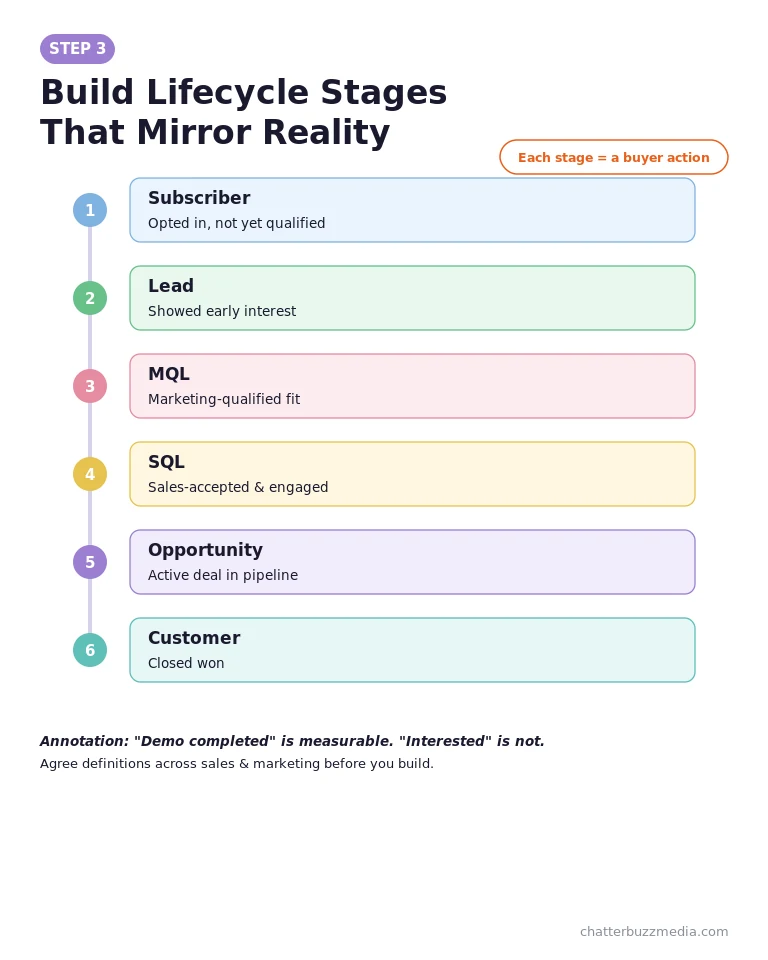
Configure your properties, deal pipelines, and lifecycle stages to mirror your real sales process, not HubSpot’s defaults. This is the single most important configuration step for adoption, because a pipeline that matches how reps actually sell gets used, and one that doesn’t gets ignored.
Properties are the fields that hold your data, and discipline here separates clean portals from chaotic ones. Create only the properties tied to a real report or workflow, and use consistent naming so nobody creates a duplicate “Industry” field next quarter.
Your lifecycle stages should map the full journey from subscriber to customer, with clear, agreed definitions for each stage. When marketing and sales disagree on what “MQL” means, every downstream report becomes unreliable.
Build your deal pipeline stages to reflect the actual steps a rep takes to close, and make each stage represent a buyer action rather than an internal feeling. “Demo completed” is measurable; “interested” is not.
As a simple example, a B2B pipeline might run from “New” to “Discovery Scheduled,” “Demo Completed,” “Proposal Sent,” “Verbal Commit,” and “Closed Won.” Each of those is an observable event, which keeps your forecast honest.
Resist the urge to build five pipelines on day one. Start with the one that reflects your primary sales motion, and add others only when a genuinely different process demands it.
Wherever possible, attach required properties to specific stages so critical data gets captured at the right moment. This is how you make reporting reliable without nagging your team. Strong buyer personas and a clear revenue-stage GTM plan make these definitions obvious. With the structure built, it’s time to bring in your data.
Step 4: Clean and Migrate Your Data the Right Way
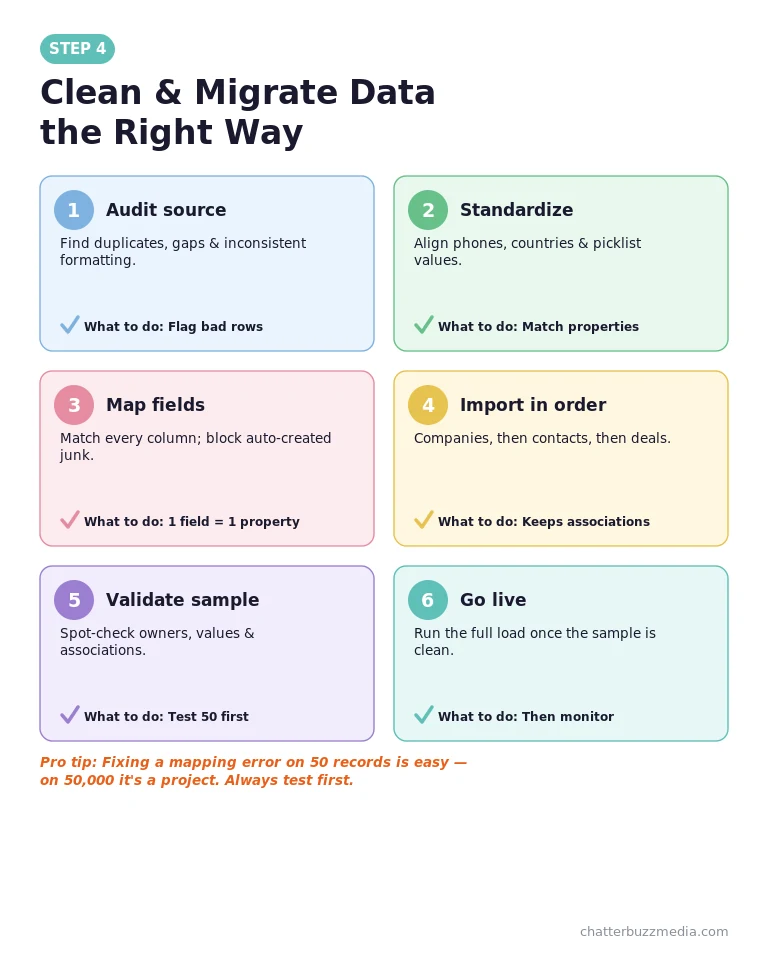
Clean, deduplicate, and standardize your data before importing it, then map every field to the properties you built in Step 3. A rushed import is the number one reason a HubSpot CRM setup has to be redone, because bad data poisons every report and automation on top of it.
Migration feels like a technical task, but it is really a data-quality project. The hours you spend cleaning a spreadsheet save you weeks of cleanup inside a live CRM.
Work through migration in a disciplined sequence:
- Audit your source data: Identify duplicates, missing fields, and inconsistent formatting before you export anything.
- Standardize formats: Align phone numbers, country names, and picklist values so they match your HubSpot properties.
- Map fields deliberately: Match every column in your file to the correct property, and don’t let HubSpot auto-create junk fields.
- Import in the right order: Load companies first, then contacts, then deals, so associations connect correctly.
- Validate a sample: Spot-check records after import to confirm associations, owners, and values landed as expected.
Always run a small test import before the full load. Fixing a mapping error on 50 records is easy; fixing it on 50,000 is a project. See HubSpot’s import documentation for file requirements before you begin. Once your data is clean and in place, you can safely add intelligence on top.
Step 5: Layer in Automation, Integrations, and Workflows
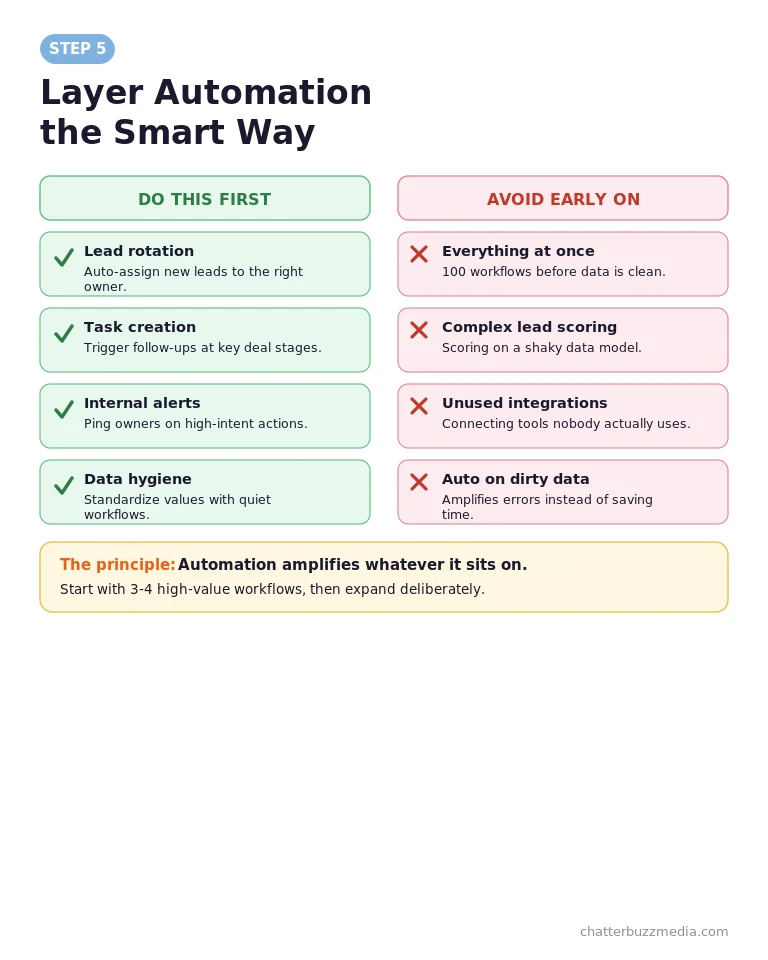
Add automation and integrations only after your foundation and data are solid, and start with a few high-value workflows rather than automating everything at once. Automation amplifies whatever system it sits on, so building it on weak data simply scales your problems.
The goal in this step is to remove manual work that steals selling time, not to build a Rube Goldberg machine. Restraint here is a feature, not a limitation.
Begin with automations that deliver obvious, immediate value:
- Lead rotation: Automatically assign new leads to the right owner so nothing sits unclaimed.
- Task creation: Trigger follow-up tasks when deals hit key stages so reps never lose the thread.
- Internal alerts: Notify owners when a high-intent action happens, like a demo request or pricing-page visit.
- Data hygiene: Use workflows to standardize property values and keep records consistent over time.
Connect your essential tools next, such as your email, calendar, and website forms, so activity flows into the CRM without manual entry. A well-planned lead nurturing sequence and the right marketing automation types make this layer pay for itself quickly. Our complete guide to marketing automation goes deeper on sequencing. With automation running, you need visibility into whether it’s all working.
Step 6: Build Reporting Dashboards and Drive Adoption
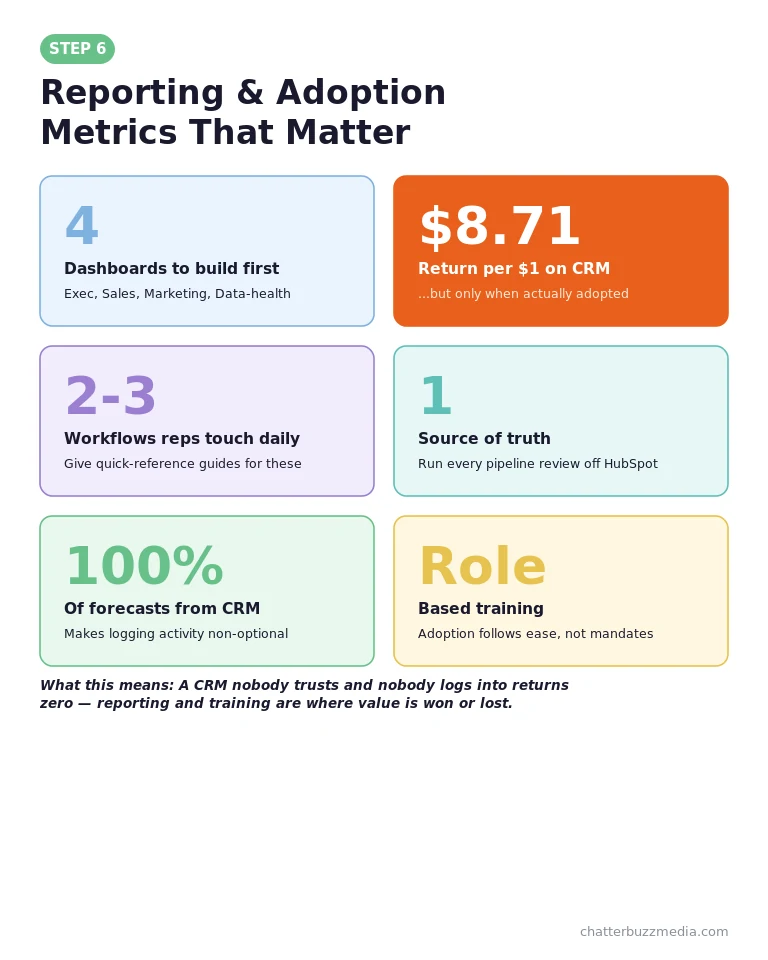
Set up role-specific dashboards that answer leadership’s key questions, then invest in training so the team actually uses the system daily. Reporting and adoption are where a CRM either proves its value or quietly dies, because a portal nobody trusts and nobody logs into returns nothing on your investment.
Reporting is not an afterthought; it is the reason the CRM exists. Build dashboards backward from the decisions your leaders make, not forward from whatever charts are easy to create.
Give each team the view it needs to do its job:
- Executive dashboard: Pipeline created, forecast, win rate, and revenue against goal in one glance.
- Sales manager dashboard: Rep activity, stage conversion, and deals at risk of stalling.
- Marketing dashboard: Lead source performance, MQL-to-SQL conversion, and campaign influence on pipeline.
- Data-health dashboard: Records missing key fields, so hygiene stays visible and manageable.
Adoption is the other half of the equation, and it is won through training, not mandates. Run role-specific onboarding sessions and give reps quick-reference guides for the two or three workflows they touch daily.
Reinforce the habit by making the CRM the single source of truth for pipeline reviews and forecasting. When the weekly meeting runs off HubSpot dashboards, logging activity stops being optional. Clear data visualization turns that activity into decisions your leaders trust. With the system live and adopted, let’s talk about what all of this costs.
What HubSpot CRM Setup Costs in 2026
In 2026, expect to pay $1,500–$7,000 for HubSpot’s direct onboarding and roughly $8,000–$20,000 for a full partner-led implementation, with total mid-market projects typically landing between $2,000 and $15,000 depending on scope. The right choice depends on your complexity, timeline, and internal capacity, not just the sticker price.
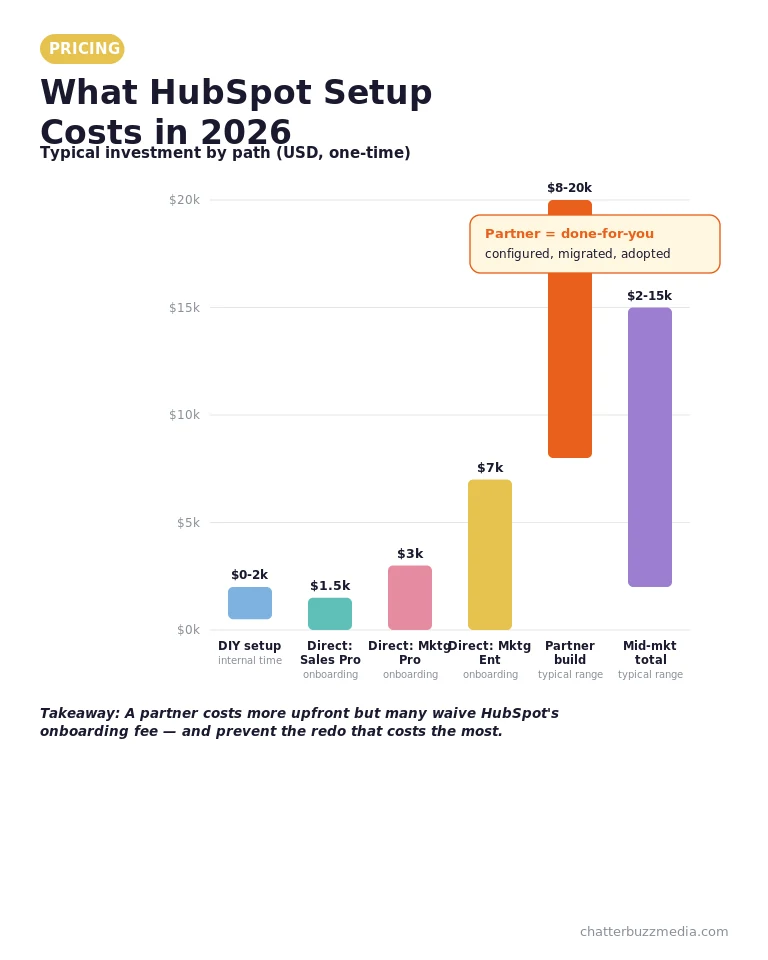
HubSpot requires onboarding on Professional and Enterprise tiers, and those fees are consultative rather than done-for-you. You get guidance, but the hands-on building is still your responsibility.
HubSpot direct onboarding fees generally break down by hub and tier, running about $1,500 for Sales or Service Professional, $3,000 for Marketing Hub Professional, and up to $7,000 for Marketing Hub Enterprise. These cover strategic guidance and best practices from HubSpot’s team.
A certified partner typically costs more upfront, often $8,000–$20,000 for a full implementation, but delivers a configured, migrated, and adoption-ready portal. Many partners also waive HubSpot’s onboarding fee, which offsets part of the difference.
A DIY build can make sense when your data is already clean, your process is simple, and you have someone internally who knows HubSpot well. The hidden cost there is time, and the risk is an amateur structure you later pay to fix.
The math favors a partner when your data is messy, your processes are complex, or your team lacks the bandwidth to build correctly the first time, a trade-off similar to weighing fractional CMO cost against an in-house hire. Research has long put CRM returns near $8.71 for every dollar spent, but only when the system is actually adopted. Compare that against the current HubSpot pricing for your hubs. Whichever path you choose, avoid the mistakes that force a costly redo.
Common HubSpot Setup Mistakes to Avoid
The most expensive HubSpot mistakes happen in the first 30 days: rushed imports, excessive customization, undefined lifecycle stages, and automation built before the data is clean. Nearly every portal rebuild we perform traces back to one of these, and all of them are preventable.
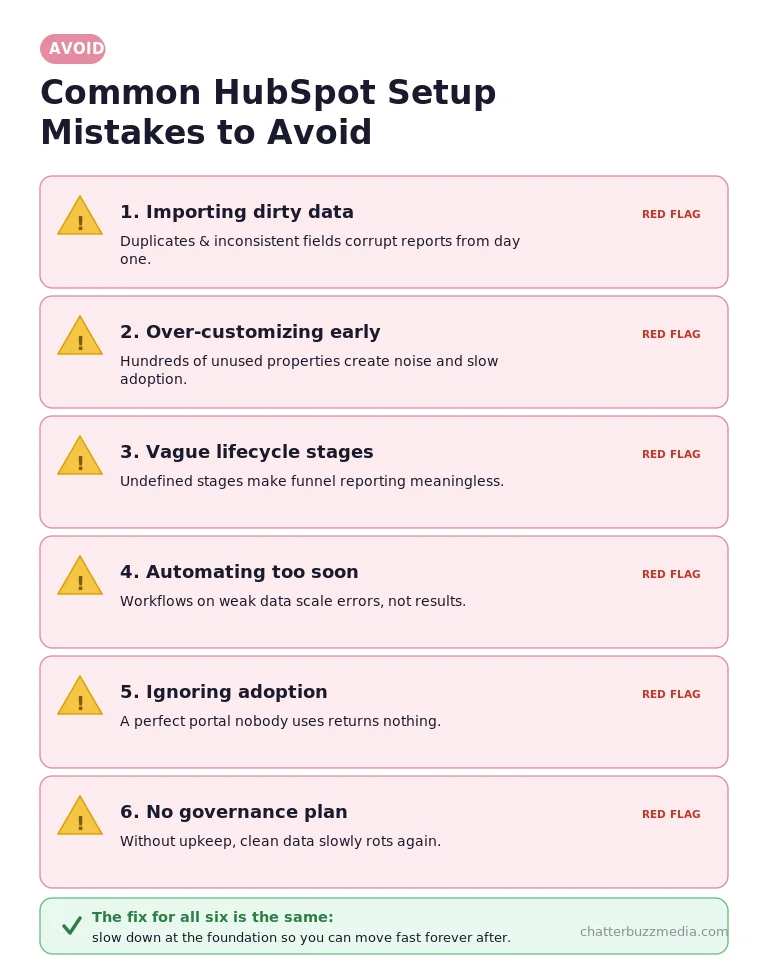
These errors are quiet at first, which is what makes them dangerous. The portal looks fine on day one and only reveals its problems once reporting and adoption are on the line.
Watch closely for the patterns that sink new portals:
- Importing dirty data: Duplicates and inconsistent fields corrupt reports and automation from day one.
- Over-customizing early: Hundreds of custom properties nobody uses create noise and slow adoption.
- Vague lifecycle stages: Undefined stages make funnel reporting meaningless and spark marketing-sales conflict.
- Automating too soon: Workflows on top of weak data scale errors instead of saving time.
- Ignoring adoption: A perfect portal nobody uses delivers zero return, so training and governance are non-negotiable.
The fix for all five is the same: slow down at the foundation so you can move fast forever after. A structured CRM strategy and documented governance plan keep these issues from creeping back in. Now let’s answer the questions teams ask most.
Frequently Asked Questions
1. 🔍 How long does a HubSpot CRM setup take?
A basic self-serve setup can be done in one to two weeks, while a full mid-market implementation with data migration, automation, and integrations typically takes four to eight weeks. Timeline depends mostly on data quality and process complexity, not the software itself.
2. 📊 What should I set up first in HubSpot CRM?
Start with your data architecture and account settings, then build properties, pipelines, and lifecycle stages before importing any data. Configuring users, roles, and permissions early prevents painful re-permissioning once the team is active.
3. ⚡ Do I need HubSpot onboarding, or can I do it myself?
HubSpot requires paid onboarding on Professional and Enterprise tiers, but that service is consultative guidance rather than hands-on building. A DIY setup works for simple portals with clean data, while complex migrations usually justify a partner.
4. 🏦 What is the difference between HubSpot onboarding and implementation?
Onboarding teaches you how to use HubSpot’s tools, while implementation is the hands-on work of configuring, migrating, and integrating your portal. HubSpot direct onboarding is advisory; a partner implementation is done-for-you.
5. 🤝 How much does HubSpot implementation cost in 2026?
HubSpot direct onboarding runs $1,500–$7,000 depending on hub and tier, while a full partner-led implementation typically costs $8,000–$20,000. Most mid-market projects land between $2,000 and $15,000 based on scope and complexity.
6. 💰 Why do so many HubSpot setups fail?
Most failures trace back to rushed data imports, undefined lifecycle stages, over-customization, and automation built before the foundation is solid. The common thread is skipping strategy and structure in favor of speed.
7. 🚀 How do I make sure my team actually adopts HubSpot?
Build the CRM around your real sales process, keep permissions and properties simple, and invest in role-specific training through resources like HubSpot Academy. Adoption follows when the system makes reps’ jobs easier, not harder.
8. 📈 Can I fix a HubSpot setup that was done wrong?
Yes, most portals can be restructured without starting over, though it requires auditing your data, redefining properties and stages, and cleaning duplicates. A structured rebuild is almost always faster than living with a broken foundation.
Conclusion: Get It Right the First Time
A successful HubSpot CRM setup is won or lost before the first contact is imported. The teams that get it right treat configuration as a strategy project, not a software install.
Here is the action plan to get started the right way:
- Blueprint your data model: Document your funnel, core objects, and the reports leadership needs before touching HubSpot.
- Build structure before data: Configure accounts, properties, pipelines, and lifecycle stages to match your real sales motion.
- Migrate clean data, then automate: Deduplicate and standardize first, and layer automation only once the foundation is solid.
- Invest in adoption: Train by role, keep the system simple, and govern it so it stays clean over time.
If your portal already feels broken or you want it built right the first time, our team’s HubSpot training and implementation resources walk through the full framework. Explore more playbooks in our marketing resource library or pair your CRM with a revenue-stage marketing plan to keep it driving pipeline long after setup.

Victoria Wallace
Victoria Wallace is a senior content strategist and marketing writer with 30+ years of experience helping more than 200 brands translate complex business goals into clear, conversion-focused content. Her background spans paid media, marketing strategy, go-to-market planning, brand positioning, and full-funnel campaign development, giving her a deep understanding of how SEO content connects to real business growth.