
 321-341-2327
Geofencing Advertising: Hyper-Local Targeting Guide
Most brands with more than one location treat geofencing like a single-store tactic bolted onto a map. That is exactly why their campaigns underperform.
This guide shows you how geofencing advertising actually works, what it costs, and how multi-location brands turn real-world foot traffic into measurable pipeline. It reflects how the technology and privacy rules work in 2026, not the outdated playbook from a few years ago.
You will get the three geofence types that decide your accuracy, real CPM benchmarks, a build sequence for campaigns across dozens of locations, and the metrics that prove ROI. Let’s start with what geofencing advertising really is.
Key Takeaways
- Geofencing advertising targets people by real-world location, serving ads when a device enters a virtual boundary around a place that signals intent.
- The geofence type decides your accuracy — building-footprint geofences beat simple radius circles for visit attribution.
- Budget roughly $300–$800 per location per month, with most managed programs priced on a $5–$15 CPM.
- Multi-location brands win with a template-and-scale approach, not one campaign copied across every store.
- Geoconquesting competitor locations is one of the highest-intent plays available to local advertisers.
- Privacy law (CCPA, GDPR, and HIPAA for healthcare) must be built into any location-based campaign from day one.
What Is Geofencing Advertising and How Does It Work?
Geofencing advertising is a location-based strategy that draws a virtual boundary around a physical place and serves ads to mobile devices that enter it. When someone crosses that boundary, they become eligible for a targeted ad — during the visit or for a defined window afterward.
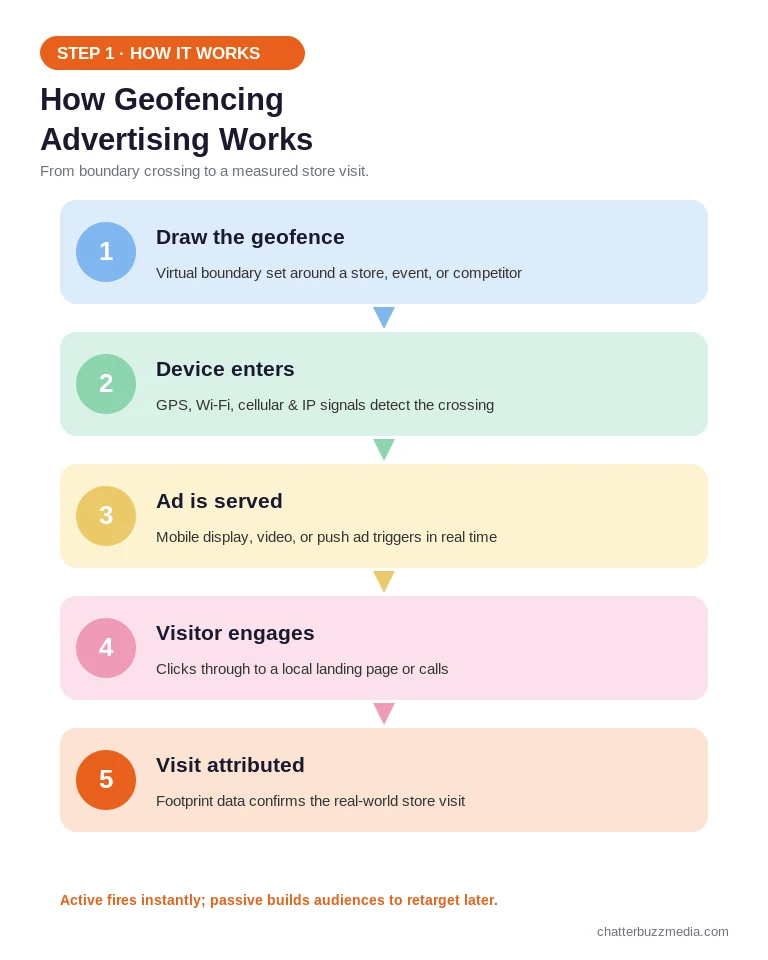
It works by combining GPS, Wi-Fi, cellular, and IP signals to detect a device inside a defined perimeter. That perimeter can sit around your own store, a competitor, an event, or any high-intent destination.
Location-based intent is powerful: Google found that 76% of people who search for something nearby visit a related business within a day. The difference from traditional advertising is intent. A billboard reaches everyone in range, while geofencing concentrates spend on people who are physically near a point of purchase — a group that tends to convert far better.
The category is growing fast for exactly this reason. The global geofencing market was valued at $3.22 billion in 2025 and is projected to reach $11.85 billion by 2034, a 14.8% annual growth rate.
There are two modes worth knowing. Active geofencing triggers an ad the moment a device crosses the boundary, while passive geofencing collects location data in the background and builds audiences you can retarget later.
Passive geofencing tends to gather richer behavioral data because it does not constantly ping the device for GPS, which drains battery and prompts users to revoke permissions. Most multi-location programs blend both — active for timely offers, passive for building durable audiences.
Because it ties a digital ad directly to physical behavior, geofencing pairs naturally with retargeting and other paid media. Before you can target well, though, you need to know how geofencing differs from the tactics it is often confused with.
Geofencing vs. Geotargeting vs. Geoconquesting
These three terms describe different mechanics, and mixing them up leads to wasted budget. Geofencing triggers on a real-time boundary crossing, geotargeting covers a broad area, and geoconquesting aims at your competitors.
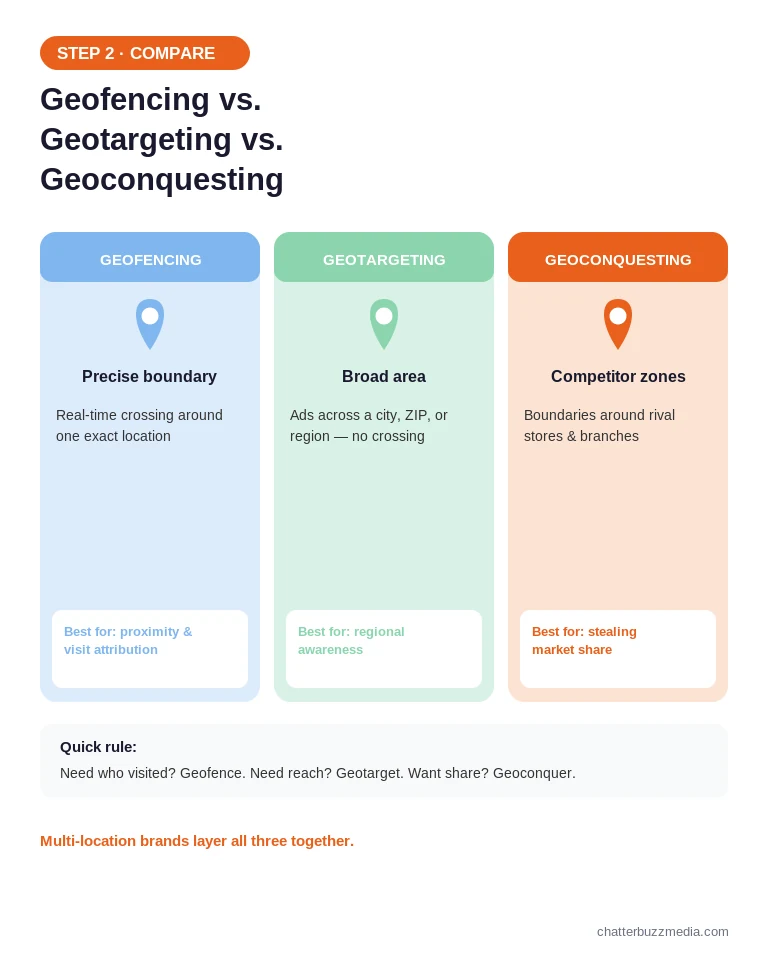
Geofencing draws a precise perimeter around a specific location and reacts the moment a device crosses it. It is built for proximity, timing, and visit attribution.
Geotargeting is broader — it delivers ads to anyone within a city, ZIP code, or region without requiring a boundary crossing. Use it for regional awareness, not precise foot-traffic plays.
Geoconquesting is geofencing pointed at competitor locations. You place boundaries around rival stores, branches, or clinics and serve ads that give nearby shoppers a reason to choose you instead.
A quick way to decide: if you need to know who physically visited, use geofencing; if you just need broad regional presence, geotargeting is cheaper; if you want to steal share, geoconquesting is the play.
For multi-location brands, the smart move is layering all three: geofences for high-intent proximity, geotargeting for regional reach, and geoconquesting to intercept competitor traffic. Which one performs depends heavily on the geofence type you choose next.
The Three Types of Geofences (and How to Pick a Radius)
There are three ways to build a geofence, and the one you choose determines your accuracy and cost. Radius circles are cheapest, isochrones are more realistic, and building footprints are the most precise.
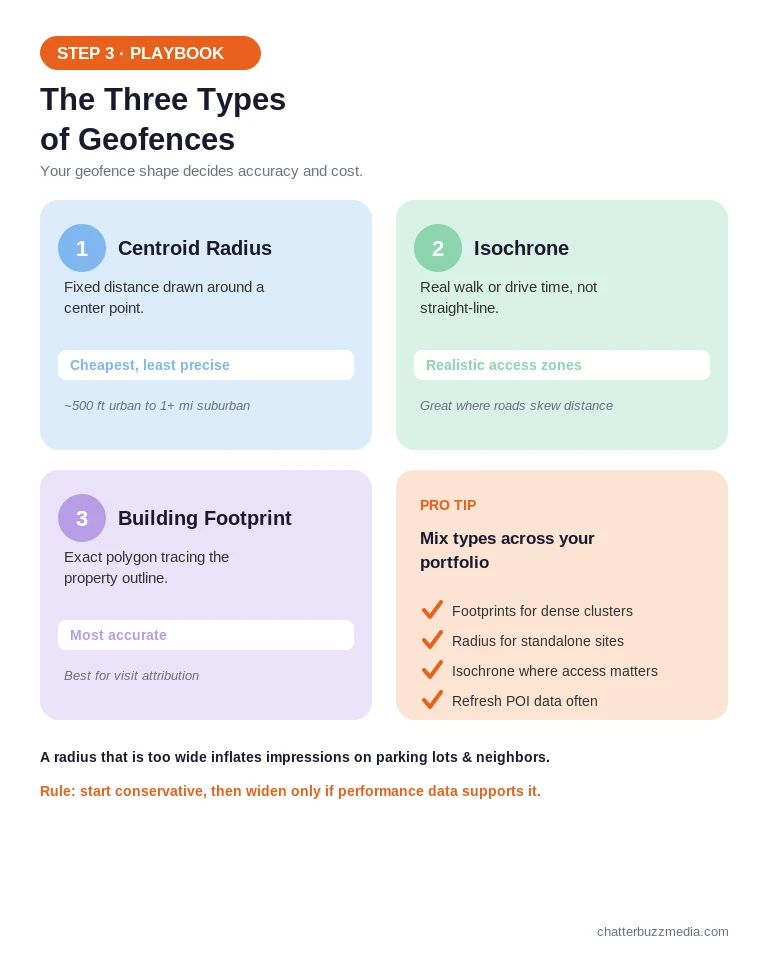
A centroid radius finds a location’s center point and draws a fixed distance in every direction. It is the simplest and least expensive, but a radius that is too wide picks up parking lots and neighboring businesses and inflates impressions.
An isochrone geofence measures actual walk or drive time instead of straight-line distance. This is more realistic in areas where highways, rivers, or one-way streets make distance a poor proxy for accessibility.
A building-footprint geofence traces the exact outline of a property, so it only counts people who truly entered. It is the preferred method for visit attribution in dense or mixed-use environments, because it corrects for the fact that few buildings are perfectly round.
Data freshness matters as much as the shape. A geofence built on outdated points-of-interest data will target a store that has moved or closed, quietly wasting spend on every impression.
Pro tip: combine types across a portfolio — footprints for dense clusters where precision protects your budget, and radius or isochrone zones for standalone suburban sites where reach matters more.
On radius size, start conservative — roughly 500 feet for dense urban storefronts up to a mile or more for suburban and big-box locations. Test and adjust against performance data rather than guessing, then move on to what all of this costs.
How Much Does Geofencing Advertising Cost?
Most geofencing advertising is priced on a CPM basis, commonly $5 to $15 per thousand impressions. For multi-location brands, a practical planning number is $300 to $800 per location per month, with managed programs often starting around $1,500 monthly.
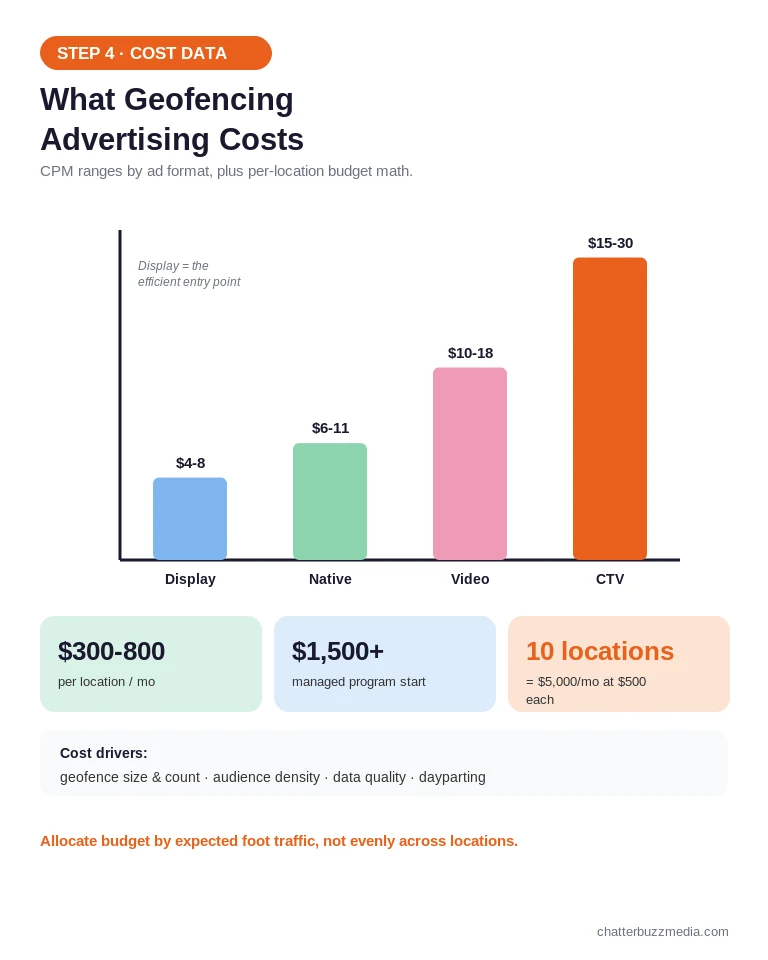
CPMs run higher than broad-reach display because the audience is more precisely targeted and the underlying location data adds cost. Premium formats like video and connected TV cost more than standard display.
Several factors move your cost up or down:
- Geofence size and count: more locations and larger areas increase impression volume and spend.
- Audience density: urban geofences generate far more impressions than rural ones.
- Data and platform quality: accurate location data reduces wasted spend on misattributed impressions.
- Duration and dayparting: running geofences only during relevant hours beats running them around the clock.
Here is the math that trips up multi-location planners: ten locations at a $500 monthly budget is $5,000 a month, but impression volume is not evenly split. Dense urban geofences will consume budget faster than rural ones, so allocate by expected foot traffic rather than splitting evenly.
Display is usually the most efficient entry point, especially when you are scaling across many locations. Ask any vendor exactly how their pricing works and what location data powers their targeting, because accuracy varies widely. With a budget framework in place, here is how to actually build the campaign across locations.
How to Launch a Multi-Location Geofencing Campaign
The multi-location advantage comes from building one strong template and scaling it, not creating every campaign from scratch. Standardize the structure, then customize the pieces that are genuinely local.
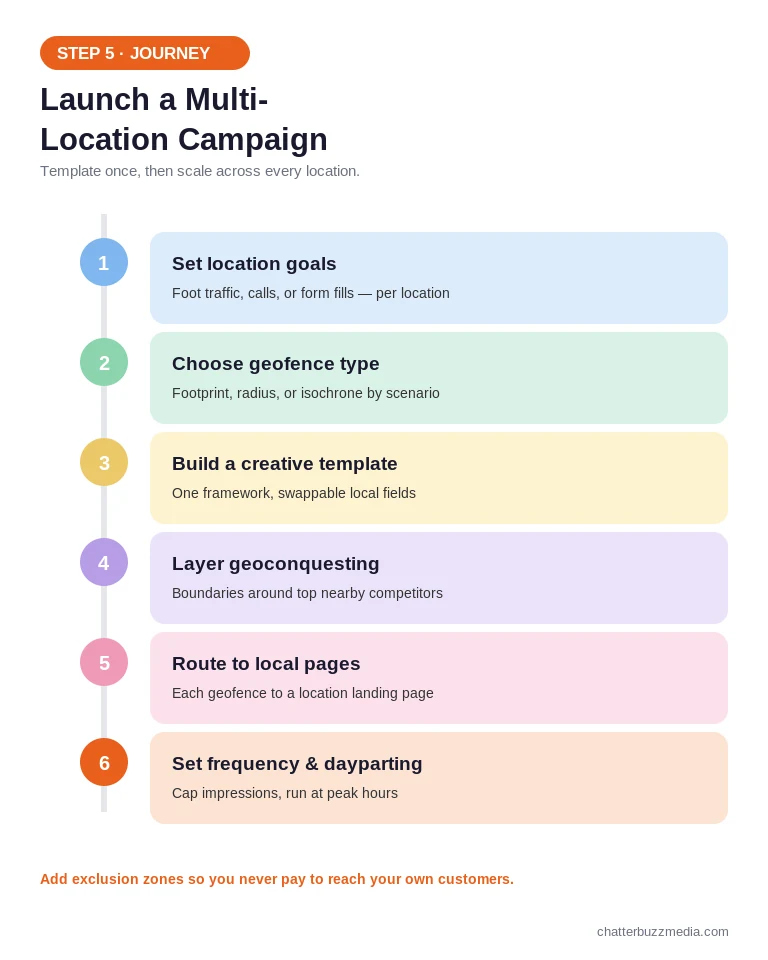
Follow this sequence to launch across many locations without the process collapsing into chaos:
- Step 1 — Set location-level goals: define what a win looks like per location (foot traffic, calls, form fills) before drawing a single boundary.
- Step 2 — Choose the geofence type per scenario: footprints for dense clusters, radius for standalone sites, isochrones where access matters more than distance.
- Step 3 — Build a creative template: one on-brand framework with swappable local fields for city, offer, and address.
- Step 4 — Layer geoconquesting: add boundaries around the strongest nearby competitors for each location.
- Step 5 — Route clicks to local landing pages: send each geofence to a location-specific landing page, not a generic homepage.
- Step 6 — Set frequency and dayparting: cap impressions and run during hours that match each location’s buying patterns.
Two moves separate mature programs from beginners. First, add exclusion zones so you stop paying to reach your own employees, existing customers, or overlapping geofences between nearby locations.
Second, rotate several creatives per location so the same person does not see one ad on repeat, which drives fatigue and rising costs. Refresh offers seasonally and by location so the message always feels current.
This template-and-scale model keeps your brand consistent while respecting the reality that a downtown branch and a suburban one behave differently. The approach also changes depending on your industry, which is where multi-location strategy gets specific.
Geofencing for Multi-Location Verticals
Geofencing looks different for a credit union than it does for a med spa or a home builder. The technology is the same, but the boundaries you draw and the timelines you run change with the buying cycle.
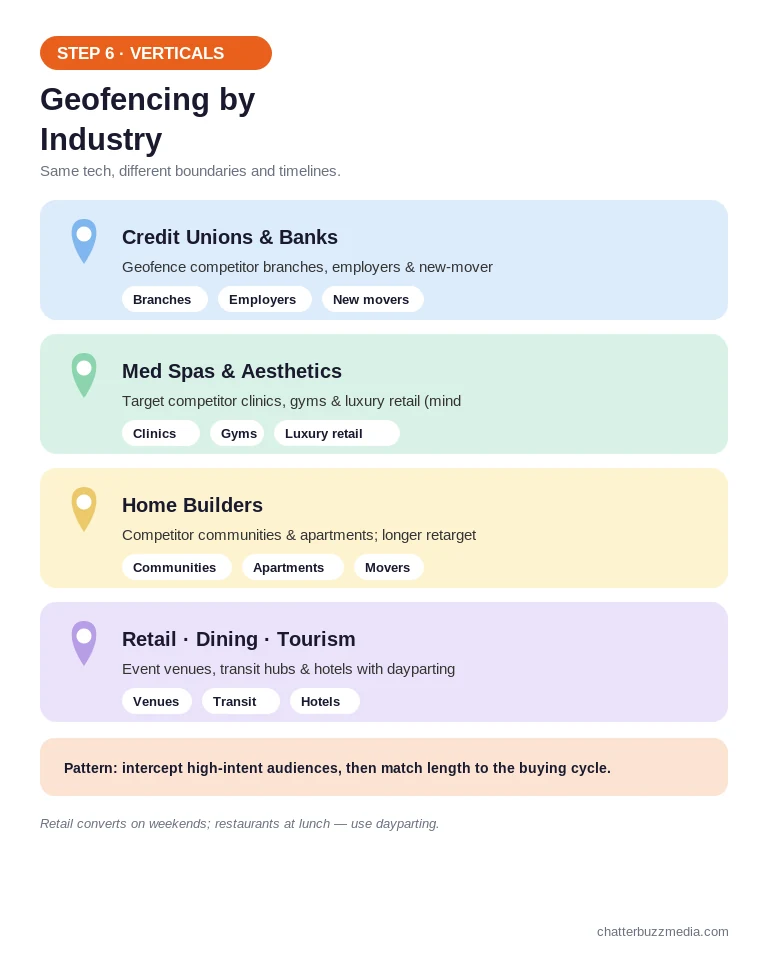
For credit unions and banks, geofence competitor branches, large employers, and new-mover hotspots to drive membership and account openings. Pair it with multi-location local SEO so the branch someone drives to also ranks when they search.
For med spas and multi-location aesthetic practices, geofence competitor clinics, gyms, and luxury retail to reach high-value clients, while keeping healthcare privacy rules front and center.
For home builders, geofence competitor communities, apartment complexes, and moving-related destinations, since leasing and buying decisions unfold over weeks and reward longer retargeting windows.
The same logic extends to retail, restaurants, and tourism brands with many locations. Geofence event venues, transit hubs, hotels, and competitor storefronts, then use dayparting to hit each audience when purchase intent peaks — lunch hours for restaurants, weekends for retail.
Across all three, the pattern holds: intercept high-intent audiences near competitor and lifestyle locations, then match the campaign length to the decision cycle. No matter the vertical, you have to measure results the right way.
Measure the Metrics That Prove ROI
Geofencing bridges digital targeting and physical outcomes, so measure both — not just clicks. The metric that decides whether a campaign gets renewed is almost always cost per real-world action.
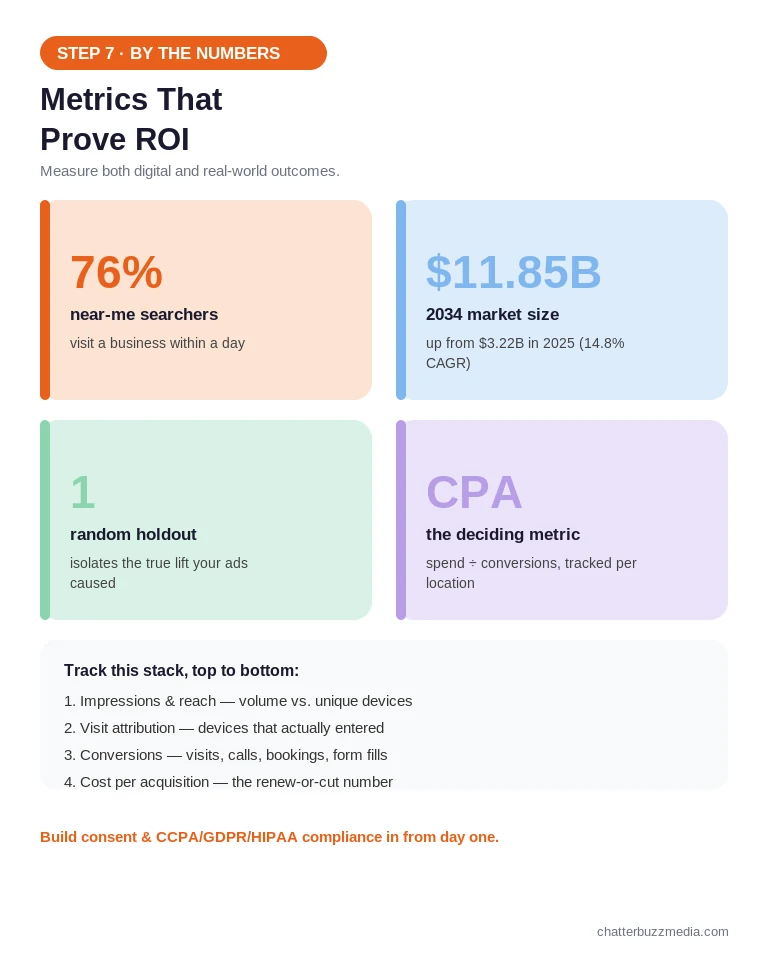
Track this stack from top to bottom:
- Impressions and reach: total ads served and unique devices reached, so you separate volume from frequency.
- Visit attribution: how many unique devices actually entered the location, strongest with building-footprint geofences.
- Conversions: the action you designed for — a visit, a call, a booking, or a form fill.
- Cost per acquisition: total spend divided by conversions, the number that proves or kills the program.
Tie these back to your site with disciplined tracking and conversion rate optimization so a foot-traffic lift is not lost between the ad and the sale. Server-side signals like the Conversions API keep attribution accurate as cookies decline.
To avoid over-crediting geofencing, run a holdout test: withhold ads from a random share of your audience and compare their visit rate to the exposed group. That isolates the true lift your campaign caused, rather than counting visits that would have happened anyway.
Benchmark cost per visit and cost per acquisition against your other channels each month, and cut or reallocate the locations that consistently lag. Geofencing should earn its budget location by location.
One caution before you scale: location data sits at the center of privacy law, so build consent and compliant data handling into every campaign from the start under rules like the California Consumer Privacy Act. Get the measurement and the compliance right, and geofencing becomes one of the most accountable lines in your paid media mix.
Frequently Asked Questions
1. 🔍 What is geofencing advertising?
Geofencing advertising is a location-based strategy that draws a virtual boundary around a physical place and serves ads to mobile devices that enter it. It targets people by real-world proximity to a location that signals intent, such as your store, an event, or a competitor.
2. 📊 How much does geofencing advertising cost?
Most campaigns are priced on a $5 to $15 CPM, and multi-location brands should plan roughly $300 to $800 per location per month. Cost depends on geofence size and count, audience density, data quality, and how premium the ad format is.
3. ⚡ Does geofencing advertising actually work?
Yes, when it is built on accurate location data and a sensible geofence size. Effectiveness drops sharply with oversized radii, outdated location data, or poor timing, so precision matters more than budget.
4. 🏦 What is the difference between geofencing and geotargeting?
Geofencing relies on a real-time boundary crossing around a specific location, while geotargeting delivers ads across a broad area like a city or ZIP code. Geofencing is for precise proximity and visit attribution; geotargeting is for regional awareness.
5. 🤝 What is geoconquesting?
Geoconquesting is geofencing aimed at competitor locations. You place boundaries around rival stores, branches, or clinics and serve ads that give nearby customers a reason to choose you, making it one of the highest-intent local plays available.
6. 💰 What geofence radius size should I use?
It depends on density and walkability. Dense urban storefronts often use radii around 500 feet, while suburban and big-box locations may use a mile or more — test and adjust based on performance rather than a fixed rule.
7. 🚀 Is geofencing advertising compliant with privacy laws?
It can be, provided you rely on anonymized or aggregated location data and honor consent under laws like CCPA and GDPR. Healthcare campaigns face additional HIPAA considerations, so involve legal counsel before combining location data with any patient information.
8. 📈 Which industries benefit most from geofencing?
Retail, restaurants, financial services and credit unions, med spas and healthcare, home builders, and multi-location service brands see the strongest results. Any business that depends on driving customers to physical locations is a strong fit.
Conclusion: Turn Foot Traffic Into Measurable Pipeline
Geofencing advertising rewards precision and structure, not raw spend. Multi-location brands that template their campaigns, choose the right geofence type, and measure real-world visits consistently outperform the ones that treat every store as a separate experiment.
Here is your action plan to put this guide to work:
- Pick your geofence type: match radius, isochrone, or building footprint to each location’s environment and goal.
- Template and scale: build one strong creative and campaign framework, then customize the local fields per location.
- Add geoconquesting: place boundaries around your strongest competitors to intercept high-intent traffic.
- Measure visits and CPA: track visit attribution and cost per acquisition, and build compliance in from day one.
For a deeper look at how location-based advertising fits a full-funnel plan, explore our local geofencing advertising resources and related marketing guides.

Victoria Wallace
Victoria Wallace is a senior content strategist and marketing writer with 30+ years of experience helping more than 200 brands translate complex business goals into clear, conversion-focused content. Her background spans paid media, marketing strategy, go-to-market planning, brand positioning, and full-funnel campaign development, giving her a deep understanding of how SEO content connects to real business growth.