
 321-236-2899
Google Ads for Manufacturers: How to Turn Industrial Search Into Qualified Pipeline
Most manufacturers who try Google Ads for manufacturers campaigns quit within four months. Not because paid search does not work in industrial markets, but because the account was built for e-commerce logic in a market that runs on RFQs, tolerances, and nine-month buying cycles.
This guide walks through the seven steps that separate industrial accounts generating real quote requests from the ones burning budget on students, job seekers, and hobbyists. Industrial search terms routinely carry costs per click well above general B2B averages, so structure matters more here than in almost any other vertical.
You will learn exactly how to feed Google purchase order data instead of form fills — the single change that stops smart bidding from chasing the wrong buyer. Start with how industrial search actually behaves, because every other decision depends on it.
Key Takeaways
- Industrial buyers search in five distinct stages, and roughly 70% of budget belongs in the last three where RFQ rates climb above 8%.
- Campaign structure should mirror capabilities, not product catalogs — one campaign per capability, one ad group per material or process.
- Your negative keyword list protects more budget than your bid strategy does. Launch with 60 to 100 negatives before spending a dollar.
- Optimizing to raw form fills teaches Google to find form-fillers, not purchase orders. Offline conversion import fixes this.
- Cost per PO — not cost per click — is the number that survives a conversation with a CFO, and it should land under 12% of average order value.
Step 1: Map How Industrial Buyers Actually Search
Industrial buyers do not search the way consumers do, and they do not search the same way twice. A maintenance engineer diagnosing a failure and a procurement manager sourcing a second supplier type completely different queries, and only one of them is close to issuing an RFQ.
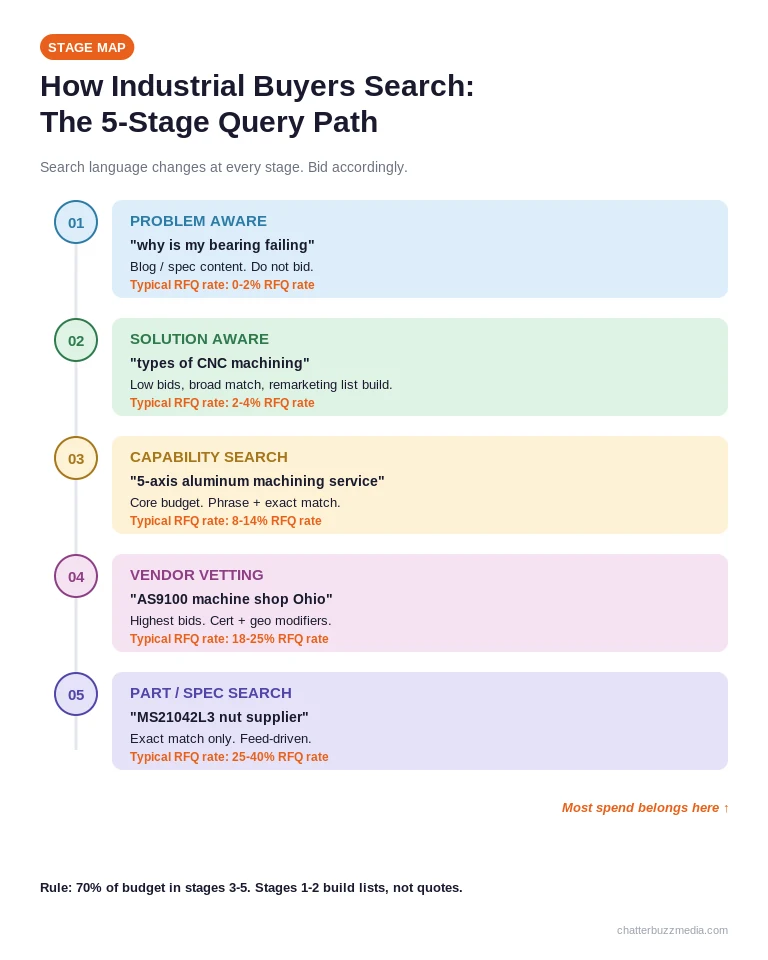
This matters because Google charges you the same rate whether a click comes from a student or a sourcing director. The difference in outcome is enormous, and the only lever you control is which stage of query you bid on.
Map your keyword set against these five stages before you build anything:
- Problem-aware queries like “why is my bearing failing” belong in content marketing for manufacturing, not paid search.
- Solution-aware queries such as “types of CNC machining” are worth low bids purely to build remarketing lists.
- Capability searches like “5-axis aluminum machining service” are where your core budget belongs.
- Vendor vetting searches that include certifications or geography convert at two to three times the capability rate.
- Part number and spec searches convert highest of all and should run on exact match only.
The practical test is simple: read the query out loud and ask whether the person typing it has a drawing on their desk. If they do not, that click will not become a quote.
There is a second dimension most accounts ignore entirely: who inside the buying organization is typing. A design engineer searching “tolerance capability” and a purchasing agent searching “second source supplier” are on the same account team but months apart in the process.
Engineers search early and search technically. They want specs, materials, and capability limits, and they rarely fill out an RFQ form on the first visit.
Procurement searches late and searches commercially. Certifications, geography, capacity, and lead time dominate their queries, and they convert quickly because the technical evaluation already happened.
Build separate ad copy for both. The same landing page can serve them if it leads with specs and closes with commercial terms, but the ads should speak different languages. This is the same segmentation logic behind any well-built B2B demand generation program.
Getting the stage map right means your budget lands where buyers are already holding specifications. Next, that map has to become an actual account structure.
Step 2: Structure Campaigns Around Capabilities, Not Products
The correct structure for a manufacturing account is one campaign per capability, with ad groups split by material, process, or industry served. Product-catalog structures fail because industrial buyers search for what a shop can do, not for a part number in your ERP.
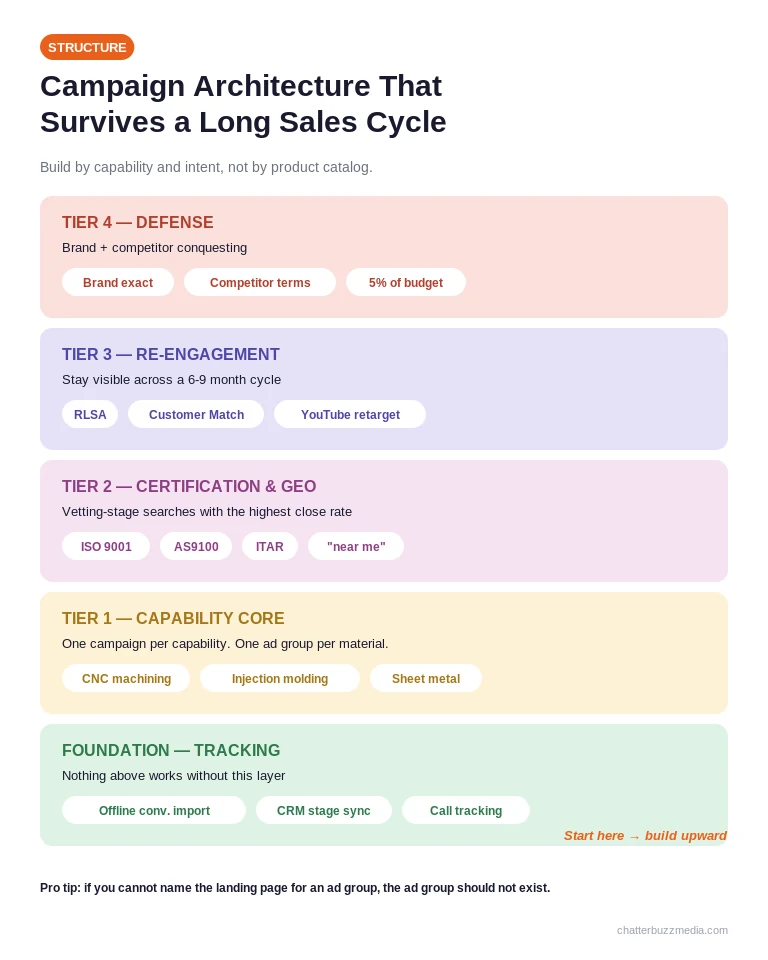
Structure is not administrative housekeeping. It determines whether you can see which capability is profitable and which one is subsidizing the rest of the account.
Build the account in four tiers plus a tracking foundation:
- Tier 1 — Capability core. Roughly 45% of budget. If you cannot name the landing page for an ad group, that ad group should not exist.
- Tier 2 — Certification and geography. ISO 9001, AS9100, ITAR, NADCAP, and “near me” modifiers. Highest close rates in the account.
- Tier 3 — Re-engagement. RLSA, Customer Match, and YouTube retargeting keep you visible across a cycle measured in quarters, not days.
- Tier 4 — Brand defense. A small allocation that stops competitors from buying your name in front of buyers who already chose you.
Geography deserves more thought than most accounts give it. A shop that ships nationally still closes at a much higher rate within a day’s freight radius, because buyers value site visits and short lead times more than they admit in a survey.
Run a tighter radius campaign at higher bids and a national campaign at lower bids, then compare quote-to-PO rates after two quarters. Most manufacturers find their close rate inside 300 miles is double the national figure, which changes how the budget should be split.
Avoid Smart Campaigns entirely. They hide the search terms report, and in industrial search that report is where the entire optimization job lives.
Skip Performance Max at launch too, unless you have a clean product feed and at least 90 days of value-scored conversion data behind it. Google’s own guidance on Performance Max assumes conversion volume most industrial accounts do not have in month one.
A clean structure gives you visibility. Filling it with the right terms is what makes it profitable, which is where most industrial accounts go wrong.
Step 3: Build a Keyword Set That Filters Out Tire-Kickers
In industrial PPC, your negative keyword list is more valuable than your positive one. A single unblocked term like “jobs” or “how to” can absorb a quarter of a monthly budget before anyone notices in a weekly report.
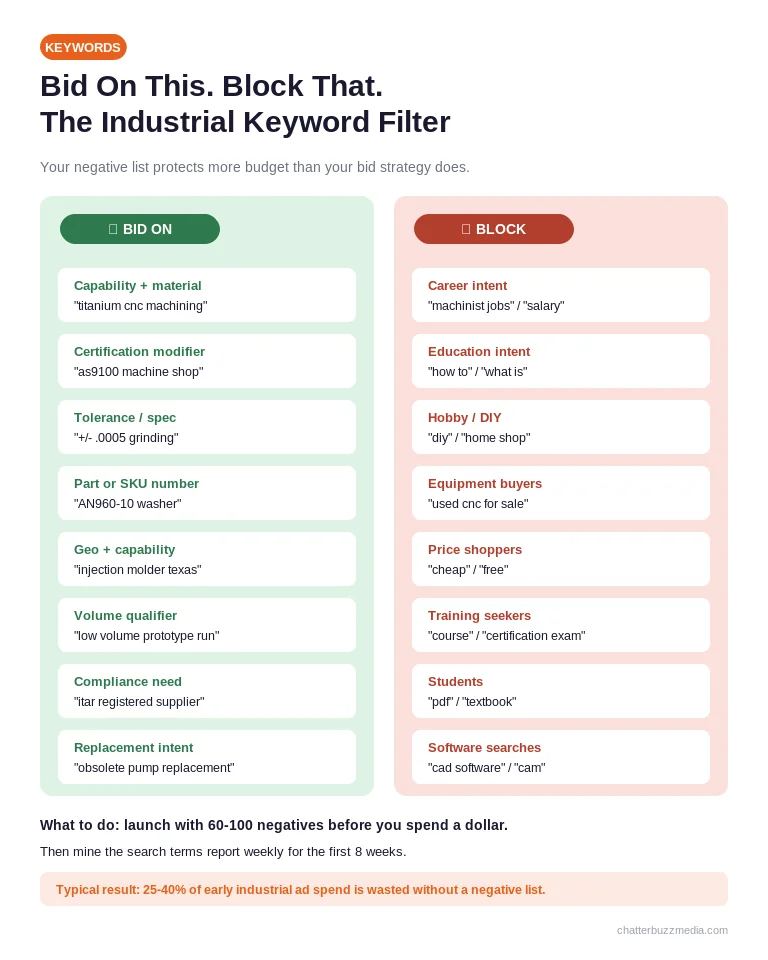
The reason is structural. Manufacturing terms carry heavy informational search intent from students, job seekers, and hobbyists who look exactly like buyers to a broad match algorithm.
Here is how to build a keyword set that filters correctly:
- Lead with phrase and exact match. Broad match belongs in a separate, small-budget discovery campaign — never in your core capability campaigns.
- Layer specificity modifiers. Material, tolerance, certification, volume, and geography all raise intent and lower wasted spend.
- Bid on part numbers and legacy SKUs. These are the highest-converting terms in industrial search and almost nobody competes for them.
- Launch with 60 to 100 negatives. Career terms, education terms, DIY terms, used-equipment terms, and software terms are the five categories that cause the most damage.
- Mine the search terms report weekly for the first eight weeks, then biweekly after that.
One overlooked tactic: add your own job titles and hiring pages as negatives. Manufacturers with active recruiting pages frequently pay for clicks from applicants who found the careers page through an ad meant for procurement.
A tight keyword set means the clicks you buy are from people with specifications. Now the question becomes how much to pay for them.
Step 4: Set Budgets and Bidding for a Nine-Month Cycle
Manufacturing accounts should start on manual CPC or Maximize Clicks with a bid cap, then move to value-based bidding only after 30 or more value-scored conversions are flowing. Automated bidding applied too early is the most common cause of failed industrial campaigns.
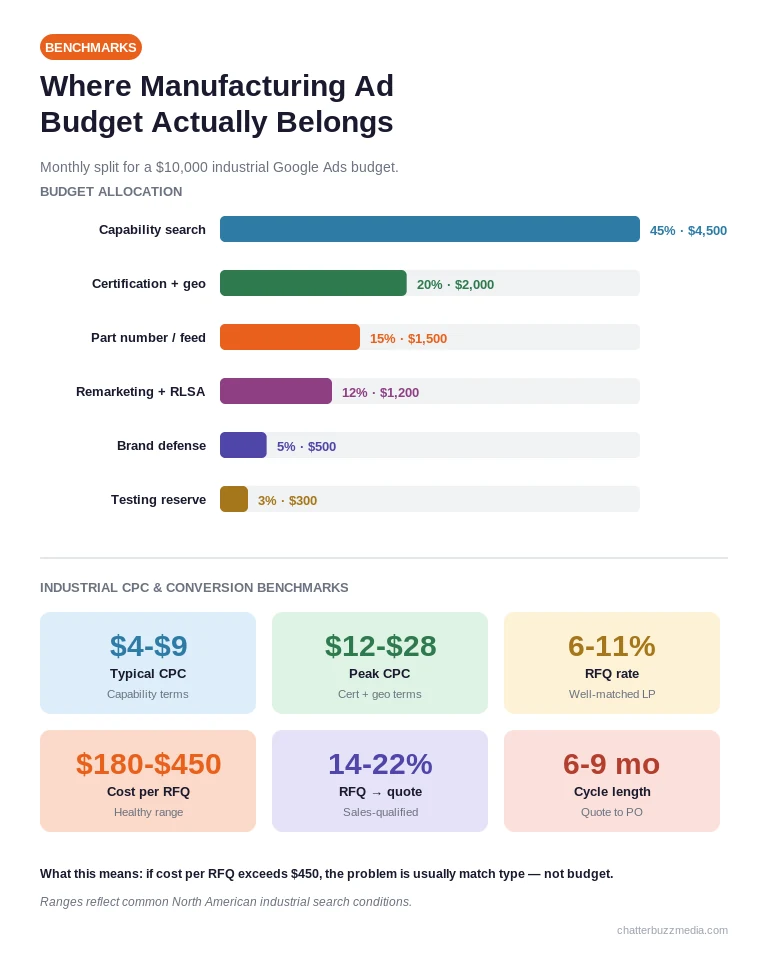
The problem is data density. Smart bidding needs conversion volume to learn, and a shop generating 15 RFQs a month cannot feed an algorithm designed for accounts generating 500.
Use these rules to set budget and bidding:
- Allocate 45% to capability search and 20% to certification and geography. These two tiers produce the majority of quotable RFQs.
- Reserve 12% for remarketing. With a cycle running six to nine months, staying visible during evaluation is not optional.
- Hold 3% as a testing reserve for new capabilities, new geographies, or seasonal demand.
- Set your attribution window to 90 days minimum. The default 30-day window will systematically undercount industrial conversions.
- Judge performance on 90-day windows, not 30. Monthly reviews in a nine-month cycle produce panic decisions.
If your cost per RFQ climbs above roughly $450, the problem is almost always match type or landing page relevance rather than budget size. Adding money to a leaking account makes the leak bigger. This is the same discipline that governs any well-run digital marketing budget.
Budget discipline gets buyers to your site at a defensible cost. What they find when they land there determines whether any of it converts.
Step 5: Build Landing Pages Engineers Actually Trust
A manufacturing landing page converts when it answers the two questions every industrial buyer asks first: can you hold this tolerance, and how fast can you deliver. Everything else on the page is secondary.
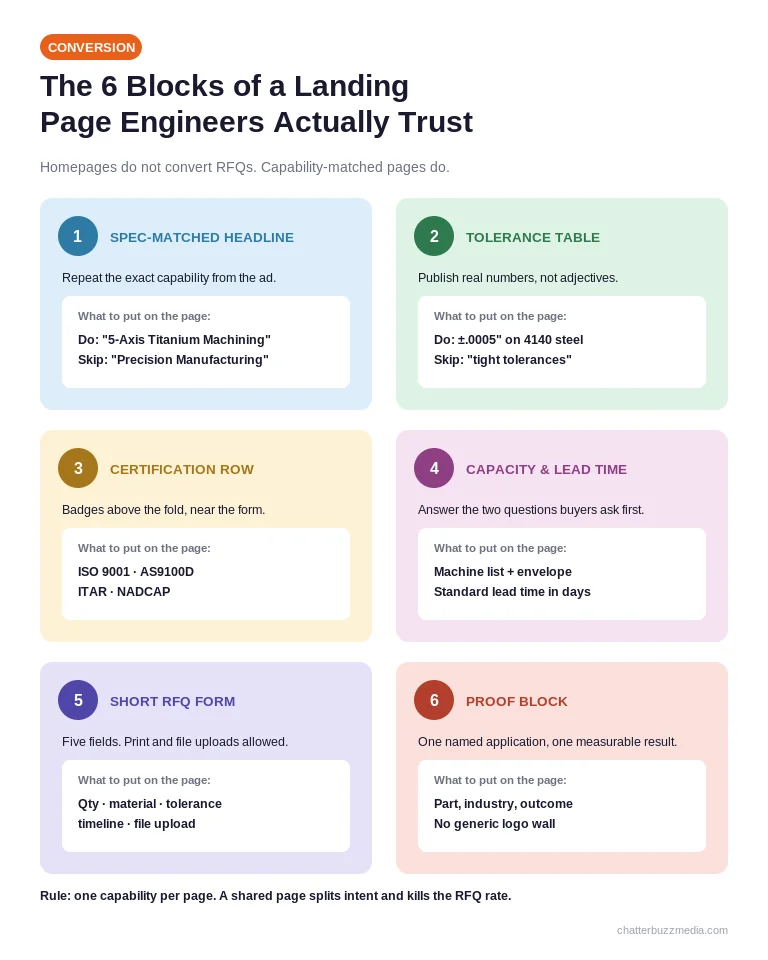
Sending paid industrial traffic to a homepage is the fastest way to waste a well-built campaign. Homepages are written for brand impression; engineers are looking for numbers.
Six blocks belong on every capability landing page:
- A spec-matched headline that repeats the exact capability from the ad. “5-Axis Titanium Machining” beats “Precision Manufacturing” every time.
- A tolerance table with real figures. Publishing ±.0005″ on 4140 steel builds more trust than any adjective.
- A certification row placed above the fold and near the form, not buried in a footer.
- Capacity and lead time including machine list, work envelope, and standard turnaround in days.
- A five-field RFQ form that accepts print and CAD file uploads. Quantity, material, tolerance, timeline, file.
- A proof block naming one real application and one measurable result — not a wall of unexplained logos.
Keep one capability per page. A shared page splits intent, dilutes the message, and reliably cuts RFQ rate in half. The broader principles behind this are covered well in the elements that make a landing page convert and in this breakdown of PPC landing page design.
File upload capability deserves special mention. Requiring a buyer to email a print separately after submitting a form adds a step that costs a meaningful share of otherwise qualified RFQs.
Response time is the other half of conversion that lives outside the page. Industrial buyers routinely contact three to five suppliers in a single afternoon, and the first substantive reply frames the entire evaluation.
Set an internal standard of a real human response within four business hours — not an autoresponder. Shops that hit that standard consistently report meaningfully higher quote rates from identical traffic, which means the fix costs nothing in ad spend.
Testing matters here too. Small changes to form length, certification placement, and headline specificity produce outsized swings, which is why conversion rate optimization often beats additional ad budget as a next investment. A well-structured manufacturing website makes each of these pages faster to build.
Good landing pages produce RFQs. But an RFQ is not a sale, and treating it like one is what breaks the next stage.
Step 6: Feed Google Real Revenue With Offline Conversion Import
Offline conversion import sends closed-loop revenue data back into Google Ads, letting the algorithm optimize toward purchase orders rather than form submissions. For manufacturers, this is the highest-leverage change available in the entire account.
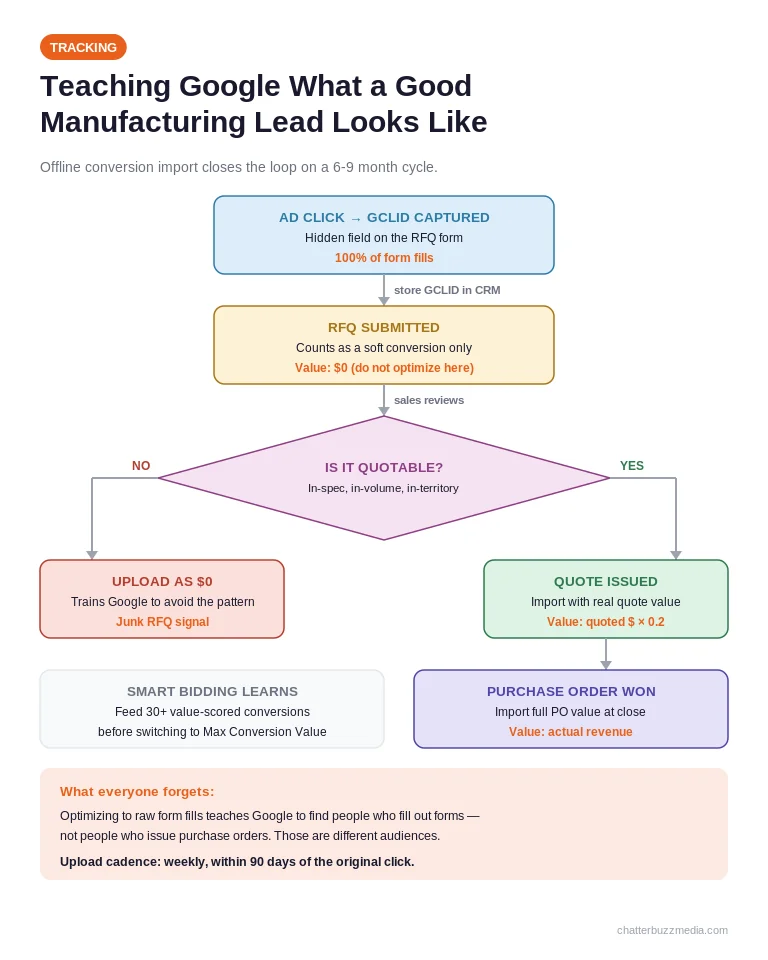
The reason is uncomfortable but simple. Optimizing to raw form fills teaches Google to find people who fill out forms, and people who fill out forms are a different population than people who issue purchase orders.
Implement it in this sequence:
- Capture the GCLID in a hidden field on every RFQ form and store it against the record in your CRM.
- Count the RFQ as a soft conversion with $0 value. Do not let smart bidding optimize to this event.
- Score the RFQ against three filters — in-spec, in-volume, in-territory — and upload unquotable leads at $0 so the algorithm learns the pattern to avoid.
- Upload quoted opportunities at roughly 20% of quote value, reflecting typical quote-to-PO conversion.
- Upload won POs at full revenue value when the order closes.
Upload weekly, and always within 90 days of the original click — Google’s offline conversion import documentation enforces that window. Anything later is discarded.
This requires your CRM and ad account to actually talk to each other, which is why CRM discipline is a prerequisite rather than a nice-to-have. Shops without a functioning CRM should fix that before spending on paid search.
The organizational obstacle is usually bigger than the technical one. Sales teams have to consistently mark opportunities as quoted or lost with a reason code, and that habit takes a quarter to establish.
Start with a single field: quotable yes or no, with a dropdown reason when the answer is no. That one field alone gives you enough signal to upload $0 values for junk RFQs and start reshaping who the algorithm targets.
The same closed-loop principle drives improvements on paid social, where server-side conversion tracking solves an equivalent problem. Manufacturers running both channels should implement them together rather than sequentially.
Once revenue data flows back into the account, you can finally measure the thing that matters. That measurement framework is the last piece.
Step 7: Measure RFQ-to-PO, Not Clicks
The only manufacturing PPC report worth building tracks six numbers, ending in cost per purchase order. Click-through rate and impression share are diagnostic details, not results.
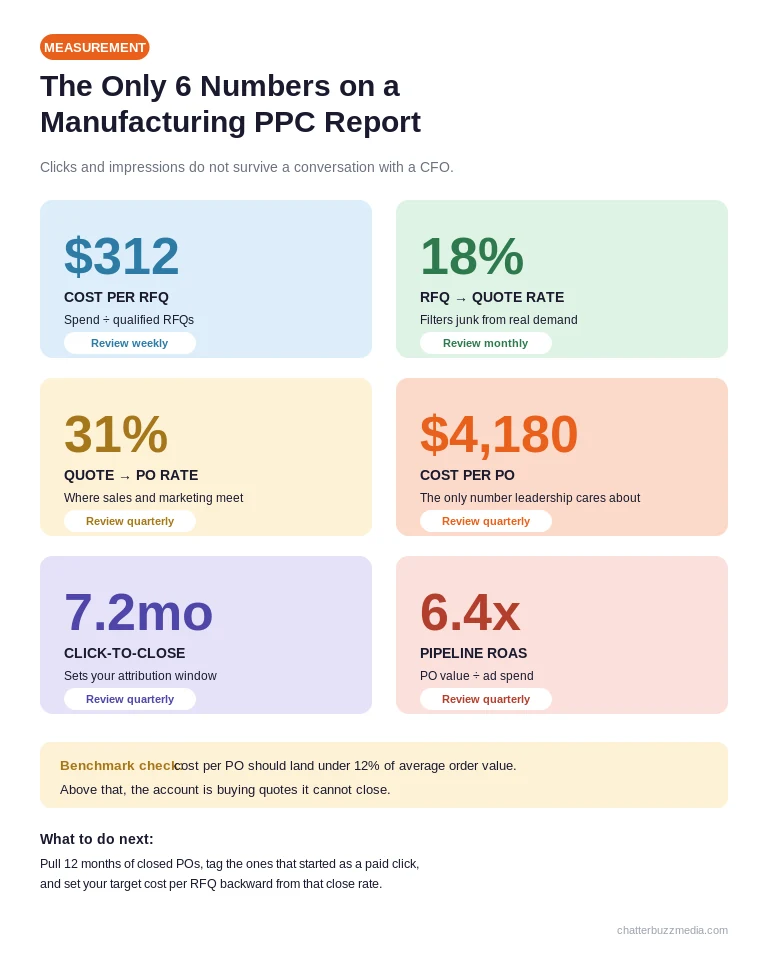
Reporting on clicks is how marketing loses budget arguments. Reporting on cost per PO is how it wins them.
Build the report around these six figures:
- Cost per RFQ — spend divided by qualified requests. Review weekly.
- RFQ-to-quote rate — the cleanest signal of traffic quality, since it reflects sales’ own judgment.
- Quote-to-PO rate — where marketing performance and sales performance become inseparable.
- Cost per PO — the single number leadership will actually act on.
- Click-to-close time — sets your attribution window and your patience level.
- Pipeline ROAS — closed PO value divided by ad spend.
Use one benchmark to sanity-check the whole account: cost per PO should land under roughly 12% of average order value. Above that, the account is buying quotes it cannot close.
To set targets, pull 12 months of closed purchase orders, tag the ones that originated as a paid click, and work backward to a defensible cost per RFQ. That exercise usually reveals that the account should be spending more on two capabilities and nothing at all on three others. The same measurement logic applies across manufacturing marketing strategy generally, and pairs well with an account-based approach for named target accounts.
With all seven steps in place, paid search stops being an expense line and becomes a forecastable pipeline source.
Frequently Asked Questions
1. 🔍 How much should a manufacturer budget for Google Ads?
Most industrial accounts need $5,000 to $15,000 per month to generate statistically meaningful data across two or three capabilities. Below roughly $3,000 monthly, there is not enough volume to optimize, and the account will look random for a year.
2. 📊 How long before Google Ads works for a manufacturer?
Expect 60 to 90 days for the account to stabilize and produce reliable RFQ data. Because industrial cycles run six to nine months, the first attributable purchase orders typically appear in month seven or later. Ramp timelines vary by market, but industrial is consistently on the slow end.
3. ⚡ Should manufacturers use Performance Max?
Not at launch. Performance Max needs a clean product feed and dense conversion data, and it hides the search terms report that industrial optimization depends on. Consider it after 90 days of value-scored conversions are flowing through offline import.
4. 🏦 Is SEO or PPC better for manufacturers?
They solve different problems. Paid search produces RFQs in weeks; organic builds compounding visibility on the technical and capability queries that make up most industrial search volume. Running both is standard, and the tradeoffs between SEO and PPC shift as an account matures. Long-term, manufacturing SEO lowers blended cost per lead.
5. 🤝 How do we handle distributor channel conflict in paid search?
Decide upfront whether ads route to your site or your distributors’. The common approach is to run capability and brand campaigns direct while using geo-targeted campaigns that surface the nearest authorized distributor, keeping the RFQ in the channel where it belongs.
6. 💰 Why is our cost per lead so high on industrial keywords?
Usually match type. Broad match on capability terms pulls in students, job seekers, and hobbyists at full price. Tightening to phrase and exact, plus a real negative list, typically cuts cost per qualified RFQ by 30% to 50% within two months.
7. 🚀 Should we bid on part numbers and competitor SKUs?
Bid on your own part numbers and legacy SKUs — they are the highest-intent, lowest-competition terms available. Competitor SKUs are legal to bid on but require careful ad copy, since you cannot use a competitor’s trademark in the ad text itself.
8. 📈 What conversion rate should a manufacturing landing page hit?
A well-matched capability landing page should convert 6% to 11% of paid clicks into RFQs. If you are below 4%, the issue is almost always message mismatch between ad and page, or a form that asks for too much before the buyer has any reason to trust you.
Turning Industrial Search Into Real Pipeline
Google Ads works for manufacturers when the account is built around how industrial buyers actually behave — long cycles, technical validation, and multiple stakeholders. It fails when it is built around clicks.
The seven steps above compound: stage mapping determines structure, structure determines keyword quality, keyword quality determines landing page relevance, and offline conversion data determines whether the algorithm learns anything useful.
Your four-step action plan:
- Audit your search terms report from the last 90 days and build a negative keyword list of at least 60 terms this week.
- Rebuild campaigns by capability, with one dedicated landing page per capability and no shared pages.
- Add GCLID capture to every RFQ form and connect your CRM so quote and PO values can flow back into Google Ads.
- Rebuild your report around cost per PO and set a target at 12% or less of average order value.
If you want the broader context that sits around paid search — demand generation, website structure, and lead handling — the manufacturing lead generation guide covers how these pieces fit together, and the full resource library goes deeper on each channel.

Victoria Wallace
Victoria Wallace is a senior content strategist and marketing writer with 30+ years of experience helping more than 200 brands translate complex business goals into clear, conversion-focused content. Her background spans paid media, marketing strategy, go-to-market planning, brand positioning, and full-funnel campaign development, giving her a deep understanding of how SEO content connects to real business growth.