
 321-236-2899
Marketing Audit Checklist: Turn Findings Into Strategy

Most marketing audits end up in a drawer. You spend two weeks pulling reports, fill in a 100-row spreadsheet, tick every box, and then… nothing changes. The audit becomes a compliance exercise instead of a decision-making tool.
This guide fixes that. It walks through a five-step marketing audit methodology that turns raw data into a prioritized action plan your team will actually execute. Over the years, the audits that moved the needle for growing companies all shared one trait: they scored findings against real benchmarks and ranked fixes by impact, not by whatever felt urgent that week.
By the end, you’ll have a complete marketing audit checklist, a scoring rubric, an impact–effort matrix for prioritizing what to fix first, and a 90-day plan to roll it out. Let’s start with why so many audits fail.
Key Takeaways
- A marketing audit is a decision tool, not a checklist. Its job is to change what you fund next quarter, not to document what you already do.
- Scope first. Define the questions the audit must answer before you touch a single report, or you’ll drown in data.
- Score against benchmarks. A finding only matters when you compare it to a target, a competitor, or your own trend line.
- Prioritize with impact vs. effort. Rank every finding on a 2×2 matrix so quick wins ship first and big bets get planned.
- End with an action plan, not a report. Every finding needs an owner, a due date, and a metric it’s expected to move.
- Re-audit on a cadence. Quarterly channel checks plus one deep annual audit keeps strategy current.
What a Marketing Audit Really Is: Strategy vs. Box-Checking
A marketing audit is a systematic review of your strategy, channels, assets, data, and technology to decide where to invest next. The keyword is decide. An audit that only inventories what exists is a status report, not an audit.
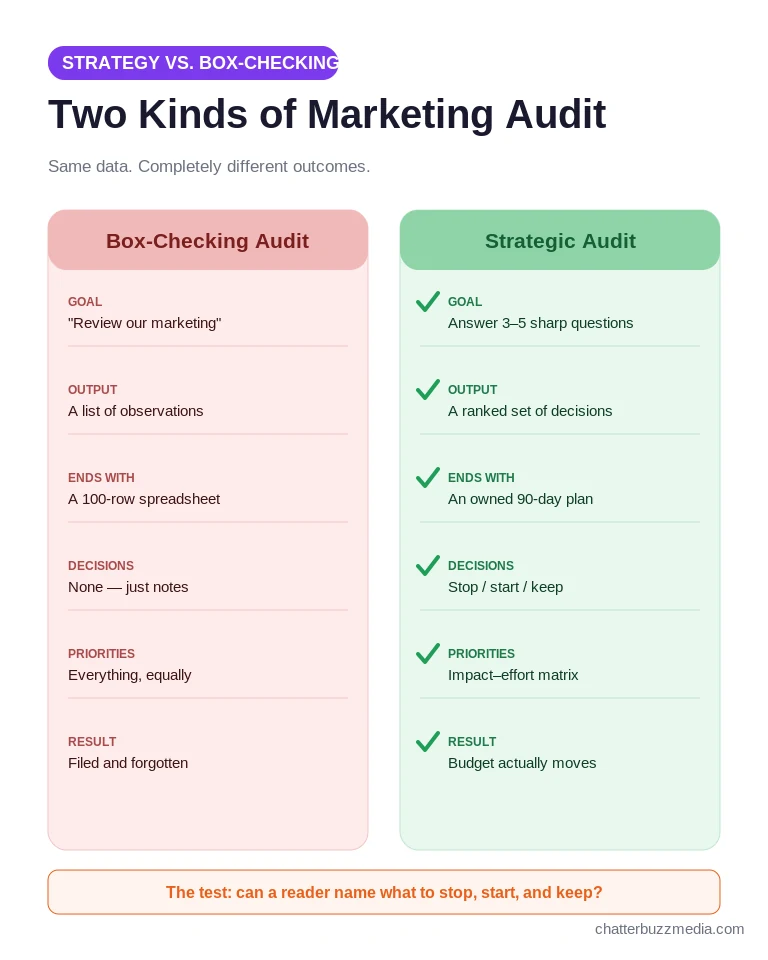
The difference between a box-checking audit and a strategic one shows up in the output. A box-checking audit produces a list of observations: “email open rate is 18%, we post three times a week, the blog has 200 posts.” A strategic audit produces decisions: “shift 20% of paid social budget to search because search leads close at triple the rate.”
The trap is thoroughness for its own sake. Teams confuse a long checklist with a good audit, then run out of energy before the analysis that actually matters. The best audits are ruthless about scope and generous about interpretation.
Here’s the test for whether your audit is strategic: can someone read the final page and know what to stop, start, and keep doing? If not, you have a document, not a diagnosis. The five steps below are built to force that clarity, and they map cleanly onto any cross-channel marketing plan.
Step 1: Set the Scope and the Questions That Matter
Start by deciding what the audit must answer, not what it must cover. Scope is the single biggest predictor of whether an audit gets used, because a tight scope keeps you focused on decisions instead of trivia.
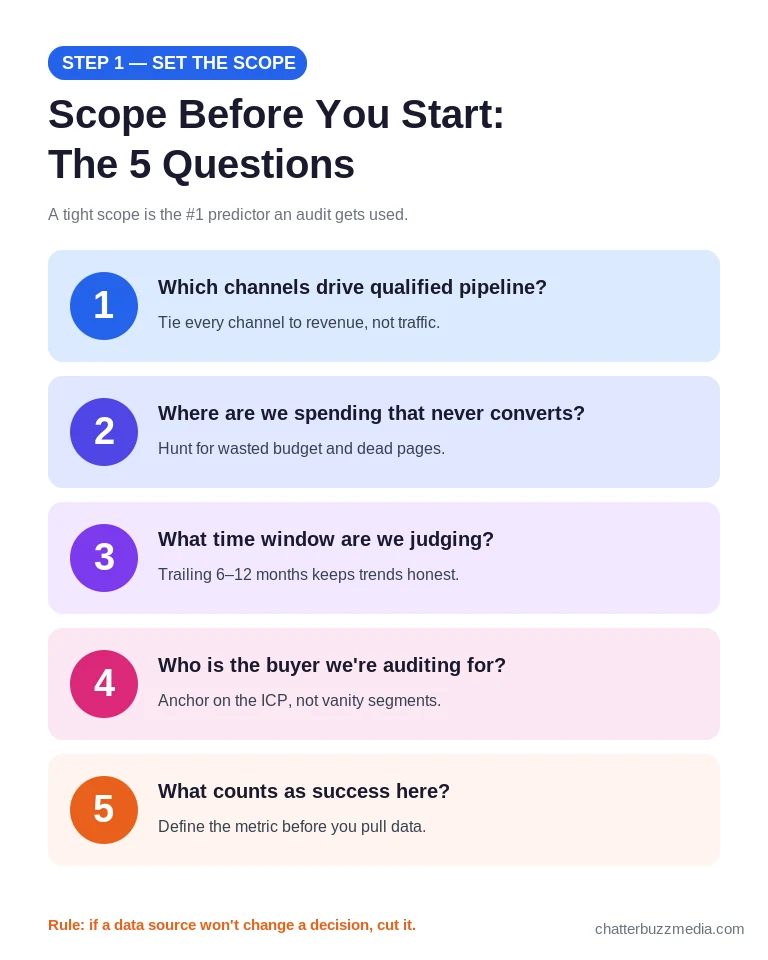
Write down three to five questions the audit exists to answer. Good questions sound like: “Which channels are actually driving qualified pipeline?” or “Where are we spending money that never converts?” Vague goals like “review our marketing” produce vague audits.
Next, set the boundaries. Decide the time window (usually the trailing 6 to 12 months), the channels in scope, and the metrics that count as success. Anchoring on your ideal customer profile keeps the audit tied to the buyers who matter rather than vanity traffic.
Finally, gather your inputs before you analyze. Pull access to analytics, ad platforms, your CRM, and email tools, and collect existing goals and budgets. A quick scoping conversation with sales and leadership surfaces the questions they’ll expect the audit to answer.
Rule: if a data source won’t change a decision, leave it out of scope. You can always run a focused follow-up audit later.
Step 2: Work Through the Marketing Audit Checklist (by Channel)
With scope locked, collect data channel by channel so nothing important slips through. This is the core marketing audit checklist, and treating each channel as its own module keeps the review consistent and comparable.
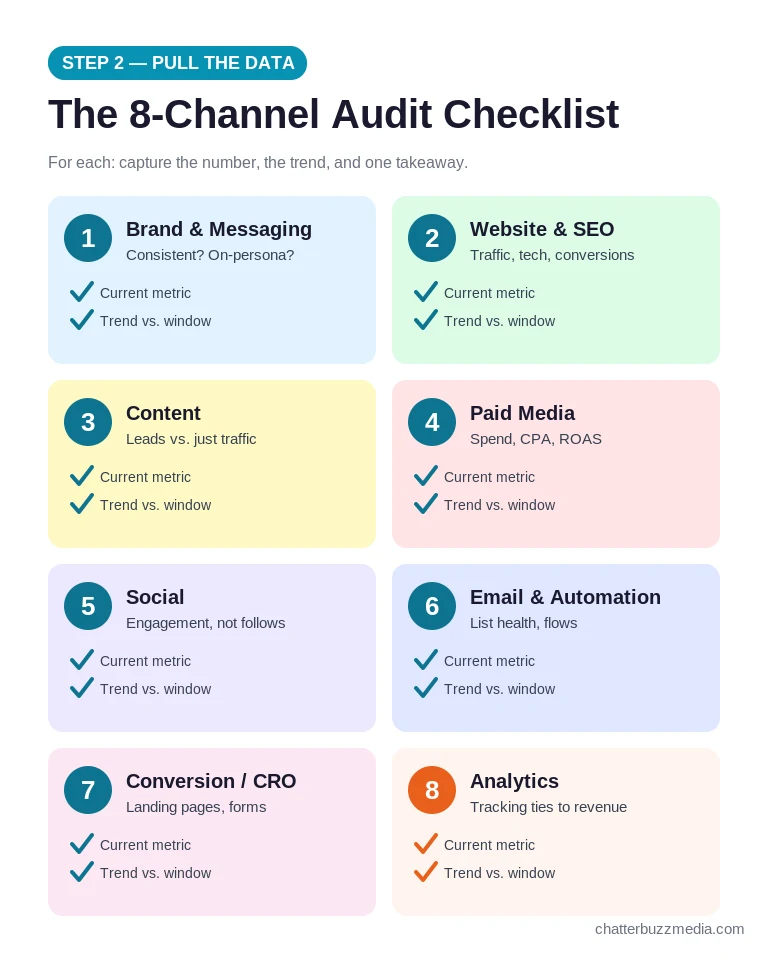
For each area below, capture the current numbers, the trend over your time window, and one sentence on what the data suggests. Don’t fix anything yet; collection and judgment are separate steps for a reason.
- Brand and messaging: Is positioning consistent across your site, ads, and social? Does the messaging map to a real buyer persona, or is it generic?
- Website and SEO: Review organic traffic, top landing pages, technical health, and conversion paths. A quick technical SEO pass catches crawl and speed issues that quietly cap growth.
- Content: Which pages drive leads versus just traffic? Map assets to funnel stages and flag thin or outdated posts, guided by your SEO content strategy.
- Paid media: Check spend, cost per acquisition, and return by platform. A structured Google Ads audit almost always surfaces wasted budget in the first hour.
- Social media: Look past follower counts to engagement and referral traffic that actually converts.
- Email and automation: Audit list health, open and click rates, segmentation, and whether your automation workflows nurture or annoy.
- Conversion and CRO: Study your key landing pages and forms. Small friction points are why good ads still fail to convert.
- Analytics and reporting: Confirm tracking is accurate and that your KPIs tie to revenue, not activity.
Keep every finding in one shared sheet with a column for the source. That single source of truth is what makes the next two steps fast instead of painful.
Step 3: Score Every Area Against Real Benchmarks
A number means nothing until you compare it to something. Scoring turns your raw data into judgment by rating each area against a target, a competitor, or your own historical trend.
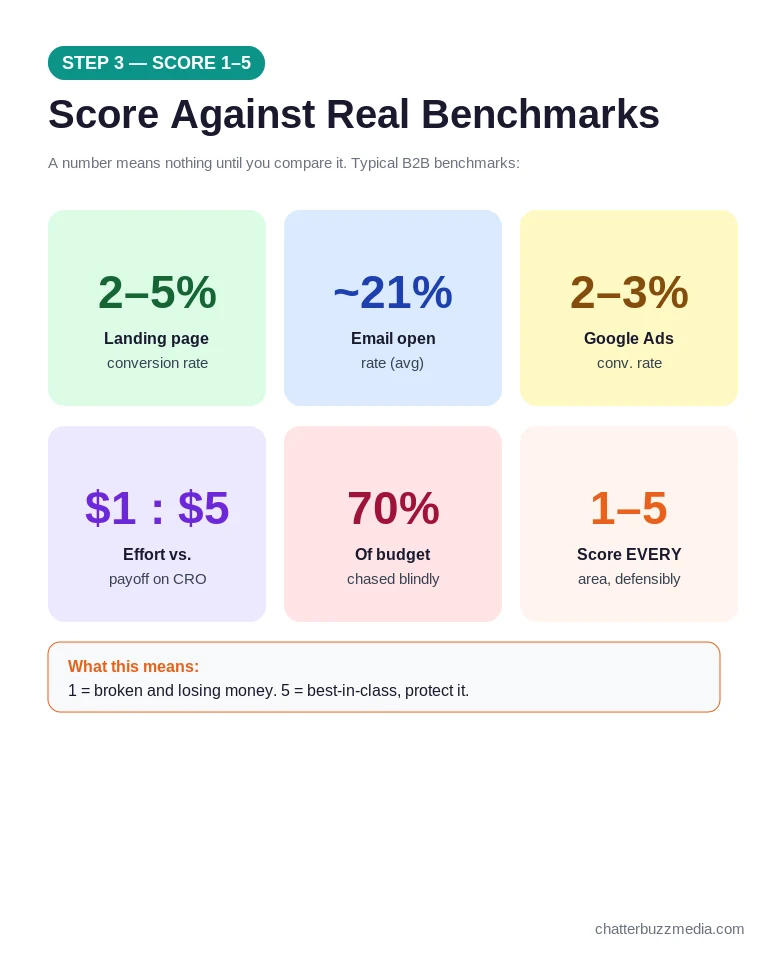
Use a simple 1-to-5 scale for each checklist area: 1 means “broken, losing money,” 5 means “best-in-class, protect it.” Force yourself to justify each score with one data point so the rating is defensible in a leadership meeting.
Compare against three reference points. First, your own goals and prior periods. Second, published industry benchmarks, like the conversion-rate and cost-per-lead figures in WordStream’s advertising benchmarks. Third, competitors, using visible signals like their content cadence and ad presence.
According to Harvard Business School Online, the most useful audits focus on performance gaps against clear KPIs rather than cataloging every activity. Frameworks like the Smart Insights RACE model exist precisely to keep that comparison structured across reach, act, convert, and engage.
When you finish, you’ll have a scored heat map: a handful of 1s and 2s screaming for attention, and 4s and 5s worth protecting. That map is the raw input for prioritization.
Step 4: Prioritize Findings With an Impact–Effort Matrix
Not every problem deserves the same urgency, and this is where most audits quietly fall apart. Prioritization decides what to fix first by weighing the potential business impact of each fix against the effort it takes to ship.
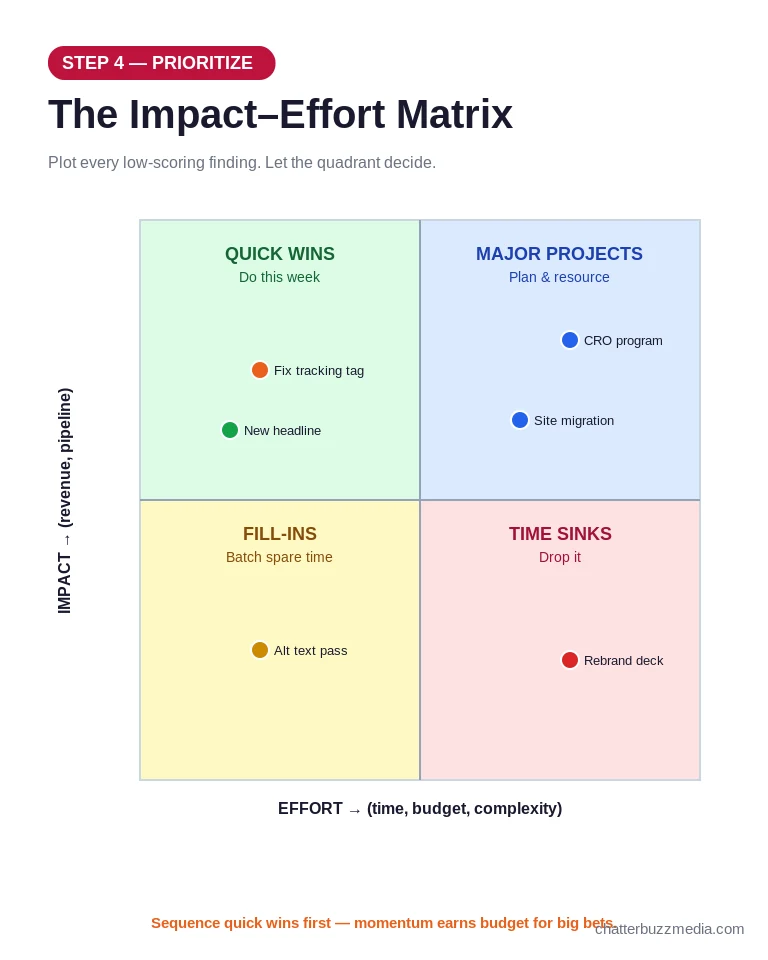
Plot every low-scoring finding on a 2×2 matrix. The vertical axis is impact on revenue or pipeline; the horizontal axis is effort in time, budget, and complexity. Four quadrants tell you exactly what to do with each item.
- Quick wins (high impact, low effort): Do these this week. Fixing a broken tracking tag or a weak headline costs little and pays fast.
- Major projects (high impact, high effort): Plan and resource these. A full CRO program or a site migration belongs here.
- Fill-ins (low impact, low effort): Batch these when you have spare time; don’t let them crowd out the quick wins.
- Time sinks (low impact, high effort): Deprioritize or drop them, no matter how interesting they seem.
This matrix is the antidote to the “everything is a priority” trap. It also gives leadership a defensible story for why budget is moving, which matters when you’re reallocating marketing spend across channels.
Sequence the work: quick wins first for momentum, then major projects on a roadmap. Fast, visible results buy you the credibility to tackle the harder bets.
Step 5: Turn Findings Into a Strategic Action Plan (and How Often to Re-Audit)
The audit isn’t done when the analysis ends; it’s done when the work is scheduled. A strategic action plan converts your prioritized findings into owned, dated tasks tied to a metric each one should move.
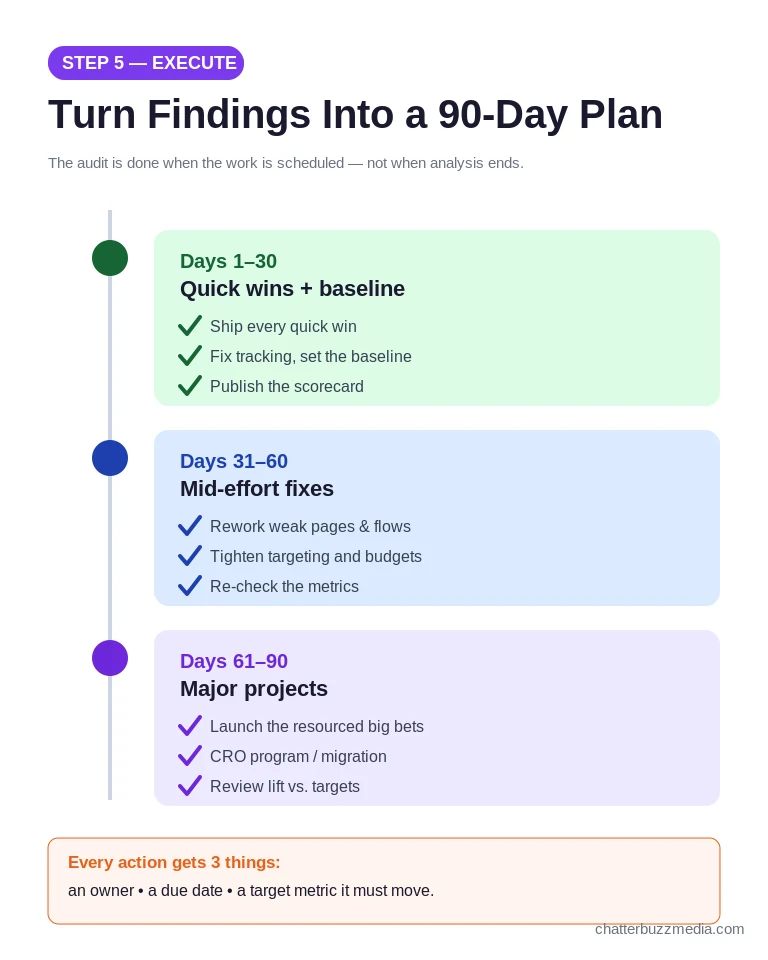
Structure the rollout in three horizons. The first 30 days are for quick wins and setting a baseline. Days 31 to 60 tackle mid-effort improvements, and days 61 to 90 launch the major projects you resourced in Step 4.
Give every action three things: an owner, a due date, and a target metric. “Improve SEO” is a wish; “Rewrite the top five service pages to lift organic conversions by 15% by March 1, owned by Priya” is a plan. That specificity is what separates a real growth roadmap from a to-do list.
Then present it well. Lead with three to five decisions, not forty observations, and put the full checklist in an appendix. Executives fund clarity, so pair each recommendation with the metric it moves and the reporting that will prove it worked.
On cadence: run a light channel-level audit each quarter and one comprehensive audit annually. With Gartner’s CMO Spend Survey showing budgets under constant pressure, a regular audit is how you defend every dollar. Markets, algorithms, and competitors shift fast, and a once-and-done audit goes stale within a year, especially as AI-driven search reshapes how buyers find you.
Frequently Asked Questions
1. 🔍 What is a marketing audit?
A marketing audit is a structured review of your marketing strategy, channels, content, data, and technology to find what’s working, what’s wasting budget, and what’s missing. Its purpose is to guide decisions about where to invest next, not just to document current activity.
2. 📊 What should a marketing audit checklist include?
A complete checklist covers brand and messaging, website and SEO, content, paid media, social media, email and automation, conversion and CRO, and analytics. For each area you capture current metrics, the trend over time, and a score against a benchmark or goal.
3. ⚡ How long does a marketing audit take?
A focused channel audit can take a few days, while a comprehensive audit of all channels typically runs one to three weeks depending on data access and team size. Tight scoping is the fastest way to shorten the timeline without losing rigor.
4. 🗓️ How often should you run a marketing audit?
Run a light, channel-specific audit each quarter and one deep, comprehensive audit annually. High-spend channels like paid media benefit from more frequent mini-audits so wasted budget is caught early.
5. 🤝 What’s the difference between an internal and external marketing audit?
An internal audit reviews factors you control, like your team, budget, systems, and channel performance. An external audit examines outside forces, like competitors, market trends, and customer perception, so you can benchmark and spot threats.
6. 💰 What tools do you need for a marketing audit?
At minimum you need web analytics, your ad platforms, a CRM, and your email or automation tool. A single shared spreadsheet to log findings and scores is often more valuable than any specialized software.
7. 🚀 How do you turn a marketing audit into action?
Score each finding, plot it on an impact–effort matrix, and convert the priorities into tasks with an owner, a due date, and a target metric. Sequence quick wins first, then schedule the high-effort projects on a 90-day roadmap.
8. 📈 How do you measure if the audit worked?
Compare the metrics you targeted before and after implementation, such as conversion rate, cost per acquisition, or qualified leads. A successful audit shows measurable movement on the specific KPIs each recommendation was meant to improve.
Conclusion: Make Your Next Audit Count
A marketing audit is only as good as the decisions it drives. The methodology above works because it forces prioritization and ends in an owned, dated plan, instead of a spreadsheet nobody opens again.
Here’s your four-step action plan to put it to work:
- Define three to five questions your audit must answer before you pull any data.
- Work the channel checklist and log every finding with its source in one shared sheet.
- Score and prioritize each finding on an impact–effort matrix to separate quick wins from time sinks.
- Build a 90-day plan where every action has an owner, a due date, and a metric it must move.
If you’d rather see where your gaps are before building the full plan, a free digital marketing audit is a fast way to pressure-test your channels. And when you’re ready to connect the findings to a broader plan, explore the marketing resource library for frameworks that turn an audit into sustained growth.
Need help with SEO? Explore our SEO agency services.

Victoria Wallace
Victoria Wallace is a senior content strategist and marketing writer with 30+ years of experience helping more than 200 brands translate complex business goals into clear, conversion-focused content. Her background spans paid media, marketing strategy, go-to-market planning, brand positioning, and full-funnel campaign development, giving her a deep understanding of how SEO content connects to real business growth.