
 321-236-2899
Marketing Plan Template: How to Build a Growth Roadmap by Revenue Stage
Most marketing plan templates ignore the one variable that determines whether your plan actually works: your revenue stage. This guide shows you how to build a marketing plan that matches your company’s size, resources, and growth phase — not a generic worksheet that treats a $2M startup the same as a $50M enterprise.
After building marketing plans for mid-market companies across manufacturing, financial services, SaaS, and professional services, one pattern keeps showing up. The plans that drive revenue match marketing strategy to growth stage, and companies that get this right see 2–3x better ROI on marketing spend than companies running a one-size-fits-all playbook.
You’ll learn a revenue-stage framework that maps exactly which channels, budgets, and KPIs to prioritize at each phase of growth. Start with what most templates get wrong, then work through a proven seven-step process for building your own plan.
Key Takeaways
- Revenue stage determines strategy. A marketing plan built for a $3M company will bankrupt or underperform at $50M, and vice versa.
- Budget benchmarks shift with maturity. Early-stage companies often invest 15–20% of revenue in marketing; mature companies typically spend 5–8%.
- Channel priorities evolve. Foundation-stage companies need focus; scale-stage companies need omnichannel coverage.
- Measurement matures alongside the business. Lead volume matters early; multi-touch attribution and LTV matter later.
- Generic templates fail because they skip the growth-stage variable entirely.
- A repeatable seven-step process — from mission to measurement — builds a plan you can actually execute.
What a Marketing Plan Actually Needs (and What Most Templates Get Wrong)
A marketing plan needs eight core components to function: objectives, target market, competitive analysis, channel mix, content strategy, budget, timeline, and KPIs. Most downloadable templates include all eight — and still fail, because they present them as static fields to fill in rather than decisions that shift with company size.
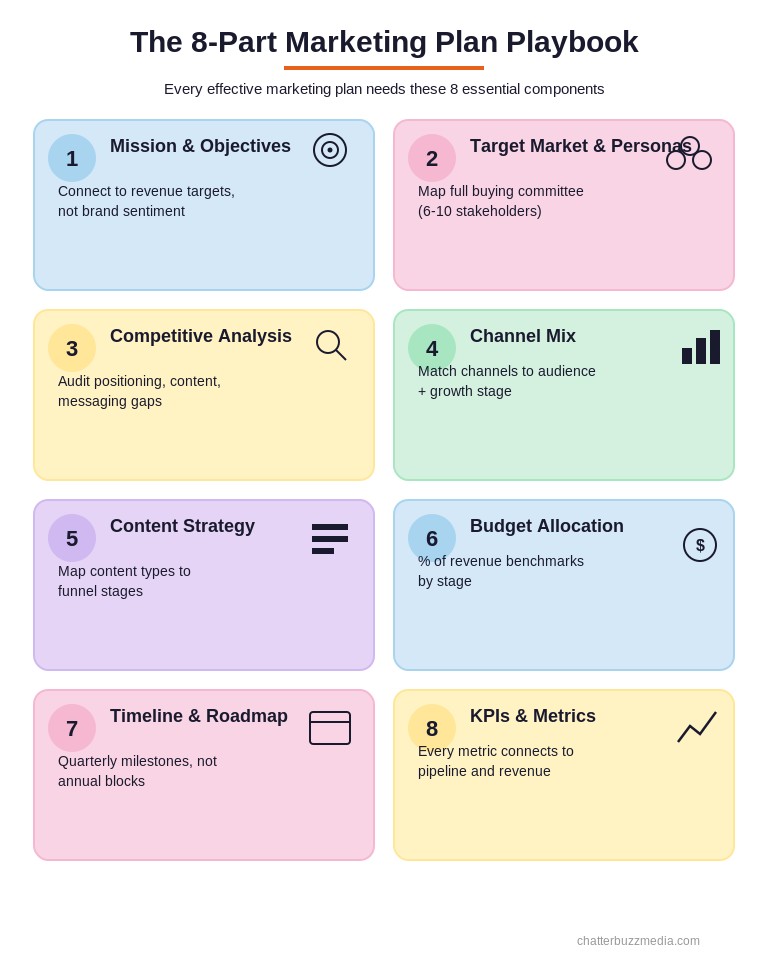
Here’s what each component actually needs to cover.
Mission and objectives. Your marketing mission statement should connect directly to revenue targets, not read like a mission statement from a values poster.
Target market and personas. B2B buying committees average six to ten stakeholders, so your personas need to reflect that complexity.
Competitive analysis. This means auditing competitor positioning and content, not just listing competitor names in a spreadsheet.
Marketing mix and channels. The channels you choose should match both your audience and how much budget and team capacity you actually have.
Content strategy. This maps content types to each stage of your funnel, from awareness through decision.
Budget allocation. Your budget should follow benchmarks tied to revenue and growth stage, not last year’s number plus 10%.
Timeline and roadmap. A useful roadmap breaks the year into quarters with clear milestones, not a single annual block.
KPIs and metrics. Every metric you track should connect to pipeline and revenue, not just activity.
Generic marketing strategy templates fail because they treat all eight components as fixed fields instead of variables that scale with your business. A $3M company and a $50M company both need “a competitive analysis,” but the depth, tools, and team executing it look completely different.
The fix isn’t a better template — it’s a better process. The next section walks through the seven steps that produce a plan tailored to where your company actually stands today.
How to Build a Marketing Plan in 7 Steps
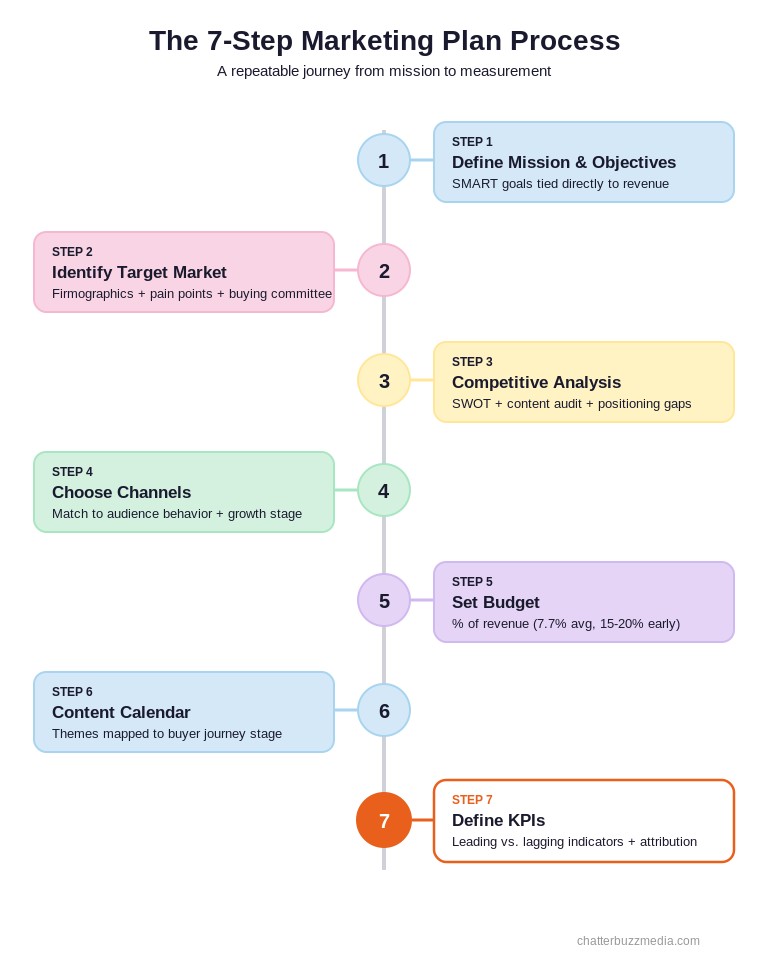
Building a marketing plan takes seven sequential steps: define objectives, identify your audience, analyze the competitive landscape, choose channels, set budget, build a content calendar, and define KPIs. Each step depends on the one before it, so skipping ahead to “pick channels” before you’ve nailed down objectives produces a plan built on guesswork.
Step 1 — Define Your Mission and Marketing Objectives
Start by writing marketing objectives as SMART goals: specific, measurable, achievable, relevant, and time-bound. “Increase brand awareness” isn’t an objective — it’s a wish.
A real objective looks like this: “Generate 150 marketing-qualified leads per month by Q4, driving $2.4M in new pipeline.” Every objective should trace back to a revenue number your CFO would recognize.
This is also where you write your marketing mission statement — one or two sentences describing what marketing exists to do for the business. Keep it tied to growth, not brand sentiment alone.
Step 2 — Identify Your Target Market and Build Buyer Personas
Define your target market using firmographics first: company size, industry, geography, and revenue range. Then layer in the pain points that make your solution relevant to that segment.
For B2B companies, map the full buying committee, not just one persona. Most complex B2B deals involve an economic buyer, a technical evaluator, and several influencers, and each one needs different messaging.
Document what triggers each persona to start looking for a solution like yours. That trigger event is often more useful for targeting than any demographic detail.
Step 3 — Run a Competitive and Market Analysis
Run a SWOT analysis — strengths, weaknesses, opportunities, threats — against your three to five closest competitors. Be honest about weaknesses; sugarcoating this step wastes the exercise.
Audit competitor content next: what topics they cover, what channels they invest in, and where their messaging gaps sit. Those gaps often become your best content opportunities.
Finally, map your positioning against the competitive set. If you can’t articulate why a prospect should choose you over the next three names on their shortlist, your plan isn’t ready yet.
Step 4 — Choose Your Marketing Channels and Tactics
Match channels to your audience’s actual behavior, not to what’s trending in marketing content this quarter. A manufacturing buyer researching capital equipment behaves nothing like a SaaS buyer evaluating software.
Then match channels to your growth stage. Early-stage companies need focus on one or two channels done well; later-stage companies can sustain a broader mix because they have the team and budget to run it properly.
This is where most plans go wrong — they list every possible channel instead of prioritizing the two or three that will move revenue this year. Our guide to B2B demand generation breaks down how to prioritize channels by buyer intent.
Step 5 — Set Your Marketing Budget
Set your marketing budget as a percentage of revenue, benchmarked against your growth stage and industry. Gartner’s 2025 CMO Spend Survey puts the average marketing budget at 7.7% of revenue — but that average hides massive variance by stage.
Early-stage companies fighting for market share often invest 15–20% of revenue in marketing. Mature companies optimizing for efficiency typically run at 5–8%.
Don’t set a budget in isolation from your revenue targets. Work backward from the pipeline you need to hit your number, then reverse-engineer the spend required to generate it.
Step 6 — Build Your Content Strategy and Campaign Calendar
Build your content calendar around themes that map to your buyer’s journey, not around a random mix of blog topics. Each piece of content should have a clear funnel stage: awareness, consideration, or decision.
Set a realistic publishing cadence based on your team’s actual capacity. A consistent two posts a month beats an ambitious plan for eight that dies in week three.
Vary your content types by funnel stage — top-of-funnel blog content and social posts, middle-of-funnel guides and webinars, bottom-of-funnel case studies and comparison pages. Our inbound marketing guide covers how to sequence content across the full funnel.
Step 7 — Define KPIs and Build Your Measurement Framework
Separate your KPIs into leading and lagging indicators. Leading indicators — traffic, engagement, MQLs — tell you if activity is happening; lagging indicators — revenue, CAC, LTV — tell you if that activity is working.
Choose an attribution model before your first campaign launches, not after your CFO asks where the pipeline came from. First-touch and multi-touch models each tell a different story, and you need to know which one you’re using.
Build a simple dashboard that ties every metric back to pipeline and revenue. Our guide to the best marketing KPIs to track walks through which metrics matter most at each funnel stage.
The Revenue Stage Framework — Why One-Size Marketing Plans Fail
One-size marketing plans fail because a $3M company and a $50M company need different budgets, teams, and channel mixes to grow efficiently. This framework breaks growth into three stages — Foundation, Growth, and Scale — and maps the marketing priorities that actually fit each one.
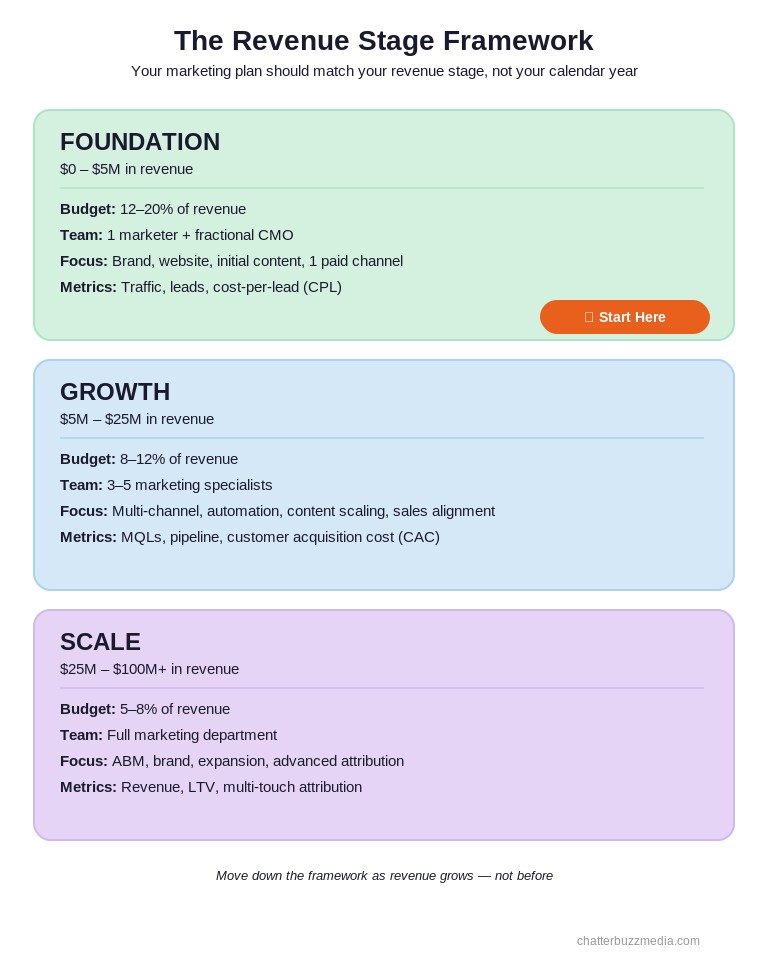
Use this section as the core of your annual marketing plan. Identify your stage first, then build every other decision — budget, channels, team, metrics — around it.
Stage 1 — Foundation ($0–$5M Revenue): Build the Engine
Foundation-stage companies need to build brand positioning, a functional website, and initial content before they scale spend on any channel. Trying to run five channels at once with no clear positioning just burns budget.
Marketing priorities: brand positioning, website foundation, initial content library, and one paid channel run well.
Budget: 12–20% of revenue, reflecting the higher relative cost of building infrastructure from zero.
Team: One in-house marketer paired with a fractional CMO or agency partner, since few Foundation-stage companies can justify a full internal team yet. Our guide to fractional CMO services covers when this model makes sense.
Key metrics: website traffic, lead volume, and cost per lead — simple indicators that show whether the engine is starting to run.
Stage 2 — Growth ($5M–$25M Revenue): Scale What Works
Growth-stage companies need to scale the channels that already prove out, layer in marketing automation, and align marketing closely with sales. This is the stage where a plan built on Foundation-stage assumptions starts collapsing under its own weight.
Marketing priorities: multi-channel expansion, marketing automation implementation, content scaling, and formal sales-marketing alignment.
Budget: 8–12% of revenue, lower than Foundation stage because existing channels are already generating returns.
Team: A three-to-five person marketing team with functional specialists — typically content, demand gen, and operations. See our guide to marketing automation for what to implement first.
Key metrics: MQLs, pipeline contribution, customer acquisition cost (CAC), and channel-level ROI — metrics that connect marketing activity directly to revenue.
Stage 3 — Scale ($25M–$100M+ Revenue): Optimize and Expand
Scale-stage companies need account-based marketing, brand investment, and advanced attribution to keep growing efficiently at size. At this stage, broad-reach tactics alone stop moving the needle — precision does.
Marketing priorities: account-based marketing (ABM), brand building, geographic or international expansion, and multi-touch attribution.
Budget: 5–8% of revenue, reflecting efficiency gains from scale and mature systems.
Team: A full marketing department with dedicated specialists across demand gen, brand, content, ABM, and marketing operations. Our account-based marketing guide covers how to launch ABM at this stage.
Key metrics: marketing-sourced and marketing-influenced revenue, customer lifetime value (LTV), and multi-touch attribution across the full buyer journey.
Marketing Budget Benchmarks That Actually Match Your Stage
Marketing budgets should range from 5% to 20% of revenue depending on growth stage, with most established companies landing between 7% and 10%. Gartner’s 2025 CMO Spend Survey found average marketing budgets sitting at 7.7% of revenue, while the Deloitte/Duke CMO Survey puts company-wide marketing spend closer to 9.4% of revenue.
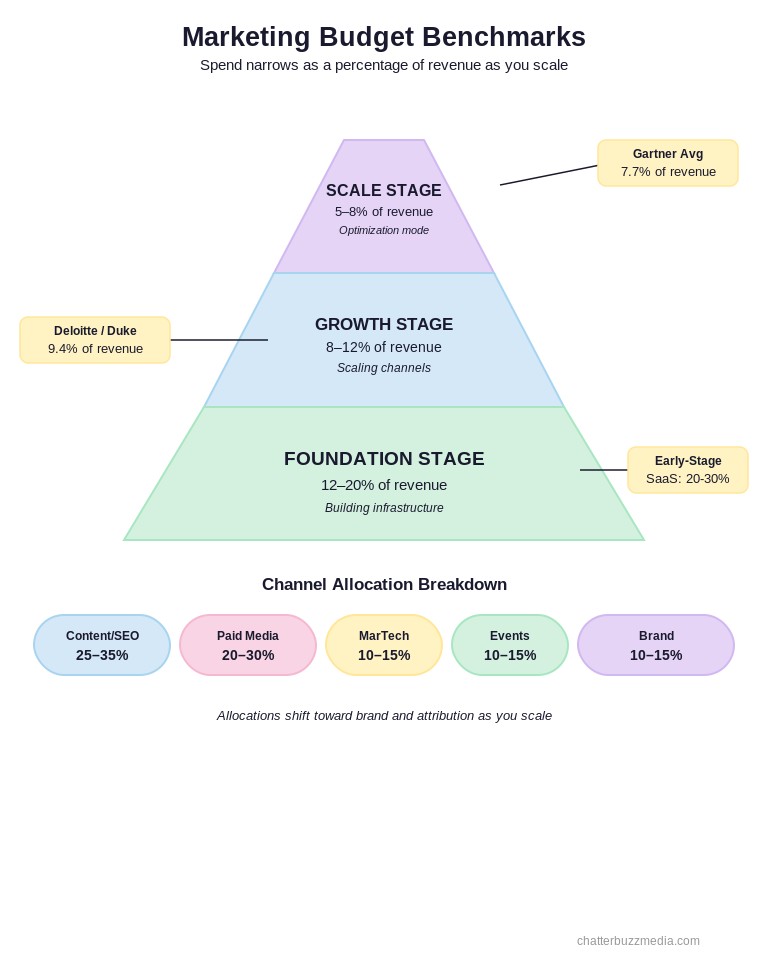
Those averages blend companies across every stage, which is exactly why they’re dangerous to apply directly. Early-stage SaaS companies fighting for initial market share often invest 20–30% of revenue in marketing.
Mature companies running in efficiency mode typically hold spend to 5–7%, prioritizing retention and expansion over acquisition. Match your number to your stage, not to the industry average.
Once you’ve set a total budget, allocate it across categories. A reasonable starting split looks like this:
- Content and SEO: 25–35% of total budget
- Paid media: 20–30% of total budget
- Marketing automation and martech: 10–15% of total budget
- Events and partnerships: 10–15% of total budget
- Brand and creative: 10–15% of total budget
Increase spend when a channel is proving ROI and you’re leaving pipeline on the table by not scaling it. Decrease spend when CAC is climbing faster than deal size, or when a channel has been flat for two consecutive quarters despite optimization attempts.
For a deeper breakdown of channel-specific budget allocation, see our marketing strategy and planning services page.
How to Choose the Right Channels for Your Stage
The right marketing channels depend on your growth stage more than your industry. Foundation-stage companies need focus on a handful of channels; Scale-stage companies can sustain a genuinely omnichannel presence.
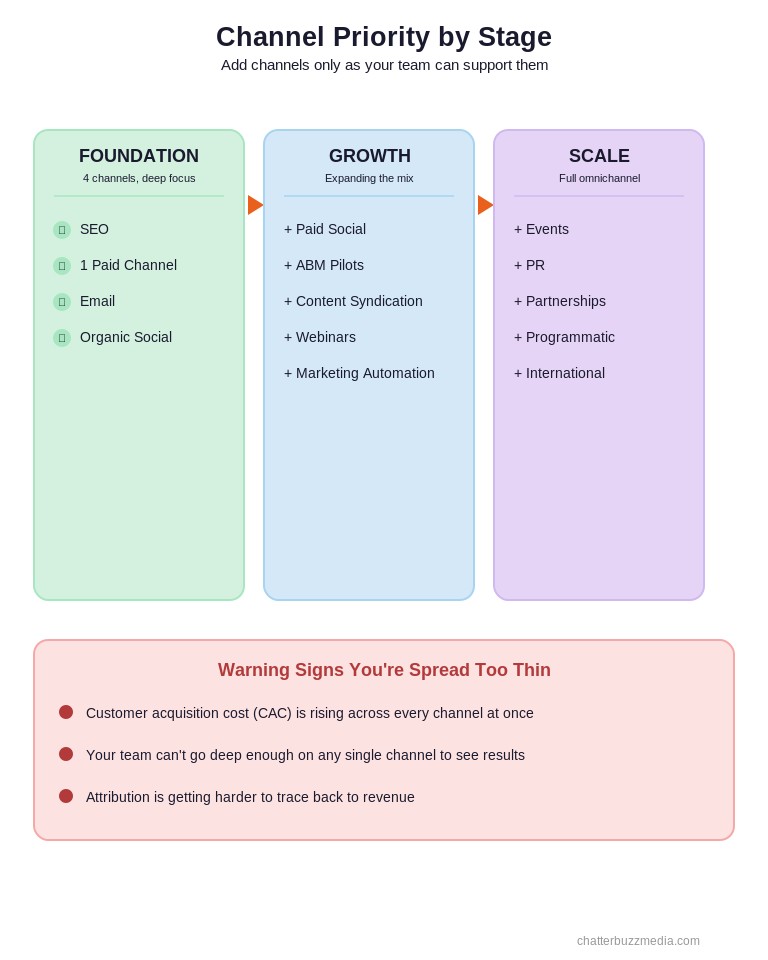
Foundation stage. Prioritize SEO, one paid channel run well, email marketing, and organic social. Trying to run six channels with a one-person team guarantees mediocre execution across all of them.
Growth stage. Add paid social, early ABM pilots, content syndication, and webinars once your Foundation channels are consistently producing pipeline. This is also when marketing automation becomes worth the investment. Our PPC management services page covers how to structure paid channels at this stage.
Scale stage. Expand into full omnichannel coverage — events, PR, partnerships, and programmatic advertising — layered on top of the channels already working. At this stage, coordination across channels matters as much as any single channel’s performance.
Use a simple channel priority matrix to decide what to add next: plot potential impact against effort required, and prioritize high-impact, lower-effort channels first. If your team can’t name which channel drove your last five closed deals, that’s a warning sign you’re spread too thin.
Other warning signs include: no single channel hits statistical significance for reporting, your team spends more time managing tools than running campaigns, and CAC is rising across the board instead of just one underperforming channel. Our social media advertising services page and local SEO services page both cover channel-specific execution details.
Common Marketing Plan Mistakes (and How to Fix Them)
The most common marketing plan mistakes involve copying generic templates, tracking vanity metrics, and building plans in isolation from sales. Each one is fixable once you know what to look for.
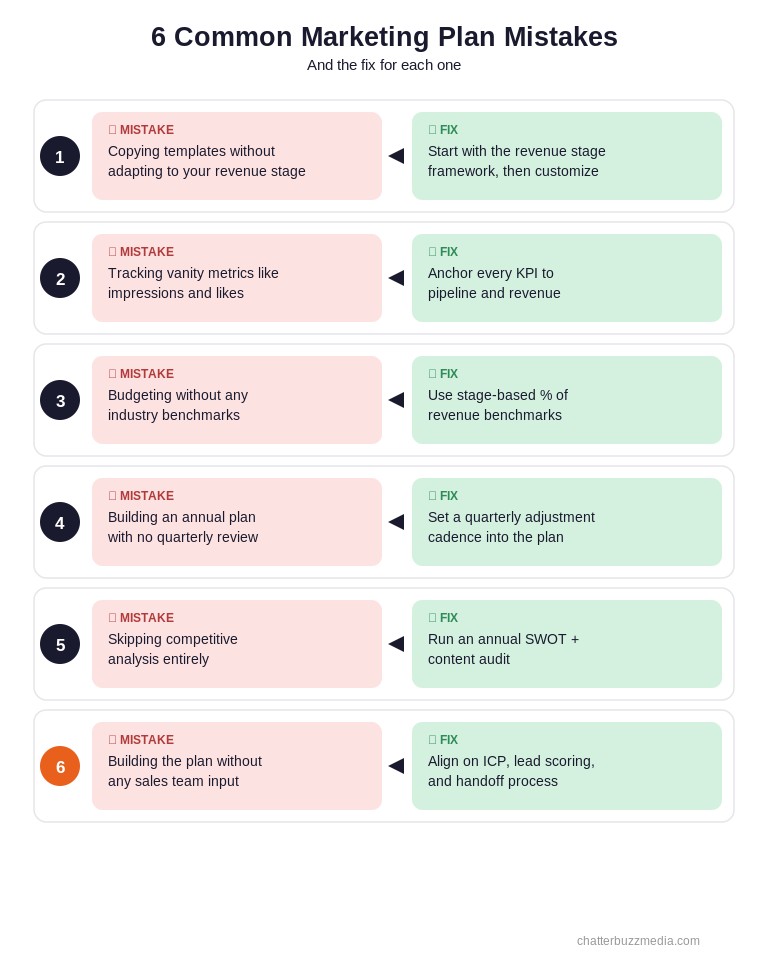
Mistake 1: Copying a template without adapting it to growth stage. A downloaded template with generic budget percentages and channel lists ignores everything unique about your company.
Fix: Start with the revenue-stage framework above, then customize every section to your actual stage and constraints.
Mistake 2: Setting vanity metrics instead of revenue-connected KPIs. Impressions and social followers feel good to report but rarely predict pipeline.
Fix: Anchor every KPI to a revenue outcome — pipeline generated, CAC, or LTV — even for top-of-funnel metrics like traffic.
Mistake 3: Budgeting without benchmarks. Setting a budget based on “what we spent last year plus 10%” ignores whether last year’s spend was even efficient.
Fix: Use the stage-based percentage-of-revenue benchmarks above as your starting point, then adjust based on channel performance.
Mistake 4: Planning annually without quarterly adjustment. Markets, competitors, and internal priorities shift faster than a single annual plan can account for.
Fix: Set the annual plan as a directional roadmap, then review and adjust tactics every quarter based on actual performance data.
Mistake 5: Skipping competitive analysis. Plans built without a clear view of competitor positioning tend to produce generic messaging that blends into the market.
Fix: Build the SWOT and content audit from Step 3 into your planning process every year, not just once at company founding.
Mistake 6: Building the plan in isolation from sales. Marketing plans built without sales input routinely generate leads that sales won’t work, because the definition of a “good lead” was never aligned.
Fix: Involve sales leadership in defining your ideal customer profile, lead scoring criteria, and MQL-to-SQL handoff process before the plan gets finalized. A marketing audit is a useful starting point if you suspect misalignment already exists.
How to Measure Your Marketing Plan’s Performance
Measure your marketing plan’s performance using a mix of leading indicators that predict future results and lagging indicators that confirm past results. Relying on only one type leaves you either flying blind on revenue impact or reacting too late to fix underperforming channels.
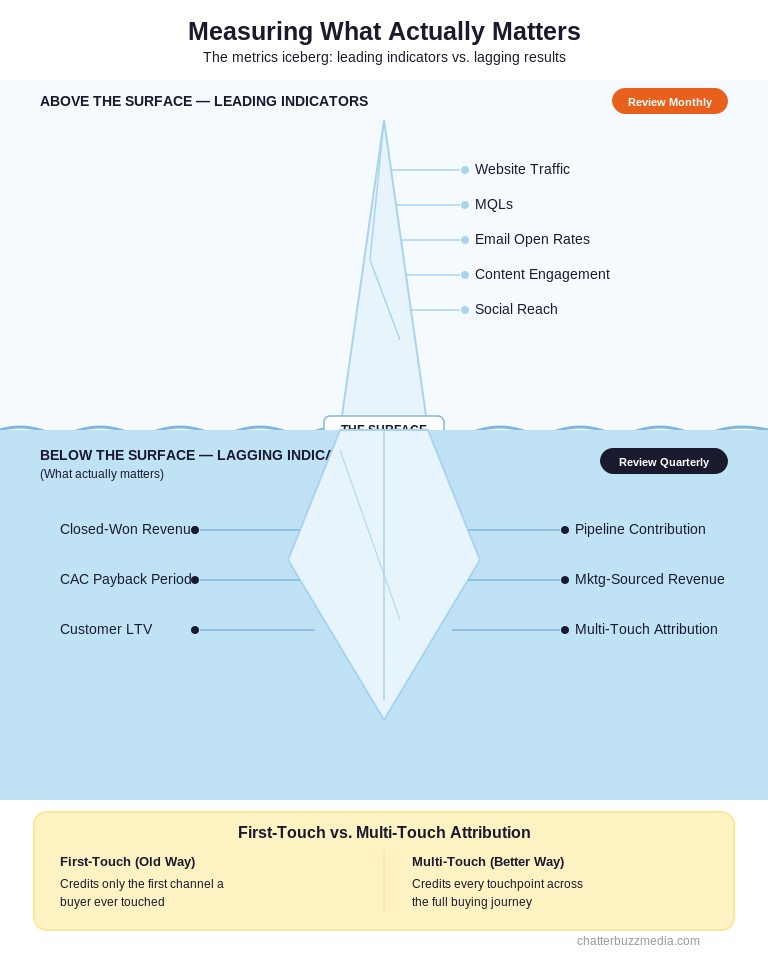
Leading indicators include website traffic, MQLs, content engagement, and email open rates. These metrics move first and give you an early read on whether a campaign is gaining traction.
Lagging indicators include closed-won revenue, CAC payback period, and customer lifetime value. These confirm whether your marketing investment actually paid off, but they arrive too late to course-correct in real time.
Review leading indicators monthly and lagging indicators quarterly. This cadence gives you enough data to spot trends without overreacting to a single slow week.
Know when to pivot versus stay the course: a channel underperforming for one month is noise, but a channel underperforming for two consecutive quarters despite optimization is a signal to reallocate budget. Our reporting and data visualization services page covers how to build dashboards that make this distinction clear.
On attribution: first-touch attribution credits the first interaction a prospect had with your brand, which is useful for measuring what drives initial awareness. Multi-touch attribution spreads credit across every touchpoint in the buyer’s journey, which is more accurate for complex B2B sales cycles involving multiple stakeholders and channels.
Neither model is perfect, but multi-touch attribution generally gives mid-market and enterprise companies a more honest picture of what’s actually driving pipeline. Tools like HubSpot make multi-touch attribution far more accessible than it used to be — our HubSpot training and implementation services page covers setup.
Frequently Asked Questions About Marketing Plan Templates
🔍 What is a marketing plan template?
A marketing plan template is a structured framework for documenting your marketing objectives, target audience, channels, budget, and KPIs. The best templates flex based on company size and growth stage rather than applying the same structure to every business.
📊 What should a marketing plan include?
A complete marketing plan should include mission and objectives, target market and buyer personas, competitive analysis, channel strategy, content plan, budget allocation, timeline, and KPIs. Each component should reflect your specific revenue stage rather than generic industry defaults.
⚡ How often should you update your marketing plan?
Update your marketing plan quarterly, even though the overall strategy is typically set annually. Quarterly reviews let you adjust tactics and budget allocation based on actual performance data without abandoning your longer-term direction.
🏦 What percentage of revenue should go to marketing?
Most established companies invest between 5% and 12% of revenue in marketing, with the overall average landing around 7.7% to 9.4% according to Gartner and Deloitte/Duke research. Early-stage companies often invest 15–20% or more, while mature companies in efficiency mode may spend as little as 5%.
🤝 What’s the difference between a marketing plan and a marketing strategy?
A marketing strategy defines the high-level direction — who you’re targeting, how you’re positioned, and why customers should choose you. A marketing plan translates that strategy into specific, executable tactics: channels, budget, timeline, and KPIs.
💰 How do you create a marketing budget from scratch?
Start by identifying your revenue stage and applying the corresponding percentage-of-revenue benchmark from this guide. Then allocate that total across categories — content, paid media, automation, events, and brand — based on which channels align with your audience and objectives.
🚀 Can a small business use the same marketing plan template as an enterprise?
No — a small business needs a plan built around focus and one or two channels done well, while an enterprise needs a plan built around omnichannel coverage and specialized team functions. Using an enterprise-scale template at Foundation-stage revenue spreads budget too thin to generate measurable results.
Conclusion: Building a Marketing Plan That Actually Fits Your Business
A marketing plan only works when it matches your company’s actual revenue stage, not a generic template’s assumptions. Use the eight core components, the seven-step process, and the Foundation-Growth-Scale framework in this guide to build a plan that fits where your business stands today.
Follow this four-step action plan to get started:
- Identify your revenue stage — Foundation, Growth, or Scale — using the framework above.
- Use the 7-step process to draft objectives, audience, competitive analysis, channels, budget, content, and KPIs.
- Set budget benchmarks that match your stage rather than an industry-wide average.
- Review quarterly and adjust tactics based on what the data actually shows.
Marketing plans built this way consistently outperform generic templates because every decision traces back to where the business actually stands. For a deeper dive into building a growth engine, explore our complete guide to go-to-market strategy.
You can also explore our go-to-market strategy by revenue stage breakdown, or browse our full library of marketing resources for more frameworks like this one.

Victoria Wallace
Victoria Wallace is a senior content strategist and marketing writer with 30+ years of experience helping more than 200 brands translate complex business goals into clear, conversion-focused content. Her background spans paid media, marketing strategy, go-to-market planning, brand positioning, and full-funnel campaign development, giving her a deep understanding of how SEO content connects to real business growth.