
 321-236-2899
GTM Strategy by Revenue Stage: What a $5M Company Needs vs a $50M Company
Most GTM strategy templates are built for two extremes — venture-backed startups launching their first product, or enterprise giants entering new markets. If you’re a mid-market company between $5M and $200M in revenue, those templates will steer you wrong.
Over the past decade, working with B2B companies across every growth stage, one pattern stands out: the companies that stall are almost always running the wrong stage’s playbook. A $12M company running enterprise ABM burns cash. A $45M company relying on the founder’s network caps its own growth.
This guide breaks down exactly how your GTM strategy template should change at four revenue stages — from team structure and budget allocation to channel selection and metrics. You’ll learn why the $10M–$25M stage is the most dangerous for underinvestment, and what specific shifts separate companies that scale from those that plateau.
Key Takeaways
- Your GTM strategy template must match your revenue stage — a $5M company needs a fundamentally different approach than a $50M company in team size, budget %, channels, and metrics.
- The $10M–$25M stage is the critical investment window — companies that underinvest in marketing here (below 8-10% of revenue) get stuck for years.
- Start with 2 channels, not 6 — master your first two acquisition channels before expanding, regardless of what your larger competitors are doing.
- Hire a fractional CMO before $15M, a full-time CMO after — the right leadership model depends on your stage, not your ambition.
- Stage transitions cause most GTM failures — build infrastructure for the next stage 6-12 months before you need it.
Why Generic GTM Templates Fail Mid-Market Companies
A go-to-market strategy template designed for a pre-revenue startup has almost nothing in common with what a $50M company needs. Yet most GTM frameworks treat every business the same — define your ICP, pick your channels, launch. That advice isn’t wrong. It’s just incomplete. And incomplete strategy is often worse than no strategy at all — because it creates false confidence. The real problem is stage mismatch. A $5M company running a $50M company’s ABM playbook will burn cash on tools and headcount it can’t support. A $50M company still relying on the founder’s LinkedIn network for pipeline has already outgrown its GTM engine. According to McKinsey’s research on market entry, four out of every five go-to-market attempts fail — and many of those failures trace back to misaligned strategy, not bad products. The complete guide to go-to-market strategy covers the foundational framework every company needs. This guide goes deeper — showing you exactly how that framework changes at each revenue stage. Revenue determines everything: your team structure, your channel mix, your budget allocation, and the metrics that actually matter. What follows is a step-by-step system for building a GTM strategy template that matches where your company is right now — and what it needs to reach the next stage.Step 1 — Map Your Company to the Right Revenue Stage
Before you build anything, you need to know which stage you’re operating in. Revenue alone doesn’t tell the full story — team maturity, sales cycle complexity, and customer acquisition patterns all factor in.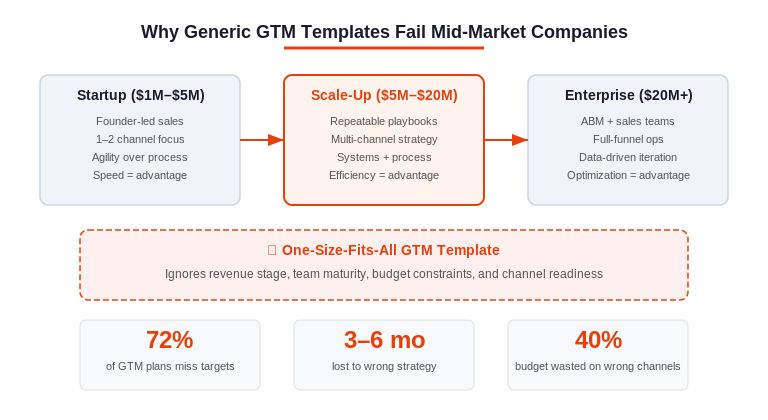
Stage 1: $5M–$10M (Founder-Led Growth)
Marketing is reactive. The founder closes most deals through relationships and referrals. There’s no dedicated marketing leader, and “strategy” usually means whatever campaign someone heard about at a conference. Key signal you’re here: More than 60% of new revenue comes from founder relationships or word-of-mouth. If the founder stopped selling for 90 days, pipeline would dry up.Stage 2: $10M–$25M (Building the Engine)
The company has outgrown founder-led sales but hasn’t yet built a repeatable demand generation system. Marketing exists but operates tactically — running campaigns without a unified strategy. Key signal you’re here: You have marketing staff but no clear attribution model connecting marketing spend to closed revenue. The CEO asks “what’s marketing doing?” and nobody has a confident answer backed by data.Stage 3: $25M–$50M (Scaling What Works)
Marketing has proven channels and a functioning pipeline. The challenge shifts from “figure out what works” to “scale it without breaking efficiency.” This is where marketing automation becomes essential, not optional. Key signal you’re here: You know your CAC and LTV by channel, but scaling spend causes diminishing returns.Stage 4: $50M+ (Portfolio GTM)
The company runs multiple products, verticals, or geographies — each potentially requiring its own GTM motion. Strategy shifts from a single playbook to a portfolio approach with shared infrastructure. Key signal you’re here: Different business units or product lines need fundamentally different sales and marketing approaches. Identify where you sit before reading further. The advice in each subsequent step is stage-specific, and applying the wrong stage’s playbook is exactly what causes GTM failure.Step 2 — Build the GTM Team Your Stage Demands
The right GTM team structure at $5M looks nothing like the right structure at $50M. Hiring too early wastes runway. Hiring too late creates bottlenecks that cap growth.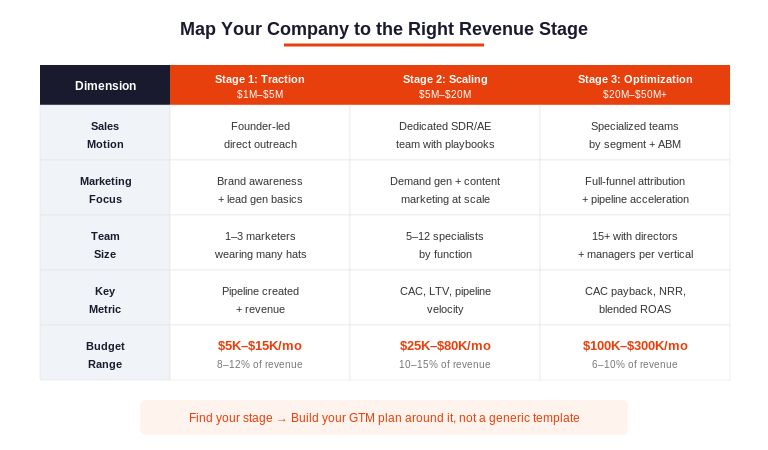
$5M–$10M: The Lean Core
- 1 marketing generalist who can run campaigns, manage the website, and write content
- 1 fractional CMO or agency partner for strategy — a fractional chief marketing officer costs 60-70% less than a full-time hire and brings enterprise-level thinking
- Founder involvement in sales positioning and key deal support
$10M–$25M: The Growth Team
- Marketing director or VP who owns the full funnel — not just top-of-funnel awareness
- Content marketing specialist focused on content that drives measurable ROI
- Demand gen or growth marketer running paid media and lead nurturing
- Sales development rep (SDR) bridging marketing and sales
$25M–$50M: The Specialized Squad
- VP of Marketing reporting to the CEO with budget authority
- Specialized roles: SEO lead, paid media manager, content strategist, marketing ops/analytics
- Revenue operations aligning marketing, sales, and customer success data in HubSpot or your CRM
- Agency partners for link building, creative production, or specialized verticals
$50M+: The Marketing Organization
- CMO with a seat at the executive table
- Functional teams: brand, demand gen, product marketing, content, events, marketing ops
- Dedicated analytics and reporting — no more “we think this channel works”
- Regional or vertical marketing managers tailoring the GTM motion to specific segments
Step 3 — Allocate Budget by Revenue Tier
Marketing budget as a percentage of revenue should increase as you grow from $5M to $25M, then stabilize. Most companies get this backwards — they underspend during the critical growth phase and overspend once they’ve plateaued.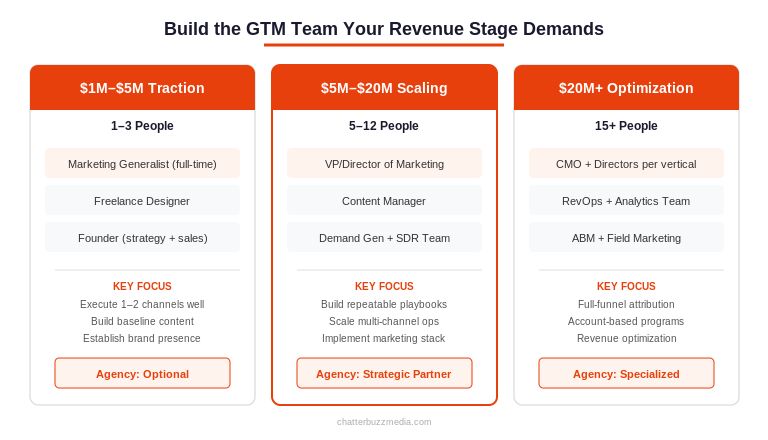
$5M–$10M: 6-8% of Revenue ($300K–$800K)
Invest heavily in inbound marketing foundations — website, SEO, basic content, and one paid channel. The goal is learning which channels produce pipeline, not scaling spend. Priority allocation:- 40% — Website and SEO foundation
- 30% — One paid acquisition channel (Google Ads or LinkedIn)
- 20% — Content creation
- 10% — Tools and technology
$10M–$25M: 8-12% of Revenue ($800K–$3M)
This is the investment stage. You’ve identified what works — now fund it aggressively. Companies that underinvest here stall between $15M and $20M because they can’t generate enough pipeline to support growth. Priority allocation:- 30% — Paid acquisition across 2-3 proven channels
- 25% — Content and SEO
- 20% — Marketing technology stack
- 15% — Events and partnerships
- 10% — Brand and creative
$25M–$50M: 8-10% of Revenue ($2M–$5M)
Budget stabilizes as a percentage, but the absolute dollars allow for account-based marketing and multi-touch attribution. Conversion rate optimization becomes critical — improving conversion by even 1% at this scale moves millions. Priority allocation:- 25% — Paid acquisition (diversified)
- 20% — ABM and enterprise programs
- 20% — Content, SEO, and thought leadership
- 15% — Marketing ops and technology
- 10% — Events and field marketing
- 10% — Brand and creative
$50M+: 7-10% of Revenue ($3.5M–$10M+)
Budget shifts toward brand building, customer expansion, and market defense. New customer acquisition still matters, but upsell and cross-sell GTM motions often deliver 3-5x better ROI than net-new acquisition. The smartest companies at this stage invest as heavily in keeping and growing existing customers as they do in finding new ones. Priority allocation:- 20% — Brand and positioning
- 20% — Paid and performance marketing
- 20% — ABM and enterprise sales support
- 15% — Product marketing and enablement
- 15% — Marketing ops, analytics, and AI
- 10% — Events and community
Step 4 — Select Channels That Match Your Maturity
Channel selection isn’t about what’s trending — it’s about what your stage can actually execute well. A $7M company running a 6-channel strategy will do all of them poorly. A $40M company running only Google Ads is leaving pipeline on the table.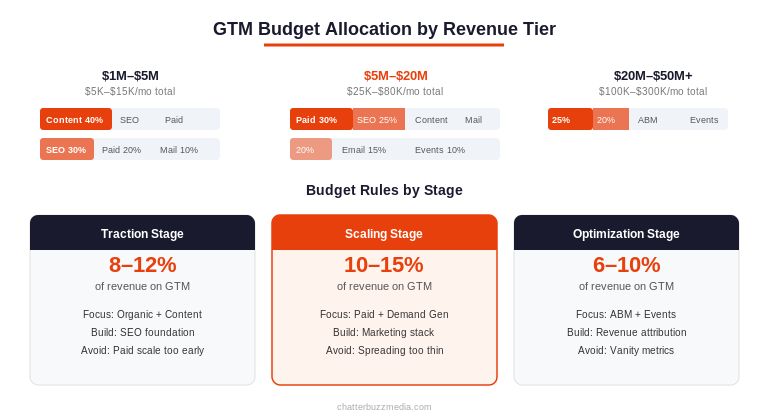
$5M–$10M: Master 2 Channels
Pick one inbound and one outbound channel. Execute them relentlessly before adding anything else.- Inbound: SEO + content marketing or LinkedIn organic
- Outbound: Cold email/LinkedIn outreach or PPC advertising
- Supporting: Website optimized for conversion with clear brand messaging
$10M–$25M: Expand to 4-5 Channels
Add channels only after your first two are producing predictable pipeline. Each new channel should pass the “can we staff it properly?” test before you commit budget. A common trap at this stage is adding channels because a board member or advisor suggested them, not because the data supports it.- Core channels from Stage 1 (optimized and scaled)
- Social media advertising (Meta, LinkedIn, or both)
- Email marketing and automated nurture sequences
- Content partnerships and guest thought leadership
- Retargeting across platforms
$25M–$50M: Layer in ABM and Events
At this stage, you need both volume channels (SEO, PPC) and precision channels (ABM, events) running simultaneously.- Account-based marketing targeting named accounts
- Industry events and speaking engagements
- Strategic partnerships and co-marketing
- Customer marketing (case studies, referral programs, community)
- PR and analyst relations
$50M+: Full Omnichannel + Category Creation
The goal shifts from capturing existing demand to creating new demand and owning a category position.- Brand campaigns across digital and traditional channels
- Owned media properties (podcast, community, research)
- Product-led growth motions alongside sales-led
- Regional and vertical-specific channel strategies
- Customer expansion programs
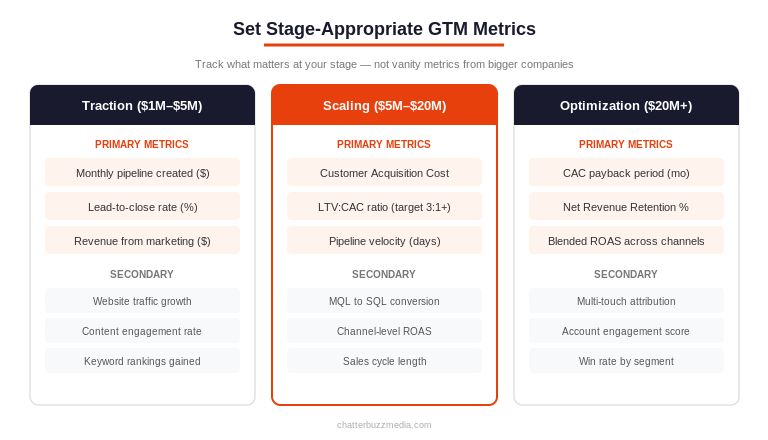
Step 5 — Set Stage-Appropriate GTM Metrics
The metrics that matter at $5M will mislead you at $50M. Every revenue stage has a different “north star” metric — and tracking the wrong one causes teams to optimize for the wrong outcomes.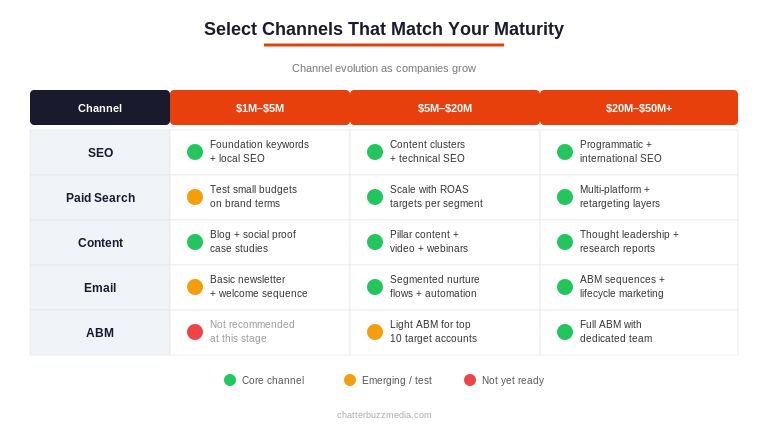
$5M–$10M: Revenue Per Channel
You’re still learning. Track which channels produce actual closed revenue — not just leads, not just MQLs, not just traffic. Every dollar matters, so you need to know exactly where revenue comes from. At this stage, vanity metrics like website traffic and social media followers are distractions — they create the illusion of progress without moving revenue. Key metrics:- Revenue attributed to each marketing channel
- Customer acquisition cost (CAC) by source
- Sales cycle length
- Website-to-lead conversion rate
$10M–$25M: Pipeline Coverage Ratio
You should have 3-4x pipeline coverage at this stage — meaning your active pipeline is 3-4 times your revenue target for the quarter. If coverage drops below 3x, marketing needs to generate more qualified opportunities. Key metrics:- Pipeline coverage ratio (3-4x target)
- Marketing-sourced pipeline percentage (target: 40-60%)
- Lead-to-opportunity conversion rate
- Marketing KPIs by funnel stage
$25M–$50M: CAC Payback Period
Efficiency becomes the focus. Your CAC payback period — how many months until a customer’s gross margin repays the cost of acquiring them — should be under 18 months for healthy B2B growth. If your payback period exceeds 24 months, you’re likely either targeting the wrong customers or spending on channels with poor unit economics. Key metrics:- CAC payback period by segment
- LTV:CAC ratio (target: 3:1 or better)
- Multi-touch attribution by channel
- Net revenue retention rate
$50M+: Market Share and Expansion Revenue
At scale, absolute growth slows unless you expand into new segments or markets. Track market share within your ICP, customer expansion revenue (upsell, cross-sell), and brand metrics. According to Bain & Company research, increasing customer retention rates by just 5% can increase profits by 25-95% — making expansion revenue the most efficient growth lever at this stage. Key metrics:- Market share within target segments
- Net revenue retention (target: 110%+)
- Customer expansion revenue as % of total
- Brand awareness and share of voice
The 5 GTM Mistakes That Stall Growth Between Stages
Most companies don’t fail within a stage. They fail during the transition between stages — when last year’s playbook stops working and the team hasn’t built the next one yet.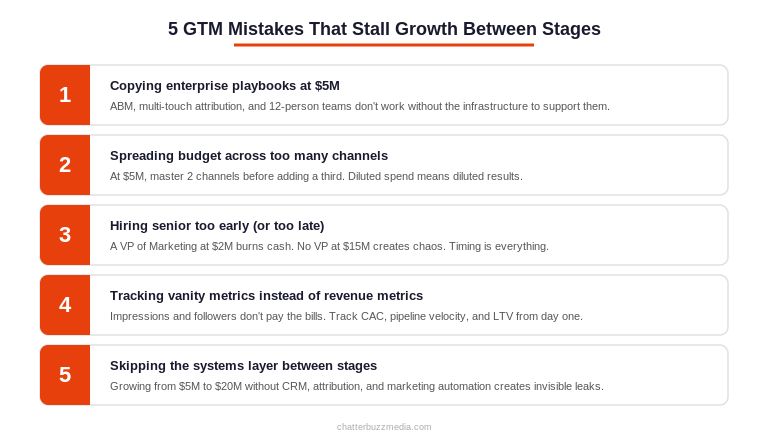
1. Hiring a Full Marketing Team Before You Have Product-Market Fit
Companies at $5M sometimes hire a VP of Marketing, a content team, and a paid media manager all at once. Without clear positioning and a proven channel, that team will spend six months figuring out what a fractional leader could validate in six weeks. The smarter move is to bring in fractional CMO services to establish the strategy first, then hire the team to execute it.2. Refusing to Invest in Marketing at $10M–$20M
This is the most dangerous stage. Revenue growth from founder-led sales has plateaued, but the CEO hesitates to invest 10-12% of revenue in marketing because “we’ve never spent that much.” According to Forrester’s B2B marketing research, companies that underinvest in marketing during their growth phase are 2.5x more likely to miss revenue targets. Companies that underinvest here get stuck at $15M for years.3. Running the Same Playbook Across All Segments
At $25M+, you likely serve multiple buyer personas, industries, or company sizes. Running a single demand generation playbook across all segments means your messaging resonates with none of them deeply.4. Ignoring Brand at $50M+
Performance marketing delivers diminishing returns at scale. Companies that never invest in brand — positioning, thought leadership, category narratives — find themselves competing purely on features and price. That’s a losing game. According to the LinkedIn B2B Institute, B2B brands that invest in long-term brand building alongside demand generation achieve 2x higher growth rates than those focused solely on performance marketing.5. Skipping the Infrastructure Between Stages
Moving from Stage 2 to Stage 3 requires more than bigger budgets. You need attribution modeling, marketing automation, CRM hygiene, and lead scoring. Companies that scale spend without scaling infrastructure waste 30-40% of their marketing budget on leads that never convert — not because the leads are bad, but because nobody can track, score, or route them properly. The fix for all five mistakes is the same: match your GTM investment and structure to your current revenue stage — not where you want to be, not where you were last year.Frequently Asked Questions
1. 🔍 What is a go-to-market strategy template?
A GTM strategy template is a structured framework that outlines how a company will reach its target customers, differentiate from competitors, and generate revenue. It typically includes your ideal customer profile, value proposition, channel strategy, budget allocation, team structure, and success metrics. The best templates are customized by company stage — a $5M company’s template looks fundamentally different from a $50M company’s template.2. 📊 How much should a mid-market company spend on marketing?
B2B companies between $10M and $50M in revenue typically invest 8-12% of revenue in marketing, according to Gartner’s CMO Spend Survey. Companies in the $10M–$25M growth stage should be at the higher end (10-12%) because this is the critical investment window. Underspending at this stage is the single most common reason mid-market companies plateau.3. ⚡ When should a company hire a CMO vs. use a fractional CMO?
Companies under $15M in revenue almost always benefit more from a fractional CMO than a full-time hire. A fractional leader brings strategy experience from multiple companies at 60-70% less cost. Once your marketing budget exceeds $2M annually and you have a team of 5+ marketers, a full-time CMO makes sense.4. 🏦 What’s the biggest GTM difference between a $5M and $50M company?
At $5M, the GTM motion is founder-led with 1-2 proven channels. At $50M, it’s a multi-motion portfolio with specialized teams, dedicated budgets per segment, and brand investment alongside demand generation. The transition requires fundamentally different team structures, technology stacks, and metrics at each stage.5. 🤝 How do you know when your GTM strategy needs to change?
Three signals indicate your GTM has outgrown its current stage: your customer acquisition cost is rising faster than revenue, your pipeline coverage ratio has dropped below 3x for two consecutive quarters, or more than 50% of revenue still comes from founder relationships above $10M. Any one of these means your GTM strategy needs restructuring.6. 💰 What channels should a $10M–$25M company prioritize?
Focus on 4-5 channels maximum: your two proven channels from the previous stage (scaled up), social media advertising, email marketing with automated nurture sequences, and content partnerships. Don’t add ABM or events until you’ve reached $20M+ and have the team to support them.7. 🚀 What is the most common reason mid-market GTM strategies fail?
Stage mismatch. Companies either run a startup playbook at $25M (under-resourced, founder-dependent) or try to execute enterprise-level marketing at $8M (overstaffed, overspent, no focus). The fix is aligning your team, budget, channels, and metrics to your current revenue stage — not your aspiration.8. 📈 How do you transition from founder-led sales to a marketing-driven GTM?
Start by documenting every conversation the founder has with prospects — the questions asked, objections raised, and language used. Build your brand messaging from those conversations. Then hire one demand gen marketer to test paid and content channels while the founder still closes deals. Gradually shift pipeline creation from the founder’s network to repeatable marketing systems over 6-12 months.Conclusion
Your GTM strategy template isn’t something you build once and run forever. It’s a living system that must evolve every time your revenue stage changes — from founder-led hustle at $5M to a portfolio marketing organization at $50M and beyond. The companies that scale efficiently through each stage share one trait: they match their GTM investment to their current reality, not their ambitions. They build for the stage they’re in while preparing the infrastructure for the next one. Your 4-step action plan:- Identify your revenue stage using the signals outlined in Step 1 — be honest about where you are, not where you want to be.
- Audit your current GTM structure against the team, budget, and channel recommendations for your stage.
- Close the gaps — if you’re underinvesting in marketing, understaffed, or running the wrong metrics, fix those first.
- Plan the next transition — build the infrastructure for your next revenue stage 6-12 months before you need it.
Need help with SEO? Explore our SEO agency services.

Victoria Wallace
Victoria Wallace is a senior content strategist and marketing writer with 30+ years of experience helping more than 200 brands translate complex business goals into clear, conversion-focused content. Her background spans paid media, marketing strategy, go-to-market planning, brand positioning, and full-funnel campaign development, giving her a deep understanding of how SEO content connects to real business growth.