
 321-236-2899
SEO vs AEO: Why Traditional SEO Alone Won’t Cut It in 2026
For twenty years, the goal of search was simple: rank on page one and win the click. That playbook is quietly breaking.
Buyers now open ChatGPT, Perplexity, and Google AI Overviews before they ever scroll a list of blue links. The question is no longer just “where do I rank” but “does the answer engine even mention me.”
This guide breaks down SEO vs AEO the way a strategist would: what each actually optimizes for, the real gap between organic traffic and AI citation traffic, and how to split effort so you win both. You will leave with a defensible 2026 budget model and a decision framework you can apply this week.
Key Takeaways
- SEO gets you ranked. AEO gets you cited. One wins a link on a results page; the other wins a sentence inside an AI-generated answer.
- AEO is a layer on top of SEO, not a replacement. The technical foundation (crawlable HTML, schema, topical authority) is shared.
- The difference is the unit of victory. SEO rewards the page; AEO rewards the paragraph a model can quote.
- Measurement splits hard. SEO tracks rank and clicks; AEO tracks mentions, citations, and share of voice with no referrer.
- A defensible 2026 split is roughly 70% SEO / 30% AEO, rebalanced quarterly as your category’s AI-answer share grows.
- Most teams are still optimizing for 2019 Google and losing visibility they can’t even see in analytics.
SEO vs AEO: What’s Actually Different in 2026
The core difference is simple: SEO optimizes a page to rank in a list of search results, while AEO optimizes a page to be cited inside an AI-generated answer. SEO wins a blue link on Google or Bing; AEO wins a quoted sentence or source card inside ChatGPT, Perplexity, Gemini, Claude, or Google AI Overviews.
Both disciplines share a lot of ground. Crawlable HTML, clean information architecture, schema markup, and genuine topical authority still matter to both.
What changes is the surface, the reader, and how success is measured. SEO writes for a human who clicks; AEO writes for a model that summarizes.
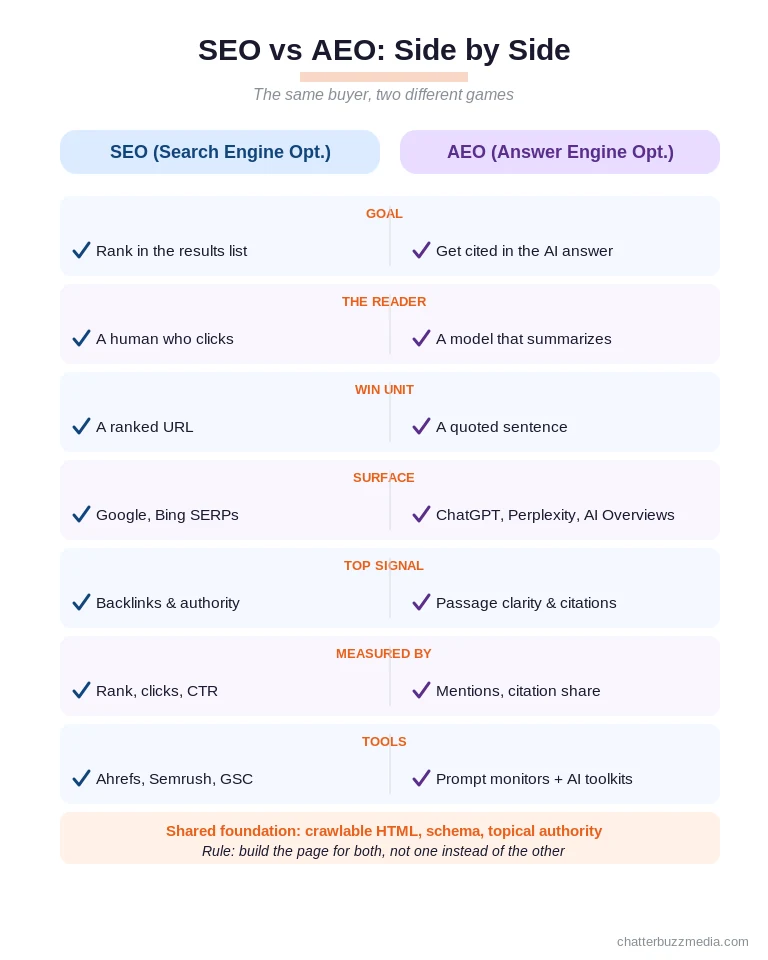
Here is the fastest way to hold the two apart:
- SEO target: rank inside the ten blue links on a search engine results page.
- AEO target: get cited, quoted, or recommended inside an AI answer.
- Shared foundation: crawlable HTML, clean structure, schema, and depth.
- Different reader: SEO writes for a clicker; AEO writes for a summarizer.
- Different metric: SEO counts rank and clicks; AEO counts mentions and citations.
The naming gets muddy, and that trips people up. AEO, GEO (Generative Engine Optimization), and “AI SEO” describe the same core shift toward being the source an AI trusts.
If you want the deep mechanics of getting cited, our complete guide to answer engine optimization covers the workflow in detail. This post stays focused on the choice between the two disciplines and how they fit together.
Why does the distinction matter enough to reorganize around? Because the behavior underneath it already changed, even if your reporting hasn’t caught up.
A decade ago, a buyer with a question typed it into Google and clicked a result. Today that same buyer might ask ChatGPT, get a synthesized answer with three cited sources, and never visit a results page at all.
If you are not one of those three cited sources, you were effectively invisible for that query — no matter how well you rank. That is the shift SEO alone cannot address.
Organic Clicks vs AI Citations: What the Data Shows
The uncomfortable truth: traditional search still drives most trackable traffic, but the share flowing through AI answers is climbing fast — and that share is nearly invisible in standard analytics. This is exactly where teams misread their own performance.
Most organic traffic you can measure today still comes from classic search. That is why cutting SEO to fund AEO is premature for almost every business.
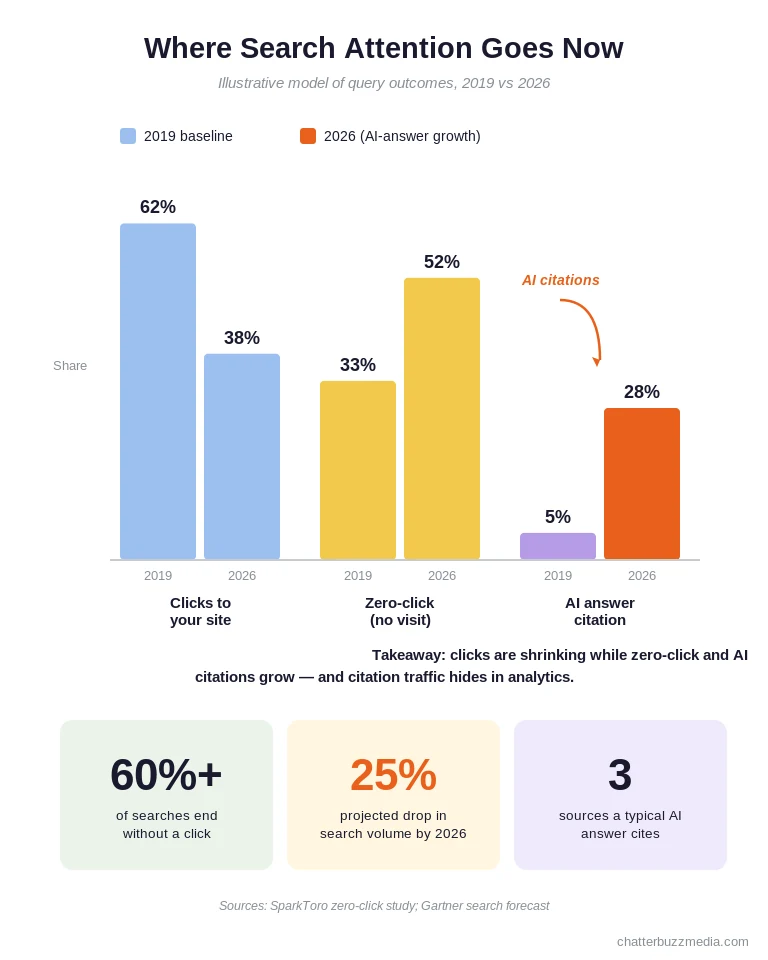
But the ground is moving. Independent research from SparkToro found that the majority of Google searches now end without a click to the open web.
Gartner went further, predicting traditional search volume will drop 25% by 2026 as buyers shift queries into AI assistants. When a buyer gets their answer inside ChatGPT, no click ever reaches your site.
The practical consequences are worth stating plainly:
- Zero-click is now the norm. Your impressions can grow while your clicks flatten — a signal AEO is eating a slice of demand.
- AI citations rarely pass a referrer. A buyer who reads about you in Perplexity, then searches your brand, shows up as “direct” traffic.
- Brand-name search is the new tell. Rising branded search alongside flat non-branded is often AEO working quietly upstream.
If your reporting only tracks rankings and clicks, you are grading a game that changed its rules. Understanding how organic and direct traffic actually behave is now a prerequisite for reading AEO’s impact.
What Each Channel Actually Rewards
SEO rewards a ranked page based on relevance, links, and user behavior. AEO rewards a passage that a language model finds clear, trustworthy, and safe to quote. A page can rank number one and still be skipped by an answer engine if its best sentence is buried or hedged.
This matters because the two channels pull from different sources of truth. Google and Bing rank from their own live index, refreshed on a crawl cycle.
Answer engines pull from three overlapping pools: model training data, a real-time retrieval layer, and a partner search index. That means an old page can rank for years yet stay invisible to a new answer engine that never retrieves it.
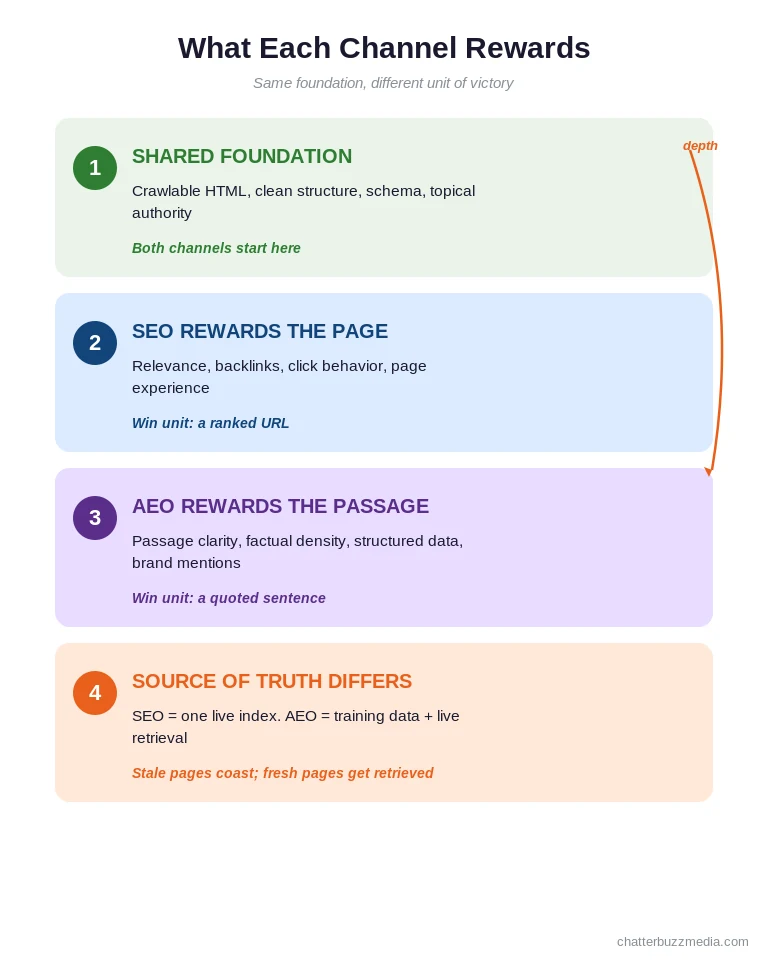
Break it into the signals that move each channel:
- SEO signals: relevance, backlinks, topical authority, click behavior, and page experience.
- AEO signals: passage clarity, source authority, factual density, structured data, and brand mentions across the web.
- SEO reward unit: a ranked URL.
- AEO reward unit: a quoted sentence with a citation.
The overlap is real and worth protecting. Both channels reward original data, named experts, and clean HTML that a crawler can parse without friction.
The divergence is where teams win or lose. AEO discounts thin listicles and rewards direct, self-contained answers, which is why a strong technical SEO foundation is table stakes rather than a differentiator now. Get the plumbing right, then compete on quotability.
Retrieval mechanics are the part most teams overlook. Some engines lean on what the model learned in training, which lags reality by months; others fetch live results at query time.
The practical takeaway is that fresh, well-structured pages get pulled into live retrieval, while stale pages coast on training data that may no longer reflect your positioning. Publishing cadence and clarity now influence AI visibility the way backlinks once influenced rank.
There is also a trust dimension. Answer engines lean on sources they already consider authoritative — established publications, well-cited pages, and brands mentioned consistently across the web.
That makes off-page reputation an AEO asset, not just an SEO one. The more places a model sees your name attached to credible information, the more likely it is to trust and quote you.
How to Measure SEO vs AEO
SEO measurement is mature and click-based; AEO measurement is newer, mention-based, and usually sampled rather than complete. You cannot fully measure AEO with a traditional analytics stack because answer engines rarely tell you they sent someone.
For SEO, the metrics are well understood. You track keyword rank, impressions, clicks, and click-through rate in Google Search Console.
AEO asks a different question entirely: for the prompts a real buyer would type, does the answer engine mention your brand, cite your page, or recommend your product?
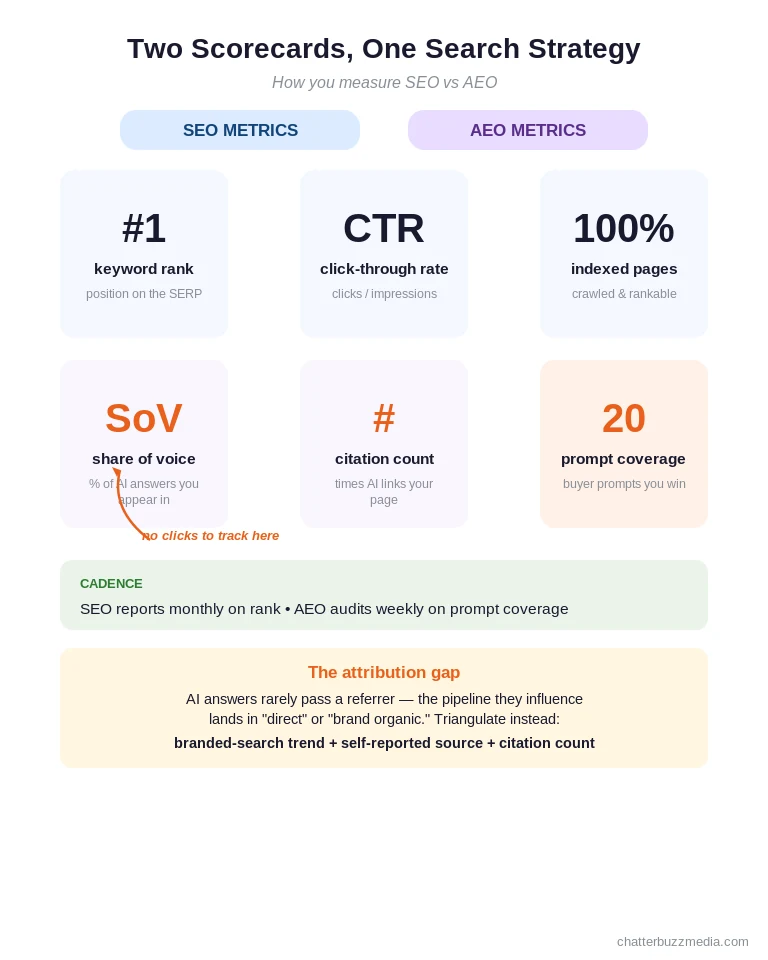
The two scorecards look almost nothing alike:
- SEO metrics: keyword rank, impressions, clicks, CTR, and indexed pages.
- AEO metrics: citation count, share of voice in AI answers, prompt coverage, and sentiment of the mention.
- SEO cadence: monthly rank and traffic reporting.
- AEO cadence: weekly prompt audits, because AI answers shift faster than rankings.
The tooling follows the same split. Your classic stack of rank trackers and crawlers stays; you simply add a prompt-monitoring layer that runs a fixed set of buyer questions on a schedule and logs every mention.
Start scrappy if you need to. A weekly spreadsheet where you manually run your top 20 buyer prompts through ChatGPT and Perplexity beats waiting for a perfect platform. Pair it with a realistic view of how long organic momentum takes to build, and you’ll set expectations your leadership can trust.
The attribution gap is the hardest part to explain to a CFO. Because AI answers rarely pass a referrer, the pipeline they influence often lands in “direct” or “organic brand” buckets.
The workaround is triangulation, not a single number. Watch branded search trends, self-reported “how did you hear about us” data, and citation counts together, and the AEO signal becomes visible even without a clean referrer.
Content That Ranks AND Gets Cited
The good news: one well-built page can win on both channels if every section opens with a direct, self-contained answer and then expands. You do not need two content teams pulling in opposite directions.
Long, well-linked pages still win in SEO. Answer engines want that same depth but read it differently — they lift the first clean sentence under each heading and prefer parallel, bulleted specifics.
The editorial rule that satisfies both is answer-first structure. Lead with the answer, support it with evidence, then go deep.
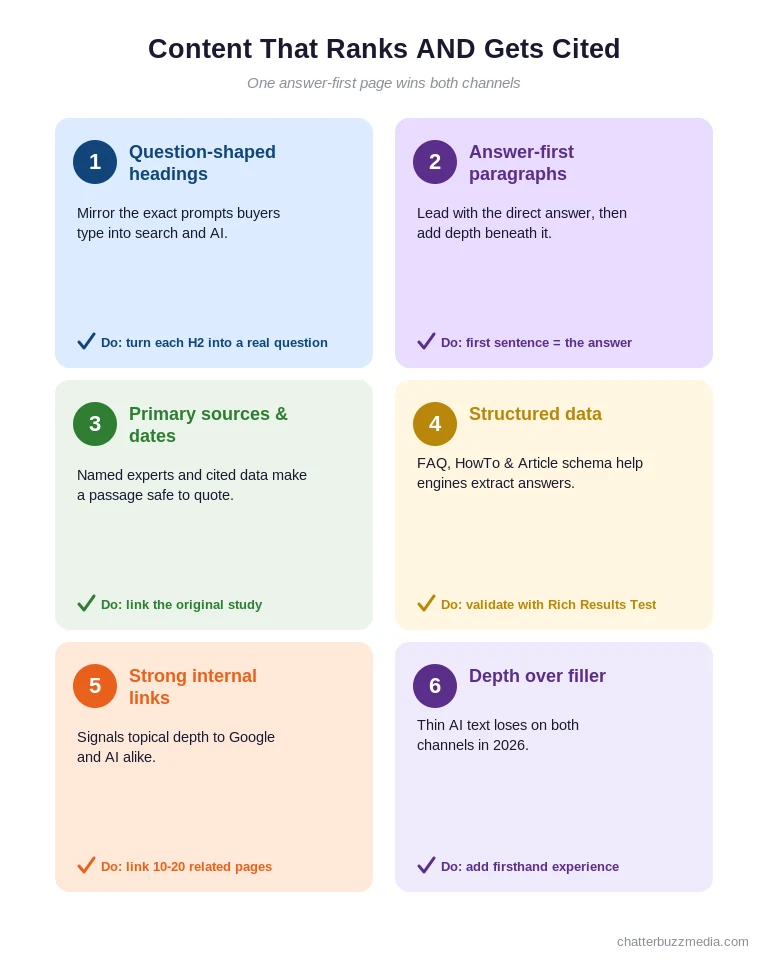
Here is the dual-channel content playbook:
- 1. Shape headings as questions. Mirror the real prompts buyers type, then answer them in the first sentence below.
- 2. Lead with the answer. Give the direct response up front, then add context, nuance, and depth beneath it.
- 3. Add primary sources and dates. Named experts, original data, and citations make a passage safe for a model to quote.
- 4. Use structured data. FAQ, HowTo, and Article schema help engines extract and attribute your answers.
- 5. Keep a strong internal link graph. It still gates SEO and helps engines understand your topical depth.
Thin, AI-generated filler now loses on both channels, so depth and firsthand experience matter more than ever. This is the same discipline behind a durable SEO content strategy that drives revenue rather than vanity traffic.
The through-line is buyer intent. When you map content to the buyer journey, you naturally produce the answer-first passages both Google and AI reward. Getting cited by optimizing for featured snippets is often the on-ramp to getting cited by AI, too.
The 2026 Playbook: How to Split Budget and Priorities
Keep doing SEO, but carve out a real, protected slice for AEO — and grow it as your category’s AI-answer share grows. A defensible starting point for most B2B and consumer sites is roughly 70% SEO and 30% AEO, rebalanced every quarter.
The split is not one-size-fits-all. Where your buyers already research inside ChatGPT and Perplexity, push AEO faster.
Where transactional and local intent dominate, SEO still does the heavy lifting. The right mix depends on where your specific buyers actually search.
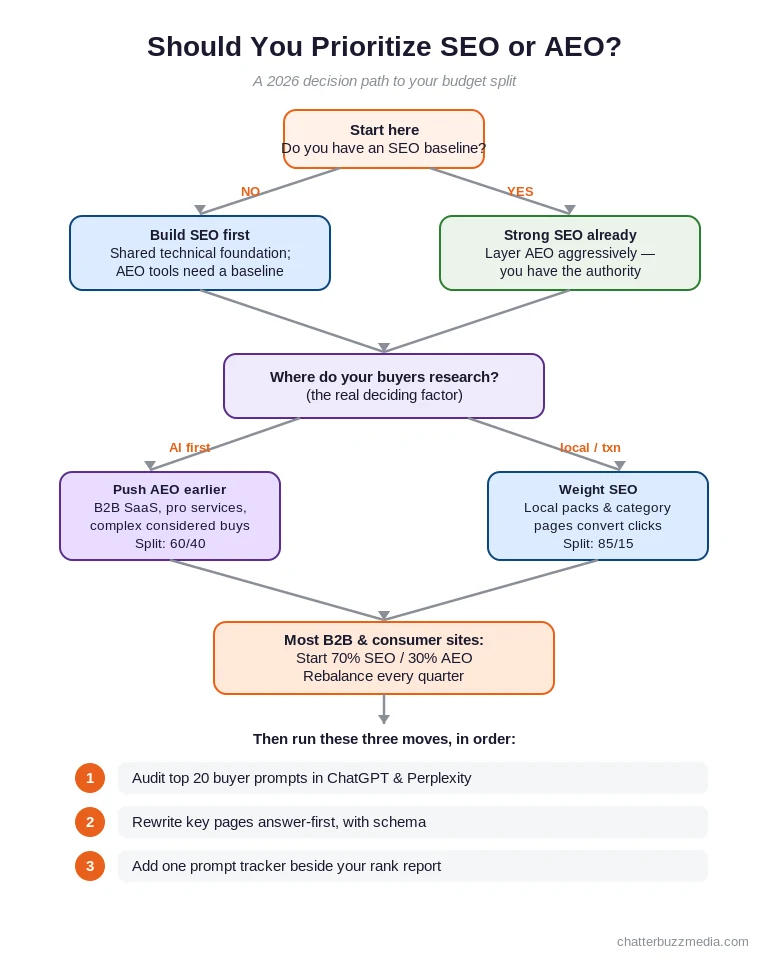
Use this decision path to set your priority:
- No SEO baseline yet? Start with SEO. The technical foundation is shared, and AEO tools measure a moving target you can’t yet influence.
- Buyers research in AI first? Push AEO earlier — common for B2B SaaS, professional services, and complex, considered purchases.
- Local or transactional demand? Weight SEO — local packs and category pages still convert clicks directly.
- Strong SEO already? Layer AEO aggressively; you have the authority engines look for.
Then run the same three moves in order, regardless of your split. Audit your top 20 buyer prompts inside ChatGPT and Perplexity, rewrite your top existing pages with answer-first passages and schema, and add one prompt tracker so citation counts sit beside rank counts.
A quick example of rebalancing in practice: a B2B software brand might start the year at 70/30 and discover, mid-year, that a third of its demo requests cite ChatGPT as the discovery point. That is the signal to move toward 60/40 and staff an AEO editor who owns prompt coverage.
A local services business, by contrast, may sit at 85/15 all year because its buyers still search “near me” and click a map result. Neither is wrong — the split simply follows the buyer.
This is where an integrated approach pays off. AEO, SEO, paid media, and AI woven across your marketing should reinforce one another, not compete for the same shrinking pool of clicks. The agencies winning in 2026 treat search as one system, a theme running through the 2026 digital marketing trends reshaping the channel.
The Costliest Mistake: Still Optimizing for 2019 Google
The biggest risk in 2026 is not choosing AEO over SEO — it’s running a 2019 SEO playbook and assuming the results still mean what they used to. Most teams are optimizing for a search experience that no longer dominates.
These are the patterns that quietly cost visibility. Each one feels productive while the ground shifts underneath it.
- 1. Grading success on rankings alone. You can hold position one and still lose the answer to an AI summary above you.
- 2. Writing suspense-first intros. Burying the answer three paragraphs down makes your passage unquotable to a model.
- 3. Ignoring branded and direct traffic. That’s often where AEO’s impact hides when there’s no referrer to credit.
- 4. Treating schema as optional. Structured data is now a citation signal, not just a rich-result nicety.
- 5. Chasing volume over authority. Thin content ranks poorly and gets cited never; depth and modern SEO best practices win both.
- 6. Measuring content by clicks only. Tie it to pipeline instead — see how to measure content marketing ROI.
The contrarian truth is that most agencies are still selling a 2019 product. They report ranking wins on a dashboard while their client’s actual buyers get answers from an AI that never mentions the brand.
None of this means SEO is dead. It means the definition of “working” expanded, and the teams still measuring the old way can’t see the gap forming.
The fix is not exotic. Strong fundamentals — a clean technical base, genuine expertise, and answer-first writing rooted in real inbound marketing — carry you further in both channels than any single tactic.
Frequently Asked Questions: SEO vs AEO
1. 🔍 Is AEO replacing SEO?
No. AEO is a new layer that sits on top of SEO, not a replacement for it. Most trackable organic traffic still comes from classic search, and the technical foundation — crawlability, schema, topical authority — is shared by both.
2. 📊 What is the difference between SEO and AEO?
SEO optimizes a page to rank in a list of search results and win a click. AEO optimizes a page to be cited or quoted inside an AI-generated answer. In short: SEO gets you ranked, AEO gets you cited.
3. ⚡ Can the same page rank in Google and get cited by AI?
Yes, and it should. A page that opens each section with a direct answer, cites primary sources, uses schema, and has a strong internal link graph can rank on Google and get quoted by ChatGPT at the same time.
4. 🏦 How do you measure AEO if there’s no click?
You measure AEO by prompt coverage and citation share rather than clicks. Prompt-monitoring tools run a fixed set of buyer questions through ChatGPT, Perplexity, Gemini, and Google AI Overviews on a schedule and log how often your brand is mentioned or linked.
5. 🤝 What is the difference between AEO and GEO?
AEO and GEO overlap heavily and are often used interchangeably. Generative Engine Optimization (GEO) usually refers to generative surfaces specifically, while AEO covers any answer surface, including featured snippets and voice results. For most teams, the tactics are the same.
6. 💰 How should I split my budget between SEO and AEO?
A defensible starting point for most sites is roughly 70% SEO and 30% AEO, rebalanced quarterly. Push AEO earlier in categories where buyers already research inside AI tools, and weight SEO more heavily for local and transactional demand.
7. 🚀 Should a brand-new site prioritize AEO over SEO?
No. Teams with no SEO baseline should start with SEO because the technical foundation is the same and AEO tools measure a target you can’t yet influence. Build authority and crawlability first, then layer AEO on top.
8. 📈 Do I need separate tools for AEO if I already use Ahrefs or Semrush?
Not necessarily. Major SEO suites now include AI share-of-voice modules that cover many teams’ needs. Dedicated prompt-monitoring platforms add depth if AI answers are a major channel for your buyers.
Conclusion: Build for Both, Measure for Both
The SEO vs AEO debate is the wrong frame. In 2026 both channels feed the same buyer, and the winners run one integrated system instead of two competing ones.
SEO still drives the majority of measurable traffic, so it stays the foundation. AEO is the layer that protects your visibility as buyers move their questions into AI — and the teams that ignore it won’t see the loss until it’s steep.
Here’s your four-step action plan to start this quarter:
- 1. Audit your top 20 buyer prompts in ChatGPT and Perplexity, and note where you’re cited and where you’re absent.
- 2. Rewrite your highest-value pages with answer-first passages, primary sources, and schema so they win both channels.
- 3. Add one AEO tracker so weekly citation counts sit next to your monthly rank reports.
- 4. Rebalance quarterly, shifting budget toward AEO as your category’s AI-answer share grows.
Search isn’t dying — it’s fragmenting across more surfaces than ever. The question is whether your strategy is built for where buyers search now, or where they searched five years ago.
Ready to see where you stand in both channels? Start with a free digital marketing audit, or explore more playbooks in our marketing resource library.
Need help with SEO? Explore our SEO agency services.

Victoria Wallace
Victoria Wallace is a senior content strategist and marketing writer with 30+ years of experience helping more than 200 brands translate complex business goals into clear, conversion-focused content. Her background spans paid media, marketing strategy, go-to-market planning, brand positioning, and full-funnel campaign development, giving her a deep understanding of how SEO content connects to real business growth.